Who’s World Order??
By Matthew Ehret for the Saker Blog | November 16, 2020
In his Foreign Policy article of April 2020, Biden states that he will reverse Trump’s embarrassing foreign policy record by standing up to both China, Russia and other totalitarian nations which represent the three-fold plague of “authoritarianism, nationalism and illiberalism” and “once more have America lead the world”.
Biden went further promising to undo the harm Trump has done to NATO by re-enforcing the military body, extending its influence to the Pacific (which sounds a lot like the Esper/Pompeo doctrine for the Pacific), and even demanded that NATO go harder on Russia stating that “the Kremlin fears a strong NATO, the most effective political military alliance in modern history.”
Considering Biden’s nearly 45 year political record supporting every military intervention in American history, opposing de-segregation, eulogizing pro-KKK Senator Strom Thurmond, passing bills that incarcerated petty drug dealers for life on behalf of the cheap labor prison industrial complex and supported the rampant growth of both Wall Street, Big Pharma and the Big Tech run surveillance state, we should think twice before celebrating this man’s possible entry into the halls of the highest office in the USA.
Biden’s call for renewing the NATO alliance in opposition to Russia and China, his support for reversing Trump’s calls for military reduction in the Middle East and his support for extending NATO in the Pacific mixed with his lifelong track record, forces us to ask if Glen Greenwald was right when he quit the Intercept on November 1 saying:
“If Biden wins, that’s going to be the power structure: A democratic party fully united with neocons, Bush/Cheney operatives, CIA/FBI/NSA Wall Street and Silicon Valley: presenting itself as the only protection against fascism. And much of the left will continue marching behind it.”
As it turns out, Greenwald’s warning was absolutely on point, as the entire intelligence apparatus, Big Tech and mainstream media complex which worked desperately to oust President Trump for 4 years and is currently running a vast voting fraud operation as this is written has given its full backing to the narrative of “an inevitable Biden presidency”.
In a Nov. 11 article from Antiwar.com entitled Biden’s Pentagon Transition Team Members Funded by the Arms Industry, journalist Dave DeCamp demonstrates that of the 23 members of Biden’s Pentagon Transition Team, over one third are directly tied to NATO and the Military Industrial Complex.
As facts continue to emerge of the corrupt deep state structure which totally dominates the geriatric hologram known as Joe Biden, it has become obvious that even the few positive remarks Biden made in support of renewing the START treaty with Russia carry little weight.
Ignoring the very real danger of a new civil war due to the fact that either result will be denied its legitimacy by half of the nation, the question must be asked: If Trump is replaced by a Biden Presidency on January 20th, then what will be the effects both on world stability and US-Russia-China relations?
It is good that Biden supports START’s renewal, but an increasing majority of nations are opting for a multipolar alliance premised on the defense of national sovereignty, the right to use protectionism, and the construction of large scale megaprojects such as the New Silk Road, Polar Silk Road, advanced space exploration and North South Transportation Corridor.
The very protectionist measures which allowed the USA (and every nation of the world for that matter) to build up their industrial base and economic sovereignty are attacked directly by Biden who demands the “taking down of trade barriers and resisting dangerous global slide toward protectionism” (which he goes so far as to assert without evidence “caused the great depression” and “lead to World War II”).
Attacking Trump for being soft on China’s imperial Belt and Road Initiative which Biden states is only an “outsourcer of pollution to other countries by financing billions of dollars worth of dirty fossil fuel energy projects”, Biden then asks: “who writes the rules that govern trade?” and answers: “the United States, not China, should be leading that effort.”
Beyond carbon reduction plans, and information technology investments (AI, 5G, Quantum Computing), there is very little in Biden’s “development outlook” that brings the USA into harmony with this multipolar consensus. His program to support cutting America’s carbon emissions to net zero by 2050 as outlined by the Green New Deal and Great Reset crowd at Davos might appear on the surface to be pro-infrastructure, professing to “create 10 million good new jobs”, but the reality on further inspection is very different.
The sorts of large scale BRI-oriented development projects now transforming more than half of the world which is increasingly operating under a completely different non-US dominated banking paradigm, are based on capital intensive heavy industry, the use of fossil fuels and also nuclear power.
Without these energy sources, then the New Silk Road and its’ sister projects could never work (much like Modi’s anti-BRI OSOWOG doppelganger has proven a total failure both scientifically and economically).
The sort of “green energy revolution” which the Davos technocrats running Biden want to impose onto the world might create short term jobs, but once the solar panels and windmills are built, the quality of energy available to nations stupid enough to walk into this cage will forever suffocate their capacity to sustain their populations and growth potential. In short, it is a green mirage obscuring a very ugly design.
In opposition to this depopulation agenda, Trump’s tendency support for space exploration, reviving protectionism to rebuild America’s lost manufacturing and his supporting large scale infrastructure programs in resolving conflict abroad (including his support for building rail in the Arctic, rail in Serbia and Kosovo, nuclear power in South Africa and Poland etc) is certainly synergistic with the multipolar system led by Russia and China and undeniably brings the USA into harmony with its own better traditions.
Additionally, Trump’s defunding of color revolutionary “civil society” groups in Hong Kong and Belarus won him many enemies from both sides of the pro-Soros isle while supporting the concept of national sovereignty which were major steps towards stability and trust-building with nations of the world who demand their sovereignty be respected as outlined in the UN Charter itself.
Compare this with Biden’s statement that we must “stand with Russian civil society which has bravely stood up time and again against President Vladimir Putin’s kleptocratic authoritarian system” and Biden’s call to host “a global summit for democracy” featuring “civil society organizations from around the world that stand on the frontlines of democracy” including “the private sector, technology companies and social media giants.”
These are the same “Big tech, and media giants” that have given their full backing to the imposition of Biden into the Presidency which have also been used to overthrow nationally elected governments in color revolutionary regime change operations for decades. These are the same networks that have suppressed all evidence of systemic vote fraud in the American elections of 2020 and are stoking the fires of a potential new civil war and regime change inside the republic itself.
Whatever the case may be, the coming weeks and months will feature fierce battles that will shape the outcome of world history.
Joe Biden is no empty sheet, may well return US to warmaking – former OSCE vice-president
RT | November 8, 2020
There’s a ‘good chance’ that the US will return to the policy of foreign wars under Joe Biden, which will make its reconciliation with the EU impossible, Willy Wimmer, former vice-president of the OSCE, warned.
The main reasons why the Americans voted for Donald Trump four years ago were their tiredness of constant wars waged by their country and collapsing economy and infrastructure in the US, Wimmer told RT.
Trump has kept his promise and didn’t start any new foreign conflict, but that may well change if a member of the Democratic Party is in the White House, former Vice President of the Organization for Security and Co-operation in Europe (OSCE) Parliamentary Assembly said.
“Joe Biden isn’t an empty white sheet – he represents the Democratic Party, who in the 1990s destroyed the Charter of the UN.”
The German political veteran recalled the US-led NATO bombing of Yugoslavia under Democratic President, Bill Clinton, in 1999. He also pointed out that “in the presidency of [Barack] Obama, Biden was Vice President and he was in absolute accordance with Obama’s drone wars and the wars in the Middle East, therefore there’s a good chance that Joe Biden continues in the same way as the Democratic Party did it in the 1990s and under Obama” before 2016.
“And going back to before 2016 means going back to war” for the US, Wimmer argued.
Relations between Washington and Brussels have deteriorated under Trump over his demands for the EU nations to make larger financial contributions to NATO as well as political and economic pressure on the block to stop dealing with Russia and China.
Hopes that things would improve under Biden will be dashed, “as long as the US and NATO don’t return to the Charter of the UN,” the 77-year-old, who also served as State Secretary to Germany’s Defense Minister, said.
However, he pointed out that it remains a question if the current US economy, which was heavily hit by the coronavirus, would even allow Biden to return to the aggressive policy, which the Democrats used to pursue.
Unlike German Chancellor, Angela Merkel, who already congratulated Biden over beating incumbent Trump in the US presidential election, Wimmer believes that others “should be very-very careful with congratulations.”
The Democratic candidate declared himself the winner on Saturday after several major television networks projected that he was on a path to take more than 270 electoral votes needed to win the presidency after four days of tense vote counts in several battleground states.
“It’s quite unusual… that the result of an election is announced by a news agency or a news channel. We’re used… in all our countries, which belong to the OSCE, that we have Election Committees, who announce results. And this hasn’t been done yet in the US,” he pointed out, describing the events surrounding the American election as “unbelievable.”
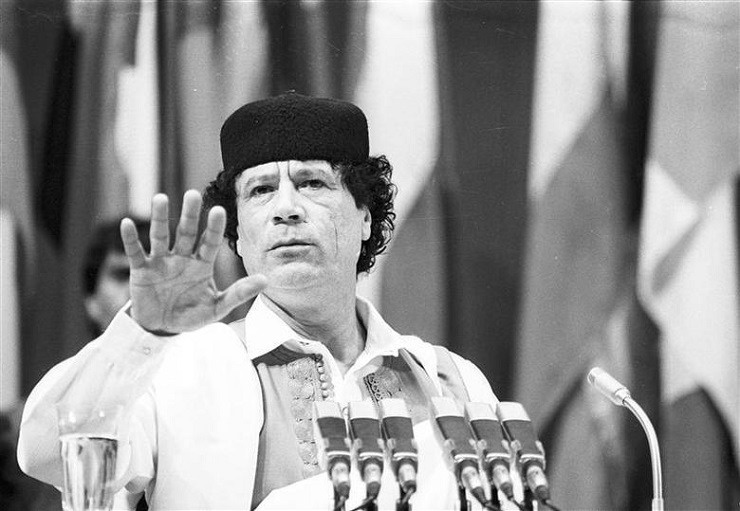
The Anniversary of Gaddafi’s Death and the Current Reality in Libya
By Yuriy Zinin – New Eastern Outlook – 26.10.2020
“Security problems, political discord, oil blockades, corruption, and Libya’s foreign debt, which has reached 270% of its GDP, all torpedo economic life,” said Central Bank of Libya governor Sadiq al-Kabir. Oil revenues in Libya have plummeted, from $53 billion in 2012 to near zero this year, he added.
These words, spoken on the eve of another anniversary of the assassination of Libyan leader M. Gaddafi on October 20, 2011, do in fact serve to illustrate what the country has come to over the past nine years of its history, since the collapse of the previous regime.
Having come to rule with massive outside support from NATO, the new forces, although they inherited huge financial reserves and the potential following the era of the previous leader, became dependent on the various militias that brought them to power. Along with that, these “brothers-in-arms” soon turned into implacable enemies. The country fell into an abyss of civil strife and, since the summer of 2014, has been divided into two military and political camps, with one pole of power in Tripoli and the other in Tobruk. Because of this turmoil, Libya’s development has come to a standstill, and GDP is dropping. In comparison with previous times, it has slid backwards in many respects.
The oil sector has become hostage to conflicts in society, a source of funding for diverse groups that act in opposition to national interests. However, there is plainly a growing shadow economy, flourishing of currency fraud, the smuggling of goods, illegal emigrants, etc.
The dependence of the Libyan authorities on external forces, both regionally and globally, has increased. At the same time, the intra-Libyan conflict does not have a clearly defined bloc “tutelage”. The aspirations of the “stakeholder forces” have many different thrusts. Their desire to resolve their differences by taking to the Libyan field is often seen, and that, among other things, is fraught with the likelihood of collisions occurring between them.
Since 2015, the UN has been initiating efforts to reconcile the opposing poles in Libya. Delegates from the warring parties participate nonstop in different series of negotiations, sometimes under the auspices of the UN, sometimes hosted by major powers, or as part of the efforts put forth by various neighboring states and the African Union. These kinds of conferences and meetings, including those between the leaders of the two camps, were held in no less than a dozen cities on three continents, including Moscow.
The efforts by various mediators have not turned the tide, or yielded any decisive results. No new constitution has been adopted, and no presidential elections, or elections for a new parliament have been held.
It is encouraging that so far the opposing sides have been honoring the decision they made on August 21 this year for a ceasefire. A number of local and foreign observers have pinned their hopes on three tracks for the negotiation process, all of which are now going on simultaneously.
For example, at talks in the Moroccan city of Bouznika under the auspices of the UN Support Mission in Libya, they reached “a mutual understanding on the transparency of the standards and mechanisms” used to allocate key positions in the government, and throughout other echelons.
In the Swiss city of Montreux, the participants agreed that for the duration of a comprehensive resolution of the intra-Libyan crisis, Sirte, which effectively divides the North African country, will become the seat of the executive and legislative bodies.
In the Egyptian city of Hurghada, Libyan representatives talked about building on the peaceful respite, and restructuring the armed forces.
Libyan experts note that there is a long distance between the decisions that were announced, and the mutual understanding that was reached, to realizing them. From circles close to the governing bodies and military authorities in Tripoli and Tobruk, criticism is spilling forth about the agreements that are progressing on these tracks.
At the same time, it cannot be said that there is absolutely no ground for agreements or compromises. First, the balance of power in Libya does not allow either of the two poles to achieve final victory by military means.
Second, Libya today is divided by the parties into peculiar areas of responsibility, but along with that none of them is economically self-sufficient. For example, most of the fields, pipelines, and oil terminals are in the sphere of influence of the authorities in Tobruk. But normal operations for the entire economic infrastructure under its control are impossible without interacting with the other component present in the Libyan conflict. In matters concerning producing oil, selling it, and earning revenue from it, the key role is still played by the state acting as a rentier, and in which economics and politics are fused in a union of marriage.
These issues for the opposing sides can serve as a starting point for moving towards each other. Among everything else, the Libyan public is putting pressure on top officials. In August this year in Tripoli and Benghazi, the largest cities for both poles of power, there were demonstrations by residents who were tired of political instability and socioeconomic hardship.
Libya since the fall of Gaddafi represents a tragic example of how a country that used to be stable, and which is rich in oil reserves, can be bled dry not only by outside intervention, but from internal conflict as well.
Yury Zinin is a Leading Research Fellow at the Moscow State Institute of International Relations.
Moscow won’t deploy controversial 9M729 missiles in European Russia if NATO reciprocates: Putin
By Jonny Tickle | RT | October 26, 2020
Russia will delay deployment of its much-debated 9M729 missiles in the European part of its territory, as a goodwill gesture, if NATO takes reciprocal steps. Monday’s proposal comes after the US withdrew from the INF treaty.
“Given the unrelenting tension between Russia and NATO, new threats to European security are becoming evident,” Russian President Vladimir Putin, in a statement posted on the Kremlin’s website.
Signed in 1987, the Intermediate-Range Nuclear Forces Treaty (INF) banned land-based missiles with a range of more than 500km. According to Putin, the agreement was vital for ensuring international security and strategic stability, and the US’ withdrawal was a mistake which risks provoking a missile arms race.
In October 2018, American President Donald Trump announced that his country would withdraw from the treaty, blaming supposed Russian non-compliance. In particular, Trump accused the Kremlin of creating a missile that is effective over the legal limit of 500km, named 9M729. Steven Pifer, the former US ambassador to Ukraine, once estimated that its range is 2,000 kilometers. Pifer is now the director of the Arms Control Initiative at the Brookings’ lobby group, which is funded by Gulf states, amongst other donors.
As part of his stated attempt to de-escalate, Putin also revealed that he wishes to take further steps to minimize the negative consequences of the collapse of the INF Treaty, including an agreement for mutual inspections of missile systems. The president also reiterated Russia’s previous promise not to deploy ground-based INF missiles until US-made missiles of similar classes are deployed.
On the controversial 9M729 missiles, Putin maintained they are in “full compliance” with the previously existing INF treaty, but still offered not to position them in Europe.
“The Russian Federation, nevertheless, is ready, in the spirit of goodwill, to continue not to deploy 9M729 missiles in European Russia, but do so only provided NATO countries take reciprocal steps that preclude the deployment of the weapons earlier prohibited under the INF Treaty in Europe,” the statement read.
Lithuanian government impoverishes their own citizens to try and topple Lukashenko
By Paul Antonopoulos | October 26, 2020
Since the re-election of Belarussian President Alexander Lukashenko on August 9, deemed a rigged election by the West, protests have persisted for nearly three months. Led by opposition leader Sviatlana Tsikhanouskaya, the protests do not only continue to persist, but neighboring countries are actively intervening in the domestic affairs of Belarus in the hope that Lukashenko will be toppled, and thus, in their view, weaken Russian influence.
Just days after the election, a faction of the Homeland Union-Lithuanian Christian Democrats in the Seimas, the unicameral parliament of Lithuania, called for the immediate announcement of Lithuanian sanctions against 39 of the most influential representatives of the “Alexander Lukashenko regime,” as they termed it.
“Lithuania must clearly, quickly and unambiguously formulate and consolidate strategic provisions for the Belarusian regime at the European Union and transatlantic level, be an icebreaker in the fight for freedom and against tyranny. Sanctions must also send a signal to other influential members of the regime that continue to support Lukashenko, will mean a stalemate and further sanctions against a wider range of the current elite,” said leader of the Seimas opposition, Gabrielius Landsbergis.
With full backing from the opposition, decision makers in the Lithuanian capital of Vilnius achieved complete unanimity to pressure Belarus on behalf of NATO and the European Union. Taking on the so-called responsibility of dealing with the situation in Belarus, Lithuania developed a plan to challenge the legitimacy of Lukashenko by providing visas, housing and financial support to opposition figures; promoting Belarusian activists in Lithuanian universities, including awarding educational scholarships at the expense of the Lithuanian Ministry of Education, Science and Sports; simplified employment in the Lithuanian labor market; and, free medical services.
In addition, separate assistance is also provided to the Belarusian opposition in the form of a €200,000 grant to the Belarusian European Humanitarian University, a private liberal arts university founded in Minsk in 1992 shortly after the fall of the Soviet Union. It has however been operating in exile in Vilnius since 2004 after being shut down for “unsuitable classes,” but more likely for aggressively promoting liberal ideology.
While Vilnius may be proud of its role in the Belarusian conflict, Lithuanians are beginning to realize the economic consequences of such assistance, especially since a Ukraine-style color revolution was averted and Lukashenko’s position is consolidated and secure. Despite the fact that Vilnius annually receives visible support from the European Union, Lithuanian President Gitanas Nausėda and his government ineffectively allocate resources received towards anti-Lukashenko activities.
Social protection spending in Lithuania is among the lowest in the Europe Union while the poverty rate is among the highest. Lithuanian citizens do not have enough employment opportunities, which is why they seek for it in Western Europe. Many educated Lithuanians travel abroad for work opportunities but often end up doing mundane work, irrespective of their university qualifications. In the United Kingdom it is common to find Lithuanians doing construction, nannying or maid work. According to a statement by representatives of the Ministry of Social Security and Labor, the situation with unemployment in Lithuania is absolutely critical.
Belarusian migrant workers to the Baltic country are just worsening the situation, especially since 2,360 labor permits were issued since the beginning of the year, a significant amount considering Lithuania’s population is only about 2.7 million. This would be especially frustrating for Lithuanians considering unemployment in Belarus was 4.6% in 2019, lower than Lithuania’s 6.35%. Belarus is also capable of consistent GDP growth without having to rely on remittances unlike Lithuania which is experiencing a population decline due to immigration to the West because of the lack of employment opportunities.
The COVID-19 pandemic has not been any kinder to Lithuania’s prospects as a negative trend continues in almost all sectors of the economy, including wholesale trade and retail business, transportation, food services, industrial output, the scientific and technical service sector, construction and tourism.
Vilnius’ priority in favor of the Belarusian opposition instead of Lithuanian citizens has seen a degradation of living quality. In fact, crime is beginning to explode in Lithuania, partially because of the lack of opportunities. In all of the EU, Lithuania had the second highest number of intentional homicides in 2017. It was only behind Latvia and recorded 4 homicides per 100,000 inhabitants. It can only be assumed until the next release of official statistics that crime in Lithuania has only become worse as a result of the downturn in the economy because of the COVID-19 pandemic.
Primary care and public health measures in Lithuania are underfunded but there is no shortage for the defense sector, whose funding is steadily growing. While Lithuania spends 2.02% of their GDP on defense, parliamentary parties signed an agreement pledging to increase the country’s defense spending to 2.5% of the GDP by 2030. An increasing military budget and prioritized funding for the Belarusian opposition will only see more Lithuanians become dissatisfied with the domestic situation.
Lithuania claims its bloated military budget is part of their NATO responsibilities and is a deterrence against Russia. Although Lithuania cannot match Russia militarily, the justification of stalling the Russians long enough so that NATO can intervene in a hypothetical war is being actively used. Of course, Russia has no ambitions of conquering the Baltic States as they would try to have us believe, but this permanent paranoia cannot be shaken off. This paranoia and servitude to Atlantic-Euro interests drives Vilnius’ anti-Lukashenko policies.
Whereas Lukashenko is believed to be a Russian puppet, he was actually far more dynamic as he attempted to balance Moscow and the West. In fact, Lukashenko often prioritized relations with the West over Moscow. However, given Belarus’ recent negative experience with the West, largely spearheaded by Lithuania, it has only forced Lukashenko to return to Russia’s sphere of influence. Effectively, rather than pressuring Lukashenko into capitulation, Lithuania has only driven him back to Moscow, thus weakening their own geopolitical positioning and failed to strengthen it. While Lukashenko is secure in Minsk, Lithuanian citizens are increasingly impoverished as their government does everything it can to topple the Belarusian leader.
Paul Antonopoulos is an independent geopolitical analyst.
Montenegro’s farmers & environmental protesters ruin army’s plans for mortar shelling exercises
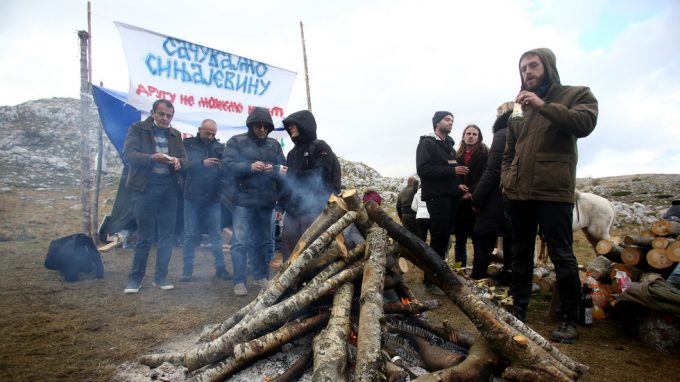
Activists and farmers camp in protest on the mountain Sinjajevina where the army planned a live-fire exercise on October 18, 2020 in Krnja Jela, Montenegro. © Getty Images / Filip Filipovic
RT | October 21, 2020
Montenegro’s Defense Ministry has postponed military training exercises after local shepherds and activists staged a protest over environmental concerns.
The mountain region of Sinjajevina was selected to host military drills including mortar shelling by the Montenegro army. However, the plan didn’t sit well with local farmers and environmental activists, who set up camps in the area and staged non-stop protests to oppose the drills.
The exercise was scheduled for this week, but the army had to retreat. Colonel Aleksandar Pantović, the Chief of Staff of the General Staff, announced that the drills have to be delayed. “We conducted a reconnaissance… the conditions for shooting were not met and that this is not possible,” Pantović told local media. “When all the conditions are met, we will continue with the realization of the exercise.”
A local MP from the URA party supporting the protest, Dritan Abazovic, called the decision a “significant victory” for Montenegro’s citizens and ecology.
The region in question, Mount Sinjajevina, consists of the largest stretch of grassland in the Balkans and makes up part of a location designated a UNESCO biosphere reserve. It was chosen as a place for a military polygon last year – something that triggered public discontent. Farmers and activists argued that explosives risk damaging the delicate environment and would contaminate the water supply.
“We will certainly not clash with the citizens,” the country’s Defense Minister Predrag Boskovic said in an interview. However, he noted that it is impossible to have an army unable to train on its own territory.
Montenegro is a NATO member state currently possessing an armed force of 2,400 active duty soldiers.
Moldova could be the next target of Western-backed color revolution to pressurize Russia
By Paul Antonopoulos | October 22, 2020
Washington could be organizing a color revolution and mass protests in Moldova like the ones that have already gripped Belarus and Kyrgyzstan. The Moldovan elections are scheduled for November 1 and have eight presidential candidates participating. The main rivals however are current President Igor Dodon, considered “pro-Russian,” and former Prime Minister Maia Sandu, considered “pro-European.”
There is a combination of internal and external factors at play in Moldova, something that has come to typically define the post-Soviet space. There is constant internal instability when considering the breakaway region of Transnistria, weak statehood, many conflicting ideological interest groups, and active attempts to get Moldova into the NATO and EU sphere of influence. This is what makes Moldova at high risk of experiencing a color revolution after the upcoming presidential elections if Dodon is re-elected.
According to polls and local experts, the first round of the presidential election may not determine the winner. Dodon, who aims to bring Moldova closer to Russia via the Eurasian Economic Union, and Sandu, who is considered the country’s main pro-Western politician, will likely compete against each other in the second round of voting. Polls show that Dodon has greater support from citizens, but not enough to win in the first round.
The director of the Russian Intelligence Service, Sergei Naryshkin, warned that the U.S. was preparing a color revolution in Moldova and highlighted that Washington would continue to interfere in the internal affairs of states friendly to Moscow, especially those along Russia’s borders. According to him, a color revolution could occur after the Moldovan presidential elections. The reason is Washington’s dissatisfaction with Dodon as he supports constructive relations with members of the Commonwealth of Independent States, particularly Russia.
The U.S. State Department ordered its embassy in the Moldovan capital of Chisinau to encourage the opposition to organize mass protests to demand an annulment if Dodon is re-elected. According to Russian secret services, U.S. diplomats are also trying to persuade Moldovan security forces not to interfere in possible street protests and to immediately “side with the people.”
Many Moldovan experts also warn of a possible coup attempt. Sandu, who sees the country as part of the EU family and supports the idea of uniting Moldova with Romania, has already accused local authorities of preparing to falsify the election results and called on her supporters to prepare for protests. However, if Dodon is re-elected, it is likely his supporters will not allow the opposition to question the election results. As recently as last week, Dodon talked about preparing for a potential color revolution attempt.
The destabilization of the post-Soviet space has all the signs of a planned and coordinated campaign to pressurize Russia by creating hotspots on or near its borders. The U.S. is the only country in the world that has enough resources and motivation to organize persistent and constant campaigns and has been actively indifferent or encouraging destabilization in countries on or near Russia’s frontiers, whether it be Belarus, Kyrgyzstan, Armenia-Azerbaijan or elsewhere.
This has been a consistent policy since the collapse of the Soviet Union when we consider how the 1990’s was dominated by manufactured coups, rebellions and revolutions in many former Soviet Republics, including Georgia, Ukraine, Kyrgyzstan, Moldova, Armenia and other neighbors or near neighbors of Russia.
Now that the U.S. is on the verge of a presidential election, the State Department and U.S. special services are attempting to weaken Russia and other geopolitical opponents. In other words, destabilization along Russia’s borders is part of a campaign to curb and undermine the country’s economic, political and technological capabilities. Because of Russia’s independent foreign and economic policies, size and resources, the Eurasian country poses a threat to U.S. global domination. It is for this reason that tensions, wars, riots and revolutions are constantly erupting near Russia’s borders, but at the same time Washington persistently points out that its national interest is to ensure peace, democracy and stability in countries that border Russia.
Although Moldova does not directly border Russia, it is a former Soviet Republic that still maintains cordial relations with Moscow. Moldova is a gateway that connects Eastern Europe to the Balkans. A potential Dodon re-election will once again prohibit any EU and NATO advancement towards the border of Russia.
This makes a color revolution against his re-election all the more necessary so that Moldova can potentially be the next country that borders Ukraine to become an EU and/or NATO member state. With another neighbor of Ukraine becoming an EU and/or NATO member, the eventual path of Kiev’s accession into those two organizations will become easier to navigate. This means the largest European country to border Russia, Ukraine, will be even more integrated into a system to pressurize Moscow.
Paul Antonopoulos is an independent geopolitical analyst.
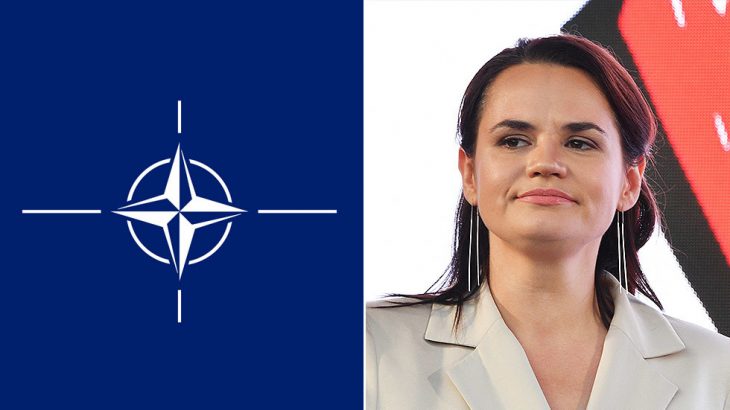
Useful Idiot or Trojan Horse? Belarusian opposition figure Tikhanovskaya’s links to NATO’s Atlantic Council adjunct raise eyebrows
By Kit Klarenberg | RT | October 16, 2020
‘Accidental politician’ Svetlana Tikhanovskaya has captured the West’s imagination, her lack of political experience presenting an ideal blank canvas for news-narrative weaving – and all too easily manipulated by malign forces.
From the moment she announced her candidacy for the Belarusian presidency after her husband Sergey was spuriously jailed for electioneering activities that would be considered normal in the rest of Europe, Tikhanovskaya has been a darling of the Western media. With her improbable ascension from stay-at-home mother to leading opposition figure, then proto-revolutionary leader-in-exile, documented on an almost daily basis.
Along the way, Tikhanovskaya has been keen to stress the upheaval in Belarus is neither pro-Western nor pro-Russian in character, but pro-democracy, a key message reiterated uncritically over and again by mainstream journalists. However, not a single one has deigned to mention, much less question, the fact that one of her key confidantes, Franak Viacorka, is a ‘non-resident fellow’ at Atlantic Council, a think tank that aggressively propagandizes in support of NATO, and wider American financial, political, military and ideological interests in Europe and beyond.
This position isn’t mentioned in his Twitter bio, and it’s unclear precisely when he became Tikhanovskaya’s ‘international relations advisor.’ Viacorka’s Atlantic Council appointment was announced on August 15 – in a Washington Post op-ed published the same day, he and Melinda Haring, deputy director of the council’s Eurasia Center, painted a glowing, provocative portrait of the would-be president of Belarus, framing her as part of a wider feminist uprising against the country’s “deeply patriarchal” elite, an upheaval central to the radical shakeup of the country.
The council billed Viacorka as a “journalist from Belarus,” which is true, to an extent. A long-time anti-Lukashenko activist, his campaigning as a teenager in the run-up to the 2006 presidential election was even the subject of an award-winning documentary. Subsequently, he spent seven years at US government-controlled media outlets Radio FreeEurope and Radio Liberty, before moving to Washington DC in August 2018 to serve as Digital Media Strategist for the US Agency for Radio Free Europe’s parent company US Agency for Global Media (USAGM), a role which ended just before he joined the Atlantic Council. In August 2018, USAGM’s then-CEO acknowledged its media outlets’ “global priorities reflect US national security interests.”
Founded in 1961, the council is best understood as NATO’s intellectual wing-cum-propaganda arm. Just as the alliance’s paradoxical purpose is, in the phrase of academic Richard Sakwa, “to manage the security risks created by its existence,” so too the organization exists to promote the notion of a Russian threat, in order to justify NATO’s post-Cold War endurance.
In this sense, the Atlantic Council is no different from most other ‘think tanks’ in that its raison d’etre is to defend and further the concerns of its financiers – in pursuit of that goal, as with most other lobby groups of this nature, it often publishes highly dubious, biased ‘research’ under the guise of objective academic inquiry, and recruits to its ranks individuals who advance its objectives in some way, promoting these as ‘independent experts.’
Some clue as to the council’s concerns and aims can be found in the publicly-available list of its key donors, which includes the US embassies of UAE and Bahrain, Ukrainian oligarch Victor Pinchuk, defense giant Raytheon, the UK Foreign & Commonwealth Office (FCO), and the US State Department. From 2006 to 2016, the council’s annual revenue leaped ten-fold, from $2 million to $21 million – a period in which, concurrently and not coincidentally, corporate and state budgets typically reserved for lobbying firms were increasingly directed to think tanks. Its board of directors is likewise highly illustrative, a veritable ‘who’s who’ of warmongers, comprising Henry Kissinger, Condoleezza Rice, Colin Powell, Robert Gates, Michael Hayden, David Petraeus, and many others.
Despite a host of council apparatchiks frequently popping up in media reporting, and in turn influencing debate, public perceptions and government policy, one would be hard-pressed to find a single mainstream article making even passing reference to the organization’s politically-charged agenda and funding sources. Indeed, the Atlantic Council’s press relations strategy has been astonishingly effective, its in-house ‘fellows’ and Digital Forensics Lab (DFRLab) operatives universally positioned as experts in an array of fields, ever-ready to provide insight on pressing issues in the form of op-eds, marketable quotes and more.
There’s no more palpable example of this phenomenon than former DFRLab chief Ben Nimmo, who for years has been widely-touted as an eminent authority on Moscow’s ‘information warfare’ and ‘cyber operations,’ as well as on Kremlin strategy and thinking – despite boasting zero discernible acumen in Russian politics, data analysis, information technology, or social media. Despite his palpable lack of relevant skills, Nimmo’s tour of duty at DFRLab saw him appear in a panoply of articles, reports and academic papers on the threat posed to the world by Russian ‘disinformation,’ in the process disseminating a vast amount of damaging untruths himself.
He was also a pivotal player in the council’s ‘anti-fake news’ partnership with Facebook. Launched in May 2018, DFRLab was granted exclusive and unprecedented access to the social media giant’s private data, in order to identify and study “disinformation networks,” before earmarking particular accounts and pages for deletion and banning. That an effective wing of Western state power was afforded such capacity failed to provoke any mainstream alarm, even when the initiative got off to a highly inauspicious start – a number of accounts Nimmo identified as Kremlin-directed ‘bots’ and ‘trolls’ and which were subsequently banned by social networks turned out to be real people.
Since then, at intermittent intervals this partnership has led to the purging of untold numbers of pages and accounts from the social network, among them many alternative media outlets, independent journalists, political groups, and other legitimate information sources, highlighting issues and events the mainstream media consistently downplays or ignores, including US interventionism, drug legalization, police brutality and more.
Viacorka’s work for the Atlantic Council to date hasn’t been quite so destructive, authoring articles for its website, and making appearances on major news networks, promoting Tikhanovskaya as the legitimate president of Belarus and perpetuating disputed and extremely questionable claims that she’d received up to 70 percent of the vote in that country’s recent election – key messages the council itself began aggressively advancing the day after the election.
Ever since, Tikhanovskaya has repeatedly appealed to US and EU leaders to recognize her as the winner and duly-elected president of Belarus, claiming she’ll step aside within six months of taking office, but her call has been ignored by international bodies and every government in the world, bar that of Lithuania.
Instead, typically at most an election re-run has been called-for, a somewhat odd display of reticence, given Washington, London, Berlin and Paris have priors in formally recognizing individuals with far less legitimate claims than she as de-facto leaders of countries, such as Juan Guaido in Venezuela. This may suggest Western governments aren’t actually as convinced of her alleged landslide victory as they publicly profess to be, and fear Lukashenko’s removal from office by external and internal force and/or without a viable, stable alternative in place could mean the country descends into further chaos, and in turn becoming a fresh flashpoint in Europe.
Viacorka himself acknowledged the disorganized nature of the protests in an Atlantic Council article – while taking as inevitable Lukashenko’s ouster and Belarus’ transition to democracy, he bemoaned how “a lack of coordination between the different elements within the protest movement” had left it “vulnerable to the divide-and-conquer tactics of authorities.”
Viacorka went on to note that, in a bid to address this “absence of leadership,” Tikhanovskaya had founded a Coordination Council to serve as the country’s effective government in waiting. He dubbed the endeavor “the main threat to Lukashenko” and “the first attempt to create a credible alternative,” but his description raises serious questions about whether it’s a legitimate attempt to provide a coherent, tangible face to the movement, or an opportunistic hostile takeover.
“The Coordination Council provides a degree of clarity for government officials and international observers looking to gain a better understanding of who represents the diverse opposition movement… The Council must occupy the political vacuum at the forefront of Belarus’s democratic uprising. Leaderless street protests have shaken the Lukashenka regime to its foundations, but they are not enough to bring about the kind of historic transition to democracy millions of Belarusians now expect… The Council features a number of members drawn from the professional classes… who are expected to play important roles in the attempt to move beyond today’s mass protests towards a national political transition,” Viacorka wrote.
One wonders whether the coordination council was an idea Viacorka himself presented to Tikhanovskaya in his capacity as her ‘international relations advisor’ – and if, in turn, his thinking was in any way influenced by the Atlantic Council.
Whatever the truth of the matter, it’s almost certain the Atlantic Council’s meddling in Belarusian politics has a clandestine element, given the organization’s key role in the UK Foreign & Commonwealth Office’s (FCO) initiative Open Information Partnership (OIP). Officially, under its auspices DFRLab, Bellingcat, Zinc Network and Media Diversity Institute “work together through peer-to-peer learning, training and working groups to pioneer methods to expose disinformation,” in collaboration with a sizable network of NGOs across Europe.
However, leaked documents make clear the endeavor is, in fact, a secret UK government information warfare outfit seeking to covertly further Whitehall’s global policy objectives, by, among other things, influencing “elections taking place in countries of particular interest to the FCO.” A file setting out the terms of the project indicates Belarus is one of a dozen “high impact, priority countries” for the OIP, strongly suggesting this year’s presidential vote was very much “of interest” to the project.
The same document indicates DFRLab, Bellingcat, Zinc Network and Media Diversity Institute had conducted a secret operation in Ukraine, Moldova and Belarus in 2018, “delivering audience insights and recommendations to increase reach and resonance of selected independent media outlets.”
While innocent-enough sounding, examples offered of the organization’s work offered elsewhere in the file indicate OIP has engaged in numerous ‘astroturfing’ initiatives across Eastern Europe, helping organizations and individuals to produce flashy, FCO-funded propaganda masquerading as independent citizen journalism, which is then amplified globally via its NGO network and other channels.
For instance, in Ukraine the Open Information Partnership worked with a 12-strong group of online ‘influencers’ “to counter Kremlin-backed messaging through innovative editorial strategies, audience segmentation, and production models that reflected the complex and sensitive political environment,” in the process allowing them to “reach wider audiences with compelling content that received over four million views.”
In Russia and Central Asia, OIP established a covert network of ‘YouTubers,’ helping them create videos “promoting media integrity and democratic values.” Participants were also taught how to “make and receive international payments without being registered as external sources of funding” and “develop editorial strategies to deliver key messages,” while the consortium minimized their “risk of prosecution” and managed “project communications” to ensure the existence of the network, and indeed OIP’s role, were kept “confidential.”
Were similar efforts undertaken in Belarus at some point subsequently, and if so, how many of the citizen journalists on the ground covering the protests this year have received funding and training from OIP, and what role has the organization and its extensive pan-European NGO matrix played in promoting their “compelling content” the world over?
At the very least, another leaked FCO file indicates a number of organizations in the country had exploratory discussions with OIP, including the Belarusian Association of Journalists, and Euroradio – both were said to have “expressed an eagerness to be part of the network,” and to be operating in “the most vital space in the entire network.”
It may be significant that Franak Viacorka has been a prominent amplifier of Euroradio’s “fearless” coverage of the unrest that has engulfed the streets of Minsk for the past two months.
NATO refuses to commit to withdrawal from Afghanistan
Press TV – October 9, 2020
NATO has dismissed US President Donald Trump’s surprise announcement to pull out all of US forces from Afghanistan by the end of the year, saying that members of the military alliance will decide together on when to withdraw forces from the war-ravaged country.
Trump announced on Twitter on Wednesday that he was going to bring all US troops home from Afghanistan by Christmas.
NATO Secretary General Jens Stoltenberg reacted to the president’s remarks on Thursday, saying that the military alliance will end its mission in Afghanistan only when conditions on the ground permit.
“We decided to go into Afghanistan together, we will make decisions on future adjustments together, and when the time is right, we will leave together,” Stoltenberg said at a news conference.
NATO deployed forces to Afghanistan following the 2001 US-led invasion to topple the Taliban-run government, on the pretext of fighting terrorism following the September 11 attacks in New York.
Afghanistan has been gripped by insecurity since the US and its allies invaded the country as part of Washington’s so-called ‘war on terror’ 19 years ago. Many parts of the country remain plagued by militancy despite the presence of US-led foreign troops.
American forces have since remained bogged down in the country through the presidencies of George W. Bush, Barack Obama, and now, Donald Trump.
In an interview on Thursday Trump also said that US forces are “down to 4,000 troops in Afghanistan. I’ll have them home by the end of the year. They’re coming home, you know, as we speak. Nineteen years is enough.”
Analysts say Trump, trailing in polls just weeks ahead of the November 3 presidential election, made the withdrawal announcement to show he is making good on his 2016 promise to end “endless wars.”
Stoltenberg, however, said NATO would only leave Afghanistan when it could do so without the risk of the country once again becoming a haven for militants.
“We will make decisions based on the conditions on the ground, because we think it is extremely important to continue to be committed to the future of Afghanistan, because it is in our interest to preserve the long-term security of Afghanistan,” he added.
Trump’s announcement was, however, welcomed by the Afghan Taliban militant group on Thursday.
A spokesman for the group, Mohammad Naeem, described Trump’s announcement as “a positive step towards the implementation of [the] Doha agreement.”
In a deal reached between the US and the Taliban earlier this year in the Qatari capital, Doha, the United States promised to pull out all its troops by mid-2021 in return for the Taliban to stop their attacks on US-led occupation foreign forces in Afghanistan.
Some 4,500 American troops are currently on the ground in Afghanistan, reduced from over 12,000 when the deal was signed in February.
The Taliban also agreed to negotiate a permanent ceasefire and a power-sharing formula with the Afghan government.
The Afghan government and Taliban last month opened peace talks in Qatar, even as key differences, including over a ceasefire, remain between the two sides.
NATO’s recent refusal to commit to withdrawal, according to observers, puts the complicated peace negotiations in jeopardy at a time when Afghanistan continues to suffer from a series of attacks — claimed either by the Taliban or the Daesh terrorist group — which took dozens of civilians’ lives.
In the meantime, Daesh has also been securing a foothold in Afghanistan.
The US has been largely blamed for relocating remnants of the terrorist group to Afghanistan following their defeat in Iraq and Syria.
The US-led military alliance and NATO are also blamed for turning Afghanistan into one of the world’s main opium producers over the last two decades, as opium has become a source for terrorist financing in the war-ravaged country.
According to the United Nations, more than 80 percent of the world’s opium is produced in Afghanistan and that the bulk of narcotics produced in the country is destined for European states.
A high-ranking Iranian official said earlier this year that the production of narcotic drugs has seen a fifty-fold increase over a span of 17 years in Afghanistan.
Director general of the Iran Drug Control Headquarters, Eskandar Momeni, said American planes as well as those belonging to the US-led military alliance and NATO are engaged in transporting illicit drugs.
Iran, located at the crossroad of international drug smuggling from Afghanistan, has long been fighting armed drug smugglers in its eastern and southeastern borders. Thousands of Iranian security forces have lost their lives in the clashes.
Analysts believe Washington, which has repeatedly named Iran, Russia and China as its enemies, intends to create insecurity and trouble on the borders of these countries through Afghanistan.
Featured Video

AIDS Inc. by Gary Null (2007)
or go to
Aletho News Archives – Video-Images
From the Archives
Clash of Civilization, Iran Part II
By Jamal Kanj – Intifada-Palestine.com – January 14, 2011
Israel’s survival kit is: perpetuate conflict, insecurity to rationalize collective hate and finally playing victim.
Devoid of conflict, Israel implodes internally; without hate, Zionism loses its justification; and playing eternal victim to continue blackmailing the West. Absence of this holy trinity, Israel ceases to exist.
From its inception, the house of Zion has mastered exploiting adversarial powers to advance Israel’s cause. For instance, their influence over the Democratic Party in the US began with President Truman’s bid for 2nd term election in 1948.
Responding to strong opposition from Secretary of State General George Marshall and Department experts urging against recognition of Israel, President Truman replied: “I’m sorry gentlemen but I have to answer to hundreds of thousands [Jewish voters] who are anxious for the success of Zionism. I do not have hundreds of thousands of [voting] Arabs among my constituents”
Zionists influence over liberal American politics was matched with the doctrinal school of Conservative theoreticians aligning the Republican Party’s platform with Israel’s objectives. The Neoconservative Zionists, coined Zioncons, invented the “Clash of Civilization” concept to fight Israel’s wars. … continue
Blog Roll
 Aletho News
- Pro-Palestine protesters arrested outside UK’s ruling Labour Conference in Liverpool
- Mauritius denies landing permit to flight from Israel, forcing cancellation: Tour operator
- Israeli finance minister calls for genocidal war on West Bank, annexation of south Lebanon
- 12 Things Your Psychiatrist Was Trained Not to Tell You
- From Unipolar Universalism to Multipolar Civilizational Distinctiveness
- RSF military group defects, joins Sudanese army: State media
- Ireland goalkeeper refuses to play ‘Israel’ as squad weighs boycott
- China pushes back against US on Cuba, Iran
- Ukrainian Soldiers, Potential Mercenaries: Have Gun, Will Travel!
- Burnham’s UN debut… A masterclass in British disinformation
- If Americans Knew
- Israel forces Gazans to live in constant peril – Daily Update
- Deconstructing Netanyahu’s pants-on-fire UN rant – Daily Update
- Trump betrayed voters with his campaign lies and prioritized a foreign country once he took office
- Netanyahu calls Israel’s war in Gaza ‘opposite of genocide’ in UN speech to near-empty hall
- Settler Kidnappings: Torture, Sexual Abuse and Terrorisation of Palestinian Abductees as Israel Deepens Annexation of West Bank
- Gaza winter nears as 162,000 tents become unusable, raising fears of humanitarian crisis
- Netanyahu says, “It’s the opposite of genocide”; UN says Gaza economy is world’s ‘most severe crisis on record’ – Daily Update
- Israel’s US-Backed Assault on Gaza Has Created the ‘World’s Most Severe Economic Crisis on Record’: UN
- ‘Protecting U.S. Citizens’… From Israel
- ‘This is where I live now, the back of a truck’: a day in the life of a grandmother in Gaza
- No Tricks Zone
- New Study: Earth And Venus Surface Warmth Largely Explained By Convection And Lapse Rate, Not CO2 Or Radiation
- 2025 Nature Paper Claiming Worsening Global Drought Gets RETRACTED …Heavily Flawed
- New Study: ‘Global Drought Shows No Detectable Recent Acceleration Under Climate Warming’
- Economic Masterminds: German Socialists Suggest Taxing Productivity Gains Stemming From Using AI
- The South China Sea Has Not Been Cooperating With The Climate Change Narrative
- Energy Crisis: Germany Enters Heating Season With Historically Low Gas Reserve Fill Levels
- New Study: The Antarctic Ice Sheet Gained Mass From 2020-2024 Due To Staggering Snow And Ice Accumulation
- Study: Ocean Heating Rates From Thousands Of Years Ago ‘Dwarf’ Modern Ocean Heating Rates
- Climate Extremists Target, Attack Large-Scale Power Grid Infrastructure In Germany!
- New Study: Antarctic Ice Melt Has Contributed Less Than 1 Centimeter To Sea Level Rise In The Last 30 Years

