Will Lebanon be the next US-NATO humanitarian war?
By Steven Sahiounie | Mideast discourse | October 2, 2020
The waters off Lebanon are the scene of a gathering Armada of French and American naval ships. What appeared at first to be a humanitarian response to the devastating Beirut Port explosion on August 4, is now feared to be the prelude of the next US-NATO humanitarian war.
French President Emmanuel Macron blamed Hezbollah and all of the Lebanese politicians Sunday and warned of a new civil war. “I’m ashamed of the Lebanese political leaders. Ashamed,” Macron repeated.
He accused them of “collective betrayal” while putting their parties and personal greed above the needs of the Lebanese people.
Some political observers now believe that Lebanon may well be going the way of Somalia, as evidenced by the characteristics of a failing state, such as lack of governance, corruption and incompetence, chronic humanitarian problems, and persistent social tensions.
Prime minister-designate Moustapha Adib stepped down September 26, and Lebanon’s Central Bank reserves may soon dry up and the government would no longer be able to subsidize basic goods such as fuel, medicine, and wheat.
Macron has been pressing Lebanese politicians to form a Cabinet made up of technocrats that can work on urgent reforms, and Macron has traveled twice to Beirut since August 4, while making it a personal mission to try to repair the devastated country, which some see as a neo-colonial farce.
Macron criticized the Lebanese system of sectarian politics, “as if competence was linked to religious confession.”
He lambasted Hezbollah demanding to know its characteristics and identity, and he criticized Lebanese political leaders from all parties and dynasties. Each Lebanese faction has found a foreign godfather and has ended up as a pawn in a regional and international chess game. Tens of billions of dollars have reportedly been looted by politicians and deposited in European and American banks.
US-NATO Humanitarian wars
In 1999 NATO updated its ‘Strategic Concept’ to allow members to defend not only other members but also conduct ‘non-Article 5 Response Operations’. It would be under this mechanism that a US-NATO military operation, along with an Arab Gulf coalition, would be used to attack, invade and defeat Hezbollah in Lebanon.
Since 2002, it was agreed that NATO forces could be sent “wherever they are needed,” regardless of the location, and in 2006 the NATO Response Force (NRF) of 25,000 troops has been fully operational.
US President Bill Clinton and NATO waged the humanitarian war on the former Yugoslavia, which broke a larger nation into ‘bite-sized’ pieces.
Critics of the US-NATO bombing of Yugoslavia have argued that certain attacks forming part of the campaign violated international humanitarian law. Noam Chomsky argued that the main objective of the US-NATO war was to force Yugoslavia into the Western economic system since it was the only country in the region that stood alone in defiance of the US world domination.
Hezbollah targeted by US-NATO war machine
Hezbollah’s prominence in the Lebanese government caused foreign donors and investors to stay away, because of US sanctions targeted on anyone with ties to the group, based on their designation as a terrorist group.
Hezbollah’s leader, Sayyed Hassan Nasrallah, said on Tuesday, “We welcomed President Macron when he visited Lebanon and we welcomed the French initiative, but not for him to be judge, jury and executioner, and ruler of Lebanon.”
Nasrallah has headed the group since 1992 as Secretary-General; however, its military wing is considered as a terrorist organization in 21 countries, as well as by the Arab League and the European Union.
Hezbollah’s 1985 manifesto listed its objectives as the expulsion of “the Americans, the French and their allies definitely from Lebanon, putting an end to any colonialist entity on our land”.
In 2008, the Lebanese government unanimously recognized Hezbollah’s existence as an armed organization and guarantees its right to “liberate or recover occupied lands”.
Hezbollah is an armed resistance group, as well as a political party that has seats in Parliament through free and fair elections. Their ally in Parliament is the ‘Amal Movement’, and together they hold the majority of Parliamentary seats. In a democracy, the majority rules and this is why recently Hezbollah and Amal insisted on choosing the Finance minister, which became a conflict point in the view of Macron.
Hezbollah is resisting the Israeli occupation of Shebaa Farms, an area in the far south of Lebanon. Moreover, Hezbollah also is resisting the Israeli occupation of Palestine. At one time, all of the Arab world demanded the rights for the Palestinian people, who have lived under brutal military occupation since 1948, and the UN has ratified resolutions calling for a 2-state solution, where Palestine would be given the land of the 1967 borders, and both Israel and Palestine would live side by side in peace.
In 2017, Ron Prosor, former Israeli ambassador to the UN said Hezbollah was then “10 times as strong now as it was in 2006, and its military infrastructure permeates Lebanon.” He added that Lebanese President Michel Aoun has also “embraced” Hezbollah’s arsenal as “a principal element of Lebanon’s defense.”
Many critics tried to blame Hezbollah for the Beirut Port blast on August 4, but the Lebanese officials and locals admitted that Hezbollah had no access to the Port, or authority over it. Even officials known to be antagonistic of Hezbollah admitted that the blame would not plausibly stick on Hezbollah. The exact cause is not known, but it may have been an accident borne of corruption and ineptitude, or it could be sabotage, according to President Michel Aoun. MP Machnouck, member of the Sunni-led ‘Future Party’ stated he was convinced Israel was responsible.
The elimination of Hezbollah is Israel’s top priority
A former director of Israel’s Counter-Terrorism Bureau, Brig. Gen. Nitzan Nuriel, said that another war between Israel and Hezbollah was “only a question of time.”
Hezbollah is the only force that Israel has faced that has caused the Israeli Defense Forces to retreat without success. Defeating Hezbollah is a top Israeli priority.
Under the Obama Administration’s Middle Eastern policy, Iran became a negotiations partner, while pressuring Israel to conclude a peace agreement with the Palestinians.
Netanyahu recently gave a virtual speech to the UN Security Council, in which he displayed a detailed map of Beirut, and he predicted the location of where a future explosion would occur, and he blamed Hezbollah for having a weapons factory and warehouse at the location, which was a residential area. During the Netanyahu speech, Nasrallah was also giving a live televised speech in Lebanon and was told what Netanyahu had claimed. He immediately invited all media to go to the location that Netanyahu portrayed in his map, and inspect for themselves if there were any weapons or warehouse present. Later, the media arrived, and live local TV coverage showed that in fact, the location was a cooking gas canister factory. This confirmed the Israeli accusation was false and led experts to assume a direct connection between the Port blast, and the Israeli proposed blast in Netanyahu’s map.
The Israeli occupation of Lebanon
Israel occupied the south of Lebanon for 23 years, during which men, women, and children were imprisoned in Khiam Prison, where they were routinely tortured, abused and many died. Hezbollah aligned with many other Lebanese resistance groups, who resisted the occupation vociferously until Israel gave up and left in 2000. The south of Lebanon is populated by both Shite Muslims and Christians. The steadfastness of Hezbollah is remembered by those Lebanese citizens. However, the North of Lebanon was never occupied and lived free of fear, oppression, and intimidation which may have influenced many Lebanese citizens to either support or reject Hezbollah. As they say, “Your view depends on where your seat is.”
Using ISIS as ground troops by US-NATO
Recently, the Lebanese Army fought fierce battles against Radical Islamic terrorists near Tripoli in the north, in the area of Wadi Khalid.
In 2016, Efraim Inbar, an Israeli scholar, and the director of the Begin-Sadat Center for Strategic Studies wrote, “The continuing existence of ISIS serves a strategic purpose,” and added that ISIS “can be a useful tool in undermining” Iran, Hezbollah, Syria, and Russia and should not be defeated. He wrote, “Stability is not a value in and of itself. It is desirable only if it serves our interests,” and stressed that the West’s “main enemy” is not ISIS; it is Iran.
Saudi Arabia part of the Coalition against Hezbollah
The King of Saudi Arabia rarely gives speeches; however, he made a televised speech in which he accused Hezbollah of the Beirut Port blast, apparently unaware that that accusation has been debunked. This is the same King who summoned Prime Minister Saad Hariri from Lebanon to be kidnapped and forced to resign in Saudi Arabia. It was President Macron who personally negotiated Hariri’s freedom.
It appears that Saudi Arabia will be among the first Arab countries to send support for a US-NATO attack on Lebanon to eliminate Hezbollah.
Steven Sahiounie is an award-winning journalist and political commentator.
The Time of Troubles in Transcaucasia – Part 2
By M. K. BHADRAKUMAR | Indian Punchline | October 3, 2020
Part-1 of the three-part essay is here.
The German Chancellor Angela Merkel said in Berlin on October 2 that the European Union seeks a “constructive dialogue and a positive agenda” with Turkey. She had just returned to the German capital after a 2-day summit meeting of the EU countries in Brussels. Germany played a key role at the summit in steering the EU-Turkey relationship away from a confrontationist path to which it was drifting lately. (See my blog EU marks distance from Indo-Pacific strategy.)
Merkel said, “We had a very long, detailed discussion about our relations with Turkey. We came to the conclusion that we would like to enter into a constructive dialogue with Turkey, we want to have a positive agenda,” adding that the Brussels summit had opened a “window of opportunity” for closer cooperation with Ankara.
Merkel disclosed that talks for closer cooperation between the EU and Turkey in the coming months would focus on migration issues, trade, modernising the Customs Union, and liberalised visa regime. In effect, Merkel has made a huge case for Turkish President Recep Erdogan at a particularly sensitive juncture for the latter when there is growing criticism in Europe regarding his regional policies.
In particular, there has been a nasty incident recently involving the Turkish and French navies in the Eastern Mediterranean. It was a rare, if not unprecedented, incident involving two NATO powers in the 7-decade old history of the western alliance.
Again, the US recently strengthened its military bases in Greece and has repeatedly called for restraint on the part of Turkey over its maritime disputes with Greece and vowed to intervene both politically and militarily in the tensions in the Eastern Mediterranean.
Turkey and France support opposite sides in the Libyan civil war, while the US is aligned with militant Kurdish groups in Syria whom Turkey regards as terrorists. And as conflict erupted in Nagorno-Karabakh, Turkey witnesses the US, France and Russia swiftly drawing close in a phalanx to push back at Erdogan’s robust backing for Azerbaijan, including pledges of military help.
To be sure, Merkel spoke with great deliberation. Before leaving for Brussels, Merkel had addressed the German Parliament where she referred to complaints against Turkey’s human rights records, but went on to praise Turkey’s “amazing and remarkable” performance in hosting refugees, highlighting that Turkey is hosting four million refugees.
Interestingly, Merkel compared Greece to Turkey in a poor light. “We have to weigh very carefully how to resolve the tensions and how to strengthen our co-operation on refugees and on the humane treatment of refugees,” she said and proceeded to condemn the manner in which Turkey’s archetypal enemy Greece is handling the migrant camp in Lesvos (Greece).
With biting sarcasm, Merkel noted, “in recent days we have seen horrible images regarding the treatment of refugees. And not from Turkey, I would like to emphasise, but from Lesvos (Greece), from an EU member state.”
Without doubt, Germany has stood up to be counted as Turkey’s friend at a time when the latter faces growing isolation within the NATO and from the EU.
Seminal events
The well-known American professor at Harvard University’s John F. Kennedy School of Government, Stephen Walt once penned an essay titled Great Powers Are Defined by Their Wars where he pointed out that explaining a great power’s foreign policy is a perennial question for scholars of international politics. He argued that major wars have powerful and long-lasting effects on a nation’s subsequent foreign or military policy.
Prof. Walt explained that wars are seminal events from which a great power’s subsequent behaviour follows, independent of its relative power, regime type or its leadership. In his words, “Those who fight in these wars are often scarred by the experience, and the lessons drawn from victory or defeat will be etched deeply into the nation’s collective memory. The experience of past wars is central to most national identities… If you want to understand the foreign policy of a great power, therefore (and probably lesser powers as well), a good place to start is to look at the great wars it has fought.”
Isn’t it a poignant historical memory for Berlin that the Ottomans were Germany’s allies in two world wars when it was hopelessly isolated by the the western powers?
On the other hand, take Russia and Turkey. Russia fought a series of twelve wars with the Ottoman Empire between the 17th and 20th centuries — one of the longest series of military conflicts in European history — which ultimately ended disastrously for the latter and led to its decline and eventual disintegration.
Russia had often fought the Ottomans at different times, often in alliance with the other European powers. Importantly, these wars helped to showcase the ascendancy of Russia as a European power after the modernisation efforts of Peter the Great in the early 18th century. In the Turkish Muslim psyche, however, Russia has figured as a protagonist which had played an historical role in the weakening of the Ottoman Empire in Central Europe, the Balkans and Transcaucasia.
The Russian conquest of the Caucasus mainly occurred between 1800 and 1864. In that era the Russian Empire expanded to control the region between the Black Sea and Caspian Sea, the territory that is present-day Armenia, Azerbaijan and Georgia (and parts of today’s Iran and Turkey) as well as the North Caucasus region of modern Russia. Multiple wars were fought against the local rulers of the regions as well as the Ottoman Empire until the last regions were brought under Russian control by 1864 with the expulsion to Turkey of several hundred thousand Circassians.
Then followed the Russo-Turkish War (1877-78) when Russia seized the the province of Kars and the port of Batumi on the Black Sea. In World War I, aligned with Germany, the Ottomans pushed against Russia as far east as Baku (capital of Azerbaijan) but then withdrew, lacking the strength to advance further, and subsequently in the post-war confusion, somehow contrived to regain Kars.
Suffice to say, in 1991 following the collapse of the former Soviet Union, when Transcaucasia became independent as the states of Georgia, Armenia and Azerbaijan, a lot of blood-soaked history involving Russia and Turkey provided the backdrop. Incidentally, Erdogan’s family originally hailed from Rize Province in the eastern part of Turkey’s Black Sea region (where he grew up as a child), which was a site of battles between the Ottoman and Russian armies during the Caucasus Campaign of World War I and was occupied by Russian forces in 1916-1918, to be finally returned to the Ottomans under the Treaty of Brest-Litovsk in 1918. The Soviet Union returned Rize to Turkey in 1921.
‘Past is never dead’
Amidst all this, an interesting feature of the flow of history has been that from the days of the Roman Empire, Transcaucasia was usually a borderland between Constantinople (Istanbul) and Persia. Areas would shift from one empire to the other, their rulers would have varying degrees of independence and were often vassals of one empire or the other, depending on the size and proximity of the suzerain’s army. By around 1750 the area was divided between the Turkish and Persian vassals. The western two thirds were inhabited by Georgians, an ancient Christian people, and the eastern third mostly by Azeris, Turkic Muslims. And Russia of course was pushing close to the Black Sea and the Caspian against the Ottoman and Persian empires.
Professor Walt in his essay cited a famous quote from the American novelist William Faulkner, “The past is never dead. It’s not even past.” Indeed, for Russia, Turkey or Iran, the current developments in Transcaucasia form part of a vast collective event that shapes their perceptions of danger and definitions of heroism, sacrifice, and even their identity.
In fact, the current line-up in the developing situation around Turkey speaks for itself: Germany voices sympathy for Turkey and offers an enhanced partnership; France lambasts Turkey and seeks EU sanctions against Turkey; France alleges Ankara’s dispatch of Syrian fighters to Nagorno-Karabakh; Germany appreciates Turkey’s big hand in addressing the refugee crisis gripping Europe; France coordinates with Russia at the highest level of leadership to pressure Turkey over Nagorno-Karabakh; the North Atlantic Treaty Organisation (NATO) and the US join Russia and France’s call for cessation of fighting in Transcaucasia; Iran maintains neutrality and suggests a joint effort with Turkey and Russia to resolve the conflict between Armenia and Azerbaijan.
Meanwhile, Moscow has shed its initial ambivalence and is stepping into the arena on the side of Armenia, expressing “serious concern in connection with incoming information about the involvement in hostilities of gunmen from illegal armed units from the Middle East” — plainly put, censuring Turkey’s backing for Azerbaijan. And President Vladimir Putin underscores that he is voicing a common stance along with “the presidents of the countries co-chairing the OSCE Minsk Group” (Russia, France and the United States). Simply put, Russia’s “competitive rivalry” with Turkey is surging.
Interestingly, Turkish President Recep Erdogan has openly drawn attention to the broader regional and geopolitical context in which the various unnamed powers are jockeying and covertly coordinating to encircle Turkey. Erdogan said on October 2, “If we connect the crises in the Caucasus, in Syria and in the Mediterranean, you will see that this is an attempt to surround Turkey.”
It doesn’t require much ingenuity to figure out the identity of the foreign powers he would have had in mind who are attempting to “surround” Turkey — France, the US and Greece (all NATO powers) and Russia, the scourge of the Ottoman Empire.
NATO boss Stoltenberg tells Georgia to ‘prepare for membership’ – influential Russian senator says it’s a ‘signal’ to Moscow
By Jonny Tickle | RT | September 30, 2020
NATO Secretary-General Jens Stoltenberg has urged Georgia to prepare to become a member of the US-led military bloc. On Tuesday, the premier of the former Soviet state Giorgi Gakharia was in Brussels to discuss closer cooperation.
Georgia’s effort to join NATO began in 2005, just six years after it left the Russian-dominated CSTO. The integration of the Caucasus nation is seen by NATO leaders as having substantial strategic benefits, including extra Black Sea ports close to Russia. Earlier this year, an agreement between Tblisi and the bloc included joint exercises in the Black Sea and the sharing of more traffic radar data.
“I urge [Georgia] to continue making full use of all the opportunities for coming closer to NATO and to prepare for membership,” Stoltenberg said, in a press conference. “This is important for Georgia, and for NATO.”
The secretary-general also noted that the bloc “supports Georgia’s territorial integrity,” calling on northern neighbor Russia to “end its recognition of the regions of Abkhazia and South Ossetia.” Abkhazia and South Ossetia are two de-facto states, recognized by most of the world as part of Georgia. According to Tbilisi, the two regions are actually occupied by Moscow.
Speaking to RT, veteran Russian senator Aleksey Pushkov said that the potential induction of Georgia as a member means that NATO sees Russia as its main opponent. Pushkov, a member of the pro-Putin United Russia party, is the former chairman of the Duma’s Foreign Affairs Committee and is widely considered to be close to the Kremlin.
“In 2008, Paris and Berlin were against Georgia’s accession. But the situation has since changed, and it might be that the advocates for Georgia inside NATO now have the upper hand,” he explained. “It is also a signal to Russia: the alliance sees it as the main and actually the sole adversary.”
In 2008, then-US President George W. Bush pushed for Georgia to join the Membership Action Plan, a mechanism that allows for a continuous review of aspiring members, providing feedback and advice. However, Bush was defeated by German Chancellor Angela Merkel, who was concerned that admitting Georgia would increase tensions with Russia.
Turkish claims that the PKK is operating in Artsakh set dangerous precedent
By Paul Antonopoulos | September 28, 2020
Conflict sparked up again yesterday in Artsakh, or more commonly known as Nagorno-Karabakh, when Azerbaijan launched an offensive against Armenian forces. Although the Republic of Artsakh is not recognized by any state, including Armenia, and it is still internationally recognized as occupied Azerbaijani territory, it achieved a de facto independence in 1994.
As acting Commissar of Nationalities for the Soviet Union in the early 1920’s, future Soviet leader Joseph Stalin granted the Armenian-majority region of Artsakh to the Azerbaijani Soviet Socialist Republic. The Azeris, the dominant ethnic group of Azerbaijan, are cultural and linguistic kin with the Turks. It is said that the Turks and Azeris constitute “one nation in two states.” The defining difference is that Azeris are Shia Muslims unlike Turks who are mostly Sunni. The Soviets had hoped that by granting Artsakh to Azerbaijan instead of Armenia, they could court the newly founded Republic of Turkey to closely align with Moscow, or perhaps even become a Soviet Republic, by appeasing their ethnic Azeri kin.
In 1921, it was estimated that Artsakh was 94% Armenian. However, according to the 1989 census, Artsakh’s population was approximately 75% Armenian and 25% Azeri. Former Soviet Azerbaijani leader Heydar Aliyev, father of current President Ilham Aliyev, said in 2002: “I tried to change demographics there […] I tried to increase the number of Azerbaijanis in Nagorno-Karabakh and the number of Armenians decreased.” The collapse of the Soviet Union unsurprisingly led to the Artsakh War, which only ended after a ceasefire in 1994 when Armenian forces achieved a decisive victory.
Despite Azerbaijan’s defense budget ($2.267 billion) being about five times larger than Armenia’s, they have failed to capture Artsakh on numerous attempts, particularly during the 2016 April War and another major attempt in July of this year. Azerbaijan’s resumption of hostilities yesterday could be passed off as just another skirmish that will subside in a few days. However, the current conditions are far different and much more dangerous than in previous situations.
Although it is well established that the Turkish economy is struggling, President Recep Tayyip Erdoğan is maintaining a policy of constant crises in the vain attempt to distract the public from the Turkish lira as it continues breaking new record lows to the US dollar and Euro, even as recently as this morning. As the military provocations and rhetoric of war against Greece and Cyprus in the East Mediterranean begins to subside in Ankara, it only took a few days for a new crisis to emerge.
Reports began emerging last week that Turkey was transferring terrorists from northern Syria to Azerbaijan. The Azerbaijani leadership in Baku flatly denied the allegations last week and today. However, despite the denials from Baku, it must be remembered that Ankara openly announced its transfer of Syrian fighters to Libya earlier this year and the Azerbaijani’s have undoubtedly used international terrorists from Afghanistan, Chechnya and Turkey during the first Artsakh war in the 1990’s. Photos, videos and voice recordings have emerged that show Syrian terrorists on their way to or already in Azerbaijan. Vardan Toghanya, the Armenian Ambassador to Moscow, said in a statement today that 4,000 militants from Syria already arrived in Azerbaijan, while according to the Armenian intelligence agency, 80 fighters from Syria have already been killed or wounded.
Turkey’s transfer of militants in support of Azerbaijan, which was also done in the 1990’s, is not what makes the current conflict more dangerous compared to previous battles and skirmishes. Starting from last week, Turkey and Azerbaijan have increased their campaign in claiming that the Kurdistan Workers Party (PKK), considered a terrorist organization by both Ankara and Baku, was operating in Artsakh. Neither Ankara and Baku provided any evidence for their claims. This sets a dangerous narrative as it could be used as a way for Turkey to “legitimize” a direct intervention against Armenia and in support of Azerbaijan.
Erdoğan justified his invasion and occupation of large areas of northern Syria and northern Iraq in 2018, 2019 and this year on the pretence that they were fighting against the PKK. Although Armenia denies PKK are operating in Artsakh, this will be ignored by Ankara and Baku.
However, unlike Syria and Iraq, Armenia is a member state of the Collective Security Treaty Organization (CSTO), alongside Belarus, Kazakhstan, Kyrgyzstan, Russia and Tajikistan. A direct Turkish attack on Armenia could activate the CSTO. This would be a dangerous scenario as in turn this could activate NATO in defense of Turkey. It is highly unlikely that the situation in Artsakh will dissolve into a CSTO-NATO faceoff. But the risk still remains, especially if Erdoğan decides to directly intervene under the guise of expelling the PKK from Artsakh.
Just as Erdoğan unleashed a migrant crisis in February and March of this year against Greece, sent Syrian terrorists to Libya in May, conducted a military operation in northern Iraq against the PKK in June, and created a new crisis with Greece by sending warships into its territorial waters in August and for most of September, it appears the new crisis to dominate headlines for the next few weeks will revolve around Artsakh.
Although it is unlikely that Turkey will directly militarily intervene, a dangerous precedent has already been established by pushing the narrative, without publicly available evidence, that the PKK are operating in Artsakh alongside Armenian forces. With the Turkish economy and lira collapsing, Erdoğan in the future may very well use the narrative that the PKK are in Artsakh to foment public furore and distract them from the declining economic situation.
Paul Antonopoulos is an independent geopolitical analyst.
US troops to stay longer in Lithuania: Defense minister
Press TV – September 22, 2020
A new battalion of US military forces, equipped with tanks and other armored vehicles, is to be deployed to Lithuania in November and will remain there until next June, the country’s defense minister says.
Lithuania’s Defense Minister Raimundas Karoblis made the announcement on Tuesday, though he said the deployment was “not connected at all to the situation in Belarus.”
He said the new battalion would replace an American troop contingent that was stationed in the country near Belarus’ border earlier this month for a two-month tour.
NATO activity has picked up near the borders of Belarus, where there has been unrest after the re-election in August of President Alexander Lukashenko.
Lukashenko has said Western countries seek to destabilize Belarus and has put the country’s military on high alert and shut its borders with Poland and Lithuania.
The US battalion currently deployed in Lithuania arrived earlier and is staying longer than the government had indicated before the outbreak of protests in neighboring Belarus.
Belarusian Defense Minister Viktor Khrenin warned in a recent televised interview that an American armor battalion had redeployed its tanks to a location in Lithuania close to the Belarusian border.
Lukashenko also accused the US of organizing the post-election protests in Belarus through social media platforms. He said Americans, acting through centers in Poland and the Czech Republic, were controlling the social media platforms that are playing a leading role in the unrest.
Earlier this month, the Lithuanian Defense Ministry issued a statement saying that the US would deploy 500 troops to the country to engage in war games near the border with Belarus.
On Russia, Joe Biden’s mouth is writing checks the US can’t afford to cash
By Scott Ritter | RT | September 18, 2020
Joe Biden’s tough rhetoric on Russia, fueled by politically motivated FBI testimony alleging continued Russian electoral interference, may play well to his base. But if US allies act on it, it could mean war.
Joe Biden talks a good show. “I believe Russia is an opponent, I really do,” he said at a CNN town hall Thursday night. Biden’s statement was in response to a question from the moderator, Anderson Cooper, as to whether Biden viewed Russia as “an enemy.”
In the world of politicized semantics as used by Joe Biden, the difference between an “opponent” (someone who competes against or fights another; a rival or adversary) and an “enemy” (a person who is actively opposed or hostile to someone or something) knows no differentiation between mens rea (the intention or knowledge of wrongdoing), as opposed actus reus (the actual action or conduct). Both are elements of a crime and, according to Biden, Russia’s actions violate both principles.
“Putin’s overwhelming objective is to break up NATO,” Biden told the made-for-television audience, “to fundamentally alter the circumstance in Europe so he doesn’t have to face an entire NATO contingent.”
Mens Rea.
Biden also called Russia’s alleged election meddling, which FBI Director Christopher Wray recently testified before Congress was “ongoing,” as a “violation of our sovereignty.”
Actus Reus.
The problem here is that while Biden seeks to soften his hardline stance on Russia by using the lesser descriptor “opponent,” the actions he is accusing Russia and its leader, President Vladimir Putin, of committing are de facto elements of a crime, meaning that to anyone listening to Biden’s words, Russia is transformed into an “enemy.”
“Opponents” engage in genteel debates; “enemies” seek to undermine your security and destroy your democracy.
Biden can play fast and loose with words, but at the end of the day, words have meaning, and the picture painted by Biden in his town hall meeting is of a Russian threat to America, and a Russian threat to him personally. “There will be a price to pay,” Biden said of Russia’s actions. “And Putin knows – the reason he doesn’t want me as president, he knows me, and he knows I mean it.”
The personalization of actions which, if true, could be construed as constituting an attack on the United States, is itself disturbing, since it links the political fate of Biden to America’s willingness to stand idle in the face of such perfidy.
Biden is not alone in making such claims. FBI Director Wray appeared to be channeling the Democratic nominee when he told Congress that Russia’s interference in the 2020 presidential race relies heavily on disinformation and agitation designed to make some Americans so angry they support a preferred candidate (Trump) and others so angry and disaffected they don’t vote for another (Biden).
Biden and Wray are both playing to a domestic American audience, and both for political reasons. Biden’s motives are that of a seasoned politician seeking to exploit a predisposition amongst a certain element of the American electorate to accept at face value anything negative said about Russia and/or its president.
Christopher Wray’s motives are more complicated, rooted as they are in the need to restore the FBI’s reputation in the aftermath of the Mueller Report fiasco, the Christopher Steele disaster, and the FISA warrant scandal. By reasserting as fact allegations of Russian political interference in the 2020 presidential election, and claiming ongoing Russian “active measures” in the form of unspecified “disinformation”, Wray seeks to soften the blow of FBI incompetence and malfeasance by resurrecting the Russian threat in a manner designed to make Americans believe that the FBI’s past errors were at least made in good faith while confronting a real enemy… or opponent.
The danger here is not that the United States under a Biden administration would do anything precipitous when it came to dealing with Russia. As Biden himself stated, he knows Russia, and he knows President Putin, and as such he knows the reality of the limits to which Russia can be pushed. Russia is not some petulant child to be punished haphazardly, but a grown man capable of giving as good, or better, than it takes. Joe knows.
But others are listening to the rhetoric who might be fooled into believing that there is substance behind the bluster. Poland, Lithuania, Ukraine, and Georgia – all of these lesser powers today play an oversized role in shaping the US-Russian dynamic, whether by anointing a “true president” in Belarus, dragging their feet on peace in the Donbas, or reigniting the dream of NATO membership by playing host to US forces in large scale military exercises designed to mimic a NATO-like reality.
All it would take in the early weeks and months of a future Biden administration would be for one of these lesser powers to overplay their hand, transitioning the rhetoric of “opposition” into the reality of “war” by pushing Russia too hard. Then Joe Biden would be left holding the bag, having talked the talk, and now being called upon to walk the walk.
But the reality is, Joe Biden’s mouth is writing checks the United States can ill afford to cash. “I don’t mean war,” he told the town hall when talking about how he would respond to alleged Russian perfidy. “But they’ll pay a price… There’ll be an economic price.”
Not if Poland, Lithuania, Ukraine and Georgia can help it.
Scott Ritter is a former US Marine Corps intelligence officer and author of ‘SCORPION KING: America’s Suicidal Embrace of Nuclear Weapons from FDR to Trump.’ He served in the Soviet Union as an inspector implementing the INF Treaty, in General Schwarzkopf’s staff during the Gulf War, and from 1991-1998 as a UN weapons inspector. Follow him on Twitter @RealScottRitter
NATO begins military maneuvers in the Barents Sea
By Lucas Leiroz | September 10, 2020
NATO has stepped up its activities in the neutral waters of the Barents Sea, raising tensions in the Arctic region. In just one day, Russian pilots escorted three military planes, one Norwegian and two British. One of the British planes was headed specifically for the Russian border when it was identified and escorted by the Russian fighter MiG-29, which caused discontent among Russian military and politicians.
Aerial maneuvers in the region were intense and revealed a new stage in the operations of the Western military alliance in the vicinity of the Arctic. Commenting about the incidents, Russian Defense Minister Sergei Shoigu stated that, while NATO training flights near Russian borders are not new, the nature of those flights has changed, considering that military flights were less frequent and now they are regular, with constant war training and missile tests, with a large number of aircraft being used in such operations.
It is important to note, however, that the increased activities of NATO forces has been general and not restricted to the Arctic zone alone. Previously, on September 1, Russian fighters escorted three US Air Force strategic B-52H bombers over the Baltic Sea. The day before, August 31, a Su-27 fighter from the Russian Aerospace Force intercepted four NATO planes heading for the Russian border. In addition, in the past week, Russian fighters had to take off three times to escort a Norwegian Air Force aircraft over the Barents Sea.
NATO’s maritime presence has been equally striking. Currently, the US Navy destroyer USS Ross, armed with Tomahawk cruise missiles and the Aegis air defense system, is leading a fleet of NATO warships that entered the Barents Sea on September 7.
These ships, bases and fighter planes are part of a major military program that aims to build a complex defense system for Europe. In fact, NATO continues to prepare for an eventual war against Russia and uses increasingly aggressive maneuvers to demonstrate its military strength and capability. What is not yet clear is the reason for such an alarm for a possible war. After all, what would be Russia’s interest in a war against the West (in NATO programs, it is preparing for a possible Russian attack)? The one who shows the most hostility and does not seem to want any kind of friendly relationship with Moscow is precisely the Western alliance, and the reasons seem clear.
NATO is a military organization designed by Washington exclusively to serve American interests. The alliance was created in the Cold War, in a context of geopolitical bipolarity precisely to contain the Soviet advance and guarantee Western interests. After the end of the Cold War, what is its purpose for existence, considering that the US already enjoys the global dominance? Simply, to preserve and perpetuate such hegemony. However, American power is in significant decline, with several facts showing the emergence of a multipolar world.
Faced with this scenario, Washington, which leads NATO, is organizing demonstrations of force that are aimed simply at ensuring the West’s ability to maintain its dominance in case of a conflict or war. Thus, determined targets are chosen to be the focus of these demonstrations, such as Russia in Europe, China in the Pacific, Venezuela in the Caribbean. For each of these targets, Washington invests in the support of a geographically close country or region, such as Western Europe in the Russian case, India in the Chinese case and Colombia in the Venezuelan case. In fact, none of these target countries has any pretensions to declare war against the US, invade Europe or anything similar. These narratives are created to justify dangerous and bold military maneuvers whose aim is simply to demonstrate force.
Especially in the Arctic, the US has a historical weakness, with Russia playing a role of regional hegemony. Washington is increasingly trying to gain space in the Arctic zone, but it cannot reverse its historical backwardness alone, thus depending on a joint NATO effort.
However, the effects of these measures are extremely dangerous. Russia cannot simply ignore the provocations, accepting that foreign forces carry out maneuvers on its border. Moscow will certainly react with similar exercises and as a result the diplomatic crisis with the US will deepen. Likewise, the role of European countries in Washington’s plans is unstable. Such military maneuvers do not favor major European interests, but many countries with lesser military potential see NATO as a possibility to increase its geopolitical relevance and then adhere to all the programs of the alliance. In the Arctic, however, all NATO efforts are unlikely to be successful, with Russian regional dominance being virtually irreversible in the current circumstances.
Lucas Leiroz is a research fellow in international law at the Federal University of Rio de Janeiro.
Most Western reporters prioritise winning the ‘information war’ over covering Russia objectively & it’s destroying the media
By Glenn Diesen | RT | September 9, 2020
International law has gradually been replaced with trial by public opinion and states have become obsessed with narrative control. Information wars and “fake news” are the natural consequences and trust in the media is collapsing.
Much focus is devoted to the polarisation of media coverage in domestic politics, although what is the state of affairs in the coverage of international politics? In the current information war, all sides appear to have dirty hands. Russian media is constantly criticised, and sometimes the criticism is just. Yet, how has the information war with Russia affected the way Western media obtain, analyse and disseminate information?
The favourite source for Western media in Syria has long been the Syrian Observatory for Human Rights, which despite its extravagant name is merely a blog. The Guardian exposed in 2012 that the Syrian Observatory for Human Rights consists of one man, Rami Abdulrahman, located in Coventry, UK. During the day, he runs a clothing store with his wife, and in the evening from his kitchen, he is the leading information source for the Western world regarding events on the ground in Syria. Why is the Syrian Observatory for Human Rights such an authority on Syria?
If the Western media needs information about Russian troops in Ukraine, chemical weapons in Syria or any other major conflict that involves Russia – the go-to-man is Eliot Higgins, a blogger for a website called Bellingcat. Previously an employee in the ladies’ underwear industry, he gained legitimacy in the Western media by reporting exactly what it wanted to hear about Russia.
In an interview with actual experts, Spiegel magazine revealed that Higgins did not use the digital analytical tools correctly to “investigate” MH17 and his evidence was dismissed as “nothing more than reading tea leaves”. Higgins denounces his critics as Russian agents, often followed by vulgar requests to “suck his balls”. How did Bellingcat become a credible source for the media?
The media did not seem interested when it was revealed that a senior official in the Organisation for Prohibition of Chemical Weapons (OPCW) had demanded the “removal of all traces” of a document that contradicted the key “evidence” that blamed the Syrian government being behind a gas attack. Instead, the media turned to its favourite bloggers/ “analysts”.
Self-censorship was also evident when former British Navy Admiral Lord West in an interview with the BBC expressed his doubts that the Syrian government was behind the chemical weapons attack in Douma. The BBC journalist interviewing him quickly interrupted to reprimand the admiral: “Given that we’re in an information war with Russia on so many fronts, do you think perhaps it’s inadvisable to be stating this so publicly”.
Germany’s Der Spiegel magazine also poked a hole in the strange narrative about the death of Sergey Magnitsky, which led to the US passing the Magnitsky Act against Russia and pushing it on the world. The storyline that Western governments and press embraced with exuberance was concocted by Bill Browder, the man who earned the media’s love by branding himself as “Putin’s Number 1 Enemy”.
Der Spiegel recognises it is doubtful that Magnitsky was killed in a grand conspiracy, rather they point to Browder’s loose relationship with the truth, the multitude of contradictions and falsehoods about the narrative of Browder’s ‘lawyer’ Magnitsky, who it turns out was not actually a lawyer. Yet, as Spiegel notes, the thrilling anti-Russian narrative was too compelling to be obstructed by the lack of evidence.
Following the poisoning of the Skripals in the UK, the focus on Western “solidarity” similarly undermined the possibility for objectivity. Former UK ambassador, Craig Murray, had several questions that seemingly eluded the media: The Skripals had different ages, genders and weights, yet several hours after being poisoned they both passed out at the exact same time so neither of them could get help. Instead, they were found by one of Britain’s leading chemical weapons experts, the Chief Nurse of the British Army.
The information about the rescuer’s identity was revealed accidentally months after the incident and it was not clear why it was concealed. The Skripals, who survived, could be asked these questions directly but the media appears content with the government’s narrative.
The press similarly has not let facts influence the narrative over Russiagate. The servers of the Democratic National Committee were never hacked according to the former National Security Agency Technical Director Bill Binney. However, it was proven that the political party that lost the election hired the former British spy Christopher Steele, who provided the sensational and fraudulent information that kick started the investigation.
Declassified information also revealed that the FBI knew the Steele dossier was fake, representing an actual collusion that should have caught the interest of the media. Yet, the Russiagate narrative remains resilient and contesting it is classed as the gravest of all crimes – supporting the narrative of the Kremlin.
One cannot help but to get a sense of déjà vu from the Georgian conflict in 2008, when Western media reported anything the Georgian government stated as indisputable facts. Even after the EU’s Independent Fact-Finding Mission in Georgia concluded that Saakashvili had thoroughly lied, the narrative of a Russian invasion remains strong to this day.
The latest media circus over the poisoning of Navalny similarly reveals the multitude of priorities that journalists are elevating above the task of informing the public. Navalny is an anti-corruption activist who enjoys miniscule support among the Russian population and was expelled from the liberal party Yabloko in 2007 due to xenophobic statements. Although, among Western journalists his critical stance against Putin has earned him the title as a “leading opposition politician” and a place alongside Browder as another “Putin’s Number 1 Enemy” that we simply cannot resist.
The media does not attempt to answer why the Russian government suddenly decided the activist needed to be assassinated with a high-profile chemical weapon, only to be treated at a state hospital and then allowed to transfer to Germany. Yet, the consensus that appears to have formed is that the Kremlin was behind the poisoning and it is now the prerogative of NATO, an anti-Russian military alliance, to investigate and punish – although not necessarily in that order.
Past incidents indicate that the rush to consensus will not be slowed down by inconvenient facts, and the conflict between the West and Russia will continue to intensify.
Glenn Diesen is an Associate Professor at the University of South-Eastern Norway and an editor at the Russia in Global Affairs journal. Follow him on Twitter @glenndiesen
Georgia Hosts Major NATO Troop Drills While Touting Bid To Join The Alliance
By Tyler Durden – Zero Hedge – 09/09/2020
Yet another provocation sure to increase tensions between Russian and NATO has begun this week in the form of war games hosted by the Republic of Georgia.
On Monday the Noble Partner 2020 military exercises kicked off, which involves close to 3,000 NATO troops from the US, Britain, France and Poland. Centered on the capital of Tibilisi, the games will simulate an external invasion of the caucusus country.
The US Army began training exercises last week ahead of the main part of the games, which will go through September 18.
The small country of Georgia is of course not a NATO member, though has since the 2008 Russo-Georgian War been increasingly cooperative and favored by the Atlantic military alliance.
Georgia has bid for membership in the alliance, though the long running South Ossetia and Abkhazia disputes are seen as preventing that, given NATO membership would most certainly trigger broader war with Russia. NATO leaders in 2008 pledged that Georgia “will become a NATO member” but the Russian issue looms too large to actually pull the trigger.
Anytime Georgia hosts war games, it stands accused by the Kremlin of modeling exercises on the prior Russo-Georgian War. Russia also sees such games as a threat given the immediate vicinity to its border.
Georgian Prime Minister Giorgi Gakharia sought to sidestep any accusations, describing the drills as “a guarantee of peace in our country” and “are not directed against anyone,” in an opening address to troops.
PM Gakharia further called the games “the most important component of efforts to make Georgia’s Euro-Atlantic integration achievable.”
No doubt such overt pro-NATO talk, again part its longstanding bid to join the military alliance, is also sure to rattle and anger Russia.
NATO jets routinely imitate MISSILE STRIKES against Russia – defense minister
RT | September 7, 2020
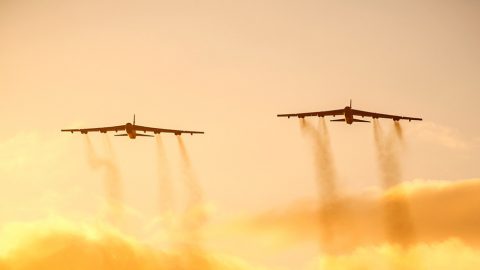
The US and NATO air forces have not only increased their surveillance activities along Russia’s borders, but now also routinely train for potential strikes on the country’s soil, Defense Minister Sergey Shoigu said.
Speaking to Russian TV on Sunday, Shoigu noted a sharp increase in foreign surveillance and training flights testing the country’s borders and air defenses. Last month such activities increased by some 30 percent compared to last August. Moreover, the bloc’s aircraft have been actively training in conducting air strikes, routinely performing mock missile launches on targets within the country, Shoigu revealed.
“The most alarming is that if earlier – even though not that frequently – there were mainly reconnaissance aircraft, they’ve now begun regular training flights with large numbers of planes, during which the mock missile strikes are conducted.”
Over the past few weeks, several incidents between Russian and NATO planes occurred in close proximity to the country’s borders. The latest took place Friday, when three nuclear-capable US Air Force B-52H strategic bombers approached Russia’s border through Ukrainian airspace. The bombers were intercepted by eight fighter jets and warned away from the border.
Another incident involving US strategic bombers occurred late in August, when a B-52H was intercepted by a Russian Su-27 fighter jet over the Baltic Sea. The altercation prompted a wider international scandal, as another NATO country – Denmark – claimed the Russian plane violated the country’s borders while chasing the US plane. Moscow, however, has firmly denied the accusations, insisting that the interception was made in accordance with all international rules.
Featured Video

AIDS Inc. by Gary Null (2007)
or go to
Aletho News Archives – Video-Images
From the Archives
Clash of Civilization, Iran Part II
By Jamal Kanj – Intifada-Palestine.com – January 14, 2011
Israel’s survival kit is: perpetuate conflict, insecurity to rationalize collective hate and finally playing victim.
Devoid of conflict, Israel implodes internally; without hate, Zionism loses its justification; and playing eternal victim to continue blackmailing the West. Absence of this holy trinity, Israel ceases to exist.
From its inception, the house of Zion has mastered exploiting adversarial powers to advance Israel’s cause. For instance, their influence over the Democratic Party in the US began with President Truman’s bid for 2nd term election in 1948.
Responding to strong opposition from Secretary of State General George Marshall and Department experts urging against recognition of Israel, President Truman replied: “I’m sorry gentlemen but I have to answer to hundreds of thousands [Jewish voters] who are anxious for the success of Zionism. I do not have hundreds of thousands of [voting] Arabs among my constituents”
Zionists influence over liberal American politics was matched with the doctrinal school of Conservative theoreticians aligning the Republican Party’s platform with Israel’s objectives. The Neoconservative Zionists, coined Zioncons, invented the “Clash of Civilization” concept to fight Israel’s wars. … continue
Blog Roll
 Aletho News
- Merck Virologists Admitted to Falsely Certifying Vaccine Efficacy
- Mandatory Folic Acid for every man, woman & child
- Pro-Palestine protesters arrested outside UK’s ruling Labour Conference in Liverpool
- Mauritius denies landing permit to flight from Israel, forcing cancellation: Tour operator
- Israeli finance minister calls for genocidal war on West Bank, annexation of south Lebanon
- 12 Things Your Psychiatrist Was Trained Not to Tell You
- From Unipolar Universalism to Multipolar Civilizational Distinctiveness
- RSF military group defects, joins Sudanese army: State media
- Ireland goalkeeper refuses to play ‘Israel’ as squad weighs boycott
- China pushes back against US on Cuba, Iran
- If Americans Knew
- Israel forces Gazans to live in constant peril – Daily Update
- Deconstructing Netanyahu’s pants-on-fire UN rant – Daily Update
- Trump betrayed voters with his campaign lies and prioritized a foreign country once he took office
- Netanyahu calls Israel’s war in Gaza ‘opposite of genocide’ in UN speech to near-empty hall
- Settler Kidnappings: Torture, Sexual Abuse and Terrorisation of Palestinian Abductees as Israel Deepens Annexation of West Bank
- Gaza winter nears as 162,000 tents become unusable, raising fears of humanitarian crisis
- Netanyahu says, “It’s the opposite of genocide”; UN says Gaza economy is world’s ‘most severe crisis on record’ – Daily Update
- Israel’s US-Backed Assault on Gaza Has Created the ‘World’s Most Severe Economic Crisis on Record’: UN
- ‘Protecting U.S. Citizens’… From Israel
- ‘This is where I live now, the back of a truck’: a day in the life of a grandmother in Gaza
- No Tricks Zone
- New Study: Earth And Venus Surface Warmth Largely Explained By Convection And Lapse Rate, Not CO2 Or Radiation
- 2025 Nature Paper Claiming Worsening Global Drought Gets RETRACTED …Heavily Flawed
- New Study: ‘Global Drought Shows No Detectable Recent Acceleration Under Climate Warming’
- Economic Masterminds: German Socialists Suggest Taxing Productivity Gains Stemming From Using AI
- The South China Sea Has Not Been Cooperating With The Climate Change Narrative
- Energy Crisis: Germany Enters Heating Season With Historically Low Gas Reserve Fill Levels
- New Study: The Antarctic Ice Sheet Gained Mass From 2020-2024 Due To Staggering Snow And Ice Accumulation
- Study: Ocean Heating Rates From Thousands Of Years Ago ‘Dwarf’ Modern Ocean Heating Rates
- Climate Extremists Target, Attack Large-Scale Power Grid Infrastructure In Germany!
- New Study: Antarctic Ice Melt Has Contributed Less Than 1 Centimeter To Sea Level Rise In The Last 30 Years

