10 Reasons Behind Most Chronic Health Issues
By Dr. Joseph Mercola | April 20, 2022
The 2015-2016 National Health and Nutrition Examination Survey (NHANES) recorded the highest rate of obesity ever documented by the survey — 39.6% of adults with obesity.1 Those numbers only continue to grow. The Centers for Disease Control and Prevention2 recorded 42.5% of adults 20 and over with obesity in 2017-2018.
When the percentage of people who are overweight is included, that percentage rises dramatically to 73.6% of the population. The adult obesity prevalence map3 shows the highest prevalence of obesity and overweight in the Midwest and southern states with greater than 40% of the population recorded as obese.
The exception is Florida, where the percentage of the population who are obese ranges between 25% and 30%. The greatest challenge to maintaining a healthy weight is your diet. There are other factors that contribute to weight gain, including a lack of physical activity.
But it’s important to recognize that you’ll never out-exercise a poor diet. So, it’s the first factor you should address if you want to maintain a healthy weight, which is important as obesity is one of the major triggers for preventable disease.4
According to the U.S. Centers for Disease Control and Prevention,5 6 of every 10 adults in the U.S. have at least one chronic health condition, such as heart disease, cancer or Type 2 diabetes. These are also the leading causes of death in the U.S.,6 and obesity and overweight are significant risk factors for them.7
One 10-year study8 showed there was a dose-response relationship between being overweight or obese and the development of several chronic health conditions including gallstones, type 2 diabetes, high blood pressure, colon cancer, and heart disease.
There are significant challenges within the food supply that make it more and more difficult each month for people to make healthy choices. @MrSollozzo from the Meat Mafia Podcast created an informative graphic tweet9 in which he lists many of the diet and food-related challenges faced by Americans today, such as:
1. 10 Companies Control Almost All Manufactured Food
Oxfam America is a nonprofit organization that focuses on the inequalities that drive poverty and Injustice. In 201410 they created a powerful graphic image demonstrating how 10 companies control nearly every food product and beverage you find in the grocery store. Between them, revenues add up to more than $1 billion every day.
These companies include CocaCola, Mars, Nestle, Kellogg, General Mills, Wrigley and Wonka. They have a vested interest in ensuring loyal customers and engaging new customers each year using advertising to promote their products as healthy, wise diet choices for foods or as a fun dessert splurge.
It is difficult for many to ignore the hot buttons11 they push in their advertising campaigns, which include featuring catchy packaging,12 funding nutrition studies13 and publishing enticing print and video campaigns.14
Advertising drives people’s preferences and eating habits, which supports a company’s financial return, and in turn, drives the obesity epidemic. If you think your hands are tied, though, you still have a voice in what these companies market as you can vote with your pocketbook by refusing to purchase their products.
2. 70% of All Crops Are Genetically Modified (GM)
When you’re looking through the produce aisle for tonight’s meal, consider the fact that nearly 70% of crops grown in the U.S. are from genetically modified seeds. According to data15 from the International Service for the Acquisition of Agri-biotech Applications (ISAAA) the most popular GM crops are soybeans, maize, cotton and canola.
Soybeans, corn and canola are products used in many processed and ultraprocessed foods on grocery store shelves. There are two types of genetically engineered seed: herbicide-tolerant (HT) and insect-resistant (Bt).16 The USDA finds the adoption rate for both is increasing, and the adoption of stacked seed varieties, which has both traits, has accelerated in recent years.
The implications for your health after exposure to GM plants are significant and tied to the use of the herbicide glyphosate,17 which has increased dramatically in the last 20 years.18 Your gut flora is extremely important to your health and is negatively impacted by glyphosate. Experts have tied exposure to glyphosate and GM plants to an imbalance in gut bacteria19 and a variety of chronic diseases, including obesity.20
3. Meat Packers Underpay Ranchers and Overcharge Consumers
In 2020, the Department of Justice began formally investigating antitrust violations of the four largest beef packers in the U.S.,21 following complaints from several states and agricultural organizations. The “Big 4” companies are Cargill, Tyson Foods, JBS and National Beef, and they are responsible for processing 85% of all beef made into steaks, roasts and other cuts.22
When hamburger is factored into the equation, the Big 4 processes 70% of beef production. The four firms gained greater control of the industry in the early 1990s when USDA data showed the market share of slaughtered animals rose from 25% in 1977 to 71% in 1992. Several incidents brought attention to the consolidation that gave just four companies controlling interest in the market.
Cattle ranchers are frustrated by the price drops they experience when a meatpacking plant closes, while the packing companies benefit from rising meat prices. In the short term, this impacts the rancher’s livelihood and ability to stay in business. In the long-term, rising prices at the grocery store from lower supply levels may move more people to purchase plant-based fake “meat”.
4. 70% of the American Diet Is Processed Food
When you investigate the links between obesity and chronic illness, roughly 70% of the crops grown in the U.S. are genetically modified; 73.6% of the population is overweight or obese;23 roughly 60% of the population has at least one chronic disease and, according to data from two studies,24,25 consumption of ultraprocessed and processed foods is just over 70% in the general population. There are well over 40,000 on grocery store shelves, with the majority being processed and ultraprocessed foods.26 One study27 found that 57.9% of foods eaten were ultraprocessed and contributed 89.7% of calories from added sugar. Data also show that an excess of sugar in the diet may lead to a decrease in satiety, an increase in calorie intake and impaired energy production in your body.28
One model tracked the link between rising sugar consumption and obesity rates, finding that “past U.S. sugar consumption is at least sufficient to explain adult obesity change in the past 30 years.”29
5. Doctors Have Become Legalized Drug Dealers
@MrSollozzo calls doctors “legalized drug dealers,”30 as many frequently overprescribe medications31 rather than help patients change lifestyle habits to avoid chronic disease. Examples can be found in patients who are overprescribed pain medication, proton pump inhibitors, antidepressants,32 antibiotics33 and medications to manage the side effects of other medications.34
This is a symptom of a larger condition in which a physician’s care appears to be highly influenced by the pharmaceutical industry and not by a focus on the prevention or treatment of physical conditions that include nutritional and lifestyle alterations.
6. Big Pharma Controls Agriculture and the Seed Supply
In the 1990s, laws were introduced to protect bioengineered crops. In 2021, four large corporations owned more than 50% of the world’s seeds, which is a staggering monopoly that dominates the global food chain.35 One of those companies is Bayer, which acquired Monsanto in 2018.36
Monsanto is an agrochemical and agricultural biotechnology company, owned by a pharmaceutical company that controls a significant portion of the world’s seed supply, namely GM seed.37 Essentially, this means that Monsanto controls the GE food you eat, and Bayer supplies you with the drugs you need to treat your chronic disease triggered by that food.
7. Government Policies Favor Corporate Farming
Earl Butz was secretary of the USDA in the 1970s. It was his vision to create a centralized food system which, as Grist writes, “plunged a pitchfork into New Deal agricultural policies that sought to protect farmers from the big agribusiness companies whose interests he openly pushed.”38 At the time he was appointed to the USDA, he had served as a board member for several large firms, including Ralston Purina.
Critics predicted that these ties might compromise his ability to function objectively, and the prophecy was fulfilled when he forced agribusiness and large farming conglomerates on the national interest. His legacy continues to thrive as small farmers are gradually forced out of business and large conglomerates buy up huge tracts of land, expanding the reach of GE produce and concentrated animal feeding operations (CAFOs).
Most people have likely never shaken the hand of their local farmer, who may sell produce and meat at local farmers markets, to small grocers or directly to you, the consumer. One of the best things about these local food suppliers is that they are incentivized to provide you with the best quality food to stay in business.
8. ‘Science’ Replaced Saturated Fat With Refined Sugar
Research known as the Seven Countries Study was conceived by the late Ancel Keys, a mid-20th century physiologist who promoted polyunsaturated fats over natural, saturated dietary fats.39 He launched the study in 1958 with the intent of identifying dietary patterns that impact heart disease.40
The results of the study changed government dietary recommendations for decades, with recommendations to eliminate saturated fats from your diet. Along with the addition of polyunsaturated fats to replace the missing natural fats, the food industry also added sugar and whole grains to the mix of processed foods meant to tempt your palate.
Yet, as science has demonstrated, this move has had a broad impact on health and instead of helping to decrease heart disease, actually increased many people’s risk of coronary heart disease as replacement leads to:41
“… changes in LDL, high-density lipoprotein (HDL), and triglycerides that may increase the risk of CHD.
Additionally, diets high in sugar may induce many other abnormalities associated with elevated CHD risk, including elevated levels of glucose, insulin, and uric acid, impaired glucose tolerance, insulin and leptin resistance, non-alcoholic fatty liver disease, and altered platelet function. A diet high in added sugars has been found to cause a 3-fold increased risk of death due to cardiovascular disease.”
As a result of the new processed foods, average Americans developed a sweet tooth so strong that many experts believe they are consuming as much as 130 pounds of sugar each year.42,43,44 Sugar has become so cheap and ubiquitous, that it’s in nearly every processed and ultra-processed food.
9. Natural Fats Replaced With Factory-Produced Vegetable Oils
According to the USDA, consumption per year of added fat and oil rose by 30 pounds from 1970 to 2010. However, the amount of saturated animal fat declined while the rate of vegetable fat from seed oils increased.45 These are industrial vegetable and seed oils that are likely behind the majority of diseases diagnosed in this past century.
The number of people diagnosed with heart disease, cancer, high blood pressure, diabetes, obesity, metabolic syndrome, Alzheimer’s disease and stroke has all risen dramatically in the last decades and they all are linked to the consumption of seed oil.
In a 45-minute presentation titled, “Diseases of Civilization: Are Seed Oil Excesses the Unifying Mechanism?” Dr. Chris Knobbe reveals startling evidence that seed oils, so prevalent in modern diets, are the reason for most of today’s chronic diseases.46
His research indicts the high consumption of omega-6 seed oil in everyday diets as the major unifying driver of the chronic degenerative diseases of modern civilization. He calls the inundation of Western diets with harmful seeds oils “a global human experiment … without informed consent.”47
10. Fake Meat Plant Foods Sold as Healthier Choice
Although many fake meat products are sold as a healthier choice for you and the environment, it turns out that this is yet another smokescreen to control the food supply. As meat prices rise, more people may consider a choice they may not have before: to eat fake meat.
Total revenues for the plant-based Beyond Meat brand have grown steadily from $16.2 million in 2016 to $87.9 million in 201848 and exceeded expectations in 2020, hitting $406.8 million.49 The rising market share is a testament to how well their branding and advertising has convinced the public that they are healthier than pure animal protein.
Yet, it’s widely known that ultraprocessed foods are the enemies of good health, even increasing the risk of premature death by 62% when eaten in quantities of more than four servings each day, with each added serving increasing the risk by another 18%.50
So what is plant-based “meat,” anyway? “It’s not food; it’s software, intellectual property — 14 patents, in fact, in each bite of Impossible Burger with over 100 additional patents pending for animal proxies from chicken to fish,” says Seth Itzkan, environmental futurist and cofounder and co-director of Soil4Climate.51
He suggests fake meat products are destroying the environment by perpetuating a harmful reliance on genetically engineered (GE) grains while accelerating soil loss and detracting from regenerative agriculture.
Buyer Beware
Controlling the food supply is one more way of controlling your health and your future. With every passing year, it becomes more important to be aware of the food choices you make each day as they impact your health and wellness.
Your nutrition dictates how well your body works, and therefore how well you feel each day. As summer approaches, make a commitment to make smart choices for your health and visit local farmers markets for produce, seek out regeneratively-grown produce, meat and dairy products and consider buying your meat and dairy directly from local farmers.
Sources and References
- 1 Trust for America’s Health, The State of Obesity 2018
- 2 Centers for Disease Control and Prevention, Obesity and Overweight
- 3 Centers for Disease Control and Prevention, Adult Obesity Prevalence Map
- 4 Polish Journal of Food and Nutrition Science, 2019;69(3)
- 5 Centers for Disease Control and Prevention, March 21, 2022
- 6 Centers for Disease Control and Prevention, Leading Causes of Death
- 7 University of Mississippi Medical Center, Obesity and Chronic Disease
- 8 JAMA, 2001;161(13)
- 9, 30 Twitter, MrSollozzo, April 11, 2022
- 10 Oxfam America, December 10, 2014
- 11 Zen Business, Hot Button Marketing
- 12 Nutrients, 2019;11(5)
- 13 BMJ, 2020;371
- 14 Pan American Health Organization, Marketing of Ultra-processed and Processed Food and Non-alcoholic Drink Products
- 15 International Service for the Acquisition of Agri-biotech Applications, July 23, 2018
- 16 USDA, Recent Trends in GE Adoption
- 17 Environmental Health, 2016;15(19)
- 18 Environmental Sciences Europe, 2016;28(3)
- 19 Neurotoxicology, 2019;75:1
- 20 Impact of Genetically Modified Organisms on Environment and Health, 2021
- 21 Bloomberg, June 4, 2020
- 22 Reuters, June 17, 2021
- 23 CDC Obesity and Overweight September 10, 2021
- 24, 27 BMJ Open, 2016;6:e009892
- 25 American Journal of Clinical Nutrition, 2021;115(1)
- 26 Troy Media, December 26, 2019
- 28 BMJ Open Heart, 2016;3:e000469
- 29 Economics & Human Biology, 2020;36(100818)
- 31 StatNews, April 2, 2019
- 32 Journal of Clinical Medicine Research, 2019;11(9)
- 33 Centers for Disease Control and Prevention, May 3, 2016
- 34 BBC, September 22, 2021
- 35 DW, August 4, 2021
- 36 Fierce Pharma, August 29, 2019
- 37 Leaders in Wildlife Conservation, March 30, 2021
- 38 Grist, February 8, 2008
- 39 Seven Countries Study, Ancel Keys, top paras
- 40 Seven Countries Study, About the Study, para 1
- 41 Progressive Cardiovascular Disease, 2016;58(5) Abstract
- 42 Smithsonian, May 2017
- 43 Daily Health Post, July 25, 2019
- 44 DailyInfographic, March 25, 2015
- 45 USDA, January 2017
- 46 YouTube, June 13, 2020
- 47 YouTube, June 13, 2020, minute 10:36
- 48 Forbes August 28, 2020
- 49 Beyond Meat 2020 Financial Results February 25, 2021
- 50 BMJ 2019;365:l1949
- 51 Medium, May 25, 2020
EAT-Lancet Report is One-sided, Not Backed by Rigorous Science
Nutrition Coalition | January 29, 2019
[…]
Report Based on Fundamentally Weak Science
This report is disturbing on a number of fronts. Most importantly, its diet lacks the backing of any rigorous science. Indeed, it does not cite a single clinical trial to support the idea that a vegan/vegetarian diet promotes good health or fights disease. Instead EAT-Lancet relies entirely on a type of science that is weak and demonstrably unreliable, called epidemiology. This kind of science has been shown to be accurate, when tested in rigorous clinical trials, only 0-20% of the time.[1][2] One wouldn’t bet on a football team with such poor odds, so why bet on the public health this way?
Even the most recent U.S. Dietary Guidelines Advisory Committee, which clearly favored a vegetarian diet and recommended it to the entire U.S. public, found, in their review of the scientific evidence, that the power of this diet to fight any nutrition-related disease was “limited”— the lowest rank given for available data.
In the same vein, there is no rigorous (clinical trial) data on humans to show that red meat causes any kind of disease. This data can been seen in a 2-pager that The Nutrition Coalition published last week, in tandem with the EAT-Lancet report.
A One-sided Commission and No Disclosure of Potential Conflicts of Interest
The EAT-Lancet commission was portrayed as the product of 37 scientists from around the world. However, in reality, the authors represented a very narrow range of opinions: 31 out of the 37 (>80%) had established published records as being in favor of vegetarian/vegan or anti-meat diets. This includes seven from a Stockholm think tank (and EAT co-founder) dedicated to reducing/eliminating meat for environmental reasons. Thus, although readers are given the impression that the EAT authors have been objectively convened to comprehensively evaluate the science, the reality is that this group was one-sided from the start. Instead of grappling with the very real scientific controversies that exist on these topics, the group considered virtually none of the science that contradicts their views.
On diet and health, the lead commissioner was Walter Willett, professor at the Harvard Chan School of Public Health, and his extensive, significant potential conflicts of interest are published in a separate, 8-page document here.
It is also a matter of concern that none of the authors’ potential conflicts of interest were disclosed by The Lancet, an apparent violation of its standard disclosure policies.
The EAT Diet is Nutritionally Insufficient…
The EAT-Lancet diet is not only nutritionally deficient, it has been likened by some observers to the macrobiotic fad diets popular in the 1970s that resulted in severe protein and nutritional deficiencies.
UK researcher Zoe Harcombe, Ph.D., analyzed the EAT-Lancet diet and found it to provide only 17% of retinol (needed for eye health), 5% of our Vitamin D needs, 22% of sodium, 67% of potassium, 55% of calcium, and 88% of iron. Yet low as these numbers are, they would be worse still if one were to factor in the reality that most of these nutrients are less “bio-available” to humans when consumed from plant rather than animal sources.
The EAT diet is also deficient in Vitamin B12, which can only be obtained from animal foods. EAT’s note in the table below states that animal sources of protein can equally well be replaced with “plant proteins” but does not note that doing so would make the diet far more deficient in B12, which is crucial for the healthy growth and cognitive development of children, as well as the ongoing health of adults.
Thus, this diet is fairly sure to lead to malnutrition and ill health. Read Harcombe’s blog post on the subject here.
… And Inadequate in Protein
EAT-Lancet recommends .8g protein per kilogram of body weight, but many populations, including children, the overweight/obese, and most people over age 40, need more. Thus, the EAT-Lancet diet overlooks the majority of the world’s population.
EAT-Lancet also recognizes that animal foods contain the most complete proteins, ideal for human growth and health yet does not recommend that people consume these superior proteins in significant amounts. Instead, EAT recommends incomplete plant protein sources, such as beans and nuts.
Dietician and Nutritionist Diana Rodgers, points out in a blog post that in addition to being less complete, plant sources of protein come at a high cost, namely much higher calorie counts. She writes,
“To get the same amount [30 grams] of protein in a 4oz steak (181 calories) you’d need to eat 12oz of kidney beans (almost one pound!) plus a cup of rice, which equals 638 calories, and 122g of carbs.
“What about nuts? To get the 30g of protein from almonds, you would need to consume a little over 1 cup of chopped almonds, which is over 850 calories and 75g of fat. YIKES!”
The EAT Diet
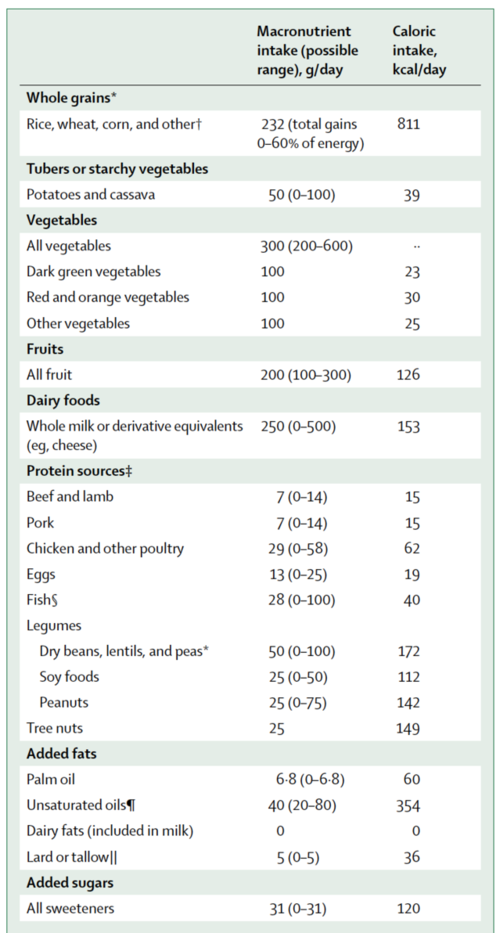
This Report is Not for Children, Teen Girls, the Aged, Malnourished, etc…And For Everyone Else, You Still Need to Buy Supplements
Georgia Ede, MD, in Psychology Today, digs into the report and uncovers a number of uncomfortable facts.
Among her findings:
—Although the report says complete proteins cause cancer, it provides no evidence for that statement.
—And:
“The authors admit that it [the report] falls short of providing proper nutrition for growing children, adolescent girls, pregnant women, aging adults, the malnourished, and the impoverished — and that even those not within these special categories will need to take supplements to meet their basic [nutritional] requirements.”
EAT Diet Recommends A Fudge Pop Tart’s Worth of Sugar/Day?
One would think from the report’s language that its recommendations are all about eating more fruits, vegetables, and whole grains, but in fact, EAT advises:
—Only 3% of calories from vegetables. Add the “potatoes/cassava” category, and the total creeps up to 5%
—Only 5% of calories from fruit
This does not appear to be a “more fruits and vegetables” report.
Rather, EAT promotes 8 teaspoons of sugar a day, which is about the equivalent of a fudge pop tart.
It also promotes 14% of calories as “unsaturated fats” which are defined as equal amounts of “olive, soybean, rapeseed, sunflower, and peanut oil.” Other than olive oil, these are all unnatural, industrial products that only entered the food supply about a century ago. Fourteen percent of calories in vegetable oils is far more than the average American now consumes.
Mostly, EAT recommends massive amounts of grains (rice, wheat, corn, soy, etc). According to EAT, these should comprise fully one third, or 32% of daily calories. Some 51% of a person’s daily calories should be consumed as carbohydrates, says EAT, according to Harcombe’s calculations.
Thus, we have a report recommending lots of wheat, rice, corn, soy and more sugar than most national guidelines. This diet is virtually toxic to people with diabetes or pre-diabetes and dangerously high in sugars for people struggling with obesity, heart diseases, fatty liver disease and other nutrition-related conditions.
If not for the public health, then whom does this diet serve?
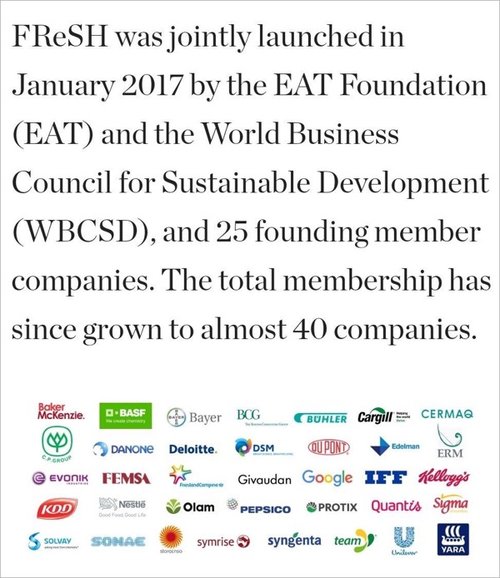
The Corporate Interests Behind EAT-Lancet
EAT-Lancet was launched simultaneously in 40 cities with a massive PR budget. Who funded all this? All we know is that EAT has an extensive array of corporate partnerships.
Tim Rees of Nutritional Therapy Online created a table of all the EAT-Lancet corporate funders. These include;
—Seven Big Pharma companies, with drugs for many nutrition-related diseases
—About 20 Big Food companies, including Kellogg’s, Nestle, and PepsiCo.
Note that the companies selling highly processed foods, like Nestle and Kellogg’s are essentially vegan. The vast majority of packaged foods sold on the inner aisles of supermarkets—cookies, crackers, chips (crisps), candy, cereals—are made up of the same basic ingredients: soy, corn, grains, sugars, and salt. This is vegan. These companies would presumably like nothing more than to put a big green V on their packages to give them a reason to advertise their foods as healthy.
Meanwhile, the pharmaceutical companies profit from selling drugs, insulin, and devices that sick people need. Would these companies be backing EAT if this diet were to genuinely improve health, reduce disease, and thus, shrink their profits? It’s hard to imagine.
Moreover, also supporting the EAT-Lancet report are:
—14 chemical companies, including BASF, the “world’s largest chemical company.”
What is the interest of these companies in supporting a report targeting animal agriculture as the main driver of global warming if not—perhaps—to displace attention away from their own polluting activities? Or perhaps they make the pesticides that grow crops.
One cannot know the answer to all these questions, but the massive level of corporate backing clearly raises serious questions about the interests behind this report, especially when there is no rigorous evidence to support the idea that this diet promotes human health and quite a bit of evidence to show that it causes harm.
The Globe-Trotting Billionaires Behind the Report
The founder and executive chair of EAT, vegan Norwegian billionaire, Gunhild Stordalen, says she has a passion for preventing climate change. Shortly after publication of EAT-Lancet, however, she was revealed to be the owner of a $26 million private jet which she and her husband regularly fly to exotic locations around the world—thus emitting vast amounts of their own greenhouse gasses (GHG) and causing some observers to wonder if Stordalen was unwittingly enacting a modern-day version of “let them eat cake.”
The Mirror UK published, “Globe-trotting billionaire behind campaign to save planet accused of blatant hypocrisy.”
On Twitter, one observer did some calculations:
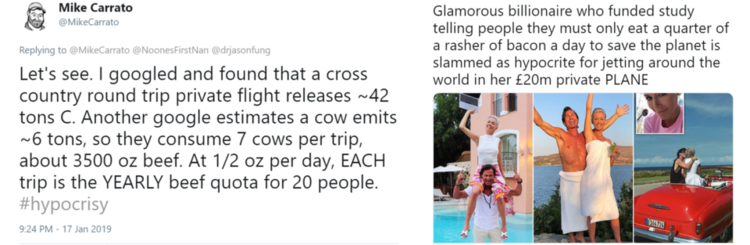
Thanks to Belinda Fettke and her article for this find.
One could ask, further, about the GHG emitted by the whole EAT-Lancet project. Thirty-seven authors from 16 countries were gathered together for at least two scientific meetings, followed in 2019 by at least 5 “launch” meetings by the Commission, as well as a further massive roll-out last week in 35 sites worldwide.
A second EAT-Lancet paper, released January 27th, involved 43 authors from countries around the globe, who were gathered for 9 “workshops” and 3 meetings in various locations worldwide. How much GHG was required to enable all this travel?
Although many researchers claim that planes, trains, and automobiles do not produce as much greenhouse gases as do cows, there are contrary views on this topic. For instance, as the Food and Agriculture Organization recently pointed out, the GHG of livestock have been calculated to include both direct and indirect costs, whereas the transport sector has been analyzed looking only at direct costs. I’m not an expert in the environmental issues here, but this does seem like a worrisome oversight.
One Other Significant Funder of EAT-Lancet: The Wellcome Trust
Among the complex network of funders behind EAT, the Wellcome Trust is a principal one, for the report’s scientific component (as opposed to the worldwide PR). The trust, with $29.2 billion in assets, is funded by the Wellcome family and its pharmaceutical fortune. This family also has a three-generation history in the 7th Day Adventist Church, including a member—the father of the trust’s founder—who was a church elder. The 7th Day Adventist Church promotes vegetarianism as part of its religious beliefs and has pursued an aggressive mission to spread these beliefs and practices around the world. This raises the disturbing question of whether a religious agenda might be informing the EAT-Lancet report.
EAT-Lancet Aggressive in its Policy Recommendations: Wants Near-Vegan Diet for All
EAT-Lancet states that “the scale of change to the food system is unlikely to be successful if left to the individual or the whim of consumer choice.” [Emphasis added.] Thus, the report advocates:
“hard policy interventions include laws, fiscal measures, subsidies and penalties, trade reconfiguration, and other economic and structural measures…. [C]ountries and authorities should not restrict themselves to narrow measures or soft interventions. Too often policy remains at the soft end of the policy ladder.”
Because meat taxes seems to be the intervention of choice, stay tuned for those… and other measures intervening in our daily choices about what to eat.
There’s a Better, Evidence-based Way Forward
In all, EAT-Lancet has every indication of being the product of international industrialist interests, from processed food companies, whose products provoke nutrition-related diseases, to pharmaceutical companies, whose profits are fueled by those diseases, to the world’s chemical companies, whose interests in environmental well-being are elusive. The common cause of these industries appears now to be scapegoating meat for all environmental and health ills. And they have found willing advocates in the committed, idealistic vegans and environmentalists who deeply believe in these solutions.
We should return to the fundamentals of good science. Establishing policy based on weak science leads to unintended consequences as we’ve seen time and again—with the mistaken policies recommending hormone replacement therapy, caps on cholesterol, and more. Such policies actually ended up causing far more harm than good, as the EAT diet seems bound to do.
What does the rigorous science say about the best way to reverse the epidemics of obesity and diabetes (and more) now crippling our nations? The rigorous evidence does not support a near-vegan diet. The answer must include animal foods, since they naturally contain the nutrients needed for healthy human growth and development.
Our way forward should be to gather a group of experts who could objectively identify the rigorous clinical trial data on healthy diets, and then work together to make those diets sustainable.
Footnotes:
[1] 0%, analysis specifically of nutritional epidemiology: https://rss.onlinelibrary.wiley.com/doi/pdf/10.1111/j.1740-9713.2011.00506.x
[2] 20%: https://www.ncbi.nlm.nih.gov/pubmed/16014596
Venezuela Promotes Breastfeeding over Baby Food, Corporate Media Spins Out of Control
By Tamara Pearson | Venezuelanalysis | June 20, 2013

A Venezuelan public media journalist breastfeeds as she works. Public breastfeeding is fairly accepted in Venezuela (blog.chavez)
Venezuela’s national assembly is debating a reform to its breastfeeding law which could see baby food companies like Nestle fined in certain situations. The corporate media have reacted hysterically to the law, claiming that President Nicolas Maduro is “taking bottles from babies’ mouths”.
Though breastfeeding is widely promoted by the Venezuelan government, and public breastfeeding is relatively de-stigmatised, a study by Venezuela’s National Nutrition Institute (INN) between 2006 and 2008 showed that only 55% of mothers exclusively breastfed when their baby was born, going down to 20% when their baby was three months old, and 11% by six months.
The percentages have probably increased since then, with broad educational campaigns in public schools and health centres, and actions such as mass public breastfeeding in plazas, organised by the INN.
However, the low figures reflect the low confidence some mothers have in their ability to breastfeed, as well as the power of multinational infant formula companies in health centres. It is common practice to give infant formula to babies from the moment they are born, without the consent of parents, according to LactArte, a pro-breastfeeding collective in Venezuela. Companies give gifts and other promotions to health workers and health centres in order to create alliances with them, and give free samples of the products to new mothers, thereby creating dependent consumers of new born babies, or at least discouraging exclusive breast feeding.
What the law actually says
In 2007 Venezuela’s national assembly passed the Law of Protection, Promotion, and Support for Breastfeeding. The law regulates the way baby formula and baby food companies advertise and label their products, and how they interact with hospitals and clinics. However, the companies have been ignoring the law, as it doesn’t specify penalties. The reform to the law currently being discussed is looking at penalties of US$600 – $50,000, and also training for health professionals. Once the reform is passed in first discussion by the assembly, it will be subject to “street parliament” – discussion by collectives and Venezuelan citizens, to then be passed by the national assembly in second discussion.
The 2007 law argues that breastfeeding provides babies with “all the necessary nutrients” in their first six months, as well as “protecting them and immunising them from illness and contributing to the development of their breathing and gastrointestinal capacity”. It states that “mothers have the right to breastfeed their children, with the support and collaboration of the fathers… [who] should provide all the support necessary so that mothers can provide this human right… The state, with solidarious participation from organised communities, will promote, protect, and support exclusive breastfeeding…of children under six months of age and breastfeeding with complementary food … until the age of two”.
Concretely under the law, health workers and health centres must help mothers start breastfeeding within the first half hour of birth, and guarantee that the newborn is always near the mother after birth, except in exceptional medical situations. They should also educate mothers, fathers, and the family on the issue, and abstain from providing babies under the age of 6 months with food other than breast milk, except when there is a specific medical need. Health centres must create human milk “banks”.
Baby food and formula products must be in Spanish or Venezuelan indigenous languages (Nestle products for example, often aren’t), and they should inform of the risks of including such food in the baby’s diet too early. Publicity or labelling can’t create the impression that such food is equal to breast milk, and publicity of any kind discouraging breastfeeding is not allowed.
All food aimed at children under three must include labelling that clearly states its ingredients, including any GMO products, and milk formulas must including a warning that “breast milk is the best food for children under two years old”.
Samples, prizes, and promotions of baby food and formula are prohibited. Likewise, companies are prohibited from donating toys, books, posters or other products which promote or identify their company to health centres, and they are also prohibited from donating “gifts” to health centre workers and from sponsoring events or campaigns aimed at pregnant or breastfeeding women, fathers, health professions, families, and communities.
Breastfeeding rights in Venezuela
Last year, with the passing of the new labour law, women’s breastfeeding rights were further expanded. Post-natal leave was extended to six months, and articles 344-352 state that mothers have the right to two half hour breaks per day to breastfeed. If there is no breastfeeding room provided by the work place, that is extended to two 90 minute breaks, and all employers of more than 20 workers must maintain a nursery centre with a breastfeeding area.
For Luisa Calzada and Kaustky Garcia, of LactArte, breastfeeding is also an act of food sovereignty – that is, third world productive or economic independence from greedy transnationals. Garcia argued that such sovereignty has been “sabotaged” in Venezuela by the “transnational industry dedicated to the business of infant formulas”. Indeed the industry is huge here – visit any supermarket or corner shop and you’ll see full aisles or shelves of powdered baby milk formula and compote.
LactArte supports a boycott of Nestle, one of the main powdered milk formula companies here, producing the infamous Cerelac since 1886. They argue that there is“collusion” between the baby food industry and the medical industry, with the food transnationals enlisting an “army of health professionals” to sell baby formula.
According to Business Insider, infant formula is an $11.5 billion market. The International Baby Food Action Network (IBFAN) claims that Nestle, apart from distributing free samples of its products in maternity wards, also uses “humanitarian aid” to create markets, and offers gifts and sponsorship to influence health workers to promote its products. According to a 1982 New Internationalist article, Nestle makes mostly third world mothers dependent on its formula in three ways: “Creating a need where none existed, convincing consumers the products are indispensable, and linking products with the most desirable and unattainable concepts- then giving a sample”.
What the corporate media are saying
The 2007 law and the draft reforms do not ban the production or sale of baby food or formula, as national and international media have alleged, nor do they apply any fines to mothers or penalise any choices regarding her body that a mother may make. The penalties are only for health care centres and their workers, and baby food and formula companies.
However the corporate media over the last two weeks has completely distorted the issue. Fox News Latino headlined “Venezuela Wants To Ban Baby Bottles To Promote Breast-Feeding” and stated that “Motherly love has become a state affair in Venezuela”.
Growing Your Baby also headlined “Venezuela considering baby bottle ban”, and opened with the utterly misinformed and misleading question, “What would you do if you woke up one morning and learned that baby bottles were no longer being made or sold in your country? This question may become a reality for Venezuelan moms who may not have planned on breastfeeding”.
Reuters won the prize however for manipulation and sensationalism, with the headline “Venezuela considers taking bottles from babies’ mouths”, while other agencies have carried similar titles along the “banning” theme, with CNN’s article “Venezuela considering a ban on baby bottles” and Huffington Post ‘Venezuela considers baby bottle ban to encourage breastfeeding’. Al Jazeera went as far as to argue in its piece that “some mothers don’t want the government telling them how to feed their children”. If Al Jazeera had bothered to read the 2007 law, it would have discovered that is actually the point of the law – to stop companies interfering, through misleading information and other gimmicks, in the breastfeeding process.
Venezuelan corporate press and other Spanish language media have been equally manipulative. Here is a small selection of their headlines: EFE: “Venezuela is debating a law to prohibit baby bottles”, Semana: “Baby bottle and dummy: the new enemies of Chavismo”, El Pais: “The Venezuelan government wants to oblige mothers to breastfeed”, El Popular: “Venezuela: Nicolas Maduro wants to eliminate the use of baby bottles”, Noticias24 “They’ll prohibit baby bottles in health centres of Venezuela in order to force breastfeeding”, El Mundo, “Venezuela declares war on the baby bottle”, and Entornointeligente, “Goodbye to baby bottles for stimulating breastfeeding”.
Garcia argued that the media campaign to demonise the law and the proposed reforms is being pushed by the milk formula industry. She said it has had an impact in Venezuela, with “many women, even those not using baby bottles, feeling scared”.
“They are worried that the government is going to try to help them to breastfeed, that the government will take away their baby bottles and infant formulas, and is going to prohibit them from feeding their infants with baby bottles, but that’s absolutely false. First of all it’s unpractical, and secondly it is this government which has most given freedom and provided information so that families can freely chose the path they desire for their children,” she said.
The World Health Organisation recommends that babies be exclusively breast fed during the first six months, and in 1981 the 34th World Health Assembly adopted a resolution which included the International Code of Marketing Breast-Milk Substitutes. Funnily enough, it stated that food companies shouldn’t promote their products in hospitals, give free samples to mothers, or provide misleading information. One wonders if these international bodies were also accused of “stealing the bottle from babies mouths”, or is that sort of rubbish reserved for countries like Venezuela where a revolution is trying to get some justice at the expense of the poor transnationals?
Featured Video

John Mearsheimer: US Already lost Iran war – No off-ramp in sight
or go to
Aletho News Archives – Video-Images
Frlom the Archives
70 Neocons Petition Congress To Effectively Allow Israel To Say When The US Should Attack Iran
By Damian Lataan | January 10, 2014
Seventy senior Israeli-centric neoconservatives have written an open letter to Congress imploring them to do more to ensure Iran complies with the conditions of any agreement finally reached with the P5+1 over Iran’s nuclear program.
While the neocons are ostensibly asking Congress to ensure compliance, it is clear that their real aim is to convince members of Congress to support the bill currently passing through the Senate which calls for tighter sanctions against Iran in the event of any waywardness on Iran’s part.
The neocons are eager to see the bill currently passing through the Senate with enough support to make it veto-proof, not so much because they are concerned about Iran’s so-called nuclear weapons program – there’s still not a skerrick of hard evidence that Iran has a nuclear weapons program – but, rather, because embedded within the bill is this clause:
… if the Government of Israel is compelled to take military action in legitimate self-defense against Iran’s nuclear weapon program, the United States Government should stand with Israel and provide, in accordance with the law of the United States and the constitutional responsibility of Congress to authorize the use of military force, diplomatic, military, and economic support to the Government of Israel in its defense of its territory, people, and existence…
Essentially, the clause is an automatic trigger for the US to attack Iran at any time the Israelis choose to launch a first strike – regardless of whether President Obama is in favour or not.
Partial list… continue
Blog Roll
 Aletho News
- UK Parliament Plans ISP Blocking and Age Verification Powers
- World cannot remain silent as US and Israel attack ‘heritage of humankind’: Iran
- Emirati billionaire rebukes US senator over call for Gulf states to join war with Iran
- Op. True Promise 4: Iran’s missile blitzkrieg dismantles US war machine in West Asia
- Aramco CEO warns ‘catastrophe’ imminent if Strait of Hormuz remains shut
- What If Iran Says No?
- Trump Threatens to ‘Hit’ Iran ‘Twenty Times Harder’ Over Strait of Hormuz Oil Flows
- Spare the hypocrisy: Baghaei slams Ursula’s support for US
- Iran War Supporters Invent a New and Absurd Justification: It Is All About China
- Corporate Media Go All Out To Support The US-Israeli War on Iran
- If Americans Knew
- Israel Decided the War, But Trump’s America Fights and Pays the Bill
- Conscientious Objector Group: Phone ‘Ringing Off Hook’ As Huge Mobilization Underway
- U.S. support for Israel continues to plummet, despite media’s best efforts
- Threats and missiles fly, death tolls soar in Iran, Lebanon, Gaza – Not a ceasefire Day 151
- Lebanon: Israel’s White Phosphorous Use Risks Civilian Harm
- Corporate Media Go All Out To Support The US-Israeli War On Iran
- US-Israel war on Iran is creating a steady growing number of amputees
- Israel planned this war on Iran for 40 years. Everything else is a smoke screen
- The wrong question about the war in Iran
- ‘Your Tax Dollars Being Used to Raise Your Gas Prices’: US-Israel Bomb Major Iranian Oil Depots
- No Tricks Zone
- Wake-up Call: Survey Shows Majority Of Germans Now Favor Postponing Climate Targets!
- Televised! Leading German Political Candidate Tells Schoolchildren CO2 Makes Sun Hotter!
- New Study: A Century Warming Of 1.1°C Is ‘Commonplace’ And ‘Not Unusual’ During This Interglacial
- New Study: ‘Internal Noise’ And Volcanic Forcing Can Trigger 10-15°C Warming Within Decades
- Glaciers Worldwide Are Suddendly Surging, Experts Blame Warming!
- Surprising Discovery: Sahara Is Greening…Billions Of Trees Where Once Thought To Be Barren
- New Research Reaffirms Clouds, Aerosols, And Surface Solar Radiation Are ‘Driving The Climate System’
- Germany: Electric Car Catches Fire At Charging Station, Sets Off Local “Inferno”, Widespread Damage
- New Study: Canada’s New Brunswick Was 1°C Warmer Than Today During The Medieval Warm Period
- Coal Power Back In Trend As Globe Tries To Keep Pace With Growing Demand For Power
 Aletho News