Powell & Iraq—Regime Change, Not Disarmament: The Fundamental Lie
By Scott Ritter – Consortium News – July 18, 2020
The New York Times Magazine has published a puff piece soft-peddling former Secretary of State Colin Powell’s role in selling a war on Iraq to the UN Security Council using what turned out to be bad intelligence. “Colin Powell Still Wants Answers” is the title of the article, written by Robert Draper. “The analysts who provided the intelligence,” a sub-header to the article declares, “now say it was doubted inside the CIA at the time.”
Draper’s article is an extract from a book, To Start a War: How the Bush Administration Took America into Iraq, scheduled for publication later this month. In the interest of full disclosure, I was approached by Draper in 2018 about his interest in writing this book, and I agreed to be interviewed as part of his research. I have not yet read the book, but can note that, based upon the tone and content of his New York Times Magazine article, my words apparently carried little weight.
Regime Change, Not WMD
I spent some time articulating to Draper my contention that the issue with Saddam Hussein’s Iraq was never about weapons of mass destruction (WMD), but rather regime change, and that everything had to be viewed in the light of this reality—including Powell’s Feb. 5, 2003 presentation before the UN Security Council. Based upon the content of his article, I might as well have been talking to a brick wall.
Powell’s 2003 presentation before the council did not take place in a policy vacuum. In many ways, the March 2003 U.S.-led invasion and subsequent occupation of Iraq was a continuation of the 1991 Gulf War, which Powell helped orchestrate. Its fumbled aftermath was again, something that transpired on Powell’s watch as the chairman of the Joint Chiefs of Staff in the administration of George H. W. Bush.
Powell was part of the policy team that crafted the post-Gulf War response to the fact that Iraq’s president, Saddam Hussein, survived a conflict he was not meant to. After being labeled the Middle East equivalent of Adolf Hitler whose crimes required Nuremburg-like retribution in a speech delivered by President Bush in October 1990, the Iraqi President’s post-conflict hold on power had become a political problem for Bush 41.
Powell was aware of the CIA’s post-war assessment on the vulnerability of Saddam’s rule to continued economic sanctions, and helped craft the policy that led to the passage of Security Council resolution 687 in April 1991. That linked Iraq’s obligation to be disarmed of its WMD prior to any lifting of sanctions and the reality that it was U.S. policy not to lift these sanctions, regardless of Iraq’s disarmament status, until which time Saddam was removed from power.
Regime change, not disarmament, was always the driving factor behind U.S. policy towards Saddam Hussein’s Iraq. Powell knew this because he helped craft the original policy.
I bore witness to the reality of this policy as a weapons inspector working for the United Nations Special Commission (UNSCOM), created under the mandate of resolution 687 to oversee the disarming of Iraq’s WMD. Brought in to create an intelligence capability for the inspection team, my remit soon expanded to operations and, more specifically, how Iraq was hiding retained weapons and capability from the inspectors.
SCUDS
One of my first tasks was addressing discrepancies in Iraq’s accounting of its modified SCUD missile arsenal; in December 1991 I wrote an assessment that Iraq was likely retaining approximately 100 missiles. By March 1992 Iraq, under pressure, admitted it had retained a force of 89 missiles (that number later grew to 97).
After extensive investigations, I was able to corroborate the Iraqi declarations, and in November 1992 issued an assessment that UNSCOM could account for the totality of Iraq’s SCUD missile force. This, of course, was an unacceptable conclusion, given that a compliant Iraq meant sanctions would need to be lifted and Saddam would survive.
The U.S. intelligence community rejected my findings without providing any fact-based evidence to refute it, and the CIA later briefed the Senate that it assessed Iraq to be retaining a force of some 200 covert SCUD missiles. This all took place under Powell’s watch as chairman of the Joint Chiefs.
I challenged the CIA’s assessment, and organized the largest, most complex inspection in UNSCOM’s history to investigate the intelligence behind the 200-missile assessment. In the end, the intelligence was shown to be wrong, and in November 1993 I briefed the CIA Director’s senior staff on UNSCOM’s conclusion that all SCUD missiles were accounted for.
Moving the Goalposts
The CIA’s response was to assert that Iraq had a force of 12-20 covert SCUD missiles, and that this number would never change, regardless of what UNSCOM did. This same assessment was in play at the time of Powell’s Security Council presentation, a blatant lie born of the willful manufacture of lies by an entity—the CIA—whose task was regime change, not disarmament.
Powell knew all of this, and yet he still delivered his speech to the UN Security Council.
In October 2002, in a briefing designed to undermine the credibility of UN inspectors preparing to return to Iraq, the Defense Intelligence Agency trotted out Dr. John Yurechko, the defense intelligence officer for information operations and denial and deception, to provide a briefing detailing U.S. claims that Iraq was engaged in a systematic process of concealment regarding its WMD programs.
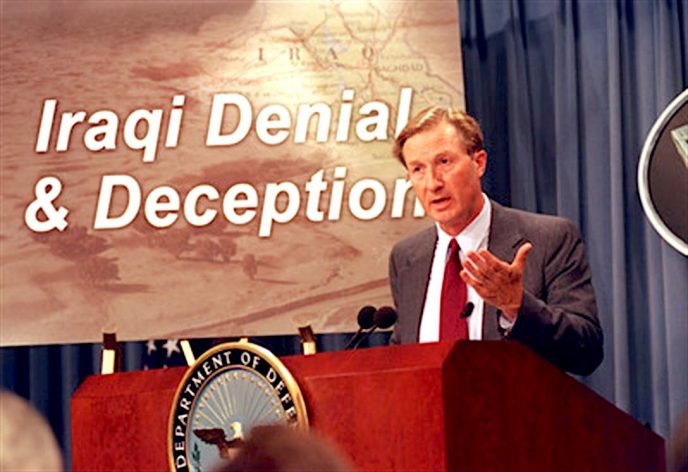
John Yurechko, of the Defense Intelligence Agency, briefs reporters at the Pentagon on Oct. 8, 2002 (U.S. Defense Dept.)
According to Yurechko, the briefing was compiled from several sources, including “inspector memoirs” and Iraqi defectors. The briefing was farcical, a deliberate effort to propagate misinformation by the administration of Bush 43. I know—starting in 1994, I led a concerted UNSCOM effort involving the intelligence services of eight nations to get to the bottom of Iraq’s so-called “concealment mechanism.”
Using innovative imagery intelligence techniques, defector debriefs, agent networks and communications intercepts, combined with extremely aggressive on-site inspections, I was able, by March 1998, to conclude that Iraqi concealment efforts were largely centered on protecting Saddam Hussein from assassination, and had nothing to do with hiding WMD. This, too, was an inconvenient finding, and led to the U.S. dismantling the apparatus of investigation I had so carefully assembled over the course of four years.
It was never about the WMD—Powell knew this. It was always about regime change.
Using UN as Cover for Coup Attempt
In 1991, Powell signed off on the incorporation of elite U.S. military commandos into the CIA’s Special Activities Staff for the purpose of using UNSCOM as a front to collect intelligence that could facilitate the removal of Saddam Hussein. I worked with this special cell from 1991 until 1996, on the mistaken opinion that the unique intelligence, logistics and communications capability they provided were useful to planning and executing the complex inspections I was helping lead in Iraq.
This program resulted in the failed coup attempt in June 1996 that used UNSCOM as its operational cover—the coup failed, the Special Activities Staff ceased all cooperation with UNSCOM, and we inspectors were left holding the bag. The Iraqis had every right to be concerned that UNSCOM inspections were being used to target their president because, the truth be told, they were.
Nowhere in Powell’s presentation to the Security Council, or in any of his efforts to recast that presentation as a good intention led astray by bad intelligence, does the reality of regime change factor in. Regime change was the only policy objective of three successive U.S. presidential administrations—Bush 41, Clinton, and Bush 43.
Powell was a key player in two of these. He knew. He knew about the existence of the CIA’s Iraq Operations Group. He knew of the successive string of covert “findings” issued by U.S. presidents authorizing the CIA to remove Saddam Hussein from power using lethal force. He knew that the die had been cast for war long before Bush 43 decided to engage the United Nations in the fall of 2002.
Powell Knew
Powell knew all of this, and yet he still allowed himself to be used as a front to sell this conflict to the international community, and by extension the American people, using intelligence that was demonstrably false. If, simply by drawing on my experience as an UNSCOM inspector, I knew every word he uttered before the Security Council was a lie the moment he spoke, Powell should have as well, because every aspect of my work as an UNSCOM inspector was known to, and documented by, the CIA.
It is not that I was unknown to Powell in the context of the WMD narrative. Indeed, my name came up during an interview Powell gave to Fox News on Sept. 8, 2002, when he was asked to comment on a quote from my speech to the Iraqi Parliament earlier that month in which I stated:
“The rhetoric of fear that is disseminated by my government and others has not to date been backed up by hard facts that substantiate any allegations that Iraq is today in possession of weapons of mass destruction or has links to terror groups responsible for attacking the United States. Void of such facts, all we have is speculation.”
Powell responded by declaring,
“We have facts, not speculation. Scott is certainly entitled to his opinion but I’m afraid that I would not place the security of my nation and the security of our friends in the region on that kind of an assertion by somebody who’s not in the intelligence chain any longer… If Scott is right, then why are they keeping the inspectors out? If Scott is right, why don’t they say, ‘Anytime, any place, anywhere, bring ‘em in, everybody come in—we are clean?’ The reason is they are not clean. And we have to find out what they have and what we’re going to do about it. And that’s why it’s been the policy of this government to insist that Iraq be disarmed in accordance with the terms of the relevant UN resolutions.” (emphasis added, Aletho News )
Of course, in November 2002, Iraq did just what Powell said they would never do—they let the UN inspectors return without preconditions. The inspectors quickly exposed the fact that the “high quality” U.S. intelligence they had been tasked with investigating was pure bunk. Left to their own devices, the new round of UN weapons inspections would soon be able to give Iraq a clean bill of health, paving the way for the lifting of sanctions and the continued survival of Saddam Hussein.
Powell knew this was not an option. And thus he allowed himself to be used as a vehicle for disseminating more lies—lies that would take the U.S. to war, cost thousands of U.S. service members their lives, along with hundreds of thousands of Iraqis, all in the name of regime change.
Back to Robert Draper. I spent a considerable amount of time impressing upon him the reality of regime change as a policy, and the fact that the WMD disarmament issue existed for the sole purpose of facilitating regime change. Apparently, my words had little impact, as all Draper has done in his article is continue the false narrative that America went to war on the weight of false and misleading intelligence.
Draper is wrong—America went to war because it was our policy as a nation, sustained over three successive presidential administrations, to remove Saddam Hussein from power. By 2002 the WMD narrative that had been used to support and sustain this regime change policy was weakening.
Powell’s speech was a last-gasp effort to use the story of Iraqi WMD for the purpose it was always intended—to facilitate the removal of Saddam Hussein from power. In this light, Colin Powell’s speech was one of the greatest successes in CIA history. That is not the story, however, Draper chose to tell, and the world is worse off for that failed opportunity.
Scott Ritter is a former Marine Corps intelligence officer who served in the former Soviet Union implementing arms control treaties, in the Persian Gulf during Operation Desert Storm, and in Iraq overseeing the disarmament of WMD.
NPR Examines One Side of Honduran “Model Cities” Debate
By Dan Beeton | CEPR The Americas Blog | January 15, 2013
Honduran newspaper El Heraldo reports that a plan for the creation of “model cities” was reintroduced in the Honduran congress yesterday, months after the Supreme Court declared earlier such plans to be unconstitutional. Congress President Juan Orlando Hernández said that he did not expect the plan to run into the same legal problems as last year because he had taken into account the Supreme Court’s arguments for its decision.
According to El Heraldo, the bill proposes the creation of the 12 special regimes of various kinds which “shall enjoy operational and administrative autonomy.” Among these are “ciudades autónomas.”
Earlier this month, NPR’s This American Life profiled the “model cities” or “charter cities” concept for Honduras in a report that only presented one side of the debate. The report follows reporters Chana Joffe-Walt and Jacob Goldstein’s previous account of the Honduran “model cities” concept for NPR’s Planet Money, and an early examination of the plans in The New York Times Magazine by Planet Money co-creator Adam Davidson.
There is much important context that the This American Life “model cities” profile left out. First, the proposed “model cities” could impact the land rights of Garifuna (Afro-indigenous) communities in the area. There was little mention of opposition to the “charter cities” idea inside Honduras, outside of lawyers and the Supreme Court decision. And crucially, Honduras has been in a state of relative chaos since the coup, with a breakdown of institutions and the rule of law leading to, among other things, Honduras having the highest murder rate in the world (now at 91 per 100,000 people, according to the UN) (a fact that the This American Life report does note).
As The Americas Blog readers know well, there is a strong political dimension to this violence. As human rights organizations from Human Rights Watch to Amnesty International to the International Federation for Human Rights have described, there has been political repression since the coup, targeting opponents of the coup and of the current Lobo government with assassination, forced disappearance, torture, rape, kidnapping, and other abuses. Journalists, lawyers, opposition party candidates, the LGBT community, and women have also been targets, with attacks against each of these groups spiking since the coup. The Garifuna communities are another targeted group, with, e.g., land barons in the Zacate Grande region attacking community groups and radio stations. Honduras is now widely recognized as one of the most dangerous countries to be a journalist, with some 23 journalists murdered since President Lobo took office in January 2010 according to the Committee to Protect Journalists.
A prominent attorney, Antonio Trejo Cabrera, who opposed the “model cities” plan and who represented campesino groups in another conflict area – the Aguan Valley – was assassinated in September in a case that received international media attention and was widely denounced.
NPR listeners might also be interested to know that Honduras had made economic progress under the Zelaya government prior to the 2009 military coup d’etat (the This American Life report does not mention the coup). As we described in a November 2009 report, poverty and inequality decreased significantly during the Zelaya administration, with economic growth of more than 6 percent during the first two years. The Zelaya government also used expansionary monetary policy to counter-act the global downturn in 2008. It did not need to construct libertarian utopias in order to do these things; indeed, they would not have had this progress had they tried.
Related article
Iran War Debate: Media Failure or Undisclosed Bias?
By Maidhc Ó Cathail | The Passionate Attachment | March 16, 2012
Comparing the media handling of the debate over Iran with the lead-up to the war on Iraq, Stephen M. Walt observes in a recent Foreign Policy column that “most mainstream news organizations have let us down again.” In his “Top Ten Media Failures in the 2012 Iran War Scare,” Prof. Walt singles out five journalists for particular criticism:
#1: Mainstreaming the war. As I’ve written before, when prominent media organizations keep publishing alarmist pieces about how war is imminent, likely, inevitable, etc., this may convince the public that it is going to happen sooner or later and it discourages people from looking for better alternatives. Exhibits A and B for this problem are Jeffrey Goldberg’s September 2010 article in The Atlantic Monthly and Ronan Bergman’s February 2012 article in the New York Times Magazine. Both articles reported that top Israeli leaders believed time was running out and suggested that an attack might come soon.
[…]
#8: Letting spinmeisters play fast and loose with facts. Journalists have to let officials and experts express their views, but they shouldn’t let them spout falsehoods without pushing back. Unfortunately, there have been some egregious cases where prominent journalists allowed politicians or government officials to utter howlers without being called on it. When Rick Santorum announced on Meet the Press that “there were no inspectors” in Iran, for example, host David Gregory didn’t challenge this obvious error. (In fact, Iran may be the most heavily inspected country in the history of the IAEA).
Even worse, when Israeli ambassador Michael Oren appeared on MSNBC last week, he offered the following set of dubious claims, without challenge:
“[Iran] has built an underground nuclear facility trying to hide its activities from the world. It has been enriching uranium to a high rate [sic.] that has no explanation other than a military nuclear program – that has been confirmed by the International Atomic Energy Agency now several times. It is advancing very quickly on an intercontinental ballistic missile system that’s capable of carrying nuclear warheads.”
Unfortunately, MSNBC host Andrea Mitchell apparently didn’t know that Oren’s claims were either false or misleading. 1) Iran’s underground facility was built to make it hard to destroy, not to “hide its activities,” and IAEA inspectors have already been inside it. 2) Iran is not enriching at a “high rate” (i.e., to weapons-grade); it is currently enriching to only 20% (which is not high enough to build a bomb). 3) Lastly, Western intelligence experts do not think Iran is anywhere near to having an ICBM capability.
In another interview on NPR, Oren falsely accused Iran of “killing hundreds, if not thousands of American troops,” a claim that NPR host Robert Siegel did not challenge.
Every one of those Walt identifies as examples of “media failures” — Jeffrey Goldberg, Ronen Bergman, David Gregory, Andrea Mitchell and Robert Siegel — either already has Israeli citizenship or would probably qualify for it under the Law of Return, which accords any Jew the legal right to assisted immigration and settlement in Israel, as well as Israeli citizenship.
Of course, being Jewish doesn’t necessarily mean that one is more susceptible to Israeli falsehoods about the alleged “Iranian threat.” After all, Glenn Greenwald is one of the journalists that Walt singles out for praise in countering the war propaganda. But we still need to ask if this is simply another case of “media failure”? Or are those in the media with an undisclosed bias helping to take America to another disastrous war for Israel?
Related articles
- BBC loses its “impartiality” yet again over the west-Iran standoff (alethonews.wordpress.com)
Featured Video
America Racing to Strategic Defeat in Iran
or go to
Aletho News Archives – Video-Images
From the Archives
An Expert Military Analysis of War with China
Actually, None is Necessary
By Fred Reed • Unz Review • December 13, 2020
The Correlation of Armed Forces: U.S. goods and services trade with China totaled an estimated $634.8 billion in 2019. Exports were $163.0 billion; imports were $471.8 billion. The U.S. goods and services trade deficit with China was $308.8 billion in 2019. Trade in services with China (exports and imports) totaled an estimated $76.7 billion in 2019. Services exports were $56.5 billion; services imports were $20.1 billion. The U.S. services trade surplus with China was $36.4 billion in 2019.
There is talk within the Washingtoniat of a possible war with China. Steve Bannon, who apparently was dropped on his head as a child, actually favors such a war. We hear the usual shoo-the-boobs alarm about how the Chinese are doing something terrible and we must gird our loins and American values and show them what for, bow wow, woof. The danger is that the current game of who-blinks-first in Asian waters might actually provoke a shooting war. You know the kind of thing: One warship refuses to get out of the way of another, a collision ensues, some retard lieutenant who signed up on waivers opens fire, and we’re off and running. It is not a good idea to let children play with matches.
The said war is discussed either in emotional terms by idiots or in purely naval terms by those familiar with such things, so we hear of the First Island Chain and the Second Island Chain and whose missiles against the other’s missiles and so on. This would be appropriate if we were fighting World War Two again. Which we aren’t. Let’s take a quick-and-dirty look at how such a war might go.
To begin the war, America would overestimate itself and underestimate China. This is doctrine in the Pentagon. … continue
Blog Roll
 Aletho News
- Rethinking America’s greatest threat: Iran vs. Israel-Firsters
- Iran accuses adversaries of false flags to strain Turkey ties
- Poland rules out sending Patriot missiles to US/Israel amid war on Iran
- Tehran approves new Hormuz plan with major restrictions
- No Threat Can Force Iran’s Surrender /Trita Parsi & Lt Cl Daniel Davis
- UK’s New Pandemic Plan Would Turn Big Tech Into a Mass Location Tracking Network
- Growing insecurity, soaring prices fuel protests in north as regime bans evacuation: Sources
- Iran denies responsibility for ‘depraved’ attack on Kuwait desalination plant
- Bring The Troops Back. End This War Now!
- Can we please stop calling Israel the ‘only democracy in the Middle East’ now?
- If Americans Knew
- The Line Between Affinity and Conspiracy
- As Iran targets US military bases, will they be relocated to Israel? Not a ceasefire Day 171
- Will Trump Go Kamikaze?
- Is the University of Florida Shutting Down College Republicans over Israel Criticism?
- Jewish extremist arrested over alleged plot to firebomb Palestinian activist Nerdeen Kiswani’s home
- More than half of Palestinian child detainees have no charges
- The More Murderous Israel Gets, The More We Hear About “Antisemitism”
- Land Day and the Palestinian struggle after 30 months of genocide
- The Iran War Is About Palestine
- Israeli soldiers echo settler ideology, talk of revenge after targeting Palestinians and detaining CNN crew in the West Bank
- No Tricks Zone
- New Study Finds Warming Saves Lives…Cold Temperatures 12 Times More Deadly Than Excess Heat
- German Science Blog Accuses PIK Climate Institute Of Hallucinating Climate Tipping Points
- Devastating Assessment Of Comirnaty Vaccine By Former Senior Pfizer Europe Toxicologist
- New Study: CO2 Is ‘Effectively Negligible’ As An Explanatory Climate Change Factor Since 2000
- Former Pfizer Toxicologist Dr. Helmut Sterz Tells Bundestag Hearing Pfizer Vaccine Should Have Never Been Approved
- Energy Expert: Germany’s Nuclear Phaseout Was A “500 Billion Euro Mistake”
- New Research: South Australia’s Mid-Holocene Sea Surface Temperatures Were 4°C Warmer Than Today
- Storing Green Energy To Last Germany 10 Days Would Require A 60-Million Tonne Battery
- New Studies: UK Sea Levels Were 4 Meters Higher Than Today During The Mid-Holocene
- Destructive Green New Deal: German Energy And Metal Group Warns Of Drastic Crisis
 Aletho News