Western media use images of PRO-government rally, protest in Miami to illustrate Cuban unrest as Havana warns of ‘soft coup’
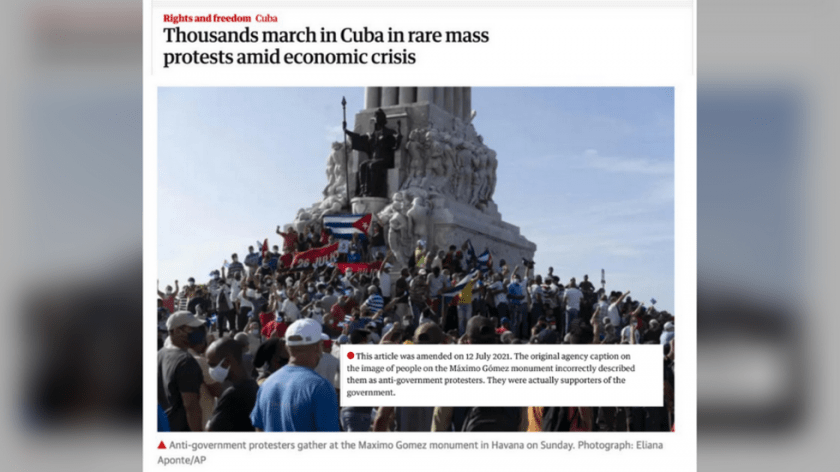
The Guardian and a number of other Western news agencies used erroneously captioned photos of a pro-government protest in Havana, Cuba, presenting it as an opposition rally instead.
© TheGuardian.com / screenshot
RT | July 14, 2021
Several Western news outlets have used an erroneously captioned photo showing a pro-government rally in Cuba, deeming it an opposition protest, while CNN opted for an image of a Miami demonstration instead, raising eyebrows.
Captured by Associated Press photographer Eliana Aponte during a demonstration in support of the government in the Cuban capital on Sunday, the photo has made the rounds in the Western corporate press as unrest grips the Caribbean nation. However, multiple outlets have incorrectly described the image as an “anti-government protest,” including the Guardian, Fox News, the Financial Times, the New York Times, the Washington Times and Voice of America. The latter outlet, the US-government funded VOA, committed the error on two separate occasions.
GrayZone journalist Ben Norton and Alan MacLeod of MintPress News were among the first to note the error, sharing screenshots of several examples. MacLeod suggested the outlets may have simply “copied and pasted” the AP’s original photo caption, replicating the error across multiple agencies.
Both journalists pointed out the red-and-black flags hoisted by demonstrators in the photo, which read “26 Julio,” a reference to Fidel Castro’s 26th of July movement. The organization played a major role in the Cuban Revolution and later formed into a political party, with the two-colored flag becoming a common symbol of support for Cuba’s communist government.
Of the six news outlets cited above, only the Guardian had issued a correction at the time of writing, stating that it amended its story because the “original agency caption on the image… incorrectly described them as anti-government protesters. They were actually supporters of the government.”
The AP image is not the only photo to be misrepresented in Western media coverage. On its Instagram page, CNN also strongly implied that another photo showed Cuban protesters, with its caption reading, in part, “Thousands of Cubans protested a lack of food and medicine.” The image in question was taken by an AFP photographer, and a search through the agency’s photo gallery shows the rally was actually held in Miami, Florida. CNN appears to have omitted the first portion of the AFP caption, which made clear the protest was based in the US.
The photo mix-ups in corporate media have been compounded by a wave of false and misleading posts by observers online, with many users sharing photos of gatherings in Egypt, Spain and Argentina while claiming they depict unrest in Cuba – some racking up thousands of shares.
The anti-state protests kicked off in earnest on Sunday, seeing large crowds of demonstrators take to the streets in Havana and elsewhere to demand urgent action on food, medicine and power shortages. The government, however, claims the rallies are fueled by hostile foreign powers, namely Washington, and involve only a small number of ‘counter-revolutionaries’. President Miguel Diaz-Canal said US sanctions were to blame, arguing that Washington’s “policy of economic suffocation” aimed to “provoke social unrest” in Cuba.
Diaz-Canal also alleged that a “campaign against the Cuban revolution” had kicked off on social media platforms, saying they are “drawing on the problems and shortages we are living.” According to internet monitoring firm NetBlocks, Cuba’s state-run web provider ETECSA has moved to restrict access to certain sites and apps since the bout of unrest erupted on Sunday.
The head of the Cuban Communist Party’s ideological department, Rogelio Polanco Fuentes, also claimed that the country is experiencing an attempt at a “color revolution” or a “soft coup,” drawing a comparison to a failed US-backed uprising in Venezuela back in 2019.
Washington, for its part, has offered rhetorical backing to the protesters, with State Department spokesman Ned Price telling reporters on Tuesday that the government is looking at ways to “support the Cuban people,” though he did not elaborate.
Havana has so far offered few details on the number of arrests made or injuries sustained during the protests, though the Cuban Interior Ministry confirmed that the first death occurred during an anti-government action on Monday. Opposition groups, meanwhile, have alleged that a spate of arrests has targeted protesters, journalists and other activists.
Iran Unjustifiably Blamed for Another False Flag Attack?
By Stephen Lendman | July 4, 2021
Unlike repeated US-dominated NATO and Israeli rule of law breaches, Iran fully complies with its international obligations.
Yet time and again it’s falsely accused of things it had nothing to do with, including attacks on Israeli vessels — despite no evidence of its involvement.
In stark contrast, international outlaw Israel attacked Iranian cargo ships numerous times.
In March, the WSJ reported that Israel targeted at least 12 Iranian cargo ships in international waters.
It cyber-attacked its nuclear facilities, accountability for its criminal actions never forthcoming.
On July 3, Lebanese al-Mayadeen television reported the following:
Citing unnamed “reliable sources,” its report said “a fire erupted in an Israeli cargo ship in the northern Indian Ocean,” adding:
“(T)he…merchant ship was hit by an unknown weapon.”
It “was anchored in the port of Jeddah before moving towards the Emirati coast.”
“(N)o one has claimed responsibility for this targeting so far.”
“(T)he incident c(ame) a day after news of an Israeli drone attack west of Tehran.”
On June 23, Iranian media reported a drone attack on a city of Karaj building.
Since its 1979 liberating revolution from US/UK-installed fascist tyranny, US, Western and Israeli regimes have waged forever war on Iran by other means — wanting its government toppled, the nation weakened, partitioned and transformed into a pro-Western vassal state.
Was Saturday’s incident involving a formerly Israeli-owned vessel staged by the Bennett regime as part of its aim to kill the JCPOA nuclear deal — by once again falsely blaming Iran for what no evidence points to its involvement?
Was the incident a joint US/Israeli false flag to blame Iran like many times before unjustifiably?
Israeli political and military dark forces have been pressuring their Biden regime counterparts not to rejoin the landmark agreement as affirmed by Security Council Res. 2231, making it binding international law.
Ideally, they want the deal killed altogether. At minimum, they want it revised to include unacceptable provisions no responsible government would accept.
Saturday’s incident targeted the Liberian-flagged CSAV Tyndall cargo ship.
Haaretz said the vessel was “previously under Israeli ownership,” the attack “causing only mild damage and no casualties.”
Like time and again unjustifiably, Bennett regime officials blamed Iran for what happened, despite no evidence suggesting it.
No Israeli nationals were on board.
Formally owned by London-based Zodiac Maritime Ltd, a company source said the vessel was sold several months earlier.
No one claimed responsibility for the incident. The Jerusalem Post reported the following:
“On Friday, IDF chief of staff Gen. Aviv Kohavi hinted at an Israeli covert operation against Iran at the graduation of the IDF officers course at the Bahad 1 base,” quoting him, saying:
“Anyone who tries to harm the state of Israel (sic) knows that any offensive enemy activity (sic), near or far, will be answered with a significant, overt or covert response.”
The hostile-to-Iran NYT implied its responsibility for the Saturday incident.
Citing no evidence because there is none, it dubiously suggested what happened was “latest tit-for-tat (sic) in a shadowy regional conflict between Israel and Iran,” adding:
The vessel “was believed to have come under assault by an Iranian drone or naval commandos (sic),” citing an unnamed Israeli source with no credibility.
The Times falsely accused Iran of earlier attacks on Israeli-owned ships despite no evidence suggesting it.
On June 1, US intelligence dubiously warned of a possible Iranian attack.
Was it issued ahead of a planned US and/or Israeli false flag on Saturday to once again blame Iran for what it had nothing to do with?
Contact Stephen Lendman at lendmanstephen@sbcglobal.net.
There is no Covid third wave in Africa
Alarmist reporting is getting basic facts wrong
By Toby Green | Unherd | June 24, 2021
The last few days have seen an avalanche of reports that a third wave of Covid-19 is underway in Africa. Seasoned coronavirus watchers will not be surprised that the alarm was raised in Geneva. WHO Central issued alarming press releases on June 7th and 17th, with the Regional Director for Africa, Dr Matshidiso Moeti, stating in the latter that “Africa is in the midst of a full-blown third wave”. So what’s happening?
Since the June 7th press release, there have been 1,651 new deaths reported from Covid-19 across the entire continent in 17 days, less than 100 per day. In a continent where 9 million people die annually (roughly 25,000 per day), reported Covid deaths in this “full-blown” third wave thus currently account for roughly 0.4% of daily mortality in Africa. Certainly, there are mortality increases from Covid reported in some countries such as Cape Verde and the Democratic Republic of Congo, but they are not anything like on the scale of what has happened elsewhere.
Moreover, the vast majority of these fatalities have occurred in temperate zones: South Africa, Morocco, Egypt, Algeria, Libya and Tunisia account for 105,000 of the 139,500 deaths reported from Covid-19 across the continent.
Many of the reports on this “third wave” point to the failure to count deaths accurately, and suggest that these figures mask the true problem. Reports from the BBC and the New York Times have pointed to a continent-wide lack of systemic mortality figures. But running at 0.4% of current mortality, and touching a small area of the continent as a whole, even if this was an underestimate by 1000%, Covid would still only be a minor concern to most Africans. In fact, a recent paper disputes these accusations of undercounting: the authors note that “while only 34.6% of countries [in Africa] have complete death registration data… all countries have a system in place, and there is no evidence that COVID-19 mortality data is less accurately reported in Africa than elsewhere”.
What certainly does go under-reported are cases. This is good news, as it indicates that much of the continent’s population has already developed antibodies to Covid-19 through mild infections. In a study from July to October 2020 of mineworkers tested in Ivory Coast, 25.1% had Covid antibodies; meanwhile, a February study in South Africa based on blood donors found antibody levels of 63% in Eastern Cape, 46% in Free State, and 52% in KwaZulu Natal, while a study from Cameroon just published found antibody levels of 32%. These figures far outstrip recorded cases, suggesting that many Africans already have protection from Covid.
However the WHO redefined herd immunity last year as only achievable through vaccination, so it may not want to publicise this. The Guardian last week added to the clamour, reporting on research that had not been peer-reviewed and which claimed that Covid infection did not provide immunity. Ironically, a series of studies published in Nature the week before had found that “the evidence thus far predicts that infection with SARS-CoV-2 induces long-term immunity in most individuals”.
The evidence from Africa is quite clear, in fact. Large sections of the population have now developed Covid antibodies, and death rates are low compared to other chronic illnesses. Herd immunity does not have to be achieved through vaccination, either in Africa or elsewhere. But none of these conclusions fit with the catastrophic decisions taken by global policy elites over the past year, so they won’t be coming to a television news channel near you any time soon.
Toby Green is the author of The Covid Consensus: The New Politics of Global Inequality (Hurst).
They Denied A Lab Leak At Wuhan. They Are Wrong About Other Things.
By Mary Beth Pfeiffer | Trial Site News | June 16, 2021
After months of denial, the U.S. government has acknowledged that the COVID-19 catastrophe may indeed have originated in a leak from a laboratory in Wuhan, China.
We are now allowed to talk about what until May 13 was a debunked conspiracy theory. Like many facets of the pandemic of our age, Wuhan was censored with the dreaded “disinformation” label, on Facebook and just about everywhere else. Not anymore.
The Wuhan debacle shows what happens when public health institutions have too much power, and the media plays mouthpiece rather than watchdog. Truth suffers. So does trust.
This commentary isn’t about the media’s wholesale buy-in of a possibly mythical pangolin that caused a pandemic.
This is about other potential Wuhans — issues that social and mainstream media have put to rest and closed to honest examination. We are told: Vaccines are safe. Lockdowns are just. We must protect, and be protected from, children. All those statements should be open to debate — and dispute.
I have spent the last eight months attacking another insidious COVID myth. It holds that there is no early treatment.
This actual disinformation has led to deaths and debility. In reporting it, the guardians of media have endowed public figures and institutions with wisdom they surely did not and do not have. Once definitive, Dr. Anthony Fauci of the National Institutes of Health and Dr. Tedros Ghebreyesus of the World Health Organization have reversed themselves on a potential Wuhan lab leak.
Then: “Extremely unlikely,” WHO said after a cursory probe.
Now: “Not convinced” the virus came from nature, said Fauci.
What else might they have gotten wrong?
‘Trusted’ News
Just months into the pandemic, research suggested that a handful of approved generic drugs could potentially quell COVID and save lives. By late last year, a safe drug that won its developers the Nobel Prize in Medicine in 2015 had risen to the top: ivermectin.
Fifty-eight trials now show this 40-year-old drug, off patent since 1997, greatly reduces the ravages of COVID. It lessens severity, lowers hospitalization, and saves lives. Significantly, it also prevents infection.
That few Americans know this is a direct result of two things: First is an unreasonably high, and shifting, bar set by the NIH, FDA and WHO, which collectively reject, cherry-pick or ignore what is now a trove of studies. Second is a media campaign that upholds the anti-IVM dictum, using charged language – from “controversial” to “snake oil” — that makes doctors, medical journals and other media fearful of backlash.
In a case of government propaganda, the Food and Drug Administration actually warned against ivermectin last spring, based, it said, on “multiple” people sickened by an animal formulation, which turned out to be four. Moreover, FDA admitted it “hadn’t studied” the considerable data then available on treatment with the human form.
As government failed us, mainstream and social media did something unique in modern history. Google, YouTube, Facebook, BBC, Washington Post, Associated Press, Reuters and others conspired to shape content and coverage in the government’s image.
They called it, ironically, the Trusted News Initiative. It existed to ferret out falsehoods and declare certainty in a rapidly changing information landscape. The media became a COVID fact-checking apparatus, devoid of nuance or meaningful investigation.
In the wake of Wuhan relevations, some outlets are now correcting the record.
Vaccine OR Treatment
From the start, there was no room for both vaccines and treatments under the statute that has allowed millions of Americans to be vaccinated with an unlicensed, largely unstudied substance. The key mechanism on which this turned was the vaccine’s “Emergency Use Authorization,” which can be granted by the FDA only if there is “no adequate, approved, and available alternative to the product for diagnosing, preventing or treating” a disease.
But even as the vaccine was minimally tested and maximally hyped, there was an alternative. Ivermectin.
“It’s the most effective antiviral agent we have,” Dr. Paul E. Marik, co-founder of Front Line COVID-19 Critical Care Alliance, said in a conversation for this article. “If the WHO was to say that or the NIH — were they to approve ivermectin — the EUA for all the vaccines would become invalid.”
Ivermectin, said FLCCC president Dr. Pierre Kory, “would kneecap the entire global vaccine policy around the world.”
The choice was always vaccines OR treatment. Not both. Operation Warp Speed spent three times as much — $18 billion — to develop a vaccine as it did to develop a treatment. Moreover, money for therapeutics went largely toward costly new drugs, some of which failed and others still in development.
The media did not question the oversight of existing drugs and emerging research. Instead, it became an arm of government in a shared single fixed goal: Vaccinate quickly and at any expense.
A Year Lost
America’s COVID Czar Anthony Fauci predicted in July of 2020 that an antiviral would be available by that fall. Then, last December he said his “highest priority” was a quick-acting COVID drug. In reality, NIH waited until April 29, 2021 to announce a large study of safety-tested, FDA-approved drugs. That was roughly 400 days – and nearly 600,000 U.S. deaths — into the pandemic.
Forget a few dozen studies – most from other countries — that universally agreed on ivermectin’s efficacy. Forget a peer-reviewed meta-analysis that showed 83 percent fewer deaths. Forget the experiences of hundreds of real treating doctors in the U.S. and around the world.
Viewed in the kindest possible way, that delay, that lost year, wasn’t so much intentional as institutionalized. U.S. treatments are driven by the integral and outsized influence of pharmaceutical money on the regulatory process, and no one was putting up $20 million for what are considered, questionably, the “gold-standard” of evidence-based medicine: randomized control trials.
Dr. Robert Malone, a vaccine researcher and inventor of mRNA technology, went bankrupt trying to repurpose old antiviral drugs to treat the Zika virus in the 2010s. “The investment community had zero interest because there’s no way to make a buck,” he said in a must-see podcast on pandemic missteps. “The financial incentives around drug repurposing are such that it doesn’t get done.”
Ivermectin is the penicillin of COVID, particularly when combined with other generics like fluvoxamine and the vilified but effective hydroxychloroquine. Now, however, as at the start of COVID, newly infected patients are still denied treatment and turned back into the community, often to infect others.
As Malone put it, “We’re sending people home and telling them not to come back until your lips are blue.”
“Were this a hundred years ago,” a Pennsylvania opthamologist named Neil Chasin told me months ago, “and Ivermectin was available, it would be used everywhere.”
Media Sees No Evil
The dereliction of duty, by the New York Times, Washington Post, Wall Street Journal (with the Wuhan exception), Associated Press, USA Today and other media giants, likely cost many thousands of lives. The questions that were never asked, the issues never investigated, include:
–In April 2020, Fauci endorsed the high-priced anti-viral remdesivir, calling it the “standard of care” before the first study was published. Did anyone in those investigative powerhouses question the financial ties between the NIH and the drug’s maker, Gilead? Did they care that the study showed no mortality improvement, and the trial’s endpoint was changed to improve benefits so marginal that the WHO advises against the drug?
–Hospitals vehemently oppose ivermectin, forcing some patients’ families to obtain court orders to get it. Does this comport with their liberal use of treatments like monoclonal antibodies and convalescent plasma that are still considered experimental? Just 19 deaths were associated with ivermectin in 20 years; 503 were linked to remdesivir in its first year. Annualized, that’s roughly a 500-fold higher toll for remdesivir. Why is ivermectin — safe, FDA-approved — not used off-label, especially in dying ICU patients, when the potential harm is miniscule?
–The COVID pandemic has led to the most widespread, government-sanctioned wave of censorship and authoritarian message control in American history. Rather than fighting this, the media carries the water. When Merck disingenuously disavowed ivermectin’s safety — a drug it gave away by the billion in a life-saving campaign against parasites — widespread media reports failed to note the company’s potential to make big money on patented new drugs on which it was already working.
–More importantly, the evidence in favor of ivermectin aligns so uniformly that the odds of it being wrong are infinitesimal. Why not read the studies? Why not talk to doctors who have used the drug and patients who have taken it?
The unholy alliance of media and money was foreshadowed at a 2016 conference on preparation for the next SARS epidemic. There, Peter Daszak, whose NIH funding for virus research in China is under scrutiny, emphasized the need to use the press. He is quoted in the proceedings:
“A key driver is the media, and the economics follow the hype. We need to use that hype to our advantage … Investors will respond if they see profit at the end of process, Daszak stated.”
So far, the hype has prevailed. But it can be wrong. Can we now talk about ivermectin?
***
Mary Beth Pfeiffer is an investigative journalist and author of two books. A list of her article links can be found here.
Yet Another Media Tale — Trump Tear-Gassed Protesters For a Church Photo Op — Collapses

CNN with Anderson Cooper and Jim Acosta, June 1, 2020
By Glenn Greenwald | June 9, 2021
For more than a year, it has been consecrated media fact that former President Donald Trump and his White House, on June 1 of last year, directed the U.S. Park Police to use tear gas against peaceful Lafayette Park protesters, all to enable a Trump photo-op in front of St. John’s Church. That this happened was never presented as a possibility or likelihood but as indisputable truth. And it provoked weeks of unmitigated media outrage, presented as one of the most egregious assaults on the democratic order in decades.
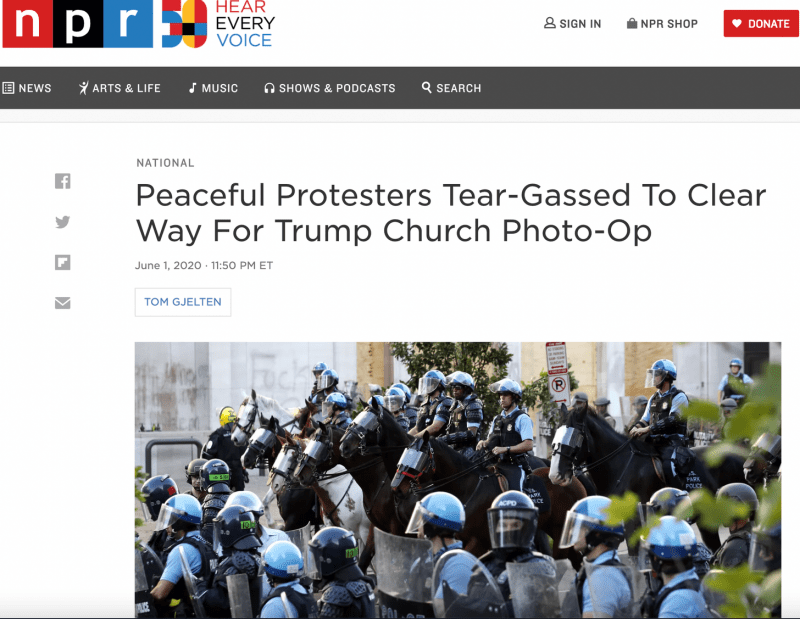
This tale was so pervasive in the media landscape that it would be impossible for any one article to compile all the examples. “Peaceful Protesters Tear-Gassed To Clear Way For Trump Church Photo-Op,” read the NPR headline on June 1. The New York Times ran with: “Protesters Dispersed With Tear Gas So Trump Could Pose at Church.” CNN devoted multiple segments to venting indignation while the on-screen graphic declared: “Peaceful Protesters Near White House Tear-Gassed, Shot With Rubber Bullets So Trump Can Have Church Photo Op.”
ABC News anchor George Stephanopoulos “reported” that “the administration asked police to clear peaceful protesters from the park across the White House so that the President could stage a photo op.” The Intercept published an article stating that “federal police used tear gas and rubber bullets to clear protesters from Lafayette Square in front of the White House,” all to feature a video where the first interviewee said: “to me, the way our military and police have behaved toward the protesters at the instruction of President Trump has almost been Nazi-like.” Nazi-like. This was repeated by virtually every major corporate outlet:

This was the scene outside of the White House on Monday as police used tear gas and flash grenades to clear out peaceful protesters so President Trump could visit the nearby St. John’s Church, where there was a parish house basement fire Sunday night nyti.ms/2MhSGOQ
At a June 2 Press Conference, then-Sen. Kamala Harris (D-CA) proclaimed with anger: “last night I watched as President Trump, having gassed peaceful protesters just so he could do this photo op, then he went on to teargas priests who were helping protesters in Lafayette Park.” Speaking on MSNBC’s Morning Joe, House Speaker Nancy Pelosi exclaimed: “What is this, a banana republic?,” when asked about NBC News’ report that “security forces used tear gas and flash-bangs against a crowd of peaceful demonstrators to clear the area for the president.”
There were some denials of this narrative at the time, largely confined to right-wing media. ABC News mocked “hosts on Fox News, one of the president’s preferred news media outlets, [who] have spent the days since the controversial photo op shifting defenses to fit the president’s narrative.” Meanwhile, The Federalist‘s Mollie Hemingway — in an article retweeted by Trump as a “must read” — cited sources to assert that the entire media narrative was false because force was to clear the Park not to enable Trump’s photo op but rather “because [protesters] had climbed on top of a structure in Lafayette Park that had been burned the prior night” and the Park Police decided to build a barrier to protect it.
But as usual, the self-proclaimed Superior Liberal Truth Squad instantly declared them to be lying. The Washington Post‘s “fact-checker,” Phillip Bump, mocked denials from Trump supporters and right-wing reporters such as Hemingway, proclaiming that a recent statement from the Park Police “brings the debate to a close,” as it proves “the deployment of security forces using weapons and irritants to clear a peaceful protest so that the president could have a photo op.”
All of this came crashing down on their heads on Wednesday afternoon. The independent Inspector General of the Interior Department, Mark Lee Greenblatt, issued his office’s findings after a long investigation into “the actions of the U.S. Park Police (USPP) to disperse protesters in and around Lafayette Park in Washington, DC, on June 1, 2020.” Greenblatt has been around Washington for a long time, occupying numerous key positions in the Obama administration, including investigative counsel at the Department of Justice’s Office of Inspector General and Assistant Inspector General for Investigations at Obama’s Commerce Department.
The letter released by Greenblatt’s office accompanying the report makes clear how far-reaching the investigation was:
Over the course of this review, our career investigative staff conducted extensive witness interviews, reviewed video footage from numerous vantage points, listened to radio transmissions from multiple law enforcement entities, and examined evidence including emails, text messages, telephone records, procurement documents, and other related materials. This report presents a thorough, independent examination of that evidence to assess the USPP’s decision making and operations, including a detailed timeline of relevant actions and an analysis of whether the USPP’s actions complied with governing policies.
The IG’s conclusion could not be clearer: the media narrative was false from start to finish. Namely, he said, “the evidence did not support a finding that the [U.S. Park Police] cleared the park on June 1, 2020, so that then President Trump could enter the park.” Instead — exactly as Hemingway’s widely-mocked-by-liberal-outlets article reported — “the evidence we reviewed showed that the USPP cleared the park to allow a contractor to safely install anti-scale fencing in response to destruction of Federal property and injury to officers that occurred on May 30 and May 31.” Crucially, “ the evidence established that relevant USPP officials had made those decisions and had begun implementing the operational plan several hours before they knew of a potential Presidential visit to the park, which occurred later that day.”
The detailed IG report elaborated on the timeline even more extensively. It was “on the morning of June 1” when “the Secret Service procured anti-scale fencing to establish a more secure perimeter around Lafayette Park that was to be delivered and installed that same day.” The agencies had “determined that it was necessary to clear protesters from the area in and around the park to enable the contractor’s employees to safely install the fence.” Indeed, “we found that by approximately 10 a.m. on June 1, the USPP had already begun developing a plan to clear protesters from the area to enable the contractor to safely install the anti-scale fence” — many hours before Trump decided to go.
The clearing of the Park, said the IG Report, had nothing to do with Trump or his intended visit to the Church; in fact, those responsible for doing this did not have any knowledge of Trump’s intentions:
The evidence we reviewed showed that the USPP cleared the park to allow the contractor to safely install the anti-scale fencing in response to destruction of property and injury to officers occurring on May 30 and 31. Further, the evidence showed that the USPP did not know about the President’s potential movement until mid- to late afternoon on June 1—hours after it had begun developing its operational plan and the fencing contractor had arrived in the park.
Beyond that, planning for that operation began at least two days before Trump decided to visit the church. “The fencing contractor told us and emails we reviewed confirmed that on May 30, the assistant division chief of the Secret Service’s Procurement Division discussed with the contractor how quickly the contractor could deliver anti-scale fencing to Lafayette Park,” the Report found.
Plans for the fence were finalized at least the day prior to Trump’s walk: “the fencing contractor’s project manager told us that she learned on May 31 that the Secret Service had contacted the fencing contractor about an anti-scale fence.” And while Attorney General William Barr did visit the Park shortly before Trump’s walk and saw what he viewed as unruly protesters, causing him to ask Park Police commanders whether they would still be there when Trump arrived, the order to clear the Park had been given well before that and was unrelated to Trump or to Barr: there is “no evidence that the Attorney General’s visit to Lafayette Park at 6:10 p.m. caused the USPP to alter its plans to clear the park.”
Indeed, none of the key decision-makers had any idea Trump was coming when they implemented plans to clear the Park:
The USPP operations commander, the USPP incident commander, and the USPP acting chief of police told us they did not know the President planned to make a speech in the Rose Garden that evening. The USPP incident commander told us he was never informed of the President’s specific plans or when the President planned to come out of the White House. He said, “It was just a, ‘Hey, here he comes.’ And all of a sudden I turn around and there’s the entourage.”
The USPP acting chief of police also told us he did not know about the President’s plans to visit St. John’s Church and that the USPP incident commander told him the President might come to the park to assess the damage at an unspecified time. The USPP acting chief of police and the USPP incident commander told us this information had no impact on their operational plan, and both denied that the President’s potential visit to the park influenced the USPP’s decision to clear Lafayette Park and the surrounding areas. Numerous other USPP captains and lieutenants and the ACPD civil disturbance unit commanders also told us they received no information suggesting that the USPP cleared the area to facilitate the President’s visit to St. John’s Church. The DCNG major we interviewed told us that his USPP liaison appeared as surprised as he was when the President visited Lafayette Park, stating, “We [were] both kind of equally shocked.”
Of the dozens of people who participated in the investigation, “no one we interviewed stated that the USPP cleared the park because of a potential visit by the President or that the USPP altered the timeline to accommodate the President’s movement.”
In sum, the media claims that were repeated over and over and over as proven fact — and even confirmed by “fact-checkers” — were completely false. Watch how easily and often and aggressively and readily they just spread lies, this one courtesy of CNN‘s Erin Burnett and Don Lemon:
With the issuance of this independent debunking of their claims, the journalists who spread this latest lie have started to come to terms with what they did — yet again. “A narrative we thought we knew is not the reality,” NBC News’ chief CIA Disinformation Agent Ken Dilanian awkwardly acknowledged on Meet the Press Daily. Shortly before publication of this article, Politico begrudgingly admitted that while “the department’s Park Police failed to give Black Lives Matter demonstrators proper warning before it cleared them from Lafayette Park,” their primary media claim was untrue: “its actions were unrelated to President Donald Trump’s photo-op appearance at a nearby church.” Time will tell how readily others who spread this lie will account for how they — yet again — got this story so wrong.
Over and over we see the central truth: the corporate outlets that most loudly and shrilly denounce “disinformation” — to the point of demanding online censorship and de-platforming in the name of combating it — are, in fact, the ones who spread disinformation most frequently and destructively. It is hard to count how many times they have spread major fake stories in the Trump years. For that reason, they have nobody but themselves to blame for the utter collapse in trust and faith on the part of the public, which has rightfully concluded they cannot and should not be believed.
Babyon Bee’s legal counsel demands retraction of NYT article that paints satire as “misinformation”
By Tom Parker | Reclaim the Net | June 3, 2021
Seth Dillon, CEO of Christian news satire site TheBabylon Bee, has announced that his legal counsel has sent a letter to The New York Times demanding the retraction of an article that insinuates The Babylon Bee is “misinformation.”
“We took this action because their article was—and remains—defamatory,” Dillon tweeted.
The original version of The New York Times’ article branded The Babylon Bee “a far-right misinformation site” that “sometimes trafficked in misinformation under the guise of satire.”
After pushback from Dillon and The Babylon Bee’s founder, Adam Ford, The New York Times replaced these claims with the claim that The Babylon Bee “has feuded with Facebook and the fact-checking site Snopes over whether the site published misinformation or satire.”
But Ford slammed the update, describing it as “awful and malicious and precisely worded to be so.”
In a subsequent interview, Dillon said The Babylon Bee was considering legal action against The New York Times and argued that mainstream media outlets that accuse The Babylon Bee of being misinformation are doing so in an attempt to get the satire site deplatformed by Big Tech.
“They put this stuff out there and if they can get it to stick, then then we have no platform remaining,” Dillon said. “There’s not going to be anybody who wants to host our stuff. … It’s an effort to try and cancel us.”
And Big Tech’s previous treatment of The Babylon Bee highlights how characterizing its content as something other than satire can have a negative impact on its business. Last year, Facebook claimed a Monty Python spoof post from The Babylon Bee was “inciting violence” and demonetized its entire page.
Following the announcement of this legal demand letter, Dillon picked apart The New York Times’ update and noted that Snopes had retracted its insinuations that The Babylon Bee was pushing misinofrmation.
“We have not, in fact, feuded with Snopes as to whether we publish satire or misinformation,” Dillon wrote. “Snopes retracted that insinuation with an editors’ note saying it was never their intent to call our motives into question. It’s therefore misleading and malicious to characterize that incident as a feud, as if Snopes ever openly stood by the claim that we are misinformation and not satire.”
“For better or worse, the NY Times is considered a ‘reliable source,’” Dillon added. “We cannot stand idly by as they act with malice to misrepresent us in ways that jeopardize our business.”
The Babylon Bee’s legal demand letter to The New York Times follows investigative reporting outlet Project Veritas filing a defamation lawsuit against The Times earlier this year after it described Project Veritas reporting as “false,” “deceptive,” and “with no verifiable evidence.”
A judge has ruled that The New York Times used “actual malice” when it accused Project Veritas of being deceptive and the lawsuit is now approaching the discovery phase with The New York Times recently filing a motion for stay of discovery process in an attempt to delay discovery.
Russia Falsely Accused of Hacking USAID
By Stephen Lendman | May 29, 2021
Virtually all accusations by Washington and its complicit partners against Russia and other nations free from US control lack evidence supporting them because none exists.
Yet they surface time and again, supported by Western press agent media.
On Friday, the Russophobic NYT was at it again, falsely accusing Moscow of hacking USAID.
In response to an earlier phony US accusation of Russian hacking last year, its US embassy said the following:
“We paid attention to another unfounded attempt of the US media to blame Russia for hacker attacks on US governmental bodies.”
“We declare responsibly: malicious activities in the information space contradicts the principles of the Russian foreign policy, national interests and our understanding of interstate relations.”
“Russia does not conduct offensive operations in the cyber domain.”
“What is more, the Russian Federation actively promotes bilateral and multilateral cyber security agreements.”
“In this regard, we would like to remind (the US regime) of the initiative put forward by President Vladimir Putin on September 25 on a comprehensive program of measures to restore Russian-US cooperation in the field of international information security.”
“We have received no reply from Washington.”
“Many our other suggestions to start constructive and equal dialogue with the US remain unanswered.”
Hacking and countless other crimes are how the US-dominated West and Israel operate.
In sharp contrast, Russia fully complies with its international obligations, according to the rule of law.
Yet once again, NYT fake news falsely claimed the following:
“Hackers linked to Russia’s main intelligence agency surreptitiously seized an email system used by (USAID) to burrow into the computer networks of human rights groups and other organizations of the sort that have been critical of President Vladimir V. Putin, Microsoft Corporation disclosed on Thursday (sic).”
When accusations are unsupported by independently verified evidence, they’re baseless.
None exists to support accusations against Russia under Vladimir Putin.
Will the latest phony one be used as a pretext to cancel a scheduled mid-June summit between Putin and Biden’s impersonator — because he can only recite lines scripted for him.
If held, the summit will be farcical — a know-nothing imposter engaging with a world leader of Putin’s stature.
Perhaps the latest phony accusation against Russia will be used to cancel it — to avoid US embarrassment if they meet face-to-face.
No Russian hack of USAID occurred, no evidence suggesting it.
What the Times indicated as the aim of the phony claim fell flat like earlier baseless accusations against Russia.
An invented scenario by the Times reads like a rejected grade B Hollywood script.
Corporate predator Microsoft is complicit with wars by hot and/or other means on invented US enemies.
So are the Times and other establishment media — operating as mouthpieces for US imperial interests on all things geopolitical, notably against Russia, China, and nations victimized by US aggression.
No phony NYT claim of Russian “malicious activity (or) appetite for disruption” against the US or other countries exists, no evidence suggesting it.
An unnamed DHS official falsely claimed that the agency was “aware of the potential compromise” at USAID (sic) and is “working with the FBI and (the State Department’s agency) to better understand the extent of the compromise (sic) and assist potential victims (sic).”
No Russian SolarWinds hack occurred earlier or other hacking it was falsely accused of earlier.
Yet Microsoft and the Times falsely claimed a Nobelium group in Russia hacked SolarWinds and USAID despite no verifiable evidence because there is none.
Time and again, Times reports don’t pass the smell test.
Its daily editions feature managed news misinformation, disinformation and fake news on major domestic and geopolitical issues — far removed from all the news it claims to be fit to print.
A Final Comment
Undemocratic Dem war goddess Samantha Power heads USAID.
Like other interventionist extremists, she never met a nation free from US control she didn’t want smashed.
She once called US foreign policy “a tool box” with a range of options to advance the nation’s hegemonic aims.
Civil rights lawyer Chase Madar earlier called her hellish agenda “a richly instructive example of the weaponization of human rights.”
Like other US hostile to the rule of law officials, she falsely blames others for its high crimes of war and against humanity.
Chances are she was behind the latest false accusation of Russian hacking, enlisting Microsoft to make the phony claim.
Her maliciously destructive worldview is polar opposite values just societies cherish.
EPA Updates Its “Climate Change Indicators”
By Francis Menton | Manhattan Contrarian | May 13, 2021
It appears that some time last month the EPA provided a major update of what it calls its “climate change indicators.” The EPA’s web page for this is headed “Climate Change Indicators in the United States,” with the sub-heading “Climate Change Is Happening Now.” The update is an initiative of the Biden administration, now eager to invest a few trillion dollars of your money in new “green” infrastructure, after several years in which the Trump EPA paid no attention to keeping these data up to date. The New York Times reports on the big update on today’s front page, under the headline “Climate Change Is getting Worse, E.P.A. Says. Just Look Around.”
The basic technique here is to propagandize you with every sort of essentially irrelevant anecdotal information, while diverting your attention away from the only indicator of “climate change” that actually counts, which is temperature. After all, if temperatures aren’t going up, it isn’t “global warming.” Here, we have some 54 supposed climate “indicators” — everything from rain to drought to ice to sea level — out of which the things relating to actual temperature are only a handful, and then are buried deep in the midst of all the others, probably in the hope that you will miss them. And moreover, the temperature data are then grossly misrepresented in what has to be an intentional effort at deception.
But let’s start with the official line from the new Biden EPA.
The Earth’s climate is changing. Temperatures are rising, snow and rainfall patterns are shifting, and more extreme climate events – like heavy rainstorms and record high temperatures – are already happening. Many of these observed changes are linked to the rising levels of carbon dioxide and other greenhouse gases in our atmosphere, caused by human activities.
The Times then picks up on the theme by its headline calling for you to “just look around” to determine that “climate change” is happening. The idea is that you can determine that there is “climate change” by observing ice on ponds, or something, without having to bother with those complicated thermometers, let alone sophisticated satellite measurements:
Wildfires are bigger, and starting earlier in the year. Heat waves are more frequent. Seas are warmer, and flooding is more common. The air is getting hotter. Even ragweed pollen season is beginning sooner. . . . [EPA’s indicators] map everything from Lyme disease, which is growing more prevalent in some states as a warming climate expands the regions where deer ticks can survive, to the growing drought in the Southwest that threatens the availability of drinking water, increases the likelihood of wildfires but also reduces the ability to generate electricity from hydropower.
So how about the temperature guys? As you can see, the Times does throw in a couple of references to “heat waves” and “hotter air” in the midst of all the stuff about flooding, ragweed pollen, ticks, and whatever else. What’s missing is any citation or link to any source to support the assertion about actual temperatures. But over at the EPA page, under the heading “U.S. and Global Temperature,” we find the following graph, which is said to have been updated to April 2021:
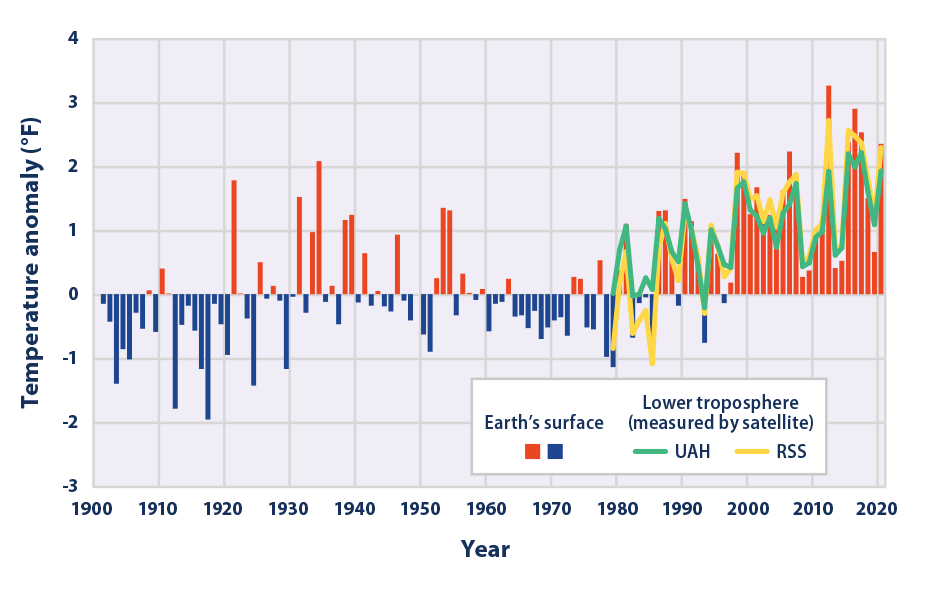
That appears rather scary! Everything looks like it is going up sharply with passing time. Check out especially the green line, which is identified as the “lower troposphere [temperatures] (measured by satellite) of UAH.” The green line ends with a steep uptick, leaving it with the latest data point just below a record reached in 2016, and a full 2 deg F above the 1901-2000 average.
Oh, but here is the actual lower troposphere temperature record from UAH, available at the website of Roy Spencer, who is the guy who compiles the UAH record:
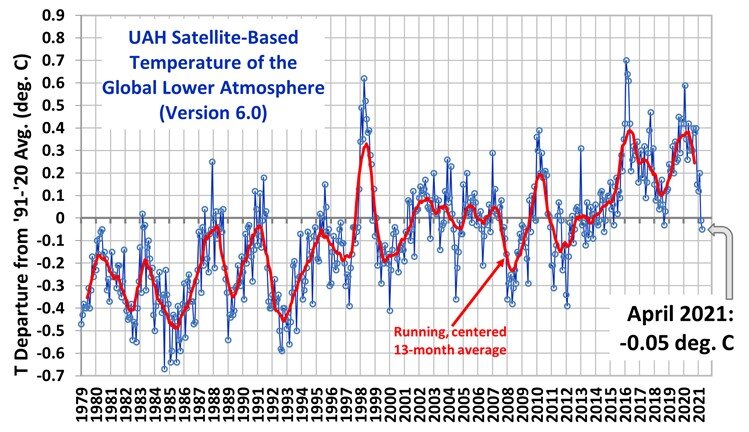
There are a few differences in the presentation that require a little interpretation, like the EPA graph is in deg F and has anomalies from a 1901-2000 mean, while the UAH graph is in deg C and shows anomalies from a 1991-2020 mean. But still, it leaps out that the green line on EPA’s web page, said to be the UAH record, ends with a sharp uptick and with the last point a full 2 deg F above the mean line; while this record, from UAH itself, ends with a sharp downtick and the last point actually below the mean line. Although EPA explicitly says on its web page that it updated the information in April 2021, this downtick in the UAH record began in January 2020 — a year and 4 plus months ago — and reflects a decline in lower troposphere temperatures of some 0.65 deg C, which is almost 1.2 deg F.
In other words, well more than half of the seemingly scary increase in temperature since 1901 shown in the EPA graph has just gone away in the last 16 months. So the Biden EPA, not wanting to complicate the official story of “climate change is happening now,” simply truncated the data in its graph at January 2020 to shut out the last year plus of big temperature declines. There is no way to characterize the EPA graph as other than intentionally deceptive.
I guess it’s OK because it’s in the noble cause of convincing the American people to allow the government to spend a few trillion dollars on windmills and electric car charging stations for the rich.
Liz Cheney Lied About Her Role in Spreading the Discredited CIA “Russian Bounty” Story
By Glenn Greenwald | May 14, 2021
In an interview on Tuesday with Fox News’ Bret Baier, Rep. Liz Cheney (R-WY) denied that she spread the discredited CIA “Russian bounty” story. That CIA tale, claiming Russia was paying Taliban fighters to kill U.S. troops in Afghanistan, was cooked up by the CIA and then published by The New York Times on June 27 of last year, right as former President Trump announced his plans to withdraw troops from Afghanistan. The Times story, citing anonymous intelligence officials, was then continually invoked by pro-war Republicans and Democrats — led by Cheney — to justify their blocking of that troop withdrawal. The story was discredited when the U.S. intelligence community admitted last month that it had only “low to moderate confidence” that any of this even happened.
When Baier asked Cheney about her role in spreading this debunked CIA story, Cheney blatantly lied to him, claiming “if you go back and look at what I said — every single thing I said: I said if those stories are true, we need to know why the President and Vice President were not briefed on them.” After Baier pressed her on the fact that she vested this story with credibility, Cheney insisted a second time that she never endorsed the claim but merely spoke conditionally, always using the “if these reports are true” formulation. Watch Cheney deny her role in spreading that story.
Liz Cheney, as she so often does, blatantly lied. That she merely spoke of the Russian bounty story in the conditional — “every single thing I said: I said if those stories are true” — is completely and demonstrably false. Indeed, other than Rep. Adam Schiff (D-CA), there are few if any members of Congress who did more to spread this Russian bounty story as proven truth, all in order to block troop withdrawal from Afghanistan. In so doing, she borrowed from a pro-war playbook pioneered by her dad, to whom she owes her career: the former Vice President would leak CIA claims to The New York Times to justify war, then go on Meet the Press with Tim Russert, as he did on September 8, 2002, and cite those New York Times reports as though they were independent confirmation of his views coming from that paper rather than from him:
MR. RUSSERT: What, specifically, has [Saddam] obtained that you believe would enhance his nuclear development program? …..
VICE PRES. CHENEY: Now, in the case of a nuclear weapon, that means either plutonium or highly enriched uranium. And what we’ve seen recently that has raised our level of concern to the current state of unrest, if you will, if I can put it in those terms, is that he now is trying, through his illicit procurement network, to acquire the equipment he needs to be able to enrich uranium to make the bombs.
MR. RUSSERT: Aluminum tubes.
VICE PRES. CHENEY: Specifically aluminum tubes. There’s a story in The New York Times this morning this is — I don’t — and I want to attribute The Times. I don’t want to talk about, obviously, specific intelligence sources, but it’s now public that, in fact, [Saddam] has been seeking to acquire, and we have been able to intercept and prevent him from acquiring through this particular channel, the kinds of tubes that are necessary to build a centrifuge. And the centrifuge is required to take low-grade uranium and enhance it into highly enriched uranium, which is what you have to have in order to build a bomb.
So having CIA stories leak to the press that fuel the pro-war case, then having pro-war politicians cite those to justify their pro-war position, is a Cheney Family speciality.
On July 1, the House Armed Services Committee, of which Rep. Cheney is a member, debated amendments to the National Defense Authorization Act, the bill that authorized $740.5 billion in military spending. One of Cheney’s top priorities was to align with the Committee’s pro-war Democrats, funded by weapons manufacturers, to block Trump’s plan to withdraw all U.S. troops from Afghanistan by the end of 2020 and to withdraw roughly 1/3 of the 34,000 U.S. troops in Germany.
To justify her opposition, Cheney — contrary to what she repeatedly insisted to Baier — cited the CIA’s Russian bounty story without skepticism. In a joint statement with Rep. Mac Thornberry (R-TX), ranking member of the House Armed Services Committee, that Cheney published on her website on June 27 — the same day that The New York Times published its first story about the CIA tale — Cheney pronounced herself “concerned about Russian activity in Afghanistan, including reports that they have targeted U.S. forces.” There was nothing conditional about the statement: they were preparing to block troop withdrawal from Afghanistan and cited this story as proof that “Russia does not wish us well in Afghanistan.”
After today’s briefing with senior White House officials, we remain concerned about Russian activity in Afghanistan, including reports that they have targeted U.S. forces. It has been clear for some time that Russia does not wish us well in Afghanistan. We believe it is important to vigorously pursue any information related to Russia or any other country targeting our forces. Congress has no more important obligation than providing for the security of our nation and ensuring our forces have the resources they need.
An even more definitive use of this Russia bounty story came when Cheney held a press conference to explain her opposition to Trump’s plans to withdraw troops. In this statement, she proclaimed that she “remains concerned about Russian activities in Afghanistan.” She then explicitly threatened Russia over the CIA’s “bounty” story, warning them that “any targeting of U.S. forces by Russians, by anyone else, will face a very swift and deadly response.” She then gloated about the U.S. bombing of Russia-linked troops in Syria in 2018 using what she called “overwhelming and lethal force,” and warned that this would happen again if they target U.S. forces in Afghanistan:
Does this sound even remotely like what Cheney claimed to Baier? She denied having played a key role in spreading the Russia bounty story because, as she put it, “every single thing I said, I said: if those stories are true.” She also told him that she never referred to that CIA claim except by saying: “if these reports are true.” That is false.
The issue is not merely that Cheney lied: that would hardly be news. It is that the entire media narrative about Cheney’s removal from her House leadership role is a fraud. Her attacks on Trump and her party leadership were not confined to criticisms of the role played by the former president in contesting the validity of the 2020 election outcome or inciting the January 6 Capitol riot — because Liz Cheney is such a stalwart defender of the need for truth and adherence to the rule of law in politics.
Cheney played the key role in forming an alliance with pro-war Democrats on the House Armed Services Committee to repeatedly defeat the bipartisan anti-war minority [led by Ro Khanna (D-CA), Rep. Tulsi Gabbard (D-HI) and Rep. Matt Gaetz (R-FL)] to prevent any meaningful changes promised by Trump during the 2016 campaign to put an end to the U.S. posture of Endless War. As I reported about the House Armed Services Committee hearing last July, the CIA tale was repeatedly cited by Cheney and her allies to justify ongoing U.S. troop presence in Afghanistan.
Cheney is motivated by power, not ethics. In 2016, Trump ran — and won — by explicitly inveighing against the Bush/Cheney foreign policy of endless war, militarism and imperialism that Liz Cheney, above all else, still vehemently supports. What she is attempting to do is reclaim the Republican Party and deliver it back to the neocons and warmongers who dominated it under her father’s reign. She is waging an ideological battle, not an ethical one, for control of the Republican Party.
That will be a debate for Republican voters to resolve. In the meantime, Liz Cheney cannot be allowed to distance herself from the CIA’s fairy tale about Russians in Afghanistan. Along with pro-war Democrats, she used this conveniently leaked CIA story repeatedly to block troop withdrawal from Afghanistan. And just as her father taught her to do — by example if not expressly — she is now lying to distance herself from a pro-war CIA script that she, in fact, explicitly promoted.
Emails show US Justice Dept Threatened MIT researchers who refuted voter fraud claims in Bolivian election
RT | May 11, 2021
An email exchange in which a US Justice Department (DOJ) lawyer threatens to subpoena academics who refuted voter fraud allegations in Bolivia’s 2019 presidential election has been leaked, fueling speculation of US involvement.
Between October 2020 and January 2021, Angela George – a trial attorney at the DOJ’s Office of International Affairs – repeatedly mailed a group of analysts at Massachusetts Institute of Technology (MIT) to obtain their research – eventually threatening to compel them to do so, according to an email chain released by The Intercept news outlet.
In their study for the Center for Economic and Policy Research (CEPR), MIT analysts Jack Williams and John Curiel refuted allegations of election-rigging by incumbent Bolivian President Evo Morales and his Movement Toward Socialism (MAS) party.
After Morales was voted back into power for a fourth term in the October 2019 election, opposition parties immediately leveled charges of voter fraud – which were amplified by an election audit conducted by the influential Washington-based regional cooperation body Organization of American States (OAS).
The Trump administration’s top diplomat for Latin America, Michael Kozak, weighed in and promised to “hold accountable anyone who undermines Bolivia’s democratic institutions.” After three weeks of unrest, the opposition installed Jeanine Áñez as president, in a coup.
The CEPR study, whose findings were published in February 2020, conducted a statistical analysis of the data and did not find “quantitative evidence” of irregularities as “claimed by the OAS” – and as had been reported by several major US publications, including the New York Times.
Following more protests and unrest, the Áñez government was forced to hold a new election, held on October 18, 2020. The first mail from Angela George came on October 15, just three days before the polls. In the initial email, the DOJ lawyer said the study data had been “formally requested” by the Bolivian government for a “criminal investigation” it had opened.
When in subsequent emails, Williams responded that the research had drawn on public information, George wrote, “I am simply trying to find out if the report… includes your research and is an authentic copy of the report that was produced” before raising the prospect of “a subpoena being served on you and the [MIT Election] lab” should it be required.
Speaking to The Intercept on condition of anonymity, a source familiar with the investigation said the “Justice Department inquiry frightened election researchers in the academic community and may have had a chilling effect on subsequent research.”
According to a former DOJ trial attorney who has also worked at the Department’s Office of International Affairs (OIA), the email exchange was “unusual.” That person, who also requested anonymity, noted that it signaled this was not a regular criminal investigation.
“This particular request is not your run-of-the-mill criminal investigation, so you can be fairly sure that it received very high-level exposure,” they said.
“Generally, OIA would enlist the FBI or other investigative agency to execute an incoming MLA (Mutual Legal Assistance) request such as a voluntary witness interview or inquiry like this one. It’s unusual for an OIA attorney to handle it,” the former trial attorney told the outlet.
A DOJ spokesperson declined to comment about the email exchanges, according to The Intercept.
Although Morales was in exile during the 2020 election, MAS won in a landslide. He has since returned. Áñez, who had dropped out of contention a month before the new election, is facing terrorism, sedition, and conspiracy charges.
CNN tries to make case for trusting anonymous-source echo chamber despite steady stream of fake news
RT | May 3, 2021
CNN took a holier-than-thou approach to explaining away mainstream media’s penchant for telling anonymously sourced stories that later prove to be false, saying that unlike “MAGA media,” it tries to get the news right.
“There are safeguards in place,” CNN media reporter Oliver Darcy told ‘Reliable Sources’ host Brian Stelter on Sunday. “Unfortunately, human error is still at play, and news organizations sometimes do get burned like this.”
Darcy was referring to the latest correction debacle involving multiple MSM outlets that supposedly confirmed each other’s anonymously sourced reports – only to later issue corrections admitting that their central claim was completely false. The New York Times, NBC News and the Washington Post said on Saturday that their reports claiming that US law enforcement had warned Rudy Giuliani and One America News that they were being targeted by a “Russian influence operation” were not true.
The false claim was so integral to the story that correcting it was not as simple as changing a name or recasting a sentence. “The premise and headline of the article below have been changed to reflect the corrected information,” NBC said in its correction.
Stelter lamented that “a bogus report of this magnitude” tars all mainstream outlets and allows “bad-faith actors” to lump them in with less credible outfits. Darcy argued that “responsible” media outlets set themselves apart by correcting their mistakes, whereas publications such as the New York Post avoid admitting their errors.
“Sometimes, it seems like they are intentionally promoting falsehoods and moving on, some of those folks in MAGA media,” Darcy said.
The Post last week removed an article from its website that said copies of a children’s book written by Vice President Kamala Harris were being put in the welcome kits given to migrant children being held at a shelter in California. In an updated version it issued a correction, saying it turned out there was only one known copy of the book at the shelter.
However, it was the New York Post that broke bombshell news last October, reporting on alleged influence-peddling by then-presidential candidate Joe Biden and his son, Hunter, after obtaining emails from a laptop that the younger Biden had allegedly left at a repair shop. At the time, with the presidential election just a couple of weeks away, CNN called the reports “dubious” and cited anonymous people saying that “US authorities” were investigating whether the Hunter Biden emails were part of a Russian disinformation campaign.
Then-Director of National Intelligence John Ratcliffe said there was no connection between Hunter Biden’s laptop and Russian disinformation, but only later did the likes of the New York Times and the Washington Post admit that the evidence-free conspiracy claims were apparently false.
The Washington Post has had its share of falsehoods lately. In March, the newspaper corrected a January story accusing former president Donald Trump of pressuring a Georgia official to help overturn the election’s result. The Post admitted that it had misquoted the official. In fact, it said that claims Trump urged the official to “find the fraud” and that she would be a “national hero” if she did were completely false.
CNN technical director Charlie Chester suggested that such “mistakes” weren’t accidental – at least at his network. Chester was shown on video telling an undercover Project Veritas reporter that CNN’s main focus was to help oust Trump from office through propaganda and that it purposely fearmongered about Covid-19 to boost ratings. He added that CNN also endeavored to make Black Lives Matter look good, a task made more difficult by the group’s conduct.
Glenn Greenwald, the journalist who helped break the Edward Snowden NSA scoops in 2013, said MSM outlets are able to “independently confirm” each other’s false reports because their meaning of “confirm” is misleading. Rather than confirming that a report is true, they merely get the same anonymous source to make the same false claims to them.
“It’d be one thing if this were some rare occurrence,” Greenwald said. “The opposite is true. Over and over and over, these same big corporate outlets purport to have ‘independently confirmed’ one another’s stories that turn out to be totally false. Is that trustworthy?”
Are Covid Fatalities Comparable with the 1918 Spanish Flu?
By Ethan Yang | AIER | April 27, 2021
On April 23, 2021 The New York Times published an article titled “How Covid Upended a Century of Patterns in U.S. Deaths.” The article lays out some data regarding the unprecedented uptick in the US death rate that occured in 2020.
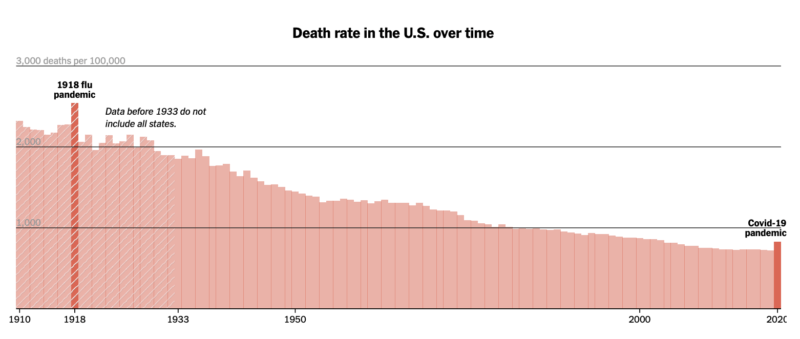
As shown in the graph provided by the New York Times, US death rates have been steadily declining over the past century, likely due to advances in technology and living standards. Last year certainly signaled a noticeable break from this trend with a sizable increase in deaths, but not nearly the same as the 1918 Flu which is a universal benchmark for a killer influenza virus.
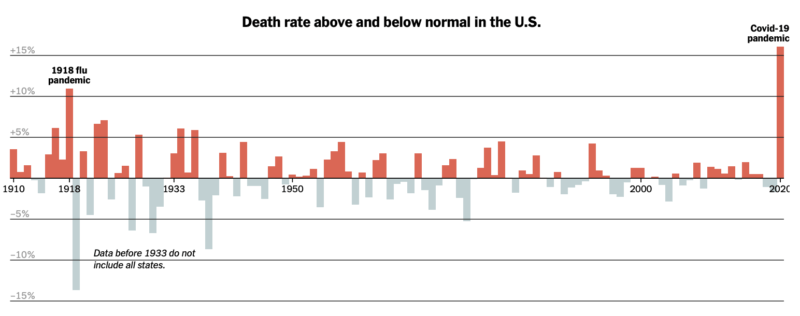
This graph provided by the New York Times indicates the spike in excess deaths in 2020, which is the number of deaths that have occured exceeding the predictions of standard death trends. This is of course all important information. Last year was certainly a horrific year with the outbreak of Covid-19, the lockdowns, and all the chaos that followed. It was a year of death and despair which should not be taken lightly.
Important Discussion: Deaths and Victims
It is common to invoke comparisons with the 1918 Flu Pandemic, as that was an extremely devastating virus that rocked the world. The article makes multiple references to the 1918 pandemic but there are a couple that raise interesting questions for further investigation. The first point is as follows,
“Combined with deaths in the first few months of this year, Covid-19 has now claimed more than half a million lives in the United States. The total number of Covid-19 deaths so far is on track to surpass the toll of the 1918 pandemic, which killed an estimated 675,000 nationwide.”
Comparing the death counts between the 1918 Flu and Covid-19 without adjusting for population growth is extremely misleading. In 1918 the population of the United States was roughly 103 million, while near the end of 2020 it stood at roughly 330 million. According to CDC statistics compiled by a study in JAMA Covid-19 killed 345,000 people in 2020 and now stands at around half a million as stated by the New York Times. Adjusted for the population growth of over 200 million people and holding the death rates constant, the 1918 Flu would have killed over 2 million people if it occured today, which is more than four times greater than Covid-19.
Furthermore, the two diseases are vastly different in terms of who is vulnerable. Covid-19’s severe outcomes almost exclusively affect the elderly and the immunocompromised, particularly those over the age of 65, which is also approaching the life expectancy of a human. Furthermore 94 percent of Covid deaths occurred with preexisting conditions. It poses virtually no risk to children, minimal risk to young adults, and only seems to kill more than 1 percent of victims with those over the age of 65.
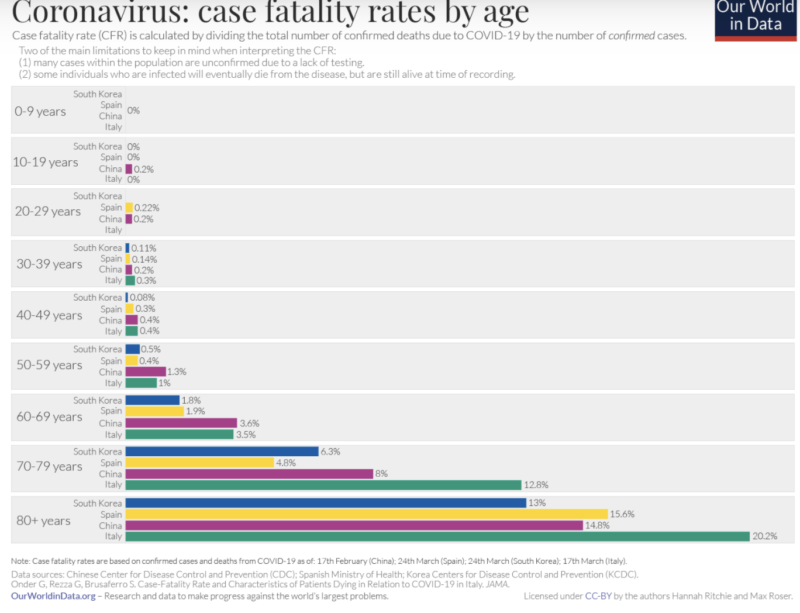
On the other hand the Spanish Flu was devastating to virtually all age groups and did not discriminate between the healthy and the unwell. The CDC writes the following about the 1918 Flu:
“Mortality was high in people younger than 5 years old, 20-40 years old, and 65 years and older. The high mortality in healthy people, including those in the 20-40 year age group, was a unique feature of this pandemic.”
It is clear that the comparison is flawed between the 1918 Flu and Covid-19, as the former was a devastating killer virus whereas the latter only poses a threat to vulnerable populations.
Too Much Statistical Noise
It is certainly worth investigating the noted increase in excess deaths in 2020 as that is obviously a problem. However, the article seems to suggest that Covid-19 was the main causal factor driving increases in death. Although that is certainly a reasonable intuition given that it is a novel virus, clearly there is far more at play.
The main issue to point out is that there were two health crises, not one. Covid-19 is certainly one but we cannot simply ignore the absolutely devastating and unprecedented use of lockdown policies that drastically upended all of society in a way that a virus could never accomplish.
The effects of lockdowns have been thoroughly studied by AIER and in a series of articles I noted just some of the damage to the economy, young people, and the normal functioning of society. All these disruptions led to adverse outcomes whether it be mental health issues, decline in living standards, or even disrupted healthcare procedures. In a press release the CDC noted that in May 2020, it recorded the highest number of drug overdoses ever recorded in a 12-month period.
A study in JAMA notes that although there was a substantial increase in overall deaths in 2020, Covid-19 was only one part of the problem, assuming all Covid deaths are directly attributable to Covid and not a comorbidity.
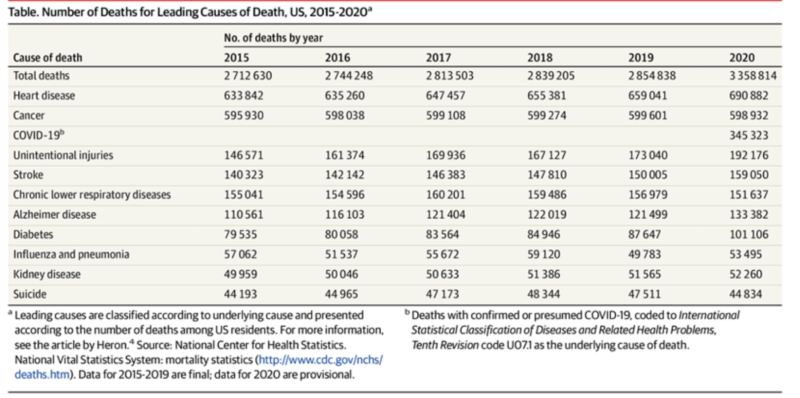
Some statistics of note are an increase in deaths due to heart disease, unintentional injuries, stroke, and diabetes. Although more investigation would be needed to understand how all of this comes together, it wouldn’t be absurd to believe that lockdown policies led to an increase in deaths due to their many disruptions to normal societal functions.
To cite one example of many, the Mackinac Center Legal Foundation recounts on one of its clients by writing,
“One of the affected medical practices, Grand Health Partners, operates in the Grand Rapids area. It performs endoscopies and other elective surgeries, many of which were deemed nonessential by executive order. Due to the shutdown, many of their patients were not able to receive treatment and have suffered because of it.”
Alongside exploring and cutting through the statistical noise posed by increases in death plausibly related to lockdowns, there still needs to be a discussion on quantifying the Covid-19 death count. Genevieve Briand, an economist at John Hopkins University, was subject to a massive degree of controversy for putting out a flawed but important lecture – later expanded into a research paper – that pointed out among other things that Covid-19 deaths may be inappropriately reclassified as deaths from other leading causes.
This is especially worthy of discussion given that the overwhelming majority of Covid deaths occur with comorbidities amongst eldery populations often nearing or exceeding life expectancy.
Key Takeaway
The data is clear; 2020 was a horrific year full of death and despair. The New York Times’ article certainly does a great job at starting a conversation about this topic. However, its comparisons of Covid-19 and the 1918 Flu raises more questions than answers. Furthermore its presentation of data regarding increases in deaths requires more context.
Upon further investigation, it is clear that Covid-19 claimed many lives. However, it is also clear that there is a substantial presence of statistical noise from comorbidities and increases in death from other causes. This raises many questions not just about the collateral damage of our policy response, but also about whether we are even operating with the appropriate information to be making such decisions with people’s lives in the first place.
Featured Video
Laith Marouf: Hezbollah’s position on US-Iran ceasefire
or go to
Aletho News Archives – Video-Images
From the Archives
Is Israel to blame for the Iraq War?
American Goy | March 10, 2008
I am so tired of this old canard that “Israel had nothing to do with USA’s war with Iraq – in fact, it officially advised America against it”.
Bullshit. … continue
Blog Roll
 Aletho News
- Laith Marouf: Hezbollah’s position on US-Iran ceasefire: What you’re not being told
- Israel’s priority lies in destroying chances of peace between Iran, US: Ex-UN nuclear chief
- Ceasefire for all or for none: Iran shuts Hormuz over Lebanon attacks
- Strait of Hormuz is Iran’s ‘nuclear weapon’ that forced US retreat: Medvedev
- Energy crisis will last for months – Kremlin envoy
- Europe’s quiet role in the war on Iran
- Forty days that shook the Empire: How Iran turned the tables on US and prevailed
- Netanyahu unilaterally declares Lebanon outside of ceasefire deal
- Israeli leaders: ‘Not a single goal’ achieved in war with Iran
- What on earth just happened? Trump, Iran, and the unlikely ceasefire
- If Americans Knew
- Gazans face a triple crisis: severe shortages of water and bread, healthcare in tatters
- NY Times reports how Netanyahu took the US into Iran War
- A sigh of relief over Iran, but Gaza and Lebanon in dire straits – Daily Update
- Thousands dead and neighborhoods razed to the ground: Aid agencies fear southern Lebanon is becoming the new Gaza
- The war the US is fighting for Israel could cost trillions
- ‘Cigarette Burns, Nail Wounds’: Toddler Tortured in Gaza to Coerce Father
- Trump Says US Sent ‘a Lot of Guns’ to Protesters in Iran
- Israeli forces destroy 17 UN peacekeeper cameras in south Lebanon
- US-Israeli strikes ‘completely destroy’ synagogue in Tehran
- Archbishop for US Military Says Iran War Is Unjust Under Catholic Teaching
- No Tricks Zone
- An Inconvenient Tree: Uncovered In Alps… Europe Much Warmer Than Today 6000 Years Ago
- New Study Reports A 60% Slowdown In Greenland’s Ice Loss Rate In The Last Decade
- Low Intensity Tornado Wrecks Major Solar Farm, Creating A Potential Toxic Dump
- New Study Finds Warming Saves Lives…Cold Temperatures 12 Times More Deadly Than Excess Heat
- German Science Blog Accuses PIK Climate Institute Of Hallucinating Climate Tipping Points
- Devastating Assessment Of Comirnaty Vaccine By Former Senior Pfizer Europe Toxicologist
- New Study: CO2 Is ‘Effectively Negligible’ As An Explanatory Climate Change Factor Since 2000
- Former Pfizer Toxicologist Dr. Helmut Sterz Tells Bundestag Hearing Pfizer Vaccine Should Have Never Been Approved
- Energy Expert: Germany’s Nuclear Phaseout Was A “500 Billion Euro Mistake”
- New Research: South Australia’s Mid-Holocene Sea Surface Temperatures Were 4°C Warmer Than Today
 Aletho News