Babyon Bee’s legal counsel demands retraction of NYT article that paints satire as “misinformation”
By Tom Parker | Reclaim the Net | June 3, 2021
Seth Dillon, CEO of Christian news satire site TheBabylon Bee, has announced that his legal counsel has sent a letter to The New York Times demanding the retraction of an article that insinuates The Babylon Bee is “misinformation.”
“We took this action because their article was—and remains—defamatory,” Dillon tweeted.
The original version of The New York Times’ article branded The Babylon Bee “a far-right misinformation site” that “sometimes trafficked in misinformation under the guise of satire.”
After pushback from Dillon and The Babylon Bee’s founder, Adam Ford, The New York Times replaced these claims with the claim that The Babylon Bee “has feuded with Facebook and the fact-checking site Snopes over whether the site published misinformation or satire.”
But Ford slammed the update, describing it as “awful and malicious and precisely worded to be so.”
In a subsequent interview, Dillon said The Babylon Bee was considering legal action against The New York Times and argued that mainstream media outlets that accuse The Babylon Bee of being misinformation are doing so in an attempt to get the satire site deplatformed by Big Tech.
“They put this stuff out there and if they can get it to stick, then then we have no platform remaining,” Dillon said. “There’s not going to be anybody who wants to host our stuff. … It’s an effort to try and cancel us.”
And Big Tech’s previous treatment of The Babylon Bee highlights how characterizing its content as something other than satire can have a negative impact on its business. Last year, Facebook claimed a Monty Python spoof post from The Babylon Bee was “inciting violence” and demonetized its entire page.
Following the announcement of this legal demand letter, Dillon picked apart The New York Times’ update and noted that Snopes had retracted its insinuations that The Babylon Bee was pushing misinofrmation.
“We have not, in fact, feuded with Snopes as to whether we publish satire or misinformation,” Dillon wrote. “Snopes retracted that insinuation with an editors’ note saying it was never their intent to call our motives into question. It’s therefore misleading and malicious to characterize that incident as a feud, as if Snopes ever openly stood by the claim that we are misinformation and not satire.”
“For better or worse, the NY Times is considered a ‘reliable source,’” Dillon added. “We cannot stand idly by as they act with malice to misrepresent us in ways that jeopardize our business.”
The Babylon Bee’s legal demand letter to The New York Times follows investigative reporting outlet Project Veritas filing a defamation lawsuit against The Times earlier this year after it described Project Veritas reporting as “false,” “deceptive,” and “with no verifiable evidence.”
A judge has ruled that The New York Times used “actual malice” when it accused Project Veritas of being deceptive and the lawsuit is now approaching the discovery phase with The New York Times recently filing a motion for stay of discovery process in an attempt to delay discovery.
Russia Falsely Accused of Hacking USAID
By Stephen Lendman | May 29, 2021
Virtually all accusations by Washington and its complicit partners against Russia and other nations free from US control lack evidence supporting them because none exists.
Yet they surface time and again, supported by Western press agent media.
On Friday, the Russophobic NYT was at it again, falsely accusing Moscow of hacking USAID.
In response to an earlier phony US accusation of Russian hacking last year, its US embassy said the following:
“We paid attention to another unfounded attempt of the US media to blame Russia for hacker attacks on US governmental bodies.”
“We declare responsibly: malicious activities in the information space contradicts the principles of the Russian foreign policy, national interests and our understanding of interstate relations.”
“Russia does not conduct offensive operations in the cyber domain.”
“What is more, the Russian Federation actively promotes bilateral and multilateral cyber security agreements.”
“In this regard, we would like to remind (the US regime) of the initiative put forward by President Vladimir Putin on September 25 on a comprehensive program of measures to restore Russian-US cooperation in the field of international information security.”
“We have received no reply from Washington.”
“Many our other suggestions to start constructive and equal dialogue with the US remain unanswered.”
Hacking and countless other crimes are how the US-dominated West and Israel operate.
In sharp contrast, Russia fully complies with its international obligations, according to the rule of law.
Yet once again, NYT fake news falsely claimed the following:
“Hackers linked to Russia’s main intelligence agency surreptitiously seized an email system used by (USAID) to burrow into the computer networks of human rights groups and other organizations of the sort that have been critical of President Vladimir V. Putin, Microsoft Corporation disclosed on Thursday (sic).”
When accusations are unsupported by independently verified evidence, they’re baseless.
None exists to support accusations against Russia under Vladimir Putin.
Will the latest phony one be used as a pretext to cancel a scheduled mid-June summit between Putin and Biden’s impersonator — because he can only recite lines scripted for him.
If held, the summit will be farcical — a know-nothing imposter engaging with a world leader of Putin’s stature.
Perhaps the latest phony accusation against Russia will be used to cancel it — to avoid US embarrassment if they meet face-to-face.
No Russian hack of USAID occurred, no evidence suggesting it.
What the Times indicated as the aim of the phony claim fell flat like earlier baseless accusations against Russia.
An invented scenario by the Times reads like a rejected grade B Hollywood script.
Corporate predator Microsoft is complicit with wars by hot and/or other means on invented US enemies.
So are the Times and other establishment media — operating as mouthpieces for US imperial interests on all things geopolitical, notably against Russia, China, and nations victimized by US aggression.
No phony NYT claim of Russian “malicious activity (or) appetite for disruption” against the US or other countries exists, no evidence suggesting it.
An unnamed DHS official falsely claimed that the agency was “aware of the potential compromise” at USAID (sic) and is “working with the FBI and (the State Department’s agency) to better understand the extent of the compromise (sic) and assist potential victims (sic).”
No Russian SolarWinds hack occurred earlier or other hacking it was falsely accused of earlier.
Yet Microsoft and the Times falsely claimed a Nobelium group in Russia hacked SolarWinds and USAID despite no verifiable evidence because there is none.
Time and again, Times reports don’t pass the smell test.
Its daily editions feature managed news misinformation, disinformation and fake news on major domestic and geopolitical issues — far removed from all the news it claims to be fit to print.
A Final Comment
Undemocratic Dem war goddess Samantha Power heads USAID.
Like other interventionist extremists, she never met a nation free from US control she didn’t want smashed.
She once called US foreign policy “a tool box” with a range of options to advance the nation’s hegemonic aims.
Civil rights lawyer Chase Madar earlier called her hellish agenda “a richly instructive example of the weaponization of human rights.”
Like other US hostile to the rule of law officials, she falsely blames others for its high crimes of war and against humanity.
Chances are she was behind the latest false accusation of Russian hacking, enlisting Microsoft to make the phony claim.
Her maliciously destructive worldview is polar opposite values just societies cherish.
EPA Updates Its “Climate Change Indicators”
By Francis Menton | Manhattan Contrarian | May 13, 2021
It appears that some time last month the EPA provided a major update of what it calls its “climate change indicators.” The EPA’s web page for this is headed “Climate Change Indicators in the United States,” with the sub-heading “Climate Change Is Happening Now.” The update is an initiative of the Biden administration, now eager to invest a few trillion dollars of your money in new “green” infrastructure, after several years in which the Trump EPA paid no attention to keeping these data up to date. The New York Times reports on the big update on today’s front page, under the headline “Climate Change Is getting Worse, E.P.A. Says. Just Look Around.”
The basic technique here is to propagandize you with every sort of essentially irrelevant anecdotal information, while diverting your attention away from the only indicator of “climate change” that actually counts, which is temperature. After all, if temperatures aren’t going up, it isn’t “global warming.” Here, we have some 54 supposed climate “indicators” — everything from rain to drought to ice to sea level — out of which the things relating to actual temperature are only a handful, and then are buried deep in the midst of all the others, probably in the hope that you will miss them. And moreover, the temperature data are then grossly misrepresented in what has to be an intentional effort at deception.
But let’s start with the official line from the new Biden EPA.
The Earth’s climate is changing. Temperatures are rising, snow and rainfall patterns are shifting, and more extreme climate events – like heavy rainstorms and record high temperatures – are already happening. Many of these observed changes are linked to the rising levels of carbon dioxide and other greenhouse gases in our atmosphere, caused by human activities.
The Times then picks up on the theme by its headline calling for you to “just look around” to determine that “climate change” is happening. The idea is that you can determine that there is “climate change” by observing ice on ponds, or something, without having to bother with those complicated thermometers, let alone sophisticated satellite measurements:
Wildfires are bigger, and starting earlier in the year. Heat waves are more frequent. Seas are warmer, and flooding is more common. The air is getting hotter. Even ragweed pollen season is beginning sooner. . . . [EPA’s indicators] map everything from Lyme disease, which is growing more prevalent in some states as a warming climate expands the regions where deer ticks can survive, to the growing drought in the Southwest that threatens the availability of drinking water, increases the likelihood of wildfires but also reduces the ability to generate electricity from hydropower.
So how about the temperature guys? As you can see, the Times does throw in a couple of references to “heat waves” and “hotter air” in the midst of all the stuff about flooding, ragweed pollen, ticks, and whatever else. What’s missing is any citation or link to any source to support the assertion about actual temperatures. But over at the EPA page, under the heading “U.S. and Global Temperature,” we find the following graph, which is said to have been updated to April 2021:
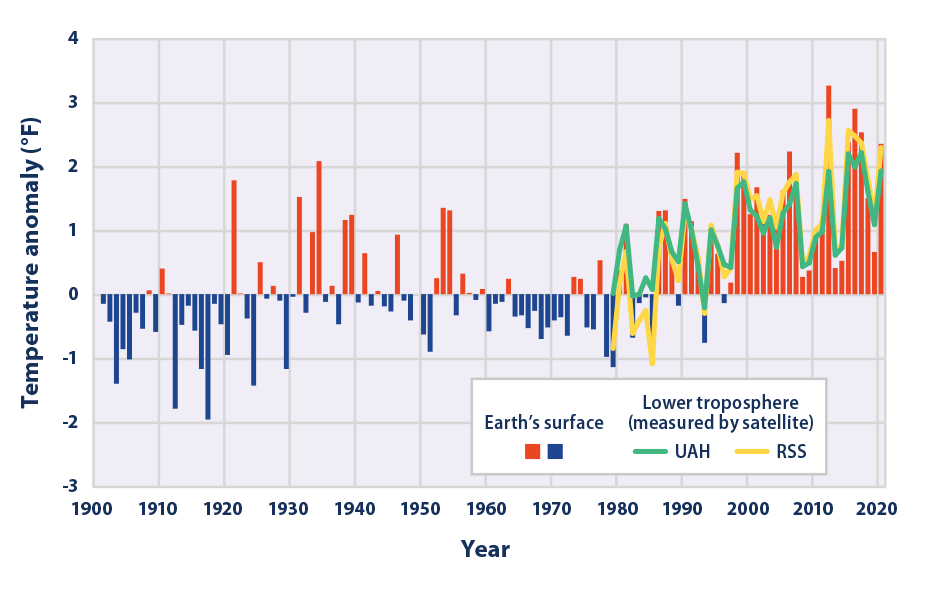
That appears rather scary! Everything looks like it is going up sharply with passing time. Check out especially the green line, which is identified as the “lower troposphere [temperatures] (measured by satellite) of UAH.” The green line ends with a steep uptick, leaving it with the latest data point just below a record reached in 2016, and a full 2 deg F above the 1901-2000 average.
Oh, but here is the actual lower troposphere temperature record from UAH, available at the website of Roy Spencer, who is the guy who compiles the UAH record:

There are a few differences in the presentation that require a little interpretation, like the EPA graph is in deg F and has anomalies from a 1901-2000 mean, while the UAH graph is in deg C and shows anomalies from a 1991-2020 mean. But still, it leaps out that the green line on EPA’s web page, said to be the UAH record, ends with a sharp uptick and with the last point a full 2 deg F above the mean line; while this record, from UAH itself, ends with a sharp downtick and the last point actually below the mean line. Although EPA explicitly says on its web page that it updated the information in April 2021, this downtick in the UAH record began in January 2020 — a year and 4 plus months ago — and reflects a decline in lower troposphere temperatures of some 0.65 deg C, which is almost 1.2 deg F.
In other words, well more than half of the seemingly scary increase in temperature since 1901 shown in the EPA graph has just gone away in the last 16 months. So the Biden EPA, not wanting to complicate the official story of “climate change is happening now,” simply truncated the data in its graph at January 2020 to shut out the last year plus of big temperature declines. There is no way to characterize the EPA graph as other than intentionally deceptive.
I guess it’s OK because it’s in the noble cause of convincing the American people to allow the government to spend a few trillion dollars on windmills and electric car charging stations for the rich.
Liz Cheney Lied About Her Role in Spreading the Discredited CIA “Russian Bounty” Story
By Glenn Greenwald | May 14, 2021
In an interview on Tuesday with Fox News’ Bret Baier, Rep. Liz Cheney (R-WY) denied that she spread the discredited CIA “Russian bounty” story. That CIA tale, claiming Russia was paying Taliban fighters to kill U.S. troops in Afghanistan, was cooked up by the CIA and then published by The New York Times on June 27 of last year, right as former President Trump announced his plans to withdraw troops from Afghanistan. The Times story, citing anonymous intelligence officials, was then continually invoked by pro-war Republicans and Democrats — led by Cheney — to justify their blocking of that troop withdrawal. The story was discredited when the U.S. intelligence community admitted last month that it had only “low to moderate confidence” that any of this even happened.
When Baier asked Cheney about her role in spreading this debunked CIA story, Cheney blatantly lied to him, claiming “if you go back and look at what I said — every single thing I said: I said if those stories are true, we need to know why the President and Vice President were not briefed on them.” After Baier pressed her on the fact that she vested this story with credibility, Cheney insisted a second time that she never endorsed the claim but merely spoke conditionally, always using the “if these reports are true” formulation. Watch Cheney deny her role in spreading that story.
Liz Cheney, as she so often does, blatantly lied. That she merely spoke of the Russian bounty story in the conditional — “every single thing I said: I said if those stories are true” — is completely and demonstrably false. Indeed, other than Rep. Adam Schiff (D-CA), there are few if any members of Congress who did more to spread this Russian bounty story as proven truth, all in order to block troop withdrawal from Afghanistan. In so doing, she borrowed from a pro-war playbook pioneered by her dad, to whom she owes her career: the former Vice President would leak CIA claims to The New York Times to justify war, then go on Meet the Press with Tim Russert, as he did on September 8, 2002, and cite those New York Times reports as though they were independent confirmation of his views coming from that paper rather than from him:
MR. RUSSERT: What, specifically, has [Saddam] obtained that you believe would enhance his nuclear development program? …..
VICE PRES. CHENEY: Now, in the case of a nuclear weapon, that means either plutonium or highly enriched uranium. And what we’ve seen recently that has raised our level of concern to the current state of unrest, if you will, if I can put it in those terms, is that he now is trying, through his illicit procurement network, to acquire the equipment he needs to be able to enrich uranium to make the bombs.
MR. RUSSERT: Aluminum tubes.
VICE PRES. CHENEY: Specifically aluminum tubes. There’s a story in The New York Times this morning this is — I don’t — and I want to attribute The Times. I don’t want to talk about, obviously, specific intelligence sources, but it’s now public that, in fact, [Saddam] has been seeking to acquire, and we have been able to intercept and prevent him from acquiring through this particular channel, the kinds of tubes that are necessary to build a centrifuge. And the centrifuge is required to take low-grade uranium and enhance it into highly enriched uranium, which is what you have to have in order to build a bomb.
So having CIA stories leak to the press that fuel the pro-war case, then having pro-war politicians cite those to justify their pro-war position, is a Cheney Family speciality.
On July 1, the House Armed Services Committee, of which Rep. Cheney is a member, debated amendments to the National Defense Authorization Act, the bill that authorized $740.5 billion in military spending. One of Cheney’s top priorities was to align with the Committee’s pro-war Democrats, funded by weapons manufacturers, to block Trump’s plan to withdraw all U.S. troops from Afghanistan by the end of 2020 and to withdraw roughly 1/3 of the 34,000 U.S. troops in Germany.
To justify her opposition, Cheney — contrary to what she repeatedly insisted to Baier — cited the CIA’s Russian bounty story without skepticism. In a joint statement with Rep. Mac Thornberry (R-TX), ranking member of the House Armed Services Committee, that Cheney published on her website on June 27 — the same day that The New York Times published its first story about the CIA tale — Cheney pronounced herself “concerned about Russian activity in Afghanistan, including reports that they have targeted U.S. forces.” There was nothing conditional about the statement: they were preparing to block troop withdrawal from Afghanistan and cited this story as proof that “Russia does not wish us well in Afghanistan.”
After today’s briefing with senior White House officials, we remain concerned about Russian activity in Afghanistan, including reports that they have targeted U.S. forces. It has been clear for some time that Russia does not wish us well in Afghanistan. We believe it is important to vigorously pursue any information related to Russia or any other country targeting our forces. Congress has no more important obligation than providing for the security of our nation and ensuring our forces have the resources they need.
An even more definitive use of this Russia bounty story came when Cheney held a press conference to explain her opposition to Trump’s plans to withdraw troops. In this statement, she proclaimed that she “remains concerned about Russian activities in Afghanistan.” She then explicitly threatened Russia over the CIA’s “bounty” story, warning them that “any targeting of U.S. forces by Russians, by anyone else, will face a very swift and deadly response.” She then gloated about the U.S. bombing of Russia-linked troops in Syria in 2018 using what she called “overwhelming and lethal force,” and warned that this would happen again if they target U.S. forces in Afghanistan:
Does this sound even remotely like what Cheney claimed to Baier? She denied having played a key role in spreading the Russia bounty story because, as she put it, “every single thing I said, I said: if those stories are true.” She also told him that she never referred to that CIA claim except by saying: “if these reports are true.” That is false.
The issue is not merely that Cheney lied: that would hardly be news. It is that the entire media narrative about Cheney’s removal from her House leadership role is a fraud. Her attacks on Trump and her party leadership were not confined to criticisms of the role played by the former president in contesting the validity of the 2020 election outcome or inciting the January 6 Capitol riot — because Liz Cheney is such a stalwart defender of the need for truth and adherence to the rule of law in politics.
Cheney played the key role in forming an alliance with pro-war Democrats on the House Armed Services Committee to repeatedly defeat the bipartisan anti-war minority [led by Ro Khanna (D-CA), Rep. Tulsi Gabbard (D-HI) and Rep. Matt Gaetz (R-FL)] to prevent any meaningful changes promised by Trump during the 2016 campaign to put an end to the U.S. posture of Endless War. As I reported about the House Armed Services Committee hearing last July, the CIA tale was repeatedly cited by Cheney and her allies to justify ongoing U.S. troop presence in Afghanistan.
Cheney is motivated by power, not ethics. In 2016, Trump ran — and won — by explicitly inveighing against the Bush/Cheney foreign policy of endless war, militarism and imperialism that Liz Cheney, above all else, still vehemently supports. What she is attempting to do is reclaim the Republican Party and deliver it back to the neocons and warmongers who dominated it under her father’s reign. She is waging an ideological battle, not an ethical one, for control of the Republican Party.
That will be a debate for Republican voters to resolve. In the meantime, Liz Cheney cannot be allowed to distance herself from the CIA’s fairy tale about Russians in Afghanistan. Along with pro-war Democrats, she used this conveniently leaked CIA story repeatedly to block troop withdrawal from Afghanistan. And just as her father taught her to do — by example if not expressly — she is now lying to distance herself from a pro-war CIA script that she, in fact, explicitly promoted.
Emails show US Justice Dept Threatened MIT researchers who refuted voter fraud claims in Bolivian election
RT | May 11, 2021
An email exchange in which a US Justice Department (DOJ) lawyer threatens to subpoena academics who refuted voter fraud allegations in Bolivia’s 2019 presidential election has been leaked, fueling speculation of US involvement.
Between October 2020 and January 2021, Angela George – a trial attorney at the DOJ’s Office of International Affairs – repeatedly mailed a group of analysts at Massachusetts Institute of Technology (MIT) to obtain their research – eventually threatening to compel them to do so, according to an email chain released by The Intercept news outlet.
In their study for the Center for Economic and Policy Research (CEPR), MIT analysts Jack Williams and John Curiel refuted allegations of election-rigging by incumbent Bolivian President Evo Morales and his Movement Toward Socialism (MAS) party.
After Morales was voted back into power for a fourth term in the October 2019 election, opposition parties immediately leveled charges of voter fraud – which were amplified by an election audit conducted by the influential Washington-based regional cooperation body Organization of American States (OAS).
The Trump administration’s top diplomat for Latin America, Michael Kozak, weighed in and promised to “hold accountable anyone who undermines Bolivia’s democratic institutions.” After three weeks of unrest, the opposition installed Jeanine Áñez as president, in a coup.
The CEPR study, whose findings were published in February 2020, conducted a statistical analysis of the data and did not find “quantitative evidence” of irregularities as “claimed by the OAS” – and as had been reported by several major US publications, including the New York Times.
Following more protests and unrest, the Áñez government was forced to hold a new election, held on October 18, 2020. The first mail from Angela George came on October 15, just three days before the polls. In the initial email, the DOJ lawyer said the study data had been “formally requested” by the Bolivian government for a “criminal investigation” it had opened.
When in subsequent emails, Williams responded that the research had drawn on public information, George wrote, “I am simply trying to find out if the report… includes your research and is an authentic copy of the report that was produced” before raising the prospect of “a subpoena being served on you and the [MIT Election] lab” should it be required.
Speaking to The Intercept on condition of anonymity, a source familiar with the investigation said the “Justice Department inquiry frightened election researchers in the academic community and may have had a chilling effect on subsequent research.”
According to a former DOJ trial attorney who has also worked at the Department’s Office of International Affairs (OIA), the email exchange was “unusual.” That person, who also requested anonymity, noted that it signaled this was not a regular criminal investigation.
“This particular request is not your run-of-the-mill criminal investigation, so you can be fairly sure that it received very high-level exposure,” they said.
“Generally, OIA would enlist the FBI or other investigative agency to execute an incoming MLA (Mutual Legal Assistance) request such as a voluntary witness interview or inquiry like this one. It’s unusual for an OIA attorney to handle it,” the former trial attorney told the outlet.
A DOJ spokesperson declined to comment about the email exchanges, according to The Intercept.
Although Morales was in exile during the 2020 election, MAS won in a landslide. He has since returned. Áñez, who had dropped out of contention a month before the new election, is facing terrorism, sedition, and conspiracy charges.
CNN tries to make case for trusting anonymous-source echo chamber despite steady stream of fake news
RT | May 3, 2021
CNN took a holier-than-thou approach to explaining away mainstream media’s penchant for telling anonymously sourced stories that later prove to be false, saying that unlike “MAGA media,” it tries to get the news right.
“There are safeguards in place,” CNN media reporter Oliver Darcy told ‘Reliable Sources’ host Brian Stelter on Sunday. “Unfortunately, human error is still at play, and news organizations sometimes do get burned like this.”
Darcy was referring to the latest correction debacle involving multiple MSM outlets that supposedly confirmed each other’s anonymously sourced reports – only to later issue corrections admitting that their central claim was completely false. The New York Times, NBC News and the Washington Post said on Saturday that their reports claiming that US law enforcement had warned Rudy Giuliani and One America News that they were being targeted by a “Russian influence operation” were not true.
The false claim was so integral to the story that correcting it was not as simple as changing a name or recasting a sentence. “The premise and headline of the article below have been changed to reflect the corrected information,” NBC said in its correction.
Stelter lamented that “a bogus report of this magnitude” tars all mainstream outlets and allows “bad-faith actors” to lump them in with less credible outfits. Darcy argued that “responsible” media outlets set themselves apart by correcting their mistakes, whereas publications such as the New York Post avoid admitting their errors.
“Sometimes, it seems like they are intentionally promoting falsehoods and moving on, some of those folks in MAGA media,” Darcy said.
The Post last week removed an article from its website that said copies of a children’s book written by Vice President Kamala Harris were being put in the welcome kits given to migrant children being held at a shelter in California. In an updated version it issued a correction, saying it turned out there was only one known copy of the book at the shelter.
However, it was the New York Post that broke bombshell news last October, reporting on alleged influence-peddling by then-presidential candidate Joe Biden and his son, Hunter, after obtaining emails from a laptop that the younger Biden had allegedly left at a repair shop. At the time, with the presidential election just a couple of weeks away, CNN called the reports “dubious” and cited anonymous people saying that “US authorities” were investigating whether the Hunter Biden emails were part of a Russian disinformation campaign.
Then-Director of National Intelligence John Ratcliffe said there was no connection between Hunter Biden’s laptop and Russian disinformation, but only later did the likes of the New York Times and the Washington Post admit that the evidence-free conspiracy claims were apparently false.
The Washington Post has had its share of falsehoods lately. In March, the newspaper corrected a January story accusing former president Donald Trump of pressuring a Georgia official to help overturn the election’s result. The Post admitted that it had misquoted the official. In fact, it said that claims Trump urged the official to “find the fraud” and that she would be a “national hero” if she did were completely false.
CNN technical director Charlie Chester suggested that such “mistakes” weren’t accidental – at least at his network. Chester was shown on video telling an undercover Project Veritas reporter that CNN’s main focus was to help oust Trump from office through propaganda and that it purposely fearmongered about Covid-19 to boost ratings. He added that CNN also endeavored to make Black Lives Matter look good, a task made more difficult by the group’s conduct.
Glenn Greenwald, the journalist who helped break the Edward Snowden NSA scoops in 2013, said MSM outlets are able to “independently confirm” each other’s false reports because their meaning of “confirm” is misleading. Rather than confirming that a report is true, they merely get the same anonymous source to make the same false claims to them.
“It’d be one thing if this were some rare occurrence,” Greenwald said. “The opposite is true. Over and over and over, these same big corporate outlets purport to have ‘independently confirmed’ one another’s stories that turn out to be totally false. Is that trustworthy?”
Are Covid Fatalities Comparable with the 1918 Spanish Flu?
By Ethan Yang | AIER | April 27, 2021
On April 23, 2021 The New York Times published an article titled “How Covid Upended a Century of Patterns in U.S. Deaths.” The article lays out some data regarding the unprecedented uptick in the US death rate that occured in 2020.
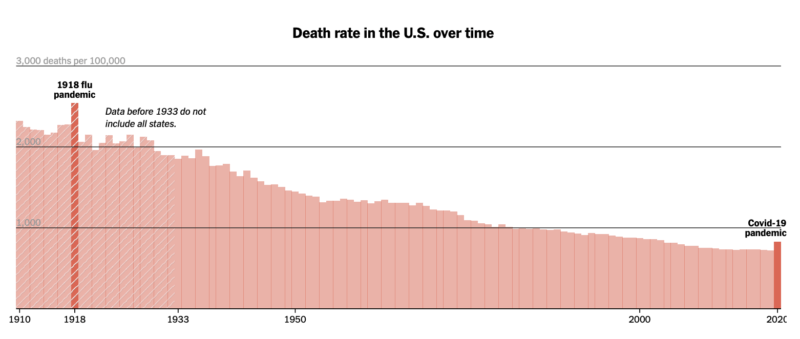
As shown in the graph provided by the New York Times, US death rates have been steadily declining over the past century, likely due to advances in technology and living standards. Last year certainly signaled a noticeable break from this trend with a sizable increase in deaths, but not nearly the same as the 1918 Flu which is a universal benchmark for a killer influenza virus.
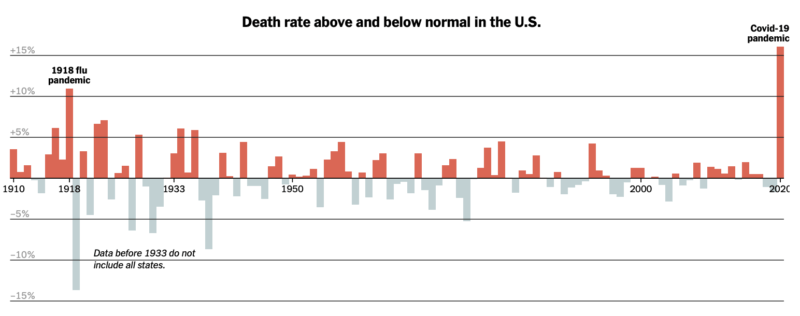
This graph provided by the New York Times indicates the spike in excess deaths in 2020, which is the number of deaths that have occured exceeding the predictions of standard death trends. This is of course all important information. Last year was certainly a horrific year with the outbreak of Covid-19, the lockdowns, and all the chaos that followed. It was a year of death and despair which should not be taken lightly.
Important Discussion: Deaths and Victims
It is common to invoke comparisons with the 1918 Flu Pandemic, as that was an extremely devastating virus that rocked the world. The article makes multiple references to the 1918 pandemic but there are a couple that raise interesting questions for further investigation. The first point is as follows,
“Combined with deaths in the first few months of this year, Covid-19 has now claimed more than half a million lives in the United States. The total number of Covid-19 deaths so far is on track to surpass the toll of the 1918 pandemic, which killed an estimated 675,000 nationwide.”
Comparing the death counts between the 1918 Flu and Covid-19 without adjusting for population growth is extremely misleading. In 1918 the population of the United States was roughly 103 million, while near the end of 2020 it stood at roughly 330 million. According to CDC statistics compiled by a study in JAMA Covid-19 killed 345,000 people in 2020 and now stands at around half a million as stated by the New York Times. Adjusted for the population growth of over 200 million people and holding the death rates constant, the 1918 Flu would have killed over 2 million people if it occured today, which is more than four times greater than Covid-19.
Furthermore, the two diseases are vastly different in terms of who is vulnerable. Covid-19’s severe outcomes almost exclusively affect the elderly and the immunocompromised, particularly those over the age of 65, which is also approaching the life expectancy of a human. Furthermore 94 percent of Covid deaths occurred with preexisting conditions. It poses virtually no risk to children, minimal risk to young adults, and only seems to kill more than 1 percent of victims with those over the age of 65.
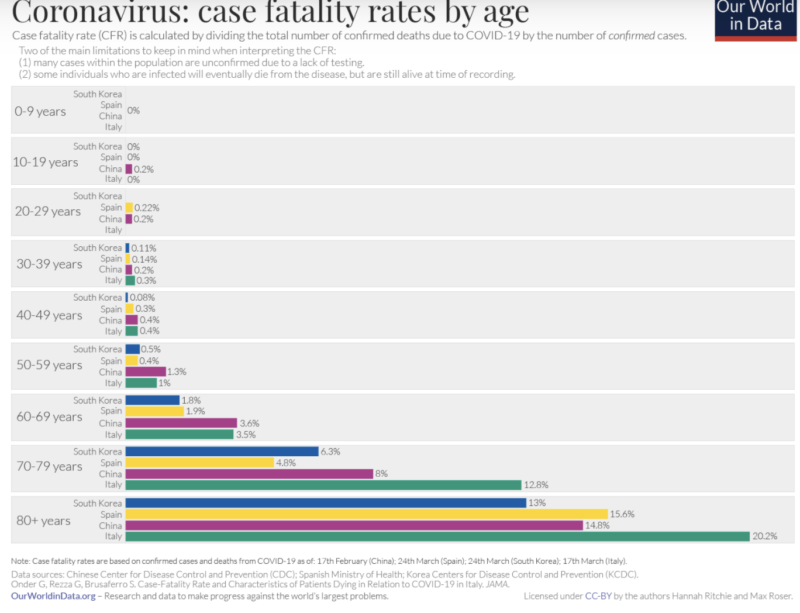
On the other hand the Spanish Flu was devastating to virtually all age groups and did not discriminate between the healthy and the unwell. The CDC writes the following about the 1918 Flu:
“Mortality was high in people younger than 5 years old, 20-40 years old, and 65 years and older. The high mortality in healthy people, including those in the 20-40 year age group, was a unique feature of this pandemic.”
It is clear that the comparison is flawed between the 1918 Flu and Covid-19, as the former was a devastating killer virus whereas the latter only poses a threat to vulnerable populations.
Too Much Statistical Noise
It is certainly worth investigating the noted increase in excess deaths in 2020 as that is obviously a problem. However, the article seems to suggest that Covid-19 was the main causal factor driving increases in death. Although that is certainly a reasonable intuition given that it is a novel virus, clearly there is far more at play.
The main issue to point out is that there were two health crises, not one. Covid-19 is certainly one but we cannot simply ignore the absolutely devastating and unprecedented use of lockdown policies that drastically upended all of society in a way that a virus could never accomplish.
The effects of lockdowns have been thoroughly studied by AIER and in a series of articles I noted just some of the damage to the economy, young people, and the normal functioning of society. All these disruptions led to adverse outcomes whether it be mental health issues, decline in living standards, or even disrupted healthcare procedures. In a press release the CDC noted that in May 2020, it recorded the highest number of drug overdoses ever recorded in a 12-month period.
A study in JAMA notes that although there was a substantial increase in overall deaths in 2020, Covid-19 was only one part of the problem, assuming all Covid deaths are directly attributable to Covid and not a comorbidity.
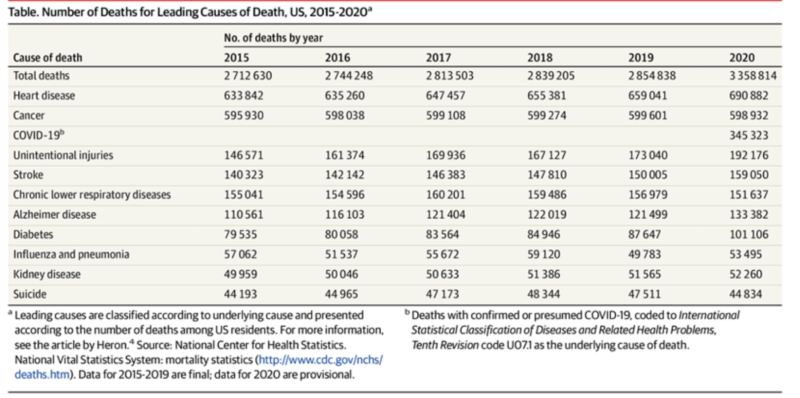
Some statistics of note are an increase in deaths due to heart disease, unintentional injuries, stroke, and diabetes. Although more investigation would be needed to understand how all of this comes together, it wouldn’t be absurd to believe that lockdown policies led to an increase in deaths due to their many disruptions to normal societal functions.
To cite one example of many, the Mackinac Center Legal Foundation recounts on one of its clients by writing,
“One of the affected medical practices, Grand Health Partners, operates in the Grand Rapids area. It performs endoscopies and other elective surgeries, many of which were deemed nonessential by executive order. Due to the shutdown, many of their patients were not able to receive treatment and have suffered because of it.”
Alongside exploring and cutting through the statistical noise posed by increases in death plausibly related to lockdowns, there still needs to be a discussion on quantifying the Covid-19 death count. Genevieve Briand, an economist at John Hopkins University, was subject to a massive degree of controversy for putting out a flawed but important lecture – later expanded into a research paper – that pointed out among other things that Covid-19 deaths may be inappropriately reclassified as deaths from other leading causes.
This is especially worthy of discussion given that the overwhelming majority of Covid deaths occur with comorbidities amongst eldery populations often nearing or exceeding life expectancy.
Key Takeaway
The data is clear; 2020 was a horrific year full of death and despair. The New York Times’ article certainly does a great job at starting a conversation about this topic. However, its comparisons of Covid-19 and the 1918 Flu raises more questions than answers. Furthermore its presentation of data regarding increases in deaths requires more context.
Upon further investigation, it is clear that Covid-19 claimed many lives. However, it is also clear that there is a substantial presence of statistical noise from comorbidities and increases in death from other causes. This raises many questions not just about the collateral damage of our policy response, but also about whether we are even operating with the appropriate information to be making such decisions with people’s lives in the first place.
HOW TO WRITE A BAD ARTICLE ABOUT RUSSIA
By Paul Robinson | IRRUSSIANALITY | April 26, 2021
Several press articles I’ve seen in the past few days have annoyed me rather, but I think that they are useful as examples of how reporting on Russia is distorted. For they demonstrate the methods used by journalists to paint a picture of the world that is far from accurate.
The articles in question come from those bastions of balanced reporting, The New York Times and The Guardian. The first is from Sunday’s edition of the NYT, with the title ‘The Arms Dealer in the Crosshairs of Russia’s Elite Assassination Squad’. This discusses Bulgarian arms dealer Emilian Gebrev, whose weapons were destroyed in an explosion in the Czech Republic in 2014, allegedly by Russian secret agents.
The second article is also from the NYT. This one has the title ‘After Testing the World’s Limits, Putin Steps Back From the Brink,’ and analyzes what author Anton Troianovski calls Russia’s ‘escalatory approach to foreign policy’, as seen by the Russian military build up near the Ukrainian border.
The third and final piece is from The Guardian, and is about last week’s protests in support of jailed oppositionist Alexei Navalny. This is somewhat schizophrenic, on the one hand saying that the pro-Navalny movement is in trouble, but on the other hand portraying the protests as a relative success and ending on a confident note that however grim things look for the opposition now, this can change at any moment.
Anyway, as one reads these articles one notices certain techniques that are used to paint a distorted picture of reality. So if you want to be a journalist, here’s what the articles teach that you should do:
1. Make stuff up. In the Guardian article, authors Andrew Roth and Luke Harding (yes, he!) begin by telling readers that ‘The future looked unspeakably grim for Alexey Navalny’s supporters before this week’s protests’. But it then lifts our spirits with the following:
What followed was surprisingly normal: a core of tens of thousands of Navalny supporters rallied near the Kremlin, waving mobile phone torches and chanting “Putin is a thief!” The police stood back in Moscow (there was a violent crackdown in St Petersburg). For an evening, the crowd roved the streets of the capital at will.
“This feeling of enthusiasm, of overcoming fear, the protest ended on a positive note … It left me with the feeling that nothing is lost, it’s still not the final battle, and that street protests in Russia are not over forever,” said Ivan Zhdanov, the head of Navalny’s Anti-Corruption Foundation, in an interview from Europe.
Ah yes, the protests were a huge success, euphoric. There were ‘tens of thousands of Navalny supporters rallied near the Kremlin.’
Except that most reporters said that there was nothing of the sort, and that the turnout was far below expectations.
Estimates of the size of the protest crowd vary, but the Russian Interior Ministry reckoned the numbers as 14,000 across the entire country and only 6,000 in Moscow. Interior Ministry counts tend to be on the low size, so you can treat them with a pinch of salt, but Russian media outlets were claiming a crowd in Moscow of 10,000 to 15,000, , while Western journalists’ estimates were in the same ballpark. Max Seddon of the Financial Times, for instance, reckoned the number at about 10,000 and commented that it was much lower than in the last protests in January. So ‘tens of thousands’ as The Guardian claims? Apparently not.
The Guardian isn’t alone in providing misleading data. In its article about the Bulgarian arms dealer, The New York Times has the following to say:
After pro-democracy protestors toppled the Kremlin’s puppet government there [i.e. Ukraine], Russia special forces units wearing unmarked uniforms seized and annexed the Crimean peninsula and also instigated a separatist uprising that is still going on in the east.
Let’s unravel this a bit: Were the demonstrators in Kiev really ‘pro-democracy’? Debatable, though not provably 100% false. But definitely untrue is the idea that the Ukrainian government that was toppled in February 2014 was a ‘Russian puppet’. That’s simply false. As for Russian special forces ‘annexing’ Crimea, it’s true in a way, although not the whole story of what happened. But the claim that Russian special forces ‘instigated a separatist uprising’ in Donbass is without foundation. I know of no evidence of ‘Russian special forces’ having been present in Donbass in the early weeks of the uprising there. (Strelkov and his goons were not ‘Russian special forces’, and most analyses of the uprising show how it was overwhelmingly spontaneous and local in origin.)
So, again, making stuff up.
2. Mention that others have ‘reported’, ‘claimed’, or ‘alleged’ something without pointing out that the claim in question is dubious at best, or false at worst.
For example. The NYT piece about Mr Gebrev talks about the alleged Russian spy unit, Unit 29155, and tell us that:
Last year, the Times revealed a CIA assessment that officers from the unit may have carried out a secret operation to pay bounties to a network of criminal militants in Afghanistan in exchange for attacks on US and coalition troops.
This is superficially true in that the Times did reveal this assessment. But what it doesn’t tell you is that the US government only has low to medium confidence that the claim is true. That’s kind of important, don’t you think? Shouldn’t it be mentioned? By failing to do so, the Times makes out that something is true that probably isn’t.
It’s not the only example. Talking of Ukraine a little later, the same article tells us that after war broke out in Donbass,
Russian assassins fanned out across the country, killing senior Ukrainian military and intelligence officials who were central to the war effort, according to Ukrainian officials.
They did, did they? Well, maybe ‘according to Ukrainian officials’ they did. But I have to say that it’s the first I’ve ever heard of it, and if it were true wouldn’t there have been news of lots of dead Ukrainian military and intelligence officers? Given that there wasn’t any such news, why repeat the claim? Shouldn’t the Times at least check it first.
3. Cite only sources that back up the narrative you are trying to tell. Ignore alternative viewpoints.
This kind of follows on from the last. If you are writing about Ukraine, cite ‘Ukrainian officials’. But don’t cite rebel spokesmen. If you’re talking about Russia, cite oppositionists. Ignore pro-government analysts.
We can see this in the Guardian piece. This quotes a couple of members of Navalny’s team, a British professor, a pro-Navalny Russia high schooler, and then to finish off some completely random former advisor to one-time British foreign minister Robin Cook, whose connection to, and knowledge of, Russia is completely unexplained. The only reason for giving him the final word seems to be that he came up with some nice lines about how opposition movements can suddenly triumph even when they seem to be losing. Needless to say, dissenting viewpoints are nowhere to be heard in the article.
The NYT piece about Russia stepping ‘back from the brink’ is similarly loaded with carefully chosen sources. First up is the ever-present Gleb Pavlovsky, a one-time advisor to Vladimir Putin turned oppositionist, who seems to be the eternal go-to person for anti-Putin quotes. After him, the article gives us a quote from Navalny’s assistant Leonid Volkov, a statement from Ukrainian National Security Advisor Oleksiy Danilov, and a few words from the generally pretty anti-Putin Estonian analyst Kadri Liik. For a pretence of balance we also get a statement by Kremlin spokesman Dmitry Peskov and the opinion of Konstantin Remchukov, editor of Nezavisimaia Gazeta, a newspaper whose political stance isn’t 100% clear to me but strikes me as sort-of oppositional, sort of not (given that Remchukov ran the re-election campaign of Moscow mayor Sergei Sobyanin). All in all, the anti-government voices get the bulk of the space.
So there you have it. Make some stuff up. Reference ‘claims’ and ‘allegations’ without pointing out that they are unsubstantiated or even false. And throw in lots of quotes from pundits who support the chosen narrative. Easy as pie. A career as a journalist awaits you. Just don’t bother trying to be accurate. Understood?
Putin keeps the door open for diplomacy with the US; too bad it’s falling on deaf ears
By Scott Ritter | RT | April 22, 2021
Putin warns of Russia’s ‘red lines’, comparing the West’s actions to ‘The Jungle Book’, but says Moscow doesn’t want to burn bridges with anyone. His message falls on deaf ears in the US, largely thanks to establishment media.
In his annual address to the Federal Assembly – the Russian parliament – President Putin devoted most of his time to domestic issues. His comments regarding national security and foreign affairs were brief, but telling.
While many pundits had predicted he would use the occasion to announce major actions that would signify a decisive break with the West in the aftermath of the US imposing a new round of economic sanctions, Putin, while lamenting the “unfriendly actions” and “outright rudeness” of the US and its allies, highlighted the fact that Moscow wants to maintain good relations with them.
“We don’t want to burn bridges,” Putin declared.
Lest those in the West who were listening to the speech mistake Russia’s “good intentions as indifference or weakness,” Putin waxed poetic in putting down a marker that Russia would have none of it.
He alluded to Rudyard Kipling’s ‘The Jungle Book’ in describing the present situation vis-à-vis Russia and the West, observing that there are “all kinds of small Tabaquis [a reference to the sniveling jackal featured in the book] running around Shere Khan [a tyrannical Bengal tiger]… howling to gain the favor of their ruler.” While not naming names, Putin’s allusion is clear – the US (Shere Khan) and its Tabaquis (NATO) are harassing Russia (Mowgli, the unmentioned hero of the tale.)
The Jungle Book reference takes on a darker meaning when the Russian president warns those countries who have “made it a habit to pick on Russia,” that if “they want to burn bridges, or even blow up these bridges, they must know that Russia’s response will be asymmetric, swift and tough.”
It should be noted that in ‘The Jungle Book’, Tabaqui the jackal was killed by Mowgli’s allies, while Shere Khan died at the hands of Mowgli himself, led into a fiery trap – the ultimate form of asymmetrical combat.
To the would-be Shere Khans and Tabaquis listening to Putin’s address, the Russian president could not have made his message any clearer – do not provoke the Russian bear. “Russia has its interests which we defend and will defend within the framework of international law,” he declared.
While some observers have interpreted Putin’s brief comments on foreign and national security as ‘war-mongering’ and ‘bellicose’, it was anything but. Putin made it clear that diplomacy, not military action, was Russia’s preferred methodology, emphasizing Russia’s “good intentions” and its desire to keep the existing bridges linking it and the West open, as opposed to burning them down.
Putin’s posture was consistent with the evaluation contained in the US intelligence community’s Global Threat Assessment for 2021, which described Russian intent as follows: “We expect Moscow to seek opportunities for pragmatic cooperation with Washington on its own terms, and we assess that Russia does not want a direct conflict with US forces.”
The document further noted that “Russia seeks an accommodation with the United States on mutual noninterference in both countries’ domestic affairs and US recognition of Russia’s claimed sphere of influence over much of the former Soviet Union.”
There is no sunlight between this assessment and the tone and content of Putin’s address.
But to read the US media’s reaction to his speech, one would get the impression that America occupied an alternative reality where the constant threat posed to Russia by the real-life Shere Khans and Tabaquis of the world has been flipped, with the Russian government assuming the role of the predatory figure threatening the existence of ‘democracy’ – apparently personified in the form of the Western-backed opposition figure Alexey Navalny, and the perpetually victimized Ukraine.
While providing dismissive lip service to the content of Putin’s address, the Washington Post instead highlighted what it reported as “a wave of protests” which “started rolling across Russia’s Far East in support of imprisoned opposition leader Alexey Navalny.” The New York Times followed suit injecting the Navalny drama, while Newsweek took a different tack and ran an article with the inflammatory headline, “Ukraine President Zelensky Is Ready for War With Russia, Vows to ‘Stand to the Last Man.’” It covered a speech delivered by Volodymyr Zelensky as if it were the geopolitical equivalent of Putin’s address. “Does Ukraine want war?” Zelensky asked. “No. Is it ready for it? Yes,” he said, adding that while “Ukraine does not start a war first,” it “always stands to the last man.” Zelensky urged Putin to meet with him “anywhere in the Ukrainian Donbas where there is war” for peace talks.
By emphasizing Navalny and the conflict in the Donbass region while simultaneously giving short shrift to the content and intent of Putin’s address, the US media has continued a course which has sought to minimize Russian statesmanship and diplomacy in favor of a Hollywood-like narrative which paints that nation and its leader as the quintessential bad guys.
Given the role played by the US mainstream media in creating an environment that compels US leaders to craft policy which conforms to domestic political imperative as opposed to legitimate national security interests, this emphasis is unfortunate. The failure on the part of the US media, and by extension, the Biden administration, to recognize this reality is reflective of the suicidal hubris and arrogance that has gripped what passes for an understanding of modern-day Russia. Read ‘The Jungle book’; it’s not an ending any would-be Shere Khan should desire.
Scott Ritter is a former US Marine Corps intelligence officer and author of ‘SCORPION KING: America’s Suicidal Embrace of Nuclear Weapons from FDR to Trump.’ He served in the Soviet Union as an inspector implementing the INF Treaty, in General Schwarzkopf’s staff during the Gulf War, and from 1991-1998 as a UN weapons inspector.
Interventionist Hypocrisy on U.S. Deaths in Afghanistan
By Jacob G. Hornberger | FFF | April 21, 2021
I’m always fascinated by the sacrificial mindset that interventionists have toward the lives of U.S. soldiers who they want to do the intervening. A recent example is Brett Stephens, a columnist for the New York Times. In an op-ed entitled “Abandoning Afghanistan Is a Historic Mistake,” Stephens writes:
The U.S. has lost fewer than 20 service members annually in hostile engagements in Afghanistan since 2015. That’s heartbreaking for those affected, but tiny next to the number of troops who die in routine training accidents worldwide.
Yes, it’s heartbreaking and the number of deaths might be “tiny” compared to other things but the point that Stephens is making, whether he realizes it or not, is that it’s worth sacrificing the lives of those 20 men every year for the indefinite future.
The important question is: What are those soldiers being sacrificed for? According to Stephens, they are being sacrificed to prevent the Taliban from retaking control over Afghanistan. He points out that if the Taliban end up winning Afghanistan’s civil war, that will mean tyranny for the Afghan people.
Is the prevention of tyranny for the Afghan people worth sacrificing 20 U.S. soldiers per year indefinitely into the future? Indeed, is it worth sacrificing even one U.S. soldier to accomplish that goal?
Stephens would say yes. He says the prevention of a Taliban victory is that important.
But there is one big problem with Stephens’s reasoning: his own personal commitment to the cause. After all, if preventing a Taliban victory is so important, what is Stephens doing here at home? There is nothing to prevent him from traveling to Afghanistan and offering his services to the Afghan government to assist it in prevailing over the Taliban.
Stephens is only 47 years old. There are plenty of men in the Afghan army that are that age. Why does he choose to remain here at home living a cushy life writing for the New York Times instead of traveling to Afghanistan and helping the U.S.-installed regime prevail in the conflict?
There is one simple reason: Stephens places a higher value on his cushy life here at home than he does on preventing a Taliban victory over there. He’s not willing to give up what he has here at home to risk his life by traveling to Afghanistan and offering his services in order to prevent a Taliban victory.
But when it comes to the lives of those 20 soldiers a year, that’s a different story. In Stephens’s internal ranking of values, the lives of those soldiers are of secondary value compared to preventing a Taliban victory.
We saw this interventionist mindset, of course, during the Vietnam War, when more than 58,000 American men were sacrificed to prevent the communists in North Vietnam from prevailing in that country’s civil war. Interventionists said (and still say) that sacrificing those 58,000-plus American men sacrifice was worth it. In fact, if interventionists had had their way, American soldiers would still be in South Vietnam today, being sacrificed to prevent a communist takeover of South Vietnam.
There are lots of bad things that happen around the world. But that doesn’t mean that American soldiers should be sacrificed to prevent them. If interventionists are outraged over bad things that happen in the world, let’s just let them travel overseas to risk their lives to right the wrongs.
My hunch is that Stephens is one of those people who exhorts everyone to thank the troops for their service and sacrifice. I wonder how many U.S. soldiers can see through this interventionist hypocrisy, especially after 20 years of official lies and deception surrounding the U.S. war on Afghanistan.
NYT ‘bounties’ non-story shows US/UK media has got so used to blaming Russia, it’s now doing it out of habit
By Paul Robinson | RT | April 20, 2021
As holes predictably appear in claims that Russia paid the Taliban to kill American soldiers, questions arise as to why such erroneous stories keep appearing in the American press. Domestic US politics provide part of the answer.
“A Powerful Russian Weapon: The Spread of False Stories.” So ran a headline in the New York Times in August 2016. If it were only a Russian phenomenon, the world would be a much better place. Alas, the Times is far from immune from spreading “false stories” itself. From Walter Duranty’s reporting from the Soviet Union, through Judith Miller’s articles on Iraqi weapons of mass destruction, up to its coverage of accusations that US President Donald Trump had colluded with the Russian government, The New York Times has had its fair share of “fake news” experiences.
“A little tiny bit flat footed,” was how the Times executive editor Dean Baquet described the newspaper when the Mueller investigation failed to find Trump guilty of collusion. “I mean, that’s what happens when a story looks a certain way for two years. Right?” added Baquet.
You have to feel a bit for him. He really believed in collusion. In his eyes, it did “look a certain way.” It was rather embarrassing when he turned out to be completely wrong.
The New York Times’ iffy relationship with reality is back in the news today. US presidential spokesperson Jen Psaki admitted that the US intelligence community was not at all convinced by accusations first aired in the Times that the Russian government had paid bounties to the Taliban in Afghanistan to kill American soldiers. Rather, it had only “low to moderate confidence” that the story was true. Psaki explained:
“The reason that they have low to moderate confidence in this judgment is in part because it relies on detainee reporting, and due to the challenging environment and also due to the challenging operating environment in Afghanistan. So it’s challenging to gather this intelligence and this data.”
The accusation against Russia appeared in The New York Times in June last year. The Times then followed up with additional stories on the same topic. “Afghan Contractor Handed Out Russian Cash to Kill Americans, Official Say,”claimed the headline of a second article. “How Russia Built a Channel to the Taliban, Once an Enemy,” read the headline of a third.
Commentators soon pointed out problems. While the CIA had moderate faith in the claim, the National Security Agency didn’t. In any case, the primary sources of information were Afghan prisoners who hadn’t themselves been involved in the alleged transaction. Their claims needed to be treated with a fair degree of caution.
Others pointed out that the story didn’t make any sense from a Russian point of view. The Russian government values the stability of Afghanistan, and had consistently supported both the Afghan government and the US military presence there. There was no obvious motive for killing Americans.
Furthermore, it’s not as if the Taliban needed to be incentivised to fight America. They were already killing as many Americans as they were able to. Paying them to do what they were doing already would have been odd, to say the least.
Now, Ms. Psaki admits what people have long since suspected: that the accusation against Russia is not well-founded. But anyone with any sense realized that from the get-go. Why, then, did The New York Times report it?
The Times’ explanation is that the story was true. It didn’t say that the accusation was accurate; it merely reported the accusation. In an article on Thursday, Times reporter Charlie Savage notes that the newspaper had stated that the CIA had only “medium” confidence in the story and the NSA had “low” confidence. It had also reported that the Afghan prisoners who recounted the story hadn’t actually been present when the alleged meetings with Russians took place. In other words, The New York Times’ reporting was accurate.
Maybe so, but that begs a question – why report a story that makes an extremely explosive allegation if you’re not at all confident that the accusation is true? Isn’t there some responsibility to hold off from repeating libelous claims until such time as you can substantiate them?
Apparently not. It seems as if the Times wanted to believe the story. It “looked a certain way,” to use Dean Baquet’s phrase. Which in turn begs another question. Why did it look that way to the Times?
The obvious answer is that it fitted the political needs of the moment. For the real target of the Russian bounty story was never Russia but Trump. Its purpose was to show that the president had in some way betrayed America’s soldiers by continuing to talk to Russia even though he had evidence that the Russians were killing Americans.
The speaker of the House of Representatives, Nancy Pelosi, thus remarked, “The administration’s disturbing silence and inaction endanger the lives of our troops and our coalition partners.”Meanwhile, then presidential candidate and now president, Joe Biden, responded to the story by saying that Trump’s “entire presidency has been a gift to Putin, but this is beyond the pale. It’s a betrayal of the most sacred duty we bear as a nation to protect and equip our troops when we send them into harm’s way. It’s a betrayal of every single American family with a loved one serving in Afghanistan or anywhere overseas.”
Russia, in other words, was merely a pawn in an internal American political struggle. Sadly, though, this is far from an isolated incident. Furthermore, the Democratic Party and its backers in the USA have now become so habituated to spreading dubious stories about Russia that they seem to be unable to stop, even though the original political motivation has vanished. The Russian bounty wasn’t the first “false story” to appear, and it won’t be the last.
Paul Robinson is a professor at the University of Ottawa. He writes about Russian and Soviet history, military history, and military ethics, and is the author of the Irrussianality blog.
The Media Lied Repeatedly About Officer Brian Sicknick’s Death. And They Just Got Caught.
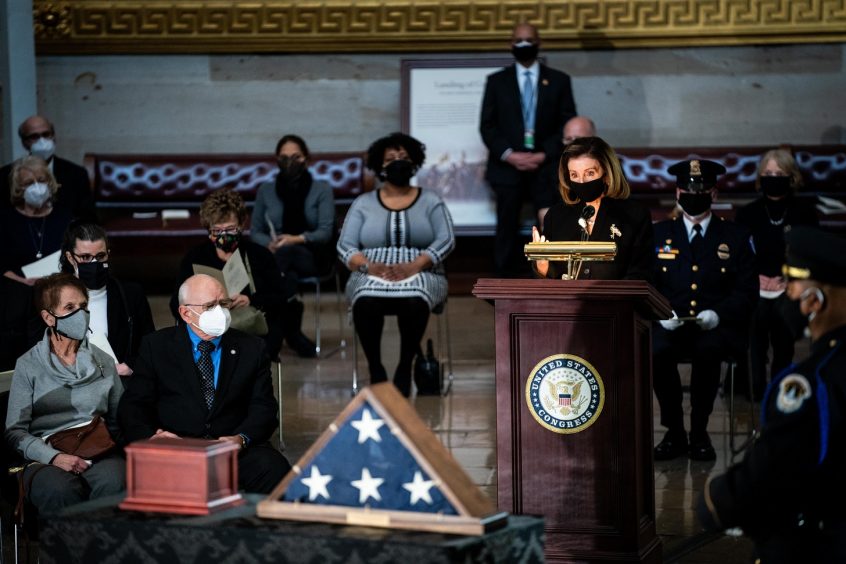
Nancy Pelosi at a congressional tribute to the late Capitol Police officer Brian Sicknick who lies in honor in the Rotunda of the U.S. Capitol on Feb. 3, 2021. (Photo by Erin Schaff-Pool/Getty Images)
By Glenn Greenwald | April 19, 2021
It was crucial for liberal sectors of the media to invent and disseminate a harrowing lie about how Officer Brian Sicknick died. That is because he is the only one they could claim was killed by pro-Trump protesters at the January 6 riot at the Capitol.
So The New York Times on January 8 published an emotionally gut-wrenching complete fiction that never had any evidence — that Officer Sicknick’s skull was savagely bashed in with a fire extinguisher by a pro-Trump mob until he died — and, just like the now-discredited Russian bounty story also unveiled by that same paper, cable outlets and other media platforms repeated this lie over and over in the most emotionally manipulative way possible. Just watch a part of what they did and how:
As I detailed over and over when examining this story, there were so many reasons to doubt this storyline from the start. Nobody on the record claimed it happened. The autopsy found no blunt trauma to the head. Sicknick’s own family kept urging the press to stop spreading this story because he called them the night of January 6 and told them he was fine — obviously inconsistent with the media’s claim that he died by having his skull bashed in — and his own mother kept saying that she believed he died of a stroke.
But the gruesome story of Sicknick’s “murder” was too valuable to allow any questioning. It was weaponized over and over to depict the pro-Trump mob not as just violent but barbaric and murderous, because if Sicknick weren’t murdered by them, then nobody was (without Sicknick, the only ones killed were four pro-Trump supporters: two who died of a heart attack, one from an amphetamine overdose, and the other, Ashli Babbitt, who was shot point blank in the neck by Capitol Police despite being unarmed). So crucial was this fairy tale about Sicknick that it made its way into the official record of President Trump’s impeachment trial in the Senate, and they had Joe Biden himself recite from the script, even as clear facts mounted proving it was untrue.

Articles on this Substack, Feb. 16, 2021 and Mar. 5, 2021
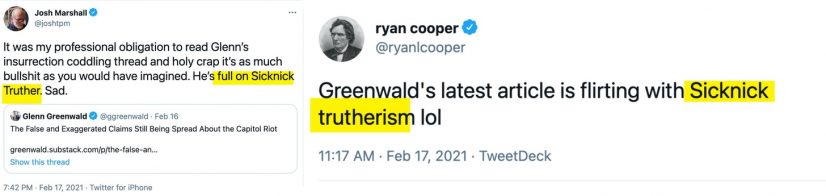
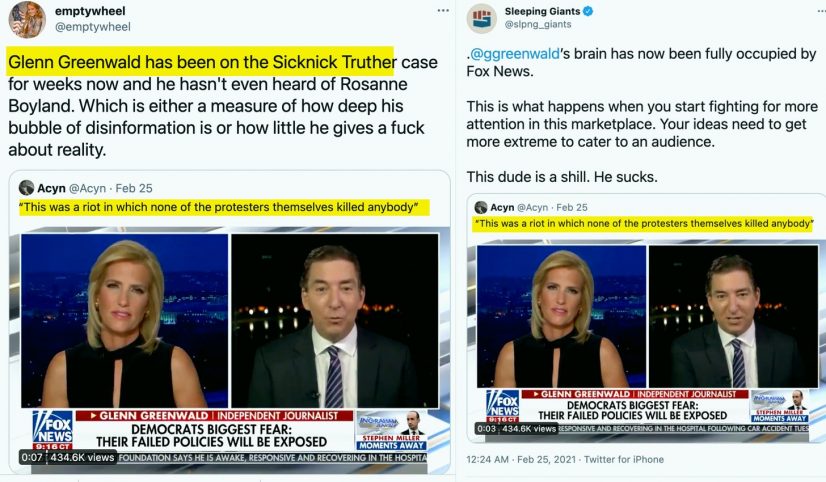
Because of its centrality to the media narrative and agenda, anyone who tried to point out the serious factual deficiencies in this story — in other words, people trying to be journalists — were smeared by Democratic Party loyalists who pretend to be journalists as “Sicknick Truthers,” white nationalist sympathizers, and supporters of insurrection.
For the crime of trying to determine the factual truth of what happened, my character was constantly impugned by these propagandistic worms, as was anyone else’s who tried to tell the truth about Sicknick’s tragic death. Because one of the first people to highlight the journalistic truth here was former Trump official Darren Beattie of Revolver News and one of the few people on television willing to host doubts about the official story was Tucker Carlson, any doubts about the false Sicknick story — no matter how well-grounded in truth, facts, reason and evidence — were cast as fascism and white supremacy, and those raising questions smeared as “truthers”: the usual dreary liberal insults for trying to coerce people into submitting to their lies:
Because the truth usually prevails, at least ultimately, their lies, yet again, all came crashing down on their heads on Monday. The District of Columbia’s chief medical examiner earlier this morning issued his official ruling in the Sicknick case, and it was so definitive that The Washington Post — one of the media outlets that had pushed the multiple falsehoods — did not even bother to try to mask or mitigate the stark conclusion it revealed:
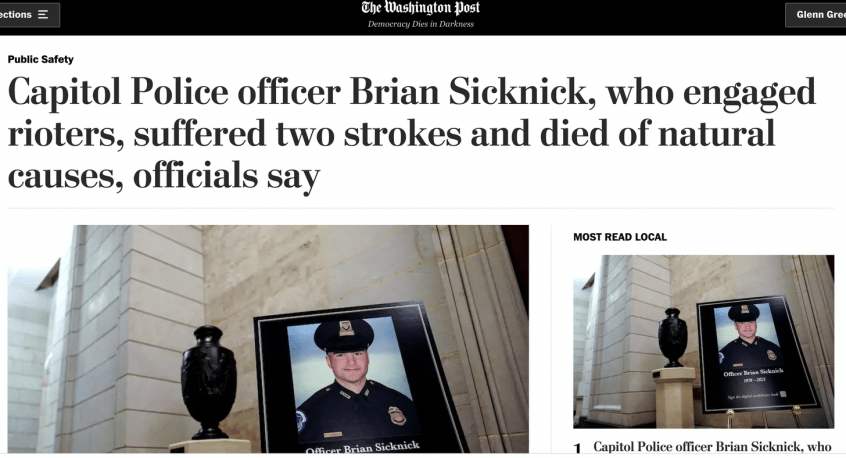
The first line tells much of the story: “Capitol Police officer Brian D. Sicknick suffered two strokes and died of natural causes a day after he confronted rioters at the Jan. 6 insurrection, the District’s chief medical examiner has ruled.” Using understatement, the paper added: “The ruling, released Monday, likely will make it difficult for prosecutors to pursue homicide charges in the officer’s death.”
This definitive finding from the medical examiner not only rids us of the Fire Extinguisher lie but also the second theory to which these media outlets resorted once they had to face the reality that they spent weeks spreading an outright lie (needless to say, they provided no real accountability or even acknowledgement for the fact that they did spread that Fire Extinguisher tale, instead just seamlessly moving to their next evidence-free claim). They changed their story to claim that pro-Trump protesters still murdered Sicknick, not with a fire extinguisher but with bear spray, which video shows at least one protester using in his vicinity.
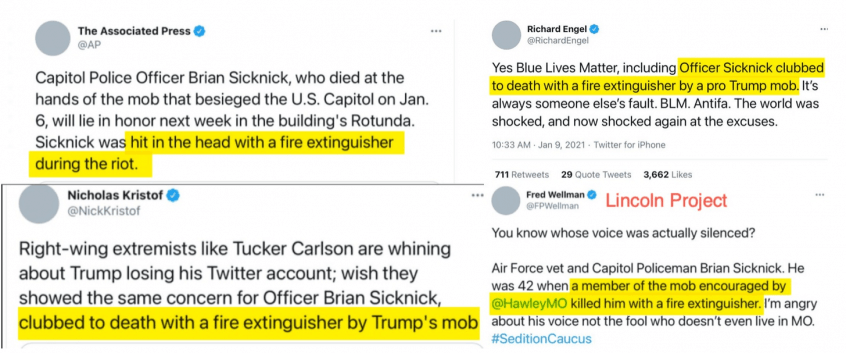
Clockwise: Tweet of Associated Press, Jan. 29; Tweet of NBC’s Richard Engel, Jan. 9; Tweet of the Lincoln Project’s Fred Willman, Jan. 29; Tweet of The New York Times’ Nicholas Kirstof, Jan. 9
The problem with that theory is that bear spray is not usually fatal, and the medical examiner’s findings ruled out the possibility that this is what caused his death:
In an interview with The Washington Post, Francisco J. Diaz, the medical examiner, said the autopsy found no evidence the 42-year-old officer suffered an allergic reaction to chemical irritants, which Diaz said would have caused Sicknick’s throat to quickly seize. Diaz also said there was no evidence of internal or external injuries…
Diaz said Sicknick suffered two strokes at the base of the brain stem caused by a clot in an artery that supplies blood to that area of the body. Diaz said he could not comment on whether Sicknick had a preexisting medical condition, citing privacy laws.
So there goes that second fairy tale. The Post did note the medical examiner’s observation regarding Sicknick’s participation in defending the Capitol that day that “all that transpired played a role in his condition.” That of course is true: just as it is true for the two pro-Trump supporters who had heart attacks that day and the other pro-Trump supporter who died from too much amphetamine in her system, having a stressful encounter as a police officer likely played a role in why someone would have two strokes the following day. But police officers are trained for stressful encounters, and that obviously is a far cry from being able to claim that any pro-Trump supporter murdered Sicknick.
I’ll have much more on this story as it unfolds. A significant amount of media accountability is warranted. But you’re seeing why there is so much resentment and so many attacks on platforms like this one that permit journalists to report and analyze facts and dissect media narratives without being constrained by liberal orthodoxies and pieties and while remaining immune from liberal pressure tactics: it’s one of the few ways that real dissent to their lies and propaganda can be aired.
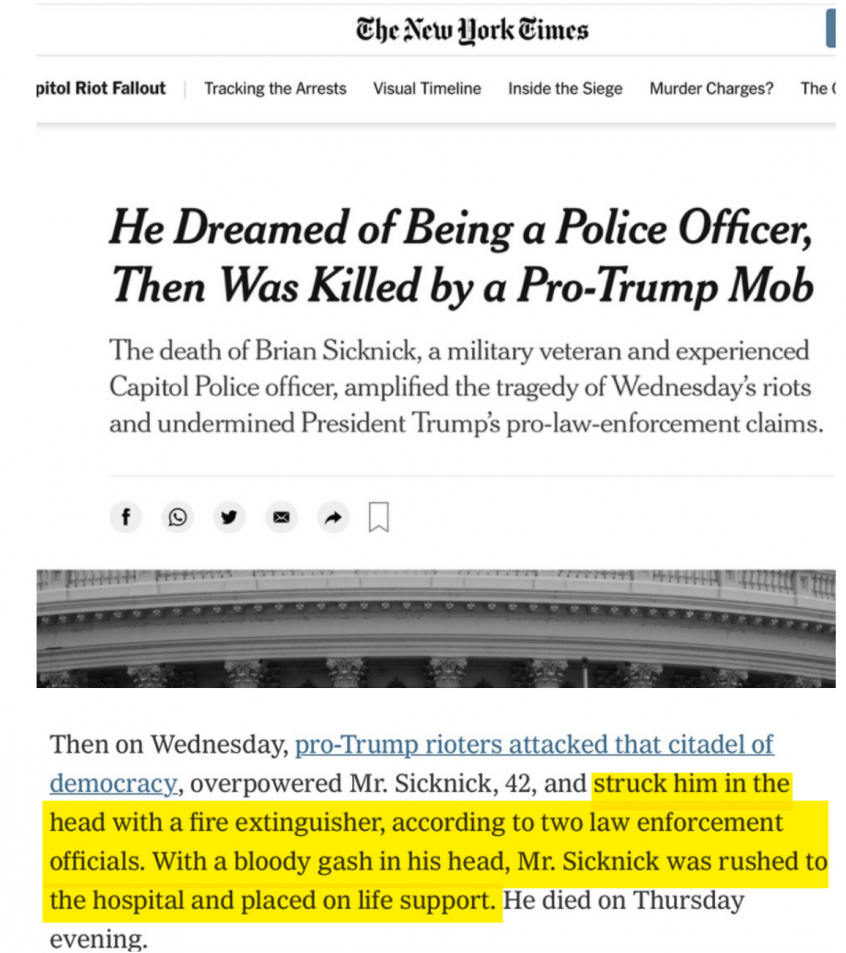
The New York Times, in a now-”updated” article, Jan. 8, 2021
Truth matters. Noble lies are never justified no matter the cause, especially in journalism. But these employees of corporate media outlets have been taught the exact opposite model: that their primary obligation is to please and flatter the partisan agenda and political sensibilities of their audience even if it means lying or recklessly spreading unproven theories to do it. That is their profit model. And they have trained their audiences to want and expect this and that is why they never feel compelled to engage in any self-critique or accountability when they get caught doing this: their audiences want to be lied to — they are grateful for it — and would prefer that they not admit they did it so that their partisan interests will not be undermined.
What is most depressing about this entire spectacle is that, this time, they exploited the tragic death of a young man to achieve their tawdry goals. They never cared in the slightest about Officer Brian Sicknick. They had just spent months glorifying a protest movement whose core view is that police officers are inherently racist and abusive. He had just become their toy, to be played with and exploited in order to depict the January 6 protest as a murderous orgy carried out by savages so primitive and inhuman that they were willing to fatally bash in the skull of a helpless person or spray them with deadly gases until they choked to death on their own lung fluids. None if it was true, but that did not matter — and it still does not to them — because truth, as always, has nothing to do with their actual function. If anything, truth is an impediment to it.
Featured Video
“Historic Russia”: The Land Putin Will Not Give Back
or go to
Aletho News Archives – Video-Images
Book Review
Why the War on Conspiracy Theories Is Bad Public Policy
By Kevin Barrett • Unz Review • February 1, 2019
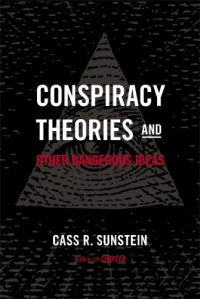 A Review of Conspiracy Theories and Other Dangerous Ideas by Cass Sunstein (based on an earlier paper co-authored with Adrian Vermeule); In Defense of Troublemakers: The Power of Dissent in Life and Business by Charlan Nemeth; and Conspiracy Theories and the People Who Believe Them, edited by Joseph E. Uscinski
On January 25 2018 YouTube unleashed the latest salvo in the war on conspiracy theories, saying “we’ll begin reducing recommendations of borderline content and content that could misinform users in harmful ways—such as videos promoting a phony miracle cure for a serious illness, claiming the earth is flat, or making blatantly false claims about historic events like 9/11.”
At first glance that sounds reasonable. Nobody wants YouTube or anyone else to recommend bad information. And almost everyone agrees that phony miracle cures, flat earthism, and blatantly false claims about 9/11 and other historical events are undesirable.
But if we stop and seriously consider those words, we notice a couple of problems. First, the word “recommend” is not just misleading but mendacious. YouTube obviously doesn’t really recommend anything. When it says it does, it is lying. … continue
Blog Roll
 Aletho News
- BRITAIN’S WARNING: PREPARE FOR WAR
- “Historic Russia”: The Land Putin Will Not Give Back
- How the Cambridge Analytica scandal still haunts Mark Zuckerberg
- The Ongoing Cancellation Campaign Against a Dissenting Academic in Norway
- Yemen and ‘the Houthis’: Challenging Sami Hamdi’s Narrative
- No, Christians did not invent Zionism
- AIPAC-led lobbying network opens branches in Cypriot, Greek parliaments
- Araghchi blasts ‘parasitic’ alliance as US taxpayers pay for Israel’s war on Iran
- Easy fix for Europe’s chaos? Stop fueling war against Russia
- Putin’s key remarks on peace talks and Europe’s ‘schizophrenia’
- If Americans Knew
- An error has occurred; the feed is probably down. Try again later.
- No Tricks Zone
- Two New Studies Find Thwaites Glacier Melt Cannot Be Driven By Human Activity Or A Warming Ocean
- E-Cars Reduce CO2 Emissions By Only 41% Compared To Internal Combustion Engine Vehicles
- Predictions Made By Renowned Climate Professor Over Past Decades Have Been Proven To Be Poor
- New Study Suggests Large Regions Of The Pacific Ocean Have Been Cooling For The Last 80 Years
- Germany’s Green Energy Debacle: High Energy Costs Force Kahla Porzellan to Close After 182 Years!
- New Study: 50 Years Of The Most Aggressive ‘Net Zero’ Policies Can Only Affect The Global Climate By 0.03°C
- US September “Heat” Was No Record…Many Records Set Decades Ago
- Latest European Green Energy Debacle; Portugal’s Largest Flagship Solar Park Insolvent!
- Green Energy Debacle: German Expert Professor Fritz Vahrenholt Warns Of Severe Economic And Social Consequences
- Two More Paleo Reconstructions Affirm Meters-Higher Sea Levels Across Ireland, Brazil 7000-6000 Years Ago

