Covid-19: For Western mainstream media, Russia fails even when it succeeds
By Anna Belkina | RT | May 14, 2020
The Russian Foreign Ministry has demanded that two of the most prominent foreign newspapers, the New York Times and the Financial Times, retract their stories stating that Russia is concealing the real Covid-19 death toll.
Even if the NYT and FT were correct in their claims, Russia would still be doing far better than the vast majority of large industrialized nations, including the US and UK.
As of the morning of May 14, Russia’s Covid-19 death toll stands at 2,212 out of 242,271 recorded cases, or 0.9 percent. This number is not disputed by the World Health Organization (WHO), which has continuously monitored the situation in the country. To compare, the death rate for the novel coronavirus is six percent in the US, seven percent in Canada, 14 percent in the UK, and 10 percent or more in Italy, Spain, France and Sweden. You know, the so-called civilized countries.
There is not a hint of evidence that the Russian government has covered up the coronavirus toll. Yet, foreign media are skeptical of Russia’s numbers. Perhaps because in their worldview, Russia is not allowed to be anything but a grim and miserable failure at everything. Any fact contradicting this narrative is Kremlin propaganda.
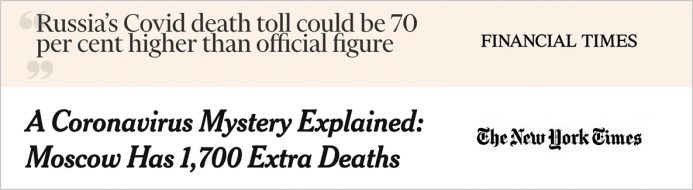
To wit, the UK-based, Japanese-owned Financial Times has analyzed the recent all-cause mortality data coming out of Moscow and Saint Petersburg vis-a-vis the cities’ historical averages. It has concluded that Russia’s actual Covid-19 death toll is around 70 percent higher than the officially reported figures.
Meanwhile, the New York Times – headquartered in the city where nurses had to wear garbage bags for the lack of protective equipment, and where the local government began prospecting parks as possible burial grounds due to the staggering Covid-19 body count of nearly 15,000 – claimed that Russia’s real death toll could be “possibly almost three times higher than the official death toll.”
Here’s what the Times doesn’t tell you: Even if their worst case scenario for Russia were true, the country’s Covid-19 death rate would still be one of the lowest among large industrialized nations. Even having been tripled by the Times’ accounting, the resulting 2.7 percent still would be an impressive healthcare result compared to six percent in the US. It would still be below Japan’s 4.1 percent and barely above the world’s main coronavirus ‘success story’, South Korea, currently at 2.3 percent. Moscow, a city with 50 percent more residents than NYC, would still have a body count five times lower even if all the extra deaths the Times is writing about were attributed Covid-19.
NB: While there are other large nations with smaller fatality numbers, such as India and Brazil, they are testing their populations at levels lower by a factor of tens, and suffer from weaker healthcare infrastructure overall. Their official recorded Covid-19 deaths therefore are likely not providing an accurate portrayal of the situation on the ground, a concern echoed by the WHO. Russia currently tests at the rate of ~40,000 per 1 million people, or well ahead of the US, UK, Canada, France, Sweden, and other OECD countries, and on par with Germany, Norway, and Switzerland, Europe’s ‘model nations’ in combating the coronavirus pandemic.
The New York Times is not interested in exploring the reasons for Russia’s promising performance, be they grounded in the country’s demographics or familial habitation traditions, legacy healthcare system or innovative scientific approaches, historical experiences with respiratory illnesses or modern infrastructure management.
It buries the lede, brushing aside its own note that “underreporting of fatalities has been observed in many other countries, where subsequent data reveal large upticks in deaths compared to the same period in previous years,” and charts showing Spain and England as countries that display a change in historical mortality trend lines nearly identical to Russia’s.
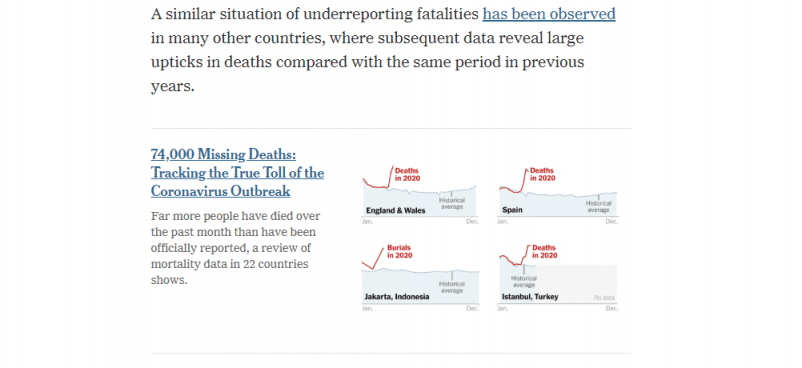
© https://www.nytimes.com/2020/05/11/world/coronavirus-news.html
New York’s own numbers, according to the US Centers for Disease Control “may be thousands of fatalities worse than the tally kept by the city and state.” Moscow’s Department of Health, by the way, has already addressed the questions about the city’s cause-of-death accounting.
Instead, the Times pivots to its favorite bête noire – malevolent Russian propaganda. Their purported 300-percent greater coronavirus death toll in Russia “contrasts sharply with the line peddled by the Kremlin.” The paper does not clarify whether the same historical disparities in Spain and the UK contrast sharply with the line peddled by Madrid or the line peddled by 10 Downing Street. Official information from the naughty countries is always ‘peddled lines’; everyone else gets to plead best intentions and innocent ignorance in perpetuity.
The ‘Kremlin line’ on the coronavirus toll in Russia is supported by international monitoring and discrepancies are accounted for by international practices. The Kremlin’s supposedly concealed ‘massive failure’ would still be kicking the a** of most ‘First World’ nations when it comes to mitigating Covid-19 fatalities. But it would kill the mainstream press to admit as much.
Anna Belkina is RT’s deputy editor in chief and head of communications, marketing and strategic development.
FBI Claims China Targeting US Organizations Engaged in Coronavirus Research
Sputnik – May 13, 2020
The Federal Bureau of Investigation (FBI) and the Cybersecurity and Infrastructure Security Agency (CISA) have issued a joint statement in which they accuse malicious Chinese actors of trying to steal US coronavirus vaccine research.
“The FBI is investigating the targeting and compromise of US organizations conducting COVID-19-related research by PRC-affiliated cyber actors and non-traditional collectors. These actors have been observed attempting to identify and illicitly obtain valuable intellectual property (IP) and public health data related to vaccines, treatments and testing from networks and personnel affiliated with COVID-19-related research. The potential theft of this information jeopardizes the delivery of secure, effective, and efficient treatment options,” the statement, put out Wednesday, says.
The FBI and CISA urge organizations carrying out research in these fields to “maintain dedicated cybersecurity and insider threat practices” to prevent such thefts, and calls on institutions to watch out for and report any “anomalous” and “unusual” activities and behaviour. The statement also warns that organizations should realize that talking to the press about their COVID-19-related research may result in “increased interest and cyber activity” by possible malicious actors.
The warning comes just days following Sunday’s report by The New York Times citing current and former US security officials indicating that US intelligence was planning to put out an alert about alleged efforts by Chinese spies to access US-based coronavirus research. Officials told the paper that the ‘non-traditional collectors’ involved may include Chinese researchers and students working in the United States who may be interested in ‘infiltrating’ US academic and private laboratories in search of a vaccine. Complementing them are China’s “state-run hacking teams,” the paper claimed.
CISA director Christopher Krebs has alleged that “China’s long history of bad behaviour in cyberspace is well documented, so it shouldn’t surprise anyone they are going after the critical organizations involved in the nation’s response to the COVID-19 pandemic.” Krebs promised that the US would “defend our interests aggressively,” without elaborating.
Strong Claims From ‘Empire of Hackers’
Chinese Foreign Ministry spokesperson Zhao Lijian commented on the claims made by NYT on Monday, saying China already leads global research and development on coronavirus vaccines and therapies, and that the hacking claims were an “immoral” and baseless attempt to “smear” his country.
Chinese biotech companies reported recently that they have four different coronavirus vaccines already undergoing clinical trials, with three of them entering the second stage, with pilot production of an inactivated COVID-19 vaccine expected to begin in July. US President Donald Trump, meanwhile, has previously said he expects the US to have a vaccine available by the end of the year.
An anonymous researcher told the Global Times newspaper Monday that in the US’s core research efforts would be of little value to China, because US efforts are DNA and RNA-based vaccines, while China has chosen to focus on inactivated vaccines (i.e. vaccines made from virulent virus by destroying its infectivity while retaining its immunogenicity). Jonas Salk’s polio vaccine is the most famous example of a major inactivated vaccine.
Earlier this year, China called out the United States for being an “empire of hackers” and “the largest state eavesdropper in international cyberspace” following revelations of the extent of the National Security Agency’s global intelligence-gathering operations going back to the Cold War.
The ‘See-No-Evil’ Phase of Russiagate
By Patrick Lawrence | Consortium News | May 11, 2020
The long, destructive conspiracy theory known as Russiagate, the mother of them all, at last evaporates into thin air. No shred of it remains as of back-to-back disclosures over the past couple of weeks. Where does this leave us? What is to come of this momentous turn of events?
Among those not inclined toward hysteria or copious quaffs of Democratic Party Kool–Aid, it has long been a question how those who concocted and sustained the tales of Russian “meddling,” “collusion,” and mail hackery would manage their embarrassment — not to mention their potential legal liabilities — once their edifice-built-on-sand collapsed, as it was destined from the first to do.
The early signs are as some predicted: They will slither quietly off the stage without comment, they will deny their incessant, ever-vehement accusations, they will profess to weariness, they will insist there are more important things to think about now.
Here is a tweet from one Bob F published Saturday. Our Bob touches nearly all of the above-noted bases. His mentions of Matt Taibbi, Aaron Maté, and Jimmy Dore reference two journalists and a talk-show host who identified the fraud from the first and had the scruples not to surrender to the liberal totalitarianism we have suffered these past three years:
ok ok ok ok @aaronjmate and @jimmy_dore got one thing right in their lives. Can we move on from this shiny object that is Russiagate? Trump and the Republicans are looting this country. We could be very close to armed revolt. But let’s talk more about Russia Russia Russia.
— Bob F (@BobF_666) May 9, 2020
Yes, Bob, lets. This is a brilliant specimen of the flaccid cowardice we’re now to witness many times over. Reassuringly enough, a modest twitter storm followed. Here is a reply from Kathy Woods, a consistently insightful commentator in Twitterland:
Move on? Hell no! I can’t stand Trump, but the Dems used the levers of the security state to perpetrate a fraud. They buried progressive momentum and brought us to the brink w/ Russia. It’s essential we completely expose this.
— Kathy Woods (@woods_kathy) May 10, 2020
For good measure, here is another response to Big Bob, this one addressing his implicit assertion of Democratic Party virtue in the Age of Trump:
A) liberals never stopped russiagating so obviously it needs to continue to be debunked.
B) if you think the Democrats are not equally to blame for the looting, I got a bridge to sell you.
— David Warschauer???? (@rogersmithbigo) May 9, 2020
There is anger abroad as Russiagate finally unwinds, plainly. This is an excellent thing. And Ms. Woods is right: It is important to make the sun shine on what became, before the end, a scandal of historic proportions. There is a chance of achieving the “complete exposure” Woods asks for, but it remains a question, as of now, whether this will come to pass.
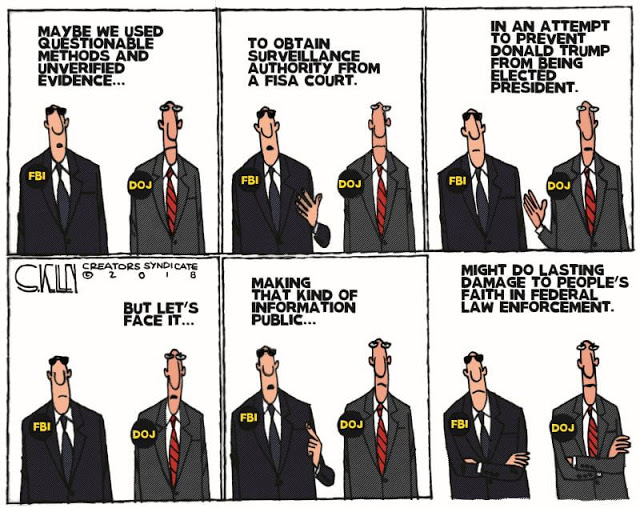
Two weeks ago the Justice Department made public documents showing that when, in January 2017, prosecutors wanted to close the collusion case against Michael Flynn, who briefly served as President Donald Trump’s national security advisor, because they found “no derogatory information” against him, Peter Strzok, the philandering F.B.I. agent later found to be shaping an “insurance policy” against a Trump victory in the 2016 election, cajoled them into keeping it open — absence of evidence be damned.
Two Other Developments
The Strzok revelations turned out to be prelude to the two other developments further demolishing the Russiagate narrative. Last Thursday Justice finally dropped its case against Flynn altogether. We now know he was the victim of a perjury trap when questioned about his contacts with Sergey Kislyak, Moscow’s ambassador to Washington in 2016. “Get him to lie so we can prosecute him,” was the FBI’s directive.
Yet worse, Flynn’s guilty plea was in response to prosecutors’ threats to indict his son if he pled otherwise. Tell me the difference, please, between this kind of stuff and the treatment of the accused in the postwar show trials in Eastern Europe.
On the same day the Justice Department dropped the charges against Flynn, the House Intelligence Committee released documents showing that the FBI had no evidence that Russia pilfered the Democratic National Committee’s email archives by hacking into its servers in mid–2016. The FBI had none because CrowdStrike, the patently corrupt cyber-security firm on which it (inexplicably) relied, never gave it any: It had none, either — contrary to its many claims otherwise.
The taker of cake here is that the documents also show that the House Intelligence Committee, chaired by the inimitable (thank goodness) Adam Schiff, knew there were no grounds to allege Russian involvement in what wasn’t a hack by anyone, but a leak, probably by someone with direct access to the DNC’s servers.
My Consortium News colleague Ray McGovern has just detailed the collapse of the “Russians-hacked-it” ruse.
No evidence anywhere along the line of collusion, none of Russians stealing mail. There is a simpler way to put this: No Russiagate.
In truth, there has been evidence aplenty of the Russiagate fraud for some time, due in part to the researches of Veteran Intelligence Professionals for Sanity, VIPS, of which McGovern is a principal. The problem has been to secure official acknowledgement of three years’ worth of wrongdoing. We now have it, even if it arrives with no admission whatsoever of responsibility.
Enter Perception Management
Now come the lies, the dissembling, and the media’s “perception management.” Tucker Carlson, the Fox News presenter, offered a funny-but-not-funny catalog of the liars who now stand exposed, none more thoroughly than the egregious Schiff, who ought to resign over this, and Evelyn Farkas, another Obama-era holdover with absolutely no regard for the truth. Loretta Lynch, Obama’s A–G, will also have things to answer for, assuming answers for her misconduct are required of her.
Among the press and broadcasters, it has been a spinfest this past week — led, naturally, by The New York Times, given no one in the media dares venture a syllable for which the Times has not signaled prior approval. The paper’s report on the dismissal of the Flynn case marked the judgment down as “the latest example of Attorney General William P. Barr’s efforts to chisel away at the results of the Russia investigation.” I lost count of the mentions of Flynn’s “lying” and “guilty plea” after nine. No reference to the perjury trap set for Flynn, or the threat to indict his son.
The Times ran two further pieces hatcheting Flynn and Barr in Saturday’s editions, here and here, and a straight-out character assassination of Flynn on Sunday, casting him as some kind of pathological split personality. The Gray Lady doth protest too much, in my view.
The press vastly over-invested in the Russiagate narrative from the first, and now appears set to throw yet more money after all the bad. This is not a good sign. It suggests that our troubled republic simply cannot accept its errors, leaving us unable to learn from them. This is why America in its post-democratic phase cannot self-correct. It is why we have no assurance that another Russiagate, in whatever form, will not be visited upon us.
“Attorney General William P. Barr’s efforts to chisel away at the results of the Russia investigation”? Absolutely. We have to hope he gets somewhere. Committed Russiagaters now take to charging that Barr is corrupting an otherwise snow-white Justice Department. Say what? Given all we now know, this starts to tip into the zone of black humor.
Barr and his investigators are fully armed as of last week. They have all they need to get to the bottom of this dark ocean. They have it in their power to bring to justice the three architects of the Russiagate scam when it was in motion — ex–C.I.A. Director John Brennan, ex–Director of National Intelligence James Clapper, ex–F.B.I. Director James Comey — for what amounted to an attempt to depose a president in a bloodless coup. These are the Democratic Party’s answer to former President Richard Nixon’s infamous “plumbers,” if you ask me.
Whether Barr and his investigators get the task done is to a great extent a matter of politics and bureaucratic warfare that will at best be partially visible to us in coming months. It is a question of how far he will be permitted to go.
Succeed or fail, the record is at least and at last straight.
Patrick Lawrence, a correspondent abroad for many years, chiefly for the International Herald Tribune, is a columnist, essayist, author and lecturer. His most recent book is “Time No Longer: Americans After the American Century” (Yale).
How a US Government-Sponsored Outlet Sparked Media Hysteria About Kim Jong-un’s ‘Death’
By Ilya Tsukanov – Sputnik – May 3, 2020
After weeks of speculation fueled by a lengthy absence, the North Korean leader suddenly reappeared in public on May 1 at the opening of a new fertilizer plant, dispelling rumours that he was dead or ‘gravely ill’.
Kim Jong-un’s surprise reemergence in public after weeks of speculation regarding his health raise a couple of important questions, specifically: how did the rumours get started, and who was behind them?
Queries regarding the North Korean leader’s whereabouts began swirling in mid-April, after he missed the public celebration of the Day of the Sun, the all-important April 15 anniversary of the birth of Kim Il-sung, founder of North Korea and Kim Jong-un’s grandfather. Before that, Kim also missed the session of the Supreme People’s Assembly, making his last public appearance on April 11 at a meeting of the ruling Workers’ Party of Korea politburo.
NED-Sponsored Rumours
It was Daily NK, a South Korean-based online newspaper which receives grant funding from the National Endowment for Democracy, a US government-funded non-profit with the stated goal of ‘promoting democracy abroad’, which began the rumour that Kim had undergone a “cardiovascular surgical procedure.” What was the paper’s information based on? An unnamed source inside North Korea.
CNN took the rumour and ran with it, with a US official ‘with direct knowledge’ of the situation telling the network on April 21 that US intelligence was monitoring reports that Kim was “in grave danger” after undergoing surgery.
South Korean officials, meanwhile, maintained at the time that Seoul had “seen no unusual signs with regard to North Korean leader Kim Jong-un’s health.” Also telling was the fact that US President Donald Trump, who initially ‘wished Kim well’ after hearing the reports, quickly corrected himself, saying he thought CNN’s reporting was “incorrect” and based on “old documents.”
On April 26, a senior advisor to South Korean President Moon Jae-in spoke to CNN directly, once again dismissing rumours regarding Kim’s health, and reiterating that as far as Seoul was aware, he was doing just fine.
As for North Korean media, it issued a series of statements about Kim’s regular back-and-forth communications with officials, foreign leaders, and construction workers in Samjiyon, a model city in the country’s north.
Still, the lack of photos or videos meant that speculation would go on, with political talking heads mulling over Kim’s possible successor, possibly his sister Kim Yo-jong, while the Washington Post and the New York Times chalked out various apocalyptic scenarios, from panic buying in Pyongyang stores to fears of a cross-border refugee crisis and even a possible military incursion into North Korea leading to nuclear war.
Kim Reappears
On May 1, following an absence of 20 days, North Korean television broadcast a report featuring Kim attending a ceremony opening a new fertilizer plant in Sunchon, an industrial city north of Pyongyang. Photos shared by Korean Central News Agency showed Kim cutting a ceremonial red ribbon at the factory, flanked by officials. Video footage of the event emerged a day later, showing Kim speaking with officials, seemingly in good health and good spirits.
Undeterred by the photo and video evidence challenging their claims, the rumour mill has continued to churn, with ‘health professionals’ telling NK News, a South-Korean-based online newspaper with alleged links to the CIA, that a mark on Kim’s arm seen in the footage actually “corroborates” earlier reports about his alleged heart surgery.
On Sunday, a senior official from the South Korean President’s office dismissed these claims, telling Yonhap that Seoul has “reasons to believe that there was no surgery, but cannot disclose such details.”
The swirling of rumours regarding Kim’s health led to an explosion of memes after his reemergence in public.
Still, only a handful of observers have called out the mainstream media for this latest bout of “fake news,” with journalist and The Grayzone assistant editor Ben Norton calling it “example number 92,730,274 of how the Western corporate media is a totally useless propaganda machine that prints lie after lie in service of Western governments.”
Meanwhile, in South Korea, the country’s ruling Democratic Party reportedly demanded an apology from two defector parliamentarians on Sunday for their alleged role in circulating the fake news regarding Kim’s health. Before the release of fresh photos and video of Kim, high-profile defector and lawmaker Thae Yong-ho publicly said he was confident that the North Korean leader “cannot stand up by himself or walk properly,” while Ji Seong-ho, another opposition lawmaker, claimed he was “99 percent sure” Kim was dead. Jung Choun-sook, Democratic Party lawmaker and spokesperson, called on the pair of MPs to apologize over their now demonstrably “groundless remarks.”
Hopefulness Despite 2.9 Billion Lost Birds
By Jim Steele | Watts Up With That? | May 1, 2020
What’s Natural
In 2019 bird researchers published Rosenberg et al “Decline of the North American Avifauna”, reporting a decline in 57% of the bird species. They estimated a net loss of nearly 2.9 billion birds since 1970, and urged us to remedy the threats, claiming all were “exacerbated by climate change”, and we must stave off the “potential collapse of the continental avifauna.” Months before publication the researchers had organized an extensive media campaign. Typical doomsday media like the New York Times piled on with “Birds Are Vanishing From North America” and Scientific American wrote, “Silent Skies: Billions of North American Birds Have Vanished.”
As I have now been sheltering in place, I finally had ample time to thoroughly peruse Rosenberg’s study. I had a very personal interest in it, having professionally studied bird populations for over 20 years and had worked to restore their habitat. I also had conducted 20 years of surveys which were part of the study’s database. Carefully looking at their data, a far more optimistic perspective is needed. So here I join a chorus of other ecologists, as reported in Slate, that “There Is No Impending Bird Apocalypse”. As one ecologist wrote, it’s “not what’s really happening. I think it hurts the credibility of scientists.”
First consider since 1970 many species previously considered endangered such as pelicans, bald eagle, peregrine falcon, trumpeter swan, and whooping crane have been increasing due to enlightened management. Despite being hunted, ducks and geese increased by 54%. Secondly, just 12 of the 303 declining species account for the loss of 1.4 billion birds, and counterintuitively their decline is not worrisome.
Three introduced species – house sparrows, starlings and pigeons – account for nearly one half billion lost birds. These birds were pre-adapted to human habitat and are considered pests that carry disease and tarnish buildings and cars with their droppings. Across America, companies like Bird-B-Gone are hired to remove these foreign bird pests. Furthermore, starlings compete with native birds like bluebirds and flickers for nesting cavities, contributing to native bird declines. The removal of starlings is not an omen of an “avifauna collapse”, but good news for native birds.

When European colonists cleared forests to create pastures and farmland or provide wood for heating, open-habitat species “unnaturally” increased. Previously confined to the Great Plains, brown‑headed cowbirds quickly invaded the newly opened habitat. Unfortunately, cowbirds parasitize other species by laying its eggs in their nests. A cowbird hatchling then pushes out all other nestlings, killing the parasitized species’ next generation. The loss of 40 million cowbirds only benefits our “continental avifauna”.
Several bird species had evolved to colonize forest openings naturally produced by fire, or floods or high winds. Those species “unnaturally” boomed when 50% to 80% of northeastern United States became de-forested by 1900. Still, eastern trees will reclaim a forest opening within 20 years, so open habitat species require a constant supply of forest openings. However as marginal farms and pastures were abandoned, fires were suppressed and logging reduced, forests increasingly reclaimed those openings. With a 50% decline in forest openings, their bird species also declined; now approaching pre-colonial numbers. Accordingly, birds of the expanding forest interior like woodpeckers are now increasing.
White-throated Sparrows and Dark-eyed Juncos quickly colonize forest openings but then disappear within a few years as the forest recovers. Those 2 species alone accounted for the loss of another quarter of a billion birds; not because of an ecosystem collapse, but because forests were reclaiming human altered habitat. Nonetheless those species are still 400 million strong, and juncos remain abundant in the open habitat maintained by suburban back yards. If environmentalists want to reclaim the abundance of their boom years, they must manage forest openings with logging or prescribed burns.
Insect outbreaks also create forest openings. For hundreds of years forests across Canada and northeastern US have been decimated every few decades by spruce bud worm eruptions. So, forest managers now spray to limit further outbreaks. Today there are an estimated 111 million living Tennessee Warblers that have specialized to feed on spruce bud worms. But the warbler’s numbers have declined by 80 million because insect outbreaks are more controlled. Still they have never been threatened with extinction. Conservationists must determine what is a reasonable warbler abundance while still protecting forests from devastating insect infestations.
The grassland biome accounted for the greatest declines, about 700 million birds. Indeed, natural grasslands had been greatly reduced by centuries of expanding agriculture and grazing. But in recent times more efficient agriculture has allowed more land to revert to “natural” states. However fossil fuel fears reversed that trend. In 2005 federal fuel policies began instituting subsidies to encourage biofuel production. As a result, 17 million more acres of grassland have been converted to corn fields for ethanol since 2006.
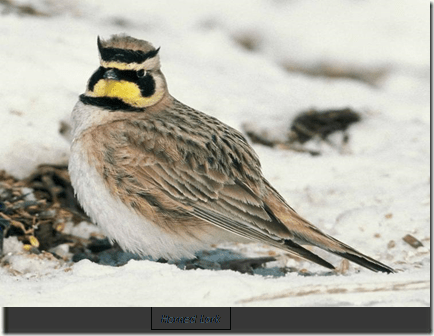
Although still very abundant, just 3 species account for the loss of 400 million grassland birds: Horned Larks, Savannah Sparrows and Grasshopper Sparrows. Horned Larks alone accounted for 182 million fewer birds due to a loss of very short grass habitats with some bare ground. To increase their numbers, studies show more grazing, mowing or burning will increase their preferred habitat.
It must be emphasized that the reported cumulative loss of 2.9 billion birds since 1970, does not signify ecosystem collapses. But there are some legitimate concerns such as maintaining wetlands. And there are some serious human-caused problems we need to remedy to increase struggling bird populations. It is estimated that cats kill between 1 to 3 billion birds each year. Up to 1 billion birds each year die by crashing into the illusions created by window reflections. Collisions with cars and trucks likely kill 89 to 350 million birds a year. Instead of fearmongering ecosystem collapse, our avifauna would best be served by addressing those problems.
Questioning Bird Models
Population estimates for most land birds are based on data from the US Geological Surveys Breeding Bird Surveys (BBS). I conducted 2 BBS surveys on the Tahoe National Forest for 20 years. Each survey route consists of 50 stops, each a half‑mile apart. At each stop for a period of just 3 minutes, I would record all observed birds, the overwhelming majority of which are heard but not seen. Many birds can be missed in such a short time, but the BBS designers decided a 3-minute observation time allowed the day’s survey to cover more habitat. Each year on about the same date, the BBS survey was repeated.
Each BBS route surveys perhaps 1% the region’s landscape. To estimate each species’ population for the whole region, the survey’s observations are extrapolated and modeled. However, models rely on several assumptions and adjustments, and those assumptions can inflate final estimates. For example, in 2004 researchers estimated there were 6,500,000 Rufous Hummingbirds. By 2017, researchers estimated there were now 21,690,000. But that larger population cannot be deemed a conservation success. That tripling of abundance was mostly due to new adjustments.
Because singing males account for most observations, the number of observed birds is doubled to account for an unobserved female that is most likely nearby. Furthermore, it is assumed different species are more readily detected than others. The models assume that each stop will account for all the birds within a 400‑meter radius. Because a crow is readily detected over that distance, no adjustments are made to the number of observed crows. But hummingbirds are not so easily detected. The earlier surveys assumed a hummingbird could only be detected if it was within an 80‑meter radius. So, to standardize the observations to an area with a 400‑meter radius, observations were multiplied by 25. Recent survey models now assume hummingbirds can only be detected within 50 meters, so their observations are now adjusted by multiplying by 64.
Thus, depending on their detection adjustments, one real observation could generate 50 or 128 virtual hummingbirds. That number is further scaled up to account for the time‑of‑day effects and the likely number of birds in the region’s un-surveyed landscapes.
Setting aside assumptions about the regional homogeneity of birds’ habitat, one very real problem with these adjustments that has yet to be addressed. If one bird is no longer observed at a roadside stop, the model assumes that the other 127 virtual birds also died.
Survey routes are done along roadsides and up to 340 million birds are killed by vehicles each year. Many sparrows and warblers are ground nesters and will fly low to the ground. Many seed eating birds like finches will congregate along a roadside to ingest the small gravel needed to internally grind their seeds. Every year I watched a small flock of Evening Grosbeaks ingesting gravel from the shoulder of a country road, get picked off one by one by passing cars. Roadside vegetation often differs from off-road vegetation. Roads initially create openings that are suitable for one species but are gradually grown over during the lifetime of a survey to become unsuitable habitat. So, it should never be assumed that the loss of roadside observations represents a decline for the whole region.
The larger the models’ detectability adjustments are for a given species, the greater the probability that any declining trend in roadside observations will exaggerate a species population loss for the region. The greatest population losses were modeled for warblers and sparrows and most warbler and sparrow data are adjusted for detectability by multiplying actual observations 4 to 10-fold. It is worth reporting good news from recent studies in National Parks that used a much greater density of observation points and were not confined to roadsides. Their observation points were also much closer together and thus required fewer assumptions and adjustments. Of the 50 species they observed, all but 3 populations were stable.
Pushing a fake crisis, Rosenberg et al argued that declining numbers within a species that is still still very abundant doesn’t mean they are not threatened with a quick collapse. He highlighted the Passenger Pigeon was once one of the most abundant birds in North America and they quickly went extinct by 1914. That doomsday scenario was often repeated by the media. But comparison to the Passenger Pigeon’s demise is a false equivalency. Passenger Pigeons were hunted for food when people were suffering from much greater food insecurity.
Rosenberg et al summarized their study with one sentence: “Cumulative loss of nearly three billion birds since 1970, across most North American biomes, signals a pervasive and ongoing avifaunal crisis.” But it signals no such thing. Wise management will continue. With better accounting of the natural causes of each species declines, plus more accurate modeling, it will be seen that Rosenberg’s “crisis” was just another misleading apocalyptic story that further erodes public trust in us honest environmental scientists.
Jim Steele is director emeritus of the Sierra Nevada Field Campus, SFSU and authored Landscapes and Cycles: An Environmentalist’s Journey to Climate Skepticism.
NY Times Caught Exaggerating Antarctic Ice Loss – If There Is Any Loss at All
By James Taylor | Climate Realism | April 30, 2020
The New York Times is attempting to panic people with an article today claiming alarming ice loss in Antarctica. However, as recently as 2015, NASA reported satellite measurements show Antarctic ice mass has been growing since at least 1992, when satellites began taking measurements. Clearly, either the New York Times story is wrong or the Times is telling an unnecessarily alarmist story about a few years of minor ice loss after many more years of ice gain.
The Times article claims, “Researchers have known for a long time that, while the continent is losing mass over all as the climate changes, the change is uneven.” The assertion is only half true. Given that less than five years ago, NASA satellite instruments reported long-term and continuing growth in Antarctic ice mass, it is factually inaccurate for the Times to state, “Researchers have known for a long time that … the continent is losing mass….”
On the other hand, the Times is correct that any current asserted ice loss is “uneven.” The ice-change map accompanying the Times article shows that a much larger portion of Antarctica is gaining ice than is losing ice. The asserted overall ice-mass loss comes primarily from a relatively few locations along the very edge of the West Antarctic ice shelf. Those locations line up almost perfectly with locations where scientists have recently discovered volcanoes under the ice.
The more accurate overall picture is that scientists have documented long-term growth in the Antarctic ice sheet, even during most of the past 40 years. If there is a recent trend of ice loss, the trend is minor, confined to just a small portion of West Antarctica, has been occurring for less than five years, and is likely due in significant part to undersea volcanoes rather than climate change.
NYT Blames Maduro for Healthcare Horror, Downplays US Role
By Bryce Greene | FAIR | April 16, 2020
The New York Times (4/10/20) published an article describing the horrendous shape of the Venezuelan healthcare system. The human interest story, written by Julie Turkewitz and Isayen Herrera, followed several women through their nightmarish journey of childbearing in a broken medical system. The piece would be outstanding reporting, had it not fumbled the most important aspect of the story: how and why the system is as bad as it is. In true “manufacturing consent” fashion, the piece downplayed the US role in destabilizing the Venezuelan economy, and instead pointed to President Nicolás Maduro’s “authoritarianism” as the primary cause of the crisis.
The piece appeared on the Times’ front page on Saturday. The section of the piece visible on the front page pointed to Maduro as the cause for Venezuela’s healthcare problem, saying the system had been “crippled by a broken economy overseen by an increasingly authoritarian government.”
The story continued on an inside page, where it finally referenced the US role in creating the desperate conditions. The reporters briefly mentioned that Maduro claimed that US sanctions had some effect, but quickly brushed the claim aside, citing “analysts and critics” who said that Maduro’s charge had “only some weight.”
To back up this dismissal, the authors cited Feliciano Reyna, the founder of a nonprofit known as Action for Solidarity. Reyna blamed the Maduro administration for refusing to accept help from aid organizations. He indicated that despite the sanctions, the country would be able to receive the supplies it needed from those organizations.
However, a few paragraphs later, the piece stated the government had been attempting to receive help through the Red Cross for nearly a year now, throwing Reyes’ criticism into doubt. The contradiction was not addressed by the reporters, and the doublethink was allowed to go unchallenged, even as the piece acknowledged that the Red Cross has been failing to meet Venezuela’s needs, due to a lack of funds, and quoted Venezuela Red Cross leader Louis Farias, who said that their chapter’s call for help “didn’t get the backing [they] had hoped.”
The New York Times omitted other statements from the Red Cross organization that shed more light on the role the US has played. Francesco Rocca, president of the International Federation of the Red Cross, stated publicly last year that he believed that “political will” was behind the lack of funding for Venezuela. He said that there are some who wanted “to use the civilian population, their desperation, as a tool to destabilize the country.” Rocca pointed out that “it is easier to receive funds for Syria and even for Yemen.”
Later in the piece, the reporters cited economist Asdrúbal Oliveros, who claimed that “Mr. Maduro had simply chosen to prioritize the import of oil and food over medicine.” Oliveros believes the calculus was based on the fact that “pregnant women and sick people don’t protest—but that hungry people do.” No explanation was offered for why it’s Maduro’s fault that his administration has been forced to choose between essential resources for his country.
The piece merely calls Oliveros “one economist,” failing to disclose that he has been part of the Venezuelan opposition backing would-be president Juan Guaidó in an ongoing US-backed coup attempt against Maduro. Oliveros was described by the pro-Guaidó publication Americas Quarterly (4/18) as one of the “10 People Who Will (One Day) Rebuild Venezuela.”
The New York Times and other elite media have played an important role in mobilizing the US public against the Maduro government. They have highlighted the very real hardships on the ground, while casting blame for them almost exclusively on the “authoritarian” Maduro government (which, despite media’s constant implications, won an internationally observed election with more than 4 million more votes over the president’s closest rival (FAIR.org, 5/10/19). They consistently downplay the role of US sanctions in contributing to the dire economic situation (FAIR.org, 2/6/19, 6/26/19, 3/25/20).
If the Times were concerned about the fate of the women it profiled, and the state of Venezuelan economy, the paper would direct its readers to the sources of instability for which they bear the most responsibility. US sanctions have decimated the Venezuelan economy, as was predicted by analysts when they were first imposed. One 2019 study from the Center for Economic Policy Research found that the sanctions had indirectly caused the deaths of 40,000. Portraying Maduro as the sole reason for the country’s crisis is factually incorrect and journalistically irresponsible.
Corporate Media Cover for US Mob Threats Against Venezuela
By Lucas Koerner and Ricardo Vaz | FAIR | April 15, 2020
The Trump administration unveiled on March 31 a “democratic transition” plan to remove Venezuelan President Nicolás Maduro from office, in favor of a “council of state” composed of both opposition and ruling party loyalists.
The plan was, however, less an offer to negotiate than a diktat, with the US State Department (3/31/20) vowing that “sanctions will remain in effect, and increase, until the Maduro regime accepts a genuine political transition.”
Despite the obvious mafioso overtones, Washington’s stenographers in the corporate press were quick to present the initiative as “sanctions relief,” once again whitewashing murderous US economic warfare against Venezuela (FAIR.org, 2/6/19, 6/14/19, 6/26/19).
Western journalists’ callous obfuscation of sanctions’ deadly toll, especially amid a global pandemic (FAIR.org, 3/25/20), goes hand in hand with their parroting of bogus “narco-terrorism” charges leveled against Maduro and top Venezuelan officials, which butresses Washington’s ever-illicit casus belli.
An Offer They Can’t Refuse
The New York Times (3/31/20) jumped at the opportunity to furnish the Trump administration’s plan with a varnish of reasonability. “The proposal…offers to ease American sanctions intended to pressure President Nicolás Maduro and his loyalists over the past year,” Lara Jakes wrote, misconstruing the unilateral measures destroying Venezuela’s economy as well-intentioned steps to bring about “fair elections.”
At no point did the paper of record mention Washington’s threat to ramp up illegal sanctions if Maduro refuses the “offer” to replace his government with a five-person junta, in flagrant violation of Venezuela’s constitution. Other Western media likewise covered up the US blackmail, praising Donald Trump’s bayonet-hoisted ultimatum as a “roadmap to relief” (Washington Post, 3/31/20), a “more toned-down approach” (Reuters, 3/31/20) and a “conciliatory framework” (Economist, 4/2/20).
Having dutifully whitewashed US sanctions, the Times and its counterparts were free to cast war criminal Elliott Abrams, rehabilitated last year as Trump’s Venezuela envoy (CounterSpin, 3/1/19), as an honest broker committed to good-faith dialogue:
But Mr. Abrams was careful to say that the plan was an opening offer for talks between the two sides, “not a take-it-or-leave-it proposition,” and that no single issue was a deal breaker—except the demand for Mr. Maduro’s departure.
By contrast, Maduro—reelected in internationally monitored elections with a greater percentage of the electorate than Trump won in 2016, or Barack Obama in 2012—is for the Times “reminiscent of mid-20th century Latin American strongmen,” whose 2018 victory was “self-declared.”
The Times went on to accuse the Venezuelan leader of “creating one of the world’s largest refugee populations,” concealing the role of criminal sanctions in driving migration (FAIR.org, 2/18/18).
This vilification of Maduro and the Chavista poor people’s movement does not merely reflect reporters’ professional class bias, but is structurally necessary to justify US economic warfare and more overt criminality in the first place.
It is therefore no coincidence that the Trump administration’s gunpoint “proposal” to overturn Venezuela’s constitutional order came on the heels of Department of Justice “narco-terrorism” charges against the Venezuelan head of state and other top officials, which corporate journalists trumpeted enthusiastically.
Most outlets regarded the timing as a symptom of “contradictory” (Washington Post, 4/14/20) or “erratic” (New York Times, 4/10/20) US policy, which could “make it harder to remove Maduro” (Economist, 4/2/20), but the underlying regime change (ir)rationality never comes into question.
Indeed, even liberal imperialist academics like David Smilde and Abraham Lowenthal (Washington Post, 4/14/20) declined to call for scrapping the indictments, let alone easing sanctions, as a goodwill gesture aimed at securing Chavista support for the US plan, which they hailed as a “step in the right direction.” Rather, they merely recommend that the Trump administration offer “guarantees for indicted officials” against extradition, as if Maduro would be inclined to negotiate while Washington continues its collective punishment and maintains a $15 million bounty on his head.
Smilde and his Washington Office on Latin America colleague Geoff Ramsey’s (Washington Post, 3/27/20) refusal to demand the immediate annulment of the drug charges and illegal sanctions is hardly surprising, given both men’s long-running support for US coup efforts (Common Dreams, 3/5/19).

(Left) The NYT found Maduro’s white suit and being flanked by ministers as “reminiscent of dictators” (Right) The WaPo found an unconstitutional plan to remove an elected president on the basis of threats “a step in the right direction”
Calling the Kettle Black
The DoJ’s indictment of 14 current or former senior Venezuelan officials on “narco-terrorism” charges provided the Western media with fresh grist for its imperial propaganda mill.
This is hardly the first time that the corporate media have reported the Washington’s evidence-free drug allegations against official enemies, which they have frequently done without any pretense of journalistic rigor (Extra!, 1/90, 9/12; FAIR.org, 9/24/19, 5/24/19).
The New York Times (3/26/20) dedicated no less than 12 paragraphs to repeating prosecutors’ claims, which are centered on the outlandish notion that Maduro secretly heads a drug cartel that conspired with Colombia’s FARC guerrillas to “‘flood’ the United States with cocaine.”
Despite marshaling a crack team of three writers and four contributing reporters, the Times proved incapable of citing any contrarian perspectives, let alone basic facts, that cast doubt on the “narco-terrorism” narrative.
The Guardian (3/26/20) and the Washington Post (3/27/20) were virtually the only outlets to mention the US government’s own publicly available data showing that just a small fraction of drug routes pass through Venezuela, with the overwhelming majority of cocaine entering the United States via Mexico and Central America. Furthermore, Colombia remains the world’s largest cocaine producer, right under the nose of large US military and DEA contingents, which have long waged a “war for drugs and of terror” in the country.
The DoJ’s case looks like a reheated version of equally unfounded accusations against former President Hugo Chávez, which corporate journalists eagerly promoted last year (FAIR.org, 9/24/19).
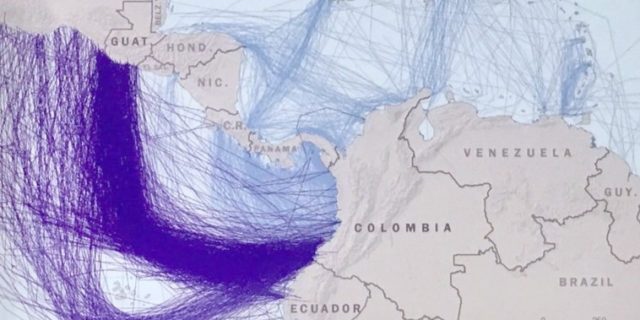
A map produced by the US Southern Command shows that most drug routes enter the US via the Pacific and then Central America (Business Insider)
As with prior allegations against Socialist Party Vice President Diosdado Cabello (Wall Street Journal, 5/18/15), the indictments hinge on the testimony of defectors, whose claims are echoed in the Western press without scrutiny.
In the most recent case, retired Maj. Gen. Cliver Alcalá and former intelligence chief Hugo “El Pollo” Carvajal were also charged by the DoJ and pledged to cooperate with US authorities. Both had previously broken with the Maduro government and endorsed self-proclaimed “interim president” Juan Guaidó.
Alcalá, who swiftly surrendered to DEA agents and was flown to the US, boasted of plotting a coup in conjunction with Guaidó and “US advisers.”
In an exposé of the coup plot, the Financial Times (4/4/20) cast doubt on the general’s “rambling and contradictory” account, quoting several US officials denying the coup attempt and alleging Alcalá was “acting on the orders of Caracas.”
The outlet conveniently ignored that this would not be the first time Alcalá conspired to invade Venezuela with a paramilitary force.
According to Bloomberg (3/6/19), there was a plan for the general to lead a contingent of 200 Venezuelan exile soldiers to clear the way for the entry of “humanitarian aid” on February 23, 2019, which was vetoed at the last minute by Colombia, suggesting high-level coordination with Washington, Bogotá and Guaidó.
By repeating the US narrative of Alcalá as a Maduro “plant,” corporate journalists paradoxically legitimize the general as a reliable source of current information on Venezuelan “narco-terrorism,” while concealing his embarrassing ties to the US and its opposition proxies.
As we have exposed for FAIR.org (5/24/19), Carvajal has already proved his worth in the past by serving up to credulous reporters highly dubious allegations about Venezuelan leaders’ Hezbollah ties (New York Times, 2/21/19).
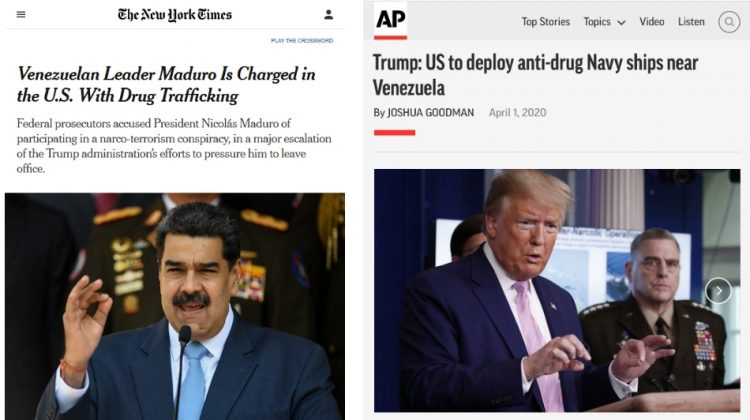
(Left) The NYT (and other outlets) accepted the DoJ’s “narco-terrorism” charges at face value (Right) An AP headline endorsed Trump’s dubious justification for an aggression
Imaginary Cartels, Real Warships
The uncritical coverage of the DoJ charges paved the way for a further US escalation shortly after the “transition” plan was unveiled.
On March 31, the Trump administration announced a military deployment to the Caribbean described by Associated Press (4/1/20) as “one of the largest in the region since the 1989 invasion of Panama.”
One might have expected such an obscenely expensive display of force amid a deadly pandemic currently killing thousands of Americans to be met with widespread rebuke across the media spectrum.
In fact, the opposition was largely muted. Newsweek (4/3/20) and Foreign Policy (4/2/20) gave voice to the Pentagon’s concern that the operation was wasteful and politically motivated, while the New York Times (4/10/20) published an op-ed raising polite proceduralist quibbles. Agreeing with the Trump administration that Maduro is a “dictator” who “must go,” Michael Shifter and Michael Camilleri nonetheless placed a vague call for Washington “to reboot sanctions policy, provide aid through accountable channels, and press the country’s leaders to work together.” Evidently, demanding the immediate lifting of (arguably genocidal) sanctions was too unreasonable to ask.
Referring to the Venezuelan military as “deeply involved in corruption and criminality,” Shifter and Camilleri exemplify the decadent imperial intelligentsia’s psychology of displacement.
From social democratic left to neoliberal right, Global North journalists and intellectuals remain invested in the self-serving illusion that besieged Southern nations such as Venezuela and Iran are more “criminal,” “corrupt” and “authoritarian” than the US empire (FAIR.org, 2/12/20).
For all their polite critiques of illegal US sanctions and military escalation–whose monstrosity has been laid bare by the current pandemic–the cult of Western exceptionalism goes unchallenged.
NYT flip-flops on Covid-19 contact tracers – because now it’s not China
‘Mao-style social controls’ or benign citizen ‘armies’?

Protesting is a “non-essential” activity, citizen! © Reuters / Kevin Lamarque
By Helen Buyniski | RT | April 16, 2020
The same citizen virus-tracing corps the New York Times decried in China as Maoism incarnate is being tried in Massachusetts and San Francisco, and the outlet has decided that what’s bad for Beijing is good for democracies.
Massachusetts and San Francisco – as well as the Republic of Ireland – are deputizing citizens to track down contacts of people infected with coronavirus, the Times reported on Thursday, describing the programs in glowing terms. After a blow-by-blow of a phone call between one of the newly-hired Massachusetts virus-trackers and her target, who gratefully gives up a file’s worth of data, we learn that the state plans to hire 1,000 caring professionals just like her to fill out its “fleet of contact tracers, charged with tracking down people who have been exposed to the coronavirus, as soon as possible, and warning them.”
The article emphasizes the bonds of “trust” between contract-tracer and coronavirus victim. There’s no talk of imprisoning people in their homes, of “keeping away outsiders” or of “arbitrary” enforcement. Indeed, one has to read to the end of the article to find out that the Massachusetts program was heavily informed by data from Wuhan and techniques from South Korea.

Massachusetts gets the warm-fuzzy treatment… © New York Times
There is just one slight problem: the NYT had already described a similar program in an article from February saying that “Mao-Style Social Control” was “blanketing” China. That piece sketched out an oppressive world in which “battalions of neighborhood busybodies, uniformed volunteers and Communist Party representatives” conducted “one of the biggest social control campaigns in history.” The goal, as the outlet melodramatically put it back then, was “to keep hundreds of millions of people away from everyone but their closest kin.”

… while China’s equivalent is “coercive” and “arbitrary” © New York Times
Stripped of the linguistic fireworks, the story described Beijing deputizing citizens to enforce quarantines by (among other things) tracing who infected persons had been in contact with, in order to keep the infected separate from the rest of the population. Not a bad idea, given the unreliability of testing and the highly-infectious nature of the coronavirus. It’s not surprising it’s catching on in the West.
San Francisco is training an all-volunteer group of 150 contact tracers, while Ireland plans to repurpose 1,000 furloughed government workers to trace contacts. Former US Centers for Disease Control director Thomas Frieden has even recommended a national “army” of 300,000 contact tracers, while other public health experts have praised the idea. It’s difficult to see how – other than the shift in vocabulary – these incarnations of what Mike Ryan of the World Health Organization called “shoe-leather epidemiology” differ from what the Times described as “Mao-style social control” in China.
With the question of how to end lockdowns still unresolved in many ‘democracies,’ human contact-tracing may emerge as the “lesser evil” with regard to preserving individual rights. While Bill Gates touts his “digital certificates” and dubious vaccines, and Apple and Google collaborate on a digital contact-tracing platform – an approach laden with privacy pitfalls that has already been used in Singapore and South Korea – that ‘Mao-style social control’ is starting to look like the most freedom-friendly option.
The Facts About Crimea Should Be Recognised. And So Should Crimea
By Brian Cloughley | Strategic Culture Foundation | April 14, 2020
Although the redoubtable New York Governor Andrew Cuomo declared that the Covid-19 virus “has been ahead of us from Day One. We’ve underestimated the enemy, and that is always dangerous, my friends. We should not do that again” it is too much to expect of most political figures that they should ever admit they were wrong about something. President Trump, for example, flatly refuses to acknowledge that in January 2020 he declared that “we have [the virus outbreak] totally under control”, and there are countless similar instances of denial of realities by other leaders, not only about the pandemic, but about very many facets of international affairs. This reluctance extends to the media, although sometimes, it has to be said, some of the media are forced to recognise facts that to them are unpalatable, and to adjust their position accordingly.
One recent instance of non-adjustment, however, is the Western media’s continuing public relations and propaganda campaign against Russia.
On 9 April Al Jazeera carried a report that “A U.S.-Russian space crew blasted off Thursday to the International Space Station following tight quarantine amid the coronavirus pandemic.
NASA astronaut Chris Cassidy and Roscosmos’ Anatoly Ivanishin and Ivan Vagner lifted off as scheduled from the Russian-operated Baikonur cosmodrome in Kazakhstan.” There was an excellent 400-word piece about the mission, just as one would expect from Al Jazeera.
On the other hand, the New York Times, as ascertained from a search of its website on 10 April, didn’t mention the mission at all. The Washington Post carried a twelve-word item that read in its entirety “By Associated Press April 9, 2020 — A U.S.-Russian space crew has blasted off to the International Space Station.” End.
The reason for reluctance on the part of the U.S. mainstream media to inform the world about such an important international event is that Russia played the major part in a successful space mission with the United States. Imagine the news cover if the spacecraft hadn’t been a Russian Soyuz, but a U.S.-produced SpaceX (still under vastly expensive development) launched from the Kennedy Space Centre. There would have been front-page headlines with “Keep America Great” exhortations from the space commander in Washington.
And so the propaganda of the third Cold War continues, involving all sorts of important international affairs, not least being Crimea which (whisper this) is doing very nicely, thank you, having been restored to Mother Russia.
It must be acknowledged, however, that the Washington Post marked the sixth anniversary of the restoration with a piece on 18 March that (albeit reluctantly) recognised Crimea’s accession to Russia. It noted, among other things, that “in Crimea itself, the annexation was popular, especially among Crimea’s large population of older ethnic Russians. More than five years later, and billions of roubles of investment later, it remains popular.” It is mandatory in the West to use the word “annexation” when referring to the accession of Crimea to Russia following a popular referendum, but even the Post can’t escape the facts, which are so distasteful to the propagandists.
In 1783 Crimea became part of Russia and remained so until, as recorded by the BBC, “In 1954 Crimea was handed to Ukraine as a gift by Soviet leader Nikita Khrushchev who was himself half-Ukrainian.” The majority of citizens wanted to rejoin Russia rather than stay with crippled post-revolution Ukraine which would have victimized them because of their Russian heritage. One of its first actions “was to repeal a 2012 law recognising Russian as an official regional language” and governance from Kiev boded badly for minorities.
It was rarely stated that 90 percent of the inhabitants of Crimea are Russian-speaking, Russian-cultured and Russian-educated, and they voted to “dissolve the political bands which have connected them with another” (in the words of the Declaration of Independence of 1776) in order to rejoin Russia. It would be strange if they had not wanted to accede to a country that not only welcomed their kinship, empathy and loyalty but was economically benevolent concerning their future, as has now been amply demonstrated by ensuing growth and prosperity. As even the Washington Post had to acknowledge, “Crimea’s three largest ethnic groups are, by and in large, happy with the direction of events on the peninsula.”
At the time that these ethnic groups were voting to rejoin their mother country, five years ago, the West, and most notably the administration in Washington, decided to oppose any such move. It didn’t matter that it was a fair and free vote, because there are ways to defeat common sense and national aspirations while creating the impression that it is wrong for people to express their feelings and wishes if these favour a nation that is anathema to those who make the rules.
For example, the government in Crimea invited observers from the Organisation for Security and Cooperation in Europe (OSCE) to witness and assess the conduct of the referendum held to determine whether the people of Crimea wished to remain under the Kiev government or rejoin Russia. There were no strings attached, and the invitation was sent to the HQ of the OSCE in Vienna. Then there was a pause during which the matter was considered in who knows what halls of power. And the OSCE conjured up an intriguing excuse for refusing to assess conduct of the plebiscite. As Reuters reported, “a spokeswoman said Crimea could not invite observers as the region was not a full-fledged state and therefore not a member of the 57-member organization. ‘As far as we know, Crimea is not a participating state of the OSCE, so it would be sort of hard for them to invite us,’ she said. She also said that Ukraine, which is an OSCE member, sent no invitation and that the organization ‘respects the full territorial integrity and sovereignty of Ukraine’.” You couldn’t make it up.
The feelings and aspirations of Crimea’s citizens didn’t matter to the OSCE or to the West as a whole. The West wanted, and still wants, Ukraine to rule Crimea, and seems determined to pester and sanction Russia accordingly. But nobody can seriously imagine for one moment that Russia is going to hand over Crimea to the Kiev government. So what is the answer?
Nobody expects the Great and the Good of the West to openly admit they were wrong about Crimea, and that the region and its citizens are in fact immeasurably better-off than they would be had they been subjected to rule by Kiev. But there is usually a way out of such a dilemma, and one that can be gently implemented without embarrassment. All that the West needs to do is quietly accept the status of Crimea and remove anti-Russia sanctions without fanfare. There would be discontent among the ultra-nationalists in Kiev, of course, but the world would be a more secure and happier place. Surely that’s a worthy aim to be achieved?
As Russia Sends Aid, US and NATO Sneer and Smear
By Ulson Gunnar – New Eastern Outlook – 08.04.2020
When Russian military planes and trucks arrived in Italy to provide relief for communities hit by the Covid-19 outbreak, the Italian government, elected into power by the Italian people, was thankful for the assistance offered by Moscow.
Named officials within the Italian government, including the foreign minister, the minister of defense and the governor of Apulia, Michele Emiliano, publically expressed thanks to Russia for the aid.
But finding any mention of this across the Western media is difficult, often buried deep within articles aimed entirely at smearing Russia for sending aid and depicting Italians as victims of a publicity stunt.
Reuters, in a smear piece published by the New York Times and aimed at vilifying Moscow, still had to admit regarding Russian aid that Italians were grateful, noting:
“There are no new geopolitical scenarios to trace, there is a country that needs help and other countries that are helping us,” Foreign Minister Luigi Di Maio was quoted as saying by Italy’s Il Corriere della Sera newspaper on Thursday.
Despite Italy being capable of speaking for itself and bringing up any suspicions (if they had any), the West decided to step in and speak for Italy instead.
Sneering and Smearing
Western headlines are flooded with scorn for both Russia and the aid they sent, completely indifferent to how Italians themselves perceived the gesture.
Articles like Bloomberg’s “Italy Questions Russians Over Their Goodwill Virus Gestures,” admit several paragraphs in that officially, Italy was grateful for the aid, noting:
“Our country can only be grateful” for the solidarity of many countries, including Russia, the Italian defense and foreign ministries said in a joint statement Friday.
Yet claims that “Italy questions Russia” suggest the entire nation is suspicious of the aid. Upon reading Bloomberg’s article, the only source cited is a single article in the Italian newspaper La Stampa. It is hard to believe an article in La Stampa constitutes all of “Italy.”
According to the pro-Western Moscow Times in their article, “80% of Russia’s Coronavirus Aid to Italy ‘Useless’ – La Stampa,” also entirely based on the La Stampa article, its admits La Stampa’s information came from an “unnamed source.”
Other articles, like the BBC’s “Coronavirus: What does ‘from Russia with love’ really mean?,” Foreign Policy’s “Beware of Bad Samaritans,” and Forbes’ “From Russia With Love? Putin’s Medical Supplies Gift To Coronavirus-Hit Italy Raises Questions,” all used similarly disingenuous tactics to depict the Russian aid as somehow sinister and unwanted.
The Guardian in its article, “Coronavirus: Russia sends plane full of medical supplies to US,” explains:
Critics likely to claim Moscow will exploit goodwill gesture as public relations coup.
France 24 in headline alone makes Western criticism even clearer, claiming, “Flying aid to virus-hit Italy, Moscow flexes soft power.“
So by sending aid to Italy, Russia is somehow supposedly flexing its “soft power.”
So How is the West Using Its Soft Power?
The West faced a collective decision. They could have used their own, very substantial soft power to one-up Russia by sending even more aid to Italy and other regions of the globe impacted by the spread of Covid-19.
Instead, they mobilized the entirety of their soft power to sneer and smear Russia’s efforts with Western-funded media fronts writing entire articles doing just that.
The West’s attempts to depict the Russian media reporting on the aid as also somehow sinister rather than simply telling the world what Russia is doing is also particularly surreal.
The Western media itself spends the summation of its own time and energy promoting what their respective governments are doing abroad which usually involves illegal invasions, wars, occupations and interventions… not sending aid.
A Missed Opportunity
Because certain special interests in the West fear some Western governments growing closer to nations like Russia and China in the spirit of cooperation and mutual benefits and derailing the Washington-led “international order” that has prevailed post World War 2, resources have been committed to attacking any development that could spur this process further.
But because these resources have been invested into attacking, even when attacking is not the best option, that is all the West appears capable of doing.
The answer to Russian aid to Italy was Western aid to Italy. The benefit would have been a flood of resources sent to where it was needed and everyone involved enjoying the benefits of lending a helping hand to those who would be grateful in return.
Instead, the West appears to be throwing rocks at a time when others are coming together to help, and throwing those rocks at those who are helping.
Rather than teaching the Italians never to deal with Russia again, it is likely this process is going to remind Italians as to why they’ve diversified their foreign relations outside the West in the first place.
Featured Video

Chinese jet fuel and the myth of energy independence
or go to
Aletho News Archives – Video-Images
From the Archives
The Dirty Little Secret behind the “Global Terrorism Index”
The Omission of Israeli Terrorism in the Occupied Palestinian Territories
By Karin Brothers | Global Research | December 6, 2014
… The Israeli settlements — all of which are illegal – have been identified as a major impediment to peace. The refusal of a major “global” terrorism report to name the Israeli settlers as one of the groups most responsible for terrorism not only misrepresents a major source of regional violence but exposes the Global Terrorism Index as a propaganda tool that supports a U.S. agenda.
In recent years, governments have been attempting to thwart terrorism by blocking supportive fund-raising. When it comes to Israeli settlements, however, the US and Canada actually encourage fund-raising by giving organizations (such as Christian Friends of Israeli Communities (CFOIC) and the Jewish National Fund) financial support in the form of donor tax-deductions.
Charities which provide funds for the Israeli settlements should be regarded as terror-financing organizations. They should not only lose their tax-deductible status, but they should be banned because they support the violation of international humanitarian law. The terror-financing laws that are being strictly enforced for Muslim charities should be applied to Christian and Jewish charities as well. … Read full article
Blog Roll
 Aletho News
- Chinese jet fuel and the myth of energy independence
- Ukraine Sea Drone Fired From Libya Hit Russian Tanker in Mediterranean
- IRGC: Iranian forces launched no attacks during ceasefire hours
- Trump Administration Moves To Automate U.S. Military Draft Registration
- Spain orders reopening of Tehran embassy, condemns Israel’s carpet bombing of Lebanon
- Israel faces ‘unsustainable’ strategic crisis following 40-day war against Iran: Analyst
- Iran restricts Hormuz access to 15 vessels per day under ceasefire terms: Report
- The ‘Opposition Party’ Has Done Nothing to Stop the Iran War and Much to Goad Trump Into Continuing It
- Moscow backs Tehran on status of Lebanon in US-Iran deal
- How UK Regulator Ofcom Quietly Bypassed International Law to Police American Speech
- If Americans Knew
- Amnesty: Urgent – Protect Lebanese civilians from brutal escalation in Israeli attacks
- Is The War Against Iran Over?
- Inside the Israeli army’s propaganda wing
- Hundreds of Gaza Amputees Stranded in Legal Limbo
- The gallows law: Israel moves toward executing Palestinian children
- Tucker Carlson: The Path to Peace requires ending ‘special alliance’ with Israel
- This is ceasefire? Israel’s biggest massacre yet in Lebanon, another journalist killed in Gaza – Daily Update
- Tucker Carlson on Israel: This Is the Behavior of an Ally? Really?
- Gazans face a triple crisis: severe shortages of water and bread, healthcare in tatters
- NY Times reports how Netanyahu took the US into Iran War
- No Tricks Zone
- An Inconvenient Tree: Uncovered In Alps… Europe Much Warmer Than Today 6000 Years Ago
- New Study Reports A 60% Slowdown In Greenland’s Ice Loss Rate In The Last Decade
- Low Intensity Tornado Wrecks Major Solar Farm, Creating A Potential Toxic Dump
- New Study Finds Warming Saves Lives…Cold Temperatures 12 Times More Deadly Than Excess Heat
- German Science Blog Accuses PIK Climate Institute Of Hallucinating Climate Tipping Points
- Devastating Assessment Of Comirnaty Vaccine By Former Senior Pfizer Europe Toxicologist
- New Study: CO2 Is ‘Effectively Negligible’ As An Explanatory Climate Change Factor Since 2000
- Former Pfizer Toxicologist Dr. Helmut Sterz Tells Bundestag Hearing Pfizer Vaccine Should Have Never Been Approved
- Energy Expert: Germany’s Nuclear Phaseout Was A “500 Billion Euro Mistake”
- New Research: South Australia’s Mid-Holocene Sea Surface Temperatures Were 4°C Warmer Than Today
 Aletho News