Hopefulness Despite 2.9 Billion Lost Birds
By Jim Steele | Watts Up With That? | May 1, 2020
What’s Natural
In 2019 bird researchers published Rosenberg et al “Decline of the North American Avifauna”, reporting a decline in 57% of the bird species. They estimated a net loss of nearly 2.9 billion birds since 1970, and urged us to remedy the threats, claiming all were “exacerbated by climate change”, and we must stave off the “potential collapse of the continental avifauna.” Months before publication the researchers had organized an extensive media campaign. Typical doomsday media like the New York Times piled on with “Birds Are Vanishing From North America” and Scientific American wrote, “Silent Skies: Billions of North American Birds Have Vanished.”
As I have now been sheltering in place, I finally had ample time to thoroughly peruse Rosenberg’s study. I had a very personal interest in it, having professionally studied bird populations for over 20 years and had worked to restore their habitat. I also had conducted 20 years of surveys which were part of the study’s database. Carefully looking at their data, a far more optimistic perspective is needed. So here I join a chorus of other ecologists, as reported in Slate, that “There Is No Impending Bird Apocalypse”. As one ecologist wrote, it’s “not what’s really happening. I think it hurts the credibility of scientists.”
First consider since 1970 many species previously considered endangered such as pelicans, bald eagle, peregrine falcon, trumpeter swan, and whooping crane have been increasing due to enlightened management. Despite being hunted, ducks and geese increased by 54%. Secondly, just 12 of the 303 declining species account for the loss of 1.4 billion birds, and counterintuitively their decline is not worrisome.
Three introduced species – house sparrows, starlings and pigeons – account for nearly one half billion lost birds. These birds were pre-adapted to human habitat and are considered pests that carry disease and tarnish buildings and cars with their droppings. Across America, companies like Bird-B-Gone are hired to remove these foreign bird pests. Furthermore, starlings compete with native birds like bluebirds and flickers for nesting cavities, contributing to native bird declines. The removal of starlings is not an omen of an “avifauna collapse”, but good news for native birds.

When European colonists cleared forests to create pastures and farmland or provide wood for heating, open-habitat species “unnaturally” increased. Previously confined to the Great Plains, brown‑headed cowbirds quickly invaded the newly opened habitat. Unfortunately, cowbirds parasitize other species by laying its eggs in their nests. A cowbird hatchling then pushes out all other nestlings, killing the parasitized species’ next generation. The loss of 40 million cowbirds only benefits our “continental avifauna”.
Several bird species had evolved to colonize forest openings naturally produced by fire, or floods or high winds. Those species “unnaturally” boomed when 50% to 80% of northeastern United States became de-forested by 1900. Still, eastern trees will reclaim a forest opening within 20 years, so open habitat species require a constant supply of forest openings. However as marginal farms and pastures were abandoned, fires were suppressed and logging reduced, forests increasingly reclaimed those openings. With a 50% decline in forest openings, their bird species also declined; now approaching pre-colonial numbers. Accordingly, birds of the expanding forest interior like woodpeckers are now increasing.
White-throated Sparrows and Dark-eyed Juncos quickly colonize forest openings but then disappear within a few years as the forest recovers. Those 2 species alone accounted for the loss of another quarter of a billion birds; not because of an ecosystem collapse, but because forests were reclaiming human altered habitat. Nonetheless those species are still 400 million strong, and juncos remain abundant in the open habitat maintained by suburban back yards. If environmentalists want to reclaim the abundance of their boom years, they must manage forest openings with logging or prescribed burns.
Insect outbreaks also create forest openings. For hundreds of years forests across Canada and northeastern US have been decimated every few decades by spruce bud worm eruptions. So, forest managers now spray to limit further outbreaks. Today there are an estimated 111 million living Tennessee Warblers that have specialized to feed on spruce bud worms. But the warbler’s numbers have declined by 80 million because insect outbreaks are more controlled. Still they have never been threatened with extinction. Conservationists must determine what is a reasonable warbler abundance while still protecting forests from devastating insect infestations.
The grassland biome accounted for the greatest declines, about 700 million birds. Indeed, natural grasslands had been greatly reduced by centuries of expanding agriculture and grazing. But in recent times more efficient agriculture has allowed more land to revert to “natural” states. However fossil fuel fears reversed that trend. In 2005 federal fuel policies began instituting subsidies to encourage biofuel production. As a result, 17 million more acres of grassland have been converted to corn fields for ethanol since 2006.
Although still very abundant, just 3 species account for the loss of 400 million grassland birds: Horned Larks, Savannah Sparrows and Grasshopper Sparrows. Horned Larks alone accounted for 182 million fewer birds due to a loss of very short grass habitats with some bare ground. To increase their numbers, studies show more grazing, mowing or burning will increase their preferred habitat.

It must be emphasized that the reported cumulative loss of 2.9 billion birds since 1970, does not signify ecosystem collapses. But there are some legitimate concerns such as maintaining wetlands. And there are some serious human-caused problems we need to remedy to increase struggling bird populations. It is estimated that cats kill between 1 to 3 billion birds each year. Up to 1 billion birds each year die by crashing into the illusions created by window reflections. Collisions with cars and trucks likely kill 89 to 350 million birds a year. Instead of fearmongering ecosystem collapse, our avifauna would best be served by addressing those problems.
Questioning Bird Models
Population estimates for most land birds are based on data from the US Geological Surveys Breeding Bird Surveys (BBS). I conducted 2 BBS surveys on the Tahoe National Forest for 20 years. Each survey route consists of 50 stops, each a half‑mile apart. At each stop for a period of just 3 minutes, I would record all observed birds, the overwhelming majority of which are heard but not seen. Many birds can be missed in such a short time, but the BBS designers decided a 3-minute observation time allowed the day’s survey to cover more habitat. Each year on about the same date, the BBS survey was repeated.
Each BBS route surveys perhaps 1% the region’s landscape. To estimate each species’ population for the whole region, the survey’s observations are extrapolated and modeled. However, models rely on several assumptions and adjustments, and those assumptions can inflate final estimates. For example, in 2004 researchers estimated there were 6,500,000 Rufous Hummingbirds. By 2017, researchers estimated there were now 21,690,000. But that larger population cannot be deemed a conservation success. That tripling of abundance was mostly due to new adjustments.
Because singing males account for most observations, the number of observed birds is doubled to account for an unobserved female that is most likely nearby. Furthermore, it is assumed different species are more readily detected than others. The models assume that each stop will account for all the birds within a 400‑meter radius. Because a crow is readily detected over that distance, no adjustments are made to the number of observed crows. But hummingbirds are not so easily detected. The earlier surveys assumed a hummingbird could only be detected if it was within an 80‑meter radius. So, to standardize the observations to an area with a 400‑meter radius, observations were multiplied by 25. Recent survey models now assume hummingbirds can only be detected within 50 meters, so their observations are now adjusted by multiplying by 64.
Thus, depending on their detection adjustments, one real observation could generate 50 or 128 virtual hummingbirds. That number is further scaled up to account for the time‑of‑day effects and the likely number of birds in the region’s un-surveyed landscapes.
Setting aside assumptions about the regional homogeneity of birds’ habitat, one very real problem with these adjustments that has yet to be addressed. If one bird is no longer observed at a roadside stop, the model assumes that the other 127 virtual birds also died.
Survey routes are done along roadsides and up to 340 million birds are killed by vehicles each year. Many sparrows and warblers are ground nesters and will fly low to the ground. Many seed eating birds like finches will congregate along a roadside to ingest the small gravel needed to internally grind their seeds. Every year I watched a small flock of Evening Grosbeaks ingesting gravel from the shoulder of a country road, get picked off one by one by passing cars. Roadside vegetation often differs from off-road vegetation. Roads initially create openings that are suitable for one species but are gradually grown over during the lifetime of a survey to become unsuitable habitat. So, it should never be assumed that the loss of roadside observations represents a decline for the whole region.
The larger the models’ detectability adjustments are for a given species, the greater the probability that any declining trend in roadside observations will exaggerate a species population loss for the region. The greatest population losses were modeled for warblers and sparrows and most warbler and sparrow data are adjusted for detectability by multiplying actual observations 4 to 10-fold. It is worth reporting good news from recent studies in National Parks that used a much greater density of observation points and were not confined to roadsides. Their observation points were also much closer together and thus required fewer assumptions and adjustments. Of the 50 species they observed, all but 3 populations were stable.
Pushing a fake crisis, Rosenberg et al argued that declining numbers within a species that is still still very abundant doesn’t mean they are not threatened with a quick collapse. He highlighted the Passenger Pigeon was once one of the most abundant birds in North America and they quickly went extinct by 1914. That doomsday scenario was often repeated by the media. But comparison to the Passenger Pigeon’s demise is a false equivalency. Passenger Pigeons were hunted for food when people were suffering from much greater food insecurity.
Rosenberg et al summarized their study with one sentence: “Cumulative loss of nearly three billion birds since 1970, across most North American biomes, signals a pervasive and ongoing avifaunal crisis.” But it signals no such thing. Wise management will continue. With better accounting of the natural causes of each species declines, plus more accurate modeling, it will be seen that Rosenberg’s “crisis” was just another misleading apocalyptic story that further erodes public trust in us honest environmental scientists.
Jim Steele is director emeritus of the Sierra Nevada Field Campus, SFSU and authored Landscapes and Cycles: An Environmentalist’s Journey to Climate Skepticism.
NY Times Caught Exaggerating Antarctic Ice Loss – If There Is Any Loss at All
By James Taylor | Climate Realism | April 30, 2020
The New York Times is attempting to panic people with an article today claiming alarming ice loss in Antarctica. However, as recently as 2015, NASA reported satellite measurements show Antarctic ice mass has been growing since at least 1992, when satellites began taking measurements. Clearly, either the New York Times story is wrong or the Times is telling an unnecessarily alarmist story about a few years of minor ice loss after many more years of ice gain.
The Times article claims, “Researchers have known for a long time that, while the continent is losing mass over all as the climate changes, the change is uneven.” The assertion is only half true. Given that less than five years ago, NASA satellite instruments reported long-term and continuing growth in Antarctic ice mass, it is factually inaccurate for the Times to state, “Researchers have known for a long time that … the continent is losing mass….”
On the other hand, the Times is correct that any current asserted ice loss is “uneven.” The ice-change map accompanying the Times article shows that a much larger portion of Antarctica is gaining ice than is losing ice. The asserted overall ice-mass loss comes primarily from a relatively few locations along the very edge of the West Antarctic ice shelf. Those locations line up almost perfectly with locations where scientists have recently discovered volcanoes under the ice.
The more accurate overall picture is that scientists have documented long-term growth in the Antarctic ice sheet, even during most of the past 40 years. If there is a recent trend of ice loss, the trend is minor, confined to just a small portion of West Antarctica, has been occurring for less than five years, and is likely due in significant part to undersea volcanoes rather than climate change.
NYT Blames Maduro for Healthcare Horror, Downplays US Role
By Bryce Greene | FAIR | April 16, 2020
The New York Times (4/10/20) published an article describing the horrendous shape of the Venezuelan healthcare system. The human interest story, written by Julie Turkewitz and Isayen Herrera, followed several women through their nightmarish journey of childbearing in a broken medical system. The piece would be outstanding reporting, had it not fumbled the most important aspect of the story: how and why the system is as bad as it is. In true “manufacturing consent” fashion, the piece downplayed the US role in destabilizing the Venezuelan economy, and instead pointed to President Nicolás Maduro’s “authoritarianism” as the primary cause of the crisis.
The piece appeared on the Times’ front page on Saturday. The section of the piece visible on the front page pointed to Maduro as the cause for Venezuela’s healthcare problem, saying the system had been “crippled by a broken economy overseen by an increasingly authoritarian government.”
The story continued on an inside page, where it finally referenced the US role in creating the desperate conditions. The reporters briefly mentioned that Maduro claimed that US sanctions had some effect, but quickly brushed the claim aside, citing “analysts and critics” who said that Maduro’s charge had “only some weight.”
To back up this dismissal, the authors cited Feliciano Reyna, the founder of a nonprofit known as Action for Solidarity. Reyna blamed the Maduro administration for refusing to accept help from aid organizations. He indicated that despite the sanctions, the country would be able to receive the supplies it needed from those organizations.
However, a few paragraphs later, the piece stated the government had been attempting to receive help through the Red Cross for nearly a year now, throwing Reyes’ criticism into doubt. The contradiction was not addressed by the reporters, and the doublethink was allowed to go unchallenged, even as the piece acknowledged that the Red Cross has been failing to meet Venezuela’s needs, due to a lack of funds, and quoted Venezuela Red Cross leader Louis Farias, who said that their chapter’s call for help “didn’t get the backing [they] had hoped.”
The New York Times omitted other statements from the Red Cross organization that shed more light on the role the US has played. Francesco Rocca, president of the International Federation of the Red Cross, stated publicly last year that he believed that “political will” was behind the lack of funding for Venezuela. He said that there are some who wanted “to use the civilian population, their desperation, as a tool to destabilize the country.” Rocca pointed out that “it is easier to receive funds for Syria and even for Yemen.”
Later in the piece, the reporters cited economist Asdrúbal Oliveros, who claimed that “Mr. Maduro had simply chosen to prioritize the import of oil and food over medicine.” Oliveros believes the calculus was based on the fact that “pregnant women and sick people don’t protest—but that hungry people do.” No explanation was offered for why it’s Maduro’s fault that his administration has been forced to choose between essential resources for his country.
The piece merely calls Oliveros “one economist,” failing to disclose that he has been part of the Venezuelan opposition backing would-be president Juan Guaidó in an ongoing US-backed coup attempt against Maduro. Oliveros was described by the pro-Guaidó publication Americas Quarterly (4/18) as one of the “10 People Who Will (One Day) Rebuild Venezuela.”
The New York Times and other elite media have played an important role in mobilizing the US public against the Maduro government. They have highlighted the very real hardships on the ground, while casting blame for them almost exclusively on the “authoritarian” Maduro government (which, despite media’s constant implications, won an internationally observed election with more than 4 million more votes over the president’s closest rival (FAIR.org, 5/10/19). They consistently downplay the role of US sanctions in contributing to the dire economic situation (FAIR.org, 2/6/19, 6/26/19, 3/25/20).
If the Times were concerned about the fate of the women it profiled, and the state of Venezuelan economy, the paper would direct its readers to the sources of instability for which they bear the most responsibility. US sanctions have decimated the Venezuelan economy, as was predicted by analysts when they were first imposed. One 2019 study from the Center for Economic Policy Research found that the sanctions had indirectly caused the deaths of 40,000. Portraying Maduro as the sole reason for the country’s crisis is factually incorrect and journalistically irresponsible.
Corporate Media Cover for US Mob Threats Against Venezuela
By Lucas Koerner and Ricardo Vaz | FAIR | April 15, 2020
The Trump administration unveiled on March 31 a “democratic transition” plan to remove Venezuelan President Nicolás Maduro from office, in favor of a “council of state” composed of both opposition and ruling party loyalists.
The plan was, however, less an offer to negotiate than a diktat, with the US State Department (3/31/20) vowing that “sanctions will remain in effect, and increase, until the Maduro regime accepts a genuine political transition.”
Despite the obvious mafioso overtones, Washington’s stenographers in the corporate press were quick to present the initiative as “sanctions relief,” once again whitewashing murderous US economic warfare against Venezuela (FAIR.org, 2/6/19, 6/14/19, 6/26/19).
Western journalists’ callous obfuscation of sanctions’ deadly toll, especially amid a global pandemic (FAIR.org, 3/25/20), goes hand in hand with their parroting of bogus “narco-terrorism” charges leveled against Maduro and top Venezuelan officials, which butresses Washington’s ever-illicit casus belli.
An Offer They Can’t Refuse
The New York Times (3/31/20) jumped at the opportunity to furnish the Trump administration’s plan with a varnish of reasonability. “The proposal…offers to ease American sanctions intended to pressure President Nicolás Maduro and his loyalists over the past year,” Lara Jakes wrote, misconstruing the unilateral measures destroying Venezuela’s economy as well-intentioned steps to bring about “fair elections.”
At no point did the paper of record mention Washington’s threat to ramp up illegal sanctions if Maduro refuses the “offer” to replace his government with a five-person junta, in flagrant violation of Venezuela’s constitution. Other Western media likewise covered up the US blackmail, praising Donald Trump’s bayonet-hoisted ultimatum as a “roadmap to relief” (Washington Post, 3/31/20), a “more toned-down approach” (Reuters, 3/31/20) and a “conciliatory framework” (Economist, 4/2/20).
Having dutifully whitewashed US sanctions, the Times and its counterparts were free to cast war criminal Elliott Abrams, rehabilitated last year as Trump’s Venezuela envoy (CounterSpin, 3/1/19), as an honest broker committed to good-faith dialogue:
But Mr. Abrams was careful to say that the plan was an opening offer for talks between the two sides, “not a take-it-or-leave-it proposition,” and that no single issue was a deal breaker—except the demand for Mr. Maduro’s departure.
By contrast, Maduro—reelected in internationally monitored elections with a greater percentage of the electorate than Trump won in 2016, or Barack Obama in 2012—is for the Times “reminiscent of mid-20th century Latin American strongmen,” whose 2018 victory was “self-declared.”
The Times went on to accuse the Venezuelan leader of “creating one of the world’s largest refugee populations,” concealing the role of criminal sanctions in driving migration (FAIR.org, 2/18/18).
This vilification of Maduro and the Chavista poor people’s movement does not merely reflect reporters’ professional class bias, but is structurally necessary to justify US economic warfare and more overt criminality in the first place.
It is therefore no coincidence that the Trump administration’s gunpoint “proposal” to overturn Venezuela’s constitutional order came on the heels of Department of Justice “narco-terrorism” charges against the Venezuelan head of state and other top officials, which corporate journalists trumpeted enthusiastically.
Most outlets regarded the timing as a symptom of “contradictory” (Washington Post, 4/14/20) or “erratic” (New York Times, 4/10/20) US policy, which could “make it harder to remove Maduro” (Economist, 4/2/20), but the underlying regime change (ir)rationality never comes into question.
Indeed, even liberal imperialist academics like David Smilde and Abraham Lowenthal (Washington Post, 4/14/20) declined to call for scrapping the indictments, let alone easing sanctions, as a goodwill gesture aimed at securing Chavista support for the US plan, which they hailed as a “step in the right direction.” Rather, they merely recommend that the Trump administration offer “guarantees for indicted officials” against extradition, as if Maduro would be inclined to negotiate while Washington continues its collective punishment and maintains a $15 million bounty on his head.
Smilde and his Washington Office on Latin America colleague Geoff Ramsey’s (Washington Post, 3/27/20) refusal to demand the immediate annulment of the drug charges and illegal sanctions is hardly surprising, given both men’s long-running support for US coup efforts (Common Dreams, 3/5/19).

(Left) The NYT found Maduro’s white suit and being flanked by ministers as “reminiscent of dictators” (Right) The WaPo found an unconstitutional plan to remove an elected president on the basis of threats “a step in the right direction”
Calling the Kettle Black
The DoJ’s indictment of 14 current or former senior Venezuelan officials on “narco-terrorism” charges provided the Western media with fresh grist for its imperial propaganda mill.
This is hardly the first time that the corporate media have reported the Washington’s evidence-free drug allegations against official enemies, which they have frequently done without any pretense of journalistic rigor (Extra!, 1/90, 9/12; FAIR.org, 9/24/19, 5/24/19).
The New York Times (3/26/20) dedicated no less than 12 paragraphs to repeating prosecutors’ claims, which are centered on the outlandish notion that Maduro secretly heads a drug cartel that conspired with Colombia’s FARC guerrillas to “‘flood’ the United States with cocaine.”
Despite marshaling a crack team of three writers and four contributing reporters, the Times proved incapable of citing any contrarian perspectives, let alone basic facts, that cast doubt on the “narco-terrorism” narrative.
The Guardian (3/26/20) and the Washington Post (3/27/20) were virtually the only outlets to mention the US government’s own publicly available data showing that just a small fraction of drug routes pass through Venezuela, with the overwhelming majority of cocaine entering the United States via Mexico and Central America. Furthermore, Colombia remains the world’s largest cocaine producer, right under the nose of large US military and DEA contingents, which have long waged a “war for drugs and of terror” in the country.
The DoJ’s case looks like a reheated version of equally unfounded accusations against former President Hugo Chávez, which corporate journalists eagerly promoted last year (FAIR.org, 9/24/19).
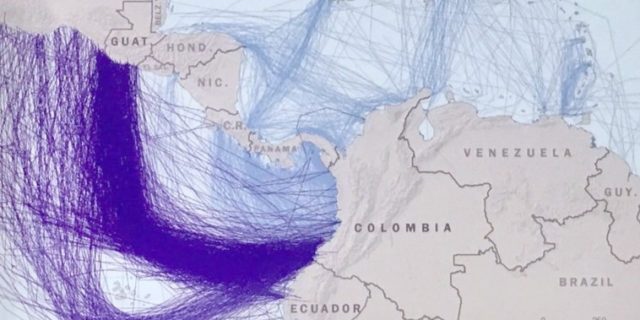
A map produced by the US Southern Command shows that most drug routes enter the US via the Pacific and then Central America (Business Insider)
As with prior allegations against Socialist Party Vice President Diosdado Cabello (Wall Street Journal, 5/18/15), the indictments hinge on the testimony of defectors, whose claims are echoed in the Western press without scrutiny.
In the most recent case, retired Maj. Gen. Cliver Alcalá and former intelligence chief Hugo “El Pollo” Carvajal were also charged by the DoJ and pledged to cooperate with US authorities. Both had previously broken with the Maduro government and endorsed self-proclaimed “interim president” Juan Guaidó.
Alcalá, who swiftly surrendered to DEA agents and was flown to the US, boasted of plotting a coup in conjunction with Guaidó and “US advisers.”
In an exposé of the coup plot, the Financial Times (4/4/20) cast doubt on the general’s “rambling and contradictory” account, quoting several US officials denying the coup attempt and alleging Alcalá was “acting on the orders of Caracas.”
The outlet conveniently ignored that this would not be the first time Alcalá conspired to invade Venezuela with a paramilitary force.
According to Bloomberg (3/6/19), there was a plan for the general to lead a contingent of 200 Venezuelan exile soldiers to clear the way for the entry of “humanitarian aid” on February 23, 2019, which was vetoed at the last minute by Colombia, suggesting high-level coordination with Washington, Bogotá and Guaidó.
By repeating the US narrative of Alcalá as a Maduro “plant,” corporate journalists paradoxically legitimize the general as a reliable source of current information on Venezuelan “narco-terrorism,” while concealing his embarrassing ties to the US and its opposition proxies.
As we have exposed for FAIR.org (5/24/19), Carvajal has already proved his worth in the past by serving up to credulous reporters highly dubious allegations about Venezuelan leaders’ Hezbollah ties (New York Times, 2/21/19).
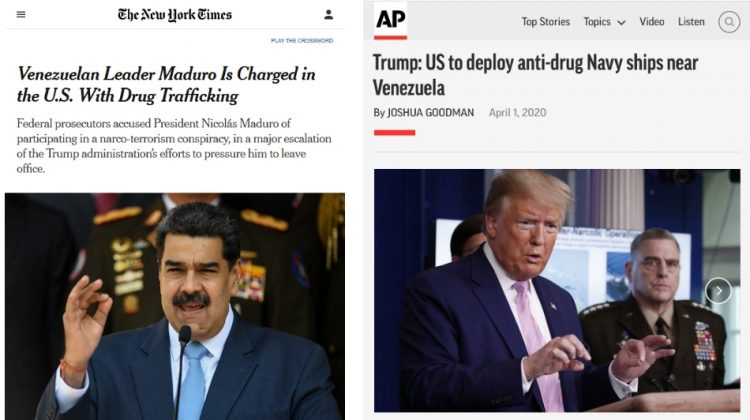
(Left) The NYT (and other outlets) accepted the DoJ’s “narco-terrorism” charges at face value (Right) An AP headline endorsed Trump’s dubious justification for an aggression
Imaginary Cartels, Real Warships
The uncritical coverage of the DoJ charges paved the way for a further US escalation shortly after the “transition” plan was unveiled.
On March 31, the Trump administration announced a military deployment to the Caribbean described by Associated Press (4/1/20) as “one of the largest in the region since the 1989 invasion of Panama.”
One might have expected such an obscenely expensive display of force amid a deadly pandemic currently killing thousands of Americans to be met with widespread rebuke across the media spectrum.
In fact, the opposition was largely muted. Newsweek (4/3/20) and Foreign Policy (4/2/20) gave voice to the Pentagon’s concern that the operation was wasteful and politically motivated, while the New York Times (4/10/20) published an op-ed raising polite proceduralist quibbles. Agreeing with the Trump administration that Maduro is a “dictator” who “must go,” Michael Shifter and Michael Camilleri nonetheless placed a vague call for Washington “to reboot sanctions policy, provide aid through accountable channels, and press the country’s leaders to work together.” Evidently, demanding the immediate lifting of (arguably genocidal) sanctions was too unreasonable to ask.
Referring to the Venezuelan military as “deeply involved in corruption and criminality,” Shifter and Camilleri exemplify the decadent imperial intelligentsia’s psychology of displacement.
From social democratic left to neoliberal right, Global North journalists and intellectuals remain invested in the self-serving illusion that besieged Southern nations such as Venezuela and Iran are more “criminal,” “corrupt” and “authoritarian” than the US empire (FAIR.org, 2/12/20).
For all their polite critiques of illegal US sanctions and military escalation–whose monstrosity has been laid bare by the current pandemic–the cult of Western exceptionalism goes unchallenged.
NYT flip-flops on Covid-19 contact tracers – because now it’s not China
‘Mao-style social controls’ or benign citizen ‘armies’?

Protesting is a “non-essential” activity, citizen! © Reuters / Kevin Lamarque
By Helen Buyniski | RT | April 16, 2020
The same citizen virus-tracing corps the New York Times decried in China as Maoism incarnate is being tried in Massachusetts and San Francisco, and the outlet has decided that what’s bad for Beijing is good for democracies.
Massachusetts and San Francisco – as well as the Republic of Ireland – are deputizing citizens to track down contacts of people infected with coronavirus, the Times reported on Thursday, describing the programs in glowing terms. After a blow-by-blow of a phone call between one of the newly-hired Massachusetts virus-trackers and her target, who gratefully gives up a file’s worth of data, we learn that the state plans to hire 1,000 caring professionals just like her to fill out its “fleet of contact tracers, charged with tracking down people who have been exposed to the coronavirus, as soon as possible, and warning them.”
The article emphasizes the bonds of “trust” between contract-tracer and coronavirus victim. There’s no talk of imprisoning people in their homes, of “keeping away outsiders” or of “arbitrary” enforcement. Indeed, one has to read to the end of the article to find out that the Massachusetts program was heavily informed by data from Wuhan and techniques from South Korea.

Massachusetts gets the warm-fuzzy treatment… © New York Times
There is just one slight problem: the NYT had already described a similar program in an article from February saying that “Mao-Style Social Control” was “blanketing” China. That piece sketched out an oppressive world in which “battalions of neighborhood busybodies, uniformed volunteers and Communist Party representatives” conducted “one of the biggest social control campaigns in history.” The goal, as the outlet melodramatically put it back then, was “to keep hundreds of millions of people away from everyone but their closest kin.”

… while China’s equivalent is “coercive” and “arbitrary” © New York Times
Stripped of the linguistic fireworks, the story described Beijing deputizing citizens to enforce quarantines by (among other things) tracing who infected persons had been in contact with, in order to keep the infected separate from the rest of the population. Not a bad idea, given the unreliability of testing and the highly-infectious nature of the coronavirus. It’s not surprising it’s catching on in the West.
San Francisco is training an all-volunteer group of 150 contact tracers, while Ireland plans to repurpose 1,000 furloughed government workers to trace contacts. Former US Centers for Disease Control director Thomas Frieden has even recommended a national “army” of 300,000 contact tracers, while other public health experts have praised the idea. It’s difficult to see how – other than the shift in vocabulary – these incarnations of what Mike Ryan of the World Health Organization called “shoe-leather epidemiology” differ from what the Times described as “Mao-style social control” in China.
With the question of how to end lockdowns still unresolved in many ‘democracies,’ human contact-tracing may emerge as the “lesser evil” with regard to preserving individual rights. While Bill Gates touts his “digital certificates” and dubious vaccines, and Apple and Google collaborate on a digital contact-tracing platform – an approach laden with privacy pitfalls that has already been used in Singapore and South Korea – that ‘Mao-style social control’ is starting to look like the most freedom-friendly option.
The Facts About Crimea Should Be Recognised. And So Should Crimea
By Brian Cloughley | Strategic Culture Foundation | April 14, 2020
Although the redoubtable New York Governor Andrew Cuomo declared that the Covid-19 virus “has been ahead of us from Day One. We’ve underestimated the enemy, and that is always dangerous, my friends. We should not do that again” it is too much to expect of most political figures that they should ever admit they were wrong about something. President Trump, for example, flatly refuses to acknowledge that in January 2020 he declared that “we have [the virus outbreak] totally under control”, and there are countless similar instances of denial of realities by other leaders, not only about the pandemic, but about very many facets of international affairs. This reluctance extends to the media, although sometimes, it has to be said, some of the media are forced to recognise facts that to them are unpalatable, and to adjust their position accordingly.
One recent instance of non-adjustment, however, is the Western media’s continuing public relations and propaganda campaign against Russia.
On 9 April Al Jazeera carried a report that “A U.S.-Russian space crew blasted off Thursday to the International Space Station following tight quarantine amid the coronavirus pandemic.
NASA astronaut Chris Cassidy and Roscosmos’ Anatoly Ivanishin and Ivan Vagner lifted off as scheduled from the Russian-operated Baikonur cosmodrome in Kazakhstan.” There was an excellent 400-word piece about the mission, just as one would expect from Al Jazeera.
On the other hand, the New York Times, as ascertained from a search of its website on 10 April, didn’t mention the mission at all. The Washington Post carried a twelve-word item that read in its entirety “By Associated Press April 9, 2020 — A U.S.-Russian space crew has blasted off to the International Space Station.” End.
The reason for reluctance on the part of the U.S. mainstream media to inform the world about such an important international event is that Russia played the major part in a successful space mission with the United States. Imagine the news cover if the spacecraft hadn’t been a Russian Soyuz, but a U.S.-produced SpaceX (still under vastly expensive development) launched from the Kennedy Space Centre. There would have been front-page headlines with “Keep America Great” exhortations from the space commander in Washington.
And so the propaganda of the third Cold War continues, involving all sorts of important international affairs, not least being Crimea which (whisper this) is doing very nicely, thank you, having been restored to Mother Russia.
It must be acknowledged, however, that the Washington Post marked the sixth anniversary of the restoration with a piece on 18 March that (albeit reluctantly) recognised Crimea’s accession to Russia. It noted, among other things, that “in Crimea itself, the annexation was popular, especially among Crimea’s large population of older ethnic Russians. More than five years later, and billions of roubles of investment later, it remains popular.” It is mandatory in the West to use the word “annexation” when referring to the accession of Crimea to Russia following a popular referendum, but even the Post can’t escape the facts, which are so distasteful to the propagandists.
In 1783 Crimea became part of Russia and remained so until, as recorded by the BBC, “In 1954 Crimea was handed to Ukraine as a gift by Soviet leader Nikita Khrushchev who was himself half-Ukrainian.” The majority of citizens wanted to rejoin Russia rather than stay with crippled post-revolution Ukraine which would have victimized them because of their Russian heritage. One of its first actions “was to repeal a 2012 law recognising Russian as an official regional language” and governance from Kiev boded badly for minorities.
It was rarely stated that 90 percent of the inhabitants of Crimea are Russian-speaking, Russian-cultured and Russian-educated, and they voted to “dissolve the political bands which have connected them with another” (in the words of the Declaration of Independence of 1776) in order to rejoin Russia. It would be strange if they had not wanted to accede to a country that not only welcomed their kinship, empathy and loyalty but was economically benevolent concerning their future, as has now been amply demonstrated by ensuing growth and prosperity. As even the Washington Post had to acknowledge, “Crimea’s three largest ethnic groups are, by and in large, happy with the direction of events on the peninsula.”
At the time that these ethnic groups were voting to rejoin their mother country, five years ago, the West, and most notably the administration in Washington, decided to oppose any such move. It didn’t matter that it was a fair and free vote, because there are ways to defeat common sense and national aspirations while creating the impression that it is wrong for people to express their feelings and wishes if these favour a nation that is anathema to those who make the rules.
For example, the government in Crimea invited observers from the Organisation for Security and Cooperation in Europe (OSCE) to witness and assess the conduct of the referendum held to determine whether the people of Crimea wished to remain under the Kiev government or rejoin Russia. There were no strings attached, and the invitation was sent to the HQ of the OSCE in Vienna. Then there was a pause during which the matter was considered in who knows what halls of power. And the OSCE conjured up an intriguing excuse for refusing to assess conduct of the plebiscite. As Reuters reported, “a spokeswoman said Crimea could not invite observers as the region was not a full-fledged state and therefore not a member of the 57-member organization. ‘As far as we know, Crimea is not a participating state of the OSCE, so it would be sort of hard for them to invite us,’ she said. She also said that Ukraine, which is an OSCE member, sent no invitation and that the organization ‘respects the full territorial integrity and sovereignty of Ukraine’.” You couldn’t make it up.
The feelings and aspirations of Crimea’s citizens didn’t matter to the OSCE or to the West as a whole. The West wanted, and still wants, Ukraine to rule Crimea, and seems determined to pester and sanction Russia accordingly. But nobody can seriously imagine for one moment that Russia is going to hand over Crimea to the Kiev government. So what is the answer?
Nobody expects the Great and the Good of the West to openly admit they were wrong about Crimea, and that the region and its citizens are in fact immeasurably better-off than they would be had they been subjected to rule by Kiev. But there is usually a way out of such a dilemma, and one that can be gently implemented without embarrassment. All that the West needs to do is quietly accept the status of Crimea and remove anti-Russia sanctions without fanfare. There would be discontent among the ultra-nationalists in Kiev, of course, but the world would be a more secure and happier place. Surely that’s a worthy aim to be achieved?
As Russia Sends Aid, US and NATO Sneer and Smear
By Ulson Gunnar – New Eastern Outlook – 08.04.2020
When Russian military planes and trucks arrived in Italy to provide relief for communities hit by the Covid-19 outbreak, the Italian government, elected into power by the Italian people, was thankful for the assistance offered by Moscow.
Named officials within the Italian government, including the foreign minister, the minister of defense and the governor of Apulia, Michele Emiliano, publically expressed thanks to Russia for the aid.
But finding any mention of this across the Western media is difficult, often buried deep within articles aimed entirely at smearing Russia for sending aid and depicting Italians as victims of a publicity stunt.
Reuters, in a smear piece published by the New York Times and aimed at vilifying Moscow, still had to admit regarding Russian aid that Italians were grateful, noting:
“There are no new geopolitical scenarios to trace, there is a country that needs help and other countries that are helping us,” Foreign Minister Luigi Di Maio was quoted as saying by Italy’s Il Corriere della Sera newspaper on Thursday.
Despite Italy being capable of speaking for itself and bringing up any suspicions (if they had any), the West decided to step in and speak for Italy instead.
Sneering and Smearing
Western headlines are flooded with scorn for both Russia and the aid they sent, completely indifferent to how Italians themselves perceived the gesture.
Articles like Bloomberg’s “Italy Questions Russians Over Their Goodwill Virus Gestures,” admit several paragraphs in that officially, Italy was grateful for the aid, noting:
“Our country can only be grateful” for the solidarity of many countries, including Russia, the Italian defense and foreign ministries said in a joint statement Friday.
Yet claims that “Italy questions Russia” suggest the entire nation is suspicious of the aid. Upon reading Bloomberg’s article, the only source cited is a single article in the Italian newspaper La Stampa. It is hard to believe an article in La Stampa constitutes all of “Italy.”
According to the pro-Western Moscow Times in their article, “80% of Russia’s Coronavirus Aid to Italy ‘Useless’ – La Stampa,” also entirely based on the La Stampa article, its admits La Stampa’s information came from an “unnamed source.”
Other articles, like the BBC’s “Coronavirus: What does ‘from Russia with love’ really mean?,” Foreign Policy’s “Beware of Bad Samaritans,” and Forbes’ “From Russia With Love? Putin’s Medical Supplies Gift To Coronavirus-Hit Italy Raises Questions,” all used similarly disingenuous tactics to depict the Russian aid as somehow sinister and unwanted.
The Guardian in its article, “Coronavirus: Russia sends plane full of medical supplies to US,” explains:
Critics likely to claim Moscow will exploit goodwill gesture as public relations coup.
France 24 in headline alone makes Western criticism even clearer, claiming, “Flying aid to virus-hit Italy, Moscow flexes soft power.“
So by sending aid to Italy, Russia is somehow supposedly flexing its “soft power.”
So How is the West Using Its Soft Power?
The West faced a collective decision. They could have used their own, very substantial soft power to one-up Russia by sending even more aid to Italy and other regions of the globe impacted by the spread of Covid-19.
Instead, they mobilized the entirety of their soft power to sneer and smear Russia’s efforts with Western-funded media fronts writing entire articles doing just that.
The West’s attempts to depict the Russian media reporting on the aid as also somehow sinister rather than simply telling the world what Russia is doing is also particularly surreal.
The Western media itself spends the summation of its own time and energy promoting what their respective governments are doing abroad which usually involves illegal invasions, wars, occupations and interventions… not sending aid.
A Missed Opportunity
Because certain special interests in the West fear some Western governments growing closer to nations like Russia and China in the spirit of cooperation and mutual benefits and derailing the Washington-led “international order” that has prevailed post World War 2, resources have been committed to attacking any development that could spur this process further.
But because these resources have been invested into attacking, even when attacking is not the best option, that is all the West appears capable of doing.
The answer to Russian aid to Italy was Western aid to Italy. The benefit would have been a flood of resources sent to where it was needed and everyone involved enjoying the benefits of lending a helping hand to those who would be grateful in return.
Instead, the West appears to be throwing rocks at a time when others are coming together to help, and throwing those rocks at those who are helping.
Rather than teaching the Italians never to deal with Russia again, it is likely this process is going to remind Italians as to why they’ve diversified their foreign relations outside the West in the first place.
Who’s Right: Donald Trump or the Media?
By Gregory Hood – American Renaissance – April 3, 2020
I’ve seen this posted everywhere; article after article in the mainstream media telling us to stop worrying about the coronavirus.

I checked them all, and every one is real.
- “We Should Deescalate the War on the Coronavirus,” by Robert Dingwall, Wired, January 29, 2020
- “As the coronavirus spreads, fear is fueling racism and xenophobia,” by Jessie Yeung, CNN, January 31, 2020
- “You’re Likely to Get the Coronavirus,” by James Hamblin, The Atlantic, February 24, 2020
- “Is the Coronavirus Worse Than The Flu? Here’s How the 2 Illnesses Compare,” by Leah Groth, Health, February 26, 2020. The subtitle is, “It depends on what you mean by ‘worse.’” A doctor quoted in the story says the flu is worse, but that the coronavirus spreads more easily.
- “The Fear of the Coronavirus, and the Reality of the Flu,” by Simon Murray, HCPLive, February 10, 2020. The final sentence says the outbreak “serves as a surrogate for a good deal of xenophobia and fear of the country [China] itself.”
- “Panic over coronavirus could be caused by flu numbers,” by Renae Skinner, KOAA, February 7, 2020
- “The Flu Is a Way Bigger Threat to Most People in The US Than Coronavirus. Here’s Why,” by Aylin Woodward, Business Insider, January 25, 2020
- “Heath official: You are more likely to catch flu in Oregon than deadly Wuhan coronavirus,” by Stephanie Rothman and KVAL.com staff, KVAL, January 22, 2020
- “Is the new virus more ‘deadly’ than flu? Not exactly,” Associated Press, February 18, 2020
- “Amid coronavirus panic, doctors remind public: Flu is deadlier, more widespread,” by Denis Dador, Eyewitness News 7, March 4, 2020
- “MD Flu Deaths Climb As Flu More Worrisome Than Coronavirus,” by Deb Belt, Patch, February 23, 2020
- “New coronavirus may be no more dangerous than the flu despite worldwide alarm: experts,” by Tom Blackwell, National Post, February 3, 2020
- “Experts warn flu is greater risk than coronavirus,” by WICS/WRSP staff, News Channel ABC 20, February 13, 2020
- “Want to Protect Yourself From Coronavirus. Do the Same Things You Do Every Winter,” by Jamie Ducharme, Time, January 31, 2020
- “Doctor suggests worrying about the common flu, not coronavirus,” by Michael Martin, Fox 17 West Michigan, January 31, 2020
- “New coronavirus is likely to go pandemic, but that’s no reason to panic or overreact,” by Bob England and Will Humble, AZCentral, February 25, 2020
- “Relax! Coronavirus is Less Dangerous Than the Flu, Says Epidemic Expert,” by Mark Emem, CCN, January 31, 2020
- “The Flu Is Still a Bigger Health in the U.S. than Novel Coronavirus,” by Lesley McClurg, KQED, January 29, 2020
- “Why are we panicked about coronavirus – and calm about the flu?” by Anthony DiFlorio, The Hill, February 4, 2020
- “Flu hitting Arizona more than usual this season, despite attention on coronavirus,” by Mike Pelton, ABC 15, February 6, 2020
- “New coronavirus spreads more like flu than SARS: Chinese study,” by Julie Steenhuysen, Reuters, February 19, 2020
- “Forget the Coronavirus: The Flu Pandemic of 1918 Killed More People in One Year than all of World War I,” by Sebastien Roblin, National Interest, February 15, 2020
- “The Virus Killing U.S. Kids Isn’t the One Dominating the Headlines,” by Michael Daly, Daily Beast, February 6, 2020. Hint: It’s a three-letter-word that begins with F.
- “Is Coronavirus Spreading Faster Than SARS, Ebola, and Swine Flu?” by Dan Evon, Snopes, February 26, 2020
- “Why we panic about coronavirus, but not the flu,” by Bob Herman, Axios, January 29, 2020
- “Coronavirus is deadly, but flu has claimed over 8,000 lives this season,” by Jasmine Vaughn-Hall, York Daily Record, January 31, 2020
Several articles reported that the flu had, at the time, killed more people than the virus. Today, journalists at many publications are slamming President Trump for having compared coronavirus to the flu, but their colleagues did the same thing. Vox didn’t just compare coronavirus to the flu, but said the new disease might “look more like the common cold than like SARS.”

Vox shamelessly deleted an article that assured readers we wouldn’t get “a deadly pandemic.”

This matters because many journalists now refuse to cover President Trump’s press conferences. They say the briefings are “falsehood-filled,” to use New York Magazine’s phrase. They want a monopoly on information, which is not reassuring when they are so reliably unreliable.
President Trump made the same mistake many journalists did, and he didn’t act strongly when he should have. However, he did ban travel from China and imposed a quarantine on returning travelers.
He was blasted for that:
- “Coronavirus quarantine, travel ban could backfire, experts fear,” by Alice Miranda Ollstein, Politico, February 4, 2020
- “The US coronavirus travel ban could backfire. Here’s how,” by Catherine Shoichet, CNN, February 7, 2020
- “Coronavirus: could the US government’s quarantine and travel ban backfire?,” by Sam Levin, The Guardian, February 4, 2020
On January 31, Joe Biden attacked President Trump’s “hysteria xenophobia [sic], hysterical xenophobia.” In March, Bernie Sanders said if the choice were his, he wouldn’t close the borders; he would listen to “scientists” instead.
This all seems ridiculous now that we are trapped in our own homes. It would have been better to have one large wall around the whole country rather than countless little ones inside it.
The press also heaped scorn on President Trump for offering “false hope” when he mentioned the anti-malarial drug hydroxychloroquine.
- “Coronavirus treatment: Dr. Donald Trump peddles snake oil and false hope,” USA Today Editorial Board, March 21, 2020
- “Trump’s claim that malaria drug can treat coronavirus gives hope, but little evidence it will work,” by Berkeley Lovelace Jr., CNBC, March 26, 2020
- “Trump touted hydroxychloroquine as a cure for Covid-19. Don’t believe the hype,” by Oliver Milman, The Guardian, March 28, 2020
Twitter removed a tweet from Laura Ingraham that claimed there were “very promising results.” Once again, a tech company decided what people should read.
President Trump didn’t say it was a cure. He said there was promising evidence, but the New York Times tried to blame him when a couple foolishly drank fish-tank cleaner. The husband died and his wife barely survived. “The drug, known as chloroquine phosphate or chloroquine,” wrote Neil Vigdor in The New York Times, “has been bandied about by President Trump during White House briefings on the coronavirus pandemic as a potential ‘game changer’.” But President Trump had not recommended that specific chemical — chloroquine phosphate — something the Axios news site admitted when it deleted a tweet blaming him.

On April 2, thousands of doctors reported in a poll that hydroxychloroquine actually is the most effective known treatment for coronavirus. A small study from China reported it is effective in treating patients with mild cases. A test of the drug’s preventive power is also underway. New York Gov. Andrew Cuomo, whom many Democrats want to be their presidential nominee, has already begun a larger clinical trial. It’s wrong to claim hydroxychloroquine works, but President Trump wasn’t just making things up. If he was selling “snake oil,” so is Andrew Cuomo.
President Trump should have done more to prevent this crisis. His claim that it could be over by Easter was stupid. Of course, had he done what was necessary, journalists would have said he was using Nazi tactics. Some do anyway.
- The Forward claimed that President Trump referring to a “foreign virus” is “as dangerous as coronavirus itself” and “straight out of the Nazi playbook.”
- “Trump Is Using Pandemic Panic to Ramp Up Attacks on Migrants,” said The Nation.
- “Be Careful,” warned The Guardian. “Trump may exploit the coronavirus for authoritarian ends.”
If only. Had he done so a few months ago, I could take my family out to dinner instead of being stuck in my house.
In an emergency, we need to know whom we can trust for accurate information. President Trump sometimes exaggerates, dissembles, or outright lies, but so do journalists, usually because they want to attack the president. Worse, many journalists believe they should decide what we should know.
Whoever is right, our economy has collapsed, millions are unemployed, thousands are dead, and people are wearing masks just to go to the grocery store. You can make a strong case that if President Trump had taken “racist” measures sooner, we would have avoided the worst. Of course, if Joe Biden thinks “hysterical xenophobia” was the problem, Democrats would have made a terrible hash of things.
Journalists have power — more than most politicians. Read their stories from the last few months, and see how they used that power.
Nationalism isn’t “as dangerous as coronavirus.” Nationalism could have stopped the virus. I’m frustrated with President Trump, but I’m furious with these journalists.
Open Letter to Chinese Government Highlights MSM Hypocrisy
By Daniel Lazare | Strategic Culture Foundation | March 30, 2020
The Washington Post, New York Times, and Wall Street Journal have written an open letter to the Chinese government urging it to reverse its “damaging and reckless” decision to expel their reporters amid a spiraling COVID epidemic.
The letter makes all the usual points about a “free flow of reliable news and information” in the middle of a growing international emergency. And however clichéd, such sentiments are correct since access to the broadest possible sources of information is indeed essential if the world is to make it through the crisis.
But the letter would have been a lot more convincing if the three papers had spoken up on Mar. 2 when the Trump administration moved to expel sixty Chinese journalists working for five news organizations that the White House regards as little more than state propaganda outfits.
Moreover, they’d be on even firmer footing if they had not actively cheered on the most dangerous anti-media effort of all, the U.S. crackdown on the TV news service RT, formerly known as Russia Today, that began in November 2017.
The crackdown on RT was in some ways even worse than McCarthyism since the latter was at least about something real and important, which is to say a Communist movement that controlled roughly forty percent of the global population and was pressing in on capitalism from every side. If the ruling class seemed spooked, it was facing a challenge of unprecedented dimensions.
But the threat this time around was about something entirely made up, i.e. the belief that Russia had supposedly used various dark arts to trick Americans into voting for Trump. The nonsense began in January 2017 when the CIA, NSA, and FBI “assessed” that Vladimir Putin had interfered in the previous year’s election in order “to undermine public faith in the U.S. democratic process, denigrate Secretary Clinton, and harm her electability” and, in the process, boost Trump. The report was entirely devoid of evidence, yet the press took it as gospel. Even worse, the intelligence report included a seven-page annex accusing RT of engaging in “criticism of U.S. and Western governments as well as the promotion of radical discontent,” running “numerous reports on alleged U.S. election fraud and voting machine vulnerabilities,” contending that U.S. election results cannot be trusted and do not reflect the popular will,” and hosting third-party candidates who contend that “the U.S. two-party system does not represent the views of at least one-third of the population and is a ‘sham.’”
Imagine – a foreign news service daring to suggest that U.S. politics were flawed! If papers like the Times or Post had the slightest inkling of self-respect, they would have laughed themselves silly over such hyper-sensitivity and told the CIA to grow a thicker skin. But they didn’t. Instead, they worked themselves up into ever greater levels of indignation. Within a few months, the New York Times was warning that “if there is any unifying character to RT, it is a deep skepticism of Western and American narratives of the world and a fundamental defensiveness about Russia and Mr. Putin” and that, thanks to snazzy graphics and snappy repartee, the network had put together “the most effective propaganda operation of the 21st century so far, one that thrives in the feverish political climates that have descended on many Western publics.”
Of course, one might observe that outlets like CNN and MSNBC are characterized by a deep skepticism of Russian narratives, so what’s the difference? But that wouldn’t be fair since everyone knows that America is right and Russia wrong and that any comparison between the two is automatically invalid, isn’t it?
Not to be outdone, the Washington Post – official slogan: “Democracy dies in darkness” – ran not one but two op-eds (here and here) calling on the federal government to require RT to register as a foreign agent, a step the Trump administration would dutifully take just two months later.
So the big two turned out to be more aggressive than the Trump administration in reducing journalistic diversity and using the power of the state to undermine a foreign competitor. Finally, just a month ago, the Times ran a front-page article declaring – queue the ominous music – that Radio Sputnik, RT’s sister outlet, had begun “broadcasting on three Kansas City-area radio stations during prime drive time.” Horror of horrors, the station was bombarding Missourians with Russki propaganda criticizing impeachment, the media, and the U.S. political system in general and informing that, in the words of one Sputnik host, that “the masses of poor and working people don’t have access to even the most essential things.”
Where did Radio Sputnik come up with such a notion? Doesn’t everyone know that perfect equality reigns in the United States and that anyone who says otherwise must be working for a foreign power?
In fact, while America never tires of touting its devotion to the First Amendment, it loses control when a foreign news service turns tables by engaging in journalism that is cheeky and irreverent. It wants a free press, which is to say one that is free to repeat over and over again how perfectly wonderful America really is. But it does not believe in a free press that allows foreigners to say the contrary.
On COVID-19 and Curtis LeMay
By Robert S. Griffin • Unz Review • March 26, 2020
As I write this in late March of 2020, the world is under attack from a deadly strain of coronavirus called COVID-19. Thus far, there have been around 18,000 deaths world-wide, including 550 deaths in the United States where I live. My country has come to a halt: schools and businesses are shut down and people have been warned to stay in their houses or apartments hunkered down in the face of this menacing enemy. We’re in a war, that’s how it is being described in the media. The president has said he is like a war-time president.
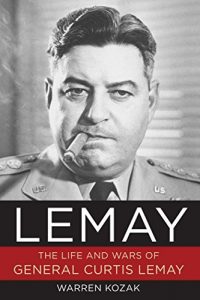
Speaking of war, tonight, hunkered down as I usually am in this very late stage of life—I didn’t need to be directed to hide out on this leather couch I’m sitting on at the moment—I read a biography of an American World War II-era air force general by the name of Curtis LeMay (LeMay: The Life and Times of General Curtis LeMay by Warren Kozak, Regnery, 2009). As I was reading along, it hit me that COVID-19 has a long way to go before it’s in a league with General LeMay as a killing machine. Back in 1945, in less than three hours, LeMay got way, way more killing done than COVID-19 has been able to accomplish in three months.
And it’s more than just in the sheer number of deaths that LeMay comes out on top in the comparison.
COVID-19 has been bad at snuffing out the lives of children and people who aren’t already sick with something. With LeMay, young and old, sick and well, he put them all in their graves.
And LeMay wasn’t limited to primly killing people lying quietly in hospital beds with rubber tubes running into them as COVID-19 has been. He set them on fire, deprived them of air to breathe, and heated them up like pot roasts. Imagine that action!
More, COVID-19 seems only to be proficient at x-ing out human life in cold weather; no good in the summer. LeMay demonstrated in both Europe and Asia that he was a man for all seasons, as it were—he was as effective cancelling someone’s existence in July as January.
Plus, Curtis LeMay didn’t just kill people; he also totally leveled the areas they lived in. COVID-19 has accomplished nothing in this regard.
In addition, Curtis LeMay had style and pizzazz—he had a snappy uniform and chewed on a big cigar. COVID-19, tiny and round with little spikes, no snappy uniform, no big cigar, nothing, lacks presence entirely.
Even more, Curtis LeMay was miles ahead of COVID-19 in public relations. He did his killing and came off looking good and got fawned over and invited to dinner parties, while COVID-19 does its killing and comes off looking bad and is shunned and people are brewing up poison to slip into its margarita. No contest there either.
The one area where COVID-19 comes out ahead of LeMay is in the ability to make the stock market plunge. LeMay was lacking in that area, though in fairness to him, he wasn’t dedicated to getting that accomplished—total destruction and super high death counts were his only priorities.
Assuming you don’t know about him, General Curtis LeMay conceived and ordered an incendiary bombing raid—fire bombs, they set everything aflame—on the civilian population of Tokyo, Japan, March 9th, 1945. Here’s a description of how it went down drawn from the LeMay biography I just read:
Across Tokyo, residents looked up in amazement. They had never seen the “B-sans” [B29 bomber airplanes] so low, nor had they ever seen so many at once. German Catholic priest, Father Gustav Bitter, who was there, later wrote, “The fire falling from the sky reminded me of tinsel hung on a Christmas tree. The red and yellow flames reflected from below onto the silvery undersides of the planes in the upper darkness gave them the appearance of giant dragon flies with jeweled wings. I watched as if I were in a trance.”
With sudden fury, tranquility became horror as the incendiaries hit home. They created tornadoes of fire. They sucked away oxygen; people couldn’t breathe and suffocated. Masuko Harino, a factory worker, reported, “Intense heat came from the firestorm. My eyes seemed about to pop out. People’s clothes were on fire. They were writhing in torment.” A young woman described a school that had become a three-story oven: every human being inside it was cooked to death. Strewn everywhere, some in batches, the incinerated bodies were black; they looked like logs from a distance. There was a dreadful sameness about the dead, no telling men from women or adults from children. If they could walk, survivors wandered about like ghosts, silent. Those still alive were left to die in agony; there was no medicine, food, or drinking water for them.
The raid lasted two hours and forty minutes. Sixteen square miles of Tokyo, one of the most densely populated areas in the world, was transformed into a moonscape of twisted reddish-black iron, roasted sheet metal, and rubble. Not a single man-made structure still stood. An estimated 100,000 people died in Tokyo that night. More than a million were left homeless. The grisly retrieval of bodies took weeks. At least 70,000 people were buried in mass pits. A U.S. Strategic Bombing Survey concluded, “More persons lost their lives in Tokyo that night than in any equivalent period of time in the history of mankind.”
How did what Curtis LeMay pulled off that March night in 1945 go over? It went over really big. And LeMay himself went over really big. I read The New York Times every morning, and it’s been non-stop trashing COVID-19 for weeks, not one positive word, and there’s been all kinds of commiserating with the dead and dying. With LeMay, the Times jumped up and down like cheerleaders. Hurray for our hero! The paper pointed out that those people in Tokyo LeMay set on fire, asphyxiated, and baked had it coming—women, children, and infants, every last one of them–because “the people, factories, and small establishments all contributed to Japan’s war effort.” The Times celebrated LeMay’s admirable deed as the start of really good things: to wit, Japanese cities becoming “no more than holes in the ground.” Though the newspaper cautioned readers that the Japanese “have done their deadliest fighting from holes in the ground,” so we need to be diligent and thorough with the killing.
Following the bombing raid, New Yorker magazine had a glowing profile of LeMay. And he was on the cover of Time magazine and given an effusive write-up in its pages. Nothing like that for COVID-19. But then again, COVID-19 hasn’t done the bang-up job of extinguishing human life that LeMay did, and it’s not anihilating the people who most richly deserve to die like LeMay was so good at doing.
LeMay got a promotion to Chief of Staff of the United States Air Force, and in 1968, ran for vice-president on a third-party ticket, garnering a hefty 13% of the vote. COVID-19 couldn’t come by a janitor’s job or get on the ballot for dogcatcher.
LeMay got an elementary school named after him, and . . . oh, you get my point. LeMay had it all going, and my best guess is that no matter how good COVID-19 does in the future—including getting up to speed with killing little children—it’s never going to measure up to him.
Russiagate: The Sequel
Impervious to facts, the false historical narrative is back for more
By Jason Hirthler | American Herald Tribune | March 23 ,2020
Famous muckraker journalist and author of The Jungle, Upton Sinclair, once declared that, “It is difficult to get a man to understand something when his salary depends on his not understanding it.” He was talking about mainstream journalism. Few mainstream outlets better exemplify his maxim than The New York Times. It should then come as no surprise that the Times, the bible of the bourgeoisie, is at it again. The editorial board recently published a new article bringing the coronavirus and this year’s election under the sweeping banner of Russiagate, a tattered and discredited narrative that is being anxiously rehabilitated by the Washington establishment. But of course. The estimable “editorial board” tells us “conditions are ripe,” sending a shiver down the spine of every Biden liberal on either coast. But ripe for what? I think we all know the answer to that question by heart: “to sow discord”. Indeed that infamous epithet is sewn into the headline of the story, as though it had never left.
The first paragraph begins with the assumption that Russian disinformation in our election has been conclusively demonstrated, such that the question need not even be broached. To be clear: Russian disinformation at the express direction of the Kremlin. This whopping assumption taken as a foregone conclusion, we jump ahead to the next question: How will the Russians interfere this time around? Having established an unproven history as fact, the board then moves on to reupholster the sagging narrative from 2016. This time it won’t be the “bumbling” G.R.U., but rather the “more competent, stealthier” S.V.R. Now, with the SVR presumably involved (thought unconfirmed), we may expect “pernicious operational innovation and escalation” with the Russians descending to new lows to weaponize the coronavirus.
Look what’s already been accomplished. A false historical narrative has been posited as the context in which the latest news is shared. Then they introduced a tantalizing new security agency to the plot. Finally, they elevate the idea that “active measures” campaigns, resurrecting an old Soviet term, were not intended to elect Donald Trump, this having been effectively challenged, but rather to, one shudders to think, “weaken the United States.” This sweeping new storyline has been adumbrated in paragraph without providing a single piece of verifiable evidence.
And so, what to expect during this year’s “quadrennial extravaganza”, as Noam Chomsky drily described our electoral farce? Not having any solid evidence of any SVR plans, better to consult Soviet history for clues. The article then accuses the Soviets of a “racial engineering” campaign of anti-semitism in West Germany in 1959, in New York and the U.S. in 1960, and Africa shortly thereafter. Again, no evidence is provided. This is particularly strange that the German Democratic Republic (GDR) in East Germany would have launched an anti-semitic campaign in the West, given that it alone conducted a thoroughgoing purge of Nazis from its society, while the Federal Republic of Germany (FRG) in the West happily integrated the surviving Nazi braintrust into its power structures, and sent not a few off to the States to lend their dastardly talents to our ‘democracy promotion’ agendas.
It is then said, with resigned recognition, that one of the central problems with combatting devious active measures of this kind was that “the K.G.B. largely stuck to the facts.” Which continues to be an insidious feature of modern Russian ‘active measures’, like the channel RT, for example, which regularly hosts angry populist Americans who rattle off chains of facts one can’t find in the mainstream press. It often seems the establishment media is more irritated at the inconvenience of alternative narratives than their veracity. Another ‘throwback’ story is tossed into the pot, perhaps to conjure dormant nostalgia for the Cold War: cigar boxes packed with explosives are sent to a ritzy dinner party to kill a diplomat. Surely the cigars in question were Cohibas, perhaps autographed by Fidel himself?
Just as one is beginning to get excited about all these ‘active measures’, the authors draw us hastily back to sobering reality. We are now given an elementary lesson in amateur psychology: active measures are intended, it seems, to elicit “emotional” reactions and “corrode” the target. Evidently, the best way to do this is to drive a wedge between deeply democratic, multicultural societies in any of the major western utopias. Hence the racial engineering. It is also important to blame the U.S. for afflicting brown people abroad: such as spreading dengue fever in Cuba and malaria in Pakistan. The authors fail to unravel these charges since each is absurd on its face. Or such is the editorial board’s consensus, if not the reader’s. One imagines the board members chucking at the charges: As if the United States of America would ever attempt such a thing! But then again, since World War Two, the U.S. has tried to overthrow some 50 foreign governments, assassinate some 50 foreign leaders, either invade directly or by proxy or simply bomb 30+ countries, not to mention interfering in some 30 foreign elections, all this with the aim of destabilizing and disbanding populist movements around the world. Nobody embodies counterrevolutionary imperialism better than Washington and its vassals. But these facts are, as Sinclair would remind us, what the board and its authors are paid to forget.
But back to the true evildoers, Russia. According to anonymous sources with no evidence to share, the Russians will harness the coronavirus to divide Americans from each other. The authors reference a discord-sowing campaign being run out of Ghana by a group called ELBA, uncovered by Facebook and CNN. A modest single-story yellow house with stone-fronting is shown in the linked CNN article, the worldwide headquarters of the ghastly ELBA “Russian trolls” who, stunningly, were not even aware they were Russian trolls. Most were Ghanaians. But such is the surreptitious and artful Kremlin craft. Ghanaian security forces raided the small house and then darkly implied our worst fears when they attributed ELBA’s funding to a “European country.” CNN traced the Ghanaian man who ran the company back to Russia, where he worked as a translator. That manager, Seth Wiredu, was confused that Ghanaian security had raided his business. “I fight for black people,” he said. Indeed, the posts on Facebook were focused on repression of African-Americans, quite sensibly. Facebook quickly took down 71 associated accounts. Of course, our white authors at the Times, say the Russians have influenced African-Americans since 2016. CNN attempted to tie Wiredu to the Internet Research Agency (IRA) of 2016 fame, though he flatly denied the association.
And so, regarding the Russians supposed gameplan for 2020, we are left with little substantiated intelligence and much speculative fodder. The story itself is based merely on what “officials said.” Unnamed officials. Anonymous officials. Government agents. “They gave few details,” of course, but this, as you know, is all done in the name of national security. One can just imagine the Times deep throat hemming and hawing and biting his lip in some oil-stained underground parking deck, finally whispering, “I really can’t show you the evidence. It would compromise national security.” And then a conspiratorial and patriotic nod from the Times stenographer. “I understand completely,” he replies. “The safety of the American people is paramount.”
Manufacturing Consent, Consensus, and Fear
One of the filters that Noam Chomsky and Edward Hermann laid out in their classic Manufacturing Consent is to do with sources. Namely, “the reliance of the media on information provided by government, business, and ‘experts’ funded and approved by these primary sources and agents of power.” Voices of the establishment, in other words. This is precisely how the MSM has managed the deliberate expansion of Russiagate. Times journalists reflexively accept the pronouncements of their government sources. It has gotten to the point where sources must no longer provide evidence for their claims. They must merely claim that providing evidence would compromise national security. Any serious journalist would insist on evidence. But journalists do not do this because they recognize that if they did, the source would likely quit being their source and begin to break stories with competitor news outlets. The muckraker again: their salary depends on blind faith. There is no reasonable excuse for this journalistic stenography. Parroting government sources is exactly that.
Anonymous Sources Lack Credibility
Aside from the self-evident willingness of the press to print unsubstantiated and inflammatory claims, there are three other reasons to view such stories with skepticism. First, how many times must we be told that the military-intelligence community is not trustworthy? An infinite number, it seems. From the Church Commission to the National Endowment for Democracy (NED) and the invention of ‘perception management’ to a former CIA director’s naked admission that the organization lied, cheated, and stole as a business model. The government has lied to us about Iraq, the greatest war crime of this century. Before then it lied to us about Cuba, Nicaragua, Vietnam, among many other nations. Since then it has spread disinformation about Libya, Syria, Venezuela, Iran, North Korea, and Russia. Evidence was manufactured to support a foregone conclusion. The CIA has bought and paid for journalists at least since the Church Commission.
Second, aside from the perfidious track record of government sources, the mainstream media itself has been shown to be untrustworthy. The notion of journalistic impartiality is more mythic than substantiated. Not least because of its history of conspiracy and connivance with the government. The press hasn’t helped its cause by installing a surfeit of military and intelligence retirees as lead analysts.
Third, and critically for this particular topic, we now know that much of the supposed evidence for Russiagate has been debunked:
- The idea the GRU was definitively behind the supposed hacking of the DNC is errant on two counts: the evidence suggests it was a leak, not a hack; and the CIA is known to have technology that allows it to fake any source it chooses.
- The Mueller Report was an unmitigated disaster for conspiracy-pushing Democrats.
- We know that the infamous dossier author Christopher Steele was a DNC contractor, like CrowdStrike, which refused to turn over its servers to the FBI for investigation after claiming it was hacked, and that the Clinton campaign paid for part of Steele’s investigative work. The Russians were central to Clinton’s explanation of why she lost.
- We know that there has been no definitive proof that the Kremlin was behind any of the social media posts that were said to corrupt the election.
- Supposed spy Maria Butina was essentially entrapped, jailed, had her reputation destroyed, and was then banished back to Russia.
- That Donald Trump’s entire presidency has been largely hostile to Russia, an odd stance for a supposed puppet of the Kremlin.
- The Times itself launched and promoted the dissimulating sham known as the Intelligence Community Assessment of Russian interference. The newspaper repeatedly claimed the ICA was signed off on by all 17 intelligence agencies, a claim it later quietly retracted when it was shown that only four handpicked agencies had actually supported the assessment. Likely handpicked by John Brennan to legitimate suspicions invented by… John Brennan.
- The supposed Russian backing of Roy Moore’s Alabama Congressional campaign was a false flag run by a company that wrote the Senate report on Russian interference.
- We do know the Internet Research Agency was a for-profit clickbait agency that spent a comparative pittance ($100,000) compared to the hundreds of millions spent by the 2016 candidates. Neither have the IRA’s posts aligned with either candidate nor the election itself, with most posts occurring after the election.
- We know the MSM’s hysterical claims in reporting the supposed reach of 126 million people via social media posts have collapsed on examination. They actually represented four ten thousandths of the total number of posts on Facebook during the time period, a “miniscule” amount according to Facebook. They mostly occurred after the election, were not predominantly political in nature, and were based on the theoretical possibility that 29 million people may have gotten at least one post in their feed and shared the posts at the average sharing rate. All this setting aside that only 10 percent of Facebook posts in a feed are ever seen at all.
- A host of other ill-conceived stories, from Paul Manafort’s supposed clandestine meetings with Julian Assange, to Putin’s hacking of electricity grids, to sonic microwave attacks of U.S. diplomats, have all been exposed and treated with the contempt they deserved.
- The indictments against the 13 members of IRA are in the process of being dropped. The reason? You guessed it: national security.
Why Anti-Russian Disinformation?
Given the breadth of Russiagate’s failure, we now know that the MSM is happy to disseminate largely counterfactual content. Why? Cui bono? After it was launched in 2016, Russiagate quickly became a perfect storm in which the interests of three powerful Washington entities converged. The Clinton campaign used the story to rationalize its embarrassing defeat to a casino mogul. The Democratic Party used the tale to attempt to excuse its discredited centrist politics to re-energize its disillusioned base in the faux resistance of a supposed traitor in the White House. And, most importantly, the intelligence community leveraged the claims to constrain Trump’s foreign policy, steering him away from befriending Russia or thoroughly dismantling costly wars abroad. All three were happy to then harness the alternative media that was undermining their chosen narratives. The Democrats and the military intelligence community likely see benefits in extending this threadbare fiction through the 2020 electoral season, not to mention the pandemic. After all, Bernie Sanders populist campaign has given the establishment a real fright, as Trump’s campaign did four years ago. Much of this has to do with deteriorating conditions among the working class. But also it has to do with access to alternative sources of information. It is the internet that has destabilized the establishment’s control of the national discourse over the last 20 years. It reached a crescendo in 2016.
Since then, Russiagate has been leveraged to suppress alternative voices on the internet and insurgent contrarians in the mainstream. The censorship of left voices across the social media spectrum has been well noted, from Google algorithm changes to Facebook account deletion to demonetization on YouTube. Likewise, progressive voices in the mainstream, like Tulsi Gabbard, were smeared by MSM for their anti-war positions and marginalized in the national discourse. Gabbard correctly clarified in a Washington Post article that it was the intelligence community that was interfering in our elections by continually leaking Russiaphobic claims without evidence. This is precisely what the Times editorial board have long peddled. They are showing little sign of quitting their perfidy.
This is standard issue rollback by federal forces. The history of anti-communism, expertly unpacked by Alex Carey among many others, demonstrates that anti-communism has been used to suppress socialist thought in America. Chomsky and Herman said anti-communism was the fifth filter by which elites managed the flow of information to the public. They called it a “national religion.” Historically, nothing has encouraged self-censorship better than the fear of being called a communist. In the post-Soviet era, that nimble and dexterous label has now been simply repurposed into the charge that one is a ‘Putin stooge,’ or a ‘Russian bot’ if you challenge Washington claims about Moscow. Easily done since Russia was the home of the Bolshevik Revolution. But it isn’t actually communism or Russia that is the underlying target of establishment repression: it is independence. Independent media, independent nations, independent politicians.
Max Blumenthal, a stalwart of the anti-imperialist left, perhaps said it best when he summarized Russiagate as follows, “those responsible for this fake neocon intrigue got a new Cold War, record defense budgets, and a McCarthyite political atmosphere to denigrate opponents of permanent war. A waste of energy and a setback for peace.” Well put. We should thus remember, in a time of remarkable insecurity about our healthcare system and its ability to combat the pandemic, there has long been a media virus that has infected the nation’s understanding of foreign policy, ironically by sanitizing news of critical context, fact, and motive. Buyer beware.
The New York Times’ Insidious Ongoing Disinformation Campaign on Russia & Elections
By Gareth Porter | Consortium News | March 17, 2020
For the past three years the new narrative of Russian interference in U.S. elections has bound corporate news media more tightly than ever to the interests of the national security state. And no outlet has pushed that narrative more aggressively – and with more violence to the relevant facts — than The New York Times.
Times reporters have produced a series of stories that loudly proclaim the Russian election meddling narrative but offer no real facts in the body of the story supporting its most sensational claims.
The Times service to the narrative was introduced by its February 2017 story headlined, “Trump Campaign Aides Had Repeated Contacts with Russian Intelligence.” We now know from Justice Department Inspector General Michael Horowitz’s report on the FBI investigation of the Trump campaign that the only campaign aide who had contacts with Russian intelligence officials was Carter Page, and those had taken place years before in the context of Page’s reporting them to the CIA. The Horowitz report revealed that FBI officials had hidden that fact from the FISA Court to justify its request for surveillance of Page.
But the Times coverage of the Horowitz report in December 2019 failed to acknowledge that the calumny about Page’s Russian intelligence contacts, which it had published without question in 2017, had been an FBI deception.
Two more Times Russiagate stories in 2018 and 2019 featured spectacular claims that proved on closer examination to be grotesque distortions of fact. In September 2018 a 10,000-word story by Scott Shane and Mark Mazzetti sought to convince readers that the Russian Internet Research Agency (IRA) had successfully swayed U.S. opinion during the 2016 election with 80,000 Facebook posts that they said had reached 126 million Americans.
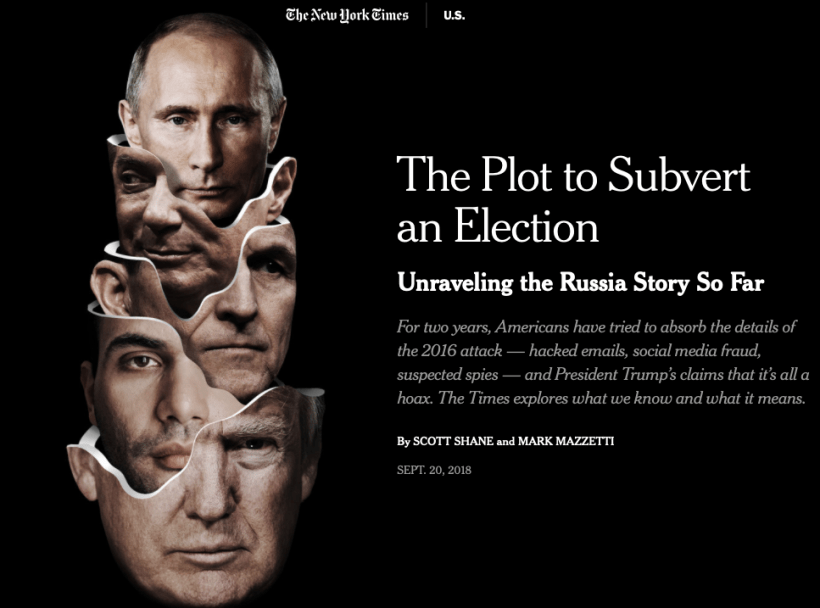
But that turned to be an outrageously deceptive claim, because Shane and Mazzetti failed to mention the fact that those 80,000 IRA posts (from early 2015 through 2017), had been engulfed in a vast ocean of more than 33 trillion Facebook posts in people’s news feeds – 413 million times more than the IRA posts.
In December 2019, senior national security correspondent David Sanger wrote a story headlined, “Russia Targeted Election Systems in All 50 States, Report Finds,” and Sanger’s lede said the Senate Intelligence Committee had “concluded” that all 50 states had been targeted. But the Committee report actually reaches no such conclusion. It quoted President Barack Obama’s cyber-security adviser Michael Daniel as recalling that he had “personally” reached that conclusion, but shows the only basis for his conclusion was remarkably lame: the “randomness of the attempts” and his conviction that Russian intelligence was “thorough.”
The Committee reported that some intelligence “developed” in 2018 had “bolstered” the subjective judgment by Daniel. But all but one of the eight paragraphs in the report describing that intelligence were redacted, and the one unredacted paragraph suggests that the redacted paragraphs provided no conclusive evidence that Russian intelligence had scanned any state election websites, much less those of all 50 states. The paragraph said, “However, IP addresses associated with the August 16, 2016 FLASH provided some indicators the activity might be attributable to the Russian government…. [emphasis added].”
The Committee report also contained summary statements from six states that the Department of Homeland Security has continued to include among the 21 states it insists were hacked by the Russians in 2016, denying any cyber threat to their systems. Another 13 states reported only that there was “scanning and probing” by inconclusive IP addresses the FBI and DHS had sent them. Sanger did not report any of those troublesome details.
In January 2020 the Times began its coverage of the theme of Russian interference in the 2020 election with a story headlined, “Chaos is the Point: Russian Hackers and Trolls Grow Stealthier in 2020.” The story, written by Sanger, Matthew Rosenberg and Nicole Perlroth, sought to heighten the existing U.S. climate of paranoia about a Russian attack in regard to the 2020 elections. Once again, however, nothing in the story supports the sinister tone of the headline.
It reported Department of Homeland Security officials’ anxiety about the ransom-ware attacks on 100 American towns, cities and federal offices during 2019, which are clearly criminal operations aimed at large-scale payoffs by cities. The story informed readers that DHS was investigating “whether Russian intelligence was involved in any of the attacks,” on the apparent theory that the criminals were being used by the Russians.
Since those ransom-ware attacks had been going on for years, the obvious question would have been why DHS would have waited until 2020 to reveal that it was investigating Russian involvement. Thus, the only fact underlying the story was the DHS desire to find evidence to support its accusations of Russian election hacking.
Still at it in 2020
The Times continued its advocacy journalism in a Feb. 26 report that U.S. intelligence officials had “warned” in a briefing for the House Intelligence Committee on Feb. 13 that “Russia was interfering in the 2020 campaign to get President Trump elected,” citing five people “familiar with the matter.”
The Times’ team of four writers proceeded to declare, “The Russians have been preparing – and experimenting – for the 2020 election… aware that they needed a new playbook of as-yet undetectable methods, United States officials said.” But instead of reporting actual evidence of any Russian action or decision for action, the Times writers again cited what their sources suspected could be done.
“Some officials,” they wrote, “believe that foreign powers, possibly including Russia, could use ransom-ware attacks…to damage or interfere with voting systems or registration databases.” The Times’ sources thus had no actual intelligence on the question and were merely speculating on what any foreign government might do to disrupt the election.
Three days after that report, moreover, the Times backed away from its previous lede after intelligence sources disputed its claim that Russia was intervening to reelect Trump, suggesting that the briefing officer, Shelby Pierson, had overstated the assessment. Sanger sought to limit the damage with a story labeling the problem one of “dueling narratives” in the intelligence community.
Then Sanger admitted, “It is probably too early for the Russians to begin any significant moves to bolster a specific candidate,” which obviously invalidated the Times’ previous speculation on the subject. But after The Washington Post published a story that the FBI had informed Senator Bernie Sanders that Russia had sought to help his campaign, Sanger quickly returned to the same narrative of Russian interference to advance its favorite candidates.
On the Times’ podcast “The Daily,” Sanger opined that the Russians were now supporting both Trump and Sanders – because Sanders, “like Donald Trump,” has “got a real aversion to interventions around the world.”
The most recent entry in the Times’ campaign to create anxiety about Russian interference in the election focused on race relations. On March 10, the Times headlined its story, “Russia Trying to Stoke U.S. Racial Tension before Elections, Officials Say.” In their lede Julian Barnes and Adam Goldman announced, “The Russian government has stepped up efforts to influence racial tensions in the United States as part of its bid to influence November’s presidential election, including trying to incite violence by white supremacist groups and stoke anger among Afro-Americans, according to seven American officials briefed on recent intelligence.”
But true to the modus operandi used routinely to push the Russian election threat narrative, the writers did not offer a single fact supporting such a story line. They even admitted that the officials who were making the claims provided “few details” about white supremacists and “did not detail how” blacks were being encouraged to use violence.
It turns out, in fact, that U.S. officials have found nothing indicating Russian support for violent white supremacists in America. The only fact that they could cite — based on a single source — was that the FBI is “scrutinizing any ties” between Russian intelligence and Rinaldo Nazzaro, the American founder of a “neo-Nazi group,” who lives with his Russian wife in St. Petersburg, Russia, but owns property in the United States. So, the Times’ single source had nothing but a suspicion for which the FBI was trying to find evidence.
The final touch in the piece was the accusation that RT had “fanned divisions” on race by running a story about a video of New York policemen attacking and detaining a young black man that Barnes and Goldman write “sparked outrage” and had also “posted tweets aimed at stirring white animosity.” But the RT article on the video merely reported accurately that the video depicted unprovoked police brutality and that it had already gone viral. The Times itself had published a much more detailed Associated Press story on the same incident that went into a discussion of the history of police brutality in New York City. By the Times’ own criterion, the AP was doing far more to stoke racial animosity than RT.
The opinion pieces that RT published attacking The New York Times for its coverage of a video at the University of Wisconsin that offended non-whites and for a Times opinion piece critical of the Apu character on “The Simpsons” echoed views on race and culture that most Americans find offensive. The idea that they were part of a Russian plot to generate racial animosity, however, is a very long stretch.
The descent of The New York Times into this unprecedented level of propagandizing for the narrative of Russia’s threat to U.S. democracy is dramatic evidence of a broader problem of abuses by corporate media of their socio-political power. Greater awareness of the dishonesty at the heart of the Times‘ coverage of that issue is a key to leveraging media reform and political change.
Gareth Porter is an independent investigative journalist and historian and winner of the 2012 Gellhorn Prize for Journalism. His latest book, with John Kiriakou, is “The CIA Insider’s Guide to the Iran Crisis: From CIA Coup to the Brink of War.”
Featured Video

“Historic Russia”: The Land Putin Will Not Give Back
or go to
Aletho News Archives – Video-Images
From the Archive
How Ukraine Tortured and Slaughtered Donbass
By Kit Klarenberg | Al Mayadeen | July 11, 2024
Almost immediately after the proxy war erupted, ISIS-tier footage of the torture and murder of Russians in Ukrainian custody emerged.
On July 6th, the New York Times published an astonishing investigation: In Ukraine, Killings of Surrendering Russians Divide an American-Led Unit. The article documents in grim detail how Chosen Company, an international volunteer battalion for Kiev, routinely executes Russian prisoners of war. It is the very first mainstream admission that this practice – a brazen breach of the Geneva Conventions, and a grave war crime – is widespread among Ukraine’s fighters, both foreign and homegrown. … continue
Blog Roll
 Aletho News
- Gates, Bourla on Trial in Netherlands Accused of ‘Great Reset’ Scheme at Vaccine Injury Hearing
- BRITAIN’S WARNING: PREPARE FOR WAR
- “Historic Russia”: The Land Putin Will Not Give Back
- How the Cambridge Analytica scandal still haunts Mark Zuckerberg
- The Ongoing Cancellation Campaign Against a Dissenting Academic in Norway
- Yemen and ‘the Houthis’: Challenging Sami Hamdi’s Narrative
- No, Christians did not invent Zionism
- AIPAC-led lobbying network opens branches in Cypriot, Greek parliaments
- Araghchi blasts ‘parasitic’ alliance as US taxpayers pay for Israel’s war on Iran
- Easy fix for Europe’s chaos? Stop fueling war against Russia
- If Americans Knew
- Damning report shows the media must confront its failures on Gaza
- BBC senior broadcaster speaks out on Gaza coverage
- Netanyahu vows vast West Bank invasion in response to 20-minute skirmish that left 2 Israeli soldiers and 2 Palestinian fighters dead
- Tied up and tortured: Israel using US-made electroshock weapons on Palestinian detainees
- The outsourced risk: how newsrooms rely on Gaza’s freelancers without protecting them
- Gaza bakeries forced to shut as Israel blocks flour shipments
- Gaza’s breast cancer patients face a deadly wait for treatment amid Israel’s genocide
- DAILY UPDATE: Latest essential news on Palestine, Israel, & region
- The Israel Lobby’s Changing Fortunes
- AIPAC has become such a political liability that it’s shifting to a more “nimble” approach to buying politicians
- No Tricks Zone
- Two New Studies Find Thwaites Glacier Melt Cannot Be Driven By Human Activity Or A Warming Ocean
- E-Cars Reduce CO2 Emissions By Only 41% Compared To Internal Combustion Engine Vehicles
- Predictions Made By Renowned Climate Professor Over Past Decades Have Been Proven To Be Poor
- New Study Suggests Large Regions Of The Pacific Ocean Have Been Cooling For The Last 80 Years
- Germany’s Green Energy Debacle: High Energy Costs Force Kahla Porzellan to Close After 182 Years!
- New Study: 50 Years Of The Most Aggressive ‘Net Zero’ Policies Can Only Affect The Global Climate By 0.03°C
- US September “Heat” Was No Record…Many Records Set Decades Ago
- Latest European Green Energy Debacle; Portugal’s Largest Flagship Solar Park Insolvent!
- Green Energy Debacle: German Expert Professor Fritz Vahrenholt Warns Of Severe Economic And Social Consequences
- Two More Paleo Reconstructions Affirm Meters-Higher Sea Levels Across Ireland, Brazil 7000-6000 Years Ago

