Taliban Refute Reports on Russia’s Alleged Role in Killings of US Troops in Afghanistan
Sputnik – 27.06.2020
KABUL – Taliban spokesman Zabihullah Mujahid refuted on Saturday the recent reports citing US intelligence assessments alleging that Russian intelligence has solicited killings of US troops by the Taliban in Afghanistan, saying that these rumors are set to create obstacles to US pullout from the country.
According to Mujahid, all weapons and tools used by the movement were already present in the country or captured from the opposition. The spokesman stressed that the Taliban’s activities are not related to any intelligence organ or foreign country.
Mujahid stated that the Taliban was committed to the deal with the United States, saying that its implementation would ensure comprehensive peace and stability in Afghanistan.
On Friday, The New York Times published an article where it cited unnamed government sources as saying that US President Donald Trump was presented with an intelligence report that claimed that Moscow could have payed bounty to armed Islamic insurgents in Afghanistan to assassinate US soldiers. The outlet said Trump had so far failed to act on the report.
In February, the US and the Taliban signed a peace deal that concluded rounds upon rounds of talks pursuing to launch the reconciliation process in Afghanistan after almost two decades of armed conflict and insurgency.
Last week, US Special Representative for Afghanistan Zalmay Khalilzad said that intra-Afghan talks were closer than ever after Kabul and the Taliban carried out a significant exchange of prisoners.
Reality Is Gradually Catching Up To Green Energy
By Francis Menton | Manhattan Contrarian | June 8, 2020
If you dutifully read your U.S. mainstream media, you undoubtedly have the impression that “clean” and “green” energy is rapidly sweeping all before it, and soon will supplant fossil fuels in powering our economy. After all, many major states, including California and New York, have mandated some form of “net zero” carbon emissions by 2050, or in some cases even earlier. That’s only 30 years away. And reports are everywhere that investment in “renewables,” particularly wind and solar energy, continues to soar. For example, from Reuters in January we have “U.S. clean energy investment hits new record despite Trump administration views.” In the New York Times on May 13 it’s “In a First, Renewable Energy Is Poised to Eclipse Coal in U.S.” The final victory of wind and solar over the evil fossil fuels must then be right around the corner.
Actually, that’s all a myth. The inherent high cost and unreliability of wind and solar energy mean that they are highly unlikely ever to be more than niche players in the overall energy picture. Politicians claim progressive virtue by commissioning vast farms of wind turbines and solar panels, at taxpayer or ratepayer expense, without anyone ever figuring out — or even addressing — how these things can run a fully functioning electrical grid without complete fossil fuel backup. And the electrical grid is the easy part. How about airplanes? How about steel mills? I’m looking for someone to demonstrate that this “net zero” thing is something more than a ridiculous fantasy, but I can’t find it.
To stay grounded in reality, there is no better source than the multiple-times-weekly email from the Global Warming Policy Foundation. If you do not already receive these emails, you can go here to subscribe. As is typical, today’s email searches out back pages and specialized sources to bring us multiple pieces showing green energy running into its inevitable wall, with no known way to get past. (Full disclosure: I am on the Board of the GWPF’s American affiliate.)
We go first to green energy champion Germany, where Bloomberg reports on June 5 that “Germany’s Green Power Finance Is Becoming Unaffordable.” Excerpt:
The German program that’s spurred the nation’s switch to green power is buckling under the weight of surging costs and needs an urgent fix. That’s the assessment of one of the scheme’s chief designers, Hans Josef Fell. . . . Yet the system’s increasing costs have become glaring during the coronavirus pandemic, the veteran Green Party lawmaker said. High and guaranteed payments made to investors in clean power plants are the problem Fell said in an interview.
It seems that to get its wind and solar facilities built, Germany put in place guaranteed payments to producers that would kick in if market prices for power were insufficient. The guaranteed payments are divvied up and added to consumer electricity bills. This year, with prices for alternative fossil fuels plummeting, the guaranteed payments are projected to come in at some 26 billion euros — which is around $100 per month for every German household, on top of electricity prices that were already about triple the U.S. average. Of course, Chancellor Merkel is proposing a “fix,” which is a government bailout as part of a supposed coronavirus relief package. That may work for a little while. Then what?
Also from Germany, we have a piece from the Financial Times of June 8 with the headline “Environmentalists on back foot as Germany’s newest coal plant opens.” What?? — Opening a new coal power plant right in the midst of a transition away from fossil fuels?? What happened here is that they are closing all their nuclear plants, and they need something that works all the time, unlike the wind and the solar. Just in January, Germany enacted legislation to completely phase out coal power generation by 2038; and then in May, they went right ahead and opened this new Dateln 4 coal plant. The Financial Times piece quotes Greenpeace activist Lisa Göldner as calling the new plant a “climate crime.” Meanwhile, the crew members of a barge bringing coal to the plant are described as “whooping and whistling in mockery” at environmental protesters seeking to block the opening of the plant.
The fact is that Germany has nowhere further to go by building more wind and solar facilities. When the wind blows on a sunny day, they already have more power than they can use, and they are forced to give it away to Poland (or even pay the Poles to take it). On a calm night, no matter how much wind and solar they build, it all produces nothing. Without the coal plant, the lights go out. Talk about climate virtue all they want, but no one has yet even begun to work on a solution to get past this hurdle.
Which brings me to the most important piece in the GWPF email, from Cambridge Professor Michael Kelly, appearing in something called CapX on June 8, with the headline “Until we get a proper roadmap, Net Zero is a goal without a plan.” Kelly makes the point that seems to me obvious, but that somehow has slipped past the New York Times and all the rest of the MSM, which is that if wind and solar energy are ever going to surpass niche status, there is a gigantic engineering problem to solve. Somebody has to engineer an electrical system based on the intermittent sources that works 24/7/365. But in fact, even as major states and countries have piously proclaimed commitment to “net zero” energy, nobody has even started the engineering project. And as soon as you start to consider the question, you quickly realize that the whole endeavor is almost certainly impossible. As an example, Kelly addresses batteries:
Take batteries. It is estimated that current battery manufacturing capabilities will need to be in the order of 500-700 times bigger than now to support an all-electric global transport system. The materials needed just to allow the UK to transition to all electric transport involve amounts of materials equal to 200% the annual global production of cobalt, 75% of lithium carbonate, 100% of neodymium and 50% of copper. Scaling by a factor of 50 for the world transport, and you see what is now a showstopper. The materials demands just for batteries are beyond known reserves. Would one be prepared to dredge the ocean floor at very large scale for some of the material? Should securing the reserves not be a first priority?
And that’s just one of the issues. Others include vast costs constituting a multiple of current energy costs; the environmental impact of mining and transporting huge amounts of materials; need for vast amounts of rare elements, far beyond known world reserves; incredibly huge amounts of material to recycle when facilities wear out; and on and on.
Read enough of this stuff and you gradually realize that almost everything you read about supposed solutions to climate change is completely delusional.
All Tom Cotton has to do to get back in the NYTimes’ good graces is call for the US military to bomb ANOTHER country’s civilians

The war comes home… literally © Reuters / Andy Sullivan
By Helen Buyniski | RT | June 6, 2020
Republican senator Tom Cotton’s controversial op-ed demanding US troops be deployed against American protesters would have been embraced by the New York Times if he’d just stuck to cheering on military actions abroad.
The Times has been consumed with angst over the backlash to the Arkansas senator’s piece, which called for the military to be turned loose in US cities as an “overwhelming show of force to disperse, detain and ultimately deter lawbreakers.” Hundreds of the outlet’s staffers have slammed management’s decision to publish, insisting Cotton’s words somehow put them in danger.
Yet the Paper of Record has a long, colorful history of publishing op-eds (and even news pieces) supporting the deployment of the US military against civilian populations. Sure, those populations generally live outside the US – maybe they’re in Iraq, or Venezuela, or Iran – but the Times can almost always be relied upon to support the idea that the US military is a force for good, bringing sweetness and light (and, of course, democracy) wherever it goes.
That the Times would then balk at Cotton’s call to send those same troops into American cities is a bit surprising. Are these writers suggesting military activity in civilian areas isn’t limited to building schools for needy children, or freeing kittens trapped up tall trees?
And if they are aware of the destruction that takes place when US troops invade a country – civilian casualties, terrorism, drug and human trafficking – what’s their excuse for declaring, again and again, that military intervention is the answer to any nation’s problems?

© New York Times
For the paper to cry fascism now – when its pages have been used to manufacture consent for war after war among the American people, facilitating the decimation of Afghanistan, Iraq, Libya, and Syria – is the pinnacle of hypocrisy. The time to speak up, morally, was long ago. Putting their foot down now is utter cowardice, motivated not by concern over a fascist takeover – that ship has sailed – but by a desire to keep Uncle Sam’s enforcers from stomping back home.
Michelle Goldberg, given the task of refuting Cotton’s ‘dangerous’ views on the op-ed page on Friday, cut to the heart of the matter when she pointed out that Cotton’s recommendations would “almost certainly amount to massive violence against his fellow citizens.” Massive violence, then, is only acceptable when it happens to civilians outside the US.
The rest of the world still has to deal with the fallout from the Times’ warmongering. If Cotton wants to make nice with the Times, all he has to do is write a piece explaining how the children of Hong Kong (or Pyongyang, or Tehran) are crying out for the kind of freedom that can only be delivered from the barrel of a made-in-USA M-16. All will be forgiven.
Helen Buyniski is an American journalist and political commentator at RT. Follow her on Twitter @velocirapture23
Twitter & media know this isn’t about mail-in ballots or fraud, but about who gets to define truth; Trump does too
By Nebojsa Malic | RT | May 27, 2020
Twitter opened a new battlefront in the 2020 US election by ‘fact-checking’ posts by President Donald Trump to say he was wrong about voter fraud. That would normally be the end of the story – except nothing about this is normal.
On Tuesday, Twitter took the unprecedented step of posting a link under the two tweets – made by the president on his personal account – listing a bunch of mainstream media articles to assert that “fact-checkers say there is no evidence that mail-in ballots are linked to voter fraud,” and therefore Trump’s opinion about the matter is factually wrong.
The move followed a campaign by mainstream media and Democrats to censor Trump over other tweets, insinuating that the intern for former congressman and current MSNBC host Joe Scarborough may not have died accidentally, which culminated in a demand for Twitter to “cleanse the Trump stain” in a New York Times op-ed earlier on Tuesday.
Try as they might, Twitter couldn’t find any violation of their ever-shifting rules to pin on Trump, so they did the next best thing and “fact-checked” him. No doubt, whoever came up with this figured it was a really clever way to appease the outrage mob. Sure, the Trump 2020 campaign would protest the bias – and reveal in the process that they pulled advertisements from Twitter months ago – but they can be brushed off, unlike the chorus of his critics.
Then the White House Press Secretary fired off a thread filled with recent stories about mail-in ballot problems – forms being mailed to the dead or people who’d long since moved away, a Philadelphia judge just convicted for stuffing the ballot box, etc. – clearly showing the Twitter “fact checkers” had some explaining to do.
That should not come as a surprise to anyone. After all, these are the same outlets that have peddled the Russiagate conspiracy theory with impunity for the past four years, and even racked up prestigious awards for the blatantly fraudulent coverage. Mainstream media archives are littered with “bombshells” designed to first prevent Trump’s election, then inauguration, then get him impeached or otherwise removed from office. Every single one turned out to be a dud.
“But Trump lies! Constantly!” scream in unison the people used to being not just gatekeepers of “respectable discourse” but the tone police of Washington, the arbiters of the acceptable, the people who believe their pen shapes the very fabric of reality. People who headline their stories with “what you should know” and “how you should think.”
When challenged, they form ranks and scream they are being unjustly attacked and “delegitimized” – but only if it’s one of their mainstream colleagues called out for their excesses. Anyone else, from Julian Assange to alternative outlets, can rot because the precious First Amendment doesn’t apply to them, supposedly.
CNN had to settle a lawsuit after defaming a teenager from Covington, Kentucky. To avoid a similar fate, MSNBC’s Rachel Maddow argued that when she says “literally” that’s not news but humorous hyperbole, essentially dismissing her entire show as fake news.
It’s telling that this very phrase – fake news – has become synonymous with Trump’s criticism of the media, even though it was originally used by Hillary Clinton as an excuse for losing the 2016 election. You know, the election the mainstream media gave her 98 percent chances of winning almost to the very end, and openly endorsed her at the same rate?
If you thought Clinton took that loss hard, though, you clearly haven’t been paying attention to the media. Trump’s victory was an existential crisis for them, the moment their power to dictate the shape of reality itself was exposed as a mirage.
This is why they’ve spent the past four years lobbing Russiagate and other ‘bombshells’ at him. This is why they have led the outrage mobs, not just against Trump or the millions of “deplorables” that voted for him, but also against the social media platforms he used to bypass them in 2016, so he wouldn’t be able to do that again this November. Don’t think for a second any of this is about mail-in ballots, which – much like immigration and other issues – Democrats themselves once used to be against.
When they wrote freedom of speech into the Constitution, America’s founders may not have imagined that a president would be an unlikely champion of it, while the “free press” would be clamoring for censorship to preserve its power. Yet here we are.
Nebojsa Malic is a Serbian-American journalist, blogger and translator, who wrote a regular column for Antiwar.com from 2000 to 2015, and is now senior writer at RT. Follow him on Twitter @NebojsaMalic
The Case of General Michael Flynn: The Use of Law as a Political Weapon

By Paul Craig Roberts | Institute for Political Economy | May 20, 2020
The audacious corruption of the FBI and the US Department of Justice (sic) is demonstrated by their frame-up of the three-star general, former Director of the Defense Intelligence Agency, and National Security Adviser to President Donald Trump.
US Department of Justice (DOJ) documents that the department was forced to turn over to General Michael Flynn’s attorney reveal that the FBI found no wrongdoing by Flynn in its investigation of him and recommended the investigation be closed. Corrupt FBI official Peter Strzok, a leader of the anti-Trump cabal in the FBI, intervened. Strzok convinced the official managing the investigation not to close the case as it was the wishes of the “7th floor” (top FBI officials) to keep the case open. In the absence of evidence against Flynn, released FBI documents prove that the FBI leadership decided to frame General Flynn. The documents reveal that the FBI’s plan is “to get him (Flynn) to lie so we can prosecute him or get him fired. . . . we should try to frame them in a way we want.” General Flynn was forced to incriminate himself with a guilty plea. Otherwise, the corrupt DOJ prosecutors threatened to indict Flynn’s son.
When this proof of egregious government misconduct came to light, the DOJ had no choice but to drop the case against General Flynn. Otherwise it would be clear that law in the US is a weapon in the hands of government. This would mean that control of government would be a life and death matter for the two political parties as it is in Ecuador and Bolivia where incoming presidents arrest or attempt to arrest outgoing presidents.
But we didn’t hear a word about the frame-up of General Flynn from the corrupt presstitutes. On May 7 the editorial board of the New York Times published the largest and most egregious collection of lies in the entire history of the disreputable organization. The editorial— “Don’t Forget, Michael Flynn Pleaded Guillty. Twice.” —claimed the lies coerced from Flynn proved Flynn’s guilt, and that Attorney General William Barr is a “personal fixer for the president” and used the Department of Justice to protect friends and to go after political enemies.
The New York Times has it backwards. Going after political enemies is precisely what the Obama Regime’s concocted case against General Flynn (and Trump) was all about. Remember, it was General Flynn who said on television that it was a “willful decision” of the Obama Regime to send the mercenary jihadists to attack Syria, a decision Obama made in the face of contrary advice by General Flynn, Director of the Defense Intelligence Agency. When Flynn revealed this, it blew up the fake news story spread by the Obama Regime and the presstitutes that the Obama-supported invasion of Syria by CIA mercenaries was an uprising by Syrian moderates fighting for democracy. Flynn’s blood is blood that the corrupt Obama Regime wanted very badly.
Obama’s role in the frame-up of Flynn and the orchestration of the Russiagate hoax is now coming to light, making the former president nervous. On May 10 the Wall Street Journal editorial board asked if Obama’s nerves are getting in the way of his judgment:
“Barack Obama is a lawyer, so it was stunning to read that he ventured into the Michael Flynn case in a way that misstated the supposed crime and ignored the history of his own Administration in targeting Mr. Flynn. Since the former President chose to offer his legal views when he didn’t need to, we wonder what he’s really worried about.”
The Democrats’ frame-up of General Flynn and their two attempted frame-ups of President Trump show an extraordinary audacity and a corruptly compliant FBI and DOJ. They thought that they could get away with it, and, of course, they had all the help possible from the New York Times, Washington Post, CNN, MSNBC, and the rest of the presstitute scum for whom lies are the currency of their fake news realm. The presstitutes have made clear that the US media is devoid of integrity.
After high officials such as James Clapper, Susan Rice, Samatha Power, and others repeatedly claimed evidence of Trump and Flynn’s guilt, when under oath their story changed 180 degrees. Here is Director of National Intelligence James Clapper:
“I never saw any direct empirical evidence that the Trump campaign or someone in it was plotting/conspiring with the Russians to meddle with the election.”
Susan Rice, Obama’s incompetent National Security Adviser, and Samatha Power, Obama’s Russia-baiting ambassador to the UN, along with the rest of the disreputable Obama cabal, have admitted that they saw no specific evidence of any collusion between Trump and Russia. The entire thing was an orchestrated hoax that proves beyond all doubt that the Democrat Party and the US media are corrupt beyond redemption.
When the case against Flynn was dropped as a result of the damning evidence of egregious government misconduct in framing a senior official of the US government, the corrupt prosecutors who had prosecuted the innocent Flynn all resigned in a huff, pretending that it was Barr, not them, who used the Department of Justice for self-interested political purpose.
Two Georgetown University law professors, Kean K. Katyal and Joshua A. Geltzer, totally discredited themselves and the Obama contingent in the DOJ, by alleging in the New York Times that the dropped charge against Flynn has resulted in the “utter demoralization” of “the law enforcement community.” In other words, for these law professors and “the law enforcement community” for which they claim to speak, dropping a case consisting entirely of an orchestrated frame-up, a contrived perjury trap, and threats against family members is demoralizing. The professors are so thoroughly dishonest that they use the lies coerced from Flynn—the price of his “cooperation with the investigation” in order that his son would not also be framed-up—as “evidence” of Flynn’s guilt and proof of the political use of the Justice Department by Trump and Barr in dropping the contrived case.
The frame-up of Flynn is not acknowledged by the law professors as political use of the Justice Department.
Instead the law professors describe the vindication of an innocent man on the basis of undeniable evidence as political use of the Justice Department.
If this is the kind of law Georgetown University teaches, the law school should be promptly shut down.
The question that demands an answer is how do people as corrupt and devoid of integrity as Comey, Mueller, and Strzok get into top FBI positions?
Russia’s handling of the Covid-19 pandemic: a busy week
By Gilbert Doctorow | May 15, 2020
This week started with a major presentation by President Putin of Russia’s plans for gradually lessening the strictures of lockdown, restarting the economy and restoring normal life as the epidemic in the country passes stabilization, which was just reached, and enters the ebb phase of contagion, hospitalization and death. The setting was a virtual conference with major players in the government responsible for managing the health crisis. However, since Putin’s lengthy speech which came to 17 typed pages was televised live by all Russian state channels, it could just as easily be called an address to the nation. The main focus was on the economy and assistance to citizens and to business.
That speech has received little attention in the West and I will come back to it in a follow-up tomorrow, because it tells us a great deal about the guiding principles of Russian governance and its ‘social economy.’
In this essay I deal with the second major appearance by Putin this week dedicated to the coronavirus which took place this afternoon, Friday, 15 May. It also was carried live by all state television channels. It also was nominally remarks made within a virtual intragovernmental conference. And it also was a major policy statement that merits our greatest attention, not only for what it says about Russia, but more importantly for what it says about us, in the West, and how we are badly handling the challenges of the pandemic because of our stubborn and proud disparagement of China.
I listened closely to two of the reports to Putin from the ‘regions’, meaning territories outside Moscow on what is being done right now to handle the growing case load of coronavirus sufferers, and Putin’s comments which may be characterized as ‘programmatic’ insofar as they seek to use the ongoing experience in combatting the coronavirus to deliver, at long last, a substantial rebuilding of medical infrastructure across the country with the help of the military.
The regions reporting were St Petersburg, which is still relatively healthy compared to Moscow but has seen a growing number of infections and hospitalizations in the past few weeks, and Voronezh, which more typically represents the Russian provinces and till now has had a very low level of infection, but is preparing for the worst. In each case the governor read a report of what is being done to build dedicated hospitals for treatment of coronavirus cases both by the local administration and with the help of the Ministry of Defense, represented by the senior officer standing at their side who is overseeing construction of modular hospitals by military personnel and staffed by military doctors.
In Petersburg, which is Russia’s second largest city with a population of approximately 5 million, there are specialized hospitals for light cases with 1,000 beds being completed and specialized hospitals with Intensive Care Units in the size of 200 to 600 beds also reaching completion. A similar approach is being implemented in Voronezh.
The involvement of the Armed Forces in building some of these hospitals is very significant, because they have developed modular solutions that can be applied uniformly across the vast continent that is Russia.
In a way, these projects are similar to what Moscow did as first mover when it opened the state of the art hospital at the city’s periphery in a district called Kommunard. The logic is to remove the coronavirus patients from the general hospital system. This leaves the general hospitals free to continue to serve their traditional ‘clientele,’ the community of those with other ailments. It focuses training, equipment, medicines in locations where maximum attention can be given to ensuring sanitary conditions that protect medical staff and encourage application of well-rehearsed solutions to the challenges of each patient.
Now where would the Russians have gotten this idea from? It is not hard to imagine. We need only think back at the response of the Chinese authorities following the recognition that the outbreak in Wuhan posed existential questions for the local population, indeed for the nation as a whole if it were not contained and wiped out. We all were stunned at the construction of the first specialized facility to deal with the epidemic in one week!
The Russians are less “Stakhanovite” these days, and the hospital projects mentioned above are being executed on a 6 week schedule. But they are being implemented at the highest technical level. Putin gave the figure 5 million rubles as the cost of one hospital bed in the new units; that comes to $60,000 and in Russia’s price equivalency to the dollar probably represents a US cost double or triple the nominal ruble cost. So they are not skimping, not planning to put the incoming patients on matrasses on the floor as happened in Bergamo, Italy.
We also know from the day’s press, that the Russians are now entering into mass production of the few medicines which the Chinese told them proved to be effective in treating their coronavirus patients. Which ones Putin did not say.
And now I must ask, how does Russia’s borrowing from the Chinese playbook compare to what we see around us in Western Europe and the United States? Here China comes up in the coronavirus story only as a punching bag, the people who ‘kept us in the dark’ about the dangers of this plague, not as providers of solutions and advice from their own first and successful experience snuffing it out.
The question I must pose is this: are the Russians being especially clever, or are we being especially stupid?
The segregation of coronavirus patients from the general flows of the ailing contrasts dramatically with what has been going on in Belgium, for example. Here about 100 hospitals around the country have been sharing the aggravated cases of coronavirus requiring hospitalization. This population reached about 5,000 at its peak with nearly one third in Intensive Care, of which to two thirds required ventilators. At the peak a couple of weeks ago, the number of patients in the last category came close to the national inventory of ventilators, a bit more than 1,000. Thankfully, the numbers in the past ten days have come down sharply and there are now half the number of hospital beds taken by virus sufferers.
However, at the peak, all of Belgium’s hospitals resembled war zones with extraterritorial suited medics at the entrances. Normal patients did not have to think twice to shun them. Accordingly, even non-elective surgery was being cancelled; chemotherapy patients were staying at home, etc. This is one element of the mortality brought on by the coronavirus that no one has been recording. Moreover, one has to ask about the quality of medical attention when 100 hospitals, mostly without any experience in epidemics, in virology, were being used to treat Covid19 patients. This had to be a contributor to the body bag count that went into official statistics.
Finally, in closing ,a word about body counts.
In the past several days there have been news reports in Western media accusing Russia of under-reporting deaths in the country due to the coronavirus epidemic. In particular, I can point to articles in The New York Times and in the Financial Times.
With respect to the New York Times the piquant title given to one respective article pointing to a “Coronavirus Mystery” – is fully in line with the daily dose of anti-Russian propaganda that this most widely read American newspaper has been carrying on for years now. A couple of weeks ago the same paper carried an article by one of its veteran science journalists accusing President Putin of using the coronavirus to undermine American science, and medicine in particular. That article was totally baseless, a collection of slanderous fake news.
With respect to the accusation of intentional underreporting of mortality figures in Russia, the New York Times was actually borrowing from the Financial Times, which stated that Russian deaths from the virus may be 70 per cent higher than the official numbers. In both cases, even if the underreporting were true, and this is very debatable, it obscures the fact that both official and unofficial numbers are miniscule compared to the devastation wrought by the virus elsewhere in Europe (Italy, Spain and the UK) or in the USA, where the numbers continue to spike. Russia has either a couple of thousand deaths or something closer to three thousand. Compare that to the official deaths ten times greater in the worst hit European countries having overall populations less than half or a third of Russia’s. So the accusation of 72% underreporting in Russia is a debating point that can easily be shown to be deceptive if not irrelevant.
However, there is a missing element here: context. The whole issue of underreporting Covid19 deaths has been reported on by the Financial Times for a good number of countries, not just Russia. Indeed, their first concern has been to show that the official numbers posted by the UK government, now in the range of 30,000 are a fraction of the actual deaths in the UK (more than 50,000) if one uses not the death certificates case by case but the overall excess of deaths in a given month in 2020 compared to the norm in the given country over the 3 preceding years. The New York Times in its typical cherry picking approach to find what is worst to say about Russia ignores this background of FT reporting.
Why is there underreporting? There are many possible reasons, the chief one is the varying methodology used by the various countries to allocate a given death to the virus.
By curious coincidence this very issue was addressed in today’s press conference on the pandemic by the Belgian Ministry of Public Health. As is widely reported, Belgium has one of the world’s highest rates of mortality from Covid19, very close to the figures in Spain and Italy. This has been reported in the local press and the Ministry today chose to respond. As they noted, Belgium is one of the few countries to report ALL Covid-19 deaths, meaning both those in hospital and those in care homes (mostly old age homes). In Belgium, as in France, deaths have been equally split between these two sets of institutions. Almost no deaths have occurred at home or, as they say, ‘in the community.’ Moreover, deaths are attributed to Covid-19 if the symptoms were there even if no proper test was carried out to confirm this.
In total, Belgium death count today stands close to 9,000 for a general population of 11.8 million. High, but still substantially lower than the mortality in New York, for example, whichever way you count. And, to put the picture into a less dire context, it is reported that each winter Belgium experiences about 5,000 deaths attributable to the seasonal flu. Of course, the flu does not lay waste to the medical establishment, and there you have the difference that makes the ongoing Russian approach to Covid19 so relevant.
© Gilbert Doctorow 2020
Covid-19: For Western mainstream media, Russia fails even when it succeeds
By Anna Belkina | RT | May 14, 2020
The Russian Foreign Ministry has demanded that two of the most prominent foreign newspapers, the New York Times and the Financial Times, retract their stories stating that Russia is concealing the real Covid-19 death toll.
Even if the NYT and FT were correct in their claims, Russia would still be doing far better than the vast majority of large industrialized nations, including the US and UK.
As of the morning of May 14, Russia’s Covid-19 death toll stands at 2,212 out of 242,271 recorded cases, or 0.9 percent. This number is not disputed by the World Health Organization (WHO), which has continuously monitored the situation in the country. To compare, the death rate for the novel coronavirus is six percent in the US, seven percent in Canada, 14 percent in the UK, and 10 percent or more in Italy, Spain, France and Sweden. You know, the so-called civilized countries.
There is not a hint of evidence that the Russian government has covered up the coronavirus toll. Yet, foreign media are skeptical of Russia’s numbers. Perhaps because in their worldview, Russia is not allowed to be anything but a grim and miserable failure at everything. Any fact contradicting this narrative is Kremlin propaganda.
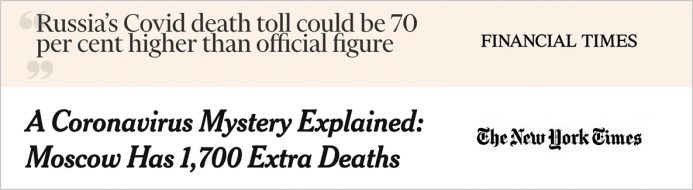
To wit, the UK-based, Japanese-owned Financial Times has analyzed the recent all-cause mortality data coming out of Moscow and Saint Petersburg vis-a-vis the cities’ historical averages. It has concluded that Russia’s actual Covid-19 death toll is around 70 percent higher than the officially reported figures.
Meanwhile, the New York Times – headquartered in the city where nurses had to wear garbage bags for the lack of protective equipment, and where the local government began prospecting parks as possible burial grounds due to the staggering Covid-19 body count of nearly 15,000 – claimed that Russia’s real death toll could be “possibly almost three times higher than the official death toll.”
Here’s what the Times doesn’t tell you: Even if their worst case scenario for Russia were true, the country’s Covid-19 death rate would still be one of the lowest among large industrialized nations. Even having been tripled by the Times’ accounting, the resulting 2.7 percent still would be an impressive healthcare result compared to six percent in the US. It would still be below Japan’s 4.1 percent and barely above the world’s main coronavirus ‘success story’, South Korea, currently at 2.3 percent. Moscow, a city with 50 percent more residents than NYC, would still have a body count five times lower even if all the extra deaths the Times is writing about were attributed Covid-19.
NB: While there are other large nations with smaller fatality numbers, such as India and Brazil, they are testing their populations at levels lower by a factor of tens, and suffer from weaker healthcare infrastructure overall. Their official recorded Covid-19 deaths therefore are likely not providing an accurate portrayal of the situation on the ground, a concern echoed by the WHO. Russia currently tests at the rate of ~40,000 per 1 million people, or well ahead of the US, UK, Canada, France, Sweden, and other OECD countries, and on par with Germany, Norway, and Switzerland, Europe’s ‘model nations’ in combating the coronavirus pandemic.
The New York Times is not interested in exploring the reasons for Russia’s promising performance, be they grounded in the country’s demographics or familial habitation traditions, legacy healthcare system or innovative scientific approaches, historical experiences with respiratory illnesses or modern infrastructure management.
It buries the lede, brushing aside its own note that “underreporting of fatalities has been observed in many other countries, where subsequent data reveal large upticks in deaths compared to the same period in previous years,” and charts showing Spain and England as countries that display a change in historical mortality trend lines nearly identical to Russia’s.
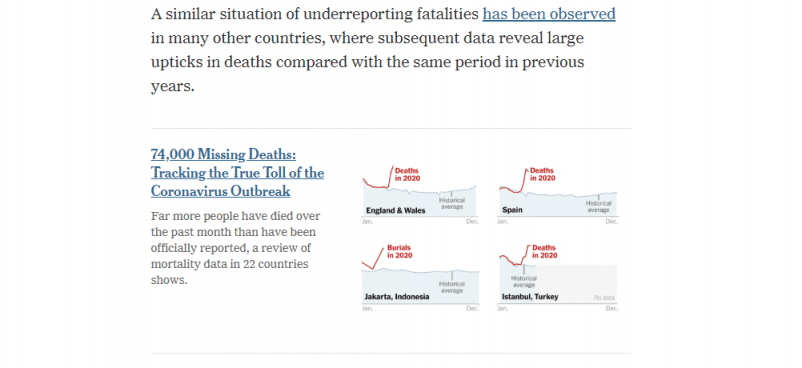
© https://www.nytimes.com/2020/05/11/world/coronavirus-news.html
New York’s own numbers, according to the US Centers for Disease Control “may be thousands of fatalities worse than the tally kept by the city and state.” Moscow’s Department of Health, by the way, has already addressed the questions about the city’s cause-of-death accounting.
Instead, the Times pivots to its favorite bête noire – malevolent Russian propaganda. Their purported 300-percent greater coronavirus death toll in Russia “contrasts sharply with the line peddled by the Kremlin.” The paper does not clarify whether the same historical disparities in Spain and the UK contrast sharply with the line peddled by Madrid or the line peddled by 10 Downing Street. Official information from the naughty countries is always ‘peddled lines’; everyone else gets to plead best intentions and innocent ignorance in perpetuity.
The ‘Kremlin line’ on the coronavirus toll in Russia is supported by international monitoring and discrepancies are accounted for by international practices. The Kremlin’s supposedly concealed ‘massive failure’ would still be kicking the a** of most ‘First World’ nations when it comes to mitigating Covid-19 fatalities. But it would kill the mainstream press to admit as much.
Anna Belkina is RT’s deputy editor in chief and head of communications, marketing and strategic development.
FBI Claims China Targeting US Organizations Engaged in Coronavirus Research
Sputnik – May 13, 2020
The Federal Bureau of Investigation (FBI) and the Cybersecurity and Infrastructure Security Agency (CISA) have issued a joint statement in which they accuse malicious Chinese actors of trying to steal US coronavirus vaccine research.
“The FBI is investigating the targeting and compromise of US organizations conducting COVID-19-related research by PRC-affiliated cyber actors and non-traditional collectors. These actors have been observed attempting to identify and illicitly obtain valuable intellectual property (IP) and public health data related to vaccines, treatments and testing from networks and personnel affiliated with COVID-19-related research. The potential theft of this information jeopardizes the delivery of secure, effective, and efficient treatment options,” the statement, put out Wednesday, says.
The FBI and CISA urge organizations carrying out research in these fields to “maintain dedicated cybersecurity and insider threat practices” to prevent such thefts, and calls on institutions to watch out for and report any “anomalous” and “unusual” activities and behaviour. The statement also warns that organizations should realize that talking to the press about their COVID-19-related research may result in “increased interest and cyber activity” by possible malicious actors.
The warning comes just days following Sunday’s report by The New York Times citing current and former US security officials indicating that US intelligence was planning to put out an alert about alleged efforts by Chinese spies to access US-based coronavirus research. Officials told the paper that the ‘non-traditional collectors’ involved may include Chinese researchers and students working in the United States who may be interested in ‘infiltrating’ US academic and private laboratories in search of a vaccine. Complementing them are China’s “state-run hacking teams,” the paper claimed.
CISA director Christopher Krebs has alleged that “China’s long history of bad behaviour in cyberspace is well documented, so it shouldn’t surprise anyone they are going after the critical organizations involved in the nation’s response to the COVID-19 pandemic.” Krebs promised that the US would “defend our interests aggressively,” without elaborating.
Strong Claims From ‘Empire of Hackers’
Chinese Foreign Ministry spokesperson Zhao Lijian commented on the claims made by NYT on Monday, saying China already leads global research and development on coronavirus vaccines and therapies, and that the hacking claims were an “immoral” and baseless attempt to “smear” his country.
Chinese biotech companies reported recently that they have four different coronavirus vaccines already undergoing clinical trials, with three of them entering the second stage, with pilot production of an inactivated COVID-19 vaccine expected to begin in July. US President Donald Trump, meanwhile, has previously said he expects the US to have a vaccine available by the end of the year.
An anonymous researcher told the Global Times newspaper Monday that in the US’s core research efforts would be of little value to China, because US efforts are DNA and RNA-based vaccines, while China has chosen to focus on inactivated vaccines (i.e. vaccines made from virulent virus by destroying its infectivity while retaining its immunogenicity). Jonas Salk’s polio vaccine is the most famous example of a major inactivated vaccine.
Earlier this year, China called out the United States for being an “empire of hackers” and “the largest state eavesdropper in international cyberspace” following revelations of the extent of the National Security Agency’s global intelligence-gathering operations going back to the Cold War.
The ‘See-No-Evil’ Phase of Russiagate
By Patrick Lawrence | Consortium News | May 11, 2020
The long, destructive conspiracy theory known as Russiagate, the mother of them all, at last evaporates into thin air. No shred of it remains as of back-to-back disclosures over the past couple of weeks. Where does this leave us? What is to come of this momentous turn of events?
Among those not inclined toward hysteria or copious quaffs of Democratic Party Kool–Aid, it has long been a question how those who concocted and sustained the tales of Russian “meddling,” “collusion,” and mail hackery would manage their embarrassment — not to mention their potential legal liabilities — once their edifice-built-on-sand collapsed, as it was destined from the first to do.
The early signs are as some predicted: They will slither quietly off the stage without comment, they will deny their incessant, ever-vehement accusations, they will profess to weariness, they will insist there are more important things to think about now.
Here is a tweet from one Bob F published Saturday. Our Bob touches nearly all of the above-noted bases. His mentions of Matt Taibbi, Aaron Maté, and Jimmy Dore reference two journalists and a talk-show host who identified the fraud from the first and had the scruples not to surrender to the liberal totalitarianism we have suffered these past three years:
ok ok ok ok @aaronjmate and @jimmy_dore got one thing right in their lives. Can we move on from this shiny object that is Russiagate? Trump and the Republicans are looting this country. We could be very close to armed revolt. But let’s talk more about Russia Russia Russia.
— Bob F (@BobF_666) May 9, 2020
Yes, Bob, lets. This is a brilliant specimen of the flaccid cowardice we’re now to witness many times over. Reassuringly enough, a modest twitter storm followed. Here is a reply from Kathy Woods, a consistently insightful commentator in Twitterland:
Move on? Hell no! I can’t stand Trump, but the Dems used the levers of the security state to perpetrate a fraud. They buried progressive momentum and brought us to the brink w/ Russia. It’s essential we completely expose this.
— Kathy Woods (@woods_kathy) May 10, 2020
For good measure, here is another response to Big Bob, this one addressing his implicit assertion of Democratic Party virtue in the Age of Trump:
A) liberals never stopped russiagating so obviously it needs to continue to be debunked.
B) if you think the Democrats are not equally to blame for the looting, I got a bridge to sell you.
— David Warschauer???? (@rogersmithbigo) May 9, 2020
There is anger abroad as Russiagate finally unwinds, plainly. This is an excellent thing. And Ms. Woods is right: It is important to make the sun shine on what became, before the end, a scandal of historic proportions. There is a chance of achieving the “complete exposure” Woods asks for, but it remains a question, as of now, whether this will come to pass.
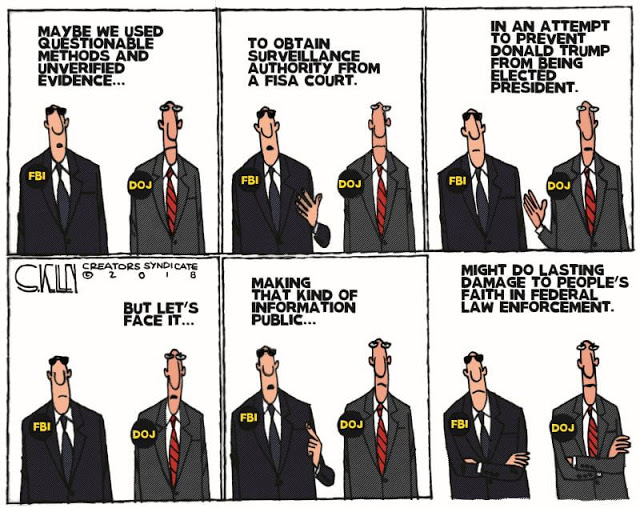
Two weeks ago the Justice Department made public documents showing that when, in January 2017, prosecutors wanted to close the collusion case against Michael Flynn, who briefly served as President Donald Trump’s national security advisor, because they found “no derogatory information” against him, Peter Strzok, the philandering F.B.I. agent later found to be shaping an “insurance policy” against a Trump victory in the 2016 election, cajoled them into keeping it open — absence of evidence be damned.
Two Other Developments
The Strzok revelations turned out to be prelude to the two other developments further demolishing the Russiagate narrative. Last Thursday Justice finally dropped its case against Flynn altogether. We now know he was the victim of a perjury trap when questioned about his contacts with Sergey Kislyak, Moscow’s ambassador to Washington in 2016. “Get him to lie so we can prosecute him,” was the FBI’s directive.
Yet worse, Flynn’s guilty plea was in response to prosecutors’ threats to indict his son if he pled otherwise. Tell me the difference, please, between this kind of stuff and the treatment of the accused in the postwar show trials in Eastern Europe.
On the same day the Justice Department dropped the charges against Flynn, the House Intelligence Committee released documents showing that the FBI had no evidence that Russia pilfered the Democratic National Committee’s email archives by hacking into its servers in mid–2016. The FBI had none because CrowdStrike, the patently corrupt cyber-security firm on which it (inexplicably) relied, never gave it any: It had none, either — contrary to its many claims otherwise.
The taker of cake here is that the documents also show that the House Intelligence Committee, chaired by the inimitable (thank goodness) Adam Schiff, knew there were no grounds to allege Russian involvement in what wasn’t a hack by anyone, but a leak, probably by someone with direct access to the DNC’s servers.
My Consortium News colleague Ray McGovern has just detailed the collapse of the “Russians-hacked-it” ruse.
No evidence anywhere along the line of collusion, none of Russians stealing mail. There is a simpler way to put this: No Russiagate.
In truth, there has been evidence aplenty of the Russiagate fraud for some time, due in part to the researches of Veteran Intelligence Professionals for Sanity, VIPS, of which McGovern is a principal. The problem has been to secure official acknowledgement of three years’ worth of wrongdoing. We now have it, even if it arrives with no admission whatsoever of responsibility.
Enter Perception Management
Now come the lies, the dissembling, and the media’s “perception management.” Tucker Carlson, the Fox News presenter, offered a funny-but-not-funny catalog of the liars who now stand exposed, none more thoroughly than the egregious Schiff, who ought to resign over this, and Evelyn Farkas, another Obama-era holdover with absolutely no regard for the truth. Loretta Lynch, Obama’s A–G, will also have things to answer for, assuming answers for her misconduct are required of her.
Among the press and broadcasters, it has been a spinfest this past week — led, naturally, by The New York Times, given no one in the media dares venture a syllable for which the Times has not signaled prior approval. The paper’s report on the dismissal of the Flynn case marked the judgment down as “the latest example of Attorney General William P. Barr’s efforts to chisel away at the results of the Russia investigation.” I lost count of the mentions of Flynn’s “lying” and “guilty plea” after nine. No reference to the perjury trap set for Flynn, or the threat to indict his son.
The Times ran two further pieces hatcheting Flynn and Barr in Saturday’s editions, here and here, and a straight-out character assassination of Flynn on Sunday, casting him as some kind of pathological split personality. The Gray Lady doth protest too much, in my view.
The press vastly over-invested in the Russiagate narrative from the first, and now appears set to throw yet more money after all the bad. This is not a good sign. It suggests that our troubled republic simply cannot accept its errors, leaving us unable to learn from them. This is why America in its post-democratic phase cannot self-correct. It is why we have no assurance that another Russiagate, in whatever form, will not be visited upon us.
“Attorney General William P. Barr’s efforts to chisel away at the results of the Russia investigation”? Absolutely. We have to hope he gets somewhere. Committed Russiagaters now take to charging that Barr is corrupting an otherwise snow-white Justice Department. Say what? Given all we now know, this starts to tip into the zone of black humor.
Barr and his investigators are fully armed as of last week. They have all they need to get to the bottom of this dark ocean. They have it in their power to bring to justice the three architects of the Russiagate scam when it was in motion — ex–C.I.A. Director John Brennan, ex–Director of National Intelligence James Clapper, ex–F.B.I. Director James Comey — for what amounted to an attempt to depose a president in a bloodless coup. These are the Democratic Party’s answer to former President Richard Nixon’s infamous “plumbers,” if you ask me.
Whether Barr and his investigators get the task done is to a great extent a matter of politics and bureaucratic warfare that will at best be partially visible to us in coming months. It is a question of how far he will be permitted to go.
Succeed or fail, the record is at least and at last straight.
Patrick Lawrence, a correspondent abroad for many years, chiefly for the International Herald Tribune, is a columnist, essayist, author and lecturer. His most recent book is “Time No Longer: Americans After the American Century” (Yale).
How a US Government-Sponsored Outlet Sparked Media Hysteria About Kim Jong-un’s ‘Death’
By Ilya Tsukanov – Sputnik – May 3, 2020
After weeks of speculation fueled by a lengthy absence, the North Korean leader suddenly reappeared in public on May 1 at the opening of a new fertilizer plant, dispelling rumours that he was dead or ‘gravely ill’.
Kim Jong-un’s surprise reemergence in public after weeks of speculation regarding his health raise a couple of important questions, specifically: how did the rumours get started, and who was behind them?
Queries regarding the North Korean leader’s whereabouts began swirling in mid-April, after he missed the public celebration of the Day of the Sun, the all-important April 15 anniversary of the birth of Kim Il-sung, founder of North Korea and Kim Jong-un’s grandfather. Before that, Kim also missed the session of the Supreme People’s Assembly, making his last public appearance on April 11 at a meeting of the ruling Workers’ Party of Korea politburo.
NED-Sponsored Rumours
It was Daily NK, a South Korean-based online newspaper which receives grant funding from the National Endowment for Democracy, a US government-funded non-profit with the stated goal of ‘promoting democracy abroad’, which began the rumour that Kim had undergone a “cardiovascular surgical procedure.” What was the paper’s information based on? An unnamed source inside North Korea.
CNN took the rumour and ran with it, with a US official ‘with direct knowledge’ of the situation telling the network on April 21 that US intelligence was monitoring reports that Kim was “in grave danger” after undergoing surgery.
South Korean officials, meanwhile, maintained at the time that Seoul had “seen no unusual signs with regard to North Korean leader Kim Jong-un’s health.” Also telling was the fact that US President Donald Trump, who initially ‘wished Kim well’ after hearing the reports, quickly corrected himself, saying he thought CNN’s reporting was “incorrect” and based on “old documents.”
On April 26, a senior advisor to South Korean President Moon Jae-in spoke to CNN directly, once again dismissing rumours regarding Kim’s health, and reiterating that as far as Seoul was aware, he was doing just fine.
As for North Korean media, it issued a series of statements about Kim’s regular back-and-forth communications with officials, foreign leaders, and construction workers in Samjiyon, a model city in the country’s north.
Still, the lack of photos or videos meant that speculation would go on, with political talking heads mulling over Kim’s possible successor, possibly his sister Kim Yo-jong, while the Washington Post and the New York Times chalked out various apocalyptic scenarios, from panic buying in Pyongyang stores to fears of a cross-border refugee crisis and even a possible military incursion into North Korea leading to nuclear war.
Kim Reappears
On May 1, following an absence of 20 days, North Korean television broadcast a report featuring Kim attending a ceremony opening a new fertilizer plant in Sunchon, an industrial city north of Pyongyang. Photos shared by Korean Central News Agency showed Kim cutting a ceremonial red ribbon at the factory, flanked by officials. Video footage of the event emerged a day later, showing Kim speaking with officials, seemingly in good health and good spirits.
Undeterred by the photo and video evidence challenging their claims, the rumour mill has continued to churn, with ‘health professionals’ telling NK News, a South-Korean-based online newspaper with alleged links to the CIA, that a mark on Kim’s arm seen in the footage actually “corroborates” earlier reports about his alleged heart surgery.
On Sunday, a senior official from the South Korean President’s office dismissed these claims, telling Yonhap that Seoul has “reasons to believe that there was no surgery, but cannot disclose such details.”
The swirling of rumours regarding Kim’s health led to an explosion of memes after his reemergence in public.
Still, only a handful of observers have called out the mainstream media for this latest bout of “fake news,” with journalist and The Grayzone assistant editor Ben Norton calling it “example number 92,730,274 of how the Western corporate media is a totally useless propaganda machine that prints lie after lie in service of Western governments.”
Meanwhile, in South Korea, the country’s ruling Democratic Party reportedly demanded an apology from two defector parliamentarians on Sunday for their alleged role in circulating the fake news regarding Kim’s health. Before the release of fresh photos and video of Kim, high-profile defector and lawmaker Thae Yong-ho publicly said he was confident that the North Korean leader “cannot stand up by himself or walk properly,” while Ji Seong-ho, another opposition lawmaker, claimed he was “99 percent sure” Kim was dead. Jung Choun-sook, Democratic Party lawmaker and spokesperson, called on the pair of MPs to apologize over their now demonstrably “groundless remarks.”
Featured Video

“Historic Russia”: The Land Putin Will Not Give Back
or go to
Aletho News Archives – Video-Images
From the Archive
How Ukraine Tortured and Slaughtered Donbass
By Kit Klarenberg | Al Mayadeen | July 11, 2024
Almost immediately after the proxy war erupted, ISIS-tier footage of the torture and murder of Russians in Ukrainian custody emerged.
On July 6th, the New York Times published an astonishing investigation: In Ukraine, Killings of Surrendering Russians Divide an American-Led Unit. The article documents in grim detail how Chosen Company, an international volunteer battalion for Kiev, routinely executes Russian prisoners of war. It is the very first mainstream admission that this practice – a brazen breach of the Geneva Conventions, and a grave war crime – is widespread among Ukraine’s fighters, both foreign and homegrown. … continue
Blog Roll
 Aletho News
- BRITAIN’S WARNING: PREPARE FOR WAR
- “Historic Russia”: The Land Putin Will Not Give Back
- How the Cambridge Analytica scandal still haunts Mark Zuckerberg
- The Ongoing Cancellation Campaign Against a Dissenting Academic in Norway
- Yemen and ‘the Houthis’: Challenging Sami Hamdi’s Narrative
- No, Christians did not invent Zionism
- AIPAC-led lobbying network opens branches in Cypriot, Greek parliaments
- Araghchi blasts ‘parasitic’ alliance as US taxpayers pay for Israel’s war on Iran
- Easy fix for Europe’s chaos? Stop fueling war against Russia
- Putin’s key remarks on peace talks and Europe’s ‘schizophrenia’
- If Americans Knew
- An error has occurred; the feed is probably down. Try again later.
- No Tricks Zone
- Two New Studies Find Thwaites Glacier Melt Cannot Be Driven By Human Activity Or A Warming Ocean
- E-Cars Reduce CO2 Emissions By Only 41% Compared To Internal Combustion Engine Vehicles
- Predictions Made By Renowned Climate Professor Over Past Decades Have Been Proven To Be Poor
- New Study Suggests Large Regions Of The Pacific Ocean Have Been Cooling For The Last 80 Years
- Germany’s Green Energy Debacle: High Energy Costs Force Kahla Porzellan to Close After 182 Years!
- New Study: 50 Years Of The Most Aggressive ‘Net Zero’ Policies Can Only Affect The Global Climate By 0.03°C
- US September “Heat” Was No Record…Many Records Set Decades Ago
- Latest European Green Energy Debacle; Portugal’s Largest Flagship Solar Park Insolvent!
- Green Energy Debacle: German Expert Professor Fritz Vahrenholt Warns Of Severe Economic And Social Consequences
- Two More Paleo Reconstructions Affirm Meters-Higher Sea Levels Across Ireland, Brazil 7000-6000 Years Ago

