Big Pharma Still Tries to Push Dangerous Drug Class
By Martha Rosenberg | CounterPunch | February 16, 2018
Bisphosphonate bone drugs are among the most harmful and misrepresented drug classes still on the market. But that has not stopped Pharma-funded medical associations like the American Society of Bone and Mineral Research, the National Osteoporosis Foundation and the National Bone Health Alliance from periodically wringing their hands over low sales. [1]
This week the New York Times repeats the industry lament. “Currently, many people at risk of a fracture — and often their doctors — are failing to properly weigh the benefits of treating fragile bones against the very rare but widely publicized hazards of bone-preserving drugs, experts say,” it writes. Hip fractures among women 65 and older on Medicare are rising says the piece and Medicare reimbursements for bone density tests are falling. “Doctors who did them in private offices could no longer afford to [do them] which limited patient access and diagnosis and treatment of serious bone loss,” says a doctor quoted in the article which sounds like a Pharma plea for tax-payer funding.
But here is the back story.
The first bisphosphonate bone drug approved for osteoporosis, Merck’s Fosamax, received only a six month review before FDA approval. When its esophageal side effects were revealed, the FDA tried to unapprove it but Merck got the FDA to settle for a warning label that told patients to sit upright for an hour after taking the drug. Six months after Fosamax was approved, there were 1,213 reports of adverse effects including 32 patients hospitalized for esophageal harm. One woman who took Fosamax but remained upright for only thirty minutes was admitted to the hospital with “severe ulcerative esophagitis affecting the entire length of the esophagus” and had to be fed intravenously, according to the New England Journal of Medicine (NEJM).
Soon bisphosphonates (which include Boniva, Actonel and Zometa) were shown to weaken not strengthen bones by suppressing the body’s bone-remodeling action. Yes bone loss is stopped but since the bone is not renewed, it becomes brittle, ossified and prone to fracture. More than a decade ago, articles in the NEJM, the Annals of Internal Medicine, the Journal of Clinical Endocrinology & Metabolism, Journal of Orthopaedic Trauma and Injury warned of the paradoxical drug results. One-half of doctors at a 2010 American Academy of Orthopaedic Surgeons annual meeting presentation said they’d personally seen patients with bisphosphonate-compromised bone. “There is actually bone death occurring,” said Phuli Cohan, MD on CBS about a woman who’d been on Fosamax for years.
By 2003, dentists and oral surgeons found that after simple office dental work, the jawbone tissue of patients taking bisphosphonates would sometimes not heal but become necrotic and die. They had received no warnings though Merck knew about the jawbone effects from animal studies since 1977.
“Up to this point, this rare clinical scenario was seen only at our centers in patients who had received radiation therapy and accounted for 1 or 2 cases per year,” said the authors of an article titled “Osteonecrosis of the Jaws Associated with the Use of Bisphosphonates: A Review of 63 Cases,” published in the Journal of Oral and Maxillofacial Surgery.
Despite reports of ulcerative esophagitis, bone degradation, fractures and jawbone death Merck aggressively promoted Fosamax. It hired researcher Jeremy Allen to plant bone scan machines in medical offices across the country to drive sales and to push through the Bone Mass Measurement Act which made bone scans Medicare reimbursable paid by you and me. Hopefully that is changing.
Blaming hip fractures on not enough people taking bisphosphonates is not a new tactic for Pharma. It blamed increasing suicides on not enough people taking antidepressants (even when as much as a fourth of the population takes antidepressants). Get ready for Pharma to blame obesity on not enough people taking prescription obesity drugs. The ruse is even more dishonest because many popular drugs people are taking like GERD medications really do thin bones. First do no harm.
Notes.
[1] According to the British Medical Journal, the National Osteoporosis Foundation is funded by Bayer Healthcare, Lane Laboratories, Mission Pharmacal, Novartis, Pharmavite, Pfizer, Roche, Warner Chilcott and Eli Lilly. The American Society for Bone and Mineral Research is funded by Pfizer and Eli Lilly. The National Bone Health Alliance is a public- private partnership that is an offshoot of the National Osteoporosis Foundation.
Martha Rosenberg is an investigative health reporter. She is the author of Born With A Junk Food Deficiency: How Flaks, Quacks and Hacks Pimp The Public Health (Prometheus).
US ‘Stumbled Into Torture,’ Says NYT Reporter
By Adam Johnson | FAIR | February 15, 2018
As part of a promotion for the upcoming “Look, Evil Russians!” film Red Sparrow (hyping Hollywood films is apparently a thing reporters do now), New York Times national security reporter Scott Shane (2/14/18) wrote a synergistic Cold War 2.0 essay about the CIA’s alleged attempt to recruit him. It included a rather jarring—if not risible—paragraph summarizing Shane’s years of reporting:
All these years later, I assume my name appears in multiple files at the CIA, the National Security Agency and perhaps other corners of the sprawling security bureaucracy, with gripes and comments related to my coverage of how America stumbled into torture; how drone strikes went wrong; espionage cases; WikiLeaks cables; Snowden documents; Russian hackers and the Shadow Brokers; and probably stories I’ve forgotten.
Two clauses stand out for their confident attribution of benevolent motives to US foreign policy. First, there’s the idea that “America stumbled into torture,” rather than planned, plotted and spent over 15 years carrying out a policy of torture. This pretends that the US’s massive global torture regime—which involved drownings, beatings, sleep deprivation and sexual humiliation, among other techniques, along with “extraordinary rendition” to allied countries for less refined torture methods–was something other than a deliberate policy initiative.
As FAIR (6/22/17) noted last year, corporate media routinely assert that the US “stumbles,” “slips” or is “dragged into” war and other forms of organized violence, rather than planning deliberate acts of aggression. For reporters in foreign policy circles, the US only does immoral things on accident—unlike Official Bad Countries, which do them for calculated gain when they aren’t motivated by sheer malice.
The second clause, claiming that “drone strikes went wrong,” is a passive way of suggesting that civilian deaths are an unforeseen accident rather than a predictable consequence baked into the cake of the US’s permawar on terror. The US doesn’t murder civilians, it simply launches missiles at unknown and faceless brown people in Yemen and Afghanistan, and sometimes the missiles “go wrong.” While Shane has certainly reported on these respective crimes (as he proudly notes), he has done so in a similar, limited fashion that treats them as unfortunate mishaps, rather than intentional features of a violent empire.
For an essay that is more or less Shane patting himself on the back for holding power to account instead of becoming a spook, his instinct to assume noble intentions on the part of these spooks is a telling indication of the broader ethos of corporate media’s national security reporting: Criticism is welcome around the margins, so long as motives are never challenged.
U.S. Media’s Objectivity Questioned Abroad
By Andrew Spannaus | Consortium News | February 2, 2108
Pick up a major newspaper or watch the television news in a European country, and it’s more likely than not you’ll quickly find a reference to the New York Times, the Washington Post, or CNN in reporting about the United States. In the era of Donald Trump, this mainstream media “Triad” continues to set the agenda for many foreign news organizations following events in the U.S., providing them with a viewpoint that is promptly transmitted to their readers and viewers as the authoritative interpretation of what’s going on in America.
A funny thing is starting to happen though: well-known public figures and journalists are beginning to point out the obvious, that these important news outlets no longer look objective. Rather, it seems they see themselves as part of the “resistance” against the President.
In just the past month, this writer has heard radio hosts, political analysts and even diplomatic personnel in Italy and Switzerland couch their public remarks about Trump with the observation that the U.S. mainstream media can no longer be considered objective. This is a notable shift, because even among those who are decidedly anti-Trump, the Triad is increasingly seen as representing the voice of a certain “establishment,” a grouping that does not speak for the majority of the American people.
Across Europe, many follow U.S. politics closely, due to a mix of cultural fascination and the fact that decisions in America continue to have a major impact around the world, of course. People look to the United States as an example and an indicator of economic and social trends, whether they approve of them or not. And in terms of news, they look in particular to the newspapers “of record”, long considered to provide quality and influential reporting and opinions on both domestic and foreign affairs.
Some news organizations take this veneration for the Triad to extreme lengths. In Italy, where I live, the references to the New York Times, the Washington Post and CNN are constant, often presented as key interventions likely to shift the political situation in the U.S. A new revelation in one of those outlets regarding Russiagate, for example, might be considered a game changer, bringing us closer to impeachment.
The concentration on these publications has gotten to the point that it heavily limits the perception of what’s going on in the country. In the past, this distortion was harder to detect; getting direct news meant reading a few major newspapers – often delivered late in the day – without having many points of comparison. Yet now, in the era of the internet, an American abroad can follow whatever news and events he or she wants, without suffering from a limitation on direct sources or the filters of a foreign press organization.
This new situation led me to the following realization some years ago: many foreign news outlets get much of their news from the Triad, rather than from their own direct reporting. Often I could read the Washington Post and the New York Times online, and already know what would be reported to Italians on the major evening news programs.
For journalists it is of course essential to be aware of how the news is reported in the country they are covering; but if one does only that, information becomes limited by what certain outlets report, and also by their editorial line. There appear to be two different kinds of foreign correspondents covering the United States: those who spend their time in New York or Washington and dedicate most of their attention to establishment sources and events, and those who attempt to get a fuller sense of what’s going on outside of those venues as well.
By way of example, consider the difference between a correspondent from the major television networks whose contacts are mostly other journalists and opinion leaders in the principal power centers, and a correspondent who periodically takes trips to other areas of the country.
I saw a positive example recently when a journalist from RSI (Swiss Italian Radio and Television) spent several days in the former steel town of Bethlehem, Pennsylvania; the opinions he gathered from residents of that area gave a different view than the more common interviews of Fifth Avenue shoppers or financial analysts in New York. Everyone’s opinion counts, of course, but if you never get out of the bubble, you tend to miss what’s going on in the rest of society.
This blindness was the dominating characteristic of the 2016 election campaign, when major media outlets around the world failed to recognize the deep currents that led to the strong support for Donald Trump and Bernie Sanders in the primaries, and ultimately carried the former to the White House. The same inability to grasp the depth of the revolt of the voters against the political and financial elites expressed by pro-establishment media outlets was almost automatically transferred abroad, due to the slavish imitation of the Triad by foreign news outlets.
The 2016 presidential election was a jolt to the system. Suddenly everyone was forced to confront the fact that almost all of the respected media and commentators had gotten it wrong, clearly failing to understand how so many could vote for a candidate considered dangerously unprepared and offensive.
Outside of the United States, people were forced to reassess whose news and opinions they could trust, leading to a period of more serious discussion of the economic and social dynamics in the United States and beyond. If half of the voters – combining the support for Gary Johnson, Jill Stein and others with that for Trump – were willing to give their vote to outsiders promising deep changes in the system, then clearly things must not be going as well as the media had been saying.
Never fear, the same media outlets and commentators quickly came up with a new narrative that papered over their previous mistakes: the Russians did it. Thus, in addition to the allegedly racist and ignorant voters outside of urban areas, the fault for Hillary Clinton’s embarrassing loss was pinned on Vladimir Putin. A convenient way to forget the reasons why so many Americans rejected the political establishment.
So rather than a discussion of decades of favoring finance over the real economy, and how “free trade” policies have caused a race to the bottom, the debate focuses on the perils of protectionism, and how important it is to defend globalization. And instead of stigmatizing the disastrous policies of continuous war, we are treated to a steady stream of neocon narratives, including from the numerous representatives of the interventionist camp who have found their way into the Trump administration.
The most recent example of this phenomenon is the sudden return to essentially the same economic narrative heard before the elections. In recent weeks media outlets and experts in Europe have begun to once again sing the praises of the U.S. economy. The stock market is doing great, and unemployment is low, so boom times must be back.
The coverage seems eerily familiar to that during the end of the Obama administration, which of course many people didn’t believe. It’s easy to imagine how Americans who rejected such talk before will react if they don’t see a tangible improvement in their lives in the coming months and years. A low official unemployment rate and modest wage growth is better than the alternative, but far from sufficient to deal with structural problems such as harsh inequality, unstable employment, the lack of social welfare protections and low purchasing power.
The White House is now complicit in this narrative, of course, as Trump wants to believe, and declare, that his policies are making things better. The mainstream media’s obfuscation of the truth should be a lesson to the President, lest he find himself on the wrong end of the revolt before long.
Andrew Spannaus is a journalist and strategic analyst based in Milan, Italy. He is the founder of Transatlantico.info, that provides news and analysis to Italian institutions and businesses.
Will Congress Face Down the Deep State?
By Ray McGovern | Consortium News | January 30, 2018
With the House Intelligence Committee vote yesterday to release its four-page memorandum reportedly based on documentary evidence of possible crimes by top Justice Department and FBI leaders, the die is cast. Russia-gate and FBI-gate are now joined at the hip.
The coming weeks will show whether the U.S. intelligence establishment (the FBI/CIA/NSA, AKA the “Deep State”) will be able to prevent its leaders from being held to account. Past precedent suggests that the cabal that conjured up Russia-gate will not have to pick up a “go-to-jail” card. This, despite the widespread guilt suggested by the abrupt way that several senior-echelon DOJ and FBI rats have already jumped ship. Not to mention the manner in which FBI Deputy Director Andrew McCabe, was unceremoniously pushed overboard yesterday, after Director Christopher Wray was given a look at the extra-legal capers described in the House Intelligence Committee memorandum.
Granted, at first glance Deep State’s efforts to undercut candidate Donald Trump seem so risky and audacious as to be unbelievable. By now, though, Americans should be able to wrap their heads around, one, the dire threat that outsider Trump was seen to be posing to the Deep State and to the ease with which it held sway under President Barack Obama; and, two, expected immunity from prosecution if Deep State crimes were eventually discovered after the election, since “everybody knew” Hillary Clinton was going to win. Oops.
Accountability This Time?
There seems to be an outside chance, this time, that the culprits who did actually interfere in the 2016 presidential election in an effort to make sure Trump could not win, and then did all in their power to sabotage him after his electoral victory, will be held to account by unusually feisty members of the House. It is abundantly clear that members of the House Intelligence and House Judiciary Committees are now in possession of the kind of unambiguous, first-hand documentary evidence needed to get a grand jury convened and, eventually, indictments obtained.
It is no exaggeration to suggest that the Republic and the Constitution are at stake. A friend put it the way:
“When GW Bush said of the Constitution, ‘It’s just a goddam piece of paper,’ I thought it was just another toss-off bit of hyperbole as he so often would utter. Not so. He, and many in his administration (and out) sincerely believe it and set out to make it so. They may actually have succeeded.”
The Media’s Role
I almost feel sorry for what is called “mainstream media” and – even more so – for the majority of Americans deceived by the prevailing narrative on Russia-gate. Even though that narrative now lies in shreds, there is no sign so far that the pundits will fess up and admit to spreading a far-fetched, evidence-impoverished story that was full of holes from the get-go.
Even vestigially honest journalists of the old school, who may themselves have been taken in, will have a Herculean challenge if they attempt to right the ship of journalism. As for brainwashed Americans, pity them. It is far easier to deceive folks than to convince them they have been deceived, as Mark Twain once wrote.
From today’s online version of the New York Times, for example, the lede headline read, “Taunted by Trump and Pressured From Above, McCabe Steps Down as F.B.I. Deputy.”
The Times quotes Representative Adam B. Schiff, the top Democrat on the House Intelligence Committee, giving hypocrisy a bad name. Schiff said yesterday that it had been a “sad day” for the committee and that Republicans had voted “to politicize the intelligence process.”
And this just in: an op-ed from NYT pundit David Leonhardt, titled – you guessed it – “The Nunes Conspiracy.”
“Instead of evidence, the memo engages in the same dark and misleading conspiracy theories that have characterized other efforts by President Trump’s allies to discredit the Russia investigation,” Leonhardt wrote. “But the substance of the claims isn’t really the point. Distraction is the point, and the distraction campaign is having an impact.”
And so it goes.
Ray McGovern works with the publishing arm of the ecumenical Church of the Savior in inner-city Washington. He was a CIA analyst for 27 years and co-founded Veteran Intelligence Professionals for Sanity (VIPS).
Slapping an Israeli Soldier More Newsworthy Than Shooting a Palestinian Child in the Face
Coverage of Ahed Tamimi obscures Israeli violence and occupation
Gregory Shupak | FAIR | January 17, 2018
Israeli soldiers shot 14-year-old Palestinian Mohammad Tamimi point-blank in the face with a rubber-jacketed bullet on December 14, 2017, in Nabi Saleh, a small village in the occupied West Bank. The boy had to undergo six hours of surgery and was placed in a medically induced coma.
An hour later, Mohammad’s cousin, Ahed Tamimi, slapped and kicked at an armed Israeli soldier. Early the next week, after video of Ahed’s actions went viral, Israeli soldiers raided the Tamimi home at 3 a.m., arresting Ahed and confiscating the family’s phones, computers and laptops.
Ahed has been denied bail and could face years in prison. (Nour Tamimi, a 16-year-old cousin of Ahed’s who is also in the video, was also arrested and has been released on bail. Ahed’s mother Nariman was arrested later that day when she inquired about her daughter, and she remains in custody.)
Erasing the shooting
A January 1 Newsweek article described the incident as Ahed “assaulting Israeli soldiers,” “threatening two Israeli soldiers and then hitting them in the face,” “pushing the soldiers as well as kicking them, hitting them in the face and throwing stones at them.” The piece referred to Ahed’s actions as “assaults” and an “attack.” It failed to report that Israeli soldiers had just shot and severely injured her 14-year-old cousin.
CNN (1/8/18) also ran a piece that left out the most serious act of violence that day, as did Reuters (12/28/17, 1/1/18). An Associated Press report (12/28/17) had the same deficiency, leaving the false impression that the soldier was attacked without provocation.
The Newsweek piece also failed to note that the Israeli soldiers are members of a military force that has been occupying the West Bank for 50 years. Nor does CBS’s December 21 account mention the occupation, which structures every interaction between Palestinians and Israelis. (The fact that occupied people have a legal right to resist occupation is left out of all of the articles discussed in this piece.)
A report in the New York Times (12/22/17) does not mention that Mohammad Tamimi was shot in the face with a rubber bullet until the 13th paragraph, as though this fact is of minimal importance. The Times describes Nabi Saleh as having “long-running disputes with a nearby Israeli settlement, Halamish, that Nabi Saleh residents say has stolen their land and water.” The Times does not note that, as a colony on occupied territory, Halamish is illegal under international law.
Normalizing military tribunals
The Newsweek piece says Tamimi “has now been indicted on five counts of assaulting security forces,” and that she is “charged with interfering with the soldiers’ duties by preventing them from returning to their post.” It notes that “in May, she was charged with interfering with soldiers who were trying to arrest a protester throwing stones,” and refers to her indictment two other times, including in the headline. At no point does the article mention that the proceedings are taking place in a military court. Similarly, an Associated Press (1/9/18) report refers to “Israel’s hard-charging prosecution” and “the charges” against Tamimi, without mentioning that she is being tried by the same occupying military that shot her cousin.
Omitting that information makes it sound like Tamimi will receive a fair legal process, but the evidence suggests the opposite. According to the Association for Civil Rights in Israel, Palestinians in the occupied West Bank are subjected to a military court system that “does not grant the right to due process and the rights derived from it,” whereas Israelis illegally colonizing the Occupied Territories have the rights and privileges of a civilian legal system.
In the military courts, the age of majority is 16, which means that Palestinian teenagers can be tried as adults, while 18 is the age of majority for Israelis. Defence for Children International Palestine (DCIP), a group that has consultative status with the UN, reports that Israeli military court judges, who are either active duty or reserve officers in the Israeli military, “rarely exclude evidence obtained by coercion or torture, including confessions drafted in Hebrew, a language most Palestinian children do not understand.” The Israeli military courts’ conviction rate of greater than 99 percent underscores how stacked they are against Palestinians.
Framing Resistance as PR Stunts
The New York Times’ framing of Tamimi’s story suggests that the case’s central issue is whether Palestinians or Israelis would have been better off if the soldier had reacted more violently to being slapped. The Times’ David Halbfinger says
that Israelis could not decide whether the soldiers were virtuous pillars of forbearance and strength . . . or an embarrassing advertisement of national paralysis and vulnerability.
Palestinians, meanwhile,
debated whether the video might have damaged their cause, by showing their oppressors behaving gently, or helped it, by showing that resistance can be effective even when one is unarmed.
The paper even implied that Palestinians may be happy that Tamimi was arrested, writing that “the scene of the young woman being hauled away may have given Palestinians the clear-cut propaganda coup they had been denied by the original confrontation.”
CNN similarly trivialized Tamimi’s arrest, noting that Israelis call her “Shirley Temper” because of “her long ginger curls” and because they accuse her of “starring in carefully choreographed ‘Pallywood’ videos, a dismissive characterization of protests considered staged for the camera.”
While the Times and CNN provide a forum for speculation about whether Palestinians want their own children to suffer because it makes for good public relations, there is much this framing overlooks. For example, none of the above-mentioned articles mention the risk of Tamimi being seriously harmed in Israeli jails. Yet UNICEF charges Israel with subjecting Palestinian youth to “practices that amount to cruel, inhuman or degrading treatment or punishment, according to the Convention on the Rights of the Child and the Convention against Torture.” These include children “being aggressively awakened in the middle of the night by many armed soldiers and being forcibly brought to an interrogation center tied and blindfolded, sleep-deprived,” and “threatened with death, physical violence, solitary confinement and sexual assault, against themselves or a family member.”
Israel’s well-documented mistreatment of Palestinian youth is ignored in these reports, which suggests it is not Palestinian parents but Western reporters who are interested in crafting a public relations spectacle.
Washington and Allies Go Orwellian on Korea Peace Talks
By Finian CUNNINGHAM | Strategic Culture Foundation | 19.01.2018
Just as North and South Korea achieve important peaceful exchanges, Washington and its NATO allies appear to be moving with determination to sabotage the initiative for averting war on the East Asian peninsula.
Further, the reckless, gratuitous provocations beg the conclusion that the United States is indeed trying to start a war.
Meanwhile, unprecedented accusations this week by US President Donald Trump that Russia is supporting North Korea to evade United Nations sanctions also point to the danger that any conflict could spiral out of control to engulf world nuclear powers.
Moscow rejected the unsubstantiated claims leveled by Trump, saying that Russia is abiding by UN trade restrictions over North Korea, and that the American president’s allegations were “entirely unfounded”.
Trump’s verbal broadside suggests that Washington is trying to undermine the nascent talks between the two Koreas, talks which Russia and China have both applauded as a long-overdue diplomatic effort to resolve the Korean conflict.
Separately, Russia’s Foreign Minister Sergei Lavrov deplored a summit held in Vancouver, Canada, earlier this week in which the US and 19 other nations – most of them NATO members – called for sharper sanctions on North Korea that go beyond the remit of the United Nations. The conference, co-hosted by Canada’s Foreign Minister Chrystia Freeland and US Secretary of State Rex Tillerson, issued a stridently bellicose statement, calling in effect for North Korea to surrender its nuclear weapons or face US-led military action.
Significantly, and pointedly, China and Russia were not invited to the Canadian summit.
Most of the attending states were part of the original US-led military force which fought against North Korea during the 1950-53 war. A war which killed as many as two million North Koreans.
Russia admonished that the conference was “harmful” to current peace talks between North and South Korea. China rebuked the Canadian event as being stuck in “Cold War thinking”.
The anachronism of countries like Britain, Belgium, Denmark, France, Italy, Netherlands and Norway attending a conference on the Korean crisis while Asia-Pacific powers Russia and China being excluded was noted by Russia’s Sergei Lavrov. The anachronism is not only absurd, he said, it reprises a provocative “war summit” message.
Disturbingly, what the Vancouver gathering demonstrated was the willingness by the US and its allies to circumvent the United Nations Security Council and the previously established regional Six-Party forum involving the two Koreas, China, Japan, Russia and the US.
At the Vancouver event, Tillerson laid out a belligerent agenda that was endorsed by the other attendees. The agenda included the precondition of North Korea giving up its nuclear program unilaterally; and it also flatly rejected the proposal made by Russia and China for a “freeze” in all military activities on the Korean Peninsula as a step to get comprehensive settlement talks going.
Tillerson made the following sinister ultimatum: “We have to recognize that that threat [of North Korea’s nuclear weapons] is growing. And if North Korea does not choose the path of engagement, discussion, negotiation, [that is, surrender] then they themselves will trigger an option [US military action].”
The US diplomat also warned that the American public must be “sober” about the possibility of war breaking out. Tillerson said the risk of such a war on the Korean Peninsula “continues to grow”. This was echoed by President Trump a day later in an interview with the Reuters news agency in which he also warned of possible war. It was the same interview in which Trump blamed Russia for aiding and abetting North Korea.
This sounds like US leaders are intensifying the conditioning of the American public to accept use of the military option, which they have been threatening for the past year in a pre-emptive attack on North Korea.
The Vancouver summit also called for proactive interdiction of international ships suspected of breaching UN sanctions on North Korea. That raises the danger of the US and its allies interfering with Russian and Chinese vessels – which would further escalate tensions.
These reprehensible developments are a reflection of the increasingly Orwellian worldview held by Washington and its partners, whereby “war is presented as peace” and “peace is perceived as war”.
Just this week, North and South Korea held a third round of peace negotiations in as many weeks. Even Western news media hailed “Olympic breakthrough” after the two adversaries agreed to participate in the opening ceremony of the forthcoming winter games next month as a unified nation under a neutral flag.
After two years of no inter-Korean talks and mounting war tensions on the peninsula, surely the quickening pace of peace overtures this month should be welcomed and encouraged. Russia, China and the UN have indeed endorsed the bilateral Korean exchange. Even President Trump said he welcomed it.
Nevertheless, as the Vancouver summit this week shows, the US and its NATO allies appear to be doing everything to torpedo the inter-Korean dialogue. Issuing ultimatums and warning of “military options” seems intended to blow up the delicate dynamic towards confidence and trust.
Two reports this week in the New York Times conveyed the contorted Orwellian mindset gripping Washington and its allies.
First, there was the report: “Military quietly prepares for a last resort: War with North Korea”. The NY Times actually reported extensive Pentagon plans for a preemptive air assault on North Korea involving a “deep attack” manned by 82nd Airborne paratroopers and special forces. The paper spun the provocative war plans as a “last resort”. In other words, war is sold here as peace.
Which raises the question of who is trying to wreck the Olympic Games being held in South Korea in February. For months, Western media have been warning that North Korea was intending to carry out some kind of sabotage. Now, it looks like the sabotage is actually coming from the US, albeit sanitized by the NY Times.
The second report in the NY Times had the telling headline: “Olympic détente upends US strategy on North Korea”.
So, let’s get our head around that display of dubious logic. A peaceful development of détente between two adversaries is somehow presented as a pernicious “upending of US strategy on North Korea”. In other words, peace is sold here as war.
Take for example this choice editorial comment from the NY Times in the second report: “This latest gesture of unity, the most dramatic in a decade, could add to fears in Washington that Pyongyang is making progress on a more far-reaching agenda.”
And what, one wonders, would that “far-reaching agenda” entail?
Again the NY Times elaborates: “White House officials warn that the ultimate goal of [North Korean leader] Mr Kim is to evict American troops from the Korean Peninsula and to reunify the two Koreas under a single flag… For the United States, the fear has been that North Korea’s gestures will drive a wedge between it and its ally, South Korea.”
Only in a perverse Orwellian worldview would an initiative to calm tensions and build peaceful relations be construed as something to “fear” and be opposed to.
Only in a perverse Orwellian worldview would peaceful dialogue provoke plans for pre-emptive war.
But that is precisely the kind of dystopian world that Washington and its lackeys inhabit.
The FBI Hand Behind Russia-gate
By Ray McGovern | Consortium News | January 11, 2018
Russia-gate is becoming FBI-gate, thanks to the official release of unguarded text messages between loose-lipped FBI counterintelligence official Peter Strzok and his garrulous girlfriend, FBI lawyer Lisa Page. (Ten illustrative texts from their exchange appear at the end of this article.)
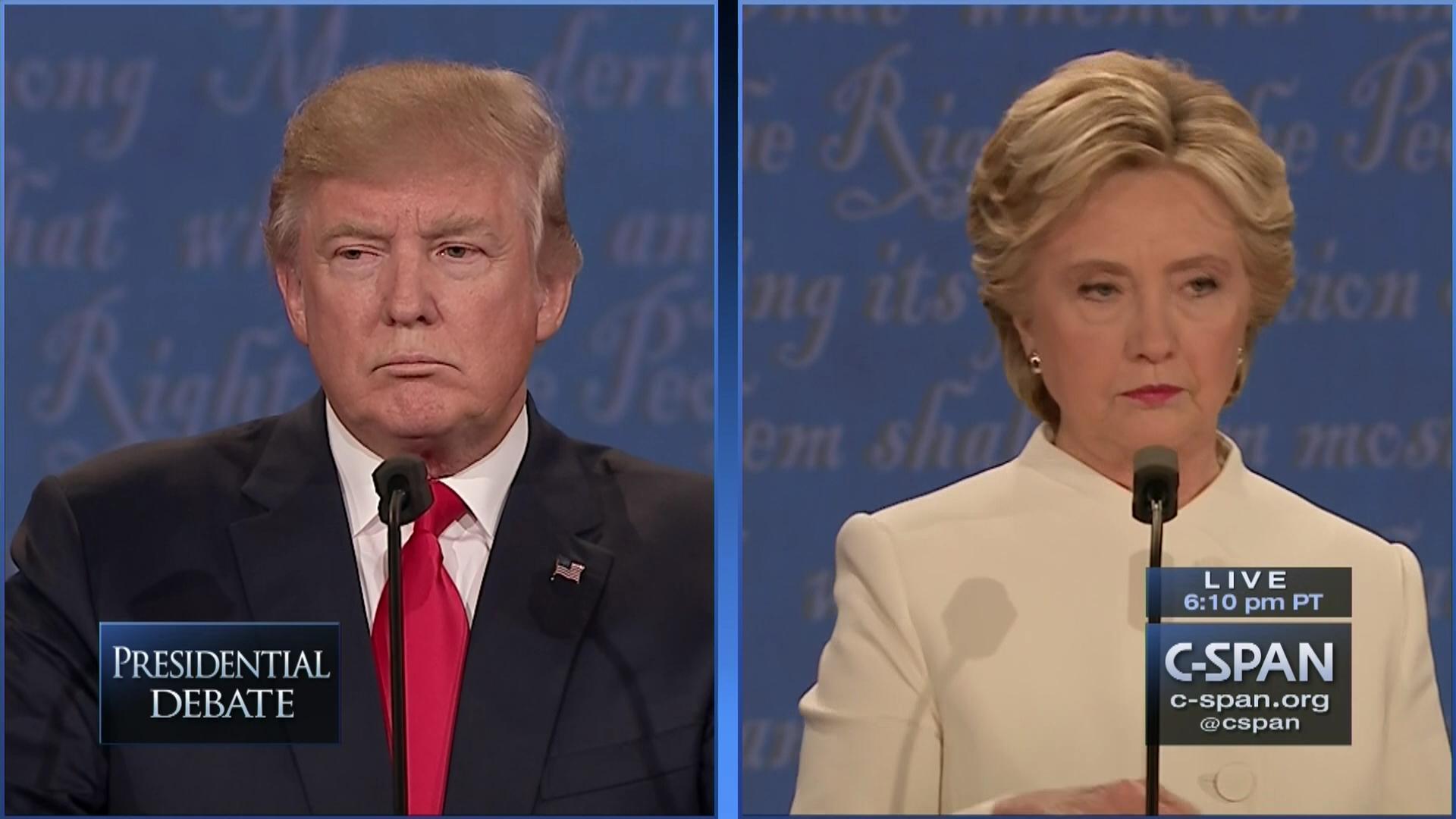
Donald Trump and Hillary Clinton in their third debate,
as Clinton called Trump Vladimir Putin’s “puppet.”
Despite his former job as chief of the FBI’s counterintelligence section, Strzok had the naive notion that texting on FBI phones could not be traced. Strzok must have slept through “Security 101.” Or perhaps he was busy texting during that class. Girlfriend Page cannot be happy at being misled by his assurance that using office phones would be a secure way to conduct their affair(s).
It would have been unfortunate enough for Strzok and Page to have their adolescent-sounding texts merely exposed, revealing the reckless abandon of star-crossed lovers hiding (they thought) secrets from cuckolded spouses, office colleagues, and the rest of us. However, for the never-Trump plotters in the FBI, the official release of just a fraction (375) of almost 10,000 messages does incalculably more damage than that.
We suddenly have documentary proof that key elements of the U.S. intelligence community were trying to short-circuit the U.S. democratic process. And that puts in a new and dark context the year-long promotion of Russia-gate. It now appears that it was not the Russians trying to rig the outcome of the U.S. election, but leading officials of the U.S. intelligence community, shadowy characters sometimes called the Deep State.
More of the Strzok-Page texting dialogue is expected to be released. And the Department of Justice Inspector General reportedly has additional damaging texts from others on the team that Special Counsel Robert Mueller selected to help him investigate Russia-gate.
Besides forcing the removal of Strzok and Page, the text exposures also sounded the death knell for the career of FBI Deputy Director Andrew McCabe, in whose office some of the plotting took place and who has already announced his plans to retire soon.
But the main casualty is the FBI’s 18-month campaign to sabotage candidate-and-now-President Donald Trump by using the Obama administration’s Russia-gate intelligence “assessment,” electronic surveillance of dubious legality, and a salacious dossier that could never pass the smell test, while at the same time using equally dubious techniques to immunize Hillary Clinton and her closest advisers from crimes that include lying to the FBI and endangering secrets.
Ironically, the Strzok-Page texts provide something that the Russia-gate investigation has been sorely lacking: first-hand evidence of both corrupt intent and action. After months of breathless searching for “evidence” of Russian-Trump collusion designed to put Trump in the White House, what now exists is actual evidence that senior officials of the Obama administration colluded to keep Trump out of the White House – proof of what old-time gumshoes used to call “means, motive and opportunity.”
Even more unfortunately for Russia-gate enthusiasts, the FBI lovers’ correspondence provides factual evidence exposing much of the made-up “Resistance” narrative – the contrived storyline that The New York Times and much of the rest of the U.S. mainstream media deemed fit to print with little skepticism and few if any caveats, a scenario about brilliantly devious Russians that not only lacks actual evidence – relying on unverified hearsay and rumor – but doesn’t make sense on its face.
The Russia-gate narrative always hinged on the preposterous notion that Russian President Vladimir Putin foresaw years ago what no American political analyst considered even possible, the political ascendancy of Donald Trump. According to the narrative, the fortune-telling Putin then risked creating even worse tensions with a nuclear-armed America that would – by all odds – have been led by a vengeful President Hillary Clinton.
Besides this wildly improbable storyline, there were flat denials from WikiLeaks, which distributed the supposedly “hacked” Democratic emails, that the information came from Russia – and there was the curious inability of the National Security Agency to use its immense powers to supply any technical evidence to support the Russia-hack scenario.
The Trump Shock
But the shock of Trump’s election and the decision of many never-Trumpers to cast their lot with the Resistance led to a situation in which any prudent skepticism or demand for evidence was swept aside.
So, on Jan. 6, 2017, President Obama’s Director of National Intelligence James Clapper released an evidence-free report that he said was compiled by “hand-picked” analysts from the CIA, FBI and NSA, offering an “assessment” that Russia and President Putin were behind the release of the Democratic emails in a plot to help Trump win the presidency.
Despite the extraordinary gravity of the charge, even New York Times correspondent Scott Shane noted that proof was lacking. He wrote at the time: “What is missing from the [the Jan. 6] public report is what many Americans most eagerly anticipated: hard evidence to back up the agencies’ claims that the Russian government engineered the election attack. … Instead, the message from the agencies essentially amounts to ‘trust us.’”
But the “assessment” served a useful purpose for the never-Trumpers: it applied an official imprimatur on the case for delegitimizing Trump’s election and even raised the long-shot hope that the Electoral College might reverse the outcome and possibly install a compromise candidate, such as former Secretary of State Colin Powell, in the White House. Though the Powell ploy fizzled, the hope of somehow removing Trump from office continued to bubble, fueled by the growing hysteria around Russia-gate.
Virtually all skepticism about the evidence-free “assessment” was banned. For months, the Times and other newspapers of record repeated the lie that all 17 U.S. intelligence agencies had concurred in the conclusion about the Russian “hack.” Even when that falsehood was belatedly acknowledged, the major news outlets just shifted the phrasing slightly to say that U.S. intelligence agencies had reached the Russian “hack” conclusion. Shane’s blunt initial recognition about the lack of proof disappeared from the mainstream media’s approved narrative of Russia-gate.
Doubts about the Russian “hack” or dissident suggestions that what we were witnessing was a “soft coup” were scoffed at by leading media commentators. Other warnings from veteran U.S. intelligence professionals about the weaknesses of the Russia-gate narrative and the danger of letting politicized intelligence overturn a constitutional election were also brushed aside in pursuit of the goal of removing Trump from the White House.
It didn’t even seem to matter when new Russia-gate disclosures conflicted with the original narrative that Putin had somehow set Trump up as a Manchurian candidate. All normal journalistic skepticism was jettisoned. It was as if the Russia-gate advocates started with the conclusion that Trump must go and then made the facts fit into that mold, but anyone who noted the violations of normal investigative procedures was dismissed as a “Trump enabler” or a “Moscow stooge.”
The Text Evidence
But then came the FBI text messages, providing documentary evivdence that key FBI officials involved in the Russia-gate investigation were indeed deeply biased and out to get Trump, adding hard proof to Trump’s longstanding lament that he was the subject of a “witch hunt.”
Justified or not, Trump’s feeling of vindication could hardly be more dangerous — particularly at a time when the most urgent need is to drain some testosterone from the self-styled Stable-Genius-in-Chief and his martinet generals.
On the home front, Trump, his wealthy friends, and like-thinkers in Congress may now feel they have an even wider carte blanche to visit untold misery on the poor, the widow, the stranger and other vulnerable humans. That was always an underlying danger of the Resistance’s strategy to seize on whatever weapons were available – no matter how reckless or unfair – to “get Trump.”
Beyond that, Russia-gate has become so central to the Washington establishment’s storyline that there appears to be no room for second-thoughts or turning back. The momentum is such that some Democrats and the media never-Trumpers can’t stop stoking the smoke of Russia-gate and holding out hope against hope that it will somehow justify Trump’s impeachment.
Yet, the sordid process of using legal/investigative means to settle political scores further compromises the principle of the “rule of law” and integrity of journalism in the eyes of many Americans. After a year of Russia-gate, the “rule of law” and “pursuit of truth” appear to have been reduced to high-falutin’ phrases for political score-setttling, a process besmirched by Republicans in earlier pursuits of Democrats and now appearing to be a bipartisan method for punishing political rivals regardless of the lack of evidence.
Strzok and Page
Peter Strzok (pronounced “struck”) has an interesting pedigree with multiple tasks regarding both Mrs. Clinton and Mr. Trump. As the FBI’s chief of counterespionage during the investigation into then-Secretary of State Hillary Clinton’s unauthorized use of a personal email server for classified information, Strzok reportedly changed the words “grossly negligent” (which could have triggered legal prosecution) to the far less serious “extremely careless” in FBI Director James Comey’s depiction of Clinton’s actions. This semantic shift cleared the way for Comey to conclude just 20 days before the Democratic National Convention began in July 2016, that “no reasonable prosecutor” would bring charges against Mrs. Clinton.
Then, as Deputy Assistant Director of the Counterintelligence Division, Strzok led the FBI’s investigation into alleged Russian interference in the U.S. election of 2016. It is a safe bet that he took a strong hand in hand-picking the FBI contingent of analysts that joined “hand-picked” counterparts from CIA and NSA in preparing the evidence-free, Jan. 6, 2017 assessment accusing Russian President Vladimir Putin of interfering in the election of 2016. (Although accepted in Establishment groupthink as revealed truth, that poor excuse for analysis reflected the apogee of intelligence politicization — rivaled only by the fraudulent intelligence on “weapons of mass destruction“ in Iraq 15 years ago.)
In June and July 2017 Strzok was the top FBI official working on Special Counsel Robert Mueller’s investigation into possible links between the Trump campaign and Russia, but was taken off that job when the Justice Department IG learned of the Strzok-Page text-message exchange and told Mueller.
There is no little irony in the fact that what did in the FBI sweathearts was their visceral disdain for Mr. Trump, their cheerleading-cum-kid-gloves treatment of Mrs. Clinton and her associates, their 1950-ish, James Clapperesque attitude toward Russians as “almost genetically driven” to evil, and their (Strzok/Page) elitist conviction that they know far better what is good for the country than regular American citizens, including those “deplorables” whom Clinton said made up half of Trump’s supporters.
But Strzok/Page had no idea that their hubris, elitism and scheming would be revealed in so tangible a way. Worst of all for them, the very thing that Strzok, in particular, worked so hard to achieve — the sabotaging of Trump and immunization of Mrs. Clinton and her closest advisers is now coming apart at the seams.
Congress: Oversee? or Overlook?
At this point, the $64 question is whether the various congressional oversight committees will remain ensconced in their customarily cozy role as “overlook” committees, or whether they will have the courage to attempt to carry out their Constitutional duty. The latter course would mean confronting a powerful Deep State and its large toolbox of well-practiced retaliatory techniques, including J. Edgar Hoover-style blackmail on steroids, enabled by electronic surveillance of just about everything and everyone. Yes, today’s technology permits blanket collection, and “Collect Everything” has become the motto.
Sen. Chuck Schumer, D-New York, with almost four decades of membership in the House and Senate, openly warned incoming President Trump in January 2017 against criticizing the U.S. intelligence community because U.S. intelligence officials have “six ways from Sunday to get back at you” if you are “dumb” enough to take them on.
Thanks to the almost 10,000 text messages between Strzok and Page, only a small fraction of which were given to Congress four weeks ago, there is now real evidentiary meat on the bones of the suspicions that there indeed was a “deep-state coup” to “correct” the outcome of the 2016 election. We now know that the supposedly apolitical FBI officials had huge political axes to grind. The Strzok-Page exchanges drip with disdain for Trump and those deemed his smelly deplorable supporters. In one text message, Strzok expressed visceral contempt for those working-class Trump voters, writing on Aug. 26, 2016, “Just went to a southern Virginia Walmart. I could SMELL the Trump support. … it’s scary real down here.”
The texts even show Strzok warning of the need for an “insurance policy” to thwart Trump on the off-chance that his poll numbers closed in on those of Mrs. Clinton.
An Aug. 6, 2016 text message, for example, shows Page giving her knight in shining armor strong affirmation: “Maybe you’re meant to stay where you are because you’re meant to protect the country from that menace [Trump].” That text to Strzok includes a link to a David Brooks column in The New York Times, in which Brooks concludes with the clarion call: “There comes a time when neutrality and laying low become dishonorable. If you’re not in revolt, you’re in cahoots. When this period and your name are mentioned, decades hence, your grandkids will look away in shame.”
Another text message shows that other senior government officials – alarmed at the possibility of a Trump presidency – joined the discussion. In an apparent reference to an August 2016 meeting with FBI Deputy Director Andrew McCabe, Strzok wrote to Page on Aug. 15, 2016, “I want to believe the path you threw out for consideration in Andy’s office — that there’s no way he [Trump] gets elected — but I’m afraid we can’t take that risk.” Strzok added, “It’s like an insurance policy in the unlikely event that you die before you’re 40.”
Insurance Policy?
Senate Judiciary Committee chair Chuck Grassley, R-Iowa, says he will ask Strzok to explain the “insurance policy” when he calls him to testify. What seems already clear is that the celebrated “Steele Dossier” was part of the “insurance,” as was the evidence-less legend that Russia hacked the DNC’s and Clinton campaign chairman John Podesta’s emails and gave them to WikiLeaks.
If congressional investigators have been paying attention, they already know what former weapons inspector Scott Ritter shared with Veteran intelligence Professionals for Sanity (VIPS) colleagues this week; namely, that Fusion GPS’s Glenn Simpson, who commissioned the Russia dossier using Democratic Party money, said he reached out to Steele after June 17, just three days before Steele’s first report was published, drawing on seven sources.
“There is a snowball’s chance in hell that this is raw intelligence gathered by Steele; rather he seems to have drawn on a single ‘trusted intermediary’ to gather unsubstantiated rumor already in existence.”
Another VIPS colleague, Phil Giraldi, writing out of his own experience in private sector consulting, added: “The fact that you do not control your sources frequently means that they will feed you what they think you want to hear. Since they are only doing it for money, the more lurid the details the better, as it increases the apparent value of the information. The private security firm in turn, which is also doing it for the money, will pass on the stories and even embroider them to keep the client happy and to encourage him to come back for more. When I read the Steele dossier it looked awfully familiar to me, like the scores of similar reports I had seen which combined bullshit with enough credible information to make the whole product look respectable.”
It is now widely known that the Democrats ponied up the “insurance premiums,” so to speak, for former British intelligence officer Christopher Steele’s “dossier” of lurid — but largely unproven — “intelligence” on Trump and the Russians. If, as many have concluded, the dossier was used to help justify a FISA warrant to snoop on the Trump campaign, those involved will be in deep kimchi, if congressional overseers do their job.
How, you might ask, could Strzok and associates undertake these extra-legal steps with such blithe disregard for the possible consequences should they be caught? The answer is easy; Mrs. Clinton was a shoo-in, remember? This was just extra insurance with no expectation of any “death benefit” ever coming into play — save for Trump’s electoral demise in November 2016. The attitude seemed to be that, if abuse of the FISA law should eventually be discovered — there would be little interest in a serious investigation by the editors of The New York Times and other anti-Trump publications and whatever troubles remained could be handled by President Hillary Clinton.
Sen. Lindsey Graham, R-South Carolina, who chairs the Judiciary Subcommittee of Judiciary on Crime and Terrorism, joined Sen. Grassley in signing the letter referring Christopher Steele to the Justice Department to investigate what appear to be false statements about the dossier. In signing, Graham noted the “many stop signs the Department of Justice ignored in its use of the dossier.” The signature of committee ranking member Sen. Dianne Feinstein, D-California, however, was missing — an early sign that a highly partisan battle royale is in the offing. On Tuesday, Feinstein unilaterally released a voluminous transcript of Glenn Simpson’s earlier testimony and, as though on cue, Establishment pundits portrayed Steele as a good source and Fusion GPS’s Glenn Simpson as a victim.
The Donnybrook is now underway; the outcome uncertain.
+++++++++++++
Sample text messages between Peter Strzok and Lisa Page, released to Congress and the media on December 13, 2016
++++++++++++++
03/04/2016
Strzok – God Hillary should win. 100,000,000-0.
Page – I know
++++++++++++
04/02/2016
Page – So look, you say we text on that phone when we talk about Hillary because it can’t be traced, you were just venting, bc you feel bad that you’re gone so much but that can’t be helped right now.
++++++++++
07/08/2016
Strzok – And meanwhile, we have Black Lives Matter protestors, right now, chanting “no justice no peace” around DoJ and the White House…
Page – That’s awful.
+++++++++
07/14/2016
Page – Have you read this? It’s really frightening. For Whites Sensing Decline, Donald Trump Unleashes Words of Resistance http://NYTI/ms/29WCu5!
Strzok – I have not. But I think it’s clear he’s capturing all the white, poor voters who the mainstream republicans abandoned in all but name in the quest for the almighty $$$
Page – Yeah, it’s not good.
Strzok – Poll Finds Emails Weighing on Hillary Clinton, Now Tied With Donald Trump http://nyti.ms/29RV5gf
Page – It is
+++++++++++++
07/26/2016
Strzok – And hey. Congrats on a woman nominated for President in a major party! About damn time! Many many more returns of the day!!
Page – That’s cute. Thanks
++++++++++
08/06/2016
Page – Jesus. You should read this. And Trump should go f himself. Moment in Convention Glare Shakes Up Khans American Life http://nyti.ms/2aHulE0
Strzok – God that’s a great article. Thanks for sharing. And F TRUMP.
++++++++
08/06/2016
Page – And maybe you’re meant to stay where you are because you’re meant to protect the country from that menace. To that end comma, read this:
Page – Trump Enablers Will Finally Have to Take A Stand http://nyti.ms/2aFakry
Strzok – Thanks. It’s absolutely true that we’re both very fortunate. And of course I’ll try and approach it that way. I just know it will be tough at times. I can protect our country at many levels, not sure if that helps
++++++++++++
08/09/2016
Page – He’s not ever going to become president, right? Right?!
Strzok – OMG did you hear what Trump just said?
+++++++++++
08/26/2016
Strzok – Just went to a southern Virginia Walmart. I could SMELL the Trump support…
Page – Yep. Out to lunch with (redacted) We both hate everyone and everything.
Page – Just riffing on the hot mess that is our country.
Strzok – Yeah…it’s scary real down here
+++++++++
10/20/2016
Strzok: I am riled up. Trump is a f***ing idiot, is unable to provide a coherent answer.
Strzok – I CAN’T PULL AWAY, WHAT THE F**K HAPPENED TO OUR COUNTRY (redacted)??!?!
Page– I don’t know. But we’ll get it back. We’re America. We rock.
Strzok– Donald just said “bad hombres”
Strzok– Trump just said what the FBI did is disgraceful.
END
Ray McGovern works with Tell the Word, a publishing arm of the ecumenical Church of the Saviour in inner-city Washington. He was an Army and CIA intelligence analyst for 30 years; prepared and briefed the President’s Daily Brief for Nixon, Ford, and Reagan; and is co-founder of Veteran Intelligence Professionals for Sanity (VIPS).
Wired’s Fake-News Suggests Russia Plotting to Cut Trans-Atlantic Internet Cables
By Robert BRIDGE | Strategic Culture Foundation | 10.01.2018
Well, that didn’t take long. Just five days into 2018, and the American fake news industry is already up and running, churning out tasteless whoppers faster than Burger King.
Wired magazine has joined the greasy ranks of other Western mythmakers now fueling a black wave of anti-Russia hysteria by mass-producing never-ending unsubstantiated claims and outright lies against the Kremlin.
The article begins with a doomsday scenario involving some “terrorist organization or nefarious nation” making the reckless decision to cut the undersea fiber optic cables that connect people across the world. So out of all the numerous diabolical groups that now populate the planet, who did Wired nominate as the most likely to pull off such a wanton act of sabotage? Yes, you got it. Putin’s Russia.
The obvious question for any rational thinking person is: Why would Russia do such a thing? Because, according to Wired, the Russian Navy has been “repeatedly caught snooping near the cables” that run along the entire expanse of the North Atlantic Ocean. Wired conveniently fails to remind its readers, however, that any country with a naval force would be forced to pass these lines on numerous occasions in the course of its travels. But acknowledging as much would be putting facts before fiction, and of course we can’t have that.
So where does Wired get its information regarding these latest nefarious plans on the part of Russia? From yet another purveyor of Russian fake news – arguably second only to the Washington Post – the New York Times.
“Russian submarines and spy ships are aggressively operating near the vital undersea cables that carry almost all global Internet communications, raising concerns among some American military and intelligence officials that the Russians might be planning to attack those lines in times of tension or conflict,” the Times breathlessly reported back in 2015.
However, just like the fake news of ‘Russia hacking the 2016 US presidential elections,’ don’t expect any evidence to support the claims. In fact, the Times admits as much in the third paragraph.
“While there is no evidence yet of any cable cutting, the concern is part of a growing wariness among senior American and allied military and intelligence officials over the accelerated activity by Russian armed forces around the globe.”
Well, now we’re getting somewhere. What really seems to be annoying the Americans is not some sort of outlandish attack on the Internet by Russia, but the fact that the Russian military is now a force to reckon with.
It is also worth noting that the Times article appeared just one month after Vladimir Putin committed the Russian military in September 2015 to fighting against Islamic State forces in Syria – following a formal request by Syrian President Bashar Assad. Some might call that curious timing.
So what exactly would Russia stand to gain from cutting these undersea cables? Absolutely nothing. In fact, as even Wired was gracious enough to admit – albeit buried far at sea in its hit piece – is that any cutting of the cables would be more injurious to Russia than most other countries.
“… Russia’s epic hypothetical cable attack would primarily harm its own people,” according to a Telegeography senior analyst Jonathan Hjembo, as quoted by the magazine. “It would hurt the Russians perhaps even more than it would hurt [Americans]. They’re far more dependent on international networks than we are, because so much of our content is stored locally.”
In fact, Wired was forced to admit that the greatest threat to the undersea cables is not Russia, the bogeyman of nearly every Western publication in circulation, but fishermen and scavengers.
Wired retold the story of one elderly woman who accidentally cut through an underground cable “while scavenging for copper,” cutting off Armenia’s entire internet access, leaving the country offline for five hours.
Yet despite those admissions, and the absolute lack of any incentive on the part of Russia to commit such an act of folly, Wired bowed out of its story with a parting shot at “Putin’s Russia” anyways.
“There have also been no ruptures attributed to Russian aggression. It appears that Putin has largely left the undersea cables alone, at least for now.”
Clearly, as this ridiculously flimsy article illustrates, without any shame, there will be no pause in the anti-Russia propaganda mudslinging in the New Year.
Surrounded by Neocons
They are all the news that fits
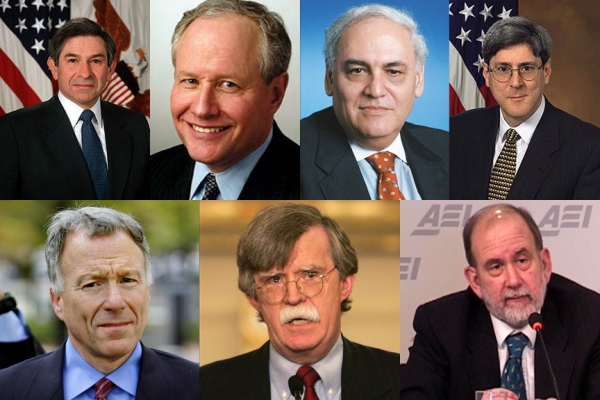
By Philip Giraldi • Unz Review • January 9, 2018
Award winning journalist James Risen has recently described in some detail his sometimes painful relationship with The New York Times. His lengthy account is well worth reading as it demonstrates how successive editors of the paper frequently cooperated with the government to suppress stories on torture and illegal activity while also self-censoring to make sure that nothing outside the framework provided by the “war on terror” should be seriously discussed. It became a faithful lap dog for an American role as global hegemon, promoting government half-truths and suppressing information that it knew to be true but which would embarrass the administration in power, be they Democrats or Republicans.
If one were to obtain a similar insider account of goings-on at the other national “newspaper of record”, The Washington Post, it is quite likely that comparable trimming of the narrative also took place. To be sure, the Post is worse than the Times, characterized by heavily editorializing in its news coverage without necessarily tipping off the reader when “facts” end and speculation begins. In both publications, stories about Iran or Russia routinely begin with an assertion that Moscow interfered in the 2016 U.S. election and that Iran is the aggressor in the Middle East, contentions that have not been demonstrated and can easily be challenged. Both publications also have endorsed every American war since 2001, including Iraq, Libya and the current mess in Syria, one indication of the quality of their reporting and analysis.
A recent op-ed in the Times by Bret Stephens is a perfect example of warmongering mischief wrapped in faux expert testimony to make it palatable. Stephens is the resident neocon at the Times. He was brought over from the Wall Street Journal when it was determined that his neocon colleague David Brooks had become overly squishy, while the resident “conservative” Russ Douthat had proven to be a bit too cautious and even rational to please the increasingly hawkish senior editors.
Stephens’ article, entitled Finding the Way Forward on Iran sparkles with throwaway gems like “Tehran’s hyperaggressive foreign policy in the wake of the 2015 nuclear deal” and “Real democracies don’t live in fear of their own people” and even “it’s not too soon to start rethinking the way we think about Iran.” Or try “A better way of describing Iran’s dictatorship is as a kleptotheocracy, driven by impulses that are by turns doctrinal and venal.”
Bret has been a hardliner on Iran for years. Early on in this op-ed he makes very clear that he wants it to be dealt with forcibly because it has “centrifuges, ballistic missiles, enriched uranium [and] fund[s] Hezbollah, assist Bashar al-Assad, arm[s] the Houthis, [and] imprison[s] the occasional British or American citizen.” He describes how Iran is a very corrupt place run by religious leaders and Revolutionary Guards and proposes that their corruption be exposed so that the Iranian people can take note and rise up in anger. And if exposure doesn’t work, they should be hammered with sanctions. He does not explain why sanctions, which disproportionately hurt the people he expects to rise up, will bring about any real change.
Stephens cites two of his buddies Ken Weinstein of the Hudson Institute and Mark Dubowitz of the Foundation for the Defense of Democracies (FDD), who are apparently experts on how to squeeze Iran. Weinstein prefers exposing the misdeeds of the Mullahs to anger the Iranian people while Dubowitz prefers punitive sanctions “for corruption.”
The article does not reveal that Weinstein and Dubowitz are long time critics of Iran, are part of the Israel Lobby and just happen to be Jewish, as is Stephens. The Hudson Institute and the FDD are leading neocon and pro-Israel fronts. So my question becomes, “Why Iran?” The often-heard Israeli complaint about its being unfairly picked on could reasonably be turned on its head in asking the same about Iran. In fact, Iran compares favorably with Israel. It has no nuclear weapons, it does not support any of the Sunni terrorist groups that are chopping heads, and it has not disenfranchised hundreds of thousands of people that it rules over. The fact is that Iran is being targeted because Israel sees it as its prime enemy in the region and has corrupted many “opinion makers” in the U.S., to include Stephens, to hammer home that point. To be sure, Iran is a very corrupt place run by people who should not be running a hot dog stand, but the same applies to the United States and Israel. And there are lots of places that are not being targeted like Iran that are far worse, including good friend and ally of both Jerusalem and Washington, Saudi Arabia.
Oddly enough Stephens, Weinstein and Dubowitz do not get into any of that back story, presumably because it would be unseemly. And, of course and unfortunately, the New York Times opinion page is not unique. An interesting recent podcast interview by Politico‘s Chief International Affairs correspondent Susan Glasser with leading neoconservatives Eliot Cohen and Max Boot, is typical of how the media selectively shapes a narrative to suit its own biases. Glasser, Cohen and Boot are all part of the establishment foreign policy consensus in the U.S. and therefore both hate and fail to understand the Trump phenomenon. Both Cohen and Booth were vociferous founding members of the #NeverTrump foreign policy resistance movement.
Boot describes the new regime’s foreign policy as “kowtow[ing] to dictators and undermin[ing] American support for freedom and democracy around the world,” typical neocon leitmotifs. Glasser appears to be in love with her interviewees and hurls softball after softball. She describes Boot as “fantastic” and Cohen receives the epithet “The Great.” The interview itself is remarkably devoid of any serious discussion of foreign policy and is essentially a sustained assault on Trump while also implicitly supporting hardline national security positions. Cohen fulminates about “a very serious Russian attack on the core of our political system. I mean, I don’t know how you get more reckless and dangerous than that,” while Boot asks what “has to be done” about Iran.
Pompous ass Cohen, who interjected in the interview that “and you know, Max and I are both intellectuals,” notably very publicly refused to have any part in a Trump foreign policy team during the campaign but later when The Donald was actually elected suggested that the new regime might approach him with humility to offer a senior position and he just might condescend to join them. They did not do so, and he wrote an angry commentary on their refusal.
Hating Trump is one thing, but I would bet that if the question of a hardline policy vis-à-vis Russia or the Jerusalem Embassy move had come up Cohen and Boot would have expressed delight. The irony is that Trump is in fact pursuing a basically neocon foreign policy which the two men would normally support, but they appear to be making room for Trump haters in the policy formulation process to push the national security consensus even farther to the right. Indeed, in another article by Boot at Foreign Policy he writes “I applaud Trump’s decisions to provide Ukraine with arms to defend itself from Russian aggression, to recognize Jerusalem as the capital of Israel, to send additional U.S. troops to Afghanistan, and to accelerate former President Barack Obama’s strategy for fighting the Islamic State.” Cohen meanwhile applauds the embassy move, though he warns that Trump’s success in so doing might embolden him to do something reckless over North Korea.
Perhaps one should not be astonished that leading neocons appearing in the mainstream media will continue to have their eyes on the ball and seek for more aggressive engagement in places like Iran and Russia. The media should be faulted because it rarely publishes any contrary viewpoint and it also consistently fails to give any space to the considerable downside to the agitprop. It must be reassuring for many Americans to know that the Center for Disease Control and Prevention (CDC) is preparing itself to deal with the aftermath of a nuclear attack on the United States and it will be sharing information on the appropriate preparations with the American people. There will be a public session on how to prepare for a nuclear explosion on January 16th.
CDC experts will consider “planning and preparation efforts” for such a strike. “While a nuclear detonation is unlikely, it would have devastating results and there would be limited time to take critical protection steps,” the Center elaborated in its press release on the event.
That the United States should be preparing for a possible nuclear future can in part be attributed to recent commentary by the “like, really smart” and “very stable genius” who is the nation’s chief executive, but the fuel being poured on the fire for war is from the very same neocons who are featured in the mainstream media as all-purpose experts and have succeeded in selling the snake oil about America’s proper role as aggressor-in-chief for the entire world. It would be an unparalleled delight to be able to open a newspaper and not see Bret Stephens, Eliot Cohen, Max Boot or even the redoubtable Bill Kristol grinning back from the editorial page, but I suppose I am only dreaming.
Philip M. Giraldi, Ph.D., is Executive Director of the Council for the National Interest, a 501(c)3 tax deductible educational foundation that seeks a more interests-based U.S. foreign policy in the Middle East. Website is http://www.councilforthenationalinterest.org, address is P.O. Box 2157, Purcellville VA 20134 and its email is inform@cnionline.org.
The Times Rides to Mueller’s Rescue
By Pat Buchanan • Unz Review • January 2, 2018
What caused the FBI to open a counterintelligence investigation into the Trump campaign in July 2016, which evolved into the criminal investigation that is said today to imperil the Trump presidency?
As James Comey’s FBI and Special Counsel Robert Mueller have, for 18 months, failed to prove Donald Trump’s “collusion” with the Kremlin, what was it, in mid-2016, that justified starting this investigation?
What was the basis for the belief Trump was colluding, that he was the Manchurian candidate of Vladimir Putin? What evidence did the FBI cite to get FISA court warrants to surveil and wiretap Trump’s team?
Republican congressmen have for months been demanding answers to these questions. And, as Mueller’s men have stonewalled, suspicions have arisen that this investigation was, from the outset, a politicized operation to take down Trump.
Feeding those suspicions has been the proven anti-Trump bias of investigators. Also, wiretap warrants of Trump’s team are said to have been issued on the basis of a “dirty dossier” that was floating around town in 2016 — but which mainstream media refused to publish as they could not validate its lurid allegations.
Who produced the dossier?
Ex-British spy Christopher Steele, whose dirt was delivered by ex-Kremlin agents. And Steele was himself a hireling of Fusion GPS, the oppo research outfit enlisted and paid by the Clinton campaign and DNC.
Writes the Washington Times, Steele “paid Kremlin sources with Democratic cash.”
Yet, if Steele’s dossier is a farrago of falsehoods and fake news, and the dossier’s contents were used to justify warrants for wiretaps on Trump associates, Mueller has a problem.
Prosecutions his team brings could be contaminated by what the FBI did, leaving his investigation discredited.
Fortunately, all this was cleared up for us New Year’s Eve by a major revelation in The New York Times. Top headline on page one:
“Unlikely Source Propelled Russia Meddling Inquiry”
The story that followed correctly framed the crucial question:
“What so alarmed American officials to provoke the FBI to open a counterintelligence investigation of the Trump campaign months before the presidential election?”
The Times then gave us the answer we have been looking for:
“It was not, as Trump and other politicians have alleged, a dossier compiled by a former British spy hired by a rival campaign. Instead it was firsthand information from one of America’s closest intelligence allies.”
The ally: Australia, whose ambassador to Britain was in an “upscale London Bar” in the West End in May 2016, drinking with a sloshed George Papadopoulos, who had ties to the Trump campaign and who informed the diplomat that Russia had dirt on Hillary Clinton.
Papadopoulos had reportedly been told in April that Russia had access to Clinton’s emails.
Thus, when the DNC and John Podesta emails were splashed all over the U.S. press in June, Amb. Alexander Downer, recalling his conversation with Papadopoulos, informed his government, which has excellent ties to U.S. intelligence, and the FBI took it from there.
The Times’ story pounds home this version of events:
“The hacking and the revelation that a member of the Trump campaign may have had inside information about it were driving factors that led the FBI to open an investigation in July 2016 into Russian attempts to disrupt the election and whether any of Trump’s associates conspired.”
This, the Times assures us, “answers one of the lingering mysteries of the past year.”
Well, perhaps.
But if Papadopoulos’s drunken babbling to the Aussie ambassador triggered the investigation in July 2016, why was George not interviewed by the FBI until January 2017?
According to the Times, an FBI agent in Rome had been told by Steele in June 2016 what he had learned from the Russians.
And Steele was interviewed by the FBI in October 2016.
If Papadopoulos triggered the investigation, why the seeming FBI disinterest in him — as compared to Steele?
Yet another major question remains unanswered.
If, as the Times writes, the FBI was looking “into Russian attempts to disrupt the elections,” why did the FBI not open an investigation into the KGB roots of the Steele dossier that was written to destroy the Republican candidate, Donald Trump?
If Trump’s alleged “collusion” with Putin to damage Clinton was worthy of an all-out FBI investigation, why did the Clinton-DNC scheme to tie Trump to Russian prostitutes, using British spies and former KGB agents, not merit an FBI investigation?
Why was there less concern about the Clinton campaign’s ties to Russian agents, than to Trumpian “collusion” that is yet unproven?
Consider what the British spy Steele and his former KGB/FSB comrades accomplished:
They have kept alive a special counsel’s investigation that has divided our country, imperiled the FBI’s reputation, preoccupied and damaged a president, and partially paralyzed the U.S. government.
Putin must be marveling at the astonishing success of his old comrades from KGB days, who could pull off an intelligence coup like this and so cripple the superpower that won the Cold War.
Copyright 2018 Creators.com.
Featured Video

Chinese jet fuel and the myth of energy independence
or go to
Aletho News Archives – Video-Images
Book Review
Former Insiders Criticize Iran Policy as U.S. Hegemony
By GARETH PORTER | CounterPunch | February 27, 2013
“Going to Tehran” arguably represents the most important work on the subject of U.S.-Iran relations to be published thus far.
Flynt Leverett and Hillary Mann Leverett tackle not only U.S. policy toward Iran but the broader context of Middle East policy with a systematic analytical perspective informed by personal experience, as well as very extensive documentation.
More importantly, however, their exposé required a degree of courage that may be unparalleled in the writing of former U.S. national security officials about issues on which they worked. They have chosen not just to criticise U.S. policy toward Iran but to analyse that policy as a problem of U.S. hegemony. … continue
Blog Roll
 Aletho News
- What is fueling unrest across the EU?
- Why no power can undermine Iran’s eternal dominance over the Strait of Hormuz
- Is The War Against Iran Over?
- Iran war will leave long-term ‘scar’ on Wall Street, investors warn
- How Iran decimated US power projection in West Asia: Military lessons of 40-day war
- Iran’s report details US-Israeli war crimes in targeting schools, hospitals, livelihoods
- NATO’s Slow Fracture: How Trump’s Iran War Exposed the Instrument of Hegemony
- Chinese jet fuel and the myth of energy independence
- Ukraine Sea Drone Fired From Libya Hit Russian Tanker in Mediterranean
- IRGC: Iranian forces launched no attacks during ceasefire hours
- If Americans Knew
- Military aid to Israel emerges as the latest political litmus test for Democrats
- The only Palestinian children’s rights organization closes following years-long Israeli campaign against it
- ‘I Can’t Forget the Smell’: Lebanese Reel After Israel Kills Over 300 in Single Day
- DNC Shoots Down Resolutions Calling Out AIPAC and Limiting Arms to Israel
- TCN: Is Israel Blackmailing President Trump?
- Israel killed at least 303 Lebanese yesterday – who were they? Daily Update
- Amnesty: Urgent – Protect Lebanese civilians from brutal escalation in Israeli attacks
- Is The War Against Iran Over?
- Inside the Israeli army’s propaganda wing
- Hundreds of Gaza Amputees Stranded in Legal Limbo
- No Tricks Zone
- New Study: No Linear Warming Or Glacier Retreat Along Northern Antarctic Peninsula Since 1980s
- An Inconvenient Tree: Uncovered In Alps… Europe Much Warmer Than Today 6000 Years Ago
- New Study Reports A 60% Slowdown In Greenland’s Ice Loss Rate In The Last Decade
- Low Intensity Tornado Wrecks Major Solar Farm, Creating A Potential Toxic Dump
- New Study Finds Warming Saves Lives…Cold Temperatures 12 Times More Deadly Than Excess Heat
- German Science Blog Accuses PIK Climate Institute Of Hallucinating Climate Tipping Points
- Devastating Assessment Of Comirnaty Vaccine By Former Senior Pfizer Europe Toxicologist
- New Study: CO2 Is ‘Effectively Negligible’ As An Explanatory Climate Change Factor Since 2000
- Former Pfizer Toxicologist Dr. Helmut Sterz Tells Bundestag Hearing Pfizer Vaccine Should Have Never Been Approved
- Energy Expert: Germany’s Nuclear Phaseout Was A “500 Billion Euro Mistake”
 Aletho News