The NYT’s latest Russiagate story on George Papadopoulos is not believable. Here’s why
Attempt to distance Russiagate investigation from discredited Trump Dossier fails on Papadopoulos’s inherent unreliability as a witness

By Alexander Mercouris | The Duran | January 1, 2018
As confidence in Robert Mueller’s investigation crumbles there have been the inevitable leaks intended to suggest that the Russiagate investigation is still on track and that despite the increasing appearances to the contrary there is actually some reality to the case it is investigating.
The leaks take the form of claims that Mueller is planning to issue a “supplemental indictment” of Paul Manafort supposedly fleshing out the tax evasion and money laundering claims he has brought against him, and more information about the strange case of George Papadopoulos.
I will not take up time discussing the ‘supplemental indictment’ against Paul Manafort. The case against Paul Manafort does not touch on the collusion allegations which are the focus of the Russiagate affair, and by all accounts the new ‘supplemental indictment’ will not change that.
What the fact that Mueller is now preparing a ‘supplemental indictment’ against Manafort shows is that what I and many others have said previously is true: the original indictment against Manafort was rushed and unprepared, probably because it was rushed out to counter criticism of Mueller which was appearing in the Wall Street Journal.
Of much more interest is the new information which has been published about George Papadopoulos. The information appears in an article in the New York Times which reads in part as follows:
During a night of heavy drinking at an upscale London bar in May 2016, George Papadopoulos, a young foreign policy adviser to the Trump campaign, made a startling revelation to Australia’s top diplomat in Britain: Russia had political dirt on Hillary Clinton.
About three weeks earlier, Mr. Papadopoulos had been told that Moscow had thousands of emails that would embarrass Mrs. Clinton, apparently stolen in an effort to try to damage her campaign.
Exactly how much Mr. Papadopoulos said that night at the Kensington Wine Rooms with the Australian, Alexander Downer, is unclear. But two months later, when leaked Democratic emails began appearing online, Australian officials passed the information about Mr. Papadopoulos to their American counterparts, according to four current and former American and foreign officials with direct knowledge of the Australians’ role.
This information has clearly been published in order to counter the increasingly widely circulating claim that it was the Trump Dossier which triggered the Russiagate investigation.
This is made absolutely clear by the following paragraphs in the New York Times article
The hacking and the revelation that a member of the Trump campaign may have had inside information about it were driving factors that led the F.B.I. to open an investigation in July 2016 into Russia’s attempts to disrupt the election and whether any of President Trump’s associates conspired…
The hacking and the revelation that a member of the Trump campaign may have had inside information about it were driving factors that led the F.B.I. to open an investigation in July 2016 into Russia’s attempts to disrupt the election and whether any of President Trump’s associates conspired.
The information that Mr. Papadopoulos gave to the Australians answers one of the lingering mysteries of the past year: What so alarmed American officials to provoke the F.B.I. to open a counterintelligence investigation into the Trump campaign months before the presidential election?
It was not, as Mr. Trump and other politicians have alleged, a dossier compiled by a former British spy hired by a rival campaign. Instead, it was firsthand information from one of America’s closest intelligence allies.
Is this however really so?
The drunken bragging of a twenty eight year old man in a London bar presumably with attractive young women present is not usually considered grounds to initiate a top secret investigation resulting in the secret surveillance of people against whom no other evidence of wrongdoing exists.
The known timeline of the Russiagate inquiry anyway strongly argues against this claim.
The DNC emails were published by Wikileaks on 22nd July 2016. The FBI launched the Russiagate inquiry in late July 2016, probably after the DNC emails were published.
This was however after the FBI had interviewed Christopher Steele, the compiler of the Trump Dossier, in early July 2016. The Trump Dossier’s first two entries are dated 20th June 2016 and 19th July 2016 – ie. before publication of the DNC emails – and it is likely that before the FBI launched the Russiagate inquiry in late July 2016 it had seen them.
The New York Times says that the FBI received the information about Papadopoulos’s bragging in front of the Australian High Commissioner after the DNC emails were published. However the FBI did not actually interview Papadopoulos until 27th January 2017.
What seems to have happened is that after the Russiagate inquiry was launched the FBI went through all the information it received which might touch on the inquiry. At some point the Australian High Commissioner’s report about Papadopoulos’s bragging in May 2016 in the London bar came up and a decision was taken to interview him.
However – contrary to what the New York Times says – the FBI cannot have accorded this any great importance since though the Russiagate inquiry was launched at the end of July 2016 the FBI did not interview Papadopoulos until 27th January 2017 ie. six months later.
That makes it all but inconceivable that it was – as the New York Times claims – the report from Australia about what Papadopoulos said in the presence of the Australian High Commissioner in the London bar rather than the Trump Dossier which triggered the Russiagate inquiry.
As it happens the rest of the New York Times article, though outlining at fantastic length the nature of Papadopoulos’s Russian contacts provides no evidence of collusion illegal or otherwise between the Russians, Papadopoulos or anyone else in the Trump campaign.
What the New York Times article does show is who Papadopoulos’s Russian contacts were.
It turns out that they were senior people in the Valdai Discussion Club, which is not at all surprising given that Professor Mifsud, the Maltese professor who was Papadopoulos’s contact, is known to have participated in a Valdai Discussion Club panel on 19th April 2016.
The Valdai Discussion Club for those who do not know is a Russian NGO which regularly hosts discussions between top level Russian officials and senior people from around the world. It is sometimes spoken of as the Russian equivalent to Davos. This page from its website gives an idea of its activities and of the very senior people from around the world who have been involved in it,
In other words when Papadopoulos and Professor Mifsud got to know each other Professor Mifsud simply put Papadopoulos in touch with the Russian organisers of the meeting he was attending.
That does not argue for Professor Mifsud’s “high level contacts” within the Russian government; it argues against it.
As it happens no Russian government official appears to have been directly involved in the discussions between the various members of the Valdai Discussion Group and Papadopoulos.
The New York Times says that Igor Ivanov, who was Russia’s foreign minister from 1998 to 2004, was consulted by Papadopoulos’s Russian contacts. Ivanov is presumably the “Russian MFA Connection” referred to in Papadopoulos’s indictment. However Ivanov is a retired official not an active one, and his Wikipedia profile suggests that he is now mainly involved in academic work and in the work of various international NGOs. As such he would have been an obvious person for members of the Valdai Discussion Club to consult, and was not in any sense a representative of the Russian government.
As for the subject matter of the discussions between Papadopoulos and his Russian contacts, there is no hint in the New York Times article of any conspiracy between Papadopoulos, the Trump campaign and the Russians concerning the election or any other matter.
Instead we are told – again at inordinate length – about Papadopoulos’s already known but ultimately futile efforts to arrange a summit meeting between Vladimir Putin and Donald Trump, which Papadopoulos persisted in even after he was told to stop them.
As has by now become typical of the New York Times’ Russiagate coverage, its latest article about Papadopoulos also states as facts things which are in fact strongly disputed.
For example it states as flat facts that it was Professor Mifsud who falsely claimed to Papadopoulos that Olga Polonskaya – one of Papadopoulos’s Russian contacts – was President Putin’s niece, and that it was Professor Mifsud who told Papadopoulos during a hotel meeting in London in April 2016 that the Russians had “dirt” on Hillary Clinton.
Professor Mifsud however has publicly denying telling Papadopoulos either of these things, and the only evidence he did so is that Papadopoulos says he did.
On the subject of the false claim that Polonskaya was Putin’s niece, it is intrinsically far more likely that this is an invention of Papadopoulos’s and not of Professor Mifsud’s. Why after all would Mifsud – presumably in cooperation with the Russians – seek to pass off Polonskaya as Putin’s niece when a five minute internet search would establish that Putin has no niece? What would be the purpose of such a thing?
The only confirmed reference to Polonskaya being Putin’s niece other than Papadopoulos’s statements to the FBI is an email Papadopoulos sent to the Trump campaign describing her as such.
It is Papadopoulos not Professor Mifsud who has pleaded guilty to lying to the FBI. Papadopoulos’s behaviour in fact clearly points to him being a young man out of his depth and given to fantasising. Even the New York Times calls him “brash, boastful and underqualified”.
It turns out that Papadopoulos even publicly reprimanded British Prime Minister David Cameron in a May 2016 interview with The London Times which he was not authorised by the Trump campaign to give, and for which he was subsequently severely reprimanded, and it is also known that he persisted in trying to arrange with the Russians a summit meeting between Donald Trump and Vladimir Putin even when told to stop doing so.
Given that Papadopoulos is therefore a known loose cannon with a record of bragging and a conviction for lying why assume that on any subject – eg. the false claims about Polonskaya – it is Papadopoulos who is telling the truth and that it is Professor Mifsud who is lying? Surely the opposite is far more likely to be true?
In the case of Polonskaya the New York Times has to pretend that it is Papadopoulos not Professor Mifsud who is telling the truth because if it were confirmed that it was Papadopoulos who invented the story about Polonskaya being Putin’s niece then that would expose him as a fantasist, which would discredit the whole elaborate scenario the New York Times is trying to spin around him.
That shows why it is dangerous to assume that Papadopoulos is telling the truth on any point when those who have a vested interest in the Russiagate story say he is. On the contrary Papadopoulos is an inherently unreliable witness and must always be treated as such.
Does the information in the New York Times article however tell us anything we didn’t previously know about the core issue in the case: the “dirt” Papadopoulos says Professor Mifsud told him that the Russians have on Hillary Clinton?
Firstly, despite the New York Times’ painstaking attempts to link the boasts which Papadopoulos blurted out in a London bar to the DNC and Podesta emails, it seems that Papadopoulos whilst he was bragging in the London bar did not in fact refer to those emails.
The relevant paragraph in the New York Times article on this point needs to be read carefully
During a night of heavy drinking at an upscale London bar in May 2016, George Papadopoulos, a young foreign policy adviser to the Trump campaign, made a startling revelation to Australia’s top diplomat in Britain: Russia had political dirt on Hillary Clinton. (bold italics added)
The words “political dirt on Hillary Clinton” are almost certainly copied from the Australian High Commissioner’s report to his government, which was subsequently passed on to the FBI, and which forms the basis of the story in the New York Times.
What these words show is that Papadopoulos was boasting in the London bar that the Russians had “political dirt about Hillary Clinton”, not that they had the DNC or Podesta emails.
What this paragraph also shows is that Papadopoulos in May 2016 was bragging about his high position in the Trump campaign and about his contacts with the Russians, and was doing so openly in the presence of no less a person than the Australian High Commissioner, whose identity he cannot have been unaware of.
This sort of wild indiscretion all but proves that Papadopoulos was not involved in a secret criminal conspiracy with the Russians. Of course the rest of the New York Times article and the text of his indictment provides no evidence that he was.
In fact it is possible to make some educated guesses about the Papadopoulos affair based on this new information, which leads to diametrically opposite conclusions to the ones reached by the New York Times.
In May 2016 Papadopoulos was clearly on a high, giving foolish interviews to The London Times and bragging in front of the Australian High Commissioner in a London bar about his high level position in the Trump campaign and about his contacts with the Russians.
That strongly points to his boast in the London bar that the Russians had ‘political dirt’ on Hillary Clinton being his own invention.
Subsequently, when he was asked about it by the FBI – long after the Russiagate scandal broke out – he panicked and blamed the whole thing on Professor Mifsud who he said told him about it during their meeting in the London hotel in April 2016.
Note that the wording of the indictment shows that Papadopoulos was vague about what precisely Professor Mifsud was supposed to have told him:
On or about April 26, 2016, defendant PAPADOPOULOS met the Professor for breakfast at a London hotel. During this meeting, the Professor told defendant PAPADOPOULOS that he had just returned from a trip to Moscow where he had met with high-level Russian government officials. The Professor told defendant PAPADOPOULOS that on that trip he (the Professor) learned that the Russians had obtained “dirt” on then-candidate Clinton. The Professor told defendant PAPADOPOULOS, as defendant PAPADOPOULOS later described to the FBI, that “They [the Russians] have dirt on her”; “the Russians had emails of Clinton“; “they have thousands of emails.” (bold italics added)
The words “the Russians had emails of Clinton” make it clear that the emails and supposedly discussed by Professor Mifsud and Papadopoulos were not the DNC and Podesta emails but Hillary Clinton’s own 33,000 emails deleted from her private email server. Had Papadopoulos referred to the DNC and Podesta emails in his interview with the FBI the indictment would have surely said so.
In May 2016 – the month when Papadopoulos was drunkenly bragging in the London bar – the scandal around Hillary Clinton’s misuse of a private email server for her State Department emails was at its height, with the Inspector General of the State Department publishing an 83 page report and with speculation rife about the progress of the FBI’s investigation into the affair.
Possibly Papadopoulos was thinking about Hillary Clinton’s 33,000 emails when he was bragging in the London bar. More likely he referred to these emails when he tried to explain away his comments in the London bar to the FBI.
By the time the FBI interviewed him Papadopoulos would have known that any reference to the DNC and Podesta emails would have exposed him to suspicion of involvement in a far greater conspiracy. Frightened and searching for ways to get himself out of trouble, and perhaps realising that he would not be believed if he admitted that he had been lying when he had been bragging in the London bar, he brought up the subject of Hillary Clinton’s emails instead, and involved Professor Mifsud in the story to give himself cover.
Regardless, the fact that Papadopoulos’s recollection of what Professor Mifsud is supposed to have told him is so vague points to what is almost certainly the truth: Papadopoulos is making it all up.
Not only does this seem to me a far more plausible explanation of the Papadopoulos affair than the one suggested by the New York Times, but there is one obvious point which for me confirms it.
Nothing Papadopoulos says about this episode can be independently confirmed.
His account of his meeting in April with Professor Mifsud is disputed by Professor Mifsud who is the only other witness.
Apart from his bragging in the London bar there is no evidence dating from the time that he had any knowledge that the Russians had “dirt” on Hillary Clinton. None of his very numerous communications to the Trump campaign refer to the fact.
To those who say that Papadopoulos would wish to keep his reports about this secret, all I would say is that Papadopoulos cannot have thought of it so very secret since in May 2016 he was openly bragging about it in front of the Australian High Commissioner in a London bar.
All this taken together makes it highly likely that Papadopoulos is inventing the whole story, just as he is almost certainly the person who invented the story of Polonskaya being Putin’s niece.
In summary the New York Times story, far from lending credence to the Russiagate collusion allegations actually provides further reason to doubt them. As for Papadopoulos, far from being a star ‘smoking gun’ witness, he comes across as a boastful fantasist who is not telling the truth.
What the article does highlight is the pressure the FBI and the Mueller investigation are under as the doubts about the Trump Dossier grow.
It is the Trump Dossier which remains however the key to the affair. This latest attempt to deny the fact and to distract from it does not refute it. On the contrary it confirms it.
NYT Trumpwashes 70 Years of US Crimes
By Adam Johnson | FAIR | December 30, 2017
Trumpwashing—defined as whitewashing, obscuring or rewriting the broader US record by presenting Donald Trump as an aberration (FAIR, 6/3/16)—was on full display Thursday in a nominally straight news report from the New York Times’ Mark Landler (12/28/17) on how Trump has reshaped US foreign policy. Buried in the otherwise banal analysis was this gem of US imperial agitprop:
Above all, Mr. Trump has transformed the world’s view of the United States from a reliable anchor of the liberal, rules-based international order into something more inward-looking and unpredictable. That is a seminal change from the role the country has played for 70 years, under presidents from both parties, and it has lasting implications for how other countries chart their futures.
There’s lots of ideology to unpack here, but let’s start with the empirically false assertion that the “world” viewed the United States as a “reliable anchor of the liberal, rules-based international order.” Poll (Guardian, 6/15/06) after poll (Pew, 3/14/07) after poll (PRI, 1/3/14) throughout the years has shown that much of the world views the United States as threat to peace, often taking the top spot as the single greatest threat. What evidence Landler has for the world viewing the US as a sort of good-natured global babysitter is unclear, as he cites nothing to support this hugely important claim (since if Trump’s cynical disregard for “human rights” is nothing new, then there’s no real story here). It’s just thrown out with the assumption the Times readership is sufficiently nationalistic and/or amnesiac to either not notice or not care. It’s designed to flatter, not to elucidate.

The US invasion of Iraq in defiance of international law
The second dubious assertion is the idea that the US is “viewed” as being (or, by implication, objectively is) concerned with “liberal, rules-based international order.” Perhaps Landler missed the part where the US runs offshore penal colonies for untried political prisoners, and a decade-long drone war that’s killed thousands—both entirely outside the scope of international law. Or the time the US invaded and destroyed Iraq without any international authorization, killing hundreds of thousands. Or perhaps he missed the part where the United States refuses to sign “liberal, rules-based international order” treaties such as the International Criminal Court or the ban on bombs and or a prohibition on nuclear weapons. Or the part where the US not only doesn’t recognize the International Criminal Court, but has a law on its books (dubbed “the Hague Invasion Act,” passed in 2002) that if an American is ever held by the ICC for committing war crimes, the US is obligated to literally invade the Hague and free them.
And this is just in the past 15 years. Landler, even more laughably, starts the clock in 1947, which would include dozens of non-“liberal,” non-“rules-based” coups, invasions, bombing campaigns, assassinations, extrajudicial murders and so forth. The number of actions carried out by the US not sanctioned by even the thinnest pretext of “international order” is too long to list.
What exactly is this “liberal, rules-based international order,” and when did “the world” view the United States as its most reliable anchor? Landler doesn’t say, he simply asserts this highly contestable and ideological claim, and moves on to pearl-clutch about Trump ruining the US’s hard-won moral authority. He has some 100 percent uncut pro-US ideology to push under the guise of criticizing Trump, and no amount of basic historical facts will get in his way.
NYT’s Argentina Op-Ed Fails to Disclose Authors’ Financial Conflict of Interest
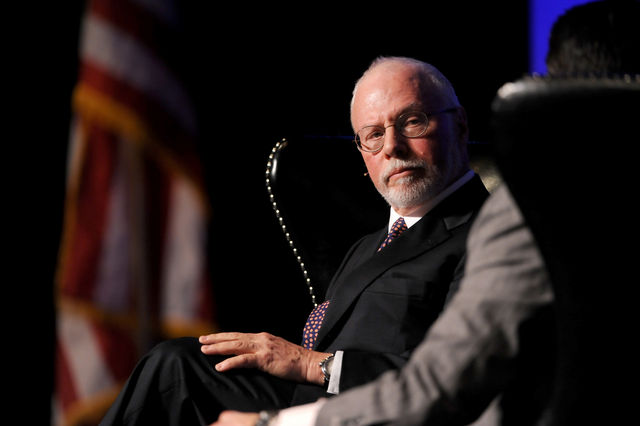
Photo: Paul Singer
By Eli Clifton | LobeLog | December 13, 2017
On Tuesday, Mark Dubowitz and Toby Dershowitz, two executives at the hawkish Foundation for Defense of Democracies (FDD), took to the op-ed pages of The New York Times to celebrate last week’s announcement that Argentina’s former president, Cristina Fernández de Kirchner, would face treason charges for her alleged role in covering up Iran’s alleged involvement in the 1994 bombing of a Jewish community center in Buenos Aries, killing 85 people.
But their op-ed fails to disclose a serious financial conflict of interest underpinning their attacks on Kirchner. One of FDD’s biggest donors financed a multi-year public diplomacy campaign against Kirchner all while attempting to collect $2 billion in debt from Argentina.
Indeed, legitimate questions exist about the bombing and suspicious 2015 death of Argentine Special Investigator Alberto Nisman who claimed in 2006 that Iran ordered the bombing. But Kirchner’s supporters fear that Argentina’s President Mauricio Macri is using judicial reforms and charges against Kirchner to remove his political opposition.
FDD has been eager to promote Nisman’s work. The group also runs AlbertoNisman.org “to honor the legacy of late Argentine Prosecutor Natalio Alberto Nisman and his tireless pursuit of justice.” FDD continues this work despite serious questions about large unexplained deposits to Nisman’s bank account.
Moreover, their rush to denigrate Kirchner omits a major conflict of interest in Dubowitz and Dershowitz’s funding. Between 2007 and 2011, hedge-fund billionaire Paul Singer contributed $3.6 million to FDD. That coincided with his battle to force Argentina to repay the full amount of the sovereign debt held by Singer’s firm, Elliott Management, a payout that Kirchner rejected. Ninety-three percent of Argentina’s creditors accepted losses, but Singer was one of the few holdouts. Having bought up Argentina’s defaulted bonds at pennies on the dollar, he had then sued the country for payment in full.
Singer embarked on a 15-year legal battle to collect on Argentina’s debt payments by attempting to seize Argentine government assets around the world, including a 100-meter three-masted tall ship when it docked in Ghana). After financing public diplomacy campaigns against Kirchner, Singer’s firm walked away with approximately 75 percent of what he was owed, $2.4 billion. The deal, finalized last year, was largely credited to Mauricio Macri, Kirchner’s successor.
Groups receiving Singer’s donations kept up a steady drumbeat of attacks on Kirchner and sought to tie her to Iran and Nisman’s suspicious death. “We do whatever we can to get our government and media’s attention focused on what a bad actor Argentina is,” Robert Raben, executive director of the American Task Force Argentina (ATFA) explained to The Huffington Post.
ATFA, a group created by Singer and other hedge fund holdouts, spent at least $3.8 million dollars over five years in its efforts attacking Argentina.
“Argentina and Iran: Shameful Allies” was the headline of one ATFA ad that ran in Washington newspapers in June 2013 as the Obama administration was weighing whether to file an amicus brief with the U.S. Supreme Court in Argentina’s favor. The ad featured side-by-side photos of Kirchner and then-Iranian President Mahmoud Ahmadinejad connected by the question, “A Pact With the Devil?” That same spring, FDD release an English-language summary of a new “ground-breaking” report by Nisman detailing “Iran’s extensive terrorist network in Latin America.”
This was followed by a flood of op-eds by FDD fellows and a series of hearings held by the House Homeland Security Subcommittee. According to FDD’s vice president, Toby Dershowitz, the report, which contains serious flaws and leaps of logic (detailed by Jim Lobe here and here), provided:
[A] virtual road map for how Iran’s long arm of terrorism can reach unsuspecting communities and that the AMIA attack was merely the canary in the coal mine. … The no-holds-barred, courageous report is a ‘must read’ for policy makers and law enforcement around the world and Nisman himself should be tapped for his guidance and profound understanding of Iran’s terrorism strategy.
Singer’s largesse also extended to the American Enterprise Institute (AEI) where he contributed $1.1 million in 2009. AEI Fellow Roger Noriega, who received $60,000 directly from Elliott Management in 2007 to lobby on the issue of “Sovereign Debt Owed to a U.S. Company,” published an article on the group’s website—“Argentina’s Secret Deal with Iran?”—citing secret documents about an alleged nuclear cooperation agreement between Tehran and Buenos Aires “brokered and paid for” by then-Venezuelan President Hugo Chávez.
In 2013, Noriega and Jose Cardenas, a contributor to AEI’s “Venezuela-Iran Project,” co-authored a seven-page policy report—“Argentina’s Race to the Bottom”—charging that Kirchner’s government was “casting its lot with rogue governments like those in Venezuela and Iran.”
Singer also gave $500,000 to The Israel Project (TIP) in 2007 and $1 million in 2012. By May 2015, the group’s magazine, The Tower, published no fewer than 48 articles that mentioned Argentina and 40 that cited Nisman and the 1994 bombing.
Neither AEI, TIP, nor FDD has bothered to disclose its funding from Singer when publishing work that advanced his public pressure campaign against Kirchner. Indeed, there is no public record of why Singer chooses to fund these organizations. But his funding poses a conflict of interest, especially when The New York Times publishes Dershowitz and Dubowitz without any public acknowledgement that their criticism of Kirchner conveniently follows the narrative and financial interests of one of the duo’s biggest financial donors.
Protecting the Shaky Russia-gate Narrative
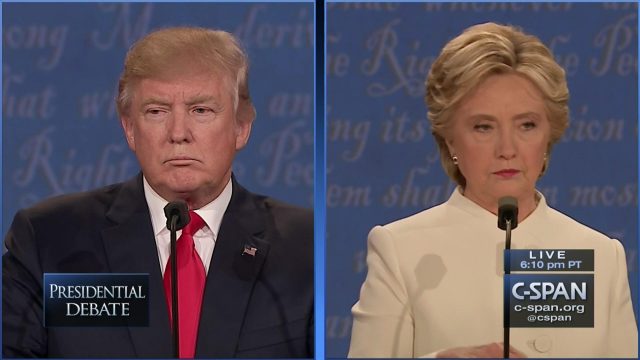
Donald Trump and Hillary Clinton in the third presidential debate in 2016, during which Clinton called Trump Vladimir Putin’s “puppet.”
By Robert Parry | Consortium News | December 15, 2017
If Russia-gate is the massive scandal that we are told it is by so many Important People — across the U.S. mainstream media and the political world — why do its proponents have to resort to lies and exaggerations to maintain the pillars supporting the narrative?
A new example on Thursday was The New York Times’ statement that a Russian agency “spent $100,000 on [Facebook’s] platform to influence the United States presidential election last year” – when the Times knows that statement is not true.
According to Facebook, only 44 percent of that amount appeared before the U.S. presidential election in 2016 (i.e., $44,000) and few of those ads addressed the actual election. And, we know that the Times is aware of the truth because it was acknowledged in a Times article in early October.
As part of that article, Times correspondents Mike Isaac and Scott Shane reported that the ads also covered a wide range of other topics: “There was even a Facebook group for animal lovers with memes of adorable puppies that spread across the site with the help of paid ads.”
As nefarious as the Times may think it is for Russians to promote a Facebook page about “adorable puppies,” the absurdity of that concern – and the dishonesty of the Times then “forgetting” what it itself reported just two months ago about the timing and contents of these “Russian-linked ads” – tells you a great deal about Russia-gate.
On Thursday, the Times chose to distort what it already knew to be true presumably because it didn’t want to make the $100,000 ad buy (which is not a particularly large sum) look even smaller and less significant by acknowledging the pre-election total was less than half that modest amount – and even that total had little to do with the election.
Why would the Times lie? Because to tell the truth would undercut the narrative of evil Russians defeating Hillary Clinton and putting Donald Trump in the White House – the core narrative of Russia-gate.
Another relevant fact is that Facebook failed to find any “Russian-linked” ads during its first two searches and only detected the $100,000 after a personal visit from Sen. Mark Warner, D-Virginia, the vice chairman of the Senate Intelligence Committee and a leading legislator on Internet regulation.
In other words, Facebook’s corporate executives dredged up something to appease Warner. That way, Warner and the Democrats could blame Russia for the Trump presidency, sparing further criticism of Clinton’s dreadful campaign (in which she labeled half of Trump’s voters “deplorables”) and her neo-liberal economic policies (and neo-conservative foreign policies) that have alienated much of America’s working class as well as many progressives.
Leaving Out Context
The Times also might have put the $100,000 in “Russian-linked” ads over a two-year period in the context of Facebook’s $27 billion in annual revenue, but the Times didn’t do that – apparently because it would make even the full $100,000 look like a pittance.
Trimming the total down to $44,000 and admitting that only a few of those ads actually dealt with Clinton and Trump would be even worse for the Russia-gate narrative.
Ironically, the Times’ latest false depiction of the $100,000 in ads as designed “to influence” the 2016 election appeared in an article about Facebook determining that other Russian-linked ads, which supposedly had a powerful effect on Great Britain’s Brexit vote, totaled just three ads at the cost of 97 cents. (That is not a misprint.)
According to Facebook, the three ads, which focused on immigration, were viewed some 200 times by Britons over four days in May 2016. Of course, the response from British parliamentarians who wanted to blame the Brexit vote on Moscow was to assert that Facebook must have missed something. It couldn’t be that many Britons had lost faith in the promise of the European Union for their own reasons.
We have seen a similar pattern with allegations about Russian interference in German and French elections, with the initial accusations being widely touted but not so much the later conclusions by serious investigations knocking down the claims. [See, for instance, Consortiumnews.com’s “German Intel Clears Russia on Interference.”]
The only acceptable conclusion, it seems, is “Russia Guilty!”
These days in Official Washington, it has become almost forbidden to ask for actual evidence that would prove the original claim that Russia “hacked” Democratic emails, even though the accusation came from what President Obama’s Director of National Intelligence James Clapper acknowledged were “hand-picked” analysts from the CIA, FBI and National Security Agency.
These “hand-picked” analysts produced the evidence-lite Jan. 6 “assessment” about Russia “hacking” the emails and slipping them to WikiLeaks – a scenario denied by both WikiLeaks and Russia.
When that “assessment” was released almost a year ago, even the Times’ Scott Shane noticed the lack of proof, writing: “What is missing from the [the Jan. 6] public report is what many Americans most eagerly anticipated: hard evidence to back up the agencies’ claims that the Russian government engineered the election attack. … Instead, the message from the agencies essentially amounts to ‘trust us.’”
But the Times soon “forgot” what Shane had inconveniently noted and began reporting the Russian “hacking” as accepted wisdom.
The 17-Agencies Canard
Whenever scattered expressions of skepticism arose from a few analysts or non-mainstream media, the doubts were beaten back by the claim that “all 17 U.S. intelligence agencies” concurred in the conclusion that Russian President Vladimir Putin had ordered the hacking to hurt Hillary Clinton and help Donald Trump. And what kind of nut would doubt the collective judgment of all 17 U.S. intelligence agencies!
Director of National Intelligence James Clapper talks with President Barack Obama in the Oval Office, John Brennan and other national security aides present. (Photo credit: Office of Director of National Intelligence)
Though the 17-agency canard was never true, it served an important purpose in establishing the Russia-gate groupthink. Wielding the “all 17 intelligence agencies” club, the U.S. mainstream media pounded politicians and policymakers into line, making any remaining skeptics seem more out of step and crazy.
So, in May 2017, when Clapper (along with former CIA Director John Brennan) admitted in congressional testimony that it wasn’t true that all 17 agencies concurred in the Russian hacking conclusion, those statements received very little attention in the mainstream media.
The New York Times among other major news outlets just continued asserting the 17-agency falsehood until the Times was finally pressured to correct its lie in late June, but that only led to the Times shifting to slightly different but still misleading wording, citing a “consensus” among the intelligence agencies without mentioning a number or by simply stating the unproven hacking claim as flat fact.
Even efforts to test the Russian-hack claims through science were ignored or ridiculed. When former NSA technical director William Binney conducted experiments that showed that the known download speed of one batch of DNC emails could not have occurred over the Internet but matched what was possible for a USB-connected thumb drive — an indication that a Democratic insider likely downloaded the emails and thus that there was no “hack” — Binney was mocked as a “conspiracy theorist.”
Even with the new disclosures about deep-seated anti-Trump bias in text messages exchanged between two senior FBI officials who played important early roles in the Russia-gate investigation, there is no indication that Official Washington is willing to go back to the beginning and see how the Russia-gate story might have been deceptively spun.
In a recently released Aug. 15, 2016 text message from Peter Strzok, a senior FBI counterintelligence official, to his reputed lover, senior FBI lawyer Lisa Page, Strzok referenced an apparent plan to keep Trump from getting elected before suggesting the need for “an insurance policy” just in case he did. A serious investigation into Russia-gate might want to know what these senior FBI officials had in mind.
But the Times and other big promoters of Russia-gate continue to dismiss doubters as delusional or as covering up for Russia and/or Trump. By this point – more than a year into this investigation – too many Important People have bought into the Russia-gate narrative to consider the possibility that there may be little or nothing there, or even worse, that it is the “insurance policy” that Strzok envisioned.
Investigative reporter Robert Parry broke many of the Iran-Contra stories for The Associated Press and Newsweek in the 1980s.
The Foundering Russia-gate ‘Scandal’
By Robert Parry | Consortium News | December 13, 2017
The disclosure of fiercely anti-Trump text messages between two romantically involved senior FBI officials who played key roles in the early Russia-gate inquiry has turned the supposed Russian-election-meddling “scandal” into its own scandal, by providing evidence that some government investigators saw it as their duty to block or destroy Donald Trump’s presidency.
As much as the U.S. mainstream media has mocked the idea that an American “deep state” exists and that it has maneuvered to remove Trump from office, the text messages between senior FBI counterintelligence official Peter Strzok and senior FBI lawyer Lisa Page reveal how two high-ranking members of the government’s intelligence/legal bureaucracy saw their role as protecting the United States from an election that might elevate to the presidency someone as unfit as Trump.
In one Aug. 6, 2016 text exchange, Page told Strzok: “Maybe you’re meant to stay where you are because you’re meant to protect the country from that menace.” At the end of that text, she sent Strzok a link to a David Brooks column in The New York Times, which concludes with the clarion call: “There comes a time when neutrality and laying low become dishonorable. If you’re not in revolt, you’re in cahoots. When this period and your name are mentioned, decades hence, your grandkids will look away in shame.”
Apparently after reading that stirring advice, Strzok replied, “And of course I’ll try and approach it that way. I just know it will be tough at times. I can protect our country at many levels, not sure if that helps.”
At a House Judiciary Committee hearing on Wednesday, Rep. Jim Jordan, R-Ohio, criticized Strzok’s boast that “I can protect our country at many levels.” Jordan said: “this guy thought he was super-agent James Bond at the FBI [deciding] there’s no way we can let the American people make Donald Trump the next president.”
In the text messages, Strzok also expressed visceral contempt for working-class Trump voters, for instance, writing on Aug. 26, 2016, “Just went to a southern Virginia Walmart. I could SMELL the Trump support. … it’s scary real down here.”
Another text message suggested that other senior government officials – alarmed at the possibility of a Trump presidency – joined the discussion. In an apparent reference to an August 2016 meeting with FBI Deputy Director Andrew McCabe, Strzok wrote to Page, “I want to believe the path you threw out for consideration in Andy’s office — that there’s no way he gets elected — but I’m afraid we can’t take that risk.”
It’s unclear what strategy these FBI officials were contemplating to ensure Trump’s defeat, but the comments mesh with what an intelligence source told me after the 2016 election, that there was a plan among senior Obama administration officials to use the allegations about Russian meddling to block Trump’s momentum with the voters and — if elected — to persuade members of the Electoral College to deny Trump a majority of votes and thus throw the selection of a new president into the House of Representatives under the rules of the Twelfth Amendment.
The scheme involved having some Democrats vote for former Secretary of State Colin Powell (which did happen), making him the third-place vote-getter in the Electoral College and thus eligible for selection by the House. But the plan fizzled when enough of Trump’s electors stayed loyal to their candidate to officially make him President.
After that, Trump’s opponents turned to the Russia-gate investigation as the vehicle to create the conditions for somehow nullifying the election, impeaching Trump, or at least weakening him sufficiently so he could not take steps to improve relations with Russia.
In one of her text messages to Strzok, Page made reference to a possible Watergate-style ouster of Trump, writing: “Bought all the president’s men. Figure I needed to brush up on watergate.”
As a key feature in this oust-Trump effort, Democrats have continued to lie by claiming that “all 17 U.S. intelligence agencies concurred” in the assessment that Russia hacked the Democratic emails last year on orders from President Vladimir Putin and then slipped them to WikiLeaks to undermine Hillary Clinton’s campaign.
That canard was used in the early months of the Russia-gate imbroglio to silence any skepticism about the “hacking” accusation, and the falsehood was repeated again by a Democratic congressman during Wednesday’s hearing of the House Judiciary Committee.
But the “consensus” claim was never true. In May 2017 testimony, President Obama’s Director of National Intelligence James Clapper acknowledged that the Jan. 6 “Intelligence Community Assessment” was put together by “hand-picked” analysts from only three agencies: the CIA, FBI and National Security Agency.
Biased at the Creation
And, the new revelations of high-level FBI bias puts Clapper’s statement about “hand-picked” analysts in sharper perspective, since any intelligence veteran will tell you that if you hand-pick the analysts you are effectively hand-picking the analysis.
Although it has not yet been spelled out exactly what role Strzok and Page may have had in the Jan. 6 report, I was told by one source that Strzok had a direct hand in writing it. Whether that is indeed the case, Strzok, as a senior FBI counterintelligence official, would almost surely have had input into the selection of the FBI analysts and thus into the substance of the report itself. [For challenges from intelligence experts to the Jan. 6 report, see Consortiumnews.com’s “More Holes in the Russia-gate Narrative.“]
If the FBI contributors to the Jan. 6 report shared Strzok’s contempt for Trump, it could explain why claims from an unverified dossier of Democratic-financed “dirt” on Trump, including salacious charges that Russian intelligence operatives videotaped Trump being urinated on by prostitutes in a five-star Moscow hotel, was added as a classified appendix to the report and presented personally to President-elect Trump.
Though Democrats and the Clinton campaign long denied financing the dossier – prepared by ex-British spy Christopher Steele who claimed to rely on second- and third-hand information from anonymous Russian contacts – it was revealed in October 2017 that the Democratic National Committee and the Clinton campaign shared in the costs, with the payments going to the “oppo” research firm, Fusion GPS, through the Democrats’ law firm, Perkins Coie.
That discovery helped ensnare another senior Justice Department official, Associate Attorney General Bruce Ohr, who talked with Steele during the campaign and had a post-election meeting with Fusion GPS co-founder Glenn Simpson. Recently, Simpson has acknowledged that Ohr’s wife, Nellie Ohr, was hired by Fusion GPS last year to investigate Trump.
Bruce Ohr has since been demoted and Strzok was quietly removed from the Russia-gate investigation last July although the reasons for these moves were not publicly explained at the time.
Still, the drive for “another Watergate” to oust an unpopular – and to many insiders, unfit – President remains at the center of the thinking among the top mainstream news organizations as they have scrambled for Russia-gate “scoops” over the past year even at the cost of making serious reporting errors.
For instance, last Friday, CNN — and then CBS News and MSNBC — trumpeted an email supposedly sent from someone named Michael J. Erickson on Sept. 4, 2016, to Donald Trump Jr. that involved WikiLeaks offering the Trump campaign pre-publication access to purloined Democratic National Committee emails that WikiLeaks published on Sept. 13, nine days later.
Grasping for Confirmation
Since the Jan. 6 report alleged that WikiLeaks received the “hacked” emails from Russia — a claim that WikiLeaks and Russia deny — the story seemed to finally tie together the notion that the Trump campaign had at least indirectly colluded with Russia.
This new “evidence” spread like wildfire across social media. As The Intercept’s Glenn Greenwald wrote in an article critical of the media’s performance, some Russia-gate enthusiasts heralded the revelation with graphics of cannons booming and nukes exploding.
But the story soon collapsed when it turned out that the date on the email was actually Sept. 14, 2016, i.e., the day after WikiLeaks released the batch of DNC emails, not Sept. 4. It appeared that “Erickson” – whoever he was – had simply alerted the Trump campaign to the public existence of the WikiLeaks disclosure.
Greenwald noted, “So numerous are the false stories about Russia and Trump over the last year that I literally cannot list them all.”
Yet, despite the cascade of errors and grudging corrections, including some belated admissions that there was no “17-intelligence-agency consensus” on Russian “hacking” – The New York Times made a preemptive strike against the new documentary evidence that the Russia-gate investigation was riddled with conflicts of interest.
The Times’ lead editorial on Wednesday mocked reporters at Fox News for living in an “alternate universe” where the Russia-gate “investigation is ‘illegitimate and corrupt,’ or so says Gregg Jarrett, a legal analyst who appears regularly on [Sean] Hannity’s nightly exercise in presidential ego-stroking.”
Though briefly mentioning the situation with Strzok’s text messages, the Times offered no details or context for the concerns, instead just heaping ridicule on anyone who questions the Russia-gate narrative.
“To put it mildly, this is insane,” the Times declared. “The primary purpose of Mr. Mueller’s investigation is not to take down Mr. Trump. It’s to protect America’s national security and the integrity of its elections by determining whether a presidential campaign conspired with a foreign adversary to influence the 2016 election – a proposition that grows more plausible every day.”
The Times fumed that “roughly three-quarters of Republicans still refuse to accept that Russia interfered in the 2016 election – a fact that is glaringly obvious to everyone else, including the nation’s intelligence community.” (There we go again with the false suggestion of a consensus within the intelligence community.)
The Times also took to task Sen. Lindsey Graham, R-South Carolina, for seeking “a Special Counsel to investigate ALL THINGS 2016 – not just Trump and Russia.” The Times insisted that “None of these attacks or insinuations are grounded in good faith.”
But what are the Times editors so afraid of? As much as they try to insult and intimidate anyone who demands serious evidence about the Russia-gate allegations, why shouldn’t the American people be informed about how Washington insiders manipulate elite opinion in pursuit of reversing “mistaken” judgments by the unwashed masses?
Do the Times editors really believe in democracy – a process that historically has had its share of warts and mistakes – or are they just elitists who think they know best and turn away their noses from the smell of working-class people at Walmart?
Investigative reporter Robert Parry broke many of the Iran-Contra stories for The Associated Press and Newsweek in the 1980s.
Russia-gate’s Litany of Corrections

By Robert Parry | Consortium News | December 11, 2017
The U.S. mainstream media’s year-long hysteria over Russia’s alleged role in the election of Donald Trump has obliterated normal reporting standards leading to a rash of journalistic embarrassments that have both disgraced the profession and energized Trump’s backers over new grievances about the MSM’s “fake news.”
Misguided groupthink is always a danger when key elements of the Washington establishment and the major news media share the same belief – whether that is Iraq’s supposed possession of WMD or the need to bring down some foreign or domestic leader unpopular with the elites.
Yet, we have rarely witnessed such a cascading collapse of journalistic principles as has occurred around the Russia-gate “scandal.” It is hard to keep track of all the corrections or to take note of all the dead ends that the investigation keeps finding.
But anyone who dares note the errors, the inconsistencies or the illogical claims is either dismissed as a “Kremlin stooge” or a “Trump enabler.” The national Democrats and the mainstream media seem determined to keep hurtling down the Russia-gate roadway assuming that the evidentiary barriers ahead will magically disappear at some point and the path to Trump’s impeachment will be clear.
On Friday, the rush to finally prove the Russia-gate narrative led CNN — and then CBS News and MSNBC — to trumpet an email supposedly sent from someone named Michael J. Erickson on Sept. 4, 2016, to Donald Trump Jr. that involved WikiLeaks offering the Trump campaign pre-publication access to purloined Democratic National Committee emails that WikiLeaks published on Sept. 13, nine days later.
With CNN finally tying together the CIA’s unproven claim that WikiLeaks collaborates with Russia and the equally unproven claim that Russian intelligence “hacked” the Democratic emails, CNN drew the noose more tightly around the Trump campaign for “colluding” with Russia.
After having congressional reporter Manu Raju lay out the supposed facts of the scoop, CNN turned to a panel of legal experts to pontificate about the crimes that the Trump campaign may have committed now that the “evidence” proving Russia-gate was finally coming together.
Not surprisingly the arrival of this long-awaited “proof” of Russian “collusion” exploded across social media. As The Intercept’s Glenn Greenwald noted in an article critical of the media’s performance, some Russia-gate enthusiasts heralded the CNN revelation with graphics of cannons booming and nukes exploding.
The problem, however, was that CNN and other news outlets that jumped on the story misreported the date of the email; it was Sept. 14, 2016, i.e., the day after WikiLeaks released the batch of DNC emails, not Sept. 4. In other words, it appeared that “Erickson” – whoever he was – was simply alerting the Trump campaign to the WikiLeaks disclosure.
CNN later issued a quiet correction to its inflammatory report – and not surprisingly people close to Trump cited the false claim as yet another example of “fake news” being spread by the mainstream media, which has put itself at the forefront of the anti-Trump Resistance over the past year.
But this sloppy journalism – compounded by CNN’s rush to put the “Sept. 4 email” in some criminal context and with CBS and MSNBC panting close behind – was not a stand-alone screw-up. A week earlier, ABC News made a similar mistake in claiming that candidate Donald Trump instructed Michael Flynn to contact Russian officials during the campaign, when Trump actually made the request after the election when Flynn was national security adviser-designate, a thoroughly normal move for a President-elect to make. That botched story led ABC News to suspend veteran investigative reporter Brian Ross.
Another inaccurate report from Bloomberg News, The Wall Street Journal and other news outlets – that Russia-gate special prosecutor Robert Mueller had subpoenaed Deutsche Bank records of President Trump and his family – was denied by Trump’s lawyer and later led to more corrections. The error apparently was that the bank records were not those of Trump and his family but possibly other associates.
A Pattern of Bias
But it wasn’t just a bad week for American mainstream journalism. The string of errors followed a pattern of earlier false and misleading reporting and other violations of journalistic standards, a sorry record that has been the hallmark of the Russia-gate “scandal.” Many stories have stirred national outrage toward nuclear-armed Russia before petering out as either false or wildly exaggerated. [See, for instance, Consortiumnews.com’s “Russia-gate Jumps the Shark.”]
As Greenwald noted, “So numerous are the false stories about Russia and Trump over the last year that I literally cannot list them all.”
The phenomenon began in the weeks after Trump’s shocking victory over Hillary Clinton as Democrats and the mainstream media looked for people to blame for the defeat of their much-preferred candidate.
So, on Thanksgiving Day, just weeks after the election, The Washington Post published a front-page story based on an anonymous group called PropOrNot accusing 200 Web sites of acting as propaganda agents for Russia. The list included some of the Internet’s leading independent news sources, including Consortiumnews, but the Post did not bother to contact the slandered Web sites nor to dissect the dubious methodology of the unnamed accusers.
Apparently, the “crime” of the Web sites was to show skepticism toward the State Department’s claims about Syria and Ukraine. In conflating a few isolated cases of “fake news” in which people fabricated stories for political or profitable ends with serious dissent regarding the demonizing of Russia and its allies, the Post was laying down a marker that failure to get in line behind the U.S. government’s propaganda on these and other topics would get you labeled a “Kremlin tool.”
As the Russia-gate hysteria built in the run-up to Trump’s inauguration during the final weeks of the Obama administration, the Post also jumped on a claim from the Department of Homeland Security that Russian hackers had penetrated into the nation’s electrical grid through Vermont’s Burlington Electric.
As journalist Gareth Porter noted, “The Post failed to follow the most basic rule of journalism, relying on its DHS source instead of checking with the Burlington Electric Department first. The result was the Post’s sensational Dec. 30 story under the headline ‘Russian hackers penetrated U.S. electricity grid through a utility in Vermont, U.S. officials say.’ …
“The electric company quickly issued a firm denial that the computer in question was connected to the power grid. The Post was forced to retract, in effect, its claim that the electricity grid had been hacked by the Russians. But it stuck by its story that the utility had been the victim of a Russian hack for another three days before admitting that no such evidence of a hack existed.”
The Original Sin
In other cases, major news outlets, such as The New York Times, reported dubious Russia-gate claims from U.S. intelligence agencies as flat fact, rather than unproven allegations that remain in serious dispute. The Times and others reported Russian “hacking” of Democratic emails as true even though WikiLeaks denied getting the material from the Russians and the Russians denied providing it.
For months into 2017, in dismissing or ignoring those denials, the U.S. mainstream media reported routinely that all 17 U.S. intelligence agencies concurred in the conclusion that Russia was behind the disclosure of Democratic emails as part of a plot initiated by Russian President Vladimir Putin to help elect Trump. Anyone who dared question this supposed collective judgment of all the U.S. intelligence agencies risked being called a “conspiracy theorist” or worse.
But the “consensus” claim was never true. Such a consensus judgment would have called for a comprehensive National Intelligence Estimate, which was never commissioned on the Russian “hacking” issue. Instead there was something called an “Intelligence Community Assessment” on Jan. 6 that – according to testimony by President Obama’s Director of National Intelligence James Clapper in May 2017 – was put together by “hand-picked” analysts from only three agencies: the CIA, FBI and National Security Agency.
Even after Clapper’s testimony, the “consensus” canard continued to circulate. For instance, in The New York Times’ White House Memo of June 25, correspondent Maggie Haberman mocked Trump for “still refus[ing] to acknowledge a basic fact agreed upon by 17 American intelligence agencies that he now oversees: Russia orchestrated the attacks, and did it to help get him elected.”
Finally, the Times ran a correction appended to that article. The Associated Press ran a similar “clarification” applied to some of its fallacious reporting which used the “17-intelligence-agencies” meme.
After the correction, however, the Times simply shifted to other deceptive wording to continue suggesting that U.S. intelligence agencies were in accord on Russian “hacking.” Other times, the Times just asserted the claim of Russian email hacking as flat fact. All of this was quite unprofessional, since the Jan. 6 “assessment” itself stated that it was not asserting Russian “hacking” as fact, explaining: “Judgments are not intended to imply that we have proof that shows something to be a fact.”
Even worse than the Times, the “fact-checking” site Politifact, which is part of Google’s First Draft Coalition for deciding what the search engine’s algorithms will promote as true and what information will be disappeared as false, simply decided to tough it out and continued insisting that the false “consensus” claim was true.
When actual experts, such as former National Security Agency technical director William Binney, sought to apply scientific analysis to the core claim about Russian “hacking,” they reached the unpopular conclusion that the one known download speed of a supposed “hack” was not possible over the Internet but closely matched what would occur via a USB download, i.e., from someone with direct access to the Democratic National Committee’s computers using a thumb drive. In other words, the emails more likely came from a DNC insider, not an external “hack” from the Russians or anyone else.
You might have thought that the U.S. news media would have welcomed Binney’s discovery. However, instead he was either ignored or mocked as a “conspiracy theorist.” The near-religious belief in the certainty of the Russian “hack” was not to be mocked or doubted.
‘Hand-picked’ Trouble
In recent days, former DNI Clapper’s reference to “hand-picked” analysts for the Jan. 6 report has also taken on a more troubling odor, since questions have been raised about the objectivity of the Russia-gate investigators and — as any intelligence expert will tell you — if you “hand-pick” analysts known for their personal biases, you are hand-picking the conclusion, a process that became known during the Reagan administration as “politicizing intelligence.”
Though little is known about exactly who was “hand-picked” by President Obama’s intelligence chiefs to assess the Russian “hacking” suspicions, Russia-gate special prosecutor Robert Mueller has been forced to reassign Peter Strzok, one of the top FBI investigators who worked on both the Hillary Clinton email-server case and the Trump-Russia inquiry, after it was discovered that he exchanged anti-Trump and pro-Clinton text messages with a lawyer who also works at the FBI.
Last week, Republicans on the House Judiciary Committee sought answers from new FBI Director Christopher Wren about Strzok’s role in clearing Hillary Clinton of criminal wrongdoing in her use of a private unsecured email server to handle official State Department communications while Secretary of State. They also wanted to know what role in the Russia-gate probe was played by a Democratic-funded “opposition research” report from ex-British intelligence officer Christopher Steele, which included unverified hearsay claims by unnamed Russians about Trump.
Wren avoided direct answers by citing an ongoing Inspector General’s review and Mueller’s criminal investigation, but Republicans expressed displeasure at this evasiveness.
The Republican questions prompted E.J. Dionne Jr., a liberal columnist at The Washington Post, to publish a spirited attack on the GOP committee members, accusing them of McCarthyistic tactics in questioning the FBI’s integrity.
Dionne’s straw man was to postulate that Republicans – because of this discovery of anti-Trump bias – would discount evidence that proves Trump’s collusion with Russia: “if Strzok played some role in developing [the] material. … Trump’s allies want us to say: Too bad the president lied or broke the law or that Russia tried to tilt our election. This FBI guy sending anti-Trump texts is far more important, so let’s just forget the whole thing. Really?”
But the point is that no such evidence of Russian collusion has been presented and to speculate how people might react if such evidence is discovered is itself McCarthyistic, suggesting guilt based on hypotheticals, not proof. Whatever one thinks of Trump, it is troubling for Dionne or anyone to imply treasonous activities based on speculation. That is the sort of journalistic malfeasance that has contributed to the string of professional abuses that pervades Russia-gate.
What we are witnessing is such an intense desire by mainstream journalists to get credit for helping oust Trump from office that they have forgotten that journalism’s deal with the public should be to treat everyone fairly, even if you personally disdain the subject of your reporting.
Journalists are always going to get criticized when they dig up information that puts some politician or public figure in a negative light, but that’s why it’s especially important for journalists to strive for genuine fairness and not act as if journalism is just another cover for partisan hatchetmen.
The loss of faith among large swaths of Americans in the professionalism of journalists will ultimately do severe harm to the democratic process by transforming information into just one more ideological weapon. Some would say that the damage has already been done.
It was, if you recall, the U.S. mainstream media that started the controversy over “fake news,” expanding the concept from the few low-lifes who make up stories for fun and profit into a smear against anyone who expressed skepticism toward State Department narratives on foreign conflicts. That was the point of The Washington Post’s PropOrNot story.
But now many of these same mainstream outlets are livid when Trump and his backers throw the same “fake news” epithet back at the major media. The sad truth is that The New York Times, The Washington Post, CNN, MSNBC and other leading news organizations that have let their hatred of Trump blind them from their professional responsibilities have made Trump’s job easy.
Investigative reporter Robert Parry broke many of the Iran-Contra stories for The Associated Press and Newsweek in the 1980s.
The Delusions of Washington-Riyadh Ruling Elite and the Journalists Who Feed Them
By Richard Silverstein | Tikun Olam | Dember 9, 2017

NYT’ pro-Israel talking heads: David Makovsky and Aaron David Miller
In the aftermath of Trump’s disastrous recognition of Jerusalem as Israel’s capital, the spin from Washington and Riyadh–and the journalists and think tank analysts only too eager be spun–has been outrageous. The level of sheer delusion is stupendous. This post will offer an anatomy of delusion and why it means only more suffering and bloodshed for both Arabs and Israelis.
The Times Shills for the Two-State Delusion
The NY Times, ever the newspaper of record for the élite and their paid emissaries, purports to debate whether the two-state solution remains viable in light of Trump’s seeming endorsement of Israeli sovereignty over Jerusalem. Who does Mark Landler quote as sources? Why, think tank talking heads who earn their keep from the Israel Lobby and its donors. Landler quotes no less than four sources affiliated with Lobby, all of whom endorse a two-state solution. And none of whom have ever offered any serious analysis or balanced discussion of the one-state solution: Martin Indyk, David Makovsky, Scott Anderson, and Daniel Levy.
How many Palestinian or Arab sources does he quote? One, Saeb Erekat. And he doesn’t quote anything original from Erekat. He merely quotes statements the Palestinian made to other media outlets. He begins with Erekat saying:
… Erekat… a steadfast advocate for a Palestinian state, said in an interview on Thursday that Mr. Trump and Prime Minister Benjamin Netanyahu of Israel “have managed to destroy that hope.” He embraced a radical shift in the P.L.O.’s goals — to a single state, but with Palestinians enjoying the same civil rights as Israelis, including the vote.
“They’ve left us with no option,” he said. “This is the reality. We live here. Our struggle should focus on one thing: equal rights.”
Once Landler lays this out, he must debunk it immediately. And he does:
Mr. Erekat’s change of heart is unlikely to change Palestinian policy. The dream of a Palestinian state is too deeply ingrained in a generation of its leaders for the Palestinian Authority to abandon it now. Israel would be unlikely to accede to equal rights, because granting a vote to millions of Palestinians would eventually lead to the end of Israel as a Jewish state.
Who is a NY Times reporter who knows little about what Palestinians believe, to say that a two-state solution is “too deeply ingrained” to be abandoned? And note who he points to as the arbiters of what Palestinians accept or believe? “Leaders,” by whom he means the doddering old kleptocratic octogenarians who have sold out the Palestinian cause for decades. Landler makes no attempt to reach out to Palestinian activists or academics or indigenous NGOs who know much better what the Palestinian street is thinking. Does Landler think that only leaders matter? Does he think leaders this corrupt and out of touch can merely wave a magic wand and four million Palestinians will follow them like the Pied Piper of Hamelin?
Further, why would Israel’s objections to “equal rights” and a one-state solution be a reason this doesn’t become the eventual resolution of the issue? Why do we assume that Israel will always be calling the shots? Did Serbia call the shots regarding Kosovo or Bosnia after NATO intervened? Why does the resistance of a nation which threatens to take the entire region to the brink of Armageddon become an immovable obstacle? The sheer chutzpah of such an assumption is enormous.
Later, the article offers the administration’s rebuttal of the Palestinian perspective on Trump’s proclamation:
Administration officials strenuously reject the argument that Mr. Trump has foreclosed a two-state solution… He studiously avoided taking a position on the eventual borders or sovereignty of Jerusalem.
That is either an ignorant or disingenuous statement. When you recognize Israeli sovereignty over Jerusalem (not over “west Jerusalem,” as Trump could have said) and you omit any reference to Palestinian sovereignty over East Jerusalem, then you’ve taken a crystal clear position on borders and sovereignty. You’ve said Israel has sovereignty and the Palestinians don’t. If you believe otherwise, you’re a fool or a villain (or both).
Then Landler chimes in with an affirmation of Trump’s claims of even-handedness:
Beyond the president’s words, there were other signs he is serious about his intentions. On the same day that he signed his name with a John Hancock-like flourish to a proclamation recognizing Jerusalem as the capital, he quietly signed another document that will delay the move of the American Embassy to the city for at least six months — and probably much longer.
How does Trump’s recognition that he can’t immediately move the embassy for a thousand logistical reasons equate to Trump being “serious in his intentions” to be fair and balanced in weighing the claims of Palestinians? Should Palestinians view the delay in moving the embassy as a gift to them? Something that has any real benefit or meaning to them?
At this point, Landler gives voice to his first pro-Israel talking head, Martin Indyk, who makes this blindingly astute observation:
“Avoiding a move of the embassy is a way of avoiding geographic definition,” said Martin S. Indyk, a former American ambassador to Israel. “Avoiding any geographic definition of their recognition of Jerusalem looks like their effort to keep the peace process alive.”
It’s hardly much of an affirmation by Indyk of Trump’s peace process. But he does seem to believe that by not moving the embassy, the U.S. believes it’s offered the Palestinians something. When of course, it’s nothing and will have no value to any Palestinian.
Landler’s coup de grâce in terms of marshalling pro-Israel analysts is David Makovsky. And his comments have to be read to be believed:
… Some longtime Middle East observers said Mr. Erekat’s talk of a one-state solution reflected anger rather than a watershed change in the Palestinian position. Given Israel’s probable rejection of equal rights, American and Israeli supporters of a two-state solution said that option, for all intents and purposes, remained the only game in town.
“I don’t want to minimize the hurt the Palestinians feel,” said David Makovsky, a senior fellow at the Washington Institute for Near East Policy. “But there was a duality to Trump’s message that has gotten lost.”
Mr. Trump, he said, was not closing the door to negotiations on borders and sovereignty. “Both parts should be heard,” he said. While he questioned the timing of the move, he said the Palestinians could return to the table when tempers cool.
“Right now their anger is such that they probably can’t hear this,” Mr. Makovsky said. “But if he presents a plan in the first quarter, are you not going to want to hear what it is? The Palestinians still think Trump’s enough of a bulldozer that if he gave something to the Israelis on a Wednesday, he’s capable of giving something to the Palestinians on a Thursday.”
It’s quite amazing that a pro-Israel shill like Makovsky who knows the two-state solution is dead and knows that no one in power in Israel or the U.S. believes in it, can still sell a journalist like Landler a bill of goods. And note that Landler only quotes analysts who support a two-state solution and a PLO official who also has supported it till now. There are no sources here offering an alternative point of view. None. Which means this article is journalism in bad faith, whether the reporters who compiled it were aware of this bias or not.
Note that the strongest adjective Makovsky can muster to describe Palestinians emotions is “hurt.” No, hurt is when you skin your knee or sprain your pinkie. What Trump did to Palestinians is more like a shot to the gut; a paralyzing blow that deprives them of any hope and drives them into the arms of radical extremists.
I also like Makovsky’s assurance that Palestinians will return to talks once their hot-headed tempers cool down. Those pesky Palestinians always let their tribal emotions get the better of them. If they could only realize they have no choice. That what Trump offers is as good as they’re going to get. Then they’d get down to business.
The sheer ignorance of Makovsky assuming that the Palestinians will have natural curiosity about Trump’s offer and want to come back to the table to hear it is amazing. Why would Palestinians care what Trump offered them? Why would they attribute any value to it given his current and past statements? And just what does Makovsky believe Trump is going to give the Palestinians on that proverbial Thursday?
Finally, Landler ends his piece quoting the “liberal” pundit of the bunch, the guy the reporter probably feels covers his bases on the left, Daniel Levy. The only problem is that Levy isn’t “on the left.” He’s a liberal Zionist, neither progressive or leftist. And Levy too supports a two state solution. So where is the diversity of opinion this subject demands?
“It’s hard to see how you can go down that route without at some stage divesting yourself of a semblance of a self-governing authority,” said Daniel Levy, the London-based president of the U.S./Middle East Project. “You’ve got to call time on the Palestinian Authority, which never became a state.”
Instead, Mr. Levy said he believed that the peace process, and the Palestinians, were in a “transitional period,” in which the two-state solution had failed for now. But he added, “what people have done can be undone.”
Got that? Two states are dead “for now.” But not forever. That should give Palestinians hope that at some point in the vague future we men of good faith can revive it; or rather pull it out of the dustheap of failed Middle East plans, dust it off, and pretend it’s as good as new.
And what does Levy mean “what’s done can be undone?” How do you undo the death of thousands? How do you undo fierce rage against a sociopathic American president and his narcissistic Saudi and Israeli buddies who believe they can put the Palestinians on ice and ignore their legitimate claims to land, rights and nation?
The Saudi Delusion
Speaking of the Saudis, this Reuters story conveys the views of the ruling Crown Prince on these matters. If anything, they’re even more delusional than Trump or Netanyahu’s views. Before I offer a sampling, it’s worth hearing about the plan Trump is offering (and which the Saudis are endorsing):
As told to Abbas, the proposal included establishing “a Palestinian entity” in Gaza as well as the West Bank administrative areas A and B and 10 percent of area C, which contains Jewish settlements, a third Palestinian official said.
Jewish settlements in the West Bank would stay, there would be no right of return, and Israel would remain responsible for the borders, he said.
The proposal appears to differ little from existing arrangements in the West Bank, widening Palestinian control but falling far short of their minimum national demands.
A Palestinian entity. Not even a state. And even if someone wanted to call it a state, it wouldn’t be. It would be a bantustan of Palestinian villages surrounded by massive Israeli settlements. If the proposal essentially ratifies a rotten status quo, why would any Palestinian be willing to accept it?
Here is the real zinger, displaying the absolute cluelessness of the Saudis involved with this charade:
A Saudi source said he believed an understanding on Israeli-Palestinian peace would nonetheless begin to emerge in the coming weeks.
“Do not underestimate the businessman in (Trump). He has always called it the ultimate deal,” the source said, declining to be named because of the sensitivity of the subject.
“I don’t think our government is going to accept that unless it has something sweetened in the pipeline which (King Salman and the crown prince) could sell to the Arab world – that the Palestinians would have their own state.”
In other words, because Trump offers some blather about an ultimate deal, but refuses to offer the Palestinians any details other than assure them it would be “something they would like,” then we’re to assume that it would be “sweet” enough for MbS to sell (the Saudi’s apt words, not mine) to the Palestinians. I don’t know who’s worse, Trump or MbS. It’s worse than the blind leading the blind. It’s the deaf, dumb, and blind leading the deaf, dumb and blind.
The Reuters article too suffers from a surfeit of sources who cynically ratify the status quo and the consensus as defined by the Middle East and Beltway elites:
Most Arab states are unlikely to object to Trump’s announcement because they find themselves more aligned with Israel than ever, particularly on countering Iran, said Shadi Hamid, senior fellow at Brookings Institution in Washington,
“If Saudi officials, including the crown prince himself, were particularly concerned with Jerusalem’s status, they would presumably have used their privileged status as a top Trump ally and lobbied the administration to hold off on such a needlessly toxic move,” he wrote in an article published in The Atlantic.
“It’s unlikely Trump would have followed through if the Saudis had drawn something resembling a red line.”
Even if this is true (and it very possibly is), why doesn’t anyone bother to say the obvious: that if the Saudis wish to betray the Palestinians and abandon their role as guardians of the region’s Muslim holy places (including Jerusalem), they themselves will be abandoned by the Arab and Muslim world. Why do the eminences grise think that the Saudis can act in any way they choose without paying any consequences in terms of regional influence?
In truth, the Saudis will make themselves irrelevant if they force this deal down the Palestinians throat. They will force those Palestinians who reject it to turn to Iran and its Shiite allies like Hezbollah. They will turn Hamas into leaders of the Palestinian resistance after the PA has abandoned its responsibility to defend Palestinian rights. Even those Sunni states like Jordan or Egypt who might feel compelled to go along with the Saudi plan, will do so with tepid enthusiasm. And at the first sign of failure, they will bolt from the stables like horses staring at a forest fire. Leaving MbS alone with his buddies, Trump and Netanyahu (who by then may be long gone as prime minister–perhaps even behind bars).
Trump Team Didn’t Just Collude with Israel, Kushner was Acting as Foreign Agent for Tel Aviv

By Patrick Henningsen | 21st Century Wire | December 7, 2107
Much was made this week in the American media about Michael Flynn’s recent guilty plea to making false statements to the FBI, as part of Special Counsel Robert Mueller’s never-ending “Russia probe.”
Although court documents show Flynn has acknowledged to previously giving false statements in reference to reaching out to Russia’s ambassador to the US, Sergey Kislyak – the mere act of reaching out to foreign officials is neither illegal, nor is it a violation of ethics. This is normal practice for members of any incoming US administration. Even if Flynn had promised to the Russian Ambassador, as claimed this week by Resistance leader Rep. Elijah E. Cummings of Maryland, that a Trump government would “rip-up sanctions,” such a promise by Flynn would not be unlawful. Anyone can make a promise, we should point out here that neither Flynn, nor Donald Trump would be in any position to make good on such a promise without the blessing of the US Congress and Senate. Just look at what happened when Trump took office. Were any sanctions lifted?
That said, after 18 months of fabricating fake news about Russian hacking, Russian meddling and Russian collusion, it’s not surprising that the New York Times would get the Flynn story wrong too, and on an even bigger scale than many of their past made-up stories about Trump scandals. Here we have yet another hand-wringing Resistance writer, Harry Litman, claiming that Flynn’s testimony will go in down history next to Watergate and Iran-Contra:
“The repercussions of the plea will be months in the making, but it’s not an exaggeration to say that the events to which Mr. Flynn has agreed to testify will take their place in the history books alongside the Watergate and Iran-contra scandals.”
He might be right, if only the media coverage and the federal hearing would focus on the correct country with whom the Trump team was colluding, which unfortunately was not Russia. Funny how partisan writer Litman did not even mention the word Israel once in his report. In fact, we can now better see why certain persons in Washington like Adam Schiff and John McCain, along with their corrupt media counterparts like CNN, the Washington Post and the New York Times have been incessantly pushing their fictional “Russia did it” narrative for the last 18 months – because Russiagate served as a convenient cover for Israelgate.
Mehdi Hassan from The Intercept writes:
“… Why aren’t more members of Congress or the media discussing the Trump transition team’s pretty brazen collusion with Israeli Prime Minister Benjamin Netanyahu to undermine both U.S. government policy and international law? Shouldn’t that be treated as a major scandal? Thanks to Mueller’s ongoing investigation, we now know that prior to President Donald Trump’s inauguration, members of his inner circle went to bat on behalf of Israel, and specifically on behalf of illegal Israeli settlements in the occupied Palestinian territories, behind the scenes and in opposition to official U.S. foreign policy. That’s the kind of collusion with a foreign state that has gotten a lot of attention with respect to the Kremlin – but colluding with Israel seems to be of far less interest, strangely.”
Yes, you heard that right. This was at minimum collusion with Israel. But it goes much deeper than that. If this story is accurate, and we every reason to believe it is (especially by the large silence in the American media, usually a positive indication of media avoidance), this would indicate that the then President-elect’s close advisor and son-in-law, Jared Kushner, was clearly acting as a foreign agent – on behalf of the state of Israel.
Granted, this is a very serious charge – which comes with some serious consequences if Kushner would ever be indicted, but the facts clearly demonstrate beyond any reasonable doubt, that then President-elect’s son-in-law was using his proximity to the incoming Commander and Chief to execute a series of highly sensitive foreign policy maneuvers at the request of a foreign country.
The history of Israeli spying and outright meddling in US affairs is no secret to anyone willing to research it (unofficially a forbidden topic in US mainstream media), but this latest episode with Trump and Kushner is even more disturbing considering this week’s East Jerusalem announcement.
Beyond this, many will argue that the radical fundamentalist Zionist agenda which Kushner is aggressively pursuing on behalf of Tel Aviv is not in the interest of the wider Middle East, nor is it good for America’s European partners, and may even contribute to a further destablization of the region – as evidenced by recent violence which has erupted following Trump’s provocative move. That result is not necessarily in America’s interests, even if it is certainly in Israel’s interests.
Author Mehdi Hassan continues:
Here’s what we learned last week when Mueller’s team unveiled its plea deal with Trump’s former national security adviser, retired Gen. Michael Flynn. In December 2016, the United Nations Security Council was debating a draft resolution that condemned Israeli settlement expansion in the occupied territories as a “flagrant violation under international law” that was “dangerously imperiling the viability” of an independent Palestinian state.
The Obama administration had made it clear that the U.S. was planning to abstain on the resolution, while noting that “the settlements have no legal validity” and observing how “the settlement problem has gotten so much worse that it is now putting at risk the … two-state solution.” (Rhetorically, at least, U.S. opposition to Israeli settlements has been a long-standing and bipartisan position for decades: Ronald Reagan called for “a real settlement freeze” in 1982 while George H.W. Bush tried to curb Israeli settlement-building plans by briefly cutting off U.S. loan guarantees to the Jewish state in 1991.)
Everyone expected that the upcoming UN vote on illegal Israeli settlements was going to be a divisive issue, but with only weeks before Trump’s fast approaching inauguration, Israel had its trojan horse in position. Hassan goes on to explain Tel Aviv’s covert mechanism for manipulate the UN vote:
“On or about December 22, 2016, a very senior member of the Presidential Transition Team directed Flynn to contact officials from foreign governments, including Russia, to learn where each government stood on the resolution and to influence those governments to delay the vote or defeat the resolution,” reads the statement of offense against Flynn, who pleaded guilty to lying to the FBI about his conversations with the Russian ambassador to the U.S. “On or about December 22, 2016, Flynn contacted the Russian Ambassador about the pending vote. Flynn informed the Russian Ambassador about the incoming administration’s opposition to the resolution, and requested that Russia vote against or delay the resolution.”

So who was this very senior member of Trump’s team who sought to execute orders from the office of Israeli President Benjamin Netanyahu? Hassan explains:
Who was the “very senior member” of the transition team who “directed” Flynn to do all this? Multiple news outlets have confirmed that it was Jared Kushner, Trump’s son-in-law and main point man on the Middle East peace process. “Jared called Flynn and told him you need to get on the phone to every member of the Security Council and tell them to delay the vote,” a Trump transition official revealed to BuzzFeed News on Friday, adding that Kushner told Flynn “this was a top priority for the president.”
According to BuzzFeed : “After hanging up, Flynn told the entire room [at the Trump transition team HQ] that they’d have to start pushing to lobby against the U.N. vote, saying ‘the president wants this done ASAP.’” Flynn’s guilty plea, BuzzFeed continued, revealed “for the first time how Trump transition officials solicited Russia’s help to head off the UN vote and undermine the Obama administration’s policy on Middle East peace before ever setting foot in the White House.”
Even during the height of the Neocon era, with multiple Israeli loyalists in the cabinet (including some dual passport holders) shaping White House Middle East policy – ultimately into a ditch with Iraq, the level of manipulation wasn’t this overt. Trump’s decision to reverse successive US administrations’ new policy on East Jerusalem is inconceivable, if not for some other x-factor which even the PNAC-dominated George W. Bush could not manage.
The facts of the case against Kushner have not been contested, and in fact Kushner has even been gloating out on the speaking circuit, with his doting wife Ivanka proudly advertizing her husband’s ‘accomplishment’ on behalf Israel.
“None of this has been contested. In fact, on Sunday, Kushner made a rare public appearance at the Saban Forum in Washington, D.C., to discuss the Trump administration’s plans for the Middle East and was welcomed by the forum’s sponsor, the Israeli-American billionaire Haim Saban, who said he “personally wanted to thank” Kushner for “taking steps to try and get the United Nations Security Council to not go along with what ended up being an abstention by the U.S.” Kushner’s response? The first son-in-law smiled, nodded, and mouthed “thank you” to Saban.
Meanwhile, the Israelis have been pretty forthcoming about their own role in all of this, too. On Monday, Ron Dermer, Israel’s ambassador to the U.S. and a close friend and ally of Netanyahu, told Politico’s Susan Glasser that, in December 2016, “obviously we reached out to [the Trump transition team] in the hope that they would help us,” and “we were hopeful that they would speak” to other governments “in order to prevent this vote from happening.”
According to these reports, Kushner was using his position in the transition team to act on Israel’s behalf – outside of any governmental framework of accountability. If Flynn is guilty of anything, it would be going also with Kushner’s Israel First scheme ahead of the United Nations vote. What is odd though, is why the entire US mainstream media is not interested in this part of the story. Even the Never Trump “Resistance” seem to be afraid of taking this narrative on. I guess even the Resistance has its limits. Rather than go for a case where the evidence is sitting right there on a silver Salva, instead they will go for the Russian conspiracy theory. Alas, old habits die hard.
This series of events is all the more pertinent when considering this week’s announcement by President Trump that the US is to recognize Jerusalem as the capital of Israel, and with be moving its embassy from Tel Aviv to East Jerusalem. Many are already calling this “the kiss of death” to the Israel-Palestine peace process. In a predictable succession of events, the Jerusalem provocation was a fait accompli after Trump had announced in October that the US would be withdrawing from support for UNESCO, the UN body which is meant to help maintain the neutrality of Jerusalem as an internationally protected area. The Trump administration justified its resignation from the key UN agency on the ground that is “biased against Israel.” But the neutrality of Jerusalem is an essential policy for maintaining peace in a less than ideal situation with Palestine still under a brutal military occupation by an illegitimate and illegal (by international law and successive UN Resolutions) Israeli jackboot.
In addition to all this, this past summer the United States announced the establishment of a permanent military installation inside of Israel. What’s scary is how many people do not know this has happened.
So Trump’s éminence grise, the wunderkind, who some people have called the President In-Law, is really Israel’s man inside the White House.
What is Jared Kushner’s experience in international affairs and diplomacy that he has been charged with negotiating Middle East affairs for the United States of America? His only visible qualification is that he’s married to the President’s daughter. That’s really it.
Credit where credit’s due though. Aside from marrying into the dynasty, Kushner is also the former owner of a mediocre website, The New York Observer, and has also managed to parlay his family status to help finance a number of high-profile New York City property deals (no doubt with the help of his father-in-law),
Isn’t that what Kushner is doing now – using his inherited clout to help “close friend” Benjamin Netanyahu secure a highly illegal property deal in the Middle East, with the United States as the guarantor? It certainly looks that way. The question is, will anyone in the US do anything about it?
When this latest episode of hubris by the White House and Israel eventually unravels, the public and the media might then turn on Kushner and Trump, but by then the damage will have already been done.
Until then, Netanyahu can feel safe in the knowledge that Israel, not Washington, is currently in control of US foreign policy.
One final note to brave Never Trump Resistance: if any foreign state actor is blackmailing this President or the White House, it’s probably not Russia.
***
Author Patrick Henningsen is an American writer and global affairs analyst and founder of independent news and analysis site 21st Century Wire, and is host of the SUNDAY WIRE weekly radio show broadcast globally over the Alternate Current Radio Network (ACR). He has written for a number of international publications and has done extensive on-the-ground reporting of the conflict Syria, Iraq and the Middle East.
The Tangled Threads of Russia-gate
By Robert Parry | Consortium News | December 5, 2017
A curious feature about the Russia-gate “scandal” is that its proponents ignore the growing number of moments when their evidence undercuts their narrative. Instead, they press ahead toward a predetermined destination in much the way that true-believing conspiracy theorists are known to do.
For instance, The New York Times ran a story on Monday, entitled “Operative Offered Trump Campaign Access to Putin,” detailing how a conservative operative “told a Trump adviser that he could arrange a back-channel meeting between Donald J. Trump and Vladimir V. Putin, the Russian president, according to an email sent to the Trump campaign” — and apparently described to the Times by a helpful source on Capitol Hill.
The Times quoted the email from National Rifle Association member Paul Erickson to Trump campaign adviser Rick Dearborn as saying, “Putin is deadly serious about building a good relationship with Mr. Trump. … [Putin] wants to extend an invitation to Mr. Trump to visit him in the Kremlin before the election.”
An NRA conference in Louisville, Kentucky, was supposed to be the location for the “first contact” between the Russians and the Trump campaign, according to the email.
The Times treated its new information as further confirmation of nefarious connections between the Trump campaign and the Russian government. Immediately after introducing this May 2016 email, which had the subject line, ”Kremlin Connection,” the Times reprised the background of former FBI Director Robert Mueller conducting a special-prosecutor investigation into “Russian interference in the election and possible collusion with the Trump campaign.”
Note how the Times’ reference to “Russian interference” was treated as flat fact although the Times still hedges on “possible collusion” between the Kremlin and the Trump campaign. Like much of the U.S. mainstream media, the Times no longer bothers to use “alleged” in front of “Russian interference” even though no solid evidence of a coordinated Kremlin effort has been presented.
But there is a bigger problem with this “scoop”: If the Russia-gate narrative were correct – that the Kremlin had identified Trump years earlier as a likely U.S. president and undertook a multi-year campaign to bribe and blackmail him to be Moscow’s Manchurian candidate or Putin’s “puppet” as Hillary Clinton charged – the Russians wouldn’t need some little-known “conservative operative” to serve as an intermediary in May 2016 to set up a back-channel meeting.
The Contradiction
In other words, assuming that the Times’ story is correct, the email suggests the opposite of the impression that the Times wants its readers to get. The email is either meaningless in that it led to no actual meeting or it contradicts the storyline about a longstanding Russian operation to plant a patsy in the White House.
Times reporter Nicholas Fandos noted that it was unclear what Dearborn did in response to this overture, although the Times reported that Dearborn had forwarded a similar proposal by Christian conservative activist Rick Clay to Trump’s son-in-law Jared Kushner, who rebuffed the offer.
On Monday, I read the rest of the Times email story looking for some acknowledgement of the problems with its implied scenario, but found none. Fandos made references to other low-level efforts by Russians to make contact with Trump’s advisers (without noticeable success, I might add), but again these examples actually run counter to the image of Trump as the Kremlin’s prized chump.
If Putin had several years ago foreseen what no one else did – that Trump would become the U.S. president – then these ad hoc contacts with members of Trump’s entourage in 2016 would not have been needed.
The Times’ scoop parallels the story of the plea deal that Russia-gate prosecutors struck with low-level Trump foreign policy adviser George Papadopoulos who admitted lying about his contacts with an obscure academic in Stirling, Scotland, who supposedly offered to be another intermediary between Trump’s team and the Kremlin.
According to court documents, Papadopoulos, a 30-year-old campaign aide, got to know a professor of international relations who claimed to have “substantial connections with Russian government officials,” with the professor identified in press reports as Joseph Mifsud, who is associated with the University of Stirling.
The first contact between Mifsud and Papadopoulos supposedly occurred in mid-March 2016 in Italy, with a second meeting in London on March 24 when the professor purportedly introduced Papadopoulos to a Russian woman whom the young campaign aide believed to be Putin’s niece, an assertion that Mueller’s investigators determined wasn’t true.
Trump, who then was under pressure for not having a foreign policy team, included Papadopoulos as part of a list drawn up to fill that gap, and Papadopoulos participated in a campaign meeting on March 31 in Washington at which he suggested a meeting between Trump and Putin, a prospect that other senior aides reportedly slapped down.
In other words, at least based on the reporting about the Dearborn email and the Papadopoulos overture, there is no reason to believe that Trump was colluding with Moscow or had any significant relationship at all.
If these developments point to anything, it is to the opposite; that Russia was fishing for some contacts with what – however implausibly – was starting to look like a possible future U.S. president, but with whom they were not well-connected.
Gotcha Moments
There have been similar problems with other Russia-gate “gotcha” moments, such as disclosures of a possible Trump hotel deal in Moscow with Mikhail Fridman of Russia’s Alfa Bank. Though Trump’s presumed financial tie-ins to Russian oligarchs close to Putin were supposed to be fundamental to the Russia-gate narrative, the outcome of the hotel deal turned out to be a big nothing.
One source knowledgeable about the proposed deal told me it fell apart because Trump was willing to put little on the table beyond the branding value of the Trump name. However, if Putin were actually trying to buy Trump’s loyalty, money presumably would have been no obstacle. Indeed, you would think that the more money used to line Trump’s pockets the better. But the hotel deal collapsed; there is no Trump hotel in Moscow.
Other Russia-gate cases are equally disconnected from what had been the original narrative about senior Russians spending years cultivating Trump as their Manchurian candidate.
The accusations against Trump’s onetime campaign chief Paul Manafort focus on his alleged failure to report income from — and pay taxes on — work that he did for the elected government of Ukraine before any involvement in the Trump campaign.
Last week’s guilty plea from former National Security Adviser Michael Flynn related to purportedly false statements and omissions that he made when questioned by FBI agents about calls to Russian Ambassador Sergey Kislyak during the transition, i.e., after Trump had been elected.
Despite the breathless coverage on MSNBC and the Times’ excited headlines about how the “inquiry grows,” there remain other core problems for the narrative. No matter how often the U.S. mainstream media asserts the suspicion of Russian “hacking” of Democratic emails as flat fact, no solid proof has yet been presented – and the claim has been denied by both the Russian government and WikiLeaks, which published the key emails.
Sleight of Hand
The Times and other mainstream media outlets play their sleight of hand on this key point by asserting that “U.S. intelligence agencies” have “concluded” that Russian intelligence services “hacked” the emails from the Democratic National Committee and Clinton’s campaign chief John Podesta, but that summary ignores the specifics.
First of all, by using this summary of the facts, the Times and other outlets continue to give the false impression that all 17 U.S. intelligence agencies concurred in the conclusion, a false claim that Hillary Clinton and the mainstream press have asserted over and over, although it is now clear that no such consensus ever existed.
Former Director of National Intelligence James Clapper testified that the Jan. 6 report on alleged Russian interference was produced by “hand-picked” analysts from only three organizations: the FBI, CIA and National Security Agency.
And, even those “hand-picked” analysts stipulated that they were not asserting Russian guilt as fact but only as their best guess. They included the disclaimer: “Judgments are not intended to imply that we have proof that shows something to be a fact. Assessments are based on collected information, which is often incomplete or fragmentary, as well as logic, argumentation, and precedents.”
Even New York Times reporter Scott Shane initially noted the absence of evidence, writing: “What is missing from the public report is what many Americans most eagerly anticipated: hard evidence to back up the agencies’ claims that the Russian government engineered the election attack. … Instead, the message from the agencies essentially amounts to ‘trust us.’”
Former senior U.S. intelligence officials, including the NSA’s ex-technical director William Binney, have raised further doubts about whether a “hack” occurred. Binney conducted tests on download speeds and determined that the extraction of one known batch of Democratic emails was not possible over the Internet, but did match the speed of a USB download onto a thumb drive, suggesting a leak from a Democratic insider.
So, rather than the many disparate strings of Russia-gate coming neatly together more than a year after last year’s election, the various threads either are becoming hopelessly tangled or flying off in different directions.
Investigative reporter Robert Parry broke many of the Iran-Contra stories for The Associated Press and Newsweek in the 1980s.
Even Russian Dissidents Say Americans Have Gone Crazy Over Putin
By Glen Ford | Black Agenda Report | November 30, 2017
The New York Times last week opened its pages to critics of the U.S. corporate media’s obsession with Vladimir Putin’s endlessly alleged, but never proven, campaign to subvert “American democracy.” After a year of unrelenting anti-Kremlin propaganda, the Times briefly lifted its curtain of censorship to allow a counter-narrative on “Russiagate” – but only for one discreet group: Russian “dissidents.” (See “Why Putin’s Foes Deplore U.S. Fixation on Election Meddling,” November 23.)
These “pro-Western liberals who look to the United States as an exemplar of democratic values and journalistic excellence,” as the Times describes them, are dismayed, insulted and angry at the non-stop lunacy churned out by U.S. media. If the Times, the Washington Post, CNN and most of the Democratic Party are to be believed, President Putin is a superman, “an almighty force from a James Bond saga,” said Leonid M. Volkov, chief of staff for anti-Putin politician Aleksei A. Navalny . How could the Russian opposition ever hope to overcome such a titan — a man who can wreck the political order in the world’s reigning superpower with the expenditure of only $100,000 on Facebook? “This image is very bad for us,” Volkov told the Times. “Putin is not a master geopolitical genius.”
Putin has been made to look “invincible,” said Michael Idov, a Russian-American screenwriter (the closest the Times got to giving a fellow American the opportunity to challenge the corporate Russiagate obsession).
The New York Times has cultivated a cabal of pro-western Russian politicians ever since Bill Clinton’s presidency, when U.S. bankers helped to create the Russian oligarchy with assets stolen from the wreckage of the Soviet state. Vladimir Putin is credited with taming the oligarchs, who nevertheless remain embedded in the nation’s infrastructure. The politicians the Times calls “dissidents” hate Putin, but they are also proud to be Russian, and cannot abide U.S. scape-goating of their nation. The Americans sound crazy. “What is happening with ‘the investigation into Russian interference,’ is not just a disgrace but a collective eclipse of the mind,” said Volko.
It is obvious to every politically aware Russian that Donald Trump and his team of incompetents met with hardly any Russians of consequence on his trips to that country — mostly wannabes and hustlers. But, U.S. audiences can’t distinguish one Russian from the other, and know only one Russian face: Putin’s.
Journalist Oleg V. Kashin, a Kremlin critic, said: “The image of Putin’s Russia constructed by Western and, above all, American media outlets over the past 18 months shocks even the most anti-Putin reader in Russia.” Times correspondent Higgins reports that Kashin “complained that the American media has consistently misconstrued the way Russia works, presenting marginal opportunists and self-interested businessmen with no real link to the Kremlin as state-controlled agents working on orders from Mr. Putin.”
The New York Times and the Washington Post know their way around Moscow — and if they don’t, the CIA will give them directions. Indeed, their friends, the Russian “dissidents,” would have been glad to advise the U.S. media on Russiagate, but that would have made a boring story about small time sleaze in a cold climate. What the U.S. War Party needed was a new cold war to accompany Washington’s global military offensive.
U.S. “liberals” and “progressives” hate Trump more than they value peace, and are not nearly as smart as they think they are. Professor of history Ivan I. Kurilla, who specializes in American studies at the European University in St. Petersburg, said anti-Trump Americans want to foist him on Russia — politically exiling the Orange Menace to somebody else’s country. “American liberals are so upset about Trump that they cannot believe he is a real product of American life,” said Kurilla. “They try to portray him as something created by Russia. This whole thing is about America, not Russia.”
The Times’ Russian dissident friends despise RT, the state-supported Russia news agency, but are worried about Washington’s demand that RT register as a foreign agent. Until only a few years ago, U.S. NGOs were hyper-active in Russia, spending millions to create and subsidize opposition to Putin’s United Russia party, hoping to foment a “color” revolution. Western-oriented political actors in Russia fear that Russiagate will provoke a Kremlin crackdown on activists that are too closely identified with the U.S. The truth is, the “dissidents” interviewed by the New York Times are dependent on western corporate media for legitimacy and visibility. The real opposition in Russia is the Communist Party, which is the second largest party in the country but gets almost no coverage in the U.S. press, while the western-allied opposition hardly shows up in the polls.
Thus, even the nature of “dissent” in Russia is grossly distorted by the U.S media, which commits a similar crime against truth on its home turf. The New York Times went all the way to Moscow and St. Petersburg to solicit critiques of Russiagate coverage (“propaganda” is a better term), but rigidly censors American skeptics.
In so doing, they create a bubble of fear and ignorance that envelops the country — while everything inside, shrinks.
Glen Ford can be contacted at Glen.Ford@BlackAgendaReport.com
How Hitler Analogies Obscure Understanding of Mideast Power Struggle
By Philip M. GIRALDI | Strategic Culture Foundation | 30.11.2017
While growing up in America during the 1950’s, one would sometimes encounter supermarket tabloid headlines asserting that Adolph Hitler had not died in May 1945 in the ruins of the Reich’s Chancellery. It was claimed that he had somehow escaped and was living under a false identity somewhere in South America, most probably in Argentina. Eventually, as the Fuhrer’s hundredth birthday came and went in 1989, the stories pretty much vanished from sight though the fascination with Hitler as the ultimate manifestation of pure evil persisted.
The transformation of Hitler into something like a historical metaphor means that his name has been evoked a number of times in the past twenty years, attached to Saddam Hussein, Moammar Gaddafi, Vladimir Putin and, most recently, to Ayatollah Ali Khamenei, the Supreme Leader of Iran. The attribution in the cases of Hussein and Gaddafi was essentially to create popular support for otherwise unjustifiable wars initiated by the United States and its European and Middle Eastern allies. Putin, meanwhile, received the sobriquet from an angry Hillary Clinton, who certainly knows a thing or two about both personalizing and overstating a case.
The Hitler designation of the Iranian spiritual leader, which appeared one week ago in a featured profile produced by Tom Friedman of The New York Times, is particularly ironic as it came from the de facto head of state of Saudi Arabia Crown Prince Mohammad bin Salman, whose country has long been regarded as cruel and despotic while also being condemned for its sponsorship of a particularly reactionary form of Islam called wahhabism. Bin Salman described the Iranian leader as “the new Hitler of the Middle East.”
Both Khamenei and bin Salman exercise power without a popular mandate. Khamenei was named to his position in 1989 by a so-called Assembly of Experts, which is a quasi-religious body, and bin Salman was appointed Crown Prince by his father King Salman in June. Both have considerable power over other organs of state, but the comparison largely ends there as Iran does have real elections for an actual parliament with enumerated powers and a president who is also serves as head of government.
Iran is also tolerant of long established religious minorities whereas Saudi Arabia, which is seen by most observers as a theocratic based autocracy that is a personal possession of the House of Saud, is hostile to them. In particular, Riyadh has been actively promoting hatred for Islam’s second largest sect, Shi’ism. The Saudis have also been assisting al-Qaeda, al-Nusra Front and ISIS, though denying the considerable evidence demonstrating those links, while Iran and its allies have been destroying those terrorists on the battlefield.
Crown Prince bin Salman has been preaching an anti-corruption drive of late, which includes torture of those arrested. Many observers believe it is actually a bid to shake down some billionaires while also diminishing the power exercised by some members of the extended Royal Family. The Prince has also suggested that he will be promoting a “more open and modern” form of Islam, which might reduce some beheadings and amputations as punishment. But the death penalty will still apply for heresy, which includes the Shi’ism practiced by Iran, Iraq, some Syrians and Hezbollah. Nor will it put an end to the current horrific slaughter by disease and starvation of Yemenis being implemented by Riyadh with some help from its friends in Tel Aviv and Washington.
Liberal journalists like Tom Friedman, who have editorially sided with the Saudis and Israelis against Iran, have largely bought into the anticorruption theme. The Times profile accepts at face value bin Salam’s claims to be a reformer who will somehow reshape both Saudi Arabia and Islam. Friedman, a passionate globalist, largely goes along for the ride because it is the kind of language a poorly-informed progressive hopes to hear from someone who walks around wearing a keffiyeh and sandals. It also serves Friedman’s other regular agenda justifying Israeli threats to go to war against its neighbors, starting with Lebanon. Make no mistake, the offerings of war abroad and repression at home being served up by Riyadh and Tel Aviv are not the birth pangs of a New Middle East. That died a long time ago. It is instead a fight over who will dominate the region, the same as it always is.
The Lost Journalistic Standards of Russia-gate
By Robert Parry | Consortium News | November 20, 2107
A danger in both journalism and intelligence is to allow an unproven or seriously disputed fact to become part of the accepted narrative where it gets widely repeated and thus misleads policymakers and citizens alike, such as happened during the run-up to war with Iraq and is now recurring amid the frenzy over Russia-gate.
NYT building in Manhattan (Photo by Robert Parry)
For instance, in a Russia-gate story on Saturday, The New York Times reported as flat fact that a Kremlin intermediary “told a Trump campaign aide, George Papadopoulos, that the Russians had ‘dirt’ on Mr. Trump’s rival, Hillary Clinton, in the form of ‘thousands of emails.’” The Times apparently feels that this claim no longer needs attribution even though it apparently comes solely from the 32-year-old Papadopoulos as part of his plea bargain over lying to the FBI.
Beyond the question of trusting an admitted liar like Papadopoulos, his supposed Kremlin contact, professor Joseph Mifsud, a little-known academic associated with the University of Stirling in Scotland, denied knowing anything about Democratic emails.
In an interview with the U.K. Daily Telegraph, Mifsud acknowledged meeting with Papadopoulos but disputed having close ties to the Kremlin and rejected how Papadopoulos recounted their conversations. Specifically, he denied the claim that he mentioned emails containing “dirt” on Clinton.
Even New York Times correspondent Scott Shane noted late last month – after the criminal complaint against Papadopoulos was unsealed – that “A crucial detail is still missing: Whether and when Mr. Papadopoulos told senior Trump campaign officials about Russia’s possession of hacked emails. And it appears that the young aide’s quest for a deeper connection with Russian officials, while he aggressively pursued it, led nowhere.”
Shane added, “the court documents describe in detail how Mr. Papadopoulos continued to report to senior campaign officials on his efforts to arrange meetings with Russian officials, … the documents do not say explicitly whether, and to whom, he passed on his most explosive discovery – that the Russians had what they considered compromising emails on Mr. Trump’s opponent.
“J.D. Gordon, a former Pentagon official who worked for the Trump campaign as a national security adviser [and who dealt directly with Papadopoulos] said he had known nothing about Mr. Papadopoulos’ discovery that Russia had obtained Democratic emails or of his prolonged pursuit of meetings with Russians.”
Missing Corroboration
But the journalistic question is somewhat different: why does the Times trust the uncorroborated assertion that Mifsud told Papadopoulos about the emails — and trust the claim to such a degree that the newspaper would treat it as flat fact? Absent corroborating evidence, isn’t it just as likely (if not more likely) that Papadopoulos is telling the prosecutors what he thinks they want to hear?
If the prosecutors working for Russia-gate independent counsel Robert Mueller had direct evidence that Mifsud did tell Papadopoulos about the emails, you would assume that they would have included the proof in the criminal filing against Papadopoulos, which was made public on Oct. 30.
Further, since Papadopoulos was peppering the Trump campaign with news about his Russian outreach in 2016, you might have expected that he would include something about how helpful the Russians had been in obtaining and publicizing the Democratic emails.
But none of Papadopoulos’s many emails to Trump campaign officials about his Russian contacts (as cited by the prosecutors) mentioned the hot news about “dirt” on Clinton or the Russians possessing “thousands of emails.” This lack of back-up would normally raise serious doubts about Papadopoulos’s claim, but – since Papadopoulos was claiming something that the prosecutors and the Times wanted to believe – reasonable skepticism was swept aside.
What the Times seems to have done is to accept a bald assertion by Mueller’s prosecutors as sufficient basis for jumping to the conclusion that this disputed claim is undeniably true. But just because Papadopoulos, a confessed liar, and these self-interested prosecutors claim something is true doesn’t make it true.
Careful journalists would wonder, as Shane did, why Papadopoulos who in 2016 was boasting of his Russian contacts to make himself appear more valuable to the Trump campaign wouldn’t have informed someone about this juicy tidbit of information, that the Russians possessed “thousands of emails” on Clinton.
Yet, the prosecutors’ statement regarding Papadopoulos’s guilty plea is strikingly silent on corroborating evidence that could prove that, first, Russia did possess the Democratic emails (which Russian officials deny) and, second, the Trump campaign was at least knowledgeable about this core fact in the support of the theory about the campaign’s collusion with the Russians (which President Trump and other campaign officials deny).
Of course, it could be that the prosecutors’ “fact” will turn out to be a fact as more evidence emerges, but anyone who has covered court cases or served on a jury knows that prosecutors’ criminal complaints and pre-trial statements should be taken with a large grain of salt. Prosecutors often make assertions based on the claim of a single witness whose credibility gets destroyed when subjected to cross-examination.
That is why reporters are usually careful to use words like “alleged” in dealing with prosecutors’ claims that someone is guilty. However, in Russia-gate, all the usual standards of proof and logic have been jettisoned. If something serves the narrative, no matter how dubious, it is embraced by the U.S. mainstream media, which – for the past year – has taken a lead role in the anti-Trump “Resistance.”
A History of Bias
This tendency to succumb to “confirmation bias,” i.e., to believe the worst about some demonized figure, has inflicted grave damage in other recent situations as well.
One example is described in the Senate Intelligence Committee’s 2006 study of the false intelligence that undergirded the case for invading Iraq in 2003. That inquiry discovered that previously discredited WMD claims kept reemerging in finished U.S. intelligence analyses as part of the case for believing that Iraq was hiding WMD.
In the years before the Iraq invasion, the U.S. government had provided tens of millions of dollars to Iraqi exiles in the Iraqi National Congress, and the INC, in turn, produced a steady stream of “walk-ins” who claimed to be Iraqi government “defectors” with knowledge about Saddam Hussein’s secret WMD programs.
Some U.S. intelligence analysts — though faced with White House pressure to accept this “evidence” — did their jobs honestly and exposed a number of the “defectors” as paid liars, including one, who was identified in the Senate report as “Source Two,” who talked about Iraq supposedly building mobile biological weapons labs.
CIA analysts caught Source Two in contradictions and issued a “fabrication notice” in May 2002, deeming him “a fabricator/provocateur” and asserting that he had “been coached by the Iraqi National Congress prior to his meeting with western intelligence services.”
But the Defense Intelligence Agency never repudiated the specific reports that were based on Source Two’s debriefings. Source Two also continued to be cited in five CIA intelligence assessments and the pivotal National Intelligence Estimate in October 2002, “as corroborating other source reporting about a mobile biological weapons program,” the Senate Intelligence Committee report said.
Thus, Source Two became one of four human sources referred to by Secretary of State Colin Powell in his United Nations speech on Feb. 5, 2003, making the case that Iraq was lying when it insisted that it had ended its WMD programs. (The infamous “Curve Ball” was another of these dishonest sources.)
Losing the Thread
After the U.S. invasion and the failure to find the WMD caches, a CIA analyst who worked on Powell’s speech was asked how a known “fabricator” (Source Two) could have been used for such an important address by a senior U.S. government official. The analyst responded, “we lost the thread of concern as time progressed I don’t think we remembered.”
A CIA supervisor added, “Clearly we had it at one point, we understood, we had concerns about the source, but over time it started getting used again and there really was a loss of corporate awareness that we had a problem with the source.”
In other words, like today’s Russia-gate hysteria, the Iraq-WMD groupthink had spread so widely across U.S. government agencies and the U.S. mainstream media that standard safeguards against fake evidence were discarded. People in Official Washington, for reasons of careerism and self-interest, saw advantages in running with the Iraq-WMD pack and recognized the dangers of jumping in front of the stampeding herd to raise doubts about Iraq’s WMD.
Back then, the personal risk to salary and status came from questioning the Iraq-WMD groupthink because there was always the possibility that Saddam Hussein indeed was hiding WMD and, if so, you’d be forever branded as a “Saddam apologist”; while there were few if any personal risks to agreeing with all those powerful people that Iraq had WMD, even if that judgment turned out to be disastrously wrong.
Sure, American soldiers and the people of Iraq would pay a terrible price, but your career likely would be safe, a calculation that proved true for people like Fred Hiatt, the editorial-page editor of The Washington Post who repeatedly reported Iraq’s WMD as flat fact and today remains the editorial-page editor of The Washington Post.
Similarly, Official Washington’s judgment now is that there is no real downside to joining the Resistance to Trump, who is widely viewed as a buffoon, unfit to be President of the United States. So, any means to remove him are seen by many Important People as justified – and the Russian allegations seem to be the weightiest rationale for his impeachment or forced resignation.
Professionally, it is much riskier to insist on unbiased standards of evidence regarding Trump and Russia. You’ll just stir up a lot of angry questions about why are you “defending Trump.” You’ll be called a “Trump enabler” and/or a “Kremlin stooge.”
However, basing decisions on dubious information carries its own dangers for the nation and the world. Not only do the targets end up with legitimate grievances about being railroaded – and not only does this prejudicial treatment undermine faith in the fairness of democratic institutions – but falsehoods can become the basis for wider policies that can unleash wars and devastation.
We saw the horrific outcome of the Iraq War, but the risks of hostilities with nuclear-armed Russia are far graver; indeed, billions of people could die and human civilization end. With stakes so high, The New York Times and Mueller’s prosecutors owe the public better than treating questionable accusations as flat fact.
Investigative reporter Robert Parry broke many of the Iran-Contra stories for The Associated Press and Newsweek in the 1980s.
Featured Video

Chinese jet fuel and the myth of energy independence
or go to
Aletho News Archives – Video-Images
Book Review
Former Insiders Criticize Iran Policy as U.S. Hegemony
By GARETH PORTER | CounterPunch | February 27, 2013
“Going to Tehran” arguably represents the most important work on the subject of U.S.-Iran relations to be published thus far.
Flynt Leverett and Hillary Mann Leverett tackle not only U.S. policy toward Iran but the broader context of Middle East policy with a systematic analytical perspective informed by personal experience, as well as very extensive documentation.
More importantly, however, their exposé required a degree of courage that may be unparalleled in the writing of former U.S. national security officials about issues on which they worked. They have chosen not just to criticise U.S. policy toward Iran but to analyse that policy as a problem of U.S. hegemony. … continue
Blog Roll
 Aletho News
- What is fueling unrest across the EU?
- Why no power can undermine Iran’s eternal dominance over the Strait of Hormuz
- Is The War Against Iran Over?
- Iran war will leave long-term ‘scar’ on Wall Street, investors warn
- How Iran decimated US power projection in West Asia: Military lessons of 40-day war
- Iran’s report details US-Israeli war crimes in targeting schools, hospitals, livelihoods
- NATO’s Slow Fracture: How Trump’s Iran War Exposed the Instrument of Hegemony
- Chinese jet fuel and the myth of energy independence
- Ukraine Sea Drone Fired From Libya Hit Russian Tanker in Mediterranean
- IRGC: Iranian forces launched no attacks during ceasefire hours
- If Americans Knew
- Military aid to Israel emerges as the latest political litmus test for Democrats
- The only Palestinian children’s rights organization closes following years-long Israeli campaign against it
- ‘I Can’t Forget the Smell’: Lebanese Reel After Israel Kills Over 300 in Single Day
- DNC Shoots Down Resolutions Calling Out AIPAC and Limiting Arms to Israel
- TCN: Is Israel Blackmailing President Trump?
- Israel killed at least 303 Lebanese yesterday – who were they? Daily Update
- Amnesty: Urgent – Protect Lebanese civilians from brutal escalation in Israeli attacks
- Is The War Against Iran Over?
- Inside the Israeli army’s propaganda wing
- Hundreds of Gaza Amputees Stranded in Legal Limbo
- No Tricks Zone
- New Study: No Linear Warming Or Glacier Retreat Along Northern Antarctic Peninsula Since 1980s
- An Inconvenient Tree: Uncovered In Alps… Europe Much Warmer Than Today 6000 Years Ago
- New Study Reports A 60% Slowdown In Greenland’s Ice Loss Rate In The Last Decade
- Low Intensity Tornado Wrecks Major Solar Farm, Creating A Potential Toxic Dump
- New Study Finds Warming Saves Lives…Cold Temperatures 12 Times More Deadly Than Excess Heat
- German Science Blog Accuses PIK Climate Institute Of Hallucinating Climate Tipping Points
- Devastating Assessment Of Comirnaty Vaccine By Former Senior Pfizer Europe Toxicologist
- New Study: CO2 Is ‘Effectively Negligible’ As An Explanatory Climate Change Factor Since 2000
- Former Pfizer Toxicologist Dr. Helmut Sterz Tells Bundestag Hearing Pfizer Vaccine Should Have Never Been Approved
- Energy Expert: Germany’s Nuclear Phaseout Was A “500 Billion Euro Mistake”
 Aletho News