Corporate Media Backing Clinton Exploits Orlando Shooting for Passive Holocaust Denial
By Robert Barsocchini | Empire Slayer | June 16, 2016
Within hours of the mass shooting in Orlando, the corporate media backing neoconservative favorite Hillary Clinton began, almost unanimously, to exploit the opportunity to passively promote holocaust and genocide denial.
Outlets including the NY Times, CBS News, NBC News, CNN, Newsweek, USA Today, and so on, all referred to the Orlando massacre unequivocally as the worst shooting and/or worst act of gun violence in US history. (CBS News, at the time it was accessed for this piece, was running a large “I’m With Her” ad for Hillary Clinton at the top of its page.) A useful comparison to the corporate assessment might be to imagine if a German civilian gassed a group of people to death and the German press reported it as the worst gassing in German history. After the Paris shooting, the Western press likewise reported that as the worst shooting in recent Parisian history, despite that the Parisian police not long ago massacred some 300 peaceful marchers protesting the French dictatorship in Algeria and dumped their bodies in the river that runs through the city (more info in previous piece).
Native News Online quickly pointed out that the corporate media was almost completely whitewashing “mass killings of American Indians in its reporting” on Orlando. It gave two well-known (as far as these go) examples of worse gun-violence and mass-shootings: some 300 Native men, women, and children, were massacred at Wounded Knee, and 70 to 180 were massacred at Sand Creek.
One commenter on the Native News piece shared that she “wrote to every single news outlet yesterday from the New York Times, the Guardian, the Huffington Post, and Salon to CNN, NBC, and the BBC. I have yet to receive a reply from any of them with the exception of the Oregonian, who changed its language immediately. They also informed me that the Associated Press has just begun to change its language. I’m hoping the Guardian and BBC begin to do the same too.”
Another commenter on the Native News piece gave a short list of some acts of gun-violence, mass-shootings, or mass killings perpetrated in US history, by US forces:
1864 – 300 Yana in California
1863 – 280 Shoshone in Idaho
1861 – 240 Wilakis in California
1860 – 250 Wiyot in California
1859 – 150 Yuki in California
1853 – 450 Tolowa in California
1852 – 150 Wintu in California
1851 – 300 Wintu in California
1850 – 100 Pomo in California
1840 – 140 Comanches in Colorado
1833 – 150 Kiowa in Oklahoma
1813 – 200 Creek in Alabama
1813 – 200 Creek in Alabama
1782 – 100 Lanape in Pennsylvania
1730 – 500 Fox in Illinois
1713 – 1000 Tuscarora in North Carolina
1712 – 1000 Fox in Michigan
1712 – 300 Tuscarora in North Carolina
1704 – 1000 Apalachee killed & 2000 sold into slavery in North Carolina
1676 – 100 Algonquian and Nipmuc in Massachusetts.
1676 – 100 Occaneechi in Virginia
1675 – 340 Narragansett in Rhode Island
1644 – 500 Lanape in New York
1640 – 129 Massapeag in New York
1637 – 700 Pequot in Connecticut
1623 – 200 Powhatan & Pamunkey in Virginia with “poison wine”
Professor David E. Stannard describes one such massacre, wherein US forces weakened a Delaware group of Native men, women, children, and elders through starvation, convinced them it would be in their best interest to disarm, then tied them up and exterminated them and mutilated their dead bodies. Stannard notes that such massacres by US forces “were so numerous and routine that recording them eventually becomes numbing”. (American Holocaust, pp. 125/6)
A couple of corporate news outlets used somewhat more precise language to describe the Orlando massacre, editorializing (while again presenting it as fact) that it was the ‘worst shooting in modern US history’.
However, this still leaves unstated the writer’s opinion of what constitutes ‘modern’. The wounded knee massacre took place in 1898, and the Black Wall Street massacre, for example, in which 55-400 people were murdered and a wealthy black community in Oklahoma ethnically cleansed, took place in 1921. (More examples.)
And, of course, the US has massacred millions of people, many of them with rifles and other types of guns, but also in far worse ways, outside the territory it officially claims, and continues to do so. Obama recently massacred almost a hundred people at one time with what could be viewed as an AR-15 on steroids. Is any of this part of ‘modern US history’? Why or why not? The qualifications are unstated and thus subjective. The vague language from the neoliberal, government-linked corporate outlets may lead readers to believe that all of US history is included in their ‘factual’ statements, and that the US has never massacred more than fifty people anywhere.
In some cases, this impression will have been intentional on the part of the oligarch mouthpiece outlets, which have an interest in fostering a benevolent image of the US to help elites further capture global markets . In others, it will have been a result of conveniently self-aggrandizing ignorance on behalf of the writers and editors – an ignorance that makes an important contribution to their job security.
As some of them partially or belatedly demonstrated, all of the corporate outlets could have easily avoided any holocaust/genocide-denial by calling the shooting the worst by a single civilian on US territory in at least the last thirty years, or any number of other obvious, simple, direct phrasings, which are supposed to be integral to journalism, anyway.
But as John Ralston Saul points out, the neoliberal/neoconservative ideology relies on the ‘whitewashing of memory’. That doesn’t always work, though, especially on survivors of US and Western genocides, which is why, as Ralston Saul further notes, the West and its proxies are behind most of the global murders of writers, who may try to expose facts and evidence that interfere with the West’s historical whitewashing.
Since the Orlando massacre, both Clinton and Trump have called for further escalation of Western aggression in the Middle East.
Robert Barsocchini is an internationally published author who focuses on force dynamics, national and global, and also writes professionally for the film industry. Updates on Twitter.
NYT Praises Obama’s Phony War on Terror, Lauds Clinton, Blasts Trump
By Stephen Lendman | June 15, 2016
New York Times editors never let facts interfere with their worldview, consistently misinforming readers, willfully lying.
On Tuesday, they ignored Obama’s imperial madness, his high crimes against peace, his rage for wars, waging them in multiple theaters, using ISIS and other terrorist groups as US foot soldiers.
Instead they praised what demands universal condemnation and accountability, saying in a Tuesday speech, Obama “listed the ways in which his administration has worked to subdue the threat of terrorism abroad and home” – at the same time denouncing what he called Trump’s “dangerous” mindset.
Fact: America created ISIS and likeminded terrorist groups.
Fact: It uses them in Syria, Iraq, Libya and elsewhere, providing their fighters with arms and other material support, waging wars on sovereign independent states, wanting US-controlled puppet regimes replacing them.
What’s ongoing is longstanding imperial policy, wanting all nations transformed into US vassal states. Instead of denouncing America’s war on humanity, The Times supports it.
As part of its pro-Clinton, anti-Trump campaign, it quoted Obama’s Big Lie about nonexistent US “pluralism and… openness, our rule of law, our civil liberties, the very things that make this country great.”
“The very things that make us exceptional.” The very things neocon infested Washington rejects.
On Thursday, Obama heads for Orlando – not “to bring solace to grieving families and a stricken city” as The Times suggests – solely to exploit last Sunday’s shootings for political advantage, ignoring a likely state-sponsored false flag, his administration responsible for what happened.
He’s been at war with Islam throughout his tenure, Hillary Clinton its lead orchestrator as secretary of state, an unindicted war criminal/racketeer The Times endorses.
Ignoring her rage for escalated war on humanity and increased crackdowns on fundamental homeland freedoms in the wake of Orlando, it praised her for “echo(ing) many of (Obama’s) points and even some of his language” – quoting her saying “(h)istory will remember what we do in this moment.”
“History” documents millions of US imperial victims at home and abroad, its contempt for rule of law principles, its rage for unchallenged dominance, its threat to world peace.
Neocon infested Democrat and Republican parties represent pure evil. World peace hangs in the balance.
Stephen Lendman can be reached at lendmanstephen@sbcglobal.net.
His new book as editor and contributor is titled Flashpoint in Ukraine: US Drive for Hegemony Risks WW III.
The Lazy Pundit’s Guide to Which Candidate’s Lies You Shouldn’t Care About
By Jim Naureckas | FAIR | June 1, 2016
Thomas Friedman kicks off the summer punditry season with a column (New York Times, 6/1/16) explaining that while “lying is serious business,” some candidates’ lies are more serious than others. For example, “Hillary’s fibs or lack of candor are all about bad judgments she made on issues that will not impact the future of either my family or my country,” whereas “Trump and Bernie Sanders have been getting away with some full Burger King Double Whoppers that will come crashing down on the whole country if either gets the chance to do what he says.”
The Donald Trump portion of the column mainly illustrates the laziness of a wealthy pundit looking forward to beach season. Friedman explains to Trump why “we can’t carpet-bomb the terrorists without killing all the civilians around them”—forgetting, or not caring, that carpet-bombing terrorists was Ted Cruz’s line, not Trump’s.
He demands an explanation from Trump: “On Mexico, please tell me why it would pay for a multibillion-dollar wall on our border and how we would compel our neighbor to do so.” Trump has been claiming since last year, at least, that he could force Mexico to pay for the wall by blocking immigrant workers from sending home money—but Friedman seems not to have heard about it.
His attack on Sanders doesn’t display much more enterprise:
He is promising to break up the big banks. Under what legal authority? What would be the economic fallout? And how would this raise stagnant incomes for middle-class Americans? Bernie mumbles on these questions.
Here Friedman picks the most obvious target, the issue that corporate media—following the lead of the Clinton campaign—most concertedly beat up Sanders over. The problem is that many of those same outlets, when they filed follow-up stories about the controversy (e.g. New York Times, 4/6/16; Washington Post, 4/7/16; Politico, 4/14/16), walked back the criticism, acknowledging that, as the Times’ Peter Eavis put it, “Bernie Sanders probably knows more about breaking up banks than his critics give him credit for.”
Friedman also cites the Tax Policy Center’s figures for increased federal spending under Sanders’ proposals—which mostly come from the Urban Institute’s estimates for the cost of his single-payer plan, which have come under heavy criticism from experts on single-payer financing. Without rehashing the entire argument, it’s worth noting, as the Urban Institute does in its defense of its report, that the bulk of the huge numbers thrown about do not reflect new spending:
Of the $32.0 trillion in additional federal costs, only $6.6 trillion reflects new health spending in the system; the remaining $25.4 trillion is produced by shifting existing state and local government spending and private spending to the federal government.
As for why every other wealthy country can provide healthcare to all citizens and pay considerably less per capita to do so, but single-payer would supposedly raise and not lower costs in the US, the Urban Institute report offers this: “Political compromises with the entire panoply of health care stakeholders would be necessary to make the plan acceptable.” In other words, it’s impossible to do anything that would significantly change the distribution of income in the United States (other than to make it more unequal, as we have already done)—an assumption that not only the Sanders campaign but millions of Americans would certainly reject.
So those are the lies being told by Sanders and Trump, according to Thomas Friedman. What about Hillary Clinton’s “struggles with the whole truth on certain issues”? Not important. “Private email servers? Cattle futures? Goldman Sachs lectures? All really stupid, but my kids will not be harmed by those poor calls.”
Let’s put aside the issue that Goldman Sachs, the benefactor that Clinton won’t come clean about, was intimately involved in the economic crisis that certainly harmed millions of kids, though maybe not Friedman’s. Isn’t there anything else—something that even a low-information pundit like Thomas Friedman might have heard of?
Well, yeah. There is that. “Debate where she came out on Iraq and Libya, if you will, but those were considered judgment calls, and if you disagree don’t vote for her.”
Judgment calls? “I believe the facts that have brought us to this fateful vote are not in doubt,” Clinton said in her October 10, 2002, speech on the Senate floor explaining her vote for war:
In the four years since the inspectors left, intelligence reports show that Saddam Hussein has worked to rebuild his chemical and biological weapons stock, his missile delivery capability, and his nuclear program…. If left unchecked, Saddam Hussein will continue to increase his capacity to wage biological and chemical warfare, and will keep trying to develop nuclear weapons…. Now this much is undisputed.
Not only were those facts very much disputed and in doubt, they were flat-out wrong. It’s not clear why questioning cost estimates for your programs qualifies as “lying,” but maintaining that there was no debate about issues that were in fact intensely debated is merely a “judgment call.” But there’s another part of her speech that deals with events that she must have witnessed first hand—and she misrepresents those events:
When Saddam blocked the inspection process, the inspectors left. As a result, President Clinton, with the British and others, ordered an intensive four-day air assault, Operation Desert Fox, on known and suspected weapons of mass destruction sites and other military targets.
This sequence is precisely backwards: President Clinton decided to bomb Iraq, the inspectors left to facilitate that bombing, and subsequently Saddam Hussein refused to allow back in the inspectors who had been used as a pretext for bombing.
These events were reported accurately at the time; presumably Hillary Clinton observed them at close range. Her willingness to reinvent them for political purposes just four years later is a graphic example of how lies can “come crashing down on the whole country”—and why lying is, indeed, serious business.
Jim Naureckas can be followed on Twitter: @JNaureckas.
You can send a message to the New York Times at letters@nytimes.com (Twitter:@NYTimes). Please remember that respectful communication is the most effective.
The NY Times Plays the Israeli Army’s Game: Hyping Threats, Shielding Criminals
By Barbara Erickson | TimesWarp | May 30, 2016
The New York Times reports today that Israel faces “monumental security challenges” and is now caught in a debate over just how tough the military should be with those who threaten to harm its soldiers and civilians.
The story, by Isabel Kershner, is framed around “months of Palestinian attacks” that have left some 30 Israelis dead. She makes no mention anywhere of the more than 200 Palestinians killed by security forces over the same time period, nor does she say anything about the brutal conditions of the occupation that provide the impetus for Palestinian assaults.
Kershner briefly notes that Palestinian and human rights groups have accused the Israeli military of “excessive force,” but she fails to say that the charges go beyond this vague reference: In fact, numerous groups have accused Israel of carrying out “street executions” of Palestinians who posed no real threat to soldiers or civilians.
The mostly youthful Palestinian attackers over the past eight months have been armed with nothing more than knives, vehicles and even scissors, but they have carried out their assaults (some alleged, some substantiated) against an army equipped with submachine guns, drones, tanks, surveillance equipment, nuclear warheads, fighter jets, attack helicopters and naval gunboats.
In spite of this immense disparity, Kershner is able to claim that Israel faces “monumental” security challenges. It never seems to occur to her that Palestinians face immense security concerns of their own.
Moreover, she presents the Israeli Defense Force as an army operating under humane policies, which are now under attack by politicians and a vocal segment of the public. “The military chiefs have urged restraint and a strict adherence to open-fire regulations, saying a soldier should shoot to neutralize a threat, but not beyond that,” she writes.
When army officials have promoted these guidelines, she says, they have been “attacked by rightist politicians who advocate a policy based on the Talmudic lesson ‘Whoever comes to slay you, slay him first.’”
Kershner thus gives voice to army leaders who have criticized the trigger-happy responses of security forces, but she fails to quote from those human rights groups who have frequently raised the alarm over the killings of Palestinians who posed no real threat.
Readers are left with the impression that the army has been operating with restraint, following a set of humane policies, but is now being challenged by rightists who urge even tougher measures against would be attackers.
Missing from her story is the fact that army and police have operated with impunity over many years, even when cases of abuse and criminal behavior are well documented. Two recent statements by Israeli rights groups, Yesh Din and B’Tselem, bear this out.
Yesh Din, which works for structural changes in the occupied territories, reported last month that 5,500 Palestinians have been killed by Israeli forces over the past 15 years, yet not one Israeli soldier has been charged for murdering a Palestinian.
Just last week the monitoring group B’Tselem announced that after more than 25 years of cooperating with the military, sharing information on cases that merited action, it has now suspended all of these efforts because of this record of impunity.
When Israel claims to investigate charges against the military, B’Tselem said, “not only does the state manage to uphold the perception of a decent, moral law enforcement system, but also maintains the military’s image as an ethical military that takes action against [ostensibly prohibited] acts.” In fact, the organization stated, the system is nothing more than “an outward pretense,” and an effort to whitewash criminal activity.
The rights group concluded that it would “no longer play a part in the pretense posed by the military law enforcement system and will no longer refer complaints to it.” After 25 years of consistent effort, the group concluded that “there is no longer any point in pursuing justice and defending human rights by working with a system whose real function is measured by its ability to continue to successfully cover up unlawful acts and protect perpetrators.”
This is far from the impression we get from Kershner’s story. She quotes military officials who insist on the moral standards of the Israeli army without a hint of irony or any effort to challenge their claims.
The Times is a willing partner in the whitewash of Israel’s military. Its editors accepted Kershner’s characterization of the army without asking for any follow up. They were aware of the B’Tselem announcement, however, running two wire service accounts of the move online but failing to assign any reporter to the story. The newspaper made no mention of the Yesh Din findings.
Kershner’s story plays perfectly into the scenario described by B’Tselem. It provides the impression of a functioning military justice system, an army run on moral principles but under attack by “terrorists”. It is all part of the narrative of Israeli victimhood, even though its chief threat comes from teenagers armed with kitchen knives.
Follow @TimesWarp on Twitter.
Gaza Despair, Israeli Culpability, Unfit to Print in The NY Times
By Barbara Erickson | TimesWarp | May 23, 2016
Gaza made the front page of The New York Times recently, with an article highlighting the fears of residents who suspect Hamas of building tunnels under and near their homes. The topic was ready-made for the newspaper, fitting perfectly into the Israeli (and Times) spin on the besieged enclave.
According to the accepted narrative, the problems in Gaza are due to Hamas, and Israel is free from blame. Thus we find the tunnel story played prominently on the front page under the headline “As Hamas Tunnels Back Into Israel, Palestinians Are Afraid, Too.”
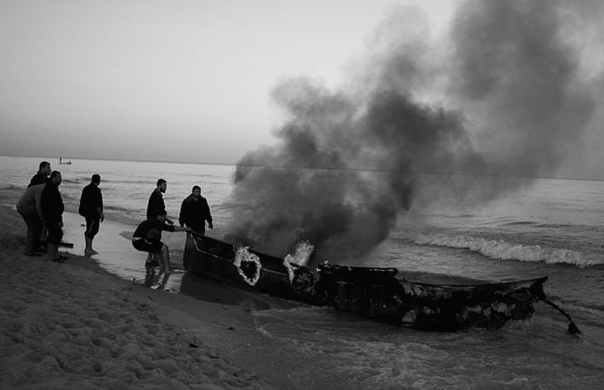
There is much cause for despair in Gaza—fishermen and farmers come under attack, drinking water is ever more scarce, patients are desperate for adequate medical care—but the Times has failed to highlight any of these issues, which are so clearly due to Israeli actions and policies.
The official Israeli line is that Hamas oppresses the residents under its control, and Israeli political leaders use this charge to help justify their airstrikes on Hamas sites and other actions, such as restrictions on the delivery of building materials to Gaza. The Times has been a willing partner in this effort.
So it is no surprise when the newspaper informs us that Hamas has rebuilt many of the tunnels it used during the assaults on Gaza in the summer of 2014, and this is causing anxiety for some Gaza residents who live near signs of underground construction work. They fear that Israel will bomb their neighborhoods to destroy the tunnels.
The story is just what the Israeli army press office ordered, and the Times willingly promotes this propaganda effort even as it shows little interest in even more urgent concerns that plague the residents of the strip. It had nothing to say, for instance, when Israel arrested 20 Gaza fishermen over less than a week this month and confiscated seven of their boats (here and here) even though they were fishing within the approved limit set by Israel.
Israeli harassment of the beleaguered fishermen has been a constant over the years: According to the Palestinian Center for Human Rights, Israeli forces detained 71 fishermen and confiscated 22 fishing boats in 2015, firing on fishing boats at least 139 times, wounding 24 fishermen and damaging 16 boats. The attacks have continued without letup this year.
The Times, however, has almost totally ignored the subject. The paper took notice briefly last month, when Israel announced new rules allowing Gaza boats to sail farther out to sea, and the story most certainly made the grade because it was a chance to show Israel in a benevolent light. The Times has been silent on the issue ever since.
Farmers with land near the border fence also face frequent attacks by Israeli soldiers who fire live ammunition at workers tending their fields, and Israel has destroyed crops and farm buildings, spraying fields of spinach and peas with herbicides and leveling land with bulldozers.
The Times has failed to report these incursions as well, although the United Nations documents them in weekly reports, and other news sources routinely tell of the assaults.
According to the UN, as of May 16, the Israeli military had made 30 incursions into Gaza this year. Its forces entered the enclave at least 56 times during 2015. These mini invasions—which include tanks, bulldozers and live fire—are breaches of the truce agreement made to end hostilities in 2014, but the Times has not seen fit to report them.
Instead, the newspaper prefers to raise the alarm about possible attacks from Gaza via the tunnels, ignoring the relevant context: the frequent shootings and other assaults by Israeli forces and the nine-year blockade, which finds not a single mention in the tunnel article.
Israel blocks the entry of needed medical supplies into Gaza, denies doctors the right to upgrade their skills in foreign countries and prevents many patients from leaving the enclave to receive the treatment they need. It has destroyed electrical equipment, wells and water treatment plants, and the lack of potable water has reached such a critical stage that only some 5 percent of the water in Gaza is safe to drink.
The Times, however, has shown no interest in exploring these crucial issues. It follows a prescribed narrative in deflecting blame from Israel and demonizing Hamas. The tunnel story fit this bill and thus merited a prime placement on page 1 above the fold.
NYT Editors Obsessed with Getting Clinton Elected President
By Stephen Lendman | May 15, 2016
She’s recklessly pro-war, pro-business, anti-populist, a threat to world peace and stability. Her deplorable public office record shows she opposes equity, justice, rule of law principles and democratic values.
Her agenda is frightening, electing her president unthinkable, a neocon war goddess, supporting endless conflicts, deploring peace, risking direct confrontation with Russia and China.
Her finger on the nuclear trigger leaves humanity’s fate up for grabs. NYT editors support the most recklessly dangerous US presidential aspirant in modern memory while bashing Trump relentlessly.
He’s over-the-top like all duopoly power presidential aspirants, supporting the same dirty business as usual agenda. Unlike Clinton, he’d rather make money than start WW III.
The Times went to extraordinary lengths to bash his womanizing history, making “unwelcome advances,” conducting “unsettling workplace conduct over decades.”
It assigned unknown numbers of reporters to locate and interview over 50 women who worked with, dated or interacted with him socially “since his adolescence” – without explaining how any of this relates to affairs of state if he’s elected president.
Numerous past presidents had extramarital affairs, including Washington, Jefferson, Franklin Roosevelt, Dwight Eisenhower, Jack Kennedy, Lyndon Johnson and Bill Clinton, among others.
Little or nothing was said about their private lives while campaigning or throughout their tenure.
Instead of focusing solely on issues and where candidates stand, the Times dwelled on where it had no business going. Nothing it reported suggested wrongdoing.
Countless hours spent locating and interviewing dozens of women found nothing more than a “portrait of a wealthy, well-known and provocative man and the women around him, one that defies categorization,” said the Times.
“Some women found him gracious and encouraging.” Some got high-level positions in his enterprises. The Times called it “a daring move for a major real estate developer at the time.”
Who cares if he made “romantic advances.” He didn’t rape or molest anyone. “A lot of things get made up over the years,” he said. “I have always treated women with great respect. And women will tell you that.”
About all the Times could conclude was saying he had power and women he came into contact with didn’t. He had and still has “celebrity… wealth (and) connections.” Some women sought his help with their careers and stuck with him.
The lengthy article isn’t worth the time or trouble to read. It reveals more about the Times’ deplorable agenda than Trump’s.
Political reporting should focus solely on issues and pinning down candidates on where they stand. America’s money-controlled system features horse-race journalism.
Duopoly power is ignored. So is a sham political process too debauched to fix. Whether Trump or Clinton succeeds Obama, ordinary people lose.
The biggest unreported issue is avoiding global nuclear war. With Trump there’s a chance, likely little at best with Clinton.
Stephen Lendman lives in Chicago. He can be reached at lendmanstephen@sbcglobal.net.
His new book as editor and contributor is titled Flashpoint in Ukraine: US Drive for Hegemony Risks WW III.
How The NY Times Whitewashes the Scandal of Israel’s Child Prisoners
By Barbara Erickson | TimesWarp | May 3, 2016
 Dima al Wawi, 12, was released from an Israeli prison last week, and according to The New York Times, her experience there was not all that bad. She played shuffle ball and went to classes, and when she came home after more than two months, she remained her spunky self.
This is the tenor of a piece by Diaa Hadid that ran on page one recently under the headline, “As Attacks Surge, Boys and Girls Fill Israeli Jails.” The tone here is in stark contrast to other accounts. The Daily Mail, for instance, ran the story with this title: “Haunted face of a 12-year-old girl broken by jail.”
A YouTube video of Dima’s reunion with her family also reveals a stony-faced child with dull eyes, and her mother speaks of her dismay at seeing her like that: “It seems like she is living in another world, in shock, not aware of what is happening.” She adds, “It feels like our suffering has increased.”
But Hadid gives us nothing like this. Her piece opens with a description of a benign Israeli prison experience and ends with Dima talking back to her mother like a normal, spirited pre-teen. Only far into the story do readers learn that Dima was not allowed to have either her parents or a lawyer present when she was interrogated and that she was shackled when she appeared in court.
Also missing from Hadid’s article is a full account of Israel’s scandalous treatment of Palestinian children and its apartheid court system. She describes these euphemistically as “a debate over how Israel’s military justice system, which prosecutes Palestinians from the West Bank, differs from the courts that cover Israeli citizens… and especially how it handles very young offenders.”
In fact, this is more than a debate. It is an atrocity that monitoring organizations have been documenting and publicizing for years: Israel routinely abuses Palestinian children in custody, deprives them of access to their parents and lawyers and coerces them into confessions. (See list of sources below.)
In addition, Israel is the only country in the world that systematically tries children (but only Palestinian children) in military courts, and it has two distinct systems for Jews and Palestinians in the West Bank. The former are tried in civil court while Palestinians face military trials.
In the Times story, however, this scandalous state of affairs becomes little more than a bureaucratic matter, a problem that calls for bringing two separate justice systems “more in line with one another.”
Hadid writes that Israel is trying to correct this deficiency, and she lists some policy changes made since a 2013 UNICEF report outlined abuses, but she fails to clarify either the extent of these abuses or the consistent and widespread condemnations of Israeli practices.
It is not only UNICEF that has raised alarm over the scandal: Human Rights Watch, Defence for Children International, the Israeli monitoring group B’Tselem, Amnesty International, Military Court Watch, several members of the U.S. Congress, the UN Committee for the Rights of the Child, Breaking the Silence (a group of former Israeli soldiers) and the U.S. State Department have done the same over several years.
It should also be noted that Israel, even as it claims it is correcting the problems, recently denied a delegation from the UK the right to witness child detainees in court. Additionally, the DCI report, cited in Hadid’s article, states, “Despite repeated calls to end night arrests and ill treatment and torture of Palestinian children, Israel has persistently failed to implement practical changes to stop violence against child detainees.”
Missing from the Times story is a major abuse cited in the above quote: the arrest of young Palestinians during night raids. Israeli soldiers routinely invade Palestinian homes after midnight—terrorizing families and neighborhoods in the process—and haul away teenagers and children accused of throwing stones or other offenses.
After a drumbeat of criticism from rights groups, the military announced that it would try a pilot program to cut down on night raids by delivering summonses to suspects, demanding that they turn themselves to the authorities.
But as the online magazine 972 reported, little has changed. The program has affected only 5 percent of these arrests, the documents are often handwritten in Hebrew without translation and soldiers are delivering the summonses during night raids.
DCI noted in its report that Israel has an obvious interest in continuing the raids: “Arresting children from their homes in the middle of the night, ill-treating them during arrest and interrogation, and prosecuting them in military courts that lack basic fair trial guarantees, works to stifle dissent and control an occupied population.”
Hadid’s story makes no mention of the night raids nor of the possible Israeli strategic interest mentioned by DCI. We get glimpses of the hardships Dima’s family has faced, but overall the effect is to minimize the trauma Israel inflicts on Palestinian children.
As the Times tells it, the treatment of these young detainees is simply “different” from that of young Israelis who run afoul of the law. It’s a matter of making a few adjustments, not a matter of ingrained racism and a brutal occupation.
Online readers can get a more complete story by clicking on the links to the DCI and UNICEF reports, but in the Times itself only fragments of the truth are allowed into print. The result is to obscure the cruel reality of routine abuse in the cells and interrogation rooms of Israel’s crowded prisons.
Follow @TimesWarp on Twitter
Pentagon Whitewashes Mass Murder
By Stephen Lendman | April 30, 2016
America considers civilians legitimate targets in all its wars of aggression. Fundamental laws of war prohibit attacking them – ignored in all US combat operations.
CENTCOM lied, calling its October 3, 2015 bombing of the Kunduz, Afghanistan Doctors Without Borders (MSF) hospital a “tragic incident.”
It turned truth on its head, claiming “personnel involved did not know that they were striking a medical facility. The intended target was an insurgent-controlled site which was approximately 400 meters away…”
CENTCOM commander General Joseph Votel willfully lied, claiming US forces “had no idea” they were attacking a medical facility.
False! CENTCOM knew it was an MSF hospital, yet ordered the attack anyway, falsely claiming it was used as a Taliban command and control center – before acknowledging otherwise.
Dozens of doctors, other medical staff and patients were massacred in cold blood, many others injured, victims of US imperial viciousness.
MSF provided CENTCOM and Afghan authorities with precise hospital coordinates several times. While under attack, it informed their authorities about what was happening, the facility struck multiple times for over an hour with precision weapons – a war crime by any standard.
MSF called the attack an “abhorrent and a grave violation of international humanitarian law. (A) war crime (was) committed.”
The Pentagon denied MSF’s demand for an independent investigation into what happened – conducted its own to whitewash mass murder.
CENTCOM’s report acknowledged violations of rules of engagement and laws of war breaches, while at the same time denying culpability for an indisputable high crime.
Votel said more than a dozen US servicemen were disciplined for what happened, meaningless wrist slaps at most. None face criminal charges for deliberate mass murder. Coverup and denial reflect longstanding Pentagon practice.
CENTCOM’s commander willfully lied, saying “(t)he investigation found that the incident resulted from a combination of unintentional human errors, process errors and equipment failures, and that none of the personnel knew they were striking a hospital.”
“The trauma center was a protected facility but it was misidentified during this engagement.” It was on a “no strike” list, its precise location known, yet willfully attacked anyway without just cause.
In response to CENTCOM’s whitewash, MSF’s Meinie Nicolai called Votel’s briefing “an admission of an uncontrolled military operation in a densely populated urban area.”
“It is incomprehensible that, under the circumstances described by the US, the attack was not called off.”
“The threshold that must be crossed for this deadly incident to amount to a grave breach of international humanitarian law is not whether it was intentional or not.”
“(A)rmed groups cannot escape their responsibilities on the battlefield simply by ruling out the intent to attack a protected structure such as a hospital.”
“(V)ictims and their families have neither the option to pursue legal action (for justice) nor claim compensation for loss of life and livelihood.”
America commits war crimes with impunity in all its theaters of conflict. US warplanes destroyed or damaged several Syrian and Iraqi hospitals along with numerous nonmilitary related sites, these actions continuing on a regular basis.
Pentagon coverup and denial doesn’t wash. Repeated high crimes go unpunished – naked aggression without mercy most of all, attacking nonbelligerent nations threatening no one, raping and destroying them, the highest of high crimes.
NYT editors disgracefully called mass murdering and injuring dozens of MSF doctors, medical staff and patients a mistake, a catastrophe, “gross negligence,” and war zone blunder – failing to condemn a willful war crime and demand full accountability.
They ludicrously cited Pentagon officials claiming “they acted promptly to retrain all troops in Afghanistan about the rules for using deadly force and… have taken precautions” to avoid repeat incidents.
They continue on a regular basis in all US war theaters. Mass civilian casualties don’t matter, considered a small price to pay to advance America’s imperium – an agenda the NYT wholeheartedly endorses.
Stephen Lendman lives in Chicago. He can be reached at lendmanstephen@sbcglobal.net.
His new book as editor and contributor is titled Flashpoint in Ukraine: US Drive for Hegemony Risks WW III.
Ecuador’s Earthquake and the NYT’s Spin Doctors
By Joe Emersberger | teleSUR | April 25, 2016
On April 23, a New York Times article by Nicholas Casey quoted a businessman in the earthquake-ravaged city of Portoviejo complaining about temporary tax increases that Rafael Correa’s government announced to pay for reconstruction which is presently estimated to cost US$2 to US$3 billion. Casey didn’t tell his readers that the areas impacted by the earthquake would be exempt from the new taxes and also given tax cuts.
The article inaccurately reported there would be “a one-time garnishing of government wages for those earning more than US$1,000 a month.” The measure would apply to all wages outside the disaster areas, not just “government wages.” Casey neglected to mention that most Ecuadorians earn less than US$1,000 per month. The average monthly salary is US$574 per month, not exactly a fact that would be common knowledge to the vast majority of NYT readers.
The biggest howler in the article is the assertion that the IMF has been “long shunned” in Ecuador “for its demands to cut government spending”. That’s like saying people avoid dealing with the Mafia because “they‘ve been known to be unpleasant”: true but wildly misleading. By the beginning of the 21st century, the IMF lost a tremendous amount of influence in Latin America because from 1980 to 2000 it had bullied governments into adopting disastrous policies which are known as “neoliberalism.”
Ecuador’s real GDP per capita grew by a pitiful 5 percent from 1980 to 1998 compared to over 100 percent in the previous two decades. Then, in 1999, Ecuador’s banking sector collapsed under the weight of corruption and a neoliberal obsession with “central bank independence” and financial deregulation. By 2000, real GDP per capita fell below what it had been in 1980.
Casey quotes Jose Hidalgo, an economist who has praised Ecuadorian governments of the neoliberal era for having “saved” money. Those governments certainly “saved” for various huge bailouts of Ecuador’s super rich like the infamous “secretization” of 1983 and the bank bailouts in 1999. Those governments also “saved” in order to make interest payments to foreign investors for debt that had often been illegally contracted.
By the time Correa took office in 2007, decades of neoliberalism had left Ecuador’s roads, public hospitals, schools and other basic infrastructure in shambles. The World Economic Forum ranked Ecuador’s roads tenth among 18 countries in the region in 2006. By 2015 they were ranked as the best. The efficiency of Ecuador’s public services, as ranked by the Inter-American Development Bank, rose from next to last among the 16 countries it evaluated to sixth best in the region. Comparative studies by the U.N. found that the quality of Ecuador’s educational system is one of the most improved in the region since 2006.
Economists like Hidalgo don’t generally try to deny the vast improvements in Ecuador’s infrastructure under Correa’s government. Instead they vaguely decry “excessive public spending.” Presumably, Ecuador’s infrastructure and public services should have been left in a deplorable state. Imagine Ecuador’s government refusing to rebuild the damage from the recent earthquake and then bragging about how much money it “saved.”
That sums up the warped logic behind Hidalgo’s view, one that was tragically put into practice during the neoliberal era. Is a country better equipped to confront natural disasters when traveling through the country is badly hampered by dilapidated roads; when hospitals are in short supply and are under equipped and understaffed; when rescue workers and other public servants are poorly paid, inadequately trained and do not have proper equipment?
Casey wrote that oil prices “once fueled a government spending bonanza.” The “bonanza” actually had more to do with clamping down on tax avoidance by the rich and sensibly regulating its financial sector. Real per capita tax revenues doubled between 2006 (the year Correa was first elected) and 2012. At their highest point during Correa’s time in office, inflation-adjusted oil revenues per capita, accounting for costs of extraction, were lower than they were during much of the 1970s and 1980s.
Moreover, early on in Correa’s presidency, Ecuador’s economy suffered a massive external shock due to the global recession of 2009 which drove oil prices down. So even before oil prices collapsed in 2014, Correa’s government did not have exceptionally high oil revenues compared to previous governments.
Another blow from the 2009 global recession was a drop in remittances from Ecuadorians living abroad. One legacy of the neoliberal era is that remittances from Ecuadorians who fled their country during those years became very important to Ecuador’s economy. The fact that Ecuador has reduced poverty by about half during Correa’s time in office cannot be rationally attributed to luck.
Based on resilience to external shocks, there is also no credible argument for returning to economic policies endorsed by Casey’s article. In 2015, Ecuador avoided recession despite losing 7 percent of its GDP to the oil price collapse. In 1987, under the neoliberal government of Febres Cordero, Ecuador went into recession when export revenues dropped by only 1.84 percent of GDP.
Casey never seemed to consider that there were facts and counterarguments to the views expressed by his sources. In the United States, newspapers like the New York Times present Paul Ryan, who wants to eliminate the entire federal government (with the exception of the military) from the U.S. economy, as a serious policy expert. So it isn’t surprising that successful public investment in Ecuador is eagerly presented as wasteful. If you can’t identify extremists and charlatans at home, you probably won’t do so abroad either.
Featured Video

US IRAN TALKS: Who Are the Crazy Ones Here? /Lt Col Daniel Davis
or go to
Aletho News Archives – Video-Images
From the Archives
Wartime internment camps in Australia
National Archives of Australia
World War I
During World War I, for security reasons the Australian Government pursued a comprehensive internment policy against enemy aliens living in Australia.
Initially only those born in countries at war with Australia were classed as enemy aliens, but later this was expanded to include people of enemy nations who were naturalised British subjects, Australian-born descendants of migrants born in enemy nations and others who were thought to pose a threat to Australia’s security.
Australia interned almost 7,000 people during World War I, of whom about 4,500 were enemy aliens and British nationals of German ancestry already resident in Australia.
Records of World War I internment camps
World War II
During World War II, Australian authorities established internment camps for three reasons – to prevent residents from assisting Australia’s enemies, to appease public opinion and to house overseas internees sent to Australia for the duration of the war.
Unlike World War I, the initial aim of internment during the later conflict was to identify and intern those who posed a particular threat to the safety or defence of the country. As the war progressed, however, this policy changed and Japanese residents were interned en masse. In the later years of the war, Germans and Italians were also interned on the basis of nationality, particularly those living in the north of Australia. In all, just over 20 per cent of all Italians resident in Australia were interned. … continue
Blog Roll
 Aletho News
- Diplomats slam US negotiators’ performance in Iran talks
- Trump Refuses Exit Ramp, War with Iran will Continue
- Trump Says US Naval Blockade in Strait of Hormuz Will Begin Shortly
- US, Iran end 21-hour talks without agreement
- US IRAN TALKS: Who Are the Crazy Ones Here? /Lt Col Daniel Davis
- Talks with the US end without a deal over excessive US demands: Iran
- Feeling Better, Getting Worse: How Psychiatric Drugs Create the Illusion They Cure
- ‘Nobody Told Me’: Former Mental Health Patient Calls Out Dangerous Side Effects of Psychiatric Drugs
- Dr. Abu-Sitta: Beirut ‘felt like a day in Shifa Hospital’
- Iran Has Won the War, It Will Be Up to the US to Secure the Peace: Mohammad Marandi
- If Americans Knew
- US-Iran ceasefire negotiations make zero progress – Daily Update
- Pro-Israel ‘Thinktanks’ and Individuals who Influence U.S. Foreign Policy
- Mearsheimer reveals how Israel dictates US policies on Iran, Gaza – video
- After killing 350+, Israel still has a “score to settle” with Lebanon before ceasefire – Daily Update
- Military aid to Israel emerges as the latest political litmus test for Democrats
- The only Palestinian children’s rights organization closes following years-long Israeli campaign against it
- ‘I Can’t Forget the Smell’: Lebanese Reel After Israel Kills Over 300 in Single Day
- DNC Shoots Down Resolutions Calling Out AIPAC and Limiting Arms to Israel
- TCN: Is Israel Blackmailing President Trump?
- Israel killed at least 303 Lebanese yesterday – who were they? Daily Update
- No Tricks Zone
- German Expert: Heat Dome Led To Record Temps In Western USA…Warmer In 1934, 1936
- New Study: No Linear Warming Or Glacier Retreat Along Northern Antarctic Peninsula Since 1980s
- An Inconvenient Tree: Uncovered In Alps… Europe Much Warmer Than Today 6000 Years Ago
- New Study Reports A 60% Slowdown In Greenland’s Ice Loss Rate In The Last Decade
- Low Intensity Tornado Wrecks Major Solar Farm, Creating A Potential Toxic Dump
- New Study Finds Warming Saves Lives…Cold Temperatures 12 Times More Deadly Than Excess Heat
- German Science Blog Accuses PIK Climate Institute Of Hallucinating Climate Tipping Points
- Devastating Assessment Of Comirnaty Vaccine By Former Senior Pfizer Europe Toxicologist
- New Study: CO2 Is ‘Effectively Negligible’ As An Explanatory Climate Change Factor Since 2000
- Former Pfizer Toxicologist Dr. Helmut Sterz Tells Bundestag Hearing Pfizer Vaccine Should Have Never Been Approved
 Aletho News