What the Videos Show: Israel is Killing in Cold Blood
By Barbara Erickson | TimesWarp | November 11, 2015
What is inspiring young Palestinians to attempt yet more stabbing attacks on Israelis? The answer, according to The New York Times, has nothing to do with the violence of military occupation, the abuse of Palestinian children or trigger-happy troops; it is merely a “loop-like dynamic” of attack and response inspired by video clips.
In a story today, Isabel Kershner reports that videos showing knife attacks and heavy-handed treatment of young detainees are inspiring Palestinian boys as young as 12 to attempt knife assaults. But in a significant omission, the article says nothing about disturbing videos that support a different take: Many Palestinians have been killed when they posed no possible threat.
Likewise, even as Kershner writes about youthful attackers, she (and the Times) have avoided any mention of the constant reports from rights groups over recent years that detail the abusive treatment of Palestinian children in Israeli custody. These include reports of troops arresting children as young as 6 and documentation of violence used against the young detainees. (Also see TimesWarp 1-13-14.)
Instead, readers are introduced to two cousins, 12 and 13, who played hooky from school yesterday in order to carry out a copycat stabbing attack in Jerusalem. Both were arrested; one was seriously wounded in the process; and both had watched video footage the night before of Israeli interrogators aggressively questioning another young teen, Ahmad Manasra, who was wounded after an alleged attack that left his cousin dead.
Kershner then devotes much of her article to rehashing the story of Manasra, who was featured earlier in a lengthy piece aimed at showing how Palestinians got it wrong when they claimed the boy had been killed. It appears to have the same purpose here: to undermine charges that Israeli troops have made false claims about knife attacks and have planted evidence.
She writes, “In several cases, with no video corroboration, Palestinians have insisted that no stabbings took place and have accused the Israeli authorities of planting knives at the scene.”
Several significant factors are missing from this statement: Although video evidence is unavailable in some cases, others are supported by credible eyewitness accounts contradicting official claims; rights groups, not only Palestinians, have charged Israeli troops with killing innocent victims; and video evidence does exist that bolsters many of the charges against Israeli forces.
In a press release last month, Amnesty International said Israeli soldiers and police had resorted to “extreme and unlawful measures” and had “used intentional and lethal force without justification.” The rights group highlighted four cases of “what appear to have been extrajudicial executions.”
Amnesty pointed up one “especially egregious case” in which Israeli forces killed 19-year-old Sa’ad Muhammad Youssef al-Atrash in Hebron on Oct. 26 as he tried to retrieve an identity card. As the youth reached into his pocket, a soldier behind Atrash shot him on the right side. The report continues, “The eyewitness said he was shot six or seven times and bled profusely as he lay on the ground for about 40 minutes afterwards, while soldiers failed to provide medical treatment.”
Times readers, however, are unlikely to know anything about Muhammad Atrash and how he died, nor are they aware of the Amnesty statements or of reports from other rights groups, including those in Israel and Europe, all of them charging Israel with unlawful killings.
Since the Amnesty release last month, Israel has continued to kill Palestinians, many of whom posed no possible threat, bringing the total to over 80 killed and some 8,500 wounded since the beginning of October. As of Oct. 31, eight Israelis had died and 115 had been wounded, according to the United Nations. These numbers, however, do not appear in Kershner’s story.
Last week Israeli forces shot and killed a 73-year-old grandmother as she drove through Hebron to meet her sister for lunch. A spokesman said she tried to ram soldiers with the car and that a knife was found in her car. Video footage shows a different scenario: Tharwat Sharawi was driving at a moderate speed and in no way aimed to hit soldiers when a barrage of bullets took her life.
The Times has made no mention of this video evidence, nor has it informed readers of other disturbing cases, also caught on video:
- A settler shoots and kills Fadi Qawasmi, 18, in Hebron on Oct. 17, and appears to hand a knife to a soldier, who drops it near the body.
- A mob chases Fadi Alloun in Jerusalem on Oct. 4, shouting, “Shoot him!” as he runs for his life. Police bring him down with a hail of bullets.
- Muhammad Ramadan al Muhtasib, 23, is shot multiple times and killed as he lies helpless on the ground in Hebron on Oct. 30. The army alleges that he tried to stab a soldier.
- Issra Abed, 30, is shot at a bus station in Afula as she stands with her hands over her head. After she lies wounded on the ground, a bystander approaches and kicks away a pair of sunglasses lying by her side. (Police said she was grasping a knife.)
- Dania Irsheid, 18, is shot and killed at a checkpoint in Hebron after passing through metal detectors and a revolving iron gate. Video footage show Israeli police giving her no assistance as she lies bleeding on the ground.
- Hadeel al Hashlamoun, 18, is shot at a checkpoint in Hebron on Sept. 22 and left to bleed to death. A video shows her being dragged by her heels along the ground.
In several of these videos the indifference of Israeli troops is striking. None of them attempts to help the victims, and in some cases witnesses report that settlers are allowed to take pictures of the dead and dying while Palestinian journalists and medics are turned away. One highly disturbing photo shows a smiling settler taking a photo of a dead Palestinian in Hebron on Oct. 29.
In this context, the report by Kershner is appalling. Although video evidence, eyewitness accounts and investigations by rights groups point to a pattern of trigger happy—even blood thirsty—security forces killing Palestinians with the slightest degree of suspicion, the Times has made no effort to inform readers of these findings. On the contrary, it places this misleading story by Kershner on page 1 above the fold.
Here we find another attempt to blame the victims, to paint Palestinians as the violent offenders, omitting even the numbers of dead and injured, which reveal a disproportionate death toll of 10 Palestinians for every one Israeli. The facts, however, seem to be of no account when it comes to protecting Israel. Given the choice between shielding this rogue state and reporting the news, the Times stands with Israel.
The New York Times’ 9/11 Propaganda
By Kevin Ryan | Dig Within | November 8, 2015
The New York Times led the propaganda behind 9/11 and the 9/11 Wars. It did so by ignoring many of the most relevant facts, by promoting false official accounts, and by belittling those who questioned the 9/11 events. The Times eventually offered a weak public apology for its uncritical support of the Bush Administration’s obviously bogus Iraq War justifications. However, it has yet to apologize for its role in selling the official account of 9/11, a story built on just as many falsehoods. Instead, the newspaper continues to propagandize about the attacks while putting down Americans who seek the truth about what happened.
The New York “newspaper of record” has published many articles that promote official explanations for the events of 9/11. These have included support for the Pancake Theory, the diesel fuel theory for WTC 7, claims based on the torture testimony of an alleged top al Qaeda leader, and accounts of NORAD notification and response to the hijackings. Since then, U.S. authorities have said that none of those explanations were true. However, the Times never expressed regret for reporting the misleading information.
Instead, the Times continued to sell every different official explanation. When a new government theory for destruction of the WTC was put forth, it was immediately promoted. The newspaper never reported any critical analysis of the official accounts, despite the fact that all of them, including the final reports for the Twin Towers and WTC 7, have been proven to be wrong.
When the fourth story for how the North American air defenses failed—the one that said U.S. military officers had spent three years giving “false testimony,” the Times pushed it as fact. Its article on the subject simply closed the matter with the statement that “someone will still have to explain why the military, with far greater resources and more time for investigation, could not come up with the real story until the 9/11 commission forced it to admit the truth.” The idea that military officers might have started out telling the truth, thereby leaving very sensitive questions to be answered, and that the 9/11 Commission was now being false, apparently never occurred to the editors.
Meanwhile, the newspaper has made considerable efforts to belittle Americans who question the official account of 9/11.
In June 2006, the Times published a snarky account of a grassroots conference of 9/11 investigators. The article focused on sensational descriptions of the participants, including what it called “a longhaired fellow named hummux who, on and off, lived in a cave for 15 years.’’ The fact that Dr. hummux was a PhD physicist who had worked on the Strategic Defense Initiative for 20 years was not mentioned. The Times simply distorted his experience living with a Native American tribe and falsely stated that he had lived in a cave. No mention was made of serious, undisputed facts that were presented at the conference.
A few months later, at the fifth anniversary of 9/11, the Times published another propaganda article in support of the politically timed reports from the National Institute of Standards and Technology (NIST). The article began by declaring that those who questioned 9/11 were “an angry minority,” while minimizing a national Scripps Howard poll, published just a month earlier. The poll showed that “More than a third of the American public suspects that federal officials assisted in the 9/11 terrorist attacks or took no action to stop them so the United States could go to war in the Middle East.” That is, the number of Americans who thought that federal officials were behind the attacks (36%) was on par with the percentage of Americans who had voted for the president. Yet the Times inferred that it was only a small fraction of the population who questioned 911.
The September 2006 article promoted one Brent Blanchard as a demolition expert, implying that his recent essay refuted any suggestions that the WTC buildings were demolished. As I told the reporter Jim Dwyer, when he interviewed me for the article, “Mr. Blanchard may be a good photographer, but the uninformative bluster that fills the first two and a half pages of this piece, and a good deal throughout the paper, shows that he is not a good writer.” The fact that Blanchard was only a photographer and not a demolition expert was not mentioned by Dwyer, nor was my point-by-point refutation of Blanchard’s limited arguments. Instead, Dwyer purposefully ignored the evidence and ended his article with another quote from Blanchard.
More recently, perhaps in response to another large billboard posted right outside the Times offices, the newspaper has renewed its 9/11 propaganda efforts. In one new article, reporter Mark Leibovich wonders “why is it good to tell the truth but bad to be a ‘Truther’.” Leibovich turns to former White House spokesman Ari Fleischer for support. Of course, the article does not refer to Fleischer’s curious behavior on the morning of 9/11, which stands among the unresolved questions. Instead, Fleischer’s input is that he uses the term “truther” as an epithet, “floating a notion and letting it hang there to absorb sinister connotations.” Leibovich goes on to portray 9/11 questioning as just another form of ridiculous “trutherism” that is “stranger than fiction.“
Leibovich and his colleagues at the Times continue to suggest that they are unaware of the many incredible facts about 9/11 that call out for critical investigation. At this point, however, that level of ignorance is not believable and the Times’ track record shows that it will never take an honest and objective approach to the events of 9/11. As one former Times reporter stated, the paper’s slogan that it provides all the news ‘fit to print’ really means that it provides all the news that’s fit to serve the powerful. And as long as the needs of the powerful differ from the needs of the people, the truth will be something that is unavailable at the New York Times.
Protecting Israel, Trashing Hebron: More Spin from The NY Times
By Barbara Erickson | TimesWarp | October 30, 2015
Today in The New York Times we have a look at Hebron, a blood-drenched city in the West Bank, a community besieged by violent settlers and trigger-happy Israeli forces. In this month alone, some 20 of its Palestinian residents have died at the hands of soldiers and police, their deaths sometimes caught on video that belies official accounts.
But this grim reality is not the focus in the Times. The article by Diaa Hadid and Rami Nazzal strips the full context of the occupation from Hebron and presents it, not as a city struggling to survive under crushing oppression, but as a hotbed of Palestinian radicals, a stronghold of the oft-demonized Hamas.
The story takes us to the funeral of Dania Irsheid (identified as Dania al-Husseini in the Times), a schoolgirl shot at a checkpoint on Sunday. It mentions other deaths in recent days, but it completely avoids the eyewitness accounts and human rights organization findings that show many of these deaths were extrajudicial executions.
Israel has callously refused to release the bodies of most of the 20 victims, and we read that residents feel “particular outrage” over the death of Dania and another girl, Bayan Oseili, 16, killed a week before, both accused of stabbing attacks. The story deftly avoids another compelling reason for this outrage: the fact that both obviously posed no threat and could have been arrested and that video footage in the case of Bayan and eyewitness accounts in the case of Irsheid contradict police claims.
Hadid and Nazzal, however, have nothing to say about these contradictions and write that residents are angry because the refusal to release the bodies is an “affront to the Muslim tradition of immediate burial and a defilement of their honor.”
This fits neatly into the Times’ attempt to spin the oppression in Hebron into more blaming of the victims, who are described as Hamas followers and culturally conservative. The article opens with a quote from a Hebron resident who applauds knife attacks on Israeli soldiers, and it closes with the same speaker who “was pleased to see the surge in violence turn to Hebron.”
Missing entirely are any comments from nonviolent Hebron activists and the accounts of eyewitnesses who say Israeli forces have planted knives near the bodies of victims. The story also omits some chilling reports of deliberate executions and the statements of human rights groups that raise the charge of extrajudicial killings.
One of the most disturbing accounts describes the death of a young man, Islam Ibeidu, 23, on Wednesday near the Kirya Arba settlement. The news outlet Middle East Eye noted, “According to the quoted eyewitness, Ibeidu was searched by Israeli soldiers by the checkpoint and released, before orders were given to execute him.”
One witness tweeted: “I saw everything. I saw soldiers loading the guns. He had his arms up and was shaking, he was unarmed and they just shot him.” A second tweet continues, “eyewitness overheard police woman say ‘he looks nice, shoot him’ before he was shot to death by m16 from 2 meters away.”
The accounts of other deaths are equally disturbing (see TimesWarp 10-27-15), but the Times story includes none of them. It states that the victims this month died “in demonstrations and attacks,” taking the official Israeli line as fact.
On the other hand, the article refers frequently to Hamas in an effort to tie the group to the violence in Hebron. It makes no mention of several non-violent groups active in the city, such as Youth Against Settlements, Christian Peacemaker Teams, the International Solidarity Movement and the UN mandated Temporary International Presence in Hebron.
All of these organizations are avowedly non-violent; they observe and document violence against Palestinians. Yet another group, Breaking the Silence, was founded by Israeli soldiers who had served in Hebron and now collect and document Israeli army abuses. None of these organizations has a voice in the Times story.
Much of Hebron’s agony dates back to March, 1994, when an American-born settler, Baruch Goldstein, massacred 29 worshippers in the Ibahimi Mosque. Hadid mentions this as part of the historical record but omits the brutal Israeli crackdown that followed.
Rather than act to protect Palestinians after this attack, Israeli security forces went on to kill some 20 more Hebron residents during protests and to lock them down under a round-the-clock curfew. The government also closed once bustling Shuhada Street to all Palestinian traffic, welded shut Palestinian shops, turned the street over to settlers and divided the mosque into Jewish and Muslim sections.
This finds no clarification in the Times story, which refers vaguely to a “volatile mix of Palestinians and Jewish settlers.” Instead, the newspaper has adopted the official playbook of the occupiers: Stick to the narrative of Israeli victimhood, ignore countervailing fact, and whenever possible blame Hamas.
Is War Beautiful?
By David Swanson | Let’s Try Democracy | October 28, 2015
“War Is Beautiful” is the ironic title of a beautiful new book of photographs. The subtitle is “The New York Times Pictorial Guide to the Glamour of Armed Conflict.” There’s an asterisk after those words, and it leads to these: “(In which the author explains why he no longer reads The New York Times ).” The author never explains why he read the New York Times to begin with.

The author of this remarkable book, David Shields, has selected color war photographs published on the front page of the New York Times over the last 14 years. He’s organized them by themes, included epigrams with each section, and added a short introduction, plus an afterword by Dave Hickey.
Some of us have long opposed subscribing to or advertising in the New York Times, as even peace groups do. We read occasional articles without paying for them or accepting their worldview. We know that the impact of the Times lies primarily in how it influences television “news” reports.
But what about Times readers? The biggest impact that the paper has on them may not be in the words it chooses and omits, but rather in the images that the words frame. The photographs that Shields has selected and published in a large format, one on each page, are powerful and fantastic, straight out of a thrilling and mythical epic. One could no doubt insert them into the new Star Wars movie without too many people noticing.
The photos are also serene: a sunset on a beach lined with palm trees — actually the Euphrates river; a soldier’s face just visible amid a field of poppies.
We see soldiers policing a swimming pool — perhaps a sight that will someday arrive in the Homeland, as other sights first seen in images from foreign wars already have. We see collective military exercises and training, as at a desert summer camp, full of camaraderie in crises. There’s adventure, sports, and games. A soldier looks pleased by his trick as he holds a dummy head with a helmet on the end of a stick in front of a window to get it shot at.
War seems both a fun summer camp and a serious, solemn, and honorable tradition, as we see photos of elderly veterans, militaristic children, and U.S. flags back Home. Part of the seriousness is the caring and philanthropic work exhibited by photos of soldiers comforting the children they may have just orphaned. We see sacred U.S. troops protecting the people whose land they have been bombing and throwing into turmoil. We see our heroes’ love for their visiting Commander, George W. Bush.
Sometimes war can be awkward or difficult. There’s a bit of regrettable suffering. Occasionally it is tragically intense. But for the most part a rather boring and undignified death about which no one really cares comes to foreigners (outside the United States there are foreigners everywhere ) who are left in the gutter as people walk away.
The war itself, centrally, is a technological wonder bravely brought out of the goodness of our superior hearts to a backward region in which the locals have allowed their very homes to turn to rubble. An empty settlement is illustrated by a photo of a chair in a street. There are water bottles upright on the ground. It looks as though a board meeting just ended.
Still, for all war’s drawbacks, people are mostly happy. They give birth and get married. Troops return home from camp after a good job done. Handsome Marines innocently mingle with civilians. Spouses embrace their camouflaged demigods returned from the struggle. A little American boy, held by his smiling mother, grins gleefully at the grave of his Daddy who died (happily, one must imagine) in Afghanistan.
At least in this selection of powerful images, we do not see people born with gruesome birth defects caused by the poisons of U.S. weapons. We do not see people married at weddings struck by U.S. missiles. We do not see U.S. corpses lying in the gutter. We do not see nonviolent protests of the U.S. occupations. We do not see the torture and death camps. We do not see the trauma of those who live under the bombs. We do not see the terror when the doors are kicked in, the way we would if soldiers — like police — were asked to wear body cameras. We do not see the “MADE IN THE USA” label on the weapons on both sides of a war. We do not see the opportunities for peace that have been studiously avoided. We do not see the U.S. troops participating in their number one cause of death: suicide.
A few of those things may show up now and then in the New York Times, more likely on a page other than the front one. Some of those things you may not want to see with your breakfast cereal. But there can be no question that Shields has captured a portrait of a day in the life of a war propagandist, and that the photographers, editors, and designers involved have done as much to cause the past 14 years of mass dying, suffering, and horror in the Middle East as has any single New York Times reporter or text editor.
NYT Perpetuates the Myth about Obama Killing Osama
By Stephen Lendman | October 29, 2015
Its latest Big Lie headlined “How 4 Federal Lawyers Paved the Way to Kill Osama bin Laden” – failing to explain how killing a dead man is impossible. Resurrection wasn’t one of his skills, or anyone else’s.
The Times claimed “four administration lawyers developed rationales intend(ing) to overcome any legal obstacles” to killing, not capturing, him.
It ignored its own July 11, 2002 account, headlined “The Death of bin Ladenism,” saying:
“Osama bin Laden is dead. The news first came from sources in Afghanistan and Pakistan almost six months ago: the fugitive died in December (2001 of natural causes) and was buried in the mountains of southeast Afghanistan.”
“Pakistan’s president, Pervez Musharraf, echoed the information. The remnants of Osama’s gang, however, have mostly stayed silent, either to keep Osama’s ghost alive or because they have no means of communication.”
Prophetically, The Times said “bin Laden’s ghost may linger on – perhaps because Washington and Islamabad will find it useful… But the truth is that Osama bin Laden is dead.”
Ignoring its own earlier reporting is longstanding Times practice. Serving imperial interests take precedence. Its May 1, 2011 report contradicted its July 2002 one, headlining “Bin Laden Is Dead, Obama Says.”
An accurate headline would have debunked his phony claim. No one dies twice. Dead men don’t return for a second time around.
Instead of truth and full disclosure, The Times reported the myth about bin Ladin “killed in a firefight with United States forces in Pakistan…”
Its source: Obama, a notorious serial liar, Times earlier reporting on bin Laden’s death proving his Big Lie.
Instead, it called bin Laden’s “demise…a defining moment in the American-led fight against terrorism, a symbolic stroke affirming the relentlessness of the pursuit of those who attacked New York and Washington on Sept. 11, 2001.”
It perpetuated a second myth: that ill and dying bin Laden from a cave in Afghanistan, or Pakistan hospital where he was being treated, somehow managed to outwit the entire US intelligence establishment on that fateful day – ignoring what really happened, history’s greatest ever false flag, the mother of all Big Lies concealing it.
David Ray Griffin’s book, titled “Osama Bin Laden: Dead or Alive” is the seminal work about him, presenting “objective evidence and testimonies.”
It explained CIA monitored messages between him and his associates abruptly ceased after December 13, 2001. On December 26, 2001, a leading Pakistani newspaper reported his death, citing a prominent Taliban official attending his funeral – witnessing his dead body before it was laid to rest.
He was terminally ill with kidney disease and other ailments. On September 10, 2001 (one day before 9/11), CBS News anchor Dan Rather reported his admittance to a Rawalpindi, Pakistan hospital. He had nothing to do with 9/11.
In a late September 2001 interview with Pakistan’s Ummat newspaper, he categorically denied involvement in what happened on that fateful day. Fabricated claims otherwise persist – Big Lies suppressing hard truths.
Evidence Griffin presented showed “people in a position to know” said bin Laden died in December 2001 of natural causes – including then Pakistani President Pervez Musharraf, Pakistani ISI intelligence, then US-installed Afghan president Hamid Karzai, and former FBI assistant counterterrorism head Dale Watson.
Griffin explained claims about “bin Laden’s continued existence (weren’t) backed up by evidence.” Perpetuating the myth about him remaining alive until US special forces allegedly killed him in May 2011 remains one of the many Big Lies of our time – The Times featuring it in its October 28 article, ignoring its own earlier confirmed report about his death.
It repeated a story gotten from unnamed US sources, claiming administration lawyers “worked in intense secrecy,” even keeping then Attorney General Eric Holder out of the loop.
Saying “(t)hey did their own research, wrote memos on highly secure laptops and traded drafts hand-delivered by (so-called) trusted couriers.” An unnamed US officials claimed “clear and ample authority for the use of lethal force under US and international law.”
No such authority exists to assassinate anyone extrajudicially for any reason. Doing so is murder. Bin Laden’s ghost was kept alive to pursue America’s war on terror.
So-called Enemy Number One was used to stoke fear to justify the unjustifiable – naked aggression against one country after another, continuing today, nearly 14 years after bin Laden’s real death. Obama did not kill him!
Stephen Lendman lives in Chicago. He can be reached at lendmanstephen@sbcglobal.net. His new book as editor and contributor is titled “Flashpoint in Ukraine: US Drive for Hegemony Risks WW III.”
New York Times Sliming Their Readers Again
Real Science | October 27, 2015
The full melting of Greenland’s ice sheet could increase sea levels by about 20 feet.

Even the most ridiculous estimates of ice loss in Greenland are less than 200 km³ per year. The volume of the ice sheet is 3,000,000 km³. Using the most aggressive claims, it would take 15,000 years for the ice sheet to melt. That accounts for a sea level rise of about one hundredth of an inch per year. Does Coral Davenport think that one inch of sea level rise over the next century is going to drown her?
But the reality is that the surface of Greenland gains about 300 billion tons of ice every year. Greenland is not melting.
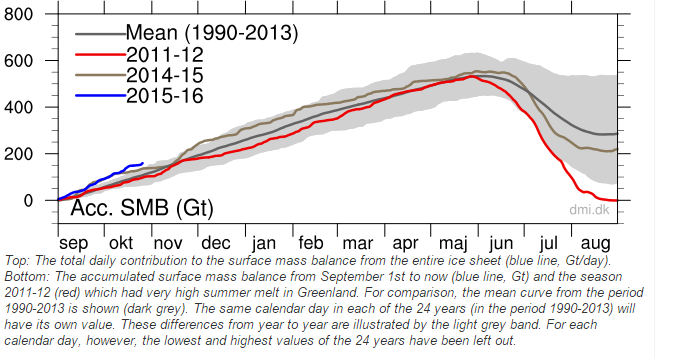
Ninety percent of the ice sheet gained mass from September 1, 2014 to August 30, 2015.
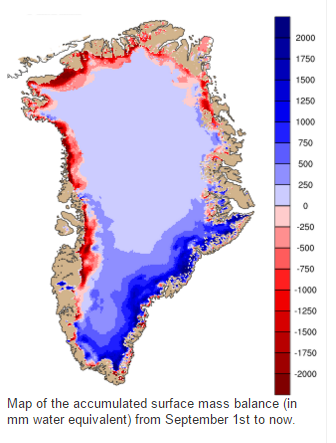
Claims that the ice sheet is losing 200 km³ / year are based on unreliable gravity calculations made by people with an agenda. Glacial flow to the ocean is controlled by the amount of excess ice building up in the interior. If for some reason the amount of ice building up in the interior decreased, flow would also decrease.
The New York Times has been reporting this same hysteria for almost 85 years.

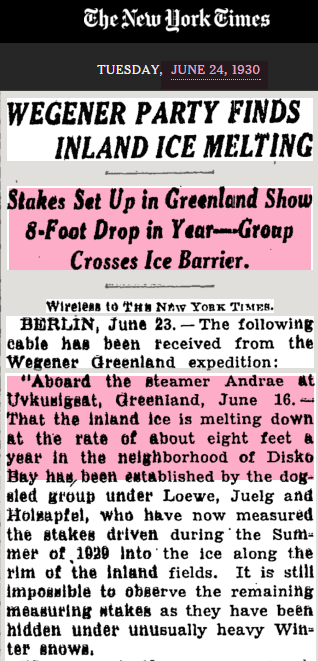
Thirty years later they were predicting a new ice age.

Climate is cyclical. There is no rational reason to believe that the Greenland ice sheet is going to disappear. More than half of it never gets above freezing most years.
In The NY Times, Israeli Injuries Make Headlines, Palestinian Deaths Are Footnotes
By Barbara Erickson | TimesWarp | October 27, 2015
These are the last moments of 17-year-old Hebron schoolgirl Dania Irsheid, as described by witnesses: Raising her hands above her head, terrified by the shouts of Israeli police, Dania cried out, “I don’t have a knife.” Immediately, one shot hit the ground between her legs; then a hail of bullets followed, and she fell.
A video shows her lying motionless, her white headscarf stained with blood, as police mill about but make no attempt to assist her. The terrible scene took place at a checkpoint near Hebron’s Ibrahimi Mosque on Sunday.
Her death merited a brief and anonymous mention in The New York Times. Far into a story about the changing tactics of Palestinian Authority security forces, we find this single sentence: “Elsewhere in the West Bank, an Israeli police officer fatally shot a 17-year-old Palestinian girl who tried to stab him, The Associated Press reported.”
Witnesses at the scene said she had no knife and had already passed through two metal detectors and revolving doors before opening her book bag for inspection at the mosque site. Israeli police, however, released a statement saying she was a “female Arab terrorist” and had been “neutralized.”
The Times says nothing of these contradictions, and it has maintained a resounding silence over other Palestinian deaths, including the shooting of two Hebron schoolboys who were killed last week, also in disturbing and disputed circumstances. (See TimesWarp 10-21-15).
On the other hand, the newspaper has taken pains to draw readers’ attention to an alleged stabbing attack on an Israeli citizen, which left the victim “moderately wounded” and resulted in the death of one Palestinian and the arrest of another.
The story appeared online five days ago, on Oct. 22, and was still present on the Middle East page through most of today’s online edition (it disappeared only after this post came out) under the headline “Jewish Man Stabbed in Israel by Palestinians as Violence Continues.” The article, touted so tenaciously on the Times website, is a mere 270 words and sketchily reported, but it outlasted other breaking news from the region with unusual longevity.
The death of Dania Irsheid merited no headline in the Times while the “moderate wounding” of an Israeli man was repeatedly flagged for online viewers. It is clear from this (and many other choices they make) that the newspaper’s editors have an agenda of their own, one that is inconsistent with accepted journalistic standards.
Israel is to be the perennial victim. Palestinians are to be the aggressors. Any deviation from this narrative causes dissonance at the Times.
Thus we find no stories about the harried and fearful lives of Palestinians in Hebron, even though the situation cries out for a close look at their ordeal. (Some 16 Palestinians have been killed in the city since the beginning of this month, out of 44 in the West Bank overall and 17 in Gaza, according to the International Middle East Media Center). Nor do we find any serious examination of the brutal occupation and colonization of Palestine that fuels the resistance.
We do, however, find a Times story about youthful Palestinian attackers inspired by social media, and we find an article focused on Palestinian songs with a nationalistic and sometimes violent bent. Both these articles appeared in print on page 1, and both conveniently fit the portrait of Palestinians as aggressors.
When evidence to the contrary cannot be ignored (as in the arson deaths of three Palestinian family members this summer), the Times turns to damage control. Thus, we have the newspaper attempting to undermine video evidence that shows Israeli security forces making false accusations or killing Palestinians who pose no threat.
This was the purpose of a story with the disingenuous headline, “Conflicting Accounts of Jerusalem Strife Surround a Wounded Arab Boy.” The point of this article is not what it purports to be, an examination of two different narratives, but an effort to debunk videos and witness accounts challenging the statements of Israeli security forces.
The Times devotes 1,600 words to telling us that Palestinian Authority president Mahmoud Abba and others got it wrong when they said Ahmad Manasra, 13, caught on video as he lay bleeding in Jerusalem, had been killed. He had only been wounded, the Times notes, and he is now being cared for in hospital.
The Times (and Israeli officials) are using this error to claim that Palestinian testimonies cannot be trusted. Some video evidence of Israeli misconduct is irrefutable, however, and monitoring groups outside of Palestine have vouched for them, calling for an end to the use of excessive force and extrajudicial executions.
Moreover, the video of Ahmad is shocking in its revelations of Israeli settler brutality even though the boy eventually survived. And beyond this, the Times story itself makes a significant error in claiming that the boy is shown in hospital being “spoon-fed by a nurse.”
In fact, it was an attorney, Tareq Barghout, who held the spoon, as the man later testified. Barghout also said Ahmad was shackled to the bed and suffered constant verbal abuse from hospital staff. The Times story, however, included none of this information.
Israeli officials made much of the error over Ahmad’s survival, with Prime Minister Benjamin Netanyahu calling it “the new big lie,” and the Times obligingly followed suit. The overblown story is consistent with Times efforts to support the Israeli narrative and to discredit the testimony of Palestinians.
Meanwhile, three more died in Hebron on Monday, and the Times has once again failed to take notice. Palestinian deaths are—at best—footnotes in the newspaper of record while Israeli injuries are headlines. This is the unspoken but evident policy at The New York Times.
Follow @TimesWarp on Twitter
NYT Hypes Russian Threat to the Internet
By Ben Schreiner | Working Left | October 25, 2015
As if Americans didn’t already have enough to worry about in regards to the recently resurrected Red Menace, we can now add the fear that those devious Russians are threatening to–horror of horrors–bring down the Internet.
As the New York Times‘ David Sanger and Eric Schmitt report, “Russian submarines and spy ships are aggressively operating near the vital undersea cables that carry almost all global Internet communications, raising concerns among some American military and intelligence officials that the Russians might be planning to attack those lines in times of conflict.”
As Navy spokesman Cmdr. William Marks adds, “It would be a concern to hear any country was tampering with communication cables.”
Indeed. Well, unless those tampering with international communication cables happen to be working on behalf of the “good guys” in the National Security Agency, or their equally good partners in Britain’s GCHQ. In that case, don’t consider it “tampering,” but rather something more akin to protecting the homeland from 21st century threats.
Of course whenever official Washington warns of a looming foreign cyber threat (China and Iran being the other favorite punching bags of the Times in this regard), it’s worth remembering that it was in fact the U.S., in partnership with Israel, that was the first state to actually launch a major offensive cyber attack on a sovereign nation. The attack being the Stuxnet virus set loose back in 2009 on Iran’s peaceful nuclear program. Such aggression was codified earlier this year when the Pentagon formally unveiled a cyber warfare doctrine sanctioning the use of preemptive strikes. But down the memory hole, it appears, with all that.
And so with all that out of mind, it’s back to Russia’s rising “aggression.” At least as the paper of record would have it.
As Sanger and Schmitt continue, “American concern over cable-cutting is just one aspect of Russia’s modernizing Navy that has drawn new scrutiny.”
Adm. Mark Ferguson, commander of American naval forces in Europe, speaking in Washington this month, said the proficiency and operational tempo of the Russian submarine force was increasing.
Citing public remarks by the Russian Navy chief, Adm. Viktor Chirkov, Admiral Ferguson said the intensity of Russian submarine patrols had risen by almost 50 percent over the last year. Russia has increased its operating tempo to levels not seen in over a decade. Russian Arctic bases and their $2.4 billion investment in the Black Sea Fleet expansion by 2020 demonstrate their commitment to develop their military infrastructure on the flanks, he said.
Left unmentioned by either Adm. Ferguson or the Times is the fact that the U.S. Navy’s fiscal year 2016 budget comes in at an astounding $161 billion. (For comparison, the entire Russian military’s FY 2016 budget is projected to come in just over $90 billion.) If scrutiny then is to be applied, one would think that the U.S. Navy’s budgetary windfall would offer plenty of fodder. For starters, it’s worth considering just how many food-insecure American children could be fed with $161 billion.
Capturing the essence of the official propaganda campaign seeking to depict Russia as some sort of dangerously revisionist power, Sanger and Schmitt go on in their piece to quote Adm. James Stavridis, NATO’s former top military commander and current dean of the Fletcher School of Law and Diplomacy. As Stavridis puts it, Russia’s supposed stepped up surveillance of undersea cables offers “yet another example of a highly assertive and aggressive regime seemingly reaching backwards for the tools of the Cold War, albeit with a high degree of technical improvement.”
Russia has indeed deployed its military forces in the last year to both Ukraine and Syria. (A fact Times readers are certainly well aware of.) But if that is a sign of a “highly assertive and aggressive regime,” what are we to make of a regime that in the past decade alone invaded and toppled governments in Afghanistan, Iraq, and Libya? What shall we call a regime that has bombed Afghanistan, Iraq, Somalia, Libya, Yemen, Syria, and Pakistan? What about a regime that unleashed a preemptive cyber attack on Iran? How about a regime with over 800 foreign military bases? Or one that exported nearly $50 billion in arms in the last year alone?
Global public opinion has of course already settled on what we are to call such a regime. According to a 2013 WIN/Gallop poll surveying the opinions of individuals from 65 nations around the world, it is the U.S. that constitutes “the greatest threat to peace in the world.” Russia didn’t register in the poll.
The recent historical record, then, reveals the latest Russian hit piece offered by the Times to be little more than Washington projection. The Russian Navy, all propaganda aside, hardly poses much of a noteworthy threat to the U.S. Navy, let alone global Internet communications. To find the greatest threat to global Internet communications we must once again heed global public opinion and come face to face with the menace within.
The Importance of the Official 9/11 Myth
By Kevin Ryan | Dig Within | October 26, 2015
People sometimes wonder why is it important to investigate the alleged hijackers and others officially accused of committing the 9/11 crimes. After all, the accused 19 hijackers could not have accomplished most of what happened. The answer is that the official accounts are important because they are part of the crimes. Identifying and examining the people who created the official 9/11 myth helps to reveal the ones who were responsible overall.
The people who actually committed the crimes of September 11th didn’t intend to just hijack planes and take down the buildings—they intended to blame others. To accomplish that plan the real criminals needed to create a false account of what happened and undoubtedly that need was considered well in advance. In this light, the official reports can be seen to provide a link between the “blaming others” part of the crimes and the physical parts.
 Pushing the concept of “Islamic Terrorism” was the beginning of the effort to blame others, although the exact 9/11 plan might not have been worked out at the time. This concept was largely a conversion of the existing Soviet threat, which by 1989 was rapidly losing its ability to frighten the public, into something that would serve more current policy needs. Paul Bremer and Brian Jenkins were at the forefront of this conversion of the Soviet threat into the threat of Islamic terrorism. Both Bremer and Jenkins were also intimately connected to the events at the World Trade Center.
The concerted effort to propagandize about Al Qaeda and Osama bin Laden (OBL) seems to have begun in earnest in 1998. That’s when the African embassy bombings were attributed to OBL and the as-yet unreported group called Al Qaeda. The U.S. government responded with bombings of Sudan and Afghanistan and, with help from the New York Times, began to drum up an intense myth about the new enemy.
“This is, unfortunately, the war of the future,” Secretary of State Madeleine Albright said. “The Osama bin Laden organization has basically declared war on Americans and has made very clear that these are all Americans, anywhere.”
In retrospect, it is surprising that this was the first reference to Al Qaeda in the New York Times, coming only three years before 9/11. More surprising is that The Washington Post did not report on Al Qaeda until June 1999, and its reporting was highly speculative about the power behind this new threat.
“But for all its claims about a worldwide conspiracy to murder Americans, the government’s case is, at present, largely circumstantial. The indictment never explains how bin Laden runs al Qaeda or how he may have masterminded the embassy bombings.”
Despite this skepticism from The Post, the reports about Al Qaeda continued in an odd mixture of propaganda and doubt. For example, The Times reported on the trial of the men accused of the African embassy attacks in May 2001. That article contradicted itself saying that “prosecutors never introduced evidence directly showing that Mr. bin Laden ordered the embassy attacks” and yet that a “former advisor” to Bin Laden, one Ali Mohamed, claimed that Bin Laden “pointed to where a truck could go as a suicide bomber.” The fact that Mohamed had worked for the U.S. Army, the FBI, and the CIA was not mentioned.
Other facts were ignored as well. That OBL had worked with the CIA and that Al Qaeda was basically a creation of CIA programs like Operation Cyclone were realities that began to fade into the background. By the time 9/11 happened, those facts were apparently forgotten by a majority of U.S. leaders and media sources. Also overlooked were the histories of people like Frank Carlucci and Richard Armitage, who played major roles in Operation Cyclone and who remained powerful players at the time of the 9/11 attacks.
In the two years before 9/11, the alleged hijackers were very active within the United States. They traveled extensively and often seemed to be making an effort to be noticed. When they were not trying to be noticed, they engaged in distinctly non-Muslim behavior. Mohamed Atta’s actions were erratic, in ways that were similar to those of Lee Harvey Oswald, and Atta appeared to be protected by U.S. authorities.
Meanwhile, leading U.S. terrorism experts seemed to be facilitating Al Qaeda terrorism. Evidence suggests that U.S. intelligence agency leaders Louis Freeh and George Tenet facilitated and covered-up acts of terrorism in the years before 9/11. Both of their agencies, the CIA and FBI, later took extraordinary measures to hide evidence related to the 9/11 attacks. And both agencies have made a mockery of the trial of those officially accused of helping OBL and the alleged hijackers.
Counter-terrorism leader Richard Clarke inexplicably helped OBL stay out of trouble, protecting him on at least two occasions. Clarke blatantly failed to follow-up on known Al Qaeda cells operating within the United States. After 9/11, Clarke was among those who falsely pointed to Abu Zubaydah as a top leader of Al Qaeda. Zubaydah’s torture testimony was then used as the basis for the 9/11 Commission Report.
Former CIA operative Porter Goss created the first official account of what happened on 9/11, along with his mentor Bob Graham. This was the report of the Joint Congressional Inquiry, produced by the intelligence oversight committees of the U.S. Congress. It was greatly influenced by people who should have been prime suspects. For example, Richard Clarke was the one in charge of the secure video conference at the White House that failed miserably to connect leaders and respond to the attacks. In the Joint Inquiry’s report, Clarke was cited as an authoritative reference 46 times. CIA director George Tenet was cited 77 times, and Louis Freeh was cited 31 times.
Therefore it is imperative that the people who worked to create the background story behind OBL and the accused hijackers be investigated for their roles in the 9/11 crimes. This includes not only those who were figureheads behind the official reports, but more importantly the ones who provided the evidence and testimony upon which those reports were built. The alleged hijackers and their associates should also be of considerable interest to 9/11 investigators. That’s because what we know about them was provided by people who we can assume were connected to the crimes and what we don’t yet know about them can reveal more of the truth.
MH-17 Case: ‘Old’ Journalism vs. ‘New’
By Robert Parry | Consortium News | October 20, 2015
The first thing any thinking person learns about the Internet is not to trust everything you see there. While you can find much well-researched and reliable material, you’ll also encounter disinformation, spoofs, doctored photographs and crazy conspiracy theories. That would seem to be a basic rule of the Web – caveat emptor and be careful what you do with the information – unless you’re following a preferred neocon narrative. Then, nothing to worry about.
A devil-may-care approach to Internet-sourced material has been particularly striking when it comes to the case of the shoot-down of Malaysia Airlines Flight 17 over eastern Ukraine on July 17, 2014. It has now become de rigueur on the part of the West’s mainstream news outlets to tout the dubious work of a British Internet outlet called Bellingcat, which bases its research on photographs and other stuff pulled off the Internet.
Bellingcat’s founder Eliot Higgins also has made journalistic errors that would have ended the careers of many true professionals, yet he continues to be cited and hailed by the likes of The New York Times and The Washington Post, which have historically turned up their noses about Internet-based journalism.
The secret to Higgins’s success seems to be that he reinforces what the U.S. government’s propagandists want people to believe but lack the credibility to sell. It’s a great business model, marketing yourself as a hip “citizen journalist” who just happens to advance Official Washington’s “group thinks.”
We saw similar opportunism among many wannabe media stars in 2002-03 when U.S. commentators across the political spectrum expressed certitude about Iraq’s hidden stockpiles of WMD. Even the catastrophic consequences of that falsehood did little to dent the career advancements of the Iraq-WMD promoters. There was almost no accountability, proving that there truly is safety in numbers. [See Consortiumnews.com’s “Through the US Media Lens Darkly.”]
New Recruits
But there’s always room for new recruits. Blogger Higgins made his first splash by purporting to prove the accuracy of U.S. government claims about the Syrian government firing rockets carrying sarin gas that killed hundreds of civilians on Aug. 21, 2013, outside Damascus, an incident that came close to precipitating a major U.S. bombing campaign against the Syrian military.
Those of us who noted the startling lack of evidence in the Syria-sarin case – much as we had questioned the Iraq-WMD claims in 2002-03 – were brushed aside by Big Media which rushed to embrace Higgins who claimed to have proved the U.S. government’s charges. Even The New York Times clambered onboard the Higgins bandwagon.
Higgins and others mocked legendary investigative journalist Seymour Hersh when he cited intelligence sources indicating that the attack appeared to be a provocation staged by Sunni extremists to draw the U.S. military into the war, not an attack by the Syrian military.
Despite Hersh’s long record for breaking major stories – including the My Lai massacre from the Vietnam War, the “Family Jewels” secrets of the CIA in the 1970s, and the Abu Ghraib torture during the Iraq War – The New Yorker and The Washington Post refused to run his articles, forcing Hersh to publish in the London Review of Books.
Hersh was then treated like the crazy uncle in the attic, while Higgins – an unemployed British bureaucrat operating from his home in Leicester, England – was the new golden boy. While Higgins was applauded, Hersh was shunned.
But Hersh’s work was buttressed by the findings of top aeronautical scientists who studied the one rocket that carried sarin into the Damascus suburb of Ghouta and concluded that it could have traveled only about two kilometers, far less distance than was assumed by Official Washington’s “group think,” which had traced the firing position to about nine kilometers away at a Syrian military base near the presidential palace of Bashar al-Assad.
“It’s clear and unambiguous this munition could not have come from Syrian government-controlled areas as the White House claimed,” Theodore Postol, a professor in the Science, Technology, and Global Security Working Group at Massachusetts Institute of Technology, told MintPress News.
Postol published “Possible Implications of Faulty US Technical Intelligence in the Damascus Nerve Agent Attack of August 21st, 2013” in January 2014 along with Richard Lloyd, an analyst at the military contractor Tesla Laboratories who was a United Nations weapons inspector and has to his credit two books, 40 patents and more than 75 academic papers on weapons technology.
Postol added in the MintPress interview that Higgins “has done a very nice job collecting information on a website. As far as his analysis, it’s so lacking any analytical foundation it’s clear he has no idea what he’s talking about.”
In the wake of the Postol-Lloyd report, The New York Times ran what amounted to a grudging retraction of its earlier claims. Yet, to this day, the Obama administration has failed to withdraw its rush-to-judgment charges against the Syrian government or present any verifiable evidence to support them.
This unwillingness of the Obama administration to fess up has served Higgins well, in that there is still uncertainty regarding the facts of the case. After all, once a good propaganda club is forged for bludgeoning an adversary, it’s not something Official Washington lays down easily. [See Consortiumnews.com’s “The Collapsing Syria-Sarin Case.“]
The MH-17 Mystery
So, Higgins and Bellingcat moved on to the mystery surrounding MH-17, where again the Obama administration rushed to a judgment, pinning the blame on the Russians and ethnic Russian rebels in eastern Ukraine who were fighting the U.S.-backed regime in Kiev.
Though again hard evidence was lacking – at least publicly – Official Washington and its many minions around the world formed a new “group think” – Russia’s President Vladimir Putin was responsible for the 298 deaths.
On July 20, 2014, just three days after the MH-17 shoot-down in an article with the definitive title “U.S. official: Russia gave systems,” The Washington Post reported that an anonymous U.S. official said the U.S. government had “confirmed that Russia supplied sophisticated missile launchers to separatists in eastern Ukraine and that attempts were made to move them back across the Russian border.”
This official told the Post that there wasn’t just one Buk battery, but three. The supposed existence of these Buk systems in the rebels’ hands was central to the case blaming Putin, who indeed would have been highly irresponsible if he had delivered such powerful weapons – capable of hitting a commercial airliner flying at 33,000 feet as MH-17 was – to a ragtag rebel force of ethnic Russians in eastern Ukraine.
But there were problems with this version, including the fact that – as reflected in a “government assessment” from the Director of National Intelligence released on July 22, 2014, (or five days after the crash) – U.S. intelligence listed other weapons allegedly provided by the Russians to the ethnic Russian rebels but not a Buk anti-aircraft missile system.
In other words, two days after the Post cited a U.S. official claiming that the Russians had given the rebels the Buks, the DNI’s “government assessment” made no reference to a delivery of one, let alone three powerful Buk batteries.
And that absence of evidence came in the context of the DNI larding the report with every possible innuendo to implicate the Russians, including references to “social media” entries. But there was no mention of a Buk delivery.
The significance of this missing link is hard to overstate. At the time eastern Ukraine was the focus of extraordinary U.S. intelligence collection because of the potential for the crisis to spin out of control and start World War III. Plus, a Buk missile battery is large and difficult to conceal. The missiles themselves are 16-feet-long and are usually pulled around by truck.
U.S. spy satellites, which supposedly can let you read a license plate in Moscow, surely would have picked up these images. And, if – for some inexplicable reason – a Buk battery was missed before July 17, 2014, it would surely have been spotted on an after-action review of the satellite imagery. But the U.S. government has released nothing of the kind – not three, not two, not one.
Different Account
Instead, in the days after the MH-17 crash, I was told by a source that U.S. intelligence had spotted Buk systems in the area but they appeared to be under Ukrainian government control. The source who had been briefed by U.S. intelligence analysts said the likely missile battery that launched the fateful missile was manned by troops dressed in what looked like Ukrainian uniforms.
At that point in time, the source said CIA analysts were still not ruling out the possibility that the troops were actually eastern Ukrainian rebels in similar uniforms but the initial assessment was that the troops were Ukrainian soldiers. There also was the suggestion that the soldiers involved were undisciplined and possibly drunk, since the imagery showed what looked like beer bottles scattered around the site, the source said. [See Consortiumnews.com’s “What Did US Spy Satellites See in Ukraine?”]
Subsequently, the source said, these analysts reviewed other intelligence data, including recorded phone intercepts, and concluded that the shoot-down was carried out by a rogue element of the Ukrainian government, working with a rabidly anti-Russian oligarch, but that senior Ukrainian leaders, such as President Petro Poroshenko and Prime Minister Arseniy Yatsenyuk, were not implicated. However, I have not been able to determine if this assessment was a dissident opinion or a consensus within U.S. intelligence circles.
Another intelligence source told me that CIA analysts did brief Dutch authorities during the preparation of the Dutch Safety Board’s report but that the U.S. information remained classified and unavailable for public release. In the Dutch report, there is no reference to U.S.-supplied information although the report reflects sensitive details about Russian-made weapons systems, secrets declassified by Moscow for the investigation.
Into this propaganda-laced controversy stepped Eliot Higgins and Bellingcat with their “citizen journalism” and Internet-based investigation. The core of their project was to scour the Internet for images purportedly of a Buk missile system rumbling through the eastern Ukrainian countryside in the days before the MH-17 crash. After finding several such images, Bellingcat insistently linked the Buk missiles to the Russians and the rebels.
Supposedly, this investigative approach is better than what we traditional journalists do in such cases, which is to find sources with vetted intelligence information and get them to share it with us, while also testing it out against verifiable facts and the views of outside experts. Our approach is far from perfect – and often requires some gutsy whistle-blowing by honest officials – but it is how many important secrets have been revealed.
A central flaw in the Internet-based approach is that it is very easy for a skilled propagandist in a government dirty-tricks office or just some clever jerk with Photoshop software to manufacture realistic-looking images or documents and palm them off either directly to gullible people or through propaganda fronts that appear as non-governmental entities but are really bought-and-paid-for conduits of disinformation.
This idea of filtering propaganda through supposedly disinterested – and thus more credible – outlets has been part of the intelligence community’s playbook for many years. I was once told by Gen. Edward Lansdale, one of the pioneers of CIA psychological operations, that his preference always was to plant propaganda in news agencies that were perceived as objective, that way people were more believing.
Lost Credibility
After the Pentagon Papers and Watergate scandals of the 1970s, when the American people were suspicious of whatever they heard from the U.S. government, the Reagan administration in the 1980s organized inter-agency task forces to apply CIA-style techniques to manage the perceptions of the U.S. public about foreign events. The architect was the CIA’s top propaganda specialist, Walter Raymond Jr., who was transferred to the National Security Council staff to skirt legal prohibitions against the CIA manipulating Americans.
Raymond, who counseled his subordinates in the art of gluing black hats on U.S. adversaries and white hats on U.S. friends, recommended that U.S. propaganda be funneled through organizations that had “credibility in the political center.” Among his favorite outlets were Freedom House, a non-governmental “human rights” group that was discreetly funded by the U.S. government, and the Atlantic Council, a think tank led by former senior U.S. government officials and promoting strong NATO ties. [For more background, see “How Reagan’s Propaganda Succeeded.”]
The same process continues to this day with some of the same trusted outlets, such as Freedom House and Atlantic Council, but requiring some new fronts that have yet to be identified as propaganda conduits. Many receive discreet or backdoor funding from the U.S. government through the National Endowment for Democracy or other U.S. entities.
For instance, the U.S. Agency for International Development (along with billionaire George Soros’s Open Society Institute) funds the Organized Crime and Corruption Reporting Project, which targets governments that have fallen into U.S. disfavor and which are then undermined by reporting that hypes alleged ties to organized crime and corruption. The USAID/Soros-funded OCCRP also collaborates with Bellingcat.
Higgins has become a favorite, too, of the Atlantic Council, which has partnered with him for a report about Russian involvement in the Ukraine conflict, and he wins praise from the Soros-financed Human Rights Watch, which has lobbied for U.S. military intervention against the Assad government in Syria. (Like Higgins, Human Rights Watch pushed discredited theories about where Syrian sarin-gas attack originated.)
Yet, because Higgins’s claims dovetail so neatly with U.S. government propaganda and neoconservative narratives, he is treated like an oracle by credulous journalists, the Oracle of Leicester. For instance, Australia’s “60 Minutes” dispatched a crew to Higgins’s house to get the supposed coordinates for where the so-called “Buk getaway video” was filmed – another curious scene that appeared mysteriously on the Internet.
When “60 Minutes” got to the spot near Luhansk in eastern Ukraine where Higgins sent them, the location did not match up with the video. Although there were some billboards in the video and at the site in Luhansk, they were different shapes and all the other landmarks were off, too. Still, the Australian news crew pretended that it was at the right place, using some video sleight-of-hand to snooker the viewers.
However, when I published screen grabs of the getaway video and the Luhansk location, it was clear to anyone that the scenes didn’t match up.


Yet, instead of simply admitting that they were in error, the “60 Minutes” host did a follow-up insulting me, asserting that he had gone to the place identified by Higgins and claiming that there was a utility pole in the video that looked something like a utility pole in Luhansk.


At this point, the Australian program went from committing an embarrassing error to engaging in journalistic fraud. Beyond the fact that utility poles tend to look alike, nothing else matched up and, indeed, the landmarks around the utility poles were markedly different, too. A house next to the pole in the video didn’t appear in the scene filmed by the Australian crew. [For details, see Consortiumnews.com’s “A Reckless Stand-upper on MH-17.”]
An Enduring Aura
But Higgins’s aura was such that objective reality and logic no longer seemed to matter. That two utility poles looked somewhat alike when nothing else in a video matched up at all somehow proved you were at the right location simply because the Oracle of Leicester had sent you there.
I’ve known many excellent journalists who saw their careers ended because they were accused of minor slip-ups on difficult stories when they were clearly correct on the big picture. Think, for instance, of the harsh treatment meted out to Gary Webb on Nicaraguan Contra drug trafficking and Mary Mapes on George W. Bush’s shirking his National Guard duty. But different rules clearly apply if you make serious errors in line with U.S. propaganda. For example, think of virtually the entire mainstream news media buying into the false Iraq-WMD claims and facing almost no accountability at all.
The second set of rules apparently applies to Higgins and Bellingcat, who have the mainstream U.S. media on bended knee despite a record of journalistic misfeasance or malfeasance. In editorials about the Dutch Safety Board report last week , both The New York Times and The Washington Post hailed Bellingcat – as if they were recognizing that the old mainstream media had to rub shoulders with supposedly “new media” to have any credibility. It was a moment that would have made the CIA’s Lansdale and Raymond smile.
The Post’s neocon editorial writers, who have backed “regime change” in Iraq, Syria and other targeted countries, viewed the Dutch Safety Board report as vindicating the initial rush to judgment blaming the Russians and praised the work of Bellingcat – although the Dutch report pointedly did not say who was responsible or even where the fatal missile was launched.
“More forensic investigation will be necessary to identify precisely where the missile came from, but the safety board identified a 123-square-mile area mostly held by the separatists,” the Post wrote, although a different way of saying the same thing would be to note that the launch area identified by the report could suggest the firing by either Ukrainian forces or the rebels.
The Post did observe what has been one of my repeated complaints — that the Obama administration is withholding the U.S. intelligence evidence that Secretary of State John Kerry claimed three days after the shoot-down had identified the precise location of the launch.
Yet, the subsequent U.S. silence on that point has been the dog not barking. Why would the U.S. government, which has been trying to pin the shoot-down on the Russians, hide such crucial evidence – unless perhaps it doesn’t corroborate the desired anti-Putin propaganda theme?
Yet, the Post sought to turn this otherwise inexplicable U.S. silence into further condemnation of Putin, writing: “A Dutch criminal investigation is underway that may identify the individuals who ordered and carried out the shootdown. We hope the prosecutors will have access to precise data scooped up by U.S. technical means at the time of the shootdown, which made clear the responsibility of Russian-backed forces.”
So, the Post sees nothing suspicious about the U.S. government’s sudden reticence after its initial loud rush-to-judgment. Note also the Post’s lack of skepticism about what these “technical means” had scooped up. Though the U.S. government has refused to release this evidence – in effect, giving those responsible for the shoot-down a 15-month head start to get away and cover their tracks – the Post simply takes the official word that the Russians are responsible.
Then comes the praise for Bellingcat : “Already, outside investigations based on open sources and social media, such as by the citizen journalist group Bellingcat, have shown the Buk launcher was probably wheeled into Ukraine in June from the Russian 53rd Air Defense Brigade, based outside Kursk. The criminal probe should aim to determine whether Russian servicemen were operating the unit when it was fired or helping the separatists fire it.”
No Skepticism
Again, the Post shows little skepticism about this version of events, leaving only the question of whether Russian soldiers fired the missile themselves or helped the rebels fire it. But there are obvious problems with this narrative. If, indeed, the one, two or three Russian Buk batteries were rumbling around eastern Ukraine the month before the shoot-down, why did neither U.S. intelligence nor Ukrainian intelligence notice this?
And, we know from the Dutch report that the Ukrainians were insisting up until the shoot-down that the rebels had no surface-to-air missiles that could threaten commercial airliners at 33,000 feet. However, the Ukrainians did have Buk systems that they were positioning toward the east, presumably to defend against possible Russian air incursions.
On July 16, 2014, one day before MH-17 was hit, a Ukrainian Su-25 fighter-jet was shot down by what Ukrainian authorities said was an air-to-air missile, according to the Dutch report. Presumably the missile was fired by a Russian fighter patrolling the nearby border.
So, if the Ukrainians already believed that Russian warplanes were attacking along the border, it would make sense that Ukrainian air defense units would be on a hair-trigger about shooting down Russian jets entering or leaving Ukrainian airspace.
Even if you don’t want to believe what I was told about U.S. intelligence analysts suspecting that a rogue Ukrainian military operation targeted MH-17, doesn’t it make sense that an undisciplined Ukrainian anti-aircraft battery might have mistakenly identified MH-17 as a Russian military aircraft leaving Ukrainian airspace? The Ukrainians had the means and the opportunity and possibly a motive – after the shoot-down of the SU-25 just one day earlier.
The Dutch Safety Board report is silent, too, on the question raised by Russian officials as to why the Ukrainians had turned on their radar used to guide Buk missiles in the days before MH-17 was shot down. That allegation is neither confirmed nor denied.
Regarding Bellingcat’s reliance on Internet-based photos to support its theories, there is the additional problem of Der Spiegel’s report last October revealing that the German intelligence agency, the BND, challenged some of the images provided by the Ukrainian government as “manipulated.” According to Der Spiegel, the BND blamed the rebels for firing the fateful Buk but said the missile battery came not from the Russians but from Ukrainian government stockpiles. [See Consortiumnews.com’s “Germans Clear Russia in MH-17 Case.”]
However, a European source told me that the BND’s information was not as categorical as Der Spiegel reported. And, according to the Dutch report, the Ukrainian government reported that a Buk system that the rebels captured from a Ukrainian air base was not operational, a point where the rebels are in agreement. They also say they had no working Buks.
Yet, even without the BND’s warning, great caution should be shown when using evidence deposited often anonymously on the Internet. The idea of “crowd-sourcing” these investigations also raises the possibility that a skillful disinformationist could phony up a photograph and then direct an unwitting or collaborating reporter to the image.
Though I am no expert in the art of doctoring photographs, my journalism training has taught me to approach every possible flaw in the evidence skeptically. That’s especially true when some anonymous blogger directs you to an image or article whose bona fides cannot be established.
One of the strengths of old-fashioned journalism was that you could generally count on the professional integrity of the news agencies distributing photographs. Even then, however, there have been infamous cases of misrepresentations and hoaxes. Those possibilities multiply when images of dubious provenance pop up on the Internet.
In the case of MH-17, some photo analysts have raised specific questions about the authenticity of images used by Bellingcat and others among the “Russia-did-it” true-believers. We have already seen in the case of the “Buk-getaway video” how Higgins sent a reporting team from Australia’s “60 Minutes” halfway around the world to end up at the wrong spot (but then to use video fakery to deceive the viewers).
So, the chances of getting duped must be taken into account when dealing with unverifiable sources of information, a risk that rises exponentially when there’s also the possibility of clever intelligence operatives salting the Internet with disinformation. For the likes of psy-ops innovator Lansdale and propaganda specialist Raymond, the Internet would have been a devil’s playground.
Which is one more reason why President Barack Obama should release as much of the intelligence evidence as he can that pinpoints where the fateful MH-17 missile was fired and who fired it. [For more on this topic, see Consortiumnews.com’s “NYT Plays Games with MH-17 Tragedy.”]
Investigative reporter Robert Parry broke many of the Iran-Contra stories for The Associated Press and Newsweek in the 1980s. You can buy his latest book, America’s Stolen Narrative, either in print here or as an e-book (from Amazon and barnesandnoble.com).
NYT Plays Games with MH-17 Tragedy
By Robert Parry | Consortium News | October 15, 2015
In its single-minded propaganda campaign against Russia, The New York Times has no interest in irony, but if it had, it might note that some of the most important advances made by the Dutch Safety Board’s report on the shoot-down of Malaysia Airlines Flight 17 came because the Russian government declassified sensitive details about its anti-aircraft weaponry.
The irony is that the Obama administration has steadfastly refused to declassify its intelligence information on the tragedy, which presumably could answer some of the key remaining mysteries, such as where the missile was fired and who might have fired it. While merrily bashing the Russians, the Times has failed to join in demands for the U.S. government to make public what it knows about the tragedy that killed 298 people on July 17, 2014.
In other words, through its hypocritical approach to this atrocity, the Times has been aiding and abetting a cover-up of crucial evidence, all the better to score some propaganda points against the Russ-kies, the antithesis of what an honest news organization would do.
In its editorial on Thursday, The Times also continues to play on the assumed ignorance of its readers by hyping the fact that the likely weapon, a Buk surface-to-air missile, was “Russian-made,” which while true, is not probative of which side fired it. Ukraine, a former Soviet republic, is armed with Russian-made weapons, too.
But that obvious fact is skirted by the Times highlighting in its lead paragraph that the plane was shot down “by a Russian-made Buk surface-to-air missile,” adding: “Even Russia, which has spent much of those [past] 15 months generating all kinds of implausible theories that put the blame … on Ukraine, and doing its best to thwart investigations, has had to acknowledge that this is what happened.”
Though some misinformed Times’ readers might be duped into finding that sentence persuasive, the reality is that Russia has long considered it likely that a Buk or other anti-aircraft missile was involved in downing MH-17. That’s why Russia declassified so many details about its Buk systems for the Dutch investigation – something governments are loath to do – and the Russian manufacturer issued a report on the likely Buk role last June.
But the Times pretends that the Russians have now been cornered with the truth, writing that Russia “now argues that the fatal missile was an older model that the Russian armed forces no longer use, and that it was fired from territory controlled by the Ukrainian government.” Yet, much of that information was provided by the Russian missile manufacturer a long time ago and was the subject of a June press conference.
Blinded by Bias
If the Times editors weren’t blinded by their anti-Russian bias, they also might have noted that the Dutch Safety Board and the Russian manufacturer of the Buk anti-missile system are in substantial agreement over the older Buk model type that apparently brought down MH-17.
Almaz-Antey, the Russian Buk manufacturer, said last June that its analysis of the plane’s wreckage revealed that MH-17 had been attacked by a “9M38M1 of the Buk M1 system.” The company’s Chief Executive Officer Yan Novikov said the missile was last produced in 1999.
The Dutch report, released Tuesday, said: “The damage observed on the wreckage in amount of damage, type of damage, boundary and impact angles of damage, number and density of hits, size of penetrations and bowtie fragments found in the wreckage, is consistent with the damage caused by the 9N314M warhead used in the 9M38 and 9M38M1 BUK surface-to-air missile.”
Also on Tuesday, the manufacturer expanded on its findings saying that the warhead at issue had not been produced since 1982 and was long out of Russia’s military arsenal, but adding that as of 2005 there were 991 9M38M1 Buk missiles and 502 9M38 missiles in Ukraine’s inventory. Company executives said they knew this because of discussions regarding the possible life-extension of the missiles.
Based on other information regarding how the warhead apparently struck near the cockpit of MH-17, the manufacturer calculated the missile’s likely flight path and firing location, placing it in the eastern Ukrainian village of Zakharchenko, a few miles south of route H21 and about four miles southwest of the town of Shakhtars’k, a lightly populated rural part of Donetsk province that the Russians claim was then under Ukrainian government control.
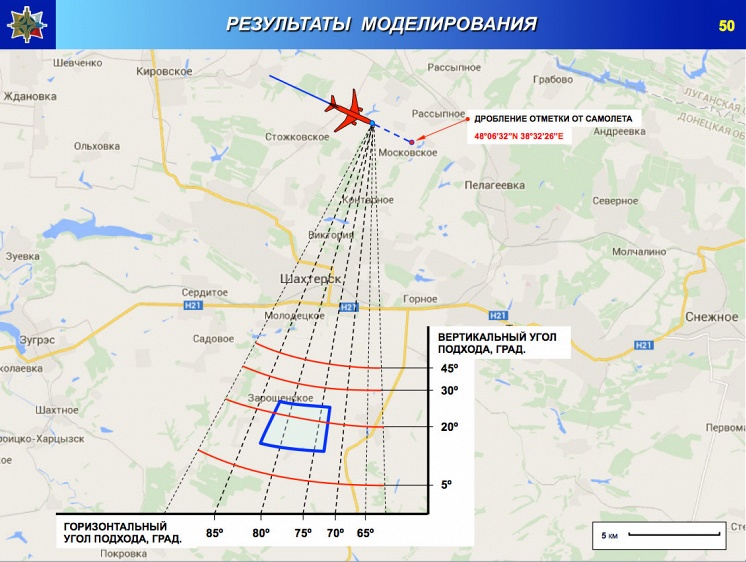
Calculation by the Buk manufacturer, Almaz-Antay, showing what it considered the likely area of the launch that took down Malaysia Airlines Flight 17.
The area is about three miles west of the 320-square-kilometer zone that the Dutch report established as the likely area from which the missile was fired. In July 2014, control of that area was being contested although most of the fighting was occurring about 100 kilometers to the north, meaning that the southern sector was more poorly defined and open to the possibility of a mobile system crossing from one side to the other.
Almaz-Antay CEO Novikov said the company’s calculations placed the missile site in Zakharchenko with “great accuracy,” a possible firing zone that “does not exceed three to four kilometers in length and four kilometers in width.” However, Ukrainian authorities said their calculations placed the firing location farther to the east, deeper into rebel-controlled territory.
Thus, the importance of the U.S. intelligence data that Secretary of State John Kerry claimed to possess just three days after the plane was shot down. Appearing on NBC’s “Meet the Press” on July 20, 2014, Kerry declared, “we picked up the imagery of this launch. We know the trajectory. We know where it came from. We know the timing. And it was exactly at the time that this aircraft disappeared from the radar.”
But the U.S. government has released none of its evidence on the shoot-down. A U.S. intelligence source told me that CIA analysts briefed the Dutch investigators but under conditions of tight secrecy. None of the U.S. information was included in the report and Dutch officials have refused to discuss any U.S. intelligence information on the grounds of national security.
In the weeks after the shoot-down, I was told by another source briefed by U.S. intelligence analysts that they had concluded that a rogue element of the Ukrainian government – tied to one of the oligarchs – was responsible for the attack, while absolving senior Ukrainian leaders including President Petro Poroshenko and Prime Minister Arseniy Yatsenyuk. But I wasn’t able to determine whether this U.S. analysis was a consensus or a dissident opinion.
Last October, Der Spiegel reported that German intelligence, the BND, concluded that the Russian government was not the source of the missile battery – that it had been captured from a Ukrainian military base – but the BND blamed the ethnic Russian rebels for firing it. However, a European source told me that the BND’s analysis was not as conclusive as Der Spiegel had described.
Prior to the MH-17 crash, ethnic Russian rebels in eastern Ukraine were reported to have captured a Buk system after overrunning a government air base, but Ukrainian authorities said the system was not operational, as recounted in the Dutch report. The rebels also denied possessing a functioning Buk system.
Who Has These Buks?
As for whether the 9M38 Buk system is still in the Ukrainian military arsenal, government officials in Kiev claimed to have sold their stockpile of older Buks to Georgia, but Ukraine appears to still possess the 9M38 Buk system, based on photographs of Ukrainian weapons displays. In other words, Ukrainian authorities appear to be lying about this crucial point.
It should be noted, too, that just because Russia no longer deploys the outmoded Buks doesn’t mean that it might not have some mothballed in warehouses that could be pulled out and distributed in a sub rosa fashion, although both the Ukrainian rebels and Russian officials deny this possibility. According to the Ukrainian government, the rebels were only known to have shoulder-fired “manpads” in July 2014 – and that weapon lacked the range to destroy a civilian airliner flying at 33,000 feet.
Yet, rather than delve into this important mystery, The New York Times’ editorial simply repeats the Western “group think” that took shape in the days after the MH-17 tragedy, that somehow the rebels shot down the plane with a Buk missile supplied by Russia. The other possibility that the missile was fired by some element of the Ukrainian security forces was given short-shrift despite the fact that Ukraine had moved some of its Buk batteries into eastern Ukraine presumably to shoot down possible Russian aircraft incursions.
As described in the Dutch report, this Ukrainian concern was quite real in the days before the MH-17 shoot-down. On July 16 – just one day before the tragedy – a Ukrainian SU-25 jet fighter was shot down by what Ukrainian authorities concluded was an air-to-air missile presumably fired by a Russian warplane patrolling the Russia-Ukraine border.
Thus, it would make sense that the Ukrainian air-defense forces would have moved their Buk batteries close to the border and would have been on the lookout for possible Russian intruders entering or leaving Ukrainian air space. So, one possibility is that a poorly organized Ukrainian air-defense force mistook MH-17 for a hostile Russian aircraft high-tailing it back to Russia and fired.
Another theory that I’m told U.S. intelligence analysts examined was the possibility that a rogue Ukrainian element – linked to a fiercely anti-Russian oligarch – may have hoped that President Vladimir Putin’s official plane was in Ukrainian air space en route home from a state visit to South America. Putin’s jet and MH-17 had very similar markings. But Putin used a different route and had already landed in Moscow.

A side-by-side comparison of the Russian presidential jetliner and the Malaysia Airlines plane.
A third possibility, which I’m told at least some U.S. analysts think makes the most sense, was that the attack on MH-17 was a premeditated provocation by a team working for a hard-line oligarch with the goal of getting Russia blamed and heightening Western animosity toward Putin.
Obama’s Secrets
But whatever your preferred scenario – whether you think the Russians or the Ukrainians did it – the solution to the mystery could clearly benefit from President Barack Obama doing what Putin has done: declassify relevant intelligence and defense information.
One might think that the Times’ editors would be at the forefront of demanding transparency from the U.S. government, especially since senior U.S. officials rushed out of the gate in the days after the tragedy to put the blame on the Russians. Yet, since five days after the shoot-down, the Obama administration has refused to update or refine its claims.
Earlier this year, a spokesperson for Director for National Intelligence James Clapper told me that the DNI would not provide additional information out of concern that it might influence the Dutch investigation, a claim that lacked credibility because the Dutch investigation began within a day of the MH-17 crash and the DNI issued a sketchy white paper on the case four days later.
In other words, the initial U.S. rush to judgment already had prejudiced the investigation by indicating which way the United States, a NATO ally of the Netherlands, wanted the inquiry to go: blame the Russians. Later, withholding more refined intelligence data also concealed whatever contrary analyses had evolved within the U.S. intelligence community after Kerry and the DNI had jumped to their hasty conclusions.
Yet, The New York Times took note of none of that, simply piling on the Russians again and hailing a dubious online publication called Bellingcat, which has consistently taken whatever the U.S. propaganda line is on international incidents and has systematically screwed up key facts.
In 2013, Bellingcat’s founder Eliot Higgins got the firing location wrong for the sarin gas attack outside Damascus, Syria. He foisted the blame on Bashar al-Assad’s forces in line with U.S. propaganda but it turned out that the missile’s range was way too short for his analysis to be correct. [See Consortiumnews.com’s “The Collapsing Syria-Sarin Case.”]
Then, earlier this year, Higgins fed Australia’s “60 Minutes” program wrong coordinates for the location of the so-called “Buk-getaway video” in eastern Ukraine. Though the program treated Higgins’s analysis as gospel, the images from the video and from the supposed location clearly didn’t match, leading the program to engage in a journalistic fraud to pretend otherwise. [See Consortiumnews.com’s “A Reckless Stand-upper on MH-17.”]
But the Times’ editorial board simply gushed all over Bellingcat, promoting the Web site as if it’s a credible source, writing that the Dutch report “is consistent with theories advanced by the United States and Ukraine as well as evidence collected by the independent investigative website Bellingcat.com, which hold that the fatal missile was fired from territory controlled by Russian-backed rebels in eastern Ukraine.”
The Times then distorted the findings of the Buk manufacturer to present them as somehow contradicted by the Dutch report, which substantially relied on the declassified information from the manufacturer to reach roughly the same conclusion, that the missile was an older-model Buk.
However, without irony, the Times writes, “This fact is not something Russians are likely to learn; Russian television has presented only the Kremlin’s disinformation of what is going on in Ukraine and, for that matter, Syria. … Creating an alternative reality has been a big reason for President Vladimir Putin’s boundless popularity among Russians. He sees no reason to come clean for the shooting down of the Boeing 777.”
Yet, the actual reality is that Russia has provided much more information and shown much greater transparency than President Obama and the U.S. government have. The Dutch report also ignored one of the key questions asked by Russian authorities in the days after the MH-17 shoot-down: why did Ukraine’s air defense turn on the radar used to guide Buk missiles?
But the Times remains wedded to its propaganda narrative and doesn’t want inconvenient facts to get in the way. Rather than demand that Obama “come clean” about what the U.S. intelligence agencies know about the MH-17 case, the newspaper of record chooses to mislead its readers about the facts.
Investigative reporter Robert Parry broke many of the Iran-Contra stories for The Associated Press and Newsweek in the 1980s. You can buy his latest book, America’s Stolen Narrative, either in print here or as an e-book (from Amazon and barnesandnoble.com).
Why Big Oil Supports a Carbon Tax, NYT Misleads Again
By David Addison | Seeking Alpha | October 14, 2015
… Internationally, many oil and gas majors which need higher energy prices have rallied around the implementation of a carbon tax. Recently, managements of Total, Shell, BP, BG Group, Repsol, Eni, and other state-run firms called for a carbon tax at a climate change conference in Paris.
While a New York Times editorial has suggested that these companies are finally experiencing the global awakening of the collective environmental consciousness, this move is patently self-serving to higher-cost producers who are struggling and will continue to struggle under a lower commodity price regime.
A tax on carbon emissions would incent utilities to shift from coal toward natural gas, thereby providing price uplift to these companies’ products. Also, such a tax would not likely cost the industry anything since regulatory costs would be passed to consumers. However, it would likely require hosts of compliance specialists, placing a disproportionate amount of stress on smaller, more thinly capitalized endeavors. Driving smaller players out of the business with increased regulation would serve two purposes: it allows the larger players to capture market share; and, it would put upward pressure on energy prices as supply would be driven out. … Full article
Featured Video

Max Blumenthal: ‘Israel First’ in Iran War Sparks MAGA Civil War
or go to
Aletho News Archives – Video-Images
From the Archives
Wartime internment camps in Australia
National Archives of Australia
World War I
During World War I, for security reasons the Australian Government pursued a comprehensive internment policy against enemy aliens living in Australia.
Initially only those born in countries at war with Australia were classed as enemy aliens, but later this was expanded to include people of enemy nations who were naturalised British subjects, Australian-born descendants of migrants born in enemy nations and others who were thought to pose a threat to Australia’s security.
Australia interned almost 7,000 people during World War I, of whom about 4,500 were enemy aliens and British nationals of German ancestry already resident in Australia.
Records of World War I internment camps
World War II
During World War II, Australian authorities established internment camps for three reasons – to prevent residents from assisting Australia’s enemies, to appease public opinion and to house overseas internees sent to Australia for the duration of the war.
Unlike World War I, the initial aim of internment during the later conflict was to identify and intern those who posed a particular threat to the safety or defence of the country. As the war progressed, however, this policy changed and Japanese residents were interned en masse. In the later years of the war, Germans and Italians were also interned on the basis of nationality, particularly those living in the north of Australia. In all, just over 20 per cent of all Italians resident in Australia were interned. … continue
Blog Roll
 Aletho News
- Tomorrow’s naval blockade showdown
- ‘Israel’ attacks civilians to hide its embarrassing military failures & out of pure sadism
- Any Foreign Military Vessel Approaching Hormuz Under Any Pretext ‘Will Be Dealt With Severely’: IRGC
- Diplomats slam US negotiators’ performance in Iran talks
- Trump Refuses Exit Ramp, War with Iran will Continue
- Trump Says US Naval Blockade in Strait of Hormuz Will Begin Shortly
- US, Iran end 21-hour talks without agreement
- US IRAN TALKS: Who Are the Crazy Ones Here? /Lt Col Daniel Davis
- Talks with the US end without a deal over excessive US demands: Iran
- Feeling Better, Getting Worse: How Psychiatric Drugs Create the Illusion They Cure
- If Americans Knew
- US-Iran ceasefire negotiations make zero progress – Daily Update
- Pro-Israel ‘Thinktanks’ and Individuals who Influence U.S. Foreign Policy
- Mearsheimer reveals how Israel dictates US policies on Iran, Gaza – video
- After killing 350+, Israel still has a “score to settle” with Lebanon before ceasefire – Daily Update
- Military aid to Israel emerges as the latest political litmus test for Democrats
- The only Palestinian children’s rights organization closes following years-long Israeli campaign against it
- ‘I Can’t Forget the Smell’: Lebanese Reel After Israel Kills Over 300 in Single Day
- DNC Shoots Down Resolutions Calling Out AIPAC and Limiting Arms to Israel
- TCN: Is Israel Blackmailing President Trump?
- Israel killed at least 303 Lebanese yesterday – who were they? Daily Update
- No Tricks Zone
- German Expert: Heat Dome Led To Record Temps In Western USA…Warmer In 1934, 1936
- New Study: No Linear Warming Or Glacier Retreat Along Northern Antarctic Peninsula Since 1980s
- An Inconvenient Tree: Uncovered In Alps… Europe Much Warmer Than Today 6000 Years Ago
- New Study Reports A 60% Slowdown In Greenland’s Ice Loss Rate In The Last Decade
- Low Intensity Tornado Wrecks Major Solar Farm, Creating A Potential Toxic Dump
- New Study Finds Warming Saves Lives…Cold Temperatures 12 Times More Deadly Than Excess Heat
- German Science Blog Accuses PIK Climate Institute Of Hallucinating Climate Tipping Points
- Devastating Assessment Of Comirnaty Vaccine By Former Senior Pfizer Europe Toxicologist
- New Study: CO2 Is ‘Effectively Negligible’ As An Explanatory Climate Change Factor Since 2000
- Former Pfizer Toxicologist Dr. Helmut Sterz Tells Bundestag Hearing Pfizer Vaccine Should Have Never Been Approved
 Aletho News