Government by billionaires? Cuomo names former Google CEO to join Gates & Bloomberg in drafting post-pandemic ‘reforms’
RT | May 6, 2020
New York Gov. Andrew Cuomo has appointed ex-Google CEO Eric Schmidt to lead a panel on post-pandemic “reform” of health and education systems, despite criticism for taking other billionaires with conflicts of interest on board.
Schmidt will head a ‘Blue Ribbon Commission’ tasked with “reimagining” New York’s existing systems of healthcare and education, Cuomo announced on Wednesday during his daily coronavirus briefing. The decision to place such power in the hands of another unelected billionaire has riled critics already uneasy about the governor’s post-Covid-19 plans.
The panel’s initial priorities will be “tele-health, remote learning and broadband,” Schmidt announced, dropping into Cuomo’s broadcast. The former Google exec still receives a paycheck from parent company Alphabet in an advisory capacity, raising questions of conflict of interest given Google’s leading role in developing a digital contact-tracing platform for Covid-19. While Cuomo confirmed in the same presser that the state is partnering with former New York Mayor Mike Bloomberg – another billionaire – in building a human contact-tracing network, any digital component will likely involve the participation of Google. At the same time, the tech giant’s insatiable hunger for health data, as evinced by initiatives like Project Nightingale and Google’s acquisition of Fitbit, is unlikely to sit well with New Yorkers concerned about the company’s privacy record.
Cuomo was previously deluged by criticism after announcing on Tuesday that he would place the Bill & Melinda Gates Foundation in charge of developing a “blueprint to reimagine education in the new normal,” praising former Microsoft CEO Bill Gates as a “visionary” and calling for state schools to be “revolutionized.” Public schooling groups slammed the billionaire, accusing him of promoting “one failed educational initiative after another, causing huge disaffection in districts throughout the state.”
The Gates Foundation poured nearly half a billion dollars of its own money into the notorious Common Core program, which while pitched as a way to improve floundering educational performance in mathematics has actually caused the US to drop even lower in international rankings since its nationwide implementation in 2013. After steering over $4 trillion of taxpayer dollars into the government-funded program, the Foundation tacitly admitted failure in 2016, acknowledging in a letter to donors that it had “underestimated the level of resources and support required for our public education systems to be well-equipped to implement [Common Core].”
Cuomo himself has landed in hot water in the past for his efforts to unilaterally refashion New York’s admittedly dilapidated public school system. In 2015, he was accused of “unconstitutional interference in education policy” by New York State Allies for Public Education, which highlighted his “cozy relationships” with charter school advocates and education technology businesses. One of those education technology businesses was Google. In 2014, Schmidt, then the company’s executive chairman, was appointed to a three-person commission to advise on a ‘Smart Schools’ bond issue, setting off alarm bells among consumer advocates who pointed out that Google would directly benefit from system-wide adoption of Google Apps and Chromebook laptops.
The New York governor’s history with his state’s healthcare system is equally checkered, marked by a long string of budget cuts, hospital consolidations, and layoffs, and his pledge to “revolutionize” the chronically strapped system has already gotten off on a bad foot. On Wednesday, Cuomo announced that out-of-state nurses who had come to New York to help out with the coronavirus epidemic would be required to pay state income tax on whatever compensation they had received, even if they were being paid by companies located in their home state.
Cuomo’s decision to appoint private equity bigwigs, including Bill Mulrow of Blackstone Group and Steven Cohen of MacAndrews & Forbes, to the economic advisory team charged with reopening New York has also come in for criticism, given that private equity firms often benefit from the same bankruptcies the state’s businesses are hoping to avoid.
Sudan’s new PM wants to withdraw troops from Yemen
Press TV – December 6, 2019
Sudan’s new Prime Minister Abdalla Hamdok has vowed to withdraw troops from the Saudi-led war in Yemen, saying his country’s role should be limited to assisting in a political resolution of the conflict.
“The conflict in Yemen has no military solution, whether from us or from anywhere in the world,” Hamdok told the Atlantic Council, a US-based think tank, on Thursday.
He added that the war “has to be resolved through political means,” and that his country will seek to “help our brothers and sisters in Yemen and play our role with the rest to help them address this”.
Sudan has been one of the main contributors to the so-called Saudi coalition against Yemen, formed in 2015 in a bid to install a pro-Saudi government in Sana’a and crush Yemen’s Houthi Ansarllah movement.
According to reports, up to 40,000 Sudanese troops were deployed in the country during the peak of the conflict in 2016-2017.
Late October, however, Sudanese officials said the country had withdrawn thousands of troops from Yemen, with only a “few thousand” remaining.
Speaking on Thursday, Hamdok said “not many” Sudanese forces remain in Yemen.
Hamdok, who is leading the country’s transitional government in a power-sharing pact with the military, further stated that he will be “absolutely” able to withdraw the remaining troops from Yemen.
The new prime minster said his government had “inherited” the deployment in Yemen from Sudan’s former president Omar Hassan al-Bashir who was ousted following a popular uprising against his rule in April.
Hamdok pledged to “address” the country’s involvement in the Saudi-led war “in the near future” without further elaborating on the matter.
While Sudanese officials have abstained from publishing official casualty numbers in Yemen, Yemen’s armed forces have said a total 4,253 Sudanese troops have been killed in the conflict.
The developments come as the Saudi-led mission in Yemen has come to a standstill due to the resistance and increasingly sophisticated attacks of Yemeni forces.
Earlier this year, the United Arab Emirates (UAE), Riyadh’s most influential partner in the war, was reported to have withdrawn most of its troops from Yemen.
UAE officials have reached the conclusion that the war has become “unwinnable” and that the Houthis will eventually “have a role in the future in Yemen”, reports said.
Fearing a long-lasting quagmire in Yemen, Riyadh has also been reportedly seeking to negotiate an end to the conflict through discussions with the Houthis.
Update On New York’s Self-Inflicted Energy Crunch
By Francis Menton | Manhattan Contrarian | December 3, 2019
As I have noted many times before, this whole green energy thing is all just so much talk until the point hits where energy shortages start to emerge or consumer prices begin to soar. At that point, the people will notice. And then, how will the politics shift? Will the politicians press forward with green energy — and impose energy deprivation on the people in the process? Or will they promptly back off the green energy blather, and return to the cheap and reliable fossil fuels?
Here in New York, where professing the green religion is the indispensable ticket to entry into polite society, we’re in the early phases of seeing this process play out. Out there in the hinterlands, you may be interested in the dynamics.
Our Governor Andrew Cuomo clearly thirsts to be part of polite society. Same with the members of the legislature. Thus, fealty to green orthodoxy must be regularly demonstrated. Result: We have had one measure after another over the past several years to restrict fossil fuels and promote energy from wind and solar sources. First came an outright ban on fracking in the state for oil and gas, imposed in 2014 despite the fact that a broad swath of upstate sits right atop the rich Marcellus shale formation. Then came the blocking of two major pipeline enhancements across the Hudson River and New York Harbor, most recently a denial in May of this year of a water quality permit for a cross-harbor project. Then there have been announcements of plans for multiple massive pie-in-the-sky wind and solar projects — none of which, however, has actually begun construction. In June the legislature passed a law (signed by the Guv) declaring that the entire state of New York will be “carbon neutral” by 2050!
But is any of this stuff real, in the sense that it will stand up when the crunch hits?
In August, the first inklings of the crunch began to hit. As I reported on September 3, after the cross-harbor pipeline was blocked in May, the natural gas utility named National Grid, which covers Long Island (including the parts of New York City known as Brooklyn and Queens) announced that it could not accept any additional gas customers. By August, some 3000 potential customers in that area had been denied service. These included people who had just renovated a house and now found that they had no functioning heat system, and others who planned to open restaurants but now found they had no functioning stove or oven. Within days, the affected customers were all over their state legislators, and the legislators were demanding action.
In other words, we had upon us a one hundred percent self-inflicted impending crisis, about 90% of it the personal responsibility of the Governor, with maybe a 10% assist from the legislature. So how has the Governor reacted? If the answer is not obvious to you, then you clearly will never qualify for political office.
The answer is that the Governor reacted by blaming National Grid. On November 12 he issued a letter to the utility, claiming that it had failed to provide “adequate and reliable service,” and threatening to revoke its operating permit unless it immediately resumed acceptance of new customers in its service area. Excerpt:
The essential responsibility for a utility to provide adequate and reliable service is to manage the supply and demand. The very lack of supply you now point to as the reason for your denial of service to thousands of customers exhibits your failure to plan for supply needs. Your fundamental legal obligation as mandated by your certificate of operation was to plan and provide for future needs. You failed by your own admission.
But hadn’t they made a perfectly reasonable plan for a pipeline that then got blocked by the Governor himself? That doesn’t count!
National Grid has made clear that its only plan for future supply was based on a single, speculative project: construction of a private pipeline through New Jersey and New York. The plan to build such a pipeline was risky at best. . . . There are existing short-term options to contract for non-piped gas from other sources, which National Grid either deliberately, negligently or incompetently did not secure. National Grid should have explored all options before denying service. Gas can be trucked, shipped, or barged. . . .
The only meaningful “risk” of the pipeline was that the Governor himself (or his minions) would disapprove. Anyway, instead of a safely buried pipeline, are we now going to have thousands of trucks bringing highly-explosive natural gas across the George Washington Bridge to get to Long Island? I’ll bet Cuomo didn’t clear that one with his environmentalist friends. (And by the way, don’t even think about moving the gas by rail. Federal regulations currently do not permit transport of liquefied natural gas by rail at all. However, there is a proposal by the Pipeline and Hazardous Materials Safety Administration — I’ll bet you never heard of that one — to begin to allow such transport. Your comments on the proposed rulemaking are due December 23.)
And I’ll also bet that the response of National Grid will not surprise you. They crumbled like a stale cookie. On November 25 they agreed to resume hookups, and also to pay a “penalty” of some $36 million for the period of the moratorium. Presumably, they continue to have at least a small amount of spare capacity in existing pipelines that will permit additional hookups for perhaps a few months until new supply alternatives are in place. Supposedly there will now be a “study” of how to make additional supply available. The only option that makes any sense is the pipeline.
So great victory there Cuomo. You went to battle against the evil utility, and like David against Goliath you emerged victorious. Except, let’s have a review of what this “victory” looks like:
-
Progress toward green energy? Of course not. At this point there is no reasonable alternative to natural gas for most home heating and cooking. One way or another, you have to let the people have their natural gas.
-
To be brought in by truck rather than pipeline? How is that a victory for anybody? Trucks are far more costly, far more dangerous, and far more likely to have adverse environmental effects.
But how about all those offshore wind turbines that are supposedly on the way? According to this piece at Smart Energy on October 28, New York finally let its first major contract for an offshore wind development on that date. The capacity will be 880 MW, although readers here will know that it will deliver at best a third of that over the course of a year, and at unpredictable times. There is no indication that construction has begun, or when it might begin.
Essentially, our Governor has patched together a temporary kludge to paper over the uselessness of his green energy schemes for another few months or years, until the next piece of the crunch hits. Yes, this can go on for quite a while. But not forever. Meanwhile, it’s very hard to underestimate the stupidity of the New York electorate.
Hidden in Plain Sight: The Shocking Origins of the Jeffrey Epstein Case

A composite image shows from left to right, Lewis Rosenstiel, Jeffrey Epstein, and Roy Cohn. Graphic | Emma Fiala
By Whitney Webb | MintPress News | July 18, 2019
Despite his “sweetheart” deal and having seemingly evaded justice, billionaire sex offender Jeffrey Epstein was arrested earlier this month on federal charges for sex trafficking minors. Epstein’s arrest has again brought increased media attention to many of his famous friends, the current president among them.
Many questions have since been asked about how much Epstein’s famous friends knew of his activities and exactly what Epstein was up to. The latter arguably received the most attention after it was reported that Alex Acosta — who arranged Epstein’s “sweetheart” deal in 2008 and who recently resigned as Donald Trump’s Labor Secretary following Epstein’s arrest — claimed that the mysterious billionaire had worked for “intelligence.”
Other investigations have made it increasingly clear that Epstein was running a blackmail operation, as he had bugged the venues — whether at his New York mansion or Caribbean island getaway — with microphones and cameras to record the salacious interactions that transpired between his guests and the underage girls that Epstein exploited. Epstein appeared to have stored much of that blackmail in a safe on his private island.
Claims of Epstein’s links and his involvement in a sophisticated, well-funded sexual blackmail operation have, surprisingly, spurred few media outlets to examine the history of intelligence agencies both in the U.S. and abroad conducting similar sexual blackmail operations, many of which also involved underage prostitutes.
In the U.S. alone, the CIA operated numerous sexual blackmail operations throughout the country, employing prostitutes to target foreign diplomats in what the Washington Post once nicknamed the CIA’s “love traps.” If one goes even farther back into the U.S. historical record it becomes apparent that these tactics and their use against powerful political and influential figures significantly predate the CIA and even its precursor, the Office of Strategic Services (OSS). In fact, they were pioneered years earlier by none other than the American mafia.
In the course of this investigation, MintPress discovered that a handful of figures who were influential in American organized crime during and after Prohibition were directly engaged in sexual blackmail operations that they used for their own, often dark, purposes.
In Part I of this exclusive investigation, MintPress will examine how a mob-linked businessman with deep ties to notorious gangster Meyer Lansky developed close ties with the Federal Bureau of Investigation (FBI) while also running a sexual blackmail operation for decades, which later became a covert part of the anti-communist crusade of the 1950s led by Senator Joseph McCarthy (R-WI), himself known throughout Washington for having a habit of drunkenly groping underage teenaged girls.
Yet, it would be one of McCarthy’s closest aides who would take over the ring in later years, trafficking minors and expanding this sexual blackmail operation at the same time he expanded his own political influence, putting him in close contact with prominent figures including former President Ronald Reagan and a man who would later become president, Donald Trump.
As will be revealed in Part II, after his death, this blackmail operation continued under various successors in different cities and there is strong evidence that Jeffrey Epstein became one of them.
Samuel Bronfman and the Mob
The Prohibition Era in the United States is often used as an example of how banning recreational substances not only increases their popularity but also causes a boom in criminal activity. Indeed, it was Prohibition that greatly increased the strength of the American mafia, as the top crime lords of the day grew rich through the clandestine trade and sale of alcohol in addition to gambling and other activities.
It is through the bootlegging trade of the 1920s and the early 1930s that this story begins, as it brought together key figures whose successors and affiliates would eventually create a series of blackmail and sex trafficking rings that would give rise to the likes of Jeffrey Epstein, the “Lolita Express” and “Orgy Island.”
Samuel Bronfman never planned to become a major producer of liquor but true to his family’s last name, which means “brandy man” in Yiddish, he eventually began distributing alcohol as an extension of his family’s hotel business. During Canada’s Prohibition period, which was briefer than and preceded that of its southern neighbor, the Bronfman family business used loopholes to skirt the law and find technically legal ways to sell alcohol in the hotels and stores the family owned. The family relied on its connections with members of the American mafia to illegally smuggle alcohol from the United States.
Soon after Prohibition ended in Canada, it began in the United States and, by the time the flow of illegal alcohol had turned the other way, the Bronfmans – whose business ventures were then being led by Sam Bronfman and his brothers — were relatively late to an already flourishing bootlegging trade.
“We were late starters in the two most lucrative markets – on the high seas and across the Detroit River. What came out of the border trade in Saskatchewan was insignificant by comparison,” Bronfman once told Canadian journalist Terence Robertson, who was then writing a biography of Bronfman. Nonetheless, “this was when we started to make our real money,” Bronfman recounted. Robertson’s biography on Bronfman was never published, as he died under mysterious circumstances soon after warning his colleagues that he had uncovered unsavory information about the Bronfman family.
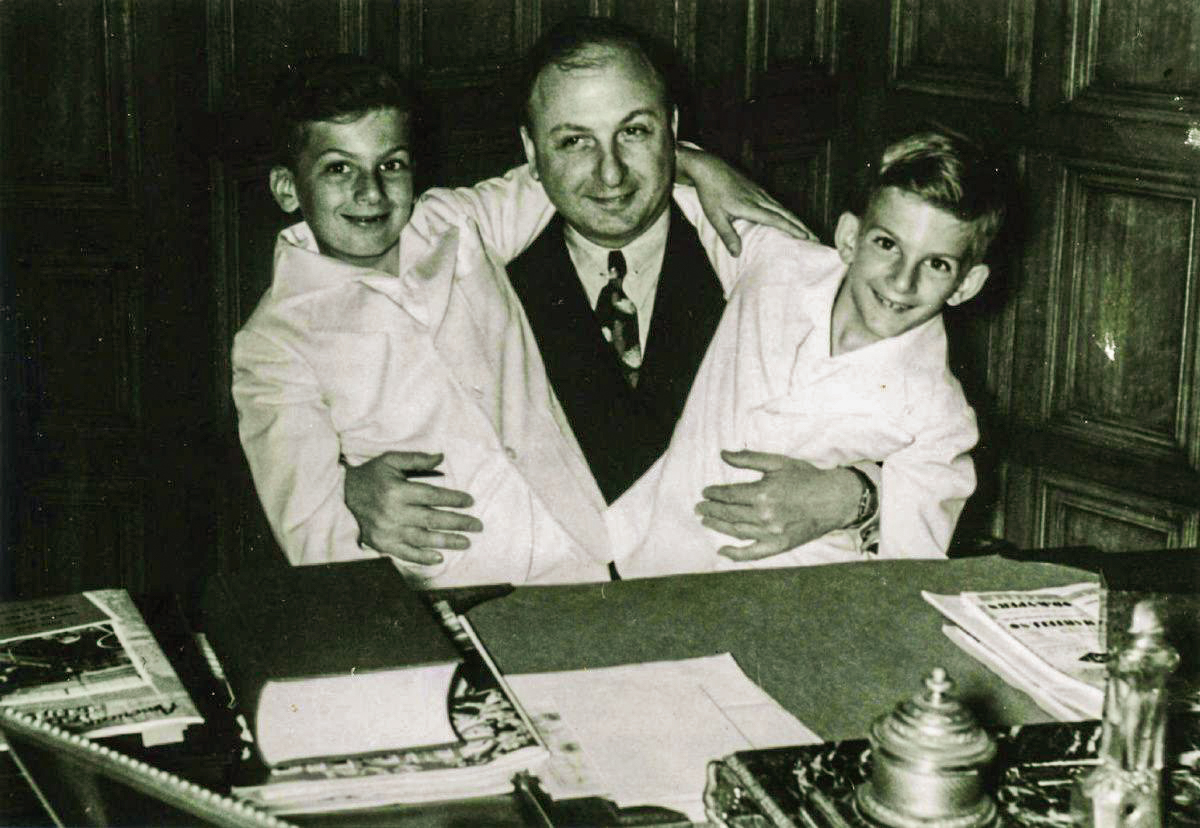
Samuel Bronfman pictured in 1937 with his sons Edgar and Charles
Key to Bronfman’s success during American Prohibition were the ties his family had cultivated with organized crime during Canada’s Prohibition, ties that led many prominent members of the mob in the United States to favor Bronfman as a business partner. Bronfman liquor was purchased in massive quantities by many crime lords who still live on in American legend, including Charles “Lucky” Luciano, Moe Dalitz, Abner “Longy” Zwillman and Meyer Lansky.
Most of Bronfman’s mob associates during Prohibition were members of what became known as the National Crime Syndicate, which a 1950s Senate investigative body known as the Kefauver Committee described as a confederation dominated by Italian-American and Jewish-American mobs. During that investigation, some of the biggest names in the American mafia named Bronfman as a central figure in their bootlegging operations. The widow of notorious American mob boss Meyer Lansky even recounted how Bronfman had thrown lavish dinner parties for her husband.
Years later, Samuel Bronfman’s children and grandchildren, their family’s ties to the criminal underworld intact, would later go on to associate closely with Leslie Wexner, allegedly the source of much of Epstein’s mysterious wealth, and other mob-linked “philanthropists,” and some would even manage their own sexual blackmail operations, including the recently busted blackmail-based “sex cult” NXIVM. The later generations of the Bronfman family, particularly Samuel Bronfman’s sons Edgar and Charles, will be discussed in greater detail in Part II of this report.
Lewis Rosenstiel’s dark secret
Crucial to Bronfman’s Prohibition-era bootlegging operations were two middlemen, one of whom was Lewis “Lew” Rosenstiel. Rosenstiel got his start working at his uncle’s distillery in Kentucky before Prohibition. Once the law banning alcohol was in force, Rosenstiel created the Schenley Products Company, which would later become one of the largest liquor companies in North America.
Though he was a high school drop-out and not particularly well-connected socially at the time, Rosenstiel happened to have a “chance” meeting with Winston Churchill in 1922 while on vacation in the French Riviera. According to the New York Times, Churchill “advised him [Rosenstiel] to prepare for the return of liquor sales in the United States.” Rosenstiel somehow managed to secure the funding of the elite and respected Wall Street firm Lehman Brothers to finance his purchase of shuttered distilleries.
Officially, Rosenstiel is said to have built his company and wealth after Prohibition, by following Churchill’s advice to prepare for Repeal. However, he was clearly involved in bootlegging operations and was even indicted for bootlegging in 1929, though he evaded conviction. Like Bronfman, Rosenstiel was close to organized crime, particularly members of the mostly Jewish-American and Italian-American mob alliance known as the National Crime Syndicate.
Subsequent New York state congressional investigations would allege that Rosenstiel “was part of a ‘consortium’ with underworld figures that bought liquor in Canada [from Samuel Bronfman]”, whose other members were “Meyer Lansky, the reputed organized crime leader; Joseph Fusco, an associate of late Chicago gangster Al Capone and Joseph Linsey, a Boston man Mr. Kelly [the congressional investigator testifying] identified as a convicted bootlegger.” Rosenstiel’s relationship with these men, particularly Lansky, would continue long after Prohibition and Samuel Bronfman, for his part, would also maintain his mob ties.
In addition to his friends in the mob, Rosenstiel also cultivated close ties with the FBI, developing a close relationship with longtime FBI Director J. Edgar Hoover and making Hoover’s right-hand man and longtime assistant at the FBI, Louis Nichols, the Vice President of his Schenley empire in 1957.
Despite their similar backgrounds as bootlegger barons turned “respectable” businessmen, Bronfman’s and Rosenstiel’s personalities were drastically different and their relationship was complicated, at best. One example of the dissimilarities between North America’s top liquor barons was how they treated their staff. Bronfman was not necessarily known for being a cruel boss, whereas Rosenstiel was known for his erratic and “monstrous” behavior towards employees as well as his unusual practice of bugging his offices in order to hear what employees said about him when he wasn’t present.
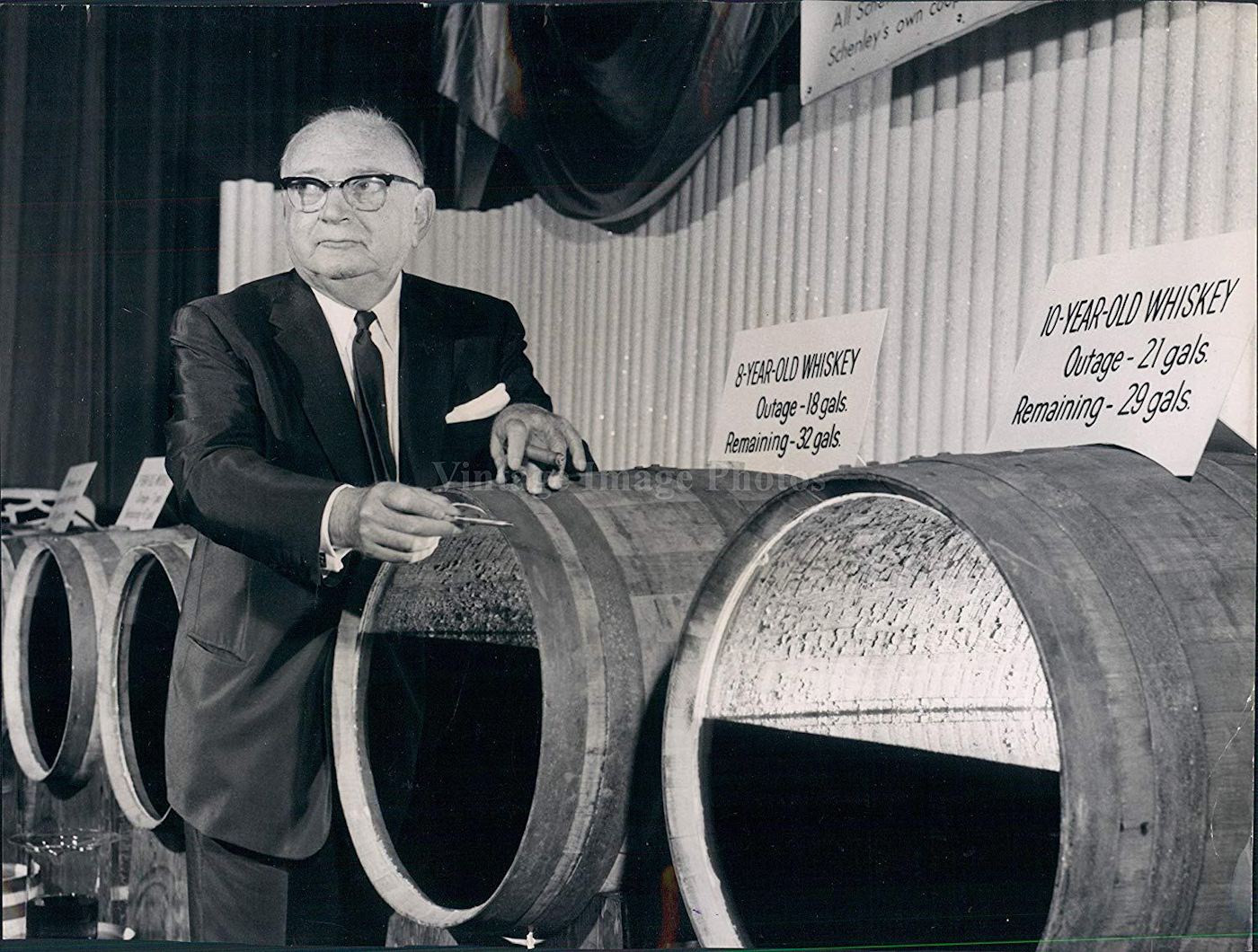
Rosenstiel was connected to both the FBI and to organized crime
Such differences between Bronfman and Rosenstiel were also reflected in their personal lives. While Bronfman married only once and was loyal to his wife, Rosenstiel was married five times and was known for his relatively closeted bisexual antics, a part of his life that was well-known to many of his close associates and employees.
Though for years there were only hints to this other side of the controversial businessman, details emerged years later during a divorce proceeding brought by Rosenstiel’s fourth wife, Susan Kaufman, that would back the claims. Kaufman alleged that Rosenstiel hosted extravagant parties that included “boy prostitutes” that her husband had hired “for the enjoyment” of certain guests, which included important government officials and prominent figures in America’s criminal underworld. Kaufman would later make the same claims under oath during the hearing of the New York’s State Joint Legislative Committee on Crime in the early 1970s.
Not only did Rosenstiel organize these parties, but he also made sure that their venues were bugged with microphones that recorded the antics of his high-profile guests. Those audio recordings, Kaufman alleged, were then kept for the purpose of blackmail. Though Kaufman’s claims are shocking, her testimony was deemed credible and held in high regard by the former chief counsel of the Crime Committee, New York Judge Edward McLaughlin, and committee investigator William Gallinaro and aspects of her testimony were later corroborated by two separate witnesses who were unknown to Kaufman.
These blackmail “parties” offer a window into an operation that would later become more sophisticated and grow dramatically in the 1950s under Rosenstiel’s “field commander” (a nickname given by Rosenstiel to an individual to be named shortly in this report). Many of the people connected to Rosenstiel’s “field commander” during the 70s and 80s have again found their names in the press following the recent arrest of Jeffrey Epstein.
The “Untouchable” Mobster
Bronfman and Rosenstiel became legendary in the North American liquor business, in part due to their fight for supremacy in the industry, which the New York Times described as often erupting “into bitter personal and corporate battles.” Despite their dueling in the corporate world, the one thing that united the two businessmen more than anything else was their close connection to American organized crime, particularly renowned mobster, Meyer Lansky.
Lansky is one of the most notorious gangsters in the history of American organized crime and is notable for being the only famous mobster that rose to notoriety in the 1920s that managed to die an old man and never serve a day in jail.
Lansky’s long life and ability to avoid prison time was largely the result of his close relationships to powerful businessmen like Bronfman and Rosenstiel (among many others), the Federal Bureau of Investigation (FBI) and the U.S. intelligence community as well as his role in establishing several blackmail and extortion rings which helped him keep the law at arm’s length. Indeed, when Lansky was finally charged with a crime in the 1970s, it was the Internal Revenue Service that brought the charges, not the FBI, and he was charged with and acquitted of tax evasion.
Lansky was remarkably close to both Bronfman and Rosenstiel. Bronfman regularly threw “lavish dinner parties” in Lansky’s honor both during and after Prohibition. These parties were remembered fondly by Lansky’s wife, and Lansky, in turn, did favors for Bronfman ranging from exclusive protection of his shipments during Prohibition to getting him tickets to coveted “fight of the century” boxing matches.
Rosenstiel also threw regular dinner parties honoring Lansky. Susan Kaufman, Rosenstiel’s ex-wife, claimed to have taken numerous pictures of her ex-husband and Lansky socializing and partying together, photos that were also seen by Mary Nichols of The Philadelphia Inquirer. In addition, Lansky, per Kaufman’s recollection, was one of the individuals that Rosenstiel sought to protect from legal scrutiny as part of his child prostitution and blackmail ring targeting high-ranking officials, and he was overheard saying that if the government “ever brings pressure against Lansky or any of us, we’ll use this [a specific recording taken at one of the “parties”] as blackmail.”
Lansky was known to address Rosenstiel as “Supreme Commander,” a title that would later be used to refer to Rosenstiel by another individual deeply connected to the mob and sexual blackmail operations, previously referred to in this report as Rosenstiel’s “Field Commander.”
Lansky also had close ties to the CIA and U.S. military intelligence. During World War II, Lansky –along with his associate Benjamin “Bugsy” Siegel — worked with Naval intelligence in what was codenamed “Operation Underworld,” an operation that the government denied for over 40 years.
Journalist and noted chronicler of CIA covert activities, Douglas Valentine, noted in his book The CIA as Organized Crime: How Illegal Operations Corrupt America and the World that the government’s cooperation with the mafia during World War II led to its expansion after the war and set the stage for its future collaboration with U.S. intelligence.
According to Valentine:
Top government officials were also aware that the government’s Faustian pact with the Mafia during World War II had allowed the hoods to insinuate themselves into mainstream America. In return for services rendered during the war, Mafia bosses were protected from prosecution for dozens of unsolved murders. […]
The Mafia was a huge problem in 1951 [when the Kefauver Committee was convened], equivalent to terrorism today. But it was also a protected branch of the CIA, which was co-opting criminal organizations around the world and using them in its secret war against the Soviets and Red Chinese. The Mafia had collaborated with Uncle Sam and had emerged from World War II energized and empowered. They controlled cities across the country.”
Indeed, the CIA forged ties with Lansky not long after its creation at the behest of CIA counterintelligence chief James J. Angleton. The CIA would later turn to the Lansky-linked mob in the early 1960s as part of its consistently fruitless quest to assassinate the Cuban leader, showing that the CIA maintained its contacts with Lansky-controlled elements of the mafia long after the initial meeting with Lansky took place.
The CIA also had close connections to associates of Lansky, such as Edward Moss, who did public relations work for Lansky and was said to be of “interest” to the CIA by the agency’s then-inspector general J.S. Earman. Harry “Happy” Meltzer was also another Lansky associate that was a CIA asset and the CIA asked Meltzer to join an assassination team in December 1960.
In addition to the CIA, Lansky was also connected to a foreign intelligence agency through Tibor Rosenbaum, an arms procurer and high-ranking official in Israel’s Mossad, whose bank – the International Credit Bank of Geneva – laundered much of Lansky’s ill-gotten gains and recycled it into legitimate American businesses.
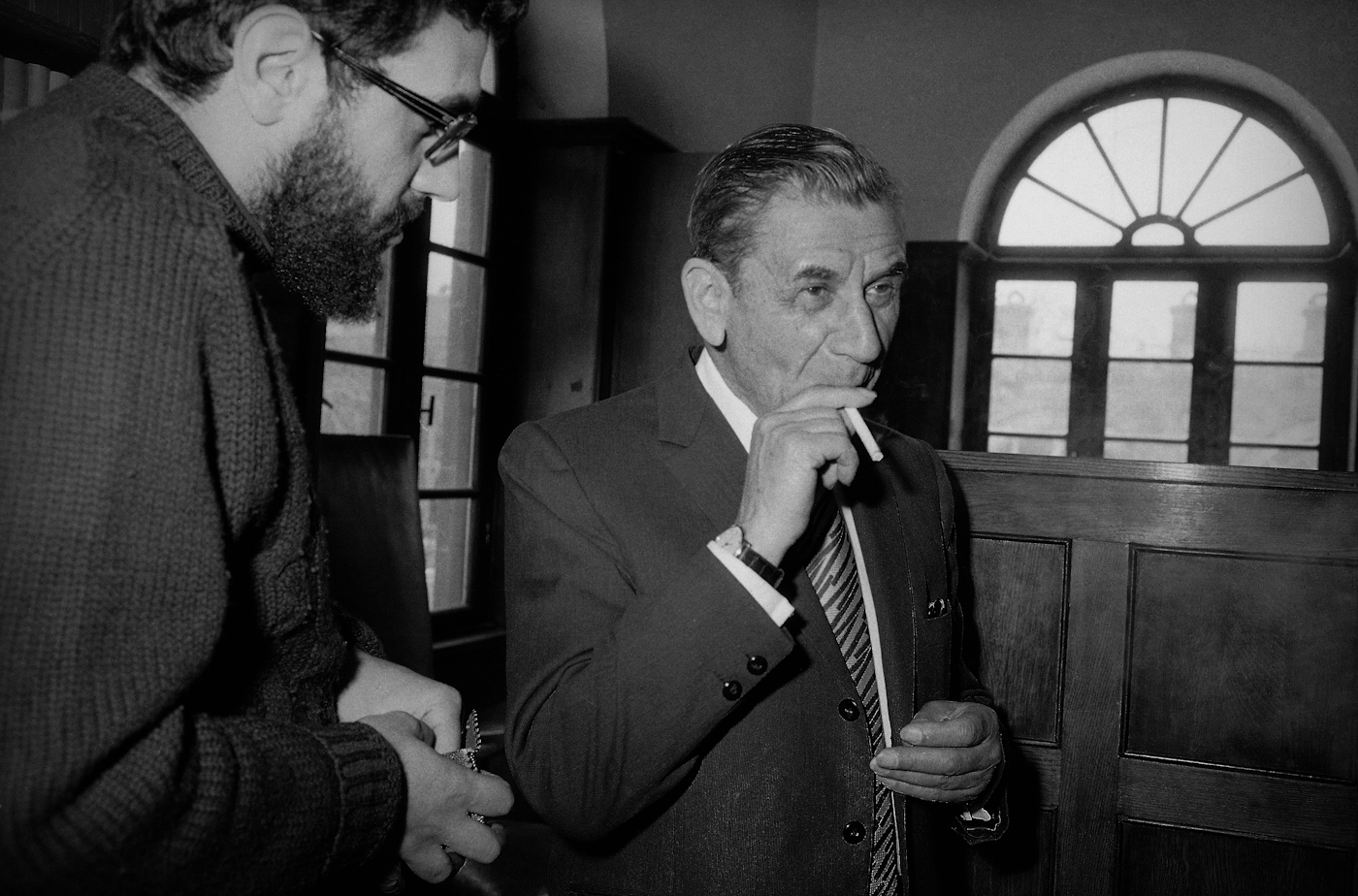
Lansky outside the High Court of Israel where he sought permission to emigrate in 1972. Photo | AP
Journalist Ed Reid, author of the Virginia Hill biography The Mistress and the Mafia, wrote that Lansky was attempting to entrap powerful people through sexual blackmail as far back as 1939. Reid contends that Lansky sent Ms. Hill to Mexico, where his West Coast connections had established a drug ring that later involved the OSS, the forerunner to the CIA, to seduce numerous “top politicians, army officers, diplomats and police officials.”
Eventually, Lansky was credited with obtaining compromising photos of FBI director J. Edgar Hoover sometime in the 1940s, which showed “Hoover in some kind of gay situation”, according to a former Lansky associate who also said that Lansky had often claimed, “I fixed that sonofabitch.” The photos showed Hoover engaged in sexual activity with his long-time friend, FBI deputy director Clyde Tolson.
At some point, these photos fell into the hands of CIA counterintelligence chief James J. Angleton, who later showed the photos to several other CIA officials, including John Weitz and Gordon Novel. Angleton was in charge of the CIA’s relationship with the FBI and Israel’s Mossad until he left the agency in 1972 and, as was recently mentioned, he was also in contact with Lansky.
Anthony Summers , former BBC journalist and author of Official and Confidential: The Secret Life of J. Edgar Hoover, has argued that it was not Lansky, but William Donovan, the director of the OSS, who obtained the original photos of Hoover and later shared them with Lansky.
Summers also stated that “To [gangster Frank] Costello and Lansky, the ability to corrupt politicians, policemen and judges was fundamental to Mafia operations. The way they found to deal with Hoover, according to several mob sources, involved his homosexuality.” This anecdote shows that Lanksy and the CIA maintained a covert relationship, which included, among other things, the sharing of blackmail material (i.e. “intelligence”).
It is also possible that Hoover was ensnared by the mob during one of Rosenstiel’s blackmail “parties,” at which Hoover sometimes found himself in attendance with prominent figures of the mafia. Hoover was said to have worn women’s clothing at the some of the events and Meyer Lansky’s wife later said that her husband had photos of the former FBI director in drag. Furthermore, Hoover is on record showing an unusual concern in the FBI’s handling of Rosenstiel’s criminal links as early as 1939, the same year that his close associate Lansky was actively orchestrating the sexual blackmail of powerful political figures.
The blackmail acquired on Hoover and the mob’s possession of the evidence has been cited as a major factor in Hoover’s decades-long denial that nationwide networks of organized crime were a serious issue. Hoover asserted that it was a decentralized, local issue and therefore outside of the bureau’s jurisdiction. By the time Hoover finally acknowledged the existence of national organized crime networks in 1963, it was so entrenched in the U.S. establishment that it was untouchable.
Congressional crime consultant Ralph Salerno told Summers in 1993 that Hoover’s willful ignorance of organized crime for most of his career as FBI director “allowed organized crime to grow very strong in economic and political terms, so that it became a much bigger threat to the wellbeing of this country than it would have been if it had been addressed much sooner.”
J. Edgar Hoover: Blackmail Victim?
Most records place the beginning of Hoover’s relationship with Rosenstiel in the 1950s, the same decade when Susan Kaufman reported that Hoover was attending Rosenstiel’s blackmail parties. Rosenstiel’s FBI file, obtained by Anthony Summers, cites the first Rosenstiel meeting as taking place in 1956, though Summers notes that there is evidence that they had met much earlier. After requesting the meeting, Rosenstiel was granted a personal face to face with the director in a matter of hours. The FBI file on Rosenstiel also reveals that the liquor baron heavily lobbied Hoover to aid his business interests.
During that time, the salacious details of Hoover’s sex life were already known to the U.S. intelligence community and to the mob, and Hoover was aware that they knew of his closeted sexuality and penchant for women’s clothing. Yet, Hoover apparently seemed to embrace the very type of sexual blackmail operation that had compromised his private life, given that he was seen at many of Rosenstiel’s “blackmail” parties in the 1950s and 1960s, including at venues such as Rosenstiel’s personal home and later at Manhattan’s Plaza Hotel. Hoover’s penchant for dressing in drag was also described by two witnesses who were not connected to Susan Kaufman.
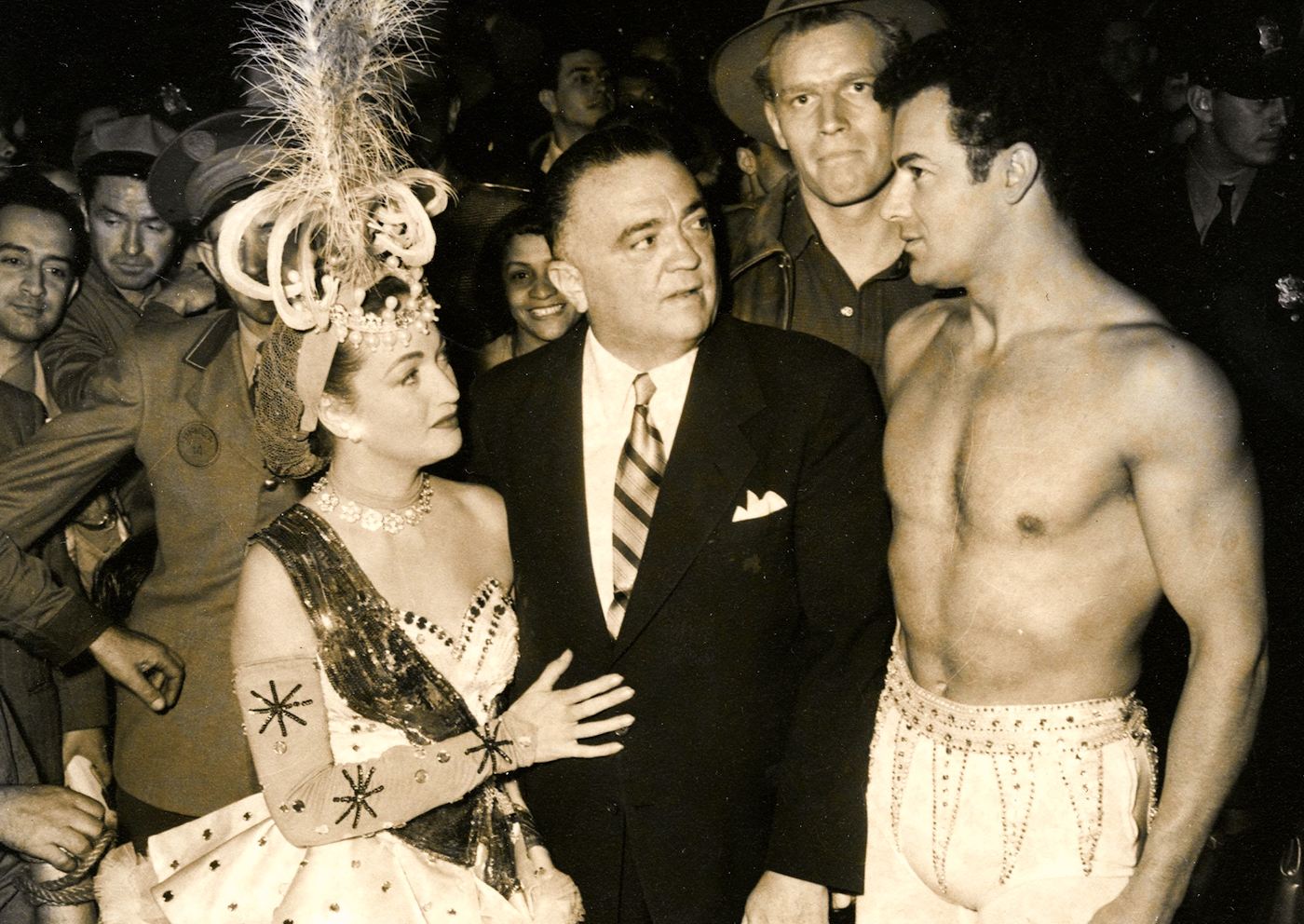
Hoover with Dorothy Lamour on the set of The Greatest Show on Earth in 1951
Soon after their first “official” meeting, the public relationship between the two men quickly flourished, with Hoover even sending Rosenstiel flowers when he fell ill. Summers reported that, in 1957, Rosenstiel was heard telling Hoover during a meeting, “your wish is my command.” Their relationship remained close and intimate throughout the 1960s and beyond.
Like Rosenstiel, Hoover was well-known for amassing blackmail on friend and foe alike. Hoover’s office contained “secret files” on numerous powerful people in Washington and beyond, files he used to gain favors and protect his status as FBI director for as long as he wished.
Hoover’s own propensity for blackmail suggests that he may have associated with Rosenstiel’s sexual blackmail operation more directly, given he already knew he was compromised and his involvement in the operation would have served as a means of procuring the blackmail he coveted for his own purposes. Indeed, if Hoover was merely being blackmailed and extorted by the Lansky-Rosenstiel connected mob, it is unlikely that he would have been so friendly to Rosenstiel, Lansky and the other mobsters at these gatherings and participated in them with such regularity.
According to journalist and author Burton Hersh, Hoover was also tied to Sherman Kaminsky, who ran a sexual blackmail operation in New York involving young male prostitutes. That operation was busted and investigated in 1966 extortion probe led by Manhattan District Attorney Frank Hogan, though the FBI quickly took over the investigation and photos of Hoover and Kaminsky together soon disappeared from the case file.
Hoover and Rosenstiel’s deep ties would continue to develop over the years, an example of which can be seen in Rosenstiel’s hiring of long-time Hoover aide Louis Nichols as the Vice President of his Schenley liquor empire and Rosenstiel’s donation of over $1 million to the J. Edgar Hoover Foundation, which Nichols also ran at the time.
There is also more than one documented occasion wherein Hoover attempted to use blackmail to protect Rosenstiel and his “field commander,” none other than the infamous Roy Cohn, the other key figure in Rosenstiel’s sexual blackmail operation involving minors.
The Making of a Monster
Decades after his death, Roy Cohn remains a controversial figure in large part because of his close, personal relationship with current U.S. President Donald Trump. Yet reports on Cohn, both in recent and in past years, often miss the mark in their characterization of the man who became closely associated with the Reagan White House, the CIA, the FBI, organized crime and, incidentally, many of the figures who would later surround Jeffrey Epstein.
To understand the true nature of the man, it is essential to examine his rise to power in the early 1950s, when at just 23 years old, he became a key figure in the high-profile trial of Soviet spies Ethel and Julius Rosenberg and later in the House Un-American Activities Committee (HUAC) led by Senator Joseph McCarthy.
Cohn’s dedication to anti-communist activities in the 1950s is allegedly what first endeared him to J. Edgar Hoover who he first met in 1952. During that meeting, as described by Hersh in Bobby and J. Edgar: The Historic Face-Off Between the Kennedys and J. Edgar Hoover That Transformed America, Hoover expressed admiration for Cohn’s aggressive and manipulative tactics and told Cohn to “call me directly” whenever he had information worth sharing. From that point on, Cohn and Hoover “traded favors, effusive compliments, gifts and elaborate private dinners. It quickly became ‘Roy’ and ‘Edgar.’” Hersh also describes Hoover as Cohn’s soon to be “consigliere.”
The date and circumstances around Cohn’s introduction to Rosenstiel is harder to come by. It is possible that the connection was made through Roy Cohn’s father, Albert Cohn, a prominent judge and an influential figure in the New York City Democratic Party apparatus then-run by Edward Flynn. It was later revealed that the Democratic organization dominated by Flynn and based in the Bronx had long-standing connections to organized crime, including associates of Meyer Lansky.
Regardless of how or when it began, the relationship between Cohn and Rosenstiel was close and was often likened to that of a father and son. They were said to frequently salute each other in public and remained close until Rosenstiel was near death, at which point Cohn attempted to trick his then-barely conscious and senile “friend” and client into naming him the executor and trustee of the liquor magnate’s estate, valued at $75 million (more than $334 million in today’s dollars).
LIFE magazine reported in 1969 that Cohn and Rosenstiel had for years referred to one another as “Field Commander” and “Supreme Commander,” respectively. Media references to these nicknames appear in other articles from the period.
Though LIFE and other outlets had interpreted this as merely an anecdote about the nicknames shared in jest between close friends, the fact that notorious crime lord Meyer Lansky also called Rosenstiel “Supreme Commander” and the fact that Cohn and Rosenstiel would later become intimately involved in the same pedophile sex ring, suggests that there may have been more to these “nicknames.” After all, the mob to which Rosenstiel was connected often used military-themed titles like “soldier” and “lieutenant” to differentiate the rank and importance of its members.
Once he had made his connection with Hoover, Cohn’s star began to rise even higher in Washington. Hoover’s recommendation of Cohn would become the deciding factor in his appointment as Sen. McCarthy’s general counsel over Robert Kennedy, a rival and bitter enemy of Cohn’s.
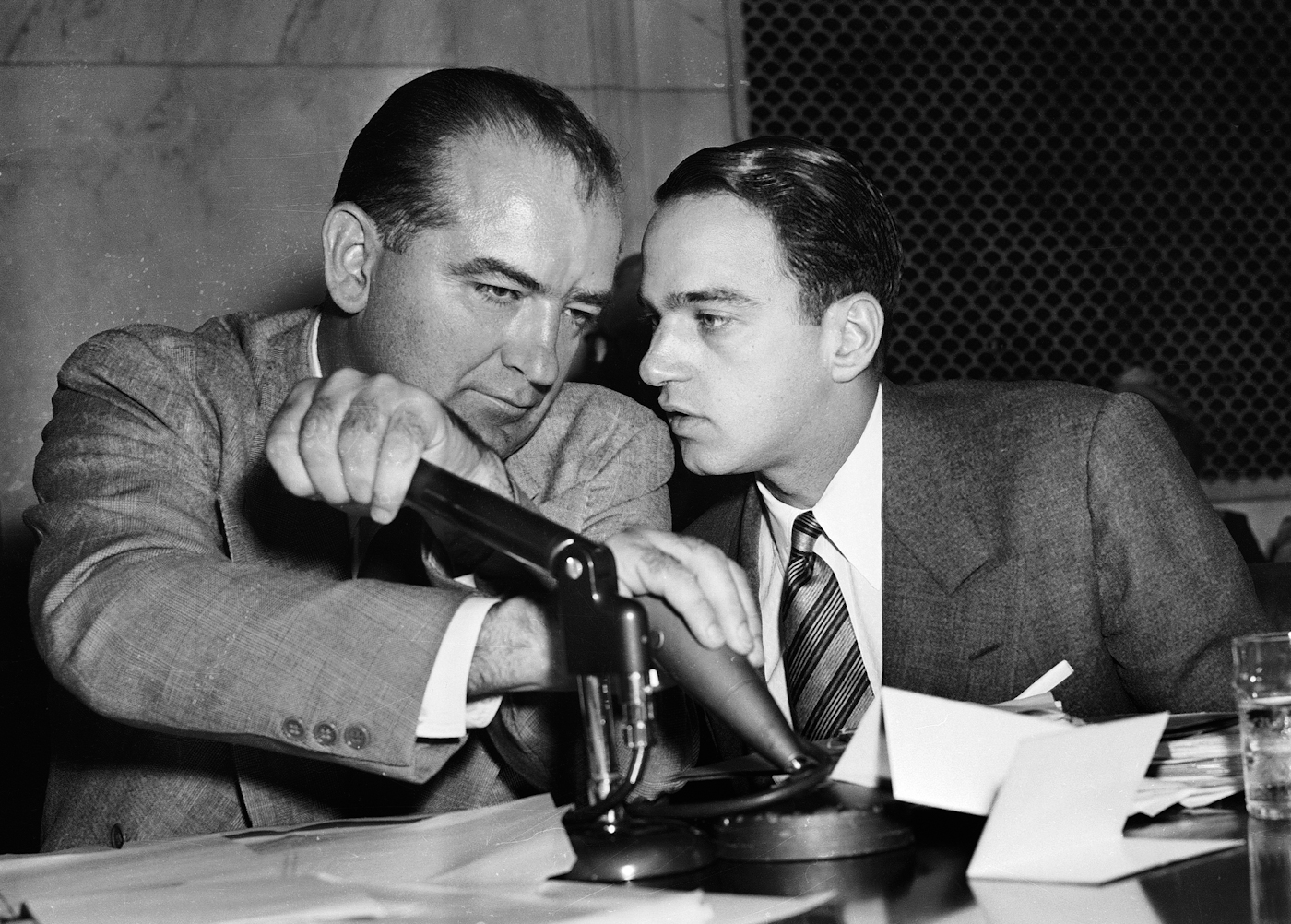
McCarthy covers the mic while having a whispered discussion with Cohn during a 1954 committee hearing. Photo | AP
Though Cohn was ruthless and seemingly untouchable as McCarthy’s counsel and helped the Senator destroy many careers during both the red and lavender scares, his antics in relation to his work on the committee would eventually lead to his downfall after he attempted to blackmail the Army in return for preferential treatment for committee consultant and Cohn’s rumored lover, David Schine.
After he was forced to leave McCarthy’s side due to the scandal, Cohn returned to New York to live with his mother and practice law. A few years later New York Judge David Peck, a long-time associate of former CIA director Alan Dulles, orchestrated Cohn’s hire to the New York law firm, Saxe, Bacon and O’Shea, which would later become Saxe, Bacon and Bolan after Tom Bolan, a friend of Cohn’s, became a partner in the firm. Upon his hire, Cohn brought the firm a slew of mafia-linked clients, including high-ranking members of the Gambino crime family, the Genovese crime family and, of course, Lewis Rosenstiel.
What happened in Suite 233?
The connections Roy Cohn built during the 1950s made him a well-known public figure and translated into great political influence which peaked during the presidency of Ronald Reagan. Yet, as Cohn built his public image, he was also developing a dark private life which would come to be dominated by the same blackmail pedophile racket that appears to have first begun with Lewis Rosenstiel.
One of the “blackmail” parties Susan Kaufman attended with her then-husband Lewis Rosenstiel was hosted by Cohn in 1958 at Manhattan’s Plaza Hotel, suite 233. Kaufman described Cohn’s suite as a “beautiful suite… all done in light blue.” She described being introduced to Hoover, who was in drag, by Cohn, who told her that Hoover’s name was “Mary” in a fit of barely concealed laughter. Kaufman testified that young underage boys were present and Kaufman claimed that Cohn, Hoover and her ex-husband engaged in sexual activity with these minors.
New York attorney John Klotz, tasked with investigating Cohn for a case well after Kaufman’s testimony, also found evidence of the “blue suite” at the Plaza Hotel and its role in a sex extortion ring after combing through local government documents and information gathered by private detectives. Klotz later told journalist and author Burton Hersh what he had learned:
Roy Cohn was providing protection. There were a bunch of pedophiles involved. That’s where Cohn got his power from — blackmail.”
Perhaps the most damning confirmation of Cohn’s activities in Suite 233 comes from statements made by Cohn himself to former NYPD detective and ex-head of the department’s Human-Trafficking and Vice-related Crimes division, James Rothstein. Rothstein later told John Decamp, a former Nebraska state senator who investigated a government-connected child sex ring based in Omaha, among other investigators, that Cohn had admitted to being part of a sexual blackmail operation targeting politicians with child prostitutes during a sit-down interview with the former detective.
Rothstein told John DeCamp the following about Roy Cohn:
Cohn’s job was to run the little boys. Say you had an admiral, a general, a congressman, who did not want to go along with the program. Cohn’s job was to set them up, then they would go along. Cohn told me that himself.”
Rothstein later told Paul David Collins, a former journalist turned researcher, that Cohn had also identified this sexual blackmail operation as being part of the anti-communist crusade of the time.
The fact that Cohn, per Rothstein’s recollection, stated that the child-sex blackmail ring was part of the government-sponsored anticommunist crusade suggests that elements of the government, including Hoover’s FBI, may have been connected at a much broader level than Hoover’s own personal involvement given that the FBI closely coordinated with McCarthy and Cohn for much of the red scare.
It is also worth noting that among Hoover’s many “secret” blackmail files was a sizeable dossier on Senator McCarthy, the contents of which strongly suggested that the Senator himself was interested in underage girls. According to journalist and author David Talbot, Hoover’s file on McCarthy was “filled with disturbing stories about McCarthy’s habit of drunkenly groping young girls’ breasts and buttocks. The stories were so widespread that they became ‘common knowledge’ in the capital, according to one FBI chronicler.”
Talbot, in his book The Devil’s Chessboard, also cites Walter Trohan, Washington Bureau Chief of the Chicago Tribune, as having personally witnessed McCarthy’s habit of molesting young women. “He just couldn’t keep his hands off young girls,” Trohan would later say. “Why the Communist opposition didn’t plant a minor on him and raise the cry of statutory rape, I don’t know.” Perhaps the answer lies in the fact that those “planting” minors on their political foes were McCarthy’s allies and close associates, not his enemies.
The question that necessarily arises from revelations regarding Cohn’s activities in Suite 233 is who else was Cohn “protecting” and servicing with underage prostitutes? One of them could very well have been one of Cohn’s close friends and clients, Cardinal Francis Spellman of the Archdiocese of New York, who was said to have been present at some of these parties Cohn hosted at the Plaza Hotel.
Spellman, one of the most powerful figures in the Catholic Church in North America who was sometimes referred to as “America’s Pope” was accused of not only condoning pedophilia in the Catholic church and ordaining known pedophiles including Cardinal Theodore “Uncle Teddy” McCarrick, but also engaging in it himself to such an extent that many New York area priests widely referred to him as “Mary.” Furthermore, J. Edgar Hoover was said to have a file detailing the Cardinal’s sex life, suggesting Spellman’s involvement in the ring and pedophile protection racket in which Cohn and Hoover were personally involved.
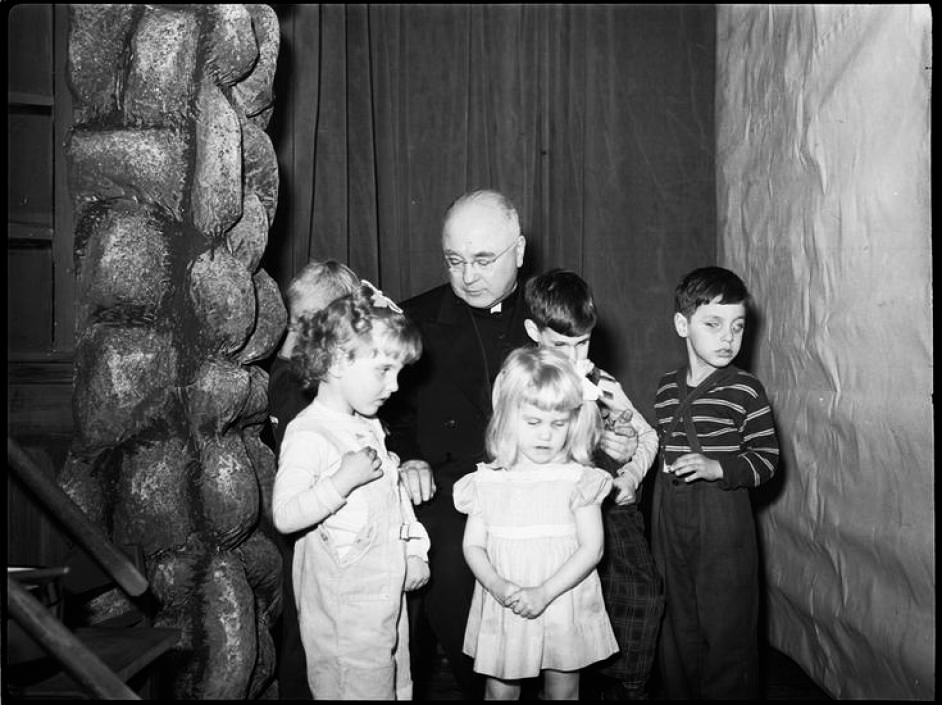
Cardinal Francis ‘Franny’ Spellman. Photo | Museum of the City of New York
People close to Cohn often remarked that he was frequently surrounded by groups of young boys, but seemed to think nothing of it. Similar off-handed comments about Epstein’s penchant for minors were made by those close to him prior to his arrest.
Controversial Republican political operative and “dirty trickster” Roger Stone, who — like Donald Trump — was also a protégé of Cohn, said the following about Cohn’s sex life during an interview with The New Yorker in 2008:
Roy was not gay. He was a man who liked having sex with men. Gays were weak, effeminate. He always seemed to have these young blond boys around. It just wasn’t discussed. He was interested in power and access.” (emphasis added)
Compare this quote from Stone to what Donald Trump, who was also close to Cohn, would later say about Jeffrey Epstein, with whom he was also closely associated:
I’ve known Jeff for 15 years. Terrific guy. He’s a lot of fun to be with. It is even said that he likes beautiful women as much as I do, and many of them are on the younger side. No doubt about it — Jeffrey enjoys his social life.” (emphasis added)
Though it is unknown how long the sex ring at the Plaza Hotel continued, and if it continued after Cohn’s death from AIDS in 1986, it is worth noting that Donald Trump purchased the Plaza Hotel in 1988. It would later be reported and confirmed by then-attendees that Trump “used to host parties in suites at the Plaza Hotel when he owned it, where young women and girls were introduced to older, richer men” and “illegal drugs and young women were passed around and used.”
Andy Lucchesi, a male model who had helped organize some of these Plaza Hotel parties for Trump said the following when asked about the age of the women present: “A lot of girls, 14, look 24. That’s as juicy as I can get. I never asked how old they were; I just partook. I did partake in activities that would be controversial, too.”
The Roy Cohn Machine
Roy Cohn was only at the beginning of his career when he waded his way into the underground sexual blackmail ring apparently led by Lewis Rosenstiel. Indeed, when Cohn first met Hoover, he was only 23 years old. Over the next three decades or so, before his death from AIDS-related complications in 1986 at the age of 56, Cohn built a well-oiled machine, largely through his close friendships with some of the country’s most influential figures.
Among Cohn’s friends were top media personalities like Barbara Walters, former CIA directors, Ronald Reagan and wife Nancy, media moguls Rupert Murdoch and Mort Zuckerman, numerous celebrities, prominent lawyers like Alan Dershowitz, top figures in the Catholic Church and leading Jewish organizations like B’nai B’rith and the World Jewish Congress. Many of the same names that surrounded Cohn until death in the late 1980s would later come to surround Jeffrey Epstein, with their names later appearing in Epstein’s now-infamous “little black book”.
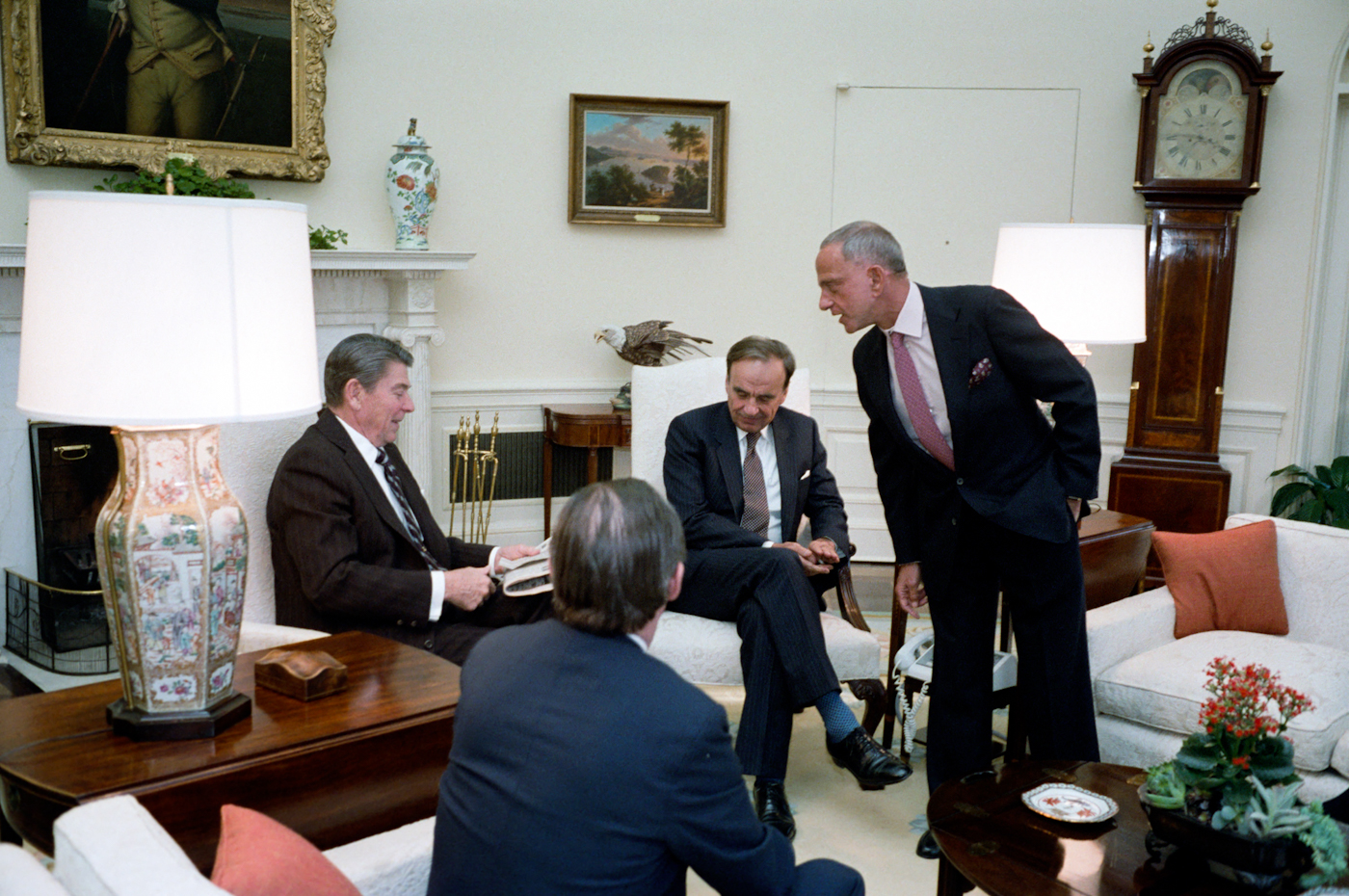
Reagan meets with Rupert Murdoch, U.S. Information Agency Director Charles Wick, and Roy Cohn in the Oval Office in 1983. Photo | Reagan presidential library
While President Trump is clearly connected to both Epstein and Cohn, Cohn’s network also extends to former President Bill Clinton, whose friend and longtime political advisor, Richard “Dirty Dick” Morris, was Cohn’s cousin and close associate. Morris was also close to Clinton’s former communications director, George Stephanopoulos, who is also associated with Jeffrey Epstein.
Yet, these were only Cohn’s connections to respectable members of the establishment. He was also known for his deep connections to the mob and gained prominence largely for his ability to connect key figures in the criminal underworld to respected influential figures acceptable to the public sphere. Ultimately, as New York attorney John Klotz stated, Cohn’s most powerful tool was blackmail, which he used against friend and foe, gangster or public official alike. How much of that blackmail he acquired through his sexual blackmail operation will likely never be known.
As Part II of this exclusive investigation will reveal, Cohn and Epstein, and the sexual blackmail operations they ran share many things in common, including not only many of the same famous friends and patrons, but also connections to intelligence agencies and consortiums of mob-linked businessmen, the modern-day equivalents of Samuel Bronfman and Lewis Rosenstiel who have since rebranded as “philanthropists.”
Part II will also reveal that Cohn’s operation was known to have successors, as revealed by a series of scandals in the early 1990s that have since been swept under the rug. The significant amount of overlap between Epstein’s and Cohn’s covert activities in sexual blackmail and their ties to many of the same powerful individuals and circles of influence strongly suggest that Epstein was one of Cohn’s successors.
As will be shown in the final installment of this report, Epstein is only the latest incarnation of a much older, more extensive and sophisticated operation that offers a frightening window into how deeply tied the U.S. government is to the modern-day equivalents of organized crime, making it a racket truly too big to fail.
Whitney Webb is a MintPress News journalist based in Chile. She has contributed to several independent media outlets including Global Research, EcoWatch, the Ron Paul Institute and 21st Century Wire, among others. She has made several radio and television appearances and is the 2019 winner of the Serena Shim Award for Uncompromised Integrity in Journalism.
Israeli settler appointed as Consul General in New York after being rejected in Brazil
Palestinian Information Center – March 28, 2016
OCCUPIED JERUSALEM – Israeli Prime Minister Benjamin Netanyahu appointed Monday morning the former head of Yesha settlement council Danny Dayan as Israel’s Consul General in New York after he failed to nominate him as an ambassador to Brazil.
In appointing Dayan, Netanyahu withdrew Dayan’s apportionment as Israel’s ambassador to Brazil after the Brazilian government refused to accept him due to his former role as a settler leader. Asked to comment, Dayan told Army Radio that he was not influenced by Brazil’s refusal. “There was no alternative but New York.”
Dayan was earlier nominated to be Israeli ambassador to Brazil, but Brazil strongly refused his appointment due to his ties to Israeli illegal settlements in the occupied West Bank.
Dayan headed the Yesha Council of Jewish settlements in the occupied West Bank between 2007 and 2013.
NY protest slams mayor over pro-Israel policy, police brutality
Press TV – October 30, 2015
American activists and protesters have staged a rally in New York City to condemn the stance of Mayor Bill de Blasio on Israel and police brutality in the US.
Pro-Palestine activists from the movement known as the ‘Black Lives Matter,’ likened US police forces in New York to Israeli soldiers in their violence and brutality against Palestinians.
They called for justice for Palestinians facing Israel’s aggression in the occupied territories.
The protesters rallied in front of the Sheraton Hotel in New York’s Times Square, where the city’s mayor was holding a re-election campaign.
At one point, about a dozen activists pushed their way into the lobby of the hotel before being repelled by security, local media reports noted.
The protesters were also angry over police brutality and their treatment of people of color.
Authorities in New York are under fire for the deaths of a number of unarmed citizens at the hands of US law enforcement officers. Most victims are usually African Americans.
Earlier in the day, the New York mayor dismissed the protesters as uninformed.
Blasio launched his re-election campaign toward the 2017 race on Thursday night, reportedly banking a million dollars during the hotel fundraiser, as other reports said the public opinion was evenly split on his job performance.
The event cost as much as some 5,000 dollars for each person in attendance.
Corporate Welfare Fails to Deliver the Jobs
The Sad Case of Start-Up NY
By Lawrence S. Wittner | May 28, 2015
For several decades, state and local governments have been showering private businesses with tax breaks and direct subsidies based on the theory that this practice fosters economic development and, therefore, job growth. But does it? New York State’s experience indicates that, when it comes to producing jobs, corporate welfare programs are a bad investment. This should be instructive to state and local officials across the US.
In May 2013, New York Governor Andrew Cuomo, with enormous fanfare, launched a campaign to establish Tax-Free NY — a scheme providing tax-free status for ten years to companies that moved onto or near the state’s public college and university campuses. According to Cuomo, this would “supercharge” the state’s economy and bring job creation efforts to an unprecedented level. It was “a game-changing initiative,” the governor insisted, and — despite criticism from educators, unions, and some conservatives — local officials fell into line. Reluctant to oppose this widely-touted jobs creation measure, the state legislature established the program — renamed Start-Up NY and including some private college campuses — that June.
After that, Start-Up NY moved into high gear. A total of 356 tax-free zones were established at 62 New York colleges and universities, with numerous administrators hired to oversee the development of the new commercial programs on their campuses. New York State spent $47 million in 2014 — and might have spent as much as $150 million over the years — advertising Start-Up NY in all 50 states of the nation, with ads focused on the theme: “New York Open for Business.” Nancy Zimpher, the chancellor of the State University of New York, crowed: “Nowhere in the country do new businesses and entrepreneurs stand to benefit more by partnering with higher education than in New York State, thanks to the widespread success of Governor Cuomo’s Start-Up NY program. With interest and investment coming in from around the globe and new jobs being created in every region, Start-Up NY has provided a spark for our economy and for SUNY.” This was, she declared, a “transformative initiative.”
But how “transformative” has Start-Up NY been? According to the Empire State Development Corporation, the government entity that oversees more than 50 of the state’s economic development programs, during all of 2014 Start-Up NY generated a grand total of 76 jobs. Moreover, the vast majority of the 30 companies operating under the program had simply shifted their operations from one region of the state to another. The New York Times reported that, of the businesses up and running under Start-Up NY, just four came from out of state. Indeed, in some cases, the “new” businesses had not even crossed county lines. One company moved one mile to qualify for the tax-free program. Furthermore, when it came to business investment, there was a substantial gap between promises and implementation. As the Empire State Development Corporation noted, companies promised $91 million in investments over a five year period, but only invested $1.7 million of that in 2014. Thus, not surprisingly, during 2014 the companies operating under Start-Up NY created only 4 percent of the new jobs they had promised.
Actually, Start-Up NY’s dismal record is not much worse than that of New York’s other economic development programs. According to a December 2013 study by the Alliance for a Greater New York, the state spends approximately $7 billion every year on subsidies to businesses, including “tax exemptions, tax credits, grants, tax-exempt bonds, and discounted land to corporations, ostensibly in the name of job creation, economic growth, and improved quality of life for all New Yorkers.” But 33 percent of spending by the state’s Industrial Development Agencies resulted in no job promises, no job creation, or a loss of jobs. In fact, “with little accountability, businesses often take the money and run.”
A recent report by state comptroller Thomas DiNapoli reached similar conclusions. According to DiNapoli, in 2014 the programs overseen by the Empire State Development Corporation cost the state $1.3 billion (not including the voluminous tax breaks granted to companies) and helped create or retain only 14,779 jobs — at a cost to taxpayers of $87,962 per job. The comptroller’s scathing report concluded that there was no attempt by the state agency to ascertain whether its programs “have succeeded or failed at creating good jobs for New Yorkers or whether its investments are reasonable.”
Of course, instead of shoveling billions of dollars into the coffers of private, profit-making companies, New York could invest its public resources in worthwhile ventures that generate large numbers of jobs — for example, in public education. In 2011, as a consequence of severe cutbacks in state funding of New York’s public schools and a new state law that capped local property tax growth — two measures demanded by Governor Cuomo — 7,000 teachers were laid off and another 4,000 teacher positions went unfilled. Overall, 80 percent of school districts reported cutting teaching positions. Today, with New York’s schools severely underfunded — more than half of them receiving less state aid now than they did in 2008-2009 — this pattern of eliminating teachers and closing down educational opportunities for children has continued. But what if the billions of dollars squandered on subsidizing private businesses in the forlorn hope that they will hire workers were spent, instead, on putting thousands of teachers back to work? Wouldn’t this policy also create a better educated workforce that would be more likely to secure employment? And wouldn’t this shift in investment have the added advantage of creating a more knowledgeable public, better able to understand the world and partake in the full richness of civilization?
It’s a shame that many state and local government officials have such a limited, business-oriented mentality that they cannot imagine an alternative to corporate welfare.
~~~~~~~~~~~~~~~~~~
Lawrence S. Wittner is Professor of History emeritus at SUNY/Albany and is syndicated by PeaceVoice. His latest book is a satirical novel about university corporatization and rebellion, What’s Going On at UAardvark?
Where the Argentine Debt Case Stands Now, and Why it Still Matters
By Aldo Caliari – NACLA – 04/06/2015
In NML v Argentina, the world continues to witness a rare and surreal spectacle: the unpredictable consequences unleashed by a U.S. judge going rogue on the law. Last June, the U.S. Supreme Court validated a lower court ruling that granted investment group NML Capital the right to obtain payment of 100% of its claims against the Argentine government, setting a legal precedent whose impact is just beginning to become clear.
NML’s actions against Argentina demonstrate why the firm is frequently described as a “vulture fund.” After initially acquiring Argentine sovereign debt bonds following the country’s 2002 default, the investment group refused to accept the terms of the agreement that Argentina reached with over 92% of bondholders, in 2005 and 2010. Then, NML sued in U.S. courts for payment of 100% of its bonds’ value, plus interest, aiming to get what amounts to a 1600% return on its original investment.
NML’s lawsuit was part of a carefully thought-out script during Argentina’s long debt restructuring process, a strategy that vulture funds have exploited in the past. First, buy the debt of a country in trouble, on the cheap. Second, systematically reject any offer of a deal worth less than the whole claim. Third, wait until the country’s circumstances improve, aided by a mix of debt relief granted by other creditors and the normal healthy impacts that such debt cancellation, if timely and sufficient, will have on the debtor country’s economy. Then, sue for the whole amount of the claim plus interest.
It is easy to see that if all creditors followed this playbook—waiting for the debtor to get better without sacrificing any part of their credit—the strategy would not work.
Unfortunately, at the international level and for nations issuing sovereign debt, there is no recourse to anything like bankruptcy, so they are exposed to rulings – even divergent ones – made by judges with jurisdiction over particular bonds.
In this particular case, U.S. Judge Thomas Griesa decided to depart from the traditionally accepted interpretation of the pari passu clause typically inserted in sovereign bonds. Whereas the standard pari passu clause is normally understood to grant equality of rank and treatment, Griesa extended the interpretation to forbid Argentina from making payments on its restructured debt without also paying the holdout bondholders.
Argentina went ahead and deposited the payment for its restructured bondholders with the banks the instruments designate as fiduciaries – in charge of collecting the payment and giving it to the bondholders. Since the banks took the judge’s order to mean they could not disburse those funds, an anomaly has emerged: a country complying with its debt obligations falling into default due to a foreign court preventing payment from being disbursed. Amazingly, the unusual nature of the ruling was only the beginning of a sui generis scenario that continues to unfold.
Holders of bonds that were restructured under European or Argentinean jurisdiction filed claims arguing that by blocking payment on their credits—even when made by U.S. banks—Judge Griesa had overstepped his jurisdiction. In fact, the judge has already granted several “one-and-only-time” exceptions so the fiduciary banks could make payments to certain non-U.S. bondholders. When one of the banks, Citi, requested that the injunction be lifted for those payments, to avoid requesting an exception every time interest payments came due, the judge denied the request, only to later backtrack on his own decision. But while agreeing to give Citi this maneuvering room, the judge expanded the initial order – and the jurisdiction overstep – by ruling that future debt under Argentine law, if it will or can be paid in U.S. dollars, qualifies as external debt. So, financial entities helping Argentina make any such payments would be prevented from doing so by the court order.
An English court, in one of these cases, ruled that payments deposited with the fiduciary institution in New York are the property of the bondholders, and no longer belong to the debtor country. Therefore, they should not fall under the jurisdiction of a US judge. Indeed, therein lies another anomaly created by the judge’s ruling: His decision ignored the arrangement Argentina reached with 92% of creditors, but then issued measures that affect payments to these majority creditors—arguably bringing them coercively under his jurisdiction.
The Argentinean Congress also passed legislation according to which it will give non-restructured bondholders – such as NML – the same deal it granted to the restructured ones, but no more. To fulfill this commitment, the government has been depositing these payments in an Argentinean banking institution , which the “vulture funds” could claim at any moment if they so wished (so far they have not).
Some observers speculated that the Argentinean government would agree to settle with the vulture funds after expiration of the RUFO clause. RUFO stands for “right upon future offer” and is inserted in the restructured bonds to promise their holders they will have a right to be offered any better deal that other bondholders receive in the future. If Argentina had settled before the expiration of the clause, it could have faced immediate demands from majority bondholders for payments proportionally equal to those made to NML. But the expiration of the clause in January did not bring any change to Argentina’s offer to the vulture funds. These observers’ speculation failed to recognize that a settlement where NML gets paid the whole amount it demands—even in the absence of the “RUFO effects”—could invite lawsuits from other non-restructured bondholders. In fact, in the wake of the Supreme Court’s ruling last June, some of those bondholders have already filed suit hoping to follow in the footsteps of NML. Since these investors hold claims to some $15 billion, this is hardly an advisable course of action for Argentina.
Regardless of what happens with Argentina, however, repercussions from Griesa’s decision reach much farther. The ruling continues a trend that, legal experts say, has seen holdouts increasingly better treated by courts, at the expense of the soundness of sovereign debt restructurings. What former IMF economist Anne Krueger characterized in 2003 as a gap in the international financial architecture is now wider than ever. By increasing the potential rewards of holdout behavior, this recent judicial precedent will make future debt crises harder to resolve, with unpredictable systemic consequences.
At the same time, creditors might opt for a jurisdiction where the traditional understanding of pari passu still holds – such as England– at the expense of New York’s current dominance as a preferential jurisdiction for issuing sovereign debt. Indeed, a large number of prominent economists warned of this possibility following Griesa’s ruling.
Last September, facing the United States and other countries’ continuing resistance to reach a consensus, developing countries voted to create a sovereign debt workout mechanism, and negotiations have begun on establishing such a legal framework at the United Nations. Even in the worst-case scenario—failure to get all countries on board—these negotiations would create a U.N.-endorsed standard for settling future sovereign debt crises. If history is any guide, there is one thing we know for sure: sooner or later there will be a country that needs to resort to it.
Aldo Caliari has been, since 2000, staff at the Washington DC-based Center of Concern where, since 2002, he has been Director of the Rethinking Bretton Woods Project, focusing on linkages between trade and finance policy, global economic governance, debt, international financial architecture and human rights in international economic policy.
NYPD Shutters Muslim Mapping Unit – But What About Other Tactics?
By Noa Yachot | ACLU | April 15, 2014
The New York Police Department is disbanding the unit that mapped New York’s Muslim communities, their places of worship, and businesses they frequent – based on nothing but their religious beliefs and associations. To this we say: Good Riddance.
But the end of the Zone Assessment Unit – better known by its former, more apt name, the Demographics Unit – doesn’t necessarily mean an end to the NYPD’s unconstitutional surveillance of New York’s Muslims.
The NYPD’s discriminatory spying program has many components, of which the Demographics Unit was just one. (The ACLU, along with the NYCLU and CLEAR Project at CUNY Law School sued the NYPD over the program – read about our case here.) Before we celebrate the end of bias-based policing, we need to ensure that the other abusive tactics employed by the NYPD meet the same fate as the unit. For example:
- Use of informants: A wide network of NYPD informants have infiltrated community organizations, mosques, restaurants, bookstores, and more to monitor, record, and take notes on innocent people and innocuous conversations. This needs to stop.
- Designation of entire mosques “terrorism enterprises”: The NYPD has used “terrorism enterprise investigations” against entire mosques to justify the surveillance of as many people as possible. That unmerited designation has allowed the police department to record sermons and spy on entire congregations.
- Discriminatory use of surveillance cameras: Cameras have been set up outside mosques and community events – even weddings – to record community members’ comings and goings and collect license plate numbers of congregants and attendees.
- Radicalization theory: The NYPD must disavow its debunked “radicalization” theory, on which discriminatory surveillance is based. This misguided notion, which we’ve described in detail here, treats with suspicion people engaging in First Amendment-protected activities including “wearing traditional Islamic clothing [and] growing a beard,” abstaining from alcohol, and “becoming involved in social activism” – meaning, basically, anyone who identifies as Muslim, harbors Islamic beliefs, or engages in Islamic religious practices.
- Discriminatory surveillance by other units: The Demographics Unit’s discriminatory mapping activities shouldn’t be carried out by other parts of the NYPD and its Intelligence Division.
The Demographics Unit has sown fear and mistrust among hundreds of thousands of innocent New Yorkers – creating “psychological warfare in our community,” Linda Sarsour of the Arab American Association of New York told the New York Times. Shutting it down is a welcome step, but it’s only the first one. New York’s Muslims — and all its communities — deserve more and better from their police force than bias-based policing.
NY state steps up surveillance on…kids
New York state authorities are planning to step-up surveillance – this time, on school kids. The program, which is to be launched state-wide, is supposed to gather information on students starting from the age of five. And as RT’s Marina Portnaya reports, the move is finding little support among parents.

Featured Video
The 1964 Coup in Brazil
or go to
Aletho News Archives – Video-Images
Frlom the Archives
70 Neocons Petition Congress To Effectively Allow Israel To Say When The US Should Attack Iran
By Damian Lataan | January 10, 2014
Seventy senior Israeli-centric neoconservatives have written an open letter to Congress imploring them to do more to ensure Iran complies with the conditions of any agreement finally reached with the P5+1 over Iran’s nuclear program.
While the neocons are ostensibly asking Congress to ensure compliance, it is clear that their real aim is to convince members of Congress to support the bill currently passing through the Senate which calls for tighter sanctions against Iran in the event of any waywardness on Iran’s part.
The neocons are eager to see the bill currently passing through the Senate with enough support to make it veto-proof, not so much because they are concerned about Iran’s so-called nuclear weapons program – there’s still not a skerrick of hard evidence that Iran has a nuclear weapons program – but, rather, because embedded within the bill is this clause:
… if the Government of Israel is compelled to take military action in legitimate self-defense against Iran’s nuclear weapon program, the United States Government should stand with Israel and provide, in accordance with the law of the United States and the constitutional responsibility of Congress to authorize the use of military force, diplomatic, military, and economic support to the Government of Israel in its defense of its territory, people, and existence…
Essentially, the clause is an automatic trigger for the US to attack Iran at any time the Israelis choose to launch a first strike – regardless of whether President Obama is in favour or not.
Partial list… continue
Blog Roll
 Aletho News
- UK Parliament Plans ISP Blocking and Age Verification Powers
- World cannot remain silent as US and Israel attack ‘heritage of humankind’: Iran
- Emirati billionaire rebukes US senator over call for Gulf states to join war with Iran
- Op. True Promise 4: Iran’s missile blitzkrieg dismantles US war machine in West Asia
- Aramco CEO warns ‘catastrophe’ imminent if Strait of Hormuz remains shut
- What If Iran Says No?
- Trump Threatens to ‘Hit’ Iran ‘Twenty Times Harder’ Over Strait of Hormuz Oil Flows
- Spare the hypocrisy: Baghaei slams Ursula’s support for US
- Iran War Supporters Invent a New and Absurd Justification: It Is All About China
- Corporate Media Go All Out To Support The US-Israeli War on Iran
- If Americans Knew
- U.S. support for Israel continues to plummet, despite media’s best efforts
- Threats and missiles fly, death tolls soar in Iran, Lebanon, Gaza – Not a ceasefire Day 151
- Lebanon: Israel’s White Phosphorous Use Risks Civilian Harm
- Corporate Media Go All Out To Support The US-Israeli War On Iran
- US-Israel war on Iran is creating a steady growing number of amputees
- Israel planned this war on Iran for 40 years. Everything else is a smoke screen
- The wrong question about the war in Iran
- ‘Your Tax Dollars Being Used to Raise Your Gas Prices’: US-Israel Bomb Major Iranian Oil Depots
- ‘Bogus Evidence’: Former Nuclear Watchdog Head Debunks US Justification for Iran War
- EXPLAINER – Dimona: What to know about Israel’s nuclear site
- No Tricks Zone
- Wake-up Call: Survey Shows Majority Of Germans Now Favor Postponing Climate Targets!
- Televised! Leading German Political Candidate Tells Schoolchildren CO2 Makes Sun Hotter!
- New Study: A Century Warming Of 1.1°C Is ‘Commonplace’ And ‘Not Unusual’ During This Interglacial
- New Study: ‘Internal Noise’ And Volcanic Forcing Can Trigger 10-15°C Warming Within Decades
- Glaciers Worldwide Are Suddendly Surging, Experts Blame Warming!
- Surprising Discovery: Sahara Is Greening…Billions Of Trees Where Once Thought To Be Barren
- New Research Reaffirms Clouds, Aerosols, And Surface Solar Radiation Are ‘Driving The Climate System’
- Germany: Electric Car Catches Fire At Charging Station, Sets Off Local “Inferno”, Widespread Damage
- New Study: Canada’s New Brunswick Was 1°C Warmer Than Today During The Medieval Warm Period
- Coal Power Back In Trend As Globe Tries To Keep Pace With Growing Demand For Power
 Aletho News