Iran condemns ‘biased’ IAEA, announces enrichment countermeasures
Al Mayadeen | June 12, 2025
Iran has sharply rejected a resolution passed by the International Atomic Energy Agency’s (IAEA) Board of Governors, accusing it of being “politically driven” and “biased”. In a joint statement released Thursday by the Foreign Ministry and the Atomic Energy Organization of Iran (AEOI), Iranian officials condemned the resolution and unveiled a series of countermeasures aimed at accelerating the country’s nuclear program.
This comes shortly after the IAEA Board of Governors passed a resolution against Iran on Thursday, claiming Iran was in breach of non-proliferation obligations. The vote passed with 19 countries voting in favor, 3 opposing, and 11 abstaining, according to diplomats cited by Reuters. Two countries were absent and thus did not vote.
The resolution, marking the first formal accusation in nearly two decades that Iran has violated its nuclear non-proliferation obligations, was passed during a closed-door session of the 35-member board. The move, described as “politically motivated” by Iranian officials, was initiated by the United States along with the E3, Britain, France, and Germany.
IAEA resolution lacks ‘neutrality’
The joint statement asserted that Iran remains committed to its obligations under the Safeguards Agreement, adding that no IAEA report to date has ever confirmed any deviation or non-compliance. Iranian authorities described the IAEA’s latest move as lacking “neutrality” and being manipulated by Western powers, particularly the United States, Britain, France, and Germany, to pursue geopolitical goals.
In a direct response, Iran announced the activation of a new uranium enrichment facility at a secure site and plans to upgrade the Fordow nuclear plant by replacing older centrifuges with sixth-generation advanced models.
Iran blasts Western double standards on nuclear disarmament
Iranian officials criticized the IAEA and its Western backers for what they described as selective enforcement of nuclear obligations. The joint statement accused the US and its European allies of reviving “25-year-old allegations” that had already been settled under the 2015 nuclear deal, while turning a blind eye to “Israel’s” undeclared nuclear arsenal and refusal to adhere to the Non-Proliferation Treaty (NPT).
“The United States, Britain, and France have failed to comply with Article VI of the NPT regarding nuclear disarmament,” the statement read, adding that Germany remains in possession of “inhumane weapons of mass destruction.”
Iran further warned that continued political maneuvering within the IAEA would render any future engagement futile. “This political approach toward Iran, which has always honored its obligations and cooperated extensively with the Agency, forces us to conclude that the path of engagement and cooperation is futile,” the statement asserted.
Iran thanks allies opposing the resolution
Iran’s Foreign Ministry spokesperson, Esmaeil Baghaei, strongly condemned the resolution passed Thursday by the IAEA Board of Governors, calling it a politically motivated effort by Western powers to undermine the peaceful nature of Iran’s nuclear program.
Baghaei specifically denounced the role of the United States, the United Kingdom, France, and Germany, accusing them of exploiting the IAEA to “cast doubt on the peaceful nature of Iran’s nuclear program.”
He firmly rejected the allegations outlined in the resolution, which he said were based on “baseless and unfounded claims” and stemmed from a political report by the IAEA Director General. The resolution, jointly submitted by the four Western states, was described as “an unjustified, groundless, and cruel move,” aimed at exerting “maximum pressure on Iran to deviate from the legitimate rights and interests of the Iranian people in the peaceful use of nuclear energy.”
Baghaei warned that those behind the resolution will be held accountable for its repercussions. “The Islamic Republic of Iran will take proportionate measures in response to this move to secure and protect the interests and inalienable rights of the Iranian nation in benefiting from peaceful nuclear energy,” he said.
He also expressed deep concern over the conduct of the IAEA Director General, criticizing his public statements and what he described as provocative interviews on Iran’s nuclear activities. Baghaei accused the agency chief of undermining the organization’s neutrality, stating that he “must adhere to his missions and duties in accordance with the Agency’s statute.”
Furthermore, the Iranian diplomat extended gratitude to China, Russia, Venezuela, Cuba, Nicaragua, and Belarus for issuing a joint statement rejecting the resolution. He praised their “responsible and legal positions” and reaffirmed the Iranian nation’s determination to defend its rights and interests as outlined in the United Nations Charter and the Non-Proliferation Treaty.
Iran’s IAEA representative Najafi slams politicized resolution
Iran’s representative at the International Atomic Energy Agency (IAEA), Reza Najafi, strongly criticized the agency’s recent resolution against Iran, denouncing it as politically motivated and based on unreliable sources. Speaking on Thursday, Najafi warned that such moves undermine the IAEA’s credibility and threaten the rights of member states under its founding charter.
Najafi emphasized that any draft resolution brought forward by the Board of Governors should rely strictly on unbiased, verifiable evidence, not intelligence supplied by specific states with vested interests. “Basing reports on questionable or politicized information undermines the agency’s objectivity,” he stated, in clear reference to data provided by Western governments and the Israeli occupation.
US current approach risks setting a dangerous precedent
He warned that the United States’ current approach risks setting a dangerous precedent, one that could erode trust and cooperation between the agency and its member states. Najafi asserted that such behavior contradicts the IAEA’s stated commitment to impartiality and transparency.
Reaffirming Iran’s position, Najafi made it clear that the Islamic Republic would not tolerate any attempt to erode its sovereignty through international pressure.
“Iran categorically rejects any pressure or mediation that seeks to undermine its sovereignty. We will defend our national interests, independence, and dignity,” he declared.
Politicized resolution in disguise
Najafi also expressed Iran’s outright rejection of what he described as a politicized resolution disguised as a technical safeguard concern, echoing Tehran’s longstanding understanding that the IAEA is being used as a tool for Western geopolitical agendas.
In a pointed warning to the E3, Britain, France, and Germany, as well as the United States, Najafi made it clear that Iran’s response would be firm. “These measures will not pass without consequences. They must take full responsibility for the repercussions and Iran’s strong reaction,” he said.
Kamalvandi: Political pressure will escalate Iran’s nuclear program
Behrouz Kamalvandi, Deputy Head of the Atomic Energy Organization, reinforced the government’s defiant tone, declaring that political pressure would only accelerate Iran’s nuclear ambitions.
“It is a strategic mistake to think that political pressure will push Iran to abandon its legitimate positions,” Kamalvandi said, warning that the current approach would “backfire”.
He confirmed that Iran would soon launch a third uranium enrichment facility, in addition to boosting enrichment capacity at existing sites. “We will develop sixth-generation centrifuges and increase uranium enrichment significantly,” he stated.
More Western pressure, more Iranian countermeasures
Iran’s latest response underscores its growing rejection of Western pressure and marks a new phase in the country’s nuclear trajectory, one increasingly independent of multilateral negotiations and oversight mechanisms perceived by Tehran as compromised.
This development comes just days ahead of the sixth round of indirect nuclear talks between Iran and the United States, set to take place this Sunday in Muscat, Oman. The announcement was confirmed by Omani Foreign Minister Badr Albusaidi, who wrote in a post on X: “I am pleased to confirm the 6th round of Iran-US talks will be held in Muscat this Sunday, the 15th.”
Tehran and Washington have held five rounds of talks since April to carve a new nuclear deal to replace the 2015 accord that Trump unilaterally withdrew from during his first term in 2018.
Did a Trump executive order just cripple the global US regime change network?
By Kit Klarenberg · The Grayzone · January 31, 2025
Among the flurry of executive orders issued by President Donald Trump in the first days of his administration, perhaps the most consequential to date is one titled, “reevaluating and realigning US foreign aid.”
Under this order, a 90-day pause was instantly enforced on all US foreign development assistance across the globe – excepting, of course, the largest recipients of US aid in Israel and Egypt. For now, the order forbids the disbursement of federal funding for any “non-governmental organizations, international organizations, and contractors” charged with delivering US “aid” programs overseas.
Within days, hundreds of “internal contractors” at the US Agency for International Development (USAID) were placed on unpaid leave or outright fired, as a direct result of the Executive Order. Washington Post contributor John Hudson has reported organization officials brand Trump’s directives on “foreign development assistance” a “shock and awe approach,” which has left them reeling, uncertain of their futures. One nameless USAID apparatchik told him, “they even removed all the pictures in our offices of aid programs,” as accompanying photographs attested.
While the Trump administration’s purge sent shockwaves through Washington’s international development corps and the Beltway Bandits which feed at its trough, the sudden severing of USAID money has sparked panic overseas. From Latin America to Eastern Europe, the US has pumped billions into NGO’s and media outlets to fuel color revolutions and assorted regime change operations, all in the name of “democracy promotion.”
Now, as the global apparatus of soft American power trumpeted by President George H.W. Bush as “a thousand points of light” goes dark, supposedly independent media outfits from Ukraine to Nicaragua are fretting about their future and panhandling for donations on their websites.
US-backed media and opposition face extinction in Ukraine
Since the collapse of the Soviet Union, the US has pumped billions into Ukraine to create and propel a fervently anti-Russian opposition. As former State Department Assistant Secretary for Eastern European Affairs Victoria Nuland remarked to an oil industry-sponsored meeting in Kiev in 2009, “we’ve invested $5 billion to assist Ukraine” to “build democratic skills and institutions” allowing it to “achieve European independence.”
The US flooded Ukrainian civil society with grants on the eve of the 2014 Maidan coup, birthing a network of pro-Western media outlets almost overnight. Among them was Hromadske, a liberal broadcasting entity which pushed for the overthrow of President Victor Yanukovych and rallied for the subsequent war with pro-Russian separatists in the country’s east – including through the glorification of Nazis who fought the Soviet Red Army during World War II.
With Trump’s executive order cutting off USAID programs, Hromadske has suddenly been severed from its financial tube. So too have the top Ukrainian media outlets which emerged in the wake of the Maidan coup, including Ukrinform, Internews, and a signatory of the Poynter-run International Fact Checking Network called VoxUkraine.
The Ministry of Culture and Strategic Communications and the Service of the Deputy Prime Minister for European and Euro-Atlantic Integration, both created to propagandize for war against Russia, are also among USAID funding recipients now starving for cash.
Ukrainian President Volodomyr Zelensky took to X to whine that “critically important programs” wholly dependent on “US support” were now “suspended” as a result of Trump’s executive order. He promised that “certain key initiatives” would “be financed through our internal resources,” while begging for donations from Kiev’s “European partners” to be “intensified.”
Given Ukraine’s near-total economic destruction since its proxy war against Russia erupted in February 2022, and complete reliance on USAID to pay the salaries of state employees, it is uncertain how the country’s “internal resources” can possibly be used to even vaguely offset its sudden deficit. Already, major Ukrainian media outlets are pleading for financial support from their readers just to keep their lights on.
According to Kiev’s foreign-funded Institute of Mass Information, around 90% of the country’s media is “dependent on American grants.”
Contra 2.0 gravy train paused in Nicaragua
Similar bleating has emanated from US-financed organizations in Nicaragua, where since the re-election of popular leftist Sandinista Front in 2006, Washington has pumped tens of millions of dollars into right-wing media outlets and opposition groups.
In tandem, these foreign-funded fifth columnists routinely disseminate disinformation, while inciting violence against the government and its supporters, and influencing Western media reporting on the country.
As The Grayzone reported, a USAID-funded Nicaraguan opposition outlet called 100% Noticias led a campaign of violent incitement throughout 2018, when a failed US-backed coup attempt left hundreds dead in the country. While the outlet repeatedly featured calls for the murder of President Daniel Ortega, its director, Miguel Mora, told The Grayone’s Max Blumenthal he wished for a US military intervention of the country to topple the elected government. When the Nicaraguan government finally shuttered the station and prosecuted Mora, Washington responded with accusations of repression and threats of heavy sanctions.
On January 21, an anti-Sandinista “news” operations called Nicaragua Investiga warned that Trump’s order “threatens to deal a severe blow” to the country and its anti-Ortega crusade, “which depends heavily on the financial and technical support provided by agencies” such as USAID. This backing, the outlet declared, was a “fundamental pillar” in the Nicaraguan right-wing’s efforts to undermine and depose the anti-imperialist President.
“Civil society organisations that rely on this assistance would be forced to reduce or cease their activities,” Nicaragua Investiga warned. The outlet further lamented that “uncertainty reigns over how and when assistance will be restored, and whether organizations critical of Daniel Ortega’s regime that still survive outside the country will be able to maintain their operations.”
Not coincidentally, Nicaragua Investiga was among the local outlets which largely depended on US government grants for their existence.
Has the US balked at balkanizing the Balkans?
Across the West Balkans, USAID, self-avowed CIA front the National Endowment for Democracy, George Soros’ Open Society Foundations and the panoply of NGOs and media outlets have infiltrated every conceivable sphere of public life. Following the 1992 – 1995 civil war, Bosnia and Herzegovina was methodically transformed into a de facto EU and US colony, with all basic functions of the state hijacked by foreign interests.
Some concern about the imperial project found its way into mainstream media at the time. The New York Times warned in 1998 that US domination of Bosnia “raised troubling questions about how the state will work without continued infusions of outside aid and direct international supervision.” A senior foreign government advisor angsted over Washington’s lack of exit strategy in the country, or any plan to end “Bosnia’s culture of dependency.” Today, at least 25,600 Western-funded NGOs are active in Sarajevo.
The pause in “foreign development assistance” has placed countless jobs and beneficiary organizations at risk of permanent erasure across the Balkans. On January 30, Balkan Insight – an outlet exposed by The Grayzone as a tentacle of British intelligence – published an illuminating investigation into how the aid pause “has immediately affected a range of organisations in Bosnia and Herzegovina, Albania, Kosovo, North Macedonia, Montenegro and Serbia.”
From 2020 until the end of 2024, Washington has funnelled a staggering $1.7 billion into the West Balkans, “supporting civil society organisations and state institutions and projects ranging from human rights and media to energy efficiency,” with next to no demonstrable social benefit. Now, “all projects have been halted… until the evaluation period is over.” Expenses up until January 27 will be covered, “while everything after that has to be stopped.” Already, layoffs and huge pay cuts have been enacted at recipient entities.
Nameless NGO workers consulted by Balkan Insight fretted that the US financing freeze would not be temporary. One source speculated the Executive Order could be “just a soft way of cutting these funds permanently.” The outlet noted Washington “has supported thousands of activities” in the region, and “the precise number of affected projects” remains “unknown”. When reporters contacted local USAID offices seeking clarity on the cuts, they were redirected in every instance to the agency’s Washington headquarters.
USAID base camp “responded by sending a link to its press release” on the funding pause. “President Trump stated clearly that the US is no longer going to blindly dole out money with no return for the American people,” it bluntly declared. “Reviewing and realigning foreign assistance on behalf of hardworking taxpayers is not just the right thing to do, it is a moral imperative.” Evidently, the new administration is not remotely concerned that entire sectors of local economies in the Balkans have been effectively shuttered.
Even in Albania – a doggedly pro-US country with an influential DC lobby – 30 Washington-subsidized projects have been suspended, including bankrolling of “courts, prosecutor’s offices and the ministries of Defence, Education and Sports, and Finance.” In Macedonia – where “most” US funding is distributed via USAID and NED – $72 million allocated to 22 projects is “now on hold.” Six wider regional USAID-backed initiatives in the Balkans, which also covers Macedonia, “worth some $140 million”, are likewise mothballed. In local terms, these sums are monumental.
Georgia not on the Trump admin’s mind
The Republic of Georgia has been the site of a series of color revolution efforts since the start of 2023, all in response to the government’s successful push to compel the more than 25,000 foreign-financed organizations in the country to disclose their funding sources. Western-backed NGOs and activist groups have been at the forefront of all these attempted putsches. Unsurprisingly, this shadow army of previously US-funded foot soldiers are furious about the Trump administration’s “foreign development assistance” cutoff.
By contrast, the Georgian government appears delighted. Parliamentary leader Mamuka Mdinaradze has even suggested the highly controversial law on foreign funding transparency “might not be needed at all anymore” after Trump’s executive order. Indeed, with untold foreign-sponsored chaos agents suddenly out of money, the color revolution coast is now clear in Tbilisi.
On January 30, local English language publication Georgia Today published a leader mourning that, “as the future of their funding hangs in the balance, aid organizations are already laying off or furloughing staff,” and “some programs” in Tbilisi “may struggle to restart after this temporary shutdown, with many potentially disappearing permanently.” It went on to note USAID financing “has been a cornerstone of the country’s development since 1992, with over $1.9 billion in assistance provided to date.”
Prior to the funding pause, USAID alone was “investing in 39 programs across the country, with a total value of $373 million and an annual budget exceeding $70 million.” These efforts overwhelmingly focused “on promoting economic reforms” and “fostering private sector investment,” which is to say facilitating foreign financial rape and pillage of Georgia.
While domestic critics of Trump’s Executive Order have lambasted Washington’s resultant loss of expansive “soft power” influence in the Global South, such retreat can only be to the enormous benefit of target countries. As a LeftEast essay noted, foreign-funded NGOs have for decades “eroded Georgian citizens’ agency and the country’s sovereignty and democracy.” Its authors explained, “Activists in Georgia know all too well what is expected of them and which behaviors are punished and rewarded: being critical of the government on Facebook will net you more grants than being out in the community helping people… Donors even monitor activists’ social media profiles, and there can be consequences for posting the wrong things.”
However, the relief could be premature for populations that have suffered decades of US “foreign development assistance,” and the attendant coups and unrest it has paid for. The “pause” on US aid may indeed be a temporary measure, or, spending on soft power could be redirected to harder options with even more grave repercussions across the world.
Human Rights Experts and Activists: UNHRC Is Lending Support to US Regime Change Plans for Nicaragua
Nicaragua Solidarity Coalition | Alliance for Global Justice | April 18, 2024
Masaya, Nicaragua – Human rights experts and activists are expressing concern over a flawed and seriously unbalanced report of the Group of Human Rights Experts on Nicaragua (GHREN), released by the UN Human Rights Council (UNHRC) on February 24, 2024.
The UNHRC, says the Nicaragua Solidarity Coalition, is lending itself to the U.S. regime-change strategy against Nicaragua by highlighting only evidence supplied by opponents of Nicaragua’s government, while omitting highly pertinent information submitted to the GHREN by a number of individuals and groups.
An open letter has been sent to the President of the UNHRC, the UN High Commissioner for Human Rights and the UN Secretary General, pointing this out. Former UN Independent Expert on International Order, Alfred de Zayas, described the GHREN as set up for the purpose of “naming and shaming” the Nicaraguan government, not for objective investigation. Signed by leading human rights experts, 49 organizations and more than 300 individuals, the letter says that the GHREN’s report should never have been published.
Coordinator of the Nicaragua Solidarity Coalition, Barbara Larcom, said:
“The work of the UN’s so-called group of experts is a disservice to the Nicaraguan people. It has deliberately ignored considerable evidence sent to it which contests its findings. This unprofessional report should immediately be withdrawn by the UN Human Rights Council and the group disbanded.”
The Coalition, which represents individuals and organizations across Nicaragua, other Latin American countries, the US and Europe, notes that April 18, 2024, marks the sixth anniversary of an attempted coup in Nicaragua. According to considerable evidence, this was financed by US agencies intent on regime change. Since the failed coup, the US has continued to apply pressure via other methods, including the GHREN report, using these to justify sanctions against Nicaragua’s economy and society.
Link to open letter, online version (Spanish): https://bit.ly/NicaCartaONU2024
Link to open letter, online version (English): https://bit.ly/NicaLetterUN2024
See full list of signatories: https://bit.ly/NicaUN2024Signers
The Nicaragua Solidarity Coalition is an international coalition of organizations and individuals in solidarity with Nicaragua, supporting its sovereignty and affirming its achievements. We are not affiliated with any governmental entity of any nation. We provide accurate, verifiable information and other resources about Nicaragua, and we work to counter misinformation about the country disseminated by the media, public events, and other sources.
Email: johnperry4321@gmail.com
NicaSolidarity.net
NicaraguaSolidarityCoalition@gmail.com
Algerian parliament unanimously votes to support Palestine militarily
The Cradle | November 3, 2023
The Algerian parliament on 2 November unanimously voted to authorize President Abdelmadjid Tebboune to enter the Gaza-Israel war and throw his support behind Palestine.
The 100/100 vote came a day after the anniversary of Algeria’s war of liberation against French colonialism.
Algeria is the second Arab nation that looks to enter the war against Israel, following Yemen’s declaration of war just two days prior.
“We launched a large number of ballistic and cruise missiles and a large number of drones at various targets of the Zionist enemy in the Palestine Occupied Territories,” the spokesperson of the Yemeni armed forces, General Yahya Saree, said earlier this week. “We emphasize that this operation is the third operation in support of our oppressed brothers in Palestine.”
Saree then added that “the position of our Yemeni people towards the cause of Palestine is fixed and principled, and the Palestinian people have the full right to defend themselves and use their full rights.” “Our forces performed their duty in supporting Gaza and fired ballistic and cruise missiles at enemy targets in the Occupied Territories.”
Arab nations have recently been following suit in their support of the Palestinian piece; Kuwait has condemned the Israeli aggression, Bahrain has cut all diplomatic ties, and Jordan has recalled their ambassador to Israel.
Nations outside of West Asia who have voiced their support for Palestine include Cuba, Chile, Venezuela, Bolivia – who’ve cut diplomatic ties with Israel completely – Nicaragua, and others.
US once again turning sword to Latin America as its global power wanes
By Drago Bosnic | April 11, 2023
The political West is always “shocked” by how deeply unpopular it is in the Global South and cannot comprehend why it “dares” to refuse to side with them against Russia and/or China. This lesson is something the political elites of the United States and its numerous satellite states need to be reminded of from time to time. On the other hand, the political West never stopped treating the Global South as a fief that just so happens to be populated by several billion people, all of whom are seen as “fair game”. Needless to say, this has left disastrous consequences for the vast majority of those living in the targeted countries.
While some were attacked directly, such as Iraq (twice), Afghanistan, Syria, Libya, Yemen, former Yugoslavia/Serbia, etc. others were being exploited “peacefully”. Luckily for the world, the power of the globe’s most imperialist bloc is gradually fading away. This is certainly not to say that it has already collapsed, but the process is well underway. The political West is also perfectly aware of this, so it now needs to prioritize which areas of the Global South it can target. Its days of waging war on the millions of unfortunate people of the Middle East will soon be over, very likely forever.
However, as the US power projection capabilities dwindle, it’s once again turning its sword toward the immediate neighborhood. And it’s not even trying to be at least somewhat subtle about it, as the people of Mexico are being threatened to find out because many in Washington DC believe it is the Mexicans’ “fault” that America is getting flooded with drugs smuggled in by the cartels. Ironically (or should we say hypocritically) enough, it was precisely the US intelligence services that essentially created these hideously violent organizations and also made sure the connection is kept under the rug.
Last month, after two US citizens were killed, presumably by members of the CDC (otherwise known as the Golf Cartel), Washington DC warhawks threatened to bomb Mexico, a country whose law enforcement works closely with the US to fight the cartels. Earlier, in January, Republicans Mike Waltz and Dan Crenshaw called for an Authorization for Use of Military Force against Mexican cartels for drug trafficking “that has caused destabilization in the Western Hemisphere.” Infamous Lindsey Graham, along with 16 Republican cosponsors, supported the bill and criticized the Biden administration for the deteriorating situation at the southern border, claiming that “up to 100,000 people have died from fentanyl poisoning coming from Mexico and China, and this administration has done nothing about it.”
While it could be argued that fighting cartels is certainly not a bad cause, we should not forget that somewhat similar “altruistic” motives were cited as the reason for virtually any war the US started. Blaming Mexico and China for the drug abuse “pandemic” in America will certainly not resolve this issue or any of the resulting violence across the country. If the establishment in Washington DC had the interests of regular Americans in mind, they would introduce bills allocating at least 10% of their massive $858 billion military budget to the improvement of healthcare, for instance.
Unfortunately, as Abraham Maslow famously wrote in 1966, “If the only tool you have is a hammer, it is tempting to treat everything as if it were a nail.” The case of Mexico is quite telling that no country (unless heavily armed) can hope to feel safe, no matter how closely it worked with the US authorities. For decades, Mexico has been ravaged by drug cartels deeply connected to the infamous CIA and other US intelligence agencies. And despite even allowing American law enforcement to operate in the country, thus undermining its own sovereignty, it’s still faced with the prospect of being attacked.
And Mexico is far from being the only target, as Washington DC is increasingly turning to Nicaragua, a small country in Central America that has already been virtually destroyed by Washington DC during the (First) Cold War when it funded the infamous Contras. Just like then, this time the US is once again “worried about human rights” in Nicaragua. As if that wasn’t laughable enough, Washington DC also officially designated the small country “a strategic threat”. Apparently, the “sole superpower” is endangered by a country roughly the size of New York State, but with the population of Maryland. And the US is also using so-called “international institutions” to target Nicaragua.
The Organization of American States (OAS) and the UN, both largely financed by Washington DC, are being used for this purpose, according to former UN rapporteur for human rights Richard Falk. If one is to believe the “human rights reports” about Nicaragua are true, President Daniel Ortega supposedly ordered 40 people to be “executed”, while conveniently leaving out the part about violent opposition attacks using firearms. The reports also claimed that Ortega ordered hospitals not to treat wounded demonstrators, although the then-health minister had made clear that anyone injured would receive treatment. US-backed “experts” also compared Nicaragua to Nazi Germany.
The glaring hypocrisy in this regard indicates that there is no “international law” for Washington DC. If a country is part of the “rules-based world order“, it can openly embrace Nazism, and it will still be considered “a beacon of freedom and democracy”, while the “Nazi analogies” are reserved for everyone else. Nicaragua should certainly be worried, as should the rest of Latin America. With the US’ ability to project power globally going down faster than most people could’ve imagined just ten years ago, the belligerent thalassocracy might try to revive the infamous Monroe Doctrine, leaving well over 600 million people in Latin America exposed to “freedom and democracy”.
Drago Bosnic is an independent geopolitical and military analyst.jj
Pentagon-NATO Blowback in Nicaragua?
By Jacob G. Hornberger | FFF | June 13, 2022
In what is obviously a tit-for-tat response to the Pentagon’s role in ginning up the Russia-Ukraine war, Nicaraguan officials have announced that they have invited Russian troops to visit the country for “humanitarian”and “training” purposes. They are saying that the visit will be “routine,” but there is actually nothing routine about it.
It will be fascinating to see how the Pentagon and its loyal supporters within the mainstream press respond to the announcement. So far, there have been no Pentagon reaction and no mainstream press editorials or op-eds coming to the defense of Nicaragua’s “right” to enter into a military alliance with Russia.
Don’t forget, after all, that that is the root cause of the crisis in Ukraine — the “right” of Ukraine to join NATO, the old Cold War dinosaur. If NATO ends up absorbing Ukraine, the Pentagon will be able to fulfill its longtime aim of installing nuclear missiles pointed at Russia’s cities along Russia’s border with Ukraine.
For its part, Russia has long made it clear that this was a “red line” that it would not permit to be crossed, just as U.S. officials refused to permit Soviet nuclear missiles to be installed in Cuba in 1962. That’s what precipitated Russia’s invasion of Ukraine — the attempt to establish Russia’s control over the Ukrainian regime in order to prevent the Pentagon from fulfilling its longtime aim through NATO to install nuclear missiles along Russia’s border.
The U.S. mainstream press, which oftentimes acts like an American Pravda, has been vociferous in its defense of Ukraine’s “right” to join NATO. It’s an independent country, they have repeatedly pointed out, and, therefore, it has the “right” to join any military alliance it wants.
Okay, fair enough. But then what about Nicaragua? Isn’t it just as independent as Ukraine? Given such, why doesn’t it have the same “right” to enter into a military alliance with Russia or, for that matter, China, North Korea, Cuba, Iran, or Vietnam?
Why are the Pentagon and its mainstream press acolytes remaining quiet about those questions?
Wouldn’t it be darkly ironic if the Pentagon’s NATO machinations with Ukraine ended up producing blowback in the form of a permanent Russian military base in Nicaragua? Wouldn’t it be darkly ironic if Russia accepted an invitation from Nicaragua to establish nuclear missiles in Nicaragua?
What then would be the response of the Pentagon and its mainstream-press acolytes? Would they opine that while Ukraine has the “right” to join NATO, which would enable the Pentagon to install its nuclear missiles on Russia’s border, Nicaragua has no “right” to enter into a similar military alliance with Russia (or China, North Korea, Cuba, Iran, or Vietnam)? If they were to take that position, would not their evil NATO machinations and hypocritical two-faced policies be on open display for all the world to witness?
Of course, none of this had to be. If the old, rotten Cold War dinosaur NATO had been dismantled at the end of the Cold War, which it should have been, the Pentagon could not have used it to engage in its Cold War machinations that ultimately have led to the deadly and destructive Russia-Ukraine war.
And now we are witnessing blowback from the Pentagon’s NATO machinations in the form of a possible Russia military base in Nicaragua or, even worse, another Cold War crisis similar to the Cuban Missile Crisis, which brought the world to the brink of nuclear war.
As I point out in my new book An Encounter with Evil: The Abraham Zapruder Story, President Kennedy was able to circumvent and nullify the Pentagon’s Cold War machinations during the Cuban Missile Crisis, and everyone in both Russia and the United States was better off for it. Unfortunately, however, as everyone knows, President Biden is no John Kennedy, and therefore, it is impossible to predict how this latest crisis will be resolved.
Purchase An Encounter with Evil: The Abraham Zapruder Story at Amazon: $9.95 Kindle version; $14.95 print version.
History tells us the United States’ supposed ‘concern for democracy’ in Nicaragua is nothing of the sort
By Daniel Kovalik | RT | July 30, 2021
A century and a half has shown us that American meddling in Nicaragua is never about improving the lot of the people of that nation, and only ever about furthering Washington’s imperialist agenda.
The US government is back at it. It is again expressing concern about the state of democracy in Nicaragua, and conjuring up a new round of punitive sanctions against that tiny country to allegedly prevent dictatorship from taking hold there.
The newest sanctions bill against the country is titled “Reinforcing Nicaragua’s Adherence to Conditions for Electoral Reform (RENACER) Act.” As the Senate version explains, “This bill requires the Executive branch to align US diplomacy and existing targeted sanctions to advance democratic elections in Nicaragua, and includes new initiatives to address corruption, human rights abuses, and the curtailment of press freedom.” Sadly, many US non-governmental organizations and ‘intellectuals’ who should know better have sided with the government in its attack on Nicaragua.
However, a brief history of US involvement in Nicaragua is worth recounting here to fairly assess the government’s bona fides regarding its interest in democracy in that country. The first instance of US intervention in Nicaragua came in the form of William Walker in the mid-19th century, at around the time the Monroe Doctrine, by which the US proclaimed its sole prerogative to dominance over the Western Hemisphere, was announced. William Walker declared himself president of Nicaragua, reinstituted slavery there, and burned down the historic city of Granada for good measure, yet his foray into the country was supported by many Americans as an exercise in progressive advancement.
John J. Mangipano explains this phenomenon well in his peer-reviewed dissertation titled ‘William Walker and the Seeds of Progressive Imperialism: The War in Nicaragua and the Message of Regeneration, 1855-1860’. As he explains: “For a brief period of time, between 1855 and 1857, William Walker successfully portrayed himself to American audiences as the regenerator of Nicaragua. Though he arrived in Nicaragua in June 1855 with only fifty-eight men, his image as a regenerator attracted several thousand men and women to join him in his mission to stabilize the region. Walker relied on both his medical studies as well as his experience in journalism to craft a message of regeneration that placated the anxieties that many Americans felt about the instability of the Caribbean. People supported Walker because he provided a strategy of regeneration that placed Anglo-Americans as the medical and racial stewards of a war-torn region. American faith in his ability to regenerate the region propelled him to the presidency of Nicaragua in July 1856. … Though William Walker did not ultimately succeed as a regenerator, American progressives such as Theodore Roosevelt revived his focus on medical and racial stabilization through their own policies in the Caribbean, starting in the 1890s.”
As Mangipano concludes, “The continuity existing between these groups of imperialists suggested that the regenerators, despite their temporary failures, succeeded in nurturing ideas about why Americans needed to intervene in the Greater Caribbean.” This impulse to “progressive imperialism” – now called by the kinder and gentler-sounding “humanitarian interventionism” – continues to motivate even many US leftists in their attitudes towards Nicaragua and other countries of the Global South, and with the same terrible results.
Meanwhile, in the name of progressivism and democracy promotion, the US would go on to send the US Marines to occupy Nicaragua in the early part of the 20th century and set up the Somoza dictatorship that ruled Nicaragua with an iron fist for over four decades from 1936. The Marines were routed by Augusto César Sandino and his gang of merry men and women, Sandino was later assassinated, and the Somozas held control. America would then organize, finance, and direct the murderous ex-Somoza National Guardsmen in the form of the Contras to try to destroy the Sandinista Revolution, which finally overthrew the US’s beloved dictatorship in 1979. Washington coerced the Nicaraguan people into voting against the Sandinistas in 1990 with the threat of continued war and brutal economic sanctions. Then, in 2018, they supported violent insurrectionists who terrorized Nicaragua for months in an effort to topple the very popular Sandinista government that was re-elected in 2006.
In short, there is a grave threat to democracy in Nicaragua. But it is not from Daniel Ortega and the Sandinistas, who have built the first democratic state in that country in years. Rather, it is from the United States and the “useful idiots” who continue to believe the US is somehow attempting to bring democracy, despite all evidence to the contrary.
One way the US is threatening democracy is by funding destabilizing and anti-government efforts to the tune of millions of dollars. Nicaragua has responded, as any self-respecting nation would, by punishing those facilitating such foreign interference pursuant to its Law 1055, titled ‘Law for the Defense of the Rights of the People to Independence, Sovereignty, and Self-Determination for Peace’. As Stephen Sefton, an educator and decades-long resident of Estelí, Nicaragua, explains,
“Under the law, it is a crime to seek foreign interference in the country’s internal affairs’ request military intervention; organize acts of terrorism and destabilization; promote coercive economic, commercial and financial measures against the country and its institutions; or request and welcome sanctions against the State of Nicaragua and its citizens.
“In addition, Cristiana Chamorro of the Violeta Chamorro Foundation, Juan Sebastián Chamorro of the Nicaraguan Foundation for Economic and Social Development (FUNIDES), Félix Maradiaga of the Institute for Strategic and Public Policy Studies (IEEPP) and Violeta Granera of the Centre for Communications Research (CINCO) may also face charges for money laundering and breaking the ‘Foreign Agents’ law which requires all organizations receiving finance from overseas [in this case, the US] to register with the authorities, report the amount of money received and how it is used.”
However, as Sefton emphasizes, “Despite numerous reports in international media to the contrary, none of the people arrested had been selected by any of Nicaragua’s political alliances or parties as possible candidates for the upcoming general election on November 7th this year. Cristiana Chamorro, Juan Sebastián Chamorro, Arturo Cruz and Félix Maradiaga had earlier stated they aspired to the candidacy of one of the political parties, most likely the Citizens for Liberty political alliance. But none of them was formally under consideration. In any case, as many observers have noted, the figure of their possible candidacy in the elections has served as a smokescreen to distract from the criminal charges against them, for which they would face prosecution in practically any country in the world.” Note that last, important phrase.
To put it bluntly, it is the US which, as it has now done for about a century and a half, is trying to dictate to the Nicaraguan people the type of government and economic model they should choose. As an independent, sovereign nation, Nicaragua has every right to push back against this incessant meddling.
I’ve just returned from Nicaragua, where, along with other members of an international delegation, I witnessed first-hand the Nicaraguan people’s enthusiasm for the Sandinista Revolution on its anniversary, July 19. I saw the crowd of thousands assemble in Pope Paul II Plaza, in Managua, to celebrate this extraordinary event, in which the Sandinista Front, led by Daniel Ortega, overthrew a dictator heavily armed by the US government. Our delegation visited Masaya, which was bombed from the air by Somoza in the final days of his brutal rule. It is continuing to rebuild after the destruction wrought by the neo-Contras of 2018, who, with US backing, laid siege to the city and terrorized it for months, until the historic combatants who defeated Somoza routed them with the assistance of the police.
During our trip, we saw for ourselves the incredible advancements of the Sandinista government, which is providing free healthcare and education to all Nicaraguans. We witnessed the children, who had suffered such poverty and deprivation during the Somoza years and the Contra War that followed, attend school and play in the beautiful parks erected across the country by the Sandinistas. We traveled throughout Nicaragua on beautifully paved roads that once were dirt and stone, if they existed at all
I myself travelled on those dirt roads in 1987 and 1988, when I visited Nicaragua for the first time. Back then, I saw children dressed in rags and without shoes, barely able to get enough to eat because of the US sanctions and the brutal war. One does not see that type of destitution in Nicaragua now, and that’s thanks to the Sandinista Revolution, which, contrary to mainstream claims, has stayed true to its values of defending the poor and the most vulnerable.
Nonetheless, the US is intent on destroying it, and the progress it has brought for the Nicaraguan people. And the people are fully aware of this, and that is why 85% of those polled oppose foreign interference in their country, just as any self-respecting nation would. I stand with them in denouncing US interference, sanctions, and aggression toward that little country which has mightily stood up to the Goliath of the North. In this Biblical struggle, all my support is with David.
Daniel Kovalik teaches International Human Rights at the University of Pittsburgh School of Law, and is author of the recently-released No More War: How the West Violates International Law by Using “Humanitarian” Intervention to Advance Economic and Strategic Interests.
US Targets Nicaraguan Presidential Election
By Roger D. Harris | Dissident Voice | July 14, 2021
Before Henry Kissinger became a Clinton pal, liberals condemned him for saying: “I don’t see why we need to stand by and watch a country go communist due to the irresponsibility of its people. The issues are much too important for the Chilean voters to be left to decide for themselves.” The 1973 US-backed coup and bloodbath in Chile followed. Now Uncle Sam has a problem in Nicaragua, where independent polls predict a landslide victory for Daniel Ortega’s leftist Sandinista slate in the November 7th presidential elections.
The US government and its sycophantic media are working to prevent Ortega’s reelection. On July 12, the US slapped visa restrictions on one hundred Nicaraguan elected legislative officials, members of the judiciary, and their families for “undermining democracy.” A month earlier, the Biden administration imposed sanctions on President Ortega’s daughter, along with a military general, the head of the central bank, and an elected legislator.
These and other recent illegal US sanctions on Nicaragua are designed to promote regime change and are based on the ridiculous charge that this poor and tiny nation is a “extraordinary and unusual threat to the US national security,” when the opposite is the case.
The NICA Act of 2018, under the Trump administration, imposed sanctions, including blocking loans from international financial institutions controlled by the US. In August 2020, the Responsive Assistance in Nicaragua (RAIN) plan was revealed, which is a multi-faceted coup strategy by which the US contracted corporations to overthrow the Nicaraguan government. RAIN calls for a “sudden, unanticipated transition” government to forestall what they admit would otherwise be a Sandinista victory in a free election. In a seamless handoff from the Trump to the Biden administration, the pending RENACER Act would further extended “targeted sanctions.”
US intervention in Nicaragua and, indeed, in all of Latin America under the 1823 Monroe Doctrine has a long history continuing to the present. Back in 1856, US citizen William Walker tried to impose himself as head of a slave state in Nicaragua, only to be assassinated four years later. In 1912, the US began an occupation of Nicaragua, forcing the country to become a US protectorate. The US was ousted in 1933 in a war led by national hero Augusto C. Sandino, after whom the present revolutionary party was named. In the 1980s, the US government proxies, the Contras, fought the new Sandinistas after they overthrew the US-backed Somoza dictatorship.
Problematic premises
In the past, most US progressives opposed the imperialism of their government. But more recently, as Jeremy Kuzmarov of CovertAction Magazine observed: “United States warmakers have become so skilled at propaganda that not only can they wage a war of aggression without arousing protest; they can also compel liberals to denounce peace activists using language reminiscent of the McCarthy era.”
A recent Open Letter to the Nicaraguan Government from U.S. Solidarity Workers 1979-1990 reflects the US imperial talking points. This US open letter, dated July 1, is joined by one from Europeans, formerly active in solidarity with Nicaragua, and one from international academics, mainly in the field of Latin American studies. (Links to all three letters may be dodgy.) All three letters, likely coordinated, use similar language to make matching critiques and demands.
While other international activists from the 1980s still prioritize non-intervention and solidarity with the Sandinista government, the concerns expressed in the open letter should be respectfully evaluated. The open letter is based on the following problematic premises:
- The open letter claims the Ortega “regime” is guilty of “crimes against humanity.”
In fact, Nicaragua is by far the most progressive country in Central America under the Sandinista government.
Unlike the Guatemalans, Hondurans, and El Salvadorians in these US client states, Nicaraguans are not fleeing to the US in search of a better life. Poverty and extreme poverty have been halved in Nicaragua, and the UN Millennium Development Goal of cutting malnutrition has been achieved. Basic healthcare and education are free, and illiteracy has been virtually eliminated, while boasting of the highest level of gender equality in the Americas. Nicaragua, which enjoys the lowest homicide rate in Central America, also has the smallest police force with the smallest budget in the region. These are not the hallmarks of a dictatorship.
- The open letter claims the 2018 coup attempt was simply a “demonstration of self-determination.” While the open letter correctly notes that the events of 2018 reflected an element of popular discontent, it renders invisible the millions of dollars and many years of US sponsored subversion in Nicaragua.
Social media campaigns of false information orchestrated by US-sponsored groups fueled viciously violent protests. According to solidarity activist Jorge Capelán: “those who kidnapped, tortured, robbed, murdered and raped citizens here in Nicaragua in April 2018 were the coup promoters. They themselves recorded everything with their cell phones. They even set fire to murdered Sandinista comrades in the street.”
Benjamin Waddell, a signatory to the open letter, admitted “it’s becoming more and more clear that the US support has helped play a role in nurturing the current [2018] uprisings.” Dan La Botz, another Ortega-must-go partisan, provided the background: “US organizations such as USAID and the National Endowment for Democracy (NED), and no doubt the CIA had for decades, of course, worked in Nicaragua as they do everywhere in the world.”
No substantive progressive alternative was offered by the opposition in 2018, according to William Robinson, another signatory to the open letter. Rather, 2018 was an attempt to achieve by violent means what could not be achieved democratically at the ballot box.
- The open letter claims the Nicaraguan government “in no way represents the values, principles and goals of the Sandinista revolution.” This stance arrogates to foreigners the role of telling the Nicaraguan people how to evaluate their revolution. The electoral process in Nicaragua makes clear that the Nicaraguans think otherwise.
After successfully overthrowing the US-backed dictator Somoza and fighting the counter-revolutionary war against the US-backed Contras, the Sandinista’s lost the 1990 election. Notably, outgoing President Ortega without hesitation obeyed the electoral mandate, the first time in Nicaragua’s history that governing power was passed peacefully to another political party. After 17 years of neoliberal austerity, Daniel Ortega won the presidential election of 2006 with a 38% plurality and went on to win in 2011 with 63% and 72.5% in 2016. Ortega’s ever increasing electoral margins suggest the majority of Nicaraguans support him as the legitimate leader of the Sandinista revolution.
Problematic proposals
Using the same loaded language as the US government, the open letter calls on the “Ortega-Murillo regime” to release political prisoners currently being held, including “pre-candidates,” members of the opposition, and “historic leaders” of the Sandinista revolution; rescind the national security law under which these individuals were arrested; and negotiate electoral reforms.
Nicaragua has passed two recent laws: the Foreign Agents Law and the Law to Defend the Rights of the People to Independence, Sovereignty, and Self-Determination for Peace. These laws, which the open letter wants rescinded, criminalize promoting foreign interference in Nicaragua’s internal affairs, seeking foreign military intervention, organizing acts of terrorism, and promoting coercive economic measures against their country. These are activities, it should be noted, that are similarly prohibited in the US’s FARA Act, after which the Nicaraguan laws were modeled.
The recent actions of the Nicaraguan government prosecuting people who break their laws is a normal function of governance. That some of the accused perpetrators may have political aspirations does not immunize those individuals from arrest for unlawful activities.
The letter from the aforementioned academics claims that among those detained are the “most prominent potential opposition presidential candidates.” In fact, none of the 17 political parties in Nicaragua have chosen their candidates, and “most of those currently under investigation do not belong to any legally registered party.” In fact, Stephen Sefton reports from Nicaragua that “no leading figure from Nicaragua’s opposition political parties has been affected by the recent series of arrests of people from organizations that supported the 2018 coup attempt.”
One of the most prominent of those arrested is NGO director Cristiana Chamorro, charged with money laundering for receiving millions of dollars from the USAID, other US government agencies, and allied foundations for regime-change purposes. In her defense, she incredulously claimed that the US State Department had audited her and found everything to their liking.
The “historic leaders” of the Sandinista revolution are just that; people who had broken with the revolution long ago and since 1994 had collaborated with the US-allied rightwing opposition and NGOs. More to the point, they are being charged with illegal collusion with foreign powers.
The open letter calls for “negotiating electoral reforms,” but electoral law in Nicaragua as in the US is determined by the legislative process and not by negotiations among various power blocks. Nicaragua has implemented some but not all reforms mandated by the Organization of American States. The fourth branch of government, the Supreme Electoral Council (CSE), oversees elections. A third of the current CSE is composed of representatives of parties other than the ruling party, even though the Sandinistas hold a super-majority in the legislature.
The right of the Nicaraguan revolution to defend itself
While acknowledging “the long and shameful history of US government intervention,” the open letter does not acknowledge the right of the Nicaraguan revolution to defend itself. On the contrary, their implied endorsement of the 2018 coup attempt is a call for regime change by non-democratic means and an implicit pass for US interference.
The open letter’s finding that “the crimes of the US government – past and present – are not the cause of, nor do they justify or excuse” the behavior of the current government in Nicaragua is a door that swings two ways. Whatever the alleged wrongdoings the Ortega government, that still does not justify the US government’s regime-change campaign. The open letter is thunderously silent on current US intervention, notably the punishing NICA and RENACER acts.
The Nicaraguan government has prioritized the needs of poor and working people and has made astounding progress on multiple fronts. That is why they are being targeted for regime change, and why the Nicaraguans have taken measures to thwart US intervention.
The Trump administration specifically targeted the so-called “Troika of Tyranny” – Cuba, Venezuela, and Nicaragua – with repressive illegal sanctions aimed at regime change. That policy of US domination did not start with Trump, nor is it ending with the new US administration.
The imperialists are clear on who they target as their enemy; some elements on the left are less clear on who is their friend and whether Nicaragua has a right to defend itself. If the signers of the open letter believe, as they claim, “in the Nicaraguan people’s right to self-determination…of a sovereign people determining their own destiny,” then the November 2021 election should be protected, free from interference by the US, its international allies, and its funded NGOs.
Roger D. Harris is with the human rights organization Task Force on the Americas founded in 1985.
Nicaragua – Varieties of Neocolonial Solidarity
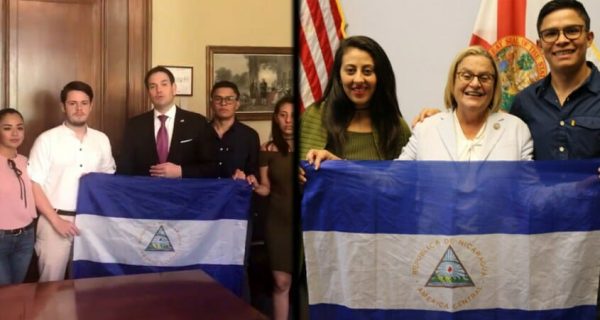
Nicaraguan student leaders lobbying for US intervention with Ileana Ros-Lehtinen and Marco Rubio
teleSUR | July 7, 2021
Just as in 2018, Nicaragua is once again the subject of the kind of mass international bad faith news coverage and perception management more usually associated recently with US and allied government offensives against Bolivia, Cuba, Iran, Syria and Venezuela. In Nicaragua’s case the current offensive is aimed at influencing the country’s elections scheduled for next November 7th. Currently, all the opinion polls show that, should President Daniel Ortega stand again for election, he and his FSLN party will win easily with over 60% support against around 20% for the the country’s right wing opposition.
The campaign against Nicaragua’s Sandinista government is clearly intended to encourage punitive coercive economic measures from the US and European Union governments aimed at influencing voter opinion in those November elections against President Ortega and the FSLN. Right now, the main false accusation is that “Ortega” has unjustly imprisoned over twenty opposition leaders, among them several presidential candidates. All US attempts to overthrow governments resisting US and allied government dictates depend on this kind of big lie. The standard big lie is that target governments are unpopular, repressive dictatorships. Invariably, the truth is very different if not the complete opposite.
For example, in 2009, the big lie in preparation for the coup against then Honduran President Manuel Zelaya was that the proposed Fourth Ballot referendum aimed to secure him re-election so as to impose a dictatorship. In Nicaragua’s case, the current big lie is that “Ortega” is arresting opposition leaders to prevent them defeating him in next November’s elections. These big lies only flourish in an essentially fascist culture of corporate dominated government in which truthful information is systematically suppressed and substituted by false beliefs.
Typical Western false beliefs or presuppositions are, for example, that the US and its allies are a force for good in the world, that Western culture is morally superior to others and that capitalism promotes optimal economic and social outcomes. These ridiculous false beliefs are fundamental tenets of Western intellectual life and public discourse. They make possible the kind of psychological warfare repeatedly unleashed against governments that obstruct the wishes of Western corporate elites and the governments they own.
An important component of Western psychological warfare shaping the moral dimension of any given disinformation assault is the essentially class based solidarity with the target country’s imperialist proxies. This neocolonial solidarity operates in reactionary and progressive varieties, both claiming a Western monopoly on freedom, democracy and defence of human rights. Both essentially agree that governments resisting Western demands deserve to be attacked one way or another.
The reactionary variety, prevalent mostly among the business and financial classes and related professionals, insists on abandoning international law in favour of intervention based on Western dictated rules. The progressive variety, prevalent mostly among non profit organizations, academics and other socially oriented professionals, agrees but is more diffident about the means of intervention deployed, demanding alibis to satisfy susceptibilities over humanitarian and human rights concerns. The right wing variety generally favors aggressive, overt or covert military-based solidarity with armed opposition rebellion, while the progressive variety favors smart-power coercive measures prioritizing solidarity with some version of opposition civil society or popular movements.
Nicaragua experienced the first right wing version of neocolonial solidarity during the Contra war of the 1980s when president Reagan declared, with more truth than he realized, that the CIA-run narco-terror campaign was “the moral equivalent of the founding fathers”. Subsequently, ever since the Sandinista FSLN party returned to government in 2007, Nicaragua has experienced principally the progressive version of smart power neocolonial solidarity developed under president Obama. That policy, supporting Nicaragua’s anti-Sandinista opposition, intensified under president Trump and continues unchanged now under “Biden”.
Self-evidently, these varieties of neocolonial solidarity thrive on their respective class loyalties and ideological susceptibilities. In 2018, a massive disinformation campaign covered up the Nicaraguan opposition’s extreme violence and their deliberate campaign of destruction. As Harold Pinter remarked in relation to the 1980s Contra War, even as the opposition violence of 2018 was happening, the murders, the extortion, the arson, the torture, it was made to seem that nothing happened. Now, when the Nicaraguan authorities have acted to preempt a repeat of that failed 2018 coup attempt, a furious psychological warfare assault is taking place to conceal the coup mongering opposition’s treasonous collusion with the US and EU country governments.
As regards progressive and left wing opinion in general, militant foreign supporters of Nicaragua’s ex-sandinista opposition have long been important protagonists covering up the ex.sandinistas’ anti-democratic collaboration with Western imperialist intervention. Even before the 2006 elections, the US authorities had coopted ex sandinistas as collaborators. But when Daniel Ortega and FSLN won those elections, successfully managed the crisis of 2008-2009 and then triumphed in the 2011 elections, US government support for the opposition switched to promoting efforts at outright regime change. Inside Nicaragua, the ex sandinistas, devoid of popular support, abused their non profit networks to camouflage their political opposition to the government and the accumulation of resources necessary to mount the 2018 coup attempt.
That systematic abusive subterfuge has been eliminated and its protagonists held to account. So now foreign supporters of the ex sandinista opposition again cloak their militant, aggressive, politically driven advocacy under phony human rights concerns. In 2018, they did so to cover up the violent role of the ex sandinistas in the failed coup attempt. Now, they falsely allege human rights abuses to cover up ex sandinista US collaborators’ treasonous criminality. The false human rights propaganda motif makes it possible for proponents of the progressive variety of neocolonial solidarity in North America, Europe and elsewhere, to work in parallel with their right wing counterparts. Even many supposedly left wing figures have written articles or signed declarations in support of the ex-Sandinista US collaborators and those people’s right wing allies in Nicaragua. They do so for three main reasons.
Firstly, many supposedly left-wing figures attacking the Nicaraguan authorities for defending Nicaragua’s independence and sovereignty have some degree of friendship with the ex-sandinistas now under investigation, so they defend them for essentially personal reasons. Secondly, it is likely that many supposed left wingers supporting the ex Sandinista US collaborators have been duped by the massive psychological warfare assault on Nicaragua without bothering to question it. A third main reason for that kind of neocolonial solidairty from people who should know better, is that they fear alienating their support networks and are simply signaling how virtuous they are so as to avoid criticism.
In any case, the current situation, just like the 2018 coup attempt, categorically defines where everyone’s loyalties lie. People genuinely committed to the principles of sovereign independence and self-determination recognize the Nicaraguan authorities are applying the country’s laws and criminal code to defend the country against US intervention aimed at overthrowing the elected government. People who believe the bogus human rights accusations and claims that the current criminal investigations are driven by electoral considerations are engaging in the kind of neocolonial solidarity regularly deployed to justify yet another operation of imperialist regime change. For anyone foolish enough to credit the ex sandinista leaders denials of complicity with the US government, this series of photographs should help disabuse them of that false belief.
Featured Video

America Racing to Strategic Defeat in Iran
or go to
Aletho News Archives – Video-Images
From the Archives
Should Europeans ‘Thank’ the Americans for Destroying Nord Stream?
By Robert Bridge | Strategic Culture Foundation | September 29, 2022
With an investigation continuing into the destruction of the Nord Stream gas pipeline that provided energy supplies to Europe from Russia, there appears to be just one prime suspect, and that should surprise nobody.
Following the sabotage of the Nord Stream 1 and 2 gas pipelines, former Polish Foreign Minister Radoslaw Sikorski already seemed to know the identity of the perpetrator when he tweeted out: “Thank you, USA.”
At first glance, it seemed that Sikorski was speaking sarcastically, berating Washington for carrying out an attack that will have severe repercussions for the people of Europe. After all, how could anyone see any good coming from the termination of Europe’s primary source of gas reserves with winter just around the corner? It was Sikorski’s homeland of Poland, after all, that urged its citizens to collect firewood in the face of dwindling gas reserves.
In fact, the Polish diplomat was speaking one-hundred percent literally… continue
Blog Roll
 Aletho News
- Growing insecurity, soaring prices fuel protests in north as regime bans evacuation: Sources
- Iran denies responsibility for ‘depraved’ attack on Kuwait desalination plant
- Bring The Troops Back. End This War Now!
- Can we please stop calling Israel the ‘only democracy in the Middle East’ now?
- US should start removing its troops from Germany, proposes AfD co-leader Chrupalla
- Iran Red Crescent: 600 educational centers attacked in US-Israeli ‘war crimes’
- Russian Oil Tanker Arrives in Cuba Amid U.S. Blockade
- America Racing to Strategic Defeat in Iran: Lt Col Daniel Davis
- FTC Warns Visa, Mastercard, PayPal, Stripe Over Political Debanking
- Russian tanker approaches Cuba despite US oil blockade
- If Americans Knew
- As Iran targets US military bases, will they be relocated to Israel? Not a ceasefire Day 171
- Will Trump Go Kamikaze?
- Is the University of Florida Shutting Down College Republicans over Israel Criticism?
- Jewish extremist arrested over alleged plot to firebomb Palestinian activist Nerdeen Kiswani’s home
- More than half of Palestinian child detainees have no charges
- The More Murderous Israel Gets, The More We Hear About “Antisemitism”
- Land Day and the Palestinian struggle after 30 months of genocide
- The Iran War Is About Palestine
- Israeli soldiers echo settler ideology, talk of revenge after targeting Palestinians and detaining CNN crew in the West Bank
- Israeli Policies Threaten Future of Christian Schools in Jerusalem
- No Tricks Zone
- New Study Finds Warming Saves Lives…Cold Temperatures 12 Times More Deadly Than Excess Heat
- German Science Blog Accuses PIK Climate Institute Of Hallucinating Climate Tipping Points
- Devastating Assessment Of Comirnaty Vaccine By Former Senior Pfizer Europe Toxicologist
- New Study: CO2 Is ‘Effectively Negligible’ As An Explanatory Climate Change Factor Since 2000
- Former Pfizer Toxicologist Dr. Helmut Sterz Tells Bundestag Hearing Pfizer Vaccine Should Have Never Been Approved
- Energy Expert: Germany’s Nuclear Phaseout Was A “500 Billion Euro Mistake”
- New Research: South Australia’s Mid-Holocene Sea Surface Temperatures Were 4°C Warmer Than Today
- Storing Green Energy To Last Germany 10 Days Would Require A 60-Million Tonne Battery
- New Studies: UK Sea Levels Were 4 Meters Higher Than Today During The Mid-Holocene
- Destructive Green New Deal: German Energy And Metal Group Warns Of Drastic Crisis
 Aletho News