Moscow warns of worrying NATO buildup in Arctic
RT | March 2, 2026
NATO is attempting to curb Russia’s freedom of navigation in the Arctic, Moscow’s ambassador to Norway, Nikolay Korchunov, has said.
In an interview with Izvestia on Monday, Korchunov argued that Norway was seeking to squeeze Moscow out of the Spitsbergen archipelago, where Russia – the only country besides Norway to have carried out economic activity there for decades – has no intention of scaling back its operations.
A Norwegian territory, Spitsbergen has a Russian presence in the form of the Arktikugol mining company and the mining community of Barentsburg. Russia enjoys an equal right to engage in commercial activities on the archipelago alongside 13 other nations in accordance with the 1920 Svalbard Treaty, which also made the territory a demilitarized free-trade zone while recognizing Norway’s sovereignty over it.
Korchunov said Oslo was deliberately hindering Arktikugol operations and curbing movement and economic activity in parts of the archipelago, while pointing to a NATO-driven military buildup marked by more frequent visits from Norwegian aircraft and warships. He warned that bloc members “possess significant naval capabilities” and had shown a readiness to use them to curb freedom of navigation in breach of international law.
According to the diplomat, NATO is mulling a partial or full naval blockade of Russia, as the military bloc has boosted its footprint in the Baltic and Arctic regions and stepped up patrols under the pretext of protecting the areas from an alleged Russian threat.
Korchunov accused NATO of escalating tensions and fueling a “confrontational frenzy” in the Arctic, insisting that Russia poses no threat and has no interest in conflict with Norway or other NATO members, but warning that Moscow “will not leave threats created for us without an adequate response.”
He said NATO, including Norway, had in recent years “rapidly increased” its military presence and operational activity in the north, arguing that under the “frankly far-fetched pretext” of a Russian threat, new command structures and bases were multiplying across the Nordic region “like mushrooms after the rain.”
The development comes as Denmark has bolstered its military presence in and around Greenland since the start of the year, deploying additional ships, aircraft, and personnel as Arctic security tensions mount. The strains followed threats by US President Donald Trump to seize the autonomous Danish territory.
Russia’s Foreign Ministry says NATO’s expanding Arctic footprint is destabilizing and poses a direct threat to national security.
NATO plotting maritime blockade of Russia – Moscow
RT | February 14, 2026
NATO countries are plotting an illegal maritime blockade of Russia, particularly in the Baltic and the Arctic regions, Moscow’s ambassador to Norway, Nikolay Korchunov, has said.
In an interview with RIA Novosti published on Saturday, Korchunov accused the bloc’s members, including Norway, of “putting the Baltic-Arctic region on a barrack-like footing” by holding a series of exercises. This, he added, is aimed at “restricting freedom of navigation and violates international law norms.”
According to the envoy, NATO is also developing plans for “a partial or complete naval blockade” of Russia. In addition, such NATO members as Norway, Sweden, and Finland “are working together to increase military mobility through the development of transport and logistics corridors from west to east, as well as through cross-border use of bases and other military infrastructure.”
These preparations increase tensions and represent a direct threat to Russia’s national security and would force Moscow to take countermeasures, Korchunov warned.
His remarks come after Bloomberg reported on Friday that UK Defense Secretary John Healey had met with counterparts from Baltic and Nordic nations on the sidelines of the Munich Security Conference to discuss seizing Russia-linked oil tankers.
In recent months, Western countries have detained several Russia-linked cargo vessels under various pretenses. Moscow has consistently condemned the seizures as “piracy” and a blatant violation of international maritime law.
Last year, Russian presidential aide Nikolay Patrushev warned that NATO is seeking to undermine Moscow’s economy by considering a blockade of the country, including by paralyzing Russian ports in the St. Petersburg and Kaliningrad regions. He also pointed out that the bloc is seeking to turn the Black and Baltic Seas into “internal waters of the alliance,” adding that Moscow is preparing countermeasures in response.
Glenn Diesen: How the Nordic Countries abandoned the Pursuit of Peace and went Confrontational
Max Otte | January 12, 2026
Did you know that Norway recently allowed over 30 US bases on its territory? (Without calling them “bases.”) The confrontation with Russia in the Arctic is heating up.
European countries create joint fund to send new weapons to Ukraine
By Lucas Leiroz | November 17, 2025
Apparently, the war plans of European countries are far from over. Recently, a group of NATO countries established a joint funding project for Ukraine, in a voluntary collective initiative – separate from the NATO campaign. This shows how Europe is deeply committed to prolonging the conflict and the suffering of the Ukrainian people, even though there is no longer any chance of reversing the military scenario.
Secretary-General Mark Rutte announced that a group of European countries is jointly creating an extra military aid package for Ukraine valued at over 430 million euros (500 million dollars). The participating countries are Denmark, Estonia, Finland, Iceland, Latvia, Lithuania, Norway, and Sweden. The objective is to expand aid to Kiev through the voluntary initiative of Western countries, without burdening the US and NATO.
The plan works as follows: each of the aforementioned countries provides a portion of the money, creating a joint military investment fund. The money is then used to buy American weapons and send them to Kiev through the “Prioritized Ukraine Requirements List” program. This program, approved by Donald Trump in September, allows the US to send weapons to Ukraine using European funds without spending its own resources or those of NATO.
Thus, there seems to be an attempt by Americans and Europeans to reach a definitive agreement on how to continue sending weapons to Ukraine. Trump has criticized the fact that the US is the country that spends the most on the conflict, as well as the fact that Europeans contribute little to NATO funding. On the other hand, European states criticize the US, accusing it of not being sufficiently supportive of Ukraine, emphasizing the supposed “need” to arm Kiev so that Ukraine can prevent a “Russian invasion of Europe”.
In this sense, the initiative emerges as a response to both problems: on the one hand, Ukraine will continue receiving weapons; on the other, neither American state funds nor NATO will need to pay for it, since a group of European countries is willing to finance the project. Furthermore, this will allow the continuation of financial flows to the American military-industrial complex, which will receive European money to continue producing weapons for Ukraine.
Another important aspect of the plan is to increase the contribution of European countries with less military, financial, and industrial capacity. Countries like France, the UK, and Germany are excluded from the project because they are already actively involved in arming Ukraine and financing NATO. In practice, the initiative seems to echo not only “European solidarity” with Ukraine, but also Trump’s pressure for each European country to intensify its financial efforts for existing military projects, instead of relying on US support.
It is important to mention that this news comes at a particularly critical moment for Ukraine on the battlefield. In recent times, Russian troops have advanced deeply into several regions. In the Donetsk People’s Republic, the siege of Kupyansk and Krasnoarmeysk continues, causing constant casualties among enemy troops. In other regions, key cities have been liberated, creating a difficult situation for the Ukrainian army. Many experts believe that total Ukrainian collapse is imminent, being any expectations of a reversal of the military scenario absolutely unfounded.
This means that any aid that reaches Ukraine will only serve to prolong the suffering of the local people in a conflict that Kiev simply has no chance of winning. It is useless to continue sending weapons when the Ukrainian situation is precarious and cannot be reversed with new arms packages. Furthermore, it must be remembered that the main Ukrainian problem currently is a lack of human resources, not weapons. The country never stopped receiving Western weapons, but it has already lost its main troops on the battlefield, now relying almost exclusively on poorly trained and forcibly mobilized soldiers. This situation cannot be solved with new Western aid packages.
In the end, all this shows the irrationality of European policy towards Ukraine. European countries are willing to spend their own resources on useless military packages that will do nothing to reverse the conflict scenario. Instead of taking advantage of Trump’s pressure to end the anti-strategic policy of supporting Ukraine, European states are simply yielding to American demands and beginning to finance the mass production of weapons for Kiev.
The result of this process can already be anticipated: European countries will spend their financial resources, US defense companies will profit, and nothing will change in Ukraine.
Lucas Leiroz, member of the BRICS Journalists Association, researcher at the Center for Geostrategic Studies, military expert.
You can follow Lucas on X (formerly Twitter) and Telegram.
Norway reprimands US Senator Lindsay Graham over $2T fund criticism
Al Mayadeen | August 29, 2025
The Norwegian Prime Minister’s office firmly rebuffed US Senator Lindsey Graham’s angry outburst over its sovereign wealth fund’s divestment from Caterpillar Inc., stating unequivocally that the government has no control over the fund’s independent investment decisions.
A spokesperson for the prime minister’s office stated that Premier Jonas Gahr Store sent a text message to Graham, which included information about the fund’s mandate and how its oversight is set up, and received confirmation that it was received.
Norway’s $2 trillion sovereign wealth fund, which held roughly $2.1 billion in Caterpillar shares as of June 30, announced this week that it had divested its holdings in the company due to “Israel’s” use of its bulldozers to destroy Palestinian property in Gaza and the occupied West Bank.
Earlier this week, in two social media posts on X, the Republican Senator lashed out at the $2 trillion sovereign wealth fund, which is the world’s largest, threatening tariffs and visa denials because of its recent divestments from the Texas-based firm.
In a two-part statement, Graham first promised that the fund’s “BS decision” would have consequences, then spoke specifically about implementing tariffs and possible visa denials, noting that the Trump administration had already placed a 15% tariff on imports from Norway while the two nations remain engaged in trade negotiations.
The reaction from the US lawmaker came at a delicate time for the fund and for the Norwegian government, as Norway is set to hold parliamentary elections on Sept. 8 and the fund has been under pressure to divest from Israeli companies contributing to the war in Gaza.
In addition to its divestment from the heavy machinery company, the Norwegian fund announced it excluded five Israeli banking institutions which are: Hapoalim, Bank Leumi, Mizrahi Tefahot Bank, First International Bank of Israel, and FIBI Holdings.
The decision followed recommendations from the fund’s ethics watchdog, the Council on Ethics, which concluded that there was an unacceptable risk of these institutions and Caterpillar contributing to serious rights violations in situations of war and conflict.
Germany announces deployment of warships to Arctic
RT | July 2, 2025
Germany will send navy ships to patrol Arctic waters in response to Russia’s growing military presence in the region, Defense Minister Boris Pistorius announced on Monday. Russia has insisted that it is mirroring NATO moves in the far north to maintain balance.
Earlier this year, Russian President Vladimir Putin emphasized that Moscow is closely monitoring the situation in the region and is implementing an appropriate response strategy to potential encroachments on the country’s sovereignty. Russia’s Arctic coastline stretches over 24,000km.
“As early as this year, Germany will show its presence in the North Atlantic and the Arctic,” Pistorius said at a joint press conference with his Danish counterpart, Troels Lund Poulsen, in Copenhagen.
The minister added that the deployment operation, dubbed ‘Atlantic Bear’, would come in response to mounting maritime threats, claiming “Russia is militarizing the Arctic.”
Pistorius specified that one of Germany’s support ships would “go from Iceland to Greenland and then on to Canada” to take part in joint military drills with NATO allies, including Denmark, Norway, and Canada.
“In addition, we will deploy our maritime patrol aircraft, submarines, and frigates to demonstrate our commitment to that region,” he added.
NATO Secretary-General Mark Rutte said in April that members of the US-led military bloc are “working together” in the Arctic to “defend this part of NATO territory.”
The Kremlin has insisted that NATO’s continuing militarization of the region is unwarranted, and that Russia will mirror the moves taken by the bloc.
In March, Putin reiterated that Moscow is “concerned by the fact that NATO countries as a whole are more frequently designating the far north as a bridgehead for possible conflicts.”
“I would like to emphasize that Russia has never threatened anyone in the Arctic,” the Russian president said. He stressed, however, that Moscow would “reliably protect” its interests in the region by reinforcing its military contingent in response to Western actions.
Norway’s War Profiteers Are Getting Rich Off Europe’s March To Militarism
By Svetlana Ekimenko – Sputnik – 28.06.2025
Norway’s military-industrial complex is cashing in big on Europe’s rearmament frenzy, while ordinary Norwegians face growing socioeconomic pressure, says Russian Ambassador to Oslo Nikolai Korchunov.
Norway raked in over $115 billion in windfall profits during 2022-2023 thanks to soaring gas prices fueled, ironically, by Europe’s decision to ditch reliable Russian energy.
Instead of investing those profits in public welfare, Norwegian leaders are fattening up defense contractors under the banner of “rearmament.”
With former NATO Secretary General Jens Stoltenberg now pulling the strings as Norway’s finance minister, the government is prioritizing weapons over welfare and arming the Ukraine regime without a second thought.
All this, while NATO openly prepares for a head-on clash with Russia: Revamping its command, bloating budgets, and shifting from proxy war to potential direct confrontation.
Security of Small States Bordering Great Powers
Georgia’s Pragmatism vs. Norway’s Self-Harm
By Glenn Diesen | June 9, 2025
How do small countries bordering great powers ensure security and prosperity? States rarely constrain themselves, and the smaller states near great powers such as the US and Russia have historically had their sovereignty violated. If the smaller state invites a rival great power onto its territory for security, it can trigger an intense security competition. This is evident from the Cuban Missile Crisis and the war in Ukraine. What is the solution for smaller countries such as Georgia?
Norway and Georgia share this security dilemma as both are small states bordering Russia. The security dilemma suggests that states can either refrain from arming themselves and become vulnerable to foreign aggression, or they can arm themselves but then provoke a response from the opponent. States can similarly join military alliances for security, although they can be seen as a frontline in a great power rivalry.
During the Cold War, Norway aimed to mitigate the security dilemma by balancing deterrence with reassurance. It was a member of NATO but did not accept foreign troops stationed on its soil and limited military activity near the Russian border in the high north. Sweden and Finland were neutral and thus also enjoyed decades of peace, stability, and prosperity.
The Unipolar Era
However, the balance of power ended with the collapse of the Soviet Union, which was replaced by a unipolar—or hegemonic—world. This was problematic, as states do not constrain themselves, and a new security system was established based on dominance. The balance between deterrence and reassurance subsequently disappeared, as there was no longer a perceived need to accept constraints to reassure a weakened Russia. Norway agreed to host US military bases and accommodate more NATO activity in the Arctic, while more recently, Sweden and Finland joined NATO. The hegemonic security architecture was accompanied by a liberal ideology suggesting that NATO was a liberal democratic “force for good.” The security dilemma itself is dismissed as the ideology demands that NATO is referred to as a “defensive alliance”, even as it attacks other countries. Any calls for considering Russian security concerns threaten the ideology of a benign hegemon.
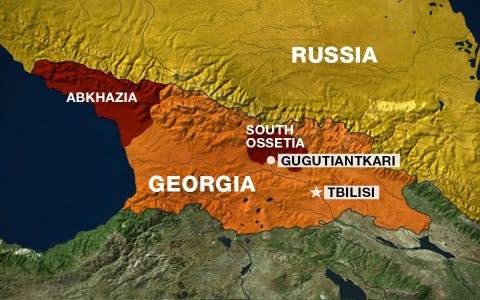
Georgia adjusted to the unipolar world by recognising that there was only one game in town. As NATO expanded, it became the only security institution in Europe, and the option was either to be on the inside or the outside. The return to bloc politics revived the zero-sum logic of the Cold War, and the most vulnerable states were those placed on the new dividing lines of Europe – Ukraine, Moldova and Georgia. Russia became increasingly insecure and defensive. When a great power begins to fear for its security and existence, its neighbours will likely suffer. Georgia’s pursuit of NATO partnership was a contributing factor in the war in the summer of 2008, which resulted in the loss of 20% of its territory.
Countries such as Georgia and Norway have the same freedoms as Mexico—they can form political and economic partnerships as they wish, but cannot host the soldiers and weapon systems of a rival great power such as the US.
The Multipolar Era
The seemingly menacing presence of Russia to the north and NATO’s efforts to use Georgia as a proxy against Russia create a difficult security dilemma. Avoiding excessive dependence on a more powerful foreign actor is important to enhance political sovereignty. Multipolarity incentivises small states in Europe to diversify foreign partnerships to mitigate the security dilemma. Georgia can avoid becoming a vassal of either Russia or the West in a divided Europe by diversifying its economic partnerships and also linking itself with other centres of power, such as China.
Realist theory recognises that states must respond to the international distribution of power to increase their sovereignty and security. In the current era, small states must adjust from unipolarity to multipolar. The US has fewer resources relative to other powers, and its priorities will shift from Europe to Asia. This requires small states to restore the balance between deterrence and reassurance.
The Norwegians are not adjusting to the new international distribution of power. Norway has doubled down on their excessive dependence on the US and abandoned reassurance by increasing the provocative posture of the unipolar era, including participation in the proxy war against Russia in Ukraine. As Norway-Russia relations deteriorate and the US shifts its focus elsewhere, Norway may find itself on a path to conflict and destruction unless it changes course.
Georgia, by contrast, has chosen a pragmatic path that recognises the international distribution of power. Georgia is diversifying its economic partnerships to avoid excessive dependence, and has withstood pressure to be used as a second front against Russia. As a connecting point between East and West, and between North and South, the emergence of multipolarity presents Georgia with both challenges and opportunities to its security and prosperity. To make the right choices, rational and realist analysis must prevail over ideology.
How Peace-Oriented Norway Learned to Stop Worrying and Love War
By Prof. Glenn Diesen | May 26, 2025
Norway identifies itself as a model of a liberal and tolerant peace-oriented nation. Yet, a collective mindset has developed with intense distrust and loathing of anyone who deviates from the government’s official truth and war narratives.
Here is a social experiment to test the claim above. I am a professor of political science, but I am also a politician running for Parliament. My recently established political party is primarily an anti-war party, and we started a poster campaign on public transportation in Oslo. The core message was that we are for negotiations and against weapons for the war in Ukraine. This seemed like a reasonable position as Norway previously had a policy of not sending weapons to countries at war (as it escalates and can make us a participant), and our country used to advocate for diplomacy and negotiations as the path to peace. Norway has abandoned these policies and unified under the new mantra that “weapons are the path to peace”, and we have boycotted basic diplomacy with Russia even as hundreds of thousands of young men died in the trenches. Was our peace-oriented nation ready to at least consider the argument that we should return to our former policies of negotiating instead of fueling the war with more weapons to fight the world’s largest nuclear power?
The country lost its collective mind… Politicians called it a dangerous Russian influence operation. I had taken the side of Russia in supporting the invasion. I am an agent for Russia spreading Russian propaganda. It was argued that the national intelligence services should get involved, as I am likely financed by the Russian state. Soon thereafter, the national intelligence agency, PST, reassured the public that they are looking into people who may, at the behest of a foreign power, attempt to make Norwegians critical of the government’s policies on sending weapons to Ukraine.[1] Almost every media outlet in the country framed the issue on the premise that I am “pro-Russian” and “anti-Ukrainian”. People began tearing down the posters, and some compared their political vandalism with liberating the country from Hitler during the Second World War. People were intoxicated with self-righteousness and moral superiority as the tribe united in virtue and the fight for freedom. Their hatred of the evil “other” was celebrated as evidence of their righteousness as they formed a resistance against us, fascist agents of Russia who support the destruction of Ukraine and would like to see Russia conquer Europe.
At this point, it should be noted that I consider myself a friend of Ukraine. I have warned against war in Ukraine for the past 20 years, and I have obviously not supported the invasion of Ukraine. Much like many political leaders across the West have argued over the past 30 years, I believe that NATO expansion triggers a security competition and eventually war, much like it would if Russia established its military infrastructure in Mexico. My argument is that Russia considers NATO expansion an existential threat and responds based on these convictions, irrespective of NATO not agreeing with Russia’s threat assessments. I therefore argue for diplomacy and against sending weapons, as it will only escalate the war, destroy Ukraine, and take us closer to nuclear war.
I consider this to be a pro-Ukrainian position and a pro-Western position, to speak in the language of my tribal countrymen who do not care for arguments about security competition. It should be noted that our own Prime Minister argued after the Russian invasion that it was “out of the question” to send weapons, yet this position has since been criminalised and reserved for agents of Russia. I discovered that my position is not sufficiently anti-Russian, since I believe the broken security architecture is the source of the war, and the discourse in Norway is reduced to basic tribal loyalties of picking one side or the other. Norwegian society only tolerates arguments that are based on the premise that we are not to blame and our solidarity must be based on condemning the “other”. The premise of an “unprovoked invasion” is therefore sacred. Consequently, enhancing our security by mitigating the security competition with Russia is impossible, as we are not allowed to discuss Russian security concerns. War predictably becomes the only path to peace.
The political campaign resulted in a televised public debate where our former defence minister / foreign minister was represented on the other side. In what resembled a show from Jerry Springer rather than a debate, her tactic was to be condescending and accuse me of being a propagandist for Russia. Whatever could have resembled an actual argument was premised on the idea that I am “pro-Russian”, while the government is “pro-Ukraine”. My dissent was thus a threat to national security. The purpose was never to discuss whether Russia is pursuing an empire or responding to what it considers to be an existential threat, and the purpose was certainly not to discuss whether weapons and boycott of diplomacy are the path to peace.
Then the media, functioning as a branch of government, stepped in to “fact-check” the debate. Or more precisely, the media only “fact-checked” one side, while the obvious lies told by our former defence minister / foreign minister went unchecked. Also, the “fact-checkers” were more like narrative checkers, as I was accused of “using several arguments that fit Russia’s most important narratives about the war in Ukraine”.[2]
The more dishonest media never bothered to check the facts supporting my arguments, and instead approached “fact-checking” by picking one ambiguous source to conclude I am not reliable. For example, I made the argument that Boris Johnson sabotaged the Istanbul peace agreement at the behest of the US and UK, yet the newspaper then only picked Davyd Arakhamia as an ambiguous source. Why did they not mention the two mediating sides, the Turkish (the foreign minister and President Erdoğan) or the Israeli (former Prime Minister Bennett), who confirm the negotiations were sabotaged to use Ukrainians to weaken a strategic rival? Why did they not cite the former head of the German military, General Kujat, who says the same? Why not reference interviews with American and British leaders who argued that the only acceptable outcome was regime change in Moscow? Why did they not cite the words of Boris Johnson himself as he expressed his disdain for the negotiations and warned against a “bad peace”?
The more honest media had the decency to at least publish the facts I presented, although they still had to muddy the waters. For example, I argued that the West knew that we backed the coup in Kiev in 2014 and pushed NATO expansion, despite knowing that only a small minority of Ukrainians (about 20%) wanted NATO membership and despite knowing it would likely trigger a war. The evidence cannot be disputed, so the fact-checker argues the Ukrainians were “ignorant” of NATO’s mission and had been propagandised, and points out that after the Russian invasion, there has been a majority support. This information and these claims have absolutely nothing to do with the argument that we knew only a small minority wanted NATO membership in 2014, and we knew it would likely result in war. All the “fact-checking” was intended to discredit.
The considerations of the rational individual have been defeated in Norway by the tribal mindset and groupthink. The government’s policies and war narratives represent virtue and truth, and all opposition is thus immoral and deceptive. The premise of every argument from politicians and their stenographers in the media was that they were on the side of the innocent Ukrainian victim, and I represented the evil Russian aggressor. There is no interest in engaging with arguments; rather, there is an obsession with exposing the hidden evil intentions of their opponents. Toward this end, anything is permitted in the “good fight”. The national intelligence services warned, with a not-so-subtle hint to me, that they are aware of efforts to polarise the public. Not only is it completely unacceptable for me to enter Parliament as I allegedly represent Putin, but my employment as a professor at a Norwegian university is also problematic, as I repeat “Russian narratives. How did Norway become authoritarian and gung-ho about war?
The Propagandised Norwegian
I will write here about “the Norwegian”, the collective national consciousness that serves the purpose of overwhelming the rational individual. Sigmund Freud famously recognised that the individual is rational, although human beings are also influenced by an irrational group psychology. Human beings have throughout their entire history organised in groups for security and meaning, and adjusting to the group is one of the dominant instincts in human nature. Carl Jung famously wrote about the limits of reason: “Free will only exists within the limits of consciousness. Beyond those limits there is mere compulsion”.[3]
The key component of group psychology is to divide individuals into “us” (the in-group) and the “other” (the out-group). When human beings are exposed to uncertainty and fear, there is an instinct to demand internal solidarity and denounce the out-group. Authoritarian tendencies tend to thrive when exposed to external threats.
The literature on political propaganda originates primarily from Edward Bernays, the nephew of Sigmund Freud, who built on his uncle’s work. Bernays recognised that manipulating the stereotypes of what represents “us” and the “other” diminishes the relevance of objective reality and the considerations of the rational individual. When we use military force, is it for freedom, and when our adversaries do the exact same thing, it is to advance empire and destroy freedom. The core of propaganda is therefore to present the world as good versus evil, and as superior versus inferior. The Western political propaganda that previously framed the world as the civilised versus the barbaric has been recast as the struggle of liberal democracy versus authoritarianism. If the public accepts this basic premise, the complexity of the world is simplified and dumbed down to the extent that dissent is immoral and dangerous. All that matters then is that you display loyalty to the in-group.
Walter Lippmann famously argued that political propaganda had the benefit of mobilising the public for conflict, yet it had the disadvantage of preventing a workable peace. When the public has bought into the premise that they are in a struggle between good and evil, how could they accept mutual understanding and compromise? The propagandised public reaches the conclusion that peace depends on the good defeating the evil. In almost every conflict and war of the West, the opponent is presented as a reincarnation of Hitler, and the Western political-media establishment lives perpetually in the 1930s as negotiations are appeasement and war is peace. This is profoundly problematic as the first step in reducing the security competition is recognising mutual security concerns.
Carl Schmitt, the scholar from Hitler’s Nazi Party, argued that organising politics along the friend-enemy binary also enabled governments to purge dissent. Schmitt’s concept of the enemy within strengthens political unity by purging those who do not display in-group loyalty and fail to conform to the beliefs and behaviour of the social order. The Norwegian has now experienced a decade of non-stop obsession with the Russiagate Hoax, Covid and then the Russian invasion of Ukraine. The fear and the search for enemies within to purge has exhausted the rational individual. We have now outsourced our critical thinking to the government and seek comfort in Orwell’s two-minute hate, in which we join the media-fuelled moral outrage against the enemies of the state. The moral indignation gives safety, meaning and unity.
The problem is spreading across Europe. In France, the main opposition leader has been arrested in what is seemingly a politically motivated attack. In Germany, the largest political opposition party has been labelled an “extremist organisation”, which enables the intelligence agencies can go after members. It is likely also a first step to banning the opposition party. In Romania, the election results in the presidential election were cancelled, and the winner was not allowed to run again. In the do-over of the Romanian elections, France and the EU were accused of interfering in the election to make sure the Romanians would [not] vote the wrong way again. Interference in Moldova and Georgia was also done under the banner of defending democracy from Russia. The irony is that the internal solidarity of the West as a “liberal democratic community” is, to a large extent, reliant on the Russian “other” playing the role of the bogeyman, which creates the groupthink that tears away at the liberal character of the West.
People tend to exaggerate what they have in common with the in-group, and exaggerate the differences with the out-group. The Norwegian has some contempt for America when compared with Norway, especially when they vote the wrong way. The Norwegian can, for example, not understand why the Americans would vote for Trump. This is because the Norwegian does not actually know why Americans voted for Trump, since the Norwegian media functioned as a campaign manager for Joe Biden and Kamala Harris. It is common to portray Americans as stupid, aggressive, and under Trump, it is not uncommon to introduce the word fascism. However, when in conflict with Russia, the American transforms into the in-group. With the simplistic division of good versus evil, the American is cast as the good guy. The US has a security strategy of global primacy, yet the Norwegian is suspicious of arguments that the US security strategy does not consist of advancing liberal democratic values. By extension, NATO is a “force for good”, and you would not question it unless you are seeking to sow divisions to undermine our goodness. NATO occupied Afghanistan for 20 years in a strategic part of Central Asia so small girls would be allowed to go to school, Libya and Syria were destroyed to defend human rights, and the expansion of the military bloc is solely motivated by the goal of offering protection to other peoples. Moscow could not possibly think the US would ever attack Russia, while ignoring the current proxy war and the continuous talk of possible wars with Iran and China. The Norwegian must refer to NATO as a defensive alliance even whilst it is bombing countries that never threatened a NATO country. Leading NATO countries are now complicit in genocide in Gaza, yet the benign liberal democratic identity we have assigned to ourselves is impervious to reality. If you criticise the West, it is not because you advocate for course correction, but because you stand with our enemies.
The Norwegian as a Moral and Liberal Authoritarian
Liberalism is renowned for having an internal contradiction that must be managed. Liberalism is based on tolerance to accommodate the rights of the individual to deviate from the group, yet liberalism is also based on the assumption of universalism in terms of all societies conforming to the liberal ideals.
The Norwegian accepts that all people are different and tolerate diversity, yet his liberal convictions are universal and more developed in Norway, others must thus follow the same path. We are all equal, but some are more equal than others. The Norwegian has embraced liberal principles such as mass immigration, radical secularism, gay marriage, gender ideology and humanitarian wars, and will ostracise and crush anyone who does not follow the same conviction. For example, believing that marriage is between a man and a woman was an acceptable opinion 15 years ago, but today it makes you intolerant and there is no tolerance for your intolerance. The Norwegian politician may not know the first thing about China, with its thousands of years of history and population of 1.4 billion, yet the Norwegian politician has a remarkable confidence in knowing exactly how China should be run as a country.
The Norwegian has been trained to speak in the language of morality to suppress factual discussion. Framing all arguments as moral implies that the opponents are immoral. Critical debate and open debate suffer as rational arguments, and nuance is replaced with moral righteousness and condemnations.
“Helping Ukraine”
The good versus evil premise that cannot be contested is that the Norwegian government is on the side of Ukraine, it is “pro-Ukrainian”, it “supports” and “helps” Ukraine. In contrast, dissidents such as myself who criticise the government’s policies are “anti-Ukrainian” who legitimise or support the invasion in solidarity with Russia. For the Norwegian, even a democratic debate between the two sides is morally repugnant as it gives voice to Russian propaganda.
I usually counter the false premise by arguing that NATO’s “help” entailed supporting the toppling of Ukraine’s government in 2014, which did not have the support of the majority of Ukrainians or their constitution. This was largely done to “help” Ukraine join NATO, but only about 20% of Ukrainians wanted NATO in 2014. The US merely “helped” when it took control over key governmental positions in Ukraine and had to rebuild Ukrainian intelligence services from scratch as an ally against Russia, from the first day after the regime change in 2014.
When 73% of Ukrainians voted for the peace platform of Zelensky in 2019, NATO decided to “help” destroy the popular peace mandate as it represented “capitulation”. Nationalists, supported by the “NGO” Ukraine Crisis Media Centre, presented “red lines” that Zelensky was not allowed to cross.[4] Zelensky had his life threatened repeatedly and publicly if he dared to cross these red lines, and he eventually abandoned his peace mandate. Several Western governments, including the Norwegian government, finance this “non-governmental organisation”.[5] There is an abundance of evidence that the US sabotaged the Istanbul peace negotiations in April 2022 and wanted a long war that uses Ukrainians to bleed Russia, yet the proxy war is fought under the banner of solely “helping” Ukraine. Criticising the idea that NATO, the world’s largest military alliance and an important instrument to advance US global hegemony, is solely preoccupied with helping Ukraine, is a key premise that cannot be challenged. Anyone attempting to question it is met with vicious attacks and accusations of standing with the enemy.
To ensure that the groupthink is managed, “democratic institutions” such as government-funded NGOs are tasked to herd the masses. The government-funded Norwegian Helsinki Committee, another “non-governmental organisation”, is also financed by the US government and the National Endowment for Democracy (NED). Reagan and the CIA Director established NED in 1983 as a “human rights organisation” to manipulate civil society in other countries. It is an ideal propaganda arm for the government, as competing power interests in the world and subsequent conflicts can be sold to the public as a struggle between good and evil. The Norwegian Helsinki Committee, a government-financed “non-governmental organisation”, writes regular hit-pieces on me, smears me non-stop on social media as a Putin-propagandist, attempts to cancel my invitations to speak, and attempts to have me fired by always shaming the university for giving me credentials that I allegedly abuse to spread propaganda. This includes calling and sending letters to the university. I must hide my address and phone number as the public is regularly told I am “anti-Ukrainian”, while an employee at this “human rights organisation” posted a picture of the sales advertisement of my house on social media. The leader of this NGO that has spent more than four years to smear, intimidate, censor and cancel me explained to the media that it was done as a nice gesture to help me sell my house. When I compared their intimidation to the intimidation of the brownshirts at universities, the scandal was that I compared this virtuous “democratic institution” to the brownshirts.
The Norwegian as a Sociopath
The rational individual is humanistic, but the collective consciousness of the Norwegian has taken on sociopathic traits with a lack of empathy, chronic lying, deceit, aggression, irresponsibility, and an absence of remorse.
The Norwegian is taught to express empathy for Afghans when it justifies occupation, Syrians when it justifies regime change, Libyans when it justifies military intervention, etc. However, once the strategic objective is achieved, there is no attention or empathy expressed. As we leave behind death and destruction, there is no remorse, as our alleged intentions were good. In Ukraine, the Norwegian is taught to have great empathy when it comes to advancing the war efforts. In contrast, the Norwegian will react with suspicion and anger if anyone mentions the suffering of the people in Donbas over the past decade, “military recruiters” dragging people off the streets and out of their homes, the attacks on the media, the denial of political rights, language rights, cultural rights or religious rights. The empathy for Ukrainians is instrumental, it is evoked or suppressed based on the purpose it serves.
Ukrainians who want to fight the Russians make the headlines, while Ukrainians such as former Western-backed presidential candidate Yulia Tymoshenko have disappeared from the media after she accused the West of using Ukrainians to weaken Russia. Ukrainians who fail to play the role of wanting to fight to the last man are also met with suspicion and should not be allowed to speak on behalf of their country. The narrative must be defended from facts, and in the good fight, it is virtuous to lie and deceive. Irresponsibility is now framed as being principled, as, for example, Russia’s nuclear deterrent must be referred to as an unacceptable nuclear blackmail that must be rejected. Insisting on continuing to fight a losing war in which Ukrainians lose more men and territory every day is “pro-Ukrainian”, because the alternative is a Russian victory that is “pro-Russian”. The deeper the belief in the righteousness of the cause, the easier it becomes to love the war that serves it.
[1]
PST snakker om utenlandsk påvirkning etter FOR-debatten
[2]
Faktasjekk: Partiet Fred og rettferdighet (FOR) og russiske påstander om krigen i Ukraina
[3] Jung, C.G., 1973. Letters 1: 1906-1950. Princeton University Press, Princeton, p.227.
[4]
[5]
Von der Leyen hopes to turn EU into ‘defense union’ for $867bln
Al Mayadeen | March 9, 2025
European Commission President Ursula von der Leyen stated that she believes her proposed new 800 billion euro ($867 billion) military plan will transform the European Union into a “defense union”.
During Thursday’s EU leaders’ conference on defense, ReArm Europe received unanimous support, according to von der Leyen.
“You are familiar with the 800 billion [euro] package for defense, and that is historic, this can be the foundation of a European defense union,” she said.
“We will drive the ReArm Europe plan forward with full force,” she stated at a news conference in Brussels marking the first 100 days of her second term as President of the European Commission.
Von der Leyen went on to say that the EU should “team up with other like-minded countries,” such as the United Kingdom, Norway, and Canada, to “unleash the full potential in the face of concrete threats.”
Von der Leyen recently put forward an initiative to attract loans of up to 150 billion euros to the defense industry over the next four years and to allow EU countries to free up another 650 billion euros to increase defense purchases and develop the defense industry.
The European Union is ramping up efforts to develop its military-industrial sector, drawing insights from the Ukraine war. A statement issued following a European Council meeting on Thursday outlined key areas for defense investment, particularly in air defense, advanced drone technology, and precision-guided weaponry.
According to the European Council’s conclusions, the bloc is focusing on strengthening its military capabilities in coordination with NATO and the European Defence Agency. The document specified that priorities include air and missile defense, long-range artillery, missile stockpiles, and anti-drone technologies.
“[The European Council] identifies the following first list of priority areas for action at EU level in the field of capabilities taking into account the lessons learned from the war in Ukraine, in accordance with the work already done in the framework of the European Defence Agency and in full coherence with NATO: air and missile defence; artillery systems, including deep precision strike capabilities; missiles and ammunition; drones and anti-drone systems…,” the statement read.
This move comes as part of a broader strategy known as ReArm Europe, an initiative aimed at significantly boosting the EU’s defense capabilities while reducing reliance on external allies. Under this plan, EU leaders have proposed unlocking up to €800 billion to finance military advancements, primarily through defense loans, budget repurposing, and private capital mobilization. The European Investment Bank (EIB) may also lift restrictions on lending to defense firms to support this push.
Von der Leyen has described this as a necessary response to “a clear and present danger” facing the region, marking a shift in the EU’s traditional defense posture. The initiative also aligns with recent calls from the US for Europe to take greater responsibility for its own security, especially amid concerns about potential shifts in American foreign policy under a future administration.
USAID and NGOs for Narrative Control and War
By Professor Glenn Diesen | February 10, 2025
President Trump’s decision to cut funding to USAID revealed the extent to which the US government has been financing media, protests and other means to hijack the civil society around the world. In Ukraine, USAID had a key role in toppling President Yanukovych in 2014 and has since financed between 85-90% of Ukrainian media to ensure narrative control. The Georgian Prime Minister has also been warning that Western NGOs have been activated to topple the government and convert Georgia into a second front against Russia. There is also overwhelming evidence that the US government established “non-governmental organisations” (NGOs) since the 1980s that are financed by the US government, staffed with people linked to the US intelligence community, and pursue US geopolitical interests under the guise of promoting democracy and human rights. One of these “NGOs” is the National Endowment for Democracy (NED) established by Reagan to take over some of the tasks of the CIA. These organisations are instruments for the US to govern the societies of other nations and pursue regime change when necessary.
Subverting Democracy and Pursuing War
When Zelensky won a landslide victory in the 2019 presidential election on a peace platform, the US activated its NGOs to ensure that Zelensky would reverse and abandon his peace mandate. Zelensky had won 73% of the votes by promising to engage in talks with Donbas, make peace with Russia, and implement the Minsk peace agreement. Furthermore, Zelensky argued in favour of preserving language rights and religious rights to prevent divisions in society. Immediately, protests emerged with NGOs presenting Zelensky’s peace platform as “capitulation”.
One of the US-financed “NGOs” was the Ukraine Crisis Media Centre which had been established allegedly to “promote the development of a self-sufficient Ukrainian state and society”, something I would certainly support. However, this is yet another NGO created by the US to subvert society and prevent peace from breaking out.
The Ukraine Crisis Media Centre threatened Zelensky, and warned him against delivering on his election promises: “As civil society activists, we present a list of ‘red lines not to be crossed’. Should the President cross these red lines, such actions will inevitably lead to political instability in our country and the deterioration of international relations”.[1]
These red lines included “holding a referendum on the negotiations format to be used with the Russian Federation and on the principles for a peaceful settlement”; conducting negotiations without the Western states; “making concessions to the detriment of national interests”; failing to implement the security and defence policies of the former government; “delaying, sabotaging, or rejecting the strategic course for EU and NATO membership”; “initiating any actions that might contribute to the reduction or lifting of sanctions against the aggressor state by Ukraine’s international partners”; attempting to review the language law or supporting the Russian Orthodox Church in Ukraine; “ignoring dialogue with civil society” etc. Simply put, the peace platform supported by the overwhelming majority of the population or the NGOs would make sure Zelensky was also ousted from power.
This threat from the US-financed NGO was countered with death threats from US-financed far-right groups. Zelensky eventually abandoned the peace mandate, ignored the Minsk peace agreement and fell in line with US policy.
The donors to the Ukraine Crisis Media Centre that financed the cancellation of Zelensky’s peace mandate include USAID, the National Endowment for Democracy, the US embassy, and various Nordic governments. On the list of donors is also The Institute for Statecraft, the discredited organisation behind the Integrity Initiative, which was caught in the covert operations of creating “clusters” of loyal politicians, journalists and academics to manufacture the impression of an established consensus to control the narrative. The integrity initiative was also working with UK intelligence agencies to target dissent in politics and the media.
My Encounter with these “NGOs”
USAID, NED and other NGOs also operate in countries allied with the US to prevent dissent and preserve bloc discipline. The Ukraine Crisis Media Centre wrote an entire article smearing me in its project of “shady horses of Russian propaganda”, which listed false accusations such as being a “defender of Russia’s aggression”. The evidence for the absurd accusations included conversations with Professor John Mearsheimer and former US Senator Ron Paul, which are labelled Kremlin “mouthpieces”.[2] The Norwegian government (my own government) is also listed as a donor to this project of intimidation and smears.
The US foreign ministry, the National Endowment for Democracy, and my own government also finance the Norwegian Helsinki Committee, another “human rights NGO”, which has pursued a project of systematic intimidation against me for the past 4 years. Their tactics against me include regular smear pieces in the media, almost weekly tweets labelling me a propagandist for Russia, letters and phone calls to the head of my university to end my position as a professor, calls on other academics to go against me, efforts to cancel me from events where I have been invited to speak, etc. After successfully whipping up hatred in the public, the police advised me to hide my address and phone number. At this point, an employee at the Norwegian Helsinki Committee published a picture of my house on social media. These are the activities that my own government finances under the guise of supporting an “NGO” that promotes democracy and human rights. In response to the purge of academic freedom, I am now in the process of acquiring another citizenship to relocate to a country where civil society is not outsourced to fake NGOs pushing war propaganda and censorship.
What was my great crime? I have been deeply critical of NATO’s policies towards Ukraine since the NGO-backed “Orange Revolution” in 2004. For years I criticised the efforts to pull Ukraine into NATO’s orbit when only a small minority of Ukrainians wanted to join the military alliance, and NATO was aware it would likely trigger a war. I criticised the EU’s rejection of Ukraine’s proposal for a trilateral EU-Ukraine-Russia agreement in 2013 that would have made Ukraine a bridge rather than a frontline. I warned that the NGO-backed toppling of Yanukovych in 2014 would result in Russia’s seizing Crimea and war. For 7 years, I insisted that sabotaging the Minsk peace agreement would result in a military solution to the conflict. Since 2022, I have argued that the sabotage of the Istanbul peace agreement and the boycott of all diplomacy and negotiations would result in Russia destroying Ukraine in a war of attrition. From my perspective, these are pro-Ukrainian arguments that would have preserved Ukrainian sovereignty, territory and lives.
The people who advocated for the policies that created this disaster have a monopoly on the media, and all dissent is crushed with smears, censorship and cancellation. We have more newspapers than I can count, yet they all write the same thing and cite the same “NGOs”. Even now, it is still considered controversial and suspicious to argue for peace negotiations, even as the majority of Ukrainians want negotiations, the war has been lost, and Ukraine suffers greatly with the loss of men and territory every day. Criticism of the NATO war narratives is not met with counterarguments, rather it is met only with accusations of having evil intentions, being “controversial” and “pro-Russian”, legitimising the invasion, not caring about Ukrainians, spreading propaganda etc. These crude and pathetic attacks do not have to be substantiated as the assault on free speech and academic freedom are always wrapped in moralistic language and claims about defending democracy.
Everything I have argued played out as predicted, including why the sanctions were destined to fail. I can confidently argue why my analyses have been correct and why my policy recommendations would have prevented this disaster. However, I do not live in an open society with the free exchange of ideas. I live in a society where government-sponsored smears, censorship and cancellation are permitted as long as an NGO is used as a middleman.
[1] Joint statement by civil society representatives on the first political steps of the President of Ukraine Volodymyr Zelensky | UACRISIS.ORG
[2] Kremlin Shady Horse’s: Glenn Diesen – Russian propaganda aligned rhetoric, defender of Russia’s aggression, blames NATO for expansionism | UACRISIS.ORG
Moscow accuses EU state’s leaders of ‘whipping up war psychosis’
RT | February 7, 2025
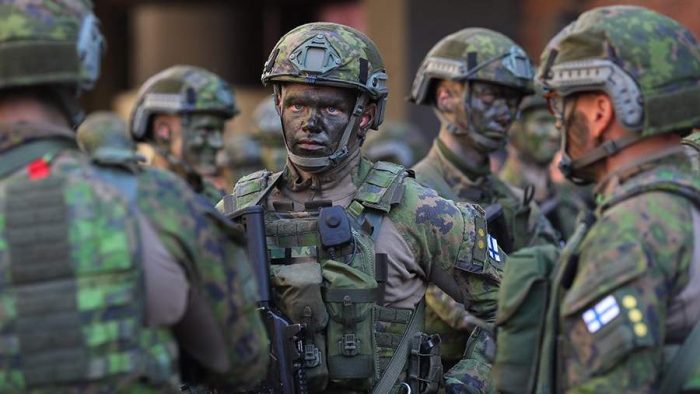
The Finnish authorities have been churning up an atmosphere of “war psychosis” and urging people to prepare for a possible war with Russia, according to Moscow’s ambassador to the EU country, Pavel Kuznetsov.
In an interview with RIA Novosti published on Thursday, Kuznetsov said that Finland’s leadership is instilling fear in the population using claims of “Russia’s aggressive plans.”
Helsinki is promoting various initiatives to strengthen military preparedness among civilians, the envoy said.
“There is increased media coverage of bomb shelter renovations, the expansion of shooting club networks, and the extension of the maximum age for reservists,” Kuznetsov observed, adding that such measures are being “widely promoted.”
According to the ambassador, such actions are part of the Finnish government’s attempt to justify the country’s “hasty” NATO accession and increased defense spending.
Finland, which shares an almost 1,300-kilometer-long border with Russia, officially joined the US-led military bloc in April 2023 following the escalation of the Ukraine conflict. The Finnish government has since strengthened its defense policies, including expanding military training and civil preparedness programs.
Multiple outlets have reported a sharp rise in interest among Finns in weapons training. Shooting ranges have seen membership soar, and the government has announced plans to open more than 300 new shooting facilities to encourage the trend.
In November 2024, Finland issued guidance on how to prepare for an armed conflict, emphasizing the importance of readiness in the face of potential threats.
Several other Nordic countries have also published information advising their populations on how to prepare for a possible war or other unexpected crises.
Sweden has sent out millions of updated booklets entitled “In case of crisis or war,” while Norway has issued pamphlets urging people to be prepared to survive on their own for a week in the event of extreme weather, war, or other threats.
Denmark’s emergency management agency has informed the public how much water, food, and medicine individuals need to get through a crisis lasting three days. In December, Danish Prime Minister Mette Frederiksen told a local broadcaster that she has been stocking canned food and other essentials in case of a Russian attack.
NATO has long declared Russia to be a direct threat, and Western officials have repeatedly claimed that if Moscow wins the Ukraine conflict, it could attack other European countries.
Russian President Vladimir Putin has dismissed any possibility of a military advance against NATO as “nonsense.”
Putin told US journalist Tucker Carlson last February that the bloc’s leaders are trying to scare their people with an imaginary threat from Moscow, but that “smart people understand perfectly well that this is a fake.”
At the same time, Russia has repeatedly warned against what it describes as NATO’s unprecedented military activity near its western borders in recent years.
Featured Video
MIT Prof Ted Postol: U.S. Iran Missile War
or go to
Aletho News Archives – Video-Images
Frlom the Archives
A dark page from the CIA’s history: What was Project Artichoke, launched 74 years ago?
By Erkin Oncan | Strategic Culture Foundation | August 22, 2025
One of the most useful instruments hidden behind the U.S. empire’s rhetoric of “freedom and democracy” was the Central Intelligence Agency, founded on September 18, 1947, as the successor of the Office of Strategic Services (OSS).
Since its creation, the CIA has carried out countless inhumane operations: assassinations, coups, drug trafficking, support for terrorism, conspiracies. The list of its crimes is endless. But among the darkest and most inhumane chapters of its record lie the notorious “mind control” experiments. … continue
Blog Roll
 Aletho News
- Iranian Strikes Dispel the Illusion of US Security Umbrella
- US Boasts of Destroyed Iranian Launchers Lack Credibility – Ex-DoD Official
- Europe not in position to cooperate with US and Israel against Iran
- Iran Has ‘Broken the Myth’ of Israeli Military Power: Former Pakistani Envoy
- How, and why, US data centers in the Gulf became targets of war
- The General who swallowed his truth
- Donald Trump Was Installed in Office to Do One Thing
- MIT Prof Ted Postol: U.S. Iran Missile War
- Unpacking glaring contradictions in US-Zionist justifications for war against Iran
- Iraq and Cuba hit by blackouts amid US pressure and attacks on Iran
- If Americans Knew
- Trump wants to run the show in Iran, but doesn’t know what he’s doing – Not a ceasefire Day 147
- ‘Dirty Work’ :The truth about how Israel was founded
- Mass Expulsion in Lebanon as Israel Expands War: “We Don’t Know Where to Go”
- Lies, distortions, and propaganda: how the U.S. mainstream media coverage on Iran hides the truth
- Palestinians in Gaza fear famine returning as Israel cuts off food amid Iran war
- AIPAC, other pro-Israel groups enter midterms with $100 million to spend
- Iranian girls killed by ‘double-tap’ strikes on Minab school
- Bari Weiss Is Going Full ‘Propaganda-Palooza’ With the Iran War
- Inside the Pro-Israel Campaign to Stop ‘The Voice of Hind Rajab’ From Winning an Oscar
- After Iran, It’s Turkey
- No Tricks Zone
- Televised! Leading German Political Candidate Tells Schoolchildren CO2 Makes Sun Hotter!
- New Study: A Century Warming Of 1.1°C Is ‘Commonplace’ And ‘Not Unusual’ During This Interglacial
- New Study: ‘Internal Noise’ And Volcanic Forcing Can Trigger 10-15°C Warming Within Decades
- Glaciers Worldwide Are Suddendly Surging, Experts Blame Warming!
- Surprising Discovery: Sahara Is Greening…Billions Of Trees Where Once Thought To Be Barren
- New Research Reaffirms Clouds, Aerosols, And Surface Solar Radiation Are ‘Driving The Climate System’
- Germany: Electric Car Catches Fire At Charging Station, Sets Off Local “Inferno”, Widespread Damage
- New Study: Canada’s New Brunswick Was 1°C Warmer Than Today During The Medieval Warm Period
- Coal Power Back In Trend As Globe Tries To Keep Pace With Growing Demand For Power
- New Study: A 4°C Warmer Beaufort Sea Had ‘No Sea Ice’ 11,700 – 8200 Years Ago
 Aletho News