Protecting the Shaky Russia-gate Narrative
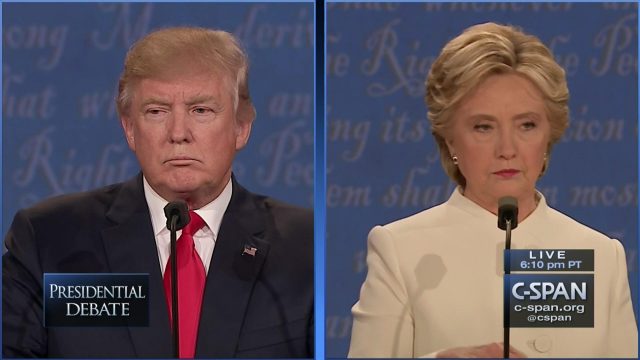
Donald Trump and Hillary Clinton in the third presidential debate in 2016, during which Clinton called Trump Vladimir Putin’s “puppet.”
By Robert Parry | Consortium News | December 15, 2017
If Russia-gate is the massive scandal that we are told it is by so many Important People — across the U.S. mainstream media and the political world — why do its proponents have to resort to lies and exaggerations to maintain the pillars supporting the narrative?
A new example on Thursday was The New York Times’ statement that a Russian agency “spent $100,000 on [Facebook’s] platform to influence the United States presidential election last year” – when the Times knows that statement is not true.
According to Facebook, only 44 percent of that amount appeared before the U.S. presidential election in 2016 (i.e., $44,000) and few of those ads addressed the actual election. And, we know that the Times is aware of the truth because it was acknowledged in a Times article in early October.
As part of that article, Times correspondents Mike Isaac and Scott Shane reported that the ads also covered a wide range of other topics: “There was even a Facebook group for animal lovers with memes of adorable puppies that spread across the site with the help of paid ads.”
As nefarious as the Times may think it is for Russians to promote a Facebook page about “adorable puppies,” the absurdity of that concern – and the dishonesty of the Times then “forgetting” what it itself reported just two months ago about the timing and contents of these “Russian-linked ads” – tells you a great deal about Russia-gate.
On Thursday, the Times chose to distort what it already knew to be true presumably because it didn’t want to make the $100,000 ad buy (which is not a particularly large sum) look even smaller and less significant by acknowledging the pre-election total was less than half that modest amount – and even that total had little to do with the election.
Why would the Times lie? Because to tell the truth would undercut the narrative of evil Russians defeating Hillary Clinton and putting Donald Trump in the White House – the core narrative of Russia-gate.
Another relevant fact is that Facebook failed to find any “Russian-linked” ads during its first two searches and only detected the $100,000 after a personal visit from Sen. Mark Warner, D-Virginia, the vice chairman of the Senate Intelligence Committee and a leading legislator on Internet regulation.
In other words, Facebook’s corporate executives dredged up something to appease Warner. That way, Warner and the Democrats could blame Russia for the Trump presidency, sparing further criticism of Clinton’s dreadful campaign (in which she labeled half of Trump’s voters “deplorables”) and her neo-liberal economic policies (and neo-conservative foreign policies) that have alienated much of America’s working class as well as many progressives.
Leaving Out Context
The Times also might have put the $100,000 in “Russian-linked” ads over a two-year period in the context of Facebook’s $27 billion in annual revenue, but the Times didn’t do that – apparently because it would make even the full $100,000 look like a pittance.
Trimming the total down to $44,000 and admitting that only a few of those ads actually dealt with Clinton and Trump would be even worse for the Russia-gate narrative.
Ironically, the Times’ latest false depiction of the $100,000 in ads as designed “to influence” the 2016 election appeared in an article about Facebook determining that other Russian-linked ads, which supposedly had a powerful effect on Great Britain’s Brexit vote, totaled just three ads at the cost of 97 cents. (That is not a misprint.)
According to Facebook, the three ads, which focused on immigration, were viewed some 200 times by Britons over four days in May 2016. Of course, the response from British parliamentarians who wanted to blame the Brexit vote on Moscow was to assert that Facebook must have missed something. It couldn’t be that many Britons had lost faith in the promise of the European Union for their own reasons.
We have seen a similar pattern with allegations about Russian interference in German and French elections, with the initial accusations being widely touted but not so much the later conclusions by serious investigations knocking down the claims. [See, for instance, Consortiumnews.com’s “German Intel Clears Russia on Interference.”]
The only acceptable conclusion, it seems, is “Russia Guilty!”
These days in Official Washington, it has become almost forbidden to ask for actual evidence that would prove the original claim that Russia “hacked” Democratic emails, even though the accusation came from what President Obama’s Director of National Intelligence James Clapper acknowledged were “hand-picked” analysts from the CIA, FBI and National Security Agency.
These “hand-picked” analysts produced the evidence-lite Jan. 6 “assessment” about Russia “hacking” the emails and slipping them to WikiLeaks – a scenario denied by both WikiLeaks and Russia.
When that “assessment” was released almost a year ago, even the Times’ Scott Shane noticed the lack of proof, writing: “What is missing from the [the Jan. 6] public report is what many Americans most eagerly anticipated: hard evidence to back up the agencies’ claims that the Russian government engineered the election attack. … Instead, the message from the agencies essentially amounts to ‘trust us.’”
But the Times soon “forgot” what Shane had inconveniently noted and began reporting the Russian “hacking” as accepted wisdom.
The 17-Agencies Canard
Whenever scattered expressions of skepticism arose from a few analysts or non-mainstream media, the doubts were beaten back by the claim that “all 17 U.S. intelligence agencies” concurred in the conclusion that Russian President Vladimir Putin had ordered the hacking to hurt Hillary Clinton and help Donald Trump. And what kind of nut would doubt the collective judgment of all 17 U.S. intelligence agencies!
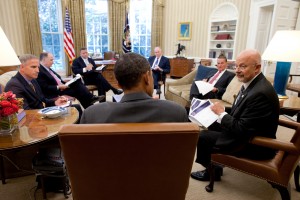
Director of National Intelligence James Clapper talks with President Barack Obama in the Oval Office, John Brennan and other national security aides present. (Photo credit: Office of Director of National Intelligence)
Though the 17-agency canard was never true, it served an important purpose in establishing the Russia-gate groupthink. Wielding the “all 17 intelligence agencies” club, the U.S. mainstream media pounded politicians and policymakers into line, making any remaining skeptics seem more out of step and crazy.
So, in May 2017, when Clapper (along with former CIA Director John Brennan) admitted in congressional testimony that it wasn’t true that all 17 agencies concurred in the Russian hacking conclusion, those statements received very little attention in the mainstream media.
The New York Times among other major news outlets just continued asserting the 17-agency falsehood until the Times was finally pressured to correct its lie in late June, but that only led to the Times shifting to slightly different but still misleading wording, citing a “consensus” among the intelligence agencies without mentioning a number or by simply stating the unproven hacking claim as flat fact.
Even efforts to test the Russian-hack claims through science were ignored or ridiculed. When former NSA technical director William Binney conducted experiments that showed that the known download speed of one batch of DNC emails could not have occurred over the Internet but matched what was possible for a USB-connected thumb drive — an indication that a Democratic insider likely downloaded the emails and thus that there was no “hack” — Binney was mocked as a “conspiracy theorist.”
Even with the new disclosures about deep-seated anti-Trump bias in text messages exchanged between two senior FBI officials who played important early roles in the Russia-gate investigation, there is no indication that Official Washington is willing to go back to the beginning and see how the Russia-gate story might have been deceptively spun.
In a recently released Aug. 15, 2016 text message from Peter Strzok, a senior FBI counterintelligence official, to his reputed lover, senior FBI lawyer Lisa Page, Strzok referenced an apparent plan to keep Trump from getting elected before suggesting the need for “an insurance policy” just in case he did. A serious investigation into Russia-gate might want to know what these senior FBI officials had in mind.
But the Times and other big promoters of Russia-gate continue to dismiss doubters as delusional or as covering up for Russia and/or Trump. By this point – more than a year into this investigation – too many Important People have bought into the Russia-gate narrative to consider the possibility that there may be little or nothing there, or even worse, that it is the “insurance policy” that Strzok envisioned.
Investigative reporter Robert Parry broke many of the Iran-Contra stories for The Associated Press and Newsweek in the 1980s.
Why America’s Law Enforcement Empire Resembles Secret Police in a Dictatorship
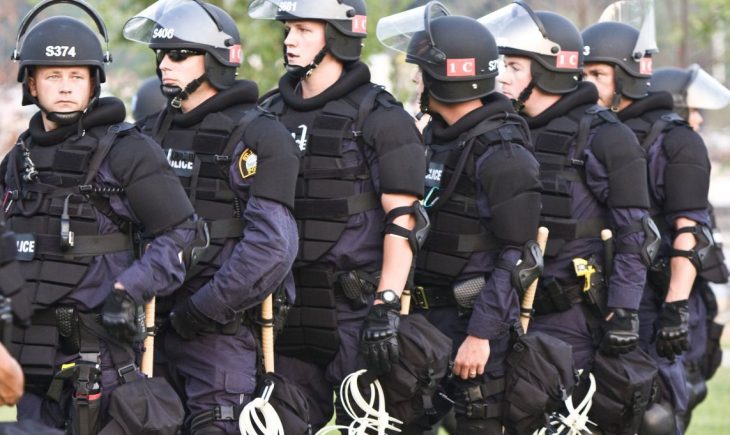
By Philip M. GIRALDI | Strategic Culture Foundation | 14.12.2017
Secret police are characteristic of dictatorships, or so goes the conventional thinking on the subject. Police in democracies operate for the most part transparently and within a set of rules and guidelines that limits their ability to gratuitously punish citizens who have done nothing wrong. If a policeman operating under rule-of-law steps out of line, he can be held accountable. That is also conventional thinking.
But what happens when an ostensibly “democratic” police force becomes corrupted and starts doing things that are outside its zone of responsibility, and does so to benefit a political relationship that will in turn protect those who have broken the law under cover of carrying out their official duties? That is the characteristic of what we have been calling a “deep state,” where forces drawn generally from the political class and security services conspire together to control what the public is allowed to know while also manipulating nuisances like elections to make sure that the “correct” outcome emerges.
Indeed, deep state operating in a democracy or republic is far more dangerous that the secret police in a dictatorship. That is because in a system where the forces of the state are all-powerful, nearly everyone expects that what they read and what the government says is all a lie. In a democratic system there is what intelligence officers would refer to as plausible denial, which means that even when the government is behaving very badly much of the public will believe that it is acting honorably because they want to trust that the system works. And when the deep state includes management of the media, many citizens will likewise believe what they are reading or hearing is honest reporting, even when it is not.
Due to the events of the past year in particular, many Americans have become convinced that there now exists something like a secret police operating in the United States that is a fusion of some political dealmakers with certain politicized elements in the intelligence and security services. However one regards President Donald Trump and his former National Security Adviser Michael Flynn, there is nevertheless something odd in terms of how they have been investigated and, in the case of Flynn, legally entrapped to convict him of lying to the FBI to force him to cut a deal with the Special Counsel inquiry headed by Robert Mueller.
Consider how, even though meeting with Russians is not illegal, Trump and his associates have been subjected to secret investigation of their Russian ties for nearly two years without any revelations apart from the fact that it was Israel, not Russia, that colluded to undermine White House policy. FBI Director James Comey’s antics during the primaries and electoral campaign, in which he first exonerated and then complained about Hillary Clinton while at the same time validating a dossier full of largely questionable information about Donald Trump’s dealings with Russia provides clear evidence of an organization that has lost its bearings and has become a politicized agent of an incumbency that has itself become corrupted and believes itself to be above the law. And then there is the Central Intelligence Agency’s own John Brennan working with the FBI to undermine the Trumps, illegally digging up dirt from the liaison intelligence partners in Europe and the Middle East.
America’s law enforcement empire has all the characteristics of secret police in a dictatorship. It is not transparent in its actions, has a history of bending the rules to obtain convictions, and its officers are rarely held accountable. It has also been politicized. And to be sure, one should recognize that there are two additional factors driving the growth and transformation of the national security state in the U.S. First is the intense dislike that the top levels of the American intelligence and police agencies have for Donald Trump personally, a contempt that Trump himself has largely earned by his scorn for much of the government that he inherited. Second is the “trust the authorities” culture that has grown up since 9/11, reinforced by fearmongering on the part of the government to justify executive overreach and enabled through anti-terror legislation that has unleashed the CIA, FBI and National Security Agency (NSA) to act with impunity while suffering no consequences whatsoever.
The Scalp-Taking of Gen. Flynn
By Robert Parry | Consortium News | December 1, 2017
Russia-gate enthusiasts are thrilled over the guilty plea of President Trump’s former National Security Adviser Michael Flynn for lying to the FBI about pre-inauguration conversations with the Russian ambassador, but the case should alarm true civil libertarians.
What is arguably most disturbing about this case is that then-National Security Adviser Flynn was pushed into a perjury trap by Obama administration holdovers at the Justice Department who concocted an unorthodox legal rationale for subjecting Flynn to an FBI interrogation four days after he took office, testing Flynn’s recollection of the conversations while the FBI agents had transcripts of the calls intercepted by the National Security Agency.
In other words, the Justice Department wasn’t seeking information about what Flynn said to Russian Ambassador Sergey Kislyak – the intelligence agencies already had that information. Instead, Flynn was being quizzed on his precise recollection of the conversations and nailed for lying when his recollections deviated from the transcripts.
For Americans who worry about how the pervasive surveillance powers of the U.S. government could be put to use criminalizing otherwise constitutionally protected speech and political associations, Flynn’s prosecution represents a troubling precedent.
Though Flynn clearly can be faulted for his judgment, he was, in a sense, a marked man the moment he accepted the job of national security adviser. In summer 2016, Democrats seethed over Flynn’s participation in chants at the Republican National Convention to “lock her [Hillary Clinton] up!”
Then, just four days into the Trump presidency, an Obama holdover, then-acting Attorney General Sally Yates, primed the Flynn perjury trap by coming up with a novel legal theory that Flynn – although the national security adviser-designate at the time of his late December phone calls with Kislyak – was violating the 1799 Logan Act, which prohibits private citizens from interfering with U.S. foreign policy.
But that law – passed during President John Adams’s administration in the era of the Alien and Sedition Acts – was never intended to apply to incoming officials in the transition period between elected presidential administrations and – in the past 218 years – the law has resulted in no successful prosecution at all and thus its dubious constitutionality has never been adjudicated.
Stretching Logic
But Yates extrapolated from her unusual Logan Act theory to speculate that since Flynn’s publicly known explanation of the conversation with Kislyak deviated somewhat from the transcript of the intercepts, Flynn might be vulnerable to Russian blackmail.
Yet, that bizarre speculation would require that the Russians first would have detected the discrepancies; secondly, they would have naively assumed that the U.S. intelligence agencies had not intercepted the conversations, which would have negated any blackmail potential; and thirdly, the Russians would have to do something so ridiculously heavy-handed – trying to blackmail Flynn – that it would poison relations with the new Trump administration.
Yates’s legal theorizing was so elastic and speculative that it could be used to justify subjecting almost anyone to FBI interrogation with the knowledge that their imperfect memories would guarantee the grounds for prosecution based on NSA intercepts of their communications.
Basically, the Obama holdovers concocted a preposterous legal theory to do whatever they could to sabotage the Trump administration, which they held in fulsome disdain.
At the time of Flynn’s interrogation, the Justice Department was under the control of Yates and the FBI was still under President Obama’s FBI Director James Comey, another official hostile to the Trump administration who later was fired by Trump.
The Yates-FBI perjury trap also was sprung on Flynn in the first days of the Trump presidency amid reverberations of the massive anti-Trump protests that had arisen across the country in support of demands for a “#Resistance” to Trump’s rule.
Flynn also had infuriated Democrats when he joined in chants at the Republican National Convention of “lock her up” over Democratic presidential nominee Hillary Clinton’s use of a private email server and other alleged offenses. So, in targeting Flynn, there was a mix of personal payback and sabotage against the Trump administration.
The Legal Construct
The two-page complaint against Flynn, made public on Friday, references false statements to the FBI regarding two conversations with Kisylak, one on Dec. 22, 2016, and the other on Dec. 29, 2016.
The first item in the complaint alleges that Flynn did not disclose that he had asked the Russian ambassador to help delay or defeat a United Nations Security Council vote censuring Israel for building settlements on Palestinian territory.
The New York Times reported on Friday that Russia-gate investigators “learned through witnesses and documents that Israeli Prime Minister Benjamin Netanyahu asked the Trump transition team to lobby other countries to help Israel, according to two people briefed on the inquiry.
“Investigators have learned that Mr. Flynn and Mr. Trump’s son-in-law and senior adviser, Jared Kushner, took the lead in those efforts. Mr. Mueller’s team has emails that show Mr. Flynn saying he would work to kill the vote, the people briefed on the matter said,” according to the Times.
Breaking with past U.S. precedents, President Obama had decided not to veto the resolution criticizing Israel, choosing instead to abstain. However, the censure resolution carried with Russian support, meaning that whatever lobbying Flynn and Kushner undertook was unsuccessful.
But the inclusion of this Israeli element shows how far afield the criminal Russia-gate investigation, headed by former FBI Director Robert Mueller, has gone. Though the original point of the inquiry was whether the Trump team colluded with Russians to use “hacked” emails to defeat Hillary Clinton’s campaign, the criminal charge against Flynn has nothing to do with election “collusion” but rather President-elect Trump’s aides weighing in on foreign policy controversies during the transition. And, one of these initiatives was undertaken at the request of Israeli Prime Minister Netanyahu, not Russian President Vladimir Putin.
The second item, cited by Mueller’s prosecutors, referenced a Dec. 29 Flynn-Kislyak conversation, which received public attention at the time of Flynn’s Feb. 13 resignation after only 24 days on the job. That phone call touched on Russia’s response to President Obama’s decision to issue new sanctions against the Kremlin for the alleged election interference.
The complaint alleges that Flynn didn’t mention to the FBI that he had urged Kislyak “to refrain from escalating the situation” and that Kislyak had subsequently told him that “Russia had chosen to moderate its response to those sanctions as a result of his request.”
The Dec. 29 phone call occurred while Flynn was vacationing in the Dominican Republic and thus he would have been without the usual support staff for memorializing or transcribing official conversations. So, the FBI agents, with the NSA’s transcripts, would have had a clearer account of what was said than Flynn likely had from memory. The content of Flynn’s request to Kislyak also appears rather uncontroversial, asking the Russians not to overreact to a punitive policy from the outgoing Obama administration.
In other words, both of the Flynn-Kislyak conversations appear rather unsurprising, if not inconsequential. One was taken at the behest of Israel (which proved ineffective) and the other urged the Kremlin to show restraint in its response to a last-minute slap from President Obama (which simply delayed Russian retaliation by a few months).
Double Standards
While Flynn’s humiliation has brought some palpable joy to the anti-Trump “Resistance” – one more Trump aide being taken down amid renewed hope that this investigation will somehow lead to Trump’s resignation or impeachment – many of the same people would be howling about trampled civil liberties if a Republican bureaucracy were playing this game on a Democratic president and his staff.
Indeed, in the turnabout-is-fair-play department, there is some equivalence in what is happening over Russia-gate to what the Republicans did in the 1990s exploiting their control of the special-prosecutor apparatus in the first years of Bill Clinton’s presidency when interminable investigations into such side issues as his Whitewater real-estate deal and the firing of the White House travel office staff plagued the Clinton administration.
Similarly, Republicans seized on the deaths of four U.S. diplomatic personnel on Sept. 11, 2012, in Benghazi, Libya, to conduct a series of lengthy investigations to tarnish Secretary of State Hillary Clinton’s tenure and raise questions about her judgment. Democrats understandably called these attacks partisan warfare in legal or investigative garb.
What I have heard from many Hillary Clinton supporters in recent months is that they don’t care about the unfairness of the Russia-gate process or the dangerous precedents that such politicized prosecutions might set. They simply view Trump as such a danger that he must be destroyed at whatever the cost.
Yet, besides the collateral damage inflicted on mid-level government officials such as retired Lt. Gen. Flynn facing personal destruction at the hands of federal prosecutors with unlimited budgets, there is this deepening pattern of using criminal law to settle political differences, a process more common in authoritarian states.
As much as the Russia-gate enthusiasts talk about how they are upholding “the rule of law,” there is the troubling appearance that the law is simply being used to collect the scalps of political enemies.
Investigative reporter Robert Parry broke many of the Iran-Contra stories for The Associated Press and Newsweek in the 1980s.
‘Zero evidence’ for claims Russia hacked DNC – NSA whistleblower
The CIA director Mike Pompeo has come under fire for meeting a former intelligence official, William Binney, over the alleged hacking of the Democratic party back in 2016. The US intelligence community laid the blame for the hack, on Moscow. READ MORE: https://on.rt.com/8rsl
Ex-NSA Official: Nobody Knows What’s Going On at US Intelligence Agencies
Sputnik – October 26, 2017
When it comes to the US intelligence community’s ability to collect, store and analyze data on any person at any time, there’s virtually nothing that can stop them. Keeping track of who’s doing what within that community, however, is a different animal.
Congressional intelligence committees, FISA (Foreign Intelligence Surveillance Act) courts, “and even the administration have no real control of what happens inside these intelligence agencies. They don’t have any way of verifying what they’re doing, that’s the real problem — even the managers of those agencies don’t necessarily know what’s going on in their agency,” former NSA officer Bill Binney told Loud & Clear on Radio Sputnik Thursday.
Regarding the government’s use of contractors in facilitating their operations, former Anonymous activist Barrett Brown told By Any Means Necessary in March, “there’s so much going on with these contracting firms, so much compartmentalization, that no single person knows exactly what’s possible these days.”
This week, the Senate Intelligence Committee voted to approve Section 702 of the Foreign Intelligence Surveillance Act 12-3. The bill “reauthorizes our nation’s most valuable intelligence collection authorities and ensure that the men and women of the intelligence community and our law enforcement agencies have the tools and authorities they need to keep us safe,” Senator Richard Burr (R-NC) said in an October 24 news release.
Reauthorizing the act is just theater anyway, since the intelligence agencies have the capabilities to skirt around the law anyway, Binney says. “You can write any number of bills you want: [the intelligence] agencies can violate them,” because Congress doesn’t really know what is going on at the agencies, the expert said.
“They have no idea what’s going on, and what’s going under, the mass collection of data on US citizens under Executive Order 12333,” Binney explained. First signed by US President Ronald Reagan on December 4, 1981, the order requires federal agencies to comply with requests for information from the Central Intelligence Agency. One statute of the order specifically allows information collection “that may violate federal, state, local or foreign laws.” In other words, the order gives the intelligence community a free pass to break the law, regardless of who made the law.
Binney refers to the intelligence apparatus as ‘the modern-day pretorian guard,’ which exerted disproportionate control over who would be selected for leadership positions during the Roman Empire and very often operated outside the legal bounds set by the Roman Senate.
This week, Senators Ron Wyden (D-OR) and Rand Paul (R-KY) introduced the USA Rights Act, praised by the Electronic Frontier Foundation as “the most comprehensive reform so far of Section 702.” The measure would make it more difficult for the government to gather data from private-sector companies.
Binney was skeptical such a measure could move the needle on mass domestic espionage. “For example, right now, and for the past 16 years,” the US intelligence community has been “violating the constitutional rights of US citizens. Well, if they can do that, and just simply, get the law to conform with to that — that’s what they’ve been doing.”
“The problem with that is it’s unconstitutional,” he said.
More Holes in Russia-gate Narrative
By William Binney and Ray McGovern | Consortium News | September 20, 2017
It is no secret that our July 24 VIPS Memorandum for the President, entitled “Was the ‘Russian Hack’ an Inside Job?,” gave rise to some questioning and controversy – nor was it a surprise that it was met with almost total silence in the mainstream media.
The ongoing U.S. media campaign against Russia has been so effective that otherwise intelligent people have been unable even to entertain the notion that they may have been totally misled by the intelligence community. The last time this happened in 2003, after a year of such propaganda, the U.S. attacked Iraq on fraudulent – not “mistaken” – intelligence.
Anticipating resistance from those allergic to rethinking “what everybody knows” about Russian “meddling,” we based our VIPS analysis on forensic investigations that, oddly, the FBI had bent over backwards to avoid. In other words, we relied on the principles of physics and the known capability of the Internet in early July 2016.
We stand by our main conclusion that the data from the intrusion of July 5, 2016, into the Democratic National Committee’s computers, an intrusion blamed on “Russian hacking,” was not a hack but rather a download/copy onto an external storage device by someone with physical access to the DNC.
That principal finding relied heavily on the speed with which the copy took place – a speed much faster than a hack over the Internet could have achieved at the time – or, it seems clear, even now. Challenged on that conclusion – often by those conducting experiments within the confines of a laboratory – we have conducted and documented additional tests to determine the speeds that can be achieved now, more than a year later.
To remind: We noted in the VIPS memo that on July 5, 2016, a computer directly connected to the DNC server or DNC Local Area Network, copied 1,976 megabytes of data in 87 seconds onto an external storage device. That yields a transfer rate of 22.7 megabytes per second.
Recent Tests
Over the last few weeks, we ran three tests to determine how quickly data could be exfiltrated from the U.S. across the Atlantic to Europe.
–First, we used a 100 megabits-per-second (mbps) line to pull data from a one-gigabyte file to Amsterdam. The peak transfer speed was .8 MBps.
–Second, we used a commercial DSL (Digital Subscriber Line) to send the same one-gigabyte file to a commercial DSL in Amsterdam. The peak transfer speed was 1.8 MBps.
–Third, we pushed the same one-gigabyte file from a data center in New Jersey to a data center in the UK. The peak transfer speed was 12 MBps.
None of these attempts achieve anything close to the average rate of 22.7 megabytes per second evident in the July 5, 2016 download/copy associated with the DNC. In fact, this happens to be the speed typical of a transfer to a USB-2 external storage device. We do not think this pure coincidence; rather, it is additional evidence of a local download.
We are preparing further trans-Atlantic testing over the next few weeks.
Some researchers have noted that some partitioning of the data might have occurred in the U.S., allowing for a transfer to be made at the measured speed over the Internet, and that this could have made possible a hack from the other side of the Atlantic. One of our associate investigators has found a way to achieve this kind of data partitioning and later transfer.
In theory, this would be one possible way to achieve such a large-data transfer, but we have no evidence that anything like this actually occurred. More important, in such a scenario, the National Security Agency would have chapter and verse on it, because such a hack would have to include software to execute the partitioning and subsequent data transfer. NSA gives the highest priority to collection on “execution software.”
Most Americans, apparently including President Donald Trump, remain in a Russia-did-it-or-could-have-maybe-might-have-done-it subjunctive mood on this important issue – one that has been used to inject Cold War ice into relations with Russia? The answer is absolutely not. Rather, definitive answers are at hand.
How can we be so confident? Because NSA alumni now active in Veteran Intelligence Professionals for Sanity (VIPS) are intimately familiar with NSA’s capabilities and practice with respect to bulk capture and storage of fiber-optic communications. Two of us actually devised the systems still in use, and Edward Snowden’s revelations filled in remaining gaps. Today’s NSA is in position to clear up any and all questions about intrusions into the DNC.
In sum, we are certain that the truth of what actually happened – or didn’t happen – can be found in the databases of NSA. We tried to explain this to President Barack Obama in a VIPS Memorandum of Jan. 17, just three days before he left office, noting that NSA’s known programs are fully capable of capturing – and together with liaison intelligence services do capture – all electronic transfers of data.
Our Jan. 17 Memorandum included this admonition: “We strongly suggest that you ask NSA for any evidence it may have indicating that the results of Russian hacking were given to WikiLeaks.” … “If NSA cannot give you that information – and quickly – this would probably mean it does not have any.”
We also appealed to Obama in his final days in office to order the chiefs of the NSA, FBI and CIA to the White House and have them lay all their cards on the table about “Russian hacking,” and show him what tangible evidence they might have – not simply their “assessments.” We added, “We assume you would not wish to hobble your successor with charges that cannot withstand close scrutiny.” Having said this, we already were reaching the assumption that there was no real evidence to back the “assessments” up.
FBI: Not Leaning Forward
The FBI could still redeem itself by doing what it should have done as soon as the DNC claimed to have been “hacked.” For reasons best known to former FBI Director James Comey, the Bureau failed to get whatever warrant was needed to confiscate the DNC servers and computers to properly examine them.
In testimony to the House Intelligence Committee six months ago, Comey conceded “best practice is always to get access to the machines themselves.” And yet he chose not to. And his decision came amid frenzied charges by senior U.S. officials that Russia had committed “an act of war.”
But is it not already too late for such an investigation? We hope that, at this point, it is crystal clear that the answer is: No, it is not too late. All the data the FBI needs to do a proper job is in NSA databases – including data going across the Internet to the DNC server and then included in their network logs.
If President Trump wants to know the truth, he can order the FBI to do its job and NSA to cooperate. Whether the two and the CIA would obey such orders is an open question, given how heavily invested all three agencies are in their evidence-impoverished narrative about “Russian hacking.”
Let us close with the obvious. All three agencies have been aware all along that NSA has the data. One wonders why it should require a Presidential order for them to delve into that data and come up with conclusions based on fact, as opposed to “assessing.”
William Binney (williambinney0802@comcast.net) worked for NSA for 36 years, retiring in 2001 as the technical director of world military and geopolitical analysis and reporting; he created many of the collection systems still used by NSA. Ray McGovern (rrmcgovern@gmail.com) was a CIA analyst for 27 years; from 1981 to 1985 he briefed the President’s Daily Brief one-on-one to President Reagan’s most senior national security officials.
Intel Vets Challenge ‘Russia Hack’ Evidence
Consortium News | July 24, 2017
In a memo to President Trump, a group of former U.S. intelligence officers, including NSA specialists, cite new forensic studies to challenge the claim of the key Jan. 6 “assessment” that Russia “hacked” Democratic emails last year.
MEMORANDUM FOR: The President
FROM: Veteran Intelligence Professionals for Sanity (VIPS)
SUBJECT: Was the “Russian Hack” an Inside Job?
Executive Summary
Forensic studies of “Russian hacking” into Democratic National Committee computers last year reveal that on July 5, 2016, data was leaked (not hacked) by a person with physical access to DNC computers, and then doctored to incriminate Russia.
After examining metadata from the “Guccifer 2.0” July 5, 2016 intrusion into the DNC server, independent cyber investigators have concluded that an insider copied DNC data onto an external storage device, and that “telltale signs” implicating Russia were then inserted.
Key among the findings of the independent forensic investigations is the conclusion that the DNC data was copied onto a storage device at a speed that far exceeds an Internet capability for a remote hack. Of equal importance, the forensics show that the copying and doctoring were performed on the East coast of the U.S. Thus far, mainstream media have ignored the findings of these independent studies [see here and here].
Independent analyst Skip Folden, a retired IBM Program Manager for Information Technology US, who examined the recent forensic findings, is a co-author of this Memorandum. He has drafted a more detailed technical report titled “Cyber-Forensic Investigation of ‘Russian Hack’ and Missing Intelligence Community Disclaimers,” and sent it to the offices of the Special Counsel and the Attorney General. VIPS member William Binney, a former Technical Director at the National Security Agency, and other senior NSA “alumni” in VIPS attest to the professionalism of the independent forensic findings.
The recent forensic studies fill in a critical gap. Why the FBI neglected to perform any independent forensics on the original “Guccifer 2.0” material remains a mystery – as does the lack of any sign that the “hand-picked analysts” from the FBI, CIA, and NSA, who wrote the “Intelligence Community Assessment” dated January 6, 2017, gave any attention to forensics.
NOTE: There has been so much conflation of charges about hacking that we wish to make very clear the primary focus of this Memorandum. We focus specifically on the July 5, 2016 alleged Guccifer 2.0 “hack” of the DNC server. In earlier VIPS memoranda we addressed the lack of any evidence connecting the Guccifer 2.0 alleged hacks and WikiLeaks, and we asked President Obama specifically to disclose any evidence that WikiLeaks received DNC data from the Russians [see here and here].
Addressing this point at his last press conference (January 18), he described “the conclusions of the intelligence community” as “not conclusive,” even though the Intelligence Community Assessment of January 6 expressed “high confidence” that Russian intelligence “relayed material it acquired from the DNC … to WikiLeaks.”
Obama’s admission came as no surprise to us. It has long been clear to us that the reason the U.S. government lacks conclusive evidence of a transfer of a “Russian hack” to WikiLeaks is because there was no such transfer. Based mostly on the cumulatively unique technical experience of our ex-NSA colleagues, we have been saying for almost a year that the DNC data reached WikiLeaks via a copy/leak by a DNC insider (but almost certainly not the same person who copied DNC data on July 5, 2016).
From the information available, we conclude that the same inside-DNC, copy/leak process was used at two different times, by two different entities, for two distinctly different purposes:
-(1) an inside leak to WikiLeaks before Julian Assange announced on June 12, 2016, that he had DNC documents and planned to publish them (which he did on July 22) – the presumed objective being to expose strong DNC bias toward the Clinton candidacy; and
-(2) a separate leak on July 5, 2016, to pre-emptively taint anything WikiLeaks might later publish by “showing” it came from a “Russian hack.”
* * *
Mr. President:
This is our first VIPS Memorandum for you, but we have a history of letting U.S. Presidents know when we think our former intelligence colleagues have gotten something important wrong, and why. For example, our first such memorandum, a same-day commentary for President George W. Bush on Colin Powell’s U.N. speech on February 5, 2003, warned that the “unintended consequences were likely to be catastrophic,” should the U.S. attack Iraq and “justfy” the war on intelligence that we retired intelligence officers could readily see as fraudulent and driven by a war agenda.
The January 6 “Intelligence Community Assessment” by “hand-picked” analysts from the FBI, CIA, and NSA seems to fit into the same agenda-driven category. It is largely based on an “assessment,” not supported by any apparent evidence, that a shadowy entity with the moniker “Guccifer 2.0” hacked the DNC on behalf of Russian intelligence and gave DNC emails to WikiLeaks.
The recent forensic findings mentioned above have put a huge dent in that assessment and cast serious doubt on the underpinnings of the extraordinarily successful campaign to blame the Russian government for hacking. The pundits and politicians who have led the charge against Russian “meddling” in the U.S. election can be expected to try to cast doubt on the forensic findings, if they ever do bubble up into the mainstream media. But the principles of physics don’t lie; and the technical limitations of today’s Internet are widely understood. We are prepared to answer any substantive challenges on their merits.
You may wish to ask CIA Director Mike Pompeo what he knows about this. Our own lengthy intelligence community experience suggests that it is possible that neither former CIA Director John Brennan, nor the cyber-warriors who worked for him, have been completely candid with their new director regarding how this all went down.
Copied, Not Hacked
As indicated above, the independent forensic work just completed focused on data copied (not hacked) by a shadowy persona named “Guccifer 2.0.” The forensics reflect what seems to have been a desperate effort to “blame the Russians” for publishing highly embarrassing DNC emails three days before the Democratic convention last July. Since the content of the DNC emails reeked of pro-Clinton bias, her campaign saw an overriding need to divert attention from content to provenance – as in, who “hacked” those DNC emails? The campaign was enthusiastically supported by a compliant “mainstream” media; they are still on a roll.
“The Russians” were the ideal culprit. And, after WikiLeaks editor Julian Assange announced on June 12, 2016, “We have emails related to Hillary Clinton which are pending publication,” her campaign had more than a month before the convention to insert its own “forensic facts” and prime the media pump to put the blame on “Russian meddling.” Mrs. Clinton’s PR chief Jennifer Palmieri has explained how she used golf carts to make the rounds at the convention. She wrote that her “mission was to get the press to focus on something even we found difficult to process: the prospect that Russia had not only hacked and stolen emails from the DNC, but that it had done so to help Donald Trump and hurt Hillary Clinton.”
Independent cyber-investigators have now completed the kind of forensic work that the intelligence assessment did not do. Oddly, the “hand-picked” intelligence analysts contented themselves with “assessing” this and “assessing” that. In contrast, the investigators dug deep and came up with verifiable evidence from metadata found in the record of the alleged Russian hack.
They found that the purported “hack” of the DNC by Guccifer 2.0 was not a hack, by Russia or anyone else. Rather it originated with a copy (onto an external storage device – a thumb drive, for example) by an insider. The data was leaked after being doctored with a cut-and-paste job to implicate Russia. We do not know who or what the murky Guccifer 2.0 is. You may wish to ask the FBI.
The Time Sequence
June 12, 2016: Assange announces WikiLeaks is about to publish “emails related to Hillary Clinton.”
June 15, 2016: DNC contractor Crowdstrike, (with a dubious professional record and multiple conflicts of interest) announces that malware has been found on the DNC server and claims there is evidence it was injected by Russians.
June 15, 2016: On the same day, “Guccifer 2.0” affirms the DNC statement; claims responsibility for the “hack;” claims to be a WikiLeaks source; and posts a document that the forensics show was synthetically tainted with “Russian fingerprints.”
We do not think that the June 12 & 15 timing was pure coincidence. Rather, it suggests the start of a pre-emptive move to associate Russia with anything WikiLeaks might have been about to publish and to “show” that it came from a Russian hack.
The Key Event
July 5, 2016: In the early evening, Eastern Daylight Time, someone working in the EDT time zone with a computer directly connected to the DNC server or DNC Local Area Network, copied 1,976 MegaBytes of data in 87 seconds onto an external storage device. That speed is many times faster than what is physically possible with a hack.
It thus appears that the purported “hack” of the DNC by Guccifer 2.0 (the self-proclaimed WikiLeaks source) was not a hack by Russia or anyone else, but was rather a copy of DNC data onto an external storage device. Moreover, the forensics performed on the metadata reveal there was a subsequent synthetic insertion – a cut-and-paste job using a Russian template, with the clear aim of attributing the data to a “Russian hack.” This was all performed in the East Coast time zone.
“Obfuscation & De-obfuscation”
Mr. President, the disclosure described below may be related. Even if it is not, it is something we think you should be made aware of in this general connection. On March 7, 2017, WikiLeaks began to publish a trove of original CIA documents that WikiLeaks labeled “Vault 7.” WikiLeaks said it got the trove from a current or former CIA contractor and described it as comparable in scale and significance to the information Edward Snowden gave to reporters in 2013.
No one has challenged the authenticity of the original documents of Vault 7, which disclosed a vast array of cyber warfare tools developed, probably with help from NSA, by CIA’s Engineering Development Group. That Group was part of the sprawling CIA Directorate of Digital Innovation – a growth industry established by John Brennan in 2015.
Scarcely imaginable digital tools – that can take control of your car and make it race over 100 mph, for example, or can enable remote spying through a TV – were described and duly reported in the New York Times and other media throughout March. But the Vault 7, part 3 release on March 31 that exposed the “Marble Framework” program apparently was judged too delicate to qualify as “news fit to print” and was kept out of the Times.
The Washington Post’s Ellen Nakashima, it seems, “did not get the memo” in time. Her March 31 article bore the catching (and accurate) headline: “WikiLeaks’ latest release of CIA cyber-tools could blow the cover on agency hacking operations.”
The WikiLeaks release indicated that Marble was designed for flexible and easy-to-use “obfuscation,” and that Marble source code includes a “deobfuscator” to reverse CIA text obfuscation.
More important, the CIA reportedly used Marble during 2016. In her Washington Post report, Nakashima left that out, but did include another significant point made by WikiLeaks; namely, that the obfuscation tool could be used to conduct a “forensic attribution double game” or false-flag operation because it included test samples in Chinese, Russian, Korean, Arabic and Farsi.
The CIA’s reaction was neuralgic. Director Mike Pompeo lashed out two weeks later, calling Assange and his associates “demons,” and insisting, “It’s time to call out WikiLeaks for what it really is, a non-state hostile intelligence service, often abetted by state actors like Russia.”
Mr. President, we do not know if CIA’s Marble Framework, or tools like it, played some kind of role in the campaign to blame Russia for hacking the DNC. Nor do we know how candid the denizens of CIA’s Digital Innovation Directorate have been with you and with Director Pompeo. These are areas that might profit from early White House review.
Putin and the Technology
We also do not know if you have discussed cyber issues in any detail with President Putin. In his interview with NBC’s Megyn Kelly, he seemed quite willing – perhaps even eager – to address issues related to the kind of cyber tools revealed in the Vault 7 disclosures, if only to indicate he has been briefed on them. Putin pointed out that today’s technology enables hacking to be “masked and camouflaged to an extent that no one can understand the origin” [of the hack] … And, vice versa, it is possible to set up any entity or any individual that everyone will think that they are the exact source of that attack.”
“Hackers may be anywhere,” he said. “There may be hackers, by the way, in the United States who very craftily and professionally passed the buck to Russia. Can’t you imagine such a scenario? … I can.”
Full Disclosure: Over recent decades the ethos of our intelligence profession has eroded in the public mind to the point that agenda-free analysis is deemed well nigh impossible. Thus, we add this disclaimer, which applies to everything we in VIPS say and do: We have no political agenda; our sole purpose is to spread truth around and, when necessary, hold to account our former intelligence colleagues.
We speak and write without fear or favor. Consequently, any resemblance between what we say and what presidents, politicians and pundits say is purely coincidental. The fact we find it is necessary to include that reminder speaks volumes about these highly politicized times. This is our 50th VIPS Memorandum since the afternoon of Powell’s speech at the UN. Live links to the 49 past memos can be found at https://consortiumnews.com/vips-memos/.
FOR THE STEERING GROUP, VETERAN INTELLIGENCE PROFESSIONALS FOR SANITY
William Binney, former NSA Technical Director for World Geopolitical & Military Analysis; Co-founder of NSA’s Signals Intelligence Automation Research Center
Skip Folden, independent analyst, retired IBM Program Manager for Information Technology US (Associate VIPS)
Matthew Hoh, former Capt., USMC, Iraq & Foreign Service Officer, Afghanistan (associate VIPS)
Michael S. Kearns, Air Force Intelligence Officer (Ret.), Master SERE Resistance to Interrogation Instructor
John Kiriakou, Former CIA Counterterrorism Officer and former Senior Investigator, Senate Foreign Relations Committee
Linda Lewis, WMD preparedness policy analyst, USDA (ret.)
Lisa Ling, TSgt USAF (ret.) (associate VIPS)
Edward Loomis, Jr., former NSA Technical Director for the Office of Signals Processing
David MacMichael, National Intelligence Council (ret.)
Ray McGovern, former U.S. Army Infantry/Intelligence officer and CIA analyst
Elizabeth Murray, former Deputy National Intelligence Officer for Middle East, CIA
Coleen Rowley, FBI Special Agent and former Minneapolis Division Legal Counsel (ret.)
Cian Westmoreland, former USAF Radio Frequency Transmission Systems Technician and Unmanned Aircraft Systems whistleblower (Associate VIPS)
Kirk Wiebe, former Senior Analyst, SIGINT Automation Research Center, NSA
Sarah G. Wilton, Intelligence Officer, DIA (ret.); Commander, US Naval Reserve (ret.)
Ann Wright, U.S. Army Reserve Colonel (ret) and former U.S. Diplomat
NYT Finally Retracts Russia-gate Canard
By Robert Parry | Consortium News | June 29, 2017
The New York Times has finally admitted that one of the favorite Russia-gate canards – that all 17 U.S. intelligence agencies concurred on the assessment of Russian hacking of Democratic emails – is false.
On Thursday, the Times appended a correction to a June 25 article that had repeated the false claim, which has been used by Democrats and the mainstream media for months to brush aside any doubts about the foundation of the Russia-gate scandal and portray President Trump as delusional for doubting what all 17 intelligence agencies supposedly knew to be true.
In the Times’ White House Memo of June 25, correspondent Maggie Haberman mocked Trump for “still refus[ing] to acknowledge a basic fact agreed upon by 17 American intelligence agencies that he now oversees: Russia orchestrated the attacks, and did it to help get him elected.”
However, on Thursday, the Times – while leaving most of Haberman’s ridicule of Trump in place – noted in a correction that the relevant intelligence “assessment was made by four intelligence agencies — the Office of the Director of National Intelligence, the Central Intelligence Agency, the Federal Bureau of Investigation and the National Security Agency. The assessment was not approved by all 17 organizations in the American intelligence community.”
The Times’ grudging correction was vindication for some Russia-gate skeptics who had questioned the claim of a full-scale intelligence assessment, which would usually take the form of a National Intelligence Estimate (or NIE), a product that seeks out the views of the entire Intelligence Community and includes dissents.
The reality of a more narrowly based Russia-gate assessment was admitted in May by President Obama’s Director of National Intelligence James Clapper and Obama’s CIA Director John Brennan in sworn congressional testimony.
Clapper testified before a Senate Judiciary subcommittee on May 8 that the Russia-hacking claim came from a “special intelligence community assessment” (or ICA) produced by selected analysts from the CIA, NSA and FBI, “a coordinated product from three agencies – CIA, NSA, and the FBI – not all 17 components of the intelligence community,” the former DNI said.
Clapper further acknowledged that the analysts who produced the Jan. 6 assessment on alleged Russian hacking were “hand-picked” from the CIA, FBI and NSA.
Yet, as any intelligence expert will tell you, if you “hand-pick” the analysts, you are really hand-picking the conclusion. For instance, if the analysts were known to be hard-liners on Russia or supporters of Hillary Clinton, they could be expected to deliver the one-sided report that they did.
Politicized Intelligence
In the history of U.S. intelligence, we have seen how this selective approach has worked, such as the phony determination of the Reagan administration pinning the attempted assassination of Pope John Paul II and other acts of terror on the Soviet Union.
CIA Director William Casey and Deputy Director Robert Gates shepherded the desired findings through the process by putting the assessment under the control of pliable analysts and sidelining those who objected to this politicization of intelligence.
The point of enlisting the broader intelligence community – and incorporating dissents into a final report – is to guard against such “stove-piping” of intelligence that delivers the politically desired result but ultimately distorts reality.
Another painful example of politicized intelligence was President George W. Bush’s 2002 National Intelligence Estimate on Iraq’s WMD that removed State Department and other dissents from the declassified version that was given to the public.
Since Clapper’s and Brennan’s testimony in May, the Times and other mainstream news outlets have avoided a direct contradiction of their earlier acceptance of the 17-intelligence-agencies canard by simply referring to a judgment by “the intelligence community.”
That finessing of their earlier errors has allowed Hillary Clinton and other senior Democrats to continue referencing this fictional consensus without challenge, at least in the mainstream media.
For instance, on May 31 at a technology conference in California, Clinton referred to the Jan. 6 report, asserting that “Seventeen agencies, all in agreement, which I know from my experience as a Senator and Secretary of State, is hard to get. They concluded with high confidence that the Russians ran an extensive information war campaign against my campaign, to influence voters in the election.”
The failure of the major news organizations to clarify this point about the 17 agencies may have contributed to Haberman’s mistake on June 25 as she simply repeated the groupthink that nearly all the Important People in Washington just knew to be true.
But the Times’ belated correction also underscores the growing sense that the U.S. mainstream media has joined in a political vendetta against Trump and has cast aside professional standards to the point of repeating false claims designed to denigrate him.
That, in turn, plays into Trump’s Twitter complaints that he and his administration are the targets of a “witch hunt” led by the “fake news” media, a grievance that appears to be energizing his supporters and could discredit whatever ongoing investigations eventually conclude.
Investigative reporter Robert Parry broke many of the Iran-Contra stories for The Associated Press and Newsweek in the 1980s.
The Age of No Privacy: The Surveillance State Shifts Into High Gear
By John W. Whitehead | The Rutherford Institute | June 26, 2017
“We are rapidly entering the age of no privacy, where everyone is open to surveillance at all times; where there are no secrets from government.” ― William O. Douglas, Supreme Court Justice, dissenting in Osborn v. United States, 385 U.S. 341 (1966)
The government has become an expert in finding ways to sidestep what it considers “inconvenient laws” aimed at ensuring accountability and thereby bringing about government transparency and protecting citizen privacy.
Indeed, it has mastered the art of stealth maneuvers and end-runs around the Constitution.
It knows all too well how to hide its nefarious, covert, clandestine activities behind the classified language of national security and terrorism. And when that doesn’t suffice, it obfuscates, complicates, stymies or just plain bamboozles the public into remaining in the dark.
Case in point: the National Security Agency (NSA) has been diverting “internet traffic, normally safeguarded by constitutional protections, overseas in order to conduct unrestrained data collection on Americans.”
It’s extraordinary rendition all over again, only this time it’s surveillance instead of torture being outsourced.
In much the same way that the government moved its torture programs overseas in order to bypass legal prohibitions against doing so on American soil, it is doing the same thing for its surveillance programs.
By shifting its data storage, collection and surveillance activities outside of the country—a tactic referred to as “traffic shaping” —the government is able to bypass constitutional protections against unwarranted searches of Americans’ emails, documents, social networking data, and other cloud-stored data.
The government, however, doesn’t even need to move its programs overseas. It just has to push the data over the border in order to “[circumvent] constitutional and statutory safeguards seeking to protect the privacy of Americans.”
Credit for this particular brainchild goes to the Obama administration, which issued Executive Order 12333 authorizing the collection of Americans’ data from surveillance conducted on foreign soil.
Using this rationale, the government has justified hacking into and collecting an estimated 180 million user records from Google and Yahoo data centers every month because the data travels over international fiber-optic cables. The NSA program, dubbed MUSCULAR, is carried out in concert with British intelligence.
No wonder the NSA appeared so unfazed about the USA Freedom Act, which was supposed to put an end to the NSA’s controversial collection of metadata from Americans’ phone calls.
The NSA had already figured out a way to accomplish the same results (illegally spying on Americans’ communications) without being shackled by the legislative or judicial branches of the government.
The USA Freedom Act was just a placebo pill intended to make the citizenry feel better and let the politicians take credit for reforming mass surveillance. In other words, it was a sham, a sleight-of-hand political gag pulled on a gullible public desperate to believe that we still live in a constitutional republic rather than a down-and-out, out-of-control, corporate-controlled, economically impoverished, corrupt, warring, militarized banana republic.
In fact, more than a year before politicians attempted to patch up our mortally wounded privacy rights with the legislative band-aid fix that is the USA Freedom Act, researchers at Harvard and Boston University documented secret loopholes that allow government agents to bypass Fourth Amendment protections to conduct massive domestic surveillance on U.S. citizens.
Mind you, this metadata collection now being carried out overseas is just a small piece of the surveillance pie.
The government and its corporate partners have a veritable arsenal of surveillance programs that will continue to operate largely in secret, carrying out warrantless mass surveillance on hundreds of millions of Americans’ phone calls, emails, text messages and the like, beyond the scrutiny of most of Congress and the taxpayers who are forced to fund its multi-billion dollar secret black ops budget.
In other words, the surveillance state is alive and well and kicking privacy to shreds in America.
On any given day, the average American going about his daily business is monitored, surveilled, spied on and tracked in more than 20 different ways by both government and corporate eyes and ears.
Whether you’re walking through a store, driving your car, checking email, or talking to friends and family on the phone, you can be sure that some government agency, whether the NSA or some other entity, is listening in and tracking your behavior. This doesn’t even begin to touch on the corporate trackers that monitor your purchases, web browsing, Facebook posts and other activities taking place in the cyber sphere.
We have now moved into a full-blown police state that is rapidly shifting into high-gear under the auspices of the surveillance state.
Not content to merely transform local police into extensions of the military, the Department of Homeland Security, the Justice Department and the FBI are working to turn the nation’s police officers into techno-warriors, complete with iris scanners, body scanners, thermal imaging Doppler radar devices, facial recognition programs, license plate readers, cell phone Stingray devices and so much more.
Add in the fusion centers, city-wide surveillance networks, data clouds conveniently hosted overseas by Amazon and Microsoft, drones equipped with thermal imaging cameras, and biometric databases, and you’ve got the makings of a world in which “privacy” is reserved exclusively for government agencies.
Thus, the NSA’s “technotyranny” is the least of our worries.
A government that lies, cheats, steals, sidesteps the law, and then absolves itself of wrongdoing cannot be reformed from the inside out.
Presidents, politicians, and court rulings have come and gone over the course of the NSA’s 60-year history, but none of them have managed to shut down the government’s secret surveillance of Americans’ phone calls, emails, text messages, transactions, communications and activities.
Even with restrictions on its ability to collect mass quantities of telephone metadata, the government and its various spy agencies, from the NSA to the FBI, can still employ an endless number of methods for carrying out warrantless surveillance on Americans, all of which are far more invasive than the bulk collection program.
Just about every branch of the government—from the Postal Service to the Treasury Department and every agency in between—now has its own surveillance sector, authorized to spy on the American people.
And of course that doesn’t even begin to touch on the complicity of the corporate sector, which buys and sells us from cradle to grave, until we have no more data left to mine. Indeed, Facebook, Amazon and Google are among the government’s closest competitors when it comes to carrying out surveillance on Americans, monitoring the content of your emails, tracking your purchases, exploiting your social media posts and turning that information over to the government.
“Few consumers understand what data are being shared, with whom, or how the information is being used,” reports the Los Angeles Times. “Most Americans emit a stream of personal digital exhaust — what they search for, what they buy, who they communicate with, where they are — that is captured and exploited in a largely unregulated fashion.”
It’s not just what we say, where we go and what we buy that is being tracked.
We’re being surveilled right down to our genes, thanks to a potent combination of hardware, software and data collection that scans our biometrics—our faces, irises, voices, genetics, even our gait—runs them through computer programs that can break the data down into unique “identifiers,” and then offers them up to the government and its corporate allies for their respective uses.
All of those internet-connected gadgets we just have to have (Forbes refers to them as “(data) pipelines to our intimate bodily processes”)—the smart watches that can monitor our blood pressure and the smart phones that let us pay for purchases with our fingerprints and iris scans—are setting us up for a brave new world where there is nowhere to run and nowhere to hide.
For instance, imagine what the NSA could do (and is likely already doing) with voiceprint technology, which has been likened to a fingerprint. Described as “the next frontline in the battle against overweening public surveillance,” the collection of voiceprints is a booming industry for governments and businesses alike.
As The Guardian reports, “voice biometrics could be used to pinpoint the location of individuals. There is already discussion about placing voice sensors in public spaces… multiple sensors could be triangulated to identify individuals and specify their location within very small areas.”
Suddenly the NSA’s telephone metadata program seems like child’s play compared to what’s coming down the pike.
That, of course, is the point.
The NSA is merely one small part of the shadowy Deep State comprised of unelected bureaucrats who march in lockstep with profit-driven corporations that actually runs Washington, DC, and works to keep us under surveillance and, thus, under control.
For example, Google openly works with the NSA, Amazon has built a massive $600 million intelligence database for CIA, and the telecommunications industry is making a fat profit by spying on us for the government.
In other words, Corporate America is making a hefty profit by aiding and abetting the government in its domestic surveillance efforts.
At every turn, we have been handicapped in our quest for transparency, accountability and a representative government by an establishment culture of secrecy: secret agencies, secret experiments, secret military bases, secret surveillance, secret budgets, and secret court rulings, all of which exist beyond our reach, operate outside our knowledge, and do not answer to “we the people.”
Incredibly, there are still individuals who insist that they have nothing to fear from the police state and nothing to hide from the surveillance state, because they have done nothing wrong.
To those sanctimonious few, secure in their delusions, let this be a warning.
There is no safe place and no watertight alibi.
The danger posed by the American police/surveillance state applies equally to all of us: lawbreaker and law-abider alike, black and white, rich and poor, liberal and conservative, blue collar and white collar, and any other distinction you’d care to trot out.
As I make clear in my book Battlefield America: The War on the American People, in an age of too many laws, too many prisons, too many government spies, and too many corporations eager to make a fast buck at the expense of the American taxpayer, we are all guilty of some transgression or other.
Eventually, we will all be made to suffer the same consequences in the electronic concentration camp that surrounds us.
NBC’s Kelly Hits Putin with a Beloved Canard
By Ray McGovern | Consortium News | June 12, 2017
NBC’s Megyn Kelly wielded one of Official Washington’s most beloved groupthinks to smack Russian President Vladimir Putin over his denials that he and his government were responsible for hacking Democratic emails and interfering with the U.S. presidential election.
In her June 2 interview with Putin, Kelly noted that all “17 intelligence agencies” of the U.S. government concurred in their conclusion of Russian guilt and how could Putin suggest that they all are “lying.” It’s an argument that has been used to silence skeptics for months and apparently is so useful that no one seems to care that it isn’t true.
For instance, on May 8, in testimony before a Senate Judiciary subcommittee, former Director of National Intelligence James Clapper conceded publicly that the number of intelligence agencies involved in the assessment was three, not 17, and that the analysts assigned to the project from CIA, FBI and NSA had been “handpicked.”
On May 23, in testimony before the House Intelligence Committee, former CIA Director John Brennan confirmed Clapper’s account about the three agencies involved. “It wasn’t a full inter-agency community assessment that was coordinated among the 17 agencies,” Brennan acknowledged.
But those public admissions haven’t stopped Democrats and the mainstream media from continuing to repeat the false claim. In comments on May 31, failed presidential candidate Hillary Clinton repeated the canard, with a flourish, saying: “Seventeen agencies, all in agreement, which I know from my experience as a Senator and Secretary of State, is hard to get.”
A couple of days later, Kelly revived the myth of the consensus among the 17 intelligence agencies in her interview with the Russian president. But Putin passed up the opportunity to correct her, replying instead:
“They have been misled and they are not analyzing the information in its entirety. … We have talked about it with former President Obama and with several other officials. No one ever showed me any direct evidence. When we spoke with President Obama about that, you know, you should probably better ask him about it – I think he will tell you that he, too, is confident of it. But when he and I talked I saw that he, too, started having doubts. At any rate, that’s how I saw it.”
As I noted in a Jan. 20 article about Obama’s news conference two days earlier, “Did President Barack Obama acknowledge that the extraordinary propaganda campaign to blame Russia for helping Donald Trump become president has a very big hole in it, i.e., that the U.S. intelligence community has no idea how the Democratic emails reached WikiLeaks? For weeks, eloquent obfuscation – expressed with ‘high confidence’ – has been the name of the game, but inadvertent admissions now are dispelling some of the clouds. …
“At President Obama’s Jan. 18 press conference, he admitted as much: ‘the conclusions of the intelligence community with respect to the Russian hacking were not conclusive as to whether WikiLeaks was witting or not in being the conduit through which we heard about the DNC e-mails that were leaked.’” [Emphasis added]
Explaining the Technology
More importantly, Putin in his interview with Kelly points out that “today’s technology” enables hacking to be “masked and camouflaged to an extent that no one can understand the origin” of the hack. “And, vice versa, it is possible to set up any entity or any individual that everyone will think that they are the exact source of that attack. Modern technology is very sophisticated and subtle and allows this to be done. And when we realize that we will get rid of all the illusions. …”
Later, when Kelly came back to the issue of hacking, Putin expanded on the difficulty in tracing the source of cyber attacks.
“Hackers may be anywhere,” Putin said. “There may be hackers, by the way, in the United States who very craftily and professionally passed the buck to Russia. Can’t you imagine such a scenario? In the middle of an internal political fight, it was convenient for them, whatever the reason, to put out that information. And put it out they did. And, doing it, they made a reference to Russia. Can’t you imagine it happening? I can.
“Let us recall the assassination of President Kennedy. There is a theory that Kennedy’s assassination was arranged by the United States special services. If this theory is correct, and one cannot rule it out, so what can be easier in today’s context, being able to rely on the entire technical capabilities available to special services than to organize some kind of attacks in the appropriate manner while making a reference to Russia in the process. …”
Kelly: “Let’s move on.”
However carefully Megyn Kelly and her NBC colleagues peruse The New York Times, they might well not know WikiLeaks’ disclosure on March 31 of original CIA documents showing that the agency had created a program allowing it to break into computers and servers and make it look like others did it by leaving telltale signs (like Cyrillic markings, for example).
The capabilities shown in what WikiLeaks calls the “Vault 7” trove of CIA documents required the creation of hundreds of millions of lines of source code. At $25 per line of code, that amounts to about $2.5 billion for each 100 million code lines. But the Deep State has that kind of money and would probably consider the expenditure a good return on investment for “proving” the Russians hacked into Democratic Party emails.
In other words, it is altogether possible that the hacking attributed to Russia was actually one of several “active measures” undertaken by a cabal consisting of the CIA, FBI, NSA and Clapper — the same agencies responsible for the lame, evidence-free report of Jan. 6, that Clapper and Brennan acknowledged last month was not the consensus view of the 17 intelligence agencies.
There is also the issue of the forensics. Former FBI Director James Comey displayed considerable discomfort on March 20, explaining to the House Intelligence Committee why the FBI did not insist on getting physical access to the Democratic National Committee’s computers in order to do its own proper forensics, but chose to rely on the examination done by the DNC’s private contractor, Crowdstrike.
The firm itself has conflicts of interests in its links to the pro-NATO and anti-Russia think tank, the Atlantic Council, through Dmitri Alperovitch, who is an Atlantic Council senior fellow and the co-founder of Crowdstrike.
Strange Oversight
Given the stakes involved in the Russia-gate investigation – now including a possible impeachment battle over removing the President of the United States – wouldn’t it seem logical for the FBI to insist on its own forensics for this fundamental predicate of the case? Or could Comey’s hesitancy to demand access to the DNC’s computers be explained by a fear that FBI technicians not fully briefed on CIA/NSA/FBI Deep State programs might uncover a lot more than he wanted?
Comey was asked again about this curious oversight on June 8 by Senate Intelligence Committee Chair Richard Burr:
BURR: “And the FBI, in this case, unlike other cases that you might investigate — did you ever have access to the actual hardware that was hacked? Or did you have to rely on a third party to provide you the data that they had collected?”
COMEY: “In the case of the DNC, and, I believe, the DCCC, but I’m sure the DNC, we did not have access to the devices themselves. We got relevant forensic information from a private party, a high-class entity, that had done the work. But we didn’t get direct access.”
BURR: “But no content?”
COMEY: “Correct.”
BURR: “Isn’t content an important part of the forensics from a counterintelligence standpoint?”
COMEY: “It is, although what was briefed to me by my folks — the people who were my folks at the time is that they had gotten the information from the private party that they needed to understand the intrusion by the spring of 2016.”
Burr demurred on asking Comey to explain what amounts to gross misfeasance, if not worse. Perhaps, NBC could arrange for Megyn Kelly to interview Burr to ask if he has a clue as to what Putin might have been referring to when he noted, “There may be hackers, by the way, in the United States who very craftily and professionally passed the buck to Russia.”
Given the congressional intelligence “oversight” committees’ obsequiousness and repeated “high esteem” for the “intelligence community,” there seems an even chance that – no doubt because of an oversight – the CIA/FBI/NSA deep-stage troika failed to brief the Senate “oversight committee” chairman on WikiLeaks “Vault 7” disclosures – even when WikiLeaks publishes original CIA documents.
Ray McGovern is a 27-year veteran of the CIA analysis division and was chief of its Soviet Foreign Policy Branch and prepared the President’s Daily Brief for Nixon, Ford, and Reagan.
Featured Video

Chinese jet fuel and the myth of energy independence
or go to
Aletho News Archives – Video-Images
Book Review
Former Insiders Criticize Iran Policy as U.S. Hegemony
By GARETH PORTER | CounterPunch | February 27, 2013
“Going to Tehran” arguably represents the most important work on the subject of U.S.-Iran relations to be published thus far.
Flynt Leverett and Hillary Mann Leverett tackle not only U.S. policy toward Iran but the broader context of Middle East policy with a systematic analytical perspective informed by personal experience, as well as very extensive documentation.
More importantly, however, their exposé required a degree of courage that may be unparalleled in the writing of former U.S. national security officials about issues on which they worked. They have chosen not just to criticise U.S. policy toward Iran but to analyse that policy as a problem of U.S. hegemony. … continue
Blog Roll
 Aletho News
- What is fueling unrest across the EU?
- Why no power can undermine Iran’s eternal dominance over the Strait of Hormuz
- Is The War Against Iran Over?
- Iran war will leave long-term ‘scar’ on Wall Street, investors warn
- How Iran decimated US power projection in West Asia: Military lessons of 40-day war
- Iran’s report details US-Israeli war crimes in targeting schools, hospitals, livelihoods
- NATO’s Slow Fracture: How Trump’s Iran War Exposed the Instrument of Hegemony
- Chinese jet fuel and the myth of energy independence
- Ukraine Sea Drone Fired From Libya Hit Russian Tanker in Mediterranean
- IRGC: Iranian forces launched no attacks during ceasefire hours
- If Americans Knew
- DNC Shoots Down Resolutions Calling Out AIPAC and Limiting Arms to Israel
- TCN: Is Israel Blackmailing President Trump?
- Israel killed at least 303 Lebanese yesterday – who were they? Daily Update
- Amnesty: Urgent – Protect Lebanese civilians from brutal escalation in Israeli attacks
- Is The War Against Iran Over?
- Inside the Israeli army’s propaganda wing
- Hundreds of Gaza Amputees Stranded in Legal Limbo
- The gallows law: Israel moves toward executing Palestinian children
- Tucker Carlson: The Path to Peace requires ending ‘special alliance’ with Israel
- This is ceasefire? Israel’s biggest massacre yet in Lebanon, another journalist killed in Gaza – Daily Update
- No Tricks Zone
- An Inconvenient Tree: Uncovered In Alps… Europe Much Warmer Than Today 6000 Years Ago
- New Study Reports A 60% Slowdown In Greenland’s Ice Loss Rate In The Last Decade
- Low Intensity Tornado Wrecks Major Solar Farm, Creating A Potential Toxic Dump
- New Study Finds Warming Saves Lives…Cold Temperatures 12 Times More Deadly Than Excess Heat
- German Science Blog Accuses PIK Climate Institute Of Hallucinating Climate Tipping Points
- Devastating Assessment Of Comirnaty Vaccine By Former Senior Pfizer Europe Toxicologist
- New Study: CO2 Is ‘Effectively Negligible’ As An Explanatory Climate Change Factor Since 2000
- Former Pfizer Toxicologist Dr. Helmut Sterz Tells Bundestag Hearing Pfizer Vaccine Should Have Never Been Approved
- Energy Expert: Germany’s Nuclear Phaseout Was A “500 Billion Euro Mistake”
- New Research: South Australia’s Mid-Holocene Sea Surface Temperatures Were 4°C Warmer Than Today
 Aletho News