NBC’s Kelly Hits Putin with a Beloved Canard
By Ray McGovern | Consortium News | June 12, 2017
NBC’s Megyn Kelly wielded one of Official Washington’s most beloved groupthinks to smack Russian President Vladimir Putin over his denials that he and his government were responsible for hacking Democratic emails and interfering with the U.S. presidential election.
In her June 2 interview with Putin, Kelly noted that all “17 intelligence agencies” of the U.S. government concurred in their conclusion of Russian guilt and how could Putin suggest that they all are “lying.” It’s an argument that has been used to silence skeptics for months and apparently is so useful that no one seems to care that it isn’t true.
For instance, on May 8, in testimony before a Senate Judiciary subcommittee, former Director of National Intelligence James Clapper conceded publicly that the number of intelligence agencies involved in the assessment was three, not 17, and that the analysts assigned to the project from CIA, FBI and NSA had been “handpicked.”
On May 23, in testimony before the House Intelligence Committee, former CIA Director John Brennan confirmed Clapper’s account about the three agencies involved. “It wasn’t a full inter-agency community assessment that was coordinated among the 17 agencies,” Brennan acknowledged.
But those public admissions haven’t stopped Democrats and the mainstream media from continuing to repeat the false claim. In comments on May 31, failed presidential candidate Hillary Clinton repeated the canard, with a flourish, saying: “Seventeen agencies, all in agreement, which I know from my experience as a Senator and Secretary of State, is hard to get.”
A couple of days later, Kelly revived the myth of the consensus among the 17 intelligence agencies in her interview with the Russian president. But Putin passed up the opportunity to correct her, replying instead:
“They have been misled and they are not analyzing the information in its entirety. … We have talked about it with former President Obama and with several other officials. No one ever showed me any direct evidence. When we spoke with President Obama about that, you know, you should probably better ask him about it – I think he will tell you that he, too, is confident of it. But when he and I talked I saw that he, too, started having doubts. At any rate, that’s how I saw it.”
As I noted in a Jan. 20 article about Obama’s news conference two days earlier, “Did President Barack Obama acknowledge that the extraordinary propaganda campaign to blame Russia for helping Donald Trump become president has a very big hole in it, i.e., that the U.S. intelligence community has no idea how the Democratic emails reached WikiLeaks? For weeks, eloquent obfuscation – expressed with ‘high confidence’ – has been the name of the game, but inadvertent admissions now are dispelling some of the clouds. …
“At President Obama’s Jan. 18 press conference, he admitted as much: ‘the conclusions of the intelligence community with respect to the Russian hacking were not conclusive as to whether WikiLeaks was witting or not in being the conduit through which we heard about the DNC e-mails that were leaked.’” [Emphasis added]
Explaining the Technology
More importantly, Putin in his interview with Kelly points out that “today’s technology” enables hacking to be “masked and camouflaged to an extent that no one can understand the origin” of the hack. “And, vice versa, it is possible to set up any entity or any individual that everyone will think that they are the exact source of that attack. Modern technology is very sophisticated and subtle and allows this to be done. And when we realize that we will get rid of all the illusions. …”
Later, when Kelly came back to the issue of hacking, Putin expanded on the difficulty in tracing the source of cyber attacks.
“Hackers may be anywhere,” Putin said. “There may be hackers, by the way, in the United States who very craftily and professionally passed the buck to Russia. Can’t you imagine such a scenario? In the middle of an internal political fight, it was convenient for them, whatever the reason, to put out that information. And put it out they did. And, doing it, they made a reference to Russia. Can’t you imagine it happening? I can.
“Let us recall the assassination of President Kennedy. There is a theory that Kennedy’s assassination was arranged by the United States special services. If this theory is correct, and one cannot rule it out, so what can be easier in today’s context, being able to rely on the entire technical capabilities available to special services than to organize some kind of attacks in the appropriate manner while making a reference to Russia in the process. …”
Kelly: “Let’s move on.”
However carefully Megyn Kelly and her NBC colleagues peruse The New York Times, they might well not know WikiLeaks’ disclosure on March 31 of original CIA documents showing that the agency had created a program allowing it to break into computers and servers and make it look like others did it by leaving telltale signs (like Cyrillic markings, for example).
The capabilities shown in what WikiLeaks calls the “Vault 7” trove of CIA documents required the creation of hundreds of millions of lines of source code. At $25 per line of code, that amounts to about $2.5 billion for each 100 million code lines. But the Deep State has that kind of money and would probably consider the expenditure a good return on investment for “proving” the Russians hacked into Democratic Party emails.
In other words, it is altogether possible that the hacking attributed to Russia was actually one of several “active measures” undertaken by a cabal consisting of the CIA, FBI, NSA and Clapper — the same agencies responsible for the lame, evidence-free report of Jan. 6, that Clapper and Brennan acknowledged last month was not the consensus view of the 17 intelligence agencies.
There is also the issue of the forensics. Former FBI Director James Comey displayed considerable discomfort on March 20, explaining to the House Intelligence Committee why the FBI did not insist on getting physical access to the Democratic National Committee’s computers in order to do its own proper forensics, but chose to rely on the examination done by the DNC’s private contractor, Crowdstrike.
The firm itself has conflicts of interests in its links to the pro-NATO and anti-Russia think tank, the Atlantic Council, through Dmitri Alperovitch, who is an Atlantic Council senior fellow and the co-founder of Crowdstrike.
Strange Oversight
Given the stakes involved in the Russia-gate investigation – now including a possible impeachment battle over removing the President of the United States – wouldn’t it seem logical for the FBI to insist on its own forensics for this fundamental predicate of the case? Or could Comey’s hesitancy to demand access to the DNC’s computers be explained by a fear that FBI technicians not fully briefed on CIA/NSA/FBI Deep State programs might uncover a lot more than he wanted?
Comey was asked again about this curious oversight on June 8 by Senate Intelligence Committee Chair Richard Burr:
BURR: “And the FBI, in this case, unlike other cases that you might investigate — did you ever have access to the actual hardware that was hacked? Or did you have to rely on a third party to provide you the data that they had collected?”
COMEY: “In the case of the DNC, and, I believe, the DCCC, but I’m sure the DNC, we did not have access to the devices themselves. We got relevant forensic information from a private party, a high-class entity, that had done the work. But we didn’t get direct access.”
BURR: “But no content?”
COMEY: “Correct.”
BURR: “Isn’t content an important part of the forensics from a counterintelligence standpoint?”
COMEY: “It is, although what was briefed to me by my folks — the people who were my folks at the time is that they had gotten the information from the private party that they needed to understand the intrusion by the spring of 2016.”
Burr demurred on asking Comey to explain what amounts to gross misfeasance, if not worse. Perhaps, NBC could arrange for Megyn Kelly to interview Burr to ask if he has a clue as to what Putin might have been referring to when he noted, “There may be hackers, by the way, in the United States who very craftily and professionally passed the buck to Russia.”
Given the congressional intelligence “oversight” committees’ obsequiousness and repeated “high esteem” for the “intelligence community,” there seems an even chance that – no doubt because of an oversight – the CIA/FBI/NSA deep-stage troika failed to brief the Senate “oversight committee” chairman on WikiLeaks “Vault 7” disclosures – even when WikiLeaks publishes original CIA documents.
Ray McGovern is a 27-year veteran of the CIA analysis division and was chief of its Soviet Foreign Policy Branch and prepared the President’s Daily Brief for Nixon, Ford, and Reagan.
‘Soft Coup’ on Trump, Hiding in Plain Sight
By Robert Parry | Consortium News | June 8, 2017
So what were we watching in ex-FBI Director James Comey’s testimony on Thursday: an upright public servant punished for resisting a power-mad President or a participant in a political scheme to use the law as a way to overturn a U.S. presidential election?
There was a general consensus in the mainstream media that it was the first, that Comey was the noble victim and President Trump the conniving villain. And, surely, Trump could be criticized for his clumsy firing of National Security Adviser Michael Flynn and ensuing expression of “hope” to then-FBI Director Comey that Flynn would not be punished further.
But – outside the view of the MSM – there are other troubling aspects of what is now unfolding, including the scene of FBI Director Comey informing President-elect Trump on Jan. 6 about a defamatory annex to an intelligence report detailing unproven but salacious allegations and then seeing those details leaked almost immediately to humiliate Trump in the days before his Inauguration.
In his Thursday testimony, Comey defended his role in alerting Trump to the Intelligence Community’s publication of the allegations, which summarized opposition research done to benefit Hillary Clinton’s campaign and alleging that Trump had hired Russian prostitutes to urinate on him as he lay in a bed once used by President and Mrs. Obama at the five-star Ritz-Carlton Hotel in Moscow – while supposedly secretly videotaped by Russian intelligence.
In the testimony, Comey said that after he and other Obama’s intelligence chiefs briefed the President-elect at Trump Towers on Jan. 6 about their report on alleged Russian interference in the 2016 campaign, “I remained alone with the President-elect to brief him on some personally sensitive aspects of the information assembled during the assessment.
“The I.C. leadership thought it important, for a variety of reasons, to alert the incoming President to the existence of this material, even though it was salacious and unverified. Among those reasons were: (1) we knew the media was about to publicly report the material and we believed the I.C. should not keep knowledge of the material and its imminent release from the President-elect; and (2) to the extent there was some effort to compromise an incoming President, we could blunt any such effort with a defensive briefing.
“The Director of National Intelligence asked that I personally do this portion of the briefing because I was staying in my position and because the material implicated the FBI’s counter-intelligence responsibilities. We also agreed I would do it alone to minimize potential embarrassment to the President-elect.”
Like J. Edgar Hoover
Given the mainstream media’s determined promotion of Russia-gate as a legitimate scandal, the extraordinary nature of this briefing incident has passed largely unnoticed.
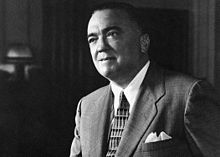
FBI Director J. Edgar Hoover
If, however, you substituted FBI Director J. Edgar Hoover for FBI Director Comey, the significance of the I.C.’s gratuitous inclusion of such an unsubstantiated smear might take on a different coloring. It was, after all, the decision to tack this classified annex onto the Jan. 6 report that gave the mainstream media the hook to disseminate the “golden shower” accusation across the country and around the world.
Rather than minimizing “potential embarrassment to the President-elect,” as Comey demurred, the classified annex was guaranteed to maximize Trump’s embarrassment, which it did.
In other words, just as Comey said he inferred an improper or illegal order when Trump expressed “hope” that Flynn’s legal ordeal might end, Trump might well have deduced that Comey’s elevation of the urination story amounted to coercion or blackmail from the Intelligence Community.
Trump, who surely knows the shadier corners of the construction trade, might have heard something like, “Gee, we’d hate for your wife and children (not to mention the rest of the world) to hear this story about prostitutes peeing on you” – and read the warning as a threat.
FBI Director Hoover was a master of just this sort of warning, conveyed as a sincere concern about some politician’s well-being. Trump, who has emphatically denied the salacious accusation, could well have seen Comey sending him a message from the leaders of the powerful Intelligence Community that they were determined to remove Trump or at least politically cripple him.
Just three days earlier, Senate Minority Leader Chuck Schumer told MSNBC’s Rachel Maddow that Trump was “being really dumb” by taking on the Intelligence Community because “they have six ways from Sunday at getting back at you.”
In the five months since the Jan. 6 briefing, Trump has gotten a taste of how accurate Schumer’s observation was. Making sure that the public got to read the “dirty dossier” – compiled by ex-British spy Christopher Steele and financed by some still unknown Clinton supporter – was clearly one of those six ways.
On top of that, Obama’s intelligence chiefs, including Comey, have testified repeatedly before Congress while they or their allies have leaked derogatory information about Trump to The New York Times, The Washington Post and other mainstream news outlets.
The ‘Soft Coup’
In other words, what we may have witnessed in Comey’s ballyhooed testimony on Thursday was just the latest chapter in a “soft coup” to remove Trump – either through a forced resignation or impeachment. The thinking is that Trump is so incompetent that “wise men” must step in to “correct a mistake” made by the U.S. electorate and made possible by the Constitution’s Electoral College system, which enabled Trump to win the presidency despite losing the popular vote,
But the American people are not supposed to see it that way. After all, the realization that U.S. intelligence chieftains might be conspiring to overturn a constitutional election of a U.S. president could be most upsetting and unsettling, even if one assumes that they are sincerely doing what they think is “best for the country.”
So, this side of the story remains unspoken, a silence made possible by the fact that most of the nation’s top news executives and much of its political elite share the opinion that Trump’s presidency must be ended and a more traditional chief executive installed.
But no one in authority wants to acknowledge that a “soft coup” is in the works because that would make America look like a banana republic to the world. It also could infuriate Trump’s 63 million voters who might take exception to this sort of “deep state” veto of a duly certified election.
So, what that means is that the planned removal of Trump will be a deliberate process cloaked in high-minded legal principles and much talk about the rule of law.
Of course, Trump would not be the only loser in this process. His sinking presidency would drag down many of those around him – and, in the case of Michael Flynn, might well lead to criminal charges.
Indeed, if civil libertarians were not largely committed to the anti-Trump #Resistance, they might pause for a moment and consider the disturbing picture of what was done to retired Lt. Gen. Flynn.
Trapping Flynn
To engineer the ouster of Flynn as Trump’s first National Security Adviser, President Obama’s Justice Department holdovers used the archaic 1799 Logan Act as a predicate to justify an FBI interrogation of Flynn about the details of a phone conversation with Russian Ambassador Sergey Kislyac on Dec. 29, 2016, while Flynn was vacationing in the Dominican Republic.
Since the FBI agents had a transcript of the intercepted phone call and Flynn was working from memory – possibly a bit hazy from a Pina Colada or two – Flynn was an easy mark for a perjury trap. Leaving out some detail, whether intentionally or not, would open him to an obstruction case – and Comey reportedly has indicated that the ongoing criminal investigation of Flynn indeed relates to whether he withheld information from investigators.
Every American who is concerned about the future political use of the U.S. intelligence agencies’ powerful surveillance tools should have shuddered a bit over what was done to Flynn. But many on the Left so desperately want Trump removed from office that they have joined the Russia-gate stampede as the best way to trample Trump.
So, few tears have been shed for Flynn even as he was ambushed based on transcripts of National Security Agency transcripts, a precedent that could be replicated in many other circumstances against American citizens who get on the Intelligence Community’s “six ways from Sunday” black list.
The use of the Logan Act predicate should have set off other alarm bells. The law, which was enacted during the Alien and Sedition Act period, was meant to stop private citizens from trying to conduct U.S. foreign policy on their own, but its constitutionality was always suspect and it has never led to a prosecution, not one in 218 years.
It was also never intended to apply to incoming foreign policy officials of a new presidential administration after the election, when they are understandably beginning to make contacts with foreign officials. So, for then-acting Attorney General Sally Yates to have dusted it off as a predicate for going after Flynn suggests additional entrapment problems.
True, Flynn may have used poor judgment in how he handled a 2015 paid speaking engagement in Moscow, how he reported on his consulting work for a Dutch company owned by a wealthy Turk with high-level political connections, and what he might have said to Kislyak (although we still don’t know the details of that conversation).
Islamic State Warning
But Flynn also had been an Army lieutenant general who led the Defense Intelligence Agency in 2012 when it produced the U.S. government’s most perceptive critique of President Obama’s proxy war in Syria, even predicting the emergence of an “Islamic state,” a judgment that annoyed other intelligence leaders who were participating in the covert war to overthrow the Syrian government.
The DIA report embarrassed the advocates for an escalation of the war in Syria and the ouster of secular President Bashar al-Assad. Journalist Seymour Hersh reported that Flynn’s DIA “had sent a constant stream of classified warnings … about the dire consequences of toppling Assad.” Flynn told Hersh that these reports “got enormous pushback from the Obama administration.”
After being forced out of his DIA job and retiring from the Army in 2014, Flynn went even further in a 2015 interview when he said the intelligence was “very clear” that the Obama administration made a “willful decision” to back these jihadists in league with Middle East allies, a choice that looked particularly stupid when Islamic State militants started beheading American hostages and capturing cities in Iraq, forcing the reintroduction of U.S. military troops.
However, out of a job, Flynn scrambled around for additional income, including signing up with a speakers’ bureau and forming a consulting company, as many other national security veterans have done.
In perhaps Flynn’s most controversial decision, he accepted a speaking fee of about $45,000 to address the tenth anniversary dinner for Russia’s RT network in Moscow, sitting next to President Vladimir Putin for part of the evening. Given the Obama administration’s heightened hostility toward Russia, Flynn’s appearance drew some high-level criticism.
Flynn further antagonized Obama’s team by signing up with the Trump campaign and then joining the “lock her up” chant at the Republican National Convention directed toward Hillary Clinton.
In the wake of Clinton’s shocking defeat and amid the Intelligence Community’s claims about Russian interference in the election, Flynn’s friendly relations with Russian leaders made him an obvious target.
Still, the notion of Obama holdovers taking Flynn out via dubious legal tactics – and their fueling of a McCarthyistic hysteria over Russia – normally might have raised more objections if not for the widespread disdain for Trump, his narcissistic behavior and his offensive policies, such as the “Muslim travel ban.”
However, amid the mainstream media’s increasingly frenzied talk about Trump’s potential impeachment, this other remarkable story – how the U.S. Intelligence Community is moving to reverse the outcome of a presidential election – is getting ignored in plain sight.
Investigative reporter Robert Parry broke many of the Iran-Contra stories for The Associated Press and Newsweek in the 1980s.
Latest Russia-hacking ‘revelation’ only exposes more ‘garbage’ US journalism
RT | June 6, 2017
A report, allegedly based on leaks within the NSA, once again lacks underlying raw intelligence, yet reporters from The Intercept ran with it anyway, Brian Becker from the anti-war ANSWER Coalition told RT.
The US National Security Agency has arrested a former contractor after she allegedly leaked classified defense material.
A Department of Justice statement said Reality Leigh Winner had a complaint filed against her after stealing a document and supplying it to a news outlet.
Some Western media have already linked the arrest to a newly published article by The Intercept about alleged Russian hacking.
The report by The Intercept alleges Russia carried out at least one cyberattack against the US during the 2016 election. Like other so-called intelligence, it does not provide any concrete evidence. Nor does it name the source of the information it based the article on.
RT: “The Intercept” has published a highly classified report by NSA stating that Russian military intelligence executed a cyberattack on at least one US voting software supplier just days before the US presidential election. Do you think the report is credible?
Brian Becker: The article in The Intercept has to be read carefully, and I would say with a giant grain of salt. I actually think it is very shoddy journalism. Why would the NSA or NSA contractors, who have spared no effort to generate an anti-Russia witch hunt over the last year, release this document to The Intercept ? Why not The New York Times, why not The Washington Post, why not CNN? The Intercept is one of the few websites that has some audience in the US that has had critical thinking from Glenn Greenwald and others who have doubted the veracity of the assertions. The report shows that the report from the NSA – again, which was given by someone working with the NSA to The Intercept for some reason – lacks all underlying raw intelligence. So we have again the formulation ‘a high degree of confidence’ and then mixing and matching as if the NSA, which has made this revelation available to The Intercept, found out that Russia was hacking American voting machines on the eve of the election. But again with no connectivity to trying to get Donald Trump elected, and yet that is what the article summarizes in its conclusion. It’s shoddy journalism; I would say it is garbage journalism and it is based on nothing with underlying intelligence. Again, why would the NSA, FBI, and CIA have been waging a war for the past year to convince the American people that Russia is taking over America, why would they release this document to The Intercept ?
There are a number of things that are peculiar here. One of them is the circumstance of the arrest of this contractor so quickly after this item appeared in The Intercept. But on The Intercept article itself, it is a little odd: this is the first article that appears to be pointed toward any kind of compromise of the actual election system, as opposed to releasing information that maybe prejudicial to Hillary Clinton’s campaign that came from the DNC, which has been the allegation thus far. Also it seems odd it would be sent to some place like The Intercept rather than the usual vehicles for leaked information, like The Washington Post or The New York Times. – former US diplomat Jim Jatras
RT: Although it’s supposedly the most detailed US report yet on claimed Russian interference in the election, it doesn’t actually show the raw intelligence. Are we ever going to see the actual hard evidence?
BB: No one actually knows what the Russian intelligence agencies hacked or didn’t hack. We don’t know. We do know that during the past year when this has become the dominant narrative within the mainstream media, the dominant call by the Democratic Party elites, the primary allegation explaining why they lost the election, when we see all of this, and we realize even up to today, even with this article, not one piece of hard evidence backing it up. Wouldn’t there be some hard evidence now, after all of this time showing the raw intelligence underlying the report? For some reason, the NSA wanted to use this liberal website in order to give them a top classified document again without any real facts or evidence contained therein.
Some people are touting this as the first counter-attack from the Trump administration to this tyranny of leaks that has been going on here in Washington. I certainly don’t see it as that. If we look at other leaks, like ones concerning General Flynn, or Comey’s conversations with Trump or the meeting of Trump and Lavrov, again, these went to the prestige media, New York Times and The Washington Post. Nobody has been nailed for any of those leaks. Those are things coming from within the deep state itself. Here is a 25-year old contractor, who doesn’t seem to be the kind of vehicle for this we are talking about, and she gets nailed right from the top on a very questionable report. This just happened today, but it almost seems like a provocation of some sort. – former US diplomat Jim Jatras
RT: Even if the hacking took place, why does the NSA insist the Russian government made the interference? Couldn’t random hackers have done it with “patriotic leanings”?
BB: Because we are in the midst of a witch hunt. After WWII, and after the breakup of the US-British-Soviet military alliance that defeated fascism, the US media and the intelligence agencies, like CIA, like FBI, later now the NSA, joined to generate a witch hunt against anyone associated with the Soviet Union and thus Russia. We see the same thing happening today. There are no facts, there is no evidence, but there is a hysteria being created. The intelligence agencies, which have overthrown other countries’ governments if they win elections that the Americans don’t prefer, who have intervened in other countries’ governments, who have carried out assassination programs now are saying we are the champions and the defenders of American democracy from the great menace to American democracy which is posed by the Kremlin. This is political; it is actually pure politics.
Read more:
DOJ charges govt contractor with leaking top secret material to The Intercept
Who Controls the Information Space and Why
By Jean Perier – New Eastern Outlook – 28.05.2017
Recently behind-the-scenes rules and restrictions being used by Facebook have fallen into the hands of Guardian reporters. According to their report, moderators employed by the tech giant are entitled to decide what exactly the 2 billion users of this social network can or cannot publish on their pages. This report has provoked a massive discussion on the absence of any ethical norms that could prevent the tech giant from exercising censorship, along with disputes about the determination of US intelligence agencies to spy on their citizens in violation of the USA Freedom Act.
The fact that the US created the Internet as a tool of exercising control over information space, as a convenient environment for espionage, collecting dirty facts and spreading lies has been established long ago. For those naive few who refuse to believe the facts, one can only be reminded of the old saying: There’s no such thing as a free lunch. But who owns the allegedly free Internet? Who created it and why?
According to Reuters, last year alone the US National Security Agency (NSA) intercepted 151 million phone calls of American citizens, in spite of the fact that Congress has allegedly limited the ability to exercise surveillance for intelligence agencies by adopting the USA Freedom Act, according to which courts must decide when to allow intelligence agencies to collect information about a person suspected of criminal activity.
However, the all-encompassing control of US intelligence services over the world’s information space has been uncovered by an unending stream of publications in American and foreign media sources, showing that the United States is grossly violating even the most basic human rights, by creating a system of electronic interception and processing of all sorts of data about users on the Internet.
It wouldn’t be an exaggeration to state that every aspect of our day-to-day lives is being controlled: phone conversations, short text messages, everything we write on social media networks or send via email. Thus, the British Guardian confirmed the existing exchange of information about intercepted electronic messages of both US citizens and British citizens established by US intelligence agencies and the British Government Communications Headquarters. Even British courts recognized that such cooperation that existed for at least seven years is unlawful, since they were carried out in violation of international conventions on human rights.
In addition, the Guardian has also revealed that phone tapping that Mi-5 and Mi-6 authorized in order to intercept private consultations between UK citizens and their lawyers in a bid to guarantee the authorities an upper hand during trials, constitutes a violation of both national laws and international norms.
The Intercept has also revealed that the US National Security Agency (NSA) and its British partners from the Government Communications Headquarters stole the encryption keys of the world’s largest SIM card manufacturer – Gemalto, situated in the Netherlands. This allowed intelligence agencies from both nations ever since to tap all sorts of phone conversations and intercept any data sent via a mobile device carrying a SIM card produced by Gemalto.
In late 2014, the Wall Street Journal has also revealed the practices that allowed US intelligence agencies to record information stored on millions of cell phones across the US through the use of special spyware. Additionally, Wikileaks released CIA documents that show this agency is capable of intercepting messages sent via encrypted message apps such as WhatsApp, Telegram and Signal.
It should be noted that US intelligence agencies have been pretty methodical in the collection of information that in one way or another could be used not just against ordinary citizens, but even against leading political figures. When in October 2013 a scandal erupted with the National Security Agency’s wiretapping of German Chancellor Angela Merkel’s phone, it turned out that the NSA had been carrying out such intrusions for more than ten years by that time. Back then, the scandal was downplayed and no actual changes in those malicious practices were pursued.
So how many more revelations about the total control that US intelligence agencies exercise over information space should be published before Washington’s open mockery of human rights and freedom of speech is finally challenged and stopped?
Jean Périer is an independent researcher and analyst and a renowned expert on the Near and Middle East.
New Cracks in Russia-gate ‘Assessment’
By Robert Parry | Consortium News | May 23, 2017
At the center of the Russia-gate scandal is a curious U.S. intelligence “assessment” that was pulled together in less than a month and excluded many of the agencies that would normally weigh in on such an important topic as whether Russia tried to influence the outcome of a U.S. presidential election.
The Jan. 6 report and its allegation that Russia “hacked” Democratic emails and publicized them through WikiLeaks have been treated as gospel by the mainstream U.S. media and many politicians of both parties, but two senior Obama administration intelligence officials have provided new information that raises fresh doubts about the findings.
On Tuesday, former CIA Director John Brennan told the House Intelligence Committee that only four of the 17 U.S. intelligence agencies took part in the assessment, relying on analysts from the Central Intelligence Agency, the National Security Agency and the Federal Bureau of Investigation, under the oversight of the Office of the Director of National Intelligence.
Brennan said the report “followed the general model of how you want to do something like this with some notable exceptions. It only involved the FBI, NSA and CIA as well as the Office of the Director of National Intelligence. It wasn’t a full inter-agency community assessment that was coordinated among the 17 agencies, and for good reason because of the nature and the sensitivity of the information trying, once again, to keep that tightly compartmented.”
But Brennan’s excuse about “tightly compartmented” information was somewhat disingenuous because other intelligence agencies, such as the State Department’s Bureau of Intelligence and Research (INR), could have been consulted in a limited fashion, based on their areas of expertise. For instance, INR could have weighed in on whether Russian President Vladimir Putin would have taken the risk of trying to sabotage Hillary Clinton’s campaign, knowing that – if she won as expected and learned of the operation – she might have sought revenge against him and his country.
The Jan. 6 report argued one side of the case – that Putin had a motive for undermining Clinton because he objected to her work as Secretary of State when she encouraged anti-Putin protests inside Russia – but the report ignored the counter-argument that the usually cautious Putin might well have feared infuriating the incoming U.S. President if the anti-Clinton ploy failed to block her election.
A balanced intelligence assessment would have included not just arguments for believing that the Russians did supply the Democratic emails to WikiLeaks but the reasons to doubt that they did.
Pre-Cooked Intelligence
However, the restricted nature of the Jan. 6 report – limiting it to analysts from CIA, NSA and FBI – blocked the kind of expertise that the State Department, the Defense Department, the Department of Homeland Security and other agencies might have provided. In other words, the Jan. 6 report has the look of pre-cooked intelligence.
That impression was further strengthened by the admission of former Director of National Intelligence James Clapper before a Senate Judiciary subcommittee on May 8 that “the two dozen or so analysts for this task were hand-picked, seasoned experts from each of the contributing agencies.”
Yet, as any intelligence expert will tell you, if you “hand-pick” the analysts, you are really hand-picking the conclusion. For instance, if the analysts were known to be hard-liners on Russia or supporters of Hillary Clinton, they could be expected to deliver the one-sided report that they did.
In the history of U.S. intelligence, we have seen how this approach has worked, such as the determination of the Reagan administration to pin the attempted assassination of Pope John Paul II and other acts of terror on the Soviet Union.
CIA Director William Casey and Deputy Director Robert Gates shepherded the desired findings through the process by putting the assessment under the control of pliable analysts and sidelining those who objected to this politicization of intelligence.
The point of enlisting the broader intelligence community – and incorporating dissents into a final report – is to guard against such “stove-piping” of intelligence that delivers the politically desired result but ultimately distorts reality.
Another painful example of politicized intelligence was President George W. Bush’s 2002 National Intelligence Estimate on Iraq’s WMD that removed INR’s and other dissents from the declassified version that was given to the public.
Lacking Evidence
The Jan. 6 report – technically called an Intelligence Community Assessment (or ICA) – avoided the need to remove any dissents by excluding the intelligence agencies that might have dissented and by hand-picking the analysts who compiled the report.
However, like the declassified version of the Iraq NIE, the Russia-gate ICA lacked any solid evidence to support the conclusions. The ICA basically demanded that the American public “trust us” and got away with that bluff because much of the mainstream U.S. news media wanted to believe anything negative about then-President-elect Trump.
Because of that, the American people were repeatedly – and falsely – informed that the findings about Russian “hacking” reflected the collective judgment of all 17 U.S. intelligence agencies, making anyone who dared question the conclusion seem like a crackpot or a “Russian apologist.”
Yet, based on the testimonies of Clapper and Brennan, we now know that the ICA represented only a hand-picked selection of the intelligence community – four, not 17, agencies.
There were other biases reflected in the ICA, such as a bizarre appendix that excoriated RT, the Russian television network, for supposedly undermining Americans’ confidence in their democratic process.
This seven-page appendix, dating from 2012, accused RT of portraying “the US electoral process as undemocratic” and offered such “proof” as RT’s staging of a debate among third-party presidential candidates who had been excluded from the Republican-Democratic debates between Mitt Romney and Barack Obama.
“RT broadcast, hosted and advertised third-party candidate debates,” the report said, as if allowing political figures in the United States who were not part of the two-party system to express their views, was somehow anti-democratic, when you might think that letting Americans hear alternatives was the essence of democracy.
“The RT hosts asserted that the US two-party system does not represent the views of at least one-third of the population and is a ‘sham,’” the report continued. Yet, polls have shown that large numbers of Americans would prefer more choices than the usual two candidates and, indeed, most Western democracies have multiple parties, So, the implicit RT criticism of the U.S. political process is certainly not out of the ordinary.
The report also took RT to task for covering the Occupy Wall Street movement and for reporting on the environmental dangers from “fracking,” topics cited as further proof that the Russian government was using RT to weaken U.S. public support for Washington’s policies (although, again, these are topics of genuine public interest).
Assessing or Guessing
But at least the appendix offered up some “evidence” – as silly as those examples might have been. The main body of the report amounted to one “assessment” after another with no verifiable evidence included, at least in the unclassified version that the American people were allowed to see.
The report also contained a warning about how unreliable these “assessments” could be: “Judgments are not intended to imply that we have proof that shows something to be a fact. Assessments are based on collected information, which is often incomplete or fragmentary, as well as logic, argumentation, and precedents.”
In other words, “assessing” in intelligence terms often equates with “guessing” – and if the guessers are hand-picked by political appointees – it shouldn’t be surprising that they would come up with an “assessment” that would please their bosses, in this case, President Obama and his appointees at CIA, NSA, FBI and ODNI.
The timing and speed of the Jan. 6 report also drew some attention at Tuesday’s House Intelligence Committee hearing, where Rep. Elise Stefanik, R-New York, noted that President Obama requested the ICA on Dec. 9 and the last entry was dated Dec. 29.
“This report was produced in just 20 days in December,” Stefanik said, adding: “It’s of concern to me that there was a two-month lag” between when Obama’s intelligence agencies first alleged Russian “hacking” of Democratic emails and when Obama ordered the ICA.
Of course, the ICA’s flaws do not mean that Russia is innocent or that WikiLeaks is telling the truth when it asserts that the two batches of Democratic emails – one from the Democratic National Committee and the other from Clinton campaign chairman John Podesta – did not come from the Russians.
But the Jan. 6 report has served as the foundation for a series of investigations that have hobbled the Trump administration and could lead to the negation of a U.S. presidential election via the impeachment or forced resignation of President Trump.
The seriousness of that possibility would seem to demand the most thorough examination and the fullest vetting of the evidence. Even just the appearance that the ICA might be one more case of politicized intelligence would do more to destroy Americans’ faith in their democratic system than anything that Putin might dream up.
Investigative reporter Robert Parry broke many of the Iran-Contra stories for The Associated Press and Newsweek in the 1980s.
US Journalism’s New ‘Golden Age’?
By Robert Parry | Consortium News | May 22, 2017
The mainstream U.S. media is congratulating itself on its courageous defiance of President Trump and its hard-hitting condemnations of Russia, but the press seems to have forgotten that its proper role within the U.S. democratic structure is not to slant stories one way or another but to provide objective information for the American people.
By that standard – of respecting that the people are the nation’s true sovereigns – the mainstream media is failing again. Indeed, the chasm between what America’s elites are thinking these days and what many working-class Americans are feeling is underscored by the high-fiving that’s going on inside the elite mainstream news media, which is celebrating its Trump- and Russia-bashing as the “new golden age of American journalism.”
The New York Times and The Washington Post, in particular, view themselves as embattled victims of a tyrannical abuser. The Times presents itself as the brave guardian of “truth” and the Post added a new slogan: “Democracy dies in darkness.” In doing so, they have moved beyond the normal constraints of professional, objective journalism into political advocacy – and they are deeply proud of themselves.
In a Sunday column entitled “How Trump inspired a golden age,” Washington Post columnist Dana Milbank wrote that Trump “took on the institution of a free press – and it fought back. Trump came to office after intimidating publishers, barring journalists from covering him and threatening to rewrite press laws, and he has sought to discredit the ‘fake news’ media at every chance. Instead, he wound up inspiring a new golden age in American journalism.
“Trump provoked the extraordinary work of reporters on the intelligence, justice and national security beats, who blew wide open the Russia election scandal, the contacts between Russia and top Trump officials, and interference by Trump in the FBI investigation. Last week’s appointment of a special prosecutor – a crucial check on a president who lacks self-restraint – is a direct result of their work.”
Journalism or Hatchet Job?
But has this journalism been professional or has it been a hatchet job? Are we seeing a new “golden age” of journalism or a McCarthyistic lynch mob operating on behalf of elites who disdain the U.S. constitutional process for electing American presidents?
For one thing, you might have thought that professional journalists would have demanded proof about the predicate for this burgeoning “scandal” – whether the Russians really did “hack” into emails of the Democratic National Committee and Hillary Clinton campaign chairman John Podesta and then slip the information to WikiLeaks to influence the outcome of the 2016 election.
You have surely heard and read endlessly that this conclusion about Russia’s skulduggery was the “consensus view of the 17 U.S. intelligence agencies” and thus only some crazy conspiracy theorist would doubt its accuracy even if no specific evidence was evinced to support the accusation.
But that repeated assertion is not true. There was no National Intelligence Estimate (or NIE) that would compile the views of the 17 intelligence agencies. Instead, as President Obama’s Director of National Intelligence James Clapper testified before a Senate Judiciary subcommittee on May 8, the Russia-hacking claim came from a “special intelligence community assessment” (or ICA) produced by selected analysts from the Central Intelligence Agency, National Security Agency and Federal Bureau of Investigation, or as Clapper put it, “a coordinated product from three agencies – CIA, NSA, and the FBI – not all 17 components of the intelligence community.”
Further, as Clapper explained, the “ICA” was something of a rush job beginning on President Obama’s instructions “in early December” and completed by Jan. 6, in other words, a month or less.
Clapper continued: “The two dozen or so analysts for this task were hand-picked, seasoned experts from each of the contributing agencies.” However, as any intelligence expert will tell you, if you “hand-pick” the analysts, you are really hand-picking the conclusion.
You can say the analysts worked independently but their selection, as advocates for one position or another, could itself dictate the outcome. If the analysts were hardliners on Russia or hated Trump, they could be expected to deliver the conclusion that Obama and Clapper wanted, i.e., challenging the legitimacy of Trump’s election and blaming Russia.
The point of having a more substantive NIE is that it taps into a much broader network of U.S. intelligence analysts who have the right to insert dissents to the dominant opinions. So, for instance, when President George W. Bush belatedly ordered an NIE regarding Iraq’s WMD in 2002, some analysts – especially at the State Department – inserted dissents (although they were expunged from the declassified version given to the American people to justify the 2003 invasion of Iraq).
An Embarrassing Product
Obama’s “ICA,” which was released on Jan. 6, was a piece of work that embarrassed many former U.S. intelligence analysts. It was a one-sided argument that lacked any specific evidence to support its findings. Its key point was that Russian President Vladimir Putin had a motive to authorize an information operation to help Hillary Clinton’s rival, Donald Trump, because Putin disdained her work as Secretary of State.
But the Jan. 6 report failed to include the counter-argument to that cui bono assertion, that it would be an extraordinary risk for Putin to release information to hurt Clinton when she was the overwhelming favorite to win the presidency. Given the NSA’s electronic-interception capabilities, Putin would have to assume that any such undertaking would be picked up by U.S. intelligence and that he would likely be facing a vengeful new U.S. president on Jan. 20.
While it’s possible that Putin still took the risk – despite the daunting odds against a Trump victory – a balanced intelligence assessment would have included such contrary arguments. Instead, the report had the look of a prosecutor’s brief albeit without actual evidence pointing to the guilt of the accused.
Further, the report repeatedly used the word “assesses” – rather than “proves” or “establishes” – and the terminology is important because, in intelligence-world-speak, “assesses” often means “guesses.” The report admits as much, saying, “Judgments are not intended to imply that we have proof that shows something to be a fact. Assessments are based on collected information, which is often incomplete or fragmentary, as well as logic, argumentation, and precedents.”
In other words, the predicate for the entire Russia-gate scandal, which may now lead to the impeachment of a U.S. president and thus the negation of the Constitution’s electoral process, is based partly on a lie – i.e., the claim that the assessment comes from all 17 U.S. intelligence agencies – and partly on evidence-free speculation by a group of “hand-picked” analysts, chosen by Obama’s intelligence chiefs.
Yet, the mainstream U.S. news media has neither corrected the false assertion about the 17 intelligence agencies nor demanded that actual evidence be made public to support the key allegation that Russia was the source of the WikiLeaks’s email dumps.
By the way, both Russia and WikiLeaks deny that Russia was the source, although it is certainly possible that the Russian government would lie and that WikiLeaks might not know where the two batches of Democratic emails originated.
A True ‘Golden Age’?
Yet, one might think that the new “golden age of American journalism” would want to establish a firm foundation for its self-admiring reporting on Russia-gate. You might think, too, that these esteemed MSM reporters would show some professional skepticism toward dubious claims being fed to them by the Obama administration’s intelligence appointees.
That is unless, of course, the major U.S. news organizations are not abiding by journalistic principles, but rather see themselves as combatants in the anti-Trump “resistance.” In other words, if they are behaving less as a Fourth Estate and more as a well-dressed mob determined to drag the interloper, Trump, from the White House.
The mainstream U.S. media’s bias against Putin and Russia also oozes from every pore of the Times’ and Post’s reporting from Moscow. For instance, the Times’ article on Putin’s comments about supposed secrets that Trump shared with Russian Foreign Minister Sergey Lavrov at the White House had the headline in the print editions: “Putin Butts In to Claim There Were No Secrets…” The article by Andrew Higgins then describes Putin “asserting himself with his customary disruptive panache” and “seizing on foreign crises to make Russia’s voice heard.”
Clearly, we are all supposed to hate and ridicule Vladimir Putin. He is being demonized as the new “enemy” in much the way that George Orwell foresaw in his dystopian novel, 1984. Yet, what is perhaps most troubling is that the major U.S. news outlets, which played instrumental roles in demonizing leaders of Iraq, Syria and Libya, believe they are engaged in some “golden age” journalism, rather than writing propaganda.
Contempt for Trump
Yes, I realize that many good people want to see Trump removed from office because of his destructive policies and his buffoonish behavior – and many are eager to use the new bête noire, Russia, as the excuse to do it. But that still does not make it right for the U.S. news media to abandon its professional responsibilities in favor of a political agenda.
On a political level, it may not even be a good idea for Democrats and progressives who seem to be following the failed strategy of Hillary Clinton’s campaign in seeking to demonize Trump rather than figuring out how to speak to the white working-class people who voted for him, many out of fear over their economic vulnerability and others out of anger over how Clinton dismissed many of them as “deplorables.”
And, by the way, if anyone thinks that whatever the Russians may have done damaged Clinton’s chances more than her colorful phrase disdaining millions of working-class people who understandably feel left behind by neo-liberal economics, you may want to enroll in a Politics 101 course. The last thing a competent politician does is utter a memorable insult that will rally the opposition.
In conversations that I’ve had recently with Trump voters, they complain that Clinton and the Democrats weren’t even bothering to listen to them or to talk to them. These voters were less enamored of Trump than they were conceded to Trump by the Clinton campaign. These voters also are not impressed by the endless Trump- and Russia-bashing from The New York Times, The Washington Post, CNN and MSNBC, which they see as instruments of the elites.
The political danger for national Democrats and many progressives is that mocking Trump and thus further insulting his supporters only extends the losing Clinton strategy and cements the image of Democrats as know-it-all elitists. Thus, the Democrats risk losing a key segment of the U.S. electorate for a generation.
Not only could that deny the Democrats a congressional majority for the foreseeable future, but it might even get Trump a second term.
Investigative reporter Robert Parry broke many of the Iran-Contra stories for The Associated Press and Newsweek in the 1980s.
The Gaping Holes of Russia-gate
By Ray McGovern and William Binney | Consortium News | May 20, 2017
Official Washington got to relive the excitement of Watergate in a “gotcha” moment after President Trump fired FBI Director James Comey. There were fond recollections of how righteous the major newspapers felt when condemning President Nixon over his “Saturday Night Massacre” firing of special prosecutor Archibald Cox.
But the overriding question from “this Russia thing, with Trump and Russia” — as President Trump calls it — is whether there is any there there. The President labeled it a “made-up story” and, by all appearances from what is known at this time, he is mostly correct.
A few days before Comey’s firing, the FBI Director reportedly had asked for still more resources to hunt the Russian bear for supposedly “interfering” with last year’s election to hurt Hillary Clinton and help Donald Trump. And so the firing allowed the Watergate-recalling news outlets to trot out the old trope that “the cover-up is worse than the crime.”
But can that argument bear close scrutiny, or is it the “phony narrative” that Senate Republican Whip John Cornyn of Texas claims it to be? Cornyn quipped that, if impeding the investigation was Trump’s aim, “This strikes me as a lousy way to do it. All it does is heighten the attention given to the issue.”
Truth is, President Trump had ample reason to be fed up with Comey, in part for his lack of enthusiasm toward investigating actual, provable crimes related to “Russia-gate” — like the flood of sensitive national security leaks, such as the highly sensitive intercepted communications used to precipitate the demise of Trump aide Michael Flynn.
The retired Army lieutenant general was “caught” talking with Russia’s ambassador last December, a normal undertaking for a person designated as the incoming National Security Adviser. But Obama administration holdovers twisted that into a supposed violation of the archaic 1799 Logan Act and then used a transcript of the phone call to trip up Flynn because he didn’t have perfect recollection of the conversation.
So, a trumped-up federal case was used to help get Flynn fired, but an apparent criminal act – the Flynn leak among many other leaks – was apparently ignored. We suspect that one reason for Comey’s disinterest was that he already knows who was responsible.
In contrast to Comey’s see-no-evil reaction to criminal leaking, the FBI Director evinced strong determination to chase after ties between Russia and the Trump campaign until the cows came home. The investigation (already underway for 10 months) had the decided advantage of casting doubt on the legitimacy of Trump’s presidency and putting the kibosh on his plans to forge a more workable relationship with Russia, a win-win for the Establishment, the Military-Industrial Complex, and the FBI/CIA/NSA “Deep State”; a lose-lose for the President – and arguably the American people and the world, both of whom might benefit from fewer big-power tensions and lower spending on an arms race.
An Evidence Shortage
What has been particularly noteworthy about this “scandal” is how much spooky music we’ve heard and how many sinister suspicions have been raised versus actual “evidence” of the core allegations. So far, it has been smoke and mirrors with no chargeable offenses and not a scintilla of convincing proof of Russian “meddling” in the election.
The oft-cited, but evidence-free, CIA/FBI/NSA report of Jan. 6 — crafted by selected senior analysts, according to then-Director of National Intelligence James Clapper — is of a piece with the “high-confidence,” but fraudulent, National Intelligence Estimate 15 years ago about weapons of mass destruction in Iraq.
But what about the “Russian hacking,” the centerpiece of the accusations about Kremlin “interference” to help Trump? Surely, we know that happened. Or do we?
On March 31, 2017, WikiLeaks released original CIA documents — almost completely ignored by the mainstream media — showing that the agency had created a program allowing it to break into computers and servers and make it look like others did it by leaving telltale signs (like Cyrillic markings, for example). The capabilities shown in what WikiLeaks calls the “Vault 7” trove of CIA documents required the creation of hundreds of millions of lines of source code. At $25 per line of code, that amounts to about $2.5 billion for each 100 million code lines. But the Deep State has that kind of money and would probably consider the expenditure a good return on investment for “proving” the Russians hacked into Democratic Party emails.
In other words, it is altogether possible that the hacking attributed to Russia was actually one of several “active measures” undertaken by a cabal consisting of the CIA, FBI, NSA and Clapper — the same agencies responsible for the lame, evidence-free report of Jan. 6.
Comey displayed considerable discomfort on March 20, explaining to the House Intelligence Committee why the FBI did not insist on getting physical access to the Democratic National Committee’s computers in order to do its own proper forensics, but chose to rely on the examination done by the DNC’s private contractor, Crowdstrike. The firm itself has conflicts of interests in its links to the pro-NATO and anti-Russia think tank, the Atlantic Council, through Dmitri Alperovitch, who is an Atlantic Council senior fellow and the co-founder of Crowdstrike.
Given the stakes involved in the Russia-gate investigation – now including a possible impeachment battle over removing the President of the United States – wouldn’t it seem logical for the FBI to insist on its own forensics for this fundamental predicate of the case? Or could Comey’s hesitancy to demand access to the DNC’s computers be explained by a fear that FBI technicians not fully briefed on CIA/NSA/FBI Deep State programs might uncover a lot more than he wanted?
President Trump has entered into a high-stakes gamble in confronting the Deep State and its media allies over the accusations of his colluding with Russia. Senate Minority Leader Charles Schumer, a New York Democrat, publicly warned him of the risk earlier this year. “You take on the intelligence community, they have six ways from Sunday at getting back at you,” Schumer told MSNBC’s Rachel Maddow on Jan. 3.
If Mr. Trump continues to “take on” the Deep State, he will be fighting uphill, whether he’s in the right or not. It is far from certain he will prevail.
Ray McGovern (rrmcgovern@gmail.com) was a CIA analyst for 27 years; he briefed the president’s daily brief one-on-one to President Reagan’s most senior national security officials from 1981-85. William Binney (williambinney0802@comcast.net) worked for NSA for 36 years, retiring in 2001 as the technical director of world military and geopolitical analysis and reporting; he created many of the collection systems still used by NSA.
Big Brother Is Still Watching You: Don’t Fall for the NSA’s Latest Ploy
By John W. Whitehead | The Rutherford Institute | May 1, 2017
“You had to live—did live, from habit that became instinct—in the assumption that every sound you made was overheard, and, except in darkness, every movement scrutinized.”—George Orwell, 1984
Supposedly the National Security Administration is going to stop collecting certain internet communications that merely mention a foreign intelligence target.
Privacy advocates are hailing it as a major victory for Americans whose communications have been caught in the NSA’s dragnet.
If this is a victory, it’s a hollow victory.
Here’s why.
Since its creation in 1952, when President Harry S. Truman issued a secret executive order establishing the NSA as the hub of the government’s foreign intelligence activities, the agency has been covertly spying on Americans, listening in on their phone calls, reading their mail, and monitoring their communications.
For instance, under Project SHAMROCK, the NSA spied on telegrams to and from the U.S., as well as the correspondence of American citizens. Moreover, as the Saturday Evening Post reports, “Under Project MINARET, the NSA monitored the communications of civil rights leaders and opponents of the Vietnam War, including targets such as Martin Luther King, Jr., Mohammed Ali, Jane Fonda, and two active U.S. Senators. The NSA had launched this program in 1967 to monitor suspected terrorists and drug traffickers, but successive presidents used it to track all manner of political dissidents.”
Not even the passage of the Foreign Intelligence Surveillance Act and the creation of the FISA Court, which was supposed to oversee and correct how intelligence information is collected and collated, managed to curtail the NSA’s illegal activities.
In the wake of the 9/11 attacks, George W. Bush secretly authorized the NSA to conduct warrantless surveillance on Americans’ phone calls and emails.
Nothing changed under Barack Obama. In fact, the violations worsened, with the NSA authorized to secretly collect internet and telephone data on millions of Americans, as well as on foreign governments.
It was only after whistleblower Edward Snowden’s revelations in 2013 that the American people fully understood the extent to which they had been betrayed once again.
What this brief history makes clear is that the NSA cannot be reformed.
This is an agency whose very existence—unaccountable and lacking any degree of transparency—flies in the face of the Constitution.
Despite the fact that its data snooping has been shown to be ineffective at detecting, let alone stopping, any actual terror attacks, the NSA has continued to operate largely in secret, carrying out warrantless mass surveillance on hundreds of millions of Americans’ phone calls, emails, text messages and the like, beyond the scrutiny of most of Congress and the taxpayers who are forced to fund its multi-billion dollar secret black ops budget.
As long as the government is allowed to make a mockery of the law—be it the Constitution, the FISA law, or any other law intended to limit its reach and curtail its activities—and is permitted to operate behind closed doors, relaying on secret courts, secret budgets and secret interpretations of the laws of the land, there will be no reform.
Presidents, politicians, and court rulings have come and gone over the course of the NSA’s 60-year history, but none of them have done much to put an end to the NSA’s “technotyranny.”
The beast has outgrown its chains. It will not be restrained.
Moreover, even if the NSA could be reformed, the problem of government surveillance goes far beyond the criminal activities of this one agency.
In fact, long before the NSA became the agency we loved to hate, the Justice Department, the FBI, and the Drug Enforcement Administration were carrying out their own secret mass surveillance on an unsuspecting populace. Just about every branch of the government—from the Postal Service to the Treasury Department and every agency in between—now has its own surveillance sector, authorized to spy on the American people.
Then there are the fusion and counterterrorism centers that gather all of the data from the smaller government spies—the police, public health officials, transportation, etc.—and make it accessible for all those in power. And of course that doesn’t even begin to touch on the complicity of the corporate sector, which buys and sells us from cradle to grave, until we have no more data left to mine.
Consider that on any given day, the average American going about his daily business will be monitored, surveilled, spied on and tracked in more than 20 different ways, by both government and corporate eyes and ears. A byproduct of this new age in which we live, whether you’re walking through a store, driving your car, checking email, or talking to friends and family on the phone, you can be sure that some government agency, whether the NSA or some other entity, is listening in and tracking your behavior.
Corporate trackers monitor your purchases, web browsing, Facebook posts and other activities taking place in the cyber sphere. For example, every time you use a loyalty card at the grocery store or elsewhere, your purchases are being monitored, mined for data, and sold to the highest bidder. Every time you use your credit or debit card, or your digital “wallet,” your transactions are being tracked. Uber’s ride service app knows where you are even when you are not actively using the service. Even store mannequins are being used to monitor and identify shoppers with facial recognition software.
Major cities are being transformed into “Smart Cities” filled with sensors in everything from pavement to lamp posts, and all of that data is being linked together to monitor the day-to-day lives of everyone in them. In some cities, even the sewage is being monitored and could potentially be used to find out what drugs a household may have used.
All of your medical data in the near future will be constantly monitored, and while the data is supposed to only be shared with your doctor, in practice it will be accessible by any number of government and private actors. Microchips in “smart pills” can communicate with tablet devices to ensure the elderly take their medications already exist. And a transponder injected into the skin that contains a person’s entire medical history has been approved by the FDA. Wearable health-monitoring devices likewise can be used to monitor you, and the information collected can be used in a court of law. Smart toothbrushes can monitor your brushing habits and communicate them to your dentist, or anyone else. Smart alarm clocks can monitor your sleep habits.
Like all other devices relying on the Internet of Things (IoT) to communicate, these can be hacked into by government and private corporations.
The “internet of things” refers to the growing number of “smart” appliances and electronic devices now connected to the internet and capable of interacting with each other and being controlled remotely. These range from thermostats and coffee makers to cars and TVs.
Of course, there’s a price to pay for such easy control and access. That price amounts to relinquishing ultimate control of and access to your home to the government and its corporate partners. For example, while Samsung’s Smart TVs are capable of “listening” to what you say, thereby allow users to control the TV using voice commands, it also records everything you say and relays it to a third party. Same goes for Amazon’s Echo.
“Smart houses” filled with IoT-capable devices are just starting to come into play, but by 2020 Samsung pledges that all of its devices, including its household appliances, will be IoT capable. Such products include ovens, microwaves, vacuums (including robot vacuums), refrigerators, dishwashers, washing machines, and dryers, as well as smart hubs which coordinate everything. Coffee makers and toasters are also being made IoT compatible.
Smart TVs seemingly out of Orwell’s 1984 will also collect data and spy on you. Modern gaming consoles likewise have internet connections, and those with cameras can be used to spy like any smartphone or computer. Smart power outlets can turn your lights on and off remotely, and smart thermostats work similarly.
All of them monitor when you’re at home or not, as can smart home security systems. Wi-Fi routers can even monitor the inside of your home and distinguish between different individuals in the house, while reading their lips to “hear” what they say. Other forms of home monitoring systems for the elderly can be hacked and used by anyone.
Already the web-enabled “Hello Barbie” doll has been the center of a hacking controversy, in which security experts disclosed a number of significant security flaws with the toy. Other smart objects include smart golf clubs, which monitor the speed, acceleration, and swing plane of your golf swing, smart shoes which track your location and can guide you on where to go. Tostitos has even unveiled a promotional smart bag of chips which can tell you if you’ve been drinking too much.
That doesn’t even begin to touch on all of the government’s many methods of spying on its citizens. For instance, police have been using Stingray devices mounted on their cruisers to intercept cell phone calls and text messages without court-issued search warrants.
Doppler radar devices, which can detect human breathing and movement within in a home, are already being employed by the police to peer inside a suspect’s home.
License plate readers, yet another law enforcement spying device made possible through funding by the Department of Homeland Security, can record up to 1800 license plates per minute. These surveillance devices can also photograph those inside a moving car. Recent reports indicate that the DEA has been using license plate readers in conjunction with facial recognition software to build a “vehicle surveillance database” of the nation’s cars, drivers and passengers.
Sidewalk and “public space” cameras, sold to gullible communities as a sure-fire means of fighting crime, is yet another DHS program that is blanketing small and large towns alike with government-funded and monitored surveillance cameras. It’s all part of a public-private partnership that gives government officials access to all manner of surveillance cameras, on sidewalks, on buildings, on buses, even those installed on private property.
Couple these surveillance cameras with facial recognition and behavior-sensing technology and you have the makings of “pre-crime” cameras, which scan your mannerisms, compare you to pre-set parameters for “normal” behavior, and alert the police if you trigger any computerized alarms as being “suspicious.”
Capitalizing on a series of notorious abductions of college-aged students, several states are pushing to expand their biometric and DNA databases by requiring that anyone accused of a misdemeanor have their DNA collected and catalogued. Technology is already available that allows the government to collect biometrics such as fingerprints from a distance, without a person’s cooperation or knowledge. One system can actually scan and identify a fingerprint from nearly 20 feet away.
Radar guns have long been the speed cop’s best friend, allowing him to hide out by the side of the road, identify speeding cars, and then radio ahead to a police car, which does the dirty work of pulling the driver over and issuing a ticket. Now, developers are hard at work on a radar gun that can actually show if you or someone in your car is texting. No word yet on whether the technology will also be able to detect the contents of that text message.
It’s a sure bet that anything the government welcomes (and funds) too enthusiastically is bound to be a Trojan horse full of nasty surprises. Case in point: police body cameras. Hailed as the easy fix solution to police abuses, these body cameras—made possible by funding from the Department of Justice—are turning police officers into roving surveillance cameras. Of course, if you try to request access to that footage, you’ll find yourself being led a merry and costly chase through miles of red tape, bureaucratic footmen and unhelpful courts.
And the FBI can remotely activate the microphone on your cellphone and record your conversations. The FBI can also do the same thing to laptop computers without the owner knowing any better.
Government surveillance of social media such as Twitter and Facebook is also on the rise. Americans have become so accustomed to the government overstepping its limits that most don’t even seem all that bothered anymore about the fact that the government is spying on our emails and listening in on our phone calls.
Drones, which are taking to the skies en masse, will be the converging point for all of the weapons and technology already available to law enforcement agencies. This means drones that can listen in on your phone calls, see through the walls of your home, scan your biometrics, photograph you and track your movements, and even corral you with sophisticated weaponry.
It’s a given that the government’s tactics are always more advanced than we know, so there’s no knowing what new technologies are already being deployed against us without our knowledge. Certainly, by the time we learn about a particular method of surveillance or new technological gadget, it’s a sure bet that the government has been using it covertly for years already.
If you haven’t figured it out yet, we’ve all become suspects, a.k.a. potential criminals.
As I make clear in my book, Battlefield America: The War on the American People, we now find ourselves in the unenviable position of being monitored, managed and controlled by our technology, which answers not to us but to our government and corporate rulers.
This is the creepy, calculating yet diabolical genius of the American police state: the very technology we hailed as revolutionary and liberating has become our prison, jailer, and probation officer.
So don’t get too excited about the NSA’s latest concession.
It won’t stop Big Brother from watching you.
Shambolic Doings in Washington
Will we survive the next 90 days?

By Philip Giraldi • Unz Review • April 25, 2017
There remains one good thing to say about Donald Trump: he is not Hillary. The boneheaded cruise missile attack in Syria would have occurred even earlier under President Rodham Clinton and there would undoubtedly be no-fly and safe zones already in place. Oh, and Ukraine and Georgia would be negotiating their entries into NATO to make sure that old Vlad Putin would be put on notice and understand that the days of namby-pamby jaw-jaw-jaw that characterized the Obama Administration are now ancient history.
Apart from that, I can only observe dumbstruck how yet again a candidate promising peace and dialogue could be flipped so quickly. Or maybe he never believed in anything he said, which is perhaps more to the point. Be that as it may, we now, after only ninety days in office, have a neo-neocon foreign policy and the folks clustered around their water coolers in the Washington think tanks are again smiling. And as the ruinous Syrian civil war continues thanks to American intervention, there are probably plenty of high fives within Israel’s Benjamin Netanyahu government. Bibi again rules the roost.
The Israelis are no doubt particularly delighted to hear Donald Trump’s latest factually exempt voyage into the outer reaches of the galaxy regarding Iran. Or perhaps The Donald is only having continuing digestive problems dealing with “most beautiful piece of chocolate cake that you’ve ever seen” when dining with mortified Chinese leader Xi Jinping while simultaneously launching cruise missiles intended to send a message to Beijing’s ally Russia. It is inevitably Iran’s turn for vilification, so Trump, while conceding that the Iranians have been compliant with the nuclear weapons agreement they signed, also felt compelled to add that they continue to be a threat and have not entered into the “spirit” of the pact. Apparently the spirit codicil was somehow left out of the final draft, an interpretation that will no doubt surprise the other signatories consisting of Russia, China and the European Union.
To make its point that Tehran is somehow a cheater, the White House has ordered a 90 day review of Iran policy which will empower hardliners in that country in upcoming elections as well as nut cases like Senators John McCain and Lindsey Graham on this side of the Atlantic. Iranian opposition groups like the terrorist Mujaheddin e Khalq (MEK) are already rising to the challenge by floating phony intelligence while Graham is currently advocating a preemptive attack on North Korea, conceding that it would be catastrophic for every country in the region while noting smugly that the carnage and destruction would not reach the United States. Too bad that Pyongyang’s fury cannot be directed straight to Graham’s house in South Carolina.
Graham is reportedly a good dancer and multitasker who can pivot back to Iran effortlessly as soon as Pyongyang is reduced to rubble, so those who want to deal with Iran sooner rather than later should not despair. As things continue to go south nearly everywhere, tension in the Middle East will no doubt lead to a rapidly deteriorating situation in the Persian Gulf that will require yet another ham-handed show of strength by the United States of Amnesia. There will be a war against Iran.
There have been a couple of other interesting stories circulating recently, all demonstrating that when Benjamin Franklin observed that we Americans had created a republic, “if we can keep it,” he was being particularly prescient. Robert Parry has observed that all the fuss about Russiagate is misleading as the only country that interferes with the political process in the U.S. persistently and successfully while also doing terrible damage to our national security is Israel. He wonders when we will have Congress convening investigative commissions to look into Israel-gate but then answers his own question by observing that it will never happen given who controls what in the United States. “No one dares suggest a probe of Israel-gate,” he concludes, but it is interesting and also encouraging to note that some Americans are actually starting to figure things out.
One of the curious things relating to the Russiagate scandal is the issue of who in the U.S. intelligence community leaked highly classified information to the media, a question which somehow seems to have disappeared from whatever final reckoning might be forthcoming. The issue is particularly relevant at the moment because there are reports that the Justice Department is pulling together a case against WikiLeaks founder Julian Assange as part of a possible attempt to remove him forcibly from his refuge in Britain and try him for constituting what CIA Director Mike Pompeo describes as a “hostile intelligence service helped by Russia.” It all suggests that low hanging fruit is fair game while some “official” leakers at high levels are somehow being protected.
To cite another example of Justice Department hypocrisy, three current and four former U.S. officials leaked to Reuters last week’s story about a Russian think tank having created a plan to subvert the U.S. election. If that is so, their identities might be discernible or surmised. Why aren’t they in jail? Or is it that many in government now believe that Russia is fair game and are prepared to look the other way?
It is significant that the recent House Intelligence Committee hearing on Russiagate, featuring FBI Director James Comey and NSA Director Mike Rogers, provided very little new information even as it confirmed troubling revelations that had already surfaced regarding the corruption of the nation’s security services. Given that former Central Intelligence Agency (CIA) head John Brennan and former Director of National Intelligence (DNI) chief James Clapper have been most frequently cited as the Obama administration’s possible bag men in arranging for the generation, collection, dissemination, and leaking of information disparaging to Trump, why weren’t they also being questioned?
The latest focus on Brennan, an Obama/Clinton loyalist who might safely be regarded as the most likely candidate seeking to discredit Team Trump and reap the benefits from Hillary, explores some suspicions about what actually took place last year and how it might have been arranged. The story broke in The Guardian on April 13th, headlined “British spies were first to spot Trump team’s links with Russia.” The article rehashes much old information, but, relying on a “source close to UK intelligence,” it describes how Britain’s NSA equivalent GCHQ obtained information late in 2015 relating to suspect “interactions” between Trump associates and the Russian intelligence. GCHQ reportedly routinely passed the information on to its U.S. liaison counterparts, and continued to do so over the next six months. The information was supplemented by similar reporting from a number of European intelligence services as well as the remaining “Five Eyes”: Canada, Australia and New Zealand.
According to the Guardian source and reporters, who are clearly hostile to Trump, the collection was not directed or targeted but was rather part of random interception of Russian communications. This may or may not be true but it serves as a useful cover story if someone was up to something naughty. And it also makes one wonder about the highly incriminating British intelligence sourced “dossier” on Trump and his associates, which The Guardian strangely does not mention, that appeared in January. Another apparent Guardian source called GCHQ the “principal whistleblower” in sharing the information that led to the opening of an FBI investigation in July 2016, a suggestion that the British role was not exactly passive.
The article goes on to describe how John Brennan, then CIA Chief, was personally the recipient of the material passed hand-to-hand at “director level” because of its sensitivity. So the Guardian article is essentially saying that the information was both routine and extremely sensitive, which would seem to be contradictory. Brennan was reportedly then the driving force behind launching a “major inter-agency investigation” and he briefed selected members of Congress regarding what he had obtained. Shortly thereafter leaks began appearing in the British press followed subsequently by revelations in the media in the U.S.
An October request to the Foreign Intelligence Surveillance Act (FISA) court reportedly was initiated after particularly damaging information was received from Estonia concerning Trump associate Carter Page and also regarding allegations that a Russian bank was funneling money into the Trump campaign. This led to an investigation of Page and the tapping into servers in Trump Tower, where the presidential campaign offices were located. Estonia, it should be noted, was particularly concerned about Trump comments on de-emphasizing NATO and strongly supported a Hillary victory so it is fair to speculate that the intelligence provided might have been cherry picked to make a particular case, but The Guardian fails to make that obvious point.
It is interesting to note how for the first time, in this media account, Brennan surfaces as the central player in the investigation of Team Trump. And it is perhaps not out of line to suggest that the European reporting of information on Trump associates was not exactly due to random collection of information, as The Guardian seeks to demonstrate. It could just as easily have been arranged at the “director level” by Brennan and his counterparts to disrupt the Trump campaign and enhance the electability of Hillary Clinton, which would have directly benefited Brennan and his inner circle as well as the Europeans, all of whom feared a Trump victory. Intelligence can be skewed, “fixed around a policy” or even fabricated and can say whatever one wants it to say so it is fair to suggest that the role of a politically committed John Brennan remains to be explored much more fully.
It is now being reported that Brennan will be summoned to give testimony at a closed House Intelligence Committee meeting on May 2nd. Hopefully his comments will be somehow leaked to the media plus those of James Clapper, who is also scheduled to appear. Nevertheless, one imagines that, as was the case in Comey’s first appearance, both former officials will spend most of their time refusing to confirm or deny anything.
The active participation of Brennan in the background to the 2016 electoral campaign is unprecedented and it is also suggestive of what America’s national security agencies have become, basically creatures of the White House. It is hard to escape the conclusion that Benjamin Franklin would undoubtedly deplore the fact that we have failed to keep the republic that the Founding Fathers bequeathed to us. That would be bad enough, but we are slipping into a pattern of foreign wars based on tissues of lies and deceptions by the very people who are in place to protect us, quite possibly exemplified by unscrupulous and ambitious ladder climbers like John Brennan, who was also the architect of Obama’s assassination policy. If we go to war because of suspected lack of “spirit” in our adversaries or merely because someone in the White House had a piece of chocolate cake and wanted something to talk about over his cup of espresso then we are doomed as a nation.
Featured Video

Trita Parsi: Israel Set a Trap for Total War in the Region
or go to
Aletho News Archives – Video-Images
From the Archive
Zionism’s Violent Legacy
By Donald Neff | Washington Report On Middle East Affairs | January 1996
On January 4, 1948, Jewish terrorists drove a truck loaded with explosives into the center of the all Arab city of Jaffa and detonated it, killing 26 and wounding around 100 Palestinian men, women and children.[1] The attack was the work of the Irgun Zvai Leumi – the “National Military Organization,” also known by the Hebrew letters Etzel – the largest Jewish terrorist group in Palestine. The Irgun was headed by Revisionist Zionist Menachem Begin and had been killing and maiming Arabs, Britons and even Jews for the previous ten years in its efforts to establish a Jewish state.
This terror campaign meant that at the core of Revisionist Zionism there existed a philosophical embrace of violence. … continue
Blog Roll
 Aletho News
- Trita Parsi: Israel Set a Trap for Total War in the Region
- Trump’s Iran war is on an Israeli leash
- Saudi oil boss issues global supply warning
- Riyadh Says Its Oil System Is Intact. The Numbers Say Otherwise.
- Trump and Netanyahu Want to “Finish the Job” on Iran
- US ‘one-sided dictation’ not Iran’s beliefs makes rational talks impossible: Baghaei
- Iran’s Next Strike May Not Explode. It Could Shut You Down /Col Doug Macgregor
- Iran: US political targets legitimate if assassinations return
- Iraq shuts key border crossing with Iran under US pressure: Report
- Undersea Internet cables could be targeted in retaliation for attacks on Iran: IRGC deputy chief
- If Americans Knew
- The Israel Lobby’s Changing Fortunes
- AIPAC has become such a political liability that it’s shifting to a more “nimble” approach to buying politicians
- At least 160 Israeli settler attacks in 2 weeks
- Will Gaza’s Ancient Christian Community Disappear Forever?
- Israel’s vision of regional security rests on keeping Arab states weak
- Heidi Levine recounts how Palestinian youths helped save her in settler attack
- DAILY UPDATE: Latest essential news on Palestine, Israel, & region
- Trump’s Intensifying Sabotage of the ICC, for Israel’s Sake
- Israeli military detain US and UK volunteers in West Bank including Democratic NY politician Brad Lander
- Americans at National Conservatism Conference held in Israel this year criticize Israel
- No Tricks Zone
- E-Cars Reduce CO2 Emissions By Only 41% Compared To Internal Combustion Engine Vehicles
- Predictions Made By Renowned Climate Professor Over Past Decades Have Been Proven To Be Poor
- New Study Suggests Large Regions Of The Pacific Ocean Have Been Cooling For The Last 80 Years
- Germany’s Green Energy Debacle: High Energy Costs Force Kahla Porzellan to Close After 182 Years!
- New Study: 50 Years Of The Most Aggressive ‘Net Zero’ Policies Can Only Affect The Global Climate By 0.03°C
- US September “Heat” Was No Record…Many Records Set Decades Ago
- Latest European Green Energy Debacle; Portugal’s Largest Flagship Solar Park Insolvent!
- Green Energy Debacle: German Expert Professor Fritz Vahrenholt Warns Of Severe Economic And Social Consequences
- Two More Paleo Reconstructions Affirm Meters-Higher Sea Levels Across Ireland, Brazil 7000-6000 Years Ago
- New Study: Earth And Venus Surface Warmth Largely Explained By Convection And Lapse Rate, Not CO2 Or Radiation

