Attorney-client privilege denied to us, used by Feds to keep the law secret
PrivacySOS | May 9, 2016
How do you spell chutzpah? I submit an alternate spelling: O-B-A-M-A D-O-J.
How the Obama administration interprets the phrase “government transparency,” in three acts.
Act One: Secret Law
The Obama administration is trying to keep secret a 2003 Office of Legal Counsel memo outlining how federal intelligence agencies interpret “commercial services agreements” between telecoms and their customers. The memo, which the ACLU seeks in a FOIA lawsuit, likely outlines the government’s legal position on how intelligence agencies can access information held by telecommunications companies. Senator Ron Wyden, who from his position on the Senate Intelligence Committee has routinely warned Americans of unconstitutional intelligence activities, has said the government’s “opinion is inconsistent with the public’s understanding of the law, and should be withdrawn.”
Wyden has also publicly stated that the DOJ misled a federal court during its legal fight to keep the memo secret. In a March 2016 letter, Wyden wrote that a DOJ memorandum of law filed in the case contains a “key assertion” that is false. “This assertion appears to be central to the DOJ’s legal arguments,” Wyden wrote.
Now the DOJ has fired back at Wyden, asserting in a brief in the ACLU lawsuit that the Senator’s claims about this “key assertion” were “wholly erroneous” and “based on a fundamental misunderstanding of the law.” The Justice Department claims the administration can keep the legal memo secret because it is not “working law,” but rather confidential legal advice. According to the DOJ, even though an agency may rely on an Office of Legal Counsel memo “by acting in a manner that is consistent with the advice,” the memo doesn’t necessarily “establish agency policy,” meaning it’s not “working law”—which is subject to public disclosure—but instead confidential legal advice.
(As Wyden noted, the DOJ “isn’t denying that this opinion is inconsistent with the public’s understanding of the law”; instead, it’s arguing that the legal memo at issue doesn’t constitute law.)
To repeat: The government is arguing that even if agencies “rely” on an OLC memo and act “in a manner consistent” with its advice, it isn’t law. Instead, it’s private legal advice, which just so happens to be something the government can keep secret from the public.
Act Two: Limitless Surveillance
In April 2016, the Office of the Director of National Intelligence (ODNI) released parts of a November 2015 Foreign Intelligence Surveillance Court (FISC) opinion about how the FBI, NSA, and CIA use information collected pursuant to Section 702 of the FISA Amendments Act. (The FISA Amendments Act, signed into law in 2008, put congress’ stamp of approval on the Bush administration’s warrantless wiretapping program.) Section 702 of that statute allows the intelligence agencies to warrantlessly wiretap Americans’ international communications, as long as Americans or people within the United States are not “targeted.” Part of that statute requires that the Attorney General and ODNI prepare annual reports, called “certifications,” to be reviewed by FISC judges. These certifications include information about how, why, and under what circumstances intelligence agencies “minimize” information about non-targets or US persons caught up in its dragnets.
The recently released November 2015 FISC opinion describes some of these minimization procedures in detail. Among them are procedures related to the capture, dissemination, and use of attorney-client privileged communications. The opinion reveals that the FBI can disseminate attorney-client privileged communications as long as the FBI’s lawyers approve it. The rules require the FBI to “advise recipients that the dissemination contains information subject to attorney-client privilege, that the information is being disseminated ‘solely for intelligence or lead purposes,’ and that it may not be further disseminated or used in any trial, hearing, or other proceeding without the approval of the AG or the Assistant AG for National Security.”
In other words: The US government allows itself to warrantlessly wiretap our international communications and even use our attorney-client privileged communications for intelligence purposes, as long as it doesn’t disclose to criminal defendants or courts that it has done so.
Act Three: Upside Down World
The US government refuses to disclose a legal memo that likely describes how intelligence agencies spy on our communications, claiming that the memo isn’t “working law” but instead constitutes “private” legal advice. Secret law is thereby justified by attorney-client privilege. In this case, the attorney and the client are one in the same: the executive branch.
At the same time, the government gives itself the power to warrantlessly wiretap, retain, disseminate, and use for intelligence purposes our attorney-client privileged communications—so long as the fact of agencies doing so never becomes public. Surveillance of attorney-client privileged communications is justified, as long as it remains secret.
Secret law, secret surveillance. Attorney-client privilege for government lawyers advising government agencies about government policy. No attorney-client privilege for ordinary people, who will likely never learn that the FBI or NSA has warrantlessly obtained their confidential communications.
Only in an upside down world could this administration choose this path, having called itself the “most transparent administration” in history.
Syria, ISIS, and the US-UK Propaganda War
By Eric Draitser | New Eastern Outlook | May 6, 2016
With the war in Syria raging in its fifth year, and the Islamic State wreaking havoc throughout the Middle East and North Africa, it’s clear that the entire region has been made into one large theater of conflict. But the battlefield must not be understood solely as a physical place located on a map; it is equally a social and cultural space where the forces of the US-UK-NATO Empire employ a variety of tactics to influence the course of events and create an outcome amenable to their agenda. And none to greater effect than propaganda.
Indeed, if the ongoing war in Syria, and the conflicts of the post-Arab Spring period generally, have taught us anything, it is the power of propaganda and public relations to shape narratives which in turn impact political events. Given the awesome power of information in the postmodern political landscape, it should come as no surprise that both the US and UK have become world leaders in government-sponsored propaganda masquerading as legitimate, grassroots political and social expression.
London, Washington, and the Power of Manipulation
The Guardian recently revealed how the UK Government’s Research, Information, and Communications Unit (RICU) is involved in surveillance, information dissemination, and promotion of individuals and groups as part of what it describes as an attempt at “attitudinal and behavioral change” among its Muslim youth population. This sort of counter-messaging is nothing new, and has been much discussed for years. However, the Guardian piece actually exposed the much deeper connections between RICU and various grassroots organizations, online campaigns, and social media penetration.
The article outlined the relationship between the UK Government’s RICU and a London-based communications company called Breakthrough Media Network which “has produced dozens of websites, leaflets, videos, films, Facebook pages, Twitter feeds and online radio content, with titles such as The Truth about Isis and Help for Syria.” Considering the nature of social media, and the manner in which information (or disinformation) is spread online, it should come as no surprise that a number of the viral videos, popular twitter feeds, and other materials that seemingly align with the anti-Assad line of London and Washington are, in fact, the direct products of a government-sponsored propaganda campaign.
In fact, as the authors of the story noted:
One Ricu initiative, which advertises itself as a campaign providing advice on how to raise funds for Syrian refugees, has had face-to-face conversations with thousands of students at university freshers’ fairs without any students realising they were engaging with a government programme. That campaign, called Help for Syria, has distributed leaflets to 760,000 homes without the recipients realising they were government communications.
It’s not hard to see what the British Government is trying to do with such efforts; they are an attempt to control the messaging of the war on Syria, and to redirect grassroots anti-war activism to channels deemed acceptable to the political establishment. Imagine for a moment the impact on an 18-year-old college freshman just stepping into the political arena, and immediately encountering seasoned veteran activists who influence his/her thinking on the nature of the war, who the good guys and bad guys are, and what should be done. Now multiply that by thousands and thousands of students. The impact of such efforts is profound.
But it is much more than simply interactions with prospective activists and the creation of propaganda materials; it is also about surveillance and social media penetration. According to the article, “One of Ricu’s primary tasks is to monitor online conversations among what it describes as vulnerable communities. After products are released, Ricu staff monitor ‘key forums’ for online conversations to ‘track shifting narratives,’ one of the documents [obtained by The Guardian ] shows.” It is clear that such efforts are really about online penetration, especially via social media.
By monitoring and manipulating in this way, the British Government is able to influence, in a precise and highly targeted way, the narrative about the war on Syria, ISIS, and a host of issues relevant to both its domestic politics and the geopolitical and strategic interests of the British state. Herein lies the nexus between surveillance, propaganda, and politics.
But of course the UK is not alone in this effort, as the US has a similar program with its Center for Strategic Counterterrorism Communications (CSCC) which describes its mission as being:
…[to] coordinate, orient, and inform government-wide foreign communications activities targeted against terrorism and violent extremism… CSCC is comprised of three interactive components. The integrated analysis component leverages the Intelligence Community and other substantive experts to ensure CSCC communicators benefit from the best information and analysis available. The plans and operations component draws on this input to devise effective ways to counter the terrorist narrative. The Digital Outreach Team actively and openly engages in Arabic, Urdu, Punjabi, and Somali.
Notice that the CSCC is, in effect, an intelligence hub acting to coordinate propaganda for CIA, DIA, DHS, and NSA, among others. This mission, of course, is shrouded in terminology like “integrated analysis” and “plans and operations” – terms used to designate the various components of the overall CSCC mission. Like RICU, the CSCC is focused on shaping narratives online under the pretext of counter-radicalization.
It should be noted too that CSCC becomes a propaganda clearinghouse of sorts not just for the US Government, but also for its key foreign allies (think Israel, Saudi Arabia, Britain), as well as perhaps favored NGOs like Human Rights Watch, Amnesty International, or Doctors Without Borders (MSF). As the New York Times noted:
[The CSCC will] harness all the existing attempts at countermessaging by much larger federal departments, including the Pentagon, Homeland Security and intelligence agencies. The center would also coordinate and amplify similar messaging by foreign allies and nongovernment agencies, as well as by prominent Muslim academics, community leaders and religious scholars who oppose the Islamic State.
But taking this information one step further, it calls into question yet again the veracity of much of the dominant narrative about Syria, Libya, ISIS, and related topics. With social media and “citizen journalism” having become so influential in how ordinary people think about these issues, one is yet again forced to consider the degree of manipulation of these phenomena.
Manufacturing Social Media Narratives
It is by now well documented the myriad ways in which Western governments have been investing heavily in tools for manipulating social media in order to shape narratives. In fact, the US CIA alone has invested millions in literally dozens of social media-related startups via its investment arm known as In-Q-Tel. The CIA is spending the tens of millions of dollars providing seed money to these companies in order to have the ability to do everything from data mining to real-time surveillance.
The truth is that we’ve known about the government’s desire to manipulate social media for years. Back in February 2011, just as the wars on Libya and Syria were beginning, an interesting story was published by PC World under the title Army of Fake Social Media Friends to Promote Propaganda which explained in very mundane language that:
… the U.S. government contracted HBGary Federal for the development of software which could create multiple fake social media profiles to manipulate and sway public opinion on controversial issues by promoting propaganda. It could also be used as surveillance to find public opinions with points of view the powers-that-be didn’t like. It could then potentially have their “fake” people run smear campaigns against those “real” people.
Close observers of the US-NATO war on Libya will recall just how many twitter accounts miraculously surfaced, with tens of thousands of followers each, to “report” on the “atrocities” carried out by Muammar Gaddafi’s armed forces, and call for a No Fly Zone and regime change. Certainly one is left to wonder now, as many of us did at the time, whether those accounts weren’t simply fakes created by either a Pentagon computer program, or by paid trolls.
A recent example of the sort of social media disinformation that has been (and will continue to be) employed in the war on Syria/ISIS came in December 2014 when a prominent “ISIS twitter propagandist” known as Shami Witness (@ShamiWitness) was exposed as a man named “Mehdi,” (later confirmed as Mehdi Biswas) described as “an advertising executive” based in Bangalore, India. @ShamiWitness had been cited as an authoritative source – a veritable “wealth of information” – about ISIS and Syria by corporate media outfits, as well as ostensibly “reliable and independent” bloggers such as the ubiquitous Eliot Higgins (aka Brown Moses) who cited Shami repeatedly. This former “expert” on ISIS has now been charged in India with crimes including “supporting a terrorist organisation, waging war against the State, unlawful activities, conspiracy, sedition and promoting enmity.”
In another example of online media manipulation, in early 2011, as the war on Syria was just beginning, a blogger then known only as the “Gay Girl in Damascus” rose to prominence as a key source of information and analysis about the situation in Syria. The Guardian, among other media outlets, lauded her as “an unlikely hero of revolt” who “is capturing the imagination of the Syrian opposition with a blog that has shot to prominence as the protest movement struggles in the face of a brutal government crackdown.” However, by June of 2011, the “brutally honest Gay Girl” was exposed as a hoax, a complete fabrication concocted by one Tom MacMaster. Naturally, the same outlets that had been touting the “Gay Girl” as a legitimate source of information on Syria immediately backtracked and disavowed the blog. However, the one-sided narrative of brutal and criminal repression of peace-loving activists in Syria stuck. While the source was discredited, the narrative remained entrenched.
And this last point is perhaps the key: online manipulation is designed to control narratives. While the war may be fought on the battlefield, it is equally fought for the hearts and minds of activists, news consumers, and ordinary citizens in the West. The UK and US both have extensive information war capabilities, and they’re not afraid to use them. And so, we should not be afraid to expose them.
A Need to Clear Up Clinton Questions
By Ray McGovern | Consortium News | May 5, 2016
“Some people think they can lie and get away with it,” said former Defense Secretary Donald Rumsfeld with feigned outrage. And, of course, he has never been held accountable for his lies, proving his dictum true.
The question today is: Will former Secretary of State Hillary Clinton’s Teflon coat be as impermeable to deep scratches as Rumsfeld’s has proven to be?
With the “mainstream media” by and large giving Hillary Clinton a pass on her past, few Americans realize how many Pinocchio faces need to be tacked onto many of her statements. Clinton is said to be “unquestionably” the frontrunner for the Democratic nomination, essentially the presumptive nominee. That is unquestionably true – but only because she has not been questioned with much rigor at all. And on those few occasions when she has been asked hard questions, she has often ducked them.
For example, at the March 9 debate in Miami, Jorge Ramos, the longtime anchor for Noticiero Univision, asked Secretary Clinton whether she would quit the presidential race if she were indicted for putting classified information on her private email server.
She replied: “Oh, for goodness sake, it’s not going to happen. I’m not even answering that question.” [See Consortiumnews.com’s “Is Hillary Clinton Above the Law?”]
Not so fast, Madame Secretary. It is looking more and more as if you will, after all, have to answer that question.
Those “Damn Emails” Again
On Wednesday in Washington, DC, a federal judge issued an order that may eventually require Clinton to testify under oath in a lawsuit related to the private email server she used while Secretary of State.
The judge gave Judicial Watch, a conservative watchdog group, permission to take sworn testimony from close Clinton aide Huma Abedin and others over the next eight weeks. It is possible that Clinton herself will have to testify under oath on the serious email issue before arriving at the Democratic convention in July.
One key issue in question is whether all relevant documents have been provided to Judicial Watch. My guess is that – given lawyers’ propensity, and often their incentive, to secure delay after delay in such proceedings – there may not be much likelihood of all this happening that quickly.
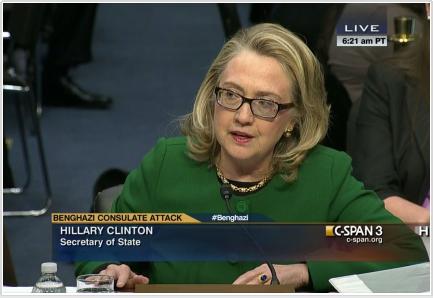
More precarious for Secretary Clinton, in my view, is the possibility that FBI Director James Comey will be allowed to perform a serious investigation and pursue Clinton on sworn testimony she has already given; for example, on whether she was aware of an operation run out of Benghazi to deliver Libyan weapons to rebels in Syria.
During her marathon testimony on Oct. 22, 2015, to the House Select Committee on Benghazi chaired by Rep. Trey Gowdy, R-South Carolina, Rep. Mike Pompeo, R-Kansas, was very specific in his questioning, leaving Clinton little wiggle-room:
Pompeo: Were you aware or are you aware of any U.S. efforts by the U.S. government in Libya to provide any weapons, directly or indirectly, or through a cutout, to any Syrian rebels or militias or opposition to Syrian forces?
Clinton: No.
Pompeo: Were you aware or are you aware of any efforts by the U.S. government in Libya to facilitate or support the provision of weapons to any opposition of Gadhafi’s forces, Libyan rebels or militias through a third party or country?
Clinton: No.
Did Secretary Clinton think we were “born yesterday,” as Harry Truman used to say? From what is already known about the activities of the U.S. “mission” and “annex” in Benghazi and the role played by the late Ambassador Christopher Stevens there, it seems quite likely that Clinton perjured herself in answering No.
And I believe this will become quite clear, if the FBI is allowed to pursue an unfettered investigation – and even clearer if the National Security Agency shares the take from its dragnet surveillance.
But those are big IFs. If I read President Barack Obama correctly, he will be more inclined to tell Attorney General Loretta Lynch to call off the FBI, just as he told former Attorney General Eric Holder to let retired General (and CIA Director) David Petraeus off with a slap on the wrist for giving his mistress intelligence of the highest classification and then lying about it to the FBI.
As for Clinton, perjury is not the kind of rap that she would welcome as she pursues the presidency. Trouble is, not only FBI investigators but also NSA collect-it-all snoopers almost certainly have the goods on whatever the truth is, with their easy access to the content of emails both classified and unclassified. [See Consortiumnews.com’s “Hillary Clinton’s Damning Emails.”]
Sadly, Comey and his counterparts at NSA are likely to cave in if the President tells them to cease and desist. Indeed, like legendary FBI Director J. Edgar Hoover, they may relish the prospect of being able to hold their knowledge of Hillary Clinton’s possible perjury and other misdeeds like a sword of Damocles over her head if she becomes president.
Whistleblower Needed
Thus, unless another patriot with the courage of an Edward Snowden or a Daniel Ellsberg recognizes that his primary duty is to honor his/her oath “to support and defend the Constitution of the United States against all enemies foreign and domestic,” and acts accordingly, the country could end up with a compromised President beholden to Hoover’s successors and the NSA sleuths who “collect everything,” including the emails of the Secretary of State – and those of the President.
Those at the FBI and NSA with the courage to consider whistleblowing need to be aware of the proud tradition they would be joining. The first recipient of the Sam Adams Award for Integrity in Intelligence (2002) was Coleen Rowley of the FBI, and in 2004 the award was given to FBI analyst and translator Sibel Edmonds.
As for signals intelligence, no fewer than four Sam Adams whistleblower awardees have come from NSA and its British counterpart GCHQ: the UK’s Katharine Gun (2003), and three from NSA itself – Thomas Drake (2011), Edward Snowden (2013), and William Binney (2015).
More distinguished company among people of integrity would be difficult – if not impossible – to find. In a few months, we will be considering nominations for the award to be given in 2017.
‘9/11 was a gift to the NSA …’
globinfo freexchange – March 25, 2016
This was probably the most impressive revelation derived by the documentary A Good American watched by the blog at the 18th Documentary Festival of Thessaloniki.
The exceptional documentary by Friedrich Moser deconstructs completely the image of the National Security Agency, one of the most powerful intelligence agencies in the world. Through the revealing stories of former NSA employees who became whistleblowers – like William Binney, Diane Roark and Thomas Andrews Drake – the agency appears that it has become a field of personal ambitions and money hunting through huge funds from the central government.
Moreover, the experienced, top analyst, William Binney (who is the central figure of the documentary), deconstructs the myth of an organization that is supposed to be pioneer in new technologies. He presents NSA as an organization which had certain difficulties to follow the explosive progress of the computer technology during 1990s, in order to modernize its obsolete equipment as fast as possible.
But the most mind-blowing revelation comes from Binney’s NSA colleague Thomas Drake. At one point, Drake recalls how a Senior Military Officer dismissed Osama bin Laden as “a raghead spouting off about a fatwa in the desert” in response to their intelligence reports on Al Qaeda in the late 90s. After the events of 9/11, Drake quotes his former NSA boss Maureen Baginski who reportedly said “9/11 was a gift to the NSA, we’re gonna get all the money we need and then some.” [1]
Although one could claim that behind this story is hidden a conflict of interest concerning two rival projects proposed to the NSA, there is plenty of evidence that ThinThread, the project developed by a small group around Binney, was rejected against Trailblazer, only because Trailblazer was promoted by a powerful lobby inside the NSA.
Indeed, as also presented in the documentary: NSA whistleblowers J. Kirk Wiebe, William Binney, Ed Loomis, and House Permanent Select Committee on Intelligence staffer Diane Roark complained to the Department of Defense’s Inspector General (IG) about waste, fraud, and abuse in the program, and the fact that a successful operating prototype existed, but was ignored when the Trailblazer program was launched. The complaint was accepted by the IG and an investigation began that lasted until mid-2005 when the final results were issued. The results were largely hidden, as the report given to the public was heavily (90%) redacted, while the original report was heavily classified, thus restricting the ability of most people to see it. [2]
Additionally, in July 2007, armed FBI agents raided the homes of Roark, Binney, and Wiebe, the same people who had filed the complaint with the DoD Inspector General in 2002. Binney claims they pointed guns at his wife and himself. Wiebe said it reminded him of the Soviet Union. None of these people were charged with any crimes. In November 2007, there was a raid on Drake’s residence. His computers, documents, and books were confiscated. He was never charged with giving any sensitive information to anyone; the charge actually brought against him is for ‘retaining’ information. The FBI tried to get Roark to testify against Drake; she refused. [3]
The documentary also reveals that the project ThinThread not only was much cheaper, but had two additional advantages: it was much more effective and was designed to protect the personal data of millions of citizens who were not related with terrorist activity.
Although NSA leadership rejected ThinThread three weeks prior to 9/11, in a secret test-run of the program against the pre-9/11-NSA database in early 2002, the program immediately found the terrorists. [4]
No one should expect intelligence agencies to be composed by “angels” who follow strictly a moral code. The dirty role of US and other agencies around the world for many decades is well known.
Yet, this documentary uncovers something much worse. Nothing has left from the original mission that the NSA supposedly serves. The protection of citizens against terrorist attacks has become irrelevant in front of the big money targeted by the corrupted groups of interests inside the agency. It seems that nothing has been remained unaffected from the rotten culture of “money and power above all and by all means” that dominates in today’s societies.
[1] Greed, Corruption & Cover-Up At The NSA, http://artvoice.com/2016/03/04/greed-corruption-cover-up-at-the-nsa/#.VvQZ_Y_PHLc
[2] Trailblazer Project, https://en.wikipedia.org/wiki/Trailblazer_Project
[3] Thomas Andrews Drake, https://en.wikipedia.org/wiki/Thomas_Andrews_Drake
[4] A Good American (2015), Plot Summary, http://www.imdb.com/title/tt4065414/plotsummary?ref_=tt_ov_pl
NSA must end planned expansion of domestic spying, lawmakers say
RT | March 25, 2016
Two members of the House Oversight Committee, a Democrat and a Republican, have asked the director of the National Security Agency to halt a plan to expand the list of agencies that the NSA shares information with.
Representatives Blake Farenthold (R-Texas) and Ted Lieu (D-California) wrote in a letter to NSA Director Michael Rogers on Monday that the reported plan would violate privacy protections in the Fourth Amendment, since domestic law enforcement wouldn’t need a warrant to use the data acquired from the agency.
“We are alarmed by press reports that state National Security Agency (NSA) data may soon routinely be used for domestic policing,” the two lawmakers wrote. “If media accounts are true, this radical policy shift by the NSA would be unconstitutional, and dangerous.”
Last month, the New York Times reported that the Obama administration was working with the NSA to create new protocols for sharing intercepted private communications with domestic law enforcement agencies, such as the FBI and the Drug Enforcement Agency (DEA).
Currently, the secretive spy agency says that its analysts remove certain personal information before giving it to other agencies. Under the new rules, however, domestic law enforcement would have access to the surveillance data without it being scrubbed of personally identifiable information.
The FBI currently has the ability to use phone-based data, but it must request the NSA’s permission to access information from digital communications. The planned loosening of these restrictions would have to be approved by Secretary of Defense Ashton Carter, Director of National Intelligence James Clapper and Attorney General Loretta Lynch.
“Our country has always drawn a line between our military and intelligence services, and domestic policing and spying,” the congressmen wrote. “We do not — and should not — use US Army Apache helicopters to quell domestic riots; Navy Seal teams to take down counterfeiting rings; or the NSA to conduct surveillance on domestic street gangs.”
The Obama administration has said it had leeway to change procedures for certain surveillance programs, thanks to executive order 12333, signed by President Ronald Reagan in 1981.
In 2015, Congress passed the USA Freedom Act, which curbed certain surveillance activities by ending bulk collection of phone records. Private telecom companies are now required to hold onto such information, so that it can be handed over to law enforcement if a warrant is obtained.
Langley’s Latest Themed Revolution: the Yellow Duck Revolution in Brazil

BY Wayne MADSEN | Strategic Culture Foundation | 24.03.2016
The latest themed revolution concocted by the Central Intelligence Agency’s «soft power» agents in the Brazilian federal and state legislatures, corporate media, and courts and prosecutors’ offices – all spurred on with the financial help of George Soros’s nongovernmental organizations – is the «Yellow Duck Revolution».
Large inflatable yellow ducks – said to represent the economic «quackery» of President Dilma Rousseff and her Workers’ Party government – have appeared at US-financed street demonstrations in Brasilia, Rio de Janeiro, and Sao Paulo. The main coordinators of these protests are found in Brazil’s largest corporate federations and corporate-owned media conglomerates and all of them have links to domestic non-profit organizations like Vem Pra Rua (To the Street) – a typical Soros appellation – and Free Brazil Movement, in turn funded by the usual suspects of the National Endowment for Democracy (NED), US Agency for International Development (USAID), and Soros’s Open Society Institute.
After trying to mount an electoral defeat of Brazil’s progressive leftist president, Dilma Rousseff, through a combination of presidential candidate assassination (the aerial assassination of Eduardo Campos in 2014 to pave the way to the presidency for the Wall Street-owned Green candidate Marina Silva, Campos’s vice presidential running mate), «rent-a-mob» street demonstrations, and corporate media propaganda, the Langley spooks are now trying to run Rousseff from office through a «Made in America» impeachment process. Aware that Rousseff’s progressive predecessor and mentor, Luiz Inacio Lula da Silva, has been targeted by Brazilian prosecutors on the CIA’s payroll, for arrest and prosecution for bribery, she appointed him to her government with ministerial rank and prosecutorial immunity. Lula only became a target because he signaled his desire to run for the presidency after Rousseff’s term ends in 2019.
The Workers’ Party correctly points out that the legislative impeachment maneuvers against Rousseff and the judicial operations against both Rousseff and Lula emanate from Washington. The same «color of law» but CIA-advanced operations were directed against presidents Cristina Fernandez de Kirchner in Argentina, Rafael Correa in Ecuador, Evo Morales in Bolivia, Nicolas Maduro in Venezuela, Fernando Lugo in Paraguay, and Manuel Zelaya in Honduras. In the cases of Lugo and Zelaya, the operations were successful and both leaders were removed from power by CIA-backed rightist forces.
Street protests against Rousseff have, since they began in 2014, taken on the typical Soros themed revolution construct. As with the disastrous Soros-inspired and CIA-nurtured Arab Spring protests in Egypt, Libya, Syria, and Tunisia and Euromaidan protest in Ukraine, the Vem Pra Rua movement and the associated Free Brazil Movement are basically nothing more than politically-motivated capitalist campaigns relying on Facebook, Twitter, and pro-insurrection television and radio networks, newspapers, and websites.
In addition to the inflatable yellow ducks, street protests have been marked by quickly-manufactured inflatable dolls of Lula in black and white prison garb and a placard cartoon drawing of Rousseff with a red diagonal «No» sign drawn through it. Street protest devices, which also include green and yellow banners and clothing, are telltale signs of significant amounts of money backing the psychological warfare gimmickry.
Brazilian prosecutors on Langley’s payroll arrested the popular Lula after staging a massive police raid on his house. Police also arrested the former First Lady of Brazil, Lula’s wife Marisa Leticia. Lula said he felt that he was kidnapped by the police. In 2009, Honduran troops actually kidnapped President Manuel Zelaya in the middle of the night and detained him in a military cell prior to expelling him from the country. That operation, like the one against Lula and Rousseff, was backed not only by the CIA and NSA, but by the US Southern Command in Miami. The Honduran coup was also backed by the Supreme Court of Honduras. To prevent a further political arrest of her predecessor, Rousseff made Lula her chief of staff, a cabinet position that affords Lula some protection from continuing prosecutorial harassment and legal proceedings by the federal court.
On March 16, Judge Sergio Moro, who is in charge of Operation «Lava-jato» («Car wash»), the two-year investigation of Petrobras and the alleged bribery involving Rousseff and Lula, released two taped intercepts of phone calls between the president and former president. The bugged phone conversation involved Rousseff’s plans to appoint Lula as her chief of staff, a Cabinet rank, as a way to afford him some protection from the CIA’s judicial-backed coup operation now in play. Rousseff previously served as Lula’s chief of staff. Classified National Security Agency documents leaked by whistleblower Ed Snowden illustrate how the NSA has spied on Rousseff’s office and mobile phones. President Obama claimed he ordered an end to such spying on world leaders friendly to the United States. Obama’s statement was false.
Judge Sergio Moro’s name appears in one of the leaked State Department cables. On October 30, 2009, the US embassy in Brasilia reported that Moro attended an embassy-sponsored conference in Rio de Janeiro held from October 4-9. Titled «Illicit Financial Crimes», the conference appears have been an avenue for the CIA and other US intelligence agencies to train Brazilian federal and state law enforcement, as well as other Latin American police officials from Argentina, Paraguay, Panama, and Uruguay, in procedures to mount bogus criminal prosecutions of Latin American leaders considered unfriendly to the United States. The State Department cable from Brasilia states: «Moro… discussed the 15 most common issues he sees in money laundering cases in the Brazilian Courts».
One item that was not on the agenda for the US embassy seminar was the NSA’s covert spying on the communications of Rousseff, Lula, and the state-owned Brazilian oil company Petrobras. In a technique known as prosecutorial «parallel construction», US prosecutors given access to illegally-intercepted communications, have initiated prosecution of American citizens based on the selective use of warrantless intercepts. If such tactics can be used in the United States, they can certainly be used against leaders like Rousseff, Lula, and others. The Operation Car wash intercepts of the Rousseff-Lula phone conversations that were released by Judge Moro to the media may have originated with NSA and its XKEYSCORE database of intercepts of Brazilian government and corporate communications conducted through bugging operations codenamed KATEEL, POCOMOKE, and SILVERZEPHYR.
In what could be called the «Obama Doctrine», the CIA has changed its game plan in overthrowing legitimate governments by using ostensibly «legal» means. Rather than rely on junta generals and tanks in the street to enforce its will, the CIA has, instead, employed prosecutors, judges, opposition party leaders, newspaper editors, and website administrators, as well as mobs using gimmicks – everything from inflatable yellow ducks, paper mâché puppets, and freshly silk screen-printed t-shirts, flags, and banners – as themed revolution facilitators.
As shown by the leaked State Department cables, the CIA has identified a number of agents of influence it can rely on for providing intelligence on both Rousseff and Lula. These sources have included the senior leadership of the Workers’ Party; officials of Petrobras eager to see their company sold off to the highest-bidding foreign vultures; Brazilian Central Bank executives; and Brazilian military intelligence officers who were originally trained by US intelligence and military agencies.
In addition to BRICS member Brazil, other BRICS nations have also seen the US increasing its efforts to organize themed revolutions. South Africa is on the target list, as are Russia and China.
U.S. Watchdog Investigations Imperiled by Obama Fixation on Government Secrecy
By Steve Straehley and Danny Biederman | AllGov | December 2, 2015
The Obama administration, by consistently refusing to turn over documents and information, has gone out of its way to make it more difficult for the inspectors general of executive branch agencies to do their jobs.
The concept of inspectors general investigating executive branch departments and agencies came into being in the late 1970s after the Watergate scandal. The idea was that inspectors general would have free rein to investigate wrongdoing in their departments and bring government abuse to light.
But thanks to an obsession with secrecy on the part of the Obama administration, inspectors general who previously had access to all documents, emails and other information have had to beg for evidence, which is often produced after months of requests and is sometimes heavily redacted.
“The bottom line is that we’re no longer independent,” Michael E. Horowitz, the Justice Department inspector general, told The New York Times.
More than three decades of established federal policy that gave watchdogs unrestricted access to government records in their investigations is now at serious risk of being undone. That includes “at least 20 investigations across the government that have been slowed, stymied or sometimes closed because of a long-simmering dispute between the Obama administration and its own watchdogs over the shrinking access of inspectors general to confidential records,” according to the Times’ Eric Lichtblau.
Justice Department lawyers wrote an opinion last summer that stated grand jury transcripts, wiretap intercepts and financial credit reports and some other “protected records” could be withheld from inspectors general. As a result of that order, investigators who need to review government records are now required to get permission from the very agencies they are monitoring in order to do so.
“This is by far the most aggressive assault on the inspector general concept since the beginning,” Paul Light, a New York University professor who has studied inspectors general, told the Times. “It’s the complete evisceration of the concept. You might as well fold them down. They’ve become defanged.”
Among the investigations being hindered are those involving FBI use of phone records collected by the NSA, the DEA’s role in the shooting of unarmed civilians in Honduras drug raids, international trade agreement enforcement at the Commerce Department, the “Fast and Furious” gun operation, intelligence relating to the Boston Marathon bombings, and additional cases at the Afghanistan reconstruction board, the EPA and the Postal Service.
Even the Peace Corps has worked to prevent access to records. The agency’s inspector general was denied information when looking into cases of sexual abuse of Peace Corps volunteers. This despite claims that the agency is in favor of “rigorous oversight” and that it cooperated with investigators.
The situation has drawn criticism from both Republicans and Democrats. Sen. Chuck Grassley (R-Iowa), head of the Senate Judiciary Committee, said of a plan to give the Justice Department inspector general more access, but not those at other agencies, “It’s no fix at all.” His colleague on the committee, Sen. Patrick Leahy (D-Vermont) said at a hearing that the Obama administration has “blocked what was once a free flow of information” to investigators.
Justice IG Horowitz said the consequence of the watchdog clampdown may be an increase in cases of waste, fraud and abuse across the government.
To Learn More:
Tighter Lid on Records Threatens to Weaken Government Watchdogs (by Eric Lichtblau, New York Times )
Gov’t Watchdogs Urge Congress to Reverse Obama Administration IG Crackdown (Fox News)
Pentagon Stonewalls U.S. Watchdog’s Inquiries into $800 Million Afghanistan Program (by Noel Brinkerhoff, AllGov )
Justice Department Tries to Limit Inspectors General Access to Government Documents (by Steve Straehley, AllGov )
FBI Claims it Doesn’t Have to Share Records with Justice Dept. Inspector General (by Noel Brinkerhoff and Steve Straehley, AllGov )
The High Cost of Secrecy to American Taxpayers (by Matt Bewig, AllGov )
Court Chooses to Ignore Overwhelming Evidence of NSA’s Mass Internet Spying

By Ashley Gorski | ACLU | October 24, 2015
A federal district court yesterday dismissed Wikimedia v. NSA, a lawsuit brought by the ACLU on behalf of a broad group of educational, legal, human rights, and media organizations whose communications are swept up by the NSA’s unprecedented Internet dragnet.
Our lawsuit concerns the NSA’s “upstream” surveillance, which involves the mass interception and searching of Americans’ international Internet communications. The court held that our clients lacked “standing” to bring suit, because they had not plausibly alleged that their communications were being monitored by the NSA. That’s just plain wrong.
The court’s opinion relies heavily on the Supreme Court’s decision in a previous ACLU lawsuit, Amnesty v. Clapper, a challenge to warrantless surveillance under the FISA Amendments Act of 2008. In February 2013, the Supreme Court dismissed that case on the grounds that the plaintiffs could not prove that they had communicated with the NSA’s targets.
But as we explained in court, our current challenge to the NSA’s warrantless spying is very different than the last one. Among other reasons, Clapper was decided prior to the Snowden revelations and extensive government disclosures about upstream surveillance. These revelations fundamentally changed the equation. Since Clapper, the public has learned that the NSA is not surveilling only its targets — it is instead surveilling virtually everyone, looking for information about those targets.
Some early takeaways from the district court’s opinion:
1.The court misunderstands how upstream surveillance is fundamentally different from and much more intrusive than the surveillance considered by the Supreme Court in Clapper.
Upstream surveillance is accomplished through the installation of devices directly on the Internet “backbone” — the network of high-capacity cables, switches, and routers across which Internet traffic travels. One particularly disturbing feature of upstream spying is known as “about” surveillance. Through this surveillance, the NSA is not simply plucking the communications to or from terrorists, spies, or other targets. Instead, it’s copying and searching through the contents of nearly everyone’s international communications, looking for information about its many targets. When the Supreme Court considered warrantless surveillance in Clapper, it was focused on whether the plaintiffs communicated with targets. At that time, the public had no idea that the NSA was essentially opening everyone’s international emails. Indeed, contrary to the district court’s understanding, “about” surveillance is in no way targeted:

2. The court ignores how Internet communications are structured — and why that requires the government to intercept at least some of our clients’ trillion-plus international communications.
Collectively, our clients engage in more than one trillion international Internet communications each year, with individuals in virtually every country on Earth. As we explained in our complaint, given the structure of the Internet, it is virtually impossible for the NSA to conduct upstream surveillance without intercepting at least some of plaintiffs’ communications. Yet the court dismissed these allegations, characterizing them as having “no basis in fact.”

3. Given how much is in the public record about upstream surveillance, our clients’ allegations are not “speculative” or “hypothetical.”
As the court acknowledged, at this early stage of the litigation, plaintiffs have to satisfy only a very low threshold: plausibility. Especially considering what’s publicly known about how upstream surveillance works, and the volume and distribution of our clients’ communications, their allegations are more than plausible.

4. The court’s opinion would insulate government surveillance from any legal challenge, except in cases where the government has already admitted its reliance on a particular program.
Although the court recognized that “no government surveillance program should be immunized from judicial scrutiny,” its analysis would do precisely that in the overwhelming majority of cases. If the court’s reasoning were correct, then the only people who could challenge NSA surveillance would be those told by the government they were spied on — a result at odds with well-established precedent and our system of checks and balances:
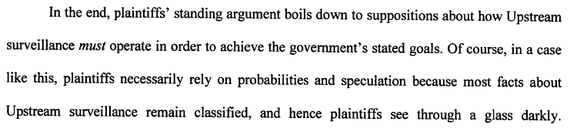
Our clients’ standing doesn’t depend on a supposition. There’s no question that the NSA is capturing and searching through their communications. That’s something the court — and everyone else — should find extremely disconcerting.
Featured Video

Your Enslavement Begins in Gaza: The ‘Board of Peace’
or go to
Aletho News Archives – Video-Images
From the Archives
The US: The Century of Lost Wars
By James Petras | Global Research | September 12, 2018
Introduction
Despite having the biggest military budget in the world, five times larger than the next six countries, the largest number of military bases – over 180 – in the world and the most expensive military industrial complex, the US has failed to win a single war in the 21st century.
In this paper we will enumerate the wars and proceed to analyze why, despite the powerful material basis for wars, it has led to failures. … continue
Blog Roll
 Aletho News
- Israel designates five Palestinian media outlets as ‘terrorist organizations’
- Israel, not America, first: Carlson’s Huckabee interview lays bare US foreign policy priorities
- Israeli troops executed Palestinian aid workers at ‘point blank range’: Report
- Iran war What if today’s Iran is resigned to a long, hellish war with the US?
- Why Israel Is Escalating Its War Crimes Against Lebanon
- Iran in the face of the armed diplomacy of imperialism
- The US build-up around Iran constitutes strategic war option, not ‘deterrence’
- Iran to US: Sanctions and war failed; try diplomacy and respect
- China supplies Iran with radar, surveillance tech to track US stealth aircraft: Report
- Zelensky rejects territorial concessions to Russia
- If Americans Knew
- Footage Shows Israeli Troops Waiting in Ambush, Then Opening Fire on a Palestinian Teen
- The US is on the brink of a major new war that Trump has not even bothered explaining
- Latest Epstein document dump is one more cover-up
- No Protection, No Justice: US Citizens Killed with Impunity by Israel
- Maria Farmer: Epstein Victim Reveals Explosive Information Covered Up by Media
- Average of five Palestinians killed by Israel every day in Gaza since ceasefire – Not a ceasefire Day 136
- Palestinian church leaders admonish Christian Zionist Mike Huckabee – Not a ceasefire Day 135
- Ominous messaging from Trump’s “Board of Peace” – Not a ceasefire Day 134
- ‘Christians Out’: Jerusalem Church Tagged With Hate Graffiti, Police Investigating
- Israeli Settlers Kill American Teen
- No Tricks Zone
- New Research Reaffirms Clouds, Aerosols, And Surface Solar Radiation Are ‘Driving The Climate System’
- Germany: Electric Car Catches Fire At Charging Station, Sets Off Local “Inferno”, Widespread Damage
- New Study: Canada’s New Brunswick Was 1°C Warmer Than Today During The Medieval Warm Period
- Coal Power Back In Trend As Globe Tries To Keep Pace With Growing Demand For Power
- New Study: A 4°C Warmer Beaufort Sea Had ‘No Sea Ice’ 11,700 – 8200 Years Ago
- Unfudging The Data: Dutch Meteorological Institute Reinstates Early 20th Centruy Heat Waves It Had Erased Earlier
- German Gas Crisis…Chancellor Merz Allegedly Bans Gas Debate Ahead of Elections!
- Pollen Reconstructions Show The Last Glacial’s Warming Events Were Global, 10x Greater Than Modern
- Germany’s Natural Gas Storage Level Dwindles To Just 28%… Increasingly Critical
- New Study Rebuts The Assumption That Anthropogenic CO2 Molecules Have ‘Special’ Properties
 Aletho News