The NSA’s Favorite Weasel Word To Pretend It’s Claiming It Doesn’t Spy On Americans
By Mike Masnick | TechDirt | June 7th 2013
Well, well. In the aftermath of the revelations that the NSA is getting records of every phone call from Verizon, followed up by the news that most of the biggest tech companies are supposedly giving direct access to the NSA, the intelligence community is responding the same way it always does: with weasel words. First up, you can see Director of National Intelligence James Clapper’s statement about the spying, which we’ll be discussing again in a bit.
But, a bunch of folks have been reasonably pointing out that Clapper appears to have lied to Congress. Of course, it’s not like this wasn’t easily called. Two years ago, we wrote about Clapper’s answers to Senators Wyden and Udall, which we pointed out was a ridiculous answer that was clearly sidestepping the real questions. However, looking over that letter again now, and having become a bit more familiar with the weasel words the NSA likes to use, it’s easy to look at Clapper’s statement and explain why he can “stand by it” while the clear implication of it was the opposite of what he meant.
You asked whether communications of Americans have been collected… Section 702 of the FAA [FISA Amendments Act] explicitly prohibits the intentional targeting of persons reasonably believed to be located in the United States or United States persons located abroad. The Intelligence Community has put in place a variety of procedures, which have been approved by the FISA Court as required by law, to ensure that only persons reasonably believed to be located outside the United States are targeted and to prevent the intentional acquisition of any communications as to which the sender and all intended recipients are known to be located in the United States. Guidelines are also required by law to ensure compliance with other limitations on FAA collection, including the requirement that a U.S. person may not be intentionally targeted under section 702. If it is discovered that a target has entered the U.S. or is a U.S. person, he or she is promptly detargeted and reports are made as appropriate to the Department of Justice (DOJ), the Office of the Director of National Intelligence (ODNI) and the FISA Court. Moreover, when communications from persons located in the United States are collected because they are communicating with a lawful target, the privacy and civil liberty rights of U.S. persons are protected through the careful implementation of the procedures required under the FAA to “minimize the acquisition and retention, and prohibit the dissemination ‘of information about U.S. persons.’”
Most people would read this to be him saying that they do not spy on Americans. And that’s obviously what he’s trying to imply. But that’s not what he’s actually saying. He’s using the NSA’s favorite weasel word: “target.” Now, most people assume that means one of the people on the call must be outside the US. But, you could — if you were devious intelligence official trying to mislead Congress and the American public (hypothetically) — interpret the word “target” to mean “if we, in general are ‘targeting’ foreign threats, no matter what they might be like, and this information we’re collecting might help in that process, then we can snarf up this data.”
In other words, most people think that “target” would mean one of the people on the phone. But, the NSA means “this overall investigation is about targeting foreign threats, so we can take whatever data we want because the goal is to stop foreign threats with it — and therefore our mandate not to spy on Americans doesn’t apply.”
So, it shouldn’t be particularly surprising to see that the administration’s “response” to this is to highlight, yet again, that this only “targets” non-US persons:
Information collected through a U.S. government surveillance program that taps into the servers of internet companies targets only non-U.S. persons living outside the United States, a senior administration official said on Thursday.
The U.S. law that allows the collection of data under this program does not allow the targeting of any U.S. citizen or of any person located in the United States, the official said, speaking on condition of anonymity.
Right, but whether or not they’re “targeting” a person, is separate from whether or not they’re spying on the data of Americans. As long as it’s all part of a process that “targets” non-US persons, they can claim that they’re playing by the rules.
Given that, however, I don’t see how Clapper can reasonably standby the following statements:
Wyden: Does the NSA collect any type of data at all on millions or hundreds of millions of Americans?
Clapper: No sir.
Wyden: It does not?
Clapper: Not wittingly. There are cases where they could, inadvertently perhaps, collect—but not wittingly.
Clapper is insisting that he didn’t lie in his comments, but he then pretends that he was only talking about email:
What I said was, the NSA does not voyeuristically pore through U.S. citizens’ e-mails. I stand by that.
Except, that’s not what he was asked, nor was it what he said. He was specifically asked if the NSA collects any type of data at all, and he said no. Up above, he was using weasel words, but here it looks like he was flat out lying directly to Congress. Usually, Congress doesn’t like that.
Related article
- The “Congress knew” defense
- This abuse of the Patriot Act must end | Jim Sensenbrenner
- Confirmed: The NSA is Spying on Millions of Americans
- NSA memo pushed to ‘rethink’ 4th Amendment
- Boundless Informant: NSA’s complex tool for classifying global intelligence
- Government Says Secret Court Opinion on Law Underlying PRISM Program Needs to Stay Secret
Boundless Informant: NSA’s complex tool for classifying global intelligence
RT | June 9, 2013
A new batch of classified NSA docs leaked to the media reveals the details of a comprehensive piece of software used by NSA to analyze and evaluate intelligence gathered across the globe as well as data extraction methods.
The top-secret documents released by the Guardian shed light on the National Security Agency’s data-mining tool being used for counting and categorizing metadata gathered and stored in numerous databases around the world.
Known as Boundless Informant, the software provides its operator a graphical insight on how many records were collected for a specific “organizational unit” or country, what type of data was collected and what type of collection was used. The program also allows determining trends in data collection for both strategic and tactical decision making, according to the slides.
One of the slides contains a part of the Informant’s user interface showing a world map with countries color-coded ranging from green to red depending on the amount of records collected there. While Iran, Pakistan and some other states are predictably “hottest” according to the map, the agency collected almost 3 billion intelligence pieces in the US in March 2013 alone.
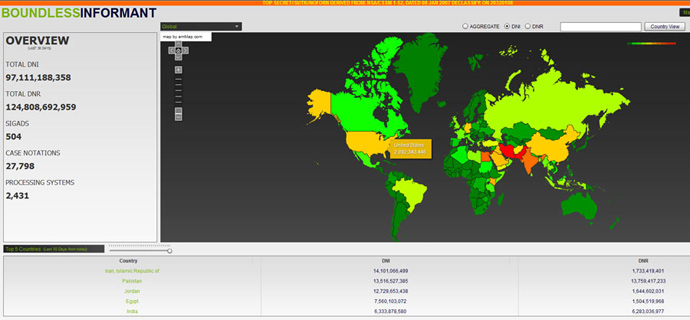
The map showing how much data is being collected in different countries across the globe (image from the Guardian)
The insight on the software being used by the NSA comes amid the agency spokesperson Judith Emmel’s claims that the NSA cannot at the moment determine how many Americans may be accidentally included in its surveillance.
“Current technology simply does not permit us to positively identify all of the persons or locations associated with a given communication,” Emmel said Saturday adding that “it is harder to know the ultimate source or destination, or more particularly the identity of the person represented by the TO:, FROM: or CC: field of an e-mail address or the abstraction of an IP address.”
NSA data sources
Another slide from the internal NSA presentation redacted by the Guardian editors details the data gathering methods used in the NSA global surveillance program.
The first method suggests interception of data from “fiber cables and infrastructure as data flows past” under the FISA Amendments Act (FAA) of 2008, Section 702.
The second distinguished method is data collection “directly from the servers of the US service providers.”

The slide detailing methods of data extraction under the FISA Amendment Act (image from the Guardian)
The presentation encourages analysts to use both methods for better results.
Google, Facebook negotiated ‘secure portals’ to share data with NSA?
Meanwhile, a report by the New York Times revealed that Internet giants, including Google and Facebook, have been in negotiations with the US security agency over ‘digital rooms’ for sharing the requested data. The companies still insist there is no “back door” for a direct access to user data on their servers.
The Internet companies seem more compliant with the spy agencies than they want to appear to their users, and are cooperating on “behind-the-scenes transactions” of the private information, according to a report that cites anonymous sources “briefed on the negotiations.”
According to the report, Google, Microsoft, Yahoo, Facebook, AOL, Apple and Paltalk have “opened discussions with national security officials about developing technical methods to more efficiently and securely share the personal data of foreign users in response to lawful government requests,” sometimes “changing” their computer systems for this purpose.
These methods included a creation of “separate, secure portals” online, through which the government would conveniently request and acquire data from the companies.
Twitter was the only major Internet company mentioned in the report that allegedly declined to facilitate the data transfer to the NSA in a described way. As opposed to a legitimate FISA request, such a move was considered as not “a legal requirement” by Twitter.
The sources claim the negotiations have been actively going in the recent months, referring to a Silicon Valley visit of the chairman of the Joint Chiefs of Staff Martin E. Dempsey. Dempsey is said to have met the executives of Facebook, Microsoft, Google and Intel to secretly discuss their collaboration on the government’s “intelligence-gathering efforts.”
NSA pressured to declassify more PRISM details
In response to the fury over US government’s counterterrorism techniques, Director of National Intelligence James Clapper for the second time in three days revealed some details of the PRISM data-scouring program.
Being one of the “most important tools for the protection of the nation’s security” the PRISM is an internal government computer system for collecting “foreign intelligence information from electronic communication service providers under court supervision,” Clapper said.
He also said that PRISM seeks foreign intelligence information concerning foreign targets located outside the US and cannot intentionally target any US citizen or any person known to be in the US. As for “incidentally intercepted” information about a US resident, the dissemination of such data is prohibited unless it is “evidence of a crime”, “indicates” a serious threat, or is needed to “understand foreign intelligence or assess its importance.”
Clapper also stressed that the agency operates with a court authority and that it does not unilaterally obtain information from the servers of US telecoms and Internet giants without their knowledge and a FISA Court judge approval.
Related articles
- The NSA Black Hole: 5 Basic Things We Still Don’t Know About the Agency’s Snooping
- NSA Document Leak Proves Conspiracy To Create Big Brother Style World Control System
- DOJ launches criminal probe of NSA leaker
- US security officials said NSA leaker, journalist should be ‘disappeared’ – report
- Government Spying: Should We Be Shocked?
- The NSA’s Favorite Weasel Word To Pretend It’s Claiming It Doesn’t Spy On Americans
- The “Congress knew” defense
- NSA memo pushed to ‘rethink’ 4th Amendment
Supreme Court Dismisses Challenge to FISA Amendments Act; EFF’s Lawsuit Over NSA Warrantless Wiretapping Remains
By Cindy Cohn and Trevor Timm | EFF | February 27, 2013
Yesterday, the Supreme Court sadly dismissed the ACLU’s case, Clapper v. Amnesty International, which challenged the FISA Amendments Act (FAA)—the unconstitutional law that allows the government to wiretap Americans communcating with people overseas. Under the FAA, the government can conduct this surveillance without naming individuals and without a traditional probable cause warrant, as the Fourth Amendment requires.
The court didn’t address the constitutionality of the FAA itself, but instead ruled that the plaintiffs—a group of lawyers, journalists, and human rights advocates who regularly communicate with likely “targets” of FAA wiretapping—couldn’t prove the surveillance was “certainly impending,” so therefore didn’t have the “standing” necessary to sue. In other words, since the Americans did not have definitive proof that they were being surveilled under the FAA—a fact the government nearly always keeps secret—they cannot challenge the constitutionality of the statute.
EFF’s Warrantless Wiretapping Case, Jewel v. NSA, Is Not Affected by Clapper
It’s shameful that the courts again have cut off another avenue for accountability regarding the NSA’s warrantless and unconstitutional surveillance activities. But as disappointing as the Clapper decision is, the good news is the decision likely won’t adversely affect our Jewel v. NSA lawsuit, which we argued in district court in December of 2012. Indeed, the Clapper decision makes the Jewel case one of the last remaining hopes for a court ruling on the legality of the warrantless surveillance of Americans, now conducted for over a decade.
The Ninth Circuit has already ruled that the Jewel plaintiffs have standing under settled law. The court’s decision is based on solid ground because we have presented the court with evidence that dragnet warrantless surveillance has already occurred, through testimony and documents from AT&T and NSA whistleblowers. In fact, the court specifically differentiated the two cases in its Jewel opinion: “Jewel has much stronger allegations of concrete and particularized injury than did the plaintiffs in Amnesty International. Whereas they anticipated or projected future government conduct, Jewel’s complaint alleges past incidents of actual government interception of her electronic communications.”
Clapper v. Amnesty’s Catch-22
Nonetheless, the Supreme Court’s requirement in Clapper that a future harm must be “certainly impending” to allow a case to go forward is very troubling, especially in the context of cases involving secret surveillance.
As Justice Stephen Breyer’s dissent points out, future conduct can never be predict anything with 100% certainty, and if certainty was a requirement for standing, then virtually no cases would ever reach conclusion. Justice Breyer runs through dozens of cases where standing has been found for plaintiffs in situations where plaintiffs had a reasonable fear of harm, and in many of those cases, the plaintiffs were much less certain than the lawyers, human rights workers and journalist in Clapper.
Breyer summed absurdity of the “certainly impending” standard by saying, “One can, of course, always imagine some special circumstance that negates a virtual likelihood, no matter how strong. But the same is true about most, if not all, ordinary inferences about future events. Perhaps, despite pouring rain, the streets will remain dry (due to the presence of a special chemical).”
This standard is especially problematic when the harm is illegal surveillance conducted via secret government programs. Unlike physical searches of the home, communications surveillance is by its nature hidden from the people affected, and national security surveillance is rarely made public or used in domestic criminal prosecutions. Thus, under the Supreme Court’s rule, regardless of whether its surveillance was legal or constitutional, the government can deny standing to a victim of illegal surveillance just by never revealing its illegal actions to the person affected. Essentially, one can’t challenge the government’s surveillance unless the government agrees.
Indeed, in arguing that its ruling does not mean that government surveillance under the FAA can never be reviewed by the courts, the Court could only point to situations in which the government intentionally revealed its surveillance.1
Allowing the Executive broad unfettered powers to “turn the Constitution on and off at will,” is exactly what the Supreme Court refused to do in Boumediene v. Bush, but what it appears to have allowed here.
It’s not even clear that the majority even understands the real scope of the FAA. In the opinion’s first sentence, Justice Alito refers to “individuals” that can be warrantlessly surveilled, but as we’ve explained many times, and the dissent notes, one of the most odious parts of the law is that it allows the government to get one court order for groups or categories of people—potentially thousands of people can be affected at a time.
The Shrinking Ranks of Warrantless Wiretapping Cases
This is the second ruling in the past year in which the government has convinced the court to dismiss challenges to the NSA warrantless wiretapping program on technical grounds, when there is ample evidence of wrongdoing. In 2012, the Ninth Circuit reluctantly dismissed the Al-Haramain case on “sovereign immunity” grounds despite a lower court ruling the government had violated the Fourth Amendment. The court reasoned that because of a glitch in the language of FISA statute, the plaintiffs had to sue individuals in the government in their personal capacities and couldn’t sue government agencies themselves or government officials in their official capacities.
We look forward to the district court in Jewel v. NSA determining that our case can move forward, and that the government can, once and for all, be held to account for the NSA’s unlawful and unconstitutional warrantless wiretapping program.
- 1. The court also noted that a provision of the FAA allows a service provider, presumably in a fit of patriotic fervor and a willingness to pay expensive attorneys for its customers, challenges the government on its own, in secret. Yet even under this provision, the victim of the surveillance is unable to seek judicial review.
Related article
Why The NSA Can’t Be Trusted to Run U.S. Cybersecurity Programs
By Mark M. Jaycox and Lee Tien and Trevor Timm | EFF | July 30, 2012
This week, the Senate will be voting on a slew of amendments to the newest version of the Senate’s cybersecurity bill. Senators John McCain and Kay Bailey Hutchison have proposed several amendments that would hand the reins of our nation’s cybersecurity systems to the National Security Agency (NSA). All of the cybersecurity bills that have been proposed would provide avenues for companies to collect sensitive information on users and pass that data to the government. Trying to strike the balance between individual privacy and facilitating communication about threats is a challenge, but one thing is certain: the NSA has proven it can’t be trusted with that responsibility. The NSA’s dark history of repeated privacy violations, flouting of domestic law, and resistance to transparency makes it clear that the nation’s cybersecurity should not be in its hands.
In case you need a refresher, here’s an overview of why handing cybersecurity to the NSA would be a terrible idea:
- An executive order generally prohibits NSA from conducting intelligence on Americans’ domestic activities
Executive Order 12333 signed by President Reagan in 1981 (and amended a few times since1), largely prohibits the NSA from spying on domestic activities:no foreign intelligence collection by such elements [of the Intelligence Community] may be undertaken for the purpose of acquiring information concerning the domestic activities of United States persons.
If amended, the Cybersecurity Act would allow the NSA to gain information related to “cybersecurity threat indicators,” which would allow it to collect vast quantities of data that could include personally identifiable information of U.S. persons on American soil. Law enforcement and civilian agencies are tasked with investigating and overseeing domestic safety. The NSA, on the other hand, is an unaccountable military intelligence agency that is supposed to focus on foreign signals intelligence—and it’s frankly dangerous to expand the NSA’s access to information about domestic communications.
- NSA has a dark history of violating Americans’ constitutional rightsIn the 1960’s, a Congressional investigation, led by four-term Senator Frank Church, found that the NSA had engaged in widespread and warrantless spying on Americans citizens. Church was so stunned at what he found, he remarked that the National Security Agency’s “capability at any time could be turned around on the American people, andno American would have any privacy left, such is the capability to monitor everything.” (emphasis added) The investigation led to the passage of the Foreign Intelligence Surveillance Act, which provided stronger privacy protections for Americans’ communications—that is, until it was weakened by the USA-PATRIOT Act and other reactions to 9/11.
- NSA has continued its warrantless wiretapping scandalIn 2005, the New York Times revealed that the NSA set up a massive warrantless wiretapping program shortly after 9/11, in violation of the Fourth Amendment and several federal laws. This was later confirmed by virtually every major media organization in the country. It led to Congressional investigations and several ongoing lawsuits, including EFF’s. Congress passed the FISA Amendments Act to granttelecom companies retroactive immunity for participating in illegal spying and severely weaken privacy safeguards for Americans communicating overseas.Since the FISA Amendments Act (FAA) passed, the NSA has continued collecting emails of Americans. A 2009 New York Times investigation described how a “significant and systemic” practice of “overcollection” of communications resulted in the NSA’s intercepting millions of purely domestic emails and phone calls between Americans. In addition, documents obtained via a Freedom of Information Act request by the ACLU, although heavily redacted, revealed “that violations [of the FAA and the Constitution] continued to occur on a regular basis through at least March 2010″— the last month anyone has public data for.
- NSA recently admitted to violating the Constitution.Just last week, the Office of the Director of National Intelligence—which oversees the NSA—begrudgingly acknowledged that “on at least one occasion” the secret FISA court “held that some collection… used by the government was unreasonable under the Fourth Amendment.” Wired called it a “federal sidestep of a major section of the Foreign Intelligence Surveillance Act,” and it confirmed the many reports over the last few years: the NSA has violated the Constitution.
- NSA keeps much of what it does classified and secretBecause cybersecurity policy is inescapably tied to our online civil liberties, it’s essential to maximize government transparency and accountability here. The NSA may be the worst government entity on this score. Much of the NSA’s work is exempt from Freedom of Information Act (FOIA) disclosure because Congress generally shielded NSA activities from FOIA2. Even aside from specific exemption statutes, much information about NSA activities is classified on national security grounds. The NSA has also stonewalled organizations trying to bring public-interest issues to light by claiming the “state secrets” privilege in court. EFF has been involved in lawsuits challenging the NSA’s warrantless surveillance program since 2006. Despite years of litigation, the government continues to maintain that the “state secrets” privilege prevents any challenge from being heard. Transparency and accountability simply are not the NSA’s strong suit.
We remain unconvinced that we need any of the proposed cybersecurity bills, but we’re particularly worried about attempts to deputize the NSA as the head of our cybersecurity systems. And even the NSA has admitted that it does “not want to run cyber security for the United States government.”
Thankfully, new privacy changes in the cybersecurity bill heading towards the Senate floor have explicitly barred intelligence agencies like the NSA from serving as the center of information gathering for cybersecurity. We need to safeguard those protections and fend off amendments that give additional authority to the NSA. We’re asking concerned individuals to use our Stop Cyber Spying tool to tweet at their Senators or use the American Library Association’s simple tool to call Senators. We need to speak out in force this week to ensure that America’s cybersecurity systems aren’t handed to the NSA.
- 1. Executive Order 12333 was amended in 2003 by Executive Order 13284, in 2004 by Executive Order 13355, and in 2008 by Executive Order 13470. The resulting text of Executive Order 12333 is available here (pdf).
- 2. Three of the most common statutes that NSA uses to fight transparency: Section 6 of the National Security Agency Act of 1959 (Public Law 86-36, 50 U.S.C. Sec. 402 note), which provides that no law shall be construed to require the disclosure of, inter alia, the functions or activities of NSA; The Intelligence Reform and Terrorism Prevention Act of 2004, 50 U.S.C. Sec. 403- 1(i), which requires under the Responsibilities and Authorities of the Director of National Intelligence that we protect information pertaining to intelligence sources and methods; and 18 U.S.C. Sec. 798, which prohibits the release of classified information concerning communications intelligence and communications security information to unauthorized persons.
Related articles
- Congress Must Act After US Government Admits To Unconstitutional Warrantless Wiretapping For the First Time (eff.org)
- Why won’t the Obama administration reveal how many Americans’ emails the NSA has collected and reviewed without a warrant? (eff.org)
- NSA whistle blowers allege data being collected on every American (rawstory.com)
- Why won’t the Obama administration reveal how many Americans’ emails the NSA has collected and reviewed without a warrant? (informationliberation.com)
Three NSA Whistleblowers Back EFF’s Lawsuit Over Government’s Massive Spying Program
EFF Asks Court to Reject Stale State Secret Arguments So Case Can Proceed
EFF | July 2, 2012
San Francisco – Three whistleblowers – all former employees of the National Security Agency (NSA) – have come forward to give evidence in the Electronic Frontier Foundation’s (EFF’s) lawsuit against the government’s illegal mass surveillance program, Jewel v. NSA.
In a motion filed today, the three former intelligence analysts confirm that the NSA has, or is in the process of obtaining, the capability to seize and store most electronic communications passing through its U.S. intercept centers, such as the “secret room” at the AT&T facility in San Francisco first disclosed by retired AT&T technician Mark Klein in early 2006.
“For years, government lawyers have been arguing that our case is too secret for the courts to consider, despite the mounting confirmation of widespread mass illegal surveillance of ordinary people,” said EFF Legal Director Cindy Cohn. “Now we have three former NSA officials confirming the basic facts. Neither the Constitution nor federal law allow the government to collect massive amounts of communications and data of innocent Americans and fish around in it in case it might find something interesting. This kind of power is too easily abused. We’re extremely pleased that more whistleblowers have come forward to help end this massive spying program.”
The three former NSA employees with declarations in EFF’s brief are William E. Binney, Thomas A. Drake, and J. Kirk Wiebe. All were targets of a federal investigation into leaks to the New York Times that sparked the initial news coverage about the warrantless wiretapping program. Binney and Wiebe were formally cleared of charges and Drake had those charges against him dropped.
Jewel v. NSA is back in district court after the 9th U.S. Circuit Court of Appeals reinstated it in late 2011. In the motion for partial summary judgment filed today, EFF asked the court to reject the stale state secrets arguments that the government has been using in its attempts to sidetrack this important litigation and instead apply the processes in the Foreign Intelligence Surveillance Act that require the court to determine whether electronic surveillance was conducted legally.
“The NSA warrantless surveillance programs have been the subject of widespread reporting and debate for more than six years now. They are just not a secret,” said EFF Senior Staff Attorney Lee Tien. “Yet the government keeps making the same ‘state secrets’ claims again and again. It’s time for Americans to have their day in court and for a judge to rule on the legality of this massive surveillance.”
For the full motion for partial summary judgment:
https://www.eff.org/document/plaintiffs-motion-partial-summary-judgment
For more on this case:
https://www.eff.org/cases/jewel
Contacts:
Cindy Cohn
Legal Director
Electronic Frontier Foundation
cindy@eff.org
Lee Tien
Senior Staff Attorney
Electronic Frontier Foundation
tien@eff.org
NSA Chief Appears to Deny Ability to Warrantlessly Wiretap Despite Evidence
By Trevor Timm | EFF | March 21, 2012
The former NSA official held his thumb and forefinger close together. “We are, like, that far from a turnkey totalitarian state,” he says. — Wired Magazine, April 2012
Last week, in Wired Magazine, noted author James Bamford reported on an expansive $2 billion “data center” being built by the NSA in Utah that will house an almost unimaginable amount of data on its servers, along with the world’s fastest supercomputers. Part of the purpose of this new center, according to Bamford, is to store “all forms of communication, including the complete contents of private emails, cell phone calls, and Google searches, as well as all sorts of personal data trails—parking receipts, travel itineraries, bookstore purchases, and other digital ‘pocket litter.’”
In the Wired article, Bamford interviewed former NSA official William Binney, a “crypto-mathematician largely responsible for automating the agency’s worldwide eavesdropping network.” Binney further shed light on the NSA’s warrantless wiretapping program, first exposed by the New York Times in 2005 and the subject of EFF’s long running suit Jewel v. NSA, which challenges the constitutionality of the NSA’s program.
The NSA claims it only has access to emails and phone calls of non-U.S. citizens overseas, but Binney provides more detail to the many previous reports by the New York Times, USA Today, New Yorker, and many more that the program indeed targets US based email records. In the 11 years since 9/11, Binney estimates 15 to 20 trillion “transactions” have been collected and stored by the NSA. From the Wired article:
He explains that the agency could have installed its tapping gear at the nation’s cable landing stations—the more than two dozen sites on the periphery of the US where fiber-optic cables come ashore. If it had taken that route, the NSA would have been able to limit its eavesdropping to just international communications, which at the time was all that was allowed under US law. Instead it chose to put the wiretapping rooms at key junction points throughout the country—large, windowless buildings known as switches—thus gaining access to not just international communications but also to most of the domestic traffic flowing through the US. The network of intercept stations goes far beyond the single room in an AT&T building in San Francisco exposed by a whistle-blower in 2006. “I think there’s 10 to 20 of them,” Binney says. “That’s not just San Francisco; they have them in the middle of the country and also on the East Coast.”
The Director of NSA, General Keith Alexander, testified at a House subcommittee hearing Tuesday and Rep. Hank Johnson (D-GA) grilled him on the details of the Wired story. He appeared to deny the main points of the article, including that the NSA was intercepting emails, phone calls, Google searches, and phone records of individuals in the United States—as well as the technical capabilities of the program’s software described by Binney. But perhaps more strangely, Alexander also seemed to claim the NSA did not have the technical ability to collect Americans’ emails and Internet traffic even if it weren’t required to get a warrant:
Gen. Alexander: In the United States we’d have to go through the FBI process, a warrant to get that and serve it to somebody to actually get it.
Rep. Johnson: But you do have the capability of doing it?
Gen. Alexander: Not in the United States.
Rep. Johnson: Not without a warrant?
Gen. Alexander: We don’t have the technical insights in the United States, in other words, you have to have something to intercept or some way of doing that. Either by going to a service provider with a warrant, or you have to be collecting in that area. We’re not authorized to collect, nor do we have the equipment in the United States to actually collect that kind of information. (emphasis ours)
In our lawsuits, EFF has provided evidence that the NSA operated a monitoring center out of AT&T’s switching facility in San Francisco that has the ability to do exactly what Gen. Alexander says the NSA can’t. In light of all the evidence, it is hard to take comfort from Gen. Alexander’s apparent denial. In previous discussions of the warrantless wiretapping program, the government has used crabbed and unusual definitions of words to make misleading statements that also seem like denials but turn out to be largely word games.
In one prominent example, then Principal Deputy Director of National Intelligence Michael Hayden said in a 2006 statement: “Let me talk for a few minutes also about what this program is not. It is not a driftnet over Dearborn or Lackawanna or Freemont grabbing conversations…” Later, when confronted with evidence of a wider drift net program during his confirmation hearing, he explained “I pointedly and consciously downshifted the language I was using. When I was talking about a drift net over Lackawanna or Freemont or other cities, I switched from the word ‘communications’ to the much more specific and unarguably accurate ‘conversation.’”
Notably, the NSA’s interpretation of what it means to “collect” communications seems to be quite limited. Under Department of Defense regulations, information is considered to be “collected” only after it has been “received for use by an employee of a DoD intelligence component,” and “[d]ata acquired by electronic means is ‘collected’ only when it has been processed into intelligible form[,]” So, under this definition, if the communications of millions of ordinary Americans were gathered and stored indefinitely in Utah, it would not be “collected” until the NSA “officially accepts, in some manner, such information for use within that component.”
The illegality of warrantless wiretapping, however, does not depend on when the NSA officially accepts the information or processes it into intelligible form (whatever that means). Americans’ privacy and constitutional protections do and should not hinge on word games. We are looking forward to establishing, in the Jewel v. NSA case, a simpler proposition: that the government can’t spy on anyone, much less everyone, without a warrant.
~
RTAmerica on March 23, 2012
Recently a report by Wired magazine revealed the details of a spy center in Bluffdale, Utah. It says that the National Security Agency has turned its surveilance apparatus on the US and its citizens, including phone calls and emails. This week the NSA chief testified to Congress and took questions about his agency’s ability – both legally and physically – to spy on US citizens and denied that this is happening. Trevor Timm, an activist with the Electronic Frontier Foundation believes otherwise – he brings his take on the issue.
Featured Video

The Empire Enters the Cocaine Trade
or go to
Aletho News Archives – Video-Images
Book Summary
The Whole Soy Story: The Dark Side of America’s Favorite Health Food

Lies Are Unbekoming | January 20, 2026
Soybeans generate approximately $80 million annually in mandatory producer assessments alone, funding a marketing apparatus that has transformed an industrial commodity into one of America’s most trusted “health foods.” The campaign succeeded. Soy milk lines supermarket shelves beside dairy. Soy protein fortifies everything from infant formula to energy bars. Vegetarians rely on tofu and tempeh as dietary staples. Doctors recommend soy to menopausal women. School lunch programs serve soy-based meat substitutes to children. An estimated 60 percent of processed foods contain soy derivatives. The premise underlying this proliferation—that Asians have thrived on soy for millennia and that modern science validates its health benefits—has been repeated so often it functions as established fact.
Kaayla T. Daniel’s The Whole Soy Story dismantles this premise through systematic examination of the scientific literature. The book documents that traditional Asian soy consumption averaged roughly one tablespoon daily, consumed as fermented condiments after processing methods that neutralized inherent toxins—a pattern bearing no resemblance to American consumption of industrially processed soy protein isolate, soy flour, and soy oil. Daniel catalogs the antinutrients that survive modern processing (protease inhibitors, phytates, lectins, saponins), the toxic compounds created by industrial methods (nitrosamines, lysinoalanine, hexane residues), and the heavy metals concentrated in soy products (manganese, aluminum, fluoride, cadmium). She traces the mechanisms by which soy isoflavones—plant estrogens present at pharmacologically significant levels—disrupt thyroid function, impair fertility, and interact with hormone-sensitive cancers. The evidence emerges from peer-reviewed journals, FDA documents, and industry sources themselves.
The stakes extend beyond individual dietary choices. Infants fed soy formula receive isoflavone doses equivalent to several birth control pills daily, with blood concentrations 13,000 to 22,000 times higher than their natural estrogen levels. Soy protein isolate—the ingredient in formula, protein bars, and thousands of products—has never received GRAS (Generally Recognized as Safe) status; its only pre-1960s use was as an industrial paper sealant. Two senior FDA scientists formally protested their own agency’s approval of soy health claims, citing evidence of thyroid damage and reproductive harm. The Honolulu Heart Program found that men consuming tofu twice weekly showed accelerated brain aging and increased dementia. These findings have not penetrated public awareness because the institutions responsible for consumer protection have been compromised by the industry they regulate. The Whole Soy Story presents the evidence that has been systematically excluded from mainstream health messaging, enabling readers to evaluate for themselves what the soy industry prefers they never learn. … continue
Blog Roll
Recent Comments
eddieb on Fourteen Incredible Facts Abou… Bill Francis on European leaders’ shift in the… seversonebcfb985d9 on Villains of Judea: Philip Esfo… loongtip on Report warns that ‘Jewish terr… Craig Nelms on New study shows that toxic gas… loongtip on A Funny Thing Happened on the… loongtip on EU free trade pact on hold as… John Edward Kendrick on Regime Change In Iran Is The F… Bill Francis on Australia Passes New Hate Spee… seversonebcfb985d9 on Australia Passes New Hate Spee… Bill Francis on Britain’s AI Policing Plan Tur… loongtip on Miami Beach Resident Questione…


 Aletho News
- Israel moves to restrict Palestinian re-entry to Gaza, ‘encourage outflow’: Report
- Trump aims to create new UN and own it, Brazil’s Lula warns
- UN rapporteur says Israeli demolition of UNRWA compound reflects broader attack on UN system
- From Proxy to Disposable: The US Betrayal of the Syrian Kurds
- Six injured in stabbing spree at Kurdish rally in Antwerp, victims stabbed ‘indiscriminately’
- US pledges to ‘starve’ Iraq of oil revenue if pro-Iran parties join new government
- Is China a threat to Greenland?
- South Korea’s Prime Minister Proposes US Send Special Envoy to North Korea — Report
- Pentagon downgrades China threat, shifts focus to homeland, hemisphere
- Ireland Moves to Legalize Spyware Use by Police
- If Americans Knew
- Another Gaza baby freezes to death on Netanyahu’s watch – Not a ceasefire Day 106
- Oppose Israel’s Abuses While You Still Can
- UNRWA Heads Tell Ha’aretz: ‘We Don’t Radicalize Palestinians – Their Lived Existence Does’
- Plans Call for “New Rafah” Built in Israel’s Image — Without Palestinians
- Posing as priest, reporter is spat at many times, highlighting anti-Christian sentiment in Israel
- Leaked Documents: “Planned Community” in Rafah Would Force Palestinians Into Israeli Panopticon
- ‘Permits of Humiliation’: How Israel Strangles Christian Education in Jerusalem
- “The world sees death, destruction and injustice – and they see dollar signs” – Not a ceasefire Day 105
- War criminal Netanyahu kills 11 in Gaza, joins Board of Peace – Not a ceasefire Day 104
- Another baby dies of cold in Gaza, as Rafah crossing remains locked down – Not a ceasefire Day 103
- No Tricks Zone
- Polar Colding…Antarctica Saw Its Coldest October In 44 Years!
- New Study: Sea Levels Rose 20 Times The Modern Rate During The Roman Warm Period
- As German Gas Storage Dips Dangerously Low…Shortage Hardly Avoidable
- New Study: Brazil’s Relative Sea Level Was 2+ Meters Higher And SSTs 3-4°C Warmer 6000 Years Ago
- Philosopher Schopenhauer: Climate Science Certainty Stems From Stupidity, Ignorance
- New Study: Species Extinction Rates Declining Since 1980 – ‘Climate Change Is Not An Important Threat’
- Denmark Places Climate Protection Above Animal Welfare, Poisoning And Culling Cows
- New Study: Greenland Was 3-7°C Warmer And Far Less Glaciated Than Today 6000-8000 Years Ago
- German Media Report That Current Frigid Weather Can Be Explained By Arctic Warming!
- Berlin Blackout Shows Germany’s $5 Trillion Green Scheme Is “Left-Green Ideological Pipe Dream”
 Aletho News