Russia-gate Evidence, Please
By Ray McGovern | Consortium News | January 15, 2019
For those interested in evidence — or the lack of it— regarding collusion between Russia and the presidential campaign of Donald Trump, we can thank the usual Russia-gate promoters at The New York Times and CNN for inadvertently filling in some gaps in recent days.
Stooping to a new low, Friday’s Times headline screamed: “F.B.I. Opened Inquiry Into Whether Trump Was Secretly Working on Behalf of Russia.” The second paragraph noted that FBI agents “sought to determine whether Mr. Trump was knowingly working for Russia or had unwittingly fallen under Moscow’s influence.”
Trump had been calling for better relations with Russia during his presidential campaign. As journalist Michael Tracy tweeted on Sunday, the Times report made it “not a stretch to say: the FBI criminally investigating Trump on the basis of the ‘national security threat’ he allegedly poses, with the ‘threat’ being his perceived policy preferences re: Russia, could constitute literal criminalization of deviation from foreign policy consensus.”
On Monday night CNN talking heads, like former House Intelligence Committee chair Mike Rogers, were expressing wistful hope that the FBI had more tangible evidence than Trump’s public statements to justify such an investigation. Meanwhile, they would withhold judgment regarding the Bureau’s highly unusual step.
Evidence?
NYT readers had to get down to paragraph 9 to read: “No evidence has emerged publicly that Mr. Trump was secretly in contact with or took direction from Russian government officials.” Four paragraphs later, the Times’ writers noted that, “A vigorous debate has taken shape among former law enforcement officials … over whether FBI investigators overreacted.”
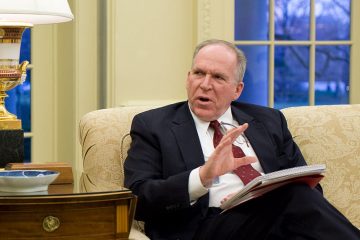
Brennan: “I don’t do evidence.” (White House photo)
That was what Republican Rep. Trey Gowdy was wondering when he grilled former CIA director John Brennan on May 23, 2017 on what evidence he had provided to the FBI to catalyze its investigation of Trump-Russia collusion.
Brennan replied: “I don’t do evidence.”
The best Brennan could do was repeat the substance of a clearly well-rehearsed statement: “I encountered and am aware of information and intelligence that revealed contacts and interactions between Russian officials and U.S. persons involved in the Trump campaign … that required further investigation by the Bureau to determine whether or not U.S. persons were actively conspiring, colluding with Russian officials.”
That was it.
CNN joined the piling on Monday, quoting former FBI General Counsel James Baker in closed-door Congressional testimony to the effect that FBI officials were weighing “whether Trump was acting at the behest of [the Russians] and somehow following directions, somehow executing their will.” The problem is CNN also noted that Lisa Page, counsel to then FBI Acting Director Andrew McCabe, testified that there had been “indecision in the Bureau as to whether there was sufficient predication to open [the investigation].’ “Predication” is another word for evidence.
Within hours of Comey’s firing on May 9, 2017, Page’s boyfriend and a top FBI counterintelligence official, Peter Strzok texted her: “We need to open the case we’ve been waiting on now while Andy [McCabe] is acting [director].” After all, if Trump were bold enough, he could have appointed a new FBI director and who knew what might happen then. When Page appeared before Congress, she was reportedly asked what McCabe meant. She confirmed that his text was related to the Russia investigation into potential collusion.
Comey v. Trump Goes Back to Jan. 6, 2017
The Times and CNN, however unintentionally, have shed light on what ensued after Trump finally fired Comey. Apparently, it finally dawned on Trump that, on Jan. 6, 2017, Comey had treated him to the time-honored initiation-rite-for-presidents-elect — with rubrics designed by former FBI Director J. Edgar Hoover.
It seems then-FBI Director James Comey rendered a good impersonation of Hoover that day when he briefed President-elect Trump on the scurrilous “Steele dossier” that the FBI had assembled on Trump. Excerpts from an interview Trump gave to the Times (below) after the firing throw light on what Trump says was at least part of his motivation to dump Comey.
To dramatize the sensitivity of the dossier, Comey asked then-National Intelligence Director James Clapper and the heads of the CIA and NSA to depart the room at the Trump Tower, leaving Comey alone with the President-elect. The Gang of Four had already briefed Trump on the evidence-impoverished “Intelligence Community Assessment.” That “assessment” alleged that Putin himself ordered his minions to help Trump win. The dossier had been leaked to the media, which withheld it but Buzzfeed published it on Jan. 10.?
‘This Russia Thing’
Evidently, it took Trump four months to fully realize he was being played, and that he couldn’t expect the “loyalty” he is said to have asked of Comey. So Trump fired Comey on May 9. Two days later he told NBC’s Lester Holt:
“When I decided to just do it, I said to myself, I said, ‘You know, this Russia thing with Trump and Russia is a made-up story, it’s an excuse by the Democrats for having lost an election that they should’ve won.’”
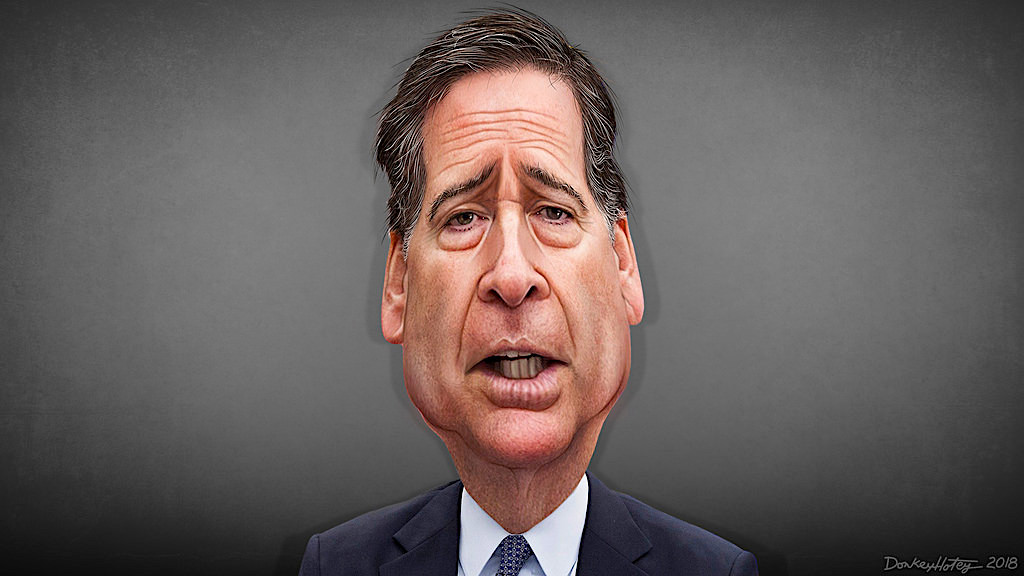
Comey: Pulled a Hoover on Trump? (Carciature by DonkeyHotey)
The mainstream media and other Russia-gater aficionados immediately seized on “this Russian thing” as proof that Trump was trying to obstruct the investigation of alleged Russian collusion with the Trump campaign. However, in the Holt interview Trump appeared to be reflecting on Comey’s J. Edgar Hoover-style, one-on-one gambit alone in the room with Trump.
Would Comey really do a thing like that? Was the former FBI director protesting too much in his June 2017 testimony to the Senate Intelligence Committee when he insisted he’d tried to make it clear to Trump that briefing him on the unverified but scurrilous information in the dossier wasn’t intended to be threatening. It took a few months but it seems Trump figured out what he thought Comey was up to.
Trump to NYT: ‘Leverage’ (aka Blackmail)
In a long Oval Office interview with the Times on July 19, 2017, Trump said he thought Comey was trying to hold the dossier over his head.
“… Look what they did to me with Russia, and it was totally phony stuff. … the dossier … Now, that was totally made-up stuff,” Trump said. “I went there [to Moscow] for one day for the Miss Universe contest, I turned around, I went back. It was so disgraceful. It was so disgraceful.
“When he [James B. Comey] brought it [the dossier] to me, I said this is really made-up junk. I didn’t think about anything. I just thought about, man, this is such a phony deal. … I said, this is — honestly, it was so wrong, and they didn’t know I was just there for a very short period of time. It was so wrong, and I was with groups of people. It was so wrong that I really didn’t, I didn’t think about motive. I didn’t know what to think other than, this is really phony stuff.”
The dossier, paid for by the Democratic National Committee and the Clinton campaign and compiled by former British spy Christopher Steele, relates a tale of Trump allegedly cavorting with prostitutes, who supposedly urinated on each other before the same bed the Obamas had slept in at the Moscow Ritz-Carlton hotel. [On February 6, 2018, The Washington Post reported that that part of the dossier was written Cody Shearer, a long-time Clinton operative and passed it along to Steele. Shearer ignored a request for comment from Consortium News. [Shearer had been a Consortium advisory board member who was asked to resign and left the board.]
Trump told the Times: “I think [Comey] shared it so that I would — because the other three people [Clapper, Brennan, and Rogers] left, and he showed it to me. … So anyway, in my opinion, he shared it so that I would think he had it out there. … As leverage.
“Yeah, I think so. In retrospect. In retrospect. You know, when he wrote me the letter, he said, ‘You have every right to fire me,’ blah blah blah. Right? He said, ‘You have every right to fire me.’ I said, that’s a very strange — you know, over the years, I’ve hired a lot of people, I’ve fired a lot of people. Nobody has ever written me a letter back that you have every right to fire me.”
McGovern lays out more details during a 12-minute interview on Jan. 10 with Tyrel Ventura of “Watching the Hawks.”
Ray McGovern works with Tell the Word, a publishing arm of the ecumenical Church of the Saviour in inner-city Washington. A CIA analyst for 27 years and Washington area resident for 56 years, he has been attuned to these machinations. He is co-founder of Veteran Intelligence Professionals for Sanity (VIPS).
How a NeoCon-Backed “Fact Checker” Plans to Wage War on Independent Media
It will soon become almost impossible to avoid Newsguard’s ranking systems on any technological device sold in the United States
By Whitney Webb | Mint Press News | January 9, 2019
Soon after the social media “purge” of independent media sites and pages this past October, a top neoconservative insider — Jamie Fly — was caught stating that the mass deletion of anti-establishment and anti-war pages on Facebook and Twitter was “just the beginning” of a concerted effort by the U.S. government and powerful corporations to silence online dissent within the United States and beyond.
While a few, relatively uneventful months in the online news sphere have come and gone since Fly made this ominous warning, it appears that the neoconservatives and other standard bearers of the military-industrial complex and the U.S. oligarchy are now poised to let loose their latest digital offensive against independent media outlets that seek to expose wrongdoing in both the private and public sectors.
As MintPress News Editor-in-Chief Mnar Muhawesh recently wrote, MintPress was informed that it was under review by an organization called Newsguard Technologies, which described itself to MintPress as simply a “news rating agency” and asked Muhawesh to comment on a series of allegations, several of which were blatantly untrue. However, further examination of this organization reveals that it is funded by and deeply connected to the U.S. government, neo-conservatives, and powerful monied interests, all of whom have been working overtime since the 2016 election to silence dissent to American forever-wars and corporate-led oligarchy.
More troubling still, Newsguard — by virtue of its deep connections to government and Silicon Valley — is lobbying to have its rankings of news sites installed by default on computers in U.S. public libraries, schools, and universities as well as on all smartphones and computers sold in the United States.
In other words, as Newsguard’s project advances, it will soon become almost impossible to avoid this neocon-approved news site’s ranking systems on any technological device sold in the United States. Worse still, if its efforts to quash dissenting voices in the U.S. are successful, Newsguard promises that its next move will be to take its system global.
Red light, green light . . .
Newsguard has received considerable attention in the mainstream media of late, having been the subject of a slew of articles in the Washington Post, the Hill, the Boston Globe, Politico, Bloomberg, Wired, and many others just over the past few months. Those articles portray Newsguard as using “old-school journalism” to fight “fake news” through its reliance on nine criteria allegedly intended to separate the wheat from the chaff when it comes to online news.
Newsguard separates sites it deems worthy and sites it considers unreliable by using a color-coded rating — green, yellow, or red — and more detailed “nutrition labels” regarding a site’s credibility or lack thereof. Rankings are created by Newsguard’s team of “trained analysts.” The color-coding system may remind some readers of the color-coded terror threat-level warning system that was created after 9/11, making it worth noting that Tom Ridge, the former secretary of Homeland Security who oversaw the implementation of that system under George W. Bush, is on Newsguard’s advisory board.
As Newsguard releases a new rating of a site, that rating automatically spreads to all computers that have installed its news ranking browser plug-in. That plug-in is currently available for free for the most commonly used internet browsers. NewsGuard directly markets the browser plug-in to libraries, schools and internet users in general.
According to its website, Newsguard has rated more than 2,000 news and information sites. However, it plans to take its ranking efforts much farther by eventually reviewing “the 7,500 most-read news and information websites in the U.S.—about 98 percent of news and information people read and share online” in the United States in English.
A recent Gallup study, which was supported and funded by Newsguard as well as the Knight Foundation (itself a major investor in Newsguard), stated that a green rating increased users likelihood to share and read content while a red rating decreased that likelihood. Specifically, it found 63 percent would be less likely to share news stories from red-rated websites, and 56 percent would be more likely to share news from green-rated websites, though the fact that Newsguard and one of its top investors funded the poll makes it necessary to take these findings with a grain of salt.
However, some of the rankings Newsguard itself has publicized show that it is manifestly uninterested in fighting “misinformation.” How else to explain the fact that the Washington Post and CNN both received high scores even though both have written stories or made statements that later proved to be entirely false? For example, CNN falsely claimed in 2016 that it was illegal for Americans to read WikiLeaks releases and illegally colluded with the DNC to craft presidential debate questions.
In addition, in 2017, CNN published a fake story that a Russian bank linked to a close ally of President Donald Trump was under Senate investigation. That same year, CNN was forced to retract a report that the Trump campaign had been tipped off early about WikiLeaks documents damaging to Hillary Clinton when it later learned the alert was about material already publicly available.
The Washington Post, whose $600 million conflict of interest with the CIA goes unnoted by Newsguard, has also published false stories since the 2016 election, including one article that falsely claimed that “Russian hackers” had tapped into Vermont’s electrical grid. It was later found that the grid itself was never breached and the “hack” was only an isolated laptop with a minor malware problem. Yet, such acts of journalistic malpractice are apparently of little concern to Newsguard when those committing such acts are big-name corporate media outlets.
Furthermore, Newsguard gives a high rating to Voice of America, the U.S. state-funded media outlet, even though its former acting associate director said that the outlet produces “fluff journalism” and despite the fact that it was recently reformed to “provide news that supports our [U.S.] national security objectives.” However, RT receives a low “red” rating for being funded by the Russian government and for “raising doubts about other countries and their institutions” (i.e., including reporting critical of the institutions and governments of the U.S. and its allies).
Keeping the conversation safe for the corporatocracy
Newsguard describes itself as an organization dedicated to “restoring trust and accountability” and using “journalism to fight false news, misinformation and disinformation.” While it repeatedly claims on its website that its employees “have no political axes to grind” and “care deeply about reliable journalism’s pivotal role in democracy,” a quick look at its co-founders, top funders and advisory board make it clear that Newsguard is aimed at curbing voices that hold the powerful — in both government and the private sector — to account.
Newsguard is the latest venture to result from the partnership between Steven Brill and Louis Gordon Crovitz, who currently serve as co-CEOs of the group. Brill is a long-time journalist — published in TIME and The New Yorker, among others — who most recently founded the Yale Journalism Initiative, which aims to encourage Yale students who “aspire to contribute to democracy in the United States and around the world” to become journalists at top U.S. and international media organizations. He first teamed up with Crovitz in 2009 to create Journalism Online, which sought to make the online presence of top American newspapers and other publishers profitable, and was also the CEO of the company that partnered up with the TSA to offer “registered” travelers the ability to move more quickly through airport security — for a price, of course.
While Brill’s past does not in itself raise red flags, Crovitz — his partner in founding Journalism Online, then Press+, and now Newsguard — is the last person one would expect to find promoting any legitimate effort to “restore trust and accountability” in journalism. In the early 1980s. Crovitz held a number of positions at Dow Jones and at the Wall Street Journal, eventually becoming executive vice president of the former and the publisher of the latter before both were sold to Rupert Murdoch’s News Corp in 2007. He is also a board member of Business Insider, which has received over $30 million from Washington Post owner Jeff Bezos in recent years.
In addition to being a member of the Council on Foreign Relations, Crovitz proudly notes in his bio, available on Newsguard’s website, that he has been an “editor or contributor to books published by the American Enterprise Institute and Heritage Foundation.” Though many MintPress readers are likely familiar with these two institutions, for those who are not, it is worth pointing out that the American Enterprise Institute (AEI) is one of the most influential neoconservative think tanks in the country and its “scholars,” directors and fellows have included neoconservative figures like Paul Wolfowitz, Richard Perle, John Bolton and Frederick Kagan.
During the George W. Bush administration, AEI was instrumental in promoting the invasion and subsequent occupation of Iraq and has since advocated for militaristic solutions to U.S. foreign policy objectives and the expansion of the U.S.’ military empire as well as the “War on Terror.” During the Bush years, AEI was also closely associated with the now defunct and controversial neoconservative organization known as the Project for a New American Century (PNAC), which presciently called, four years before 9/11, for a “new Pearl Harbor” as needed to rally support behind American military adventurism.
The Heritage Foundation, like AEI, was also supportive of the war in Iraq and has pushed for the expansion of the War on Terror and U.S. missile defense and military empire. Its corporate donors over the years have included Procter & Gamble, Chase Manhattan Bank, Dow Chemical, and Exxon Mobil, among others.
Crovitz’s associations with AEI and the Heritage Foundation, as well as his ties to Wall Street and the upper echelons of corporate media, are enough to make any thinking person question his commitment to being a fair watchdog of “legitimate journalism.” Yet, beyond his innumerable connections to neoconservatives and powerful monied interest, Crovitz has repeatedly been accused of inserting misinformation into his Wall Street Journal columns, with groups like the Electronic Frontier Foundation accusing him of “repeatedly getting his facts wrong” on NSA surveillance and other issues. Some of the blatant falsehoods that have appeared in Crovitz’s work have never been corrected, even when his own sources called him out for misinformation.
For example, in a WSJ opinion piece that was written by Crovitz in 2012, Crovitz was accused of making “fantastically false claims” about the history of the internet by the very people he had cited to support those claims.
As TechDirt wrote at the time:
Almost everyone he [Crovitz] sourced or credited to support his argument that the internet was invented entirely privately at Xerox PARC and when Vint Cerf helped create TCP/IP, has spoken out to say he’s wrong. And that list includes both Vint Cerf, himself, and Xerox. Other sources, including Robert Taylor (who was there when the internet was invented) and Michael Hiltzik, have rejected Crovitz’s spinning of their own stories.”
The oligarch team’s deep bench
While Brill and Crovitz’s connections alone should be enough cause for alarm, a cursory examination of Newsguard’s advisory board makes it clear that Newsguard was created to serve the interests of American oligarchy. Chief among Newsguard’s advisors are Tom Ridge, the first Secretary of Homeland Security under George W. Bush and Ret. General Michael Hayden, a former CIA director, a former NSA director and principal at the Chertoff Group, a security consultancy seeking to “advise corporate clients and governments, including foreign governments” on security matters that was co-founded by former Homeland Security Secretary Michael Chertoff, who also currently serves as the board chairman of major weapons manufacturer BAE systems.
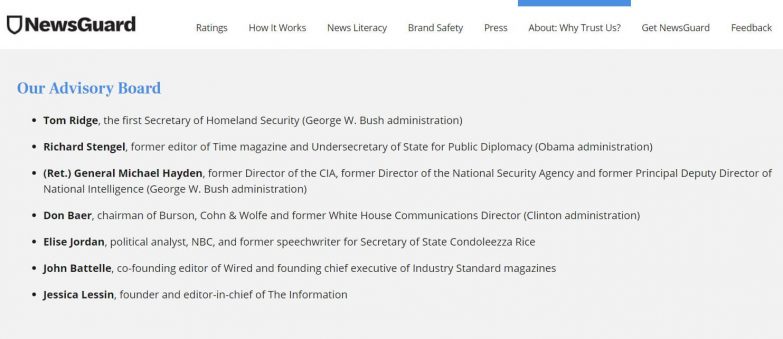
Another Newsguard advisor of note is Richard Stengel, former editor of Time magazine, a “distinguished fellow” at the Atlantic Council and Undersecretary of State for Public Diplomacy under President Barack Obama. At a panel discussion hosted last May by the Council on Foreign Relations, Stengel described his past position at the State Department as “chief propagandist” and also stated that he is “not against propaganda. Every country does it and they have to do it to their own population and I don’t necessarily think it’s that awful.”
Other Newsguard advisors include Don Baer, former White House communications director and advisor to Bill Clinton and current chairman of both PBS and the influential PR firm Burson Cohn & Wolfe as well as Elise Jordan, former communications director for the National Security Council and former speech-writer for Condoleezza Rice, as well as the widow of slain journalist Michael Hastings — who was writing an exposé on former CIA director John Brennan at the time of his suspicious death.
A look at Newguard’s investors further illustrates the multifarious connections between this organization and the American political and corporate elite. While Brill and Crovitz themselves are the company’s top investors, one of Newsguard’s most important investors is the Publicis Groupe. Publicis is the third largest global communications company in the world, with more than 80,000 employees in over 100 countries and an annual revenue of over €9.6 billion ($10.98 billion) in 2017. It is no stranger to controversy, as one of its subsidiaries, Qorvis, recently came under fire for exploiting U.S. veterans at the behest of the Saudi government and also helped the Saudi government to “whitewash” its human rights record and its genocidal war in Yemen after receiving $6 million from the Gulf Kingdom in 2017.
Furthermore, given its size and influence, it is unsurprising that the Publicis Groupe counts many powerful corporations and governments among its clientele. Some of its top clients in 2018 included pharmaceutical giants Eli Lilly, Merck, Pfizer and Bayer/Monsanto as well as Starbucks, Procter & Gamble, McDonalds, Kraft Heinz, Burger King, and the governments of Australia and Saudi Arabia. Given its influential role in funding Newsguard, it is reasonable to point out the potential conflict of interest posed by the fact that sites that accurately report on Publicis’ powerful clients — but generate bad publicity — could be targeted for such reports in Newsguard’s ranking.
In addition to the Publicis Groupe, another major investor in Newsguard is the Blue Haven Initiative, which is the venture capital “impact investment” fund of the wealthy Pritzker family — one of the top 10 wealthiest families in the U.S., best known as the owners of the Hyatt Hotel chain and for being the second largest financial contributors to Hillary Clinton’s 2016 presidential campaign.
Other top investors include John McCarter, a long-time executive at U.S. government contractor Booz Allen Hamilton, as well as Thomas Glocer, former CEO of Reuters and a member of the boards of pharmaceutical giant Merck & Co., financial behemoth Morgan Stanley, and the Council on Foreign Relations, as well as a member of the Atlantic Council’s International Advisory Board.
Through these investors, Newsguard managed to raise $6 million to begin its ranking efforts in March of 2018. Newsguard’s actual revenues and financing, however, have not been disclosed despite the fact that it requires the sites it ranks to disclose their funding. In a display of pure hypocrisy, Newsguard’s United States Securities and Exchange Commission Form D — which was filed March 5, 2018 — states that the company “declined to disclose” the size of its total revenue.
Why give folks a choice?
While even a quick glance at its advisory board alone would be enough for many Americans to decline to install Newsguard’s browser extension on their devices, the danger of Newsguard is the fact that it is diligently working to make the adoption of its app involuntary. Indeed, if voluntary adoption of Newsguard’s app were the case, there would likely be little cause for concern, given that its website attracts barely more than 300 visits per month and its social-media following is relatively small, with just over 2,000 Twitter followers and barely 500 Facebook likes at the time of this article’s publication.
To illustrate its slip-it-under-the-radar strategy, Newsguard has gone directly to state governments to push its browser extension onto entire state public library systems, even though its website suggests that individual public libraries are welcome to install the extension if they so choose. The first state to install Newsguard on all of its public library computers across its 51 branches was the state of Hawaii — which was the first to partner with Newsguard’s “news literacy initiative,” just last month.
According to local media, Newsguard “now works with library systems representing public libraries across the country, and is also partnering with middle schools, high schools, universities, and educational organizations to support their news literacy efforts,” suggesting that these Newsguard services targeting libraries and schools are soon to become a compulsory component of the American library and education system, despite Newsguard’s glaring conflicts of interest with massive multinational corporations and powerful government power-brokers.
Notably, Newsguard has a powerful partner that has allowed it to start finding its way into public library and school computers throughout the country. As part of its new “Defending Democracy” initiative, Microsoft announced last August that it would be partnering with Newsguard to actively market the company’s ranking app and other services to libraries and schools throughout the country. Microsoft’s press release regarding the partnership states that Newsguard “will empower voters by providing them with high-quality information about the integrity and transparency of online news sites.”
Since then, Microsoft has now added the Newsguard app as a built-in feature of Microsoft Edge, its browser for iOS and Android mobile devices, and is unlikely to stop there. Indeed, as a recent report in favor of Microsoft’s partnership with Newsguard noted, “we could hope that this new partnership will allow Microsoft to add NewsGuard to Edge on Windows 10 [operating system for computers] as well.”
Newsguard, for its part, seems confident that its app will soon be added by default to all mobile devices. On its website, the organization notes that “NewsGuard will be available on mobile devices when the digital platforms such as social media sites and search engines or mobile operating systems add our ratings and Nutrition Labels directly.” This shows that Newsguard isn’t expecting its rating systems to be offered as a downloadable application for mobile devices but something that social media sites like Facebook, search engines like Google, and mobile device operating systems that are dominated by Apple and Google will “directly” integrate into nearly every smartphone and tablet sold in the United States.
A Boston Globe article on Newsguard from this past October makes this plan even more clear. The Globe wrote at the time:
Microsoft has already agreed to make NewsGuard a built-in feature in future products, and [Newsguard co-CEO] Brill said he’s in talks with other online titans. The goal is to have NewsGuard running by default on our computers and phones whenever we scan the Web for news.”
This eventuality is made all the more likely given the fact that, in addition to Microsoft, Newsguard is also closely connected to Google, as Google has been a partner of the Publicis Groupe since 2014, when the two massive companies joined Condé Nast to create a new marketing service called La Maison that is “focused on producing engaging content for marketers in the luxury space.” Given Google’s power in the digital sphere as the dominant search engine, the creator of the Android mobile operating system, and the owner of YouTube, its partnership with Publicis means that Newsguard’s rating system will soon see itself being promoted by yet another of Silicon Valley’s most powerful companies.
Furthermore, there is an effort underway to integrate Newsguard into social media sites like Facebook and Twitter. Indeed, as Newsguard was launched, co-CEO Brill stated that he planned to sell the company’s ratings of news sites to Facebook and Twitter. Last March, Brill told CNN that “We’re asking them [Facebook, Twitter, Microsoft and Google] to pay a fraction of what they pay their P.R. people and their lobbyists to talk about the problem.”
On Wednesday, Gallup released a poll that will likely be used as a major selling point to social media giants. The poll — funded by Newsguard and the Knight Foundation, which is a top investor in Newsguard and has recently funded a series of Gallup polls relating to online news — seems to have been created with the intention of manufacturing consent for the integration of Newsguard with top social media sites.
This is because the promoted findings from the study are as follows:“89% of users of social media sites and 83% overall want social media sites and search engines to integrate NewsGuard ratings and reviews into their news feeds and search results” and “69% would trust social media and search companies more if they took the simple step of including NewsGuard in their products.” However, a disclaimer at the end of the poll states that the results, which were based on the responses of 706 people each of whom received $2 to participate, “may not be reflective of attitudes of the broader U.S adult population.”
With trust at Facebook nose-diving and Facebook’s censorship of independent media already well underway, the findings of this poll could well be used to justify its integration into Facebook’s platform. The connections of both Newsguard and Facebook to the Atlantic Council make this seem a given.
Financial censorship
Another Newsguard service shows that this organization is also seeking to harm independent media financially by targeting online revenue. Through a service called “Brandguard,” which it describes as a “brand safety tool aimed at helping advertisers keep their brands off of unreliable news and information sites while giving them the assurance they need to support thousands of Green-rated [i.e., Newsguard-approved] news and information sites, big and small.”
At the time the service was announced last November, Newsguard co-CEO Brill stated that the company was “in discussions with the ad tech firms, leading agencies, and major advertisers” eager to adopt a blacklist of news sites deemed “unreliable” by Newsguard. This is unsurprising given the leading role of the Publicis Groupe, one of the world’s largest advertising and PR firms, has in funding Newsguard. As a consequence, it seems likely that many, if not all, of Publicis’ client companies will choose to adopt this blacklist to help crush many of the news sites that are unafraid to hold them accountable.
It is also important to note here that Google’s connection to Publicis and thus Newsguard could spell trouble for independent news pages that rely on Google Adsense for some or all of their ad-based revenue. Google Adsense has long been targeting sites like MintPress by demonetizing articles for information or photographs it deemed controversial, including demonetizing one article for including a photo showing U.S. soldiers involved in torturing Iraqi detainees at the infamous Abu Ghraib prison.
Since then, Google — a U.S. military contractor — has repeatedly tried to shutter ad access to MintPress articles that involve reporting that is critical of U.S. empire and military expansion. One article that has been repeatedly flagged by Google details how many African-Americans have questioned whether the Women’s March has aided or harmed the advancement of African-Americans in the United States. Google has repeatedly claimed that the article, which was written by African-American author and former Washington Post bureau chief Jon Jeter, contains “dangerous content.”
Given Google’s already established practice of targeting factual reporting it deemed controversial through Adsense, Brandguard will likely offer the tech giant just the excuse it needs to cut off sites like MintPress, and other pages equally critical of empire, altogether.
An action plan for the genuine protection of journalism
Though it is just getting started, Newsguard’s plan to insert its app into every device and major social-media network is a threat to any news site that regularly publishes information that rubs any of Newsguard’s investors, partners or advisors the wrong way. Given its plan to rank the English-language U.S. news sites that account for 98 percent of U.S. digital news consumption, Newsguard’s agenda is of the utmost concern to every independent media page active in the United States and beyond — given Newsguard’s promise to take its project global.
By linking up with former CIA and NSA directors, Silicon Valley Giants, and massive PR firms working for some of the most controversial governments and corporations in the world, Newsguard has betrayed the fact that it is not actually seeking to “restore trust and accountability” in journalism, but to “restore trust and accountability” in news outlets that protect the existing power structure and help shield the corporate-led oligarchy and military-industrial complex from criticism.
Not only is it trying to tank the reputations of independent media through its biased ranking system, Newsguard is also seeking to attack these alternative voices financially and by slipping its ranking system by default onto all computers and phones sold in the U.S.
However, Newsguard and it agenda of guarding the establishment from criticism can be stopped. By supporting independent media and unplugging from social media sites committed to censorship, like Facebook and Twitter, we can strengthen the independent media community and keep it afloat despite the unprecedented nature of these attacks on free speech and watchdog journalism.
Beyond that, a key way to keep Newsguard and those behind it on their toes is to hold them to account by pointing out their clear conflicts of interest and hypocrisy and by derailing the narrative they are carefully crafting that Newsguard is “non-partisan,” “trustworthy,” and true guardians against the scourge of “fake news.”
While this report has sought to be a starting point for such work, anyone concerned about Newsguard and its connections to the war machine and corrupt corporations should feel encouraged to point out the organization’s own conflicts of interests and shady connections via its Twitter and Facebook pages and the feedback section on Newsguard’s website. The best way to defeat this new tool of the neocons is to put them on notice and to continue to expose Newsguard as a guardian of empire, not a guardian of journalism.
Whitney Webb is a staff writer for MintPress News and a contributor to Ben Swann’s Truth in Media. Her work has appeared on Global Research, the Ron Paul Institute and 21st Century Wire, among others. She has also made radio and TV appearances on RT and Sputnik. She currently lives with her family in southern Chile.
A Look Back at Clapper’s Jan. 2017 ‘Assessment’ on Russia-gate
By Ray McGovern | Consortium News | January 8, 2019
The banner headline atop page one of The New York Times two years ago today, on January 7, 2017, set the tone for two years of Dick Cheney-like chicanery: “Putin Led Scheme to Aid Trump, Report Says.”
Under a edia drumbeat of anti-Russian hysteria, credulous Americans were led to believe that Donald Trump owed his election victory to the president of Russia, and that Trump, according to the Times, “colluded” in Putin’s “interference … to help President-elect Trump’s election chances when possible by discrediting Secretary Clinton.”
Hard evidence supporting the media and political rhetoric has been as elusive as proof of weapons of mass destruction in Iraq in 2002-2003. This time, though, an alarming increase in the possibility of war with nuclear-armed Russia has ensued — whether by design, hubris, or rank stupidity. The possible consequences for the world are even more dire than 16 years of war and destruction in the Middle East.
If It Walks Like a Canard…
The CIA-friendly New York Times two years ago led the media quacking in a campaign that wobbled like a duck, canard in French.
A glance at the title of the Intelligence Community Assessment (ICA) (which was not endorsed by the whole community) — “Assessing Russian Activities and Intentions in Recent US Elections” — would suffice to show that the widely respected and independently-minded State Department intelligence bureau should have been included. State intelligence had demurred on several points made in the Oct. 2002 Estimate on Iraq, and even insisted on including a footnote of dissent. James Clapper, then director of national intelligence who put together the ICA, knew that all too well. So he evidently thought it would be better not to involve troublesome dissenters, or even inform them what was afoot.
Similarly, the Defense Intelligence Agency should have been included, particularly since it has considerable expertise on the G.R.U., the Russian military intelligence agency, which has been blamed for Russian hacking of the DNC emails. But DIA, too, has an independent streak and, in fact, is capable of reaching judgments Clapper would reject as anathema. Just one year before Clapper decided to do the rump “Intelligence Community Assessment,” DIA had formally blessed the following heterodox idea in its “December 2015 National Security Strategy”:
“The Kremlin is convinced the United States is laying the groundwork for regime change in Russia, a conviction further reinforced by the events in Ukraine. Moscow views the United States as the critical driver behind the crisis in Ukraine and believes that the overthrow of former Ukrainian President Yanukovych is the latest move in a long-established pattern of U.S.-orchestrated regime change efforts.”
Any further questions as to why the Defense Intelligence Agency was kept away from the ICA drafting table?
Handpicked Analysts
With help from the Times and other mainstream media, Clapper, mostly by his silence, was able to foster the charade that the ICA was actually a bonafide product of the entire intelligence community for as long as he could get away with it. After four months it came time to fess up that the ICA had not been prepared, as Secretary Clinton and the media kept claiming, by “all 17 intelligence agencies.”
In fact, Clapper went one better, proudly asserting — with striking naiveté — that the ICA writers were “handpicked analysts” from only the FBI, CIA, and NSA. He may have thought that this would enhance the ICA’s credibility. It is a no-brainer, however, that when you want handpicked answers, you better handpick the analysts. And so he did.
Why is no one interested in the identities of the handpicked analysts and the hand-pickers? After all, we have the names of the chief analysts/managers responsible for the fraudulent NIE of October 2002 that greased the skids for the war on Iraq. Listed in the NIE itself are the principal analyst Robert D. Walpole and his chief assistants Paul Pillar, Lawrence K. Gershwin and Maj. Gen. John R. Landry.
The Overlooked Disclaimer
Buried in an inside page of the Times‘ Jan. 7, 2017 report was a cautionary paragraph by reporter Scott Shane. It seems he had read the ICA all the way through, and had taken due note of the derriere-protecting caveats included in the strangely cobbled together report. Shane had to wade through nine pages of drivel about “Russia’s Propaganda Efforts” to reach Annex B with its curious disclaimer:
“Assessments are based on collected information, which is often incomplete or fragmentary, as well as logic, argumentation, and precedents. … High confidence in a judgment does not imply that the assessment is a fact or a certainty; such judgments might be wrong.”
Small wonder, then, that Shane noted: “What is missing from the public report is what many Americans most eagerly anticipated: hard evidence to back up the agencies’ claims that the Russian government engineered the election attack. This a significant omission.”
Since then, Shane has evidently realized what side his bread is buttered on and has joined the ranks of Russia-gate aficionados. Decades ago, he did some good reporting on such issues, so it was sad to see him decide to blend in with the likes of David Sanger and promote the NYT official Russia-gate narrative. An embarrassing feature, “The Plot to Subvert an Election: Unraveling the Russia Story So Far,” that Shane wrote with NYT colleague Mark Mazzetti in September, is full of gaping holes, picked apart in two pieces by Consortium News.
Shades of WMD
Sanger is one of the intelligence community’s favorite go-to journalists. He was second only to the disgraced Judith Miller in promoting the canard of weapons of mass destruction in Iraq before the U.S. invasion in March 2003. For example, in a July 29, 2002 article, “U.S. Exploring Baghdad Strike As Iraq Option,” co-written by Sanger and Thom Shanker, the existence of WMD in Iraq was stated as flat fact no fewer than seven times.
The Sanger/Shanker article appeared just a week after then-CIA Director George Tenet confided to his British counterpart that President George W. Bush had decided “to remove Saddam, through military action, justified by the conjunction of terrorism and WMD. But the intelligence and facts were being fixed around the policy.” At that critical juncture, Clapper was in charge of the analysis of satellite imagery and hid the fact that the number of confirmed WMD sites in Iraq was zero.
Despite that fact and that his “assessment” has never been proven, Clapper continues to receive praise.
During a “briefing” I attended at the Carnegie Endowment in Washington several weeks ago, Clapper displayed master circular reasoning, saying in effect, that the assessment had to be correct because that’s what he and other intelligence directors told President Barack Obama and President-elect Donald Trump.
I got a chance to question him at the event. His disingenuous answers brought a painful flashback to one of the most shameful episodes in the annals of U.S. intelligence analysis.
Ray McGovern: My name is Ray McGovern. Thanks for this book; it’s very interesting [Ray holds up his copy of Clapper’s memoir]. I’m part of Veteran Intelligence Professionals for Sanity. I’d like to refer to the Russia problem, but first there’s an analogy that I see here. You were in charge of imagery analysis before Iraq.
James Clapper: Yes.
RM: You confess [in the book] to having been shocked that no weapons of mass destruction were found. And then, to your credit, you admit, as you say here [quotes from the book], “the blame is due to intelligence officers, including me, who were so eager to help [the administration make war on Iraq] that we found what wasn’t really there.”
Now fast forward to two years ago. Your superiors were hell bent on finding ways to blame Trump’s victory on the Russians. Do you think that your efforts were guilty of the same sin here? Do you think that you found a lot of things that weren’t really there? Because that’s what our conclusion is, especially from the technical end. There was no hacking of the DNC; it was leaked, and you know that because you talked to NSA.
JC: Well, I have talked with NSA a lot, and I also know what we briefed to then-President Elect Trump on the 6th of January. And in my mind, uh, I spent a lot of time in the SIGINT [signals intelligence] business, the forensic evidence was overwhelming about what the Russians had done. There’s absolutely no doubt in my mind whatsoever. The Intelligence Community Assessment that we rendered that day, that was asked, tasked to us by President Obama — and uh — in early December, made no call whatsoever on whether, to what extent the Russians influenced the outcome of the election. Uh, the administration, uh, the team then, the President-Elect’s team, wanted to say that — that we said that the Russian interference had no impact whatsoever on the election. And I attempted, we all did, to try to correct that misapprehension as they were writing a press release before we left the room.
However, as a private citizen, understanding the magnitude of what the Russians did and the number of citizens in our country they reached and the different mechanisms that, by which they reached them, to me it stretches credulity to think they didn’t have a profound impact on election on the outcome of the election.
RM: That’s what the New York Times says. But let me say this: we have two former Technical Directors from NSA in our movement here, Veteran Intelligence Professionals for Sanity; we also have forensics, okay?
Now the President himself, your President, President Obama said two days before he left town: The conclusions of the intelligence community — this is ten days after you briefed him — with respect to how WikiLeaks got the DNC emails are “inconclusive” end quote. Now why would he say that if you had said it was conclusive?
JC: I can’t explain what he said or why. But I can tell you we’re, we’re pretty sure we know, or knew at the time, how WikiLeaks got those emails. I’m not going to go into the technical details about why we believe that.
RM: We are too [pretty sure we know]; and it was a leak onto a thumb drive — gotten to Julian Assange — really simple. If you knew it, and the NSA has that information, you have a duty, you have a duty to confess to that, as well as to [Iraq].
JC: Confess to what?
RM: Confess to the fact that you’ve been distorting the evidence.
JC: I don’t confess to that.
RM: The Intelligence Community Assessment was without evidence.
JC: I do not confess to that. I simply do not agree with your conclusions.
William J. Burns (Carnegie President): Hey, Ray, I appreciate your question. I didn’t want this to look like Jim Acosta in the White House grabbing microphones away. Thank you for the questioning though. Yes ma’am [Burns recognizes the next questioner].
The above exchange can be seen starting at 28:45 in this video.
Not Worth His Salt
Having supervised intelligence analysis, including chairing National Intelligence Estimates, for three-quarters of my 27-year career at CIA, my antennae are fine-tuned for canards. And so, at Carnegie, when Clapper focused on the rump analysis masquerading as an “Intelligence Community Assessment,” the scent of the duck came back strongly.
Intelligence analysts worth their salt give very close scrutiny to sources, their possible agendas, and their records for truthfulness. Clapper flunks on his own record, including his performance before the Iraq war — not to mention his giving sworn testimony to Congress that he had to admit was “clearly erroneous,” when documents released by Edward Snowden proved him a perjurer. At Carnegie, the questioner who followed me brought that up and asked, “How on earth did you keep your job, Sir?”
The next questioner, a former manager of State Department intelligence, posed another salient question: Why, he asked, was State Department intelligence excluded from the “Intelligence Community Assessment”?
Among the dubious reasons Clapper gave was the claim, “We only had a month, and so it wasn’t treated as a full-up National Intelligence Estimate where all 16 members of the intelligence community would pass judgment on it.” Clapper then tried to spread the blame around (“That was a deliberate decision that we made and that I agreed with”), but as director of national intelligence the decision was his.
Given the questioner’s experience in the State Department’s intelligence, he was painfully aware of how quickly a “full-up NIE” can be prepared. He knew all too well that the October 2002 NIE, “Iraq’s Continuing Programs for Weapons of Mass Destruction,” was ginned up in less than a month, when Cheney and Bush wanted to get Congress to vote for war on Iraq. (As head of imagery analysis, Clapper signed off on that meretricious estimate, even though he knew no WMD sites had been confirmed in Iraq.)
It’s in the Russians’ DNA
The criteria Clapper used to handpick his own assistants are not hard to divine. An Air Force general in the mold of Curtis LeMay, Clapper knows all about “the Russians.” And he does not like them, not one bit. During an interview with NBC on May 28, 2017, Clapper referred to “the historical practices of the Russians, who typically, are almost genetically driven to co-opt, penetrate, gain favor, whatever, which is a typical Russian technique.” And just before I questioned him at Carnegie, he muttered, “It’s in their DNA.”
Even those who may accept Clapper’s bizarre views about Russian genetics still lack credible proof that (as the ICA concludes “with high confidence”) Russia’s main military intelligence unit, the G.R.U., created a “persona” called Guccifer 2.0 to release the emails of the Democratic National Committee. When those disclosures received what was seen as insufficient attention, the G.R.U. “relayed material it acquired from the D.N.C. and senior Democratic officials to WikiLeaks,” the assessment said.
At Carnegie, Clapper cited “forensics.” But forensics from where? To his embarrassment, then-FBI Director James Comey, for reasons best known to him, chose not to do forensics on the “Russian hack” of the DNC computers, preferring to rely on a computer outfit of tawdry reputation hired by the DNC. Moreover, there is zero indication that the drafters of the ICA had any reliable forensics to work with.
In contrast, Veteran Intelligence Professionals for Sanity, working with independent forensic investigators, examined metadata from a July 5, 2016 DNC intrusion that was alleged to be a “hack.” However, the metadata showed a transfer speed far exceeding the capacity of the Internet at the time. Actually, all the speed turned out to be precisely what a thumb drive could accommodate, indicating that what was involved was a copy onto an external storage device and not a hack — by Russia or anyone else.
WikiLeaks had obtained the DNC emails earlier. On June 12, 2016 Julian Assange announced he had “emails relating to Hillary Clinton.” NSA appears to lack any evidence that those emails — the embarrassing ones showing that the DNC cards were stacked against Bernie Sanders — were hacked.
Since NSA’s dragnet coverage scoops up everything on the Internet, NSA or its partners can, and do trace all hacks. In the absence of evidence that the DNC was hacked, all available factual evidence indicates that earlier in the spring of 2016, an external storage device like a thumb drive was used in copying the DNC emails given to WikiLeaks.
Additional investigation has proved Guccifer 2.0 to be an out-and-out fabrication — and a faulty basis for indictments.
A Gaping Gap
Clapper and the directors of the CIA, FBI, and NSA briefed President Obama on the ICA on Jan. 5, 2007, the day before they briefed President-elect Trump. At Carnegie, I asked Clapper to explain why President Obama still had serious doubts. On Jan. 18, 2017, at his final press conference, Obama saw fit to use lawyerly language to cover his own derriere, saying: “The conclusions of the intelligence community with respect to the Russian hacking were not conclusive as to whether WikiLeaks was witting or not in being the conduit through which we heard about the DNC e-mails that were leaked.”
So we end up with “inconclusive conclusions” on that admittedly crucial point. In other words, U.S. intelligence does not know how the DNC emails got to WikiLeaks. In the absence of any evidence from NSA (or from its foreign partners) of an Internet hack of the DNC emails the claim that “the Russians gave the DNC emails to WikiLeaks” rests on thin gruel. After all, these agencies collect everything that goes over the Internet.
Clapper answered: “I cannot explain what he [Obama] said or why. But I can tell you we’re, we’re pretty sure we know, or knew at the time, how WikiLeaks got those emails.”
Really?
Ray McGovern works with Tell the Word, a publishing arm of the ecumenical Church of the Saviour in inner-city Washington. During his 27-year CIA career he supervised intelligence analysis as Chief of Soviet Foreign Policy Branch, as editor/briefer of the President’s Daily Brief, as a member of the Production Review Staff, and as chair of National Intelligence Estimates. In retirement he co-founded Veteran Intelligence Professionals for Sanity (VIPS).
What About Clapper’s Lies?
By Jacob G. Hornberger | FFF | December 5, 2018
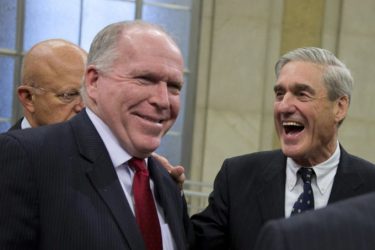 Critics of President Trump are exulting over convictions that special counsel Robert Mueller has secured in his Trump-Russia collusion investigation, some of which involve lying to Congress or to federal investigators. The critics are emphasizing the importance of telling the truth to federal officials.
Really?
Then why the continued pass for James Clapper, Jr., the former Director of National Intelligence. He lied to Congress under oath about the secret surveillance that the NSA was conducting on the American people.
Yet no indictment and punishment for Clapper. What gives with that? If telling the truth to Congress is important, then why give Clapper a pass? Is it fair to punish some people for lying and do nothing to others?
Or is it that the members of the national-security branch of the government are given elite status given their overwhelming power within the federal governmental structure?
We want to believe: ‘Russian hacking’ memo REVEALS how US intel pinned leaks to Kremlin
By Nebojsa Malic | RT | November 10, 2018
A newly-out memo containing the Obama admin’s talking points about “Russian hacking” in the 2016 election reveals how US spy agencies attributed email leaks to the Kremlin by saying it’s “consistent” with what they think Russia does.
The seven-page document was contained within the 49 pages published on Friday by BuzzFeed, which obtained them through a Freedom of Information Act (FOIA) inquiry from the Office of the Director of National Intelligence (ODNI) in late October. At the root of it is a November 29 letter by several Democrats on the Senate Intelligence Committee, asking then-President Barack Obama to declassify documents concerning “Russian Active Measures.”
The claim that Russia directly interfered in the 2016 US presidential elections – by first hacking the emails of the Democratic National Committee and Hillary Clinton’s campaign chair John Podesta, and then releasing them through DCLeaks, WikiLeaks and the hacker known as “Guccifer 2.0” – was all the rage in Washington at the time, as Democrats sought to explain the fact that Clinton just lost to Donald Trump.
Obama did not declassify the documents. Instead, he apparently instructed DNI James Clapper to respond to the senators. Moving at the speed of government, the ODNI responded on January 27 – a week after Trump’s inauguration – saying that their inquiry resulted in the January 6 release of the intelligence community assessment (ICA) on “Russian activities and intentions.”
This ended up as the infamous report making all sorts of claims and accusations but offering no evidence – and prominently featuring an annex about RT dating back from 2012.
The talking points memo sent by ODNI to the Senate Democrats has not been previously published. Reading through it, one is struck by the circular reasoning of the US “intelligence community” – or rather, Clapper’s hand-picked group of CIA, FBI and NSA people charged with coming up with the assessment.
The US intelligence community is “confident” that the Russian government was behind the “compromises” of emails, because their release is “consistent with the methods and motivations of Russian-directed efforts,” the talking points say. In other words, this fits what US spies believe are Russian objectives, therefore it had to be the Kremlin doing it!
“We believe, based on the scope and sensitivity of these efforts, that only Russia’s senior-most officials could have authorized these activities,” the memo goes on to say. Again, inference based on assumption, not evidence.
Blaming Russia for the hack of the DNC and the Democratic Congressional Campaign Committee (DCC) was based on “the forensic evidence identified by a private cyber-firm” – meaning CyberStrike, a DNC contractor led by Atlantic Council fellow Dmitry Alperovich – and the spies “own review and understanding of cyber activities by the Russian Government.”
In plain English, the evidence CrowdStrike gave the intelligence community fit its preconceived notions about Russian cyber operations, which sounds quite convenient.
Remember the accusations that several state election systems were also “hacked” by the Russians? Here is the ODNI, saying that they “are not definitively attributing the intrusions into state elections systems to the Russian Government.” But “the fact that they are consistent with Russian motivations and intent behind the DNC and DCCC intrusions, strongly suggests that Russia is responsible.”
Answering its own question whether Russia is trying to alter the outcome of the election, the ODNI says: “The Kremlin probably expects that publicity surrounding the disclosures will raise questions about the integrity of the election process and would undermine the legitimacy of the President-elect.”
At this point, any TV legal drama would have a charming courtroom lawyer shout out “Objection, speculation!” Except that passage is also a self-fulfilling prophecy. It wasn’t the disclosures of Democrat emails, however, that sowed doubts about the legitimacy of US elections, but rather the absurd conspiracy theory about Trump’s “collusion” with the Kremlin and “Russian hacking,” which the ODNI memo reveals was based on nothing more than the spies wanting to believe it was true.
The Two Brett Kavanaugh Stories
By Philip M. GIRALDI | Strategic Culture Foundation | 11.10.2018
There were two simultaneous Brett Kavanaugh stories. Together, as part of the confirmation process regarding his nomination as Supreme Court Justice, they revealed how political discourse in the United States has reached a new low, with debate over the man’s possible predilection to make judgments based on his own preferences rather than the US Constitution being ignored in favor of the politically motivated kabuki theater that was deliberately arranged to avoid that issue and instead go after his character.
Consider first of all, his flaws as a candidate. He was regularly framed as a “conservative,” but what did that mean in the context of his career? Some of the critics are referring to his time spent as a government lawyer, specifically for the George W. Bush Administration, where he was a supporter of wide executive authority in the context of the war against terror while others point to his decisions and writings during his time as a US Circuit judge from 2006 until the present. That meant essentially that Kavanaugh then supported and apparently continues to support what is now referred to as the John Yoo doctrine, named after the Department of Justice lawyer who penned the memo that made the case for the president to act unilaterally to do whatever is required in national security cases even if there be no direct or immediate threat. Yoo specifically argued that the president, by virtue of his office, is not bound by the War Crimes Act. This theory of government, also more broadly dubbed the unitary executive, was popularized by Yoo, fellow government lawyer Jay Bybee and Eric Posner of the University of Chicago.
For those who find Kavanaugh unacceptable in terms of his judicial philosophy, this repudiation of the constitutional principle of three branches of government that check each other was enough to disqualify him from a position on the Supreme Court, principally as it impacts on both the first and second articles of the constitution by granting to the president the authority to both begin and continue a war on his own recognizance. It also means that the president on his own authority can suspend first and fourth amendment rights to freedom of speech and association as well as freedom from illegal search. He supported, for example, the government’s “right” to conduct mass searches of private data such as was conducted by the NSA. Kavanaugh supports government authority to legitimize incarceration without trial and to order assassinations and torture. Kavanaugh is also on record as favoring limiting the public’s right to use the courts to redress government overreach.
But curiously enough, or perhaps not so curiously, Kavanaugh was treated with kid gloves on those critical issues, basically because both major parties are now supportive of the unitary executive concept even if they would not admit that to be the case. Bill Clinton launched cruise missiles attacks on Sudan and Afghanistan on his own authority and involved the US in a war in the Balkans. George W. Bush did the same in approving torture and expanding the war on terror to Iraq and also globally, while Barack Obama attacked both the Syrian and Libyan governments and assassinated US citizens abroad, all acts of war or war crimes carried out without a congressional declaration of war or without any real pushback by the judiciary.
The failure of Congress to carry out its duty to review Kavanaugh’s ability or lack thereof to interpret the constitution impartially was the more important story line in the confirmation process but it was ignored by the media. The other narrative that ran simultaneously, the purely political attempt made by the Democrats and some Republicans to destroy Kavanaugh as a person through the exploitation of random claims of sexual assault dating from more than thirty-five years ago, was an attempt to discredit the candidate that everyone knew right from the beginning could not be substantiated.
This all means that the important issue of Kavanaugh’s likely comportment as a judge was subjected to too little inquiry while his character as evidenced by tales from his past life received far too much attention. Ironically, the media, which has been frantically searching for an explanation for the breakdown of democracy in the United States, has been pillorying the Russians and more recently the Chinese for outside interference in the process, while ignoring the intense public dissatisfaction with the government it has been allowed to have by the Establishment, which is exemplified by the dystopic reality demonstrated by Kavanaugh. Some Americans would have rejected him based on his merits as a judge, but the case was not clearly made. Many instead came to view him as a victim of a vicious personal campaign and that was apparently enough to win confirmation, at least as reckoned by the calculus of those in Congress who cast the actual votes. In either case, the system failed to produce a good result and we only have our polarized and dysfunctional government to blame for that failure.
Journalist explains why US doesn’t need hackers to control the world, and it’s hard to disagree
RT | October 5, 2018
‘Russian hackers’ have become the go-to bogeymen for Washington. There’s little mention of American hackers though – probably because they aren’t needed, since most of the internet is a branch of US intelligence.
The US, which is now raising massive alarm over Russia’s supposed efforts to hack everything Americans hold dear, has been refusing to sign a treaty on cyberspace behavior with Russia for almost a decade now. The reason is simple, one Russian-American author explains: Washington doesn’t need a treaty, because it dominates the digital space completely as it is.
Washington’s panic over ‘Russian hackers’ is just a reflection of what it’s been doing to the world for years, says Yasha Levine, the author of ‘Surveillance Valley: The Secret Military History of the Internet.’
And thanks to surveillance programs like PRISM, outed by Edward Snowden 2013, the US doesn’t even need hackers: just by being on social media or using Google, you’re voluntarily surrendering your data to the NSA.
Far from scaling back its snooping after Snowden pulled the curtain on PRISM, the US has multiplied its efforts. Citing ‘national security’, lawmakers renewed the NSA’s sweeping spying powers this year. Domestic phone surveillance tripled last year, user data requests to Apple doubled, and user data requests to Google were at an all-time high.
And just recently, the ‘Five eyes’ powers – the US, the UK, Canada, New Zealand and Australia – issued a memo demanding that tech giants implement ‘backdoors’ to allow governments direct access to users’ encrypted data.
The entire narrative of cyber threats to the “good guys” US is a smokescreen to hide the unenviable fact: it’s the US that’s the apex predator of the digital ocean.
First They Came for Our Democracy, Then They Came for Our S’Mores: Russophobia Has Jumped the Shark
By Helen Buyniski | Aletho News | October 1, 2018
It’s almost election time, and lest you forget, American democracy has never been in greater peril. Not from inaccurate, insecure voting machines a schoolchild can hack; nor from bought-off candidates who leave voters cold; but from Russian agents probing the fabric of our society, looking for weaknesses. It is up to us, as patriotic Americans, to defend our beloved institutions against the Red Menace.
So writes Susan Landau, a “cybersecurity expert” (professional fearmonger) with funding links to Big Tech and the military-industrial complex, at least. Landau warns that the same Russians whose interference in the 2016 presidential election was never conclusively proven are burrowing further into American society, emboldened by the absence of a decisive response to their prior meddling.
Perhaps realizing that Americans are running low on fear – twenty years fighting a losing War on Terror have inured us to the threat of jihad, and it was only through appeals to Cold War-era pop culture that our Russophobia was so easily resuscitated – Landau plays dirty with the one card left in her propagandist’s deck. The Russians aren’t just targeting our “civil society” organizations; they want our boy scouts.
Such allegations are calculated for maximum emotional impact. Even the most avowedly liberal American parents feel a twinge of discomfort at the rapid pace of social change over the last decade, and the scouts – no longer boy scouts in our brave new world – have been ground zero for much of this change. America has morphed from a society that guardedly accepts sexual variation into a neurotically permissive society terrified of offending members of genders not yet invented. Facebook offers the user over 70 gender options, an all-you-can-be buffet of identity politics. To question this paradigm is considered intolerant.
By linking the gender-neutral Scouts with the Red Menace, Landau is offering progressive parents a “get out of bigotry free” card. It’s OK to be uncomfortable with the queering of the Boy Scouts, as long as the Russians are behind it!
Almost exactly a year ago, she wrote a piece for Foreign Policy warning that the Russians were plotting an assault on our cherished civil institutions and that should they succeed in infiltrating them, they might…cause us to lose trust in our government! That threat clearly didn’t galvanize the Resistance, because this year, she’s kicking things up a notch: it’s now “extremely likely” that Russians are targeting civil society groups, which are the only thing standing between us and abject barbarism.
Landau has no proof that Russians have captured our institutions, as gay scoutmasters or otherwise, but she won’t let that stand in the way of a good story. Lacking Russian examples, she claims Facebook turned a German town into refugee-attacking hatemongers and points to a spoofed text sent to undocumented supporters of Texas senate candidate Beto O’Rourke as something Russia “could” do. In an effort to bridge these logical chasms, she links to a Brookings Institute report that depicts Russian use of US social media platforms in terms normally used to describe thermonuclear war (“An attack on western critical infrastructure seems inevitable”).
Like the January 2017 “Intelligence Community Assessment” from which she derives her certainty that Russians are infiltrating civil society organizations, Landau’s article treats Russian interference in the 2018 election as a foregone conclusion despite the lack of evidence, pointing to Microsoft’s claim that Russia “hacked” two conservative think tanks and two Democratic senate campaigns as proof that Putin has “our democracy” by the throat yet again.
Coverage of Microsoft’s “discovery” reads like a press release for its new AccountGuard initiative, seemingly designed to profit off candidates’ fears of Russian meddling while offering no proof of actual Russian involvement. The company also called for greater cooperation between corporations and the government, though as the first eager collaborator with the NSA’s Orwellian PRISM program way back in 2007, Microsoft could hardly cooperate any more than it already has.
The most disturbing outgrowth of the entire Russian bot narrative is the adoption of “sowing discord” as a new social sin, a crime worthy of de-platforming citizens from social media – or worse. The phrase is relatively new to the American lexicon, but one finds it in authoritarian countries like Saudi Arabia or Kazakhstan, where it is used as a catch-all charge to imprison journalists and activists whose work inconveniences the regime.
With McCarthyite organizations like PropOrNot collaborating with the mainstream media to smear independent journalists as useful idiots and traitors, the US doesn’t need Russians to sow discord. Years of dishonest divide-and-conquer media narratives have completely alienated us from our fellow man. Nothing – not even the threat of Boris and Natasha filling our children’s heads with gender theory around the campfire – can rescue our national solidarity. 2016’s status-quo candidate, Hillary Clinton, said as much when she denounced half the electorate as a “basket of deplorables” – and conservatives took that ball and ran with it, denouncing the Left as mentally ill “snowflakes” and violent Antifa goons.
As if Big Tech’s censorship wasn’t onerous enough, Landau implores Americans to censor themselves online so as not to contribute to the Russian discord-sowing operation. It’s the same line we were fed when the bogeyman was Islamic terrorism: They hate us for our freedom! So we’re going to take away your freedom in the hope they’ll go away! Or, in her words, “It’s time for Americans to change their behavior.” We’re supposed to keep our politics to ourselves, lest it get back to Putin that American civilization has its discontents.
Landau is right about one thing. It reflects poorly on American society that all that is needed to bring the whole house of cards down is for a few well-placed “wrongthink” social media posts to go viral. But this is less the fault of Russia than of America’s homegrown oligarchs, who have exploited the people so thoroughly that even the robust psychological defense mechanisms we’re taught as children to combat cognitive dissonance can only keep reality at bay for so long. Everyone has their breaking point, and America’s is fast approaching. Blame-the-Russians propaganda is the last gasp of an empire in decline, and even propagandists like Landau don’t believe it anymore. A propagandist with no audience is just a liar.
Helen Buyniski blogs at Helen of desTroy.
Featured Video

Chinese jet fuel and the myth of energy independence
or go to
Aletho News Archives – Video-Images
Book Review
Former Insiders Criticize Iran Policy as U.S. Hegemony
By GARETH PORTER | CounterPunch | February 27, 2013
“Going to Tehran” arguably represents the most important work on the subject of U.S.-Iran relations to be published thus far.
Flynt Leverett and Hillary Mann Leverett tackle not only U.S. policy toward Iran but the broader context of Middle East policy with a systematic analytical perspective informed by personal experience, as well as very extensive documentation.
More importantly, however, their exposé required a degree of courage that may be unparalleled in the writing of former U.S. national security officials about issues on which they worked. They have chosen not just to criticise U.S. policy toward Iran but to analyse that policy as a problem of U.S. hegemony. … continue
Blog Roll
 Aletho News
- Chinese jet fuel and the myth of energy independence
- Ukraine Sea Drone Fired From Libya Hit Russian Tanker in Mediterranean
- IRGC: Iranian forces launched no attacks during ceasefire hours
- Trump Administration Moves To Automate U.S. Military Draft Registration
- Spain orders reopening of Tehran embassy, condemns Israel’s carpet bombing of Lebanon
- Israel faces ‘unsustainable’ strategic crisis following 40-day war against Iran: Analyst
- Iran restricts Hormuz access to 15 vessels per day under ceasefire terms: Report
- The ‘Opposition Party’ Has Done Nothing to Stop the Iran War and Much to Goad Trump Into Continuing It
- Moscow backs Tehran on status of Lebanon in US-Iran deal
- How UK Regulator Ofcom Quietly Bypassed International Law to Police American Speech
- If Americans Knew
- Amnesty: Urgent – Protect Lebanese civilians from brutal escalation in Israeli attacks
- Is The War Against Iran Over?
- Inside the Israeli army’s propaganda wing
- Hundreds of Gaza Amputees Stranded in Legal Limbo
- The gallows law: Israel moves toward executing Palestinian children
- Tucker Carlson: The Path to Peace requires ending ‘special alliance’ with Israel
- This is ceasefire? Israel’s biggest massacre yet in Lebanon, another journalist killed in Gaza – Daily Update
- Tucker Carlson on Israel: This Is the Behavior of an Ally? Really?
- Gazans face a triple crisis: severe shortages of water and bread, healthcare in tatters
- NY Times reports how Netanyahu took the US into Iran War
- No Tricks Zone
- An Inconvenient Tree: Uncovered In Alps… Europe Much Warmer Than Today 6000 Years Ago
- New Study Reports A 60% Slowdown In Greenland’s Ice Loss Rate In The Last Decade
- Low Intensity Tornado Wrecks Major Solar Farm, Creating A Potential Toxic Dump
- New Study Finds Warming Saves Lives…Cold Temperatures 12 Times More Deadly Than Excess Heat
- German Science Blog Accuses PIK Climate Institute Of Hallucinating Climate Tipping Points
- Devastating Assessment Of Comirnaty Vaccine By Former Senior Pfizer Europe Toxicologist
- New Study: CO2 Is ‘Effectively Negligible’ As An Explanatory Climate Change Factor Since 2000
- Former Pfizer Toxicologist Dr. Helmut Sterz Tells Bundestag Hearing Pfizer Vaccine Should Have Never Been Approved
- Energy Expert: Germany’s Nuclear Phaseout Was A “500 Billion Euro Mistake”
- New Research: South Australia’s Mid-Holocene Sea Surface Temperatures Were 4°C Warmer Than Today
 Aletho News