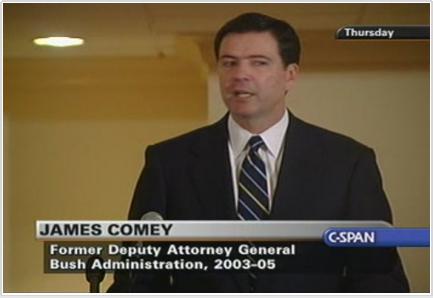
President Obama is reportedly picking a former hedge fund executive turned senior Bush administration official at the Justice Department by the name James Comey to be his next head of the FBI. Like Chuck Hagel, this largely meaningless nomination in terms of actual policy is being played up as meaningful by the hacks whose job it is to do that sort of thing.
Forget the pundits. Here’s what the nomination means, if anything, by way of remarks Comey made at a press conference in 2004:
Had we tried to make a case against Jose Padilla through our criminal justice system, something that I, as the United States attorney in New York, could not do at that time without jeopardizing intelligence sources, he would very likely have followed his lawyer’s advice and said nothing, which would have been his constitutional right.
He would likely have ended up a free man, with our only hope being to try to follow him 24 hours a day, seven days a week, and hope — pray, really — that we didn’t lose him.
Trials can be so inconvenient, especially when the criminal justice system only affords the state a 93 percent conviction rate. You really don’t want to take any risks when it comes to national security. Indeed, “We could care less about a criminal case when right before us is the need to protect American citizens and to save lives,” Comey told reporters, presumably grabbing his genitals. “We’ll figure out down the road what we do with Jose Padilla.” His remarks mean he will do well at the FBI, that Comey, leading a department where protecting Americans has long served as justification for ignoring their rights.
Padilla ended up being labeled an “enemy combatant” and stashed away in a Naval brig, spending nearly four years in solitary confinement, which in the words of a psychiatrist who examined him led to the “destruction of a human being’s mind.” Despite his years spent being tortured in military custody, however, Padilla was ultimately tried and convicted within the civilian criminal justice system. A final punch to the gut, because this America and we are terrible: the mentally destroyed Padilla’s original conviction of 17 years in prison for expressing an interest in (if not actually engaging in) violent jihad was overturned for being too lenient.I hope you like your humor dark.
May 31, 2013
Posted by aletho |
Civil Liberties, Progressive Hypocrite | Federal Bureau of Investigation, James B. Comey, James Comey, Obama, United States, United States Department of Justice |
Leave a comment
President Obama may pledge to finally close Guantanamo’s doors, but all his words are just an illusion, while prisoners are suffering at the notorious detention facility.
Human rights lawyer David Remes, who represents 17 Guantanamo detainees has been talking to RT.
RT: President Obama has made numerous promises over the years to close Guantanamo Bay prison. Is it likely to happen?
David Remes: I don’t see how it can happen under the current circumstances. For one thing, President Obama keeps blaming Congress for preventing him from transferring detainees. As long as he puts responsibility on Congress, it’s unlikely that he will make major moves. In addition, he’s set up this new system for releasing Yemenis, whereby they have to go through another review process, which is likely to take a long time if it happens at all. So I think what he said sounded good, as usual, but, once again, it only provides the illusion of movement. The men face a very bleak circumstance in Guantanamo in terms of being transferred.
RT: Has the hunger strike involving over a hundred detainees influenced the pledge to close the facility?
DR: I haven’t talked to anyone yet, I’m going to speak to a couple of them tomorrow afternoon. But I imagine, based on what we’ve discussed in the past, that this was all a big snooze to them. Obama has no credibility down there. The men even say that they prefer Bush because he released detainees. I think this will be disregarded or just snorted at with cynicism.
RT: Some inmates from Yemen have already been cleared for release – but what about those from other countries?
DR: There are about thirty other detainees, from other countries, who have been approved for transfer. About half of them can be sent home to their own countries, but about half have to be re-settled in third countries because of concerns about torture in their own countries. Ambassador Dan Fried who has been appointed to place the detainees was on the verge to transfer these men when Congress stepped in, and that’s basically why his office was closed. They are the most promising candidates for transfer, but I don’t really think it’s going to happen very soon.
RT: In the event of Guantanamo actually closing, is it likely Washington will use other secret detention centers?
DR: If they are secret, we don’t know about them. I’m not trying to be flip about it. I also don’t think that the US is using secret centers – although obviously, if they are secret, I don’t know for sure. I think they may be handing men over to countries of origin or we may be just drowning these people instead of imprisoning them.
May 31, 2013
Posted by aletho |
Deception, Progressive Hypocrite, War Crimes | Guantanamo, Guantanamo Bay detention camp, Human rights, Obama, United States |
Leave a comment
There is an American tradition of frequent war. Indeed, over the course of the country’s history the United States has been at war almost constantly. Some of these have been relatively short conflicts like interventions in various Central American venues. Some have been much larger and longer affairs, like the Civil War, World War II and Vietnam.
The point to be drawn from this is that the people of the United States are (perhaps unconsciously) acclimated to always being in one sort of armed conflict or another. Unfortunately, this history renders a recent public statement by the Pentagon’s general counsel, Jeb Johnson, into just a bit of fanciful idealism. He insisted “war must be regarded as a finite, extraordinary and unnatural state of affairs.” Certainly not for Americans.

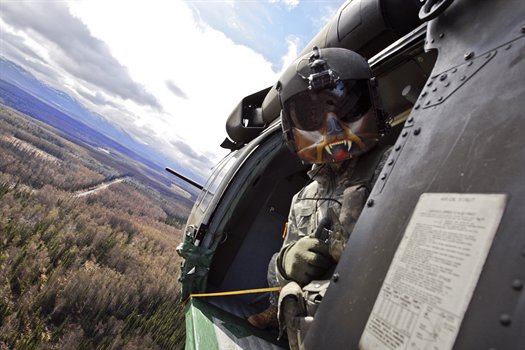
An Army sergeant peers out the door of a UH-60 Black Hawk helicopter on the way to pick up soldiers in a training operation at Joint Base Elmendorf-Richardson, Alaska, May 23, 2013. (U.S. Army photo by Percy Jones)
With their active assumption that the U.S. represents the world’s best chance for the victory of “good” against “evil,” Americans seem willing to battle on as long as they are convinced they are winning and the casualties are low. That may be why there was no popular protest when Michael Sheehan, Obama’s assistant secretary of defense for “special operations,” told a Senate hearing that the country’s “war on terror” might last “at least 10 or 20 years” longer (it has already been going on 12 years). In the mainstream media, there was not even a noticeable raising of an anchorperson’s eyebrows!
The reason given for Sheehan’s prognosis was that al-Qaida, and its franchise allies, keep recreating themselves as fast as their alleged leaders can be droned into oblivion. Missing from the congressional and media reaction was the obvious question of “how come” such groups keep recreating themselves?
Many middle-echelon State Department analysts familiar with the Middle East know the answer has something to do with the fact that U.S. policies in the region have not significantly changed since the 9/11 attacks. Most of the personnel above the middle echelon are political appointees who keep asserting that what motivates the al-Qaida types is religious fanaticism.
Of course there are religious fanatics at work on both sides of the “war on terror,” but those in the Middle East have grievances to focus on and U.S. policies are seen as one source of those. The fact that the “war on terror” is largely a consequence of American policies cemented into place by powerful special interests calls into question President Barack Obama’s recent assertion that “this is a just war, a war waged proportionally in last resort and in self-defense.”
It also suggests that the struggle is likely to go on and on until its ruinous consequences become so obvious to the voting public that the politicians are forced to break with their special-interest supporters. This is the real criterion for change, for, under the present circumstances, there will always be “terrorists” out there who, to reword (and correct) an assertion by President George W. Bush, “hate our policies.”
And what is there not to hate about draconian sanctions, the arming of dictators, and giving opened-ended support to the most racist state in the region?
Rules of Engagement
In the meantime, President Obama has been trying to create “rules of engagement” for the use of the government’s primary weapon in this endless war: those remote controlled bombs we call drones. These rules will, he says, provide “clear guidelines, oversight and accountability” and satisfy partisan congressional grumblings, if not the more pertinent questions of human rights advocates.
To this end the White House has issued guidelines concerning procedures for counterterrorism operations such as drone attacks. The guidelines tell us “there must be a legal basis for using lethal force” and decisions to use such “force against individual terrorists outside the United States and areas of active hostilities are made at the most senior levels of the U.S. Government.” The document then lays out other specific preconditions for the use of lethal force, among which are:
1. “Near certainty” that the terrorist target is present.
2. “Near certainty” that noncombatants will not be injured or killed.
3. An assessment that “capture is not feasible at the time of the operation.”
4. An assessment that the relevant governmental authorities in “the country where action is contemplated cannot or will not effectively address the threat to U.S. persons.”
5. An assessment that “no other reasonable alternatives exist” to effectively address the threat to U.S. persons.
Finally, “International legal principles, including respect for sovereignty and the law of armed conflict, impose important constraints on the ability of the United States to act unilaterally – and on the way in which the United States can use force. The United States respects national sovereignty and international law.”
The problem with these guidelines, beyond a number of undefined terms such as “near certainty,” “reasonable” and “feasible,” is that its criteria misrepresent reality or are utterly unreliable. For instance, under international law there is no “legal” basis for this sort of use of “lethal force.”
What the Obama administration (and the Bush regime before it) has done is take up the illegal Israeli “targeted assassination” program, which constitutes the behavior of a rogue state. Even from a domestic legal prospective, Obama’s criteria for targeted assassination will be carried out behind closed doors. There will be no due process. And there will be no accountability for “mistakes.”
Finally, nothing in the guidelines is enacted into legislation and therefore, assuming an effort to actually follow their criteria, they are specific to the Obama presidency and have no authority over his successors. As Kenneth Roth, director of Human Rights Watch, put it, “a mere promise that the U.S. will work within established guidelines . . . provides little confidence that the U.S. is complying with international law.”
Throughout the country’s history of one war following another, there has been a parallel history of cyclical deterioration and recovery of constitutional rights.
However, with the government’s wholehearted embrace of targeted assassination, as well as modern surveillance technology and the precedent of offshore prisons for “enemy combatants,” one wonders if, from now on, the recovery of rights will ever be fully equal to their loss. Maybe now it really will be all downhill for freedom in the “land of the free.”
~
Lawrence Davidson is a history professor at West Chester University in Pennsylvania. He is the author of Foreign Policy Inc.: Privatizing America’s National Interest; America’s Palestine: Popular and Official Perceptions from Balfour to Israeli Statehood; and Islamic Fundamentalism.
May 30, 2013
Posted by aletho |
Illegal Occupation, Militarism, Progressive Hypocrite, Timeless or most popular, War Crimes, Wars for Israel | al-Qaeda, al-Qaida, Kenneth Roth, Middle East, Obama, United States |
Leave a comment
Beirut – Under withering pressure from Washington and the UK, the European Union met this week to decide whether to increase the pressure on the Syrian public by repealing the March 2011 arms embargo that was intended to prohibit arms shipments to Syria and whether or not to continue economic sanctions against the Syrian public.
On 5/27/13 it decided to open the flood gate of arms flow into Syria and to keep the civilian targeting economic sanctions in place.
Lobbying for scrapping the arms embargo, set to expire at midnight on 31 May, had reached nearly historic intensity at EU HQ in Brussels, London and Washington. Recently, the US State Department demanded that every one of the 27 European Ambassadors posted in the US appear at the State Department for “consultations to avoid any misunderstandings about what the White House was expecting at the upcoming EU meeting.”
US Secretary of State John Kerry had been urging the EU to gut the arms embargo so as to expedite weapon shipments to the rebels. It currently appears that Britain now has the support of France, Italy and Spain, while Germany appears neutral and Austria, Finland, Sweden and the Czech Republic are still opposed. “Fine for him to say, but what is Washington willing to do?” one European foreign minister opposed to lifting the ban put it to BBC correspondent Lyse Doucet.
This week’s EU meeting, which was postponed three months ago, raised again the obligation of the international community to respect the laws of armed conflict and the Geneva Convention with respect to protecting the civilian population during armed conflicts and virtually every other international humanitarian law requirement.
For the American administration, designing and applying economic sanctions in order to pressure a population to break with its government to achieve regime change or any other political objective, as in the case of both Syria and Iran are fundamentally illegal under US law.
Just as soon as a group of Syrian-Americans and/or Iranian-American file a class action lawsuit in US Federal District Court ( the Court will have in persona and subject matter jurisdiction and the Plaintiffs will have standing to sue, given that they are American citizens) and the day after filing when they would no doubt file a Motion petitioning the Court for an Interim Measure of Protection (injunction) immediately freezing and lifting the US-led sanctions against the two countries civilian population, pending the final Court (Jury Trial) on the merits, the Obama administration is going to face serious judicial challenges to its outlawry.
William Hague, the UK Defense Minister, was quite active the past several days supporting the various Syrian militias’ arguments including: “The EU arms embargo must be lifted because the current economic sanctions regime is ineffective.” Presumably the right honorable gentleman means by “ineffective” that these brutal sanctions have not broken the will of the populations to settle their own affairs without transparent foreign interference. This is true if by “effective” Hague means that the US-led sanctions, that target Syria’s civilian population for purely political purposes of regime change, will cause the people of Syria, who unlike their leaders, are the ones directly affected by the sanctions to revolt over the lack of medicines and food stuffs plus inflation at the grocery stores.
Mr. Hague surely must be aware that very rarely, if ever at all in history, have civilian targeted sanctions designed to cause hardships among a nation’s population for purely political purposes actually broken the population such that they turned against their governments. Both the Syrian and Iranian sanctions have confirmed history’s instruction that the civilian targeting sanctions imposed from outside tend to have the exact opposite intended effect. This is true particularly modernly with more available information, and that the populations turn not against their national governments but rather against those foreign governments viewed as being responsible for these crimes.
The British, French, Turks and the Americans (the latter, not actually an EU member but then, who would know from its involvements in EU deliberations?) were the zealots in Brussels advocating amendment of the imposed arms embargo so that weapons can be sent to “moderate” forces in these countries largely nurtured and sustained “opposition”.
The UK Defense Minister gave his colleagues repeated assurances that weapons would be supplied only “under carefully controlled circumstances” and with clear commitments from the opposition… We have to be open to every way of strengthening moderates and saving lives rather than the current trajectory of extremism and murder.” The assurances have apparently convinced very few.
Unanimity was needed to repeal the embargo and several countries were opposed. So it was allowed to lapse. One Austrian official told the BBC that allowing lethal weapons to be sent into a war zone “would turn EU policy on its head.” Another European diplomat insisted that “It would be the first conflict where we pretend we could create peace by delivering arms,” the diplomat said. “If you pretend to know where the weapons will end up, then it would be the first war in history where this is possible. We have seen it in Bosnia, Afghanistan and Iraq. Weapons don’t disappear; they pop up where they are needed.”
Oxfam warned before and after the vote of “devastating consequences” if the embargo ends.”There are no easy answers when trying to stop the bloodshed in Syria, but sending more arms and ammunition clearly isn’t one of them,” the aid agency’s head of arms control, Anna Macdonald told the media this week.
The result of the predicted 5/27/13 European Union meeting prevented the renewal of the arms embargo on Syria, raising the possibility of a new flow of weapons to various jihadist militias working with Qatar and Saudi Arabia, among others, to bring down the government of President Bashar al-Assad.
Sustaining a personal rebuke of sorts given that the EU did not affirmatively oppose the embargo as he had hoped, William Hague, the British foreign secretary, told the media after more than 12 hours of stormy talks: “While we have no immediate plans to send arms to Syria, it gives us the flexibility to respond in the future if the situation continues to deteriorate and worsen,”
As a claimed safeguard of some kind, according to EU officials, the European Union declared that member states who might wish to send weapons to Syrian rebels “shall assess the export license applications on a case-by-case basis” in line with the organization’s rules on exports of military technology and equipment.
Some of the 27 EU countries are now even more concerned that anti-aircraft and anti-tank weapons given to “moderate” militiamen (per Libya?) would end up Lord knows where, in the hands of salafist, jihadist-takfiri militants, including those from the al-Nusra Front, which has pledged fealty to al-Qaeda in Iraq.
The current embargo includes the following:
- Ban on export/import of arms and equipment for internal repression since May 2011All Syrian cargo planes banned from EU airports
- All Syrian cargo planes banned from EU airports
- EU states obliged to inspect Syria-bound ships or planes suspected of carrying arms
- Assets freeze on 54 groups and 179 people responsible for or involved in repression [many who are not involved in decision making are included-ed]
- Export ban on technical monitoring equipment
In February this year, EU foreign ministers agreed to enable any EU member state to provide non-lethal military equipment “for the protection of civilians” or for the opposition forces, “which the Union accepts as legitimate representatives of the Syrian people”.
As is its habit recently, the European External Action Service (EEAS), the EU’s diplomatic service, has spoken on both sides of this critical issue. On the one hand it has cautioned against “any counterproductive move” that could harm the prospects of the Geneva conference and suggests extending the embargo to allow “more time for reflection”. On the other suggesting that lifting the arms embargo would only prolong the war.
The practice of targeting a civilian population by outsiders in order to achieve political objectives such as regime change is fast heading for the dustbin of history given its blatant violation of all norms of international humanitarian law and common decency reflected in the values of most societies.
This week revealed on which side of history the European Union has chosen to anchor itself on the issue of targeting civilian populations in a blatant attempt to achieve regime change. It affirmatively voted “to renew all the economic sanctions already in place against the Syrian government.”
One imagines, as surely the EU is aware, that officials are not suffering much from the economic sanctions, but rather it is exactly those the EU claims to want to help, who will continue to suffer rises in the cost of living generally as well as the sanctions causing shortages of medicines and medical equipment as well as specialized cancer treatments and other medicines for seriously ill drug-dependant citizens.
May 28, 2013
Posted by aletho |
Militarism, Progressive Hypocrite, War Crimes | European Union, John Kerry, Obama, Syria, United States, William Hague |
Leave a comment
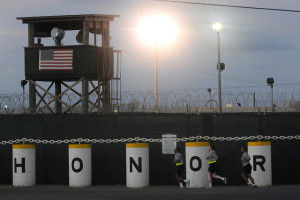
Guantanamo (Joshua Nistas/US Army)
President Barack Obama’s address yesterday on U.S. terror strategies got a lot of attention for supposedly charting a new course in America’s longest war. But some of the facts were mangled along the way.
On CBS Evening News (5/23/13), reporter Major Garrett stated that
Obama urged Congress to close the military prison in Guantanamo Bay, Cuba. To that end, he will seek permission to send 86 of the 166 jailed terror suspects already cleared for release to other countries.
Those 86 prisoners have not been, and will not be, charged with any crime whatsoever; they are not “terror suspects.” Garrett’s statement was all the more awkward considering that it came right before CBS played a clip of Obama saying this:
Imagine a future, 10 years from now, or 20 years from now–when the United States of America is still holding people who have been charged with no crime on a piece of land that is not a part of our country.
To refer to “people who have been charged with no crime” as “terror suspects” is simply Orwellian. Garrett went on to say:
An intelligence report in January, Scott, found that fewer than 5 percent of those detainees released since 2009 have rejoined the fight.
That is indeed the language used in the government’s accounting of former Guantanamo detainees–and the definition of “re-enagaging” has been narrowed considerably since the Bush years. Reporters have taken some of this Pentagon propaganda on this issue at face value in the past, which should be all the more reason to continue to be skeptical. If someone has been imprisoned without charge or trial for a number of years, can one plausibly claim that they have “returned” to committing crimes that they were never charged with in the first place?
It’s not just CBS. In the New York Times (5/24/13), Peter Baker writes:
Mr. Obama said he was lifting a moratorium he imposed on sending detainees to Yemen, where a new president has inspired more faith in the White House that he would not allow recidivism.
Again, these are prisoners cleared for release because they cannot be charged with any crimes. It is bizarre to seriously discuss the threat that they might go back to committing crimes there’s no apparent evidence that they’ve ever taken part in.
May 26, 2013
Posted by aletho |
Deception, Mainstream Media, Warmongering, Progressive Hypocrite | CBS, Guantanamo Bay detention camp, New York Times, Obama, United States |
Leave a comment
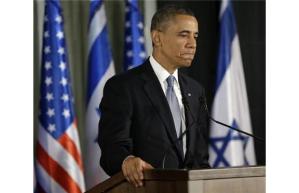 In his address on terrorism and America’s counterterrorism policy, President Barack Obama invoked the “just war” theory to justify the continued use of assassination by drones as America’s increasingly favored war policy. The President and most Americans need schooling on just what the “just war theory” (JWT) is.
JWT lays out the tests that state-sponsored violence must pass to be deemed morally defensible. JWT has its roots in the first tentative moves – in ancient Hebraic, Greek and Roman societies – away from total obliteration of the enemy, its people and its land as the goal of war. It was and is an effort to put some limits on collective violence.
According to JWT, there are six tests a war must pass to claim some moral justification. If the war fails on any of the six, that war is immoral and the killing it involves is murder.
1. A Just Cause: As ethicist David Hollenbach writes: “The only just cause is defense against unjust attack.” Aggressive, imperial or preemptive wars fail this test and open the door to international barbarism.
Drone attacks that kill “suspected terrorists” based not on due process proceedings but on “intelligence” agencies, do not pass this initial test. Those are the same agencies that gave us the fictional weapons of mass destruction in Saddam’s Iraq resulting in a decade of unjustified slaughter and havoc.
2. Declaration by Competent Authority: For the United States, proper declaration is defined in Article One, Section 8 of the U.S. Constitution which says that it is the prerogative of Congress “to declare war” and to “provide for the common Defence.” James Madison said that “in no part of the Constitution is more wisdom to be found than in the clause which confides the question of war and peace to the legislature and not to the executive department.”
The United States has not obeyed this part of the Constitution since December 1941. The constitutional requirement was alluded to at the onset of the Korean War but bypassed ever since. Instead Congress surrenders its right to declare war by giving blank check authorization to the president (whether Lyndon Johnson or George W. Bush) to go to war if he, in his royal wisdom, chooses to do so.
When President Bush was given authorization to use “force” after the 9/11 attacks, the decision to use kill-power was seen as entirely his and the wisdom of the Constitution was trashed. President Obama’s drone policy – sending unmanned aircraft around the world to kill people – continues to rely on this congressional abdication of responsibility.
The United States further defined proper declaration of war when it helped to draft and signed on to the United Nations Charter. As Richard Falk writes, that historic document outlawed state vigilantism and entrusted “the Security Council with administering a prohibition of recourse to international force (Article 2, Section 4) by states except in circumstances of self-defense, which itself was restricted to response to a prior ‘armed attack’ (Article 51) and only then until the Security Council had the chance to review the claim.”
This is called “the policing paradigm” and it would put upon states the communitarian and legal restraints imposed on use of violence by police and would also serve as a deterrent since to attack one was to attack all.
Briefing Congress before, or more often, after using state-sponsored drone violence mocks the right and abandoned duty of Congress to declare war. So does ignoring the UN Security Council.
3. Right Intention: This requirement of JWT involves honesty about the real reason for the violence and avoidance of excessive secrecy. It does not hide the truth and suppress the vox populi. It also does not substitute force for due process.
4. Non-combatant immunity: Drone warfare involves long-distance killing by remote control. It is disingenuous to say that drone usage honors non-combatant immunity. The targeted individual will rarely be found alone. The loose definition of who is and who is not a “militant” further belies the claims of sensitivity to civilian casualties.
5. Last Resort: Totally missing from President Obama’s May 23 address was the question why? Why do these targeted people hate us but don’t hate Sweden or Japan or Brazil. Why is killing them the answer when there has been little or no consideration of the grievances that lead them to engage in suicide attacks to hurt us?
Are we not stupidly striking at the bitter fruit of the tree while still nourishing its roots and thus guaranteeing more bitter fruit? If war is to be the last resort, shouldn’t we first ask what legitimate grievances animate the animosity toward our nation?
American economic supremacy has played a big part in producing a world where 82 percent of the world’s income goes to the top 20 percent, leaving the rest to face hardship or starvation. Our paltry foreign aid does little to alleviate world poverty and the world knows that.
As to the trouble zones in the Middle East, there is a question that is not permitted in our halls of political power or even in the American press. It was asked by Jesuit scholar John Sheehan who studied in the Middle East. His question: “Whenever I hear that Israel is our best friend in the Middle East I ask why is it that before Israel, we had no enemies in the Middle East?”
Our financial, political and military support for Israeli expansionism and militarism make us no friends in the Middle East or elsewhere in the world. It is also not good for Israel or for us to be Israel’s ever deferential enabler. Friends do not let friends drive off a cliff and Israel is doing just that by having started the nuclear arms race in the Middle East and with its policy of occupation and expansionism. It’s not friendly of us to keep paying for that.
In the Suez crisis of 1956, when President Dwight Eisenhower threatened cutback of aid if Israel did not retreat from its expansionism, Israeli officials agreed to retreat. When George H. W. Bush did the same in 1989 regarding settlements in Palestinian territory, the Israeli government again stopped, only to restart at the end of his term.
Tony Judt has called us Israel’s “paymaster.” When the paymaster makes demands – not feeble entreaties – the recipients listen.
6. Proportionality: War must do more good than harm, a proviso that is increasingly infeasible given the advances in weaponry. When drones are causing constant fear and dread for Pakistani children and their parents, are those elusive demons in the sky doing more good than harm? What good do we envision when we export terror into other nations’ homes?
Is it not past time to realize that our kill-power is not making us safe but sowing fear and enmity? In regard to that recognition, Obama’s May 23 speech is not reassuring.
Is American genius not up to the challenge of sensitive diplomacy, the kind that does not love its enemies but strains to understand their grievances? Are our fingers grown too rough with bludgeoning to undertake the needlepoint of peace-making diplomacy? Much of the world seems to think so.
~
Daniel C. Maguire, a professor of religious ethics at Marquette University, is author of The Horrors We Bless: Rethinking the Just-War Legacy, Fortress Press.
May 25, 2013
Posted by aletho |
Ethnic Cleansing, Racism, Zionism, Militarism, Progressive Hypocrite, Wars for Israel | Iraq, Israel, Just War Theory, JWT, Middle East, Obama, United States Constitution, Zionism |
Leave a comment
President Obama is right to say that we cannot be on a war footing forever, but the time to take our country off the global warpath and fully restore the rule of law is now, not at some indeterminate future point. Four years into his presidency, President Obama has finally taken the first steps to jump-start his administration’s effort to make good on early campaign promises to close Guantánamo and recognized the human cost of failing to act. These are encouraging and noteworthy actions.
To the extent the speech signals an end to signature strikes, recognizes the need for congressional oversight, and restricts the use of drones to threats against the American people, the developments on targeted killings are promising. Yet the president still claims broad authority to carry out targeted killings far from any battlefield, and there is still insufficient transparency. We continue to disagree fundamentally with the idea that due process requirements can be satisfied without any form of judicial oversight by regular federal courts.
We are particularly gratified that President Obama embraced our recommendations to use his authority to allow prompt transfer and release of Guantánamo detainees who pose no national security threat and that have been cleared by the military and intelligence agencies. We also applaud his appointment of a high level official to supervise the process for closing Guantánamo once and for all.
But there are other problems that must still be addressed. The unconstitutional military commissions must be shuttered, not brought to the United States. While the president expressed appropriate concern about indefinite detention, he offered no clear plan for ending this unconstitutional policy for those who have not been tried or cleared for release.
President Obama’s efforts to repair his legacy in the eyes of future historians will require that he continue to double down if he is to fully restore this nation’s standing at home and abroad. The ACLU realizes that Congress has thrown significant barriers in closing Guantánamo. But in some areas Congress has been more progressive, having recently demanded legal memoranda that claim to authorize the illegal killing program. The ACLU stands ready to work with, and if necessary do battle with, those elements of government that impede our nation’s obligations to honor the rule of law and to protect our values while safeguarding our security.
May 24, 2013
Posted by aletho |
Civil Liberties, Progressive Hypocrite, Subjugation - Torture, War Crimes | Guantanamo, National security, Obama, United States |
Leave a comment
In a speech to the National Defense University yesterday outlining his new policies regarding the use of drones in targeted killings US President Obama told his audience;
…before any strike is taken, there must be near-certainty that no civilians will be killed or injured – the highest standard we can set.
This last point is critical, because much of the criticism about drone strikes – at home and abroad – understandably centers on reports of civilian casualties. There is a wide gap between U.S. assessments of such casualties, and non-governmental reports. Nevertheless, it is a hard fact that U.S. strikes have resulted in civilian casualties, a risk that exists in all wars. For the families of those civilians, no words or legal construct can justify their loss. For me, and those in my chain of command, these deaths will haunt us as long as we live, just as we are haunted by the civilian casualties that have occurred through conventional fighting in Afghanistan and Iraq.
But as Commander-in-Chief, I must weigh these heartbreaking tragedies against the alternatives. To do nothing in the face of terrorist networks would invite far more civilian casualties – not just in our cities at home and facilities abroad, but also in the very places –like Sana’a and Kabul and Mogadishu – where terrorists seek a foothold. Let us remember that the terrorists we are after target civilians, and the death toll from their acts of terrorism against Muslims dwarfs any estimate of civilian casualties from drone strikes.
At least Obama is admitting – contrary to CIA director John Brennan’s claims that no civilians have been killed in drone strikes – that there are civilians being killed in these attacks though he is inferring that civilian deaths are not as high as some are reporting (though the Human Rights Institute are saying that some non-government reports are actually under-reporting the numbers) suggesting that the people of the world should believe US assessments rather than ‘non-governmental reports’. (Why would anyone want to believe ‘US assessments’ after the Iraq WMDs fiasco?)
Obama goes on to say that the civilian deaths will ‘haunt him’ and all those involved in the killings for ‘as long as we live’. This is unadulterated and utterly transparent garbage. Obama and his willing killers that operate the drones couldn’t care less about the civilian casualties. They do it time and time again. Thousands of civilians have been killed in drone strikes in Pakistan alone and each time Obama thinks it’s enough just to say; ‘Sorry. We didn’t mean it. We’ll do our best to ensure it doesn’t happen again’, but, of course, it does happen again – and again, and again. Obama then sinks to new low levels of rhetoric by resorting to the use of moral relativism as he attempts to justify civilian deaths by saying that the ‘enemy they are targeting also kill civilians’.
The reality is that Obama and the US kill the enemy off battlefield simply because they can and they really are not in the slightest bit concerned about the civilian deaths except inasmuch that it may adversely effect public opinion; hence the attempts at justification. What doesn’t seem to have been thought through yet is the possibility that America’s enemy may one day have the same ability to kill by remote control. What then when scores of American citizens die when the enemy makes an attempt to assassinate an American political or military leader via a remotely controlled weapon?
May 24, 2013
Posted by aletho |
Militarism, Progressive Hypocrite, War Crimes | Civilian casualties, Drone attacks in Pakistan, Obama, United States |
Leave a comment
United States Attorney General Eric Holder has informed Congress that four American citizens have been killed in Yemen and Pakistan by US drones since 2009.
It has been widely reported but rarely acknowledged in Washington that three US citizens — Samir Khan, Anwar al-Awlaki and his teenage son, Abdulrahman al-Awlaki — were executed in Yemen by missile-equipped drones in 2011. With Holder’s latest admission, however, a fourth American — Jude Kenan Mohammed — has also been officially named as another casualty in America’s continuing drone war.
“Since 2009, the United States, in the conduct of US counterterrorism operations against al-Qaeda and its associated forces outside of areas of active hostilities, has specifically targeted and killed one US citizen, Anwar al-Awlaki,” the letter reads in part. “The United States is further aware of three other US citizens who have been killed in such US counterterrorism operations over that same time period,” Holder said before naming the other victims.
“These individuals were not specifically targeted by the United States,” the attorney general wrote.
The news of the admission broke Wednesday afternoon when New York Times reporter Charlie Savage published the letter sent from Holder to congressional leaders in a clear attempt to counter critics who have challenged the White House for falling short of US President Barack Obama’s campaign plans of utmost transparency. Upon a growing number of executive branch scandals worsened by the Department of Justice’s recently disclosed investigation of Associated Press journalists, Holder wrote that coming clean is an effort to include the American public in a discussion all too often conducted in the shadows cast by the US intelligence community.
“The administration is determined to continue these extensive outreach efforts to communicate with the American people,” continued Holder. “To this end, the president has directed me to disclose certain information that until now has been properly classified. You and other members of your committee have on numerous occasions expressed a particular interest in the administration’s use of lethal force against US citizens. In light of this face, I am writing to disclose to you certain information about the number of US citizens who have been killed by US counterterrorism operations outside of areas of active hostilities.”
The letter, dated Wednesday, May 22, was addressed to Sen. Patrick Leahy (D-Vermont) and the Senate Judiciary Committee.
Drone strikes have become a signature counterterrorism tool used by the Obama administration and his predecessor, President George W. Bush, and have been attributed with killing roughly 5,000 persons abroad, according to Sen. Lindsey Graham (R-South Carolina). But under the covert and protective umbrella of the Central Intelligence Agency, little has been formally acknowledged from Washington as to the details of these strikes.
As part of the vaguely defined ‘War on Terror,’ the US has reportedly waged drone strikes outside of Afghanistan where the Taliban once harbored al-Qaeda. In recent years, those strikes have targeted towns in neighboring Pakistan, as well as Yemen, Somalia and perhaps elsewhere.
But despite growing criticism over escalating use of drones, the president and his office has remained adamant about defending the operations.
“It’s important for everybody to understand that this thing is kept on a very tight leash,” Obama said last January, adding that his administration does not conduct “a whole bunch of strikes willy-nilly.”
Others have argued quite the opposite, though, and have opposed these drone strikes over the lack of due process involved and the habit of accidently executing civilians in the strikes. When researchers at Stanford University and New York University published their ‘Living Under Drones’ report last September, they found that roughly 2 percent of drone casualties are of top militant leaders. The Pakistani Interior Minister has said that around 80 percent of drone deaths in his country were suffered by civilians.
Earlier this year, Sen. Rand Paul (R-Kentucky) led a marathon filibuster on the floor of Congress to oppose the CIA’s drone program and demand the administration explain to elected lawmakers why the use of unmanned aerial vehicles is warranted in executing suspects, often killing innocent civilians as a result.
Of particular concern, Paul said, was whether or not the Obama administration would use the 2011 Yemen strike as justification to kill American citizens within the US. For 13 hours, he demanded the White House respond.
“I rise today to begin to filibuster John Brennan’s nomination for the CIA,” Sen. Paul said. “I will speak until I can no longer speak. I will speak as long as it takes, until the alarm is sounded from coast to coast that our Constitution is important, that your rights to trial by jury are precious, that no American should be killed by a drone on American soil without first being charged with a crime, without first being found to be guilty by a court.”
One day after the filibuster, both Attorney General Holder and White House Press Secretary Jay Carney reached out to Sen. Paul to say the president lacks the authority to issue such a strike within the US. With this week’s letter, however, Holder admits that at least four Americans have met their demise due to US drones. He also explains why the administration felt justified in using UAVs to execute its own people.
“Al-Awlaki repeatedly made clear his intent to attack US persons and his hope that these attacks would take American lives,” wrote Holder. “Based on this information, high-level US government officials appropriately concluded that al-Awlaki posed a continuing and imminent threat of violent attack against the United States.”
Later, Holder says the decision to strike al-Awlaki was “not taken lightly” and was first put into plan in early 2010. Additionally, Holder said the plan was “subjected to exceptionally rigorous interagency legal review” and that Justice Department lawyers and attorneys for other agencies agreed that it was the appropriate action to take.
According to Holder, the senior al-Awlaki and Mr. Khan were killed in the same September 2011 drone strike in Yemen. The following month, 16-year-old Abdulrahman Anwar Al-Awlaki was killed in a strike in the same country. Mohammed, a North Carolina resident born in 1988, was killed by a drone likely in November 2011 within a tribal area of Pakistan. Mohammed was indicted by a federal grand jury in 2009 for conspiracy to provide material support to terrorists and conspiracy to murder, kidnap, maim and injure persons in a foreign country, and was considered armed and dangerous by the Federal Bureau of Investigation. Both Khan and the older al-Awlaki were suspected members of al-Qaeda and were affiliated with the group’s magazine, Inspire.
Last February, friends of Mohammad told a North Carolina newspaper that they believed he was dead.
“Farhan Mohammed says he heard in November that his friend was killed in a drone strike,” Raleigh’s WRAL News reported in 2012. “Jude Mohammad’s pregnant wife was hysterical about her husband’s death and called her mother-in-law in the Triangle to break the news, according to Sabra. The US government hasn’t confirmed Mohammad’s death, but the people who knew him in North Carolina say it’s probably true.”
Holder declined to explain why either Mohammad or the teenage al-Awlaki were killed. President Obama is expected to discuss America’s drone program at an address in Washington on Thursday.
May 22, 2013
Posted by aletho |
Civil Liberties, Full Spectrum Dominance, Progressive Hypocrite, War Crimes | Anwar al-Awlaki, Central Intelligence Agency, Obama, United States |
Leave a comment
The journalism world has been rightly outraged by the Justice Department dragging the Associated Press (and now a Fox News reporter) into one of its sprawling leak investigations. As we wrote last week, by obtaining the call records of twenty AP phone lines, “the Justice Department has struck a terrible blow against the freedom of the press and the ability of reporters to investigate and report the news.”
But there are several other important lessons that this scandal can teach us besides how important free and uninhibited news-gathering is to the public’s right to know.
1. Weak Privacy Laws That Doomed AP Affect Everyone
The AP detailed in its letter to the Justice Department how its privacy was grossly invaded even though the government accessed only the call records of its reporters and not the content of their conversations. We completely agree. Unfortunately, this isn’t just a problem in the AP investigation. Law enforcement agencies routinely demand and receive this information about ordinary Americans over long periods of time without any court involvement whatsoever, much less a full warrant.
For example, according to information released by the phone companies to Rep. Ed Markey, Sprint alone received a staggering 500,000 subpoenas for call records data last year.
The DOJ’s decision to dive into these call records shows the growing need to update our privacy laws to eliminate the outmoded Third Party Doctrine—which holds that anything you give to a service provider, or that a service provider collects as part of providing you a service—can retain no reasonable expectation of privacy. In an era where email is stored by our providers, cellphone companies keep records that track our location and cloud services hold our documents, it’s long past time to bring our interpretation of the Fourth Amendment and statutory electronic privacy laws in compliance with the 21st Century.
In response to the AP scandal, a bipartisan coalition in Congress just introduced a bill to partially fix this problem called The Telephone Records Protection Act. The bill would require the Justice Department to get a judge’s approval before seeking these records. At EFF, we think the government should have to go even further than a court order: a judicial warrant showing the kind of probable cause required by the Fourth Amendment should be the standard. But this bill is certainly an improvement over administrative subpoenas, which don’t need a sign-off from a judge at all and allow the Executive branch to seek information without any external check.
2. Phone Companies May Give Up Your Information Without Telling You
As the New York Times reported, the AP is still examining if and when any telephone companies tried to push back on the over-broad requests for its call records. “But at least two of the journalists’ personal cellphone records were provided to the government by Verizon Wireless without any attempt to obtain permission to tell them so the reporters could ask a court to quash the subpoena,” the Times said. And it also seems clear that the AP itself wasn’t given notice before their phone company turned over the records.
In EFF’s 2013 “Who Has Your Back” report, which tracks several ways in which communications companies can help protect user privacy, we give a star for promising to notify users about government demands for data whenever whenever the company is not legally prevented from doing so. Notably, Verizon does not have such a notification policy and did not receive a star. In fact, Verizon was the only company to receive zero stars.
This isn’t a small problem or just a problem for journalists. Verizon received 260,000 similar subpoenas for call records last year. The government requests this information with regularity, and given the phone companies control the data, communications company policies are all that stand between you and governmental overreach.
Users should demand that their communications companies notify them when the government comes seeking information, unless they are legally barred by a court order.
3. Government often Overstates National Security Claims, Over-classifies Information
We’ve written many times about the many ways “national security” has been invoked—and exaggerated—in order to cover up government embarrassment or wrongdoing, or to assert powers that would normally not be granted under the Constitution. The government routinely over-classifies information that should never be secret, according to reports commissioned by the White House itself.
The most glaring example for EFF is our lawsuit over the NSA warrantless wiretapping program, where the government won’t admit or deny that the program even exists, citing the danger to national security, despite thousands of pages of public evidence. The government has argued the same thing in cases about torture and the CIA drone program where, many times, the same information that they claim is secret is on the front pages of the nation’s newspapers.
In the AP’s case, while Attorney General Holder says this leak put “lives at risk,” John Brennan said the opposite around the time of the story (“Brennan said the plot was never a threat to the U.S. public or air safety,” reported Reuters). The AP also held its story for six days until the CIA told them it was safe to publish and the White House had a news conference planned the day after the story to announce the successful counterterrorism operation.
As the late Supreme Court Justice Huge Black once said, “The word ‘security’ is a broad, vague generality whose contours should not be invoked to abrogate the fundamental law embodied in the First Amendment.”
4. There’s Not Much Recourse For Prosecutorial Misconduct
In this case, just like the case of Aaron Swartz, there has been widespread criticism that the Justice Department has abused its authority and aggressively pursued parties in an unprofessional manner. As we detailed last week, it seems the Justice Department didn’t follow its own guidelines when issuing subpoenas about[?] the reporters, or at least went to the very edge of its own guidelines.
Just like in the Swartz case, the specific prosecutor has a history of over-aggressive prosecutions (even being accused of overzealous prosecution by Eric Holder himself when he was in private practice). Yet when Congress asked Holder at a hearing about the allegations, just like in the Swartz case, he did not admit to any wrongdoing, and was able to deflect questions about his department’s handling of the case. Unfortunately, there is not much recourse for meaningful remedy for the public in these situations, and this case is just the latest example.
5. Journalists Need to be Pro-Active in Protecting Their Digital Security
In an age where warrantless surveillance is skyrocketing and governments potentially have access to an astonishing amount of information, journalists must learn to proactively protect both themselves and their sources.
The Committee to Protect Journalists Journalist Security Guide is an excellent place to start. It addresses concerns faced by journalists working inside the United States and internationally.
Wired published an op-ed last week about the care one needs to take from the source’s end if one wishes to send information to the press undetected. Much of the advice is applicable to reporters talking to sources as well. Additionally, the New Yorker has just released a promising—but un-tested—anonymous leak submission system, coded by Aaron Swartz before he tragically died in January. In certain circumstances physical mail remains the safest option.
Overall, the final lesson is that journalists, and sources, need to take security seriously. Trusting that the government won’t come after you because you’re engaged in journalism, serving the public interest, or helping reveal wrongdoing is plainly not sufficient.
May 21, 2013
Posted by aletho |
Civil Liberties, Full Spectrum Dominance, Progressive Hypocrite | Cindy Cohn, Justice Department, NSA warrantless surveillance controversy, Obama, United States Department of Justice |
Leave a comment
Acting IRS chief Steven Miller on Friday said he did not believe agency officials did anything illegal when giving extra scrutiny to conservative groups seeking tax-exempt status.
Miller, who was forced to resign this week by President Obama, said he didn’t believe the scrutiny was illegal even as he apologized for the IRS’s actions, which have turned into a political storm for the White House.
He also admitted under questioning from House Ways and Means Committee members that facts could emerge that might change whether he thinks anyone in the agency committed a crime, and he said one staffer involved in the extra scrutiny was reassigned and another received counseling.
Facing tense, and at times hostile, questions from GOP lawmakers at the first congressional hearing on the IRS controversy, Miller said the screening process the IRS used was “obnoxious” and called the customer service the agency offered “horrible.”
Miller stressed that the extra attention happened because IRS officials faced an avalanche of applications for tax-exempt status.
But he also pushed back on GOP lawmakers who said the IRS was targeting conservatives, calling that a “loaded” statement.
“When you talk about targeting, that’s a pejorative term,” Miller said.
Asked if the IRS’s actions had been illegal, he responded: “I don’t believe it is.”
He then added of the behavior: “I don’t believe it should happen.”
Miller’s answers did not sit well with GOP lawmakers throughout Friday’s hearing, and his comments fly in the face of top Republicans like Speaker John Boehner (R-Ohio), who have said that agency staffers should be jailed.
Republicans on Friday accused the acting IRS chief of lying to them about the extra scrutiny given to conservative groups seeking tax-exempt status. Miller found out about that special attention more than a year ago but declined to tell lawmakers.
At the start of Friday’s committee hearing, Chairman Dave Camp (R-Mich.) rattled off several different violations he believes the IRS committed.
Camp also linked the IRS uproar to what he called a “culture of cover-ups and political intimidation in this administration,” an apparent reference to last year’s attack in Benghazi, Libya, and the Justice Department’s subpoena of reporter records.
“This systemic abuse cannot be fixed with just one resignation,” Camp said. “And, as much as I expect more people need to go, the reality is this is not a personnel problem. This is a problem of the IRS being too large, too powerful, too intrusive and too abusive of honest, hardworking taxpayers.”
But Republicans on the panel have also expressed frustration throughout the hearing at Miller’s sometimes feisty answers, with the acting chief maintaining that he did not lie to them.
“You’re not going to cooperate with me, Mr. Miller, and you’ve been uncooperative in this hearing,” Rep. Dave Reichert (R-Wash.) told the IRS official.
Democrats acknowledged that the IRS had made serious mistakes and generally agreed with Miller’s statements that agency officials did not target Tea Party and conservative groups for political reasons.
“What I’m trying to point out, and basically to debunk, is the notion or idea the political statements — and, I believe, nonfactual statements by Chairman Camp — to link these scandals to the White House,” said Rep. Joe Crowley (N.Y.), a member of House Democratic leadership.
Democrats also stressed repeatedly that the Doug Shulman, who was IRS commissioner when the targeting took place, was nominated by former President George W. Bush. And several said that the major issue was the cloudy regulations guiding which groups should be granted tax-exempt status.
Miller is testifying along with Russell George, the Treasury inspector general whose report details what he called “ineffective management” at the agency.
George’s report found that the IRS asked for excessive information from conservative groups, including donor lists and whether group leaders wanted to run for public office. The IRS also applied inconsistent principles when deciding which groups to give extra screening, the report said, leading some groups to wait months or years for approval.
According to the inspector general’s report, Lois Lerner, the IRS official who first disclosed the targeting, found out in June 2011. Lerner pushed for the screening guidelines to be changed, but other IRS officials eventually went around her to change them again.
George’s report also says that IRS staffers assert that lower-level employees crafted the screening process and that they were not influenced by any outside group.
Miller on Friday acknowledged that Lerner’s disclosure of the IRS targeting last Friday came from a planted question.
Camp had said in his opening statement that he was interested in hearing why the IRS targeting occurred and why the agency kept it secret for so long, who started the extra scrutiny, and when President Obama and his administration found out.
But in a hearing break, he told The Hill that he wasn’t satisfied with the answers the panel was getting from Miller, a feeling shared by other Republicans.
“On the one hand, you’re arguing today that the IRS is not corrupt,” said Rep. Peter Roskam (R-Ill.). “But the subtext of that is you say, ‘Look, we’re just incompetent.’ And I think it is a perilous pathway to go down.”
May 17, 2013
Posted by aletho |
Civil Liberties, Full Spectrum Dominance | Dave Camp, Internal Revenue Service, IRS, Obama |
Leave a comment
As we move towards the fifth anniversary of the great financial crisis of 2008, people should be outraged that cutting Social Security is now on the national agenda, while taxing Wall Street is not. After all, if we take at face value the claims made back in 2008 by Fed Chairman Ben Bernanke and former Treasury Secretaries Henry Paulson and Timothy Geithner, Wall Street excesses brought the economy to the brink of collapse.
But now the Wall Street behemoths are bigger than ever and President Obama is looking to cut the Social Security benefits of retirees. That will teach the Wall Street boys to be more responsible in the future.
Most people are now familiar with President’s Obama’s proposal to cut Social Security by reducing the annual cost of living adjustment. While the final formula is somewhat convoluted, the net effect is to reduce benefits by an average of roughly 3.0 percent.
Since Social Security benefits account for more than 70 percent of the income of a typical retiree, this cut is more than a 2.0 percent reduction in income. By comparison, a wealthy couple earning $500,000 a year would see a hit to their after-tax income of just 0.6 percent from the tax increase that President Obama put in place last year.
While President Obama is willing to make seniors pay a price for the economic crisis, his administration his unwilling to impose any burdens on Wall Street. Specifically, it has consistently opposed a Wall Street speculation tax: effectively a sales tax on trades of stock and derivatives. The Obama administration has even used its power to try to block efforts by European countries to impose their own taxes on financial speculation.
If the idea of taxing stock trades sounds strange, it shouldn’t. The United States used to impose a tax of 0.04 percent until Wall Street lobbied to eliminate it in the mid-1960s. Many countries, including the United Kingdom, Switzerland, China, and India already impose taxes on stock trades.
The tax in the UK is 0.5 percent on stock trades (0.25 percent for both the buyer and the seller). It dates back more than 3 centuries. The country raises more than 0.2 percent of GDP ($32 billion in the United States) from the tax each year. The tax has not prevented the London stock exchange from being one of the largest in the world.
There are currently two bills in Congress for a similar tax in the United States. A bill by Minnesota Representative Keith Ellison would impose the same tax as the UK on stock trades and would apply a scaled rate to options, futures, credit default swaps and other derivative instruments. It could raise more than $150 billion annually or more than $2 trillion over the ten year budget window.
A second bill has been put forward by Iowa Senator Tom Harkin and Oregon Representative Peter DeFazio. This bill would apply a 0.03 percent tax to trades of stock and a wide range of other financial assets. According to the Joint Tax Committee, the bill would raise close to $40 billion a year or over $400 billion over a ten-year budget window once it is implemented.
Unfortunately the administration has consistently opposed both bills. It claims that it is concerned about the incidence of these taxes – that ordinary investors would see large burdens from the tax. It also claims to be worried that the taxes will disrupt financial markets by making trading more costly.
Neither of these stories passes the laugh test. Ordinary investors don’t trade much, and therefore are not going to feel much impact from the tax. If someone with $100,000 in a 401(k) (this is much larger than the typical 401(k)) turns it over at the rate of 50 percent annually, they would pay $15.00 each year as a result of the Harkin-DeFazio tax.
Furthermore research shows that investors reduce their trading as costs increase. This means that if the tax increases trading costs by 20 percent, then investors will reduce their trading by roughly the same amount (in this example, turnover would fall to 40 percent annually). That means that the net cost of turnover in a 401(k) will barely change for a typical investor as a result of the tax. Wall Street would just see much less business.
So the Obama administration wants us to believe that it is willing to cut the Social Security benefits of retiree living on $15,000 a year in Social Security by $450 but it opposes a Wall Street speculation tax because it is concerned that investors with $100,000 in a 401(k) may pay a few dollars a year in additional trading costs. Only a reporter with the Washington Post would believe a story like that.
The other part of the Obama administration’s story is equally laughable. The cost of financial transactions has plummeted in the last four decades because of computers. Even the Ellison tax rate would just raise costs back to their mid-80s level. The Harkin-DeFazio tax rate would probably still leave costs lower than they were in 2000.
The country certainly had a vibrant capital market and stock exchange in the 1980s, taking costs part of the way back to this level will not prevent Wall Street from serving its proper role of transferring capital from savers to borrowers. It will just clamp down on speculation.
The basic story is very simple. Wall Street bankers have a lot more political power than old and disabled people who depend on Social Security. That is why President Obama is working to protect the former and cut benefits for the latter.
May 16, 2013
Posted by aletho |
Deception, Economics, Progressive Hypocrite | Obama, Social Security, United States, United States Congress Joint Committee on Taxation, Wall Street |
Leave a comment


 Aletho News