US Senators Warn Trump Against Returning Seized Russian Diplomatic Compounds
Sputnik – 07.07.2017
WASHINGTON — Three US senators warned President Donald Trump against making any deal with his counterpart Russian President Vladimir Putin to return two seized Russian diplomatic compounds, a letter from the lawmakers showed.
“The return of these two facilities to Russia while the Kremlin refuses to address its influence campaign against the United States would embolden President Vladimir Putin and invite a dangerous escalation in the Kremlin’s destabilizing actions against democracies worldwide,” Senators Jeanne Shaheen, Marco Rubio and Johnny Iakson warned in their letter to Trump on Thursday.
The senators wrote their letter ahead of a scheduled face-to-face meeting between Putin and Trump on Friday on the sidelines of the G20 Summit in Hamburg.
Senior Trump administration officials have said that the two leaders could discuss the return of the two diplomatic compounds in the US states of New York and Maryland.
But the three senators urged Trump to “remove the return of these facilities from any negotiation or consideration in your discussions with President Putin during your upcoming trip.”
Former President Barack Obama shut down the two compounds in December last year, amid allegations that Russia interfered in the 2016 US presidential election.
Russia denies meddling in the vote, insisting that it does not interfere in the internal affairs of other countries.
The Age of No Privacy: The Surveillance State Shifts Into High Gear
By John W. Whitehead | The Rutherford Institute | June 26, 2017
“We are rapidly entering the age of no privacy, where everyone is open to surveillance at all times; where there are no secrets from government.” ― William O. Douglas, Supreme Court Justice, dissenting in Osborn v. United States, 385 U.S. 341 (1966)
The government has become an expert in finding ways to sidestep what it considers “inconvenient laws” aimed at ensuring accountability and thereby bringing about government transparency and protecting citizen privacy.
Indeed, it has mastered the art of stealth maneuvers and end-runs around the Constitution.
It knows all too well how to hide its nefarious, covert, clandestine activities behind the classified language of national security and terrorism. And when that doesn’t suffice, it obfuscates, complicates, stymies or just plain bamboozles the public into remaining in the dark.
Case in point: the National Security Agency (NSA) has been diverting “internet traffic, normally safeguarded by constitutional protections, overseas in order to conduct unrestrained data collection on Americans.”
It’s extraordinary rendition all over again, only this time it’s surveillance instead of torture being outsourced.
In much the same way that the government moved its torture programs overseas in order to bypass legal prohibitions against doing so on American soil, it is doing the same thing for its surveillance programs.
By shifting its data storage, collection and surveillance activities outside of the country—a tactic referred to as “traffic shaping” —the government is able to bypass constitutional protections against unwarranted searches of Americans’ emails, documents, social networking data, and other cloud-stored data.
The government, however, doesn’t even need to move its programs overseas. It just has to push the data over the border in order to “[circumvent] constitutional and statutory safeguards seeking to protect the privacy of Americans.”
Credit for this particular brainchild goes to the Obama administration, which issued Executive Order 12333 authorizing the collection of Americans’ data from surveillance conducted on foreign soil.
Using this rationale, the government has justified hacking into and collecting an estimated 180 million user records from Google and Yahoo data centers every month because the data travels over international fiber-optic cables. The NSA program, dubbed MUSCULAR, is carried out in concert with British intelligence.
No wonder the NSA appeared so unfazed about the USA Freedom Act, which was supposed to put an end to the NSA’s controversial collection of metadata from Americans’ phone calls.
The NSA had already figured out a way to accomplish the same results (illegally spying on Americans’ communications) without being shackled by the legislative or judicial branches of the government.
The USA Freedom Act was just a placebo pill intended to make the citizenry feel better and let the politicians take credit for reforming mass surveillance. In other words, it was a sham, a sleight-of-hand political gag pulled on a gullible public desperate to believe that we still live in a constitutional republic rather than a down-and-out, out-of-control, corporate-controlled, economically impoverished, corrupt, warring, militarized banana republic.
In fact, more than a year before politicians attempted to patch up our mortally wounded privacy rights with the legislative band-aid fix that is the USA Freedom Act, researchers at Harvard and Boston University documented secret loopholes that allow government agents to bypass Fourth Amendment protections to conduct massive domestic surveillance on U.S. citizens.
Mind you, this metadata collection now being carried out overseas is just a small piece of the surveillance pie.
The government and its corporate partners have a veritable arsenal of surveillance programs that will continue to operate largely in secret, carrying out warrantless mass surveillance on hundreds of millions of Americans’ phone calls, emails, text messages and the like, beyond the scrutiny of most of Congress and the taxpayers who are forced to fund its multi-billion dollar secret black ops budget.
In other words, the surveillance state is alive and well and kicking privacy to shreds in America.
On any given day, the average American going about his daily business is monitored, surveilled, spied on and tracked in more than 20 different ways by both government and corporate eyes and ears.
Whether you’re walking through a store, driving your car, checking email, or talking to friends and family on the phone, you can be sure that some government agency, whether the NSA or some other entity, is listening in and tracking your behavior. This doesn’t even begin to touch on the corporate trackers that monitor your purchases, web browsing, Facebook posts and other activities taking place in the cyber sphere.
We have now moved into a full-blown police state that is rapidly shifting into high-gear under the auspices of the surveillance state.
Not content to merely transform local police into extensions of the military, the Department of Homeland Security, the Justice Department and the FBI are working to turn the nation’s police officers into techno-warriors, complete with iris scanners, body scanners, thermal imaging Doppler radar devices, facial recognition programs, license plate readers, cell phone Stingray devices and so much more.
Add in the fusion centers, city-wide surveillance networks, data clouds conveniently hosted overseas by Amazon and Microsoft, drones equipped with thermal imaging cameras, and biometric databases, and you’ve got the makings of a world in which “privacy” is reserved exclusively for government agencies.
Thus, the NSA’s “technotyranny” is the least of our worries.
A government that lies, cheats, steals, sidesteps the law, and then absolves itself of wrongdoing cannot be reformed from the inside out.
Presidents, politicians, and court rulings have come and gone over the course of the NSA’s 60-year history, but none of them have managed to shut down the government’s secret surveillance of Americans’ phone calls, emails, text messages, transactions, communications and activities.
Even with restrictions on its ability to collect mass quantities of telephone metadata, the government and its various spy agencies, from the NSA to the FBI, can still employ an endless number of methods for carrying out warrantless surveillance on Americans, all of which are far more invasive than the bulk collection program.
Just about every branch of the government—from the Postal Service to the Treasury Department and every agency in between—now has its own surveillance sector, authorized to spy on the American people.
And of course that doesn’t even begin to touch on the complicity of the corporate sector, which buys and sells us from cradle to grave, until we have no more data left to mine. Indeed, Facebook, Amazon and Google are among the government’s closest competitors when it comes to carrying out surveillance on Americans, monitoring the content of your emails, tracking your purchases, exploiting your social media posts and turning that information over to the government.
“Few consumers understand what data are being shared, with whom, or how the information is being used,” reports the Los Angeles Times. “Most Americans emit a stream of personal digital exhaust — what they search for, what they buy, who they communicate with, where they are — that is captured and exploited in a largely unregulated fashion.”
It’s not just what we say, where we go and what we buy that is being tracked.
We’re being surveilled right down to our genes, thanks to a potent combination of hardware, software and data collection that scans our biometrics—our faces, irises, voices, genetics, even our gait—runs them through computer programs that can break the data down into unique “identifiers,” and then offers them up to the government and its corporate allies for their respective uses.
All of those internet-connected gadgets we just have to have (Forbes refers to them as “(data) pipelines to our intimate bodily processes”)—the smart watches that can monitor our blood pressure and the smart phones that let us pay for purchases with our fingerprints and iris scans—are setting us up for a brave new world where there is nowhere to run and nowhere to hide.
For instance, imagine what the NSA could do (and is likely already doing) with voiceprint technology, which has been likened to a fingerprint. Described as “the next frontline in the battle against overweening public surveillance,” the collection of voiceprints is a booming industry for governments and businesses alike.
As The Guardian reports, “voice biometrics could be used to pinpoint the location of individuals. There is already discussion about placing voice sensors in public spaces… multiple sensors could be triangulated to identify individuals and specify their location within very small areas.”
Suddenly the NSA’s telephone metadata program seems like child’s play compared to what’s coming down the pike.
That, of course, is the point.
The NSA is merely one small part of the shadowy Deep State comprised of unelected bureaucrats who march in lockstep with profit-driven corporations that actually runs Washington, DC, and works to keep us under surveillance and, thus, under control.
For example, Google openly works with the NSA, Amazon has built a massive $600 million intelligence database for CIA, and the telecommunications industry is making a fat profit by spying on us for the government.
In other words, Corporate America is making a hefty profit by aiding and abetting the government in its domestic surveillance efforts.
At every turn, we have been handicapped in our quest for transparency, accountability and a representative government by an establishment culture of secrecy: secret agencies, secret experiments, secret military bases, secret surveillance, secret budgets, and secret court rulings, all of which exist beyond our reach, operate outside our knowledge, and do not answer to “we the people.”
Incredibly, there are still individuals who insist that they have nothing to fear from the police state and nothing to hide from the surveillance state, because they have done nothing wrong.
To those sanctimonious few, secure in their delusions, let this be a warning.
There is no safe place and no watertight alibi.
The danger posed by the American police/surveillance state applies equally to all of us: lawbreaker and law-abider alike, black and white, rich and poor, liberal and conservative, blue collar and white collar, and any other distinction you’d care to trot out.
As I make clear in my book Battlefield America: The War on the American People, in an age of too many laws, too many prisons, too many government spies, and too many corporations eager to make a fast buck at the expense of the American taxpayer, we are all guilty of some transgression or other.
Eventually, we will all be made to suffer the same consequences in the electronic concentration camp that surrounds us.
Trump Administration Following in Obama Administration’s Footsteps on Marijuana

By Adam Dick | Ron Paul Institute | June 16, 2017
Last month, United States Attorney General Jeff Sessions sent a letter to congressional leaders urging them to oppose Congress again including in Department of Justice appropriations legislation a provision intended to stop, through a restriction on the use of appropriated money, the US government from arresting and prosecuting people for actions that comply with state medical marijuana laws, even if those actions violate US drug laws. Some people are reacting to Sessions’ letter, which was revealed this week, with condemnation of Sessions and the Trump administration for departing from Obama administration policy that showed increased leniency in regard to marijuana. But this claim appears to misrepresent the Obama administration’s marijuana history.
Tom Angell, who revealed the Sessions letter in a Monday article at MassRoots, suggests that Sessions’ request is consistent with the position under the Obama administration given that President Barack Obama, in his last two budget requests, suggested Congress remove the medical marijuana language. Indeed, Sessions pretty much makes this same observation that he is continuing the prior administration’s policy in the first sentence of his letter to Senate Majority Leader Mitch McConnell (R-KY), Senate Minority Leader Charles E. Schumer (D-NY), House or Representatives Speaker Paul Ryan (R-WI), and House Minority Leader Nancy Pelosi (D-CA). Sessions starts the letter as follows: “I write to renew the Department of Justice’s opposition to the inclusion of language in any appropriations legislation that would prohibit the use of Department of Justice funds or in any way inhibit its authority to enforce the Controlled Substances Act (CSA).”
Further, Obama administration Justice Department lawyers, after the appropriations provision was in effect, defended in the Ninth US Circuit Court of Appeals case of United States v. McIntosh ignoring, in ten separate drug law cases that had been consolidated for review on appeal, whether defendants complied with state medical marijuana laws. In each case, the individuals were being prosecuted for actions that they argued complied with state medical marijuana laws. The Obama administration lost the argument in the appellate court, with the court deciding in August of 2016 that the appropriations provision “prohibits DOJ from spending funds from relevant appropriations acts for the prosecution of individuals who engage in conduct permitted by the State Medical Marijuana Laws and who fully complied with such laws.” The court decision, in addition, ordered that, if the US government should decide to proceed with prosecution of any appellants, those appellants “are entitled to evidentiary hearings to determine whether their conduct was completely authorized by state law.”
While the Ninth Circuit decision interprets the medical marijuana appropriations provision as providing protection for people complying with state medical marijuana laws, that decision does not help people who live in the states outside that judicial circuit. Also, as I noted in an article shortly after the McIntosh decision was announced, the DOJ argument for a reading of the appropriations language that would mean the provision provides little to no protection from prosecution is rather persuasive and could be accepted by other courts. The appropriations provision also provides no hope for protection for anyone anywhere who is dealing with recreational instead of medical marijuana or for anyone living in one of the states that has not liberalized medical marijuana laws.
Though the Obama administration backed off some in prosecutions of individuals acting in compliance with state laws concerning marijuana that over the past few years have been increasingly liberalized, that did not mean that the Obama administration wanted to subject itself to any additional restraints imposed by the legislative branch. Instead, the Obama administration preferred to design its own restraints via Department of Justice memoranda. These memoranda culminated in the August 29, 2013 Cole memorandum that directs DOJ lawyers to limit their prosecutions of people who are complying with liberalized state medical and recreational marijuana laws. But, the Cole memorandum also provides several exceptions that prosecutors can use to justify cases against individuals who are complying with state laws. In addition, the Cole memorandum and other Justice Department memoranda are just advisory for government employees (unlike a statute that could be enforceable as law to the benefit of defendants) and can be revoked or amended by subsequent DOJ memos.
Sessions has indicated a general support for the Cole memorandum’s policies, stating the following in a March 15 questions and answers with reporters: “The Cole memorandum set up some policies under President Obama’s Department of Justice about how cases should be selected in those states and what would be appropriate for federal prosecution, much of which I think is valid.” Yet, there is no guarantee that the wiggle room the Cole memorandum provides for prosecutions will be used the same in the Trump administration as it was in the Obama administration or that the DOJ will not come out with a new memorandum that keeps much of the Cole memorandum policies while also creating significant changes in DOJ policies related to people complying with state marijuana laws.
If you want to ensure people who grow, sell, use, or otherwise deal with marijuana are not arrested, prosecuted, and imprisoned by the US government, then both the appropriations medical marijuana provision and the Cole memorandum fall far short of accomplishing the goal. What is needed is for Congress to pass legislation ending the war on marijuana. Leave marijuana laws to the states. Just walk away from the war.
States are steadily developing a patchwork quilt of differing marijuana laws, with full prohibition becoming increasingly rare. Meanwhile, the majority of Americans favor legal recreational marijuana, and significantly more favor legal medical marijuana. The US government’s war on marijuana is increasingly becoming the odd man out. Despite the evident lack of will among congressional leaders to challenge the war on marijuana, increasing pressure, contributed to by changes in state and local governments’ law as well as public opinion, may soon succeed in emboldening Congress so it will approve legislation that ends the US government’s war on marijuana.
US repeatedly interfered in Russian elections – Putin
RT | June 16, 2017
The US has repeatedly meddled in Russian politics, “especially aggressively” in the 2012 presidential elections, President Vladimir Putin told Oliver Stone, while dismissing allegations that Moscow hacked the US elections as lies from Trump’s opponents.
In the final part of US filmmaker Oliver Stone’s documentary series, Putin Interviews, which was aired on Showtime on Thursday night, the Russian leader told the Oscar-winning director about how Washington has attempted to interfere in the Russian electoral process through US diplomatic staff and by pouring money into NGOs.
“[They did it] in 2000, and in 2012, this always happened. But especially aggressively in 2012. I will not go into details,” Putin said, adding that all of the other post-Soviet republics have also been subject to US meddling.
As one of the most glaring examples, Putin pointed out that US diplomatic workers had actually campaigned for the Russian opposition.
“They gathered opposition forces and financed them, went to opposition rallies,” the Russia leader noted, adding that he had broached this issue with members of the past administration, including former US President Barack Obama and former Secretary of State John Kerry.
Engaging in the power struggle within Russia runs contrary to the role of diplomats, which is to “establish interstate relations,” Putin argued. Another tool the US uses to project influence is NGOs, which “are frequently financed through a number of layers and structures either from the State Department or some other quasi-governmental sources,” he said, adding that Washington employs the same interference strategy all over the world.
Dismissing the allegations that Russia meddled in the November presidential elections as a “lie,” Putin said that US-Russia relations are being held hostage to US domestic squabbles and used as “a tool in the intra-political fight in the United States.”
Putin said he had read the US intelligence report alleging Russia’s involvement in the US elections and found it superficial, as it lacks concrete details and is based on speculation rather than hard facts.
Putin stressed that Russia has not carried out cyberattacks targeting the infrastructure of other countries.
“We have not engaged in any cyberattacks. It is hard to imagine that any country, including a country like Russia, could seriously influence the electoral campaign and its results,” he said.
When asked whether a “secret war” was underway between Russia and the US in the cybersphere, the Russian president simply said that for every action, there is always an equal and opposite reaction.
The Russian president admitted that it had taken some time for Russia to grasp the threat to its cybersecurity that had come with the hardware and software it procured from Europe and the US soon after the collapse of the Soviet Union.
“Since the early 1990s, we assumed that the Cold War was over. We thought there was no need to take any extra security measures because we were an organic part of the world community,” Putin said, adding that now Russia is “taking certain steps” to reclaim its technological independence.
The US Hand in the Libyan/Syrian Tragedies
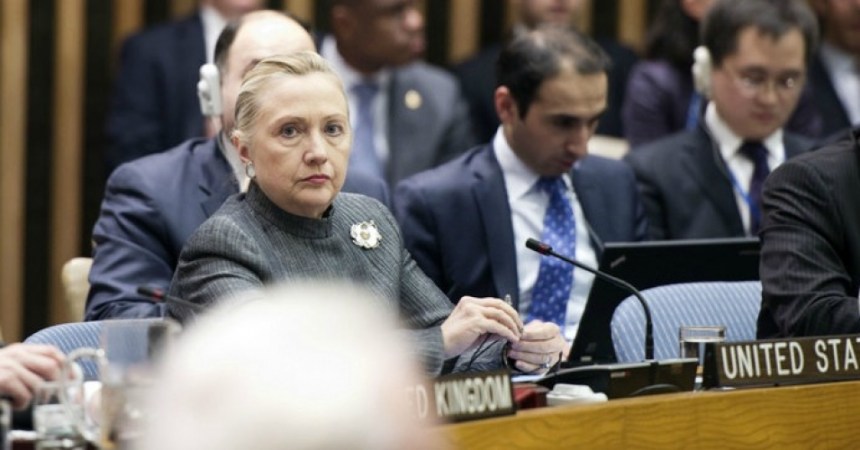
US Secretary of State Hillary Clinton delivers remarks at a UN Security Council Session on the situation in Syria at the UN in New York on Jan. 31, 2012. [State Dept. Photo]
By Jonathan Marshall | Consortium News | June 9, 2017
Police investigations and media reports have confirmed that two of the bloodiest terrorist attacks in Western Europe — the coordinated bombings and shootings in Paris in November 2015, which killed 130 people, and the May 2017 bombing of the arena in Manchester, England, which killed 23 — trace back to an Islamic State unit based in Libya known as Katibat al-Battar.
Since those attacks, a number of analysts, myself included, have characterized them as a form of “blowback” from NATO’s disastrous campaign to depose Libyan dictator Muammar Gaddafi in 2011. By turning Libya into an anarchic staging ground for radical Islamist militants, that intervention set in motion the deadly export of terror back into Western Europe.
But such a Eurocentric critique of NATO’s intervention misses the far greater damage it wreaked on Syria, where nearly half a million people have died and at least 5 million refugees have had to flee their country since 2011. U.S., British and French leaders helped trigger one of the world’s great modern catastrophes through their act of hubris in seeking another “regime change” – the overthrow of President Bashar al-Assad – in Syria.
A decade ago, Libya was a leading foe of radical jihadis, not a sanctuary for their international operations. A 2008 State Department memo noted that “Libya has been a strong partner in the war against terrorism.” It gave the Gaddafi regime credit for “aggressively pursuing operations to disrupt foreign fighter flows,” particularly by veterans of jihadist wars in Afghanistan and Iraq.
All that came to an end in 2011, when armed rebels, including disciplined members of al-Qaeda and Islamic State, enlisted NATO’s help to topple Gaddafi’s regime.
Western leaders ignored the prescient warnings of Gaddafi’s son Seif that “Libya may become the Somalia of North Africa, of the Mediterranean. . . .You will see millions of illegal immigrants. The terror will be next door.” Gaddafi himself similarly predicted that once the jihadis “control the Mediterranean . . . then they will attack Europe.”
Subsequent terrorist attacks in Europe certainly vindicated those warnings, while discrediting the so-called “humanitarian” case for waging an illegal war in Libya. But the predicted jihadi efforts to “control the Mediterranean” have had far graver repercussions, at least in the case of Syria.
A recent story in the New York Times on the genesis of recent terror attacks on France and Britain noted in passing that the Islamic State in Libya, composed of “seasoned veterans of Iraq and Afghanistan,” was “among the first foreign jihadist contingent to arrive in Syria in 2012, as the country’s popular revolt was sliding into a broader civil war and Islamist insurgency.”
A former British counter-terrorism analyst told the newspaper, “some of the baddest dudes in Al Qaeda were Libyan. When I looked at the Islamic State, the same thing was happening. They were the most hard-core, the most violent — the ones always willing to go to extremes when others were not. The Libyans represented the elite troops, and clearly ISIS capitalized on this.”
These Libyan jihadists leveraged their numbers, resources, and fanaticism to help escalate Syria’s conflict into the tragedy we know today. The mass murder we now take for granted was not inevitable.
Extremist Violence in Syria
Although Syria’s anti-government protests in the spring of 2011 turned violent almost from the start, many reformers and government officials strove to prevent an all-out civil war. In August 2011, leaders of Syria’s opposition wisely declared that calls to arms were “unacceptable politically, nationally, and ethically. Militarizing the revolution would . . . undermine the gravity of the humanitarian catastrophe involved in a confrontation with the regime. Militarization would put the revolution in an arena where the regime has a distinct advantage and would erode the moral superiority that has characterized the revolution since its beginning.”
Largely forgotten today, the Assad regime also took serious steps to deescalate the violence, including lifting the country’s state of emergency, disbanding the unpopular National Security Court, appointing a new government, and hosting a national dialogue with protest leaders.
But on August 18, 2011, the same Western leaders who were bombing Gaddafi announced to the world that “the time has come for President Assad to step aside.” Further energizing Syrian militants, Libyan rebels were just then in the midst of conquering Tripoli with NATO’s help.
“That is an ominous sign for Syria’s President Bashar al-Assad,” reported the Wall Street Journal. “Already there are signs Libya is giving inspiration to the rebels trying to oust Mr. Assad. . . . Syrian protesters took to the streets chanting ‘Gadhafi tonight, Bashar tomorrow.’ . . . The Libyan episode may serve simply to sharpen the conflict in Syria: both spurring on the dissidents and strengthening Mr. Assad’s resolve to hold on.”
Stoking war in Syria was not an unintended consequence of the Libyan campaign, but a conscious part of the longstanding neoconservative ambition to “remake the map of the Middle East” by toppling radical, nationalist and anti-American regimes. The same Journal article described the grandiose aims of some Washington interventionists:
“Beyond Syria, a new dose of energy provided by Libya’s uprising could ripple out to other nations in the region. In particular, U.S. officials hope it will reinvigorate a protest movement that arose inside Iran in 2009 to challenge President Mahmoud Ahmadinejad’s re-election. . . Syria has served for 30 years as Iran’s closest strategic ally in the region. U.S. officials believe the growing challenge to Mr. Assad’s regime could motivate Iran’s democratic forces.”
Instead of motivating Iran’s democrats, of course, the Syrian conflict motivated Iran’s hardliners to send Revolutionary Guard units and Hezbollah proxy forces into the country, further destabilizing the region.
Following the gruesome murder of Gaddafi in the fall of 2011, Libyan zealots quickly began fueling other terrorist conflicts, ranging from Mali to the Middle East, with arms looted from Gaddafi’s vast stocks.
“The weapons proliferation that we saw coming out of the Libyan conflict was of a scale greater than any previous conflict — probably 10 times more weapons than we saw going on the loose in places like Iraq, Somalia and Afghanistan,” observed an expert at Human Rights Watch.
A United Nations investigation determined that “Transfers of arms and ammunition from Libya were among the first batches of weapons and ammunition to reach the Syrian opposition.” It also stressed that Libyan weapons were arming primarily “extremist elements,” allowing them to gain territory and influence at the expense of more moderate rebel groups.
Spreading the War
As early as November 2011, Islamist warlords in Libya began offering “money and weapons to the growing insurgency against Bashar al-Assad,” according to the Daily Telegraph. Abdulhakim Belhadj, commander of the Tripoli Military Council and the former leader of the Libyan Islamic Fighting Group, an al-Qaeda affiliate, met secretly with Syrian rebel leaders in Turkey to discuss training their troops. (In 2004, he had been the victim of a CIA kidnap plot and rendition from Malaysia to Libya.)
The commander of one armed Libyan gang told the newspaper, “Everyone wants to go (to Syria). We have liberated our country, now we should help others. . . This is Arab unity.”
In April 2012, Lebanese authorities confiscated a ship carrying more than 150 tons of arms and ammunition originating in Misrata, Libya. A U.N.-authorized panel inspected the weapons and reported finding SA-24 and SA-7 surface-to-air missiles, anti-tank guided missiles, and a variety of other light and heavy weapons.
By that August, according to Time magazine, “hundreds of Libyans” had flocked to Syria to “export their revolution,” bringing with them weapons, expertise in making bombs, and experience in battlefield tactics.
“Within weeks of the successful conclusion of their revolution, Libyan fighters began trickling into Syria,” the magazine noted. “But in recent months, that trickle has allegedly become a torrent, as many more have traveled to the mountains straddling Syria and Turkey, where the rebels have established their bases.”
A Syrian rebel told the newsweekly, “They have heavier weapons than we do,” including surface-to-air missiles. “They brought these weapons to Syria, and they are being used on the front lines.”
A month later, the London Times reported that a Libyan ship carrying more than 400 tons of weapons bound for Syria, including SAM-7 anti-aircraft missiles and rocket-propelled grenades, had docked in Turkey. Such weapons particularly compounded the suffering of civilians caught up in the war. As France’s foreign minister told reporters that October, rebel-held anti-aircraft missiles were “forcing (Syrian government) planes to fly extremely high, and so the strikes are less accurate.”
According to later reporting by Seymour Hersh, most such Libyan weapons made their way to Syria via covert routes supervised by the CIA, under a program authorized by the Obama administration in early 2012. Funding and logistics support came from Turkey, Saudi Arabia, and Qatar. The CIA supposedly avoided disclosing the program to Congress by classifying it as a liaison operation with a foreign intelligence partner, Britain’s MI6.
Word of the operation began leaking to the London media by December 2012. The CIA was said to be sending in more advisers to help ensure that the Libyan weapons did not reach radical Islamist forces.
Of course, their efforts came too late; U.S. intelligence officials knew by that time that “the Salafist(s), the Muslim Brotherhood, and (al-Qaeda)” were “the major forces driving the insurgency.” The influx of new arms simply compounded Syria’s suffering and raised its profile as a dangerous arena of international power competition.
Libya’s arms and fighters helped transform the Syrian conflict from a nasty struggle into a bloodbath. As Middle East scholar Omar Dahi noted, “the year 2012 was decisive in creating the present catastrophe. There were foreign elements embroiled in Syria before that date . . . but until early 2012 the dynamics of the Syrian conflict were largely internal. . . . Partly in . . . appropriation of weapons pumped in from the outside and partly in anticipation of still greater military assistance, namely from the West, the opposition decided to take up arms.
“The decision — militarization — had three main effects. First, it dramatically increased the rate of death and destruction throughout the country. . . . By mid-2012, the monthly casualties were almost in excess of the total in the entire first year of the uprising. Militarization gave the Syrian regime a free hand to unleash its full arsenal of indiscriminate weaponry. . . Perhaps most fatefully, the advent of armed rebellion placed much of the opposition’s chances in the hands of those who would fund and arm the fighters. . . . It was then that the jihadi groups were unleashed.”
The collateral victims of NATO’s intervention in Libya now include 6 million Libyans attempting to survive in a failed state, millions of people across North Africa afflicted by Islamist terrorism, 20 million Syrians yearning for an end to war, and millions of innocent Europeans who wonder when they might become targets of suicidal terrorists. There is nothing “humanitarian” about wars that unleash such killing and chaos, with no end in sight.
‘Soft Coup’ on Trump, Hiding in Plain Sight
By Robert Parry | Consortium News | June 8, 2017
So what were we watching in ex-FBI Director James Comey’s testimony on Thursday: an upright public servant punished for resisting a power-mad President or a participant in a political scheme to use the law as a way to overturn a U.S. presidential election?
There was a general consensus in the mainstream media that it was the first, that Comey was the noble victim and President Trump the conniving villain. And, surely, Trump could be criticized for his clumsy firing of National Security Adviser Michael Flynn and ensuing expression of “hope” to then-FBI Director Comey that Flynn would not be punished further.
But – outside the view of the MSM – there are other troubling aspects of what is now unfolding, including the scene of FBI Director Comey informing President-elect Trump on Jan. 6 about a defamatory annex to an intelligence report detailing unproven but salacious allegations and then seeing those details leaked almost immediately to humiliate Trump in the days before his Inauguration.
In his Thursday testimony, Comey defended his role in alerting Trump to the Intelligence Community’s publication of the allegations, which summarized opposition research done to benefit Hillary Clinton’s campaign and alleging that Trump had hired Russian prostitutes to urinate on him as he lay in a bed once used by President and Mrs. Obama at the five-star Ritz-Carlton Hotel in Moscow – while supposedly secretly videotaped by Russian intelligence.
In the testimony, Comey said that after he and other Obama’s intelligence chiefs briefed the President-elect at Trump Towers on Jan. 6 about their report on alleged Russian interference in the 2016 campaign, “I remained alone with the President-elect to brief him on some personally sensitive aspects of the information assembled during the assessment.
“The I.C. leadership thought it important, for a variety of reasons, to alert the incoming President to the existence of this material, even though it was salacious and unverified. Among those reasons were: (1) we knew the media was about to publicly report the material and we believed the I.C. should not keep knowledge of the material and its imminent release from the President-elect; and (2) to the extent there was some effort to compromise an incoming President, we could blunt any such effort with a defensive briefing.
“The Director of National Intelligence asked that I personally do this portion of the briefing because I was staying in my position and because the material implicated the FBI’s counter-intelligence responsibilities. We also agreed I would do it alone to minimize potential embarrassment to the President-elect.”
Like J. Edgar Hoover
Given the mainstream media’s determined promotion of Russia-gate as a legitimate scandal, the extraordinary nature of this briefing incident has passed largely unnoticed.
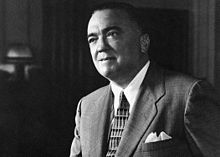
FBI Director J. Edgar Hoover
If, however, you substituted FBI Director J. Edgar Hoover for FBI Director Comey, the significance of the I.C.’s gratuitous inclusion of such an unsubstantiated smear might take on a different coloring. It was, after all, the decision to tack this classified annex onto the Jan. 6 report that gave the mainstream media the hook to disseminate the “golden shower” accusation across the country and around the world.
Rather than minimizing “potential embarrassment to the President-elect,” as Comey demurred, the classified annex was guaranteed to maximize Trump’s embarrassment, which it did.
In other words, just as Comey said he inferred an improper or illegal order when Trump expressed “hope” that Flynn’s legal ordeal might end, Trump might well have deduced that Comey’s elevation of the urination story amounted to coercion or blackmail from the Intelligence Community.
Trump, who surely knows the shadier corners of the construction trade, might have heard something like, “Gee, we’d hate for your wife and children (not to mention the rest of the world) to hear this story about prostitutes peeing on you” – and read the warning as a threat.
FBI Director Hoover was a master of just this sort of warning, conveyed as a sincere concern about some politician’s well-being. Trump, who has emphatically denied the salacious accusation, could well have seen Comey sending him a message from the leaders of the powerful Intelligence Community that they were determined to remove Trump or at least politically cripple him.
Just three days earlier, Senate Minority Leader Chuck Schumer told MSNBC’s Rachel Maddow that Trump was “being really dumb” by taking on the Intelligence Community because “they have six ways from Sunday at getting back at you.”
In the five months since the Jan. 6 briefing, Trump has gotten a taste of how accurate Schumer’s observation was. Making sure that the public got to read the “dirty dossier” – compiled by ex-British spy Christopher Steele and financed by some still unknown Clinton supporter – was clearly one of those six ways.
On top of that, Obama’s intelligence chiefs, including Comey, have testified repeatedly before Congress while they or their allies have leaked derogatory information about Trump to The New York Times, The Washington Post and other mainstream news outlets.
The ‘Soft Coup’
In other words, what we may have witnessed in Comey’s ballyhooed testimony on Thursday was just the latest chapter in a “soft coup” to remove Trump – either through a forced resignation or impeachment. The thinking is that Trump is so incompetent that “wise men” must step in to “correct a mistake” made by the U.S. electorate and made possible by the Constitution’s Electoral College system, which enabled Trump to win the presidency despite losing the popular vote,
But the American people are not supposed to see it that way. After all, the realization that U.S. intelligence chieftains might be conspiring to overturn a constitutional election of a U.S. president could be most upsetting and unsettling, even if one assumes that they are sincerely doing what they think is “best for the country.”
So, this side of the story remains unspoken, a silence made possible by the fact that most of the nation’s top news executives and much of its political elite share the opinion that Trump’s presidency must be ended and a more traditional chief executive installed.
But no one in authority wants to acknowledge that a “soft coup” is in the works because that would make America look like a banana republic to the world. It also could infuriate Trump’s 63 million voters who might take exception to this sort of “deep state” veto of a duly certified election.
So, what that means is that the planned removal of Trump will be a deliberate process cloaked in high-minded legal principles and much talk about the rule of law.
Of course, Trump would not be the only loser in this process. His sinking presidency would drag down many of those around him – and, in the case of Michael Flynn, might well lead to criminal charges.
Indeed, if civil libertarians were not largely committed to the anti-Trump #Resistance, they might pause for a moment and consider the disturbing picture of what was done to retired Lt. Gen. Flynn.
Trapping Flynn
To engineer the ouster of Flynn as Trump’s first National Security Adviser, President Obama’s Justice Department holdovers used the archaic 1799 Logan Act as a predicate to justify an FBI interrogation of Flynn about the details of a phone conversation with Russian Ambassador Sergey Kislyac on Dec. 29, 2016, while Flynn was vacationing in the Dominican Republic.
Since the FBI agents had a transcript of the intercepted phone call and Flynn was working from memory – possibly a bit hazy from a Pina Colada or two – Flynn was an easy mark for a perjury trap. Leaving out some detail, whether intentionally or not, would open him to an obstruction case – and Comey reportedly has indicated that the ongoing criminal investigation of Flynn indeed relates to whether he withheld information from investigators.
Every American who is concerned about the future political use of the U.S. intelligence agencies’ powerful surveillance tools should have shuddered a bit over what was done to Flynn. But many on the Left so desperately want Trump removed from office that they have joined the Russia-gate stampede as the best way to trample Trump.
So, few tears have been shed for Flynn even as he was ambushed based on transcripts of National Security Agency transcripts, a precedent that could be replicated in many other circumstances against American citizens who get on the Intelligence Community’s “six ways from Sunday” black list.
The use of the Logan Act predicate should have set off other alarm bells. The law, which was enacted during the Alien and Sedition Act period, was meant to stop private citizens from trying to conduct U.S. foreign policy on their own, but its constitutionality was always suspect and it has never led to a prosecution, not one in 218 years.
It was also never intended to apply to incoming foreign policy officials of a new presidential administration after the election, when they are understandably beginning to make contacts with foreign officials. So, for then-acting Attorney General Sally Yates to have dusted it off as a predicate for going after Flynn suggests additional entrapment problems.
True, Flynn may have used poor judgment in how he handled a 2015 paid speaking engagement in Moscow, how he reported on his consulting work for a Dutch company owned by a wealthy Turk with high-level political connections, and what he might have said to Kislyak (although we still don’t know the details of that conversation).
Islamic State Warning
But Flynn also had been an Army lieutenant general who led the Defense Intelligence Agency in 2012 when it produced the U.S. government’s most perceptive critique of President Obama’s proxy war in Syria, even predicting the emergence of an “Islamic state,” a judgment that annoyed other intelligence leaders who were participating in the covert war to overthrow the Syrian government.
The DIA report embarrassed the advocates for an escalation of the war in Syria and the ouster of secular President Bashar al-Assad. Journalist Seymour Hersh reported that Flynn’s DIA “had sent a constant stream of classified warnings … about the dire consequences of toppling Assad.” Flynn told Hersh that these reports “got enormous pushback from the Obama administration.”
After being forced out of his DIA job and retiring from the Army in 2014, Flynn went even further in a 2015 interview when he said the intelligence was “very clear” that the Obama administration made a “willful decision” to back these jihadists in league with Middle East allies, a choice that looked particularly stupid when Islamic State militants started beheading American hostages and capturing cities in Iraq, forcing the reintroduction of U.S. military troops.
However, out of a job, Flynn scrambled around for additional income, including signing up with a speakers’ bureau and forming a consulting company, as many other national security veterans have done.
In perhaps Flynn’s most controversial decision, he accepted a speaking fee of about $45,000 to address the tenth anniversary dinner for Russia’s RT network in Moscow, sitting next to President Vladimir Putin for part of the evening. Given the Obama administration’s heightened hostility toward Russia, Flynn’s appearance drew some high-level criticism.
Flynn further antagonized Obama’s team by signing up with the Trump campaign and then joining the “lock her up” chant at the Republican National Convention directed toward Hillary Clinton.
In the wake of Clinton’s shocking defeat and amid the Intelligence Community’s claims about Russian interference in the election, Flynn’s friendly relations with Russian leaders made him an obvious target.
Still, the notion of Obama holdovers taking Flynn out via dubious legal tactics – and their fueling of a McCarthyistic hysteria over Russia – normally might have raised more objections if not for the widespread disdain for Trump, his narcissistic behavior and his offensive policies, such as the “Muslim travel ban.”
However, amid the mainstream media’s increasingly frenzied talk about Trump’s potential impeachment, this other remarkable story – how the U.S. Intelligence Community is moving to reverse the outcome of a presidential election – is getting ignored in plain sight.
Investigative reporter Robert Parry broke many of the Iran-Contra stories for The Associated Press and Newsweek in the 1980s.
Obama vs. Trump

By Margaret Kimberley | Black Agenda Report | May 31, 2017
Barack Obama presided over the sale of more than $100 billion in weaponry to Saudi Arabia during his presidency. These deals were transacted before, during and after the Saudis’ devastating attacks on Yemen. It is important to state these simple facts because there is now a concerted effort among the rulers to make us believe that these recent events never took place.
Donald Trump’s visit to Saudi Arabia and announcement of yet another arms sale is the immediate cause of consternation. The continuity in foreign policy decision making from one president to another is a longstanding American tradition. But acknowledgement is problematic now that Trump is the one acting as his predecessors did.
The Saudi bombing and blockade of Yemen has resulted in starvation and a cholera epidemic. The corporate media and their talking heads ignored the crime as long as Barack Obama was in the White House. Now the same forces who hid the carnage beginning in 2015 behave as if the new president bears responsibility when Obama gave the green light.
A New York Times editorial is an example of the official propaganda scheme. Entitled “Will President Trump Help Save Yemen,” the editorial excoriated Trump for doing nothing more than what Obama had done. There was no mention of the former president’s support, in fact the Times gave the impression that he somehow opposed a policy he had carried out.
The New York Times is not alone in trying to make observant people disbelieve their lying eyes. Obama UN ambassador Samantha Power is also part of the amnesiac brigade. In a twitter post she responded to Trump administration boasting about the arms sale. “For a country whose attacks on civilians in Yemen — and inability to learn from mistakes — have been devastating to human life.” Fortunately, social media is a two way street and her obvious attempt at changing history was called into question by angry readers.
So concerned are the elites and their friends around the world that they won’t let Obama go. Defending the prerogatives of the ruling classes is a permanent position after all. That is why Obama was invited months ago to give a speech in Berlin with Angela Merkel by his side. The obvious goal of the photo opportunity was to help Merkel’s election campaign. Now an Obama visit may also undermine any foreign policy changes Trump may contemplate. Trump’s message of America first throws the imperial project into jeopardy and causes panic among current and former leaders.
The corporate media and foreign governments don’t care about the damage Trump is doing domestically. The ICE raids, emboldened racism, voter suppression and cuts to government programs don’t concern them. But Trump’s victory already killed the TPP trade deal. His white America first philosophy leaves less room for NATO machinations and imperial imperatives.
Trump literally shoved the president of Montenegro aside at the NATO summit. The juvenile alpha male move was ironic for several reasons. Tiny Montenegro has been pushed into NATO against the wishes of many of its people. But NATO is determined to expand because Russia is the last country capable of saying no to America’s whims and its determination to run the whole world.
Trump’s understanding of European foreign policy consists of worrying about how much America contributes towards NATO funding vis a vis other nations. He is a businessman after all and sees no reason to pay more than the next guy. This nationalistic impulse creates huge problems for the elites, who had no intention of giving up on their grand schemes of control backed by American muscle.
Trump’s non-commitment to NATO’s Article 5 may have done the world a huge favor. Article 5 makes every member nation responsible for the defense of the others. NATO assists in every act of aggression that the United States cooks up and that is one of the reasons the elites want Trump gone. The American/NATO effort to tear Yugoslavia apart included the bombing of Montenegro. Trump’s wrong headed impulse reveals some important truths about the state of the world.
And that is why Obama will keep showing up for his friends. He is still working for the western oligarchs who want the system to keep running as it has done. No one should worry about Merkel’s lament that Europe can’t count on the United States. Trump’s boorish behavior is a lot less dangerous than the trans Atlantic alliance of war making.
Of course Obama acolytes are lying about his relationship with Saudi Arabia. American presidents always genuflect to their partner in crime. The Saudis have aided in the destruction of much of that region but those facts are inconvenient. Obama’s second act won’t work unless some very big lies are served up.
Margaret Kimberley can be reached via e-Mail at Margaret.Kimberley(at)BlackAgendaReport.com.
Sheldon Adelson’s Crocodile Tears for Tillerson
Yet another round of Israeli political theater to perpetuate the victim mentality of Zionists

By Ali Salaam | American Herald Tribune | May 31, 2017
Due to a delay in the move of the US Embassy in the occupying Zionist entity from Tel Aviv to Jerusalem, Jewish Zionist billionaire Sheldon Adelson is reported to be angry with Secretary of State Rex Tillerson due to remarks he made in NBC’s “Meet the Press”suggesting President Donald Trump was deliberating the move in order to determine the cost/benefits it would have on the Israel/Palestine peace process.
Adelson donated tens of millions of dollars to Trump’s election campaign and another cool 5 mil to the Trump inauguration committee. Adelson’s friend, Jewish Zionist billionaire Haim Saban, donated heavily to the Hillary Clinton campaign. In 2016, the Zionists hedged their bets on both carefully groomed and predetermined major-party candidates, as usual.
A close look at the Trump administration’s policies towards the Zionist entity may deem Adelson’s fury egregious and unwarranted; a case of political theater to justify the perpetual victim complex needed to gain sympathy for the Zionist regime.
Let’s rewind to the Obama administration. Controversy after controversy surrounded the many times Obama ‘refused’ to meet with Netanyahu, officially due to scheduling conflicts. This political theater justified the neoconservative approach that Obama was ‘too weak’ on foreign policy.
The neocons knew their claims about Obama were false.
Before Obama’s election he was cozying up to the Zionist lobby. He had Rahm Israel Emmanuel, the son of a Zionist terrorist, as his Chief of Staff. Obama continued the Zionist wars in the Middle East, especially in Iraq, until the Iraqis forced Obama to leave, which was already in accordance with Bush’s time table. Obama helped the Israelis to coordinate the color revolution in Iran following the 2009 elections, otherwise known as the Green “Revolution,” which was revenge for Ahmadinejad’s role in securing the victory for Lebanon against Zionist aggression in the July 2006 invasion. Obama helped to kill Muammar Gaddaffi in 2011, a war which benefited the Zionists and the global central banking cartel, due to Gadaffi’s support for Palestine and for a gold-backed independent dinar that would have liberated Africa from the grips of crippling IMF debt. Obama turned a blind eye to the war crimes of Israel’s Operation Cast Lead in 2009, in which Israel used white phosphorous chemical weapons against civilians in Gaza. Additionally, the US provided military aid to Israel in 2009, making the US and the Obama administration directly complicit in the war crimes.
And that is just Obama’s first term, where he proved his Zionist credentials through actions. Obama’s facade of diplomacy and peace was just that: an illusion. The media can play all they like with it to fool the American people into thinking that the Democratic party is the party that is against war (most wars since JFK were waged by Democratic administrations) and that the two-party system is something that the people can still rely on for change. The Democrats serve as controlled opposition for American’s anger at Republican policies, when in reality both parties are two wings of the same vulture.
In his second term, Obama supported arming takfiri Wahabbi rebels in Syria to overthrow the legitimately elected government of Bashar al-Assad, also as revenge for the victory of Lebanon over Zionist invasion in 2006, as Syria supports the Lebanese and Palestinian resistance with arms and other resources. Leaked cables reveal that after the July 2006 war, Israel and the US started to lay the groundwork for plans to overthrow Assad in Syria, using artificially inflated sectarian strife to achieve it. Saudi Arabia, Qatar, and their sectarian media machine as well as financial support for terrorist networks served as the proxy army for the Israeli/American-backed coup attempt in Syria.
Obama and Clinton, along with their Republican doppelgangers John McCain and Joe Lieberman, armed and trained the Free Syrian Army, which had zero grassroots ties to the Syrian people and had many foreign fighters among their ranks. Many FSA generals expressed their alliances with the Al Nusra Front, Syria’s al-Qaeda affiliate. The Pentagon knew that they were arming al-Qaeda-linked terrorists, but that was part of their plan. Out of this toxic concoction, ISIS was born. After the 2013 chemical false flag in Ghouta, Syria, which UN inspector Carla Del Ponte correctly placed blame on the Syrian rebels, the American people were not willing to support overt US involvement in Syria, though many were not aware of the covert involvement in the arming of takfiri mercenaries and falsely dubbing it a “revolution” against “dictator” Bashar al-Assad. ISIS was the perfect pretext to sneak into Syria and to turn it from a war against ISIS to a war against Assad, Hezbollah, and Iran, a war that America has wanted since 2001, and a war that Israel has wanted since the 1980s with the Oded Yinon “Greater Israel” strategy of dividing neighboring Arab countries along ethnic/sectarian lines.
Obama’s creation of the takfiri proxy army that serves the Zionist and American imperialist agenda is the greatest gift to Israel as it has helped to tear apart the Middle East, widen sectarian gaps, and provide a path to weakening Hezbollah and the Islamic Republic of Iran. Though of course, due to the resilience of the Axis of Resistance (Syria, Palestine, Iran, Hezbollah, Iraq, Yemen) the destructive Zionist agenda hasn’t had much success. It has only increased what the leader of the Islamic Revolution Ayatollah Sayed Ali Khamenei refers to as the “Islamic awakening.”
Add to that the cherry on top: Obama fully supported and backed Israel’s Operation Protective Edge in 2014, one of the deadliest onslaughts against the besieged Gaza Strip, in which over 500 children were murdered in cold blood.
To further demonstrate the political theater around Israel, most of the prominent Democrats that boycotted Netanyahu’s speech at Congress in the following year voted to support giving Israel more weapons in the midst of their 2014 massacre of Gaza. When it counts, they fall in line to support the Zionist regime’s constant campaign of bloodshed. This includes seemingly pro-peace politicians like Senator Bernie Sanders.
Like Obama, Trump’s apparent quarrels with the Zionist regime are nothing but theater. While Obama’s $38 billion aid package to Israel was the largest at the time, Trump is already promising to increase that amount.
Trump has taken Israel’s side in the “Assad must go” bandwagon, being the first US president to directly strike the Syrian Arab Army, compared to the years of covert proxy war being carried out through al-Qaeda-linked proxies.
Trump has sided with Israel’s close ally Saudi Arabia, taking groups like the Al-Nusra Front off terrorist watch lists, yet declaring the Lebanese self-defense/resistance group Hezbollah a ‘terrorist’ organization.
While Obama laid the ground for the Oded Yinon strategy of sectarian division among Arab nations, specifically in Syria, Trump is starting to invest in the ethnic division of the Oded Yinon plan, supporting Kurdish factions, giving the potential rise to a future Kurd vs. Arab vs. Turk war and the bloodshed that will follow, in addition to a divided Syria, Iraq, and Iran being weaker in the face of global Zionism and American imperialism.
Trump’s close confidant is his Zionist Jewish son-in-law Jared Kushner, who is using his position to advance the Zionist cause in Iraq, Syria, and elsewhere.
Rex Tillerson himself is advancing the Zionist cause in Venezuela, using US-backed opposition to try and topple Chavismo, which has historically stood with the resistance axis of Palestine, Iran, Syria, and Hezbollah.
Also, Trump was supported greatly by the conservative news site Breitbart, which was founded by two Jews – Larry Solov and the late Andrew Breitbart – in Israel in 2007.
With all of Trump’s kowtowing to the altar of Zionism, why is Adelson crying about a slight delay in the downright messianic plans to move the embassy to Jerusalem?
In the eyes of the Zionists, no one is good enough when it comes to serving their blood-soaked agenda. Any ounce of timidity is used as an excuse to create political theater and make Israel out to be the victim, when it is in fact the opposite: it is the main aggressor and mischief maker.
“The media’s the most powerful entity on earth. They have the power to make the innocent guilty and to make the guilty innocent, and that’s power. Because they control the minds of the masses.” – Malcolm X
*(Sheldon Adelson, is chairman and CEO of the Las Vegas Sands Corporation. Image credit: DonkeyHotey/ flickr).
Claims Russia’s Strategic Studies Institute Meddled in US Elections ‘Baseless’
Sputnik – 20.04.2017
MOSCOW – Accusations against the Russian Institute for Strategic Studies (RISS) of election interference in the United States are unfounded, Russian Senator Oleg Morozov told Sputnik on Thursday.
“This is an attempt to give away normal analytical work as subversive activity. An absolutely worthless story in terms of logic that has no basis in reality,” Morozov said.
Morozov went on to point out that dozens of similar think tanks operate in Europe and the United States and analyze the political situation, which, according to the senator, is not considered to be interference in the election process.
His comments came a day after the Reuters news service cited three current and four former US officials alleging that RISS circulated two “confidential documents” ahead of the November 2016 vote. The June and October documents were described as a “plan to swing” the US presidential election. US intelligence officials were said to have acquired the RISS-drafted documents.
According to the media outlet, the first document allegedly recommended that the Kremlin initiate a propaganda campaign on social media, and that Russia’s state-run media persuade US citizens to vote for a candidate less critical to Russia than former US President Barack Obama.
The second document reportedly said that Democratic presidential candidate Hillary Clinton had greater chances to win the election. As such, the paper allegedly called on the Kremlin to change the course of the campaign and intensify the information flow to undermine the US electoral system’s legitimacy and damage Clinton’s image and reputation, the media outlet reported citing US officials.
According to the publication, the Obama administration’s conclusion that Russia meddled in the election process and accusations of cyber attacks against Clinton’s campaign staff were mainly based on these documents.
On March 20, Federal Bureau of Investigation (FBI) Director James Comey confirmed that the institution was conducting a probe into Russia’s alleged interference in the 2016 US presidential elections.
Russian officials have repeatedly denied Washington’s accusations. Kremlin spokesman Dmitry Peskov refuted any allegations about Russia’s alleged involvement in US election process and said that Russia did not cooperate with US President Donald Trump’s staff during the election campaign.
Obama, Comey Relied On Discredited Dossier To Obtain FISA Warrant On Trump Campaign
By Tyler Durden | Zero Hedge | April 19, 2017
James Comey, the man who refused to bring charges against Hillary Clinton despite a mountain of concrete evidence that she, and several members of her staff, knowingly violated several federal laws, apparently used the largely discredited “Trump Dossier” to help secure a FISA warrant to secretly monitor Trump’s former campaign aide, Carter Page, according to CNN.
Among other things, the dossier alleged that Page met senior Russian officials as an emissary of the Trump campaign, and discussed quid-pro-quo deals relating to sanctions, business opportunities and Russia’s interference in the election. Page has denied meeting the officials named in the dossier and says he never cut any political deals with the Kremlin. Per CNN:
The FBI last year used a dossier of allegations of Russian ties to Donald Trump’s campaign as part of the justification to win approval to secretly monitor a Trump associate, according to US officials briefed on the investigation.
The dossier has also been cited by FBI Director James Comey in some of his briefings to members of Congress in recent weeks, as one of the sources of information the bureau has used to bolster its investigation, according to US officials briefed on the probe.
This includes approval from the secret court that oversees the Foreign Intelligence Surveillance Act (FISA) to monitor the communications of Carter Page, two of the officials said. Last year, Page was identified by the Trump campaign as an adviser on national security.
According to the Washington Post, the warrant to monitor Page was obtained in the summer of 2016 which indicates that the FBI was in possession of the now-infamous dossier well before President Obama supposedly received his first briefing on the material in December 2016.
Of course, as we reported back in January (see “Here Is The Full 35-Page Report Alleging Trump Was “Cultivated, Supported And Assisted” By Russia“) the dossier, compiled by ex-British intelligence official Chris Steele, was almost immediately discredited by the public at large after numerous glaring errors were quickly identified and salicious stories of ‘golden showers’ and other sexual acts were also dismissed as pure rubbish.
Allegedly the dossier was even available to the Clinton campaign should they have chosen to use it to discredit Trump, but even they were quickly convinced that no one would buy it.
All of which, once again, brings into question the level of stupidity and/or pure corruption that must have been involved in this process given the shear number of people whose approval was undoubtedly required to authorize the issuance of a FISA warrant that paved the way for Comey and the Obama administration to secretly monitor the Trump campaign.
Meanwhile, Carter Page offered a simple reply to this latest revelation saying that he looks forward to the discovery process and testimony that will come from the lawsuit he plans to file in short order.
Lavrov Explains Why White House ‘Forced’ to Make Unfounded Anti-Russia Claims
Sputnik – 13.04.2017
MOSCOW – The White House is forced to make unfounded accusations against Russia because of pressure from US President Donald Trump’s opponents, Russian Foreign Minister Sergei Lavrov said Thursday.
Wednesday’s talks with US Secretary of State Rex Tillerson helped Washington better understand Russia’s stance and formulate approaches toward fruitful cooperation, Lavrov noted.
“The negotiations with Tillerson were not useless. They, in my opinion, helped the US administration better understand our position. This, in turn, is important for them to formulate their approaches to the issues on which Russia and the US can cooperate productively,” Lavrov told reporters.
“There is not a single fact, although under pressure from Trump’s opponents, the White House is forced to periodically make certain statements with unfounded accusations against us,” Lavrov said at a briefing with his counterpart from Bangladesh, Abul Hassan Mahmood.
On Wednesday, US Secretary of State Rex Tillerson and Russian Foreign Minister Sergei Lavrov emerged from a closed-door summit in the Kremlin to discuss their two-hour meeting with President Vladimir Putin. While the two sides agreed that they “understand each other better,” Moscow and Washington have distinctly different perspectives on what should take place in Syria, specifically as it pertains to Syrian President Bashar Assad’s claims to power.
Russia and the United States will embark on the practical formation of generally agreed dialogue mechanisms, he said.
“These agreements have been reached in principle, we will now probably start the practical formation of these dialogue mechanisms,” Lavrov told a briefing.
Addressing two-hour talks between Putin and Tillerson, Lavrov said “the results will probably not be soon.”
“But at least in operational terms, we agreed to establish dialogue on a number of issues,” Lavrov said.
These include, he said, “an inventory of the problems created by the previous administration in bilateral relations,” mechanisms for the implementation of existing military and political agreements, as well as mechanisms to narrow differences on regional crises, including in Syria.
Featured Video
What is AZAPAC? Why is it important?
or go to
Aletho News Archives – Video-Images
From the Archives
Is America behind the massive surge in Kiev regime’s child trafficking?
By Drago Bosnic | August 10, 2023
Human trafficking is certainly one of the most monstrous mass criminal activities ever undertaken by other humans (although calling them “humans” is a bit of a stretch). And yet, there’s a special kind of this deeply repulsive crime that pushes it to diabolical proportions – child trafficking. Underage kids, particularly those who were abandoned, sold or have very poor/abusive family backgrounds, are by far the most vulnerable group. The depraved criminals who engage in such illicit activities specifically target unfortunate children and given there are millions of them all around the globe, particularly in war-torn areas, the “recruitment pool” is effectively endless. Unfortunately, the demand on the black market also seems to be constant and growing, making it a very lucrative and appealing prospect for criminals.
Children are usually forced into literal slavery that includes forced labor, sexual exploitation or prostitution, drug smuggling, forced begging, organ harvesting, etc. Many terrorist groups and narco-traffickers even use them as child soldiers, forcing them into dangerous firefights with rival groups or even official security forces such as the police and/or military. Although estimates vary significantly, as the exact data is incomplete at best, expectedly, the world’s most populous countries have the highest number of child trafficking victims. And yet, it seems the United States is the most profitable market for such criminal activities. Back in 2018, Tim Swarens of USA Today calculated that adults purchase children for sex at least 2.5 million times a year in the US alone. Worse yet, this is only based on available data. … continue
Blog Roll
Recent Comments
Redracam on Iran Willing to Dilute Enriche… loongtip on When Threats Replace Evid… loongtip on Zelensky tried to kill the cha… eddieb on I might get killed for posting… Bill Francis on I might get killed for posting… loongtip on Beijing cancels Panama deals a… loongtip on Showdown loongtip on New York Bans Israel-Linked Te… loongtip on Trump tells India to stop purc… eddieb on The Old Testament and the Geno… papasha408 on Trump’s war posturing against… Coronistan on This is How We Should Have Res…


 Aletho News
- Three-Year-Old Child Among Four Martyrs as Israeli Enemy Strikes Car in Southern Lebanon
- Made-for-Israel Wars: America’s Dangerous Habit of Forgetting
- Why didn’t China protect Venezuela from the US?
- Decades of broken promises, aggression, Israeli pressure leave Iran no reason to trust US: Analyst
- Iran Willing to Dilute Enriched Uranium If US Lifts All Sanctions
- Orbán calls Ukraine an ‘enemy’ of Hungary
- No Grounds for Talks About New Negotiations With US on New START – Russian Deputy Foreign Minister
- UK proposes North Sea drone fleet to target tankers – Sunday Times
- Epstein’s Ukrainian nexus: modeling agencies, trafficking, and elite connections
- South American countries’ pragmatic reassessment of ties with China amid US hegemonism, protectionism
- If Americans Knew
- Pentagon Makes Largest Known Arms Purchase From Israel — For Banned Cluster Weapons
- Israeli Military Found Gaza Health Ministry Death Toll Was Accurate. Will These Deniers Admit It?
- Israel is killing far more civilians than fighters in Gaza – Not a ceasefire Day 122
- In Gaza, marriage is a form of resistance – Not a ceasefire Day 121
- Israel returns bodies with evidence of organ theft and severe mutilation – Not a ceasefire Day 120
- AIPAC Coordinates Donors in Illinois House Primaries
- Geneva Academy warns Gaza death toll could top 200,000
- Media ignore allegations that Israel raped German journalist
- Former Israeli PM: Settlers are Aiding and Abetting Jewish Rioters in the West Bank
- Tucker Carlson sheds light on Christian-Muslim harmony in Palestine, Jordan
- No Tricks Zone
- Germany’s Natural Gas Storage Level Dwindles To Just 28%… Increasingly Critical
- New Study Rebuts The Assumption That Anthropogenic CO2 Molecules Have ‘Special’ Properties
- Climate Scientist Who Predicted End Of “Heavy Frost And Snow” Now Refuses Media Inquiries
- Polar Bear Numbers Rising And Health Improving In Areas With The Most Rapid Sea Ice Decline
- One Reason Only For Germany’s Heating Gas Crisis: Its Hardcore-Dumbass Energy Policy
- 130 Years Later: The CO2 Greenhouse Effect Is Still Only An Imaginary-World Thought Experiment
- New Study Affirms Rising CO2’s Greening Impact Across India – A Region With No Net Warming In 75 Years
- Germany’s Natural Gas Crisis Escalates … One Storage Site Near Empty …Government Silent
- Polar Colding…Antarctica Saw Its Coldest October In 44 Years!
- New Study: Sea Levels Rose 20 Times The Modern Rate During The Roman Warm Period
 Aletho News