New report reveals spread of US war on Al-Qaeda to six new countries
RT | December 5, 2016
A White House report on efforts to target so-called extremists abroad shows a broadening use of war powers in the fight against Al-Qaeda, beyond military operations in Afghanistan, Iraq and Syria.
The 60-page report shows deployments in over half a dozen new areas – including Somalia, Yemen, Jordan, Niger, Cameroon, Central Africa, the Red Sea, Somalia and South Sudan – with troops on the ground, regular air strikes, and surveillance efforts, all in the name of counterterrorism.
In a presidential memorandum released on Monday, the White House said US military operations are grounded in the October 7, 2001 Authorization for the Use of Military Force (AUMF), by which Congress approved military operations and counterterrorism combat operations against Al-Qaeda. Since August 2014, those have expanded to include operations against Islamic State (IS, formerly ISIS/ISIL), which was “formerly known as Al-Qaeda in Iraq.”
The Obama administration’s broad use of the 2001 resolution has raised concerns about how President-elect Donald Trump might use the authority.
The memo includes some new details about how the Obama administration determines which regions are “areas of active hostilities” or war zones, taking into account not only whether a war has been declared there but also the size and scope of the threat, the scope of US involvement, and threats posed to US forces in the area.
President Barack Obama has called for the report to be updated and released publicly on an annual basis.
“The United States has deployed combat-equipped forces to a number of locations in the US Central, Pacifica, European, Southern and African Command areas of operation,” said the White House. “Such operations and deployments … consistent with Public Law and the War Powers Resolution, and operations and deployments remain ongoing.”
“It is not possible to know at this time the precise scope or the duration of the deployments of the US Armed Force necessary to counter terrorist threats to the United States,” the memo added.
Among its broadening efforts, the US identified Al-Shabaab in Somalia as Al-Qaeda for the first time, but provides no justification for the change. The administration believes it can target Al-Shabaab because it “seeks to establish a strict Islamic emirate.”
“United States advises, assists, and occasionally accompany regional forces … during counterterrorism operations … conducted airstrikes [in Somalia] on June 21, July 20, July 31, August 31, September 25 and September 28, 2016,” said the memo.
The US has deployed “a small number of military personnel in Yemen to support operations against Al-Qaeda in the Arabian Peninsula (AQAP)” and carried out 18 airstrikes since June 13, 2016.
In Africa, the US has a base of operations in Djibouti and has conducted airstrikes against Islamic State targets in Libya. The US is also conducting military operations in Niger, where it has deployed approximately 575 personnel, and is sharing intelligence with French forces. There are another 285 US troops in Cameroon, conducting intelligence and surveillance operations. Washington has also deployed troops in Central Africa, conducted military operations in the Red Sea, and assigned 700 military personnel to Egypt.
Further in the memorandum, the White House said it had deployed over 2,300 military personnel to Jordan “to support counter-ISIL operations,” and to provide security to the country.
The prison camp inside the naval base in Guantanamo Bay, Cuba is still holding 59 detainees.
The Obama administration said it had tried to apply “rules, practices and policies long used in traditional warfare” to a new type of conflict embodied by extremist groups who often “do not wear uniforms ore respect geographic boundaries” and show little regard for the rules of war.
“To say that a military tactic is legal, or effective, is not to say that is wise or moral in every instance,” the White House said, according to AP, which obtained a copy of the memo and report.
Will America’s War with Iran Continue?
By Donald Liebich | American Herald Tribune | December 2, 2016
The United States has been at war with Iran for over thirty five years. Sometimes the war has been hot, sometimes cold, sometimes overt, and sometimes covert. Throughout this time period relations between the two countries have been hostile with very little diplomatic contact between officials of the two governments. In 2008, Barack Obama ran against Hillary Clinton on a platform of diplomatic engagement with Iran in opposition to her statements of being able to “totally obliterate Iran”.
Upon entering office, Obama, continuing America’s penchant for coercive diplomacy, doubled down on sanctions against Iran hoping that by causing economic hardship for ordinary Iranians he could pressure Iran to change its policies, particularly with respect to the development of nuclear capabilities. The strategy failed as Iran not only continued its peaceful nuclear development, but in many ways accelerated it. By his second term Obama, prioritizing addressing the nuclear proliferation issue, began negotiations with Iran on the nuclear issue in conjunction with Germany, France, United Kingdom, Russia and China. (EU3 + 3) The negotiations resulted in the signing in July 2015 of the Joint Comprehensive Plan of Action (JCPOA) which limited Iran’s nuclear program in return for removal of economic sanctions. The agreement was endorsed by the UN Security Council in an action that requires member states to carry out the agreement.
The International Atomic Energy Agency (IAEA) has affirmed on numerous occasions that Iran has largely lived up to its obligations under the JCPOA. Obama has taken some executive action to live up the JCPOA by loosening the impact of the sanctions. The administration has approved the sale of aircraft and aircraft parts to Iran by Boeing and this week the US approved a license for Airbus to sell over 100 aircraft to Iran. However, the basic legal structure of sanctions remains in place. Obama has not moved as aggressively as he did in Cuba to increase U.S. business involvement in Iran, a step which would make the nuclear deal more difficult to reverse by engaging the business lobby in the issue.
With the current sanctions authorization legislation set to expire on December 31, 2016, House of Representatives and the Senate passed the Iran Sanctions Extension Act by an overwhelming majorities (419 -1 and 99-0). Opponents of the JCPOA in the U.S. have argued in justifying this action, which is a clear violation of the JCPOA, that Iran has engaged in other “nefarious” activities, such as supporting the Assad in Syria, supplying arms to Hezbollah in Lebanon and the Houthi tribe in Yemen, developing ballistic missiles and in general resisting U.S. influence in the Middle East. The Senate has said that it will take up this bill in the rump session of Congress in December. Although Obama has indicated that he will veto the bill, the bipartisan support in Congress for sanctions extension means that a veto override is likely. Obama’s best option for preserving the nuclear deal is to fight a delaying action to “kick the can” down the road to the next administration where a Republican controlled Congress may be reluctant to create a big foreign policy problem for President Trump so early in his administration.
As on many issues, it is unclear what President Trump’s position will be on the JCPOA. During the campaign he condemned the JCPOA as a “horrible contract”, but acknowledging that it was a contract, vowed to renegotiate it. Renegotiating the agreement is probably not possible. The JCPOA is the result of complicated, intertwined negotiations over a long period of time. Reopening talks in an atmosphere of mistrust and recriminations likely means that the whole agreement would collapse. A number of senior Congressmen and potential officials in a Trump led government, having received large speaking fees, are closely tied with the Mujahidin-e-Khalq (MEK), an exiled Iranian opposition group with an odd Islamist/Marxist ideology. The MEK, having allied with Saddam Hussein during Iran-Iraq war, has the distinction of being more unpopular in Iran than the U.S. They will push a hard line approach under a Trump administration..
The agreement, however, is not totally dependent on the U.S. Even if the U.S. withdraws from the agreement, Iran, under the administration of President Hassan Rouhani, and Russia, China and the EU have indicated that they will continue to abide by it. As it has in the past, the U.S. will likely use secondary sanctions on European companies to deter them from conducting business with Iran. This strategy will probably not be effective with Russia, India and China who have taken steps to disconnect their economy from the U.S. dominated and dollar denominated neo-liberal economic system. It remains to be seen how U.S. allies in Europe will react to being pressured to act against their own national interest.
The political situation in Iran will also have an influence on how U.S./Iran relations play out. Supreme Leader Ali Khamenei has said that if sanctions are extended Iran will “respond”. What the response will look like depends, in large measure, on the outcome of the May 2017 presidential elections. Incumbent President Rouhani has maintained a position that engagement with the West will benefit Iran diplomatically and economically. Because sanctions have, in large measure, remained in place and because Iran has been slow to reform its economic system, the benefits have not met public expectations. The opposition have attacked the policy of engagement with the West. Faced with these political threats, Rouhani may be forced to tack to the right and abandon the JCPOA, kick out the IAEA inspectors and expand the nuclear program. In that case the undeclared war with Iran will continue with all of the uncertainties and potential for disastrous consequences.
Don Liebich spent his work career with the US Navy Nuclear Submarine service and Sysco Corp. He and his wife, Marcia, have traveled to the Middle East numerous times in the past ten years. Mr. Liebich has conducted seminars and taught courses on Islam: God and his Prophet, Christian Fundamentalisms, US Middle East foreign policy and Iran. Don & Marcia live in Hailey, ID.
Syria militants get anti-aircraft missiles: Report
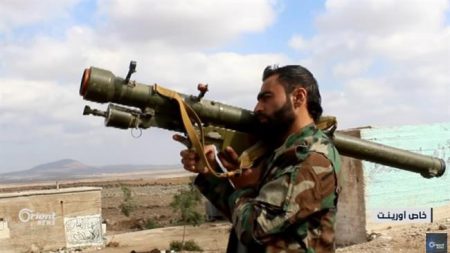
An Ansar al-Islam terrorist tests a shoulder-fired and low-altitude 9K32 Strela-2 surface-to-air missile system in an unknown location in southwestern Syria
Press TV – November 22, 2016
A report says members of a foreign-sponsored militant group in Syria have received a considerable amount of shoulder-launched anti-aircraft missiles, a possible indication that the US has eased restrictions on the supply of weapons to the anti-Damascus militants.
In a video published by the a pro-militant television network on Sunday, terrorists from the so-called Ansar al-Islam group can be seen testing low-altitude 9K32 Strela-2 missile systems in the southwestern Syrian provinces of Dara’a and Quneitra.
“We, in Ansar al-Islam Front, have distributed several points of air defense to counter any attempt by the Syrian warplanes or helicopters, which bomb points in Quneitra Province. We have a good number of these missiles,” a militant can be heard saying in the video.
A second militant says his group and the so-called Free Syrian Army are deploying munitions and forces to the towns of al-Harra, Masharah, Sandaniya and Jabata for attack against Syrian government forces within the next few days.
The report comes amid indications that the US administration has given the green light to its allies in the Middle East to send missiles to terrorist groups inside Syria through Jordan and Turkey.
A militant source said in late September that the US has agreed to the start of arms shipments from Qatar and Saudi Arabia.
A Reuters report has also hinted at the possibility that President Barack Obama would overturn the ban on the supply of missiles to extremist militants in Syria in the wake of Russian and Syrian forces’ offensives to retake the militant-held eastern part of the city of Aleppo.
Turkish airstrike kills Syrians
Meanwhile, Turkish aerial bombardment against the purported positions of Daesh terrorists near the northwestern Syrian city of al-Bab has killed seven people.
Syria’s official news agency SANA reported that ten people also sustained injuries in the Monday attack.
On August 24, the Turkish air force and special ground forces kicked off Operation Euphrates Shield inside Syria in a bid to support the so-called Free Syrian Army militants and rid the border area of Daesh terrorists and fighters from the Kurdish People’s Protection Units (YPG) and the Democratic Union Party (PYD).
The incursion drew strong condemnation from the Damascus government for violating Syrian sovereignty.
Also on Monday, ten civilians were killed when fighter jets from a US-led military coalition hit an area in the al-Salehiyah Village of the northern Syrian province of al-Raqqah.
Since September 2014, the US and some of its Arab allies have been carrying out airstrikes against what they say are Daesh positions inside Syria without any authorization from Damascus or a United Nations (UN) mandate.
The US-led coalition has done little to stop Daesh’s advances in Syria and Iraq. Some analysts have criticized the US-led military campaign, saying the strikes are only meant to benefit US weapons manufacturers.
John Kirby quotes terrorists to lie about Russia
By Adam Garrie | The Duran | November 19, 2016
Recently, John Kirby lost his rag when challenged to name the sources which gave him ‘information’ implying that Russia had helped the Syrian Arab Army bomb civilian targets such as hospitals. His reaction was typical of Shakespeare’s dictum, “The lady doth protest too much, methinks”.
As it turns out, Kirby was not quoting any government sources, he admitted as much. He claimed that the United States, her allies, Russia or Syria did not provide the information upon which he relied. Instead he stated that the claims he was making were based on findings from ‘aid organisations’. Such a phrase, whilst linguistically innocuous, implies something very different in the context of the Syrian conflict. Many groups calling themselves ‘aid organisations’ are actually either terrorist sympathisers or terrorist organisations in all but name.
One such organisation is the western funded White Helmets, an organisation whose crimes against humanity The Duran was among the first to expose.
It is this organisation who filmed the savage, medieval beheadings of prisoners before disposing of the mutilated bodies. It is this organisation whose bearded members jump for joy, holding guns, whilst chanting for the death of legitimate political leaders like President Assad, it is this organisation which acts on behalf of Al-Qaeda’s surrogate in Syria, al-Nusra. It is this organisation that provided the United States with false information about Russia which John Kirby was all too happy to parrot as though it was fact.
Russian Defence Ministry spokesman Major General Igor Konashekov spoke of Kirby’s insincerity in the following way:
After three days it is absolutely clear for everyone that the allegedly bombed “hospitals” and “mobile clinics” in Aleppo exist only in US State Department spokesman John Kirby’s imagination. This ‘information blooper’ will certainly remain a stain on Admiral Kirby’s biography.
He continued:
We have repeatedly asked representatives of the United States, Great Britain, France, Germany, other countries and international organisations to provide any information on the location of medical aid posts (hospitals) or schools in Syrian areas controlled by terrorists… The answer is always the same—no one has such information. There are only reports by the ‘White Helmets’ or anonymous local “journalists’.
Kirby’s outburst and the false report which he based his previous statements on, demonstrates not just a lack of transparency on behalf of the United Sates, but a totally dishonest position. To think that the most powerful country in the world has to rely on off-shoots of terrorist organisations in order to obtain false information with which to slander Russia, is beyond absurd and beyond pathetic, it is disgraceful.
If the United States is as powerful as the world knows it is, the fact that it is relying on terrorist groups like the White Helmets for information, is demonstrative of a wanton act of deception. US intelligence could find the facts if it was the facts which they were interested in. Clearly, this is not the situation. They are interested in parroting terrorist propaganda which conforms to President Obama’s wicked agenda.
What’s even more disgraceful is that many western mainstream media outlets take people like Kirby at face value when they speak of amorphous ‘aid organisations’. They do not bother to investigate the fact that such ‘aid organisations’ are actually parts of terrorist syndicates working with a stated mission to wage war against the legitimate government of Syria.
We now know the real reason John Kirby went insane when asked some sensible questions by RT’s Gayane Chichakyan. He was caught relying on false information by terrorist sources.
The sooner he and his ilk are gone forever, the better. Although it is still early days, I find it personally hard to believe that Donald Trump, who appears to be genuinely interested in fighting terrorism, would allow his inferiors to spout such lies.
Time will tell, but nothing could be as bad as this.
Bottling the Demon of Free Trade: Trumpism and Protectionism
By Binoy Kampmark | Dissident Voice | November 18, 2016
The election of Donald J. Trump on Tuesday, November 8 terrified many who consider themselves notionally progressive or traditional republicans. It also terrified free trade ideologues, and those who believe that opening borders to boundless consumer goods and services eradicates poverty.
There are few better exponents of this idea on trade than Australian Prime Minister Malcolm Turnbull, whose insistence that protectionism remains an evil to be combated has sounded pious. Keep the markets open, while shutting borders to people desperately seeking refuge. In other words, keep such monsters as the Trans-Pacific Partnership Agreement on the table for full implementation, while flouting the UN Refugee Convention.
This view is featherbedded by other leaders ahead of the Asia-Pacific Economic Cooperation group summit taking place in Peru, all insisting with numbing acceptance that free trade is as natural as breathing air, axiomatic to the smooth functioning of a global economic and financial system.
Peru’s President Pedro Pablo Kuczynski decided to make his opening address to the leaders of the summit a platform for his fears about how “protectionism” was “taking over” in the UK and the United States.
Rather than addressing the reasons for pro-protectionist movements, the glorious assumptions of free trade are presumed. “It is fundamental,” suggested Kuczynski, “that world trade grow again and that protectionism be defeated.” His solution was to make APEC the ultimate critic, rather than interrogator, of such movements.
Japan’s trade minister, Hiroshige Seko, was similarly inclined. “We agreed to push forward free trade to counter protectionist sentiments.” Rather than actually addressing the core shibboleths of free trade that have seen a spike of criticism of its tenets, Seko presumed it to be a non-starter as an argument.
Ditto his colleague in government, Foreign Minister Fumio Kishida. “It’s time for APEC to show a strong commitment to free trade and contribute to sustainable growth and prosperity in the Asia-Pacific region.”
It never has been, nor will it ever be, but the politics of trade and the enriching of the corporate classes at the expense of social and public policy (medicine, environment) has taken place along one axis, ignoring the effects and views on those it supposedly benefits.
In Trumpland, and the world of Brexit, these supposed beneficiaries have roared their disapproval. They look at their bank balances and see diminishing returns. They fear the cost of increasing medication. Others are concerned about environmental degradation. All are concerned by surrendering sovereignty through the death of a thousand cuts.
The nonsense of free trade as a magic pudding of delight and gifts has populated the thinking of economic establishments for decades, and has only received a good bashing in recent years. Studies have been produced on specific free-trade deals showing that the trade engaged in is never that free, and never that competitive. No matter – ideology manufactures the necessary blinkers for free traders to insist on the virtues of such arrangements.
Amidst such Trump promises as the building of a defiant wall to keep unruly Mexicans out of the land of the free, or withdrawing funding from sanctuary cities who shelter undocumented immigrants, lies a promise to those not associated with the neo-liberal traditionalists. The Trans-Pacific Partnership, he promised, would be scrapped.
Once Hillary Clinton’s campaign effectively pulled the rug of calculation from under rival Bernie Sanders’ campaign, Trump intensified focus on the TPP and the notion of the unfair trade deal that would fail to deliver for American workers.
The response was not purely populist – the problems of such a trade deal provide a neat illustration on how modern governments treat their citizens relative to corporations. Notorious for unprecedented levels of secrecy, the entire base for negotiating a deal intended to influence countries through the Asia-Pacific rejected the very idea of civil society.
The message, in other words, is simply not getting through, despite the election result. The patrician classes feel they know better. Bloomberg View columnist Mihir Sharma provides a typical view, preferring to see trade in its global context: American workers bemoaning their returns from free trade, along with critics from the left, ignore “the obvious benefits of trade for workers in poorer countries, and thus barely deserves to be called progressive.”
Take the big view, and the long road, insists Sharma. That road, however, has become a vaguer one, with President Barack Obama admitting on Wednesday in Athens that the effects of globalisation on those “who feel they’re losing control of their future” had to be dealt with.
Despite such a statement, the status-quo, at least till Trump thunders into the White House, remains, shining a light on free trade enthusiasts. This can be gathered from the joint opinion piece by Obama and German Chancellor Angela Merkel, published by the German daily Wirtschaftswoche: “Germans and Americans must seize the opportunity to shape globalization according to our values and ideas.” (Be wary of Chinese efforts to do the same, in other words.)
Furthermore, “We have an obligation to our companies and our citizens – in fact, to the entire global community – to broaden and deepen our cooperation.” The ease of universalising a local or national project is irresistible in such messages.
For Trump, this pompous assertion of universality needs to end. Be openly self-interested; keep things distinct to the American program. To make America great again may require bruising trade battles precisely done to preserve perceived values. If necessary, raise tariffs and toughen the stance on China’s currency policy. Many who voted for him will find such views hard to fault, whatever their tangible consequences.
Binoy Kampmark was a Commonwealth Scholar at Selwyn College, Cambridge. He lectures at RMIT University, Melbourne and can be reached at: bkampmark@gmail.com.
Zuckerberg hints at third-party news verification to fight ‘fake news’ on Facebook
RT | November 19, 2016
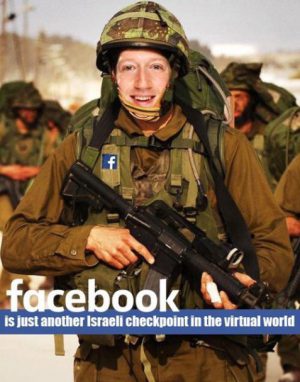 Facebook may entrust a third party with verifying content to stop so-called ‘fake news’ from spreading, its head said in a post. The social network, which is many people’s primary source of news, has recently been criticized for spreading misinformation.
Outgoing US President Barack Obama launched the war on ‘fake news’ last week, complaining that it may have had an adverse effect on the presidential election. He claimed that social media hosts “much active misinformation” that “looks the same when you see it on a Facebook page or you turn on your television.”
There is speculation that fake news about presidential candidates may have played a considerable role in swaying the minds of voters who ultimately elected Republican Donald Trump. Facebook head Mark Zuckerberg initially dismissed the notion as “pretty crazy,” but this week Facebook and Google both said they would change their ad policies to prevent fake news websites from using their systems.
In a Friday post, Zuckerberg gave an update on how his network is planning to fight misinformation.
“Historically, we have relied on our community to help us understand what is fake and what is not,” he said, explaining that the reporting mechanism already in place on the site fights fake news along with clickbait, spam, and scams.
This may be not enough to combat inaccurate news content, however, so Facebook is considering engaging “trusted third parties” to filter out fake news.
Another possible approach would be to have Facebook police itself, which would mean installing “better technical systems to detect what people will flag as false before they do it themselves,” the FB head said.
Links to news stories classified by the network as untruthful would be flagged as fake for people trying to share or read them, according to Zuckerberg.
False stories circulating on Facebook during America’s presidential election campaign included one claiming that anchor Megyn Kelly had been fired from Fox News, another alleging an FBI agent involved in the Clinton investigation had been murdered, and even an announcement that the Pope had endorsed Trump.
Obama’s Hollow Legacy
The emptiness of defeat

By Margaret Kimberley | Black Agenda Report | November 16, 2016
Obama’s legacy is in tatters, and that is good news. Donald Trump’s victory was not just a win over Hillary Clinton, but against Democratic Party policies that silenced the rank and file. For years Democrats became convinced that the only means of keeping Republicans at bay was to go along with their party leadership without complaint. If they wanted to expand trade deals that stole workers’ jobs, so be it. The people who marched against the invasion of Iraq folded their tents when Democrats became the party of endless war. When Obama promoted austerity and “grand bargains” with Republicans not a word was uttered. Even Black Lives Matter refused to point out that the Obama Justice Department left killer cops unpunished.
Barack Obama is nothing if not consistent. While Democrats take to the streets in protest against president elect Trump, Obama declares that the man he once called unfit is not an ideologue, but a “pragmatist.” No one should be surprised about the conciliatory tone. Obama never had a problem with Republicans. They may have obstructed him, but he was always happy to assist them because he wasn’t really opposed to their policies.
The most obvious example of Obama’s lack of substance was his relationship with black Americans. His disdain and contempt for the people who loved him the most was clear to anyone who paid attention. Jokes about “cousin Pookie” and parents serving fried chicken for breakfast should have been seen as the racist screeds they clearly were. But the desire to see a black face in a prominent place endures to our detriment.
Obama won by making himself palatable to white people while also taking advantage of undeserved black pride. Hillary Clinton would be the president elect if the new voters who emerged in 2008 had remained committed to the Democratic Party. But their loyalty was to the imagery of Barack Obama as president. Their joy was confined to seeing him meet the queen of England alongside his first lady or disembarking from Air Force One with his signature swagger. The sight of Barack and Michelle hosting a state dinner was enough to make black hearts swoon. Policy initiatives need not intrude upon the love fest.
The end result of this unrequited and superficial love was six million fewer votes cast for Hillary Clinton in 2016 than for Obama in 2012. The apocryphal cousin Pookie stayed home and no one should be surprised. There is no secret to keeping voters engaged. They are engaged if their needs are met. Deliver for voters and they deliver in the voting booth.
Even the unpopular and shady Hillary Clinton could have won Michigan if the people of Flint had received the federal help they needed so badly. Not only did the Obama environmental protection agency allow the beleaguered city to be given contaminated water, but he showed up for a photo opportunity and did nothing else as residents suffered. He drank a glass of water, posed for the cameras and returned to Washington. The people of Flint are still living under conditions Americans think of as being “Third World.”
The response to Trump’s victory should mean more than protesting policies the Democrats now have little ability to fight. This moment presents an opportunity for much needed introspection and mea culpas. Millions of people did more than just accept Democratic Party policy. They supported actions they would have rejected if carried out by a Republican or a white Democrat. They supported Muammar Gaddafi when Republicans were president but averted their eyes to his murder when committed by a Democrat. They even voted for the person who bragged about the killing. Democratic voters must ask themselves why they said nothing when their party promoted trade deals that were against their interests. Ultimately that acquiescence led to defeat at Trump’s hands.
The Obama team’s propaganda skills were legendary but the day of reckoning revealed the emptiness of what they produced. The corporate media acted like scribes under White House direction and declared that Russia was an enemy state and its president a 21st century Hitler. Now it is Donald Trump, the self-promoting reality television star, who declares his willingness to talk to his Russian counterpart. It is the sort of behavior that Democrats once valued.
Democratic presidents Jimmy Carter and Bill Clinton began the tradition of getting Democrats to support what they didn’t like. Obama perfected the art, which ultimately led to the debacle. He will certainly not be the last to tempt the party faithful but in 2016 Democrats sold their souls and ended up with nothing. Defeat creates the most hollow feelings of all.
Margaret Kimberley can be reached via e-Mail at Margaret.Kimberley(at)BlackAgendaReport.com.
Moscow Hopes New US Administration to Stop Extraterritorial Arrests of Russians
Sputnik – 16.11.2016
MOSCOW – Russia hopes that the new US administration will show political will and will end the practice of extraterritorial arrests of Russian nationals, Russian Foreign Ministry Commissioner for Human Rights, Democracy and the Rule of Law Konstantin Dolgov said Wednesday.
“We shall continue seeking the return of our nationals to their motherland. We intend to make these efforts, of course, in our work with the new US administration. We hope that it will show political will and put an end to the aforementioned illegal practice,” the statement read.
Dolgov added that Russia would continue working with the outgoing US administration to ensure the rights of the Russian nationals that have been detained abroad.
or go to
Aletho News Archives – Video-Images
From the Archives
Israel Would Have No Qualms About USS Liberty-Style FALSE FLAG If Iran Campaign Falters – Analysts
By Ilya Tsukanov – Sputnik – 18.06.2025
Donald Trump is mulling whether or not to join Israel’s aggression against Iran as Tel Aviv faces problems sustaining its defenses against growing counterstrikes, and apparently lacks a realistic game plan for an end to hostilities after failing to achieve its goals. Analysts told Sputnik how the US could be ‘nudged’ into the conflict.
“The US is already assisting Israel with supplies, intel, refueling support, etc. One of the many US posts in the region could be attacked for a casus belli,” former Pentagon analyst Karen Kwiatkowski explained.
“If Trump doesn’t comply with Israel’s demand” and join its aggression voluntarily, “a false flag may be needed” to drag the US in, Kwiatkowski, retired US Air Force Lt. Col.-turned Iraq War whistleblower, fears.
Netanyahu has a diverse array of options at his disposal, according to the observer, including:
- a false flag against US assets abroad blamed on Iran or one of its Axis of Resistance allies, like the Houthis
- a US domestic attack or assassination blamed on Iran
- Iranian air defenses ‘accidentally’ hitting a civilian jetliner carrying Americans
- use of a dirty bomb or nuclear contamination somewhere in the region blamed on Iran
- even blackmailing by threatening to use nukes against Iran if the US doesn’t join the fight
Kwiatkowski estimates that Israel probably has “enough blackmail power” against President Trump and Congress to avoid the necessity of a false flag operation, but a “USS Liberty-style” attack, targeting the soon-to-be-retired USS Nimitz supercarrier that’s heading to the Middle East, for example, nevertheless cannot be ruled out entirely, she says. … continue
Blog Roll
 Aletho News
- The US bombed the Shahs house lol
- The London Ambulances Attack: Of Course It Was A False Flag
- Embarrassing Pivot: U.S. considers dropping Iran oil sanctions amid war
- US has 2 months of rare earths left to replenish weapons amid Iran war: Report
- Strait Of Hormuz closure brings Empire to brink
- Iran controls Strait of Hormuz, dictates terms of war and peace as US excursion backfires
- Outlasting the Superpower: The Reasons Why Iran is Beating uhe US and Israel
- Top PMU commander, over a dozen fighters killed in new US strikes on Iraq
- Is Netanyahu’s war gamble threatening the future of ‘Israel’?: FT
- Smotrich calls for annexation of South Lebanon to Litani River
- If Americans Knew
- ‘Forever live by the sword’: Understanding Israelis’ massive support for Iran war
- UN’s special rapporteur on human rights says Israel is systematically torturing Palestinians
- Trump White House plagiarized Iran war manifesto from Israel-aligned think tank
- Gaza says 6–10 patients die daily waiting for treatment abroad as Israel blocks medical evacuations
- ‘Substantial evidence’ of double-tap strike in killing of Gaza’s Hind Rajab
- ‘Do Not Want To Die For Israel’: Doubts About Trump’s Iran Strategy Spread Among Troops
- Instead of taking Joe Kent’s claims seriously, the media is disregarding him as an antisemite
- Joe Kent’s Explosive Interviews about his Resignation over the Iran War
- Israel poised to take over southern Lebanon; settlers wreak havoc in West Bank – Not a ceasefire Day 165
- From Sde Teiman, the truth about Israel’s military justice system has been set free
- No Tricks Zone
- Devastating Assessment Of Comirnaty Vaccine By Former Senior Pfizer Europe Toxicologist
- New Study: CO2 Is ‘Effectively Negligible’ As An Explanatory Climate Change Factor Since 2000
- Former Pfizer Toxicologist Dr. Helmut Sterz Tells Bundestag Hearing Pfizer Vaccine Should Have Never Been Approved
- Energy Expert: Germany’s Nuclear Phaseout Was A “500 Billion Euro Mistake”
- New Research: South Australia’s Mid-Holocene Sea Surface Temperatures Were 4°C Warmer Than Today
- Storing Green Energy To Last Germany 10 Days Would Require A 60-Million Tonne Battery
- New Studies: UK Sea Levels Were 4 Meters Higher Than Today During The Mid-Holocene
- Destructive Green New Deal: German Energy And Metal Group Warns Of Drastic Crisis
- New Study Documents A 20-Year Pause In Arctic Sea Ice Decline – Driven By Internal Variability
- Wake-up Call: Survey Shows Majority Of Germans Now Favor Postponing Climate Targets!
 Aletho News