Obama Announces New Privacy Rules for the World. World Not Impressed.
By Rainey Reitman | EFF | February 10, 2015
President Obama recently announced slight changes to NSA data collection practices. The recent tweaks mean two new privacy protections for those that U.S. law considers foreigners (in this case, people who are outside of the United States borders who are neither U.S. citizens nor legal U.S. residents).
Perhaps you’re thinking Obama is using his executive authority to stop the mass surveillance of all Internet traffic of people worldwide? Nope, not quite. The new protections are:
- If the U.S. government collects information about a foreigner, it will consider the privacy ramifications before disseminating that information, such as to other governments;1 and
- If the U.S. government collects information on innocent foreigners not connected to any crime or investigation and the information has no national security value, it will dispose of that information after five years.2
That’s right, the world’s personal information will only be retained for five short years. And that’s if the U.S. government decides you’re not under suspicion.
David Medine, the chairman of the Privacy and Civil Liberties Oversight Board, has said that “There’s no country on the planet that has gone this far to improve the treatment of non-citizens in government surveillance.”
That’s certainly laudable. However, a critic might also note that there’s no country on earth extending such enormous resources into surveilling all the people on the planet, so the United States has more room for “improvement” than most countries. (That’s certainly what President Obama implied when he spoke of his country’s “unique” capabilities in his speech defending the new rules.)
We wondered if people worldwide would be excited about these new privacy protections, and so we reached out to a few of our global partners to solicit their feedback.
Here’s what they thought of Obama’s protections for the privacy rights on non-US citizens:
“This decision is not only a confirmation of the disregard the United States has for its international human rights obligations, but given the fact that the US is treating our privacy worse than our own governments, it sends a terrible message for human rights defenders fighting against unchecked surveillance in our own country,” said Luis Fernando García, a lawyer at Network for Digital Rights in Mexico.
“Deleting is no comfort at all because it can never be confirmed,” said Professor K.S. Park of Korea University Law School, “Korea also allows warrantless wiretapping of overseas people for national security purposes. The United States should not set a bad precedent for the whole world to follow.”
And Carolina Botero, a Colombian researcher and blogger with Fundacion Karisma, said, “Mass surveillance is unacceptable in democratic societies because of the threat it poses to human rights. Obama’s reforms to NSA practices fail to address this situation for his citizens and continue the obnoxious violation of the privacy rights of foreigners. A data retention period of 5 years is a clear example of an illegal measure that can be seen abroad as justification for similar laws in other countries.”
If Obama wants to make good on his promise to uphold the privacy of innocent people outside the United States, he’s going to have to do better than this.
And he should start by ending mass surveillance under Executive Order 12333, the primary legal authority for mass surveillance of people outside U.S. borders. Sign our petition and tell Obama to rein in mass spying of people worldwide.
- 1. The exact language from IC on the Record is: “All agency policies implementing PPD-28 now explicitly require that information about a person may not be disseminated solely because he or she is a non-U.S. person and the Office of the Director of National Intelligence has issued a revised directive to all Intelligence Community elements to reflect this requirement. Intelligence Community personnel are now specifically required to consider the privacy interests of non-U.S. persons when drafting and disseminating intelligence reports.”
- 2. IC on the Record explains: “We have imposed new limitations on the retention of personal information about non-U.S. persons. Before PPD-28, Intelligence Community elements had disparate restrictions on how long information about non-U.S. persons could be retained. PPD-28 changes these retention practices in significant ways to afford strengthen privacy protections. Now Intelligence Community elements must delete non-U.S. person information collected through SIGINT five years after collection unless the information has been determined to be relevant to, among other things, an authorized foreign intelligence requirement, or if the Director of National Intelligence determines, after considering the views of the Office of the Director of National Intelligence Civil Liberties Protection Officer and agency privacy and civil liberties officials, that continued retention is in the interest of national security.”
Obama the War President
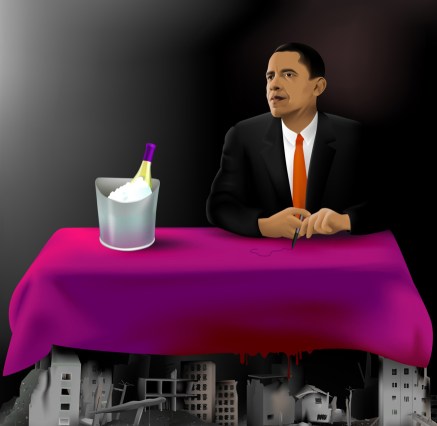
By Dave Lindorff | This Can’t Be Happening! | February 6, 2015
The Nobel Peace Laureate President Barack Obama, the guy who once campaigned claiming one US war — the one against Iraq — was a “bad” one, and the other — against Afghanistan — was a “good” one, turns out to be a man who, once anointed commander-in-chief, can’t seem to find a war he doesn’t consider to be a “good” idea.
Obama turned out, on taking office, to have a hard time saying good-bye to the occupation of Iraq, only leaving when he was forced out by an Iraqi government that refused to continue giving US forces legal immunity for killing Iraqi civilians. In Afghanistan, he decided to copy the same “surge” — a massive increase in targeted assassinations and violence — that he had once condemned in Iraq. Then he stepped up drone-launched rocket attacks and bombings in seven other countries.
More recently he has begun an air war against Syria (okay, he says it’s against the so-called Islamic State, but the whole world, with the exception of a lot of ill-informed US citizens, knows it’s ultimately against the Syrian government), and now his Secretary of Defense (sic) Ashton Carter and his Secretary of State John Kerry are pushing for sending heavy arms and, inevitably, US “advisors” to Ukraine to escalate US involvement in the civil war there. What makes that latest war particularly dangerous is that all the while, Peace Laureate Obama makes it clear that the “enemy” is Russian President Vladimir Putin and the Russian military.
Never mind that it is the US that originally orchestrated and encouraged the fascist coup that overthrew the elected government of Ukraine, setting in motion a huge pogrom against ethnic Russians in the east of that country and provoking the current armed conflict, and never mind that Russian concern about the Ukraine stems from a decades long history of the US pushing NATO ever closer to Russia’s western border, with Ukraine kind of the last straw.
Anyone looking objectively at the warmaking and war-promotion of this administration would have to conclude that President Obama is one of the most bellicose Chief Executives in the history of the United States.
If you don’t believe me, just look at the US military budget President Obama has proposed for FY2016. At $585.3 billion, it would if approved by Congress represent an increase in spending of $24.9 billion, or about 4%, over the 2015 budget, and that is despite a decline in what, since the Bush/Cheney years, has euphemistically been called Overseas Contingency Operations spending, or spending on actual wars. The proposed OCO budget for 2016 in this “peace” president’s budget is “just” $50.9 billion, down about $13.3 billion from 2015 thanks to what the president, in one whopper offered during his State of the Union address, called the “end of combat” in Afghanistan (that war is actually continuing, with some 12,000 US troops expected to remain stationed in that country indefinitely).
The thing about OCO funding is that it is really not predictive of anything. It could soar way beyond that $50.9-billion level, for example, in a flash if the US follows through and escalates the war in Ukraine — especially if Russian troops are drawn directly into that conflict and the US responds by upping its own involvement.
In fact, the OCO part of the budget has been used by the Pentagon and the administration over the last few years to get around the constraints of an ongoing Congressional “sequestration” requirement that cuts so-called discretionary spending, both military and non-military. Congress, ever mindful and solicitous of the country’s imperial ambitions, provided an exemption for ongoing military conflicts, and the Pentagon has since been deceptively slipping all kinds of other spending under the OCO heading now ever since the loophole was created.
But the Obama administration’s warmongering stance, in terms of the budget, isn’t told just by looking at the official Pentagon budget. There is much more spending that is really all about war. Not included in that $585.3 billion figure is $70.2 billion in discretionary spending for Veterans Affairs (that’s in addition to $90 billion in mandated spending). This is money to pay for the damages of the nation’s warmaking — the injured or ailing veterans who served or are now serving in the nation’s armed forces. Then there’s the intelligence agencies’ budgets — the CIA, the NSA, the FBI, the DIA, the DEA, the ATF and Homeland Security, etc. — most of which is really part of part of the war machine, thanks to the so-called “War on Terror,” which has re-defined the US itself as part of a global war zone. While much of that intelligence budget is concealed from the public on the spurious grounds of “national security,” it is known to exceed $100 billion a year. Add to that the $24-billion share of the Department of Energy budget that is weapons and war related, and you have a real military budget for 2016 of $707 billion. That’s out of a $1.2 trillion total discretionary spending budget (the rest of the $4 trillion proposed 2016 budget is called mandatory because it is debt repayment or spending on mandated things like Social Security and Medicare, which are funded by dedicated payroll taxes, not income taxes and other federal taxes, and which are promised to recipients like retirees and the sick.
What this means is that when you look closely, some 59% of the entire discretionary budget of the federal government – things that are funded each year by money that Congress has to appropriate — is being spent on the military. Given that the total amount of taxes collected by the federal government (income, corporate profits, exist, inheritance, etc.) also comes in at about $1.2 trillion, we’re saying that taxpayers this coming year will be pouring not just $707 billion, but 59 cents of every tax dollar in to war, planning for war, or paying for war. But it’s actually worse than that because actually the US government operates at a deficit, and doesn’t ever finance its wars on a pay-as-you-go basis. Instead, it borrows the money and then pays interest on that debt. Every year that interest comes to about $240 billion, and roughly half that is for borrowing to pay for past wars and past and current military spending. So add $120 billion to the $707 total and it become $827 billion.
In other words, it’s really 68.9% of every tax dollar you pay this April 15 that’s going to pay for America’s wars and its obsession with militarism.
No wonder our schools and universities, our parks, our roads, our once-vaunted global scientific leadership, our environment, our health and safety, our family budgets and even our life expectancy, have been going to hell! The only thing that’s really getting funded in this country is war.
By the way, the reason you may not have realized how much you are paying for war out of your taxes is that the government, and the corporate media, carefully avoid letting you know. They do this by sleight of hand. You see, they never really break out just the “discretionary” budget, or point out the parts of the budget that are outside the Pentagon but that are still really military-related, like spending on nuclear weapons and weapons development, nuclear research and cleanup, decommissioning of nuclear processing plants, and of course veterans affairs and benefits. They also do it by lumping the huge outlays for Social Security benefits and Medicare into the overall spending budget, though actually those benefits are funded not by income taxes but by a Trust fund of some $1.7 trillion that was created over the years by specially-dedicated payroll taxes separately paid by workers and their employers over the working life of each person. Adding those items into the national budget, while leaving out things like spending on veterans, nukes and war debt, appears to reduce military spending to a much less troubling 6.8% of the budget.
But it’s a fraud.
If we want to revitalize the US, the only way to do it is to end militarism and war, and to generously fund human needs.
To do that, we need a real peace president and a peace congress, not the Nobel Laureate warmonger we have now in the White House, and the bi-partisan war chorus we have in the Congress.
Nuclear War and Clashing Ukraine Narratives
By Robert Parry | Consortium News | February 6, 2015
The U.S. government and mainstream media are swaggering toward a possible nuclear confrontation with Russia over Ukraine without any of the seriousness that has informed this sort of decision-making throughout the nuclear age. Instead, Official Washington seems possessed by a self-righteous goofiness that could be the prelude to the end of life on this planet.
Nearly across the U.S. political spectrum, there is a pugnacious “group think” which has transformed what should have been a manageable political dispute in Ukraine into some morality play where U.S. politicians and pundits blather on about how the nearly year-old coup regime in Kiev “shares our values” and how America must be prepared to defend this regime militarily.

Jaanika Merilo, an Estonian brought into the Ukrainian government to oversee foreign investments. (A photo released on the Internet by Merilo via DanceswithBears)
Though I’m told that President Barack Obama personally recognizes how foolhardy this attitude is, he has made no significant move to head off the craziness and, indeed, has tolerated provocative actions by his underlings, such as neocon Assistant Secretary of State Victoria Nuland’s scheming with coup plotters to overthrow Ukraine’s elected President Viktor Yanukovych last February.
Obama also has withheld from the American people intelligence information that undercuts some of the more extreme claims that his administration has made. For instance, I’m told that he has detailed intelligence reporting on both the mysterious sniper attack that preceded the putsch nearly a year ago and the shoot-down of the Malaysia Airlines Flights 17 that deepened the crisis last summer. But he won’t release the findings.
More broadly over the last year, Obama’s behavior – ranging from his initial neglect of the Ukraine issue, as Nuland’s coup plotting unfolded, to his own participation in the tough talk, such as boasting during his State of the Union address that he had helped put the Russian economy “in tatters” – ranks as one of the most irresponsible performances by a U.S. president.
Given the potential stakes of nuclear war, none of the post-World War II presidents behaved as recklessly as Obama has, which now includes allowing his administration officials to talk loosely about sending military support to an unstable regime in Kiev that includes neo-Nazis who have undertaken death-squad operations against ethnic Russians in eastern Ukraine.
U.S. Gen. Philip Breedlove, who is commander of NATO, declared last November that – regarding supplying military support for the Kiev government – “nothing at this time is off the table.” Breedlove is now pushing actively to send lethal U.S. military equipment to fend off an offensive by ethnic Russian rebels in the east.
I’m told that the Russians fear that U.S. officials are contemplating placing Cruise missiles in Ukraine or otherwise introducing advanced weaponry that Moscow regards as a direct threat to its national security. Whether or not the Russians are being alarmist, these fears are affecting their own decision-making.
None of the nuclear-age presidents – not Harry Truman, Dwight Eisenhower, John F. Kennedy, Lyndon Johnson, Richard Nixon, Gerald Ford, Jimmy Carter, Ronald Reagan, George H.W. Bush, Bill Clinton or even George W. Bush – would have engaged in such provocative actions on Russia’s borders, though some surely behaved aggressively in overthrowing governments and starting wars farther away.
Even Ronald Reagan, an aggressive Cold Warrior, kept his challenges to the Soviet Union in areas that were far less sensitive to its national security than Ukraine. He may have supported the slaughter of leftists in Central America and Africa or armed Islamic fundamentalists fighting a Soviet-backed government in Afghanistan, but he recognized the insanity of a military showdown with Moscow in Eastern Europe.
After the Soviet Union’s collapse in 1991, U.S. presidents became more assertive, pushing NATO into the former Warsaw Pact nations and, under President Clinton, bombing a Russian ally in Serbia, but that came at a time when Russia was essentially flat on its back geopolitically.
Perhaps the triumphalism of that period is still alive especially among neocons who reject President Vladimir Putin’s reassertion of Russia’s national pride. These Washington hardliners still feel that they can treat Moscow with disdain, ignoring the fact that Russia maintains a formidable nuclear arsenal and is not willing to return to the supine position of the 1990s.
In 2008, President George W. Bush – arguably one of the most reckless presidents of the era – backed away from a confrontation with Russia when Georgian President Mikheil Saakashvili, a neocon favorite, drew the Russians into a border conflict over South Ossetia. Despite some war talk from the likes of Vice President Dick Cheney and Sen. John McCain, President Bush showed relative restraint.
Imbalanced Narrative
But Obama has failed to rein in his administration’s war hawks and has done nothing to correct the biased narrative that his State Department has fed to the equally irresponsible mainstream U.S. news media. Since the Ukraine crisis began in fall of 2013, the New York Times and other major U.S. news outlets have provided only one side of the story, openly supporting the interests of the pro-European western Ukrainians over the ethnic Russian eastern Ukrainians.
The bias is so strong that the mainstream media has largely ignored the remarkable story of the Kiev regime willfully dispatching Nazi storm troopers to kill ethnic Russians in the east, something that hasn’t happened in Europe since World War II.
For Western news organizations that are quick to note the slightest uptick in neo-Nazism in Europe, there has been a willful blindness to Kiev’s premeditated use of what amount to Nazi death squads undertaking house-to-house killings in eastern Ukraine. [See Consortiumnews.com’s “Seeing No Neo-Nazi Militias in Ukraine.”]
The Russian government has repeatedly protested these death-squad operations and other crimes committed by the Kiev regime, but the U.S. mainstream media is so in the tank for the western Ukrainians that it has suppressed this aspect of the crisis, typically burying references to the neo-Nazi militias at the end of stories or dismissing these accounts as “Russian propaganda.”
With this ugly reality hidden from the U.S. public, Obama’s State Department has been able to present a white-hat-vs.-black-hat narrative to the crisis. So, while Russians saw a constitutionally elected government on their border overthrown by a U.S.-backed coup last February – and then human rights atrocities inflicted on ethnic Russians in eastern Ukraine – the American people heard only about wonderful pro-American “reformers” in Kiev and the evil pro-Russian “minions” trying to destroy “democracy” at Putin’s bidding.
This distorted American narrative has represented one of the most unprofessional and dangerous performances in the history of modern U.S. journalism, rivaling the false conventional wisdom about Iraq’s WMD except in this case the media propaganda is aimed at a country that really does have weapons of mass destruction.
The Russians also have noted the arrival of financially self-interested Americans, including Vice President Joe Biden’s son Hunter Biden and Ukraine’s new Finance Minister Natalie Jaresko, reminding the Russians of the American financial experts who descended on Moscow with their “shock therapy” in the 1990s, “reforms” that enriched a few well-connected oligarchs but impoverished millions of average Russians.
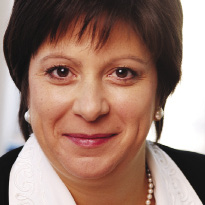
Ukraine’s Finance Minister Natalie Jaresko.
Jaresko, a former U.S. diplomat who took Ukrainian citizenship in December 2014 to become Finance Minister, had been in charge of a U.S.-taxpayer-financed $150 million Ukrainian investment fund which involved substantial insider dealings, including paying a management firm that Jaresko created more than $1 million a year in fees, even as the $150 million apparently dwindled to less than $100 million.
Jaresko also has been involved in a two-year-long legal battle with her ex-husband to gag him from releasing information about apparent irregularities in the handling of the U.S. money. Jaresko went into Chancery Court in Delaware to enforce a non-disclosure clause against her ex-husband, Ihor Figlus, and got a court order to silence him.
This week, when I contacted George Pazuniak, Figlus’s lawyer about Jaresko’s aggressive enforcement of the non-disclosure agreement, he told me that “at this point, it’s very difficult for me to say very much without having a detrimental effect on my client.”
With Jaresko now being hailed as a Ukrainian “reformer” who – in the words of New York Times’ columnist Thomas L. Friedman – “shares our values,” one has to wonder why she has fought so hard to shut up her ex-husband regarding possible revelations about improper handling of U.S. taxpayer money. [See Consortiumnews.com’s “Ukraine’s Made-in-USA Finance Minister.”]
More Interested Parties
The Russians also looked askance at the appointment of Estonian Jaanika Merilo as the latest foreigner to be brought inside the Ukrainian government as a “reformer.” Merilo, a Jaresko associate, is being put in charge of attracting foreign investments but her photo spreads look more like someone interested in some rather kinky partying.

Jaanika Merilo, the Estonian being put in charge of arranging foreign investments in Ukraine. (A photo released by Merilo on the Internet via DanceswithBears)
The Russians are aware, too, of prominent Americans circling around the potential plunder of Ukraine. For instance, Hunter Biden was named to the board of directors of Burisma Holdings, which is a shadowy Cyprus-based company linked to Privat Bank.
Privat Bank is controlled by the thuggish billionaire oligarch Ihor Kolomoysky, who was appointed by the Kiev regime to be governor of Dnipropetrovsk Oblast, a south-central province of Ukraine. Kolomoysky has helped finance the paramilitary forces killing ethnic Russians in eastern Ukraine.
And, Burisma has been lining up well-connected lobbyists, some with ties to Secretary of State John Kerry, including Kerry’s former Senate chief of staff David Leiter, according to lobbying disclosures. As Time magazine reported, “Leiter’s involvement in the firm rounds out a power-packed team of politically-connected Americans that also includes a second new board member, Devon Archer, a Democratic bundler and former adviser to John Kerry’s 2004 presidential campaign. Both Archer and Hunter Biden have worked as business partners with Kerry’s son-in-law, Christopher Heinz, the founding partner of Rosemont Capital, a private-equity company.” [See Consortiumnews.com’s “The Whys Behind the Ukraine Crisis.”]
So, the Russians have a decidedly different view of the Ukrainian “reforms” than much of the U.S. media does. But I’m told that the Russians would be willing to tolerate these well-connected Americans enriching themselves in Ukraine and even having Ukraine expand its economic relations with the European Union.
But the Russians have drawn a red line at the prospect for the expansion of NATO forces into Ukraine and the continued killing of ethnic Russians at the hands of neo-Nazi death squads. Putin is demanding that those paramilitary forces be disarmed.
Besides unleashing these right-wing militias on the ethnic Russians, the Kiev government has moved to punish the people living in the eastern sectors by cutting off access to banks and other financial services. It also has become harder and more dangerous for ethnic Russians to cross into territory controlled by the Kiev authorities. Many are turned back and those who do get through face the risk of being taken and killed by the neo-Nazi militias.
These conditions have left the people in the Donetsk and Luhansk areas – the so-called Donbass region on Russia’s border – dependent on relief supplies from Russia. Meanwhile, the Kiev regime — pumped up by prospects of weapons from Washington as well as more money — has toughened its tone with vows to crush the eastern rebellion once and for all.
Russia’s Hardening Line
The worsening situation in the east and the fear of U.S. military weapons arriving in the west have prompted a shift in Moscow’s view of the Ukraine crisis, including a readiness to resupply the ethnic Russian forces in eastern Ukraine and even provide military advisers.
These developments have alarmed European leaders who find themselves caught in the middle of a possible conflict between the United States and Russia. German Chancellor Angela Merkel and French President Francois Hollande rushed to Kiev and then Moscow this week to discuss possible ways to defuse the crisis.
The hardening Russian position now seeks, in effect, a division of Ukraine into two autonomous zones, the east and the west with a central government that maintains the currency and handles other national concerns. But I’m told that Moscow might still accept the earlier idea of a federated Ukraine with greater self-governance by the different regions.
Putin also does not object to Ukraine building closer economic ties to Europe and he offered a new referendum in Crimea on whether the voters still want to secede from Ukraine and join Russia, said a source familiar with the Kremlin’s thinking. But Putin’s red lines include no NATO expansion into Ukraine and protection for ethnic Russians by disarming the neo-Nazi militias, the source said.
If such an arrangement or something similar isn’t acceptable and if the killing of ethnic Russians continues, the Kremlin would support a large-scale military offensive from the east that would involve “taking Kiev,” according to the source.
A Russian escalation of that magnitude would likely invite a vigorous U.S. response, with leading American politicians and pundits sure to ratchet up demands for a military counterstrike against Russia. If Obama were to acquiesce to such bellicosity – to avoid being called “weak” – the world could be pushed to the brink of nuclear war.
Who’s to Blame?
Though the State Department and the mainstream U.S. media continue to put all the blame on Russia, the fact that the Ukraine crisis has reach such a dangerous crossroads reveals how reckless the behavior of Official Washington has been over the past year.
Nuland and other U.S. officials took an internal Ukrainian disagreement over how quickly it should expand ties to Europe – while seeking to retain its historic relations with Russia – and turned that fairly pedestrian political dispute into a possible flashpoint for a nuclear war.
At no time, as this crisis has evolved over the past year, did anyone of significance in Official Washington, whether in government or media, stop and contemplate whether this issue was worth risking the end of life on the planet. Instead, all the American people have been given is a steady diet of anti-Yanukovych and anti-Putin propaganda.
Though constitutionally elected, Yanukovych was depicted as a corrupt tyrant who had a pricy sauna in his official mansion. Though Putin had just staged the Winter Olympics in Sochi, signaling his desire for Russia to integrate more with the West, he was portrayed as either a new-age imperial czar or the second coming of Hitler – if not worse because he occasionally would ride on a horse while not wearing a shirt.
Further, the U.S. news media refused to conduct a serious investigation into the evidence that Nuland and other U.S. officials had helped destabilize Yanukovych’s government with the goal of achieving another neocon “regime change.”
Nuland, who personally urged on anti-Yanukovych protests in Kiev, discussed with U.S. Ambassador to Ukraine Geoffrey Pyatt in early February 2014 who should lead the new government – “Yats is the guy,” she said, referring to Arseniy Yatsenyuk – and how to “glue this thing.”
After weeks of mounting tensions and worsening violence, the coup occurred on Feb. 22, 2014, when well-organized neo-Nazi and other right-wing militias from western Ukraine overran presidential buildings forcing officials to flee for their lives. With Yanukovych ousted, Yatsenyuk soon became Prime Minister. [See Consortiumnews.com’s “When Is a Putsch a Putsch.” ]
Many ethnic Russians in southern and eastern Ukraine, who had strongly supported Yanukovych, refused to accept the new U.S.-backed order in Kiev. Crimean officials and voters moved to secede from Ukraine and rejoin Russia, a move that Putin accepted because of Crimea’s historic ties to Russia and his fear that the Russian naval base at Sevastopol might be handed to NATO.
The resistance spread to eastern Ukraine where other ethnic Russians took up arms against the coup regime in Kiev, which responded with that it called an “anti-terrorist operation” against the east. To bolster the weak Ukrainian army, Internal Affairs Minister Arsen Avakov dispatched neo-Nazi and other “volunteer” militias to spearhead the attacks.
After the deaths of more than 5,000 people, a shaky cease-fire was announced in September, but — amid complaints about neo-Nazi death squads operating in government-controlled areas and with life deteriorating in rebel-controlled towns and cities — the ethnic Russians launched an offensive in January, using Russian-supplied weapons to expand their control of territory.
In reaction, U.S. pundits, including columnists and editors of the New York Times and the Washington Post, called for dispatching U.S. aid to the Kiev forces, including proposals for lethal weaponry to deter Putin’s “aggression.” Members of Congress and members of the Obama administration have joined the chorus.
On Feb. 2, the New York Times reported “With Russian-backed separatists pressing their attacks in Ukraine, NATO’s military commander, Gen. Philip M. Breedlove, now supports providing defensive weapons and equipment to Kiev’s beleaguered forces, and an array of administration and military officials appear to be edging toward that position, American officials said. … President Obama has made no decisions on providing such lethal assistance.”
That same day, the lead Times editorial was entitled “Mr. Putin Resumes His War” and continued with the theme about “Russian aggression” and the need “to increase the cost” if Russia demands “a permanent rebel-held enclave.”
On Feb. 3, the Washington Post ran an editorial entitled “Help for Ukraine. Defensive weapons could deter Russia in a way sanctions won’t.” The editorial concluded that Putin “will stop only if the cost to his regime is sharply raised – and quickly.”
A new war fever gripped Washington and no one wanted to be viewed as “soft” or to be denounced as a “Putin apologist.” Amid this combination of propaganda, confusion and tough-guy-ism – and lacking the tempering wisdom about war and nuclear weapons that restrained earlier U.S. presidents – a momentum lurched toward a nuclear showdown over Ukraine that could put all life on earth in jeopardy.
~
Investigative reporter Robert Parry broke many of the Iran-Contra stories for The Associated Press and Newsweek in the 1980s. You can buy his latest book, America’s Stolen Narrative, either in print here or as an e-book (from Amazon and barnesandnoble.com). You also can order Robert Parry’s trilogy on the Bush Family and its connections to various right-wing operatives for only $34. The trilogy includes America’s Stolen Narrative. For details on this offer, click here.
Did North Korea Really Hack Sony?
By James DiEugenio | Consortium News | February 3, 2015
One of the major problems with modern American democracy is the fact that the U.S. government has a serious credibility problem. This is not new of course. In its contemporary strain, it goes back at least to 1964 when two events focused and magnified the problem. The first was the Gulf of Tonkin incident, which was used to launch the Vietnam War. The second was the issuance of the Warren Report, the widely doubted official account of John F. Kennedy’s assassination.
As Kevin Phillips demonstrated with polling results in his book Arrogant Capital, that year marked the beginning of a long decline in the public’s trust in the government’s ability to do what is right most of the time. Prior to that year, the number hovered in the mid-70 percentile. After that, the figure began to drop steeply. It bottomed out at 19 percent in 1992. (This was clearly a large factor in boosting the presidential candidacy of Ross Perot that year.) It has failed to recover in any significant way since.
Historically speaking, it’s easy to name some of the causes for this headlong slide into skepticism and disbelief: the escalation in Vietnam, the assassinations of key leaders during the 1960s, Watergate, the Iran/Contra affair, the exposure of CIA drug-running during wars in Southeast Asia and Central America.
As Nicolas JS Davies has pointed out, some more recent examples would be the false reasons for the invasion of Iraq, the dubious attribution of imminent nuclear weaponry for Iran, the attempt to accuse President Bashar al-Assad of Syria of using sarin gas against civilians, and the attempt to blame Russia for the shoot-down of Malaysia Airlines Flight 17.
As the reader can see, many of these instances involve the effort of certain reactionary members of the Executive Branch in Washington and their allies in the media to use the American military abroad. One would have thought that after the disastrous results of the Tonkin Gulf Resolution, the major media would investigate more carefully what now seems to be a recurrent pattern of ersatz attribution to provoke American intervention. But, by and large, the doubts about these events have been expressed only in the alternative media.
The final incident Davies (briefly) mentioned was last year’s computer hacking of Sony/Columbia studios, which the FBI blamed on North Korea. The ostensible reason for this cyber-attack was the upcoming release of the comedy film, The Interview, which depicted an interview by a fictional American TV personality with Kim Jong-un, the actual leader of North Korea.
This interview becomes a pretext for an assassination attempt that goes awry. But, as the movie unfolds, the interview does happen and Kim does not come off well in it. This causes him to try to kill the Americans responsible. It backfires and he is killed instead.
Perhaps no film since Oliver Stone’s JFK generated as much pre-release controversy as The Interview. But unlike Stone’s picture, which created a sensation over its contrary-to-the-Establishment view of President Kennedy’s assassination, this particular brouhaha is largely based upon the alleged cyber-attack by North Korea.
When the FBI pointed the finger at Pyongyang, Sony/Columbia decided not to release the film, citing security concerns. Both people in the film colony and in the media met that decision with much derision. Therefore, Columbia reconsidered and did a limited theatrical run for the film, combined with a large online release. Due to the massive coverage of the controversy, the latter has been a big success. In fact, it has set records in that category.
‘The Interview’ as a Movie
The movie was co-directed by Seth Rogen and Evan Goldberg, who also had a hand in writing the story. Along with James Franco, Rogen also stars in the film. Rogen and Goldberg have been friends since childhood in Vancouver, Canada. Rogen’s career took off after he moved to Los Angeles and met writer-director Judd Apatow, who produced Anchorman: The Legend of Ron Burgundy and directed The 40 Year Old Virgin.
After first using Rogen in a TV series called Freaks and Geeks, Rogen starred in Apatow’s 2007 film Knocked Up. Apatow then produced two films written by Rogen and Goldberg, Pineapple Express and Superbad. Franco was also in Freaks and Geeks, and Pineapple Express with Rogen. Rogen and Goldberg then scripted The Green Hornet in 2011; they wrote and co-directed This Is the End in 2013.
Reportedly, Rogen once advised Apatow to make his work more “outrageously dirty.” [Los Angeles Times, May 13, 2007] And Apatow once said he wanted to include a penis in each of his films. [The Guardian. Aug. 26, 2008]
Well, we get those kinds of jokes in The Interview. The premise of the film revolves around Franco as a TV personality named Dave Skylark, the host of a rather lowbrow interview show titled Skylark Tonight. Rogen plays the producer-director of the program and has ambitions of doing something more socially and politically significant, a la 60 Minutes.
In one of the several unfathomable plot twists in the film, Kim likes Skylark Tonight so much that he wants to be a guest on the show and to arrange the guest spot through Rogen. But, in another hard to buy plot twist, Kim wants to arrange the interview in some sparsely populated rural area in China. (I think this segment was designed to generate laughs — which it does not.)
The visit to North Korea is now set up with a female military representative of Kim’s. Upon Rogen’s return, he and Franco celebrate and they announce the upcoming event on the air.
Now, another rather hard to believe strophe occurs. The CIA visits the two men and asks them to assassinate Kim. No specific reason is given as to why (though Kim is widely viewed in the West as a clownish and unstable dictator), or why they chose these two utter amateurs for such a daring, high-risk scheme.
The CIA wants them to kill Kim with a toxic poison attached to the palm of their hands. This strip is hidden in a pack of gum. But when they arrive in North Korea, one of their military guards takes out the pack and chews the strip. He spits it out, and in a rather unfunny follow-up, we later watch him die from the poison at a dinner.
Franco now meets Kim. The North Korean is on his best behavior and the two hit it off for a couple of days playing basketball and partying with some scantily clad girls.
Twisting the Plot
But now, another rather weird plot twist occurs. Franco wanders out of the presidential palace, going to what he thought was a grocery store nearby. He goes inside and discovers that the store is really a Potemkin village. That is, things like fruit and vegetables are really painted props.
Obviously, this scene is intended to highlight the shortage of food supplies in North Korea, but why the North Koreans would plant the store so close to the palace, why they would leave it unattended, and why they could not import real goods to stock it at this crucial time, these kinds of questions make this episode another head-scratcher. But the plot device explains why Franco turns on his new friend, Kim Jong-un.
In the meantime, Rogen has fallen for the female military attaché. It turns out she secretly hates Kim and now allies herself with the Americans. She says they cannot just kill him; they must humiliate him on TV so the Korean people will see him as a pretentious buffoon and charlatan.
So, Franco/Skylark decides to structure the interview to expose Kim. But the station technicians cut the feed. Rogen and his girlfriend then pull out firearms, touching off a bloody fight in the control room also involving Korean troops. Somehow, the amateur Americans kill all the Koreans. Franco is shot at, but he survives because he had a bulletproof vest on.
The trio manages to escape in a tank (no, I won’t explain how that happened) and are pursued by Kim and some soldiers in a helicopter. Kim orders preparations for a nuclear launch. But the tank fires a heat-seeking missile that takes out the chopper. Some CIA double agents then help Rogen and Franco escape the country.
At the end, we see Franco at a book reading about the whole affair as Rogen talks to his North Korean girlfriend via Skype. She stayed behind to democratize the country.
As the reader can see, the story is pretty much escapist, goofball fiction with a plot focused on murdering a real-life leader. But as bad as the script is, the direction by Rogen and Goldberg is even worse.
The Decline of Comedy
In 1965, before he retired from the field, illustrious film critic Dwight MacDonald wrote an essay entitled “Whatever Happened to Hollywood Comedy?” There, he lamented how low the genre had fallen from the Alpine peaks attained by the likes of Keaton, Chaplin, Lloyd and Langdon. Or even from the hills of Preston Sturges, Billy Wilder, Ernst Lubitsch and Howard Hawks.
MacDonald outlined three rules that comic films he was reviewing broke almost systematically. First, he wrote that most of the films had no appealing comic protagonists, which he felt was necessary in the genre. Second, he said they were overproduced and too Rube Goldberg-like in their construction and depiction. (Rogen and Goldberg shoot the helicopter exploding at the end in super-slow-motion.)
Finally, according to MacDonald, the sadism inherent in comedy could not be shown realistically, i.e., if the comic actually broke his back while slipping on a banana peel, that would not be funny.
Well, in the fight in the control room in The Interview, we watch as not one, but two fingers get bitten off. Apparently, no one on the set said to Rogen, “Uh Seth, is that really funny?” Rogen is an even worse director than he is an actor. And the man can’t act.
If MacDonald felt gloomy about the state of film comedy in 1965, one can imagine what he would have written in later years, which leads us to the first question about the hacking mystery: Unless the North Koreans are as imbecilic as the people depicted in the film, could they really have thought that such a frivolous production somehow imperiled the security or image of their country – and to such an extent that they went ahead and risked retaliation by hacking into a private company’s computer system?
To me, the risk simply does not equate with whatever reward was to be had. But there are other indications that the case against North Korea is not nearly as conclusive as the FBI wants us to think. President Barack Obama may have compounded the problem by announcing retaliatory sanctions on Jan. 2. Further, White House Press Secretary Josh Earnest implied there would be more of this because he called it “the U.S. government’s first action…”
The Facts of the Case
The controversy actually began to take shape last June when the North Korean ambassador to the United Nations — without seeing the movie in all of its silliness — condemned the film and urged the United States to cancel its distribution. Clearly, making light of assassinating a nation’s leader is problematic, whatever one may think of the leader, and the North Koreans made their disgust clear.
Then, on Nov. 24, 2014, Columbia discovered that its computers had been hacked. Their employees were locked out and an ugly caricature of a bright red skeleton popped up on their screens that morning. A message appeared which said, “Hacked by #GOP.” Later, personal information, e-mails and unreleased films were leaked online. The films included Still Alice, Annie and To Write Love on Her Arms.
In this context, GOP does not refer to the Republican Party but to a hacking group that calls themselves the Guardians of Peace. It’s interesting to note that although North Korea denies the attack, Guardians of Peace takes credit for it. In fact, the Guardians actually called the FBI a bunch of idiots because of the stupidity of their investigation.
As Kim Zetter pointed out in Wired, nation-states usually don’t announce themselves with images of blazing skeletons or criticize their victims for having poor cyber security, nor do they post stolen data to Pastebin, which is sort of the unofficial warehouse for heisted files on the cloud.
As Zetter writes, “These are all hallmarks of hacktivists — groups like Anonymous and LulzSec, who thrive on targeting large corporations for ideological reasons … or by hackers sympathetic to a political cause” (Wired, Dec. 17, 2014)
Cyber-security expert Marc Rogers agreed that the operation did not look like it was from a nation-state, and he criticized the FBI’s case on specific grounds, noting that because the malware was written in Korean means little, since programs exist to translate that code.
Rogers also said that whoever wrote the malware had extensive knowledge of hard-coded paths and passwords. This would suggest that whoever did the attack was somehow watching Sony/Columbia’s computer architecture for a long time or was a company insider because not only did the hackers know where certain files were located but they knew the access codes on them.
Third, Rogers wrote that when a hacker simply dumps this amount of material onto a public site, that has the earmarks of a hack job from some ideologically motivated group. There was much information North Korea could have garnered from the huge access they allegedly had. And this could have served them well in their intelligence files. Why make it public? (See Roger’s blog, “Marc’s Security Ramblings” entry dated Dec. 18, 2014)
More Skepticism
Rogers is backed up on his first point by Kurt Stammberger, senior vice-president of Norse, a company that provides computer intelligence systems and technology to both private corporations and the government.
Stammberger has been in possession of the specific malware used in the Sony hack as far back as last July, which can be secured by interested parties on the black market. His sample of the program is totally in English, not a trace of Korean.
The executive noted that specific Sony credentials, server address and digital codes and certificates were then written into the malware. As another authority in the field noted, certain malware behaves erratically. It just dives into a system, shuffles around the computer and spirals around looking for things to link to randomly. The Sony hack was more like a cruise missile.
“This stuff was incredibly targeted. That is a very strong signal that an insider was involved,” said Stammberger. (New York Post, Dec. 30, 2014) Thus, he concluded that “It’s virtually impossible to get that information unless you are an insider, were an insider, or have been working with an insider. That’s why we and so many other security professionals are convinced an insider played an important role.”
Furthering this belief is the fact that, last spring, Sony issued layoff notices to hundreds of employees. A private Facebook group made up of former Sony employees voted by a large majority that the hack was an inside job. An ex-employee said what makes this even more possible is that Sony’s security was not very tight or sophisticated, a point that was echoed by Rogers. (Dana Liebelson, Huffington Post, Jan. 6, 2015)
In fact, Norse, Stammberger’s computer-intelligence company, went even further. They named a former employee as a suspect, along with five accomplices. They did this by going through hacked personnel files and then locating a disgruntled employee online. (The Security Ledger Dec. 18, 2014)
In one message, for instance, one of Stammberger’s suspects identified as “lena” wrote :“Sony doesn’t lock their doors, physically, so we worked with other staff with similar interests to get in. I’m sorry I can’t say more, safety for our team is important.” (The Wrap, Dec. 30, 2014)
From this and other evidence, Stammberger deduces that the conspiracy was a collaboration between an employee or employees terminated early last summer and a hacking group involved in distributing pirated movies online, a group that has been pursued by Sony.
The FBI visited Norse to hear this presentation and seemed suitably impressed. But Stammberger said the FBI didn’t reveal anything from its inquiry to Norse.
Chronology Problems
What makes the whole operation even more puzzling is the fact that an e-mail was sent to Sony executives three days before the hack became public, on Nov. 21, 2014, addressed to top executives such as CEO Michael Lynton and Chairperson Amy Pascal (among others). It reads:
“Monetary compensation we want. Pay the damages, or Sony Pictures will be bombarded as a whole. You know us very well. We never wait long. You’d better behave wisely.”
Clearly, the fact that this was sent in advance indicates that whoever sent it knew what was about to happen. But the warning contains no mention, not even a hint, about censoring an about-to-be-released movie. The message appears to be pure and simple extortion, as is clearly denoted in the first sentence about money.
But what makes this piece of evidence ultimately confusing is that it was signed by “God’sApstls,” a rubric that also was in one of the malicious files used in the cyber attack. (ibid)
As Wired’s Zetter points out, it was only on Dec. 8, a week after a logjam of media stories appeared linking the attack to North Korea, that the attackers made a reference to the film in one of their announcements. And after this, the hackers made oblique terrorist threats against the film’s premiere in New York on Christmas Day.
In other words, it was after the finger-waving at North Korea had begun that “the GOP” began to explicitly link the film to the crime. To top that, as Sam Biddle noted in The Gawker on Dec. 22, the self-declared attackers — “the GOP” — then released a message declaring that Sony/Columbia had their permission to release The Interview anyway, which certainly implies that whoever did the hacking was simply bluffing about any terrorist attacks if the film were shown.
Lessons Not Learned
This points out another interesting aspect of the case, which Peter Singer, another security expert, expounded on at Motherboard. In an interview, he said: “This is not just now a case study in how not to react to cyber threats and a case study in how not to defend your networks; it’s now also a case study in how not to respond to terrorism threats.
“We have just communicated to any would-be attacker that we will do whatever they want. It’s mind-boggling to me, particularly when you compare it to real things that have actually happened. Someone killed 12 people and shot another 70 people at the opening night of Batman: The Dark Knight Rises. They kept that movie in the theater. You issue an anonymous cyber threat that you do not have the capability to carry out: We pulled a movie from 18,000 theaters.” (Sic, that number is exaggerated.)
Singer said whoever conducted the attack understood the American psyche and culture to the point of knowing that politicians like John McCain and Newt Gingrich would call it an attack of “cyber terrorism” and demand retaliation and that no one would ask: Why?
Would North Korea really commit its scarce resources and take this geopolitical risk over a witless, very bad comedy and think that a fitting retaliation would be to publicize how much money Sony executives make or that producer Scott Rudin thinks Angelina Jolie is only marginally talented?
Gauging by the U.S. overreaction, one is reminded of what Orson Welles did with a radio microphone, four actors, and some mood music in 1938 with his broadcast of H. G. Wells’ War of the Worlds.
Singer added that this image of Sony/Columbia as a frightened and intimidated victim benefits the company because it conceals the fact that it has been hacked before, going back to 2005, and more than once.
Yet, their whole computer architecture has been relatively unchanged, even though the previous hacks were not labeled as attacks from a nation-state. It’s fairly clear that Sony did not take the attacks seriously enough to do a major upgrade on their security system or to change passwords and pass codes every few months. Obviously, they could afford the financial outlay to do such things.
Obama’s Hypocrisy
On the day the FBI announced North Korea as the culprit, President Obama criticized Sony’s initial decision to pull the film from theaters. Echoing what Singer said, the President commented: “We cannot have a society in which some dictator in some place can start imposing censorship here in the USA. If somebody can intimidate folks out of releasing a satirical comedy, imagine what they’ll do when they see a documentary or political film they don’t like.”
He continued in this vein, “That’s not what we are, that’s not what America is about. I’m sympathetic that some private company was worried about liabilities. I wish they’d spoken to me first. Do not get into a pattern in which we’re intimidated by these kinds of criminal attacks.”
Obama did not seem aware of the irony, either in regards to his own participation in actual assassinations, i.e., “targeted killings” via drone attacks, or his administration’s aggressive effort to silence U.S. government whistleblowers through criminal prosecutions, examples of real censorship.
In response to Obama’s expressed disappointed that Sony had not come to him for help, Sony CEO Michael Lynton contradicted this observation the same day it was made on Dec. 19. In a statement made on CNN, the executive said, “We definitely spoke to a senior advisor in the White House … about the situation. The White House was certainly aware of the situation.”
Lynton added that Sony consulted with the State Department before the hacking to anticipate any political controversy the film could provoke. But Lynton went even further, saying Sony went to think tanks, foreign policy authorities, and the State Department “to get an understanding of whether or not there was a problem” with the film. The CEO said he was told by all that there was no problem, so they proceeded with the advertising rollout of the film.
Lynton said it really was not Sony that pulled the film from theatrical release but rather too many major exhibitors refused to show the film for fear of possible terrorist attacks. He concluded that he “had no alternative but to not proceed with the theatrical release on the 25th of December.” (Deadline, Dec. 19, 2014)
Weighing the Evidence
Of course, it is possible that these accusations against North Korea are correct. However, as of today, there is a large body of expert opinion that says the evidence so far is lacking. In fact, another expert, Robert Graham of Errata Security, was even more unimpressed than Rogers, calling the FBI’s evidence “nonsense.” (New York Post, Dec. 30, 2014)
If that is so, then the Sony hack may end up joining the long line of instances in which the U.S. government either jumped to misguided conclusions or intentionally misled the American people. Meanwhile, the real culprits escape and the real facts become harder to ascertain since the U.S. government hates to admit mistakes especially when the falsely accused have been thoroughly demonized and have few defenders.
If the truth is discovered many years down the line, the major news media usually ignores it or, in the rare case that the truth is acknowledged and accepted, it is way past the time for avoiding dangerous actions rationalized by the false allegations.
It took Professor Edwin Moise three decades to produce the definitive book on the Tonkin Gulf incident, showing that just about everything President Lyndon Johnson said about what happened there was wrong. By then, millions of Vietnamese and 58,000 Americans were dead.
~
James DiEugenio is a researcher and writer on the assassination of President John F. Kennedy and other mysteries of that era. His most recent book is Reclaiming Parkland.
Good News! US Corporations Won’t Have to Pay for Nuclear Disasters in India
By Jim Naureckas | FAIR | January 27, 2015
“US, India Move Forward on Nuclear Energy Deal” read the headline at the top of USA Today’s front page (1/26/15). Moving forward–that sounds good, doesn’t it? The subhead was “Obama makes progress on the 1st day of his 3-day visit”–making progress also generally being seen as a good thing.
Online, the headline was “Obama, India’s Modi Cite Nuclear Investment Breakthrough” (1/25/15). And who doesn’t like a “breakthrough”?
The article itself had the same positive spin, beginning with its lead:
President Obama and Indian Prime Minister Narendra Modi said Sunday they reached “a breakthrough understanding” in freeing up US investment in nuclear energy development in India, as Obama began a three-day visit to India.
Not only is it a “breakthrough understanding,” it’s also going to be “freeing up” investment. In these word choices, USA Today is saying it wants you to know that this is good news.
But what is the news? Here’s how the paper’s Mandakini Gahlot summarizes the agreement:
Picking up from a stalled 2008 civil nuclear agreement between the two countries, the deal would allow US firms to invest in energy in India. It also resolves a dispute over US insistence on tracking fissile material it supplies to the country and over Indian liability provisions that have discouraged US firms from capitalizing on the agreement.
“Indian liability provisions”–what does that mean? The only further explanation USA Today gives is a paraphrase of the White House view that the agreement “resolves the US concerns on both tracking and liability.” In other words, it doesn’t explain much.
You get a much fuller picture from a story in the Mumbai-based newspaper Indian Express (1/26/15), which explains that the problem is with Indian law:
India’s Civil Liability for Nuclear Damage Act, 2010, has a simple purpose: to make sure that victims of a nuclear accident can get quick compensation, without having to prove the plant operator was negligent, and irrespective of who was at fault…. Section 17b of CLiNDA says the plant operators…can claim compensation from their equipment suppliers if the accident resulted as a result of “equipment or material with patent or latent defects.” And Section 46 makes both suppliers and operators liable to be sued by accident victims.
This is in conflict with the international rules that the US nuclear industry has arranged for itself when marketing its products abroad:
In the US, the law allows victims to file damages claims against operators, suppliers and designers. However, when US firms started selling abroad, they pushed for the concept of legal channeling, which left only operators liable.
These corporations–who have the political backing of the US government–have succeeded in getting international conventions to agree that “no one other than operators can be held responsible” in the event of a nuclear catastrophe. The suppliers want assurances that these international conventions, and not Indian law, will be applied in the wake of such an event.
The “breakthrough” between Obama and Modi seems to be an agreement that the law will be “tweaked” to let US corporations off the hook in case of a devastating accident. For example, suppliers of nuclear equipment could be redefined as “contractors” and therefore not be liable under Indian law.
Of course, if USA Today explained that Obama had gotten the Indian prime minister to find a loophole that would allow US corporations to avoid having to compensate victims of nuclear disasters that they contributed to, that would be harder to present as a “good news!” story.
Why is Hollywood Rewarding Claire Danes and Mandy Patinkin for Glamorizing the CIA?
Legitimizing Torture, Lies and Killer Drones
By Dave Clennon | CounterPunch | January 25, 2015
The Screen Actors Guild has nominated Claire Danes of “Homeland” for its Best Actress Award. It has also nominated Danes, Mandy Patinkin and the rest of the “Homeland” cast for the Outstanding Ensemble Award.
The Hollywood Foreign Press Association nominated Danes for its Golden Globe Award. Danes did not win, but the nomination was a valuable honor for her, and for “Homeland.”
In addition, “Homeland” will be a strong candidate for Emmy nominations, in several categories (Best Drama, writer, director, etc.) in June.
“Homeland” dramatizes the actions of a fictional Central Intelligence Agency.
The CIA is pleased with the way it is portrayed on “Homeland.” The Agency invited the show’s cast and producers to come on a friendly visit to its headquarters in Virginia. CIA Director John Brennan gave actor Mandy Patinkin (Brennan’s fictional counterpart) a tour of his office. USA Today reported, “Patinkin … was struck by the CIA director’s sincerity. ‘I thought he had a wonderful heart,’ [Patinkin] said.”
Later, CIA officials attended a screening of “Homeland”‘s third season premiere at D.C.’s Corcoran Gallery of Art.
The C.I.A. likes “Homeland.”
“Homeland” likes the C.I.A.
The problem is that the C.I.A. has a long history of incompetence and, what is more disturbing, a long history of criminal activity.
I believe that most creative endeavors in film and television have a moral dimension.
Specifically, I believe there can be a powerful connection between real-world government criminality and the mass entertainment which we, the people, consume.
Well-crafted dramas can promote our tolerance of immoral behavior.

Actors physically embody the moral implications of the story they help to tell. For two years, beginning in 2001, I acted in a CBS series, “The Agency.” It showed glimpses of the darker side of the CIA, but each episode implied that the Agency’s morally questionable actions were necessary to safeguard the American people, and therefore, not immoral. Not evil. Taking money for spreading that lie plagued my conscience.
The greatest shame of my career was a fall 2002 episode which dramatized, convincingly, the proposition that Iraq’s Saddam Hussein was actively engaged in the development of nuclear weapons. The Bush Administration was warning Americans that the WMD “smoking-gun” could appear in the form of “a mushroom cloud.” And on “The Agency,” we were confirming Bush’s lies in the minds of viewers in at least 13 million households. Members of Congress were nervously contemplating a resolution giving Bush the power to invade Iraq, and more than 13 million of their constituents were seeing persuasive dramatic “proof” that an invasion was indeed necessary. That hour of television drama was one effective salvo in the larger propaganda war. We all know what followed. I’ll always regret that I didn’t have the courage to quit “The Agency.”
The dismissive cliché, “It’s just a TV show,” just isn’t true.
“Homeland” is more popular and highly esteemed than “The Agency” was. “Homeland” is produced by Howard Gordon and Alex Gansa. The show is a continuation of the flattering posture which they adopted toward the CIA, as producers of Fox’s “24.” Gordon and Gansa are masterful at playing on the audience’s post-9/11 paranoia. They employ outstanding skills to keep us in suspense, and our fears incline us to tolerate crimes we’d ordinarily find inexcusable.
As the recent Senate Intelligence Committee Report makes clear, one of the C.I.A.’s most atrocious crimes has been the routine torture of detainees. Kiefer Sutherland and the producers of “24” succeeded where Dick Cheney and Donald Rumsfeld struggled: they made torture morally acceptable in Bush’s America. And, thanks to the Senate Report, we now have some idea of how wantonly the C.I.A. exploited that popular tolerance.
In Gordon and Gansa’s new show, Claire Danes follows in Sutherland’s footsteps, as C.I.A. officer Carrie Mathison, and “Homeland” is even more openly friendly to the C.I.A. than “24” was.
“Homeland” makes a hero of Mathison who orders Predator drone attacks from her new post in Pakistan. It shows that she is guilty of the murder of innocents, but, in the end, “Homeland” justifies and condones the real-life CIA practice of murder-by-drone, and its horrific “collateral damage.” Despite her crimes, Danes’s Mathison remains sympathetic and admirable.
Under Barack Obama, the CIA has dramatically expanded its drone-homicide program, the perfect expression of malice and cowardice. Obama has revealed that “Homeland” is one of his favorite television shows.
It’s troubling to me that The Hollywood Foreign Press Association nominated Danes for a Golden Globe, and that the Screen Actors Guild, has nominated her and the cast of “Homeland,” including Patinkin, for SAG Actor Awards.
I can only express the hope that SAG and Emmy voters will consider the voice of their consciences, as well as their personal artistic standards, when they cast their ballots. Whatever their final conclusions may be, I hope they will allow the moral dimension to have a place in their own, private evaluations.
I myself would expect to be judged, not only on my performance in a project, but also on the moral values of the film or TV program in which I choose to exercise my skills. I received favorable reviews for my performances on “The Agency,” but the last thing I would have expected was any kind of award for the use of my craft in a deceitful project that condoned grievous crimes, including a catastrophic war of aggression.
The goodness or evil of a fictional character is not the issue. The moral stance of the movie or TV program is what matters. “Homeland”‘s Mandy Patinkin skillfully portrays a sympathetic and upright C.I.A. chief, Saul Berenson, who tries to discourage the misdeeds of his subordinates. Unfortunately, Patinkin’s Good Guy contributes to “Homeland”‘s false portrayal of the CIA as a benevolent, self-correcting institution.
I believe that writers, directors and actors all share responsibility for the world-view and the moral values a film or TV show promotes.
In my opinion, giving members of the “Homeland” cast a Screen Actors Guild Award would be tantamount to rewarding them, and their show, for promoting the C.I.A. and its criminal practices.
I do not advocate censorship. I just don’t think the legitimization of torture, disinformation, drone-killings, and other crimes should be rewarded.
Dave Clennon is a long-time actor and political agitator, probably best known for portraying the advertising mogul Miles Drentell on ABC’s thirtysomething. His more recent projects include: Syriana, Grey’s Anatomy, Prison Break, Weeds, and The Mentalist.
Obama’s Childish Climate Claims
By Judith Curry | Climate Etc. | January 21, 2015
I would like to address this statement made by the President:
Well, I’m not a scientist, either. But you know what — I know a lot of really good scientists at NASA, and NOAA, and at our major universities. The best scientists in the world are all telling us that our activities are changing the climate, and if we do not act forcefully, we’ll continue to see rising oceans, longer, hotter heat waves, dangerous droughts and floods, and massive disruptions that can trigger greater migration, conflict, and hunger around the globe. The Pentagon says that climate change poses immediate risks to our national security. We should act like it.
And also his tweet:
97% of climate scientists agree: Climate change is real. Denial from Congress is dangerous.
The problem is that President Obama is listening to scientists that are either playing politics with their expertise, or responding to a political mandate from the administration (probably a combination of both). Not just administrators in government labs (e.g. Schmidt, Karl), but think of the scientist networks of John Holdren and John Podesta: to me the scariest one one is Mann to Romm to Podesta.
So what is wrong with President Obama’s statements as cited above?
- His statement about humans having exacerbated extreme weather events is not supported by the IPCC
- The Pentagon is confusing climate change with extreme weather (see above)
- ‘Climate change is real’ is almost a tautology; climate has always changed and always will, independently of anything humans do.
- His tweet about ‘97%’ is based on an erroneous and discredited paper [link]
- As for ‘Denial from Congress is dangerous’, I doubt that anyone in Congress denies that climate changes. The issue of ‘dangerous’ is a hypothetical, and relates to values (not science).
And speaking of the ‘deniers’ in Congress, did anyone spot any errors in the actual science from Senator Inhofe’s rebuttal?
The apparent ‘contract’ between Obama and his administrators to play politics with climate science seems to be a recipe for anti science and premature policies with negative economic consequences that have little to no impact on the climate.
Maybe some day, in a future administration, we can have a grown up conversation about climate change (natural and human caused), the potential risks, and a broad range of policy responses.
Lavrov on Obama speech: Efforts to isolate Russia will fail
RT | January 21, 2015
Attempts at isolating Russia will not work, Foreign Minister Sergey Lavrov said at a press conference on the outcome of 2014.
“We hear from our Western partners that Russia has to be isolated,” Lavrov said. “Specifically, Barack Obama has just repeated that. These attempts won’t be effective. Russian President Vladimir Putin said that Russia will never resort to self-isolation.”
The minister said Moscow is calling on Washington to resume cooperation that was thwarted last year. “Relations between Moscow and Washington significantly deteriorated in 2014. We call for resuming effective cooperation at a bilateral and international level. But dialogue is only possible if based on equality and respect for each other’s interests,” he said.
Cutting ties with NATO was not Russia’s choice, according to Lavrov.
“NATO followed the US in its drive for confrontation. NATO made an absolutely politicized decision to halt civil and military cooperation. Almost all projects have been frozen,” Lavrov said. Moscow “will not allow a new Cold War,” he added.
Commenting on US President Barack Obama’s State of the Union Speech, Lavrov said it showed Washington wanted to dominate the world and required all the rest to acknowledge their superiority.
“Americans are absolutely non-critical in assessing their own steps, and yesterday’s speech by Obama shows that the core of their philosophy is: ‘we are number one’. And all the rest should accept that.”
Lavrov described US “aggressive” foreign policy as “outdated.”
Lavrov has denied allegations of a Russian military presence in southeastern Ukraine, calling on those who believe the opposite to prove their point. “I say it every time: if you are so sure in stating that, confirm it with facts. But no one can or wants to provide them,” he said.
Lavrov said he would try to negotiate an immediate ceasefire in eastern Ukraine at talks in Berlin due to take place later in the day. The foreign ministers of Ukraine, Germany and France are expected to be present.
He said it was now vital to withdraw heavy artillery from the line separating militia-held territories from those under Kiev’s control. The move would prevent civilian casualties. “Russia has already persuaded the self-defense fighters to withdraw heavy artillery,” he said. “Now the Ukrainian authorities should do their bit.”
Ukrainian President Petro Poroshenko is, according to Lavrov, ready to discuss the peace plan offered by President Putin on January 15, despite earlier reports of its rejection.
“Judging by the reaction of President Poroshenko, we feel he’s ready to discuss it, but raises certain questions, some of those quite technical. They can all be agreed upon equitably.”
Recent days have seen an escalation of violence in eastern Ukraine. Government troops launched a massive assault on militia-held areas, in accordance with a presidential order.
Residential areas have come under fire with reports of several civilian casualties.
The Danger of an MH-17 ‘Cold Case’
By Robert Parry | Consortium News | January 19, 2015
Now more than six months after the shoot-down of a Malaysia Airlines plane over Ukraine, the refusal of the Obama administration to make public what intelligence evidence it has about who was responsible has created fertile ground for conspiracy theories to take root while reducing hopes for holding the guilty parties accountable.
Given the U.S. government’s surveillance capabilities – from satellite and aerial photographs to telephonic and electronic intercepts to human sources – American intelligence surely has a good idea what happened on July 17, 2014, when Malaysia Airlines Flight 17 crashed in eastern Ukraine killing all 298 people onboard.
I’m told that President Barack Obama has received briefings on what this evidence shows and what U.S. intelligence analysts have concluded about the likely guilty parties — and that Obama may have shared some of those confidential findings with the Malaysian Prime Minister Najib Razak when they met on Dec. 24 in Hawaii.
But the U.S. government has gone largely silent on the subject after its initial rush to judgment pointing fingers at ethnic Russian rebels for allegedly firing the missile and at the Russian government for supposedly supplying a sophisticated Buk anti-aircraft battery capable of bringing down the aircraft at 33,000 feet.
Since that early flurry of unverified charges, only snippets of U.S. and NATO intelligence findings have reached the public – and last October’s interim Dutch investigative report on the cause of the crash indicated that Western governments had not shared crucial information.
The Dutch Safety Board’s interim report answered few questions, beyond confirming that MH-17 apparently was destroyed by “high-velocity objects that penetrated the aircraft from outside.” Other key questions went begging, such as what to make of the Russian military radar purporting to show a Ukrainian SU-25 jetfighter in the area, a claim that the Kiev government denied.
Either the Russian radar showed the presence of a jetfighter “gaining height” as it closed to within three to five kilometers of the passenger plane – as the Russians claimed in a July 21 press conference – or it didn’t. The Kiev authorities insisted that they had no military aircraft in the area at the time.
But the 34-page Dutch report was silent on the jetfighter question, although noting that the investigators had received Air Traffic Control “surveillance data from the Russian Federation.” The report also was silent on the “dog-not-barking” issue of whether the U.S. government had satellite surveillance that revealed exactly where the supposed ground-to-air missile was launched and who may have fired it.
The Obama administration has asserted knowledge about those facts, but the U.S. government has withheld satellite photos and other intelligence information that could presumably corroborate the charge. Curiously, too, the Dutch report said the investigation received “satellite imagery taken in the days after the occurrence.” Obviously, the more relevant images in assessing blame would be aerial photography in the days and hours before the crash.
In mid-July, eastern Ukraine was a high priority for U.S. intelligence and a Buk missile battery is a large system that should have been easily picked up by U.S. aerial reconnaissance. The four missiles in a battery are each about 16-feet-long and would have to be hauled around by a truck and then put in position to fire.
The Dutch report’s reference to only post-crash satellite photos was also curious because the Russian military released a number of satellite images purporting to show Ukrainian government Buk missile systems north of the eastern Ukrainian city of Donetsk before the attack, including two batteries that purportedly were shifted 50 kilometers south of Donetsk on July 17, the day of the crash, and then removed by July 18.
Russian Claims
Russian Lt. Gen. Andrey Kartopolov called on the Ukrainian government to explain the movements of its Buk systems and why Kiev’s Kupol-M19S18 radars, which coordinate the flight of Buk missiles, showed increased activity leading up to the July 17 shoot-down.
The Ukrainian government countered these questions by asserting that it had “evidence that the missile which struck the plane was fired by terrorists, who received arms and specialists from the Russian Federation,” according to Andrey Lysenko, spokesman for Ukraine’s Security Council, using Kiev’s preferred term for the rebels.
Lysenko added: “To disown this tragedy, [Russian officials] are drawing a lot of pictures and maps. We will explore any photos and other plans produced by the Russian side.” But Ukrainian authorities have failed to address the Russian evidence except through broad denials.
On July 29, amid escalating rhetoric against Russia from U.S. government officials and the Western news media, the Veteran Intelligence Professionals for Sanity called on President Obama to release what evidence the U.S. government had on the shoot-down, including satellite imagery.
“As intelligence professionals we are embarrassed by the unprofessional use of partial intelligence information,” the group wrote. “As Americans, we find ourselves hoping that, if you indeed have more conclusive evidence, you will find a way to make it public without further delay. In charging Russia with being directly or indirectly responsible, Secretary of State John Kerry has been particularly definitive. Not so the evidence. His statements seem premature and bear earmarks of an attempt to ‘poison the jury pool.’”
However, the Obama administration failed to make public any intelligence information that would back up its earlier suppositions. In early August, I was told that some U.S. intelligence analysts had begun shifting away from the original scenario blaming the rebels and Russia to one focused more on the possibility that extremist elements of the Ukrainian government were responsible.
A source who was briefed by U.S. intelligence analysts told me that they had found no evidence that the Russian government had given the rebels a BUK missile system. Thus, these analysts concluded that the rebels and Russia were likely not at fault and that it appeared Ukrainian government forces were to blame, although apparently a unit operating outside the direct command of Ukraine’s top officials.
The source specifically said the U.S. intelligence evidence did not implicate Ukrainian President Petro Poroshenko or Prime Minister Arseniy Yatsenyuk but rather suggested an extremist element of the armed forces funded by one of Ukraine’s oligarchs. [See Consortiumnews.com’s “Flight 17 Shoot-down Scenario Shifts”and “Was Putin Targeted for Mid-air Assassination?”]
But then chatter about U.S. intelligence information on the shoot-down faded away. When I recently re-contacted the source who had been briefed by these analysts, the source said their thinking had not changed, except that they believed the missile may have been less sophisticated than a Buk, possibly an SA-6.
What was less clear was whether these analysts represented a consensus view within the U.S. intelligence community or whether they spoke for one position in an ongoing debate. The source also said President Obama was resisting going public with the U.S. intelligence information about the shoot-down because he didn’t feel it was ironclad.
A Dangerous Void
But that void has left the debate over whodunit vulnerable to claims by self-interested parties and self-appointed experts, including some who derive their conclusions from social media on the Internet, so-called “public-source investigators.” The Obama administration also hasn’t retracted the early declarations by Secretary Kerry implicating the rebels and Russia.
Just days after the crash, Kerry went on all five Sunday talk shows fingering Russia and the rebels and citing evidence provided by the Ukrainian government through social media. On NBC’s “Meet the Press,” David Gregory asked, “Are you bottom-lining here that Russia provided the weapon?”
Kerry: “There’s a story today confirming that, but we have not within the Administration made a determination. But it’s pretty clear when – there’s a build-up of extraordinary circumstantial evidence. I’m a former prosecutor. I’ve tried cases on circumstantial evidence; it’s powerful here.” [See Consortiumnews.com’s “Kerry’s Latest Reckless Rush to Judgment.”]
But some U.S. intelligence analysts soon offered conflicting assessments. After Kerry’s TV round-robin, the Los Angeles Times reported on a U.S. intelligence briefing given to several mainstream U.S. news outlets. The story said, “U.S. intelligence agencies have so far been unable to determine the nationalities or identities of the crew that launched the missile. U.S. officials said it was possible the SA-11 [a Buk anti-aircraft missile] was launched by a defector from the Ukrainian military who was trained to use similar missile systems.” [See Consortiumnews.com’s “The Mystery of a Ukrainian ‘Defector.’”]
In October, Der Spiegel reported that the German intelligence service, the BND, had concluded that Russia was not the source of the missile battery – that it had been captured from a Ukrainian military base – but still blaming the rebels for firing it. The BND also concluded that photos supplied by the Ukrainian government about the MH-17 tragedy “have been manipulated,” Der Spiegel reported.
And, the BND disputed Russian government claims that a Ukrainian fighter jet had been flying close to MH-17 just before it crashed, the magazine said, reporting on the BND’s briefing to a parliamentary committee on Oct. 8, which included satellite images and other photography. But none of the BND’s evidence was made public — and I was subsequently told by a European official that the evidence was not as conclusive as the magazine article depicted. [See Consortiumnews.com’s “Germans Clear Russia in MH-17 Case.”]
So, it appears that there have been significant disagreements within Western intelligence circles about precisely who was to blame. But the refusal of the Obama administration and its NATO allies to lay their evidence on the table has not only opened the door to conspiracy theories, it has threatened to turn this tragedy into a cold case with the guilty parties – whoever they are – having more time to cover their tracks and disappear.
~
Investigative reporter Robert Parry broke many of the Iran-Contra stories for The Associated Press and Newsweek in the 1980s. You can buy his latest book, America’s Stolen Narrative, either in print here or as an e-book (from Amazon and barnesandnoble.com).
US Condemns ICC Preliminary Probe into Israeli War Crimes
Al-Akhbar | January 17, 2015
The United States joined Israel in condemning the International Criminal Court decision to open a preliminary probe Friday into possible war crimes committed against Palestinians, blasting it as a “tragic irony.”
ICC prosecutor Fatou Bensouda said her office would conduct an “analysis in full independence and impartiality” into alleged war crimes by Israel, including those committed during its latest Gaza offensive.
Her decision comes after the Palestinian Authority formally joined the ICC earlier this month, allowing it to lodge war crimes and crimes against humanity complaints against Israel as of April.
At least 2,300 Palestinians, an estimated 70 percent of them civilians, and 72 Israelis, 66 of them soldiers, were killed during last summer’s war in Gaza.
The US criticized the decision late Friday, saying it opposed actions against Israel at the ICC as “counterproductive to the cause of peace.”
“It is a tragic irony that Israel, which has withstood thousands of terrorist rockets fired at its civilians and its neighborhoods, is now being scrutinized by the ICC,” US State Department spokesman Jeff Rathke said in a statement.
Israeli Prime Minister Benjamin Netanyahu had earlier reacted angrily to the prosecutor’s decision, calling it “scandalous” and “absurd” since “the Palestinian Authority cooperates with Hamas, a terror group that commits war crimes, in contrast to Israel that fights terror while maintaining international law, and has an independent justice system.”
Gambian-born Bensouda had earlier stressed that “a preliminary examination is not an investigation but a process of examining the information available… on whether there is a reasonable basis to proceed with an investigation.”
Bensouda will decide at a later stage whether to launch a full investigation.
Israel began a massive crackdown in June, using the kidnapping and murder of three Israeli teenagers to launch sweeping arrests and violent repression of Palestinians in the West Bank, triggering a series of events that led to the seven-week Gaza war.
Palestine’s move to join the ICC is also seen as part of a shift in strategy to internationalize its campaign for statehood and move away from the stalled US-led peace process.
The Palestinians were upgraded from observer status to UN “observer state” in 2012, opening the doors for them to join the ICC and a host of other international organizations.
Israel reacted swiftly on Friday, slamming the announcement.
Israeli Foreign Minister Avigdor Lieberman said the sole purpose of the preliminary examination was to “try to harm Israel’s right to defend itself from terror” and he said the decision was “solely motivated by political anti-Israel considerations.”
Lieberman accused the court of double standards for not examining the mass killings in Syria or other conflict zones, investigating instead what he called “the most moral army in the world.”
Israel earlier this month delayed transferring some $127 million in taxes it collects on behalf of the Palestinian Authority in retaliation for the attempts to press war crimes charges against the Zionist state.
Palestinian foreign minister Riyad al-Malki welcomed the ICC’s move.
“Everything is going according to plan, no state and nobody can now stop this action we requested,” he told AFP.
“In the end, a full investigation will follow the preliminary one.”
‘Justice for victims’
Rights group Amnesty International welcomed the ICC’s announcement saying it “could pave the way for thousands of victims of crimes under international law to gain access to justice.”
But the initial probe could lead to an investigation into crimes “committed by all sides,” Amnesty stressed in a statement.
Friday’s announcement is the second such initial probe by the ICC’s prosecutor into the situation in Palestine.
The Palestinian Authority in 2009 lodged a complaint against Israel, but the ICC prosecutor said in 2012 after “carefully considering legal arguments” it could not investigate because of the Palestinians’ status at the UN.
At the time Palestine’s “observer” status blocked them from signing up to the ICC’s founding Rome Statute.
The ICC, which sits in The Hague in the Netherlands, is the world’s first independent court set up in 2002 to investigate genocide, war crimes and crimes against humanity.
But it can only probe alleged crimes in countries that have ratified the Rome Statute, or accepts the Hague-based court’s jurisdiction for a certain time period, or through a referral by the UN Security Council.
Currently, chief prosecutor Bensouda is also running preliminary investigations in Afghanistan, Colombia, Georgia, Guinea, Honduras, Iraq and Ukraine.
While 123 countries have now ratified the Rome Statute, Israel and the United States have not.
The roots of the Israel-Palestine conflict date back to 1917, when the British government, in the now-infamous Balfour Declaration, called for “the establishment in Palestine of a national home for the Jewish people.”
In 1948, with the end of the British mandate, a new state — Israel — was declared inside historical Palestine.
As a result, some 700,000 Palestinians fled their homes, or were forcibly expelled, while hundreds of Palestinian villages and cities were razed to the ground by invading Zionist forces.
The Palestinian diaspora has since become one of the largest in the world. Palestinian refugees are currently spread across the region and in other countries, while many have settled in refugee camps in the Palestinian West Bank and Gaza Strip.
Israel then occupied East Jerusalem and the West Bank during the 1967 Middle East War. It later annexed the holy city in 1980, claiming it as the capital of the self-proclaimed Zionist state — a move never recognized by the international community.
(AFP, Al-Akhbar)
Featured Video
Jeffrey Epstein’s ‘one single cause’: Israel
or go to
Aletho News Archives – Video-Images
Book Excerpt
Leslie Wexner’s Inner Demon
BY WHITNEY WEBB |
UNLIMITED HANGOUT| JUNE 10, 2022
This short excerpt from Whitney Webb’s upcoming book “One Nation Under Blackmail” examines an obscure media profile of Leslie Wexner, Jeffrey Epstein’s mentor, from the 1980s that contains disconcerting revelations about Wexner’s personality and his inner world. … continue
Blog Roll
Recent Comments
Coronistan on Why can’t western leaders acce… John Edward Kendrick on German government ‘embezzling’… loongtip on Von der Leyen to have new secu… papasha408 on First Gaza, then the world: Th… papasha408 on Is Nixing Aid to Israel a Pois… papasha408 on Japan to Sign Up For NATO’s Uk… Redracam on Iran Willing to Dilute Enriche… loongtip on When Threats Replace Evid… loongtip on Zelensky tried to kill the cha… eddieb on I might get killed for posting… Bill Francis on I might get killed for posting… loongtip on Beijing cancels Panama deals a…


 Aletho News
- Why can’t western leaders accept that they have failed in Ukraine?
- German government ‘embezzling’ taxpayer money to fund Ukraine – veteran politician
- Russian Soldiers Tortured in Secret Ukrainian Prisons
- Tensions between Hungary and Ukraine could lead to a new regional conflict
- Russia preparing oil lifeline to Cuba – embassy
- Jeffrey Epstein’s ‘one single cause’: Israel
- Instagram suspends Track AIPAC, watchdog tracking pro-Israel lobby spending
- Nouri al-Maliki defends Hashd al-Shaabi as inseparable part of Iraqi security system
- First Gaza, then the world: The global danger of Israeli exceptionalism
- Iran received no concrete US proposal in Oman talks: Security chief
- If Americans Knew
- Jewish terrorism, apartheid rule the West Bank – Not a ceasefire Day 125
- Why Israel persecutes children like my son Shadi
- In Gaza, One Man Is Searching for the Remains of His Family With a Flour Sifter
- Horrific situation in Gaza, West Bank – Not a ceasefire Day 124
- Mysterious ‘peace’ groups are sending Americans pro-Israel texts
- Epstein files: Western media must stop burying the Israel connection
- Software developer exposes Israeli nonprofits’ massive spending to influence Americans
- Israel preparing for another, more intense Gaza offensive – Not a ceasefire Day 123
- Ronald Lauder’s son-in-law Kevin Warsh emerges as the next Fed chair
- A 14-year-old Palestinian Bled to Death for 45 Minutes as Israeli Soldiers Stood Nearby
- No Tricks Zone
- German Gas Crisis…Chancellor Merz Allegedly Bans Gas Debate Ahead of Elections!
- Pollen Reconstructions Show The Last Glacial’s Warming Events Were Global, 10x Greater Than Modern
- Germany’s Natural Gas Storage Level Dwindles To Just 28%… Increasingly Critical
- New Study Rebuts The Assumption That Anthropogenic CO2 Molecules Have ‘Special’ Properties
- Climate Scientist Who Predicted End Of “Heavy Frost And Snow” Now Refuses Media Inquiries
- Polar Bear Numbers Rising And Health Improving In Areas With The Most Rapid Sea Ice Decline
- One Reason Only For Germany’s Heating Gas Crisis: Its Hardcore-Dumbass Energy Policy
- 130 Years Later: The CO2 Greenhouse Effect Is Still Only An Imaginary-World Thought Experiment
- New Study Affirms Rising CO2’s Greening Impact Across India – A Region With No Net Warming In 75 Years
- Germany’s Natural Gas Crisis Escalates … One Storage Site Near Empty …Government Silent
 Aletho News