Bringing SOPA to the Trans-Pacific Partnership
Robert Holleyman in the Seat
By Binoy Kampmark | Dissident Voice | March 6, 2014
The machinery to dominate global intellectual property by American fiat was further tightened by the announcement of Robert Holleyman as deputy US trade representative. President Obama’s announcement is just another reminder of what sources of inspiration are governing the drive by Washington to control the downloading and dissemination of information via the Trans-Pacific Partnership. After all, Holleyman was a former lobbyist of the Stop Online Piracy Act (SOPA), the bill introduced by US Rep. Lamar S. Smith (R-Tx) to gift US law enforcement authorities with the means to combat copyright infringements.
Indeed, Holleyman’s own blurb as an author for The Huffington Post considers him as “one of the 50 most influential people in the intellectual property world”, an individual who “was instrumental in putting into place the global policy framework that today protects software under copyright law.” Such is the nature of mislabelled internationalism – Washington’s policy by another name.
Holleyman has also been heavily involved as a former president of the Business Software Alliance, a body representing the main software vendors including Apple, IBM, and Microsoft. Through the consortium, Holleyman unintentionally put the problems of SOPA, and its sister legislation, PROTECT-IP, in the bright spotlight. He found himself fighting, at least for a time, a losing battle. Protest against them was extensive, with January 18, 2012 featuring the “largest online protest in history”. Congress took heed, shelving the bills. The vendors pondered the next move.
SOPA’s reach would have been global, enabling US law enforcement the means to target websites and individuals outside its jurisdiction. The carceral provisions of the bill were also hefty – five year prison terms for downloading unauthorised content.
It would have also been a rather formidable mechanism to insinuate censorship into the Internet. The legislation would allow the content provider or the US Justice Department to block sites hosting material supposedly in breach of copyright. Having such a provision would effectively overburden internet service providers to err on the side of caution and “over-block” material. If ever you want to enshrine censorship, a fine way of doing so is frightening the hosts into censoring themselves.
The secret negotiations of the TPP have proven to be a feast of select company. The negotiators themselves, such as Stefan Selig, nominee for under-secretary for international trade at the Commerce Department, have a direct line to the Bank of America. Selig’s accounts have been inflated to the tune of $9.1 million in bonus pay and $5.1 million in incentive pay. Happy is the bank that can sue for diminished assets and target governments in courts of law.
The clubbable ones are the software demons who have been “cleared” to have briefings, some 700 “stakeholders”. The “cleared advisors” also represent groups such as the Pharmaceutical Research and Manufacturers of America, the Entertainment Software Association, and the Recording Industry Association of America.
While the premise of having such vendors involved is ostensibly to protect innovation, the converse is true. The world of innovation does not matter to those who claim they have the ideas and want to protect them at cost. That is a recipe for sloppiness and envy.
The anti-democratic slant in the TPP process has also impressed itself upon observers. The press, and even members of Congress, have been kept at bay. Till parts of the treaty were published by WikiLeaks, elected officials could only view the document on visiting the Trade Representative Office. They would not be able to reproduce or transcribe it.
While SOPA and its twin PIPA were shelved indefinitely, the Obama administration has decided to shop in other forums to enforce some of their provisions. One way of doing so is through the faulty premise of free trade, which is simply another way of making some trade freer than others. The American firm features prominently in that guise of freedom.
Aspects of the leaked intellectual property chapter of the TPP so far indicate a model with SOPA trimmings. Provisions, for example, holding ISPs liable for hosting copyright infringement, have been preserved. The life of certain, corporate-owned copyrights will also be extended. In other words, this is SOPA by stealth, a process that “could not [be] achieved through an open democratic process.”
The fact that the Obama administration has also sought to sideline Congress in the debate is indicative of that. As Henry Farrell observed, “The United States appears to be using the non-transparent Trans-Pacific Partnership negotiations as a deliberate end run around Congress on intellectual property, to achieve a presumably unpopular set of policy goals.” Senate Democrats have been mindful of their shrinking role, and have blocked the president’s attempt to obtain “fast-track authorisation”.
The effect of such authorisation would give the administration scope to limit congressional consultation while using its prerogative powers. Congress would become, in effect, a chamber of marionettes. Appointments such as Holleyman’s show little change of heart away from that policy. The copyright vanguard, along with the dance of secrecy, is digging its heels in.
Binoy Kampmark was a Commonwealth Scholar at Selwyn College, Cambridge. He lectures at RMIT University, Melbourne and can be reached at: bkampmark@gmail.com.
Related articles


Nukes Now
Obama Worse Than Reagan
By Steve Breyman | CounterPunch | March 6, 2014
Heads-up, veterans of the nuclear freeze movement in the US, the anti-Euromissile campaigns in Western Europe, and the various anti-nuclear weapons efforts in New Zealand, Australia and Japan. Incoming.
We spent much of the eighties resisting Ronald Reagan’s new Cold War, and his new nuclear weapons of all shapes and sizes. We pushed back against his giant ‘defense’ budgets and countered his harrowing rhetoric. We knew Star Wars was a scam, and the MX missile a danger. We grimaced at his appointments to key policymaking positions, and scoffed at his insincere arms control efforts.
In the end, we prevailed (after a sort). We get much of the credit for preventing planetary incineration that seemed frighteningly close at the time (Gorbachev deserves some too). Professional activists, Plowshares heroes, and a handful of stalwart others stayed in the anti-nuclear weapons movement trenches. Although nukes were not abolished with the end of the Cold War, most of the rest of us nonetheless moved on to fight other evils, and to work on one or more better world construction projects.
It’s time to return. President Obama released his FY 2015 budget on Tuesday, March 4. Ready for this? It asks for considerably more money (in constant dollars) for nuclear weapons maintenance, design and production than Reagan spent in 1985, the historical peak of spending on nukes: $8.608 billion dollars, not counting administrative costs (see graph below). The Los Alamos Study Group crunched the numbers for us.

Next year’s request tops this year’s by 7%. Should the President’s new Opportunity, Growth and Security Initiative be approved, yet $504 million more would be available for warhead spending. The OGSI is $56 billion over and above the spending agreed to in the December 2013 two-year budget (unlikely to pass given that it’s an election year, would be paid for by increased taxes on the retirement funds of the rich, and reduced spending in politically dicey areas like crop insurance).
Increased lucre for the nuclear weapons complex maintains Obama’s inconsistency on the Bomb. He wrote his senior thesis at Columbia on the arms race and the nuclear freeze campaign. Two months after his first inauguration, he uttered these words in Prague: “So today, I state clearly and with conviction America’s commitment to seek the peace and security of a world without nuclear weapons.”
The Pentagon’s 2010 Nuclear Posture Review promised to avoid “new military missions or . . . new military capabilities” for nuclear weapons (don’t laugh, you’d be surprised how imaginative those guys can be). 2011 was even better: Obama signed the New START Treaty. It limits the number of operationally deployed nuclear warheads to 1550, a 30% decrease from the previous START Treaty, signed in 2002. New START also lowered limits on the number of launch platforms — ICBMs, ballistic missile launching subs, and nuke-equipped bombers.
At the same time, his State Department refuses—under first Hilary Clinton and now John Kerry—to present the Comprehensive Test Ban Treaty to the Senate for ratification out of timidity over expected resistance (never mind that the US has essentially figured out ways to circumvent the Treaty’s spirit if not letter; the CTB was once the ‘holy grail’ for arms control and disarmament advoates).
That same State Department refrains—under both Hilary Clinton and John Kerry—from getting tough with Pakistan over its years-long obstruction of United Nations-sponsored negotiations over a global ban on the stuff needed to make bombs. (Pakistan is the country building them faster than any other; how about: ‘we’ll ground the killer drones in exchange for a fissile material cut-off?’). And Obama now wants to outspend Reagan on nuclear weapons maintenance, design and production.
Winding down nuclear weapons spending, and eventually abolishing the things (for which no negotiations are underway) has been the right thing to do since the first bomb exploded in the New Mexico desert in 1945. State Department support for the coup in Ukraine and the resultant saber rattling (echoes of August 1914?) make it as urgent as ever.
Steve Breyman was 2011-12 William C. Foster Visiting Scholar Fellow in the Euro-Atlantic Security Affairs Office of the Bureau of Arms Control, Verification and Compliance at the US Department of State where he worked fruitlessly on reforming nuclear weapons policy.
US Policy of Isolating Russia and Expanding NATO Is a Dismal Failure
By Rodrigue Tremblay | The People’s Voice | March 5, 2014
[NATO’s goal is] to keep the Russians out, the Americans in, and the Germans down.
— Hastings Ismay, first NATO Secretary-General
Of all the enemies to public liberty, war is perhaps the most to be dreaded because it comprises and develops the germ of every other.
— James Madison (1751-1836), fourth American President
The hazards associated with American foreign policy since the collapse of the Soviet Union in 1991 should appear obvious to all, because it is precisely this policy that has caused the crisis in Ukraine with all its negative consequences for the coming months and years.
President Barack Obama was candid in admitting it on March 3, 2014: “we are indicating to the Russians [that] if in fact they continue on the current trajectory they’re on, then we are examining a whole series of steps — economic, diplomatic— that will isolate Russia.”
Well, it is precisely this desire to expand NATO and to isolate Russia by incorporating all the countries bordering Russia into NATO; i.e., a strategy of geopolitical and military encirclement of Russia, which has provoked that country when it felt threatened in its national security.
This is easy to understand.
For example, what would the United States do if a hypothetical Russian Empire were to incorporate Mexico or Canada into a military alliance? To ask the question is to answer it. Why is it so difficult to understand that the best way to start a war is to threaten a country’s vital interests?
The truth is that NATO should have been disbanded after the collapse of the Soviet empire in 1991, and especially after the Warsaw Pact was itself dismantled. Europe should have then moved to build an expanded Europe of nations, large, democratic and peaceful, within a framework of economic and political cooperation and peace. But no! The United States wanted to take advantage of the situation and demanded that everything fell into the military-financial U.S. empire.
That is the source of many problems.
In my book The New American Empire, originally published in 2003, just before the onset of the Iraq war, I pointed out the dangers of the American global imperial ambition and explained the reasons. The Middle East was the first to suffer under this global policy of interventionism. And now, Europe as a whole, most unfortunately, may have to pay the price for this unbridled American hubris, under both George W. Bush and Barack Obama, although that policy goes back to George H. Bush and Bill Clinton.
This is why President Obama and his neocon advisers do not think beyond their nose, as was the case for the not-too-bright George W. Bush, when they adopted such a global imperialist ideology.
In 2008, it just happened that I wrote an article in which I advanced the idea that Europe had a vital interest in disbanding that relic of another age: NATO. Indeed, we must blame European leaders not to have understood that the fundamental interest of Europe was not to blend into the American Empire but rather to build an independent and united Europe. Because that reality has not been well understood, Europe is now running the risk of falling prey to a new Cold War with divisive and ruinous conflicts, while the United States will try to pull the chestnuts out of the fire, with the U.K. as its convenient ally from within Europe.
It may be not too late for European leaders to rectify the situation. This would, however, require wisdom and the courage to tell the American neo-cons who have designed American foreign policy for a quarter of a century that they are not masters of the world and that the European Union has no intention to pursue an aggressive policy of military encirclement of Russia. Point to the line.
Rather, on the contrary, Russia should be invited to join an expanded Europe of nations, large, democratic and peaceful within a framework of economic cooperation and peace.
What is needed of them is vision, insight, and a spirit of independence, which currently seems to be lacking badly in many current European governments.
Carelessness and the current European abdication in letting Washington decide European foreign policy may serve the interests of the American empire, but this could lead Europe to disaster.
The author can be reach at: rodrigue.tremblay1@gmail.com
The Crimea will soon be back in Russia
By Col. W. Patrick Lang | March 1, 2014
It is becoming clear that the Nuland/neocon/NED campaign against Russia in Ukraine was probably a covert action intended to punish Russia for not supporting US/Israeli/Saudi and Turkish policy in Syria and to some extent with regard to Iran.
I have no specific knowledge of US actions in this but “back azimuths” run into events and actors make the true story obvious. Was there to be a second phase of the spread of revolution, a phase aimed at Russia itself? We will probably never know.
In any case Putin has called Obama’s bluff:
“Mr. Putin’s request, largely a formality, signaled publicly for the first time the Kremlin’s readiness to intervene militarily in Ukraine, and it served as a blunt response to President Obama, who just hours earlier pointedly warned Russia to respect Ukraine’s sovereignty. Even as Mr. Putin submitted his request to the Senate, formally called the Federation Council, it was clear that forces allied with Moscow were largely in control of the disputed peninsula.” – NY Times
You should not threaten if you are not prepared to act. The Russian Strategic Missile Forces have the ability to end civilization in North America. The same is true with regard to the capabilities of US missile forces if they were applied to the Eurasian land mass.
For those who have forgotten or never knew, this is called MAD (mutual assured destruction). Russian and US ICBM forces cancel each other out as instruments of war.
Obama threatened penalties for Russia for disobedience to his warnings.
What could they be?
- Conventional war conducted by the US in Russia’s back yard would be very foolish. The risk of escalation to nuclear war would loom large.
- The editorial board of the Washington Post suggests diplomatic and economic sanctions against Russia.
What?
- We would close our diplomatic posts in Russia and withdraw our ambassador?
- We would boycott the G-8 meeting in Sochi?
- We would persuade the Europeans to boycott Russian natural gas?
- We would seek UN sanctions against Russia? They would veto anything like that.
- We would not allow them to participate in diplomacy involving Syria and Iran?
You get the picture.
http://www.cnn.com/2014/03/01/world/europe/ukraine-politics/
http://www.haaretz.com/news/world/1.577114
Colonel W. Patrick Lang is a retired senior officer of U.S. Military Intelligence
Putin Tells Obama Russia Will Act In Case of Ukraine Violence
RIA Novosti | March 2, 2014
MOSCOW – Russian leader Vladimir Putin told US President Barack Obama in a telephone conversation Sunday that Moscow reserved the right to protect its own interests and those of Russian speakers in the event of violence breaking out in eastern Ukraine and Crimea.
The Kremlin press service said Putin responded to Obama’s expression of concern over possible Russian plans to deploy troops in Ukraine by drawing attention “to the provocative, criminal acts of ultranationalist elements being effectively encouraged by authorities in Kiev.”
Putin said that there was a real threat to the life of many Russians on Ukraine’s territory, the press service said.
Russia’s upper house of parliament voted Saturday to approve military action on Ukraine, citing the same motivations as those mentioned by Putin.
There is already a substantial Russian military presence in southern Ukraine, courtesy of the leased Black Sea Fleet naval base in the Crimean Peninsula.
Large movements of Russian troops have been reported around the peninsula, which is in defiance of express instructions from Ukrainian authorities this week for Russian soldiers to remain confined to their quarters.
In the 90-minute conversation with Putin, Obama condemned Russia’s military intervention, calling it a “clear violation of Ukrainian sovereignty and territorial integrity” and describing it as a breach of international law.
The US leader urged Russia to minimize tension by pulling back troops to bases in Crimea and refrain from any involvement in affairs anywhere else in Ukraine.
In a gesture aimed at signaling the degree of its distress over the course of events, the White House said it is suspending planned participation in preparatory meetings for a G-8 summit due to be held in June in the southern Russian city of Sochi, which last month hosted the Winter Olympics.
“Going forward, Russia’s continued violation of international law will lead to greater political and economic isolation,” the White House said in a read-out of the conversation between Obama and Putin.
Crimea is home to a large ethnic Russian community, which has reacted with alarm to what it sees as the aggressively nationalistic government that has taken hold since last month’s ouster of President Yanukovych. Eastern Ukraine, which was another political stronghold for Yanukovych, also has a substantial Russian-speaking population and saw many anti-government protests Saturday.
Obama said that the United States understood the need to protect the ethnic Russian minority in Ukraine and that it would push Kiev to ensure their rights weren’t hindered.
“The Ukrainian government has made clear its commitment to protect the rights of all Ukrainians and to abide by Ukraine’s international commitments, and we will continue to urge them to do so,” the White House said in the readout.
Russia’s Federal Migration Service said it has noted a sharp spike in applications from Ukrainian citizens seeking refuge.
The head of the migration service’s citizenship department, Valentina Kazakova, said 143,000 people had applied for asylum in the last two weeks of February alone.
“People are afraid for the fate of those close to them and are asking not just for protection, but also to help them receive fast-tracked Russian citizenship,” Kazakova said. “A large number of applications are from members of Ukrainian law enforcement bodies and government officials fearing reprisals from radically disposed groups.”
What the Hell is Obama Thinking?
Worst Man for the Job
By Daniel Patrick Welch – 3/01/2014
Nothing is quite as nauseating as watching the hypocrisy and hubris with which President Obama ‘warns’ the Russian president not to ‘interfere’ in Ukraine, telling the Russians there would be ‘costs to pay.’ It’s a surreal move, echoed by his equally creepy and out-of-touch consigliore and chief “diplomat,” the morally bankrupt John Kerry. Astonishing in its audacity and lack of regard for history, truth or facts, this bellicose blather seems aimed only at the idiots over whom he presides, the fools and tools in congress and the press, and his bought-and-paid-for lackeys in European capitals.
Outside the bubble, the sabre rattling is alarming and threatening. Having stood the issue completely on its head, No Drama Obama ignores how it looks to Russia, China and anyone with a skeptical mind. It is so jarring that it leaves only two options: is he crazy or does he really want war? That’s why the Russian Senate, offended to the core, asked President Putin to recall the US ambassador over Obama’s remarks.
How oblivious or arrogant do you have to be to spend $5 billion dollars destabilizing a country (the actual total is undoubtedly much higher), have your diplomats caught on tape planning a coup, bring a gang of fascist thugs to power on Russia’s doorstep–whose first order of business is to outlaw the Russian language, conduct a purge of opposing parties, threaten the Russian-speaking population, threaten to restore Ukraine’s nuclear status and provoke and threaten Russia non-stop… and have the *balls* to lecture anyone about interfering? Oh, add to the pot that you have done the same exact thing in several other countries in the past few years alone. It simply boggles the mind.
Continue poking Putin by suggesting he is being a “bully” when he moves to protect the Russian naval base, protect Russians, and listen to the wishes of the elected government of the region who ask for his support, as as new protests erupted across eastern Ukraine rejecting the putschists in Kiev, with Russian flags being raised over government buildings and protesters brandished signs saying “In Russia We Have Brothers. In Europe We Are Slaves” and “Where We Are, It is Also Russia.” This is called an ‘invasion’ by the people who bought and organized a fascist coup. Bizarro World.
But why do I focus on Obama? After all, he is little more than an irrelevant placeholder president, a sort of ventriloquist’s dummy for the vested interests and forces that put him where he is. Furthermore, I am not a fan of any Great Man theory of history that implies superhuman powers to people instead of historical forces. Accordingly, I don’t really go in for ad hominem attacks, which seems to be the only stock-in-trade of the western media, whose searing, eternal question seems to be who is the next Hitler.
Maybe it’s because I’m in the grip of the question the rest of the world is pondering: is he crazy or does he really want war? I can’t get past wondering whether he is sleepwalking through his presidency, having given over control of his administration to a foreign policy apparatus gone wild–or if he indeed believes the hypocritical warmongering crap that escapes his mouth. In short, Either he eats babies for breakfast or he has no clue that he is being led by the nose by psychopaths.
It’s important because in either case he is perhaps the most dangerous man who has ever held the office. His chief flaw is *exactly* the puzzle piece that is *least* amenable to being a leader at this historical juncture. It is a horrific perfect storm, and one that has allowed him to blunder disastrously close to World War III on at least two occasions.
The measure of the man has always told us he was an extremely glib politician. On watching an early speech of his, my wife was shocked at what all the fuss was about, and actually quoted King Herod out loud to the TV: “Take him away/ He’s got *nothing* to say!” Yeah, she’s funny like that. But still, glibness isn’t always hollowness. We got more of a glimpse when he joked casually about sending drones after any boys who had designs on his precious daughters. Later, referring to the boys he actual did mow down with his drones, he joked to aides–equally casually, we assume–that he never thought he ‘would wind up being so good at killing people.’
But the clincher for me is one memory which still haunts me from campaign 2008: a late rally in some Florida dump where Clinton explained (actually apologizing for going off script) that Obama was The Guy because he had said to the council of elders behind closed doors–you tell me what’s the right thing to do and I’ll sell it. At the time I did a double take, and it raised the hairs on the back of my neck. This is not a leader, a president, or even a thinker at all, but a glorified and willing Pitchman-in-Chief, a sort of real life Clayton Bigsby selling an ideology he is too blind to see.
It was a bit of the mask slipping… and it was incredibly ominous. I felt it and said so to my wife at the time, but she had checked out long before. Never thought he was anything more than a charlatan and a whore – from the first time she heard him, actually. Damn, I envy her clarity sometimes. It’s like they made a clone of Truman in a test tube, only this time not a hick… scary. Jimmy Burns led Truman around on a leash, and this misplaced trust in Wise Men led to war crimes such as Hiroshima and Nagasaki, among others.
In another famous example, Kennedy stupidly let the Bay of Pigs invasion proceed, as he was advised by ‘wiser men’ who told him it was already in the pipeline. However, he wisely vetoed air support, realizing that is was a stupid plan laid out by zealots. Obama has neither the balls nor the intelligence to pull off any such thing. There was a flicker over Syria in August, but it appears to have been a mirage brought on by Russian missiles and wiser generals. He has the fatal flaw which makes all smart men stupid: heeding the counsel of fools and those with their own secret agenda masquerading as Wise Men.
The zealots who have his ear have been in power for a long time, and they are the kind of fanatics who avoid scrutiny in public and accountability even to themselves, so stupid or proud that they still see chasing the Russians out of Afghanistan as their greatest triumph, and take no responsibility for having created, from the ground up, the very concept of militarized global jihad.
Even cutting him the most possible slack, he listens to them–and that makes him delusional, a hollow man issuing idle threats. As logic dictates, it is the US who should be worrying about costs, starting with billions to set the coup in motion. That will turn out to have been a pittance.
He is now a dangerous man being counseled by dangerous men. Just today, listening to his smug, arrogant self humiliate a heckler, someone trying to shout a tiny bit of truth through the noise, is truly chilling. The trouble is, Obama may not be lying. He really doesn’t know what the guy is talking about, and doesn’t know that this is the plan–at what may be the most dangerous moment in history–and will go along with whichever three loudest advisers tell him is the right thing. The saddest and scariest part is that he doesn’t even seem to know it–a true button pusher. Soulless.
But this is a measure of the man. At a friendly, fundraising event, with full control and no opposition, he could have said anything he wanted, could have made some sensible retort. Instead he chose to be mean and demeaning, calling the guy a drunk and implying that he is crazy. So now I have to add Bad Man to my list. No lie lives forever, and some day his uppance will come, as Stewie Griffin says. He richly deserves the place he has earned in history, and I have lost interest in splitting hairs: enabler, dupe or antichrist–take your pick.
Writer, singer, linguist and activist Daniel Patrick Welch lives and writes in Salem, Massachusetts, with his wife, Julia Nambalirwa-Lugudde. Translations of articles are available in in up to 30 languages.
When Protests and Violence Are Important to the U.S. Media
By Nate Singham | CEPR Americas Blog | February 28, 2014
In light of the recent political demonstrations that have swept the country, Venezuela has received considerable attention from both the US State Department and mainstream media. In recent days, President Obama, U.S. Secretary of State John Kerry and several others have issued numerous statements regarding the protests. In the US major media, The New York Times has published articles nearly every day since the protests began. Extensive reporting can also be found in the Wall Street Journal, USA Today and The Washington Post.
It is worth comparing the extent of this coverage to protests of similar importance next door to Venezuela. In August of last year, Colombian farmers launched large-scale demonstrations in opposition to Colombian trade policies that are strongly supported by the U.S. government.
Unlike the protests in Venezuela, the Colombian protests received very little coverage from mainstream media, as CEPR pointed out at the time. The graph below compares the amount of coverage, in total number of articles published, given by four of the United States’ most influential newspapers to the protests and violence in Colombia and Venezuela. The difference ranges from more than two times to 14 times as many articles devoted to the Venezuelan protests as compared with Colombia, despite the fact that the period covered for Colombia is twice as long.
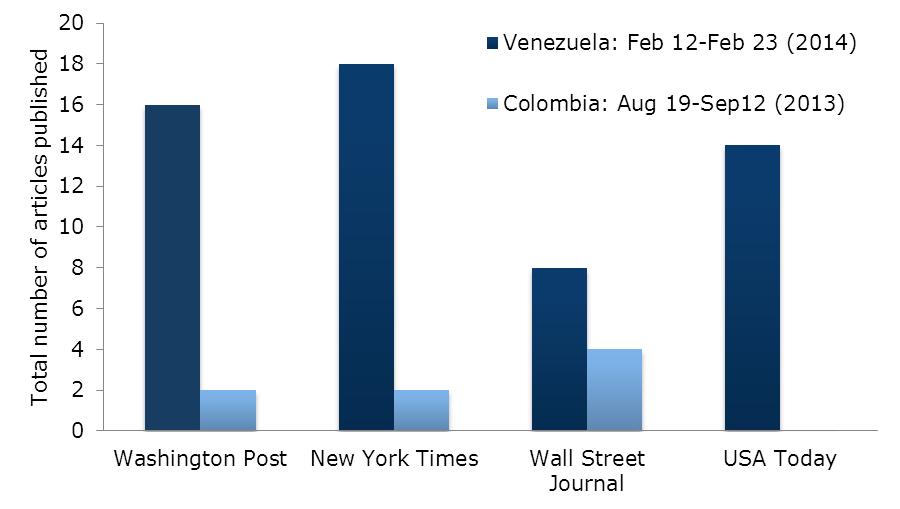
This is especially remarkable if we consider the high levels of repression carried out by the Colombian police and military in response to these protests. The International Office for Human Rights Action in Colombia described the violence as “unprovoked” and “indiscriminate” and attributes all of the violence to state forces.
The incidence of deaths in both Colombia and Venezuela[i], so far, is only slightly higher in Venezuela, with 13 deaths versus 12 deaths in Colombia.[ii] Yet there was very little coverage, and almost no criticism of the Colombian government as compared to the harsh attacks on the Venezuelan government in the U.S. media.
As mentioned earlier, US Secretary of State John Kerry and President Obama made public statements regarding the protests in Venezuela. Both demanded that students arrested in Venezuela be released, without regard as to whether any had been arrested for allegedly committing crimes such as arson and assault. There were no such statements from U.S. officials regarding the hundreds arrested in Colombia.
It is possible that both the huge differences in the amount of media coverage, and the responses to these two sets of protests by both the media and U.S. government officials has to do with the protesters and their aims, and the respective governments. The Colombian farmers were protesting against policies strongly supported by the U.S. government; they were also protesting against a government that the U.S. sees as a strategic ally, home to U.S. military bases and receiving billions of dollars in U.S. aid. The Venezuelan protesters are demanding the ouster of a government that the U.S. government has [spent] millions of dollars trying to get rid of, including U.S. support for the 2002 military coup against the government.
[i] The total amount of deaths reflects data from the most recent figures from Venezuela Transparencia, as of Monday, February 24 2014.
[ii] It is important to note that so far only six of the 13 deaths in Venezuela are confirmed to be opposition protesters.
Kerry proposes Beit Hanina as future capital of Palestine
MEMO | February 27, 2014
US Secretary of State John Kerry is proposing for the Palestinians to establish the capital of a future Palestinian state in Beit Hanina instead of all of occupied East Jerusalem, which Israel captured in the 1967 war, Palestinian Al-Quds newspaper reported on Wednesday.
Beit Hanina is located to the north of the old city, on the road to Ramallah.
According to the newspaper, Kerry’s proposal for the Palestinian capital to be located in only a small part of East Jerusalem, along with his other suggestions, enraged Palestinian President Mahmoud Abbas, who left his meeting with Kerry last week furious, threatening to torpedo the framework agreement. Kerry is said to have adopted the Israeli positions completely, including demanding that the Palestinians recognise Israel as a Jewish state and retain the ten Israeli settlement blocs in the West Bank as part of a land swap. Kerry also hinted that the Jordan Valley will not be part of a future Palestinian state and refused having any international presence in the Palestinian territories when Israel pulls out.
Meanwhile, the New York Times reported that US President Barack Obama has decided to intervene in the talks and “pressure both sides” to reach a framework agreement within the set deadline. Obama is meeting with Israel’s Prime Minister Benjamin Netanyahu at the White House on Monday and has invited Abbas to visit Washington next month.
Regarding the possibility of extending the negotiations between the Palestinians and Israel after the April deadline, Kerry told reporters that the parties took seven months to reach an understanding on their positions and he did not believe that anyone would feel concerned if it took another nine months to reach a final agreement. “I very much hope we should be able to make both parties take what is necessary to enter the most important stage, that is the final stage. To negotiate the final status based on a clear and specific framework.”
Related article

The Minimum Wage and Immigration
By Ron Unz | February 9, 2013
Earlier this week Washington Post Columnist Matt Miller published an excellent piece making the case for a large increase in the federal minimum wage, including arguments drawn from a wide range of prominent business and political figures, as well as mention of my own recent New America article on that issue.
Given the importance of the topic, it is hardly unexpected that the column attracted some 600 comments. But far more surprising was the overwhelmingly negative response of those readers. Given that the Post is a centrist-liberal newspaper and Miller a centrist-liberal columnist, one suspects that the vast majority of the commenters were similarly of the centrist-liberal orientation. But I suspect that most of their hostile remarks would have been indistinguishable from what would have greeted a similar suggestion posted on National Review or FoxNews or the Koch-funded Americans for Prosperity; and therein lies a tale.
Although the ideological spectrum of American political discourse is casually rendered along a Left-to-Right spectrum, the range of views obviously has high dimensionality; and projecting an idea-space of ten or fifteen independent degrees of freedom onto a single axis is surely absurd, with even the two most prominent dimensions of “social issues” and “economic issues” failing to capture the underlying reality.
Thus in 2008 we saw many of America’s most influential Republican pundits urging Sen. John McCain to select Sen. Joe Lieberman as his vice presidential selection to assuage and reassure distrustful conservatives. This came despite Lieberman having one of the most liberal Senate voting records on hot-button social and economic issues such as abortion, gay rights, gun control, affirmative action, immigration, taxes, regulations, and almost everything else, while even having served as candidate Al Gore’s loyal vice presidential Democratic pick just a few years earlier. But in 2008, Lieberman’s enthusiastic support for the continued Iraq Occupation and Bush’s “Great War on Terror” had momentarily eclipsed all other issues among much of the conservative elite.
Similarly, over the last couple of decades, the economic well-being of America’s working- or middle-classes seems to have been relegated to an afterthought, not merely among Republicans and conservatives, but also among their Democratic and liberal opponents as well. The shocking truth that the average American family is probably poorer today in real terms than they were fifty years ago has been almost entirely ignored by both parties, and therefore ignored by the media as well, presumably under the theory that what people don’t know won’t really hurt them.
Meanwhile, the loud battles over Gay Marriage and Gun Control, whose outcome would directly impact an utterly negligible fraction of our total population, generates front-page headline after front-page headline, perhaps because these issues excite the people who write those headlines or those who fund our campaigns. As a leading Democratic political consultant in California once joked to me during the late 1990s, no wealthy liberals he knew had any interest in funding a minimum wage increase or any similar meat-and-potato economic issue of the traditional Left; instead, the ideal initiative for fundraising purposes would promise to “Save the Gay Whales from Second-Hand Smoke.”
The near-total intellectual hegemony established by neoliberal economics during the last generation is further demonstrated by the skeptical response to Miller’s minimum wage column by Slate financial columnist and progressive pundit Matt Yglesias (refuted here). The latter seems to see Federal Reserve monetary policy as the solution to all our economic problems, worrying that the inflationary impact from increasing wages at the lower end of the spectrum would interfere with attempts to keep interest rates low, thereby derailing the desperately-awaited recovery. Given that five years of exceptionally low interest rates seem to have benefited Wall Street a great deal but Main Street little or nothing, it’s far from clear whether another five years of the same policy would do much different.
In any event, a rise in the minimum wage to $10 or even $12 per hour would simply produce a one-time jump in prices, perhaps in the range of a couple of percent, rather than the sort of continuing inflationary spiral which might unnerve the Fed. Lower wage-earners would gain vastly more than they lost, the affluent wouldn’t even notice the difference, while hundreds of billions of dollars in additional disposable income for those who spend every dollar might finally jumpstart the economy, being an enormous stimulus package funded entirely by the private sector.
In fact, the AFL-CIO has suggested that a Republican Party which strongly supported a higher minimum wage might warrant a strong second look from the vast number of ordinary American workers who had refused to even consider the plutocratic candidacy of a Mitt Romney.
As it happens, I was recently invited by The Aspen Institute to speak at their DC headquarters on a March 6th panel addressing a minimum wage increase, and perhaps some of these important points will come out during the discussion.
This same bipartisan elite consensus on the harmful effects of raising workers’ wages by law also manifests itself in a wide range of other issues. Leading Democrats and Republicans are now lining up in favor of a new amnesty program for America’s 11 million or so illegal immigrants, planning to combine this legislation with expanded quotas for skilled immigrants and also some sort of guestworker program for the lesser skilled.
It is surely an odd thing for a country’s political leaders to propose substantial increases in new immigration at a time of such high unemployment and so much economic misery among the middle- and working-classes. Obviously part of the explanation is that our elites are doing very well financially, with the DC area having become America’s wealthiest region. But the political cross-currents are quite intriguing.
Throughout most times and places, business interests have always tended to favor high immigration levels, for the obvious reason that a greater supply of available workers drives down wages and increases profits. So the responsiveness of Republican officials to their business donor class is hardly surprising, nor is the position of business-funded thinktanks and pundits.
But for exactly the same reason, worker advocates have traditionally been doubtful or hostile to immigration, even if they might often be friendly towards existing immigrants or had themselves originally come from such a background. It is hardly surprising that America’s leading anti-immigrationist figure throughout most of the 1960s and 1970s was famed labor leader Cesar Chavez.
Given such realities, the eagerness with which the Democratic side of the aisle have embraced a softening of immigration policy without any commensurate protections against job loss or wage decline is surely a sign they too have been captured by the business elites, just as was their widespread support for financial bailouts at the top of the economy and their disinterest in minimum wage increases at the bottom. As some Internet pundits have noted, President Obama actually traveled to Las Vegas, Nevada to announce his immigration proposal, selecting the highest-unemployment state to roll out a proposal hardly likely to alleviate that problem, but certainly one which would benefit the mega-wealthy employers of the low-wage service workers who staff the local casino-and-hotel economy. In our current political system, only the views—and dollars—of the latter much matter.
Given the obvious connection between more immigrants competing for jobs and a relentless downward pressure on wages, I would suggest that the easiest way for both Democrats and Republicans to demonstrate that they are not wholly owned subsidiaries of our business class would be to explicitly link the two issues by attaching a large rise in the federal minimum wage to any proposed immigration reform. After all, the primary force which originally drew those 11 million illegals to America was the attractive availability of so many millions of low-wage jobs in our country, and unless this suction force at the bottom of the economy is eliminated, more border crossers will eventually come to take their places once the current ones are legalized.
As I have argued at length elsewhere, immigration and the minimum wage are deeply intertwined policy issues, and should naturally be addressed together. Raising our minimum wage to $12 per hour as part of the proposed amnesty legislation would probably do more to solve future immigration problems than would any sort of electronic fence or national ID card.
The Case for Humanitarian War- Again
By Ajamu Baraka | Black Agenda Report | February 25, 2014
With the predictable failure of the Syrian peace conference, the call for the Obama administration to wage a humanitarian war to save civilians in Syria is once again being championed by some elements of the mainstream media in the U.S. This shouldn’t be a surprise to anyone, since certain powerful voices in the U.S. corporate media have long been in lock-step with some of the most hawkish elements in the Obama administration regarding the use of force in Syria.
A sober, clear-eyed analysis of the logic of the decisions by the Obama administration suggest that the failure of the peace conference was a programmed outcome. The inescapable conclusion as to why the conference was even held, therefore, is that administration hawks saw the failure of the conference as a valuable public relations weapon to move public opinion in favor of more direct military involvement.
Before I am accused of being overly cynical or even conspiratorial, a review of the decisions made in the days and weeks leading up to the conference provides more than adequate evidence to support this contention.
If the Obama administration had been even remotely committed to brokering some kind of diplomatic solution, would it have insisted that all of the parties to the talks be bound by the terms of the Geneva communiqué that called for “regime change” in the form of a transitional government? Would the administration have excluded Iran or been committed to pretending that the “legitimate opposition” was represented by the Syrian National Coalition, a motley crew of slavish opportunist exiles who everyone knows have no real connection to the political and military situation on the ground?
The propaganda value of the talks seems to be the only plausible explanation for why the administration would engineer the elaborate charade in Geneva. The decision to hold the talks knowing that they were going to lead to failure is where the real cynicism lies.
As I have argued since the beginning of this manufactured conflict, peace and particularly the humanity of the Syrian people are the last things on the minds of U.S. policy-makers. The often-invoked concerns for the starving people of Homs and all of the other innocents in this brutal conflict continue to be no more than a crude subterfuge to allow the administration to pursue its broader regional geostrategic objective – the elimination of the Syrian state.
That is why the Islamic fundamentalist groups that U.S. intelligence services helped to arm, train and deploy with destructive efficiency (without much real concern if they were affiliated with al-Qaeda) have targeted all of the institutions of the Syrian state – schools, hospitals, government agencies, electrical stations, water and sanitation facilities, food distribution networks – as part of their strategy. Generalized mayhem, reducing the population to dependence on their networks and territorial dismemberment have all moved the administration toward realization of its strategic objective. But because of the successes of the Syrian armed forces and the uncertainties generated as a result of internal conflicts breaking out among Islamist forces in the country, Washington decision-makers want to make sure that the Syrian government is not able to retake or re-consolidate its influence in contested zones. This can only be assured as a result of more direct military intervention on the part of the U.S. and its allies.
So the next act in this macabre play is now centering on the very real sufferings of the Syrian people. The administration’s man at the U.N., Lakhor Brahimi, set this direction in motion by skillfully moving the peace talks toward the issue of humanitarian concerns. No longer needing the chemical weapons excuse, the administration along with its coterie of collaborationist human rights organizations and media apologists, are now demanding U.N. access to the areas where the Syrian governmental forces have hemmed in the armed groups.
Taking a page from its Libyan playbook on how to manipulate the public to support war, the Obama administration had a draft U.N. Security Council resolution circulated that placed the full blame on the Syrian government for the humanitarian situation in the country.
The language in the resolution was seen as so one-sided and belligerent by some U.N. members that it had no chance of being supported, which of course was the real objective. Orchestrated by U.S. Ambassador to the U.N. Samantha Power, the resolution appeared aimed at invoking a veto in the Security Council that would set the stage for another illegal NATO-led military assault on the Syrian armed forces. Instead, a resolution was passed over the weekend that some characterized as more balanced because it called on “all sides” to allow humanitarian aid to reach civilians and condemned acts of terror. But all of the delegations understand that this compromise resolution is primarily targeting the Syrian government.
This concern for the humanity of the Syrians is comical if it was not so deadly serious. Sen. John McCain – the same Vietnam-era war criminal who was silent on the uprising of the people in Bahrain, the slaughter of innocent civilians in the various military assaults by Israel in Gaza and who supported the illegal war against Iraq that resulted in the deaths of over a million Iraqi’s – loudly condemned the Obama administration for not doing more for people suffering in Syria.
McCain as well as the hawks in the Obama administration and in the media know that they have a powerful weapon with the imperial and racist notion of the U.S. government’s “responsibility to protect.” The New York Times, Washington Post and a number of other major newspapers are now on record suggesting that the “use of force” by the Obama administration to end the starvation of innocents trapped in besieged cities is morally justified.
No one can deny the reality of tens of thousands of innocents suffering from the savage brutality of war. And who can disagree with relieving the sufferings of innocent civilians trapped in the middle of warring factions? U.S. decision-makers are well aware that most polling data suggest that when issues of humanitarian concerns are introduced, public support for more direct involvement in Syria shifts from a majority that is opposed to a slight majority that would support it.
So the U.S. public has been saturated over the last two weeks with stories about the trapped civilians, the cruel al-Assad government opposing humanitarian access and the innocent American administration that only wants to help the suffering Syrian people. The sad part of all of this is that with the anti-war and anti-imperialist movement in shambles, suffering from a combination of institutional weakness, marginalization and the effects of the “liberal virus” that has confused and disarmed U.S. radicals, the administration may very well be successful in maneuvering the public into supporting more direct military involvement.
The consequence of all of this for the people of Syria will be more violent destruction, brutality and displacement. But I am sure that the pro-imperialist and pro-war Democrats in the Obama administration have concluded that for the Syrian people, freedom – as they define it – is “worth the price” in death and destruction. And they will not see any irony in this.
Ajamu Baraka is a human rights activist and organizer. Baraka is an Associate Fellow at the Institute for Policy Studies (IPS) in Washington, D.C.
Why Does Ukraine Seem So Much Like Syria?
By Daniel McAdams | Ron Paul Institute | February 19, 2014

In Ukraine, US-backed rebels seize weapons from a military depot and begin firing on police — killing at least ten. The rebel groups occupy and torch government buildings, trade union headquarters, the central post office, and political party headquarters. They occupy local government facilities in other cities and physically attack local authorities. Their goal is to overthrow the elected government.
Reports of rebel reinforcements arriving, with “bulky backpacks near the scene of the latest protests,” are suspiciously reminiscent of the “Internet in a Suitcase” project funded by the US government to provide tools for “activists” in regime-change candidate countries. The US has similarly trained and equipped the Syrian rebels.
US-backed rebels are photographed all over Ukraine with weapons, sometimes photographed shooting at police. In Syria, the US covertly provided the weapons and approved Saudi Arabia, Qatar, and other “friends of Syria” to provide even more. A Russian official has accused the US of arming the Ukrainian opposition.
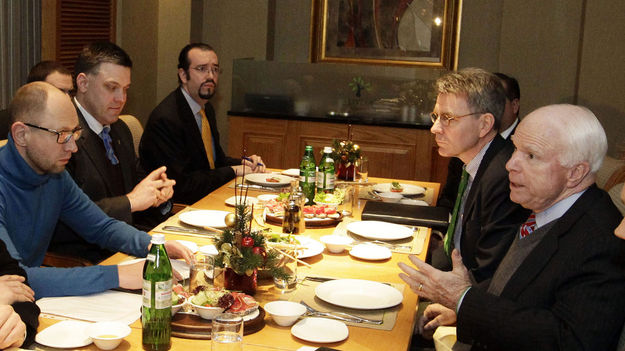
As in Syria, where US Ambassador Robert Ford adopted the rebels from the beginning of the insurrection, US officials have beat a steady path to the Ukrainian rebels to offer their support and assistance. Senator John McCain has even dined with Svoboda Party president Oleh Tyahnybok, shown here in a rather different pose. US Assistant Secretary of State Victoria Nuland was recorded plotting the overthrow and replacement of the Ukrainian government with the US Ambassador to Ukraine, Geoffrey Pyatt.
Pyatt, a man surely devoid of any sense of self-reflection, boldly proclaimed that his recorded plotting to overthrow of the Ukrainian government was merely “helping to build bridges between the government and the opposition.” Of course in a strict sense that is true: he is actively engaged in building a bridge to government power for the Ukrainian opposition.
The Syrian rebels are presented as a moderate group of would-be democrats seeking political reform; Ukrainian rebels are presented as a bunch of pro-Western, pro-EU “peaceful demonstrators.” In both cases the real power on the streets has been radical extremists with whom US officials have had considerable contact.
In Syria, President Assad responded early on to the unrest with offers of compromise, including agreeing to hold a constitutional referendum which put an end to generations of one-party rule. In Ukraine, President Yanukovich granted amnesty to violent protesters, rescinded legislation seen as inhibiting protest, fired his government at the request of the opposition and even offered to name opposition leaders to a new interim government. Each move toward compromise and appeasement of the opposition was met with increased violence and escalating demands on the part of the rebels, most recently in Ukraine after opposition leaders met with US and EU officials at a security conference in Munich.
President Obama sternly warns the Ukrainian government against restoring order: “We expect the Ukrainian government to show restraint, to not resort to violence in dealing with peaceful protesters.” He cryptically hinted at possible US escalation, stating: “We’ll be monitoring very carefully the situation, recognizing that, along with our European partners and the international community, there will be consequences if people step over the line.”
He similarly warned Syrian president Assad against taking action to defend the country against armed rebels fighting for its overthrow.
Another red line drawn? This time on Russia’s doorstep?
Here again is the million dollar question: What would Washington do if rebels intent on overthrowing the Obama regime raided military weapons depots, killed at least ten police officers and wounded dozens of others, set Washington D.C. on fire, occupied key government buildings including the US Capitol complex, and demanded a change in the Constitution favoring their ascendance to power?
Obama warned the Ukraine government to make sure the “Ukrainian military does not step in to resolve issues that could be resolved by civilians.” The US military was called in to quell a far less significant protest in Seattle over the World Trade Organization meeting there in 1999.
The US Capitol area has been on “lockdown” innumerable times over such “threats” as a mentally disturbed woman driving erratically — who was unarmed and shot dead by police.
One need not side with either opposing group in Ukraine to point out the choking hypocrisy of the US position.
But what is truly remarkable are the many similarities between what has been happening in Syria and what is now happening in Ukraine. It almost seems as if the same hand with the same playbook is plotting both regime change operations.
Obama’s Next Assassination Target
Get email updates: http://stormcloudsgathering.com/scg_u…
Donate: http://StormCloudsGathering.com/donate
Speak out: http://commongroundmovement.com/no-mo…
Sources and transcript: http://stormcloudsgathering.com/the-r…
Follow us on Facebook: http://facebook.com/StormCloudsGathering
Follow us on Twitter: http://twitter.com/collapseupdates
Featured Video

America Racing to Strategic Defeat in Iran
or go to
Aletho News Archives – Video-Images
From the Archives
An Expert Military Analysis of War with China
Actually, None is Necessary
By Fred Reed • Unz Review • December 13, 2020
The Correlation of Armed Forces: U.S. goods and services trade with China totaled an estimated $634.8 billion in 2019. Exports were $163.0 billion; imports were $471.8 billion. The U.S. goods and services trade deficit with China was $308.8 billion in 2019. Trade in services with China (exports and imports) totaled an estimated $76.7 billion in 2019. Services exports were $56.5 billion; services imports were $20.1 billion. The U.S. services trade surplus with China was $36.4 billion in 2019.
There is talk within the Washingtoniat of a possible war with China. Steve Bannon, who apparently was dropped on his head as a child, actually favors such a war. We hear the usual shoo-the-boobs alarm about how the Chinese are doing something terrible and we must gird our loins and American values and show them what for, bow wow, woof. The danger is that the current game of who-blinks-first in Asian waters might actually provoke a shooting war. You know the kind of thing: One warship refuses to get out of the way of another, a collision ensues, some retard lieutenant who signed up on waivers opens fire, and we’re off and running. It is not a good idea to let children play with matches.
The said war is discussed either in emotional terms by idiots or in purely naval terms by those familiar with such things, so we hear of the First Island Chain and the Second Island Chain and whose missiles against the other’s missiles and so on. This would be appropriate if we were fighting World War Two again. Which we aren’t. Let’s take a quick-and-dirty look at how such a war might go.
To begin the war, America would overestimate itself and underestimate China. This is doctrine in the Pentagon. … continue
Blog Roll
 Aletho News
- Suicide Should Not Be a Government Service
- Rethinking America’s greatest threat: Iran vs. Israel-Firsters
- Iran accuses adversaries of false flags to strain Turkey ties
- Poland rules out sending Patriot missiles to US/Israel amid war on Iran
- Tehran approves new Hormuz plan with major restrictions
- No Threat Can Force Iran’s Surrender /Trita Parsi & Lt Cl Daniel Davis
- UK’s New Pandemic Plan Would Turn Big Tech Into a Mass Location Tracking Network
- Growing insecurity, soaring prices fuel protests in north as regime bans evacuation: Sources
- Iran denies responsibility for ‘depraved’ attack on Kuwait desalination plant
- Bring The Troops Back. End This War Now!
- If Americans Knew
- Champagne all around for the new death penalty (for Palestinians) law – Not a ceasefire Day 172
- Why are Palestinian books struggling to be seen on Amazon?
- The Line Between Affinity and Conspiracy
- As Iran targets US military bases, will they be relocated to Israel? Not a ceasefire Day 171
- Will Trump Go Kamikaze?
- Is the University of Florida Shutting Down College Republicans over Israel Criticism?
- Jewish extremist arrested over alleged plot to firebomb Palestinian activist Nerdeen Kiswani’s home
- More than half of Palestinian child detainees have no charges
- The More Murderous Israel Gets, The More We Hear About “Antisemitism”
- Land Day and the Palestinian struggle after 30 months of genocide
- No Tricks Zone
- New Study Finds Warming Saves Lives…Cold Temperatures 12 Times More Deadly Than Excess Heat
- German Science Blog Accuses PIK Climate Institute Of Hallucinating Climate Tipping Points
- Devastating Assessment Of Comirnaty Vaccine By Former Senior Pfizer Europe Toxicologist
- New Study: CO2 Is ‘Effectively Negligible’ As An Explanatory Climate Change Factor Since 2000
- Former Pfizer Toxicologist Dr. Helmut Sterz Tells Bundestag Hearing Pfizer Vaccine Should Have Never Been Approved
- Energy Expert: Germany’s Nuclear Phaseout Was A “500 Billion Euro Mistake”
- New Research: South Australia’s Mid-Holocene Sea Surface Temperatures Were 4°C Warmer Than Today
- Storing Green Energy To Last Germany 10 Days Would Require A 60-Million Tonne Battery
- New Studies: UK Sea Levels Were 4 Meters Higher Than Today During The Mid-Holocene
- Destructive Green New Deal: German Energy And Metal Group Warns Of Drastic Crisis
 Aletho News