Putin: “Odessa is a Russian city”
BY M. K. BHADRAKUMAR | INDIAN PUNCHLINE |DECEMBER 17, 2023
At the year-end news conference on Thursday lasting four hours, Russian President Vladimir Putin made some key remarks on the conflict in Ukraine which throw light on the likely trajectory of the war through 2024. To be sure, Russia will not accept a “frozen conflict” that falls short of realising the objectives Putin had laid out at the commencement of the special military operations in February last year.
Putin stated: “There will be peace when we achieve our goals… Now let’s return to these goals – they have not changed. I would like to remind you how we formulated them: denazification, demilitarisation, and a neutral status for Ukraine.”
He spelt out denazification and demilitarisation as work in progress while leaving out the crucial question of a neutral status for Ukraine, a notion which the collective West outright rejects while pressing ahead with its intervention in newer forms despite the failure of Kiev’s months-long counteroffensive. Ironically, the accent in the revised western narrative is to create a strong resilient defence industry in Ukraine eventually with western technology and capital to ward off any Russian military threats in future.
On denazification specifically, Putin said that during the negotiations in Istanbul last year in March, Kiev showed receptiveness towards the idea of legislating against the spread of extremist ideology, but that lies buried in the past. As for demilitarisation, that idea also never caught on as Ukraine began receiving weaponry “even more than what was promised by the West.”
Therefore, Russia is left with no other option but to keep destroying the Ukrainian military capability as the core of the demilitarisation process. But Putin believed that certain parameters can still be negotiated, and, in fact, “We actually agreed on them [with Ukrainian negotiators] during the Istanbul talks; although these were thrown out later, we managed to reach agreement.” The alternative to reaching an agreement on demilitarisation is to “resolve the conflict by force. This is what we will strive for.” However, to this end, Putin ruled out another mobilisation as already “there will be about half a million people [in the war zone] by the end of this year.”
These remarks bear the hallmark of a statesman speaking from a position of strength who is conscious of it, too. Putin asserted that Russian forces are “improving their position almost along the entire line of contact. Almost all of them are engaged in active combat. And the position of our troops is improving along [the entire line of contact.]” Putin conveyed no willingness to compromise with the US and EU.
Significantly, Putin said that the southern part of Ukraine has “always been Russian territory… Neither Crimea nor the Black Sea has any connection to Ukraine. Odessa is a Russian city.” This is an ominous statement implying that the Russian operation may after all extend to Odessa which is on the western side of the Dnieper and even further westward along the Black Sea coast to Moldova that renders Ukraine a land-locked country. A prolonged conflict is in the cards.
On the contrary, the reports from the US media quoting American officials convey the impression that there is no willingness to throw in the towel at the present stage. That is of course predicated on the belief that Russia will be hard put to realise its objectives and by the end of 2024, the tide of war can change and Russia may be compelled to compromise. Thus, a new strategy is being worked out between the US and Ukrainian military that can be executed by the early part of 2024 with the American accent on holding the territory that Ukraine controls as of now and digging in.
The New York Times reported that the Ukrainian military subscribes to a “forward policy.” The Pentagon is stationing a three-star general in Kiev with a view to “stepping up the face-to-face military advice it provides to Ukraine.” This could be the beginning of deployment of American military advisors to Ukraine to oversee the war, which will put the Pentagon in a direct role in the management of the operations from both the tactical as well as strategic perspectives.
Meanwhile, the final word is not yet spoken by the US Senate on the Administration’s demand of $61 billion as additional funds for Ukraine. The likelihood is that the senate will eventually pass the bill since there is a big groundswell of support among Republican lawmakers for the war effort. The Administration is driving home that Russia has an “imperial” agenda toward NATO countries and vital US interests are at stake in preventing Russia from winning the war.
Interestingly, in a related development two days ago, Congress approved legislation that would prevent any president from withdrawing the US from NATO without approval from the Senate or an Act of Congress. Equally, Europe is also circling the wagons and taking a long-term view that Russia’s scale-up of arms production to sustain its operations in Ukraine poses a real threat to Europe, especially to the Baltic states, Georgia and Moldova. NATO Secretary-General Jens Stoltenberg last week warned that “If Putin wins in Ukraine, there is real risk that his aggression will not end there.”
The German Defence Minister Boris Pistorius echoed that sentiment when he said on Saturday that Europe must ramp up its security and defence capabilities to respond to the threat Russia poses, as the US will likely reduce its involvement on the Continent in the coming years and increasingly turn its attention to the Pacific region in the next decade. As he put it, “This isn’t just sabre-rattling. Dangers could lie ahead at the end of this decade.”
The message from the European Council meeting in Brussels last Friday is also that in circumventing Hungary’s opposition, EU leaders are navigating a pathway to ensure Ukraine will still get its €50 billion aid package to help prop up its hollowed out economy — if necessary, by taking the radical step of sacrificing EU unity and providing the money on a bilateral basis. The EU leaders are expected to reconvene at the end of January or early February to unlock the issue.
On Friday, Ukraine’s foreign ministry released a statement lauding the opening of EU membership negotiations and voicing optimism about the €50 billion aid package from Brussels. The tough talk notwithstanding, Russia too must be sensing that the EU will ultimately find a way somehow to solve the financial question. For the present, though, the deadlock in Brussels and Washington on aid has generated an air of uncertainty, which is bad optics for Kiev and plays into the Russian narrative.
All in all, Putin’s tough remarks on Thursday factor in that the US isn’t going anywhere but stays put in Ukraine and the Biden administration’s game plan is to revamp the war strategy to put it on a stronger footing and make it sustainable through the period ahead till the November 2024 election.
Kremlin’s hope that US support for Ukraine is on the wane seems misplaced. Curiously, spokesman Dmitry Peskov added in good measure in an interview on Friday with broadcaster NBC News that Putin would prefer an American president who is “more constructive” toward Russia and understands the “importance of the dialogue” between the two countries. Peskov added that Putin would be ready to work with “anyone who will understand that from now on, you have to be more careful with Russia and you have to take into account its concerns.”
Between now and the presidential election in March in Russia, domestic politics will be hotting up. After Putin’s re-election for a fresh 6-year term as president, which is widely expected, by the time the new government is formed, the campaign for the US election will have accelerated and it is a safe bet that the Ukraine war will be on auto-pilot with the priority almost entirely lying on averting any serious embarrassment to Biden’s reelection bid.
Suffice to say, staving off a military defeat in Ukraine and keeping the stalemate on track will be the Biden administration’s singular aim through 2024. The big question is whether Putin would “cooperate” or have some surprises in store. Peskov has begun looking beyond the Biden presidency.
NATO Could Send Troops to Western Ukraine if Kiev’s Spring Offensive Fails – Here’s Why
By Ilya Tsukanov – Sputnik – 26.04.2023
Mainstream reporting related to the so-called “Pentagon leaks” about the DoD’s sobering assessment of the real state of the NATO-Russia proxy conflict in Ukraine has brought the “do or die” pressure facing Kiev into focus. Without a decisive victory, Kiev may be pushed into ceasefire talks, says international affairs expert Mark Sleboda.
Anonymous Biden administration officials told US media this week that the White House is “quietly preparing” for the contingency of Ukrainian forces failing to gain any significant ground against Russia during Kiev’s much-hyped spring offensive, and for the reputational blow this might have for Washington via-a-vis other allies and clients. Administration officials reportedly also fear that a failed or stalled offensive could result in attacks on the White House at home both by hawks pushing for even more aid to Kiev, and doves arguing that the Ukrainian Army’s failure would prove that Russia can’t be ejected from Crimea, Donbass, and its new territories.
Officials are reportedly mulling pushing Zelensky into a “ceasefire” to enable Kiev to retool and reequip for a resumption of the conflict at a later date, with measures meant to prod the Zelensky government into accepting including “NATO-like security guarantees,” EU economic support, and more military aid.
“I think this is actually one in a series of articles that have come out in the last few weeks, including the so-called ‘Pentagon Leaks’ which I think most Russian analysts believe are just another narrative management tool,” Mark Sleboda said, speaking to Radio Sputnik’s The Final Countdown radio show on Tuesday.
The latest piece in the MSM hyping the prospects of a possible Ukrainian defeat isn’t the first, Sleboda recalled, pointing to another recent legacy media piece from last week warning that a “breakthrough” in the conflict may not come at all in 2023, and that observers should lower their expectations of Ukraine advancing more than 30 km.
“So [there’s a] lowering [of] expectations, lowering the bar for success. Now we have twin articles coming out of Politico, but also The New York Times coming out within 24 hours of each other. And the Times tells us that ‘Ukraine’s spring offensive comes with immense stakes for future of the war’ and that without a decisive victory, Western support for Ukraine could weaken and Kiev could come under increasing pressure to enter serious peace talks to end or freeze the conflict,” the observer noted.
Characterizing the expected Ukrainian offensive as “the most telegraphed offensive in history,” Sleboda said that naturally, reality “cannot possibly” live up to the hype as far as objectives are concerned.
“And again, the mainstream media, The Washington Post, The New York Times have done features about how Russia has been, for the last half year, building up extensive layered trench networks, fortified concrete fortifications, pillboxes, tank obstacles like dragon teeth, etc., and very extensive minefields laid out in advance… We have seen the Kiev regime go on the offensive before against Russian troops that weren’t even half as well dug-in in Kherson. And it’s now acknowledged that Russian forces withdrew, but without taking any significant casualties. They withdrew tactically to avoid being enveloped, but they inflicted crippling casualties because the Ukrainian forces were charging across open steppe into superior artillery, rocket systems, and air dominance,” the analyst said.
Russia could afford to give up territory in the past because they’re “fighting a different type of conflict,” according to Sleboda, prioritizing force preservation and attrition warfare meant to “grind down the Kiev regime’s military and now effectively NATO as well, because NATO is 100% supplying the regime at this point.”
‘Talking Smack About Crimea’
Among Kiev’s formal priorities is a long-promised attack on Crimea. That’s a fantasy, Sleboda believes, since even without a Kherson-Zaporozhye “land bridge” linking Crimea to the Russian mainland, the peninsula is just too tough a nut to crack.
“Of course, they talk a lot of smack about Crimea, which is ridiculous, because Crimea is a peninsula, geographically a very difficult target to attack, very heavily defended with a 95% pro-Russian population. It’s ridiculous,” the observer stressed. The reality, he added, is that even officials like Joint Chiefs Chairman Mark Milley have recognized that Kiev has no chance of “retaking” the peninsula.
“It’s perfectly obvious from the articles being put out today that now they don’t believe they could even get to that administrative border, nowhere close to it. I don’t believe so either. They may push Russian forces back a bit. But they talked about it in The New York Times back in December even, that the Biden administration, speaking through their stenographers anonymously, said ‘we don’t think that they can take Crimea, but we need to have the Russians believe Crimea is under threat to improve the Kiev regime’s negotiating position in future negotiations.’ They think they can get Russia to withdraw from Kherson and Zaporozhye and be satisfied with just the Donbass and Crimea. That’s their thinking. That’s why they don’t consider Bakhmut strategic, unlike Zelensky, who is trying to hold on to it all, because the US has written the Donbass off. They know that it’s an overwhelmingly pro-Russian area, that Russia has invested an enormous amount of political capital with the referendums there, but they think they can still get them to give up on Kherson and Zaporozhye, which also held referendums, by the way,” Sleboda said.
Sleboda pointed to the Times’ admission that the 12 new Ukrainian combat brigades of 4,000 troops apiece formed for the spring offensive – which are expected to be ready by the end of the month, are “raw recruits with a small core of experienced veteran soldiers,” and that they are equipped with handfuls of more modern NATO tanks and armored vehicles accompanied by much older equipment, and facing a big disadvantage in artillery and control of airspace.
Even the debate over deliveries of the much-vaunted F-16 fighters to Kiev is “all political,” according to the observer, because it takes years to train to use them, and Washington may prefer to save them, along with the ATACMS missiles long demanded by Kiev, for a possible war against China in the Pacific.
‘New Domino Theory’ and Danger of WWIII
Pointing to the “new domino theory” that’s being pushed by neocons and neoliberals in Washington on the need to prop up Kiev at all costs, or face Taiwan “falling” to China, Sleboda fears that if push comes to shove and Kiev suffers a major defeat on the battlefield, NATO may be tempted to intervene directly in the crisis to prevent its global defeat.
“I believe that if the Kiev regime suffers a catastrophic defeat and NATO can’t filter more weapons useful to them through them, they might consider what I’ve talked about for maybe half a year now – sending US and Polish troops, maybe Romanians, the Baltics, the Brits – a new ‘coalition of the willing’ as ‘peacekeepers’ into western Ukraine. To tell you the truth Russia would probably yell and scream, but they don’t really want to occupy West Ukraine because unlike East Ukraine, they really do hate Russia over there. It would be very hostile guerilla territory. That’s the part of Ukraine that sided with Nazi Germany in World War II and is resurrecting all of that type of anti-Russian, Banderite fascist glorification today,” Sleboda said.
Ultimately, the main issue of concern for the analyst is Odessa – the strategic, majority Russian-speaking seaport. “If the Kiev regime loses that, then they’re a landlocked little rump state, and the US [has] got the 101st Airborne just across the border in Romania exactly to step across as a tripwire force into Odessa. And that’s the scenario that keeps me up at night. That’s the World War III scenario, as far as I’m concerned [it] is a possible direct NATO-Russia fight over Odessa because I do not believe for a second that Russia would allow Odessa to become a US naval base,” Sleboda summed up.
Kiev’s Repression of Anti-Fascism in Odessa
By ERIC DRAITSER | CounterPunch | May 27, 2015
There is a common misconception in the West that there is only one war in Ukraine: a war between the anti-Kiev rebels of the East, and the US-backed government in Kiev. While this conflict, with all its attendant geopolitical and strategic implications has stolen the majority of the headlines, there is another war raging in the country – a war to crush all dissent and opposition to the fascist-oligarch consensus. For while in the West many so called analysts and leftists debate whether there is really fascism in Ukraine or whether it’s all just “Russian propaganda,” a brutal war of political repression is taking place.
The authorities and their fascist thug auxiliaries have carried out everything from physical intimidation, to politically motivated arrests, kidnappings, torture, and targeted assassinations. All of this has been done under the auspices of “national unity,” the convenient pretext that every oppressive regime from time immemorial has used to justify its actions. Were one to read the Western narrative on Ukraine, one could be forgiven for believing that the country’s discontent and outrage is restricted solely to the area collectively known as Donbass – the Donetsk and Lugansk People’s Republics as they have declared themselves. Indeed, there is good reason for the media to portray such a distorted picture; it legitimizes the false claim that all Ukraine’s problems are due to Russian meddling and covert militarization.
Instead, the reality is that anger and opposition to the US-backed oligarch-fascist coalition government in Kiev is deeply rooted and permeates much of Ukraine. In politically, economically, and culturally important cities such as Kharkov, Dnepropetrovsk, and Kherson, ghastly forms of political persecution are ongoing. However, nowhere is this repression more apparent than in the Black Sea port city of Odessa. And this is no accident.
Odessa: Center of Culture, Center of Resistance
For more than two centuries, Odessa has been the epicenter of multiculturalism in what is today called Ukraine, but what alternately was the Soviet Union and the Russian Empire. With its vibrant history of immigration and trade, Odessa has been the heart of internationalism and cultural, religious, and ethnic coexistence in the Russian-speaking world. Its significant populations of Russians, Jews, Ukrainians, Poles, Germans, Greeks, Tatars, Moldovans, Bulgarians and other ethnic and national identities made Odessa a truly international city, a cosmopolitan Black Sea port with French architecture, Ottoman influence, and rich Jewish and Russian/Soviet cultural history.
In many ways, Odessa was the quintessential Soviet city, one which, to a large extent, actually embodied the Soviet ideal enumerated in the state anthem – a city “united forever in friendship and labor.” And it is this spirit of multiculturalism and shared history which rejects the racist, chauvinist, fascist politics which now passes for standard political currency in “Democratic Ukraine.”
When in February 2014, the corrupt, though democratically elected, government of former President Viktor Yanukovich was ousted in a US-backed coup, the people of Odessa, just as in many other cities, began to organize counter-demonstrations against what they perceived to be a Western-sponsored oligarch-fascist alliance seizing power over their country. In the ensuing weeks and months, tens of thousands turned out into the streets to air their discontent, including massive rallies held in February, March, and April.
This inchoate movement against the new dispensation in Kiev, handpicked by the US and its European allies, culminated in two critical events: the establishment of an anti-Maidan movement calling for federalization and greater autonomy for the Odessa region, and the massacre at the Trade Unions House carried out by fascist thugs which resulted in the deaths of more than fifty anti-fascist activists and demonstrators. As a protest organizer and eyewitness recounted to this author, “That was the moment when everything changed, when we knew what Ukraine had really become.”
The brutality of the pogrom – an appropriate word considering the long and violent history of this region – could hardly be believed even by hardened anti-fascist activists. Bodies with bullet wounds found inside the burned out building, survivors beaten on the streets after their desperate escape from the flames, and myriad other horrific accounts demonstrate unequivocally that what the Western media dishonestly and disgracefully referred to as “clashes with pro-Russian demonstrators,” was in fact a massacre; one that forever changed the nature of resistance in Odessa, and throughout much of Ukraine.
No longer were protesters simply airing their grievances against an illegitimate government sponsored by foreigners. No longer were there demonstrations simply in favor of federalization and greater autonomy. Instead, the nature of the resistance shifted to one of truly anti-fascist character seeking to get the truth about Ukraine out to the world at large. Where once Odessa had been the site of peaceful demands for fairness, instead it became the site of a brutal government crackdown aimed at destroying any semblance of political protest or resistance. Indeed, May 2, 2014 was a watershed. That was the day that politics became resistance.
The Reality of the Repression
The May 2, 2014 massacre in Odessa is one of the few examples of political repression that actually garnered some attention internationally. However, there have been numerous other examples of Kiev’s brutal and illegal crackdown on dissent in the critical coastal city and throughout the country, most of which remain almost entirely unreported.
In recent weeks and months, the local authorities have engaged in politically motivated arrests of key journalists and bloggers who have presented a critical perspective on the developments in Odessa. Most prominent among them are the editors of the website infocenter-odessa.com, a locally oriented news site that has been fiercely critical of the Kiev regime and its local authorities.
In late 2014, the editor of the site, Yevgeny Anukhin, was arrested without any warrant while he was attempting to register his human rights organization with the authorities. According to various sources, the primary reasons for his arrest were his possession of video evidence of illegal shelling by Ukrainian military of a checkpoint in Kotovka, and data on his computer which included a compilation of names of political prisoners held without trial in Odessa. With no evidence or warrant, and in breach of standard legal procedures, he was arrested and charged with recruitment of insurgents against the Ukrainian state.
In May 2015, the new editor of infocenter-odessa.com Vitaly Didenko, a leftist, anti-fascist activist and journalist was also arrested on trumped up charges of drug possession which, according to multiple sources in Odessa, are entirely fabricated by the SBU (Security Service of Ukraine) secret police in order to create a pretext upon which to detain him. In the course of his arrest, Didenko was seriously injured, incurring several broken ribs and a broken arm. He is currently sitting in an Odessa jail, his case entirely ignored by Western media, including those organizations ostensibly committed to the protection of journalists.
Additionally, just this past weekend (May 24, 2015) there was yet another sickening display of political repression on the very spot of the May 2, 2014 massacre. Activists and ordinary Odessa citizens had been taking part in a memorial service for the victims of the tragedy when the demonstration was violently dispersed by armed men in either military or national guard uniforms (see here for photos). According to eyewitnesses, the military men instigated violence at the gathering and broke it up, all while both local police and OSCE monitors stood aside and watched. Naturally, this is par for the course in “Democratic Ukraine.”
Aside from journalists, a large number of activists have been detained, kidnapped, and/or tortured by Ukrainian authorities and their fascist goons. Key members of the Borotba (Struggle) leftist organization have been repeatedly harassed, arrested, and beaten by the police. One particularly infamous example was the detainment of Vladislav Wojciechowski, a member of Borotba and survivor of the May 2nd massacre. According to Borotba’s website, “During the search of the apartment where he lived, explosives were planted. Nazi “self-defense” paramilitaries participated in his arrest. Vladislav was beaten, and it is possible that a confession was beaten out of him under torture. Currently, he is in SBU custody.” He was ultimately charged with “terrorism” by the authorities after having been beaten and tortured by both Nazi goons and SBU agents.
Upon his release more than three months later in December 2014 in a “prisoner exchange” between Kiev and the eastern rebels, Wojciechowski defiantly stated, “I am very angry with the fascist government of Ukraine, which proved once again with its barbaric acts that it is willing to wade through corpses to defend its interests and those of the West. They failed to break me! And my will has become tempered steel. Now I’m even more convinced that it is impossible to save Ukraine without defeating fascism on its territory.” Wojciechowski was also the editor of the website 2May.org, a site dedicated to disseminating the truth about the Odessa massacre.
It should be noted though that Wojciechowski was arrested along with his comrades Pavel Shishman of the now outlawed Communist Party of Ukraine, and Nikolai Popov of the Communist Youth. These arrests should come as no surprise to observers of the political situation in Ukraine where all forms of leftist politics – the Communist party, Soviet symbols and names, etc. – have been outlawed and brutally repressed.
Kiev is not only engaged in an assault on political freedoms, but also a class war against the working class of Odessa and Ukraine generally. That the events leading up to the massacre took place at Kulikovo Field – a famous staging area for Soviet era demonstrations of working class politics – and the massacre itself took place in the adjacent Trade Unions House, there’s a symbolic resonance, the significance of which is not lost on the people of Odessa. It is the attempt to both erase the legacy of working class struggle and leftist politics, as well as the sacrifices of previous generations in a place where historical memory runs deep, and the scars of the past have yet to heel.
Aside from these shameful attacks on leftist formations, multicultural institutions too have been repressed under the pretext of “Russian separatism.” A multiethnic, multi-nationality organization known as the Popular Rada of Bessarabia (PRB) was founded in early April 2015 in order to push for regional autonomy and/or ethnic autonomy in response to the legal and extralegal attacks on minorities by the Kiev authorities. It was reported that within 24 hours of the founding congress, Ukraine’s SBU had detained the core leaders of the organization, including the Chair of the organization’s presidium Dmitry Zatuliveter whose whereabouts, according to this author’s latest information, remain unknown. Within two weeks 30 more PRB activists were arrested, including founding member Vera Shevchenko.
While the Western media and its armies of think tanks and propaganda mouthpieces steadfastly deny that an organization such as PRB can be anything other than “a project of Russian political consultants,” the reality is that such moves have been a reaction to repressive legislation and intimidation by the US-backed regime in Kiev which has done everything from outlawing the two most popular political parties of the Russian-speaking South and East (The Party of Regions and the Communist Party), to attempting to strip the Russian language of official status within Ukraine, a move interpreted by these groups as a direct threat against them and their regions where Russian, not Ukrainian, is the lingua franca.
As Senior Fellow at the Jamestown Foundation and former Radio Free Europe/Radio Liberty (read CIA front) contributor Vladimir Socor wrote last month in an article entitled Ukraine Defuses Pro-Russia Instigations in Odesa Province, “In the spirit of preventive action, Ukrainian law enforcement agencies have arrested some 20 members of a centrifugal organization in Odesa [sic] province.. The timely intervention also stopped the publicity bandwagon that had just started rolling from Moscow in support of the Odesa [sic] group.” Interestingly, the author deceptively frames his apologia for so called “preventive detention” as merely a “timely intervention,” conveniently glossing over the blatant illegality of the action by Kiev, which has eschewed the rule of law in favor of brute force and repression.
And what is the PRB’s great crime in the eyes of Mr. Socor and the US interests for which he speaks? As he directly states in the article with typical condescension:
[BPR’s program and manifesto] include demands for: greater representation of ethnic groups in the administration of Ukraine’s Odesa [sic] province; promotion of the ethnic groups’ cultural identities and schools; conferral of a “national-cultural special status” to Bessarabia; a free economic zone, with specific reference to local control over Ukraine’s Black Sea and Danube ports; no integration of Ukraine with the European Union, the “enslavement practices of which would ruin the region and its agriculture”; and reinstatement of Ukraine’s [recently abandoned] international status of nonalignment, or else: “In the event of Ukraine moving close to NATO [the North Atlantic Treaty Organization], we reserve the right to implement the self-determination of Bessarabia.”
A careful reading of these demands reveals that these are precisely the demands that any right-minded anti-imperialist position should espouse, including rejection of NATO integration, rejection of EU integration, rejection of opening up Ukraine’s agricultural sector to the likes of Monsanto and other Western corporations, and protection of ethnic, religious, and cultural minorities, among other things. While Socor writes of these demands derisively, the reality is that they constitute precisely the sort of program that is essential for defending both Ukraine’s sovereignty, and the rights of the people of Odessa and the region. But of course, for Socor, this is all just a Russian plot. Instead, he kneels to kiss the chocolate ring of Poroshenko… and perhaps other parts of Victoria Nuland and John Kerry, while vigorously cheer-leading further political repression.
A Message for the Left
The question facing leftists internationally is no longer whether they believe there are fascists in Ukraine, or whether they are an important part of the political establishment in the country; this is now impossible to refute. Rather, the challenge before the international left is whether it can overcome its deep-seated mistrust of Russia, and consequent inability to separate fact from fiction, and unwaveringly defend its comrades in Ukraine with the conviction and aplomb of its historical antecedents.
There is a whole history that is under assault, a whole people being oppressed, a leftist tradition being ground to dust under the heel of an imperialist agenda and comprador oligarch bourgeoisie. Some on the left choose to snicker derisively at this struggle, aligning themselves once again with the Empire just as they so often have in Libya, Syria, and elsewhere. And then there are those who, like this author, refuse to be cowed by the baseless slur of “Russian apologist” and “Putin puppet”; those of us who choose not to look away while our comrades in Ukraine are beaten, kidnapped, tortured, imprisoned, and disappeared.
For while they speak out in the face of reprisals, in the midst of brutal repression, under threat of prison and death, the least we can do is speak out from our comfortable chairs. Anything less is moral cowardice and utter betrayal.
Self-proclaimed Donetsk and Lugansk republics form ‘Novorossiya’ union
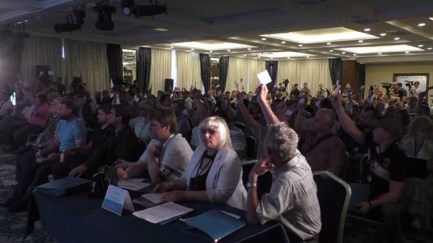
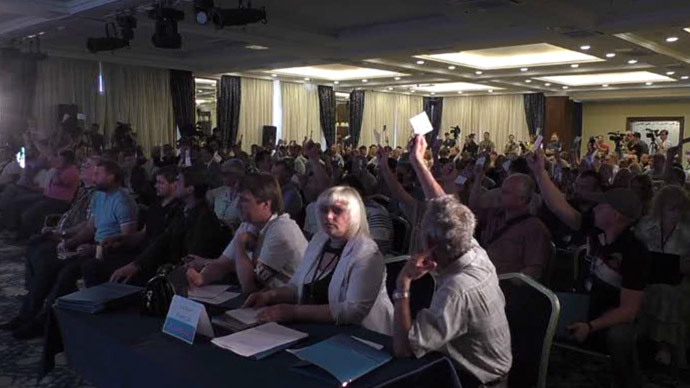
Representatives from eight south-eastern regions voting at the people’s congress in Donetsk
RT | May 24, 2014
Self-proclaimed Donetsk and Lugansk People’s Republics which recently held referenda on independence from Ukraine have declared the creation of Novorossiya union.
“We have signed a memorandum on the union,” Denis Pushilin, co-chairman of the Donetsk People’s Republic, told the media.
The new union will be called Novorossiya, said the people’s governor of the Donetsk Region, Pavel Gubarev.
He added that the document was signed in the city of Donetsk by Donetsk People’s Republic Prime Minister Aleksandr Borodai and the head of Lugansk People’s Republic Aleksey Karyakin.
People’s representatives from eight Ukrainian regions gathered for a congress in Donetsk on Saturday, a day ahead of scheduled countrywide presidential elections.
As a result of the congress, the south-eastern regions of Ukraine, where anti-government protests gained momentum, have announced the creation of a pro-federalization Popular Front socio-political coalition. The movement accepted a manifesto vowing self-determination and protection of people from “Nazi gangs’ terror.”
The coalition involves Odessa, Nikolaev, Dnepropetrovsk, Zaporozhye, Kharkov, Kherson, Donetsk and Lugansk Regions.
At the congress, all 145 delegates accepted the manifesto, which stresses that the Popular Front will consist of “everybody, who is ready to resist self-appointed Kiev authority, which started war against the people.”
The coalition vowed to protect innocent civilians from the “terror of Nazi gangs, financed by oligarchs and foreign security services.” It also pledges “a joint fight for people’s rights to a decent life.”
It says it has launched an investigative commission that will probe “crimes of Nazi-terrorists and their Kiev patrons”.
The coalition is calling for a boycott of the presidential election, which is scheduled to take place on Sunday, because “all major candidates” are “oligarchs, whom we have already seen in top positions, hence, robbery and terror would continue,” the manifesto said.
When it comes to a new Ukrainian constitution, the Popular Front demands that it guarantees “neutrality” and non-participation in military blocks as well as “political independence”, “mechanisms to stop corruption and massive poverty.”
The coalition also demands that the parliament consists of two chambers. At the same time, regions must be given “a right to autonomy” and “independent foreign-economic activity”.
In addition to that, regional governments must be given a right to “announce its territory de-militarized zones and also “ban political, social and religious organizations on its territory” in case they are considered a “threat” to the people.
The Popular Front wants two official languages in Ukraine – Ukrainian and Russian.
Lugansk and Donetsk People’s Republics earlier announced they will not participate in Ukraine’s presidential elections scheduled for May 25.
Ukrainian Police Find Traces of Chloroform at Site of Odessa Fire
RIA Novosti – 19/05/2014
KIEV – Ukrainian investigators have discovered traces of chloroform in garbage and ashes removed from the House of Trade Unions in Odessa, the site of a fire where dozens of activists died on May 2, acting Ukrainian Deputy Interior Minister Vitaliy Sakal said Monday.
“There is an expert conclusion that in the garbage and ashes, where there were already around 30 investigations held on the premises; a like substance of chloroform was discovered. It is used during surgeries, but how it ended up in the Professional Union Building is currently being investigated,” Sakal said during a press conference.
He said that inhaling large amounts of the substance leads to respiratory arrest, which is what happened during the fire, in which 32 people died from an unknown substance, not extreme temperatures.
Clashes in Odessa broke out on May 2, between pro-federalization activists on one side and fans of the Odessa and Kharkiv football teams on the other, joined by Euromaidan activists.
Pro-Kiev radicals joined by Right Sector militia blocked the anti-government protesters in the House of Trade Unions and set the building on fire by hurling Molotov cocktails inside. Those trapped inside had little chance of extinguishing the blaze, as fire hoses in the building were out of order.
Six died of bullet wounds, 32 suffocated, and 10 fell to their death by jumping through the windows of the burning building. Another 214 were injured. According to some information, another 48 are reported to be missing.
No plausible explanation has been offered for the fact that many of those who died did not try to take refuge on upper floors or the roof, prompting rumors that they were poisoned by an unknown chemical.
Ukrainian ultranationalist leader calls for guerilla war against pro-federalists
RT | May 18, 2014
Television debates with three nationalist presidential candidates ended up in calls to pursue a guerilla war against federalist Ukrainian citizens and conduct targeted assassinations of their leaders.
The leader of the radical Right Sector movement, Dmitry Yarosh, and his no less nationalist opponents, former chief of foreign intelligence service, Nikolay Malomuzh, and chairman of People’s Rukh nationalist party, Vasily Skubiyda, presented their vision of Ukraine on Saturday after the presidential election set for May 25.
Because their positions are really close, they represent the far-right body of electors. The extremist views of Dmitry Yarosh stood out against a background of total antagonism towards everything non-Ukrainian, in the first place the Russian-speaking citizens of the country’s southeast who are demanding federalization.
The leader of the militants, who now make up the backbone of the newly created National Guards, currently conducting military operations against federalization activists in eastern Ukraine, has called for “extensive guerilla war” against the protesting federalist forces in Donetsk and Lugansk.
The Right Sector, which last month formed a special detachment, Donbass-1, for waging war against the federalists in eastern Ukraine, is now busy forming the Donbass-2 unit and plans to recruit militants for a third one, said Yarosh.
The ultranationalist leader categorically denied that the autonomous republic of Crimea had the right to disengage with Ukraine through a popular referendum and reunite with Russia. Crimea “has always been, and remains” a Ukrainian territory, stated Yarosh and called to start a guerilla war in the peninsula get the region back.
The Right Sector leader also shared new tactics to be used against federalists in the East, saying that there should be no more attempts to storm the rebel cities, but rather “knock out” the activist leaders. It means that they should be physically eliminated, he specified.
The federalization of Ukraine should never be allowed as it would destroy the Ukrainian state, stressed Yarosh, and promised in case of victory in the presidential race to form future authorities out of Maidan activists who have proven their loyalty.
There is no secret that several Ukrainian oligarchs, who were appointed governors of several eastern regions of the country by the new Kiev authorities, are financing paramilitary units that actually make up private armies of their own.
As for and the Right Sector, its leader Dmitry Yarosh stated that he is “against oligarchs.” The new politician claimed that once he becomes president, he would “redirect Ukrainian economy and tax system from supporting monopolies owned by oligarchs to support small and medium business.”
However, the Right Sector leader never explained what happened to the valuables that were reported missing after Right Sector members occupied certain premises, such as the recreational center ‘Bear oak grove’, or the lavish residence of the former Ukrainian President Viktor Yanukovich soon after the ousted president fled the country.
During the debates, all three candidates agreed that there should be only one official language in Ukraine to maintain the integrity of the country. The presidential candidates expressed a readiness to ensure the rights of the ‘national minorities,’ but offered no solution to the historically Russian-speaking majority of the 20 million-strong population of the South and East of Ukraine, who do not speak Ukrainian.
Towards the end of the debates, Dmitry Yarosh made a controversial statement, addressing the electorate.
“I would like to assure all citizens in the East and South of Ukraine that neither me as a person, nor the Right Sector, bear any ill will to peaceful Ukrainian citizens. Yes, we’re ready to carry out our constitutional duty to protect territorial integrity and the sovereignty of Ukraine, and we’re already doing so. We will protect our country with arms if necessary,” said Yarosh.
In fact, Ukrainian citizens of the protesting regions have every right to fear Yarosh and his Right Sector union as they are acting as the spearhead of punitive actions against the protesters in the Donetsk, Lugansk, Kharkov and Odessa regions.
So far there have been 23 registered presidential candidates in Ukraine, but five of them have called off their candidacies for various reasons.
Developments over the last several months have revealed that the coup-imposed government in Kiev has little, if any authority over the Right Sector’s actions.
After a notorious Right Sector radical militant, Aleksandr Muzychko, was shot dead in a police raid in late March, Dmitry Yarosh demanded the immediate resignation of the Interior Minister Arsen Avakov and punishment for those law enforcement officers who took part in the operation. Right Sector militants besieged the Ukrainian parliament headquarters, forcing the coup-imposed government to consider banning the radical organization, but it never dared to do so.
In Russia Dmitry Yarosh has been put on the wanted list for taking part in killing Russian soldiers in Chechnya in 1994-1995. Moscow also requested Interpol to put the ultranationalist on the international wanted list.
Ukrainian warships voluntarily leave Sevastopol: sources
RT | March 2, 2014
About 10 Ukrainian Black Sea Fleet ships have left the naval base in Sevastopol, with several vessels now heading to Odessa, administrative sources have said. The ships left the base voluntarily but some of them broke down and returned, they claimed.
Over the last 24 hours, “about 10 [war]ships and vessels of the Ukrainian Black Sea Fleet have left the Sevastopol base,” a source in the government of the Autonomous Republic of Crimea told Interfax on Sunday.
“Naturally, no one has compelled them to do so,” the government source added.
The administration of the Crimean autonomy has nothing to do with the moves of the Ukrainian ships, an administrative source also told RIA Novosti.
Several vessels have since returned to the base in Sevastopol “because of malfunctions,” the source said.
Meanwhile, former Ukrainian troops were due to swear allegiance to the Crimean authorities in Sevastopol at 5pm local time (15:00 GMT). An unnamed official source earlier told RIA Novosti that “the majority of the Ukrainian armed forces deployed in Crimea” have passed to the side of the region. The transition was made “without a single shot fired,” the source said.
Ukrainian state agencies have been categorically denying both the claims of Ukrainian soldiers switching sides en masse and, earlier, reports of warships leaving Sevastopol.
However, the governor of southern Ukrainian Odessa Region told local media that several Ukrainian ships are sailing to the city of Odessa and it is being decided where they will dock.
A Russian media report on Saturday claimed that Ukraine’s Navy flagship, the Hetman Sahaidachny frigate has refused to follow orders from Kiev, came over to Russia’s side and was returning home from the Gulf of Aden flying the Russian naval flag. Various Ukrainian media denied the report as “false” and “propaganda,” but gave only a Facebook statement of a former Navy officer turned journalist in support of the rebuttal.
This comes as the newly appointed Navy Chief rear admiral Denis Berezovsky has sworn allegiance to the people of Crimea, according to RIA Novosti.
“I, Berezovsky Denis, swear allegiance to the Crimean people and pledge to protect it, as required by the [army] regulations,” Berezovsky said.
Hours after the announcement, the self-proclaimed government in Kiev dismissed the Navy Chief and launched a treason case against him.

Featured Video

America Racing to Strategic Defeat in Iran
or go to
Aletho News Archives – Video-Images
From the Archives
An Expert Military Analysis of War with China
Actually, None is Necessary
By Fred Reed • Unz Review • December 13, 2020
The Correlation of Armed Forces: U.S. goods and services trade with China totaled an estimated $634.8 billion in 2019. Exports were $163.0 billion; imports were $471.8 billion. The U.S. goods and services trade deficit with China was $308.8 billion in 2019. Trade in services with China (exports and imports) totaled an estimated $76.7 billion in 2019. Services exports were $56.5 billion; services imports were $20.1 billion. The U.S. services trade surplus with China was $36.4 billion in 2019.
There is talk within the Washingtoniat of a possible war with China. Steve Bannon, who apparently was dropped on his head as a child, actually favors such a war. We hear the usual shoo-the-boobs alarm about how the Chinese are doing something terrible and we must gird our loins and American values and show them what for, bow wow, woof. The danger is that the current game of who-blinks-first in Asian waters might actually provoke a shooting war. You know the kind of thing: One warship refuses to get out of the way of another, a collision ensues, some retard lieutenant who signed up on waivers opens fire, and we’re off and running. It is not a good idea to let children play with matches.
The said war is discussed either in emotional terms by idiots or in purely naval terms by those familiar with such things, so we hear of the First Island Chain and the Second Island Chain and whose missiles against the other’s missiles and so on. This would be appropriate if we were fighting World War Two again. Which we aren’t. Let’s take a quick-and-dirty look at how such a war might go.
To begin the war, America would overestimate itself and underestimate China. This is doctrine in the Pentagon. … continue
Blog Roll
 Aletho News
- Tehran approves new Hormuz plan with major restrictions
- No Threat Can Force Iran’s Surrender /Trita Parsi & Lt Cl Daniel Davis
- UK’s New Pandemic Plan Would Turn Big Tech Into a Mass Location Tracking Network
- Growing insecurity, soaring prices fuel protests in north as regime bans evacuation: Sources
- Iran denies responsibility for ‘depraved’ attack on Kuwait desalination plant
- Bring The Troops Back. End This War Now!
- Can we please stop calling Israel the ‘only democracy in the Middle East’ now?
- US should start removing its troops from Germany, proposes AfD co-leader Chrupalla
- Iran Red Crescent: 600 educational centers attacked in US-Israeli ‘war crimes’
- Russian Oil Tanker Arrives in Cuba Amid U.S. Blockade
- If Americans Knew
- As Iran targets US military bases, will they be relocated to Israel? Not a ceasefire Day 171
- Will Trump Go Kamikaze?
- Is the University of Florida Shutting Down College Republicans over Israel Criticism?
- Jewish extremist arrested over alleged plot to firebomb Palestinian activist Nerdeen Kiswani’s home
- More than half of Palestinian child detainees have no charges
- The More Murderous Israel Gets, The More We Hear About “Antisemitism”
- Land Day and the Palestinian struggle after 30 months of genocide
- The Iran War Is About Palestine
- Israeli soldiers echo settler ideology, talk of revenge after targeting Palestinians and detaining CNN crew in the West Bank
- Israeli Policies Threaten Future of Christian Schools in Jerusalem
- No Tricks Zone
- New Study Finds Warming Saves Lives…Cold Temperatures 12 Times More Deadly Than Excess Heat
- German Science Blog Accuses PIK Climate Institute Of Hallucinating Climate Tipping Points
- Devastating Assessment Of Comirnaty Vaccine By Former Senior Pfizer Europe Toxicologist
- New Study: CO2 Is ‘Effectively Negligible’ As An Explanatory Climate Change Factor Since 2000
- Former Pfizer Toxicologist Dr. Helmut Sterz Tells Bundestag Hearing Pfizer Vaccine Should Have Never Been Approved
- Energy Expert: Germany’s Nuclear Phaseout Was A “500 Billion Euro Mistake”
- New Research: South Australia’s Mid-Holocene Sea Surface Temperatures Were 4°C Warmer Than Today
- Storing Green Energy To Last Germany 10 Days Would Require A 60-Million Tonne Battery
- New Studies: UK Sea Levels Were 4 Meters Higher Than Today During The Mid-Holocene
- Destructive Green New Deal: German Energy And Metal Group Warns Of Drastic Crisis
 Aletho News