Russia & Syria call for on-the-ground probe in Douma, pledge to provide security to OPCW experts
RT | April 10, 2018
Moscow has proposed to create an independent investigative mechanism into the alleged chemical attack in the Damascus suburb of Douma, promising, along with the Syrian army, to guarantee prompt access for experts to the site.
Russia’s envoy to the UN, Vassily Nebenzia, has reiterated that Russia will support a thorough investigation into the alleged use of chemical weapons in the rebel-held town of Douma over the weekend.
“Let us recall that our draft resolution to set up such a mechanism is in blue. And we stand ready to adopt it today if necessary,” Nebenzia said, referring to the Russia-sponsored UNSC resolution to establish an independent investigative mechanism under the auspices of the Organization for the Prohibition of Chemical Weapons (OPCW).
Moscow is ready to serve as a guarantor of security for those OPCW experts who would inspect the site of the incident, Nebenzia added, stressing the need for the probe to be carried out without delay. The experts may “immediately, tomorrow, fly to Damascus,” the diplomat said.
“There, the Syrian authorities and Russian troops will provide conditions to travel to the area of the alleged incident for them to familiarize themselves with the situation,” Nebenzia said, reminding the UNSC member-states’ representatives that “that is what President Trump and other western leaders called upon us to undertake.”
The Syrian Permanent Representative to the United Nations Bashar Jaafari said his country is also ready to welcome the OPCW team as soon as possible and to provide them with everything necessary for a comprehensive investigation.
“My country, Syria, stresses its unlimited cooperation with the OPCW to fulfill the commitments stated in the convention of the prohibition of the development, production, stockpiling and use of chemical weapons,” he said.
Highlighting the importance of a swift investigation, Nebenzia noted that it should be conducted on the ground, and not through third parties. Moscow has repeatedly criticized the OPCW investigation into last April’s Khan Sheikhoun incident as “unprofessional.” One of the major flaws of the Joint Investigative Mechanism (JIM), as pointed out by Moscow, was that the whole investigation was conducted remotely. As a result, the findings of the OPCW report, that blamed the attack on the Syrian government, were mostly based on speculation by analysts, accounts by unidentified witnesses and material evidence submitted by third parties with no chain of custody being implemented.
In November, the mechanism’s mandate expired and Moscow vetoed a resolution to extend its authority, arguing that it was effectively “dead” and couldn’t be revived, stressing a need for a new, “professional, objective and unbiased” mechanism to replace its discredited predecessor. Moscow at the time proposed a resolution to create one but it was not passed by the UNSC.
Speaking to the media on Monday, Nebenzia did not specify if Russia would put the resolution to a vote on Tuesday. Meanwhile, US Ambassador to the UN Nikki Haley said she is looking forward to the Security Council voting on the resolution proposed by the US.
The US draft, leaked to the media, implies that Syria might be found in violation of UNSC Resolution 2118 as a result of the investigation by a proposed “Independent Mechanism of Investigation.” The resolution, adopted in 2013, provided for the destruction of Syria’s chemical weapons stockpiles. Damascus has repeatedly stressed its compliance, denying allegations of the use of toxic agents in the offensives on rebel-held regions.
“The Syrian Arab Republic stresses once again it does not possess any chemical weapons of any type, including chlorine,” Jaafari said at Monday’s UNSC meeting.
The US-sponsored draft “condemns in the strongest terms the continued use of chemical weapons” and also stipulates that measures might be taken against Syria under the UN Charter Chapter 7, which paves the way for the use of force.
Nebenzia denounced the draft, saying that it contains “some unacceptable elements.” “There is nothing there that would meet the high standards of the United Nations Chemical Weapons Convention,” he said.
The UNSC President, Gustavo Meza-Cuadra, Permanent Representative of Peru to the United Nations, said that he expects the countries’ delegations to continue to work on the draft for the rest of Monday and on Tuesday, describing the situation as “very difficult.”
Russia won’t respond to UK ultimatum until samples of alleged chemical weapon received – Lavrov
RT | March 13, 2018
Moscow will not respond to the British request about a clandestine Soviet chemical weapon allegedly used in an ex-double agent’s poisoning until a sample of the agent is provided, the Russian foreign minister said.
On Monday, British Prime Minister Theresa May said a chemical weapon developed under a secret Soviet program dubbed Novichok was used in the poisoning of Sergei Skripal. May demanded that Russia provide details of the program, saying otherwise London would consider the poisoning an attack directed by the Russian government.
The Russian Foreign Ministry said on Tuesday that it had summoned British Ambassador to Moscow Laurie Bristow. No further details were provided.
“We have certainly heard the ultimatum voiced in London,” Lavrov said on Tuesday. “The spokesperson for the Foreign Ministry has commented on our attitude to this,” he added referring to Maria Zakharova branding of May’s appearance in Parliament as a “circus.”
He added that a case of alleged use of chemical weapons should be handled through the proper channel, being the Organization for the Prohibition of Chemical Weapons (OPCW) – of which both Russia and Britain are members.
“As soon as the rumors came up that the poisoning of Skripal involved a Russia-produced agent, which almost the entire English leadership has been fanning up, we sent an official request for access to this compound so that our experts could test it in accordance with the Chemical Weapons Convention [CWC],” Lavrov said. So far the request has been ignored by the British side, he added.
The minister affirmed that Russia has nothing to do with the poisoning of Skripal and would assist Britain in the investigation, provided that London meets its own obligations as to how such probes are to be handled.
The OPCW rules allow Britain in this case to send a request to Russia on the suspected Russian-made chemical weapon and expect a response within 10 days, Lavrov explained. If the response is not satisfactory, Britain would have to file a complaint with the organization’s executive council and the conference of CWC member-states, he said.
For its part, Russia expects Britain to share evidence on the Skripal case, Lavrov stated. The former double agent and his daughter Yulia, who was also poisoned, hold Russian citizenship, so Russia has a right to know how the apparent attempt on their lives is being investigated, the foreign minister said.
The British theory is that Russia was either directly responsible for the poisoning, or had lost possession of the chemical weapon that was used. London gave Moscow until Tuesday to explain what had happened.
Russia, US craft rival UN resolutions on extending chemical probe in Syria
Press TV – November 3, 2017
Russia and the United States have drawn up rival UN Security Council resolutions on extending the mission of a body of international experts probing chemical attacks in Syria.
The Joint Investigative Mechanism (JIM) was formed by a Security Council resolution in 2015, and is run jointly by the UN and the Organization for the Prohibition of Chemical Weapons (OPCW), the world body’s chemical weapons watchdog.
Russia, however, has been exceedingly critical of JIM’s reports, finding faults with its evidence gathering techniques.
On October 14, Russia vetoed a US-sponsored Security Council resolution that would have renewed the experts’ mandate for a year. It said it would wait for an official report on an alleged sarin gas attack last year in northwestern Syria by the mission to decide whether it would back extending its mandate.
The report came out two days after the veto, blaming Syria for the incident which took place in April 2016 in the town of Khan Shaykhun and killed over 90 people.
Both Russia and Syria have rejected the report.
Reacting to the report on Thursday, Russian Foreign Ministry said the JIM experts had produced it without even turning up on site despite being offered guarantees of safety.
Mikhail Ulyanov, the head of the ministry’s arms control and non-proliferation department, said, “Imagine a criminal investigation in which police refuse to visit the site of the crime. No court will ever accept it.” “But they consider it possible to do such thing at the UN Security Council,” he noted.
According to a draft resolution obtained by news agencies, both the American and Russian versions demand the JIM mission’s extension, but under totally different conditions.
According to AFP, Russia wants the UN Security Council to shelve the latest JIM report and launch a new investigation into the Khan Shaykhun incident.
The Russian draft also urged a six-month extension of the UN-led panel’s mission, while the version put forward by the US calls for a two-year extension of the mandate, the report added.
The Associated Press also reported that the Russian draft resolution on the future of JIM’s mandate urges the mission to send investigators to Khan Shaykhun, where the attack reportedly happened, and the Shayrat airfield in Syria’s central Homs Province, which the US attacked later in April with missiles under the pretext of punishing Syria.
The accusations against the Damascus government come while Syria has turned over its entire chemical stockpile under a deal negotiated by Russia and the United States back in 2013. The OPCW supervised that removal process.
OPCW-UN Syria Sarin Attack Probe Based on ‘Staged Proof’
Sputnik – October 30, 2017
The Organization for the Prohibition of Chemical Weapons (OPCW) and the United Nations used fabricated evidence in their Joint Investigative Mechanism (JIM) probe into April’s chemical attack in the Syrian town of Khan Sheikhoun, threatening the reputation of international organizations, Professor Emeritus of Science, Technology, and National Security Policy at Massachusetts Institute of Technology Theodore A. Postol told Sputnik.
Last week, the JIM presented to the UN Security Council (UNSC) a confidential report on the attack, carried out in the Syrian opposition-held province of Idlib, reportedly killing over 80 people. Some Western media outlets, which had access to the report, quoted the document as saying that the government of Syria’s President Bashar Assad was held responsible for the chemical attack on April 4. The panel also reportedly blamed the Islamic State terror group (banned in Russia) for using sulfur mustard in an attack on Syria’s Um Housh on September 16, 2016.
The report “relies on findings” of the OPCW Fact-Finding Mission (FFM) in Syria that was published this June following the investigation into the incident. The mission revealed that the victims had been exposed to sarin, a toxic substance, or a sarin-like substance. The FFM did not send its staff directly to the site, but completed the probe by conducting interviews, and collecting evidence and samples, such as video footage of the incident and hair from a dead goat found at the scene. The FFM also specified that it was unable to “implement a complete chain of custody, by the team, for samples from source.”
Postol shared with Sputnik the results of his own research proving that the UN-OPCW probe into the Khan Sheikhoun incident was flawed and biased.
Postol’s Research
In his analysis, the expert referred to the well-publicized video footage taken by Orient News in Khan Sheikhoun very shortly after the alleged April 4 nerve agent attack. The video showed a dead goat that allegedly suffocated in the attack next to the targeted area. Postol underlined that this evidence could not be used because the animal’s corpse could have been planted.
“As an inspection of the four images and the labels on the images clearly and unambiguously show, the dead goat in the image was dragged to the location where the journalists claim it died,” Postol said.
According to the expert, the corpse’s location could be easily established by other images taken in the Orient News video and other videos. The goat was located roughly 100 meters (328 feet) southeast of a crater that was considered the source of the sarin release.
“Perhaps most incredible in the OPCW report is an appendix that reports evidence of sarin use from analysis of a hair from the dead goat. Nowhere in the OPCW report is there any indication that the goat may have died elsewhere, possibly from sarin poisoning in a room or barn, and was then dragged to the location as an exhibit,” Postol pointed out.
The FFM found that the alleged nerve agent was most likely triggered at the site where there was a crater in the road. The OPCW concluded that such a release could only be determined as the use of sarin as a chemical weapon. According to the UN commission, two parts of a bomb were found at the site, including a larger part for chemical payload and a filler cap for chemical weapon itself, adding that it was “unable to determine the exact type of chemical bomb used,” however it suggested the explosive was a Soviet-era chemical bomb.
“There are many images of this crater that indicate subsequent tampering with the pipe that is vertically standing near the edge of the crater. In later photographs that can be seen that the pipe was pulled out from its vertical position in place flat at the center of the crater. This was then followed by claims that the pipe was a vessel containing sarin that was released at the site. Our calculations speculated that the crater was formed by a standard 122 mm artillery rocket explosive warhead of the kind that is ubiquitously available for purchase around the world,” Postol pointed out.
Postol’s research included forensic computational analysis performed by two of his colleagues — Professor Goong Chen and Dr. Chung Gu, at Texas A&M University — which “unambiguously explains how this crater was actually created.”
“The spent rocket motor casing of the rocket is embedded at the forward edge of the crater (not at the center as some people have asserted) and it is slightly bent forward by the sudden torque that occurs when the warhead impacts the asphalt surface. If we assume that the rocket casing was fabricated into a pipe and welded, our calculations show exactly the kind of split along the axis of symmetry of the pipe. This suggests that the rocket motor was manufactured locally and probably filled with a propellant that was locally produced. One such propellant that is commonly used in the manufacturing of improvised rocket motors is potassium nitrate and sugar,” the expert explained.
Postol suggested that the rocket motor had been manufactured locally, and the warhead, igniter and nozzle had been attached to each end of the improvised rocket.
The expert then went into detail about the blast site, and the positions the rocket was found in.
“The arrival azimuth is easily identified because the rocket is embedded at the forward edge of the crater and the bent spent rocket casing also points forward along the direction of arrival. The cracking of the asphalt surface surrounding the crater is due to hot gases propagating through the underlying ground and pushing the asphalt vertically,” the expert explained.
It was because of the above-mentioned observations Postol was able to determine the type of explosive device used and why it was not possible to definitely conclude that this warhead carried the alleged sarin toxin.
“It is therefore unambiguous that the crater was created by a standard 122 mm explosive warhead of the type that can be purchased anywhere in the world. There is absolutely no evidence of any sarin containing vessel. The split pipe that has been inaccurately identified as evidence of the container filled with sarin is simply the casing of the rocket motor that propelled the purchased warhead to the location of the explosion,” the expert noted.
UN Reputation Threatened
“The information I am providing contains compelling and unambiguous evidence that the UN OPCW investigation of this matter was deeply flawed and biased. The fact that the UN OPCW did not have investigators under their direct control at the scene of the alleged nerve agent attack at Khan Sheikhoun on April 4, 2017 is no excuse for them making claims that are demonstrably false,” Postol said.
Postol pointed to the fact that in their analyses, both the UN commission and the OPCW used publicly available information obtained from videos that “clearly showed attempts by local organizations to manipulate information.”
“The fact that the OPCW has made no effort to verify the accuracy of this information indicates either extreme incompetence, or much more likely, extreme bias on the part of OPCW leadership. Of even greater concern is that the UN leadership is not exercising its fiduciary responsibilities to member countries by assuring that the OPCW is free of bias and incompetence,” the expert continued.
By failing to properly investigate incidents like the supposed Khan Sheikhoun chemical weapons attack, the United Nations and the OPCW are most likely enabling various groups with military and political agendas to use nerve agents and then point a finger at their enemies, Postol suggested.
“Continuing failure to properly review the veracity of the OPCW claims will ultimately have serious negative consequences for the reputation of the UN. This will, in turn, have serious negative consequences for the role of the UN as a credible source of analysis with regard to other dismaying and potentially escalatory events that will certainly occur in the future,” the expert emphasized.
Postol noted Russia’s “well-justified” criticisms of the handling of the JIM by the UN leadership.
The expert called on Russia to introduce a proposal within the UNSC for his investigation results to be reviewed by the organization’s authorities.
“Our interest is to help the UN reach a technically sound conclusion about the evidence that is available that indicates that the crater at Khan Sheikhoun has been misidentified as the source of a sarin release,” Postol explained.
Postol believes the data on flaws in the UN-sponsored report on the alleged use of sarin in Khan Sheikhoun provides strong ground for the Russian UN delegation to seek a review of the JIM report, because the misidentified source of the sarin attack, as outlined by Postol, casts doubts on whether the JIM report can accurately claim Assad as the responsible party.
Fabricated Casus Belli
After the incident in Khan Sheikhoun, the United States launched 59 Tomahawk cruise missiles at the Syrian military airfield in Ash Sha’irat in the province of Homs from which the chemical attack was allegedly carried out.
“My concern was that the United States attack against Syria would encourage these rebel groups to engage in false attacks, attack people with sarin and then blame it on the Assad government. So that’s what got me involved at looking at this,” Postol explained.
Postol reiterated the lack of reliable evidence in the UN and OPCW materials, as all the information that the investigators used had been fabricated, misidentified and misinterpreted.
Also, the expert pointed out the lack of methodology, noting that the investigators’ findings were “filled with errors.”
“They made no attempt at all to determine the veracity of the evidence, that their claims can reach that conclusion. There was a very substantial indication that I put in the report for you that indicated that the site where the alleged sarin release occurred could not have been [the place where] there was a sarin release … but those things were clearly staged, clearly fraudulent,” Postol continued.
Postol also said that he had released a series of papers on the issue, which were ignored by the Western press. The expert explained this by the fact that public opinion in the United States is split into two camps: the liberals and the conservatives. In order to be a “liberal,” one has to adopt certain ideas, like that Assad is a monster, Postol explained. With Washington putting pressure on everyone whose vision of things is different, the liberal US media refuse to publish materials which provide an alternative perspective, such as Postol’s analysis of the events in Khan Sheikhoun, the expert elaborated.
The UN chief’s spokesman said on Thursday that he had trust in the professionalism and objectivity of the OPCW-UN joint mechanism.
Meanwhile, on Friday, Russian Deputy Foreign Minister Sergey Ryabkov told Sputnik the methodology of the OPCW-UN report on chemical weapon use in Syria was flawed, being based on biased evidence. He continued by saying that after an in-depth analysis of the JIM report and presentation of conclusions, Russia would put forward specific measures and steps aimed at “improving dramatically this unacceptable position and put the investigation of crimes with chemical weapons use on a solid, reliable … basis.”
Damascus reportedly denied the JIM allegations. Moscow, in turn, said that the Russian Foreign Minister would present its own analysis of the UN-OPCW report since “opinions and assessments by Russian specialists that were transferred to the mechanism at its own request turned out to be completely ignored” in JIM’s investigation.
The JIM revealed its report two days after Russia blocked a UNSC resolution extending its mandate in Syria, set to expire on November 16, for another year. The Russian Foreign Ministry has said that the decision on the prolongation of the UN-OPCW investigators’ mandate must not be made by the UNSC until the examination of the probe results.
Syria Rejects Report of Joint Inquiry of UN and OPCW
Al-Manar | October 27, 2017
Syria has rejected the report of joint inquiry of the UN and Organization for the prohibition of chemical weapons (OPCW), which was announced yesterday, stressing that it came in implementation of the instructions of the US administration and Western countries to exert more political pressures and threats to Syria’s sovereignty.
A source at Foreign and Expatriates Ministry said Friday that Syria reiterates its complete commitment to Non-Proliferation of Chemical Weapons Convention and that it no longer has any toxic chemicals banned in accordance with the Convention.
It considers the use of chemical weapons an immoral and condemnable act anywhere, at any time and under any circumstances, the ministry said.
The ministry’s source said that Syria strongly condemns the direct and indirect accusations against it which were included in this report and the previous one since they represent a falsification of the truth and distortion of all accurate information about what happened in Khan Sheikhon.
It also condemns dependence of the Joint Investigative Mechanism on the statements of criminals who committed this immoral act in Khan Sheikhon and suspicious witnesses in addition to what they call open sources.
Investigation into Khan Sheikhoun: Rules-based order tested by Western scheming
By Dr Alexander Yakovenko | RT | May 2, 2017
There is still no proper reaction by the OPCW to the alleged use of sarin in Khan Sheikhoun in Syria on 4 April.
Unfortunately, the work of the OPCW Fact-Finding Mission (FFM) to Syria is shrouded in secrecy. What is clear is that it continues to operate in a remote mode, using Internet data mostly concocted by the radical elements of the Syrian opposition, including the notorious “White Helmets”.
From the scarce information one can gather that the samples taken from those injured or dead were tested in the OPCW-licensed laboratories in Britain and Turkey and established to be sarin or sarin-like substance. However, the samples were not taken at the site of the incident. Hence, the basic principle of the investigation, that of the chain of custody, hasn’t been observed. There are no answers on that from our Western partners. As there is no clear evidence that those people were from Khan Sheikhoun and not from somewhere else.
Equally dubious is the questioning of the “witnesses” by the FFM. One can’t be sure they were residents of Khan Sheikhoun. Moreover, those “witnesses”, as we understand, are mostly supporters of the opposition or their family members. Their impartiality is questionable. However, information is available, including provided by the Swedish Doctors for Human Rights, which demonstrates that those photo- and video- materials were clearly staged.
It looks like the FFM, so far, is not doing its job properly. That the FFM team, in terms of its composition, is absolutely dominated by the countries hostile to Damascus, is another fundamental flaw. This is in sharp contrast to the established international practice. According to the UN Secretary-General decision the UN-OPCW Investigation Mechanism mustn’t include representatives of the UNSC P5, as well as Syria’s neighbors. And yet the heads of both FFM segments are British citizens, albeit no one can in earnest assume the British position in the Syrian conflict as unbiased. Why not act by the book and why afraid of the truth being established in due course? The proposal to have a special investigation, with due oversight of the international community, was voted down by the West.
There’s still time to conduct a proper, full-fledged investigation. According to the UN Secretariat, the security situation in Khan Sheikhoun is quite acceptable. The Syrian side is also ready, in the interests of this investigation, to put a ceasefire in force along the way of the OPCW staff’s travel to the site. The Director-General of the OPCW Technical Secretariat stated his willingness to send the OPCW experts to Khan Sheikhoun.
The Syrian Government is also ready to ensure a totally secure environment for the FFM staff to visit Shayrat airbase. We insist on such a visit. The US Administration explained its Shayrat missile attack by the alleged storage of sarin at this airbase. It is necessary to verify this allegation.
It is a fair assumption that sarin could have been used in Khan Sheikhoun. The question is who did it and how the toxic substance was delivered. A few versions exist. As the information is accumulated there is more and more grounds to think that the terrorists controlling this area blew up the home-built sarin munition on the ground which resulted in civilian casualties. The “White Helmets” acted too hastily to stir public outrage and posted in-advance prepared materials on the Internet. However, they made several bad mistakes which point to the staged nature of those materials.
The definitive answer to what really happened in Khan Sheikhoun can only be provided by a full-fledged investigation in full compliance with the OPCW verification provisions. It is too serious a matter for peace in the region and a wider world for the OPCW to fail this test of credibility. Those who have taken over the FFM investigation are all to eager to manage the truth in their vested interest. Otherwise they wouldn’t obstruct efforts to open it up for due scrutiny. It is this tactics of pushing the UN Security Council to act on the basis of forged evidence and flawed investigation, that undermines the rules-based world order.
It has to be borne in mind that the British Foreign Secretary recently hypothesized on joining another US action in Syria in response to another chemical incident, which means that an order for it has already been placed. A lot is said about the disastrous lack of trust in international relations. Unilateral actions and takeovers of international bodies by the West further undermine it.
Dr Alexander Yakovenko, Russian Ambassador to the United Kingdom of Great Britain and Northern Ireland, Deputy foreign minister (2005-2011). Follow him on Twitter @Amb_Yakovenko
The Existential Question of Who to Trust
By Robert Parry | Consortium News | April 30, 2017
The looming threat of World War III, a potential extermination event for the human species, is made more likely because the world’s public can’t count on supposedly objective experts to ascertain and evaluate facts. Instead, careerism is the order of the day among journalists, intelligence analysts and international monitors – meaning that almost no one who might normally be relied on to tell the truth can be trusted.
The dangerous reality is that this careerism, which often is expressed by a smug certainty about whatever the prevailing groupthink is, pervades not just the political world, where lies seem to be the common currency, but also the worlds of journalism, intelligence and international oversight, including United Nations agencies that are often granted greater credibility because they are perceived as less beholden to specific governments but in reality have become deeply corrupted, too.
In other words, many professionals who are counted on for digging out the facts and speaking truth to power have sold themselves to those same powerful interests in order to keep high-paying jobs and to not get tossed out onto the street. Many of these self-aggrandizing professionals – caught up in the many accouterments of success – don’t even seem to recognize how far they’ve drifted from principled professionalism.
A good example was Saturday night’s spectacle of national journalists preening in their tuxedos and gowns at the White House Correspondents Dinner, sporting First Amendment pins as if they were some brave victims of persecution. They seemed oblivious to how removed they are from Middle America and how unlikely any of them would risk their careers by challenging one of the Establishment’s favored groupthinks. Instead, these national journalists take easy shots at President Trump’s buffoonish behavior and his serial falsehoods — and count themselves as endangered heroes for the effort.
Foils for Trump
Ironically, though, these pompous journalists gave Trump what was arguably his best moment in his first 100 days by serving as foils for the President as he traveled to Harrisburg, Pennsylvania, on Saturday and basked in the adulation of blue-collar Americans who view the mainstream media as just one more appendage of a corrupt ruling elite.
Breaking with tradition by snubbing the annual press gala, Trump delighted the Harrisburg crowd by saying: “A large group of Hollywood celebrities and Washington media are consoling each other in a hotel ballroom” and adding: “I could not possibly be more thrilled than to be more than 100 miles away from [the] Washington swamp … with much, much better people.” The crowd booed references to the elites and cheered Trump’s choice to be with the common folk.
Trump’s rejection of the dinner and his frequent criticism of the mainstream media brought a defensive response from Jeff Mason, president of the White House Correspondents’ Association, who complained: “We are not fake news. We are not failing news organizations. And we are not the enemy of the American people.” That brought the black-tie-and-gown gathering to its feet in a standing ovation.
Perhaps the assembled media elite had forgotten that it was the mainstream U.S. media – particularly The Washington Post and The New York Times – that popularized the phrase “fake news” and directed it blunderbuss-style not only at the few Web sites that intentionally invent stories to increase their clicks but at independent-minded journalism outlets that have dared question the elite’s groupthinks on issues of war, peace and globalization.
The Black List
Professional journalistic skepticism toward official claims by the U.S. government — what you should expect from reporters — became conflated with “fake news.” The Post even gave front-page attention to an anonymous group called PropOrNot that published a black list of 200 Internet sites, including Consortiumnews.com and other independent-minded journalism sites, to be shunned.

Secretary of State Colin Powell, Feb. 5, 2003
But the mainstream media stars didn’t like it when Trump began throwing the “fake news” slur back at them. Thus, the First Amendment lapel pins and the standing ovation for Jeff Mason’s repudiation of the “fake news” label.
Yet, as the glitzy White House Correspondents Dinner demonstrated, mainstream journalists get the goodies of prestige and money while the real truth-tellers are almost always outspent, outgunned and cast out of the mainstream. Indeed, this dwindling band of honest people who are both knowledgeable and in position to expose unpleasant truths is often under mainstream attack, sometimes for unrelated personal failings and other times just for rubbing the powers-that-be the wrong way.
Perhaps, the clearest case study of this up-is-down rewards-and-punishments reality was the Iraq War’s WMD rationale. Nearly across the board, the American political/media system – from U.S. intelligence analysts to the deliberative body of the U.S. Senate to the major U.S. news organizations – failed to ascertain the truth and indeed actively helped disseminate the falsehoods about Iraq hiding WMDs and even suggested nuclear weapons development. (Arguably, the “most trusted” U.S. government official at the time, Secretary of State Colin Powell, played a key role in selling the false allegations as “truth.”)
Not only did the supposed American “gold standard” for assessing information – the U.S. political, media and intelligence structure – fail miserably in the face of fraudulent claims often from self-interested Iraqi opposition figures and their neoconservative American backers, but there was minimal accountability afterwards for the “professionals” who failed to protect the public from lies and deceptions.
Profiting from Failure
Indeed, many of the main culprits remain “respected” members of the journalistic establishment. For instance, The New York Times’ Pentagon correspondent Michael R. Gordon, who was the lead writer on the infamous “aluminum tubes for nuclear centrifuges” story which got the ball rolling for the Bush administration’s rollout of its invade-Iraq advertising campaign in September 2002, still covers national security for the Times – and still serves as a conveyor belt for U.S. government propaganda.
The Washington Post’s editorial page editor Fred Hiatt, who repeatedly informed the Post’s readers that Iraq’s secret possession of WMD was a “flat-fact,” is still the Post’s editorial page editor, one of the most influential positions in American journalism.
Hiatt’s editorial page led a years-long assault on the character of former U.S. Ambassador Joseph Wilson for the offense of debunking one of President George W. Bush’s claims about Iraq seeking yellowcake uranium from Niger. Wilson had alerted the CIA to the bogus claim before the invasion of Iraq and went public with the news afterwards, but the Post treated Wilson as the real culprit, dismissing him as “a blowhard” and trivializing the Bush administration’s destruction of his wife’s CIA career by outing her (Valerie Plame) in order to discredit Wilson’s Niger investigation.
At the end of the Post’s savaging of Wilson’s reputation and in the wake of the newspaper’s accessory role in destroying Plame’s career, Wilson and Plame decamped from Washington to New Mexico. Meanwhile, Hiatt never suffered a whit – and remains a “respected” Washington media figure to this day.
Careerist Lesson
The lesson that any careerist would draw from the Iraq case is that there is almost no downside risk in running with the pack on a national security issue. Even if you’re horrifically wrong — even if you contribute to the deaths of some 4,500 U.S. soldiers and hundreds of thousands of Iraqis — your paycheck is almost surely safe.
The same holds true if you work for an international agency that is responsible for monitoring issues like chemical weapons. Again, the Iraq example offers a good case study. In April 2002, as President Bush was clearing away the few obstacles to his Iraq invasion plans, Jose Mauricio Bustani, the head of the Organization for the Prohibition of Chemical Weapons [OPCW], sought to persuade Iraq to join the Chemical Weapons Convention so inspectors could verify Iraq’s claims that it had destroyed its stockpiles.
The Bush administration called that idea an “ill-considered initiative” – after all, it could have stripped away the preferred propaganda rationale for the invasion if the OPCW verified that Iraq had destroyed its chemical weapons. So, Bush’s Undersecretary of State for Arms Control John Bolton, a neocon advocate for the invasion Iraq, pushed to have Bustani deposed. The Bush administration threatened to withhold dues to the OPCW if Bustani, a Brazilian diplomat, remained.
It now appears obvious that Bush and Bolton viewed Bustani’s real offense as interfering with their invasion scheme, but Bustani was ultimately taken down over accusations of mismanagement, although he was only a year into a new five-year term after having been reelected unanimously. The OPCW member states chose to sacrifice Bustani to save the organization from the loss of U.S. funds, but – in so doing – they compromised its integrity, making it just another agency that would bend to big-power pressure.
“By dismissing me,” Bustani said, “an international precedent will have been established whereby any duly elected head of any international organization would at any point during his or her tenure remain vulnerable to the whims of one or a few major contributors.” He added that if the United States succeeded in removing him, “genuine multilateralism” would succumb to “unilateralism in a multilateral disguise.”
The Iran Nuclear Scam
Something similar happened regarding the International Atomic Energy Agency in 2009 when Secretary of State Hillary Clinton and the neocons were lusting for another confrontation with Iran over its alleged plans to build a nuclear bomb.
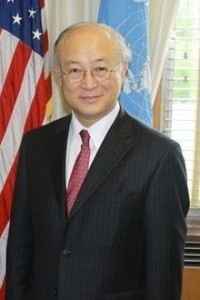
IAEA director Yukiya Amano
According to U.S. embassy cables from Vienna, Austria, the site of IAEA’s headquarters, American diplomats in 2009 were cheering the prospect that Japanese diplomat Yukiya Amano would advance U.S. interests in ways that outgoing IAEA Director General Mohamed ElBaradei wouldn’t; Amano credited his election to U.S. government support; Amano signaled he would side with the United States in its confrontation with Iran; and he stuck out his hand for more U.S. money.
In a July 9, 2009, cable, American chargé Geoffrey Pyatt said Amano was thankful for U.S. support of his election. “Amano attributed his election to support from the U.S., Australia and France, and cited U.S. intervention with Argentina as particularly decisive,” the cable said.
The appreciative Amano informed Pyatt that as IAEA director-general, he would take a different “approach on Iran from that of ElBaradei” and he “saw his primary role as implementing safeguards and UNSC [United Nations Security Council] Board resolutions,” i.e. U.S.-driven sanctions and demands against Iran.
Amano also discussed how to restructure the senior ranks of the IAEA, including elimination of one top official and the retention of another. “We wholly agree with Amano’s assessment of these two advisors and see these decisions as positive first signs,” Pyatt commented.
In return, Pyatt made clear that Amano could expect strong U.S. financial assistance, stating that “the United States would do everything possible to support his successful tenure as Director General and, to that end, anticipated that continued U.S. voluntary contributions to the IAEA would be forthcoming. Amano offered that a ‘reasonable increase’ in the regular budget would be helpful.”
What Pyatt made clear in his cable was that one IAEA official who was not onboard with U.S. demands had been fired while another who was onboard kept his job.
Pandering to Israel
Pyatt learned, too, that Amano had consulted with Israeli Ambassador Israel Michaeli “immediately after his appointment” and that Michaeli “was fully confident of the priority Amano accords verification issues.” Michaeli added that he discounted some of Amano’s public remarks about there being “no evidence of Iran pursuing a nuclear weapons capability” as just words that Amano felt he had to say “to persuade those who did not support him about his ‘impartiality.’”
In private, Amano agreed to “consultations” with the head of the Israeli Atomic Energy Commission, Pyatt reported. (It is ironic indeed that Amano would have secret contacts with Israeli officials about Iran’s alleged nuclear weapons program, which never yielded a single bomb, when Israel possesses a large and undeclared nuclear arsenal.)
In a subsequent cable dated Oct. 16, 2009, the U.S. mission in Vienna said Amano “took pains to emphasize his support for U.S. strategic objectives for the Agency. Amano reminded ambassador [Glyn Davies] on several occasions that he was solidly in the U.S. court on every key strategic decision, from high-level personnel appointments to the handling of Iran’s alleged nuclear weapons program.
“More candidly, Amano noted the importance of maintaining a certain ‘constructive ambiguity’ about his plans, at least until he took over for DG ElBaradei in December” 2009.
In other words, Amano was a bureaucrat eager to bend in directions favored by the United States and Israel regarding Iran’s nuclear program. Amano’s behavior surely contrasted with how the more independent-minded ElBaradei resisted some of Bush’s key claims about Iraq’s supposed nuclear weapons program, correctly denouncing some documents as forgeries.
The world public got its insight into the Amano scam only because the U.S. embassy cables were among those given to WikiLeaks by Pvt. Bradley (now Chelsea) Manning, for which Manning received a 35-year prison sentence (which was finally commuted by President Obama before leaving office, with Manning now scheduled to be released in May – having served nearly seven years in prison).
It also is significant that Geoffrey Pyatt was rewarded for his work lining up the IAEA behind the anti-Iranian propaganda campaign by being made U.S. ambassador to Ukraine where he helped engineer the Feb. 22, 2014 coup that overthrew elected President Viktor Yanukovych. Pyatt was on the infamous “fuck the E.U.” call with Assistant Secretary of State for European Affairs Victoria Nuland weeks before the coup as Nuland handpicked Ukraine’s new leaders and Pyatt pondered how “to midwife this thing.”
Rewards and Punishments
The existing rewards-and-punishments system, which punishes truth-tellers and rewards those who deceive the public, has left behind a thoroughly corrupted information structure in the United States and in the West, in general.
Across the mainstream of politics and media, there are no longer the checks and balances that have protected democracy for generations. Those safeguards have been washed away by the flood of careerism.
The situation is made even more dangerous because there also exists a rapidly expanding cadre of skilled propagandists and psychological operations practitioners, sometimes operating under the umbrella of “strategic communications.” Under trendy theories of “smart power,” information has become simply another weapon in the geopolitical arsenal, with “strategic communications” sometimes praised as the preferable option to “hard power,” i.e. military force.
The thinking goes that if the United States can overthrow a troublesome government by exploiting media/propaganda assets, deploying trained activists and spreading selective stories about “corruption” or other misconduct, isn’t that better than sending in the Marines?
While that argument has the superficial appeal of humanitarianism – i.e., the avoidance of armed conflict – it ignores the corrosiveness of lies and smears, hollowing out the foundations of democracy, a structure that rests ultimately on an informed electorate. Plus, the clever use of propaganda to oust disfavored governments often leads to violence and war, as we have seen in targeted countries, such as Iraq, Syria and Ukraine.
Wider War
Regional conflicts also carry the risk of wider war, a danger compounded by the fact that the American public is fed a steady diet of dubious narratives designed to rile up the population and to give politicians an incentive to “do something.” Since these American narratives often deviate far from a reality that is well known to the people in the targeted countries, the contrasting storylines make the finding of common ground almost impossible.
If, for instance, you buy into the Western narrative that Syrian President Bashar al-Assad gleefully gases “beautiful babies,” you would tend to support the “regime change” plans of the neoconservatives and liberal interventionists. If, however, you reject that mainstream narrative – and believe that Al Qaeda and friendly regional powers may be staging chemical attacks to bring the U.S. military in on their “regime change” project – you might favor a political settlement that leaves Assad’s fate to the later judgment of the Syrian people.
Similarly, if you accept the West’s storyline about Russia invading Ukraine and subjugating the people of Crimea by force – while also shooting down Malaysia Airlines Flight 17 for no particular reason – you might support aggressive countermoves against “Russian aggression,” even if that means risking nuclear war.
If, on the other hand, you know about the Nuland-Pyatt scheme for ousting Ukraine’s elected president in 2014 and realize that much of the other anti-Russian narrative is propaganda or disinformation – and that MH-17 might well have been shot down by some element of Ukrainian government forces and then blamed on the Russians [see here and here] – you might look for ways to avoid a new and dangerous Cold War.
Who to Trust?
But the question is: who to trust? And this is no longer some rhetorical or philosophical point about whether one can ever know the complete truth. It is now a very practical question of life or death, not just for us as individuals but as a species and as a planet.
The existential issue before us is whether – blinded by propaganda and disinformation – we will stumble into a nuclear conflict between superpowers that could exterminate all life on earth or perhaps leave behind a radiated hulk of a planet suitable only for cockroaches and other hardy life forms.
You might think that with the stakes so high, the people in positions to head off such a catastrophe would behave more responsibly and professionally. But then there are events like Saturday night’s White House Correspondents Dinner with self-important media stars puffing about with their First Amendment pins. And there’s President Trump’s realization that by launching missiles and talking tough he can buy himself some political space from the Establishment (even as he sells out average Americans and kills some innocent foreigners). Those realities show that seriousness is the farthest thing from the minds of Washington’s insiders.
It’s just too much fun – and too profitable in the short-term – to keep playing the game and hauling in the goodies. If and when the mushroom clouds appear, these careerists can turn to the cameras and blame someone else.
Investigative reporter Robert Parry broke many of the Iran-Contra stories for The Associated Press and Newsweek in the 1980s.
Western States ‘Afraid’ of an Impartial Probe Into Idlib Chemical Incident
Sputnik – April 23, 2017
The United States and other Western countries have blocked any attempt to launch an objective investigation into the chemical weapons incident in the Syrian province of Idlib, Syrian President Bashar Assad said in a recent interview with Sputnik.
“We formally sent a letter to the United Nations, we asked them in that letter to send a delegation in order to investigate what happened in Khan Shaykhun,” Assad said.
“Of course till this moment they haven’t sent anyone, because the West and the United States blocked any delegation from coming, because if they come, they will find that all their narratives about what happened in Khan Shaykhun and then the attack on Sha’irat airport was a false flag, was a lie,” he said.
Furthermore, Assad said that in the wake of the first attack in Aleppo carried out by terrorists against the army a few years ago, Damascus had asked the United Nations to send an investigation delegation “in order to prove what we said about the terrorists having used gas against our army.”
“And later many incidents happened in that way, and they didn’t send any delegation. It’s the same now,” Assad said.
Dmitry Egorchenkov, deputy head of the Institute for Strategic Studies and Prognosis at the People’s Friendship University of Russia, noted that the current situation proves that the West continues to apply double standards.
“Structures within the UN, first of all the Organization for the Prohibition of Chemical Weapons (OPCW), try to conduct some kind of a remote investigation. These organizations and structures have ignored other reports by Damascus about chemical weapons incidents in Syria. Our Western partners continue to follow the logic of double standards. Unfortunately, the UN is not independent and cannot have an impartial role in the investigation,” Egorchenkov told Radio Sputnik.
According to the expert, the West is blocking the probe for a number of reasons.
“These organizations (the UN and the OPCW) are controlled by Western states. They are afraid of an impartial investigation because it may turn out that the incident was organized by West-backed forces. And if it turns out that the attack was fake this would mean it was part of an information war and this would be clear,” Egorchenkov pointed out.
Meanwhile, earlier this week, the OPCW fact-checking mission investigating the alleged use of chemical weapons in Khan Sheikhun said it had found traces of sarin in the victims’ bodies.
“The results of these analyses from four OPCW designated laboratories indicate exposure to Sarin or a Sarin like substance. While further details of the laboratory analyses will follow, the analytical results already obtained are incontrovertible,” OPCW Director-General Ahmet Uzumcu said Wednesday.
The next day, the OPCW rejected the Russian and Iranian proposal to investigate the suspected chemical weapons incident in Syria’s Idlib.
According to ex-member of a UN commission on biological and chemical weapons Igor Nikulin, the OPCW probe cannot be considered objective in any way.
“Unfortunately, the hasty statements that they [OPCW officials] make without the commission’s visit [to Idlib], without taking analyses on the ground, are of course alarming as the footages we all saw don’t necessarily mean that exactly sarin had been used, although it cannot be excluded. If the commission arrived at the site and took trial tests, then it would be logical. But they made a diagnosis from The Hague. It reminds of a diagnosis of a doctor who did not see his patient,” he told Sputnik Radio.
Nikulin added that Damascus has been blamed for the alleged chemical attack that hadn’t been properly investigated.
On April 4, a chemical weapons incident in Syria’s Idlib Province claimed the lives of some 80 people and inflicted harm on an additional 200 civilians. The Syrian National Coalition of Revolutionary and Opposition Forces, as well as a number of Western states, accused the Syrian government troops of carrying out the attack, while Damascus refuted these allegations. The Syrian government has repeatedly said that the Syrian Army does not possess chemical weapons.
Russian President Vladimir Putin said on April 6 that groundless accusations related to the chemical weapons incident in Idlib Province were unacceptable before the investigation into the matter had been carried out.
However, the incident was used as pretext for the United States to conduct a missile strike against Ash Sha’irat Airbase on April 6. US President Donald Trump characterized the strike as a response to the alleged use of chemical weapons by Syrian government troops while Russian Foreign Minister Sergei Lavrov said it was a violation of international law. Iranian Supreme Leader Ayatollah Ali Khamenei described the US missile strike against the Syrian airfield as a strategic mistake.
OPCW’s block of on-site probe shows Western powers now aiming to oust Assad – Lavrov
RT | April 21, 2017
The attempt by Western countries to derail Russia’s fact-finding initiative in Syria to examine the site of the chemical incident in Idlib province exposes their aim to topple the Syrian government, Russian Foreign Minister Sergey Lavrov said.
“I believe that it’s a very serious situation, because now it’s obvious that false information about the use of chemical weapons by the Syrian government is being used to move away from implementing Resolution 2254, which stipulates a political settlement with the participation of all the Syrian parties, and aims to switch to the long-cherished idea of regime change,” Lavrov said, speaking at a press conference with Chinese Foreign Minister Wang Yi in Astana.
UNSC Resolution 2254 calls for an inclusive government in Syria and a peace process that would involve a new constitution and free and fair elections.
According to the minister, the decision displayed “complete incompetence” on the part of his Western colleagues, who, in fact, are “prohibiting the OPCW from sending their experts to the site of the incident, as well as to the airfield from where aircraft loaded with chemical weapons allegedly flew out.”
“Yesterday [April 20], our proposal that experts from the Organization for the Prohibition of Chemical Weapons [OPCW] visit the sites of the suspected chemical attack in Syria was blocked by Western delegations without any explanations,” Lavrov said.
In the meantime, the UK and France claim their experts have received samples from the site of the incident, Lavrov added.
“London, Paris, and the OPCW have given no answers to our questions as to where they took these samples, who took them, or when they were delivered,” Lavrov stated.
“I think we are very close to this organization [OPCW] being discredited,” Lavrov added.
On Thursday, the OPCW’s executive council overwhelmingly rejected a proposal from Russia and Iran for a new investigation into the Idlib chemical incident.
The proposal had been amended to agree to Western demands that the investigation into the alleged attack be carried out by the existing OPCW fact-finding mission, but was defeated nonetheless.
The draft proposal seen by AFP called on the OPCW “to establish whether chemical weapons were used in Khan Sheikhoun and how they were delivered to the site of the reported incident.”
Both OPCW fact-checking missions tasked with looking into the Idlib incident are being headed by UK citizens, which Lavrov called “a very strange coincidence” that “runs contrary to the principles of an international organization.”
Earlier in April, an incident in the Syrian town of Khan Shaykhun reportedly killed as many as 100 people and injured several hundred. The US has squarely laid the blame on Damascus, claiming that it hid chemical weapons stockpiles from the OPCW after pledging to hand them over in 2013.
Moscow, however, said a thorough investigation, including an on-site inspection in rebel-held territory, should be carried out before jumping to any conclusions. Russia has cautioned that the incident may have been a false flag operation meant to provoke a US attack against Syrian government forces.
Featured Video
Yemen joins the war – Red Sea could be blocked next – Saudi regime at risk
or go to
Aletho News Archives – Video-Images
From the Archives
A superpower and “the world’s sickest warrior state”
By Paul J. Balles | March 8, 2010
Living through five or six major wars has hardened me to what I thought were the extremes of inhuman cruelty and brutality.
Two things made those extremes almost bearable: the brutality always revealed – at least according to the media coverage – the viciousness of the enemy. It was therefore quite understandable when our “brave men and women” pulverized the enemy.
Films of Japanese torturing captive Americans somehow justified holding Japanese Americans in internment camps during World War II; and only a small percentage of Americans found the bombing of Hiroshima and Nagasaki unreasonably vengeful at best, at worst, depraved.
The media giants in America portrayed the North Koreans as barbaric beasts with their captives, quite unlike their southern counterpoints – our allies during the Korean War. No one ever felt the need to explain how the South Koreans were a civilized breed while the North Koreans were absolute savages, at least according to the official line.
In Vietnam, our warriors justifiably (or so the media made us believe) dropped napalm on the North Vietnamese who had the gall to hide in villages and tunnels to ravage our invaders. At least it was accepted practice until some rogue photojournalist filmed a young girl screaming down a Vietnamese road in flames. … continue
Blog Roll
 Aletho News
- America Racing to Strategic Defeat in Iran: Lt Col Daniel Davis
- FTC Warns Visa, Mastercard, PayPal, Stripe Over Political Debanking
- Russian tanker approaches Cuba despite US oil blockade
- Marandi: Yemen joins the war – Red Sea could be blocked next – Saudi regime at risk
- Pro-Palestinian French member of European Parliament denied entry to Canada
- Pakistan to Host US-Iran Talks
- How Indonesia’s tilt toward the US left it stranded in the Strait of Hormuz
- US has no choice but to retreat from Iranian borders: Top commander
- Iran Retaliation Strikes Chemical Plant Near Dimona
- AWACS’ Destruction is a Major Loss for US Military – Ex-DoW Analyst
- If Americans Knew
- Israeli police block Catholic cardinal from entering Church of the Holy Sepulchre on Palm Sunday
- Israel is assassinating journalists again, more than any other nation, anywhere, ever – Not a ceasefire Day 170
- Over 300 US service members wounded, majority have brain injuries – Not a ceasefire Day 169
- Researchers at Human Rights Watch Resign Over Blocked Report on Palestinian Refugee Return
- Jewish Groups Are Backing a War Americans Don’t Want
- Eric Fingerhut Thinks He’s the President of the Jews
- Top Jewish Philanthropists, Rabbis Urge Israeli President to Take Action Against ‘Jewish Extremists’
- Don’t Be Fooled. Zionist Leaders Have Always Wanted to Control Southern Lebanon
- Israel’s widespread use of torture is a core element of its genocide against the Palestinian people
- In Israel’s War on Iran, Many Middle East US Bases Rendered “All But Uninhabitable”
- No Tricks Zone
- New Study Finds Warming Saves Lives…Cold Temperatures 12 Times More Deadly Than Excess Heat
- German Science Blog Accuses PIK Climate Institute Of Hallucinating Climate Tipping Points
- Devastating Assessment Of Comirnaty Vaccine By Former Senior Pfizer Europe Toxicologist
- New Study: CO2 Is ‘Effectively Negligible’ As An Explanatory Climate Change Factor Since 2000
- Former Pfizer Toxicologist Dr. Helmut Sterz Tells Bundestag Hearing Pfizer Vaccine Should Have Never Been Approved
- Energy Expert: Germany’s Nuclear Phaseout Was A “500 Billion Euro Mistake”
- New Research: South Australia’s Mid-Holocene Sea Surface Temperatures Were 4°C Warmer Than Today
- Storing Green Energy To Last Germany 10 Days Would Require A 60-Million Tonne Battery
- New Studies: UK Sea Levels Were 4 Meters Higher Than Today During The Mid-Holocene
- Destructive Green New Deal: German Energy And Metal Group Warns Of Drastic Crisis
 Aletho News