Why the US & Saudi Arabia fear Iran-Pakistan cooperation
© AFP / IRANIAN PRESIDENCY
By Darius Shahtahmasebi | RT | April 23, 2019
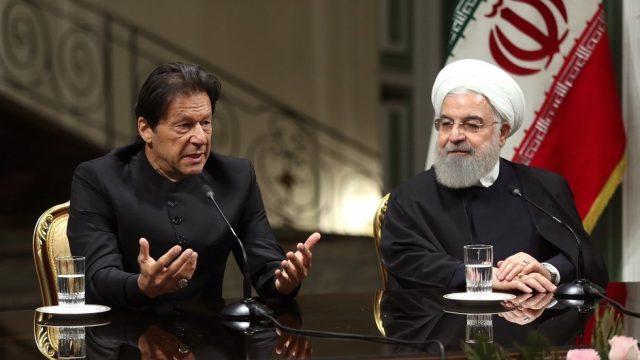
Pakistani Prime Minister Imran Khan’s visit to Tehran has been marred by two recent deadly attacks. Despite an apparent willingness to cooperate, there remain many outside players who will push for this alliance to fail.
Someone clearly hates the idea of peaceful dialogue between Iran and Pakistan. Whether a coincidence or not, the timing of an attack in Pakistan within barely a day or two of a planned visit to Iran’s capital by Pakistani Prime Minister Imran Khan is certainly perfect timing for those who view an increasing relationship between the two nations through negative terms. The attack in question saw at least 14 Pakistani security forces personnel killed in a bus ambush. Not helping the issue, is the fact that Pakistan’s foreign office instantly blamed the attack on Iran, accusing Iran of inaction against ethnic Baloch separatist groups, even as Khan was set to visit Tehran.
In February, there was similarly an attack in eastern Iran that killed at least 27 Iranian security personnel. Tehran warned Islamabad it would “pay a heavy price” for allegedly harboring the militants who planned the suicide bombing, which was claimed by the Pakistan-based Jaish al-Adl group.
Now, I am not saying that there is any conspiracy behind the attacks. I mean, why would I need to bother? Whether there are attacks or not, the media and a handful of notable leaderships will continue to portray Iran-Pakistan relations as the worst possible form of détente imaginable.
All this being said, the two countries were able to have a somewhat fruitful and productive engagement during Khan’s visit. The news that is likely to infuriate some other major players on the world stage is the announcement of a creation of a joint rapid reaction force along the shared border of Iran and Pakistan.
Ironically, the recent attacks against Iranian and Pakistani personnel may have brought these two nations closer together, as Khan announced that Pakistan will not allow any militant groups to operate from Pakistani soil, vowing to dismantle any militant group inside the country.
On a side note, WikiLeaks documents have shown that Saudi Arabia financed militant groups inside Pakistan. Even Deutsche Welle notes that most of the Pakistani based militant groups “unleashing terror” on Pakistan’s minority Shiite population “take inspiration from the hardline Saudi-Wahhabi Islamic ideology”.
Khan’s visit also magically coincided with US Secretary of State Mike Pompeo’s announcement that it was clamping down hard on countries who sought to buy Iranian oil, namely, India, Japan, South Korea, Turkey and of course, China, who account for about half of Iranian oil exports. This would undoubtedly send a clear picture to Pakistan about what will happen if it continues down its current trajectory.
Undeterred, Pakistan and Iran have agreed to establish a so-called barter committee to help in a planned increase in trade, with an eye for bypassing US-enforced sanctions.
Despite the picture the media wants to paint of a hostile Pakistan weary of an aggressive, terrorist-supporting Iran, the truth is that Iran and Pakistan are not really traditionally that adversarial.
Historically speaking, the two countries have had relatively friendly relations. Iran was one of the first countries to recognise and reach out to Pakistan after its creation in 1947. In fact, then-Shah Mohammad Reza Pahlavi was the first head of a foreign nation to visit the newly created country. Iran also provided moral and material support to Pakistan during its infamous conflicts with India in 1965 and 1971.
The countries only really split along a Sunni-Shia divide after the Islamic revolution in Iran in 1979. Aside from strengthening its relations with Saudi Arabia, Iran’s major rival, Pakistan also became a major US ally, particularly during the Afghan-Soviet war in the 1980s. Iran then viewed Pakistan as nothing but a lackey state of the United States.
Even though, Khan has made it clear that Pakistan holds no ill will to Iran following the revolution, purportedly stating that “I came here [to Iran] in 1972. I saw a big difference between the rich and the poor, a big cultural difference. Iran has become a more egalitarian society that is what the revolution has done.”
Despite the fact these two countries have many long standing differences and areas of competition, they still have many avenues of cooperation that they have felt the need to pursue.
One such avenue is the question of Afghanistan. For example, India has increased its interest in the war-ravaged nation, which puts Pakistan in a very compromising position indeed given it is essentially on the verge of a major war with its Indian neighbour.
According to Khan, both Pakistan and Iran have been affected by the conflict in Afghanistan, hosting millions of refugees between the two nations.
Iran and Pakistan have also been in the line of fire of Donald Trump’s hawkish administration. While Trump’s desire to annihilate Tehran is much more apparent than any such desire to go to war with Pakistan, we cannot ignore the major blows to US-Pakistan relations that have occurred under the watch of Trump.
The two nations further share close relations with China, the formulation of which has been termed as a trilateral nexus by the Asia Times. Pakistan and Iran also have a pipeline of their own capability of pursuing, which will most likely entail the deepening of cooperation even in spite of their major differences.
Another interesting aspect that comes into play in this dynamic – which I guarantee you, you will never see highlighted in a corporate media outlet – is that Iranian President Rouhani actually enjoys the support of the local ethnic Sunni population of Iran. Therefore, it is not beyond the administration of Rouhani to work more closely with its predominantly Sunni neighbours (if you don’t believe me, I wrote an extensive article highlighting the notable attempts by Iran to reach out to Sunni Saudi Arabia over the last few years).
The major problem that Pakistan faces is that while it can find common ground with Iran, including on matters in relation to economic ties and security, it does not want to irk Saudi Arabia too much, a nation which just pledged $20 billion in investments to Pakistan. Islamabad is likewise not impressed by Iran’s growing relationship with India. This is why Pakistan put itself in a questionable position whereby its former Chief of Army staff was appointed to what is essentially the head of a Saudi-led Arab NATO, which does not include Iran (indeed, it seems as though its existence is based on the idea that it needs to counter Iran).
At the end of the day, the optimist in me reckons that there are enough areas of cooperation between the two countries which can help to balance out the devastating rivalries between Iran and Saudi Arabia and prevent a deadly war. But in all honesty, if you were to compare the outcomes between Saudi Crown Prince Mohammed bin Salman’s (MBS) visit to Pakistan and Khan’s visit to Tehran, the latter seems a bit weak in substance. It seems as though no matter how far Iran reaches its hand out to Pakistan, its loyalty to Saudi Arabia will continue to prevail ($20 billion will always be worth more than anything Iran can ever offer to its neighbour). Not to mention the money that Pakistan is offered from the United Arab Emirates (UAE), which also views Tehran mostly in hostile terms.
Perhaps Khan can act as a mediator between Iran and Saudi Arabia, but the available evidence suggests there is nothing to mediate. Since 2015, Saudi Arabia has destroyed an entire country on its border simply on the suspicion that Iran could be backing the rebel movement inside Yemen. Even the possibility that a rebel-controlled government installed on its border could align itself with Tehran is a major deal-breaker for the Saudi Kingdom, worth starving over 85,000 children to death and threatening behind closed doors that Yemen should “shiver” for generations when they hear Saudi Arabia uttered.
The optimist in me is going to have to be a bit more realistic.
Read more:
Iranian President Rouhani declares joint border ‘reaction force’ with Pakistan
What you won’t hear from US govt: Iran is open to working with Saudi Arabia
India sponsoring terror activities in Balochistan: Pakistan FM
The Frontier Post | April 23, 2019
ISLAMABAD – Foreign Minister Shah Mahmood Qureshi has said that India is trying to destabilize Pakistan and sponsoring the terror activities in Balochistan.
FM Qureshi said this on Tuesday while talking to a private news channel; Qureshi said that India is behind the terror activities in Balochistan province.
Regarding the Ormara terror incident, he said that Pakistan has already shared the details of the incident with Iranian authorities, adding that Afghanistan and Iranian territories are being used for carrying out terror acts in Pakistan.
He said Pakistan is helping Iran in recovering their kidnapped border guard personnel.
Qureshi repeated Pakistan’s resolve to have a stable and peaceful border with its neighboring countries, including Iran, to check cross border terrorism.
Earlier on Monday, Prime Minister Imran Khan reiterated his resolve not to allow any militant group to use Pakistani soil against anyone.
Addressing a joint press conference along with Iranian President Hassan Rouhani, the prime minister had said, Islamabad is taking decisive action against the militant groups.
The premier had said we will not allow Iran to be harmed from Pakistani soil and hopes to ensure the same from Iran.
It may be noted that Pakistan and Iran have also agreed to set up a Joint Rapid Reaction Force to guard the common borders.
Pakistan And Iran Enter New Era of Anti-Terror Cooperation
By Adam Garrie | EurasiaFuture | 2019-04-22
Just as the PKK and its sister organisation PJAK are a mutual threat to both Turkey and Iran’s western frontier, so too are terror groups active on the Iran-Pakistan border a mutual threat to both countries that are best neutralised through joint efforts. This was proved beyond a shadow of a doubt when in February of this year a suicide bomber from Pakistan’s Balochistan frontier with Iran took the lives of 27 Iranian Islamic Revolutionary Guard Corps (IRGC) soldiers and likewise the message was made doubly clear when last week, terrorists based in the neighbouring Iranian province of Sistan and Baluchestan crossed into Pakistan disguised as soldiers and martyred 14 innocent people at point blank range after boarding a bus on the Makran Coastal Highway.
As the Makran Coastal Highway attack came days before Pakistani Prime Minister’s first visit to Iran, it may well have been a calculated provocation designed to inflame Pakistan’s relations with Iran during a season when both countries had already experienced a degradation in relations due to Iran’s hyperbolic reaction to the 13 February attack. Mohammad Ali Jafari, at the time the commander-in-chief of the IRGC made inflammatory remarks about seeking “revenge” on Pakistan for an atrocity committed by a non-state terror group proscribed as an enemy of Pakistan. Jafari’s unambiguous comments which blamed Pakistani state institutions for the attack on the IRGC cast a new narrative over the region which lead one to logically conclude that India’s investments in the Iranian port at Chabahar combined with a misunderstanding of Pakistan’s partnership with Saudi Arabia, led Iranian officials into saying things that should not have been said about a potentially strategically important neighbour.
By contrast, after the Makran Coastal Highway attack, Pakistan launched a formal diplomatic complaint to Iran and the Foreign Minister stated that the issue would be a top priority during Imran Khan’s meeting with the Iranian President Hassan Rouhani.
News has now broken that a breakthrough has in fact been reached as Pakistan and Iran have agreed to form a joint border patrol “reaction force” that will see Pakistani and Iranian soldiers police an erstwhile porous border that has led to deeply unfortunate attacks on both countries from terrorists who have no regard for either Pakistani nor Iranian national sovereignty and territorial integrity.
Even before the announcement of the joint reaction force, there were indications that Iran’s top leadership had realised the errors that were made in February in respect of blaming Pakistan for an attack that should have been a clear indicator of the fact the further cooperation was urgently needed. Yesterday, Iran’s Supreme Leader Sayyid Ali Hosseini Khamenei relieved Mohammad Ali Jafari of his duties as the IRGC commander-in-chief and replaced him with Brigadier General Hossein Salami. It is likely that the change of the guard in this respect was motivated by internal factors but the timing of the announcement has the optics of a good will gesture to Pakistan as Jafari was among the most unhinged when it came to slandering Pakistani state institutions in February. As geopolitical expert Andrew Korybko wrote last week, “the ball is in Iran’s court” and it seems that this time Tehran did in fact make the proper decision to favour win-win cooperation over totally unnecessary lose-lose antagonism and suspicion.
Overall, Iran and Pakistan have the potential to be important strategic partners in areas beyond the all-important matter of cross-border security and counter-terrorism cooperation. In the long term, Iran could form an important part of a wider CPEC+. Such a Belt and Road based trading structure could potentially see goods originating from China before travelling across CPEC to Gwadar, then being shipped to Iran where they could then either travel to north-west Eurasia via the Caucasus or otherwise into the Mediterranean via Iran’s Turkish neighbour, thus bypassing the Suez region in which Israel and other enemies of Iran hold a great deal of influence.
In terms of energy cooperation, the long anticipated pipeline from Iran into south Asia is a project that has been stalled but nevertheless holds great potential for new win-win energy exchange in the region.
Finally, as geopolitical expert Agha Hussain recently pointed out, if Iran is to bolster its pan-Islamic credentials at a time when the country is facing unique challenges from the west, Israel and parts of the Arab world, it would behove Tehran to embrace the cause of Kashmiri justice just as the country has since its inception as an Islamic Republic, embraced the cause of Palestinian justice. Not only would this help demonstrate that Iran’s Islamic Revolution is more than just a single issue geopolitical development but it would help to eliminate many of the false stereotypes that some Pakistanis have about Iran and that some Iranians have about Pakistan.
The task now for both countries is to make sure that the reaction force is well-equipped and that cooperation along the border can help to create a new era of win-win relations for both neighbours.
Pakistan Should Not Blindly Surrender to Modi Over Sikh Demonstrations
By Adam Garrie – EurasiaFuture – 2019-04-14
Sikh civil society groups have condemned Pakistan’s decision to ban activities of Sikhs peacefully campaigning for “Referendum 2020” in which Sikhs plan to defy New Delhi and exercise their democratic right to vote on the issue of self-determination. Next year, Sikhs intend vote “yes or no” on the question of whether Khalistan should be formed as an independent state that would separate from the Indian state of Punjab. Similar votes have happened throughout the world with a wide array of results.
In 2014, Scotland narrowly voted to remain part of the United Kingdom in such a vote whilst in 2017, in a vote that was not recognised by Spain, Catalonia voted to become an independent republic.
In Indonesia’s Western New Guinea (often referred to as West Papua internationally), there have long been calls for a new referendum after the initial vote in 1969 in which the region voted to integrate with Indonesia has been described as un-free and unfair to ordinary people in the region. Even more recently, the French overseas territory of New Caledonia voted to remain politically united with France. Perhaps the most politicised referendum in recent years was when Crimea voted to leave Ukraine and rejoin Russia. The result of this vote has been recognised by Russia, the DPRK and Syria but few other nations.
Of course, the world’s most controversial self-determination referendum is one that the UN first called for in 1948. This is the yet unrealised vote for self-determination in Kashmir.
In 2020, Sikhs in Indian Punjab are planning to hold a referendum on whether they want to form an independent nation known as Khalistan or whether they want to remain within India. India’s reaction thus far has been to browbeat, bully and threaten those who allow pro-Khalistan activities on their soil. Canada, Britain and some mainland European countries have refused to ban the Khalistan movement but India seems to have forced Pakistan’s hand in the matter.
While Pakistan has generally warm relations with the global and domestic Sikh community, it appears that Pakistan effectively succumbed to bullying from its militant BJP ruled neighbour. Of course, it is Pakistan’s domestic right to ban whatever political or activist groups it desires, including peaceful ones like the Khalistan movement. In this sense, the biggest problem is that Pakistan moved against a very small group of Sikhs who planned on hoisting banners and handing out literature at a time when India’s RAW continues to work with the Kabul regime to promote terrorism in Pakistan’s Balochistan province. Likewise, Indian occupation forces continue to inflict supreme violence against the civilians of Kashmir.
In this sense, Pakistan has leverage that it refused to exercise against India. If New Delhi is so desperate for Islamabad to prohibit insignificantly small groups of Sikhs from handing out non-violent political literature outside their places of worship, Islamabad could have said ‘we will only prohibit Khalistan activism if India gives Pakistan all of the details of the last 50 years worth of Indian meddling in Balochistan, ceases its promotion of terrorism in Balochistan via Kabul, begins a ceasefire in occupied Kashmir and renounces all forms of military violence as a means of conflict resolution with Pakistan’.
In other words, it takes two to tango. If India wants Pakistan to ban peaceful symbols of a Khalistan referendum on its soil, India had better cease fomenting violent separatism in south-western Pakistan. But in typically anti-strategic fashion, Pakistan simply capitulated to India’s bullying and got less than nothing for it. The concept of getting less than nothing for it can be proved by the fact that major pro-government Indian media outlets continue to claim (without evidence) that Pakistan is officially promoting the Khalistan movement in Indian Punjab when in fact the Khalistan movement’s presence outside of India is almost all in either Canada or the UK with other activists present in the United States and parts of continental Europe.
Forgetting any moral arguments, from a purely strategic view, Pakistan made a blunder. Islamabad could have asked India for something in return for actively prohibiting low level Khalistan activists and instead, Pakistan asked for nothing.
Pakistan Asks India to Provide Intel Proving Pakistan’s Involvement in Pulwama Attack
Sputnik – 11.04.2019
Pakistan has handed over a “request for more information” to the India High Commissioner in Islamabad on the Pulwama dossier, Ministry of Foreign Affairs spokesman Dr Muhammad Faisal told reporters on Thursday.
The minister added that India had so far not provided any actionable intelligence that could lead to concluding Pakistan’s involvement in the Pulwama attack that took place on 14 February this year. The attack took the lives of more than 40 Indian soldiers.
“We hope India will answer these questions soon”, Dr Faisal said during a weekly briefing, adding that the reply to previous questions had so far also not been given.
Diplomatic sources told Sputnik that Islamabad has sought a specific response with regards to an individual who is allegedly based in India. Dr Faisal told reporters that Foreign Minister Shah Mehmood Qureshi had credible intelligence that India is preparing another act of aggression against Pakistan between 16 and 20 April.
“India will receive the same response as February 27 if it challenges our resolve,” Dr Faisal told reporters on Thursday.
On the basis of the first dossier submitted by the Indian government on 27 February, Pakistan’s Foreign Office on 28 March stated that it had thoroughly investigated the entire dossier related to the Pulwama terror attack and had neither found any evidence of terror camps at the locations mentioned by India, nor of any of the persons mentioned therein that could be linked to the said attack.
“While 54 detained individuals are being investigated, no details linking them to Pulwama have been found so far. Similarly, the 22 pin locations shared by India have been examined. No such camps exist. Pakistan is willing to allow visits, on request, to these locations”, the Foreign Ministry added.
The tensions between the two nuclear-armed nations escalated in February after the Pulwama terror attack, which expanded into a full-fledge aerial clash on 27 February. An Indian MiG-21 Bison was shot down by the Pakistanis, while India has claimed that it too shot down a Pakistani F-16. Pakistan has rubbished the Indian claims.
Like America With Russiagate, India Is Now Obsessed With Pakistangate
By Andrew Korybko | EurasiaFuture | 2019-04-11
The Indo-American Strategic Partnership has rapidly progressed to such a point that the South Asian state is now copying some of the same conspiracy theories as its new patron, though instead of India being obsessed with suspected Russian interference in its elections like America was, its people can’t stop talking about its imaginary Pakistani variant.
Pakistangate
Pakistani Prime Minister Khan made global headlines earlier this week when he said that it might be easier for his country to clinch peace talks with India and resolve the Kashmir Conflict if Modi wins re-election after his country’s month-long electoral process concludes at the end of May. This took many Indians completely off guard who had hitherto been preconditioned by none other than the ruling BJP itself to think that Pakistan was “meddling” in their elections in order to support the opposition Congress party and their coalition allies. The Pakistani leader explained his initially surprising position by rationally noting how it would be less likely that right-wing forces would oppose any BJP-led peace talks unlike the spoiling effect they could have if left-leaning Congress attempted to initiate the same, which makes sense upon further contemplation and is actually a very wise observation.
From -Gate To -Gate
Instead of being interpreted as such, however, India’s “confirmation bias” on all sides caused it to continue cannibalizing itself over the entirely speculative issue of “who Pakistan really supports”, with practically all parties refusing to believe that their neighbor is just sitting on the sidelines watching in awe as the Indian political class tears itself apart over this issue and discredits their claim to being the self-professed “world’s largest democracy”. Interestingly, what’s unfolding in India at the moment with Pakistangate is very similar to what has been taking place in its military-strategic partner over the past couple of years with Russiagate. This suggests that the vassal state is copying some of the same conspiracy theories as its new patron, including the role that elements of its permanent military, intelligence, and diplomatic bureaucracies (“deep state”) are playing in this process.
“Deep State” Meddling
Democratic-friendly elements of the American “deep state” essentially entrapped Carter Page, after which they consequently used this false flag as the pretext for “justifying” a far-reaching FISA surveillance operation against the entire Trump campaign which then sought to exploit its “six degrees of separation” from Russia to concoct a weaponized narrative that ultimately failed to prevent him from winning the election and then later getting him overthrown through a de-facto coup. Something along the same lines happened with the BJP-friendly elements of the Indian “deep state” that “passively facilitated” the Pulwama incident which was later blamed on Pakistan and used as the pretext for “justifying” a so-called “surgical strike” against it that also miserably failed in what it sought out to do, though it nevertheless succeeded in making Indians hysterical about anything to do with Pakistan.
Witch Hunts
The BJP has even gone as far as to imply that all dissidents who disagree with its official version of events are treasonous, which is reminiscent of how the then-ruling Democrats suggested that anyone supporting Trump was either under the influence of “Russian propaganda” or a “Russian bot” if they were expressing their views in cyberspace. Just as Russia became a convenient scapegoat for the pro-incumbent elements of the American “deep state” to centralize their power behind the scenes and meddle in their own country’s elections, so too has Pakistan been abused to serve the same purpose vis-a-vis the pro-incumbent elements of the Indian “deep state”, with both of their permanent bureaucracies presently in the process of merging their narratives into a geopolitically weaponized one ridiculously alleging that Russia and Pakistan are jointly waging “hybrid wars” across the world.
Concluding Thoughts
It therefore shouldn’t be surprising that India’s “deep state” is copying its American counterpart’s Russiagate conspiracy theory and remixing it with a national touch to produce Pakistangate in pursuit of the exact same purpose of remaining in power, though just like with its inspiration, this might ultimately end up backfiring against its practitioners since it’s impossible to control chaotic processes once Pandora’s Box has been opened. In any case and regardless of the eventual electoral outcome, the Indian and American “deep states” will continue to converge into a single unipolar shadow entity dedicated to the shared objective of stopping multipolarity, using the “bonding experience” of their respective manufactured -gate conspiracies to accelerate this ongoing process and ensure that the Indo-American Strategic Partnership is one of the Eastern Hemisphere’s most geopolitically disruptive developments this century.
Pakistan is blackmailing Modi and Doval
By M. K. BHADRAKUMAR | Indian Punchline | April 11, 2019
Doublespeak is commonplace in statecraft. A celebrated case is of the former US President Barack Obama who was facing re-election in 2012. Battered by criticism by his Republican contender Mitt Romney for being “soft” on Russia, Obama sought a private understanding with the Kremlin leadership that he couldn’t afford to be seen by the American public as flexible on relations with Russia until the presidential election in November that year got over.
Obama and his interlocutor then Russian President Dmitry Medvedev were unaware that their deal-making conversation on March 26, 2012 in Seoul was caught on open microphone, with the latter agreeing to Obama’s proposition that Russians would be patient until he secured his second term as president.
Quite obviously, the strong likelihood is that Pakistan Prime Minister Imran Khan’s reported optimism was not intuitively arrived at when he told the international media on Tuesday that if Prime Minister Narendra Modi won a second term in office, a Kashmir settlement was entirely conceivable.
Imran Khan would only have spoken with the full awareness of Modi’s complex political personality. In particular, he has the great advantage of being privy to the confidential exchanges between then Pakistan Prime Minister Nawaz Sharif and Modi during the latter’s celebrated surprise visit to Lahore in December 2015 as well as the ‘back channel’ conversations between the National Security Advisors of the two countries. Unlike in our dysfunctional system in the most recent years, Pakistan’s ISI keeps meticulous track of all high-level exchanges with India.
The Indian public knows hardly anything about what transpired between Modi and Nawaz in Lahore — or for that matter, during their famous “informal conversation” in Paris 25 days earlier, which probably set up the Lahore meeting.
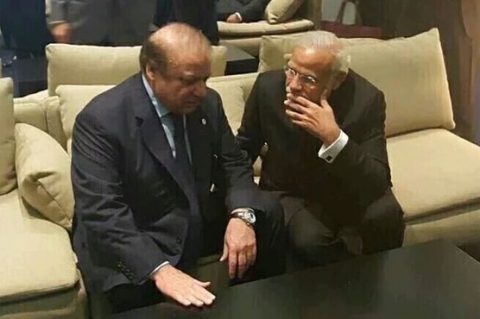
(Nawaz Sharif and Modi in “informal” conversation, Paris, Nov 30, 2015)
But make no mistake that the ISI kept track. The Pakistani side was actually expecting Modi’s surprise visit to Lahore and had made elaborate arrangements for a red carpet reception for the visiting Indian leader. Beyond doubt, every move that Modi made on Pakistani soil and every word he spoke to Nawaz was stored away as memory in the ISI archives.
Suffice to say, it is only Modi who is today in a position to clarify on what basis Imran Khan could have said with such audacity, “Perhaps if the BJP – a right-wing party – wins, some kind of settlement in Kashmir could be reached.”
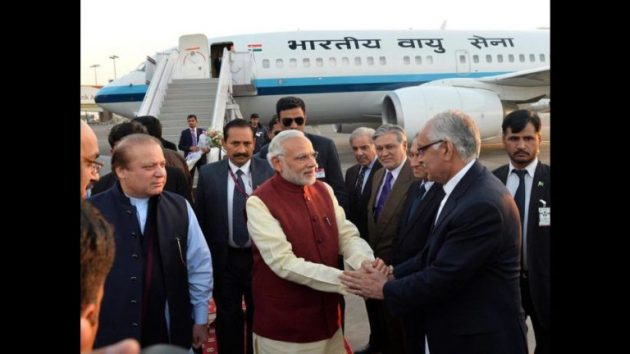
(Nawaz Sharif receiving Modi at the tarmac of Lahore airport, Dec 25, 2015)
Equally, Imran Khan’s caustic remark about the Congress is not unwarranted, when he said he didn’t expect the grand old party to deliver on a Kashmir settlement. Imran Khan cannot be unaware that although Manmohan Singh (or his NSAs) didn’t hang tough on Pakistan in the Indian media, he was tough as nail when it came to defending India’s national interests and didn’t make any concessions whatsoever to Pakistan.
In fact, Congress Party’s record has been consistently “hardline”, although it couldn’t match Modi’s rhetoric. Bangladesh war, occupation of Siachen, maritime boundary in Sir Creek — these are just three templates in India-Pakistan relations that alone should testify to the legacy of Congress rule. It must be remembered that the systematic erosion of Kashmir’s autonomy and India’s breach of promises to the Kashmir people took place in the decades since the fifties right up to the eighties only under Congress governments when BJP wasn’t even around as a gadfly.
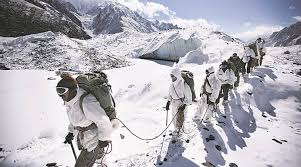
(Indian troops defending Siachen.)
So, the big question is about the signal that Imran Khan is giving when he reposes confidence in Modi to settle the Kashmir problem. Contextually, he would have three objectives — one, cautioning Modi against going too far in demonising Pakistan in his election rallies, no matter his political compulsions; two, projecting to the international audience an air of reasonableness in Pakistani policies ; and, three, forestalling any precipitate move by Modi to ratchet up tensions with Pakistan in the coming weeks between now and May 23, especially if a spectre of defeat haunts him in the election.
This last point is relevant if we factor in the decision by Islamabad only last Sunday to publicise “reliable intelligence” and “authentic information” available with it to the effect that India might make some military moves against Pakistan in the second half of April, once the elections got under way in India, out of which Modi could make political capital by whipping up jingoism.
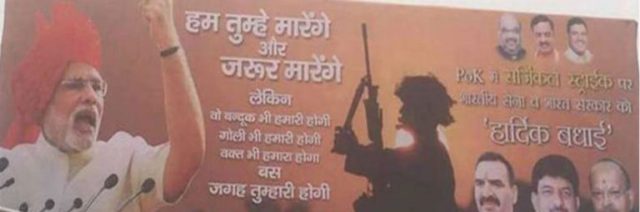
(BJP election poster with Modi and Indian soldier providing backdrop)
The intriguing part in all this is what Imran Khan really thinks of Modi as a politician. Historically, there is a perception in Pakistan that the BJP is a “Baniya party” of wheeler-dealers. But the past five years of BJP rule would have somewhat dispelled such notions. Imran Khan cannot but be aware that Modi is a creation of the RSS and unless and until he broke that umbilical cord, he cannot plough a de-ideologised furrow toward Pakistan.
Now, this is where the Modi-Nawaz exchanges and the back channel conversations between Ajit Doval and his counterpart in Islamabad, former NSA Lt. Gen. Nasser Khan Janjua, come into play. The Indian public knows nothing about the contents of these exchanges and conversations. But ISI knows, the GHQ in Rawalpindi knows and Imran Khan knows. (And, indeed, Modi and Doval know.)
Importantly, therefore, a Pakistani Prime Minister for the first time in the past 7 decades has interfered in an Indian general election and showed his preference for a particular political leader. This is unacceptable. This is blackmail.
Yet, Modi only is responsible for it. Figuring out that he has nothing positive to project before the Indian electorate, Modi made Pakistan the centre piece of his election campaign to malign and embarrass Congress and to deflect attention from burning issues such as unemployment, agrarian crisis, Rafale scam, etc. But by doing so, Modi held open a door through which Imran Khan has simply walked in.
Look at the kind of things Imran Khan says on the eve of an Indian general election — that he prefers Modi (to Rahul Gandhi) as his interlocutor; that “Muslim-ness is being attacked” in India; that Muslims in India are unhappy; that Modi is electioneering like Israel’s Netanyahu, exploiting “fear and nationalist feeling”; that J&K’s special status is under attack; that Kashmiris are waging a political struggle and there is no military solution to it; that “there is still the possibility if the polls turn against Modi in the next few weeks that India could take some further military action against Pakistan” and so on.
The most intriguing remark Imran Khan made was that Modi’s much-touted Balakot attack on February 27 was only an act of dissimulation and so the Pakistani retaliation the next day was a pro forma act — as if it were an elaborate pantomime being played out with Modi as the master choreographer. As he put it, the IAF bombed trees and the PAF retaliated by bombing stones.
These are exceptional remarks for the leader of a foreign country to make. But Modi cannot take exception, because he only invited this Pakistani slur on India’s democracy and its leadership. Clearly, Pakistan is blackmailing Modi and Doval. This seems like Modi’s “Obama moment” in Seoul 7 years ago.
Russia’s Response To India’s ASAT Missile Test Wasn’t What New Delhi Expected
By Andrew Korybko | EurasiaFuture | 2019-03-31
India probably thought that Russia would enthusiastically accept its entry into the “space super league” as Prime Minister Modi described it, but Moscow is actually pretty critical of New Delhi’s anti-satellite missile tests and urged it to join a Russian-Chinese multilateral mechanism for preventing the weaponization of space, something that it curiously announced around the same time as the Pakistan-Russia Consultative Group on Strategic Stability met in Islamabad and “agreed on the need for preserving multilateralism in the field of international security and disarmament”.
Indian Boasting Meets Russian “Balancing”
India’s anti-satellite (ASAT) missile test was heralded by Prime Minister Modi as an unprecedented achievement that catapulted his nation into the “space super league” of only four countries capable of pulling off this military feat, which he thought would boost his reelection prospects ahead of the upcoming onset of general elections that will continue into May. The Indian leader also intended to send a strong signal to China and Pakistan, one that he anticipated would be positively received by his American ally and passively accepted by his country’s Old Cold War-era Russian one, but while Washington is behaving as expected, Moscow is not. In fact, it can even be said that the Russian reaction took India off guard because New Delhi has yet to recognize the new reality of its relations with Moscow, which have undergone a drastic change since the Pulwama incident that accelerated previous trends.
Russia’s 21st-century grand strategy is to “balance” between the various forces of Afro-Eurasia in order to facilitate the emerging Multipolar World Order and maintain harmony in the Eastern Hemisphere, to which end it commenced a game-changing rapprochement with former rival Pakistan that’s since seen Moscow prioritize its relations with the global pivot state in order to “make up for lost time”. Russia announced its “Return to South Asia” by offering to mediate between Pakistan and India following the recent uptick in bilateral tensions between them, but while this was warmly welcomed by Islamabad, it was shot down by New Delhi whose Ambassador to Russia was later proven to have lied about the reason for rejecting this unprecedented diplomatic outreach. It’s therefore not for naught that Russia’s response to India’s ASAT test was “diplomatically critical” and nothing like what New Delhi anticipated.
Russia’s Carefully Worded Response
The Russian Ministry of Foreign Affairs put out a carefully worded statement about this a day after the test on 28 March, with the Google Translated version being shared below because an official English translation has yet to be published on their website at the time of writing:
“We drew attention to the anti-satellite weapon test conducted by India on March 27, as a result of which an Indian spacecraft in a low near-earth orbit was hit by a interceptor ballistic missile as a target. We note the non-directionality of this test against a specific country declared by the Indian leadership, as well as their confirmation of the immutability of the New Delhi foreign policy to prevent the deployment of weapons in outer space and thereby the development of an arms race in it.
At the same time, we are compelled to state that this step of India in many respects was the result of the substantially degraded situation in the field of arms control. Russia has repeatedly warned that the destructive actions of the United States to undermine the entire architecture of international security and strategic stability, including the one-sided and unlimited expansion of the global US missile defense systems, as well as the reluctance to abandon plans for putting weapons into space, make other states think about improving their own similar potentials in the interests of strengthening their national security. We urge Washington to take a responsible position, think again and abandon the insane, and most importantly – absolutely unrealizable – the idea of universal military domination. It is still possible to stop the arms race unfolding in various regions of the world. It is important to assist the responsible states in maintaining an adequate level of international security and stability.
For our part, we intend to continue taking all the necessary steps to prevent an arms race in outer space. With the support of a solid group of like-minded people, the idea of developing a multilateral legally binding instrument for keeping outer space peaceful based on the Russian-Chinese draft treaty on preventing the placement of weapons in outer space, the use of force or the threat of force against space objects, as well as a multilateral initiative – political obligations not to place weapons first in space. We offer our Indian partners to actively join these joint efforts of the international community.”
As can be seen, Russia hinted that India is a “rogue state” whose strategically destabilizing test was influenced by the US, which sent the signal that it would be acceptable for its ally to do this at the time that it did after recently pulling out of the INF Treaty and creating its so-called “Space Force”.
The Chinese & Pakistani Angles
Another important point to pay attention to is the last one where Russia urged India to join the multilateral mechanism that it proposed together with China to prevent the weaponization of space. It’s extremely unlikely that India will do this, however, seeing as how the whole point of this test was to send an aggressive signal to its Asian Great Power neighbor and “fellow” BRICS “frenemy”, though it’s not surprising that Russia would play the part of the Eurasian “balancer” by publicly suggesting that it join that framework. Although Russia’s intentions were positive in doing so and aimed at preserving peace in the supercontinent, India’s ruling Hindutva supremacists must have taken supreme offense at its suggestion because it implies that the two rising powers are equals unlike the BJP’s implied attitude towards its neighbor, especially in the hyper-jingoist run-up to the general elections.
Furthermore, it’s extremely curious that Russia’s statement came a day before the Pakistan-Russia Consultative Group on Strategic Stability met in Islamabad and “agreed on the need for preserving multilateralism in the field of international security and disarmament”, with this outcome once again showing that Islamabad is much more responsible of a regional actor than New Delhi is which has yet to signal any interest whatsoever in Moscow’s multilateral security proposal. Both the symbolism and timing of this development shouldn’t be dismissed as a mere coincidence since it undoubtedly sent a powerful political signal that the previous state of affairs has changed in South Asia and that Russia seems to have more in common with Pakistan nowadays than it does with India, with the first-mentioned aiming to unite Eurasia through its global pivot state grand strategy while the latter is trying to divide it through the US’ “Indo-Pacific” paradigm.
Concluding Thoughts
India’s present leadership has proven itself to be remarkably short-sighted in recent weeks when it comes to advancing the country’s strategic interests, having been both humiliated by Pakistan after its reckless response to the Pulwama incident and now “diplomatically criticized” by Russia following its irresponsible election gimmick of an ASAT test. Just like the latest events accelerated previous trends involving Russia’s position towards South Asia, so too have they also done the same for India’s one towards Eurasia, with it now being evident that New Delhi is siding more closely with Washington than with its notional BRICS “partners” in Moscow and especially Beijing. Given the clear pattern that’s visibly being established, it can be expected that India will continue to engage in strategically destabilizing unilateral action at the behest of its new American patron as it moves away from its erstwhile policy of “multi-alignment” and towards a new US-influenced model instead.
No Terror Camps Found in Pakistan at Locations Pointed by India – Islamabad
Sputnik – March 28, 2019
New Delhi – Categorically denying the presence of any terror camps, Pakistan’s Foreign Office on Thursday stated that it has thoroughly investigated the entire dossier related to the Pulwama terror attack and has neither found any evidence of terror camps at the locations mentioned by India, nor of any of the persons mentioned therein that could be linked to the said attack.
“During the course of investigations, all aspects of the information provided by India have been thoroughly examined including the ‘confessional’ video of Adil Dar, ‘claim’ of responsibility for the attack, WhatsApp and Telegram numbers used to share videos and messages in support of Pulwama attack, list of 90 individuals suspected of belonging to a proscribed organisation and 22 pin locations of alleged training camps”, Pakistan’s Ministry of Foreign Affairs said on Thursday in a statement.
On 27 February, India had shared a dossier related to the Pulwama militant attack in which at least 40 Indian soldiers were killed on 14 February. Pakistan’s Foreign Ministry said that it had constituted an investigation team, detained a number of persons for investigations and initiated work on the technical aspects of social media content, on the basis of the Indian paper.”While 54 detained individuals are being investigated, no details linking them to Pulwama have been found so far. Similarly, the 22 pin locations shared by India have been examined. No such camps exist. Pakistan is willing to allow visits, on request, to these locations”, the Foreign Ministry added.
Pakistan also alleged that out of 91 pages and six parts shared as dossier by India, only part two and three pertain to Pulwama attack, other parts are generalised allegations.
Pakistan reiterated that additional information and documents from India would be essential to continue the process of investigations. Pakistan remains committed to taking this process to its logical conclusion, it added.
The two nuclear-armed South Asian neighbours India and Pakistan have been embroiled in an escalated border conflict after the Pulwama terror attack in the Indian state of Jammu and Kashmir that killed over 40 Indian soldiers. Pakistan-based terror outfit Jaish-e-Mohammed claimed the responsibility for the attack.
Pakistan Must Resist Demands From “Friends”
The Perfectionistas | March 9, 2019
Someone needs to send the Pakistani government a copy of the picture book If You Give a Mouse a Cookie.
In it, a pestering mouse asks a boy for a cookie, and after he obliges, the rodent gets pushier with his demands until he’s moved into the exhausted boy’s house.
Similarly, Pakistan is surrounded by a nest of mice, actually wolves in sheep’s clothing, pressuring the nuclear-armed country through a carrots-and-sticks policy to oblige to their demands to join the anti-Iran coalition. These countries include America, Israel, Saudi Arabia, and United Arab Emirates, all bent on waging war with Iran and aware they can’t do it without cooperation from Pakistan.
Prime Minister Imran Khan’s government has so far resisted pressure to join the war path but future prospects look precarious, unfortunately, as the government shows signs of capitulating under stress and altering policies to oblige outsiders.
This week, for example, under global pressure to reign in terrorists, the government seized hundreds of institutions run by banned outfits and apprehended their leaders. That’s the right thing to do, of course, but should be done on principle not under pressure.
Buckling under pressure sends signals to others that, if enough force is applied, Pakistan will come around and do as told.
High on the American-Israeli-Saudi axis to-do list for Pakistan right now is normalizing relations with Israel, something most Arab countries have done de facto but are waiting for 200-million strong Pakistan to do first so they can declare it officially. Pakistan’s founder Muhammad Ali Jinnah refused to recognize Israel in 1947, and that has remained the country’s policy.
While getting Pakistan to change course on Israel is a tall order, especially with Pakistani officials accusing Israelis of involvement in India’s foiled attacks on Pakistan last month, the pressure is on nonetheless, and has been intensified since Khan, whose ex-wife has Jewish roots, took office last year.
Khan insists normalization with Israel is not on the table but some in his government have already succumbed to the normalization narrative.
Last month Pakistan’s Foreign Minister Shah Mehmood Qureshi told an Israeli news portal that “Pakistan is interested in advancing its relations with Israel,” according to media reports, and in November MNA Asma Hadid tried coaxing colleagues to support Israel during a meeting of the National Assembly. The media also claims that the Pakistani government allowed a plane carrying a senior Israeli official to fly into Islamabad from Tel Aviv last fall. And although the Pakistani passport says it is “valid for all countries of the world except Israel,” a Pakistani Jew was allowed to fly to Israel for the first time in January.
Others pushing Pakistan to establish diplomatic ties with Israel include:
- Military men: Pakistan’s former President Retired General Pervez Musharraf told reporters in Dubai last month that “there is no harm to establish a relationship with Israel” as it will help “counter India,” buttressing the arguments of those who say India’s attacks were the “sticks” to get Pakistan to normalize relations with Israel.

- Media: Pakistan’s English-language newspaper Daily News editorialized last week that Pakistan should explore ties with Israel as the two “are not enemies.”
- Lobby: The Pakistan Israel Alliance (PIA) of London “seeks to build bridges and better understanding between Israelis and Pakistanis,” according to its Facebook page. PIA offers ways of “maintaining relations” off-the-record, including the pre-revoluton Iranian model (recognize Israel secretly like the Shah of Iran), Jordanian model (close political and military ties without official recognition), or Chinese model (establish military contacts before political relations), according to a February 2018 post on its Facebook page.
- Literature: PIA’s publishing arm Pak Israel News releases books in Urdu celebrating Zionism, such as “Zionism, Israel, and Palestinians” and “The State of Israel: In War and Peace and Islamic Terrorism.”
Even if Pakistan does sell its soul and recognizes Israel, demands on the country–like those on the boy in If You Give a Mouse a Cookie–will not stop until Pakistan too is weakened to the point of collapse. These demands include helping the American-Israeli-Saudi axis wage war on Iran and the nuclear disarmament of Pakistan. Scholar Syed Jawad Naqvi predicts Pakistan will eventually be pressured to shut its nuclear program and sell its technology to Saudi Arabia.
Pakistan can learn from the disastrous affects of capitulating to outside pressures from Iran. Iran’s economy is in shambles after agreeing to curb its nuclear program under a 2013 deal with the US and five other countries. Not only did the the US start putting demands on Iran’s missile program next but it then backed out of the agreement altogether and imposed stringent sanctions on the Iranian nation.
Iran’s Supreme Leader Imam Ali Khamanei had warned its politicians that acquiescence to demands will lead to attempts to “bring the country’s decision-making… centers under their control.”
“The point is Iran doesn’t follow arrogant powers,” Khamanei said in 2016. “In this war, willpowers are fighting. The stronger willpower will win.”
Pakistan, too, must strengthen its resolve and resist outside pressures. That is the only way to fail the best-laid schemes of mice and men.
As Pakistan Calls for Peace, India Refuses to Reveal Air Raid Details – Report
Sputnik – 03.03.2019
India’s Finance Minister Arun Jaitley has stated that security agencies will not publish any operational details about the air raid against militant groups in Pakistan, the newspaper Dawn reported. The statement comes following calls to release evidence that the Indian Air Force hit militant camps in airstrikes on 26 February, which led to an escalation in tensions between the two neighbours.
“The armed forces must have, and our security and intelligence agencies must have, a full leeway in dealing with situations, and if anybody wants operational details to be made public […] he certainly does not understand the system”, Jaitley said.
India’s finance minister also denied allegations that the Indian military activities were connected with the upcoming general elections in May.
At the same time, Pakistani Foreign Minister Shah Mahmood Qureshi called for a resolution to the escalating tensions between Pakistan and India via dialogue and diplomatic channels instead of military power.
“Peace is our priority and we do not desire war with India”, Qureshi said.
Calls to publish proof of striking militant camps came after Pakistan stated that the Indian airstrike on 26 February had hit an empty hillside. The air raid over Pakistani territory, which led to an escalation in tensions between Delhi and Islamabad, came in wake of a deadly attack on a security convoy that claimed the lives of 40 servicemen on 14 February carried out by the terrorist group Jaish-e-Mohammed (JeM).
New Delhi insists that Islamabad is harbouring and supporting militants that commit terrorist acts on Indian territory. Pakistan denies both the accusations and the existence of militant camps.
Russia and China offer the SCO platform for India-Pak de-escalation
By M. K. BHADRAKUMAR | Indian Punchline | March 2, 2019
Saudi Arabia is pushing forward as mediator between India and Pakistan with a messianic zeal that patently enjoys US backing. The Saudi Minister of State for Foreign Affairs Adel Al-Jubeir is arriving in Delhi tomorrow. He was to have visited Islamabad on Friday but rescheduled his plan so that he can touch base with Modi first and thereafter meet the Pakistani leaders, including army chief Gen. Qamar Bajwa.
Modi and Bajwa will be Adel’s key interlocutors. How far the Saudi waltz will advance remains to be seen. How Modi handles the piquant situation will bear watch.
Certainly, the Saudi mediation makes India look rather immature and that becomes willy-nilly a reflection of Modi’s foreign policy legacy. The point is, no matter what Modi may boast about “new India”, the geopolitical reality is that India’s stature diminishes when it needs a small country like Saudi Arabia under an autocratic ruler to help out with what is arguably one of the most critical templates of its diplomacy.
Saudi Arabia has no track record as a peacemaker. On the contrary, it has a notorious reputation the world over as a promoter of terrorist groups.
Meanwhile, India does not have to be beholden to the Saudis to ease its tensions with Pakistan. The indications are that Russia and China are jointly sponsoring an initiative in this regard. China is deputing a special envoy to visit India and Pakistan to discuss the crisis situation. The Pakistani FM Shah Mehmood Qureshi disclosed this in Islamabad.
To be sure, Russia and China, which actively coordinate on the foreign policy front, are in consultation each other on the India-Pakistan tensions. We may also factor in that the foreign ministers of Russia and China had an opportunity last Wednesday to meet EAM Sushma Swaraj at the RIC ministerial.
Following that, Chinese State Councilor and Foreign Minister Wang Yi also briefed Qureshi in a phone conversation where the latter had expressed the hope that “the Chinese side will continue to play a constructive role in easing the current tension.”
Equally, at the height of the India-Pakistan crisis, on February 27, Russian Foreign Ministry also had issued a statement expressing “grave concern over the escalating situation along the Line of Control and the surge in tensions” between India and Pakistan “which are Russia’s friends.” It took a neutral stance and called on both sides “to show restraint and redouble efforts to resolve existing problems by political and diplomatic means.”
It is entirely conceivable that the Chinese special envoy’s visit is a related development signifying a coordinated effort by Beijing and Moscow and in consultation with Islamabad and New Delhi. This is of course a major shift in the tectonic plates of Eurasian politics and it has an added significance insofar as it is taking place in the New Cold War conditions.
Indeed, it does not need much ingenuity to figure out that a US-sponsored Saudi mediation between India and Pakistan must be a worrisome development for both Russia and China, from the geopolitical perspective.
At any rate, on Thursday, President Vladimir Putin telephoned Modi. According to the Kremlin readout, they discussed the “crisis in relations between India and Pakistan” and the Russian leader “expressed hope for a prompt settlement.” The careful wording hinted that Putin offered to lend a helping hand, jointly with China, to ease the tension.
Curiously, the very next day, the Russian Foreign Minster telephoned Qureshi in Islamabad — presumably to follow up on the Putin-Modi conversation — and offered help to “de-escalate” the tensions. The Russian Foreign Ministry readout, cited by state news agency TASS, says: “Moscow expressed its readiness to contribute to de-escalating tensions and that there is no alternative to settling all differences between Islamabad and New Delhi by political and diplomatic means.”
Importantly, Lavrov also outlined to Qureshi how the de-escalation process can be achieved — via the mechanism of the Regional Anti-Terrorist Structure of the Shanghai Cooperation Organization (SCO).
A Xinhua report since highlighted this aspect — that Lavrov told Qureshi about the “possibility of using the Shanghai Cooperation Organization’s Regional Anti-terrorist Structure for this purpose.”
Alongside, the Russian Foreign Ministry spokesperson Maria Zakharova outlined in an important statement on Thursday Moscow’s broad approach. Zakharova said:
“We are worried about the escalation of tension in relations between India and Pakistan and dangerous manoeuvres of both states’ armed forces along the Line of Control that are fraught with a direct military clash.”
“We are urging the sides to display maximum restraint. We continue to assume that contentious matters should be resolved by political-diplomatic methods on a bilateral basis in line with the provisions of the 1972 Simla Agreement and the 1999 Lahore Declaration.”
“We reaffirm our readiness to provide all-out support to the Indian and Pakistani efforts in countering terrorism.”
From the Indian perspective, this adds up to an extremely positive outcome of EAM’s consultations in Zhejiang with her Russian and Chinese counterparts. This must be EAM Swaraj’s finest hour in international diplomacy, as the curtain begins descending shortly on her scintillating stint as India’s foreign minister.
No doubt, the urgency of “de-escalation” of the tensions with Pakistan is self-evident. The “de-escalation” is far from over with the return of the Indian pilot. In fact, the tensions on the Line of Control can spiral out of control anytime in the present supercharged atmosphere.
Without doubt, the international community — read the US and NATO allies — is closely watching. The Afghan endgame is at a most sensitive stage and any eruption of tensions between India and Pakistan will negatively impact the peace process.
India should wholeheartedly welcome the Sino-Russian proposal, cast within an SCO framework as far more preferable to the dalliance with the Saudis and the Emiratis — or, for that matter, any UN intervention.
The fact of the matter is that both Russia and China are stakeholders in India-Pakistan normalisation and neither has any hidden agenda in this regard. Of course, Russia and China are like-minded partners for India in the fight against terrorism. On the other hand, unlike in the Cold War era, Pakistan is keen on Eurasian integration, too.
Featured Video

Deception – Submarines against Olof Palme
or go to
Aletho News Archives – Video-Images
From the Archives
Woolsey Fire started at Santa Susana Field Lab — where “radioactive materials released were never accurately measured”
By John Laforge | CounterPunch | November 30, 2018
In my Nov. 16 column, I reported on potential radiation risks posed by California’s Woolsey wildfire having burned over parts or all of the Santa Susana Field Laboratory—south of Simi Valley, Calif., 30 miles outside Los Angeles—site of at least four partial or total nuclear reactor meltdowns.
The field laboratory operated 10 experimental reactors and conducted rocket engine tests. In his 2014 book Atomic Accidents, researcher James Mahaffey writes, “The cores in four experimental reactors on site … melted.” Reactor core melts always result in the release of large amounts of radioactive gases and particles. Clean up of the deeply contaminated site has not been conducted in spite of a 2010 agreement.
Los Angeles’s KABC-7 TV reported Nov. 13 that the Santa Susana lab site “appears to be the origin of the Woolsey Fire” which has torched over 96,000 acres. Southern Calif. Public Radio said, “According to Cal Fire, the Woolsey Fire started on the afternoon of Thursday, Nov. 8 … on the Santa Susana site.” … continue
Blog Roll
 Aletho News
- Between war and industrial breakdown: The US-Israeli attrition crisis
- Pressure builds on Iran to ‘drop’ Lebanon ceasefire demand as Islamabad talks hang in balance
- In another clash report, US denies agreement to release Iran’s assets
- What is fueling unrest across the EU?
- Why no power can undermine Iran’s eternal dominance over the Strait of Hormuz
- Is The War Against Iran Over?
- Iran war will leave long-term ‘scar’ on Wall Street, investors warn
- How Iran decimated US power projection in West Asia: Military lessons of 40-day war
- Iran’s report details US-Israeli war crimes in targeting schools, hospitals, livelihoods
- NATO’s Slow Fracture: How Trump’s Iran War Exposed the Instrument of Hegemony
- If Americans Knew
- After killing 350+, Israel still has a “score to settle” with Lebanon before ceasefire – Daily Update
- Military aid to Israel emerges as the latest political litmus test for Democrats
- The only Palestinian children’s rights organization closes following years-long Israeli campaign against it
- ‘I Can’t Forget the Smell’: Lebanese Reel After Israel Kills Over 300 in Single Day
- DNC Shoots Down Resolutions Calling Out AIPAC and Limiting Arms to Israel
- TCN: Is Israel Blackmailing President Trump?
- Israel killed at least 303 Lebanese yesterday – who were they? Daily Update
- Amnesty: Urgent – Protect Lebanese civilians from brutal escalation in Israeli attacks
- Is The War Against Iran Over?
- Inside the Israeli army’s propaganda wing
- No Tricks Zone
- New Study: No Linear Warming Or Glacier Retreat Along Northern Antarctic Peninsula Since 1980s
- An Inconvenient Tree: Uncovered In Alps… Europe Much Warmer Than Today 6000 Years Ago
- New Study Reports A 60% Slowdown In Greenland’s Ice Loss Rate In The Last Decade
- Low Intensity Tornado Wrecks Major Solar Farm, Creating A Potential Toxic Dump
- New Study Finds Warming Saves Lives…Cold Temperatures 12 Times More Deadly Than Excess Heat
- German Science Blog Accuses PIK Climate Institute Of Hallucinating Climate Tipping Points
- Devastating Assessment Of Comirnaty Vaccine By Former Senior Pfizer Europe Toxicologist
- New Study: CO2 Is ‘Effectively Negligible’ As An Explanatory Climate Change Factor Since 2000
- Former Pfizer Toxicologist Dr. Helmut Sterz Tells Bundestag Hearing Pfizer Vaccine Should Have Never Been Approved
- Energy Expert: Germany’s Nuclear Phaseout Was A “500 Billion Euro Mistake”
 Aletho News