Iran dismisses ‘unreasonable’ joint statement by Australia, New Zealand
Press TV – August 21, 2024
Iran has dismissed a joint statement by Australia and New Zealand calling on the Islamic Republic not to retaliate the recent crimes of Israel.
Foreign Ministry Spokesman Nasser Kana’ani said on Wednesday that such a move once again demonstrates the double standards these countries employ when it comes to fundamental human rights, international law, and regional developments.
Kana’ani said the “unreasonable request” in the joint statement undermines Iran’s inherent right to punish the attacker and deter future attacks.
The Iranian official was referring to the assassination of Ismail Haniyeh, the political bureau chief of the Palestinian resistance movement Hamas, in Tehran on July 31.
“In a situation where the United Nations Security Council, due to the unconditional support of the United States for the Zionist regime, could not even issue a statement condemning the terrorist act of the regime in assassinating Haniyeh … the unreasonable request of Australia and New Zealand means ignoring Iran’s inherent right to punish the aggressor and create deterrence against Israel’s adventures.”
In the joint statement, Australia and New Zealand expressed “grave concern about the prospect of further escalation across the region” and called on Iran to “refrain from further destabilizing actions in the Middle East, and cease its ongoing threats of a military attack against Israel.”
Kana’ani said the statement is a real example of turning a blind eye to the facts and misleading global public opinion. He said the main source of threat to regional and international peace and security is the “racist Zionist regime,” which enjoys broad Western support.
He said the crimes of the Israeli regime in Palestine and the region are taking on new dimensions every day, and now the regional stability is under grave threat due to the criminal behavior of the Zionist regime, which violates the United Nations Charter and international law.
“The approach of Australia and New Zealand in selectively choosing international norms not only does not help reduce tensions in the region but also encourages the rogue Israeli regime and its destabilizing actions in the region.”
World Mosque Day: Gaza mosques bear testimony of Zionist regime’s barbarism
By Ivan Kesic | Press TV | August 21, 2024
Images of displaced Palestinians in the besieged Gaza Strip assembling amid the ruins to hold congregational prayers have been circulating on social media in recent months.
The Israeli regime has not even spared places of worship in the coastal territory, indiscriminately and aimlessly bombing them, most recently last week in Gaza City.
At least 100 people were killed, many of them unrecognizable, after the Israeli regime bombed a mosque at the al-Tabin School in the Daraj district during the pre-dawn prayers last Saturday.
As the world marks ‘World Mosque Day’, a total of 610 mosques have been completely destroyed in the Israeli genocidal bombings in Gaza in the past 320 days, according to the Gaza Media Office.
The World Mosque Day was instituted in honor of the Al-Aqsa Mosque after it was set ablaze in a deeply provocative act by an Australian Zionist named Michael Dennis Rohan on August 21, 1969.
The day has over the years transformed into a symbol of unity and a reminder of the importance and sacredness of the places of worship, particularly the Al-Aqsa Mosque, the third holiest site in Islam.
The fire damaged nearly 1,500 square meters of the mosque, including the medieval minbar (pulpit), the mihrab (prayer niche) of Prophet Zachariah, and various arches and pillars, causing the roof to collapse.
Following a proposal by the Islamic Republic of Iran, the international observance of this day, also known as the International Mosque Day, was approved by the Organization of Islamic Cooperation.
The sacred mosque, however, has continued to be a flashpoint in the long-running struggle for Palestinian freedom from the Zionist occupation with the regime often ordering attacks on the mosque.
Destruction of mosques in Gaza
Since October 7, 2024, the Israeli regime has bombed every inch of the territory in Gaza, including mosques. According to the Gaza Media office, a total of 824 mosques have been completely or partially damaged in the past 11 months, including 610 mosques that have been damaged completely.
According to Palestinian official data from 2019, the Gaza Strip had 1,117 mosques, meaning that 55 percent of all mosques have been destroyed so far, with an additional 19 percent damaged.
Beyond their religious significance to Gaza’s majority Muslim population, many of these mosques are of great cultural and historical importance, as their history dates back to several centuries.
Over the past 11 months, mosques have been deliberately targeted with displaced people inside them, such as the Ahmed Yassin Mosque in the Shati refugee camp in Gaza, the Salim Abu Muslim Mosque in Beit Lahia, and the Khalid bin Al-Walid Mosque in Khan Yunis city.
Numerous direct airstrikes, like the one on the Khalid bin al-Walid Mosque in southern Gaza, have been video-documented, and all evidence demonstrates that they had no military function, debunking false claims of the Zionist regime.
In a report in May, the Ministry of Endowments and Religious Affairs in Gaza reported that Israeli troops have also desecrated at least 60 cemeteries during their ground invasion of Gaza, using bulldozers to dig up graves and steal the bodies of more than 1,000 people.
Furthermore, over 100 Muslim preachers and 91 ministry employees have been killed in the genocidal war, representing only a fraction of the 40,000 victims so far.
These actions by the Israeli regime flagrantly violate international laws and conventions that strictly prohibit targeting places of worship during war, according to experts.
In addition to mosques, historic churches have also been destroyed, along with numerous other civilian buildings such as schools, hospitals, and residential structures.
Destroyed historical mosques
The Great Mosque of Gaza, also known as the Great Omari Mosque, was the largest and oldest mosque in the Gaza Strip and one of the oldest in the world before its destruction by Israeli regime forces.
Built by early Muslims in the 7th century, the mosque had been damaged multiple times throughout history by earthquakes, crusaders, Mongols, and British aviation, yet it was always rebuilt.
The mosque was used as a place of worship by the local Muslim community and served as a focal point for gatherings and cultural activities for centuries.
This sandstone building could accommodate up to 5,000 worshipers, but today, only its ruined Mamluk-era minaret remains.
On December 7, 2023, it was destroyed by an Israeli airstrike, leaving most of the structure collapsed and the minaret bent and broken.
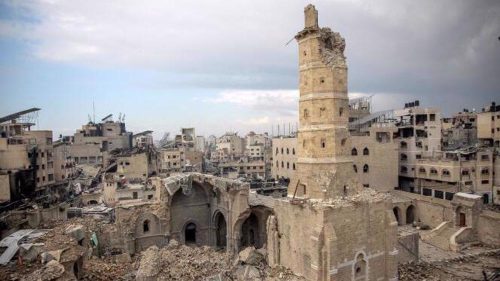
The destroyed Great Mosque of Gaza, the largest and oldest mosque in the Gaza Strip
The Ibn Uthman Mosque, the second largest in Gaza after the Great Mosque, was also reduced to rubble last month after Israeli warplanes fired several missiles at it.
Built in the Mamluk style, the mosque covered 2,000 square meters, with 400 square meters dedicated to its main courtyard. It had two gates overlooking the Shuja’iyya market.
The mosque had been subjected to attacks and demolition during previous wars on the Gaza Strip and was a center of confrontations with Israeli occupation forces during the First Intifada in 1987.
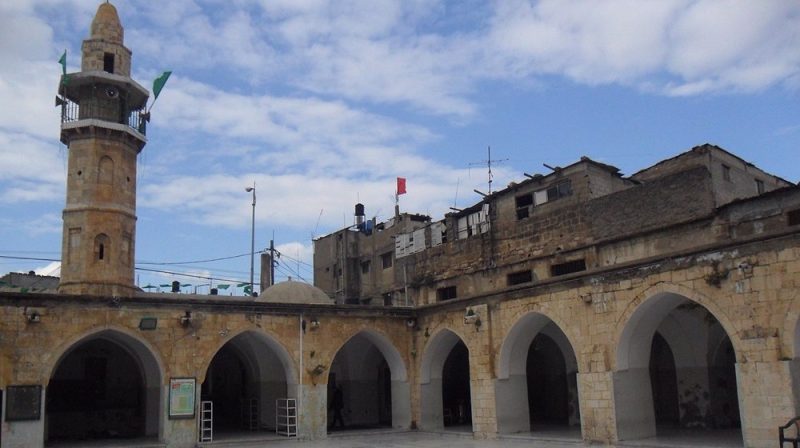
The Ibn Uthman Mosque, destroyed in July
Sayed al-Hashim Mosque, one of the largest and oldest mosques in Gaza, built at the site where Prophet Muhammad’s great-grandfather, Hashim bin Abd Manaf, is believed to have been buried, was also razed to the ground.
Legend says that he was a merchant traveling back to Mecca from Syria when he became ill, died, and was buried in what is now Gaza’s Daraj neighborhood.
The mosque, built from limestone in the 12th century and renovated several times, stood until it was hit by an Israeli bomb in October last year.
In Gaza City’s Zeitoun neighborhood, the Othman bin Qashqar Mosque, built during the same period as the Sayed al-Hashim Mosque, was badly damaged in an Israeli airstrike on December 7.
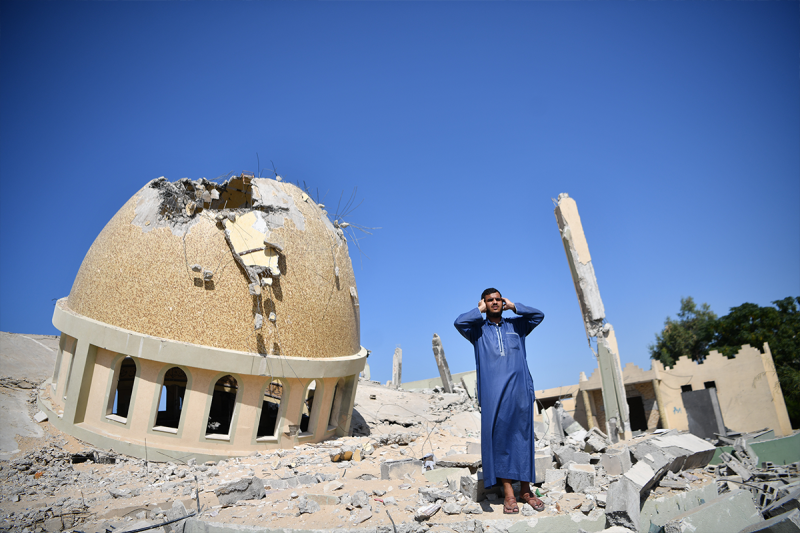
The destroyed Al Amin Muhammad Mosque in Khan Yunis
Among other notable destroyed mosques is the Al Amin Muhammad Mosque in Khan Yunis, destroyed in the early days of the genocidal war.
Its fallen dome, with a hole on top, has become a symbol of Israeli savagery.
The Al-Rahma Mosque, located in the Al-Amal neighborhood of the same city and once used by thousands of worshipers, was also completely destroyed.
After its destruction, thousands of Palestinians prayed next to its ruins during the last Eid al-Adha.
The Al Noor Mosque, on the seashore in Deir al-Balah Camp in the central Gaza Strip, was targeted by Israeli warships, resulting in large portions of it being destroyed.
Other mosques were bombed by warplanes while worshipers were inside, such as the White Mosque in Gaza. Some were bulldozed or blown up with dynamite.
A strategic shift: Will Palestinian groups return to ‘martyrdom attacks’ inside Israel?
By Ramzy Baroud | MEMO | August 20, 2024
Yesterday, the Palestinian Resistance Movement Hamas and the Palestinian Islamic Jihad warned Israel that they plan to return to ‘martyrdom attacks’ inside Israel.
“The Brigades affirm that martyrdom operations within the occupied territories will return to the forefront as long as the massacres by the occupation, the displacement of civilians and the assassination policy continue,” a joint statement by Al-Qassam Brigades and Al-Quds Brigades said.
Palestinian groups have refrained from using martyrdom attacks, or suicide bombings, as it is often called by mainstream media, as a central piece of their ongoing resistance against Israel.
The warning followed an explosion that rocked Tel Aviv on the evening of Sunday.
Initially, Israeli media conveyed a degree of confusion regarding what had transpired in the Israeli capital, before an Israeli police commander announced that there was a 99 per cent chance that the operation was “an attempted terror attack”.
Later, Israel said that the attacker may have originated from the Nablus area of the southern West Bank.
The attack and the announcement of responsibility by Hamas and the Islamic Jihad the following day are significant and could become the beginning of a strategic shift by Palestinians in their ongoing war against the Israeli occupation.
But why would Palestinians return to such operations?
Since 7 October, the Israeli war on Gaza has expanded to reach other domains, thus complicating the mission of the Israeli army, which has been overstretched to fight on several fronts.
While the war in Gaza itself remains the main battlefield, other war fronts began escalating with time, mainly the border war between the Lebanese Resistance Movement, Hezbollah, and the Israeli occupation army.
To prevent the West Bank from turning into a major front for the resistance, the Israeli army began carrying out bloody, but focused, attacks on Palestinian resistance brigades, which operate mostly in the northern West Bank.
Geographically isolated and operating mostly in small groups, Palestinian fighters underwent a bloody, disproportionate war against the Israeli army.
The Israeli occupation army’s confidence was buoyed by the fact that security forces and intelligence belonging to the Palestinian Authority openly cooperated with the Israeli military in their attempt to crush the resistance.
The degree of cooperation reached its zenith on 26 July, when PA security forces besieged the 26-year-old leader of the Tulkarm Brigades, and other fighters, in the Thabet Thabet Hospital in Tulkarm.
If it were not for hundreds of ordinary Palestinians who rushed to the hospital to rescue their youth, the fighters would have been apprehended, if not even worse.
But Israel’s military campaign to crush the resistance in the West Bank was hardly a success. According to Al Jazeera, 100 Palestinian operations were carried out in the last month alone.
Meanwhile, the resistance in Gaza has proved its durability, moving from the stage of defence to that of counter-attacks on more than one occasion. The operation by Hamas’s Al-Qassam fighters targeting Israeli forces inside the fortified Netzarim area in central Gaza, on Sunday, was a case in point.
These developments have been taking place in the larger context of the widening confrontation between Hezbollah and Israel, with the former extending its pinpointed operations to reach Nahariya, among other areas, in northern Israel.
Despite all the setbacks, Israeli Prime Minister Benjamin Netanyahu has managed to reverse his dwindling numbers among potential voters. According to a poll conducted by the Israeli newspaper Maariv on 9 August, the Likud Party, led by Netanyahu, would be the largest party in the Knesset if elections were held today. This is the first time such results have been seen since 7 October.
A combination of factors led to the resurgence of Netanyahu in opinion polls.
First, the Israeli leader’s main rival, Benny Gantz has failed to galvanize on the anti-Netanyahu and anti-government popular sentiments starting on 7 October.
Second, Netanyahu’s ability to guarantee US support for his aggressive regional policies helped reassure the Israeli public.
Third, the direct involvement of the US-British and other western navies in confronting Yemen’s Ansarallah – Houthis – in the Red Sea has partly downgraded the geopolitical threat of the Yemeni solidarity with the Palestinians.
Fourth, the daring assassination of top Hamas political leader Ismail Haniyeh in Tehran on 31 July, and the assassination of leading Hezbollah commander Fuad Shukr the day before, allowed Netanyahu to sell the idea, however temporary, that Israel has regained its so-called ‘deterrence’.
And, finally, despite the interception of occasional missiles beyond the Gaza Envelope or Israel’s northmost regions, Israeli society in the central areas of the country has learned to adapt to the new reality of the war.
While the Israeli army is losing an unprecedented number of soldiers and equipment on multiple fronts, not all Israelis are experiencing that loss in their everyday lives.
The opposite is true for Palestinians and Lebanese.
For the former, the genocide in Gaza has turned into a daily reality, and the Israeli occupation forces’s war on the West Bank has proved to be the most violent since the Second Intifada or Uprising of 2002.
Meanwhile, in Lebanon, Israel continues to target civilian areas as a matter of course, thus constantly challenging the rules of engagement that have governed the relationship between the Israeli army and the Lebanese resistance for years.
The new status quo may have assured Netanyahu that he might be able to carry on with his war in Gaza, reject any reasonable ceasefire proposal and maintain low-intensity warfare with Lebanon.
Netanyahu would also like to see the US-British war on Yemen escalate into an all-out war against Iran.
The Palestinian warning of their intention to return to striking deep inside Israel is meant to disturb Netanyahu’s calculations.
By denying Israelis any sense of security in major cities inside Israel, the Israeli public could, once more, turn against Netanyahu for failing to deliver on any of his lofty promises.
It remains unclear whether Sunday’s truck bombing was the exception or the start of a new norm. Either way, Netanyahu and his security apparatus must be aware of how such a move could prove equally costly to all of Israel’s losing wars, on all fronts.
Soft normalization: Saudi Arabia quietly engages with Israel
By Mawadda Iskandar | The Cradle | August 20, 2024
Despite Israel’s ongoing brutal assault on the Gaza Strip and its 2.4 million Palestinians, Saudi Crown Prince Mohammed bin Salman (MbS) continues to pursue a controversial deal to normalize relations with the occupation state. Riyadh has persisted in deepening relations with Tel Aviv in multiple sectors despite receiving ‘death threats’ from opponents of normalization in the kingdom.
So why, then, does the crown prince insist on trudging down this unpopular path unless he believes that establishing ties with Israel is crucial for securing his ascendency to the Saudi throne?
Earlier this week, Politico revealed new details about these secretive negotiations, including multiple US commitments to Riyadh. These US assurances range from security guarantees through a treaty to assistance with a civilian nuclear program and economic investments in technology.
However, Tel Aviv remains resistant to including a credible path for establishing a Palestinian state as part of a deal, a key demand from the Saudis.
A history of quiet diplomatic moves
Normalization with Saudi Arabia is no less important for Israeli Prime Minister Benjamin Netanyahu, who has considered the deal a major diplomatic goal since before his re-election in 2022. Prior to last year’s Operation Al-Aqsa Flood, Netanyahu believed the deal was imminent.
Today, the situation remains complex, with the deal’s fate hanging in the balance due to conflicting conditions and demands set by Saudi Arabia, the US, and Israel.
The roots of normalization between Saudi Arabia and Israel stretch back several decades, with a history of covert diplomatic dealings often referred to as ‘soft normalization.’
Since his appointment as Riyadh’s ambassador to Washington in 1983, Prince Bandar bin Sultan Al-Saud laid the groundwork for this gradual rapprochement, meeting with Israeli political and security leaders over the years. His successor, Turki al-Faisal, continued these efforts, becoming a key point man in Saudi–Israeli contacts.
Anwar Eshki, who served as his predecessor and was an adviser to Prince Bandar, participated in seminars promoting normalization and paid his first visit to the occupied territories in 2016.
A pivotal moment in this covert relationship took place in 2019 when MbS hosted a delegation of evangelical figures supporting the Zionist project led by Joel Rosenberg. The meeting, along with subsequent secret talks between MbS and Netanyahu in NEOM in 2020, marked a notable step toward open normalization. Over time, such meetings and visits became routine, with Saudi officials and citizens increasingly engaging with Israel, including making public visits to the occupied territories.
Repressive measures and strategic interests
The two states share several strategic goals. Saudi Arabia is opposed to the regional Axis of Resistance, which includes Iran, Syria, Hezbollah, Ansarallah, Hamas, and other non-state actors, and has implemented repressive measures against the Palestinian resistance. The kingdom has for years targeted supporters of Hamas and individuals funneling funds to the Palestinian territories. This includes the arrest of more than 60 Palestinians in 2019, some of them Hamas officials and Saudi nationals who received lengthy prison terms.
As recently as May, Saudi Arabia stepped up its campaign to arrest social media users in the kingdom who attacked Israel online – this after more than 34,000 Palestinians had been killed in relentless Israeli airstrikes on population centers.
From the sidelines, Saudi Arabia has also supported the normalization efforts of Bahrain and Sudan while offering the occupied West Bank-based Palestinian Authority (PA) economic incentives to collaborate further with Israel.
Since its inception, the kingdom has utilized Islam to legitimize its political actions, and this Saudi soft normalization with Israel is no exception, with Muhammad bin Abdul Karim bin Abdulaziz Al-Issa, Secretary General of the Muslim World League, playing a key role in promoting religious normalization.
Since 2017, Al-Issa has championed the cause of interfaith dialogue as a gateway for furthering religious ties with Israel. His 2020 visit to Auschwitz and subsequent meetings with Israeli and Jewish leaders were part of this broader strategy.
US Special Envoy for Monitoring and Combating Anti-Semitism, Deborah Lipstadt, also met with Saudi officials in the kingdom, and a delegation of American Jewish leaders visited to promote normalization. Areas of soft normalization included Saudi Arabia’s hosting of Rabbi Yaakov Herzog, a former Israeli artillery soldier and an extremist Zionist advocate of the demolition of the Al-Aqsa Mosque. The rabbi seeks to stir controversy through his activities, including a visit to the mosque and the cemetery of martyrs of Uhud in Medina.
Security and economic ties with Israel
Unsurprisingly, Riyadh and Tel Aviv have worked to enhance their security cooperation – a significant aspect of their relationship today. As the world’s largest arms importer, Saudi Arabia has sought to enhance its military capabilities through deals with the occupation state, including acquiring Israel’s flawed Iron Dome air defense system. Security relations have included joint military exercises and cooperation on cybersecurity, with Saudi Arabia relying on Israeli spyware to monitor and control opposition within the kingdom.
Speaking to The Cradle, dissident Saudi author and political analyst Fouad Ibrahim says:
Saudi Arabia views normalization as more than just a political project, as it also includes an economic project and a strategic project related to the future of the throne in Saudi Arabia.
Economic normalization is crucial for MbS’s coveted Vision 2030 project, which aims to transform the kingdom’s economy and institute social liberalization. The deal with Israel includes opening Saudi airspace to Israeli flights and encouraging Israeli investment in Saudi heritage sites. Jared Kushner, the architect of the 2020 Abraham Accords, has played a prominent role in these efforts, working to establish an investment corridor between Riyadh and Tel Aviv.
Among the most ambitious projects is the fiber optic cable linking Tel Aviv to Persian Gulf countries, as well as a planned railway expansion that would connect Saudi Arabia to Israel via Jordan. Ibrahim contends that the Palestinian resistance’s Al-Aqsa Flood operation last October disrupted these plans, placing a whole host of these economic projects in jeopardy:
The Al-Aqsa Flood came and thwarted this project and disrupted it for an unknown period. Therefore, the Saudi regime, along with the US and the Israeli entity, was the first to feel that the Al-Aqsa Flood was directed primarily at the normalization project in the region.
Softening stance leading to soft normalization
Cultural and media strategies have played an advanced role in acclimating Saudis to normalization with Israel. Since the events of 11 September 2001, Saudi Arabia has worked on revising its education curricula, gradually removing references to Israel as an enemy and promoting a more neutral stance on the occupation state. Art and media have also played a role, with Saudi TV channels airing programs that subtly promote peace with Israel.
The media, in particular, has been a powerful tool in shaping public perception, with Saudi outlets often hosting Israeli officials and broadcasting reports from within the kingdom. This propaganda campaign has aimed to create a climate conducive to normalization, although public support for such a move has fluctuated, especially after the events of 7 October.
At the heart of the crown prince’s Vision 2030 is his desire to position Saudi Arabia as a global sports hub. The Public Investment Fund, Saudi Arabia’s sovereign wealth fund, leads this expansive project by purchasing major foreign sports franchises and hosting international sporting events in the kingdom.
The sports sector has been yet another tool of soft normalization, paving the way for official Israeli teams to appear in Saudi Arabia, where they raise the occupation state’s flag and sing its national anthem. Official matches and competitions are held between Saudi and Israeli players, and the Saudi national football team has even participated in matches held in the occupied West Bank.
As is now glaringly evident, Riyadh’s efforts toward normalization with Tel Aviv have been multifaceted, involving diplomatic, religious, security, economic, cultural, and media strategies. While these efforts have made significant progress over the years, the future of this delicate relationship remains uncertain, especially with rapid developments in the region-wide resistance against the occupation state in solidarity with Palestinians in Gaza.
The underlying strategic interests that drive Riyadh’s approach to Israel – security, economic growth, and regional influence – suggest that these efforts will continue, albeit with tweaks and adjustments, so as not to invite reprisals from the Resistance Axis, not least the Yemeni Armed Forces on Saudi Arabia’s restive southern border.
A new leader for the next phase of Palestinian resistance

Yahya Sinwar, head of the Palestinian Islamic movement Hamas ,in Gaza City on 14 April 2023 [Yousef Masoud/SOPA Images/LightRocket via Getty Images]
By Sayid Marcos Tenório | MEMO | August 20, 2024
The Palestinian Islamic Resistance Movement, Hamas, announced on 6 August the election of Yahya Sinwar as the new head of the movement’s Political Bureau, succeeding Ismail Haniyeh, who was assassinated in an Israeli terrorist attack in Tehran. Haniyeh was in the Iranian capital to attend the inauguration of President Masoud Pezeshkian.
Sinwar is one of the most prominent figures in the Hamas political sphere, known for his heavy hand and for making big changes. His unanimous election is a strong message that Hamas has become stronger and more resilient despite the severe blow it received from the political murder of Haniyeh. The movement expressed its confidence in Sinwar, known as Abu Ibrahim, to lead this new delicate phase in a complex local, regional and international context.
Known for his steadfast leadership style and his resistance-focused approach to the occupation state, Sinwar has played a crucial role in shaping the resistance movement’s strategies and managing Gaza’s complex political and social relations.
Hamas wanted a replacement for Haniyeh who would send strong messages to the enemies of the Palestinian people.
Sinwar was elected head of the Hamas Political Bureau in Gaza in February 2017, also succeeding Ismail Haniyeh. He was re-elected for a second term in 2021. He led the Great March of Return in 2018, a peaceful attempt to break the siege of Gaza, as well as the Sword of Al-Quds campaign in 2021. He has also played a prominent role in strengthening relations with the axis of resistance.
The new political bureau head was the mastermind and commander of the epic Al-Aqsa Flood, which has lasted more than 300 days. In a speech at the commemoration in Gaza on 14 December 2022 of the 35th anniversary of the creation of Hamas, he foreshadowed the events of 7 October when he declared: “We will come to you [Israel], God willing, in a thunderous flood. We will go against you with endless rockets, we will go against you in an endless onslaught of combatants, we will go against you with millions of our own, like an endless tide.”
The other Palestinian factions and leaders of the axis of resistance expressed their support for Sinwar’s election, demonstrating confidence in his ability to overcome the loss of Haniyeh and to continue his legacy and that of all the martyred leaders, especially those who fell during Al-Aqsa Storm.
Yahya Sinwar was born in 1962 in the Khan Younis refugee camp in the Gaza Strip after his family was ethnically cleansed from the city of Majdal Asqualan (“Ashkelon”) by the Zionists in the 1948 Nakba. He completed his secondary education at Khan Younis Boys Secondary School. He then earned a bachelor’s degree in Arabic from the Islamic University of Gaza, where he was one of the leaders of the Student Council for five years, serving as Secretary of the Artistic Committee, then of the Sports Committee, Vice-President, President of the Council, and then Vice-President again from 1982 to 1987.
He began his political activity in his youth, leading numerous popular clashes against the Zionist occupation state between 1982 and 1988. His participation was instrumental in the founding of Majd, the Hamas internal security apparatus tasked with exposing Israeli spies. Along with Salah Shehada, he was one of the founders of the Hamas military wing, the Izz Ad-Din al-Qassam Brigades, in 1991.
Arrested by Israel in 1982, Sinwar spent six months in Fara’a Prison for his resistance activities. In 1988, he was arrested again and given four life sentences, serving 23 consecutive years in the enemy’s prisons.
He spent four years being held in solitary confinement.
In prison, he repeatedly assumed leadership of the Hamas prisoners’ High Command, leading a series of hunger strikes, with significant examples in 1992, 1996, 2000 and 2004. He learnt and still speaks fluent Hebrew and has numerous writings and translations related to political and security issues.
He translated the books Shabak Among the Remains and Israeli Parties in 1992, for example, and authored Hamas: Experience and Mistakes and Al-Mayd, which documents the work of the occupation state’s Shin Bet internal security agency. He is also the author of a novel, Thorns and Carnations, which covers the experience of the Palestinian struggle from the 1967 Naksa to the First Intifada (1987-1993).
After his release in 2011 under the prisoner exchange deal which saw 1,027 Palestinian prisoners freed in exchange for Israeli soldier Gilad Shalit, he was elected to the Hamas political office in Gaza and assumed responsibility for the security cabinet in 2012. He was later elected to the general political office and assumed responsibility for the military cabinet in 2013.
Now, the legitimate resistance for the liberation of the historic land of Palestine from occupation, with Jerusalem as its capital, continues under the leadership of Yahya Sinwar, a selfless anti-colonial, anti-occupation fighter.
Democratic Party platform lacks call for US arms embargo on Israel
Press TV – August 20, 2024
The US Democratic Party has unveiled its party platform ahead of the 2024 presidential race, laying out 92 pages of policy priorities with no mention of halting weapons sales to Israel amid the regime’s genocidal war in the besieged Gaza Strip.
The platform which was approved by delegates at the Democratic National Convention (DNC) in Chicago a day earlier lacks a call for curbing arms sales to Israel despite a demand by pro-Palestinian demonstrators for an arms embargo on the occupying regime in the US city.
The platform, rather, announces that the 2016 Memorandum of Understanding (MOU) reached with Israel under former President Barack Obama “is ironclad”. The memorandum which runs until 2028 gives Israel $3.8bn in US military aid each year.
The platform also lists examples of US President Joe Biden’s unwavering support for Israel’s war on Gaza, including the sending of arms shipments and providing a diplomatic shield for Israel at the United Nations during votes for a ceasefire.
The latest development comes a week after Biden’s administration approved more than $20 billion in weapons sales to Israel.
The new US military aid comes despite claims by Washington that it is supporting a ceasefire in Gaza where Israel has been waging a genocidal war since early October last year.
Israel launched the war on Gaza on October 7 after the Palestinian resistance movement Hamas waged the surprise Operation Al-Aqsa Storm against the occupying entity in retaliation for its intensified atrocities against the Palestinian people.
Since then, the United States has supplied the Tel Aviv regime with more than 10,000 tons of military equipment and used its veto power against all United Nations Security Council resolutions that called for an immediate ceasefire in Gaza.
The occupying regime has killed more than 40,000 Palestinians, mostly women and children, since the start of the barbaric campaign of death, destruction and genocide. And more than 1.7 million people have been internally displaced.
Majority of Jewish Israelis oppose prosecution of soldiers for raping Palestinian detainees: Poll
The Cradle | August 19, 2024
A new poll conducted by the Institute for National Security Studies (INSS) at Tel Aviv University has revealed Israeli Jews’ opinions regarding whether Israeli soldiers should be prosecuted for raping Palestinian detainees and whether Israel should launch a wide-scale war against Hezbollah and Iran.
The poll asked a question regarding the five soldiers recently accused of torturing and sexually assaulting a Palestinian detainee at the notorious Sde Teiman camp.
The poll stated, “If it is found that there is a basis for suspicion against the five suspects, how should they be treated?”
A large majority of Israeli Jews, 65 percent, responded, “They should be disciplined at the command level only.”
In contrast, only 21 percent said they should be prosecuted. The remaining 14 percent said, “I don’t know.”
The poll also asked, “Do you think Israel should or should not obey international law and maintain moral values in war?”
In response, 47 percent of Israeli Jews said the army “Doesn’t have to obey.” Only 42.5 percent said it “Must obey.” The remaining 10.5 percent said, “I don’t know.”
The poll also asked, “What do you think Israel’s response to Hezbollah’s attacks should be?”
In response, 52 percent of Israeli Jews said, “Israel must initiate broad military activity even at the cost of regional war.”
This included the 27 percent who said the regional war should also include “the occupation and certain control of the territories of southern Lebanon.”
In contrast, 17 percent of Israel Jews responded that “Israel should respond locally to all attacks and avoid an escalation and deterioration into a wide-scale war as much as possible.”
A further 26 percent of Israeli Jews said, “Israel should initiate military activity limited to harming Hezbollah.”
The poll further asked, “Under the current circumstances, is it advisable for Israel to take direct military action against Iran?”
In response, 52 percent of Jewish Israelis answered positively with “yes” or “I think so.”
In contrast, 37.5 percent said “no” or “I don’t think so.” The remaining 17.5 percent said they didn’t know.
In another question, the poll asked, “What worries you more, security threats to Israel from outside, or socio-religious tensions within Israel?”
In response, 39 percent said security threats to Israel from outside worry them more. Some 51 percent said socio-religious tensions within Israel are more worrying.
Colombia bans coal exports to Israel
MEMO | August 19, 2024
Colombia’s President Gustavo Petro signed a decree banning coal exports to Israel, Bloomberg reported, adding that this is an effort “to pressure the government of Prime Minister Benjamin Netanyahu to end the conflict in Gaza.”
The Columbian president said that Israel uses Colombian coal to make bombs to kill Palestinian children.
Since the beginning of the war on Gaza, the Colombian president has repeatedly stressed that Israel is committing genocide, calling on the world to put an end to Netanyahu’s violations.
At the end of February, Petro announced the suspension of arms purchase deals from the occupation, following the flour massacre in Gaza when 118 Palestinians were martyred while waiting for an aid convoy near the Nabulsi roundabout in the northern Gaza Strip.
Petro also announced in May that his country has severed its diplomatic relations with Israel and that the countries of the world should not be passive towards what is happening in Gaza.
Colombia is Israel’s biggest coal supplier, having sold it about $450 million of the fuel in 2023, according to Bloomberg News.
It had suspended coal exports in June.
Hamas reveals details of latest US proposal for Gaza ceasefire: Report
The Cradle | August 18, 2024
Sources in the Hamas movement revealed details of the newest US proposal for a Gaza ceasefire between the Palestinian resistance movement and Israel, Al-Sharq newspaper reported on 18 August.
An official source in the movement told Al-Sharq that the US proposal included reducing the presence of the Israeli army on the strategic Gaza-Egypt border area known as the Philadelphia Corridor but not a full withdrawal of the Israeli army. The proposal also included the returning management of the Rafah crossing to the Palestinian Authority (PA) under Israeli supervision.
The source added that the US proposal also includes allowing Israel to monitor displaced Palestinians at the Netzarim Corridor as they return to the north of Gaza.
Washington’s proposal also includes deporting outside of Palestine a large number of Palestinian prisoners who will be released by Israel in the exchange deal, according to a source in the Hamas movement.
The source also pointed out that the proposal gives Tel Aviv the right to refuse the release of at least 100 Palestinian prisoners now held in Israeli prisons in any exchange for the remaining Israeli captives held by Hamas.
The US proposal additionally states that “a permanent ceasefire will be discussed in the second phase within a specific limit, and if Hamas does not agree to the Israeli demands, the army will return to the war and carry out its military operations,” according to the source.
He explained that according to the proposal, an agreement on the reconstruction of Gaza and lifting of the 17-year blockade on the enclave would be discussed only after the implementation of the first phase of the deal.
The US proposal comes as Israel continues to carry out regular massacres of women and children in Gaza and amid reports that Israeli Prime Minister Benjamin Netanyahu is seeking to sabotage a possible ceasefire deal.
Documents cited by the New York Times (NYT) on 13 August confirmed that Netanyahu has continued to add new conditions to Israel’s demands each time a deal for a ceasefire is close to being reached.
The unpublished documents show that Israel “relayed a list of new stipulations in late July to American, Egyptian, and Qatari mediators that added less flexible conditions to a set of principles it had made in late May,” NYT reported.
It added that the documents “make clear that the behind-the-scenes maneuvering by the Netanyahu government has been extensive.”
Hamas has stated that Netanyahu continues to delay a ceasefire agreement to give the Israeli army more time to kill Palestinians and destroy homes and infrastructure in Gaza. The resistance movement called in a statement on 12 August for mediators to push Israel into accepting the proposal it had agreed to in early July, which was an updated version of Biden’s May proposal.
“We demand that the mediators submit a plan to implement what they presented to the movement and that we agreed to on 2 July 2024, based on Biden’s vision and the Security Council resolution, and oblige the occupation to do so, instead of going to more rounds of negotiations or new proposals that provide cover for the occupation’s aggression and give it more time to perpetuate the war of genocide against our people,” Hamas said on 11 August.
This week, the number of Palestinians killed by Israel in Gaza exceeded 40,000, according to the health ministry. The number may be much higher due to indirect deaths from the destruction of Gaza’s health and sanitation infrastructure and due to those people who remain missing, buried under the rubble of buildings and homes destroyed by Israeli bombs.
Hamas responds to Doha proposal, says Netanyahu ‘obstructing’ ceasefire deal
Press TV – August 18, 2024
Hamas has squarely blamed Israeli Prime Minister Benjamin Netanyahu for the failure to reach a ceasefire agreement in Gaza, following two days of talks in Doha that concluded on Friday, in which the Palestinian resistance movement did not participate
Hamas gave its official response in a statement on Sunday after reviewing the outcomes of the negotiations, mediated by Qatar and Egypt as well as the United States.
Hamas called on the mediators to present a concrete plan to implement the proposals agreed upon on July 2, emphasizing the need to avoid a continuous cycle of stalled negotiations due to Netanyahu’s delaying tactics and new conditions.
The resistance movement accused Netanyahu of employing a strategy to buy time and prolong the aggression in Gaza.
“We became certain that Netanyahu is still putting obstacles in the way of reaching an agreement,” Hamas said in its statement.
The group emphasized that the latest proposal presented during the talks aligns with Netanyahu’s conditions, which notably include his rejection of a permanent ceasefire and any withdrawal from Gaza.
The resistance movement highlighted that the proposal also reflects Netanyahu’s insistence on maintaining control over strategic areas of Gaza, including the Netzarim Junction, the Rafah Crossing, and the Philadelphi Corridor.
Furthermore, Hamas criticized the new conditions that Netanyahu imposed on the prisoner exchange negotiations.
“We hold Netanyahu fully responsible for thwarting the mediators’ efforts and obstructing the path to an agreement,” it reiterated.
Hamas asserted that they have approached the mediation efforts in Qatar and Egypt responsibly, and have considered all proposals intended at stopping the aggression against Palestinians and concluding a prisoner exchange deal.
This approach, Hamas noted, is driven by a desire to spare the blood of their people and end the ongoing violence and genocide against Palestinian civilians in the Gaza Strip.
The movement also reaffirmed its commitment to what it agreed upon on July 2, which was outlined by US President Joe Biden at the end of May and approved by the UN Security Council.
“We call on the mediators to fulfill their responsibilities and oblige the occupation to implement what has been agreed upon,” it added.
The latest round of ceasefire talks on Gaza concluded in Doha without a breakthrough on Friday, but a new date has been set for further discussions next week.
A statement from the White House, issued by co-mediators Qatar and Egypt, described a fresh proposal that they said builds “on areas of agreement” and seeks to bridge remaining gaps, allowing for “a swift implementation of the deal.”
In a separate statement late Friday, President Biden expressed optimism about a deal, saying that the “bridging proposal” provides a foundation for a final agreement on a ceasefire and a prisoner exchange deal.
Despite the optimistic tone, dozens of rounds of indirect talks between Hamas and Israel have failed to produce an agreement since a short-lived truce collapsed in December.
The mediation efforts have suffered several setbacks, chief among them the assassination of Hamas’ political leader and chief negotiator, Ismail Haniyeh, in an Israeli strike in Tehran late in July.
The Cradle’s Instagram page ‘permanently banned’ over pro-Palestine content

The message that The Cradle team received from Instagram
Press TV – August 18, 2024
In yet another instance of censorship targeting alternative media outlets, Instagram has blocked the page of The Cradle, a journalist-driven news website covering West Asia.
Owned by Meta Platforms Inc., formerly Facebook Inc., Instagram claimed the page was “disabled” for not “following our community guidelines,” without specifying which guidelines were violated.
The Cradle’s social media team was informed that they “cannot request another review of the decision,” effectively making the suspension indefinite.
“No one can see or find your account and you can’t use it. All your information will be permanently deleted,” the message added.
A senior member of The Cradle team took to social media to condemn the censorship.
“This, my friends, is what happens when you amplify the voice of the resistance,” wrote the journalist, referring to the “permanent Meta ban.”
“We are proud of our work and its overwhelming reach, and none of it was in vain. Returning to Meta seems impossible at the moment, but please stay with us on X, Telegram, and YouTube.”
The Cradle has extensively covered Israel’s genocidal war against Palestinians in the Gaza Strip since October 7, 2023, highlighting both the regime’s war crimes and the complicity of Western states.
Its social media presence and following have also grown over the past year amid the war on Gaza.
According to rights groups, social media giants, particularly Meta-owned platforms, have engaged in systemic, global censorship of pro-Palestinian content since the genocidal war began last year.
At least three of Meta’s most senior leaders are believed to have close ties to Israel, including Chief Information Security Officer (CISO) Guy Rosen, who also served in the Israeli military’s Unit 8200.
Mark Zuckerberg, Meta founder and CEO, and Sheryl Sandberg, a Meta board member, have also been involved in pushing Israeli propaganda, including the discredited “Hamas October 7 mass rape” hoax, Paul Biggar, a New York-based software engineer and founder of Tech for Palestine, told the Press TV website in a May interview.
In October last year, days after the genocidal war on Gaza was launched, Meta removed the largest Palestinian news page, Quds News Network, on Facebook.
In February, Meta removed the English-language accounts belonging to the Leader of the Islamic Revolution Ayatollah Seyyed Ali Khamenei on Instagram.
It came on the day when the Leader said the genocide in Gaza was a tragedy for the entire humanity.
Press TV has also faced multiple bans on various social media platforms, including Instagram, Facebook, and X, for its pro-resistance coverage, both before and after Operation Al-Aqsa Storm.
US universities impose ‘police state’ rules to prevent campus protests over Gaza war
Press TV – August 18, 2024
US universities have imposed “police state” rules to avoid a repeat of campus protests against Israel’s genocidal war on Gaza, with students and faculties warning of the chilling effect they would have on free speech.
Reports indicate that as summer break ends, university administrations across the United States are imposing tougher measures to avoid a new wave of campus protests, which led to nationwide police crackdowns on campuses last semester.
Large protest encampments set up last semester eventually ended after a nationwide police crackdown on campuses in different US universities led to more than 3,100 arrests.
Scores of students faced criminal charges and disciplinary measures, and several schools scaled back graduation ceremonies for protesting against the Israeli war which has killed more than 40,000 Palestinians so far.
Columbia University students, who were at the vanguard of the movement, may encounter the most changes.
The university president, Minouche Shafik, resigned this week in the wake of criticism for her handling of the protests, but not before overseeing the installation of fencing around the lawns of the school’s quad – the heart of campus life and the site of large protest encampments.
According to the Wall Street Journal, university administrators are also considering bringing in “peace officers” with the authority to arrest students – something Columbia’s current 290 security personnel cannot do.
In an email sent to students last month, the administration also announced a “color-coded campus status” system, with varying levels of access restrictions “based upon the potential disruption to our academic mission and/or campus operations.”
To further confront protesting students, some universities have banned the use of “event tents, tables, walls, outdoor displays, inflatables, freestanding signs, huts, sculptures, booths, facilities, flashing or rotating lights, illuminated signs, or similar objects and structures.”
Students say despite new draconian rules the pro-Palestine rallies will continue as long as Israeli atrocities go on in occupied Palestinian lands.
“The war is still there … nothing has changed in Palestine,” said Jonathan Ben-Menachem, a sociology PhD student who participated in the Columbia University students’ campus protests.
He said universities’ efforts to quash the protests when students return from summer vacation will fail.
“It’s going to be more of a police state than it was, but I don’t think that means no one’s going to do anything,” the graduate student pointed out.
Human rights advocates and student activists as well as university faculty members have sounded the alarm about the new policies, warning that the restrictions in addition to endangering free speech, run counter to educational institutions’ mission to foster debate, risk deepening tensions on campuses, and – in the case of public universities – may run foul of schools’ constitutional obligations.
Last week, the American Association of University Professors issued a statement condemning the harsh anti-protesting rules at universities.
The tougher new rules “impose severe limits on speech and assembly that discourage or shut down freedom of expression”, wrote the group, which represents more than 44,000 faculty members nationwide.
“Those who care about higher education and democracy should be alarmed.”
Featured Video

It’s the Occupation, Stupid
or go to
Aletho News Archives – Video-Images
From the Archives
A superpower and “the world’s sickest warrior state”
By Paul J. Balles | March 8, 2010
Living through five or six major wars has hardened me to what I thought were the extremes of inhuman cruelty and brutality.
Two things made those extremes almost bearable: the brutality always revealed – at least according to the media coverage – the viciousness of the enemy. It was therefore quite understandable when our “brave men and women” pulverized the enemy.
Films of Japanese torturing captive Americans somehow justified holding Japanese Americans in internment camps during World War II; and only a small percentage of Americans found the bombing of Hiroshima and Nagasaki unreasonably vengeful at best, at worst, depraved.
The media giants in America portrayed the North Koreans as barbaric beasts with their captives, quite unlike their southern counterpoints – our allies during the Korean War. No one ever felt the need to explain how the South Koreans were a civilized breed while the North Koreans were absolute savages, at least according to the official line.
In Vietnam, our warriors justifiably (or so the media made us believe) dropped napalm on the North Vietnamese who had the gall to hide in villages and tunnels to ravage our invaders. At least it was accepted practice until some rogue photojournalist filmed a young girl screaming down a Vietnamese road in flames. … continue
Blog Roll
 Aletho News
- Pro-Palestinian French member of European Parliament denied entry to Canada
- Pakistan to Host US-Iran Talks
- How Indonesia’s tilt toward the US left it stranded in the Strait of Hormuz
- US has no choice but to retreat from Iranian borders: Top commander
- Iran Retaliation Strikes Chemical Plant Near Dimona
- AWACS’ Destruction is a Major Loss for US Military – Ex-DoW Analyst
- Israel’s Iran Strategy Uses US Military & Gulf States as Its Pawns
- Iran: Trump wanted regime change, now just begging for Hormuz to open
- IRGC: Israeli, US universities in region legitimate targets after strikes on Iranian university
- Trump admits Iran hit USS Ford carrier: ‘We ran for our lives’
- If Americans Knew
- Israeli police block Catholic cardinal from entering Church of the Holy Sepulchre on Palm Sunday
- Israel is assassinating journalists again, more than any other nation, anywhere, ever – Not a ceasefire Day 170
- Over 300 US service members wounded, majority have brain injuries – Not a ceasefire Day 169
- Researchers at Human Rights Watch Resign Over Blocked Report on Palestinian Refugee Return
- Jewish Groups Are Backing a War Americans Don’t Want
- Eric Fingerhut Thinks He’s the President of the Jews
- Top Jewish Philanthropists, Rabbis Urge Israeli President to Take Action Against ‘Jewish Extremists’
- Don’t Be Fooled. Zionist Leaders Have Always Wanted to Control Southern Lebanon
- Israel’s widespread use of torture is a core element of its genocide against the Palestinian people
- In Israel’s War on Iran, Many Middle East US Bases Rendered “All But Uninhabitable”
- No Tricks Zone
- German Science Blog Accuses PIK Climate Institute Of Hallucinating Climate Tipping Points
- Devastating Assessment Of Comirnaty Vaccine By Former Senior Pfizer Europe Toxicologist
- New Study: CO2 Is ‘Effectively Negligible’ As An Explanatory Climate Change Factor Since 2000
- Former Pfizer Toxicologist Dr. Helmut Sterz Tells Bundestag Hearing Pfizer Vaccine Should Have Never Been Approved
- Energy Expert: Germany’s Nuclear Phaseout Was A “500 Billion Euro Mistake”
- New Research: South Australia’s Mid-Holocene Sea Surface Temperatures Were 4°C Warmer Than Today
- Storing Green Energy To Last Germany 10 Days Would Require A 60-Million Tonne Battery
- New Studies: UK Sea Levels Were 4 Meters Higher Than Today During The Mid-Holocene
- Destructive Green New Deal: German Energy And Metal Group Warns Of Drastic Crisis
- New Study Documents A 20-Year Pause In Arctic Sea Ice Decline – Driven By Internal Variability
 Aletho News