Human Rights Watch Report on October 7 accused of bias, Here’s why
By Robert Inlakesh | Al Mayadeen | July 23, 2024
On July 17th, Human Rights Watch (HRW) published a 236-page report that accused Hamas and other Palestinian Resistance groups of committing war crimes on October 7th. However, the report has significant shortcomings, including a heavy reliance on Israeli sources and forensic evidence based on analogies of information provided by the infamous ZAKA rescue service, known for fabricating crime scenes and disseminating various propaganda hoaxes.
Despite its length and the new details it brings to light on the events of October 7 during the Hamas-led Al-Aqsa Flood offensive, the new HRW report is perhaps the most biased international investigation so far, and does not make mention of the ‘Hannibal Directive’ and “Israel’s” role in killing its own non-combatants on that day.
Given the report’s extensive nature, with over 800 footnotes, it’s impossible to cover every aspect in a single article. However, it’s important to examine some areas where it falls short.
Dealing with claims that HRW was biased
To begin with, Sari Bashi, the Israeli Program Director for the report and co-founder of the “Gisha- Legal Center for Freedom of Movement,” which is funded by Zionist sources such as the “New Israel Fund“, stated the following on X:
“This is the most comprehensive account of October 7 by an independent international organization and concludes that Hamas-led attacks against civilians in Israel rise to the level of crimes against humanity. We need accountability and civilian protection. Now.”
The methodology of the report is perhaps the most telling part, from which we can decipher how HRW reached its conclusions. Many of these conclusions do not hold up to scrutiny or, at the very least, demand further answers.
In their methodology section, HRW notes that it interviewed “94 survivors and witnesses from the October 7 assault”, which suggests a comprehensive picture of what occurred across “19 kibbutzim and five moshavim (cooperative communities), the cities of Sderot and Ofakim, two music festivals, and a beach party” that they noted in their overview. However, they admit that they were only able to actually interview survivors from the Moshav Pri Gan, Moshav Yachini, and the Psyduck music festival sites – just three out of 24 locations mentioned in their summary of events.
The report goes on to state that for its actual forensic information, HRW “spoke to two medical experts hired by the Israeli government to examine the remains collected by ZAKA (see below) and provide forensic advice.” They further note that “following October 7, some ZAKA members provided information to the media that proved unfounded”, which is a major understatement. The head of the “Search and Rescue” service has repeatedly peddled debunked lies, as ZAKA produced false claim after false claim, ranging from grotesque stories of rape, sexualized torture, babies strewn on clothing lines, to the infamous “40 beheaded babies” lie.
Despite this, HRW interviewed 10 ZAKA members who were all first responders on October 7 and claimed that it only used independently verifiable information. However, it admits that the two experts they spoke to that were tasked with examining the forensic evidence provided by ZAKA, were both hired by the Israeli regime directly.
Without going through every detail in their methodology, it consists of interviews with Israeli journalists, ZAKA members, an Israeli soldier, a range of experts without specifying who they were exactly, in addition to some interviews with Palestinian citizens of “Israel” and Palestinians in Gaza. “Most of those interviewed were Jewish Israelis, but we also interviewed Palestinians from Gaza, Palestinian citizens of “Israel”, and foreign workers from Nepal, Thailand, and the Philippines. Interviews were primarily conducted in Hebrew with the assistance of interpreters, and in Arabic, English, Spanish, and Thai”, the report states.
Then there is the fact that the HRW was prevented by the Israeli authorities from entering any other site than Kibbutz Be’eri, where they were not given unrestricted access, meaning that their ability to actually inspect would have been restricted. In the segment of the HRW report on Kibbutz Be’eri, they cite survivor testimonies and build a narrative about what occurred there, without bothering to mention the fact that the Hannibal Directive was triggered there.
In one case, at Yossi Cohen’s home in Kibbutz Be’eri, where the Israeli military opened fire with light arms and then tank fire, killing 13 Israelis, the account is completely one-sided and omits key information that is readily available online. It mentions a key witness, Yasmin Porat, who survived the battle between Hamas fighters and the Israeli military. While the report says that Porat “briefly spoke to Human Rights Watch and confirmed these events, albeit in less detail“, this comes off as an attempt at providing a linguistic loophole in order to provide cover to the fact that Porat did not actually confirm the precise characterisation of events presented by HRW.
In reality, Yasmin Porat was lambasted after a number of appearances she made on Israeli television, where she said that during hours of being kept under Hamas captivity “they did not abuse us. They treated us very humanely,” adding that “they give us something to drink here and there. When they see we are nervous they calm us down. It was very frightening but no one treated us violently. Luckily nothing happened to me like what I heard in the media.” Porat also said that a Palestinian fighter spoke to her in Hebrew in order to calm her down and said “‘Look at me well, we’re not going to kill you. We want to take you to Gaza. We are not going to kill you. So be calm, you’re not going to die.’ That’s what he told me, in those words.” Porat lost her husband on October 7 and undoubtedly endured significant trauma, which is why her testimony was so powerful at the time.
Porat did not attempt to justify the actions of Hamas, but she presented a completely different picture to the one depicted in the HRW report, which is not at all acknowledged. If anything, the way the report deals with this specific incident is evidently omitting important details.
Then we have the allegations of a premeditated mass rape campaign, which the Israeli regime claims was carried out on the orders of Hamas that day. The report, in its section titled “Crimes Involving Acts of Sexual and Gender-Based Violence”, admitted the following:
“Human Rights Watch was not able to gather verifiable information through interviews with survivors of or witnesses to rape during the assault on October 7. Human Rights Watch requested access to information on sexual and gender-based violence in the possession of the Israeli government, but this request was not granted.”
Although this is a massive blow to the Israeli narrative about a mass rape campaign, they did claim that “forced nudity, and the posting without consent of sexualized images on social media”, but provided no in-depth information and simply stated that it came to these conclusions after “interviewing first responders, and experts on sexual violence who provided information about the context, and reviewing images captured during the assault”. It did not name who these experts and first responders were, however, we can reasonably assume from the information presented on methodology that ZAKA and Israelis were the bulk of those sources. The photographic evidence aspect is also not clearly explained or detailed, which does not enable us to further inspect such claims.
This segment seems, however, to rely heavily on a report by the UN Special Representative of the Secretary-General on Sexual Violence in Conflict, Pramila Patten, which concluded that there is “reasonable grounds to believe that conflict-related sexual violence occurred during the 7 October attacks in multiple locations across Gaza periphery” despite admitting no conclusive evidence. This report was made at the request of the Israeli regime and did not claim to be investigative in nature, however, it did reveal the below-mentioned issues:
“At least two of the allegations of sexual violence previously reported were determined by the mission team to be unfounded, due to either new superseding information or inconsistency in the information gathered, including first responder testimonies, photographic evidence, and other information. These included the allegation of a pregnant woman whose womb had reportedly been ripped open before she was killed, with her fetus stabbed while still inside her. Another such account was the interpretation initially made of the body of a girl found separated from the rest of her family, naked from the waist down. It was determined by the mission team that the crime scene had been altered by a bomb squad and the bodies moved, explaining the separation of the body of the girl from the rest of her family. Allegations of objects found inserted in female genital organs also could not be verified by the mission team due in large part to the limited availability and low quality of imagery.”
In addition to this, the HRW report notes that they viewed and analyzed hundreds of videos and photos from that day, most of which were from Telegram channels and have long been available to the public. These only provide snapshots of what went on and are no way conclusive.
On top of this, there was no analysis, investigation, or even mention of “Israel’s” triggering of the Hannibal Directive at numerous sites that day, which has now been confirmed as per sources cited by the Israeli daily Haaretz. Right here, this is the biggest red flag that indicates bias and debunks the idea that this report was in any way comprehensive, as it completely left out the role of Israeli forces in killing non-combatants that day. The most recent UN report which focused heavily on October 7, released on June 12 under a Human Rights Council resolution, mentions the Hannibal Directive and reports of Israeli forces killing their own people, making it a lot more balanced than the HRW report.
Overall, if we look at the examples noted above, the claim that this report is unbiased and presents a comprehensive view of the situation is false.
What’s behind Israel’s war against UNRWA?
By Ramzy Baroud | MEMO | July 23, 2024
Targeting a school during a war could be justified as, or at least argued, to have been a mistake. But striking over 120 schools, and killing and wounding thousands of civilians sheltering inside, can only be intentional, with each attack a horrific war crime in its own right.
Between 7 October last year and 18 July, Israel has done precisely that, targeting with total impunity UN infrastructure in the besieged Gaza Strip, including schools and medical centres. According to the estimates of the UN Relief and Works Agency for Palestine Refugees in the Near East (UNRWA), at least 561 internally displaced Palestinians sheltering in UNRWA buildings have been killed and 1,768 have been wounded since the start of Israel’s war. Within just ten days between 8 and 18 July, at least six UNRWA schools serving as makeshift shelters for displaced Palestinians were targeted by the Israeli army, resulting in the killing and wounding of hundreds.
Historically, UN-linked organisations have been more or less immune from the impact of wars. The privilege of being neutral outsiders to any conflict allowed those affiliated with such organisations to carry out their duties largely unhindered. The Israeli war on the Palestinians in Gaza, however, is the primary exception among all modern conflicts. According to UN sources, 274 aid workers and over 500 healthcare workers linked to the international organisation have been killed by the Israeli occupation forces.
These figures are consistent with all other statistics produced by the ongoing Israeli genocide in Gaza. Indeed, not a single category of people has been spared: neither doctors nor civil defence workers, mayors or even traffic police, let alone the children, women and elderly.
It was obvious from the very start of the war that Israel wanted to criminalise all Palestinians.
Not only those affiliated with Hamas or other groups, but also the civilian population and any international organisation that came to their aid. Blaming and dehumanising all of Gaza was and remains part of Israel’s strategy that lets its army operate without any restraints, and without even the most minimal moral threshold or respect for international law.
However, the Israeli attacks on all UN institutions, in particular UNRWA, the agency responsible for the welfare of Gaza’s Palestinian refugees, serve a different purpose than that of mere “collective punishment”. Israel does not attempt to mask or justify its attacks on the agency as it did during previous Gaza wars. This time around, the Israeli war was accompanied, from the very beginning, with the outlandish accusation that UNRWA staff had participated in the 7 October cross-border incursion by Hamas and other Palestinian groups.
Without providing any evidence, Tel Aviv launched an international vilification campaign against the UN agency which has, for decades, provided essential educational, medical and humanitarian services to millions of Palestinian refugees, not only in occupied Palestine, but also in refugee camps in Syria, Jordan and Lebanon. Sadly, and tellingly, some Western, and even non-Western governments, answered the Israeli call to punish UNRWA by withholding badly-needed funds, the urgency of which did not only stem from the direct impact of the Israeli war, but also the acute famine resulting from the war. UNRWA depends almost entirely on such voluntary donations from UN member states.
True, a number of governments eventually resumed their funding of the agency, but such action was only taken when much damage had already been done. Moreover, most, if not all, Western governments have taken no action against Israel for its continued targeting of UNRWA facilities, and thus the killing of hundreds of innocent Palestinians in the process.
This non-committal attitude has emboldened Israel to the extent that, just this week, the Israeli Knesset (parliament) passed the first reading of a bill to designate UNRWA as a “terrorist organisation”. On 18 July, Israeli spokesman David Mencer accused the Commissioner-General of UNRWA, Philippe Lazzarini, of being a “terrorist sympathiser”.
Israel’s hate for UNRWA, however, stretches back long before the current war.
For years, successive Israeli governments, not least with the aid of the Donald Trump administration in the US, have sought to shut down the agency altogether.
Jared Kushner, Trump’s former advisor on the Middle East, said in January 2018 that it was “important to have an honest and sincere effort to disrupt UNRWA.” For him, the dismantlement of the agency meant the eradication of the legitimate Right of Return for Palestinian refugees.
Indeed, the issue is not just about UNRWA, but rather the historic role the agency has played as a reminder of the plight of millions of Palestinian refugees in occupied Palestine, the Middle East and across the world.
UNRWA was established through General Assembly Resolution 302 (IV) of 8 December 1949. The founding of UNRWA came one year after the passing of UN Resolution 194, which granted Palestinian refugees the right to “return to their homes”. Although UNRWA’s mission has turned into a de facto permanent mandate (albeit one that has to be renewed periodically), since Palestinian refugees were not granted their right of return, the role of the agency has remained as critical as it was decades ago.
Since Kushner and others have failed to have UNRWA shut down, the Israeli government has taken advantage of its war on Gaza to try to do so. According to Israeli “logic”, without a UN agency specifically for Palestinian refugees, there must be no more Palestinian refugees, so the issue of their return would lose its main legal platform and would ultimately disappear. This would give Israel the space and leverage to “resolve” the problem of the refugees in any way it sees fit, especially if it has Washington’s full support.
Israel must not be allowed to dismantle UNRWA or to dismiss the generational struggle of Palestinian refugees, which is the core of the Palestinian fight for justice and freedom. The international community must challenge Israel’s vilification of UNRWA and insist on the centrality of the Right of Return for Palestinian refugees. Without it, no real peace is possible.
Palestinian Factions Sign Unity Deal in Beijing
Al-Manar – July 23, 2024
Palestinian factions have signed a “national unity” agreement aimed at maintaining Palestinian control over Gaza once Israel’s war on the enclave concludes.
The deal, finalized on Tuesday in China after three days of intensive talks, lays the groundwork for an “interim national reconciliation government” to rule post-war Gaza, said Chinese Foreign Minister Wang Yi.
The agreement was signed by long-term rivals Hamas and Fatah, as well as 12 other Palestinian groups.
“Today we sign an agreement for national unity and we say that the path to completing this journey is national unity,” said senior Hamas official Moussa Abu Marzouk at a news conference in Beijing.
Mustafa Barghouti, secretary-general of the Palestinian National Initiative, one of the 14 factions to sign the accord, told Al Jazeera the agreement goes “much further” than any other reached in recent years.
He said its four main elements are the establishment of an interim national unity government, the formation of unified Palestinian leadership ahead of future elections, the free election of a new Palestinian National Council, and a general declaration of unity in the face of ongoing Israeli attacks.
The move towards a unity government is especially important, he said, because it “blocks Israeli efforts to create some sort of collaborative structure against Palestinian interests”.
Reconciliation between Hamas and Fatah would be a key turning point in internal Palestinian relations.
“We’re at a historic junction,” Abu Marzouk said, according to CNN. “Our people are rising up in their efforts to struggle.”
Barghouti said the Israeli war on Gaza was the “main factor” motivating the Palestinian sides to set aside their differences.
“There is no other way now but for Palestinians to be unified and struggle together against this terrible injustice,” he said.
“The most important thing now is to not only sign the agreement, but to implement it.”
Hamas: The Beijing Declaration is an important step towards national unity
Palestinian Information Center – July 23, 2024
BEIJING – The head of the Hamas National Relations Office and a member of its political bureau, Husam Badran, said the Beijing Declaration is an important positive step to achieve Palestinian national unity.
In a press statement on Tuesday, Badran expressed his appreciation for China’s efforts to reach this declaration, stressing the Palestinians’ need for confronting the US solo policy in the Palestinian issue file and its complete bias to and partnership with Israel.
Badran explained that during the Beijing meetings, it has been agreed on the Palestinian demands related to ending the Israeli genocide war and aggression on Gaza, a permanent ceasefire, a complete withdrawal from the Gaza Strip, and starting Gaza reconstruction.
He said that the most important point of the agreement is the formation of a national consensus government with specific tasks to confront regional and international interventions that seek to impose facts against the interests of the Palestinian people, and to supervise Gaza reconstruction and prepare for holding elections.
Badran reported that the Beijing meeting stressed the need for confronting the Israeli occupation’s conspiracies and its ongoing violations at Al-Aqsa Mosque and its attempts to Judaize Jerusalem as well as the necessary need for the support of Palestinian prisoners in Israeli jails.
AIPAC, the leading Israeli lobby group, and its role in subversion of US democracy
By David Miller | Press TV | July 23, 2024
The American Israel Public Affairs Committee (AIPAC) is the most famous and equally notorious Israeli lobby group in the world. But how important is it really?
Some argue that its influence has been exaggerated and it can at best influence American policies at the margins, while others say it wields considerable clout in US power corridors.
Many of these arguments come from the political left like the one published in Mother Jones, the US leftist magazine, or the one from the former stalwart of the Palestinian cause, Christopher Hitchens, or even the one by Novara Media, a British “leftist” website.
In it, David Wearing presents his argument in these words:
AIPAC may best be seen as performing a disciplinary function within US politics. One can certainly argue that US support for Israel is made somewhat firmer given AIPAC’s role, and these marginal factors matter. But they are still marginal.
Certainly, the Zionist movement is keen to downplay its influence. A report in the Tablet: “How Influential Is AIPAC? Less Than Beer Sellers, Public Accountants, and Toyota” states:
The way AIPAC is talked about, you’d think they’d be a lobbying juggernaut, surely one of the largest in the nation’s capital. Wrong…:
Between 1998 and 2018, AIPAC didn’t make a dent in the Center for Responsive Politics list of the top-spending lobbying groups. In 2018, total pro-Israel lobbying spending was around $5 million, of which AIPAC accounted for $3.5 million.
In contrast, Native American casinos spent around $22 million that year. By Tablet’s count, AIPAC was the 147th highest-ranked entity in terms of lobbying spending in 2018.
This is an attempt to pretend that the influence of the Zionist movement is much less than suggested by observers.
However, based on our findings, we can present these facts:
- Taking the figure disclosed to the lobbying regulator as if that was all AIPAC spends on lobbying is profoundly mistaken. Though it disclosed only $2.7 million lobby expenditure in 2022, its actual total expenditure was £79.1 million.
- In addition, AIPAC controls another nonprofit, the American Israel Education Foundation. It discloses nothing to the regulator, yet had a 2022 expenditure of a further $44.6 million.
- When we add campaign contributions the figures rise significantly. Donations by AIPAC’s Political Action Committee (PAC for short) and its new Super PAC, the United Democracy Project, in the most recent period (2024) total $17.4 million and $31.5 million respectively. It’s worth noting that none of this was donated by AIPAC itself. This adds to donations it has raised from others. The United Democracy Project is the third largest Superpac in the US in terms of 2024 expenditure, according to Open Secrets, the US lobby watchdog. This easily outstrips all corporate-related Superpacs.
- Looking more widely at the Israel lobby in general declared lobbying expenditure by the lobby in 2018 was $7 million not “around $5 million” as stated by the Tablet. The figure for 2022 was $5.4 million, with the following groups making significant declarations: Anti-Defamation League ($340,000), Christians United for Israel ($240,000), Foundation for Defense of Democracies ($180,000), J Street ($640,000), Jewish Federations of North America ($893,000), Republican Jewish Coalition ($320,000), Zionist Organisation of America ($160,000). But of course, their actual budget/expenditure is much higher than the narrow specific lobbying disclosure data.
However, taking figures the lobby narrowly conceives are woefully inadequate as it does not include money spent by Israeli firms or by foreign agents registered with the US Federal government’s Foreign Agents Registration Act office.
- $6.3 million was spent in 2022 by Israeli firms including arms firms Elbit ($770,000), Rafael ($680,000), Israel Aerospace Industries ($446,000), and phone hacking firm Cellebrite ($440,000).
- $16 million in the same year was spent by registered foreign agents of Israel including the regime itself, the World Zionist Organisation ($4.2 million), the Jewish Agency ($9.5 million), and the phone hacking firm NSO Group ($1.5 million).
But even that pales in comparison to data compiled by the Israellobby.org website.
It collates data on Zionist groups providing subsidies to the Zionist entity (including illegal settlements and the occupation forces) and lobbying and education.
It shows a total annual budget of £3.6 billion as long ago as 2012, rising to an estimated £6.3 billion in 2020. These figures do not include the data above on Israeli firms or foreign agents.
However extensive this data is (the best available source on the extent of the economic basis of the Zionist movement), it does not include the following:
- The American Zionist Movement is the official US affiliate of the World Zionist Organisation. It has 46 members. Of these, only 13 are included in the Israellobby.org data.
- The many branches of Chabad-Lubavitch in the US. Chabad is an extreme, genocidal ultra Zionist Hasidic sect. Two Chabad-Lubavitch foundations are included in the data, but according to Lubavitch official figures, which almost certainly underestimate its full reach there are some 1,274 Chabad-Lubavitch groups in the US, (by far the largest number anywhere in the world). Internal Revenue Service data on Chabad-Lubavitch lists 1,313 separate groups in the US.
- Virtually none of the other Hasidic and Haredi groups in the US are included in the data. These groups are overwhelmingly ultra-Zionist, though some refuse to allow their young men to serve in the occupation forces and the Satmar appears to remain anti-Zionist.
- Lastly and perhaps of most significance, the non-profit Foundations which funds many of the groups above, of which there are many hundreds, are excluded. These are Zionist family foundations or Zionist community foundations, including the following well-known examples: Adelson Family Foundation, Allegheny Foundation, Anchorage Charitable Fund, Castle Rock Foundation, Earhart Foundation, John M. Olin Foundation, Klarman Family Foundation, Paul E. Singer Foundation, Smith Richardson Foundation, Sarah Scaife Foundation, Scaife Family Foundation, The Lynde and Harry Bradley Foundation, William Rosenwald Family Fund.
There is hardly any research on the depth and extent of the Zionist penetration of US society which is cognizant of this data.
It’s time to dig deeper and reveal the actual spending power and reach of the lobby.
Turning back to AIPAC, it has a deserved reputation as the most powerful Israeli lobby group in the US. However, a key Zionist talking point is the claim that it is not so powerful.
AIPAC was created by Isiah Kenen a contractor for the Zionist regime in 1963. It was initially called the American Zionist Council. Two months after the American Zionist Council was ordered to register as a foreign agent, Kenen incorporated AIPAC which did not register as a foreign agent, though it is.
One element of AIPAC activities not well understood is its role in spending millions every year ferrying Israeli settlers for eight-day junkets.
The trips are organized through a cutout called the American Israel Education Fund, a charitable organization founded by AIPAC, from which it borrows its offices, board members, and even part of its logo. Like other tax-exempt nonprofits, AIEF must file a Form 990 every year with the Internal Revenue Service, but donors are redacted from the public version.
Recently, an unredacted tax filing for 2019 was obtained by The Intercept. It revealed that the financiers are a clutch of large foundations and nonprofits, some of which are family-run, which also offer funds to other genocidal Zionist groups.
They include foundations associated with the following families, Koret, Swartz, Schusterman and Singer.
The role of AIPAC in campaign contributions is also poorly understood. In November 2023, it was reported that AIPAC was “airing attack ads and beginning to back primary opponents to challenge Congress members who are not voting for or supporting Israel’s war on Gaza.”
According to the report in the Guardian :
Although AIPAC’s roots trace back to the 1950s, the group spent decades focusing most of its attention on lobbying members of Congress – only getting directly involved in races in the past few years. In late 2021, AIPAC announced the formation of a political action committee, known as AIPAC Pac, and a Super Pac, the United Democracy Project, to get more directly involved in congressional campaigns.
The groups hit the ground running in the 2022 midterms, spending nearly $50m across the election cycle. Aipac Pac boasts that it supported 365 pro-Israel candidates from both parties in 2022, while critics condemned the group’s endorsement of dozens of Republicans who voted against certifying the results of the 2020 presidential election.
The Guardian reported that A group of Super Pacs and dark-money non-profits – most notably groups such as the United Democracy Project ($31,679,020) and the Democratic Majority for Israel ($35,000) – as well as other PACs (AIPAC PAC ($1,491,025) tied to Israeli interests contributed about significantly to US campaigns during the last cycle, according to Open Secrets, a campaign finance watchdog.
Open Secrets data show that this amounts to some $58.4 million in the past year.
In the spring of this year, it was revealed that AIPAC had a $100 million war chest for the upcoming election cycle.
AIPAC’s Super Pac is amusingly named the United Democracy Project. It spends targeted funds on lawmakers who challenge any pro-Israel policy including the mildly critical Squad of Democrat representatives and also Libertarian Republicans such as Thomas Massie who has voted against military aid to Israel.
It was Massie who revealed in an interview with Tucker Carlson that AIPAC appoints handlers for each Congress person.
Here is his description: ”It’s like your babysitter. Your AIPAC babysitter who is always talking to you for AIPAC. They’re probably a constituent in your district, but they are, you know, firmly embedded in AIPAC.
In November 2022, AIPAC claimed that “more than 95% of AIPAC-backed candidates won their election last night! Being pro-Israel is good policy and good politics!”
In July 2024, AIPAC claimed “So far this cycle, all 90 AIPAC-endorsed Democrats have won their primary election”
When all of this data and activity is considered we can see that AIPAC is much more of a player than is admitted in those views from the right and left who minimize its importance.
AIPAC is part of a complex network of lobby groups which collectively can be described as the “Israel lobby”. Further, the lobby is itself only a smallish part of the much larger Zionist movement. It is this which needs to be assessed in all its complexity.
When we do that a more rounded and complex account emerges. The role of AIPAC cannot be considered outside its role in the wonder movement because its activities including raising funds and deploying them through other groups and organizations are a core element of its strategy.
Reducing AIPAC to its lobbying disclosure expenditure or its total budget cannot capture its significance in the movement, let alone the significance of the Zionist movement in total.
Hence, AIPAC, and the rest of the Zionist movement, must be stopped.
David Miller is the producer and co-host of Press TV’s weekly Palestine Declassified show. He was sacked from Bristol University in October 2021 over his Palestine advocacy.
Gaza refugee camp attacked 63 times by Israel in a week, authorities say
MEMO | July 21, 2024
The Israeli army bombarded the Nuseirat refugee camp in the central Gaza Strip 63 times in a week, killing at least 91 people and injuring 251 others, local authorities said on Sunday.
“More than 75% of the victims were admitted to hospitals with burns due to Israel’s use of thermal and chemical weapons,” Gaza’s government media office said in a statement.
The Nuseirat refugee camp is one of the most densely populated camps in Gaza, currently housing 250,000 residents and displaced people.
The media office held Israel and the US administration “fully responsible for the continued massacres against the displaced and civilians.”
It called on the international community, the UN, and international organizations to “pressure the Israeli occupation and the US administration to stop the genocide and halt the bloodshed in the Gaza Strip.”
How western Big Tech giants enable Israel’s occupation
By Kit Klarenberg | The Cradle | July 20, 2024
On 10 July, Hebrew newspaper Maariv reported that 46,000 Israeli businesses have been forced to shut down due to the ongoing Gaza war and its devastating effect on the economy. The outlet referred to Israel as a “country in collapse.”
Regular readers of The Cradle will be well aware of the scale of the occupation state’s economic collapse since the Gaza genocide began. Yet, its effect on the precipitous decline of Tel Aviv’s once-thriving tech sector remains underexplored.
Complicity in occupation infrastructure
In mid-June, mainstream news outlets reported that chip giant Intel was halting expansion of a major factory project in Israel, which was slated to pump an extra $15 billion into the occupation entity’s economy.
Intel is just one tech giant whose fortunes have soured since Palestinian freedom fighters breached Gaza’s concentration camp walls on 7 October 2023.
The same fate has been suffered by many tech companies profiteering from illegal Zionist settlement expansion, which also provide infrastructure and resources used to oppress Palestinians and enforce Tel Aviv’s apartheid.
Multiple consumer-facing western companies that not only profit from illegal Jewish settlement expansion but actively provide core infrastructure and resources used to oppress Palestinians and enforce Tel Aviv’s apartheid could now be subject to lawsuits.
This week, the International Court of Justice (ICJ) ruled that Israel’s continued presence in occupied Palestinian territory is unlawful and should come to an end “as rapidly as possible.” Notably, the court opened the door to “reparations” for any illegal actions carried out by Israel and other entities since 1967.
The ICJ’s landmark judgment means the long-term viability of these tech firms’ operations in the occupied territories is moribund – for fear of legal repercussions, if nothing else.
Fittingly, given Germany is currently in the dock at the ICJ for its support and facilitation of the genocide in Gaza, Munich-headquartered tech conglomerate Siemens is among the culprits.
The firm is “focused on automation and digitalization in the manufacturing industries, intelligent infrastructure for buildings and distributed energy systems, smart mobility solutions for rail transport, and medical technology and digital healthcare services.” Its products are profuse throughout the occupation state and its illegal settlements.
Traffic control systems and traffic lights produced by Siemens can be found in areas of the West Bank where Palestinian residents are forbidden from traveling. In 2014, the company’s Israeli subdivision RS Industries won a tender to provide traffic control systems across the Jerusalem Municipality too – East Jerusalem, designated as the capital of the Palestinian state, was occupied in 1967, and falls within the ICJ’s mandate.
Elsewhere, Siemens provides its DDEMU model cars for the Tel Aviv Jerusalem Fast Train and, in 2018, was awarded a $1 billion contract by the entity-owned Israel Railways to supply 330 electric cars as part of Israel’s electrification project, which includes the Tel Aviv – Jerusalem Fast Train (A1).
A highly controversial project that passes through two areas of the West Bank, including privately owned, occupied Palestinian land, it is intended for exclusive use by Israeli Jews.
Don’t Buy Into Occupation (DBIO) states: “Siemens’ activities are of concern, as they are linked to the provision of services and utilities supporting the maintenance and existence of settlements.”
However, the company’s activities extend far further. Through its Israeli representative, Orad Group, the company provides equipment and technology to the notorious Israel Prison Service (IPS).
In 2004, the Orad Group provided a Siemens technology-based perimeter security system to Gilboa prison — a detention center specifically designated for Palestinian political prisoners. Siemens also supplies the IPS with a sophisticated fire detection and extinguishing system.
Connecting settlements
US brand Motorola is widely recognized for its innovative smartphone devices. However, DBIO has meticulously documented the involvement of Motorola’s Tel Aviv division in settlement expansion over the past decade.
The tech giant has collaborated closely with Israeli occupation forces, the Ministry of Defense, and Zionist settlement councils across the illegally occupied territories. A prime example of this collaboration is the surveillance system “MotoEagle,” designed to monitor settlers on appropriated land, operate within occupation military bases, and oversee the Gaza concentration camp’s separation wall.
Notably, Motorola-produced radar stations have been installed on illegally appropriated private Palestinian land, restricting Palestinian movement in these areas. Furthermore, Motorola supplies the Ministry of Defense’s Zramim System, a smart card operation utilized at Israeli checkpoints to monitor goods transportation.
Palestinian drivers, merchants, and transport companies are compelled to register their personal information in this system, enabling Tel Aviv to monitor all entry and exit points meticulously.
The company is also a preferred contractor for internal security systems in numerous occupation settlements. The Jordan Valley regional council, encompassing more than 20 settlements in the occupied West Bank, employs multiple Motorola products, including command and control systems and surveillance cameras. Additionally, the Population and Immigration Authority in the settlement of Beitar Illit uses Motorola for its security needs.
In 2022, Motorola Solutions secured a contract to provide security cameras and entrance control resources for the Jerusalem Light Rail’s (JLR) entire Green Line. This route links the Gilo settlement in occupied East Jerusalem with the city center and the Ramat Eshkol, Ma’alot Dafna, and French Hill settlements, facilitating connectivity between settler enclaves and supporting settler movement. Consequently, Motorola has been listed in the UN’s database of firms profiting from illegal settlement expansion.
Powering apartheid
Hewlett Packard Enterprises (HPE), which split from personal computer and printer provider Hewlett Packard in 2015, is one of the most profitable US corporations. However, it is less well-known that HPE supplies and manages much of the technological infrastructure underpinning the occupation state’s apartheid and settler colonialism.
For example, HPE provides “Itanium” servers and maintenance services to Tel Aviv’s Population and Immigration Authority. This computerized Israel’s checkpoint system while storing vast amounts of information on all Palestinians with Israeli citizenship and non-citizen Palestinian residents of occupied East Jerusalem.
HPE directly contracts with the illegal settler municipalities of Modi’in Ilit and Ariel, two of the largest Jewish-only settlements in the West Bank, providing them with a range of services. Additionally, HPE maintains the central server system for the Israeli Prison Service (IPS), placing the company at the core of Tel Aviv’s use of mass incarceration to suppress Palestinian resistance. A 1994 Human Rights Watch report highlighted this by noting:
“The extraction of confessions under duress, and the acceptance into evidence of such confessions by the military courts, form the backbone of Israel’s military justice system.”
Moreover, HPE is the primary provider of the Basel system, an automated biometric access control system employed at Israeli checkpoints and the Gaza apartheid wall. ID cards distributed under Basel are integral to the systematic discrimination against Palestinians.
The checkpoints, by design, segregate and fragment the Occupied Palestinian Territories and its inhabitants, separating workers from their places of employment, students from their schools, and families from each other through electrified fences, watchtowers, and concrete barriers.
Electronic counter intifada
This system is part of a broader state of siege under which Palestinians have lived for decades, significantly intensified by the sealing off of Gaza and the West Bank. The Israeli navy, another HPE customer, relies on the company’s IT infrastructure and support services. The siege severely restricts the movement of goods and people in and out of Palestinian territories, aiming explicitly to crush Palestinian resistance.
In 2006, Dov Weisglass, an adviser to then-Israeli Prime Minister Ehud Olmert, explained: “The idea is to put the Palestinians on a diet, but not to make them die of hunger.” It was hoped hunger pangs through limited caloric intake might encourage Palestinians to reject Hamas or at least force its fighters to temper their resistance efforts. The starvation of Palestinians has only galvanized their support for Hamas and their yearning for freedom from Israeli occupation.
The occupation state failed to crush the Palestinian resistance via Operation Swords of Iron, an effort so catastrophic that even Israeli media has branded it a “total defeat.”
Following Iran’s successful 14 April retaliatory strikes against Israel, Tel Aviv’s reign of impunity appears to be nearing its long-overdue end. It is only a matter of time before major western tech firms like HPE, which facilitated the oppression of Palestinians, will face consequences for their complicity.
This investigation is the second in a series at The Cradle that examines illegal investments by western corporations in the occupied Palestinian territories and/or that assist Israel in implementing its apartheid system. The first investigation can be found here.
‘Israel’ attacks Yemeni civilian facilities, Sanaa vows heavy price
Al Mayadeen | July 20, 2024
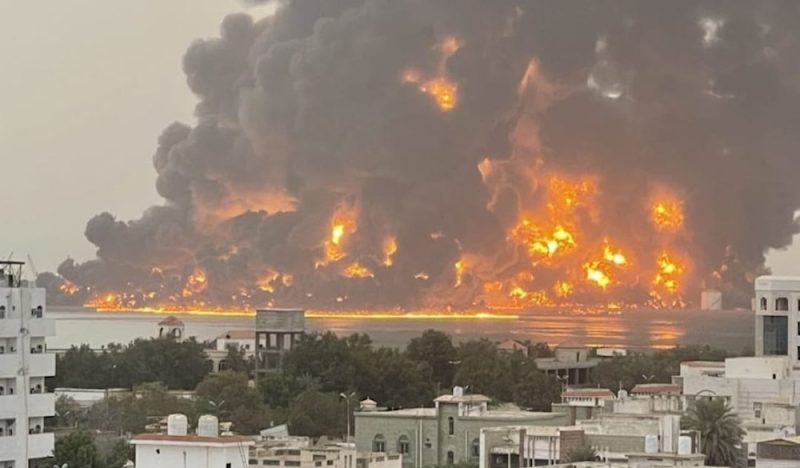
Israeli war jets launched a series of airstrikes on Saturday targeting Yemen’s province of Hodeidah on the Red Sea coast.
The aggression targeted an oil refinery, leading to a massive fire that can be seen kilometers away.
Al Mayadeen’s correspondent reported that the strikes targeted the Ras Kathib power station in Hodeidah, igniting the oil storage facilities.
The Yemeni Ministry of Health reported martyrs and wounded as a result of the aggression, confirming that civilians suffered severe burns due to the fires.
Israeli Kan 11 channel citing a US official reported that the Israelis conducted an attack in Yemen.
Civil defense teams are battling to extinguish the fires and flames engulfing the targeted zone, our correspondent added, noting that the size of the blaze is making the task extremely difficult.
Yemeni sources informed Al Mayadeen that these airstrikes were coordinated between US and Israeli forces, indicating that the nature of the targets hit by the aggression shows the blindness of the enemy.
They emphasized that there will be a response to the aggression.
Israeli media quoted official American sources stating that 25 F-35 fighters attacked multiple targets in Yemen in several attack waves.
Furthermore, an Israeli media platform mentioned that Italians assisted “Israel” with refueling aircraft in Yemeni airspace.
Following the Israeli aggression, the head of Yemen’s negotiating delegation, Mohammad Abdul-Salam, affirmed that pressuring Yemen to cease supporting Gaza is “a dream that will not come true for the Israeli enemy.”
“The brutal Israeli aggression will only increase the determination and the steadfastness of the Yemeni people and its brave armed forces in an escalating manner.”
UN’s top court says Israel’s presence in Palestinian territories ‘illegal’
Press TV – July 19, 2024
The United Nations’ top court has ruled that Israel’s presence in the 1967-occupied Palestinian territories is “unlawful” and must end.
On Friday, the International Court of Justice said “Israel’s continued presence in the occupied Palestinian territory is unlawful”, adding that the regime “is under an obligation” to end it “as rapidly as possible.”
Israel occupied the West Bank, Gaza Strip and East al-Quds, areas Palestinians want for a future independent state, in a 1967 war.
The 83-page advisory opinion read out by court President Nawaf Salam outlined a wide list of policies that it said violated international law, including the building and expansion of Israeli settlements in the West Bank and east al-Quds.
“Israel is under obligation to cease immediately all new settlement activities and to evacuate all settlers from occupied Palestinian territory,” the court said, adding that the regime must “make reparation for damage caused to all natural and legal persons concerned.”
The ruling urged all states and international organizations, including the United Nations, “not to recognize as legal” the situation arising from the unlawful presence of Israel in occupied Palestinian territory.
According to the opinion, the UN and the Security Council “should consider the precise modalities and further action required to bring to an end as rapidly as possible” to the unlawful presence of Israel in the occupied territory.
In February, a record 52 countries presented arguments at the ICJ, known as the World Court, about the legal ramifications of Israel’s actions in the territories.
This case was initiated by a UN General Assembly (UNGA) resolution in December 2022, before Israel’s October genocidal war on the Gaza Strip.
Erwin van Veen, a senior research fellow at the Clingendael think tank in The Hague, was quoted by the Associated Press as saying that if the court rules that Israel’s policies in the West Bank and east al-Quds breach international law, it would “isolate Israel further internationally, at least from a legal point of view.”
He noted that such a ruling would “worsen the case for occupation. It removes any kind of legal, political, philosophical underpinning of the Israeli expansion project.”
The case is separate from another ICJ case filed against Israel by South Africa.
South Africa filed a genocide case against Israel in December 2023 over its war on the Gaza Strip. According to South Africa’s application, Israel’s actions in Gaza were “genocidal in character because they are intended to bring about the destruction of a substantial part of the Palestinian national, racial and ethnical group.”
The ICJ’s final ruling on the broader South African case may take months if not years to rule, but the court can order urgent measures while weighing its decision.
In January, the ICJ, whose orders are legally binding but lack direct enforcement mechanisms, issued an interim ruling, ordering the occupying regime to take all measures to prevent genocide in Gaza, but stopped short of ordering a ceasefire.
In May, the court ordered Israel to halt its offensive in Rafah after South Africa asked the ICJ to order a halt to the war in Gaza, and in the refugee-packed city in particular.
While Israel ignored the ruling, the Friday opinion could add political pressure over Israel’s nine-month-old war against Gaza.
Israel launched the war on Gaza on October 7 after the Palestinian resistance movement Hamas waged the surprise Operation Al-Aqsa Storm against the occupying entity in response to the Israeli regime’s decades-long campaign of bloodletting and devastation against Palestinians.
Since the start of the offensive, the Tel Aviv regime has killed at least 38,848 Palestinians and injured 89,459 more. Thousands more are also missing and presumed dead under rubble.
Palestinian Factions: The day after the war is a Palestinian internal affair
Palestinian Information Center – July 19, 2024
GAZ – The Palestinian national and Islamic factions said on Thursday evening that the day after the war on Gaza is a purely Palestinian national affair, and no external party will be allowed to interfere in the Palestinian internal affairs.
The factions stressed in a statement that the Rafah crossing is a Palestinian-Egyptian border crossing, and that the form of its management on the Palestinian side is determined by the Palestinian forces and definitely not the USA or Israel, or those who cooperate with them.
“The recent Knesset resolution which rejects the establishment of a Palestinian state takes us to the heart of the conflict with the occupier,” the statement added.
The factions called for establishing a widespread national movement aimed at “reclaiming the Palestine Liberation Organization that has been silenced for decades and for developing a national strategy and program for liberation.”
The factions’ statement comes in light of the news about a secret meeting held last week between the USA, Israel, and the Palestinian Authority, represented by its intelligence chief Majid Faraj, to discuss reopening the Rafah crossing under the control of Israel and the USA.
For 73 days, Israeli occupation forces have been occupying and closing the Gaza crossings, preventing the wounded and sick from traveling abroad for treatment or bringing in any humanitarian aid into the besieged Strip, turning a blind eye to warnings from humanitarian and relief organizations and international demands to reopen the crossings to avoid famine and to save the lives of thousands of citizens.
Hamas calls on PLO to withdraw recognition of Israel after Knesset rejects Palestinian statehood
Palestinian Information Center – July 18, 2024
DOHA – The Hamas Movement and the Palestinian Islamic Jihad (PIJ) called on the leadership of the Palestine Liberation Organization (PLO) to withdraw its recognition of Israel.
The announcement was made during a meeting between head of Hamas’s political bureau Ismail Haneyya and the PIJ Secretary-General Ziyad Al-Nakhaleh and his deputy Dr Mohammad Al-Hindi in Doha.
The leaders of the two movements discussed the overall political and field developments related to the Israeli genocide war on the Gaza Strip.
They also hailed the heroic steadfastness of the Palestinian people in the face of the Israeli bloody massacres in the Gaza Strip.
“The leaderships viewed that, in light of the Knesset’s declared position rejecting the Palestinian people’s right to establish their independent state, the national forces are required today to take a unified stance to confront these attempts to erase the Palestinian cause,” they said in a joint statement.
The joint statement also called on the leadership of the PLO “to withdraw its recognition of the Zionist entity, reaffirming at the same time our people’s right to establish their independent state with Jerusalem as its capital, and the right of return for refugees.”
Earlier Wednesday, Israel’s Knesset voted overwhelmingly in favor of a resolution rejecting the establishment of a Palestinian state.
The resolution garnered support from 68 Knesset members, including those from Benny Gantz’s National Unity Party. Nine Knesset members from Arab parties opposed the proposal, and members of the Labor Party abstained from voting.
Featured Video
Yemen joins the war – Red Sea could be blocked next – Saudi regime at risk
or go to
Aletho News Archives – Video-Images
From the Archives
A superpower and “the world’s sickest warrior state”
By Paul J. Balles | March 8, 2010
Living through five or six major wars has hardened me to what I thought were the extremes of inhuman cruelty and brutality.
Two things made those extremes almost bearable: the brutality always revealed – at least according to the media coverage – the viciousness of the enemy. It was therefore quite understandable when our “brave men and women” pulverized the enemy.
Films of Japanese torturing captive Americans somehow justified holding Japanese Americans in internment camps during World War II; and only a small percentage of Americans found the bombing of Hiroshima and Nagasaki unreasonably vengeful at best, at worst, depraved.
The media giants in America portrayed the North Koreans as barbaric beasts with their captives, quite unlike their southern counterpoints – our allies during the Korean War. No one ever felt the need to explain how the South Koreans were a civilized breed while the North Koreans were absolute savages, at least according to the official line.
In Vietnam, our warriors justifiably (or so the media made us believe) dropped napalm on the North Vietnamese who had the gall to hide in villages and tunnels to ravage our invaders. At least it was accepted practice until some rogue photojournalist filmed a young girl screaming down a Vietnamese road in flames. … continue
Blog Roll
 Aletho News
- FTC Warns Visa, Mastercard, PayPal, Stripe Over Political Debanking
- Russian tanker approaches Cuba despite US oil blockade
- Marandi: Yemen joins the war – Red Sea could be blocked next – Saudi regime at risk
- Pro-Palestinian French member of European Parliament denied entry to Canada
- Pakistan to Host US-Iran Talks
- How Indonesia’s tilt toward the US left it stranded in the Strait of Hormuz
- US has no choice but to retreat from Iranian borders: Top commander
- Iran Retaliation Strikes Chemical Plant Near Dimona
- AWACS’ Destruction is a Major Loss for US Military – Ex-DoW Analyst
- Israel’s Iran Strategy Uses US Military & Gulf States as Its Pawns
- If Americans Knew
- Israeli police block Catholic cardinal from entering Church of the Holy Sepulchre on Palm Sunday
- Israel is assassinating journalists again, more than any other nation, anywhere, ever – Not a ceasefire Day 170
- Over 300 US service members wounded, majority have brain injuries – Not a ceasefire Day 169
- Researchers at Human Rights Watch Resign Over Blocked Report on Palestinian Refugee Return
- Jewish Groups Are Backing a War Americans Don’t Want
- Eric Fingerhut Thinks He’s the President of the Jews
- Top Jewish Philanthropists, Rabbis Urge Israeli President to Take Action Against ‘Jewish Extremists’
- Don’t Be Fooled. Zionist Leaders Have Always Wanted to Control Southern Lebanon
- Israel’s widespread use of torture is a core element of its genocide against the Palestinian people
- In Israel’s War on Iran, Many Middle East US Bases Rendered “All But Uninhabitable”
- No Tricks Zone
- New Study Finds Warming Saves Lives…Cold Temperatures 12 Times More Deadly Than Excess Heat
- German Science Blog Accuses PIK Climate Institute Of Hallucinating Climate Tipping Points
- Devastating Assessment Of Comirnaty Vaccine By Former Senior Pfizer Europe Toxicologist
- New Study: CO2 Is ‘Effectively Negligible’ As An Explanatory Climate Change Factor Since 2000
- Former Pfizer Toxicologist Dr. Helmut Sterz Tells Bundestag Hearing Pfizer Vaccine Should Have Never Been Approved
- Energy Expert: Germany’s Nuclear Phaseout Was A “500 Billion Euro Mistake”
- New Research: South Australia’s Mid-Holocene Sea Surface Temperatures Were 4°C Warmer Than Today
- Storing Green Energy To Last Germany 10 Days Would Require A 60-Million Tonne Battery
- New Studies: UK Sea Levels Were 4 Meters Higher Than Today During The Mid-Holocene
- Destructive Green New Deal: German Energy And Metal Group Warns Of Drastic Crisis
 Aletho News