MPs smear Gaza protestors, while others invent scare stories
By Yvonne Ridley | MEMO | March 1, 2024
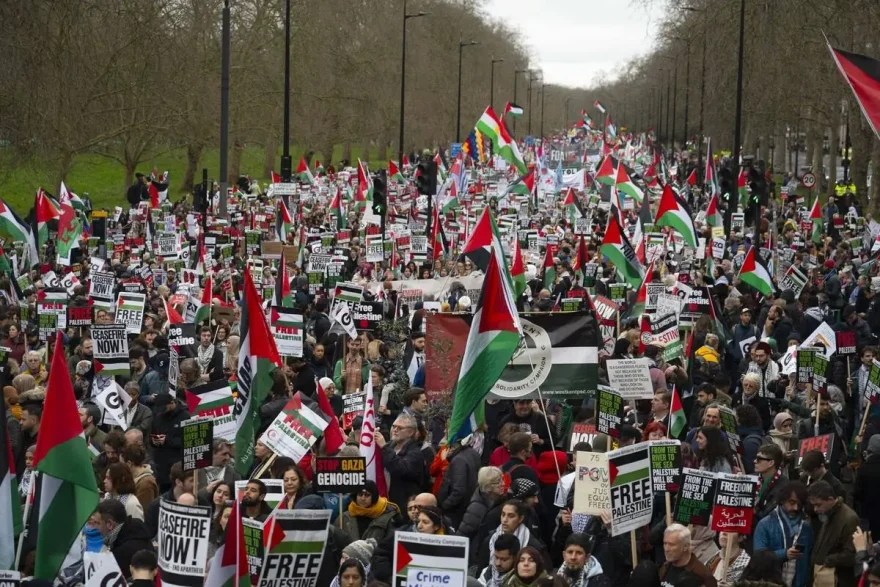
Are the massive pro-Palestine marches in Britain being deliberately targeted and smeared as part of a concerted Zionist effort to use the law to stop people from joining the ranks of the growing anti-war movement? That would certainly explain the furore over MPs’ safety which came to a head last week when Sir Lindsay Hoyle, the Speaker of the House of Commons and a member of the Labour Friends of Israel lobby group, cited threats to politicians in his disastrous handling of a debate on calls for a ceasefire in Gaza.
I pose the question after some extraordinary events have been picked up and anchored in a media campaign which has collectively shown nothing but hostility towards Palestinians in favour of the Zionist Israeli state as the genocidal onslaught in Gaza continues. Throw in some decidedly Islamophobic comments by prominent Conservative MPs, and there is a really toxic atmosphere brewing in advance of this year’s General Election, with Muslims — “Islamists” — cast as the bad guys.
Today, my suspicions were fuelled by none other than British Prime Minister Rishi Sunak who resorted to shameless smears and scare tactics as he warned police chiefs of a “growing consensus that mob rule is replacing democratic rule”. Calling for more robust police action, Sunak used inflammatory language to insist that politicians need to be protected from intimidatory protests outside their homes.
However, the Home Office has nevertheless announced a £31 million package aimed at protecting MPs. It is said to be in response to the impact of the ongoing “Israel-Hamas conflict”.
Meanwhile, in Scotland police were called to investigate bizarre claims that the Glasgow constituency office of Labour Members of the Scottish Parliament was “stormed” by 30 pro-Palestine protesters, with MSP Paul Sweeney criticising officers for taking 27 minutes to respond even though the office staff were left “distressed”.
Police Scotland insist that the storming of the politicians’ shared office never happened as described, and rejected the claims made by Sweeney. According to him, campaigners forced their way into the office that he shares with party leader Anas Sarwar, and fellow MSPs Pam Duncan-Glancy and Pauline McNeil.
“It may well be that this entire furore over alleged threats by protestors is confected,” said Mick Napier, a co-founder of the Scottish Palestine Solidarity Campaign, whose members took part in the protest. Certainly, the example of Sweeney caught flagrantly inventing threats to the staff suggests that this might be the case. Sweeney supports a party leader who endorses Israel withholding water, food and fuel from the entire population of Gaza — not only cruel, but also collective punishment, a war crime — while he complains that people opposing such barbarism raise their voices.
“Although in this case voices weren’t even raised,” explained Napier. “There seems to be something new in the shamelessness with which our politicians lie to the public. Could it be because the mainstream media have given up any pretence of investigating such fabrications?”
Despite repeated attempts to contact Sarwar, McNeil, Duncan-Clancy and Sweeney, none were prepared to offer a comment to me about the incident.
European political analyst Kevin Ovenden wrote about the incident on 22 February: “Two elected politicians have been exposed today for simply lying that they faced violent intimidation when they merely had to deal with democratic lobbying and political pressure. One is the Labour Member of the Scottish Parliament Paul Sweeney. Police in Glasgow refuted his highly charged claim that anti-war protesters stormed his office and intimidated his staff. They did no such thing, as the police concluded, having been present throughout for an orderly protest, without even any civil disobedience, by a small group of middle-aged or older women and men.
“That has not stopped the Speaker of the House of Commons, Lindsay Hoyle (for years a nodding-donkey Labour MP) today smearing the entire anti-war movement as in some way incubating terrorism as justification for his anti-democratic manoeuvres on behalf of [Labour Party leader] Keir Starmer.”
Ovenden blames craven support for Israel by the two main establishment parties, Conservative and Labour, for “not only leading to authoritarianism against public protest and free speech. It is now even crushing the limited democratic avenues available through parliament.”
The streets of London have witnessed some of the largest, peaceful, pro-Palestine demonstrations in the capital’s history, but that did not stop Sunak from calling an urgent meeting in Downing Street for police chiefs on Thursday. He urged them to use all of their existing powers to crack down on the alleged intimidation, disruption and subversion.
“We simply cannot allow this pattern of increasingly violent and intimidatory behaviour which is, as far as anyone can see, intended to shout down free debate and stop elected representatives doing their job,” insisted the prime minister.
Without a hint of irony, the man who has so far given his unconditional support to Israel, currently under investigation for genocide by the International Court of Justice, added: “That is simply undemocratic… I am going to do whatever it requires to protect our democracy, and our values, which we all hold dear.”
Del Babu, a former chief superintendent in London’s Metropolitan Police, said language like “mob rule” was not “helpful”. He told BBC Radio 4’s Today programme that appealing to people to demonstrate less could have “unintended consequences” and potentially lead to more people protesting.
“We will continue to march until there is an immediate ceasefire,” said Shamiul Joarder of Friends of Al-Aqsa. The organisation is part of a coalition of groups organising the marches which have brought world attention to London’s streets.
Members from all six groups, along with Labour MP and former shadow chancellor John McDonnell, and the campaign group Liberty, held a press conference earlier this week in parliament criticising unhelpful language used by politicians. They claim that anti-Muslim “hysteria” and pressure from the government had provoked the Metropolitan Police into heavy-handed and “discriminatory” policing of “peaceful mass protests”.
Home Secretary James Cleverly, meanwhile, told the BBC: “I genuinely don’t know what these regular protests are seeking to achieve. They have made their position clear, we recognise that there are many people in the UK that hold that position.”
Hours later, 104 starving Palestinians in Gaza were massacred — witnesses say that Israeli troops opened fire on them — as they gathered around an aid convoy distributing food. If Cleverly doesn’t understand the point of the street demonstrations then he has the emotional intelligence of a brick and a surname which doesn’t quite match his IQ.
Calls for a ceasefire will continue until Israel’s genocide of the people of occupied Palestine is stopped in its murderous tracks. Which bit of “Stop Killing Civilians” do our politicians not understand?
‘State-minus’: Biden’s Palestine solution
Three decades after the Oslo Lie, neither the US nor the EU are in any position to dangle the promise of a Palestinian state.
By Stasa Salacanin | The Cradle | February 29, 2024
Is it sadly ironic that the issue of Palestinian statehood – unresolved for over 75 years – has resurfaced only after Israel’s wholesale carpet-bombing of the Gaza Strip, killing over 30,000 civilians, injuring tens of thousands more, and destroying significant swathes of the territory’s infrastructure.
University of California (UCLA) historian James Gelvin states the case plainly:
“There would have been no serious discussion of a two-state solution without [the events of] 7 October. As a matter of fact, putting the Palestine issue back on the front burner of international and West Asian politics was one of the reasons Hamas launched its operation.”
As Gelvin explains it to The Cradle, Hamas has already scored several victories since its Al-Aqsa Flood operation: “The Palestine issue is back on the international agenda, it is negotiating the release of its captives as an equal partner to Israel,” and has demonstrated that it is “more effective in realizing Palestinian goals than its rival, Fatah.”
New ‘Biden Doctrine’
While the unprecedented, brutal Israeli military response has indeed illustrated the urgency for establishing a Palestinian safe haven, it is impossible to ignore that western state backers of the 1993 Oslo Accords – which laid out the essential framework for the establishment of a Palestinian state – have then so assiduously ignored and neglected that responsibility.
Even greater hypocrisy emerges from the fact that these western powers, led by Washington, have now decided to force the discussion of Palestinian statehood in the midst of Gaza’s carnage, with an Israeli prime minister, Benjamin Netanyahu, who is infamously opposed to it.
So, why is this debate possible now? Why was it ignored before 7 October – or even prior to Netanyahu’s return to the prime ministership?
After enormous public and international pressure, US President Joe Biden has, at least rhetorically, reopened the issue of Palestinian statehood. According to the New York Times, the Biden White House’s new doctrine would “involve some form of US recognition of a demilitarized Palestinian state in the West Bank and Gaza Strip in return for strong Palestinian guarantees that their institutions could never threaten Israel.”
In addition, the US president’s plan also envisages Saudi–Israeli normalization and a tough military stance against Iran and its regional allies. However, many analysts have already raised questions about the viability of a plan that does not reflect current ground realities.
While Netanyahu rejects the very notion of a Palestinian state, the ‘Biden doctrine’ and its offering of some limited-sovereignty version of a demilitarized Palestinian state is nothing less than humiliating for Palestinians.
Dr Muhannad Ayyash, Professor of Sociology at Mount Royal University, observes that there is no fundamental change of approach by the US on this issue. In short, the Biden administration refuses to clarify what it means by a ‘Palestinian state.’ Its initiative appears mainly to advance a form of a two-state solution that would be palatable to Israel.
Ayyash points out that the key issues related to Palestinian statehood are left unanswered, including the issue of sovereignty, Jewish settlements, the status of East Jerusalem, a necessary West Bank/East Jerusalem connection with the Gaza Strip, the Palestinian right to return, and so forth.
As Israel has firmly insisted on retaining full security control over the entire territory west of Jordan – meaning, over all the territory likely to come under Palestinian (self-)rule – many experts fear that Israel would have the right to militarily enter those territories at will, without Palestinian consent, with the latter banned from assembling its own military force.
This version of ‘statehood’ is not remotely on par with that of other UN member-states, who are entitled, under the UN Charter, to exercise full sovereignty and defend their territorial integrity. Biden’s ‘solution’ of a Palestinian state with limited sovereignty is nothing more than the legalization of Israel’s perpetual occupation of Palestine.
A Palestinian ‘empty shell’
The revived debate on Palestinian statehood is also intricately connected to a big western public relations dilemma. The Atlanticists’ unconditional support for Israel’s illegal, disproportionate military assault against mostly female and child populations has deeply impacted their image and capacity to maneuver in West Asia and beyond.
This is especially true for Washington’s foreign policy objectives in the region, which are facing major, direct resistance on the ground in Iraq, Syria, and Yemen.
The revival of a two-state solution is, therefore, a “desperate act to salvage some of the credibility or legitimacy of these regimes (both Arab and Western governments),” argues Dr Mohammed Abu-Nimer, Professor and Abdulaziz Said Chair for Peace and Conflict Resolution at the American University in Washington, DC.
For decades, the US has capitulated to Israeli demands on pretty much everything Tel Aviv has ever asked for. In recent years, as Gelvin describes it, the US has mainly focused “on bribing various Arab governments – the UAE, Bahrain, Morocco, Sudan – to normalize relations with Israel” through the “Abraham Accords,” which, in effect, took the Palestine issue off the table.”
Meanwhile, Arab states managed regional expectations by continuing to pay lip service to Palestinian issues while scuttling any opportunities behind the scenes. With few Arab state allies left, Palestinians themselves had no cards left to leverage – until 7 October.
Now, Israel is doing all it can to negate that day’s gains. Says Ayyash:
“Netanyahu wants to dispense with all pretension about the establishment of the Palestinian state and use this moment to establish full Israeli Jewish sovereignty from the river to the sea, whereas the Biden administration prefers a quieter approach that pretends to care about the aspirations of the Palestinian people in order to maintain its close ties with Arab regimes across the region.”
The two-state solution, according to Professor Abu-Nimer, is, therefore, nothing other than a “fig leaf” to resuscitate the west’s crashing image and should not be viewed as a serious US initiative. The proposed plan is “a skeleton or an empty shell which lacks of any serious form of sovereignty.”
Nathan Brown, an American scholar of Middle Eastern law and politics at George Washington University, largely concurs:
“This is not a step toward statehood but only reviving some provisions of the Oslo Accords. Even at a maximum, it would produce what would have been called a ‘protectorate’ in the nineteenth century, not a state.”
A Palestinian state is not on the cards
Although the US and the EU could exercise immense leverage over Israel to revive the Oslo agreement and fast-track its provisions, they are doing nothing of the sort.
Today, there is a unique opportunity for Tel Aviv’s western allies to play this hand, given the utter collapse of Israel’s image worldwide and the mass public demand for the protection of Palestinians.
Instead, the Biden administration thinks that it can resurrect the two-state idea by mediating a grand regional deal – one that will deliver everything Israel wants, by dangling the promise of a rump Palestinian state.
The White House believes that the reward of normalizing relations with Saudi Arabia will offset for the Netanyahu government a reversal on the question of Palestinian statehood and withdrawal from the occupied Palestinian territories.
Gelvin dismisses the plan, saying it simply won’t work on so many levels. For starters, “if Netanyahu commits to a Palestinian state and withdrawal from the occupied territories, his government will collapse and he will go to jail.”
Don’t expect anything spectacular from the European Union either. Although EU High Representative for Foreign Relations Josep Borrell has said that a Palestinian state may need to be imposed from the outside without Israel’s agreement, realistically, the range and reach of European foreign policy is minimal or non-existent. According to Gelvin, “the EU has no more leverage against Israel than Costa Rica.”
Abu-Nimer likely speaks for the majority of regional observers – who have seen this game play out before: these top-down western statehood formulas do not work without genuine engagement with Palestinian political representation – in this case, Hamas and other Palestinian resistance organizations.
Thirty-one years after the Oslo Accords promised a Palestinian state, Israel is ethnically cleansing Gaza and swallowing up the West Bank and East Jerusalem. Almost five months after the start of Operation Al-Aqsa Flood, some of the leverage is back in Palestinian resistance hands, and they are unlikely to trade their gains for an unsovereign rump state which diplomats are privately calling a ‘state-minus.’
Heavy losses inflict ‘dramatic manpower crisis’ on Israel

The Cradle | March 1, 2024
The Israeli military is demanding an addition of at least 7,000 soldiers to its forces due to a serious manpower crisis.
The 7,000 are needed on top of the soldiers already enlisting, the Israeli army said on 1 March.
“The army requires standards for another 7,500 officers and noncommissioned officers, while the Treasury currently approves only 2,500. These are unprecedented numbers, which indicate the shock that befell the IDF following almost 150 days of fighting, which began with heavy losses on 7 October,” Hebrew news site Ynet reported, citing the army’s General Staff.
“The army is compiling the data that will explain how dramatic the manpower problem is,” it added.
Just one day ago, Israel’s Defense Minister, Yoav Gallant, called to end draft exemptions for members of the ultra-Orthodox community. Gallant said he would only support legislation allowing for continued exemptions if all members of the ruling coalition backed it.
The minister asserted that “all parts of society” must “bear the burden” of service.
Gallant’s position could result in tension with ultra-Orthodox parties in the coalition, viewed as integral to the current government’s survival, according to Hebrew media.
However, the army’s demand for a boost in manpower “has nothing to do with politics or the demand for equal burden: The situation is simply not good and does not match the threat map,” Ynet wrote.
Israel is taking severe losses in its genocidal war in Gaza and its attempt to eradicate the Palestinian resistance.
While Israel claims that Gaza’s southernmost city of Rafah is the final Hamas stronghold, the group’s military wing, along with several other factions, continue to fiercely confront Israeli troops across the strip.
A source from within the resistance told Al-Mayadeen on Thursday that the Israeli army has been forced out of Gaza City’s Al-Zaytoun neighborhood, where it had been operating over the past eleven days in an attempt to clear out Hamas fighters.
The source added that the neighborhood is a “graveyard” for Merkava tanks, and the “bloodied and torn” uniforms of Israeli soldiers are spread out across the battlefield.
Clashes between the resistance and the army continued to rage on 1 March in several areas of Gaza, including the southern city of Khan Yunis and the Jabalia area in the northern strip.
Washington blocks UNSC statement condemning Israel for ‘Flour Massacre’
The Cradle | March 1, 2024
The US, on 29 February, vetoed a UN Security Council (UNSC) statement that would have condemned Israel for the mass murder of over 100 Palestinian civilians who were awaiting the delivery of humanitarian aid in Gaza City.
“We don’t have all the facts on the ground – that’s the problem,” US deputy ambassador to the UN Robert Wood told reporters on Thursday.
He then claimed there are “contradictory reports” about the Israeli army’s latest massacre and highlighted that Washington was focused on finding “some language that everyone can agree on.”
Thursday’s veto is the fifth time Washington has blocked a UNSC statement or ceasefire resolution that would hold Israel accountable for the atrocities it has committed in Gaza.
According to Riyad Mansour, the Palestinian UN ambassador, 14 of the 15 council members supported the statement advanced by Algeria.
At least 112 Palestinians were killed and more than 750 wounded after Israeli troops opened heavy machine gun and artillery fire on thousands waiting for food on Gaza’s Al-Rashid Street, in what marked the first delivery of food to northern Gaza in several weeks.
“After opening fire, Israeli tanks advanced and ran over many of the dead and injured bodies,” Al Jazeera’s Ismail al-Ghoul reported from the scene.
“We had come here to get our hands on some aid. I have been waiting since noon yesterday. At about 4:30 in the early morning, trucks started to trickle in. The Israelis just opened random fire on us as if it was a trap. Once we approached the aid trucks, the Israeli tanks and warplanes started firing on us,” a witness at the scene told Al Jazeera.
The Israeli aggression triggered a stampede, adding to the chaos.
“We were going to bring flour … then Israeli snipers shot at us,” another person in the area told the Qatari news outlet. “They shot me in the leg. I’m unable to stand up,” he added.
Tel Aviv changed its story multiple times on Thursday, first claiming the majority of victims were killed by the stampede and later saying that soldiers opened fire only after feeling “threatened.” Officials have yet to explain how the crowds of underfed and displaced civilians posed any threat to them.
Colombia suspends Israeli arms purchases following attack on Palestinian crowd
The Cradle – March 1, 2024
Colombian President Gustavo Petro on 29 February announced the country would suspend all arms purchases from Israel in protest against the ongoing genocide of Palestinians in Gaza.
“Asking for food, more than 100 Palestinians were killed by Netanyahu. This is called genocide and is reminiscent of the [Holocaust] even if the world powers do not like to recognize it. The world must block Netanyahu. Colombia suspends all purchases of weapons from Israel,” Petro said via social media after the latest massacre of civilians by Israel in Gaza.
Israel has killed at least 30,035 and injured 70,457 others in Gaza while inflicting mass destruction and shortages of basic necessities on the strip.
Colombia is among the countries that fully supported South Africa’s genocide case against Israel at the International Court of Justice (ICJ). Petro has also continuously condemned Tel Aviv for its indiscriminate attacks against Palestinians since 7 October, taking a similar stance as the leaders of other Latin American nations like Bolivia, Brazil, Venezuela, Cuba, Honduras, and Nicaragua.
“If we have to suspend foreign relations with Israel, we suspend them. We do not support genocides,” Petro said via social media on 15 October.
His comments came after Israel suspended all security exports to the South American country in response to Petro’s public stance on the genocide unfolding in Gaza.
Petro drew the ire of Israel after posting on social media: “Neither the Yair Kleins nor the Raifal Eithans will be able to say what the history of peace in Colombia is. They unleashed the massacre and genocide in Colombia.”
Former Israeli army colonel and mercenary Yair Klein in the 1980s was responsible for training fighters from the United Self-Defense Forces of Colombia, a right-wing paramilitary group responsible for multiple war crimes during Colombia’s internal war. Klein was later brought to Colombia to train the National Police.
Raifal Eithan, the former chief of staff of the Israeli army, served as an advisor to former Colombian president Virgilio Barco and once proposed killing the members of the Patriotic Union political party, which was born from the failed peace process with the Revolutionary Armed Forces of Colombia (FARC) in 1984.
Far-right Colombian paramilitaries are responsible for killing tens of thousands of civilians, including social leaders, environmental activists, and campesinos, and forcing millions more out of their homes. Furthermore, all branches of the Colombian armed forces use Israeli weaponry as standard, and all have been trained by Tel Aviv in combat techniques.
Time’s ‘New Antisemitism’ is More Woke Garbage
By Adam Dick | Peace and Prosperity | February 29, 2024
We’ve all heard the “woke” assertion that some people cannot be considered racist no matter how they act or what they say while other people are destined to live their entire lives as racists no matter how they act or what they say. The key difference between the two groups of people is whether their ancestry dictates they be labeled among the oppressors or the oppressed.
People exercising rationality see through this nonsense. They can judge people’s actions and statements with no investigation of family trees required.
Reading the Tuesday editorial “The New Antisemitism” at Time one comes across a fair amount of interesting commentary. But, in the end, the editorial just ends up applying a variation of the now familiar woke garbage assertions to Israel’s ongoing war. The Israel government cannot be engaging in genocide in its war because Israel is “the Jewish state” and Jewish people have a long history of being much oppressed, plus people who say otherwise are antisemitic. That is how the author Noah Feldman wraps up the editorial.
Here is the Time editorial’s presentation of its conclusions on genocide and antisemitism:
There is something specifically noteworthy about leveling the [genocide] charge at the Jewish state—something intertwined with the new narrative of the Jews as archetypal oppressors rather than archetypal victims. Call it the genocide sleight of hand: if the Jews are depicted as genocidal—if Israel becomes the very archetype of a genocidal state—then Jews are much less likely to be conceived as a historically oppressed people engaged in self-defense.
The new narrative of Jews as oppressors is, in the end, far too close for comfort to the antisemitic tradition of singling out Jews as uniquely deserving of condemnation and punishment, whether in its old religious form or its Nazi iteration. Like those earlier forms of antisemitism, the new kind is not ultimately about the Jews, but about the human impulse to point the finger at someone who can be made to carry the weight of our social ills.
The Time editorial says people seeking to hold the Israel government to account for its actions and statements are applying a “genocide sleight of hand” rooted in antisemitism. However, critical readers will recognize that real sleight of hand is the rhetorical sleight of hand whereby the clever wording of the editorial is used in an attempt to absolve a government for its horrendous actions by defining that government as a perpetual victim and its accusers as inescapably antisemites.
US, pushed by Israel, involved in widening war despite consequences: Iran FM
Press TV – February 28, 2024
Iran’s Foreign Minister Hossein Amir-Abdollahian says the United States is involved in the expansion of the scope of the Israeli war on Palestinians in the besieged Gaza Strip to other fronts across the West Asia region.
Amir-Abdollahian stressed that Israeli prime minister Benjamin Netanyahu is seeking to widen the Gaza war and involve the United States in a way that goes beyond the all-out support Washington and some of its allies have already provided for Tel Aviv.
“The Americans do not yet have the necessary will to stop the war, but at the same time, they are sending messages expressing their unwillingness to expand its scope because they are well aware of the danger of expanding its scope,” the top Iranian diplomat said.
“On the other hand, they are expanding the scope of the war through their joint aggression with the UK against Yemen.Today in Europe, everyone talks about the necessity of stopping the war, but Britain is playing a double game.”
He made the statement in an interview with Lebanon’s Arabic-language al-Mayadeen television news network in the Swiss city of Geneva on Tuesday,
Amir-Abdollahian added that Washington’s talk of reducing the intensity of the Gaza war, rather than stopping it, is a “mistake and malicious behavior that means giving the green light to Netanyahu” to press ahead with its months-long brutal aggression.
“I told the British foreign minister that the joint British-American aggression against Yemen is a strategic mistake that you are committing,” he said. Yemen has “proven that they do not trifle with any party regarding the security of their lands. They have been able to convey this message and clearly warned that ships carrying military cargo to Israel will be stopped.”
US hypocrisy on Gaza
The Iranian foreign minister also pointed to the US administration’s unswerving support to Israel in its brutal war on the besieged Palestinian territory and its continued supply of weapons and logistics to the occupying regime.
“Our information has it that the process of sending weapons from all American bases in the region and its warships to Tel Aviv is continuing,” he said, adding, “Islamic countries should not be turned into a place to supply weapons to the Israeli entity.”
Denouncing the US hypocrisy in dealing with the Gaza war, Amir-Abdollahian said, “Everyone agrees that if the United States abandons its military support for the occupying entity, Netanyahu will not be able to continue the war against Gaza for even an hour.”
The top Iranian diplomat also stressed that Israel did not achieve any of its declared goals in the war on Gaza, including the elimination of the Palestinian resistance movement Hamas, the group’s disarmament and the arrest of its Gaza-based leader Yahya Sinwar.
“The Lebanese and Palestinian resistance movements are at their best despite all the challenges and difficulties, and that they have the material and human resources and capabilities necessary to continue to withstand a longer war than what we have seen so far,” Amir-Abdollahian said.
Praising the morale and steadfastness of the residents of Gaza and the occupied West Bank, he underlined that the Israeli plans in Rafah “will not translate into reality and the occupation will not be able to forcibly displace people to the Egyptian Sinai.”
UN performance ‘unacceptable’
Elsewhere in his interview, the Iranian foreign minister censured as “unacceptable” the United Nations’ performance regarding the situation on the ground in Gaza and the occupied West Bank, saying the UN Security Council has not fulfilled its duty in light of the United States’ use of its veto.
“The Security Council did not fulfill its duty as the US continuously and unilaterally exploited its veto power. Every prospect and proposal of a Gaza ceasefire has been rejected by the American veto, exhibiting a contradictory behavior to the banners of primary human rights. Even at the UN Human Rights Council, we still have not seen any adequate mobilization in this regard,” he said.
“Does the UNHRC not want to create a special committee that relays the facts and investigations into war crimes, genocide, and human rights violations being committed in Gaza? So far, we have not witnessed a singular decisive measure taken by any of the organizations that fall under the UN.”
Amir-Abdollahian said UN Secretary-General Antonio Guterres had so far taken some good measures but had not been able to help the people of Gaza “in an effective and real way” through the existing mechanisms of the United Nations.
“In the Human Rights Council, we clearly see that everything is subject to the control of politicians and false human rights advocates,” he said.
Israel launched the campaign of death and destruction on October 7, after Hamas-led Palestinian resistance groups conducted the surprise Operation Al-Aqsa Storm against the occupying entity in response to the regime’s decades-long atrocities.
Israel has killed nearly 30,000 people and injured more than 70,000 others in Gaza since that October day.
US senators slam Biden’s strategy against Red Sea operations
Press TV – February 28, 2024
A bipartisan group of US senators has slammed President Joe Biden’s handling of the Yemeni army’s attacks against Israeli-linked vessels, as well as American and British ships in the Red Sea.
The senators on Tuesday contended Biden should seek congressional authorization for ongoing military action against the Yemen-based movement.
The United States has been carrying out near-daily strikes against the Houthi Ansarullah movement, who have said their attacks on shipping are in solidarity with Palestinians.
The Houthi Ansarullah movement said Yemen’s attacks against shipping in the Red Sea will only stop after the Israeli regime ends its aggression and blockade on the Palestinians in the Gaza Strip.
The American strikes have so far failed to halt the Yemeni attacks, which have upset global trade and raised shipping rates.
Democratic Senator Tim Kaine said during a congressional hearing with Pentagon and State Department officials that he had serious concerns about the legal authority the Biden administration was relying on for the strikes but also what impact they were having.
“Trying to re-establish deterrence, I don’t think you’re going to do it if the 200 strikes become 400 strikes, 800 strikes, 1,200 strikes,” Kaine said.
“I think you will re-establish deterrence when we get a hostage deal that leads us to a truce, that leads us to humanitarian aid into Gaza, that leads us to the ability to discuss, whatever that truce period is, can be extended,” he added.
The Pentagon said on Tuesday that its strikes have so far destroyed or degraded 150 missiles and launchers along with radars, weapons storage areas and drones.
Yemen’s Red Sea operations would end in case a ceasefire is reached between the Israeli regime and the Gaza-based Hamas resistance movement, said Mohammed Abdul-Salam, who is also the chief negotiator of the Ansarullah movement.
He added that the situation would be reassessed if Israel ended its siege on Gaza and allowed humanitarian aid to enter the Palestinian territory.
Yemenis have declared their open support for Palestine’s struggle against the Israeli occupation since the regime launched a devastating war on Gaza on October 7 after resistance movements in the territory carried out the surprise Operation Al-Aqsa Storm on Israeli settlers and military forces in occupied Palestine.
The Yemeni Armed Forces have said they will not stop retaliatory strikes until unrelenting Israeli ground and aerial offensives in Gaza, which have killed nearly 30,000 people and wounded around 70,000, come to a complete end.
The maritime attacks have forced some of the biggest shipping and oil companies to suspend transit through one of the world’s most important maritime trade routes.
“The Constitution requires Congress to authorize acts of war. … We swore an oath to follow the Constitution. If we believe this is a just military action and I do, then we should authorize it,” Senator Chris Murphy, who chairs the Senate Foreign Relations Committee’s Middle East subcommittee.
Murphy, a Democrat, said he would be in talks with his colleagues to introduce such an authorization.
Senator Todd Young, the subcommittee’s senior Republican, also questioned the Biden administration’s strategy.
“It’s imperative that the administration respond to these actions while demonstrating it is both a strategy for deterring aggression and appropriate legal doctrine,” said Young. “To date, I have not seen such a strategy put forward.”
The US Constitution gives Congress the right to authorize war, but US law gives the White House the authority to launch limited foreign military action.
The United States and the United Kingdom have been carrying out strikes against Yemen since early January after Washington and its allies offered Israel their full support amid attacks by Yemeni forces on Israeli-linked ships sailing to and from the occupied territories through the Red Sea.
Separately on Tuesday, the US military’s Central Command (CENTCOM) said in a statement that US “preemptive” strikes on Yemen on Monday had destroyed two anti-ship cruise missiles, three unmanned surface vessels and a drone in the Arab country.
It claimed that the destroyed missiles were being prepared to launch toward the Red Sea.
Two days earlier, the US and the UK said that they had targeted at least 18 military sites in eight locations across Yemen. The attacks included strikes against underground weapons and missile storage facilities, air defense systems, radars and a helicopter, they added.
Ukraine ‘Fiasco’ Likely Driving West to Seek Victory Against Houthis
Sputnik – 28.02.2024
Efforts of the US-led coalition to thwart Houthi attacks on Israeli-linked shipping in the Gulf of Aden have been recently backed by Germany which deployed one of its warships, frigate Hessen, to aid Washington’s effort.
The frigate’s deployment came as part of an “EU-wide operation that includes other countries as well,” said Nikolas Kosmatopoulos, assistant professor of public policy and international affairs at the American University of Beirut.
“I know that my country, Greece, also sent off frigates only a few days ago. So this is a major escalation. This is a very dangerous major escalation,” he told Sputnik. “[It is] A decision that’s made by the EU to interfere in the conflict that has been raging in the Sea of Aden and the coast of Yemen.”
According to Kosmatopoulos, this a “very worrisome development” as the European Union’s decision to join the US conflict with the Houthis leads to “extreme militarization of the waters” in the region, not to mention the EU becoming a “party to the regional war waging in Israel –Palestine.”
He also suggested that it is hard to tell whether the Hessen’s deployment came as a result of US pressure on Germany or as part of an EU effort to unblock the waterway in question.
On one hand, Kosmatopoulos noted, the US does seek to have other NATO members “share the burdens of the collective security under the NATO alliance,” including all of the associated costs and risks.
On the other hand, “the current European governance and current European leadership seems to be willingly going in this direction.”
“We saw it also in the case of the Ukraine-Russia conflict that it has been more or less unified front, consolidated front that makes it difficult to decide whether it’s just the US pressure or is also a collective decision of the West to close ranks and show strength in multiple fronts,” Kosmatopoulos said.
Regarding the reason why the US seeks to drag more of its NATO allies into the confrontation with the Houthis, the scholar postulated that Washington “wants to share the responsibility, wants to make others partake in this, wants them to dirty their hands and to show what they got,” just like they did by compelling European nations to back Kiev.
The ensuing escalation in the Middle East, he reasoned, “allows the US and its allies to ask for more and more intensive engagement that might also mean active military action against the Ansar Allah and Houthis in Yemen” as the West seeks to “reestablish its hegemony.”
“Perhaps the Ukraine fiasco made it necessary to have victory somewhere else,” Kosmatopoulos. “I hope that this is not understood as a zero-sum game in the Western elites. But it might look like that from the outset. So in that case, we’re in for a regional flare-up, if not – bigger than that. And this is an extremely worrisome development.”
Houthis Refute Claims They’ve Sabotaged Underwater Cables in Red Sea
By Ilya Tsukanov – Sputnik – 27.02.2024
Israeli media reported on Monday that the Yemeni militia had targeted “four submarine communication cables” in the area between Jeddah, Saudi Arabia and the Republic of Djibouti.
The Houthis’ Telecommunications Ministry has denied reports by “Zionist-linked media” claiming that they have sabotaged major underwater telecommunications cables connection, Europe, Africa and Asia.
“The Ministry of Telecoms and Information Technology denies what has been published by the Zionist-linked media outlets and also what has been published by other media outlets and the social networks, on allegations as to what [has] been caused to Red Sea submarine cables,” the militia said in an English-language statement Tuesday, a day after an Israeli Hebrew-language newspaper reported that the militia had caused “serious disruption” to internet cables between Europe and Asia.
“Yemen Telecom affirms its pivotal role to continue and build up and develop the international and regional telecom and internet networks which are provided by the submarine cables running within the Yemeni territorial waters and will keep up to facilitate the passage and implementation of the submarine cables projects through the Yemeni territorial waters, inclusive the projects into which the Yemen Republic participated, by Yemen International Telecom Co – TeleYemen,” the statement added.
The Ministry pointed to recent statements by Houthi movement leader Abdul-Malik al-Houthi committing the militia to keeping underwater cables and its relevant services “away from any possible risks,” and said the militia’s campaign “to ban the passage of Israeli ships” through Red Sea waters “does not pertain [to] the other international ships which have been licensed to execute submarine works within the Yemeni territorial waters.”
Houthi Politburo member Khuzam al-Assad told Sputnik that the militia undertook “no actions… aimed at damaging internet cables, and we have repeatedly confirmed this.”
Al-Assad said the claims of Houthi attacks on the cables were insinuations being pushed by Tel Aviv, Washington and London to try to turn global public opinion against the Houthis instead of “stopping the crimes of genocide committed by the Israeli Army with the support of the United States and the West against Gaza residents.”
The Israeli media report said four major cables, including AAE-1 (connecting East Asia to Europe via Egypt), Seacom (linking Europe, Africa and India), EIG (linking India and the Gulf to Africa and Europe) and TGN (linking France to India) had been hit, with most of the immediate damage expected to be felt by India and the Gulf States.
Western reporting on possible Houthi operations to sabotage underwater internet cables began to surface in January, with the BBC running a story in early February saying the Houthis “almost certainly would” target the cables “if they could,” while admitting that “the fiber cables, which carry 17% of the world’s internet traffic, lie on the seabed mostly hundreds of meters below the surface – well below the reach of divers.” Only a handful of countries, including the US and Russia, have the capability to sabotage this infrastructure using deep sea submersibles, the outlet said.
The Houthis began a months-long maritime campaign of ship hijackings, drone strikes and missile launches targeting Israel-affiliated commercial vessels in the Red Sea in November in solidarity with Gaza amid Israel’s ground assault into the enclave. The US announced the creation of a naval ‘coalition of the willing’ against Yemen in December, and started bombing the country in January to try to degrade the militia’s missile and drone capabilities. The Houthis responded by banning all American and British ships from passing through the strategic waterway, and launching attacks on US and British warships operating in the area.
The Yemeni militia has effectively shut the Red Sea down to up to 40 percent of its normal commercial traffic, adding tens if not hundreds of billions of dollars to global shipping costs and disrupting supply chains worldwide.
US Official Admits Only 85 Aid Trucks Entering Gaza Per Day
By Kyle Anzalone | The Libertarian Institute | February 27, 2024
The head of USAID said on Monday that only around 85 aid trucks were able to enter Gaza each day, under 10% of the prewar number. The White House has touted that it has leveraged US influence to get Israel to provide more aid to the Strip. However, Tel Aviv is deploying a myriad of tactics to strangle aid shipments in Gaza.
“More than 500 trucks should be entering Gaza daily. In the past week, only ~85/day managed to get through,” Samantha Power, the head of USAID, posted on X. Power, who considers herself an expert on genocide prevention, has not called for a ceasefire or an end to US weapons shipments to Israel even as the International Court of Justice concluded Tel Aviv was plausibly waging a genocide in Gaza.
Before October 7, about 500 trucks entered Gaza daily to sustain the people. The number of Palestinians in the Strip needing aid has skyrocketed over the past four months. Nearly all 2.3 million Palestinians are displaced and do not have access to clean water or food.
Since Israel went to war in Gaza, Tel Aviv has used a multitude of methods to stifle aid deliveries, including attacking shipments. CNN reports that the Israeli military attacked a UN aid shipment in Gaza on February 5 after approving the trucks to travel through the Strip.
Additionally, Israel is preventing a US-funded food shipment from being unloaded at the port. Tel Aviv has enacted an onerous inspection regime that slows deliveries and prevents lifesaving medication from reaching the Strip. Israeli government agencies have denied visas to international aid workers, limiting the activities of dozens of organizations.
Israeli civilian protesters are also interfering with shipments by blocking and delaying trucks carrying the aid. Once convoys enter Gaza, they are mobbed by starving Palestinians. Recently, Israeli forces began targeting the police force in the Strip, making it harder for the trucks to move through Gaza.
Jordan has airdropped aid in Gaza 16 times since October 7 to bypass the backup at the border inspection checkpoint.
The Israeli onslaught in Gaza has thrown the Palestinian people into a horrific humanitarian crisis. Most of the medical facilities have been destroyed or shut down, and tens of thousands of Palestinians have suffered serious burns, cuts, and amputations.
In the northern half of the Strip, one in six children are suffering from acute malnutrition, meaning they could soon die of starvation or other deprivation. A two-month-old child succumbed to starvation in central Gaza last week. Palestinians are eating animal feed, grass, and rotten food.
The Biden administration has faced increasing pressure over its support for Tel Aviv as Israeli forces killed tens of thousands of Palestinians in Gaza and annihilated most of the Strip. President Biden has touted that he has successfully pressed Israeli Prime Minister Netanyahu to allow more assistance into Gaza. As with aid, Tel Aviv has ignored nearly all of Washington’s requests with no impact on US weapons shipments to Tel Aviv.
Leaked Gaza ceasefire proposal US ‘psychological warfare’: Hamas
The Cradle | February 27, 2024
Hamas official Ahmad Abdul Hadi stated on 27 February that a leaked proposal for a ceasefire deal in Gaza is part of a “psychological warfare” campaign being carried out by the US.
Details of the alleged proposal were leaked to Reuters on Monday, the same day US President Joe Biden said he hoped a ceasefire agreement between Israel and Hamas could be reached by 4 March.
“My national security adviser tells me that they’re close. They’re close. They’re not done yet. My hope is by next Monday we’ll have a ceasefire,” Biden claimed during an appearance on a late-night US talk show.
But Abdul Hadi, the Hamas representative in Lebanon, stated that the resistance movement is not satisfied with the proposal and will not compromise on any of its demands, particularly “on a ceasefire and reaching an honorable, serious deal.”
Hamas is seeking a permanent end to the war and the release of thousands of Palestinian prisoners in Israeli jails. Israel is seeking the release of the 136 captives held by Hamas in Gaza and a temporary ceasefire that would allow it to resume the war after a pause.
“We are open to any ideas posed by mediators but are also keen on preserving our key demands,” Abdul Hadi told Al-Mayadeen, adding that Israel is “seeking to hold Hamas accountable for any later failures in talks, planning to use this as an excuse to pave the way for the invasion of Rafah.”
He said the leaks were not part of the Paris negotiations but a US and Israeli attempt to give the public an illusion that Hamas had approved of them. He reiterated that “everything being shared is not serious, but a ploy to maneuver and press on the Resistance.”
The proposal leaked to Reuters outlined plans for a 40-day truce during which Hamas would free around 40 captives – including female soldiers, those under 19 or over 50 years old, and the sick – in return for about 400 Palestinians held captive in Israel.
Israel would withdraw its troops from populated areas of Gaza. Displaced Gaza residents, excluding men of fighting age, would be permitted to return to their homes. Israel would be required to allow additional humanitarian aid to enter Gaza, as hundreds of thousands of Palestinians in the strip are on the verge of starvation.
Palestinian Islamic Jihad (PIJ) also responded to leaked Paris proposal.
“The leaks are an attempt to pressure the Palestinians and incite them against the resistance.
They are pushing for a ceasefire before Ramadan in anticipation of what might happen in Al-Quds.
The enemy believes that it can deceive the resistance with different methods in order to achieve a victory it has failed to achieve on the ground,” PIJ Political Bureau member Ihsan Ataya told Al-Mayadeen.
In Gaza, residents speaking to Reuters expressed mixed feelings about possible outcomes.
“We don’t want a pause, we want a permanent ceasefire, we want an end to the killing,” said Mustafa Basel, a father of five from Gaza City, now displaced in Rafah.
“Unfortunately, people’s conditions are so grim that some may accept a pause, even [just] during Ramadan,” he said. “They want a permanent end to the war, but the dire conditions make them want a pause even for a month or 40 days in the hope it becomes permanent.”
Featured Video
Laith Marouf: Hezbollah’s position on US-Iran ceasefire
or go to
Aletho News Archives – Video-Images
From the Archives
The Dirty Little Secret behind the “Global Terrorism Index”
The Omission of Israeli Terrorism in the Occupied Palestinian Territories
By Karin Brothers | Global Research | December 6, 2014
… The Israeli settlements — all of which are illegal – have been identified as a major impediment to peace. The refusal of a major “global” terrorism report to name the Israeli settlers as one of the groups most responsible for terrorism not only misrepresents a major source of regional violence but exposes the Global Terrorism Index as a propaganda tool that supports a U.S. agenda.
In recent years, governments have been attempting to thwart terrorism by blocking supportive fund-raising. When it comes to Israeli settlements, however, the US and Canada actually encourage fund-raising by giving organizations (such as Christian Friends of Israeli Communities (CFOIC) and the Jewish National Fund) financial support in the form of donor tax-deductions.
Charities which provide funds for the Israeli settlements should be regarded as terror-financing organizations. They should not only lose their tax-deductible status, but they should be banned because they support the violation of international humanitarian law. The terror-financing laws that are being strictly enforced for Muslim charities should be applied to Christian and Jewish charities as well. … Read full article
Blog Roll
 Aletho News
- The ‘Opposition Party’ Has Done Nothing to Stop the Iran War and Much to Goad Trump Into Continuing It
- Moscow backs Tehran on status of Lebanon in US-Iran deal
- How UK Regulator Ofcom Quietly Bypassed International Law to Police American Speech
- The Black Cube Files: How Former Mossad Operatives Flipped a Nation
- Laith Marouf: Hezbollah’s position on US-Iran ceasefire: What you’re not being told
- Israel’s priority lies in destroying chances of peace between Iran, US: Ex-UN nuclear chief
- Ceasefire for all or for none: Iran shuts Hormuz over Lebanon attacks
- Strait of Hormuz is Iran’s ‘nuclear weapon’ that forced US retreat: Medvedev
- Energy crisis will last for months – Kremlin envoy
- Europe’s quiet role in the war on Iran
- If Americans Knew
- This is ceasefire? Israel’s biggest massacre yet in Lebanon, another journalist killed in Gaza – Daily Update
- Tucker Carlson on Israel: This Is the Behavior of an Ally? Really?
- Gazans face a triple crisis: severe shortages of water and bread, healthcare in tatters
- NY Times reports how Netanyahu took the US into Iran War
- A sigh of relief over Iran, but Gaza and Lebanon in dire straits – Daily Update
- Thousands dead and neighborhoods razed to the ground: Aid agencies fear southern Lebanon is becoming the new Gaza
- The war the US is fighting for Israel could cost trillions
- ‘Cigarette Burns, Nail Wounds’: Toddler Tortured in Gaza to Coerce Father
- Trump Says US Sent ‘a Lot of Guns’ to Protesters in Iran
- Israeli forces destroy 17 UN peacekeeper cameras in south Lebanon
- No Tricks Zone
- An Inconvenient Tree: Uncovered In Alps… Europe Much Warmer Than Today 6000 Years Ago
- New Study Reports A 60% Slowdown In Greenland’s Ice Loss Rate In The Last Decade
- Low Intensity Tornado Wrecks Major Solar Farm, Creating A Potential Toxic Dump
- New Study Finds Warming Saves Lives…Cold Temperatures 12 Times More Deadly Than Excess Heat
- German Science Blog Accuses PIK Climate Institute Of Hallucinating Climate Tipping Points
- Devastating Assessment Of Comirnaty Vaccine By Former Senior Pfizer Europe Toxicologist
- New Study: CO2 Is ‘Effectively Negligible’ As An Explanatory Climate Change Factor Since 2000
- Former Pfizer Toxicologist Dr. Helmut Sterz Tells Bundestag Hearing Pfizer Vaccine Should Have Never Been Approved
- Energy Expert: Germany’s Nuclear Phaseout Was A “500 Billion Euro Mistake”
- New Research: South Australia’s Mid-Holocene Sea Surface Temperatures Were 4°C Warmer Than Today
 Aletho News