Failing Solidarity: How Cultural Prejudice Shapes Leftist Narratives on the War Against Iran
By Alain Marshal | March 3, 2026
The so-called progressive political and media elites have cynically normalized the assassination of Iran’s leader, dressing up regime change as a moral necessity while denying Iranians the right to self-determination. In doing so, they expose a racist double standard that humanizes Israeli victims, dehumanizes Iranian lives, and buries the very principles of freedom, dignity and international law they claim to defend.
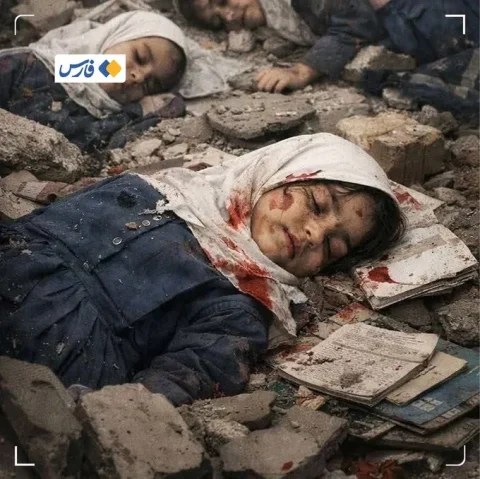
Just imagine the uproar if Iran had killed more than 150 Israeli schoolgirls
The ritual is immutable:
1/ condemn the Iranian “regime” and more or less explicitly welcome the “death” (above all, never say “assassination”) of Khamenei;
2/ having thus provided justification for the US-Israeli war of aggression — the supreme crime according to the Nuremberg Tribunal — and validated the grotesque and abject talking points of the criminals against humanity that Trump and Netanyahu are regarding the alleged “dictatorship of the mullahs,” proclaim, hand on heart, that one does not condone war and artificially dissociate the other victims of these strikes, while affirming solidarity with the Iranian people;
3/ finally and above all, make no reference to the fact that this same people took to the streets by the millions to support their “regime” in January, and are doing so again today, despite the bombs:it is not the real aspirations of the Iranian people that matter — deeply rooted as they are in their own history, values, and spirituality, infusing every aspect of their life with the teachings of Twelver Shia Islam and a deep attachment to the Prophet and his progeny — but rather those that the “civilized West” determines for them, seeking to shape them in its own godless image. Colonial mentality obliges — the same mentality that led Jules Ferry to declare that “the superior races have the duty to civilize the inferior ones.”
It is absolutely sickening to see that more than two years of genocide in Gaza have done nothing to change the crass ignorance, steeped in racism and Islamophobia, of our so-called progressive Left, whose hyperbolic reaction of solidarity we witnessed when it came to the 40 Israeli babies “beheaded” — existing solely in the putrid imagination of propagandists. In France, even La France Insoumise (LFI, main leftist party headed by Jean-Luc Mélenchon), which had managed to distance itself from the inept and complicit “neither-Maduro-nor-Trump” discourse on Venezuela, is now revelling in the war crime constituted by the assassination of a foreign leader, servilely described by Mélenchon as “the executioner of his people,” parroting US-Zionist propaganda and dismissing the millions of Iranians who hold him in reverence and regard him as their political and spiritual leader. Let us therefore listen to Mélenchon, the “Tribune of the plebs”:
“This is the first time there has been a war with no good guys. This is the first time there has been a war with only people we don’t like, I mean governments we don’t like. The government of Iran inspires no sympathy in me: for my part, I have opposed it from the very beginning. When its leader Ali Khamenei dies, I am obliged to say that I feel no sadness.
Mélenchon then claims that just as Nazism was a form of supremacism, the governments of Trump, Netanyahu and Khamenei are each in their own way supremacist powers competing for domination — going so far as to suggest that Khamenei proclaims Iran’s “superiority within Islam and over the Middle East,” an absurd characterization that serves only to justify equating aggressors with the attacked. He concludes: “Neither Shah nor Mullahs.”
No sadness, then, for Khamenei, nor for his wife, nor for his daughter, nor for his son-in-law, nor for his 14-month-old granddaughter, murdered alongside him — except insofar as one adopts the Israeli logic whereby, in order to assassinate one person, dozens or even hundreds are killed with him, invoking “collateral damage,” or even consigning them to oblivion by denying their very existence.
No sadness either for international law, the purposes and principles enshrined in the Charter of the United Nations, the fundamental norms governing relations between States, global peace and stability. Nor for the more than 100 million Iranians and Shiite Muslims throughout the world (including in France and in the other European and Western countries) who mourn the loss of their Guide — whose popularity is questioned only by the ignorant and the ideologues, as for his followers, he is more than the Pope is to Catholics — because they do not embrace the model of society promoted by Mélenchon, who opposes the Islamic Republic on principle, even were it massively supported by the Iranian people, simply because the very principle of a theocracy repels him.
Iran must be regime-changed, even if that means sending it back to the Stone Age, like Syria and Libya, destroying all its incredible accomplishments since 1979 in fields such as healthcare, education, and the sciences — achievements made despite crippling sanctions and persistent external pressures, just like Cuba, from dramatic improvements in life expectancy to the expansion of medical and higher education, rapid growth in research output and scientific innovation, and self-sufficiency in pharmaceutical and high-tech sectors. Iranian women are 70% of Iran’s STEM graduates (Science, Technology, Engineering and Mathematics), but one must guess they are not “free” until they wear miniskirts. Such blindness and the outright denial of the right to political and cultural self-determination are outrageous.

“I feel no sadness”
Although Western tradition humanizes only Israeli victims, deemed alone worthy of compassion, let us defy convention and give a name and a face to the martyrs: above, Zahra Mohammadi Golpayegani, 14 months old, Khamenei’s granddaughter, murdered with her family. No sadness, really? And below, several faces of the victims of the strike on a girls’ primary school — how abominable single-gender education must seem in your eyes — whose wearing of the veil, which Mélenchon once described as a “rag on the head,” may perhaps shock you.
Mélenchon, whose condemnations and impassioned outbursts after October 7 are well remembered — when the Palestinian Resistance had merely exercised its right to struggle against occupation (and Israel responded with the Hannibal doctrine and genocide) — would he dare to say “I feel no sadness” if Trump or Netanyahu had been killed along with their wife, children, and grandchildren, without provocation, triggering a regional war that could quickly becomeWorld War III? Never in a million years. He would have condemned the very act of international terrorism constituted by the aggression and assassination of a foreign leader, evoked all its potentially cataclysmic ramifications, and explicitly mentioned the victims. But when it comes to Iran, none of this matters. Iranian and Israeli lives are not equal in the eyes of the “supremacists,” whether ethnic, political, or civilizational — are they, Mr. Mélenchon?
As for Mediapart, long regarded as one of France’s leading left-leaning media outlets, it no longer even bothers to conceal its Atlanticist and Zionist allegiances, openly embracing them. It congratulated Israel on the “tactical stroke of genius” represented by the mass terrorist beeper attack against Lebanon (later discreetly revising the description to a “strategic success” once it recognized that the original wording was apologetic), and is now explicitly turning the victim into the culprit, daring to claim that Iran had it coming because it refused to “capitulate on its foundations,” namely its defense capabilities (nuclear weapons being nothing more than a crude pretext), and refused to allow itself to be carved up (see the surreal article Rather than Capitulate on Its Foundations, the Iranian Regime Prefers to Endure War, torn to pieces by the comments of Mediapart subscribers themselves, who are increasingly turning their backs on this vile NATO bootlicking). France remains, without a doubt, the daughter of Jules Ferry the colonialist and Pétain the collaborationist.
If our grandees truly cared about international law, the rights of peoples, and global peace and security, the assassination of Khamenei would be unanimously condemned with horror and indignation, both in itself and for the cataclysmic consequences it could entail, from a global economic crisis to a third world war. If “human animals” possessed as much dignity as Western and Israeli lives in the eyes of our self-proclaimed “feminists,” the Iranian schoolgirls targeted by Israel would make every front page — and draw condemnations dwarfing those provoked by the fake story of 40 decapitated babies. Instead of ludicrous accusations of expansionism or imperialism toward Iran, we would be reminded at every second that Israel — the intergalactic champion of killing children and destroying schools and hospitals — dreams of turning the entire Middle East into Gaza, and wants to ensure Trump follows through on “Operation Epstein’s Fury” to the very end.
The great historical tradition of international solidarity, which once led French men and women to risk their lives and endure torture in support of the Algerian FLN, is no more. At best, one can expect the “progressives” and other self-styled “revolutionaries” to place aggressor and victim on the same footing. Far from those who claim neutrality in situations of injustice, and who, as Desmond Tutu said, merely play the game of the oppressor, we affirm our genuine internationalist solidarity with the Islamic Republic of Iran in the face of imperialist and Zionist aggressors, and affirm not only its right to defend itself, but its right to choose its model of society, including that of a “theocracy,” which is only a dirty word for fanatic secularists.
This blog is the result of voluntary work. To support it, you can make a donation.
Iran no longer has any reason for restraint
By Samuel Geddes | Al Mayadeen | March 3, 2026
Tehran may well refuse US-Israeli pleas for a ceasefire until the region is transformed.
Both Trump and Netanyahu find themselves in an extraordinarily vulnerable position. They have given their greatest ideological opponent the means and the justification to extract maximum damage from them, as well as ceasefire conditions that would truly make this conflict a turning point in modern history.
President Trump clearly believed, at Netanyahu’s encouragement, that assassinating Iran’s Leader would pressure it to soften its negotiating position on the nuclear file. What he did instead was to shatter nearly a decade of Iranian restraint in the face of relentless provocation.
Trump has rendered both Washington and Tel Aviv more desperate for an end to the war than Iran. In addition to retribution for the assassination of the Leader of the Revolution, Tehran is calling in the debts of Trump’s “maximum pressure strategy” in full.
Ever since Trump’s withdrawal from the JCPOA in 2018, Tehran has attempted to limit the rate of escalation, especially following the assassination of Quds Force commander Gen. Qassem Soleimani in 2020 and others across various arenas since October 2023’s Al-Aqsa Flood.
Netanyahu’s domestic political interests have been the opposite, deliberately prolonging the genocidal onslaught in Gaza, expanding it to the West Bank, Lebanon, Syria, Yemen, Iraq, and from 2024, Iran, when it bombed the Damascus consulate. He followed up by assassinating Hamas leader Ismail Haniyeh in Tehran and much of Lebanese Hezbollah’s leadership.
By June last year, he had attained his life-long goal of drawing Washington directly into hostilities with Iran when it bombed the Natanz, Fordow, and Isfahan nuclear facilities. Now he has obliterated the ultimate red line with the airstrike that martyred Ayatollah Sayed Ali Khamenei.
As US and Israeli military sources themselves acknowledged, even before the outbreak of war, stockpiles of missile defense munitions were critically low. The 12 days of direct war between Iran and “Israel” last year cut deeply into the regime’s Iron Dome, Arrow and David’s Sling systems before Washington stepped in to impose a ceasefire.
Now that Iran and Hezbollah are unleashing their arsenal, the ability of Israel, US forces and GCC states to avoid catastrophic blows is being measured in days rather than weeks. The global supply of these munitions has been further strained by shipments sent to Ukraine and will be insufficient to resupply the West Asian theatre well before the end of this week. This will critically expose western assets not just in the region but globally, for years to come.
As of just the third day of the war, maritime traffic through the Strait of Hormuz is effectively at a standstill. In Saudi Arabia, Ras Tanura, the most crucial oil refinery in the world, has sustained impact from drones and halted operations.
Even without direct hits on regional energy infrastructure, GCC oil producers will be forced to halt production within three weeks due to a lack of storage capacity. President Trump’s favorite metric of economic performance, the stock market, is staring down the barrel of an energy shock unseen since 1973, and which may well exceed that crisis. The frail state of the US economy, combined with the global blowback to its tariff policy, could easily tip into recession or even depression. This would be shattering to the petrodollar system as well as the very status of the US Dollar as the global reserve currency.
Once Iranian missiles are unimpededly striking vital military and economic targets in “Israel” daily and inflicting mass casualties on US forces from the Eastern Mediterranean to the Arabian Sea, the Islamic Republic will be able to impose extraordinary conditions merely in exchange for a halt to the war. It will plausibly be able to demand the unconditional lifting of all Western sanctions, not just against itself, but against Yemen, Lebanon, and Gaza. It will also be able to dictate the end of Netanyahu’s regional escalation spree, forcing “Israel’s” withdrawal from Gaza, Lebanese and Syrian territories, and re-establishing a balance of terror that ensures an indefinite calm, even if a limited one.
Alternatively, it could, in emulation of Ansar Allah in early 2025, agree a separate ceasefire with Washington, leaving them a free hand to continue full-scale bombardment of “Israel”.
Assuming the intensity of hostilities doesn’t achieve this first, it could also demand the definitive withdrawal of US forces from the Persian Gulf, ending America’s hegemony over the region and the world by extension.
Israel launches Bible study program targeting US evangelicals
The new initiative features Israeli soldiers, West Bank settlers, and a pastor of Messianic Judaism as key voices
By Nick Cleveland-Stout and Connor Echols | Responsible Statecraft | February 28, 2026
An Israeli-funded firm is hoping to boost evangelical support for Israel through a guided Bible study program that features interviews with Israel Defense Forces soldiers, theologians, and West Bank settlers, according to a new website uncovered by RS.
The firm, California-based Show Faith by Works, is launching a new initiative called “Hear from us,” featuring an eight-part series of lessons that mix typical Bible study prompts with stories about the importance of modern Israel.
Show Faith by Works previously sparked outrage among some evangelical communities after proposing a campaign to geofence churchgoers’ phones during worship hours to deliver pro-Israel advertisements. Since September, the Israeli government has invested over $3 million in the firm.
Republican strategist Chad Schnitger, who is overseeing the influence operation, hopes his initiative will shore up Gen Z support for Israel. While 70% of evangelicals over age 60 support Israel, only 39% of evangelicals between 18 and 29 do, according to a Marquette University Law School survey from late last year.
Schnitger says his funders at the Israeli Foreign Ministry want him to focus narrowly on religious issues. “They’ve not asked me to talk about politics, they’re not asking me to talk that much about the war,” Schnitger said. “This is here to be a champion for the Christian church and take the message to the American Southwest.”
But the materials on his website, reported here for the first time, suggest a blurry division between religion and politics. A sample booklet, for example, denies that “Hear from us” represents a “political movement” but appears to embrace controversial views on the Israeli-Palestinian conflict. For instance, the pamphlet displays a map of Israel that shows full Israeli control over the Palestinian territories and the Golan Heights, which are internationally recognized as Syrian land.
The booklet’s release comes amid rising concern over possible expansion of Israel’s territorial claims. Just last week, U.S. Ambassador to Israel Mike Huckabee told Tucker Carlson that “it would be fine” for Israel to take control of territories belonging to Arab states, including the West Bank and Gaza. Asked about the remarks, Israeli opposition leader Yair Lapid said that Israel’s borders should be “as broad as possible.”
Schnitger did not respond to a request for comment from RS.
‘GAZANS GOTTA GO’
Hear from us’ guided Bible study features interviews with several speakers whose views are controversial, both within Israel and among critics of its conduct in Gaza. One such interviewee is Chaim Malespin, an IDF Sergeant Major who runs an organization that helps Jewish immigrants move to Israel and “provides essential support” to Israeli soldiers.
Malespin has long faced criticism from anti-missionary groups in Israel, who have alleged that he seeks to evangelize Jews and convert them to Messianic Judaism, which follows some Jewish traditions but considers Jesus the Messiah. He drew criticism in 2022 for his viral claim that Lapid’s wife is secretly a Messianic Jew, which he later apologized for. On another occasion, the Jewish Agency cut its partnership with Malespin’s organization for having “created the perception” that it evangelizes.
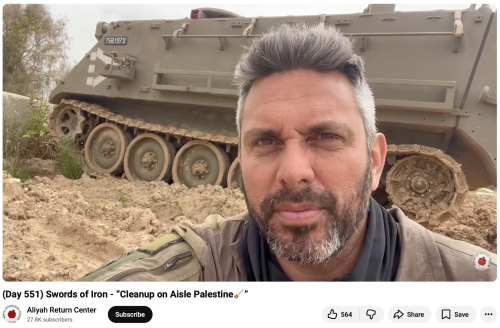
Since October 7, Malespin has posted daily updates on the Gaza War. In one video posted after the United Kingdom recognized Palestine, Malespin said Palestinians “don’t want to do anything but destroy Israel.” Another video, titled “Cleanup on Aisle Palestine,” featured Malespin reacting to what sounded like Israeli bombing of Gaza. “Wow, loud explosions huh?” said Malespin, standing in front of an Israeli armored vehicle.
Perhaps most inflammatory are the views of Yishai Fleisher, who joins the program for a study session that carries “the story [of Israel] forward,” according to the sample booklet. Fleisher is among the most prominent advocates of Israeli annexation of the West Bank and Gaza, a policy that he has championed as the spokesperson for the settler community in the segregated West Bank city of Hebron.
Fleisher has long railed against the idea of a two-state solution, arguing that Israel should have full control of the area between the Mediterranean Sea and the Jordan River and that Palestinians should have limited rights. In a recent video posted on his popular YouTube channel, Fleisher said that Carlson, in his interview with Huckabee, was “spitting on the God of Israel,” adding that the American political commentator “needs to be taken down” like the Biblical Goliath.
The prominent settler is also a frequent commentator on U.S. policy toward Israel. He has referred to the American Israel Public Affairs Committee’s annual conference as the “Fourth Pilgrimage Holiday,” after the traditional Jewish holidays of Sukkot, Shavuot and Passover. In a podcast episode entitled “GAZANS GOTTA GO,” he advocated for the ethnic cleansing of Gaza and likened pro-ceasefire protestors on American college campuses to the Amalekites, who were massacred by the army of Saul, according to the Bible.
“Amalekites come for the Jews because they know that Jews represent civilization,” he said. “That’s what we’re seeing with the Jihadis on campus in the United States.”
Another interviewee is Messianic Jewish Pastor Avner Boskey. The preacher has written lengthy criticisms of Islam, warning in one pamphlet that “paganism and demonic worship are the spiritual matrix out of which Allah was elevated.” And, when Zohran Mamdani was elected mayor of New York City last year, Boskey wrote a piece with the subheading, “When The Upper West Side Turns Into The Lower West Bank.”
Destiny Magnett, Programs and Outreach Manager at Churches for Middle East Peace, told RS that the initiative contributes to the erasure of Palestinian culture, heritage, and history. Much of the sample booklet, for example, promotes a controversial new archaeological site called the Pilgrimage Road that cuts through a Palestinian neighborhood in Israeli-occupied East Jerusalem and has caused structural damages to local homes.
“Pilgrimages to this land simply don’t exist in a vacuum detached from the everyday realities of people on the ground,” said Magnett. “Acknowledging that should be part of the responsibility undertaken by anyone working at the intersections of faith and Israel/Palestine.”
Shifting strategies
Show Faith by Works’ initial plan, filed under the Foreign Agents Registration Act (FARA), indicated that the firm would “geofence” the physical boundaries of major churches in the American Southwest during worship times in order to “track attendees and continue to target [them] with ads” on behalf of Israel.
But the campaign was met with backlash from many congregations. The Christian Life Commission of Baptist General Convention of Texas urged church leaders to sign a letter calling on Attorney General Pam Bondi to prohibit foreign government use of tracking technologies at churches. A campaign and website called “show mercy and do likewise” was created as an interfaith project to support Christians being targeted by the campaign. Timothy Feldman, an attendee of one of the churches listed, told RS, “It was a strange feeling to see my local church directly targeted by a foreign country committing a genocide on the other side of the world.”
Show Faith by Works responded to the concerns by defending the geofencing campaign. Schnitger, the founder of the firm, told RS in an email at the time that “irresponsible” media outlets had “sensationalized” the firm’s use of geofencing. “It is a very common marketing tool that literally every person with a smartphone in America has experienced in one way or the other,” Schnitger explained. He later revealed that he was scrapping the geofencing campaign “due to security concerns.”
It is unclear whether this pivot will help Schnitger and the Israeli government win more support among Evangelicals. Uriesou Brito, presiding minister of counsel for the Communion of Reformed Evangelical Churches and senior pastor of Providence Church in Pensacola, told World — a media outlet that says it is “grounded in facts and biblical truth” — that he disagrees with Show Faith by Works’ approach. “My general principle has been that we should always be cautious when any government funds religious or theological outreach,” said Brito. “The concern in my estimation is not unique to Israel.”
Nick Cleveland-Stout is a Research Associate in the Democratizing Foreign Policy program at the Quincy Institute. Previously, Nick conducted research on U.S.-Brazil relations as a 2023 Fulbright fellow at the Federal University of Santa Catarina.
Did Israel Just Forfeit Its ‘Right To Exist’? — Carlson’s Interview with Huckabee
By Robert Inlakesh | The Palestine Chronicle | February 28, 2026
Key Takeaways
- Senior political figures openly endorsed a Nile-to-Euphrates territorial vision.
- The “Greater Israel” concept is no longer fringe rhetoric.
- Israel’s borders remain undeclared while territorial expansion continues.
- Legal justifications rooted in Balfour and UNGA 181 are increasingly strained.
- The demand to recognize Israel’s “right to exist” faces growing scrutiny.
The Mainstreaming of ‘Greater Israel’
There is no nation on earth whose government constantly demands its critics acknowledge its ‘right to exist’ as does Israel; this is because it seeks the world’s acquiescence as a means of enabling the indefensible. In truth, nobody, short of Christian Zionists and Jewish Supremacists believe Israel has a right to exist.
In Tucker Carlson’s recent interview with US Ambassador to Israel, Mike Huckabee, the idea of Israel’s legitimacy was not only touched upon, but completely unraveled through a basic series of questions. Instead of furiously clashing with the self-described Christian Zionist, all Carlson did was ask serious follow-up questions and demand answers.
Since then, the fallout from what was a trainwreck of an interview for Huckabee has triggered a wave of backlash from countries throughout the region. The US ambassador triggered this backlash after affirming his belief that Israel is entitled to all of the land between the River Nile and the Euphrates River, as part of its biblical right to exist.
This enormous land grab is what is known as the ‘Greater Israel Project’, once dubbed an outlandish conspiracy theory. ‘Greater Israel’ would include all of Lebanon, Jordan, Palestine, most of Syria, along with parts of Iraq, Saudi Arabia, Egypt, and even Turkiye. Therefore, it is no wonder that a US ambassador expressing his belief that Tel Aviv is entitled to all of this territory drew the ire of the entire region.
However, an even more important development came only days later, receiving much less media attention. The leader of the Israeli opposition, former Prime Minister Yair Lapid, expressed his own belief that Israel should seize all of the territory between the Nile and the Euphrates. Pegged as the more liberal and moderate opponent of Israeli Premier Benjamin Netanyahu, Lapid argued that the territory should be seized only when the right “security” predicament presents itself.
Even though Lapid’s comments did not draw the same kind of backlash from the Arab world’s leadership, his open confession of belief in a biblical right to all of ‘Greater Israel’ is a more important and damning development than the comments of Huckabee. This clearly demonstrates that the entire mainstream Israeli political establishment seeks to achieve this vision.
The Loss of Legitimacy
As pointed out during Tucker Carlson’s interview with the US ambassador to Israel, the infamous Balfour Declaration was written by British Lord Arthur Balfour to Lord Walter Rothschild. An important fact that is often never brought into question as the Balfour Declaration is often cited as a legal document justifying Israel’s existence. Instead, it was a document between two men.
From there, Israeli propagandists will point to later British government declarations as cementing this ‘right to establish a Jewish State in occupied Palestine. Finally, there is the 1947 United Nations General Assembly resolution 181 that is held up as Israel’s de facto birth certificate. This, of course, ignores the fact that Israel was only granted 56% of the land, yet seized nearly 80% of the entire territory.
However, all of this is now irrelevant to the question of Israel’s alleged legitimacy and ‘right to exist’. The reason for this is very simple: the British sought to grant the territory of occupied Palestine, and so too did the UNGA resolution 181. No legal document exists to legitimize the occupation of Syrian and Lebanese lands, as the Israelis continue to expand their borders into these neighboring nations.
Which brings us back to the alleged ‘biblical’ right to existence that the US ambassador, Israeli PM Benjamin Netanyahu, and opposition leader Yair Lapid have all expressed their belief in. The Israelis have historically occupied Egyptian territory, and many Israeli politicians, including current ministers in the Likud Party’s coalition government, have expressed their desire to return to Egypt once again.
The Politics of the ‘Right to Exist’
Israel has never declared its borders, and since 1967 has occupied territory from both Syria and Lebanon, in violation of international law. At this current moment, it is capturing more and more land in southern Syria on a near-daily basis.
Therefore, Israel, as a nation that has no definable borders and whose political leadership, along with its society, believes in its biblical right to seize the territory belonging to its neighbors, has no legal basis to exist as it does today. It has committed genocide, apartheid, mass ethnic cleansings, and operates a system of total Jewish Supremacy in all the land it has seized, through war.
In addition to this, the Zionist movement has actively worked, especially since October 7, 2023, to not only undermine the United Nations as a whole, but to replace it. Yet turns around and cites a UNGA resolution as its ‘legal right to exist’. It violates all known diplomatic norms, having attacked the former Iranian embassy in Syria, bombarded Doha despite its status as a US ally, while ignoring a UN Security Council resolution calling for a ceasefire in Gaza back in 2024.
The only argument that can be made for the continued existence of Israel as it functions today is an ideological one. This means that only two categories of human beings fit into this camp, Jewish Supremacists who believe in a biblical title to the land, and their Christian Zionist allies, who also provide a similar, theologically grounded argument.
There is no evidence that the majority, or even a plurality, of Christians believe in the concept of a ‘Greater Israel’, despite the best efforts of Christian Zionist lobby groups – the most powerful of which operate in the United States. In other words, a very small portion of the global population believes in this biblical interpretation. Even more troubling for the Zionist movement is that its settler colonial project was founded and led for much of its history by atheists.
If we are to define Israel by its current borders, which are undeclared and forever expanding, then there simply is no basis for arguing its existence, unless you do so from a theological perspective. As demonstrated through the questions offered to Ambassador Huckabee, who is himself a Christian pastor, there is no way of demonstrating that the Jewish population, or at least the majority of those Jewish people living in occupied Palestine, are directly related to the Israelites of the bible. In fact, all of the available DNA evidence would suggest that the Palestinians are more closely blood related to that population.
There is no nation on earth today that operates a system of ethno-religious supremacy as Israel does, no nation that violates international law as Israel does, nor is there another nation that bases its legitimacy on isolated and out of context passages from religious texts like Israel does either.
The reason why pro-Israel advocates are constantly demanding that everyone validate their legitimacy and ‘right to exist’ is simple: the affirmation of their flimsy arguments is what provides them the basis to continue behaving as the out-of-control regime that Israel is.
What Israel’s ‘right to exist’ comes down to is the belief that it should be allowed to dispossess millions of Muslims, Christians, and other indigenous peoples of their lands, in order to establish a system of domination. That ethnic cleansing is its right, the acquisition of territory via war is its right, and that committing mass murder against anyone who fights back is also their right.
Israel’s biblical ‘right to exist’ is just as valid as its right to kill entire populations it deems to be ‘Amalek’. If they do have that right, then so too does the so-called “Islamic State” terrorist organization.
The arguments made by Daesh (ISIS) and Israel for their ambitions to establish ever-expanding regimes of tyranny both carry the exact same level of historical and factual legitimacy. That is to say, neither argument carries any weight, beyond it being the belief of an isolated group of extremists – amongst the global population – who believe in a warped religious ‘right’ and that their theological arguments make them superior to all other human beings.
– Robert Inlakesh is a journalist, writer, and documentary filmmaker. He focuses on the Middle East, specializing in Palestine.
Female Iranian academic sentenced to 4 years in prison in France over protesting Israel’s genocide in Gaza
Press TV – February 26, 2026
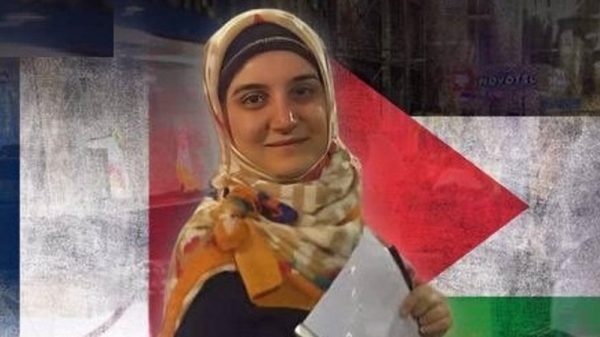
An Iranian academic woman in France has been sentenced to four years in prison after she protested Israel’s genocide in the besieged Gaza Strip, with a permanent ban on her entry into the European country.
A court in France on Thursday, sentenced Iranian citizen Mahdieh Esfandiari, who had been detained on alleged charges of “public defense of terrorism,” to four years in prison, France 24 reported.
According to the court ruling, Esfandiari, a linguist and French language graduate, received a four-year sentence, three years of which were suspended and one year to be served.
The 39-year-old Iranian citizen had previously spent eight months in pretrial detention before being released under conditional terms.
The court also permanently barred Esfandiari from entering French territory.
Esfandiari graduated from Lumière University, where she worked as a professor, translator, and interpreter. She has also been a prominent pro-Palestinian activist with a significant online presence.
Her arrest last year came amid a crackdown in the United States and other Western countries targeting scholars, students, and activists who opposed Israeli genocide and advocate for peace, both on campuses and in public spaces.
The Paris Prosecutor’s Office charged the Iranian academic with “apologie du terrorisme” over Telegram posts that allegedly supported the Hamas-led Operation Al-Aqsa Flood against Israel in October 2023.
US university cancels Palestine conference citing sanctions concerns
Al Mayadeen | February 26, 2026
The University of Southern Maine has withdrawn permission to use a campus venue for a conference centered on Palestine, just days before it was scheduled to begin, triggering a dispute over sanctions law and First Amendment protections.
The event, titled “Consequence of Palestine,” had drawn more than 300 registrants and was organized by the Maine Coalition for Palestine, Maine Voices for Palestinian Rights, and the university’s department of criminology and sociology. It was expected to feature virtual remarks by Francesca Albanese, the United Nations special rapporteur for the occupied Palestinian territories, who has been under US sanctions since last year.
University officials said the decision was based on federal sanctions law. Samantha Warren, chief external and governmental affairs officer for the University of Maine system, told The Guardian in an email that “hosting a conference that is being actively promoted as including a speaker sanctioned by the US government would put our public university in violation of federal law”. She said organizers should have obtained authorization from the Treasury Department before proceeding.
Sanctions regulations prohibit US entities from providing “any goods or services” to individuals designated under sanctions regimes. Violations can carry severe penalties, including heavy fines and potential prison time. However, legal scholars argue that the scope of what constitutes a “service” remains ambiguous.
Campus rights clash
In December, the Treasury Department’s Office of Foreign Assets Control (OFAC) clarified in correspondence with the Middle East Studies Association that “no authorization” was required to include Albanese in an academic event, provided that she did not receive payment, reimbursement, or “training or assistance”. That clarification emerged after concerns were raised about the impact of sanctions on academic exchange.
Xiangnong Wang, a staff attorney at the Knight First Amendment Institute who had sought clarification from OFAC, said the cancellation reflects broader concerns about the chilling impact of sanctions on constitutionally protected speech. “It’s very concerning that sanctions continue to have such a broad deterrent effect on speech that is undoubtedly protected by the First Amendment,” he said.
Organizers said they were caught off guard by the abrupt cancellation. Abigail Fuller, a sociology professor involved in planning the conference, stressed the constitutional implications of the decision. “We’re a public university; the university system is subject to First Amendment laws,” she said. “We feel we have a very, very strong case that they are suppressing our free speech.”
According to organizers, they attempted to clarify that federal guidance did not require special permission to include Albanese. They even proposed removing her from the program in an effort to preserve the event. They were subsequently told there was insufficient time for administrators to evaluate the conference’s “risk”.
Speech under pressure
The dispute comes amid reports that Republican lawmakers had written to the system’s chancellor requesting “information on steps the university is taking to ensure the safety and well-being of its Jewish students”. Organizers believe such political pressure contributed to the reversal and said administrators had also expressed concern about possible federal funding consequences.
Albanese was sanctioned last July, with US authorities accusing her of “unabashed antisemitism, expressed support for terrorism, and open contempt for the United States, Israel, and the West”. She has previously rejected those allegations and criticized the move as politically motivated, describing the United States as “a country of contradictions, full of ideals and principles and still, plotting against democratic values”.
The Treasury Department did not immediately respond to requests for comment on the university’s interpretation of sanctions law.
Despite losing access to their campus venue, conference organizers say they are seeking an alternative location and are exploring possible legal action. Fateh Azzam, a member of the Maine Coalition for Palestine, said canceling the conference outright was not an option.
“That would mean that they have effectively silenced an open and public debate on the issues,” he said. “This controversy will probably bring in more people.”
Israel displaces last two families from Al Khalayel valley, Al Mughayyir
Palestine Solidarity Movement | February 25, 2025
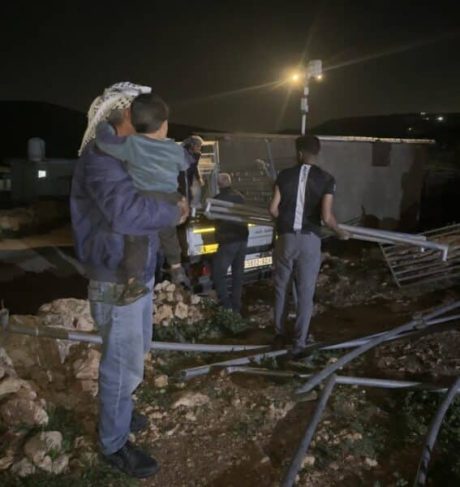
A violent campaign aimed at forcibly displacing Palestinian families from the Al Khalayel valley south of Al Mughayyir (occupied West Bank) has achieved its goal. Two years of coordinated attacks between illegal settlers and Israeli occupation forces finally pushed out the last two remaining families: Abu Najeh and Abu Naim/Abu Hamam.
The Abu Najeh family compound comprised 12 families, around 50 people in total. They have been forcibly displaced 7 times in the last 80 years. They moved to Al Khalayel just 2 years ago after being displaced from Ein Samiya in 2023; investing significant resources into establishing what they hoped would be a permanent home on the land they owned. On Tuesday, February 17, Israeli forces entered their homes seeking to arrest three men under false accusation that they threw rocks at settlers. When they did not find them, they broke two security cameras and arrested 55 year-old Mustafa Omari for filming illegal settlers. He was imprisoned until 10am on Wednesday February 18.
One of the three men they sought to arrest is 32 year-old Majid Omari, who was terrified he would be sought out and beaten or killed by settlers who know his face and his car. “Urgent intervention is needed to protect us,” he said. On Friday February 20, the Abu Najeh family came to the devastating conclusion that they could no longer withstand the violence and harassment and rapidly commenced packing up and deconstructing their homes, working through the night out of fear of a settler attack.
 At approximately 12:00 the following day, Saturday February 21, while the Abu Najeh family was packing, illegal Israeli settlers began surveilling the only other remaining Palestinian home in the area, that of the Abu Naim family, with drones. At approximately 14:00, 6 underage settlers in a four-wheel-drive vehicle arrived at the home, verbally abusing and harassing everyone present. Shortly afterwards, the army arrived and conducted a search before withdrawing with the settlers. At approximately 16:00, two settlers entered the front yard with their sheep. Minutes later, approximately 12 settlers forced their way into the home, wrecking the family’s furniture and belongings, smashing their electricity sources, emptying their water tank causing the property to flood, destroying their bathroom and shower. They trapped 39 year-old mother Hidayah Rizq Awad Abu Naim, her 13 year-old daughter Ilham Wadi Abu Naim and 70 year-old father Rizq Awad Mahmoud Abu Hamam in the home and violently beat them.
Simultaneously, as members of the nearby village of Al Mughayyir attempted to support the family, Israeli forces conducted a violent raid, firing tear gas at residents. Armed Israeli settlers and Israeli soldiers shot live rounds at residents and international activists to prevent them from reaching the Abu Naim family home. Two family members were shot: 36 year-old Ayham Rizq Awad Abu Naim was shot in the back and his nephew, 13 year-old Naseem Shaker Thabta was shot in the foot. Ayham faces a lengthy rehabilitation process.
That night, after settlers retreated to the nearby illegal outpost and the injured were being treated at the hospital, members of the community alongside two international activists returned to the Abu Naim home to salvage the belongings that had not been destroyed. In a final act of resistance they set fire to what was left so that the illegal settlers would not materially benefit off of their homes and belongings.
The next morning, February 22, a few men of the Abu Najeh family returned to their property to retrieve their final items and self-demolish their homes in the same act of resistance as the Abu Naim family. By 10am they were forced off their land by illegal settlers. As they departed, settlers set fire to their remaining structures.
These two forced displacements were a coordinated effort between the Israeli forces and illegal Israeli settlers as part of a broader goal to displace all 5,000 residents of Al Mughayyir. Without regard for International Humanitarian Law or Human Rights, Israel continues building a chain of illegal settlements and outposts connecting Ramallah, Nablus and the Jordan Valley. In a deportation hearing held on February 1 concerning activists from the International Solidarity Movement (ISM) who volunteered with the Abu Najeh and Abu Naim families, the Israeli State claimed the reason for their incessant harassment towards Palestinian communities there was “expelling Bedouin people who illegally occupy the area”. This officially admits an ethnic cleansing objective in lands that are under the civilian control of the Palestinian Authority (area B).
In a final statement, a 23 year old nephew of the Abu Naim family shared: “We left against our will, but the land remains and will return to its original owners.
What happened is a serious attack that demands accountability. Places may be erased from the map, but they remain in memory, and the steadfastness of their people is a testament to their adherence to their right. The land belongs to its owners, and it will remain so, God willing.”
Islamic Jihad: Trump’s peace board is a “theatrical stunt detached from reality”
Palestinian Information Center – February 25, 2026
BEIRUT – Mohamed al-Hindi, Islamic Jihad’s deputy secretary-general, has described the US-led Board of Peace as nothing more than a “theatrical stunt,” saying it is detached from the reality on the ground.
In an interview with Al Jazeera Mubasher satellite channel on Wednesday, Hindi stressed that the board’s recent meeting “has not brought about any change in the course of the Israeli war on the Gaza Strip or in the scale of Israel’s ongoing violations against Palestinians.”
Hindi affirmed that this peace council was founded on a “formula of absolute American dominance and full security for Israel, while denying the Palestinian people the right to shape their own future.”
“The Palestinian role in this framework is purely symbolic, confined to technocratic committees handling Gaza’s municipal affairs without any sovereignty or political power,” Hindi said.
“The proposed vision fully embraces Israel’s stance, linking Gaza’s reconstruction to resistance groups surrendering their weapons, without any serious discussion of an Israeli withdrawal or accountability for ceasefire violations,” the Islamic Jihad official added.
He underscored that his Movement never trusted the US administrations under president Donald Trump or his predecessor Joe Biden, citing America’s unwavering pro-Israel bias.
He said that the Palestinian acceptance of prior understandings over Gaza aimed solely to put an end to Israel’s relentless massacres against civilians.
Pentagon sets deadline for Anthropic to lift AI restrictions on autonomous weapons systems, mass domestic surveillance
The Cradle | February 25, 2026
The US Department of War has issued a deadline to AI company Anthropic to allow broader military use of its Claude models or face possible action under the Defense Production Act.
The company could face losing its Pentagon contract, and has been threatened with a government blacklist, US media reports said.
The Pentagon has a $200-million contract with Anthropic. The company has placed guardrails on the Claude AI, preventing its use for fully autonomous weaponry and mass domestic surveillance, triggering a standoff with US Secretary of War Pete Hegseth.
Hegseth met with Anthropic CEO Dario Amodei on Tuesday. According to CNN, the CEO held firm on the restrictions.
Amodei has until Friday at 5:00 pm to “get on board or not,” a source told CNN.
If it does not, Hegseth will make sure “the Defense Production Act is invoked on Anthropic, compelling them to be used by the Pentagon regardless of if they want to or not.”
“Anthropic has concerns over two issues that it isn’t willing to drop, AI-controlled weapons and mass domestic surveillance of US citizens. Anthropic believes AI is not reliable enough to operate weapons, and there are no laws or regulations yet that cover how AI could be used in mass surveillance,” CNN’s sources went on to say.
According to Axios, Washington has threatened to declare Anthropic a “supply chain risk.”
“The only reason we’re still talking to these people is we need them and we need them now. The problem for these guys is they are that good,” a US official told Axios.
Anthropic said it remains engaged in “good-faith conversations” to support national security “in line with what our models can reliably and responsibly do.”
Claude has already been used by the US military for intelligence analysis, mission planning, and satellite imagery processing.
Washington reportedly used the AI model in the mission to illegally kidnap Venezuelan President Nicolas Maduro. This came via Anthropic’s partnership with Palantir, which has entered into multi-billion-dollar partnerships with the US and Israeli governments, and has been used in the Gaza genocide.
Several other AI systems were used to kill Palestinians.
The Pentagon has been negotiating AI contracts with major firms, including Anthropic, Google, OpenAI, and xAI, with each contract valued at up to $200 million.
Palantir CEO Alex Karp openly stated this month that his company is dedicated “to the service of the west and the United States of America” and aims to “disrupt” and “on occasion” to “kill” the enemies of the west and the US.
Israel designates five Palestinian media outlets as ‘terrorist organizations’
The Cradle | February 23, 2026
Israel’s Defense Ministry has designated five Palestinian news platforms in occupied East Jerusalem as “terrorist organizations,” alleging “incitement” and links to the Palestinian resistance movement Hamas, Israel’s Channel 12 reported on 22 February.
“Defense Minister Israel Katz signed an order designating these platforms as terrorist organizations, and the Attorney General confirmed that there is no legal obstacle,” Channel 12 reported, adding that the outlets “are accused of incitement by focusing on developments in (East) Jerusalem and Al-Aqsa Mosque,” it added.
The order targets Alasima News, M3raj Network, Al-Quds Albawsala Network, Maydan Al-Quds, and Plus Quds Network, none of whom maintain offices in occupied East Jerusalem.
Alasima News said it was suspending all media activities until further notice, while the other four platforms issued no immediate comment.
“In a new step added to Israel’s record of repression and gagging, the occupation has banned the work of several Jerusalem-based news networks in an attempt to isolate Jerusalem and Al-Aqsa, monopolize them, and suppress their news from the world,” Alasima said in a statement.
The outlet expressed pride in “what it has achieved over the past years,” stressing that its motto “has always been to make Jerusalem the focus and compass of the (Palestinian) cause.”
“The Israeli ban will not hide the truth. Silencing the camera will not silence Jerusalem. The narrative written in blood and resilience is stronger than any prohibition,” it added.
Rights groups have identified Israel as the single deadliest country for journalists in recent years, with more than 250 media workers killed since the start of the Gaza genocide across Israel’s various theaters.
Meanwhile, independent foreign reporters remain barred from entering Gaza except through the Israeli military.
Israel’s crackdown on Palestinian freedoms has intensified in parallel with a marked rise in violent settler attacks across the occupied West Bank.
Over the past year, Israeli attacks and crackdowns have displaced around 25,000 Palestinians from the Tulkarem and Nour Shams refugee camps in the occupied West Bank, according to local authorities, with raids, infrastructure destruction, and prolonged closures forcing families from their homes.
The broader campaign of aggression, launched in January 2025 and centered on refugee camps in Jenin and Tulkarem, has uprooted roughly 40,000 people across the occupied West Bank this year alone, while satellite imagery shows nearly half of Nour Shams Camp buildings damaged or destroyed since early last year.
The most recent settler attack saw part of the Abu Bakr al-Siddiq Mosque in the village of Tell, near Nablus, set ablaze and defaced with racist graffiti.
Since 7 October 2023, more than 1,000 Palestinians have been killed by settlers and soldiers in the West Bank.
Official data cited by the Times of Israel shows that over 99 percent of complaints filed by Palestinians against Israeli soldiers in recent years were closed without indictment, with just 23 indictments out of 2,427 complaints recorded between 2016 and 2024.
Israel’s security cabinet approved on 8 February new measures aimed at drastically overhauling the occupied West Bank’s legal and civil framework, allowing Tel Aviv to further expand illegal settlements and strengthen its grip on the territory.
During the month of Ramadan, Israeli authorities greatly restricted the entry of West Bank Palestinians to Jerusalem to 10,000 worshippers for the first Friday prayers at Al-Aqsa mosque, far below the 250,000 seen in previous years, enforcing age and permit restrictions that left hundreds stranded at checkpoints.
Israel, not America, first: Carlson’s Huckabee interview lays bare US foreign policy priorities
By Maryam Qarehgozlou | Press TV | February 23, 2026
In a recent interview with the US ambassador to the Israeli-occupied territories, Mike Huckabee, prominent US journalist and commentator Tucker Carlson confronted an Israeli-led system of intimidation, censorship, and foreign influence shaping American policy.
In a blistering monologue before his sit-down with the controversial American diplomat, Carlson framed his trip to Israeli-occupied territories not as a routine diplomatic media engagement, but as a revealing encounter with an entrenched apparatus exerting sway over American power.
The interview, conducted at the high-security Ben Gurion Airport, 20 kilometers to the south of Tel Aviv, itself began with a public challenge on Twitter from Huckabee, who suggested that if Carlson was addressing Christians in West Asia, he should speak to him as well.
Carlson initially hesitated. Having known Huckabee for decades, he admitted that interviewing him would require “a lot of self-control,” noting that the hawkish former Baptist minister’s genial, grandfatherly persona makes it difficult to press hard without appearing hostile.
Still, Carlson concluded that the moment demanded it. The stakes, he said, were enormous.
The United States, he noted, is moving toward a war with Iran – and Israel is “driving that.”
The US, he stated bluntly, is acting “at the behest, at the demand of” the Israeli regime’s premier Benjamin Netanyahu, who has presided over the modern-day holocaust in Gaza.
Embassy obstruction and security refusals
From the very outset, Carlson described encountering bizarre and hostile treatment from the US Embassy personnel in Israeli-occupied territories.
He said he requested basic measures – private security or an embassy representative to accompany his team from the airport. He was flatly refused.
At the time, he noted, Israeli regime officials, including Netanyahu, had publicly denounced him, suggesting Carlson was effectively aligned with Nazis and branding him a “member of the Woke Reichstag.”
Given such rhetoric, Carlson believed modest security precautions were reasonable.
Instead, the embassy declined assistance and referred him to Israel’s foreign ministry, specifically to deputy foreign minister Sharon Haskell, who had released a video labeling him an anti-Semite and “enemy of Israel.”
Carlson was stunned.
“I’m an American citizen responding to an invitation from the American ambassador,” he recounted telling embassy officials.
Why, he asked, was he being handed over to foreign officials who had publicly smeared him? Why was the US Embassy unwilling to provide even minimal official accompaniment?
The explanation that “legal reasons” prevented it struck him as evasive. He described the behavior as “very strange” and later, more ominously, as “menacing.”
Flight data and a troubling refusal
Tensions escalated when Carlson’s team chartered a plane for a quick in-and-out trip.
He asked the embassy to pass along his flight details to Israeli military authorities, citing airspace protocols and regional volatility. Israel, he pointed out, is engaged in a “seven-front war” and has a history of aggressive military action.
The embassy initially refused. The refusal unnerved him. Only after pressing aggressively did they agree.
For Carlson, the episode underscored what he sees as a deeper dysfunction: American officials appearing either unwilling or afraid to act independently of Israeli authorities, even in matters concerning American citizens.
The Netanyahu rift
Parallel to arranging the Huckabee interview, Carlson had been trying for months to secure even a brief meeting with Netanyahu. Not for an interview, he says, but partially because of the attempts by the Israeli regime to target members of his family.
He references Netanyahu’s invocation of “Amalek,” a biblical concept for collective punishment, and says the rhetoric felt threatening to him and his family members.
Despite reaching out through multiple intermediaries, Carlson was rebuffed. He was told meeting him would not be “in [Netanyahu’s] political interest.”
To Carlson, this signaled not merely disagreement but fanaticism. “You’re dealing with people who are unreasonable, who are inflexible, who are, in fact, fanatical,” he later said.
The interview
When Carlson finally arrived at Ben Gurion Airport’s diplomatic terminal, he describes the setting as grim and shabby, a metaphor, perhaps, for the larger dysfunction he was witnessing.
Huckabee, he said, was friendly but constrained.
During the two-and-a-half-hour marathon interview, Carlson said Huckabee seemed less like an American representative and more like a spokesperson for the Israeli regime.
“You’re the US ambassador,” Carlson reflected. “You’re our representative to a foreign country. Why is your red line criticism of that country?”
He arrived at the conclusion that his country’s ambassador was “obviously representing the Israelis.”
Interrogation and intimidation
After the interview concluded, as Carlson’s team prepared to depart, Israeli military personnel detained and interrogated him and his team, including two of his producers.
The questions, Carlson said, had nothing to do with security and everything to do with intelligence gathering: What did you ask the ambassador? Was the interview hostile? Who works at your company? Where is your office? Show us your text exchanges.
“They’re doing an intel op and humiliation exercise,” Carlson said. “This isn’t security.”
Carlson slammed the Israeli regime as a “police state” and “surveillance state,” as constant monitoring and digital intrusion are routine.
The interrogation, he said, confirmed that criticism of Israel, even by an American journalist, triggers aggressive retaliation.
The aftermath
Carlson said he never received a follow-up from Huckabee or the US Embassy asking about the interrogation. Instead, Huckabee publicly dismissed Carlson’s account as false.
For Carlson, that response crystallized the deeper issue: “Who exactly is Huckabee working for?”
He pointed out that the incident revealed a harsh reality: “If you’re an American in [Israeli-occupied territories], you can be certain that your government will take the side of the Israeli [regime] and not your side.”
Worse, he said, the same dynamic operates within the United States itself. “Your government exists for you, not for a foreign [regime],” he declared. “But that’s not how we live in this country.”
In his telling, the episode was not just about one interview or one ambassador. It was about what he sees as an inversion of sovereignty — an American government reflexively defending a foreign power while marginalizing its own citizens.
The interview with Huckabee, Carlson implied, did more than expose diplomatic friction. It revealed a structure of influence and intimidation that, in his view, is “not sustainable,” “too humiliating,” and dangerously corrosive to American self-government.
Here are some highlights from the interview.
Jonathan Pollard, the spy
At the beginning of his sit-down with Huckabee, Carlson pressed him on a meeting that has long disturbed critics of US-Israeli relations: His encounter at the US Embassy with convicted spy Jonathan Pollard.
Pollard is no ordinary offender. He was convicted of passing highly classified US military secrets to Israel during the Cold War, material that, according to US intelligence officials at the time, ultimately reached the Soviet Union.
Carlson slammed Huckabee as the sitting US ambassador to the occupied territories for receiving him at the American Embassy at all, especially given Pollard’s unrepentant posture.
Huckabee described the meeting as a courtesy. He had previously met Pollard briefly at a hotel in occupied al-Quds years earlier.
After Pollard’s wife died, Huckabee sent a condolence note. Pollard then requested to visit the embassy to thank him.
He dismissed media reports describing the encounter as secretive.
Carlson, however, was unmoved. He reminded Huckabee that Pollard, after his release, gave interviews to Israeli media, urging Jewish Americans with US security clearances to spy for Mossad.
Pollard said at the time that “all Jews should have dual loyalty.” Carlson called this “not repentance… that’s someone who’s encouraging American Jews to betray their country.”
“That’s pretty heavy, don’t you think?” Carlson pressed. “Oh, I do, and I disagree with that wholeheartedly,” Huckabee replied.
Yet he did not distance himself from the decision to host Pollard at the embassy.
When Carlson emphasized the symbolism — “Once you become US Ambassador… and then you invite not only the most damaging betrayer in our lifetimes, but also a guy who continues to advocate for betrayal” — Huckabee minimized the significance.
“You make it sound like I’m hosting a meeting,” he objected. “I simply met with him. I meet with people all the time.”
Carlson interjected: “You can just walk in without a… No, they have to have an appointment,” Huckabee admitted.
“Oh, so it is hosting him then, I think,” Carlson replied.
Huckabee ultimately stood firm: “He was certainly able to come to the US Embassy to have a meeting at his request. And frankly, I don’t regret it.”
The exchange exposed more than a dispute over terminology. It revealed a deeper tension about allegiance and optics. The US Embassy in the occupied territories is sovereign American territory.
For its chief diplomat to welcome a man convicted of spying against the United States, who has since defended dual loyalty and encouraged further espionage, struck Carlson as shocking.
Huckabee, however, treated it as routine diplomacy.
Israel sheltering child molesters
In another charged segment of his interview with Huckabee, Carlson confronted a disturbing pattern: American fugitives accused of child sex crimes finding refuge in the occupied territories.
“There are dozens and dozens,” Carlson said, citing a recent case involving an Israeli cybersecurity official arrested in Nevada in a sting targeting individuals soliciting minors.
The suspect was charged with attempted child molestation, then fled to Israeli-occupied territories.
“Have you advocated for the Israeli [regime] to return him?” Carlson asked. Huckabee feigned ignorance.
“It has not come to us at the embassy,” he said, though he added, “I would have no problem with him being extradited back to the US.”
Carlson pressed the moral point. “Does it seem strange to you that people accused of child molestation… are allowed to have refuge within the borders of our closest ally?”
He then slammed the Israeli regime for allowing — even “shielding” — fugitives. Huckabee rejected that characterization.
“I am not aware that the Israeli [regime] is shielding people,” he said, emphasizing due process and noting extradition would be a Justice Department matter.
In the exchange, Carlson described the occupied territories as a haven where American fugitives can find protection, shielded by diplomatic inertia and political sensitivities.
Huckabee framed the matter as procedural, dependent on formal requests and judicial channels.
At its core, the exchange underscored a troubling question: if individuals charged with crimes against American children can flee to the occupied territories and remain there without swift resolution, what does that say about accountability — and about the priorities of an alliance rarely subjected to scrutiny.
The Epstein files and Israel
Elsewhere during the interview, Carlson asked about the murky case of Jeffrey Epstein and the millions of documents the United States Department of Justice continues to withhold.
Carlson’s question was blunt: Why are they still classified? Huckabee’s answer was even blunter in its indifference.
“I have no idea. I haven’t kept up with that,” he said, adding that he is “6,000 miles away from DC.”
But geography was not the real distance on display.
Carlson pressed further, pointing to disclosures suggesting that Isaac Herzog — Israeli president— was listed as a visitor to Epstein’s island.
Huckabee claimed total ignorance: “Had never heard that. Never heard it even in the Israeli press.”
The denial was categorical. Yet the exchange illuminated a deeper pattern: when allegations brush up against powerful Israeli figures, the reflex is not inquiry but dismissal.
Carlson was later forced to issue a public apology on X after receiving a forceful letter from Herzog’s office denying any contact with Epstein.
He said the claim stemmed from a 2014 email released by the Justice Department in which Epstein mentioned Herzog and former prime minister Ehud Barak as potential guests.
But even setting Herzog aside, the broader web of connections remains unsettling.
Barak’s relationship with Epstein is well documented, and evidence has proven that Epstein maintained contact with figures tied to both the Israeli spy agency Mossad and the CIA.
“I’m not saying he worked for Mossad,” Carlson said. “But there’s no question that he had extensive contact with the CIA.”
Huckabee bristled at the implication. “You think he does. From where do you get that?” he demanded, as though the mere suggestion of Israeli spy agency proximity crossed an invisible line.
That line — the boundary beyond which criticism of the Israeli regime becomes taboo — hovered over the entire exchange.
Carlson noted the asymmetry himself: “Everyone’s very sensitive about the Israel connection, but not at all sensitive about the US connection. We should care about what our government does first.”
Huckabee’s defense was evasive. As an ambassador based in occupied al-Quds, he said the matter was not “in my portfolio.”
He repeated that the Justice Department handles such issues. When Carlson urged him to call for full transparency, Huckabee shrugged: “Well, fine — call for it. Let’s have it all open.”
Yet the casual tone belied the gravity of the subject: a convicted sex offender with global elite ties, intelligence-adjacent associations, and high-level contacts in the occupied territories.
Millions of pages remain hidden under the banner of “national security.” Whose security, precisely, remains the unspoken question.
Epstein was a wealthy financier who cultivated relationships with presidents, billionaires, academics and intelligence-linked figures while operating a vast sex trafficking ring involving underage girls.
He socialized with members of the American elite, moved easily in circles connected to the CIA and Mossad, and maintained ties to prominent Israeli political figures.
Arrested in 2019 on sex trafficking charges after a prior lenient plea deal in Florida, Epstein was found dead in a Manhattan jail cell before trial, in what authorities ruled a suicide — a conclusion that convinced few.
‘Right to the land’
In one of the lengthiest parts of the conversation, Huckabee was pressed about the geographical borders of Israeli-occupied territories, which he claimed are rooted in the Bible.
However, Huckabee, a vocal supporter of the Israeli regime and its expansionism, repeatedly struggled to answer simple questions.
Carlson’s probing made clear the absurdity of his worldview: that an entire region of West Asia belongs to a religious and ethnic group because of a biblical promise.
The conversation began with definitions. “What is a Christian Zionist?” Huckabee asked, then provided his own answer: a believer in the Old and New Testaments who accepts the idea that Jews have a divine right to their homeland.
Carlson pressed him: Does this “right” extend beyond Israel? Huckabee stumbled.
He cited Genesis and the promise to Abraham, claiming a divine grant of land stretching from the Nile to the Euphrates — essentially all of modern Lebanon, Syria, Jordan, Iraq, and parts of Saudi Arabia.
When Carlson asked if it would be “fine” for Israel to take all of it, Huckabee hesitated. His answer was telling: “It would be fine if they took it all, but I don’t think that’s what we’re talking about here today.”
Carlson, who appeared taken aback by the statement, asked Huckabee if indeed he would approve of Israel expanding over the entire region.
“They don’t want to take it over. They’re not asking to take it over,” the ambassador replied.
The US envoy, an avowed Christian Zionist and staunch defender of Israeli apartheid, later appeared to walk back his assertion, saying that it “was somewhat of a hyperbolic statement.”
Still, he left the door open for Israeli expansionism based on his religious interpretation.
“If they end up getting attacked by all these places, and they win that war, and they take that land, OK, that’s a whole other discussion,” Huckabee said.
Huckabee also claimed that Jews have a moral and legal right to occupied Palestine due to both ancient ties and modern international recognition.
Yet he struggled to define who qualifies as Jewish or how legitimacy is measured.
Carlson repeatedly noted that modern Israel is largely populated by descendants of European Jews, many of them secular or atheist, with no direct genealogical connection to the biblical land.
Huckabee offered vague appeals to language, religion, and tradition, but avoided any concrete answer. Huckabee’s invocation of international law was equally shaky.
He cited the Balfour Declaration, League of Nations mandates, and UN resolutions as proof of Israel’s legitimacy. Carlson pointed out the absurdity: “The Balfour Declaration is not exactly international law… it was a colonial power saying, ‘Okay.’”
Huckabee responded with a rhetorical dodge, praising Israel’s military assaults as if survival in war creates moral entitlement. Carlson also asked, “If Israel were out of compliance with international law, whatever that is, would it be less legitimate?”
Huckabee’s answer was revealing: “Depends on if the law and the way it’s applied are legitimate. Some applications of so-called international law are not legitimate. Look at the ICC or the ICJ.”
Here, the first cracks in the narrative appear. The justification for Israel’s so-called modern statehood leans on selective legal interpretations rather than consistent international standards.
Israel faces significant legal challenges and escalating pressure from both the International Criminal Court (ICC) and the International Court of Justice (ICJ) related to its genocidal war in Gaza and the West Bank.
In November 2024, the ICC issued arrest warrants for Prime Minister Benjamin Netanyahu and former minister of military affairs Yoav Gallant for using starvation as a method of warfare and intentionally directing attacks against civilians in Gaza.
The Israeli regime, in response, has “personally threatened” ICC officials, including former prosecutor Fatou Bensouda and current prosecutor Karim Khan.
Supporting Israel, the US government (under both the Biden and Trump administrations) has imposed or threatened sanctions against ICC judges and staff, branding the court’s actions as “illegitimate judicial overreach.”
The debate over Jewish identity further exposes the tension. Huckabee insisted that modern Jews are descendants of Abraham, maintaining “an unbroken line of Jewish people… they were hunted down… they came back.”
Carlson countered with historical facts inconvenient to the narrative: the founders of the Israeli regime, largely secular or atheists from Europe, had no direct connection to the land for millennia.
“The current prime minister’s ancestors weren’t from here within recorded history… Bibi Netanyahu… his family from Poland… how do we know that he has a connection to the people whom God promised the land to?” he asked.
The answer was vague, relying on cultural markers rather than genealogical certainty: “If they speak the same language, if they worship the same God, if they follow the same Bible… does that not give you a clue?”
This logic conveniently ignores the existing Palestinian population, who have inhabited the land continuously for centuries.
The claim to occupied Palestine as a homeland for Jews from around the world effectively erases local Arab communities.
Carlson pointedly noted that in 1948, Jews “kicked out a lot of people… it was a war… a lot of Christians wound up fleeing, they lost their homes, and they’ve never been allowed back.”
Yet Huckabee dismissed these losses, asserting that Christianity is now growing in Israeli-occupied territories and claiming, “There are 184,000 Christians here today,” a figure Carlson immediately challenged as misleading.
“There are many more Christians in Qatar than there are in Israel. Fact.”
Carlson’s questioning exposed the selective narrative: Israeli-occupied territories are portrayed as a safe haven, yet the regime’s policies have displaced indigenous populations.
The repeated invocation of a “right to exist” ignores the rights of those already living there.
When asked, “Does every nation have the same right to its own homeland that you say Israel does?” Huckabee evaded a universal principle, insisting that Israel’s claim is unique:
“I think it applies specifically to Israel… Israel… does bring up international law… connection to the history… connection to the Jewish people.”
On the Gaza death toll
When asked how many civilians have been killed by the Israeli military in Gaza, the exchange was brief. The questions were simple. The answers were not. Huckabee did not offer a number.
“We don’t know,” he said. “You know why? We don’t know.”
It was a striking admission: after months of war, after at least 72,000 reported dead, after global headlines, satellite images, hospital counts, and intelligence briefings.
Still, he insisted: “We don’t know.” Across from him, Tucker Carlson pressed further. “What’s your guess?” Huckabee hesitated. Then he shifted the ground.
“Well, the only numbers we have come from this dubious entity called the Gaza Health Ministry. You know who that is?”
The implication was clear. The figures cannot be trusted. Therefore, the scale cannot be known. Therefore, the moral weight remains suspended.
“How many kids were killed?” Carlson asked. Again:
“We don’t know.”
“What’s your guess?”
“I don’t know. I’m sure it was thousands,” Huckabee conceded. Then came the justification. “And some of the kids who were killed had been recruited to be in the military — kids as young as 14 years old.”
There it was. Thousands of children are dead, followed immediately by a caveat.
Carlson responded sharply: “Terrible. Did you hear yourself?”
Huckabee doubled down. “I just said that there were kids as young as 14 that were recruited to be Hamas soldiers and given arms.”
The moral frame narrowed. The dead children became potential soldiers. The category of innocence shrank. “How do you feel about the kids being killed?” Carlson asked.
“I think it’s horrible,” Huckabee replied. But the answer did not rest there. “You know what I also think is horrible? I think it’s horrible that 1,200 people were slaughtered by people across the border, and 252 people were taken hostage.”
The reference was to the October 7 resistance operation by Hamas. The numbers have become fixed in Western political discourse. 1,200 killed, 252 taken captive, forty-eight Americans among them.
“When are all lives equal?” Huckabee asked. “When Hamas could have ended this on October 8th and given all the hostages up, they didn’t — leaving no choice.”
“Leaving no choice.” It is a phrase that has defined much of the defense of Israel’s genocidal war on Gaza. No choice. No alternative.
No other path. The responsibility, in this framing, lies entirely with Hamas. The consequences, however vast, are portrayed as inevitable.
What stood out in the exchange was not simply Huckabee’s refusal to cite figures from Gaza’s health authorities. It was the asymmetry. The October 7 toll was precise, the captive count exact. The number of Americans specified. But when it came to Palestinian killings, especially children, the language dissolved into uncertainty.
Huckabee defended Israel’s aggression on Gaza, claiming the military warns civilians before attacks.
“They send page messages and texts to every cell phone in Gaza… They drop leaflets, and they announce where they’re going to hit,” he said, framing it as an effort “to prevent civilian casualties.”
Huckabee blamed Hamas for killings, claiming they “gather up the children and put them in the targets… by gunpoint, they push people into those various places,” then accuse Israel of “slaughtering these people.”
He went further, claiming that even if Hamas’ casualty figures were accurate, “you still have a lower number of civilians killed than in any urban warfare environment in modern history.”
Oxfam reported that the average daily death rate in Gaza (estimated at 250 people per day in early 2024) exceeded that of any other major conflict in the 21st century, including Syria (96.5), Sudan (51.6), and Iraq (50.8).
More than 3 percent of Gaza’s pre-conflict population has been killed. This rate of mortality relative to the total population in such a short period is considered unprecedented by some researchers.
Netanyahu’s ‘Amalek’ reference
During the interview, Huckabee also came to the defense of Netanyahu, who referred to Palestinians in Gaza as “Amalek,” a biblical reference associated with total annihilation.
Carlson pressed the issue, noting the chilling implications: “If you say ‘our enemy is Amalek’… you are calling for genocide. Tell me how I’m missing something.”
Huckabee sidestepped, offering only vague justifications.
“I don’t know what he meant. I don’t know if it was an illustrative metaphor,” he said.
He attempted to minimize the concern by saying, “If Israel wanted to commit genocide, they could have done it in two and a half hours,” framing the killing of tens of thousands of civilians, including children, as a controlled operation rather than a moral crisis.
Israel’s grip on US foreign policy
In a revealing exchange, Huckabee defended Israel’s repeated lobbying of the US, including seven White House visits in a single year under Netanyahu, pushing for “regime change” in Iran.
Huckabee framed Israel as “not just a friend or an ally — it is a real partner,” insisting that close coordination justifies the influence.
Carlson pressed the moral and strategic implications: “Why do you think a foreign leader was in the White House seven times in one year? Are you okay with that?”
Huckabee offered no real critique, sidestepping questions about US sovereignty and the extent to which American foreign policy is being shaped by outsiders.
Huckabee also justified US aid to Israel, claiming that the $3.8 billion sent annually “goes right back to the US to purchase weapon systems,” supporting American jobs in places like Arkansas.
He claimed that the investment yields “many more times back in the return on investment.”
Carlson countered with the domestic perspective: “Our country is not thriving, and we’re spending tens and tens of billions of dollars over time defending Israel… Why are we sending money to a country that has a higher standard of living than ours?”
Israeli troops executed Palestinian aid workers at ‘point blank range’: Report
The Cradle | February 23, 2026
Israeli soldiers massacred 15 Palestinian aid workers, targeting them with nearly a thousand bullets, including at least eight at point-blank range, in Tal al-Sultan in southern Gaza on 23 March 2025, a joint investigation by the independent research groups Earshot and Forensic Architecture has shown.
The report, based on eyewitness testimony and audio and visual analysis, shows that Israeli troops executed many of the aid workers, including shooting one from as close as a meter away.
The victims included eight aid workers with the Palestine Red Crescent Society (PRCS), six from the Palestinian Civil Defense, and a UN relief agency staffer.
After ambushing the aid workers, the Israeli troops crushed the ambulances and buried them along with the bodies in a mass grave.
The report by Earshot and Forensic Architecture reconstructed the details of the massacre using video and audio recordings taken by the aid workers before their deaths, open-source images and videos, satellite imagery, social media posts, and other materials, as well as in-depth interviews with two survivors.
On 23 March 2025 at 3:52 am, the PRCS dispatched two ambulances from two different areas to the scene of an Israeli airstrike in Al-Hashashin near Rafah on the Egyptian border.
Israeli soldiers ambushed the Palestinian aid workers, firing at them 910 times in a near continuous assault lasting over two hours.
At least 93 percent of the gunshots were fired directly towards the emergency vehicles and aid workers by a group of at least 30 soldiers.
Israeli soldiers began firing on the aid workers from an elevated position on a sandbank. They then began walking toward the defenseless aid workers while continuing to shoot.
Once they reached them, they walked between the ambulances, carrying out execution-style killings at point-blank range.
“The soldiers could clearly see the aid workers, shot at them continuously and deliberately from this position and then approached to execute them one by one at close range,” Samaneh Moafi, assistant director of research at Forensic Architecture, told Drop Site News.
“Locating the massacre within the evolution of Israel’s campaign in Gaza shows that it was not an isolated incident but part of the genocide,” Moafi added.
The 15 aid workers killed were: Mustafa Khafaja, Ezz el-Din Shaat, Saleh Muammar, Refaat Radwan, Muhammad Bahloul, Ashraf Abu Libda, Muhammad al-Hila, and Raed al-Sharif with the PRCS; Zuhair Abdul Hamid al-Farra, Samir Yahya al-Bahapsa, Ibrahim Nabil al-Maghari, Fouad Ibrahim al-Jamal, Youssef Rassem Khalifa, and Anwar al-Attar with the Civil Defense; and Kamal Mohammed Shahtout with UNRWA.
After the mass grave was discovered and news of the massacre emerged, Israeli authorities attempted to cover it up.
“Following our discovery of the mass grave, the narrative from Israeli forces shifted multiple times; we were fed several versions of a blatant lie,” stated Jonathan Whittall, a senior UN official in Palestine between 2022 and 2025.
“The men we retrieved on Eid last year were medics. We found them in their uniforms, ready to save lives, only to be killed by Israeli forces, fully aware of their protected status.”
Featured Video
Pentagon insider says high US official Douglas Feith reported to Netanyahu
or go to
Aletho News Archives – Video-Images
Frlom the Archives
The Fiction of the Jewish History in Palestine
By Hasan Afif El-Hasan | The Palestine Chronicle | April 8, 2011
Prime Minister Benjamin Netanyahu told NNC Pierce Morgan on March 18, 2011 that he might agree to a Palestinian state through negotiations. And he added, “We will make territorial concessions although it is very painful to do that in our ancestral land.” Netanyahu was not talking about Poland where his ancestors lived. He was talking about Palestine where generations of its indigenous population ancestors lived, cultivated the land and are buried.
By the end of the nineteenth century, Zionism created a new Jewish identity of blood and soil. To mobilize their followers and supporters and appeal to their emotions, the Zionists created myths. Zionism started as a tribal religion without god, but in order to fulfill its function as a unifying force, Zionism required external religious and race symbols, not inner content. Its leaders regarded metaphysical religious belief and purity of race as having value in itself. They created a divine paradisiacal state of merger with the gods. Despite his non-religious ideology, Herzl’s writings were replete with religious references. The Jews should settle in Palestine because, in his words, “the Temple will be visible from long distance, for it is only our ancient faith that has kept us together”.
The Zionists and their supporters have invested tremendous financial and scholarly resources to work within the Hebrew Bible historical narratives to affirm the links between the intrusive Zionist population and the ancient Israelite past, and by doing so assert the right of that population to the land. The political end-game shaped the investigation and the outcome. Tracing the roots of Israel’s ethnic state in biblical antiquity is effectively to silence the indigenous Palestinian claim to the past and therefore to the land. The Biblical scholarship employs a bewildering array of terms for the region: “the Holy Land”, “the Land of the Bible”, “Eretz Israel”, “the Land of Israel”, or “Judah and Samaria.” To the casual reader these names appear interchangeable, but they all imply connection to ancient Israel.
Biblical narratives or poems that cannot be supported by archeology and common sense are treated by the Zionists and their supporters as historical language. … continue
Blog Roll
 Aletho News
- Pentagon insider says high US official Douglas Feith reported to Netanyahu
- The Sludging of Rural America
- Lawyers’ groups demand end to British military bases in Cyprus
- CIA Assessment: The Resistance Cannot Be Crushed
- Hezbollah Returns: It Didn’t Start a War, It Is Ending One
- EU states seek ‘talks’ with Iran for access to Strait of Hormuz: Report
- Trump on Hormuz: “Others must take care of it” after US falters
- Who Is closer to collapse?
- A War that Backfired: Why the US-Israeli Campaign Is Strengthening Iran
- How Zionist Control Is Hurting US Interests
- If Americans Knew
- As US-Israel war on Iran rages, Gaza faces massive dust storm – Not a ceasefire Day 156
- No let-up in attacks on Gaza as Israel takes on Iran, Lebanon – Not a ceasefire Day 155
- ‘Of Course’: IDF Drops Case Against Soldiers Accused of Raping Palestinian Prisoner
- Don’t Fall for the Regime Change Talk. Israel Is ‘Mowing the Lawn’ in Iran
- Will Israel and the US wreck the Gulf States along with Iran?
- US so far burned through ‘years’ of munitions in Iran war: Report
- How the Israeli Tail Wags the American Dog
- Outdated intel likely led to deadly U.S. strike on Iranian elementary school, sources say
- Pentagon insider says high U.S official Douglas Feith reported to Netanyahu
- In fond memory of Walid Khalidi, the historian of Palestine
- No Tricks Zone
- Storing Green Energy To Last Germany 10 Days Would Require A 60-Million Tonne Battery
- New Studies: UK Sea Levels Were 4 Meters Higher Than Today During The Mid-Holocene
- Destructive Green New Deal: German Energy And Metal Group Warns Of Drastic Crisis
- New Study Documents A 20-Year Pause In Arctic Sea Ice Decline – Driven By Internal Variability
- Wake-up Call: Survey Shows Majority Of Germans Now Favor Postponing Climate Targets!
- Televised! Leading German Political Candidate Tells Schoolchildren CO2 Makes Sun Hotter!
- New Study: A Century Warming Of 1.1°C Is ‘Commonplace’ And ‘Not Unusual’ During This Interglacial
- New Study: ‘Internal Noise’ And Volcanic Forcing Can Trigger 10-15°C Warming Within Decades
- Glaciers Worldwide Are Suddendly Surging, Experts Blame Warming!
- Surprising Discovery: Sahara Is Greening…Billions Of Trees Where Once Thought To Be Barren
 Aletho News