The Missing Link in the JFK Assassination Conspiracy
US didn’t discuss ‘deal of century’ with Moscow, Russia’s UN envoy says
RT | January 28, 2020
The US did not hold consultations with Moscow on a plan to resolve the Israeli-Palestinian conflict, Russia’s permanent representative to the United Nations Vassily Nebenzia has said.
“We were not consulted, we don’t know what this plan consists of,” he said in response to a question from a reporter.
Israeli envoy to the UN Danny Danon, meanwhile, said that his country was looking forward to the unveiling of the plan, TASS reported on Tuesday.
US President Donald Trump previously announced that the White House would unveil a plan for peace in the Middle East on Tuesday.
Fifteen Years Before Kennedy, Zionists Murdered Forrestal

By Laurent Guyénot • Unz Review • January 27, 2020
Israel as serial murderer
In the 1990s, a couple of bestsellers brought to the knowledge of a large public the fact that JFK’s assassination in 1963 solved an intense crisis over Israel’s secret nuclear program. In one of his last letters to Kennedy, quoted by Seymour Hersh in The Samson Option (1991), Prime Minister David Ben-Gurion complained: “Mr. President, my people have the right to exist […] and this existence is in danger.”[1] The nuclear option was judged vital for Israel, and JFK opposed it. A Haaretz review of Avner Cohen’s book Israel and the Bomb (1998) puts it this way:
“The murder of American President John F. Kennedy brought to an abrupt end the massive pressure being applied by the US administration on the government of Israel to discontinue the nuclear program. Cohen demonstrates at length the pressures applied by Kennedy on Ben-Gurion. […] The book implied that, had Kennedy remained alive, it is doubtful whether Israel would today have a nuclear option.”[2]
Also openly discussed by Israeli historians today are the close connections between Ben-Gurion’s network in the U.S. and what Tel-Aviv professor Robert Rockaway calls “Gangsters for Zion”, including the infamous “Murder, Incorporated”, run by Bugsy Siegel and then by Mickey Cohen, Jack Ruby’s mentor.
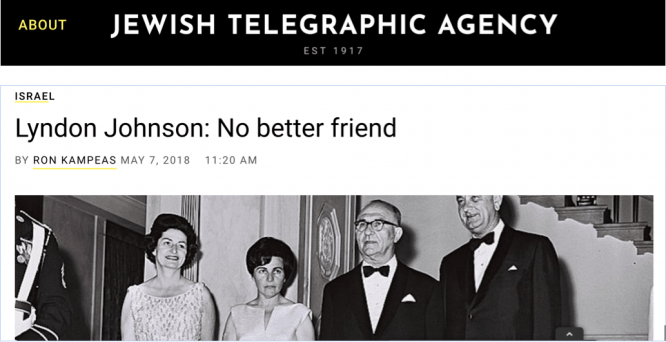
That Israel had the motive and the means of killing JFK does not prove that Israel did it. But I am quite certain that today, most smart Israelis assume and half-approve that Ben-Gurion ordered the elimination of JFK in order to replace him by Lyndon Johnson, whose love for Israel is also now widely celebrated, to the point that some speculate he might have been a secret Jew.

In Ben-Gurion’s mind, making Israel a nuclear state was a matter of life and death, and obliterating any obstacle was an absolute necessity. In Netanyahu’s mind today, preventing Iran—or any other enemy of Israel—from becoming a nuclear state is of the same order of necessity, and would surely justify eliminating another U.S. president in order to replace him by a more supportive Vice President. Most dedicated Zionists understand that. Andrew Adler, owner and editor in chief of The Atlanta Jewish Times, assumes that the idea “has been discussed in Israel’s most inner circle,” and, in his column of January 13, 2012, called on the Israeli Prime Minister to,
“give the go-ahead for U.S.-based Mossad agents to take out a president deemed unfriendly to Israel in order for the current Vice-President to take his place and forcefully dictate that the United States’ policy includes its helping the Jewish State obliterate its enemies. […] Order a hit on a president in order to preserve Israel’s existence.”[3]
Eliminating unsubmissive foreign leaders is part of Israel’s struggle for existence. Besides, it is entirely biblical: foreign kings are supposed to “lick the dust at [Israelis’] feet” (Isaiah 49:23), or perish, with their names “blotted out under heaven” (Deuteronomy 7:24).
On November 6, 1944, members of the Stern Gang, led by future Prime Minister Yitzhak Shamir, assassinated Lord Moyne, the British resident minister in the Middle East, for his anti-Zionist positions. The bodies of his murderers, executed in Egypt, were later exchanged for twenty Arab prisoners and buried at the “Monument of Heroes” in Jerusalem. On September 17, 1948, the same terrorist group murdered in Jerusalem Count Folke Bernadotte, a Swedish diplomat appointed as United Nations mediator in Palestine. He had just submitted his report A/648, which described “large-scale Zionist plundering and destruction of villages,” and called for the “return of the Arab refugees rooted in this land for centuries.” His assassin, Nathan Friedman-Yellin, was arrested, convicted, and then amnestied; in 1960 he was elected to the Knesset.[4]
In 1946, three months after members of the Irgun, led by future Prime Minister Menachem Begin, killed ninety-one people in the headquarter of the British Mandate’s administration (King David Hotel), the same terrorist group attempted to murder British Prime Minister Clement Attlee and Foreign Secretary Ernest Bevin, according to British Intelligence documents declassified in 2006.
These killings and more are documented by Israeli journalist Ronen Bergman in Rise and Kill First: The Secret History of Israel’s Targeted Assassinations (Random House, 2018). Bergman writes:
“At the end of 1947, a report to the British high commissioner tallied the casualties of the previous two years: 176 British Mandate personnel and civilians killed. / ‘Only these actions, these executions, caused the British to leave,’ David Shomron said, decades after he shot Tom Wilkin dead on a Jerusalem street. ‘If [Avraham] Stern had not begun the war, the State of Israel would not have come into being.’”[5]
James Forrestal’s strange death
Absent from Israel’s body count in Bergman’s book is former U.S. Secretary of Defense James Forrestal, assassinated eight months after Count Bernadotte. Forrestal had been Roosevelt’s Secretary of the Navy from April 1944. With consolidation of the armed services under Truman in 1947, he became the first Secretary of Defense. He opposed the United Nations’ vote to partition Palestine, and protested vigorously against U.S. recognition of Israel on May 15, 1948, on the ground that U.S. interests in the Middle East would be seriously jeopardized by American sponsorship of a Jewish state. For this, Forrestal received “an outpouring of slander and calumny that must surely be judged one of the most shameful intervals in American journalism,” in the words of Robert Lovett, then Under Secretary of State. Truman replaced Forrestal on March 28, 1949—shortly after his reelection—by the man who had been his main fundraiser, Louis Johnson. According to the received story, Forrestal, who was psychologically exhausted, fell into depression immediately. On April 2, 1949, he was interned against his will in the military hospital of the Navy in Bethesda, Maryland, a Washington, DC, suburb, where he was forcibly confined for seven weeks. He fell to his death from the 16th floor at 1:50 in the morning of May 22, 1949, landing on the roof of the third floor. He had a dressing-gown sash tied around his neck.
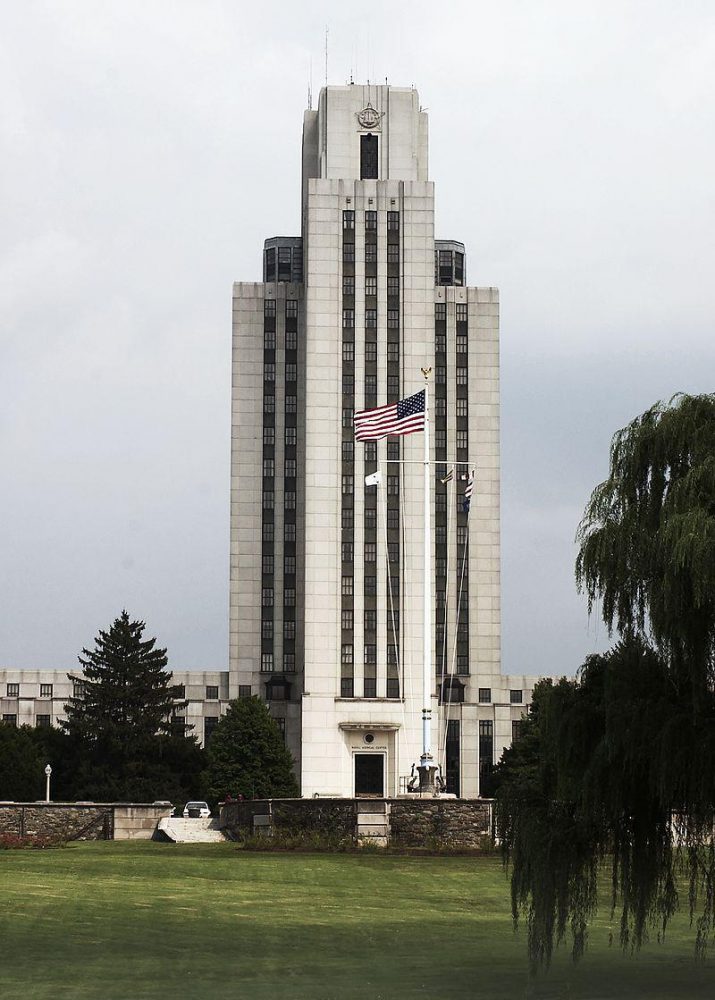
Bethesda Navy Hospital, where Forrestal met his death
National authorities and mainstream media immediately labeled his death a suicide, without any known criminal investigation. A review board was appointed on May 23, headed by Admiral Morton Willcutts, to conduct hearings of members of the hospital staff with the sole purpose of exonerating everyone of responsibility in Forrestal’s assumed suicide. The board completed its work in one week, and published a short press release four months later. But the full report, containing the transcripts of all hearings and crucial exhibits, were kept secret for 55 years, until David Martin obtained it through a Freedom of Information Act request in April 2004 (it is now available on the Princeton University Library website in pdf form, or here in HTML rendition by the anonymous Mark Hunter, who makes useful comments).
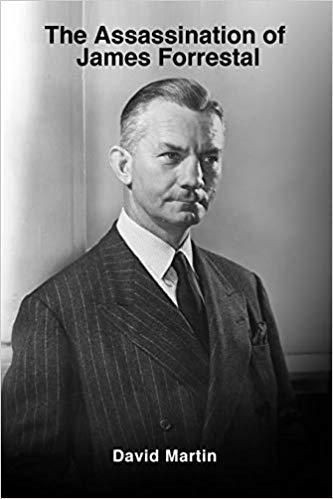
In his book and in his web articles complementing it, David Martin makes a compelling case that Forrestal was murdered, and that his murder was ordered by the Zionists, most probably with the knowledge and approval of Truman, who was then completely hostage to the Zionists. The motive? Forrestal was planning to write a book and to launch a national magazine: he had the money and the connections for it, and he had three thousand pages of personal diary to back his revelations on the corruption of American leadership and the sell-out of American foreign policy to communism under Roosevelt, and to Zionism under Truman.
I will here summarize the evidence accumulated by David Martin, and highlight the significance of this case for our understanding of Israel’s takeover of the heart, soul, and body of the United States. Unless specified otherwise, all information is from Martin’s book or articles.
From James Forrestal to John Kennedy
My own interest for this heartbreaking story stems from my interest for the Kennedy assassinations. (read my article Did Israel Kill the Kennedys?). I found the connection and similarities between the two stories highly illuminating. Everyone knows that Kennedy was assassinated, yet most Americans are still unaware of the evidence incriminating Israel. In the case of Forrestal, it is the opposite: few people suspect a murder, but once the evidence for murder has been presented, it points directly to Israel as the culprit. For this reason, Forrestal’s assassination by the Zionists becomes a precedent that makes JFK’s assassination by the same collective entity more plausible. If Israel can kill a former U.S. Defense Secretary on American soil in 1949 and get away with it with government and media complicity, then why not a sitting President fifteen years later? If the truth on Forrestal had been known by 1963, it is unlikely that Israel could have killed two Kennedys with impunity.
Forrestal was of Irish Catholic origin like the Kennedys, and was close to JFK’s father. Both James Forrestal and Joseph Kennedy are examples of American patriots of Irish stock who were alarmed by Jewish influence over American foreign policy. The entry for 27 December 1945 in Forrestal’s edited diary, says:
“Played golf with Joe Kennedy. I asked him about his conversations with Roosevelt and Neville Chamberlain from 1938 on. […] Chamberlain, he says, stated that America and the world Jews had forced England into the war.”
One major difference between the two men is that Joe Kennedy had resigned from government after Roosevelt’s entry into the war, and had kept a low profile on Israel. Moreover, unlike Forrestal, he was the head of a wealthy clan and had his own men in the press. He was a politician, whereas Forrestal was an uncompromising man. These differences explain why Forrestal was assassinated, whereas Joe had his son elected president. Yet in the end, the Kennedys suffered the Talmudic curse over three generations.
When James Forrestal, hostile to Stalin’s ambitions on Eastern Europe and to Truman’s decision to nuke Japan, was kept away from the official delegation to the Potsdam Conference in the summer 1945, he flew there privately and took with him the then 28-year-old John Kennedy, for a tour of post-war Germany. Later on, John integrated James Forrestal’s son Michael Forrestal as a member of his National Security Council. In May 1963 he made a symbolic public gesture by visiting the grave of James Forrestal on Memorial Day.

JFK visits Forrestal’s grave at Arlington cemetery
James Forrestal’s and John Kennedy’s assassinations bear one sinister thing in common: Bethesda Naval Hospital. As most readers recall, this is where Kennedy’s autopsy was tampered with after his body had been whisked away at gunpoint from Dallas Parkland Hospital, most probably by Secret Service agents on Lyndon Johnson’s order. In 1963, Lyndon Johnson could count on high-level complicity within the Navy.
It happens that Johnson, whom Billy Sole Estes claims ordered nine murders in the course of his political career,[6] makes a special appearance, although brief and poorly documented, in the story of Forrestal’s assassination. LBJ was then a newly elected congressman, on the payroll of Abraham Feinberg, former president of Americans for Haganah Incorporated and financial godfather of Israel’s atomic bomb.[7] According to the testimony of Forrestal’s assistant Marx Leva (more on him later), Johnson paid an unwanted visit to Forrestal at Bethesda Hospital. David Martin asks:
“Could LBJ have been playing something of a foot-soldier role for the orchestrators of Forrestal’s demise? Might he have been there to size up the overall situation, and at the same time contribute to ‘making his bones,’ as it were, by participating in such an important operation?” (Martin p. 20)
The official narrative
It bears repeating that no investigation was conducted into the death of James Forrestal, either by the FBI or the NCIS (Navy Criminal Investigative Service). The very day of his death, the mainstream press announced his suicide as a matter of fact. The New York Times stated in its late May 22 edition that Forrestal “jumped thirteen stories to his death,” and added the next morning:
“There were indications that Mr. Forrestal might also have tried to hang himself. The sash of his dressing-gown was still knotted and wrapped tightly around his neck when he was found, but hospital officials would not speculate as to its possible purpose.”
Later biographers did speculate that he may have tried to hang himself but failed to tie the sash securely to the radiator beneath the window. In The Man Who Kept the Secrets, Pulitzer Price winner Thomas Powers says that Forrestal died trying to hang himself “from his hospital window, but slipped and fell sixteen stories to his death.”
Forrestal left no suicide note, but the New York Times (May 23) informs its readers that:
“A book of poetry beside his bed was opened to a passage from the Greek tragedian, Sophocles, telling of the comfort of death. […] Mr. Forrestal had copied most of the Sophocles poem from the book on hospital memo paper, but he had apparently been interrupted in his efforts. His copying stopped after he had written ‘night’ of the word ‘nightingale’ in the twenty-sixth line of the poem.”
On May 24, the New York Times gave the final word to the psychiatrist in charge, who made suicide sound predictable:
“Captain George M. Raines, the Navy psychiatrist who had been treating Mr. Forrestal, said that the former Secretary ended his life in a sudden fit of despondency. He said this was ‘extremely common’ to the patient’s severe type of mental illness.”
That’s it. Never did the mainstream media hint at the possibility of foul play. The conclusion that Forrestal’s death is an obvious suicide caused by his “mental illness” was taken at face value by the authors of Forrestal’s two main biographies:
- Arnold Rogow, James Forrestal, A Study of Personality, Politics, and Policy (MacMillan Company, 1963);
- Townsend Hoopes and Douglass Brinkley, Driven Patriot, the Life and Times of James Forrestal (Alfred A. Knopf, 2003).
Rogow, whose book has been called a “psychological autopsy,” insists on linking Forrestal’s alleged mental illness to his alleged anti-Semitism, with the implication that anti-Semitism is a form of paranoia that may lead to suicide. Rogow is an expert on the subject of anti-Semitism, on which he wrote the article for The International Encyclopedia of Social Science. He is also the author The Jew in a Gentile World: An Anthology of Writings about Jews by Non-Jews.
 Hoopes and Brinkley borrow heavily from Rogow, but add valuable information based on their own interviews. They give an interesting interpretation of the morbid poem allegedly copied by Forrestal from Mark Van Dorren’s Anthology of World Poetry, titled “The Chorus from Ajax.” Taking their clue from Zionist apologist John Loftus, author of The Belarus Secret (Alfred A. Knopf, 1982), they speculate that, when reaching the word “nightingale” in the poem, Forrestal might have been overwhelmed by a sudden rush of guilt for having authorized a CIA operation with the code name of “Nightingale,” that infiltrated into the Soviet Union Ukrainian spies who had been formerly Nazi collaborators and probably killers of Jews. The word “nightingale,” Hoopes and Brinkley surmise, must have triggered Forrestal’s urge to take the poet’s admonition literally and end his life on the spot.
Was Forrestal mentally ill?
David Martin has uncovered grave inconsistencies and outright lies in the official story. First, it appears that Forrestal’s nervous breakdown has been wildly exaggerated, if not totally invented. As the story goes, Forrestal’s mental health had started deteriorating before Truman replaced him, and collapsed on March 29, just after a brief ceremony in his honor at Capitol Hill. The main source for this story is an Oral history interview of Marx Leva, Forrestal’s special assistant at that time, recorded for the Truman library in 1969. Leva says that, on that day, he found Forrestal in his Pentagon office, “almost in a coma.” He had him driven home and later met him there with Forrestal’s friend Ferdinand Eberstadt, and the two men decided that Forrestal’s state required that he urgently take some vacation. So Leva made immediate arrangement for a Marine plane to fly him to the estate of Robert Lovett in Hobe Sound, Florida that very night. “And on the way out Forrestal said three times, the only thing he said, [Eberstadt] tried to speak to him and he would say, ‘You’re a loyal fellow, Marx.’ ‘You’re a loyal fellow, Marx,’ three times.” Since Leva is Jewish, the implication is that Forrestal was obsessed by the disloyalty he attributed to many Jewish officials. For Leva, “he apparently was beyond being neurotic, I mean it was apparently paranoid”.
David Martin shows in this article (adding a new perspective to his book) that Marx Leva is lying. Forrestal’s vacation had in fact been planned in advance, and his wife was already waiting for him there. This is proven by a Jacksonville Daily Journal article dated March 28 about the ceremony when Truman pinned the Distinguished Service Medal on Forrestal’s chest that very day. The article concludes: “Forrestal is flying tomorrow to Hobe Sound, Fla., for a long rest.” This video clip of Forrestal shows him perfectly healthy and composed on March 28.
News reports and biographies insist that, during his four-day stay at Hobe Sound, Forrestal showed signs of paranoia. One rumor, made up by Daniel Yergin and repeated by Thomas Powers in The Man Who Kept the Secrets, has him running through the streets yelling, “The Russians are coming.” There is no credible source for this claim. Under Secretary of State (and future Defense Secretary) Robert Lovett, who was at Hobe Sound with Forrestal, did say in 1974 that Forrestal appeared to him as “not of sound mind,” because “he was obsessed with the idea that his phone calls were being bugged,” and complained that “they’re really after me.” I find rather strange, though, that Lovett feigns to ignore who Forrestal meant by “they”. There is nothing irrational in Forrestal’s belief that “his telephones were being bugged, [and that] his house was being watched”, as he had earlier complained to Truman’s appointments secretary, Matthew J. Connelly (who said so in a 1968 interview by the Truman Library).
There is also a rumor that Forrestal attempted suicide at Hobe Sound. It is contradicted by the Willcutts report, where Dr. George Raines, the psychiatrist in charge of Forrestal at Bethesda, is recorded stating: “So far as I know he never made a single real attempt at suicide except that one that was successful.” All of Forrestal’s doctors interviewed are unanimous that he had never attempted suicide before his fatal fall.
That is not to say that Forrestal was not psychologically strained in 1949. As Secretary of Defense, he had been subjected not only to slander and calumny by the press, but also to anonymous death threats. Robert Lovett, who shared Forrestal’s views on Israel, testified that he himself received night phone calls with death threats, and that Forrestal was more exposed than him to this kind of treatment. Having lost all protection from the government after March 28, Forrestal had reasons to fear for his life. On May 23, 1949, The Washington Post concluded an article headlined “Delusions of Persecution, Acute Anxiety, Depression Marked Forrestal’s Illness,” with the somewhat paradoxical statement:
“His fear of reprisals from pro-Zionists was said to stem from attacks by some columnists on what they said was his opposition to partition of Palestine under a UN mandate. In his last year as Defense Secretary, he received great numbers of abusive and threatening letters.”
John Loftus and Mark Aarons, the arch-Zionist authors of The Secret War against the Jews, identify Forrestal as “the principal villain, the man who nearly succeeded in preventing Israel’s birth.” They reveal that “The Zionists had tried unsuccessfully to blackmail Forrestal with tape recordings of his own deals with the Nazis” (before the war, Forrestal had been a partner of Clarence Dillon, the Jewish founder of the banking firm Dillon, Read, and Co.), but they believe that Zionist harassment at least succeeded in making him insane: “His paranoia convinced him that his every word was bugged. To his many critics, it seemed that James Forrestal’s anti-Jewish obsession had finally conquered him.”[8]
How convenient to claim that anti-Semitism may lead to suicide. When the Zionist mafia wishes you dead, fearing for your life is not a sign of mental illness, but rather of sound judgment.
We need not doubt Raines’ words to the Willcutts Review Board that, when he first saw Forrestal at Bethesda Hospital, “he was obviously exhausted physically” and showed “high blood pressure.” But here, we also have to take into account that Forrestal had been literally abducted from his vacation center at Hobe Sound. We should not be surprised when Rogow, and Hoopes and Brinkley after him, tell us that, even though he had been sedated, Forrestal “was in a state of extreme agitation during the flight from Florida,” and that:
“Forrestal’s agitation increased during the trip in a private car from the airfield to the hospital. He made several attempts to leave the car while it was in motion, and had to be forcibly restrained. Arriving at Bethesda, he declared that he did not expect to leave the hospital alive.”
As Martin mentions, there is also the very real possibility that Forrestal had been drugged at Hobe Sound, in order to make him appear insane and justify his internment.
Forrestal’s behavior at Bethesda shows nothing abnormal for a man locked up in the psychiatric division of a military hospital, on the 16th floor, for reasons he feared were not strictly medical. It has been reported by medical personnel that Forrestal often seemed restless, walking back and forth in his room late at night. Why wouldn’t he? Forrestal was even denied visits by those dearest to him. His brother Henry had tried several times to visit him, but had been rebuffed by Dr. Raines. The hospital authorities relented only after Henry threatened legal action. Forrestal was also denied the visit of his friend the Catholic priest, Monsignor Maurice Sheehy. Sheehy wrote in The Catholic Digest, January 1951, that, “The day he was admitted to the hospital, Forrestal told Dr. Raines he wish to see me,” but that Dr. Raines told him “that Jim was so confused I should wait some days before seeing him.” Raines turned away Father Sheehy on six occasions.
Despite being kept in virtual imprisonment and under forced medication, Forrestal endured remarkably well. From the hearings conducted by the Willcutts Review Boards, it appears that he was doing fine, in the days preceding his death. Willcutts himself expressed surprise at learning about his death, because he had dinner with him one day earlier (Friday the 20th), and thought he was “getting along splendidly.”
Evidence of cover-up and the fake suicide note
As mentioned earlier, the Willcutts Review Board’s mission was to exonerate every single individual of negligence. Even the brief conclusions released four months after it concluded its hearings, admits so, as reported in the New York Times October 12, 1949:
“Francis P. Matthews, Secretary of the Navy, made public today the report of an investigating board absolving all individuals of blame in the death of James Forrestal last May 22.”
Strangely enough, as Martin discovered, the report states that Forrestal’s fall was the cause of his death, but avoids any statement about the cause of the fall itself.
There is an obvious lack of interest from the Willcutts Board regarding all elements that point to murder rather than to suicide. The nurse who first entered Forrestal’s room after his death testified that there was broken glass on his bed. But the room must have been laundered before the crime scene photographs were taken, because they show the bed with nothing but a bare mattress, while another picture shows broken glass on the carpet at the foot of his bed (photos available on Mark Hunter’s site). The Willcutts Board had no interest in finding the origin of the broken glass, nor the reason it was removed from the bed.
They also failed to ask the personnel or themselves any relevant questions about the gown sash tied around Forrestal’s neck. Hoopes and Brinkley later speculated that Forrestal tied the sash to a radiator beneath the window, but that his knot “gave way.” That is contradicted by hospitalman William Eliades, who found the body of Forrestal with the sash (cord) around his neck, and declared to the Willcutts Review Board: “I looked to see whether he had tried to hang himself and whether a piece of cord had broken off. It was still in one piece except it was tied around his neck.”
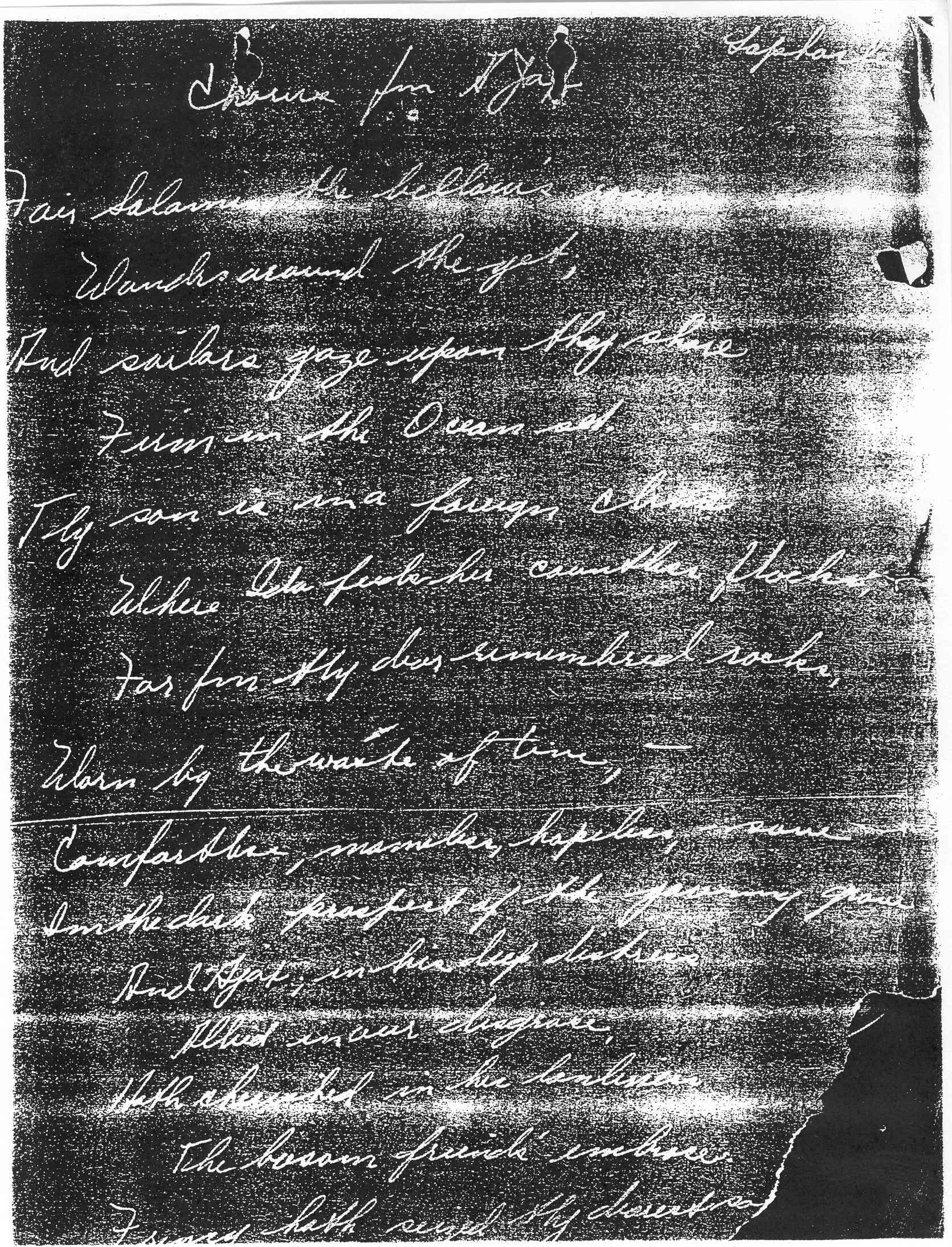
But the most compelling proof that Forrestal’s death has been disguised as a suicide is the poem allegedly copied by Forrestal. Among the exhibits obtained by Martin alongside the Willcutts report is a copy of the memo sheet with the transcription of the poem (here). A comparison with any handwritten note by Forrestal makes it plain that it was not copied by Forrestal (both can be found on Mark Hunter’s webpage).
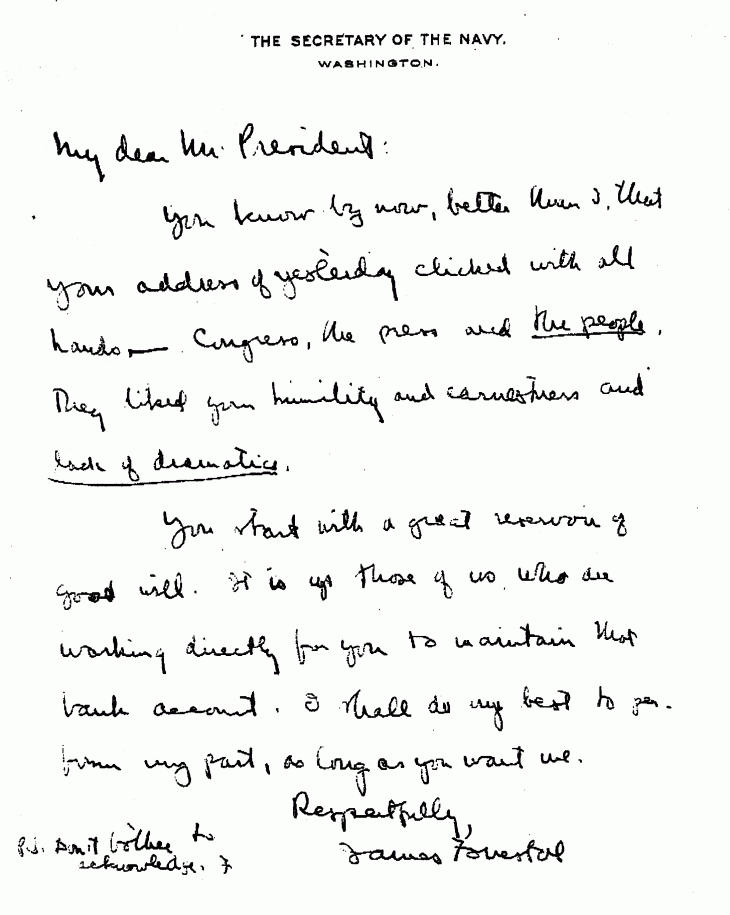

A sample of Forrestal’s handwriting and the note supposedly found in his room
As Martin comments, “One hardly needs an expert to tell him that the person who transcribed the poem is not the same person who wrote the various letters there.” Martin also notes that, from this single page, it is doubtful that the writer, whoever he was, even reached the word “nightingale”, which appears 11 verses below in the poem.
Interestingly, no one is identified in the official report as the discoverer of this handwritten note. It didn’t occur to the members of the Review Board to mention how it came into their possession, and to question about it the person who gave it to them.
In an effort to make the note a convincing proof of suicide, Rogow claims, and Hoopes and Brinkley repeat, that Apprentice Robert Wayne Harrison, Jr., the corpsman on duty to keep watch on Forrestal, checked into his room at 1:45 and saw him copying the poem. But by doing so, they both contradict Harrison’s declaration to the Willcutts Board. He said that, when he checked on him at 1:45, Forrestal was “in his bed, apparently sleeping.” Then he went to fill in the medical chart. Minutes later, a nurse heard the sound of Forrestal’s body striking the third floor roof. Harrison heard nothing but then became aware that Forrestal was missing at 1:50.
 Robert Wayne Harrison, Jr. would certainly have been a prime suspect if any criminal investigation had taken place. He was new to the job, and unknown to Forrestal until that fatal night. He had started his guard at midnight, replacing Edward Prise whose shift had started at 4 pm. Prise was well-known and apparently appreciated by Forrestal; he had been assigned to keep watch on Forrestal from the third day of Forrestal’s arrival at Bethesda. Strangely, his name is not mentioned in any contemporary news report, and it is misspelled “Price” in the report and in all biographies, although he clearly signed “Prise” in the medical chart included among the exhibits with the Willcutts report.
David Martin mentions that he received an e-mail from Prise’s daughter saying:
“We grew up hearing whispers between our parents in reference to this matter but were not allowed to ask for detail. Even up until a year prior to my father’s death in 1991 he had called me and was in fear that he was going to be questioned again about the issue.” (Martin p. 9)
We need not insist on the fact that witnesses are easily intimidated in a military environment, as was Bethesda Hospital. The pressure transpires in the transcripts of the Willcutts interviews: every nurse, corpsman or doctor said what they were expected to say, and understood their obligation never to speak otherwise. An interesting insight into this can be gained from David Martin’s interview of John Spalding, James Forrestal’s Navy Driver, then 27 years-old. When informed of the death of Forrestal by his superior, Spalding was handed a sheet of paper to sign, saying “I could never talk about anything that happened between him and me.”
Was it the communists or the Zionists?
Before David Martin, one author, writing under the pen-name Cornell Simpson, had claimed that Forrestal had been murdered. His book, The Death of James Forrestal, was published in 1966, although he claims to have written it in the mid-1950s. Simpson’s book contains much valuable and credible information. He had for example interviewed James Forrestal’s brother Henry, who was positively certain that his brother had been murdered. Henry Forrestal found the timing of the death very suspicious because he was coming to take his brother out of the hospital a few hours later that very same day. According to Simpson, another person who didn’t believe in Forrestal’s suicide was Father Maurice Sheehy. When he hurried to the hospital several hours after Forrestal’s death, he was approached discreetly by an officer who whispered to him, “Father, you know Mr. Forrestal didn’t kill himself, don’t you?”
Simpson blames the communists for Forrestal’s murder. The claim is not preposterous. Forrestal was definitely anti-communist. He had been alarmed by what he saw as communist infiltration in the Roosevelt administration (the Venona decrypts, giving evidence of 329 Soviet agents inside the U.S. government during World War II, would prove him right). After Roosevelt’s death, he was influential in the transformation of U.S. policy toward the Soviet Union, from accommodation to “containment.” Senator Joseph McCarthy, another Irish Catholic, testifies in his book The Fight for America that it was Forrestal who directly inspired his exposés of communist influence and subversion in the federal government:
“Before meeting Jim Forrestal I thought we were losing to international Communism because of incompetence and stupidity on the part of our planners. I mentioned that to Forrestal. I shall forever remember his answer. He said, ‘McCarthy, consistency has never been a mark of stupidity. If they were merely stupid they would occasionally make a mistake in our favor.’ This phrase stuck me so forcefully that I have often used it since.”
After Forrestal met his violent end, McCarthy moved up to the front line. He himself died on May 2, 1957, at the age of forty-eight, in Bethesda Hospital. Hospital officials listed the cause of death as “acute hepatic failure,” and the death certificate reads “hepatitis, acute, cause unknown.” The doctors declared that the inflammation of the liver was of a “noninfectious type”. Acute hepatitis can be caused either by infection or by poisoning, yet no autopsy was performed. Simpson comments (as quoted at length in Martin’s article James Forrestal and Joe McCarthy):
“Like Jim Forrestal, Joe McCarthy walked into the Bethesda Naval Hospital as its most controversial patient and as the one man in America most hated by the Communists. And, like Forrestal, he left in a hearse, as a man whose valiant fight against Communism was ended forever.”
M. Stanton Evans, who built on his father Medford Evans’ earlier work for his commendable Blacklisted by History: The Untold Story of Senator Joe McCarthy and His Fight Against America’s Enemies (2009), hints at the possibility that McCarthy was murdered, but does not explore the issue.

In 1953, Robert Kennedy worked as an assistant counsel to the Senate committee chaired by Senator Joseph McCarthy
The problem with Cornell Simpson’s theory is that Forrestal’s worst enemies were not the communists, but the Zionists. Although Forrestal’s anti-communism later attracted criticism from left-wing historians, it was not, then, a matter of public condemnation. Forrestal’s anti-communism was shared by most of his contemporaries, especially within the military. As long as you did not mention the high percentage of Jews among communists, being anti-communist did not make you the target of the mainstream media. The same, obviously, cannot be said of anti-Zionism. Neither the Washington Post nor the New York Times can be said to have been pro-communist at any time, but both turned strongly pro-Zionist around 1946. Arthur Hays Sulzberger, the NY Times’ director of publication since 1938, had actually denounced in 1946 the “coercive methods of the Zionists” influencing his editorial line, but eventually gave in and, since 1948, the NY Times has produced singularly unbalanced coverage of Palestine.[9]
It was his opposition to Zionism, not to communism, that attracted death threats to Forrestal. In his diary entry for February 3, 1948, Forrestal writes that he had lunch with Bernard Baruch and mentioned to him his effort at stopping the process of recognition:
“He took the line of advising me not to be active in this particular matter and that I was already identified, to a degree that was not in my own interests, with opposition to the United Nations policy on Palestine.”
Martin comments (p. 86):
“Baruch clearly did not know his man when he attempted to influence him by appealing to Forrestal’s own self-interest. He might have known more than he was telling, though, when he hinted at the danger that Forrestal faced for the courageous position he had taken.”
Jewish gangsters were traditionally anti-communists, but the Zionists could count on them to give a hand whenever needed. From 1945, Ben-Gurion’s Jewish Agency had close links to the Yiddish mafia, also known as the Mishpucka (Hebrew for “the Family”), who contributed greatly to the clandestine arms-purchasing-and-smuggling network that armed the Haganah. Leonard Slater writes in The Pledge that Teddy Kollek, who later became the longtime mayor of Jerusalem, ran the day-to-day operations and was told explicitly by Jewish gangsters from Brooklyn, “If you want anyone killed, just draw up a list and we’ll take care of it.” Yehuda Arazi, a close aide to Ben-Gurion sent by him to the U.S. to purchase heavy armaments, approached Meyer Lansky and met with members of “Murder, Incorporated.” Another Haganah emissary, Reuvin Dafni, who would become Israeli consul in Los Angeles and New York, met with Benjamin Siegelbaum, known as Bugsy Siegel. Some of those “gangsters for Zion”, writes Robert Rockaway, “did so out of ethnic loyalties,” or “saw themselves as defenders of the Jews, almost biblical-like fighters. It was part of their self-image.” Some also helped “because it was a way […] to gain acceptance in the Jewish community.”[10] Mickey Cohen, the successor of Bugsy Siegel, explains in his memoirs that from 1947, “I got so engrossed with Israel that I actually pushed aside a lot of my activities and done nothing but what was involved with this Irgun war.”[11] He was in close contact with Menachem Begin, and met with him when Begin came touring the U.S. in December 1948, a few months before Forrestal was confined to the Bethesda hospital.[12] Had Begin wanted Forrestal dead, he had only to ask.
I think it is quite self-evident that Forrestal had more to fear from the Zionists than from the communists. And so it is strange that Cornell Simpson totally ignores the Zionists as possible culprits. Neither Israel nor Zionism appears in his index. David Martin, who nevertheless recognizes the merit of Simpson’s investigation, finds the explanation for his blackout on Zionism in the fact that his book was published by Western Islands Publishers, the in-house publishing company of the John Birch Society, a Zionist front.
Three years before the Birch Society published Simpson’s book, Rogow had published the first biography of Forrestal, defending the official line about his death, and linking his supposed mental illness directly to his supposed anti-Semitism. It is very unlikely that Rogow’s book eased the suspicions of the skeptics about Forrestal’s suicide. On the contrary, Rogow’s obvious bias as a writer mainly concerned with anti-Semitism must have led many to consider his book as just another layer in the cover-up. Martin therefore speculates that the writing and publishing of Simpson’s book by the Birch Society was a way to give voice to the skepticism over Forrestal’s death, while directing that skepticism away from the most likely suspects. Blaming the communists was the easiest way to deflect suspicions from the Zionists.
It was all the easier that, from the 1930s up to the time of Forrestal’s death, the communists and the Zionists were the same people in many instances, as David Martin points out. Although communism and Zionism may seem incompatible from an ideological viewpoint, it is a matter of record that some of the Jews who acted as communist agents under Roosevelt, turned ardent Zionists under Truman. A case in point is David Niles (Neyhus), one of the few of FDR’s top advisors kept by Truman: he was identified in the Venona decrypts as a communist agent, but then played a key role as a Zionist gatekeeper under Truman. Edwin Wright, in The Great Zionist Cover-Up, names him as “the protocol officer in the White House, [who] saw to it that the State Department influence was negated while the Zionist view was presented.” David Niles’ brother Elliot, a high official of B’nai B’rith, was a Lieutenant Colonel who passed information to the Haganah while working in the Pentagon.
Did the order come from the White House?
Martin considers David Niles “the most likely coordinator of the Forrestal assassination.” He had the motives and the means. He was actually capable of passing orders on behalf of Truman, as he did when orchestrating the campaign of intimidation and corruption that obtained a two-third majority in favor of the Partition Plan at the U.N. General Assembly.[13]
There are reasons to believe that the order to eliminate Forrestal came directly from the White House. According to Truman’s appointments secretary, Matthew J. Connelly, it was Truman himself who suggested arranging for Forrestal a vacation at Hobe Sound. As for the decision to abduct him from there and intern him in Bethesda, Martin makes the following remark:
“Considering the fact that Forrestal, having been officially replaced as Defense Secretary by Johnson on March 28, was a private citizen at this point, it is certainly reasonable to assume that Forrestal’s extra-legal transportation to Florida on a military airplane and confinement and treatment in the Naval Hospital at Bethesda was not done without approval at the highest level.” (Martin p. 29)
Hoopes and Brinkley state explicitly that the decision to take Forrestal to Bethesda came from Truman, and that Forrestal’s wife was convinced by a telephone conversation with Truman.
The decision to put Forrestal on the 16th floor, which seems hardly appropriate for a patient reputed suicidal, also came from the White House. Hoopes and Brinkley quote Dr. Robert P. Nenno, a young assistant to Dr. Raines from 1952 to 1959, who believed that Raines had received instruction to put Forrestal there, and added, “I have always guessed that the order came from the White House.”
Hoopes and Brinkley justify Dr. Raines’ turning Sheehy away on six occasions by the fear that Forrestal might divulge sensitive information during confession. Such concerns obviously came from higher up. It apparently didn’t come from Navy Secretary John L. Sullivan because, as Hoopes and Brinkley tell us, when Sheehy and Henry Forrestal took their complaint to him on May 18, he expressed surprise and had the decision overruled. According to Simpson: “the priest later commented that he received the distinct impression that Dr. Raines was acting under orders.”
There is, of course, no evidence that throwing Forrestal out of the window was also ordered by the White House, but given Truman’s complete control by the Zionists, and by David Niles in particular, it is not unlikely.
Why kill him after he had been dismissed from power?
But, one may ask, why would Truman or anyone need to kill Forrestal? Once out of the Pentagon, he had no more influence on government policy.
The answer is easy. Far from being suicidal, Forrestal was a man with a plan. According to Hoopes and Brinkley,
“he had told powerful Wall Street friends […] that he was interested in starting a newspaper or a magazine modeled after The Economist of Great Britain, and they had demonstrated a willingness to help him raise the start-up funds.”
He also planned to write a book. With no more ties to the government or to the army, he was free to speak his mind on many issues. As a war hero and a very popular figure, he was sure to have a great impact. And he had plenty of embarrassing things to reveal about what he had seen during his nine years in the government.

Time cover, October 29, 1945
As Navy Secretary, he had been the central person for Pacific operations during World War II. He had inside knowledge of Roosevelt’s scheme to provoke the Japanese into attacking Pearl Harbor. According to his diary entry for April 18, 1945, he had even told Truman, that,
“I had got Admiral Hewitt back to pursue the investigation into the Pearl Harbor disaster. […] I felt I had an obligation to Congress to continue the investigation because I was not completely satisfied with the report my own Court had made.”
Forrestal was also very bitter about the way the war ended in the Pacific. Knowing the desperate situation of the Japanese, he had worked behind the scene to achieve a negotiated surrender from the Japanese. He was opposed to the demand of “unconditional surrender”, which he knew was unacceptable to the Japanese military leadership. Simpson writes, as quoted by David Martin here:
“As secretary of the navy, Forrestal had originated a plan to end the war with Japan five and a half months before V-J Day finally dawned. He had mapped this plan on the basis of massive intelligence information obtained on and prior to March 1, 1945, to the effect that the Japanese were already desperately anxious to surrender and the fact that the Japanese emperor had even asked the pope to act as peace mediator. If Roosevelt had acted on Forrestal’s plan, the war would have ground to a halt in a few days. A-bombs would never have incinerated Hiroshima and Nagasaki, thousands of Americans would not have died in the unnecessary battle of Okinawa and later bloody encounters, and the Russians would not have had a chance to muscle into the Pacific war for the last six of its 1,347 days, thus giving Washington the pretext for handing them the key to the conquest of all Asia.”
Forrestal had also much to say about the way the Zionists obtained the Partition Plan at the General Assembly of the United Nations, or about the way Truman was blackmailed and bought into supporting the recognition of Israel. He had written in his diary, February 3, 1948, about his meeting with Franklin D. Roosevelt, Jr., a strong advocate of the Jewish State:
“I thought the methods that had been used by people outside of the Executive branch of the government to bring coercion and duress on other nations in the General Assembly bordered closely onto scandal.”
Forrestal had a pretty good memory. But, in addition, he had accumulated thousands of pages of diary during his public service. According to Simpson,
“During Forrestal’s brief stay at Hobe Sound, his personal diaries, consisting of fifteen loose-leaf binders totaling three thousand pages, were hastily removed from his former office in the Pentagon and locked up in the White House where they remained for a year. […] all during the seven weeks prior to Forrestal’s death, his diaries were out of his hands and in the White House, where someone could have had ample time to study them.”
The White House later claimed that Forrestal had sent word that he wanted President Truman to take custody of these diaries, but that is very unlikely.
A small part of Forrestal’s diaries was ultimately published in a heavily censored form by Walter Millis, FDR apologist and New York Herald Tribune journalist. Simpson estimates that more than 80 percent was left out. Millis frankly admitted that he had deleted unfavorable “references to persons, by name [and] comment reflecting on the honesty or loyalty of an individual.” Millis also said that he deleted everything on the Pearl Harbor investigations. One can only guess how much censorship Millis exerted on Forrestal’s view about American support for Israel.
David Martin’s conclusion makes perfect sense:
“Forrestal’s writing and publishing plans provide the answer to the question, ‘Why would anyone bother to murder him when he had already been driven from office and disgraced by the taint of mental illness?’”
“The compelling reasons for Forrestal to want to continue living were also compelling reasons for his powerful enemies to see to it that he did not.”
“He comes across, in short, not as a prime candidate for suicide, but for assassination.” (Martin, pp. 52, 53, 87)
A parallel with Lord Northcliffe
In his blurb for Martin’s book, James Fetzer puts it this way:
“Dave Martin has established that James Forrestal was targeted for assassination by Zionist zealots who were convinced that his future influence as an editor and publisher represented an unacceptable risk.”
In this article, Martin expands on this idea by comparing Forrestal to Lord Northcliffe (Alfred Harmsworth), an influential newspaper editor whose tragic story is told by Douglas Reed in The Controversy of Zion (pp. 205-208), based on The Official History of The Times (1952). In the 1920s just like today, factual reporting from the press was the greatest obstacle to the Zionist ambitions. Lord Northcliffe owned journals and periodicals, including the two most widely read daily newspapers, and he was the majority proprietor of the most influential newspaper in the world at that time, The Times of London. He took a definite stand against the Zionist plan, and wrote, after a visit to Palestine in 1922: “In my opinion we, without sufficient thought, guaranteed Palestine as a home for the Jews despite the fact that 700,000 Arab Moslems live there and own it.” Northcliffe commissioned a series of articles attacking Balfour’s attitude towards Zionism. His editor, Wickham Steed, refused, and, when Northcliffe asked him to resign, took a series of actions to have Northcliffe declared mentally ill. Although he appeared perfectly normal to most people he met, on June 18, 1922, Northcliffe was declared unfit for the position of editor of The Times on the authority of an unknown “French nerve specialist,” removed from all control of his newspapers, and put under constraint. On July 24, 1922 the Council of the League of Nations met in London, secure from any possibility of loud public protest by Lord Northcliffe, to bestow on Britain a “mandate” to remain in Palestine and to install the Zionists there. On August 14, 1922, Northcliffe died at the age of fifty-seven, officially of “ulcerative endocarditis.” The public was, of course, kept in total ignorance of the way this highly respected public figure was taken off the scene. Douglas Reed, who was then working as a clerk in the office of The Times, and learned the full story much later, remembers that:
“Lord Northcliffe was convinced that his life was in danger and several times said this; specifically, he said he had been poisoned. If this is in itself madness, then he was mad, but in that case many victims of poisoning have died of madness, not of what was fed to them. If by any chance it was true, he was not mad. […] His belief certainly charged him with suspicion of those around him, but if by chance he had reason for it, then again it was not madness.”
Reed sees Northcliffe’s elimination as a turning point:
“After Lord Northcliffe died the possibility of editorials in The Times ‘attacking Balfour’s attitude towards Zionism’ faded. From that time the submission of the press […] grew ever more apparent and in time reached the condition which prevails today, when faithful reporting and impartial comment on this question has long been in suspense.”
The parallel with Forrestal is indeed striking, as David Martin remarks:
“Forrestal’s first love was journalism. In his youth he had worked as a reporter for three newspapers in his native upstate New York, and he had been the editor of the student newspaper at Princeton. As former president of the investment banking firm of Dillon, Read, & Co. he was a rich, powerful and well-connected man. He had plans to run his own news magazine. In short, he could have become an American Lord Northcliffe with the ability to have a great deal of influence on public opinion in the country.”
Notes
[1] Seymour Hersh, The Samson Option: Israel’s Nuclear Arsenal and American Foreign Policy, Random House, 1991, p. 141.
[2] Haaretz, February 5, 1999, quoted in Michael Collins Piper, False Flags: Template for Terror, American Free Press, 2013, pp. 54–55.
[3] Joe Sterling, “Jewish paper’s column catches Secret Service’s eye,” CNN, January 22, 2012.
[4] Alan Hart, Zionism: The Real Enemy of the Jews, vol. 2: David Becomes Goliath, Clarity Press, 2013, p. 90.
[5] Ronen Bergman, Rise and Kill First: The Secret History of Israel’s Targeted Assassinations, Random House, 2018, p. 20.
[6] William Reymond and Billie Sol Estes, JFK Le Dernier Témoin, Flammarion, 2003.
[7] Alan Hart, Zionism: The Real Enemy of the Jews, vol. 2: David Becomes Goliath, Clarity Press, 2013, p. 250.
[8] John Loftus and Mark Aarons, The Secret War against the Jews: How Western Espionage Betrayed The Jewish People, St. Martin’s Griffin, 2017 , p. 212-213.
[9] Alfred Lilienthal, What Price Israel? (1953), Infinity Publishing, 2003, pp. 95, 143.
[10] Robert Rockaway, “Gangsters for Zion. Yom Ha’atzmaut: How Jewish mobsters helped Israel gain its independence”, April 19, 2018, on tabletmag.com
[11] Mickey Cohen, In My Own Words, Prentice-Hall, 1975, pp. 91–92.
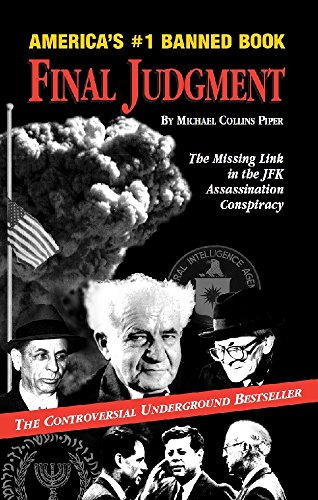
[12] Gary Wean, There’s a Fish in the Courthouse, Casitas, 1987, quoted by Michael Collins Piper, Final Judgment: The Missing Link in the JFK Assassination Conspiracy, American Free Press, 6th ed., 2005, pp. 290–297.
[13] Alfred Lilienthal, What Price Israel? (1953), Infinity Publishing, 2003, p. 50.
Iran slams Trump’s ‘delusional’ Middle East peace plan, calls on US to accept Tehran’s proposal instead
RT | January 27, 2020
Iranian Foreign Minister Mohammad Javad Zarif has blasted US President Donald Trump’s soon-to-be-revealed peace plan for the Israeli-Palestinian conflict, suggesting Iran’s referendum proposal would be a better strategy.
Trump said he will unveil his “deal of the century” for Israel and Palestine – actually prepared by his aide and son-in-law Jared Kushner – on Tuesday, but Zarif has already taken to Twitter to condemn it. He suggested that Washington should abandon its “delusional” plan and instead support a solution offered by Iran’s Supreme Leader Ayatollah Ali Khamenei.
Unlike the US plan, the details of which remain a mystery, the proposal put forward by Khamenei amounts to holding a referendum on a system of government including “Muslim, Christian and Jewish residents of Palestine as well as Palestinian refugees.” The Iranian leader also repeatedly slammed the US’ “deal of the century” by calling it “traitorous” and designed to “destroy” Palestine’s identity, as he apparently suspects the plan will greatly favor Israel.
While little is known about the deal, reports suggest that it’s unlikely to envisage statehood for Palestinians. AFP said that Palestinian President Mahmoud Abbas has already rejected the deal ahead of it being unveiled, and the Palestinian Authority considers that a two-state solution is the only way forward.
Tellingly, both Israeli Prime Minister Benjamin Netanyahu and his rival in the forthcoming snap elections, Benny Gantz, will attend the ceremony at the White House, while no Palestinian representatives will be present.
In anticipation of a strongly pro-Israeli plan, Palestinian leaders in Ramallah and Gaza have also condemned the upcoming deal and called for a “day of rage” on Tuesday. They urged Palestinians to boycott American goods, and remove all US symbols remaining in the West Bank.
Trump claimed in a press conference earlier this week that his administration had spoken “briefly” to the Palestinians, and vowed to talk to them again at some point in the future. He admitted that they might not like his proposals “at first.” However, he also maintained that his plan is “actually very positive to them.”
Washington has curtailed hundreds of millions of dollars in aid and stopped funding the UN agency that supports Palestinian refugees. Trump’s decision to move the US embassy from Tel Aviv to Jerusalem also drew the ire of the Palestinian Authority, which cut all communications with the US thereafter.
American Pravda: Mossad Assassinations

By Ron Unz • Unz Review • January 27, 2020
From the Peace of Westphalia to the Law of the Jungle
 The January 2nd American assassination of Gen. Qassem Suleimani of Iran was an event of enormous moment.
Gen. Suleimani had been the highest-ranking military figure in his nation of 80 million, and with a storied career of 30 years, one of the most universally popular and highly-regarded. Most analysts ranked him second in influence only to Ayatollah Khameini, Iran’s elderly Supreme Leader, and there were widespread reports that he was being urged to run for the presidency in the 2021 elections.
The circumstances of his peacetime death were also quite remarkable. His vehicle was incinerated by the missile of an American Reaper drone near Iraq’s Baghdad international airport just after he had arrived there on a regular commercial flight for peace negotiations originally suggested by the American government.
Our major media hardly ignored the gravity of this sudden, unexpected killing of so high-ranking a political and military figure, and gave it enormous attention. A day or so later, the front page of my morning New York Times was almost entirely filled with coverage of the event and its implications, along with several inside pages devoted to the same topic. Later that same week, America’s national newspaper of record allocated more than one-third of all the pages of its front section to the same shocking story.
But even such copious coverage by teams of veteran journalists failed to provide the incident with its proper context and implications. Last year, the Trump Administration had declared the Iranian Revolutionary Guard “a terrorist organization,” drawing widespread criticism and even ridicule from national security experts appalled at the notion of classifying a major branch of Iran’s armed forces as “terrorists.” Gen. Suleimani was a top commander in that body, and this apparently provided the legal figleaf for his assassination in broad daylight while on a diplomatic peace mission.
But consider that Congress has been considering legislation declaring Russia an official state sponsor of terrorism, and Stephen Cohen, the eminent Russia scholar, has argued that no foreign leader since the end of World War II has been so massively demonized by the American media as Russian President Vladimir Putin. For years, numerous agitated pundits have denounced Putin as “the new Hitler,” and some prominent figures have even called for his overthrow or death. So we are now only a step or two removed from undertaking a public campaign to assassinate the leader of a country whose nuclear arsenal could quickly annihilate the bulk of the American population. Cohen has repeatedly warned that the current danger of global nuclear war may exceed that which we faced during the days of the 1962 Cuban Missile Crisis, and can we entirely dismiss such concerns?
Even if we focus solely upon Gen. Solemaini’s killing and entirely disregard its dangerous implications, there seem few modern precedents for the official public assassination of a top-ranking political figure by the forces of another major country. In groping for past examples, the only ones that come to mind occurred almost three generations ago during World War II, when Czech agents assisted by the Allies assassinated Reinhard Heydrich in Prague in 1941 and the US military later shot down the plane of Japanese admiral Isoroku Yamamoto in 1943. But these events occurred in the heat of a brutal global war, and the Allied leadership hardly portrayed them as official government assassinations. During that same conflict, when one of Adolf Hitler’s aides suggested that an attempt be made to assassinate Soviet leaders, the German Fuhrer immediately forbade such practices as obvious violations of the laws of war.
The 1914 terrorist assassination of Archduke Franz Ferdinand, heir to the throne of Austria-Hungary, was certainly organized by fanatical elements of Serbian Intelligence, but the Serbian government fiercely denied its own complicity, and no major European power was ever directly implicated in the plot. The aftermath of the killing soon led to the outbreak of World War I, and although many millions died in the trenches over the next few years, it would have been completely unthinkable for one of the major belligerents to consider assassinating the leadership of another.
A century earlier, the Napoleonic Wars had raged across the entire continent of Europe for most of a generation, but I don’t recall reading of any governmental assassination plots during that era, let alone in the quite gentlemanly wars of the preceding 18th century when Frederick the Great and Maria Theresa disputed ownership of the wealthy province of Silesia by military means. I am hardly a specialist in modern European history, but after the 1648 Peace of Westphalia ended the Thirty Years War and regularized the rules of warfare, no assassination as high-profile as that of Gen. Soleimani comes to mind.
The bloody Wars of Religion of previous centuries did see their share of assassination schemes. For example, I think that Philip II of Spain supposedly encouraged various plots to assassinate Queen Elizabeth I of England on grounds that she was a murderous heretic, and their repeated failure helped persuade him to launch the ill-fated Spanish Armada; but being a pious Catholic, he probably would have balked at using the ruse of peace-negotiations to lure Elizabeth to her doom. In any event, that was more than four centuries ago, so America has now placed itself in rather uncharted waters.
Different peoples possess different political traditions, and this may play a major role in influencing the behavior of the countries they establish. Bolivia and Paraguay were created in the early 18th century as shards from the decaying Spanish Empire, and according to Wikipedia they have experienced nearly three dozen successful coups in their history, the bulk of these prior to 1950, while Mexico has had a half-dozen. By contrast, the U.S. and Canada were founded as Anglo-Saxon settler colonies, and neither history records even a failed attempt.
During our Revolutionary War, George Washington, Thomas Jefferson, and our other Founding Fathers fully recognized that if their effort failed, they would all be hanged by the British as rebels. However, I have never heard that they feared falling to an assassin’s blade, nor that King George III ever considered such an underhanded means of attack. During the first century and more of our nation’s history, nearly all our presidents and other top political leaders traced their ancestry back to the British Isles, and political assassinations were exceptionally rare, with Abraham Lincoln’s death being one of the very few that come to mind.
At the height of the Cold War, our CIA did involve itself in various secret assassination plots against Cuba’s Communist dictator Fidel Castro and other foreign leaders considered hostile to US interests. But when these facts later came out in the 1970s, they evoked such enormous outrage from the public and the media, that three consecutive American presidents—Gerald R. Ford, Jimmy Carter, and Ronald Reagan—issued successive Executive Orders absolutely prohibiting assassinations by the CIA or any other agent of the US government.
Although some cynics might claim that these public declarations represented mere window-dressing, a March 2018 book review in the New York Times strongly suggests otherwise. Kenneth M. Pollock spent years as a CIA analyst and National Security Council staffer, then went on to publish a number of influential books on foreign policy and military strategy over the last two decades. He had originally joined the CIA in 1988, and opens his review by declaring:
One of the very first things I was taught when I joined the CIA was that we do not conduct assassinations. It was drilled into new recruits over and over again.
Yet Pollack notes with dismay that over the last quarter-century, these once solid prohibitions have been steadily eaten away, with the process rapidly accelerating after the 9/11 attacks of 2001. The laws on our books may not have changed, but
Today, it seems that all that is left of this policy is a euphemism.
We don’t call them assassinations anymore. Now, they are “targeted killings,” most often performed by drone strike, and they have become America’s go-to weapon in the war on terror.
The Bush Administration had conducted 47 of these assassinations-by-another-name, while his successor Barack Obama, a constitutional scholar and Nobel Peace Prize Laureate, had raised his own total to 542. Not without justification, Pollack wonders whether assassination has become “a very effective drug, but [one that] treats only the symptom and so offers no cure.”
Thus over the last couple of decades American policy has followed a very disturbing trajectory in its use of assassination as a tool of foreign policy, first restricting its use to only the most extreme circumstances, next targeting small numbers of high-profile “terrorists” hiding in rough terrain, then escalating those same such killings to the many hundreds. And now under President Trump, the fateful step has been taken of America claiming the right to assassinate any world leader not to our liking whom we unilaterally declare worthy of death.
Pollack had made his career as a Clinton Democrat, and is best known for his 2002 book The Threatening Storm that strongly endorsed President Bush’s proposed invasion of Iraq and was enormously influential in producing bipartisan support for that ill-fated policy. I have no doubt that he is a committed supporter of Israel, and he probably falls into a category that I would loosely describe as “Left Neocon.”
But while reviewing a history of Israel’s own long use of assassination as a mainstay of its national security policy, he seems deeply disturbed that America might be following along that same terrible path. Less than two years later, our sudden assassination of a top Iranian leader demonstrates that his fears may have been greatly understated.
“Rise and Kill First”
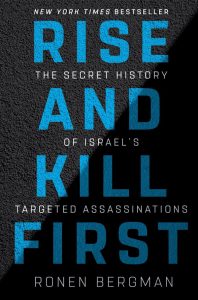
The book being reviewed was Rise and Kill First by New York Times reporter Ronan Bergman, a weighty study of the Mossad, Israel’s foreign intelligence service, together with its sister agencies. The author devoted six years of research to the project, which was based upon a thousand personal interviews and access to some official documents previously unavailable. As suggested by the title, his primary focus was Israel’s long history of assassinations, and across his 750 pages and thousand-odd source references he recounts the details of an enormous number of such incidents.
That sort of topic is obviously fraught with controversy, but Bergman’s volume carries glowing cover-blurbs from Pulitzer Prize-winning authors on espionage matters, and the official cooperation he received is indicated by similar endorsements from both a former Mossad chief and Ehud Barak, a past Prime Minister of Israel who himself had once led assassination squads. Over the last couple of decades, former CIA officer Robert Baer has become one of our most prominent authors in this same field, and he praises the book as “hands down” the best he has ever read on intelligence, Israel, or the Middle East. The reviews across our elite media were equally laudatory.
Although I had seen some discussions of the book when it appeared, I only got around to reading it a few months ago. And while I was deeply impressed by the thorough and meticulous journalism, I found the pages rather grim and depressing reading, with their endless accounts of Israeli agents killing their real or perceived enemies, with the operations sometimes involving kidnappings and brutal torture, or resulting in considerable loss of life to innocent bystanders. Although the overwhelming majority of the attacks described took place in the various countries of the Middle East or the occupied Palestinian territories of the West Bank and Gaza, others ranged across the world, including Europe. The narrative history began in the 1920s, decades before the actual creation of the Jewish Israel or its Mossad organization, and ranged up to the present day.
The sheer quantity of such foreign assassinations was really quite remarkable, with the knowledgeable reviewer in the New York Times suggesting that the Israeli total over the last half-century or so seemed far greater than that of any other country. I might even go farther, if we excluded domestic killings, I wouldn’t be surprised if the body-count exceeded the combined total for that of all other major countries in the world. I think all the lurid revelations of lethal CIA or KGB Cold War assassination plots that I have seen discussed in newspaper stories might fit comfortably into just a chapter or two of Bergman’s extremely long book.
National militaries have always been nervous about deploying biological weapons, knowing full well that if once released, the deadly microbes might easily spread back across the border and inflict great suffering upon the civilians of the country that deployed them. Similarly, intelligence operatives who have spent their long careers so heavily focused upon planning, organizing, and implementing what amount to judicially-sanctioned murders may develop ways of thinking that become a danger both to each other and to the larger society they serve, and some examples of this possibility leak out here and there in Bergman’s comprehensive narrative.
In the so-called “Askelon Incident” of 1984, a couple of captured Palestinians were beaten to death in public by the notoriously ruthless head of the Shin Bet domestic security agency and his subordinates. Under normal circumstances, this deed would have carried no consequences, but the incident happened to be captured by the camera by a nearby Israeli photo-journalist, who managed to avoid confiscation of his film. His resulting scoop sparked an international media scandal, even reaching the pages of the New York Times, and this forced a governmental investigation aimed at criminal prosecution. To protect themselves, the Shin Bet leadership infiltrated the inquiry and organized an effort to fabricate evidence pinning the murders upon ordinary Israeli soldiers and a leading general, all of whom were completely innocent. A senior Shin Bet officer who expressed misgivings about this plot apparently came close to being murdered by his colleagues until he agreed to falsify his official testimony. Organizations that increasingly operate like mafia crime families may eventually adopt similar cultural norms.
Mossad agents sometimes even contemplated the elimination of top-ranking Israeli leaders whose policies they viewed as sufficiently counter-productive. For decades, Gen. Ariel Sharon had been one of Israel’s greatest military heroes and someone of extreme right-wing sentiments. As Defense Minister in 1982, he orchestrated the Israeli invasion of Lebanon, which soon turned into a major political debacle, seriously damaging Israel’s international standing by inflicting great destruction upon that neighboring country and its capital city of Beirut. As Sharon stubbornly continued his military strategy and the problems grew more severe, a group of disgruntled Mossad officers decided that the best means of cutting Israel’s losses was to assassinate Sharon, though the proposal was never carried out.
An even more striking example occurred a decade later. For many years, Palestinian leader Yasir Arafat had been the leading object of Israeli antipathy, so much so that at one point Israel made plans to shoot down an international civilian jetliner in order to assassinate him. But after the end of the Cold War, pressure from America and Europe led Prime Minister Yitzhak Rabin to sign the 1993 Oslo Peace Accords with his Palestinian foe. Although the Israeli leader received worldwide praise and shared a Nobel Peace Prize for his peacemaking efforts, powerful segments of the Israeli public and its political class regarded the act as a betrayal, with some extreme nationalists and religious zealots demanding that he be killed for his treason. A couple of years later, he was indeed shot dead by a lone gunman from those ideological circles, becoming the first Middle Eastern leader in decades to suffer that fate. Although his killer was mentally unbalanced and stubbornly insisted that he acted alone, he had had a long history of intelligence associations, and Bergman delicately notes that the gunman slipped past Rabin’s numerous bodyguards “with astonishing ease” in order to fire his three fatal shots at close range.
Many observers drew parallels between Rabin’s assassination and that of our own president in Dallas three decades earlier, and the latter’s heir and namesake, John F. Kennedy, Jr., developed a strong interest in the tragic event. In March 1997, his glossy political magazine George published an article by the Israeli assassin’s mother, implicating her own country’s security services in the crime, a theory also promoted by the late Israeli-Canadian writer Barry Chamish. These accusations sparked a furious international debate, but after Kennedy himself died in an unusual plane crash a couple of years later and his magazine quickly folded, the controversy soon subsided. The George archives are not online nor easily available, so I cannot easily judge the credibility of the charges.
Having himself narrowly avoided Mossad assassination, Sharon gradually regained his political influence in Israel, and did so without compromising his hard-line views, even boastfully describing himself as a “Judeo-Nazi” to an appalled journalist. A few years after Rabin’s death, he provoked major Palestinian protests, then used the resulting violence to win election as Prime Minister, and once in office, his very harsh methods led to a widespread uprising in Occupied Palestine. But Sharon merely redoubled his repression, and after world attention was diverted by 9/11 attacks and the American invasion of Iraq, he began assassinating numerous top Palestinian political and religious leaders in attacks that sometimes inflicted heavy civilian casualties.
The central object of his anger was Palestine President Yasir Arafat, who suddenly took ill and died, thereby joining his erstwhile negotiating partner Rabin in permanent repose. Arafat’s wife claimed that he had been poisoned and produced some medical evidence to support this charge, while longtime Israeli political figure Uri Avnery published numerous articles substantiating those accusations. Bergman simply reports the categorical Israeli denials while noting that “the timing of Arafat’s death was quite peculiar,” then emphasizes that even if he knew the truth, he couldn’t publish it since his entire book was written under strict Israeli censorship.
This last point seems an extremely important one, and although it only appears just that one time in the text, the disclaimer obviously applies to the entirety of the very long volume and should always be kept in the back of our minds. Bergman’s book runs some 350,000 words and even if every single sentence were written with the most scrupulous honesty, we must recognize the huge difference between “the Truth” and “the Whole Truth.”
Another item also raised my suspicions. Thirty years ago, a disaffected Mossad officer named Victor Ostrovsky left that organization and wrote By Way of Deception, a highly-critical book recounting numerous alleged operations known to him, especially those contrary to American and Western interests. The Israeli government and its pro-Israel advocates launched an unprecedented legal campaign to block publication, but this produced in a major backlash and media uproar, with the heavy publicity landing it as #1 on the New York Times sales list. I finally got around to reading his book about a decade ago and was shocked by many of the remarkable claims, while being reliably informed that CIA personnel had judged his material as probably accurate when they reviewed it.
Although much of Ostrovsky’s information was impossible to independently confirm, for more than a quarter-century his international bestseller and its 1994 sequel The Other Side of Deception have heavily shaped our understanding of Mossad and its activities, so I naturally expected to see a very detailed discussion, whether supportive or critical, in Bergman’s exhaustive parallel work. Instead, there was only a single reference to Ostrovsky buried in a footnote on p. 684. There we are told of Mossad’s utter horror at the numerous deep secrets that Ostrovsky was preparing to reveal, which led its top leadership to formulate a plan to assassinate him. Ostrovsky only survived because Prime Minister Yitzhak Shamir, who had formerly spent decades as the Mossad assassination chief, vetoed the proposal on the grounds that “We don’t kill Jews.” Although this reference is brief and almost hidden, I regard it as providing considerable support for Ostrovsky’s general credibility.
Having thus acquired serious doubts about the completeness of Bergman’s seemingly comprehensive narrative history, I noted a curious fact. I have no specialized expertise in intelligence operations in general nor those of Mossad in particular, so I found it quite remarkable that the overwhelming majority of all the higher-profile incidents recounted by Bergman was already familiar to me simply from the decades I had spent closely reading the New York Times every morning. Is it really plausible that six years of exhaustive research and so many personal interviews would have uncovered so few major operations that had not already been known and reported in the international media? Bergman obviously provides a wealth of detail previously limited to insiders, along with numerous unreported assassinations of relatively minor individuals, but it seems strange that he came up with so few surprising revelations.
Indeed, some major gaps in his coverage are quite apparent to anyone who has even somewhat investigated the topic, and these begin in the early chapters of his volume, which include coverage of the Zionist prehistory in Palestine prior to the establishment of the Jewish state.
Bergman would have severely damaged his credibility if he had failed to include the infamous 1940s Zionist assassinations of Britain’s Lord Moyne or U.N. Peace Negotiator Count Folke Bernadotte. But he unaccountably fails to mention that in 1937 the more right-wing Zionist faction whose political heirs have dominated Israel in recent decades assassinated Chaim Arlosoroff, the highest-ranking Zionist figure in Palestine. Moreover, he omits a number of similar incidents, including some of those targeting top Western leaders. As I wrote last year:
Indeed, the inclination of the more right-wing Zionist factions toward assassination, terrorism, and other forms of essentially criminal behavior was really quite remarkable. For example, in 1943 Shamir had arranged the assassination of his factional rival, a year after the two men had escaped together from imprisonment for a bank robbery in which bystanders had been killed, and he claimed he had acted to avert the planned assassination of David Ben-Gurion, the top Zionist leader and Israel’s future founding-premier. Shamir and his faction certainly continued this sort of behavior into the 1940s, successfully assassinating Lord Moyne, the British Minister for the Middle East, and Count Folke Bernadotte, the UN Peace Negotiator, though they failed in their other attempts to kill American President Harry Truman and British Foreign Minister Ernest Bevin, and their plans to assassinate Winston Churchill apparently never moved past the discussion stage. His group also pioneered the use of terrorist car-bombs and other explosive attacks against innocent civilian targets, all long before any Arabs or Muslims had ever thought of using similar tactics; and Begin’s larger and more “moderate” Zionist faction did much the same.
As far as I know, the early Zionists had a record of political terrorism almost unmatched in world history, and in 1974 Prime Minister Menachem Begin once even boasted to a television interviewer of having been the founding father of terrorism across the world.
In the aftermath of World War II, Zionists were bitterly hostile towards all Germans, and Bergman describes the campaign of kidnappings and murders they soon unleashed, both in parts of Europe and in Palestine, which claimed as many as two hundred lives. A small ethnic German community had lived peacefully in the Holy Land for many generations, but after some of its leading figures were killed, the rest permanently fled the country, and their abandoned property was seized by Zionist organizations, a pattern which would soon be replicated on a vastly larger scale with regard to the Palestinian Arabs.
These facts were new to me, and Bergman seemingly treats this wave of vengeance-killings with considerable sympathy, noting that many of the victims had actively supported the German war effort. But oddly enough, he fails to mention that throughout the 1930s, the main Zionist movement had itself maintained a strong economic partnership with Hitler’s Germany, whose financial support was crucial to the establishment of the Jewish state. Moreover, after the war began a small right-wing Zionist faction led by a future prime minister of Israel attempted to enlist in the Axis military alliance, offering to undertake a campaign of espionage and terrorism against the British military in support of the Nazi war effort. These undeniable historical facts have obviously been a source of immense embarrassment to Zionist partisans, and over the last few decades they have done their utmost to expunge them from public awareness, so as a native-born Israeli now in his mid-40s, Bergman may simply be unaware of this reality.
“Who Killed Zia?”
Bergman’s long book contains thirty-five chapters of which only the first two cover the period prior to the creation of Israel, and if his notable omissions were limited to those, they would merely amount to a blemish on an otherwise reliable historical narrative. But a considerable number of major lacunae seem evident across the decades that follow, though they may be less the fault of the author himself than the tight Israeli censorship he faced or the realities of the American publishing industry. By the year 2018, pro-Israeli influence over America and other Western countries had reached such enormous proportions that Israel would risk little international damage by admitting to numerous illegal assassinations of various prominent figures in the Arab world or the Middle East. But other sorts of past deeds might still be considered far too damaging to yet acknowledge.
In 1991 renowned investigative journalist Seymour Hersh published The Samson Option, describing Israel’s secret nuclear weapons development program of the early 1960s, which was regarded as an absolute national priority by Prime Minister David Ben-Gurion, There are widespread claims that it was the threatened use of that arsenal that later blackmailed the Nixon Administration into its all-out effort to rescue Israel from the brink of military defeat during the 1973 war, a decision that provoked the Arab Oil Embargo and led to many years of economic hardship for the West.
The Islamic world quickly recognized the strategic imbalance produced by their lack of nuclear deterrent capability, and various efforts were made to redress that balance, which Tel Aviv did its utmost to frustrate. Bergman covers in great detail the widespread campaigns of espionage, sabotage, and assassination by which the Israelis successfully forestalled the Iraqi nuclear program of Saddam Hussein, finally culminating in their long-distance 1981 air raid that destroyed his Osirik reactor complex. The author also covers the destruction of a Syrian nuclear reactor in 2007 and Mossad’s assassination campaign that claimed the lives of several leading Iranian physicists a few years later. But all these events were reported at the time in our major newspapers, so no new ground is being broken. Meanwhile, an important story not widely known is entirely missing.
About seven months ago, my morning New York Times carried a glowing 1,500 word tribute to former U.S. ambassador John Gunther Dean, dead at age 93, giving that eminent diplomat the sort of lengthy obituary usually reserved these days for a rap-star slain in a gun-battle with his drug-dealer. Dean’s father had been a leader of his local Jewish community in Germany, and after the family left for America on the eve of World War II, Dean became a naturalized citizen in 1944. He went on to have a very distinguished diplomatic career, notably serving during the Fall of Cambodia, and under normal circumstances, the piece would have meant no more to me than it did to nearly all its other readers. But I had spent much of the first decade of the 2000s digitizing the complete archives of hundreds of our leading publications, and every now and a particularly intriguing title led me to read the article in question. Such was the case with “Who Killed Zia?” which appeared in 2005.
Throughout the 1980s, Pakistan had been the lynchpin of America’s opposition to the Soviet occupation of Afghanistan, with its military dictator Zia ul-Haq being one of our most important regional allies. Then in 1988, he and most of his top leadership died in a mysterious plane crash, which also claimed the lives of the U.S. ambassador and an American general.
Although the deaths might have been accidental, Zia’s wide assortment of bitter enemies led most observers to assume foul play, and there was some evidence that a nerve gas agent, possibly released from a crate of mangos, had been used to incapacitate the crew and thereby cause the crash.
At the time, Dean had reached the pinnacle of his career, serving as our ambassador in neighboring India, while the ambassador killed in the crash, Arnold Raphel, had been his closest personal friend, also Jewish. By 2005, Dean was elderly and long-retired, and he finally decided to break his seventeen years of silence and reveal the strange circumstances surrounding the events, saying that he was convinced that the Israeli Mossad had been responsible.
A few years before his death, Zia had boldly declared the production of an “Islamic atomic bomb” as a top Pakistani priority. Although his primary motive was the need to balance India’s small nuclear arsenal, he promised to share such powerful weapons with other Muslim countries, including those in the Middle East. Dean describes the tremendous alarm Israel expressed at this possibility, and how pro-Israel members of Congress began a fierce lobbying campaign to stop Zia’s efforts. According to longtime journalist Eric Margolis, a leading expert on South Asia, Israel repeatedly tried to enlist India in launching a joint all-out attack against Pakistan’s nuclear facilities, but after carefully considering the possibility, the Indian government declined.
This left Israel in a quandary. Zia was a proud and powerful military dictator and his very close ties with the U.S. greatly strengthened his diplomatic leverage. Moreover, Pakistan was 2,000 miles from Israel and possessed a strong military, so any sort of long-distance bombing raid similar to the one used against the Iraqi nuclear program was impossible. That left assassination as the remaining option.
Given Dean’s awareness of the diplomatic atmosphere prior to Zia’s death, he immediately suspected an Israeli hand, and his past personal experiences supported that possibility. Eight years earlier, while posted in Lebanon, the Israelis had sought to enlist his personal support in their local projects, drawing upon his sympathy as a fellow Jew. But when he rejected those overtures and declared that his primary loyalty was to America, an attempt was made to assassinate him, with the munitions used eventually traced back to Israel.
Although Dean was tempted to immediately disclose his strong suspicions regarding the annihilation of the Pakistani government to the international media, he decided instead to pursue proper diplomatic channels, and immediately departed for Washington to share his views with his State Department superiors and other top Administration officials. But upon reaching DC, he was quickly declared mentally incompetent, prevented from returning to his India posting, and soon forced to resign. His four decade long career in government service ended summarily at that point. Meanwhile, the US government refused to assist Pakistan’s efforts to properly investigate the fatal crash and instead tried to convince a skeptical world that Pakistan’s entire top leadership had died due to a simple mechanical failure in their American aircraft.
This remarkable account would surely seem like the plot of an implausible Hollywood movie, but the sources were extremely reputable. The author of the 5,000 word article was Barbara Crossette, the former New York Times bureau chief for South Asia, who had held that post at the time of Zia’s death, while the piece appeared in World Policy Journal, the prestigious quarterly of The New School in New York City. The publisher was academic Stephen Schlesinger, son of famed historian Arthur J. Schlesinger, Jr.
One might naturally expect that such explosive charges from so solid a source might provoke considerable press attention, but Margolis noted that the story was instead totally ignored and boycotted by the entire North American media. Schlesinger had spent a decade at the helm of his periodical, but a couple of issues later he had vanished from the masthead and his employment at the New School came to an end. The text is no longer available on the World Policy Journal website, but it can still be accessed via Archive.org, allowing those so interested to read it and decide for themselves.
Moreover, the complete historical blackout of that incident has continued down to the present day. Dean’s very detailed Times obituary portrayed his long and distinguished career in highly flattering terms, yet failed to devote even a single sentence to the bizarre circumstances that ended it.
At the time I originally read that piece a dozen or so years ago, I had mixed feelings about the likelihood of Dean’s provocative hypothesis. Top national leaders in South Asia do die by assassination rather regularly, but the means employed are almost always quite crude, usually involving one or more gunman firing at close range or perhaps a suicide-bomber. By contrast, the highly sophisticated methods apparently used to eliminate the Pakistani government seemed to suggest a very different sort of state actor. Bergman’s book catalogs the enormous number and variety of Mossad’s assassination technologies.
Given the important nature of Dean’s accusations and the highly reputable venue in which they appeared, Bergman would certainly have been aware of the story, so I wondered what arguments his Mossad sources might muster to rebut or debunk them. Instead, I discovered that the incident appears nowhere in Bergman’s exhaustive volume, perhaps reflecting the author’s reluctance to assist in deceiving his readers.
I also noticed that Bergman made absolutely no mention of the earlier assassination attempt against Dean when he was serving as our ambassador in Lebanon, even though the serial numbers of the anti-tank rockets fired at his armored limousine were traced to a batch sold to Israel. However, sharp-eyed journalist Philip Weiss did notice that the shadowy organization which officially claimed credit for the attack was revealed by Bergman to have been a Israel-created front group they used for numerous car-bombings and other terrorist attacks. This seems to confirm Israel’s responsibility in the assassination plot.
Let us assume that this analysis is correct and that there is a good likelihood that Mossad was indeed behind Zia’s death. The broader implications are considerable.
Pakistan was one of the world’s largest countries in 1988, having a population that was already over 100 million and growing rapidly, while also possessing a powerful military. One of America’s main Cold War projects had been to defeat the Soviets in Afghanistan, and Pakistan had played the central role in that effort, ranking its leadership as one of our most important global allies. The sudden assassination of President Zia and most of his pro-American government, along with our own ambassador, thus represented a huge potential blow to U.S. interests. Yet when one of our top diplomats reported Mossad as the likely culprit, the whistleblower was immediately purged and a major cover-up begun, with no whisper of the story ever reaching our media or our citizenry, even after he repeated the charges years later in a prestigious publication. Bergman’s very comprehensive book contains no hint of the story, and none of the knowledgeable reviewers seem to have noted that lapse.
“By Way of Deception”
If an event of such magnitude could be totally ignored by our entire media and omitted from Bergman’s book, many other incidents may also have escaped notice.
A good starting point for such investigation might be Ostrovsky’s works, given the desperate concern of the Mossad leadership at the secrets he revealed in his manuscript and their hopes of shutting his mouth by killing him. So I decided to reread his work after a decade or so and with Bergman’s material now reasonably fresh in my mind.

Ostrovsky’s 1990 book runs just a fraction of the length of Bergman’s volume and is written in a far more casual style while totally lacking any of the latter’s copious source references. Much of the text is simply a personal narrative, and although both he and Bergman had Mossad as their subject, his overwhelming focus was on espionage issues and the techniques of spycraft rather than the details of particular assassinations, although a certain number of those were included. On an entirely impressionistic level, the style of the Mossad operations described seemed quite similar to that presented by Bergman, so much so that if various incidents were switched between the two books, I doubt that anyone could easily tell the difference.
In assessing Ostrovsky’s credibility, a couple of minor items caught my eye. Early on, he states that at the age of 14 he placed second in Israel in target shooting and at 18 was commissioned as the youngest officer in the Israeli military. These seem like significant, factual claims, which if true would help explain the repeated efforts by Mossad to recruit him, while if false would surely have been used by Israel’s partisans to discredit him as a liar. I have seen no indication that his statements were ever disputed.
Mossad assassinations were a relatively minor focus of Ostrovsky’s 1990 book, but it is interesting to compare those handful of examples to the many hundreds of lethal incidents covered by Bergman. Some of the differences in detail and coverage seem to follow a pattern.
For example, Ostrovsky’s opening chapter described the subtle means by which Israel pierced the security of Saddam Hussein’s nuclear weapons project of the late 1970s, successfully sabotaging his equipment, assassinating his scientists, and eventually destroying the completed reactor in a daring 1981 bombing raid. As part of this effort, they lured one of his top physicists to Paris, and after failing to recruit the scientist, killed him instead. Bergman devotes a page or two to that same incident, but fails to mention that the French prostitute who had unwittingly been part of their scheme was also killed the following month after she became alarmed at what had happened and contacted the police. One wonders if numerous other collateral killings of Europeans and Americans accidentally caught up in these deadly events may also have been carefully airbrushed out of Bergman’s Mossad-sourced narrative.
An even more obvious example comes much later in Ostrovsky’s book, when he describes how Mossad became alarmed upon discovering that Arafat was attempting to open peace negotiations with Israel in 1981, and soon assassinated the ranking PLO official assigned to the task. This incident is missing from Bergman’s book, despite its comprehensive catalog of far less significant Mossad victims.
One of the most notorious assassinations on American soil occurred in 1976, when a car-bomb explosion in the heart of Washington D.C. took the lives of exiled former Chilean Foreign Minister Orlando Letalier and his young American assistant. The Chilean secret police were soon found responsible, and a major international scandal erupted, especially since the Chileans had already begun liquidating numerous other perceived opponents across Latin America. Ostrovsky explains how Mossad had trained the Chileans in such assassination techniques as part of a complex arms sale agreement, but Bergman makes no mention of this history.
One of the leading Mossad figures in Bergman’s narrative is Mike Harari, who spent some fifteen years holding senior positions in its assassination division, and according to the index his name appears on more than 50 different pages. The author generally portrays Harari in a gauzy light, while admitting his central role in the infamous Lillehammer Affair, in which his agents killed a totally innocent Moroccan waiter living in a Norwegian town through a case of mistaken identity, a murder that resulted in the conviction and imprisonment of several Mossad agents and severe damage to Israel’s international reputation. By contrast, Ostrovsky portrays Harari as a deeply corrupt individual, who after his retirement became heavily involved in international drug-dealing and served as a top henchman of notorious Panamanian dictator Manuel Noriega. After Noriega fell, the new American-backed government gleefully announced Harari’s arrest, but the ex-Mossad officer somehow managed to escape back to Israel, while his former boss received a thirty year sentence in American federal prison.
Widespread financial and sexual impropriety within the Mossad hierarchy was a recurrent theme throughout Ostrovsky’s narrative, and his stories seem fairly credible. Israel had been founded on strict socialistic principles and these still held sway during the 1980s, so that government employees were usually paid a mere pittance. For example, Mossad case officers earned between $500 and $1,500 per month depending upon their rank, while controlling vastly larger operational budgets and making decisions potentially worth millions to interested parties, a situation that obviously might lead to serious temptations. Ostrovsky notes that although one of this superiors had spent his whole career working for the government on that sort of meager salary, he had somehow managed to acquire a huge personal estate, complete with its own small forest. My own impression is that although intelligence operatives in America may often launch lucrative private careers after they retire, any agents who became very conspicuously wealthy while still working for the CIA would be facing serious legal risk.
Ostrovsky was also disturbed by the other sorts of impropriety he claims to have encountered. He and his fellow trainees allegedly discovered that their top leadership sometimes staged late-night sexual orgies in the secure areas of the official training facilities, while adultery was rampant within Mossad, especially involving supervising officers and the wives of the agents they had in the field. Moderate former Prime Minister Yitzhak Rabin was widely disliked in the organization and one Mossad officer regularly bragged that he had personally brought down Rabin’s government in 1976 by publicizing a minor violation of financial regulations. This foreshadows Bergman’s far more serious suggestion of the very suspicious circumstances behind Rabin’s assassination two decades later.
Ostrovsky emphasized the remarkable nature of Mossad as an organization, especially when compared to its late Cold War peers that served the two superpowers. The KGB had 250,000 worldwide employees and the CIA tens of thousands, but Mossad’s entire staff barely numbered 1,200, including secretaries and cleaning personnel. While the KGB deployed an army of 15,000 case officers, Mossad operated with merely 30 to 35.
This astonishing efficiency was made possible by Mossad’s heavy reliance on a huge network of loyal Jewish volunteer “helpers” or sayanim scattered all across the world, who could be called upon at a moment’s notice to assist in an espionage or assassination operation, immediately lend large sums of money, or provide safe houses, offices, or equipment. London alone contained some 7,000 of these individuals, with the worldwide total surely numbering in the tens or even hundreds of thousands. Only full-blooded Jews were considered eligible for this role, and Ostrovsky expresses considerable misgivings about a system that seemed so strongly to confirm every traditional accusation that Jews functioned as a “state within a state,” with many of them being disloyal to the country in which they held their citizenship. Meanwhile, the term sayanim appears nowhere in Bergman’s 27 page index, and there is almost no mention of their use in his text, although Ostrovsky plausibly argues that the system was absolutely central to Mossad’s operational efficiency.
Ostrovsky also starkly portrays the utter contempt that many Mossad officers expressed toward their purported allies in the other Western intelligence services, trying to cheat their supposed partners at every turn and taking as much as they could get while giving as little as possible. He describes what seems a remarkable degree of hatred, almost xenophobia, towards all non-Jews and their leaders, however friendly. For example, Margaret Thatcher was widely regarded as one of the most pro-Jewish and pro-Israel prime ministers in British history, filling her cabinet with members of that tiny 0.5% minority and regularly praising plucky little Israel as a rare Middle Eastern democracy. Yet the Mossad members deeply hated her, usually referred to her as “the bitch,” and were convinced that she was an anti-Semite.
If European Gentiles were regular objects of hatred, peoples from other, less developed parts of the world were often ridiculed in harshly racialist terms, with Israel’s Third World allies sometimes casually described as “monkeylike” and “not long out of the trees.”
Occasionally, such extreme arrogance risked diplomatic disaster as was suggested by an amusing vignette. During the 1980s, there was a bitter civil war in Sri Lanka between the Sinhalese and the Tamils, which also drew in a military contingent from neighboring India. At one point, Mossad was simultaneously training special forces contingents from all three of these three mutually-hostile forces at the same time and in the same facility, so they nearly encountered each other, which would have surely produced a huge diplomatic black eye for Israel.
The author portrays his increasing disillusionment with an organization that he claimed was subject to rampant internal factionalism and dishonesty. He was also increasingly concerned about the extreme right-wing sentiments that seemed to pervade so much of the organization, leading him to wonder if it wasn’t becoming a serious threat to Israeli democracy and the very survival of the country. According to his account, he was unfairly made the scapegoat for a failed mission and believed his life was at risk, leading him to flee Israel with his wife and return to his birthplace of Canada.
After deciding to write his book, Ostrovsky recruited as his co-author Claire Hoy, a prominent Canadian political journalist, and despite tremendous pressure from Israel and its partisans, the project succeeded, with the book becoming a huge international best-seller, spending nine weeks as #1 on the New York Times list and soon having over a million copies in print.
Although Hoy had spent 25 years as a highly-successful writer and this project was by far his greatest publishing triumph, not long afterwards he was financially bankrupt and the butt of widespread media ridicule, having suffered the sort of personal misfortune that so often seems to visit those who are critical of Israel or Jewish activities. Perhaps as a consequence, when Ostrovsky published his 1994 sequel, The Other Side of Deception, no co-author was listed.
“The Other Side of Deception”
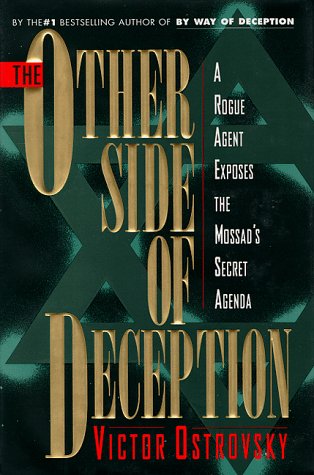
The contents of Ostrovsky’s first book had been rather mundane, lacking any shocking revelations. He merely described the inner workings of Mossad and recounted some of its major operations, effectively piercing the veil of secrecy that had long shrouded one of the world’s most effective intelligence services. But having established his reputation with an international bestseller, by 1994 the author felt confident enough to include numerous bombshells, so that individual readers must decide for themselves whether these were factual or merely a product of his wild imagination. Bergman’s comprehensive bibliography lists some 350 titles, but although Ostrovsky’s first book is included, his second is not.
Portions of Ostrovsky’s original narrative had certainly struck me as rather vague and odd. Why had he supposedly been scapegoated for a failed mission and drummed out of the service? And since he had left Mossad in early 1986 but only began work on his book two years later, I wondered what he had been doing during the intervening period. I also found it difficult to understand how a junior officer had obtained such a wealth of detailed information about Mossad operations in which he himself had not been personally involved. There seemed to be many missing pieces to the story.
These explanations were all supplied in the opening portions of his 1994 sequel, though they are obviously impossible to verify. According to the author, his departure had occurred as a byproduct of an ongoing internal struggle at Mossad, in which a moderate dissident faction intended to use him to undermine the credibility of the organization and thereby weaken its dominant leadership, whose policies they opposed.
Reading this second book eight or nine years ago, one of the earliest claims seemed totally outlandish. Apparently, the director of Mossad had traditionally been an outsider appointed by the prime minister, and that policy had long rankled many of its senior figures, who preferred to see one of their own put in charge. In 1982, their furious lobbying for such an internal promotion had been ignored, and instead a celebrated Israeli general had been named, who soon made plans to clean house in support of different policies. But instead of accepting this situation, some disgruntled Mossad elements instead arranged his assassination in Lebanon just before he was scheduled to officially take office. Some evidence of the successful plot immediately came to light and was later confirmed, igniting a subterranean factional conflict involving both Mossad personnel and some members of the military, a struggle that ultimately drew in Ostrovsky.
This story came towards the beginning of the book, and struck me as so wildly implausible that I became deeply suspicious of everything that followed. But after reading Bergman’s authoritative volume, I am now not so sure. After all, we know that around the same time, a different Mossad faction had seriously considered assassinating Israel’s defense minister, and there are strong suspicions that security operatives orchestrated the later assassination of Prime Minister Rabin. So perhaps the elimination of a disfavored Mossad director-designate is not so totally absurd. And Wikipedia does indeed confirm that Gen. Yekutiel Adam, Israel’s Deputy Chief of Staff, was named Mossad Director in mid-1982 but then killed in Lebanon just a couple of weeks before he was scheduled to take office, thereby becoming the highest-ranking Israeli ever to die on the battlefield.
According to Ostrovsky and his factional allies, powerful elements within Mossad were transforming it into a dangerous, rogue organization, which threatened Israeli democracy and blocked any possibility of peace with the Palestinians. These individuals might even act in direct opposition to the top Mossad leadership, whom they often regarded as overly weak and compromising.
Early in 1982, some of the more moderate Mossad elements backed by the outgoing director had tasked one of their officers in Paris to open diplomatic channels with the Palestinians, and he did so via an American attache whom he enlisted in the effort. But when the harder-line faction discovered this plan, they frustrated the project by assassinating both the Mossad agent and his unlucky American collaborator, while throwing the blame upon some extremist Palestinian group. I obviously can’t verify the truth of this remarkable account, but the New York Times archive does confirm Ostrovsky’s account of the mysterious 1982 killings of Yakov Barsimantov and Charles Robert Ray, puzzling incidents that left experts searching for a motive.
Ostrovsky claims to have been deeply shocked and disbelieving when he was initially informed of this history of hard-line Mossad elements assassinating both Israeli officials and their own colleagues over policy differences, but he was gradually persuaded of the reality. So as a private citizen now living in Canada, he agreed to undertake a campaign to disrupt Mossad’s existing intelligence operations, hoping to sufficiently discredit the organization that the dominant factions would lose influence or at least have their dangerous activities curtailed by the Israeli government. Although he would receive some assistance by the moderate elements that had recruited him, the project was obviously an extremely dangerous one, with his life very much at risk if his actions were discovered.
Presenting himself as a disgruntled former officer who was seeking revenge against his past employer, he spent much of the next year or two approaching the intelligence services of Britain, France, Jordan, and Egypt, offering to assist them in uncovering the Mossad networks in their countries in exchange for substantial financial payments. No similarly knowledgeable Mossad defector had ever previously come forward, and although some of these services were initially suspicious, he eventually won their trust, while the information he provided was quite valuable in breaking up various local Israeli spy-rings, most of which had previously been unsuspected. Meanwhile, his Mossad confederates kept him informed of any signs that his activities had been detected.
The very detailed account of Ostrovsky’s anti-Mossad counter-intelligence campaign occupies well over half the book, and I have no easy means of determining whether his stories are real or fantasy, or perhaps some mixture of the two. The author does provide copies of his 1986 plane tickets to Amman, Jordan and Cairo, Egypt, where supposedly he was debriefed at length by the local security services, and in 1988 a major international scandal did erupt when the British very publicly closed down a large number of Mossad safe-houses and expelled numerous Israeli agents. Personally, I found most of Ostrovsky’s account reasonably credible, but perhaps individuals who possess actual professional expertise in intelligence operations might come to a different conclusion.
Although two years of these attacks against Mossad intelligence networks had inflicted serious damage, the overall political results were less than desired. The existing leadership still held a firm grip on the organization and the Israeli government gave no sign of taking action. So Ostrovsky finally concluded that a different approach might be more effective, and he decided to write a book about Mossad and its inner workings.
His internal allies were initially quite skeptical, but he eventually won them over, and they fully participated in the writing project. Some of these individuals had spent many years at Mossad, even rising to a senior level, and they were the source of the extremely detailed material on particular operations in the 1990 book, which had seemed far beyond the knowledge of a very junior officer such as Ostrovsky.
Mossad’s attempt to legally suppress the book was a terrible blunder and generated the massive publicity that made it an international bestseller. Outside observers were mystified at such a counter-productive media strategy, but according to Ostrovsky, his internal allies had helped persuade the Mossad leadership to take that approach. They also tried to keep him abreast of any Mossad plans to abduct or assassinate him.
During the production of the 1990 book, Ostrovsky and his allies had discussed numerous past operations, but only a fraction of these were ultimately included in the text. So when the author decided to produce his sequel, he had a wealth of historical material to draw upon, which included several bombshells.
The first of these came with regard to Israel’s major role in the illegal sales of American military equipment to Iran during the bitter Iran-Iraq war of the 1980s, which eventually exploded into the headlines as the notorious “Iran-Contra Scandal,” although our media did its utmost to keep Israel’s central involvement out of the stories.
The arms trade with Iran was a very lucrative one for Israel, and was soon expanded to the training of military pilots. The deep ideological antipathy that the Islamic Republic held for the Jewish State required that the business be conducted via third parties, so a smuggling route was established through the small German state of Schleswig-Holstein. However, when an effort was later made to enlist the support of the state’s top elected official, he rejected the proposal. The Mossad leaders were fearful that he might interfere in the business, so they successfully fabricated a scandal to unseat him and install a more pliable German politician instead. Unfortunately, the disgraced official raised a fuss and demanded public hearings to clear his name, so Mossad agents lured him to Geneva, and after he rejected a large bribe to keep quiet, killed him, disguising the death so that police ruled it a suicide.
During my original reading, this very lengthy and detailed incident, which ran over 4,000 words, seemed quite doubtful to me. I’d never previously heard of Uwe Barschel, but he was described as a close personal friend of German Chancellor Helmut Kohl, and I found it totally implausible that Mossad had so casually removed a popular and influential European elected official from office, then subsequently murdered him. My deep suspicions regarding the rest of Ostrovsky’s book were further magnified.
However, in recently revisiting the incident, I discovered that seven months after the book appeared, the Washington Post reported that the Barschel case had been reopened, with German, Spanish, and Swiss police investigations finding strong indications of a murder committed exactly along the lines previously suggested by Ostrovsky. Once again, the surprising claims of the Mossad defector had apparently checked out, and I now became much more willing to believe that at least most of his subsequent revelations were probably correct. And there were quite a long list of those.
(As an aside, Ostrovsky noted one of the crucial sources of Mossad’s growing internal influence in Germany. The threat of domestic German terrorism led the German government to regularly send large numbers of its security and police officials to Israel for training, and these individuals became ideal targets for intelligence recruitment, who continued to collaborate with their Israeli handlers after they returned home and resumed their careers. Thus, although the topmost ranks of those organizations were generally loyal to their country, the mid-ranks gradually became honeycombed with Mossad assets, who could be used for various projects. This raises obvious concerns about America’s post-9/11 policy of sending such large numbers of our own police officials to Israel for similar training, as well as the tendency for nearly all newly elected members of Congress to travel there as well.)
I vaguely recalled the early 1980s controversy surrounding UN Secretary-General Kurt Waldheim, who was discovered to have lied about his World War II military service, and left office under a dark cloud, with his name becoming synonymous with long-hidden Nazi war-crimes. Yet according to Ostrovsky, the entire scandal was fabricated by Mossad, which placed incriminating documents obtained from other files into those of Waldheim. The UN leader had become increasingly critical of Israel’s military attacks on South Lebanon, so the falsified evidence was used to launch a smear campaign in the media, destroying him.
And if Ostrovsky can be credited, for many decades Israel itself had engaged in activities that would have occupied center-stage at the Nuremberg Trials. According to his account, from the late 1960s onward, Mossad had maintained a small laboratory facility at Nes Ziyyona just south of Tel Aviv for the lethal testing of nuclear, chemical, and bacteriological compounds upon hapless Palestinians selected for elimination. This ongoing process of deadly testing allowed Israel to perfect its assassination technologies while also upgrading its powerful arsenal of unconventional weapons available in the event of war. Although during the 1970s, the American media endlessly focused on the terrible depravity of the CIA, I don’t ever recall hearing any accusations along these lines.
At one point, Ostrovsky had been surprised to discover that Mossad agents were accompanying Israeli doctors on their medical mission to South Africa, where they treated impoverished Africans at an outpatient clinic in Soweto. The explanation he received was a grim one, namely that private Israeli companies were using the unknowing blacks as human guinea-pigs for the testing of medical compounds in ways that could not legally be conducted in Israel itself. I obviously have no means of verifying this claim, but I had sometimes wondered how Israel eventually came to dominate so much of world’s generic drug industry, which naturally relies upon the cheapest and most efficient means of testing and production.
Also quite interesting was the story he told of the rise and fall of British press tycoon Robert Maxwell, a Czech immigrant of Jewish background. According to his account, Maxwell had closely collaborated with Mossad throughout his career, and the intelligence service had been crucial in facilitating his rise to power, lending him money early on and weakening his media acquisition targets by deploying their allies in labor unions and the banking industry. Once Maxwell’s empire had been created, he repaid his benefactors in ways both legal and illegal, supporting Israel’s policies in his newspapers while providing Mossad with a slush fund, secretly financing their off-the-books European operations with cash from his corporate pension account. Those latter outlays were normally meant to be serve as temporary loans, but in 1991 Mossad was slow in returning the funds and he grew financially desperate as his fragile empire tottered. When he hinted at the dangerous secrets he might be forced to reveal unless he were paid, Mossad killed him instead and disguised it as suicide.
Once again, Ostrovsky’s claims cannot be verified, but the dead publisher was given a hero’s funeral in Israel, with the serving Prime Minister deeply praising his important services to the Jewish State while three of his predecessors were also in attendance, and Maxwell was buried with full honors in the Mount of Olives. Most recently, his daughter Ghisele reached the headlines as the closest associate of notorious blackmailer Jeffrey Epstein, and the woman is widely believed to have been a Mossad agent, now hiding in Israel.
But Ostrovsky’s most potentially momentous story filled one of the last short chapters, commencing in late 1991. In the aftermath of America’s great military victory over Iraq in the Gulf War, President George H.W. Bush decided to invest some of his considerable political capital in finally forcing peace in the Middle East between Arabs and Israelis. Right-wing Prime Minister Yitzhak Shamir was bitterly opposed to any of the proposed concessions, so Bush began placing financial pressure upon the Jewish State, blocking loan guarantees despite the efforts of America’s powerful Israel Lobby. Within certain circles, he was soon vilified as a diabolical enemy of the Jews.
Ostrovsky explains that when faced with strong opposition by an American president, pro-Israel groups have traditionally cultivated his Vice President as a backdoor means of regaining their influence. For example, when President Kennedy fiercely opposed Israel’s nuclear weapons development program in the early 1960s, the Israel Lobby focused their efforts upon Vice President Lyndon Johnson, and this strategy was rewarded when the latter doubled aid to Israel soon after taking office. Similarly, in 1991 they emphasized their friendship with Vice President Dan Quayle, an easy task since his chief of staff and top advisor was William Kristol, a leading Neocon.
Meanwhile, an extreme faction in Mossad settled upon a much more direct means of solving Israel’s political problems, planning to assassinate President Bush at his international peace conference in Madrid while throwing the blame upon three Palestinian militants. On October 1, 1991, Ostrovsky received a frantic call from his leading Mossad collaborator informing him of the plot and desperately seeking his assistance in thwarting it. At first he was disbelieving, finding it difficult to accept that even Mossad hard-liners would consider such a reckless act, but he soon agreed to do whatever he could to publicize the plot and somehow bring it to the attention of the Bush Administration without being dismissed as a mere “conspiracy theorist.”
Since Ostrovsky was now a prominent author, he was frequently invited to speak on Middle East issues to elite groups, and at his next opportunity, he emphasized the intense hostility of Israeli right-wingers to Bush’s plans, and strongly suggested that the president’s life was in danger. As it happened, a member of the small audience brought those concerns to the attention of former Congressman Pete McCloskey, an old friend of the president, who soon discussed the situation with Ostrovsky by phone, then flew to Ottawa for a lengthy personal meeting to assess the credibility of the threat. Concluding that the danger was serious and real, McCloskey immediately began using his DC connections to approach members of the Secret Service, finally persuading them to contact Ostrovsky, who explained his inside sources of information. The story was soon leaked to the media, generating extensive coverage by influential columnist Jack Anderson and others, and the resulting publicity caused the assassination plot to be abandoned.
Once again I was quite skeptical after reading this account, so I decided to contacted a few people I knew, and they informed that the Bush Administration had indeed taken Ostrovsky’s warnings about the alleged Mossad assassination plot very seriously at the time, which seemingly confirmed most of the author’s story.
Following his publishing triumph and his success in foiling the alleged plot against the life of President Bush in late 1991, Ostrovsky largely lost touch with his internal Mossad allies, and instead focused on his own private life and new writing career in Canada. Furthermore, the June 1992 Israeli elections brought to power the much more moderate government of Prime Minister Rabin, which seemed to greatly reduce the need for any further anti-Mossad efforts. But government shifts may sometimes have unexpected consequences, especially since in the lethal world of intelligence operations, personal relationships are often be sacrificed to expediency.
After the publication of his 1990 book, Ostrovsky had become very fearful of being abducted or killed, and as a consequence he had avoided crossing the Atlantic and visiting Europe. But in 1993, his former Mossad allies began urging him to travel to Holland and Belgium to promote the release of new translations of his work. They firmly assured him that the political changes in Israel meant that he would now be perfectly safe, so he finally agreed to do so despite misgivings. But although he took some reasonable security precautions, an odd incident in Brussels convinced him that he had narrowly escaped a Mossad kidnapping. Growing alarmed, he called his senior Mossad contact at home, but instead of getting any reassurance, received a strangely cold and unfriendly response, which included a reference to the notorious case of a individual who had once betrayed Mossad and then been killed together with his wife and three children.
Rightly or wrongly, Ostrovsky concluded that the fall of Israel’s hard-line government had apparently given the more moderate Mossad faction a chance of gaining control of their organization. Tempted by such power, they now regarded him as a dangerous and expendable loose end, someone who might eventually reveal their own past involvement in anti-Mossad intelligence activities as well as the highly-damaging book project.
Believing his former allies now wanted to eliminate him, he quickly began work on his sequel, which would put the full story into the public record, thereby greatly reducing the benefits of shutting his mouth. I noticed that his new text repeatedly mentioned his secret possession of a comprehensive collection of the names and photos of Mossad’s international operatives, which whether true or not might serve as a life-insurance policy by greatly increasing the risk of taking any action against him.
This short description of events closed Ostrovsky’s second book, explaining why the volume was written and contained so much sensitive material that had been excluded from the previous one.
“Final Judgment” on the JFK Assassination
Ostrovsky’s second book was released late in 1994 by HarperCollins, a leading publisher. But despite its explosive contents, this time Israel and its advocates had learned their lesson, and they greeted the work with near-total silence rather than hysterical attacks so it received relatively little attention and sold only a fraction of the previous number of copies. Among mainstream publications, I could only locate one short and rather negative capsule review in Foreign Affairs.
However, another book published earlier that same year on related issues suffered from a far more complete public blackout that has now still endured for over a quarter-century, and this was not merely because of its obscure source. Despite the severe handicap of a near-total media boycott, the work went on to become an underground bestseller, eventually having over 40,000 copies in print, widely read and perhaps discussed in certain circles, but almost never publicly mentioned. Final Judgment by the late Michael Collins Piper set forth the explosive hypothesis that Mossad had played a central role in the most famous assassination of the twentieth century, the 1963 killing of President John F. Kennedy.
While Ostrovsky’s books drew upon his personal knowledge of Israel’s secret intelligence service, Piper was a journalist and researcher who had spent his entire career at Liberty Lobby, a small activist organization based in DC. Being sharply critical of Israeli policies and Zionist influence in America, the group was usually portrayed by the media as part of the far right anti-Semitic populist fringe, and almost entirely ignored by all mainstream outlets. Its weekly tabloid Spotlight, which often focused on controversial topics, had once reached a remarkable circulation of 300,000 in the unsettled times of the late 1970s, but then declined substantially in readership during the more placid and optimistic Reagan Era that followed.
Liberty Lobby had never much delved into JFK assassination issues, but in 1978 it published an article on the subject by Victor Marchetti, a prominent former CIA official, and was soon sued for defamation by E. Howard Hunt of Watergate fame, with the lawsuit threatening its survival. In 1982 this ongoing legal battle attracted the involvement of Mark Lane, an experienced attorney of a leftist Jewish background who had been the founding father of JFK conspiracy investigations. Lane won the case at trial in 1985 and thereafter remained a close ally of the organization.
Piper gradually became friendly with Lane and by the early 1990s he himself had grown interested in the JFK assassination. In January 1994, he published his major work, Final Judgment, which presented a very large body of circumstantial evidence backing his theory that Mossad had been heavily involved in the JFK assassination. I summarized and discussed the Piper Hypothesis in my own 2018 article:
For decades following the 1963 assassination, virtually no suspicions had ever been directed towards Israel, and as a consequence none of the hundreds or thousands of assassination conspiracy books that appeared during the 1960s, 1970s, and 1980s had hinted at any role for the Mossad, though nearly every other possible culprit, ranging from the Vatican to the Illuminati, came under scrutiny. Kennedy had received over 80% of the Jewish vote in his 1960 election, American Jews featured very prominently in his White House, and he was greatly lionized by Jewish media figures, celebrities, and intellectuals ranging from New York City to Hollywood to the Ivy League. Moreover, individuals with a Jewish background such as Mark Lane and Edward Epstein had been among the leading early proponents of an assassination conspiracy, with their controversial theories championed by influential Jewish cultural celebrities such as Mort Sahl and Norman Mailer. Given that the Kennedy Administration was widely perceived as pro-Israel, there seemed no possible motive for any Mossad involvement, and bizarre, totally unsubstantiated accusations of such a monumental nature directed against the Jewish state were hardly likely to gain much traction in an overwhelmingly pro-Israel publishing industry.
However, in the early 1990s highly-regarded journalists and researchers began exposing the circumstances surrounding the development of Israel’s nuclear weapons arsenal. Seymour Hersh’s 1991 book The Samson Option: Israel’s Nuclear Arsenal and American Foreign Policy described the extreme efforts of the Kennedy Administration to force Israel to allow international inspections of its allegedly non-military nuclear reactor at Dimona, and thereby prevent its use in producing nuclear weapons. Dangerous Liaisons: The Inside Story of the U.S.-Israeli Covert Relationship by Andrew and Leslie Cockburn appeared in the same year, and covered similar ground.
Although entirely hidden from public awareness at the time, the early 1960s political conflict between the American and Israeli governments over nuclear weapons development had represented a top foreign policy priority of the Kennedy Administration, which had made nuclear non-proliferation one of its central international initiatives. It is notable that John McCone, Kennedy’s choice as CIA Director, had previously served on the Atomic Energy Commission under Eisenhower, being the individual who leaked the fact that Israel was building a nuclear reactor to produce plutonium.
The pressure and financial aid threats secretly applied to Israel by the Kennedy Administration eventually became so severe that they led to the resignation of Israel’s founding Prime Minister David Ben-Gurion in June 1963. But all these efforts were almost entirely halted or reversed once Kennedy was replaced by Johnson in November of that same year. Piper notes that Stephen Green’s 1984 book Taking Sides: America’s Secret Relations With a Militant Israel had previously documented that U.S. Middle East Policy completely reversed itself following Kennedy’s assassination, but this important finding had attracted little attention at the time.
Skeptics of a plausible institutional basis for a JFK assassination conspiracy have often noted the extreme continuity in both foreign and domestic policies between the Kennedy and Johnson Administrations, arguing that this casts severe doubt on any such possible motive. Although this analysis seems largely correct, America’s behavior towards Israel and its nuclear weapons program stands as a very notable exception to this pattern.
An additional major area of concern for Israeli officials may have involved the efforts of the Kennedy Administration to sharply restrict the activities of pro-Israel political lobbies. During his 1960 presidential campaign, Kennedy had met in New York City with a group of wealthy Israel advocates, led by financier Abraham Feinberg, and they had offered enormous financial support in exchange for a controlling influence in Middle Eastern policy. Kennedy managed to fob them off with vague assurances, but he considered the incident so troubling that the next morning he sought out journalist Charles Bartlett, one of his closest friends, and expressed his outrage that American foreign policy might fall under the control of partisans of a foreign power, promising that if he became president, he would rectify that situation. And indeed, once he had installed his brother Robert as Attorney General, the latter initiated a major legal effort to force pro-Israel groups to register themselves as foreign agents, which would have drastically reduced their power and influence. But after JFK’s death, this project was quickly abandoned, and as part of the settlement, the leading pro-Israel lobby merely agreed to reconstitute itself as AIPAC.
Final Judgment went through a number of a reprintings following its original 1994 appearance, and by the sixth edition released in 2004, had grown to over 650 pages, including numerous long appendices and over 1100 footnotes, the overwhelming majority of these referencing fully mainstream sources. The body of the text was merely serviceable in organization and polish, reflecting the total boycott by all publishers, mainstream or alternative, but I found the contents themselves remarkable and generally quite compelling. Despite the most extreme blackout by all media outlets, the book sold more than 40,000 copies over the years, making it something of an underground bestseller, and surely bringing it to the attention of everyone in the JFK assassination research community, though apparently almost none of them were willing to mention its existence. I suspect these other writers realized that even any mere acknowledgement of the existence of the book, if only to ridicule or dismiss it, might prove fatal to their media and publishing career. Piper himself died in 2015, aged 54, suffering from the health problems and heavy-drinking often associated with grim poverty, and other journalists may have been reluctant to risk that same dismal fate.
As an example of this strange situation, the bibliography of Talbot’s 2005 book contains almost 140 entries, some rather obscure, but has no space for Final Judgment, nor does his very comprehensive index include any entry for “Jews” or “Israel.” Indeed, at one point he very delicately characterizes Sen. Robert Kennedy’s entirely Jewish senior staff by stating “There was not a Catholic among them.” His 2015 sequel is equally circumspect, and although the index does contain numerous entries pertaining to Jews, all these references are in regards to World War II and the Nazis, including his discussion of the alleged Nazi ties of Allen Dulles, his principal bête noire. Stone’s book, while fearlessly convicting President Lyndon Johnson of the JFK assassination, also strangely excludes “Jews” and “Israel” from the long index and Final Judgment from the bibliography, and Douglass’s book follows this same pattern.
Furthermore, the extreme concerns that the Piper Hypothesis seems to have provoked among JFK assassination researchers may explain a strange anomaly. Although Mark Lane was himself of Jewish origins and left-wing roots, after his victory for Liberty Lobby in the Hunt libel trial, he spent many years associated with that organization in a legal capacity, and apparently became quite friendly with Piper, one of its leading writers. According to Piper, Lane told him that Final Judgment made “a solid case” for a major Mossad role in the assassination, and he viewed the theory as fully complementary to his own focus on CIA involvement. I suspect that concerns about these associations may explain why Lane was almost completely airbrushed out of the Douglass and 2007 Talbot books, and discussed in the second Talbot book only when his work was absolutely essential to Talbot’s own analysis. By contrast, New York Times staff writers are hardly likely to be as versed in the lesser-known aspects of the JFK assassination research community, and being ignorant of this hidden controversy, they gave Lane the long and glowing obituary that his career fully warranted.
When weighing the possible suspects for a given crime, considering their past pattern of behavior is often a helpful approach. As discussed above, I can think of no historical example in which organized crime initiated a serious assassination attempt against any American political figure even moderately prominent on the national stage. And despite a few suspicions here and there, the same applies to the CIA.
By contrast, the Israeli Mossad and the Zionist groups that preceded the establishment of the Jewish state seem to have had a very long track record of assassinations, including those of high-ranking political figures who might normally be regarded as inviolate. Lord Moyne, the British Minister of State for the Middle East, was assassinated in 1944 and Count Folke Bernadotte, the UN Peace Negotiator sent to help resolve the first Arab-Israel war, suffered the same fate in September 1948. Not even an American president was entirely free of such risks, and Piper notes that the memoirs of Harry Truman’s daughter Margaret reveal that Zionist militants had tried to assassinate her father using a letter laced with toxic chemicals in 1947 when they believed he was dragging his heels in supporting Israel, although that failed attempt was never made public. The Zionist faction responsible for all of these incidents was led by Yitzhak Shamir, who later became a leader of Mossad and director of its assassination program during the 1960s, before eventually becoming Prime Minister of Israel in 1986.
There are other notable elements that tend to support the Piper Hypothesis. Once we accept the existence of a JFK assassination conspiracy, the one individual who is virtually certain to have been a participant was Jack Ruby, and his organized crime ties were almost entirely to the huge but rarely-mentioned Jewish wing of that enterprise, presided over by Meyer Lansky, an extremely fervent supporter of Israel. Ruby himself had particularly strong connections with Lansky lieutenant Mickey Cohen, who dominated the Los Angeles underworld and had been personally involved in gun-running to Israel prior to the 1948 war. Indeed, according to Dallas rabbi Hillel Silverman, Ruby had privately explained his killing of Oswald by saying “I did it for the Jewish people.”
An intriguing aspect to Oliver Stone’s landmark JFK film should also be mentioned. Arnon Milchan, the wealthy Hollywood producer who backed the project, was not only an Israeli citizen, but had also reportedly played a central role in the enormous espionage project to divert American technology and materials to Israel’s nuclear weapons project, the exact undertaking that the Kennedy Administration had made such efforts to block. Milchan has even sometimes been described as “the Israeli James Bond.” And although the film ran a full three hours in length, JFK scrupulously avoided presenting any of the details that Piper later regarded as initial clues to an Israeli dimension, instead seeming to finger America’s fanatic home-grown anti-Communist movement and the Cold War leadership of the military-industrial complex as the guilty parties.
Summarizing over 300,000 words of Piper’s history and analysis in just a few paragraphs is obviously an impossible undertaking, but the above discussion provides a reasonable taste of the enormous mass of circumstantial evidence mustered in favor of the Piper Hypothesis.
In many respects, JFK Assassination Studies has become its own academic discipline, and my credentials are quite limited. I have read perhaps a dozen books in the subject, and have also tried to approach the issues with the clean slate and fresh eyes of an outsider, but any serious expert would surely have digested scores or even hundreds of the volumes in the field. While the overall analysis of Final Judgment struck me as quite persuasive, a good fraction of the names and references were unfamiliar, and I simply do not have the background to assess their credibility, nor whether the description of the material presented is accurate.
Under normal circumstances, I would turn to the reviews or critiques produced by other authors, and comparing them against Piper’s claims, then decide which argument seemed the stronger. But although Final Judgment was published a quarter-century ago, the near-absolute blanket of silence surrounding the Piper Hypothesis, especially from the more influential and credible researchers, renders this impossible.
However, Piper’s inability to secure any regular publisher and the widespread efforts to smother his theory out of existence, have had an ironic consequence. Since the book went out of print years ago, I had a relatively easy time securing the rights to include it in my collection of controversial HTML Books, and I have now done so, thereby allowing everyone on the Internet to conveniently read the entire text and decide for themselves, while easily checking the multitude of references or searching for particular words or phrases.
This edition actually incorporates several much shorter works, originally published separately. One of these, consisting of an extended Q&A, describes the genesis of the idea and answers numerous questions surrounding it, and for some readers might represent a better starting point.
There are also numerous extended Piper interviews or presentations easily available on YouTube, and when I watched two or three of them a couple of years ago, I thought he effectively summarized many of his main arguments, but I cannot remember which ones they were.
Some additional evidence tends to support Piper’s arguments for likely Mossad involvement in the death of our president.
David Talbot’s influential 2007 book Brothers revealed that Robert F. Kennedy had been convinced almost from the first that his brother had been struck down in a conspiracy, but he held his tongue, telling his circle of friends that he stood little chance of tracking down and punishing the guilty parties until he himself reached the White House. By June 1968, he seemed on the threshold of achieving that goal, but was felled by an assassin’s bullet just moments after winning the crucial California presidential primary. The logical assumption is that his death was engineered by the same elements as that of his elder brother, who were now acting to protect themselves from the consequences of their earlier crime.
A young Palestinian named Sirhan Sirhan had fired a pistol at the scene and was quickly arrested and convicted for the murder. But Talbot emphasizes that the coroner’s report revealed that the fatal bullet came from a completely different direction, while the acoustical record proves that far more shots were fired than the capacity of the alleged killer’s gun. Such hard evidence seems to demonstrate a conspiracy.
Sirhan himself seemed dazed and confused, later claiming to have no memory of events, and Talbot mentions that various assassination researchers have long argued that he was merely a convenient patsy in the plot, perhaps acting under some form of hypnosis or conditioning. Nearly all these writers are usually reluctant to note that the selection of a Palestinian as scapegoat in the killing seems to point in a certain obvious direction, but Bergman’s recent book also includes a major new revelation. At exactly the same moment that Sirhan was being wrestled to the floor of the Ambassador Hotel ballroom in Los Angeles, another young Palestinian was undergoing intensive rounds of hypnotic conditioning at the hands of Mossad in Israel, being programmed to assassinate PLO leader Yasir Arafat; and although that effort ultimately failed, such a coincidence seems to stretch the bounds of plausibility.
Three decades later, JFK’s heir and namesake had developed a growing public profile as publisher of his popular political magazine George, which attracted considerable international controversy when he published a long article claiming that the assassination of Israeli Prime Minister Rabin had been orchestrated by hard-liners within his own security services. There were also strong indications that JFK Jr. might soon enter politics, perhaps running for the US Senate as a stepping-stone to the White House.
Instead, he died in an unusual 1999 light plane crash, and a later edition of Piper’s book outlined some of the suspicious circumstances, which the author believed suggested an Israeli hand. For years Piper had made efforts to bring his explosive book to the attention of JFK’s son, and he thought that he might have finally succeeded. Israeli-Canadian author Barry Chamish also believed that it was JFK Jr.’s discovery of the Piper Hypothesis had led him to promote the Rabin assassination conspiracy theory in his magazine.
Last year, French researcher Laurent Guyenot published an exhaustive analysis of JFK Jr.’s death, arguing that he was probably killed by Israel. My own reading of the material he presents is rather different, and although there are a number of somewhat suspicious items, I think that the evidence of foul play—let alone Mossad involvement—is rather thin, leading me to conclude that the plane crash was probably just the tragic accident portrayed by the media. But the aftermath of his death did highlight an important ideological divide.
For six decades, members of the Kennedy family have been wildly popular among ordinary American Jews, probably attracting greater political enthusiasm than almost any other public figures. But this undeniable reality has masked an entirely different perspective found within a particular segment of that same community.
John Podhoretz, a leading scion of the militantly pro-Israel Neocons, was opinion editor of The New York Post at the time of the fatal plane crash, and he immediately published an astonishing column entitled “A Conversation in Hell” in which he positively reveled at the death of the young Kennedy. He portrayed patriarch Joseph Kennedy as an unspeakable anti-Semite who had sold his soul to the Devil for his own worldly success and that of his family, suggesting that all the subsequent assassinations and other early deaths of Kennedys constituted the fine print of his Satanic bargain. So brutally harsh a piece surely indicates that those bitter sentiments were hardly uncommon within Podhoretz’s small ultra-Zionist social circle, which probably overlapped with similar right-wing elements in Israel. So this reaction demonstrates that the exact same political figures who were most deeply beloved by the overwhelming majority of American Jews may have also been regarded as mortal enemies by an influential segment of the Jewish State and its corps of Mossad assassins.
When I published my original 2018 article on the JFK assassination, I naturally noted the widespread use of assassination by Zionist groups, a pattern that long predated the creation of the Jewish State, and I cited some of the supportive evidence contained in the two Ostrovsky books. But at the time, I still had considerable doubts about Ostrovsky’s credibility, especially regarding the shocking claims in his second book, and I had not yet read Bergman’s volume, which had just been published a few months earlier. So although there seemed considerable evidence for the Piper Hypothesis, I regarded it as far from conclusive.
However, I now have digested Bergman’s book, which documents the enormous volume of international Mossad assassinations, and I have also concluded that Ostrovsky’s claims were far more solid than I had previously assumed. As a result my opinion has substantially shifted. Instead of merely being a solid possibility, I now believe there is strong likelihood that Mossad together with its American collaborators played a central role in the Kennedy assassinations of the 1960s, leading me to fully affirm the Piper Hypothesis. Guyenot has relied upon many of the same sources and has come to roughly similar conclusions.
The Strange Death of James Forrestal, and Other Fatalities
Once we recognize that Israel’s Mossad was probably responsible for the assassination of President John F. Kennedy, our understanding of post-war American history may require substantial reevaluation.
The JFK assassination was possibly the most famous event of the second half of the twentieth century, and inspired a vast outpouring of media coverage and journalistic investigation that seemingly explored every nook and crany of the story. Yet for the first three decades after the killing in Dallas, virtually no whisper of suspicion was ever directed at Israel, and during the quarter-century since Piper published his ground-breaking 1994 book, scarcely any of his analysis has leaked into the English-language media. If a story of such enormity can have remained so well hidden for so long, perhaps it was neither the first nor the last.
If the Kennedy brothers did indeed perish due to a conflict over our Middle Eastern policy, they were certainly not the first prominent Western leaders to suffer that fate, especially a generation earlier during the bitter political battles over the establishment of Israel. All our standard history books describe the mid-1940s Zionist assassinations of Lord Moyne of Britain and U.N. Peace Negotiator Count Folke Bernodotte, though they rarely mention the failed attempts on the lives of President Harry S. Truman and Britain Foreign Secretary Ernest Bevin around the same time.
But another leading American public figure also died during that period under rather strange circumstances, and although his demise is always mentioned, the crucial political context is excluded, as I discussed at length in a 2018 article:
Sometimes our standard history textbooks provide two seemingly unrelated stories, which become far more important only once we discover that they are actually parts of a single connected whole. The strange death of James Forrestal certainly falls into this category.
During the 1930s Forrestal had reached the pinacle of Wall Street, serving as CEO of Dillon, Read, one of the most prestigious investment banks. With World War II looming, Roosevelt drew him into government service in 1940, partly because his strong Republican credentials helped emphasize the bipartisan nature of the war effort, and he soon became Undersecretary of the Navy. Upon the death of his elderly superior in 1944, Forrestal was elevated to the Cabinet as Navy Secretary, and after the contentious battle over the reorganization of our military departments, he became America’s first Secretary of Defense in 1947, holding authority over the Army, Navy, Air Force, and Marines. Along with Secretary of State Gen. George Marshall, Forrestal probably ranked as the most influential member of Truman’s Cabinet. However, just a few months after Truman’s 1948 reelection, we are told that Forrestal became paranoid and depressed, resigned his powerful position, and weeks later committed suicide by jumping from an 18th story window at Bethesda Naval Hospital. Knowing almost nothing about Forrestal or his background, I always nodded my head over this odd historical event.
Meanwhile, an entirely different page or chapter of my history textbooks usually carried the dramatic story of the bitter political conflict that wracked the Truman Administration over the recognition of the State of Israel, which had taken place the previous year. I read that George Marshall argued such a step would be totally disastrous for American interests by potentially alienating many hundreds of millions of Arabs and Muslims, who held the enormous oil wealth of the Middle East, and felt so strongly about the matter that he threatened to resign. However, Truman, heavily influenced by the personal lobbying of his old Jewish haberdashery business partner Eddie Jacobson, ultimately decided upon recognition, and Marshall stayed in the government.
However, almost a decade ago, I somehow stumbled across an interesting book by Alan Hart, a journalist and author who had served as a longtime BBC Middle East Correspondent, in which I discovered that these two different stories were part of a seamless whole. By his account, although Marshall had indeed strongly opposed recognition of Israel, it had actually been Forrestal who spearheaded that effort in Truman’s Cabinet and was most identified with that position, resulting in numerous harsh attacks in the media and his later departure from the Truman Cabinet. Hart also raised very considerable doubts about whether Forrestal’s subsequent death had actually been suicide, citing an obscure website for a detailed analysis of that last issue.
It is a commonplace that the Internet has democratized the distribution of information, allowing those who create knowledge to connect with those who consume it without the need for a gate-keeping intermediary. I have encountered few better examples of the unleashed potential of this new system than “Who Killed Forrestal?”, an exhaustive analysis by a certain David Martin, who describes himself as an economist and political blogger. Running many tens of thousands of words, his series of articles on the fate of America’s first Secretary of Defense provides an exhaustive discussion of all the source materials, including the small handful of published books describing Forrestal’s life and strange death, supplemented by contemporaneous newspaper articles and numerous relevant government documents obtained by personal FOIA requests. The verdict of murder followed by a massive governmental cover-up seems solidly established.
As mentioned, Forrestal’s role as the Truman Administration’s principal opponent of Israel’s creation had made him the subject of an almost unprecedented campaign of personal media vilification in both print and radio, spearheaded by the country’s two most powerful columnists of the right and the left, Walter Winchell and Drew Pearson, only the former being Jewish, but both heavily connected with the ADL and extremely pro-Zionist, with their attacks and accusations even continuing after his resignation and death.
Once we move past the wild exaggerations of Forrestal’s alleged psychological problems promoted by these very hostile media pundits and their many allies, much of Forrestal’s supposed paranoia apparently consisted of his belief that he was being followed around Washington, D.C., his phones may have been tapped, and his life might be in danger at the hands of Zionist agents. And perhaps such concerns were not so entirely unreasonable given certain contemporaneous events.

Indeed, State Department official Robert Lovett, a relatively minor and low-profile opponent of Zionist interests, reported receiving numerous threatening phone calls late at night around the same time, which greatly concerned him. Martin also cites subsequent books by Zionist partisans who boasted of the effective use their side had made of blackmail, apparently obtained by wire-tapping, to ensure sufficient political support for Israel’s creation.
Meanwhile, behind the scenes, powerful financial forces may have been gathering to ensure that President Truman ignored the unified recommendations of all his diplomatic and national security advisors. Years later, both Gore Vidal and Alexander Cockburn would separately report that it eventually became common knowledge in DC political circles that during the desperate days of Truman’s underdog 1948 reelection campaign, he had secretly accepted a cash payment of $2 million from wealthy Zionists in exchange for recognizing Israel, a sum perhaps comparable to $20 million or more in present-day dollars.
Republican Thomas Dewey had been heavily favored to win the 1948 presidential election, and after Truman’s surprising upset, Forrestal’s political position was certainly not helped when Pearson claimed in a newspaper column that Forrestal had secretly met with Dewey during the campaign, making arrangements to be kept on in a Dewey Administration.
Suffering political defeat regarding Middle East policy and facing ceaseless media attacks, Forrestal resigned his Cabinet post under pressure. Almost immediately afterwards, he was checked into the Bethesda Naval Hospital for observation, supposedly suffering from severe fatigue and exhaustion, and he remained there for seven weeks, with his access to visitors sharply restricted. He was finally scheduled to be released on May 22, 1949, but just hours before his brother Henry came to pick him up, his body was found below the window of his 18th floor room, with a knotted cord wound tightly around his neck. Based upon an official press release, the newspapers all reported his unfortunate suicide, suggesting that he had first tried to hang himself, but failing that approach, had leapt out his window instead. A half page of copied Greek verse was found in his room, and in the heydey of Freudian psychoanalyical thinking, this was regarded as the subconscious trigger for his sudden death impulse, being treated as almost the equivalent of an actual suicide note. My own history textbooks simplified this complex story to merely say “suicide,” which is what I read and never questioned.
Martin raises numerous very serious doubts with this official verdict. Among other things, published interviews with Forrestal’s surviving brother and friends reveal that none of them believed Forrestal had taken his own life, and that they had all been prevented from seeing him until near the very end of his entire period of confinement. Indeed, the brother recounted that just the day before, Forrestal had been in fine spirits, saying that upon his release, he planned to use some of his very considerable personal wealth to buy a newspaper and begin revealing to the American people many of the suppressed facts concerning America’s entry into World War II, of which he had direct knowledge, supplemented by the extremely extensive personal diary that he had kept for many years. Upon Forrestal’s confinement, that diary, running thousands of pages, had been seized by the government, and after his death was apparently published only in heavily edited and expurgated form, though it nonetheless still became a historical sensation.
The government documents unearthed by Martin raise additional doubts about the story presented in all the standard history books. Forrestal’s medical files seem to lack any official autopsy report, there is visible evidence of broken glass in his room, suggesting a violent struggle, and most remarkably, the page of copied Greek verse—always cited as the main indication of Forrestal’s final suicidal intent—was actually not written in Forrestal’s own hand.
Aside from newspaper accounts and government documents, much of Martin’s analysis, including the extensive personal interviews of Forrestal’s friends and relatives, is based upon a short book entitled The Death of James Forrestal, published in 1966 by one Cornell Simpson, almost certainly a pseudonym. Simpson states that his investigative research had been conducted just a few years after Forrestal’s death and although his book was originally scheduled for release his publisher grew concerned over the extremely controversial nature of the material included and cancelled the project. According to Simpson, years later he decided to take his unchanged manuscript off the shelf and have it published by Western Islands press, which turns out to have been an imprint of the John Birch Society, the notoriously conspiratorial rightwing organization then near the height of its national influence. For these reasons, certain aspects of the book are of considerable interest even beyond the contents directly relating to Forrestal.
The first part of the book consists of a detailed presentation of the actual evidence regarding Forrestal’s highly suspicious death, including the numerous interviews with his friends and relatives, while the second portion focuses on the nefarious plots of the world-wide Communist movement, a Birch Society staple. Allegedly, Forrestal’s staunch anti-Communism had been what targeted him for destruction by Communist agents, and there is virtually no reference to any controversy regarding his enormous public battle over Israel’s establishment, although that was certainly the primary factor behind his political downfall. Martin notes these strange inconsistencies, and even wonders whether certain aspects of the book and its release may have been intended to deflect attention from this Zionist dimension towards some nefarious Communist plot.
Consider, for example, David Niles, whose name has lapsed into total obscurity, but who had been one of the very few senior FDR aides retained by his successor, and according to observers, Niles eventually became one of the most powerful figures behind the scenes of the Truman Administration. Various accounts suggest he played a leading role in Forrestal’s removal, and Simpson’s book supports this, suggesting that he was Communist agent of some sort. However, although the Venona Papers reveal that Niles had sometimes cooperated with Soviet agents in their espionage activities, he apparently did so either for money or for some other considerations, and was certainly not part of their own intelligence network. Instead, both Martin and Hart provide an enormous amount of evidence that Niles’s loyalty was overwhelmingly to Zionism, and indeed by 1950 his espionage activities on behalf of Israel became so extremely blatant that Gen. Omar Bradley, Chairman of the Joint Chiefs of Staff, threatened to immediately resign unless Niles was fired, forcing Truman’s hand.
Forrestal was a wealthy and pugnacious Irish Catholic, and I think there is very considerable evidence that his death was the result of factors quite similar to those that probably claimed the life of an even more prominent Irish Catholic in Dallas 14 years later.
There are some other possible fatalities that follow this pattern, though the evidence in those cases is far less strong. Piper’s 1994 opus is focused primarily on the JFK assassination, but over half his 650 pages are given over to long series of appendices dealing with somewhat related topics. One of these discusses the strange deaths of a couple of former high-ranking CIA officials, suggesting they might have involved foul play.
Former CIA Director William Colby had apparently long been regarded as highly skeptical of the nature of America’s relationship with Israel, and therefore was characterized by pro-Israel members of the media as a notorious “Arabist.” Indeed, while serving as director in 1974, he had finally ended the career of longtime CIA counter-intelligence chief James Angleton, whose extreme affinity with Israel and Mossad had sometimes raised doubts about his true loyalties. Piper says that by 1996 Colby had grown sufficiently concerned about Israel’s infiltration and manipulation of the US government and its intelligence community that he arranged a meeting with high-level Arab officials in DC, suggesting that they all work together to counter this disturbing situation. A few weeks later, Colby disappeared and his drowned body was eventually found, with the official conclusion being that he supposedly perished near his home in a canoeing accident, although his Arab interlocutors alleged foul play.
Piper goes on to also describe the earlier death of John Paisley, the former longtime deputy director of the CIA’s Office of Strategic Research, and also a strong critic of the influence of Israel and its close Neocon allies in American national security policy. In late 1978, Paisley’s body was found floating in the Chesapeake Bay with a bullet in the head, and although the death was officially ruled a suicide, Piper claims that few believed the story. According to him, Richard Clement, who had headed the Interagency Committee on Counterterrorism during the Reagan Administration, explained in 1996:
The Israelis had no compunction about “terminating” key American intelligence officials who threatened to blow the whistle on them. Those of us familiar with the case of Paisley know that he was killed by Mossad. But no one, not even in Congress, wants to stand up and say so publicly.
Piper also notes the bitter political battles that other Washington national security experts, such as former CIA Deputy Director Adm. Bobby Ray Inman, had experienced over the years with elements of the Israel Lobby in Congress and the media. After Inman was nominated by President Clinton to lead the Defense Department, a firestorm of criticism by pro-Israel partisans forced his withdrawal.
I have made no effort to investigate the material cited by Piper in his short discussion. These examples were previously unknown to me, and all of the evidence he provides seems purely circumstantial, hardly making a case that rises above mere suspicion. But I do regard the author as a reasonably solid investigative journalist and researcher, whose views should be taken seriously. Those so interested can read his 5,000 word Appendix Six and decide for themselves.
The 9/11 Attacks – What Happened?
Although somewhat related, political assassinations and terrorist attacks are distinct topics, and Bergman’s comprehensive volume explicitly focuses on the former, so we cannot fault him for providing only slight coverage of the latter. But the historical pattern of Israeli activity, especially with regard to false-flag attacks, is really quite remarkable, as I noted in a 2018 article:
One of history’s largest terrorist attacks prior to 9/11 was the 1946 bombing of the King David Hotel in Jerusalem by Zionist militants dressed as Arabs, which killed 91 people and largely destroyed the structure. In the famous Lavon Affair of 1954, Israeli agents launched a wave of terrorist attacks against Western targets in Egypt, intending to have those blamed on anti-Western Arab groups. There are strong claims that in 1950 Israeli Mossad agents launched a wave of false-flag terrorist bombings against Jewish targets in Baghdad, successfully using those violent methods to help persuade Iraq’s thousand-year Jewish community to emigrate to the Jewish state. In 1967, Israel launched a deliberate air and sea attack against the U.S.S. Liberty, intending to leave no survivors, and ultimately killing or wounding over 200 American servicemen before word of the attack reached our Sixth Fleet and it was called off.
The enormous extent of pro-Israel influence in world political and media circles meant that none of these brutal attacks ever drew serious retaliation, and in nearly all cases, they were quickly thrown down the memory hole, so that today probably no more than one in a hundred Americans is even aware of them. Furthermore, most of these incidents came to light due to chance circumstances, so we may easily suspect that many other attacks of a similar nature have never become part of the historical record.
Of these famous incidents, Bergman only includes mention of the King David Hotel bombing. But much later in his narrative, he describes the huge wave of false-flag terrorist attacks unleashed in 1981 by Israeli Defense Minister Ariel Sharon, who recruited a former high-ranking Mossad official to manage the project.
Under Israeli direction, large car bombs began exploding in the Palestinian neighborhoods of Beirut and other Lebanese cities, killing or injuring enormous numbers of civilians. A single attack in October inflicted nearly 400 casualties, and by December, there were eighteen bombings per month, with their effectiveness greatly enhanced by the use of innovative new Israeli drone technology. Official responsibility for all the attacks was claimed by a previously unknown Lebanese organization, but the intent was to provoke the PLO into military retaliation against Israel, thereby justifying Sharon’s planned invasion of the neighboring country.
Since the PLO stubbornly refused to take the bait, plans were put into motion for the huge bombing of an entire Beirut sports stadium during a January 1st political ceremony using tons of explosives, with the death and destruction expected to be “of unprecedented proportions, even in terms of Lebanon.” But Sharon’s political enemies learned of the plot and emphasized that many foreign diplomats including the Soviet ambassador were expected to be present and probably would be killed, so after a bitter debate, Prime Minister Begin ordered the attack aborted. A future Mossad chief mentions the major headaches they then faced in removing the large quantity of explosives that they had already planted within the structure.
I think that this thoroughly documented history of Israeli major false-flag terrorist attacks, including those against American and other Western targets, should be carefully kept in mind when we consider the 9/11 attacks, whose aftermath has massively transformed our society and cost us so many trillions of dollars. I analyzed the strange circumstances of the attacks and their likely nature at considerable length in my 2018 article:
Oddly enough, for many years after 9/11, I paid very little attention to the details of the attacks themselves. I was entirely preoccupied with building my content-archiving software system, and with the little time I could spend on public policy matters, I was totally focused to the ongoing Iraq War disaster, as well as my terrible fears that Bush might at any moment suddenly extend the conflict to Iran. Despite Neocon lies shamelessly echoed by our corrupt media, neither Iraq nor Iran had had anything whatsoever to do with the 9/11 attacks, so those events gradually faded in my consciousness, and I suspect the same was true for most other Americans. Al Qaeda had largely disappeared and Bin Laden was supposedly hiding in a cave somewhere. Despite endless Homeland Security “threat alerts,” there had been absolutely no further Islamic terrorism on American soil, and relatively little anywhere else outside the Iraq charnel house. So the precise details of the 9/11 plots had become almost irrelevant to me.
Others I knew seemed to feel the same way. Virtually all the exchanges I had with my old friend Bill Odom, the three-star general who had run the NSA for Ronald Reagan, had concerned the Iraq War and risk it might spread to Iran, as well as the bitter anger he felt toward Bush’s perversion of his beloved NSA into an extra-constitutional tool of domestic espionage. When the New York Times broke the story of the massive extent of domestic NSA spying, Gen. Odom declared that President Bush should be impeached and NSA Director Michael Hayden court-martialed. But in all the years prior to his untimely passing in 2008, I don’t recall the 9/11 attacks themselves even once coming up as a topic in our discussions.
Admittedly, I’d occasionally heard of some considerable oddities regarding the 9/11 attacks here and there, and these certainly raised some suspicions. Most days I would glance at the Antiwar.com front page, and it seemed that some Israeli Mossad agents had been caught while filming that plane attacks in NYC, while a much larger Mossad “art student” spy operation around the country had also been broken up around the same time. Apparently, FoxNews had even broadcast a multi-part series on the latter topic before that expose was scuttled and “disappeared” under ADL pressure.
Although I wasn’t entirely sure about the credibility of those claims, it did seem plausible that Mossad had known of the attacks in advance and allowed them to proceed, recognizing the huge benefits that Israel would derive from the anti-Arab backlash. I think I was vaguely aware that Antiwar.com editorial director Justin Raimondo had published The Terror Enigma, a short book about some of those strange facts, bearing the provocative subtitle “9/11 and the Israeli Connection,” but I never considered reading it. In 2007, Counterpunch itself published a fascinating follow-up story about the arrest of that group of Israeli Mossad agents in NYC, who were caught filming and apparently celebrating the plane attacks on that fateful day, and the Mossad activity seemed to be far larger than I had previously realized. But all these details remained a little fuzzy in my mind next to my overriding concerns about wars in Iraq and Iran.
However, by the end of 2008 my focus had begun to change. Bush was leaving office without having started an Iranian war, and America had successfully dodged the bullet of an even more dangerous John McCain administration. I assumed that Barack Obama would be a terrible president and he proved worse than my expectations, but I still breathed a huge sigh of relief every day that he was in the White House.
Moreover, around that same time I’d stumbled across an astonishing detail of the 9/11 attacks that demonstrated the remarkable depths of my own ignorance. In a Counterpunch article, I’d discovered that immediately following the attacks, the supposed terrorist mastermind Osama bin Laden had publicly denied any involvement, even declaring that no good Muslim would have committed such deeds.
Once I checked around a little and fully confirmed that fact, I was flabbergasted. 9/11 was not only the most successful terrorist attack in the history of the world, but may have been greater in its physical magnitude than all past terrorist operations combined. The entire purpose of terrorism is to allow a small organization to show the world that it can inflict serious losses upon a powerful state, and I had never previously heard of any terrorist leader denying his role in a successful operation, let alone the greatest in history. Something seemed extremely wrong in the media-generated narrative that I had previously accepted. I began to wonder if I had been as deluded as the tens of millions of Americans in 2003 and 2004 who naively believed that Saddam had been the mastermind behind the September 11th attacks. We live in a world of illusions generated by our media, and I suddenly felt that I had noticed a tear in the paper-mache mountains displayed in the background of a Hollywood sound-stage. If Osama was probably not the author of 9/11, what other huge falsehoods had I blindly accepted?
A couple of years later, I came across a very interesting column by Eric Margolis, a prominent Canadian foreign policy journalist purged from the broadcast media for his strong opposition to the Iraq War. He had long published a weekly column in the Toronto Sun and when that tenure ended, he used his closing appearance to run a double-length piece expressing his very strong doubts about the official 9/11 story, noting that the former director of Pakistani Intelligence insisted that Israel had been behind the attacks.

I eventually discovered that in 2003 former German Cabinet Minister Andreas von Bülow had published a best-selling book strongly suggesting that the CIA rather than Bin Laden was behind the attacks, while in 2007 former Italian President Francesco Cossiga had similarly argued that the CIA and the Israeli Mossad had been responsible, claiming that fact was well known among Western intelligence agencies.
Over the years, all these discordant claims had gradually raised my suspicions about the official 9/11 story to extremely strong levels, but it was only very recently that I finally found the time to begin to seriously investigate the subject and read eight or ten of the main 9/11 Truther books, mostly those by Prof. David Ray Griffin, the widely acknowledged leader in that field. And his books, together with the writings of his numerous colleagues and allies, revealed all sorts of very telling details, most of which had previously remained unknown to me. I was also greatly impressed by the sheer number of seemingly reputable individuals of no apparent ideological bent who had become adherents of the 9/11 Truth movement over the years.
When utterly astonishing claims of an extremely controversial nature are made over a period of many years by numerous seemingly reputable academics and other experts, and they are entirely ignored or suppressed but never effectively refuted, reasonable conclusions seem to point in an obvious direction. Based on my very recent readings in this topic, the total number of huge flaws in the official 9/11 story has now grown enormously long, probably numbering in the many dozens. Most of these individual items seem reasonably likely and if we decide that even just two or three of them are correct, we must totally reject the narrative that so many of us have believed for so long.
Now I am obviously just an amateur in the complex intelligence craft of extracting nuggets of truth from a mountain of manufactured falsehood. Although the arguments of the 9/11 Truth Movement seem quite persuasive to me, I would obviously feel much more comfortable if they were seconded by an experienced professional, such as a top CIA analyst. A few years ago, I was shocked to discover that was indeed the case.
William Christison had spent 29 years at the CIA, rising to become one of its senior figures as Director of its Office of Regional and Political Analysis, with 200 research analysts serving under him. In August 2006, he published a remarkable 2,700 word article explaining why he no longer believed the official 9/11 story and felt sure that the 9/11 Commission Report constituted a cover-up, with the truth being quite different. The following year, he provided a forceful endorsement to one of Griffin’s books, writing that “[There’s] a strong body of evidence showing the official U.S. Government story of what happened on September 11, 2001 to be almost certainly a monstrous series of lies.” And Christison’s extreme 9/11 skepticism was seconded by that of many other highly-regarded former US intelligence officers.
We might expect that if a former intelligence officer of Christison’s rank were to denounce the official 9/11 report as a fraud and a cover-up, such a story would constitute front-page news. But it was never reported anywhere in our mainstream media, and I only stumbled upon it a decade later.
Even our supposed “alternative” media outlets were nearly as silent. Throughout the 2000s, Christison and his wife Kathleen, also a former CIA analyst, had been regular contributors to Counterpunch, publishing many dozens of articles there and certainly were its most highly-credentialed writers on intelligence and national security matters. But editor Alexander Cockburn refused to publish any of their 9/11 skepticism, so it never came to my attention at the time. Indeed, when I mentioned Christison’s views to current Counterpunch editor Jeffrey St. Clair a couple of years ago, he was stunned to discover that the friend he had regarded so very highly had actually become a “9/11 Truther.” When media organs serve as ideological gatekeepers, a condition of widespread ignorance becomes unavoidable.
With so many gaping holes in the official story of the events seventeen years ago, each of us is free to choose to focus on those we personally consider most persuasive, and I have several of my own. Danish Chemistry professor Niels Harrit was one of the scientists who analyzed the debris of the destroyed buildings and detected the residual presence of nano-thermite, a military-grade explosive compound, and I found him quite credible during his hour-long interview on Red Ice Radio. The notion that an undamaged hijacker passport was found in an NYC street after the massive, fiery destruction of the skyscrapers is totally absurd, as was the claim that the top hijacker conveniently lost his luggage at one of the airports and it was found to contain a large mass of incriminating information. The testimonies of the dozens of firefighters who heard explosions just before the collapse of the buildings seems totally inexplicable under the official story. The sudden total collapse of Building Seven, never hit by any jetliners is also extremely implausible.
The 9/11 Attacks – Who Did It?
Let us now suppose that the overwhelming weight of evidence is correct, and concur with high-ranking former CIA intelligence analysts, distinguished academics, and experienced professionals that the 9/11 attacks were not what they appeared to be. We recognize the extreme implausibility that three huge skyscrapers in New York City suddenly collapsed at free-fall velocity into their own footprints after just two of them were hit by airplanes, and also that a large civilian jetliner probably did not strike the Pentagon leaving absolutely no wreckage and only a small hole. What actually did happen, and more importantly, who was behind it?
The first question is obviously impossible to answer without an honest and thorough official investigation of the evidence. Until that occurs, we should not be surprised that numerous, somewhat conflicting hypotheses have been advanced and debated within the confines of the 9/11 Truth community. But the second question is probably the more important and relevant one, and I think it has always represented a source of extreme vulnerability to 9/11 Truthers.
The most typical approach, as generally followed in the numerous Griffin books, is to avoid the issue entirely and focus solely on the gaping flaws in the official narrative. This is a perfectly acceptable position but leaves all sorts of serious doubts. What organized group would have been sufficiently powerful and daring to carry off an attack of such vast scale against the central heart of the world’s sole superpower? And how were they possibly able to orchestrate such a massively effective media and political cover-up, even enlisting the participation of the U.S. government itself?
The much smaller fraction of 9/11 Truthers who choose to address this “whodunit” question seem to be overwhelmingly concentrated among rank-and-file grassroots activists rather than the prestigious experts, and they usually answer “inside job!” Their widespread belief seems to be that the top political leadership of the Bush Administration, probably including Vice President Dick Cheney and Defense Secretary Donald Rumsfeld, had organized the terrorist attacks, either with or without the knowledge of their ignorant nominal superior, President George W. Bush. The suggested motives included justifying military attacks against various countries, supporting the financial interests of the powerful oil industry and military-industrial complex, and enabling the destruction of traditional American civil liberties. Since the vast majority of politically-active Truthers seem to come from the far left of the ideological spectrum, they regard these notions as logical and almost self-evident.
Although not explicitly endorsing those Truther conspiracies, filmmaker Michael Moore’s leftist box office hit Fahrenheit 9/11 seemed to raise such similar suspicions. His small budget documentary earned an astonishing $220 million by suggesting that the very close business ties between the Bush family, Cheney, the oil companies, and the Saudis were responsible for the Iraq War aftermath of the terrorist attacks, as well as a domestic crackdown on civil liberties, which was part-and-parcel of the right-wing Republican agenda.
Unfortunately, this apparently plausible picture seems to have almost no basis in reality. During the drive to the Iraq War, I read Times articles interviewing numerous top oil men in Texas who expressed total puzzlement at why America was planning to attack Saddam, saying that they could only assume that President Bush knew something that they themselves did not. Saudi Arabian leaders were adamantly opposed to an American attack on Iraq, and made every effort to prevent it. Prior to his joining the Bush Administration, Cheney had served as CEO of Halliburton, an oil services giant, and his firm had heavily lobbied for the lifting of U.S. economic sanctions against Iraq. Prof. James Petras, a scholar of strong Marxist leanings, published an excellent 2008 book entitled Zionism, Militarism, and the Decline of US Power in which he conclusively demonstrated that Zionist interests rather than those of the oil industry had dominated the Bush Administration in the wake of the 9/11 attacks, and promoted the Iraq War.
As for Michael Moore’s film, I remember at the time sharing a laugh with a (Jewish) friend of mine, both of us finding it ridiculous that a government so overwhelmingly permeated by fanatically pro-Israel Neocons was being portrayed as in thrall to the Saudis. Not only did the plot of Moore’s film demonstrate the fearsome power of Jewish Hollywood, but its huge success suggested that most of the American public had apparently never heard of the Neocons.
Bush critics properly ridiculed the president for his tongue-tied statement that the 9/11 terrorists had attacked America “for its freedoms” and Truthers have reasonably branded as implausible the claims that the massive attacks were organized by a cave-dwelling Islamic preacher. But the suggestion that that they were led and organized by the top figures of the Bush Administration seems even more preposterous.
Cheney and Rumsfeld had both spent decades as stalwarts of the moderate pro-business wing of the Republican Party, each serving in top government positions and also as CEOs of major corporations. The notion that they capped their careers by joining a new Republican administration in early 2001 and immediately set about organizing a gigantic false-flag terrorist attack upon the proudest towers of our largest city together with our own national military headquarters, intending to kill many thousands of Americans in the process, is too ridiculous to even be part of a leftist political satire.
Let’s step back a bit. In the entire history of the world, I can think of no documented case in which the top political leadership of a country launched a major false-flag attack upon its own centers of power and finance and tried to kill large numbers of its own people. The America of 2001 was a peaceful and prosperous country run by relatively bland political leaders focused upon the traditional Republican goals of enacting tax-cuts for the rich and reducing environmental regulations. Too many Truther activists have apparently drawn their understanding of the world from the caricatures of leftist comic-books in which corporate Republicans are all diabolical Dr. Evils, seeking to kill Americans out of sheer malevolence, and Cockburn was absolutely correct to ridicule them at least on that particular score.
Consider also the simple practicalities of the situation. The gigantic nature of the 9/11 attacks as postulated by the Truth movement would have clearly required enormous planning and probably involved the work of many dozens or even hundreds of skilled agents. Ordering CIA operatives or special military units to organize secret attacks against civilian targets in Venezuela or Yemen is one thing, but directing them to mount attacks against the Pentagon and the heart of New York City would be fraught with stupendous risk.
Bush had lost the popular vote in November 2000 and had only reached the White House because of a few dangling chads in Florida and the controversial decision of a deeply divided Supreme Court. As a consequence, most of the American media regarded his new administration with enormous hostility. If the first act of such a newly-sworn presidential team had been ordering the CIA or the military to prepare attacks against New York City and the Pentagon, surely those orders would have been regarded as issued by a group of lunatics, and immediately leaked to the hostile national press.
The whole scenario of top American leaders being the masterminds behind 9/11 is beyond ridiculous, and those 9/11 Truthers who make or imply such claims—doing so without a single shred of solid evidence—have unfortunately played a major role in discrediting their entire movement. In fact, the common meaning of the “inside job” scenario is so patently absurd and self-defeating that one might even suspect that the claim was encouraged by those seeking to discredit the entire 9/11 Truth movement as a consequence.
The focus on Cheney and Rumsfeld seems particularly ill-directed. Although I’ve never met nor had any dealings with either of those individuals, I was quite actively involved in DC politics during the 1990s, and can say with some assurance that prior to 9/11, neither of them were regarded as Neocons. Instead, they were the archetypical examples of moderate business-type mainstream Republicans, stretching all the way back to their years at the top of the Ford Administration during the mid-1970s.
Skeptics of this claim may note that they signed the 1997 declaration issued by the Project for the New American Century (PNAC), a leading Neocon foreign policy manifesto organized by Bill Kristol, but I would regard that as something of a red herring. In DC circles, individuals are always recruiting their friends to sign various declarations, which may or may not be indicative of anything, and I remember Kristol trying to get me to sign the PNAC statement as well. Since my private views on that issue were absolutely 100% contrary to the Neocon position, which I regarded as foreign policy lunacy, I deflected his request and very politely turned him down. But I was quite friendly with him at the time, so if I had been someone without strong opinions in that area, I probably would have agreed.
This raises a larger point. By 2000, the Neocons had gained almost total control of all the major conservative/Republican media outlets and the foreign policy wings of nearly all the similarly aligned thinktanks in DC, successfully purging most of their traditional opponents. So although Cheney and Rumsfeld were not themselves Neocons, they were swimming in a Neocon sea, with a very large fraction of all the information they received coming from such sources and with their top aides such as “Scooter” Libby, Paul Wolfowitz, and Douglas Feith being Neocons. Rumsfeld was already somewhat elderly while Cheney had suffered several heart-attacks starting at age 37, so under those circumstances it may have been relatively easy for them to be shifted toward certain policy positions.
Indeed, the entire demonization of Cheney and Rumsfeld in anti-Iraq War circles has seemed somewhat suspicious to me. I always wondered whether the heavily Jewish liberal media had focused its wrath upon those two individuals in order to deflect culpability from the Jewish Neocons who were the obvious originators of that disastrous policy; and the same may be true of the 9/11 Truthers, who probably feared accusations of anti-Semitism. Regarding that former issue, a prominent Israeli columnist was characteristically blunt on the matter in 2003, strongly suggesting that 25 Neocon intellectuals, nearly all of them Jewish, were primarily responsible for the war. Under normal circumstances, the president himself would have surely been portrayed as the evil mastermind behind the 9/11 plot, but “W” was too widely known for his ignorance for such accusations to be credible.
It does seem entirely plausible that Cheney, Rumsfeld, and other top Bush leaders may have been manipulated into taking certain actions that inadvertently furthered the 9/11 plot, while a few lower-level Bush appointees might have been more directly involved, perhaps even as outright conspirators. But I do not think this is the usual meaning of the “inside job” accusation.
So where do we now stand? It seems very likely that the 9/11 attacks were the work of an organization far more powerful and professionally-skilled than a rag-tag band of nineteen random Arabs armed with box-cutters, but also that the attacks were very unlikely to have been the work of the American government itself. So who actually attacked our country on that fateful day seventeen years ago, killing thousands of our fellow citizens?
Effective intelligence operations are concealed in a hall of mirrors, often extremely difficult for outsiders to penetrate, and false-flag terrorist attacks certainly fall into this category. But if we apply a different metaphor, the complexities of such events may be seen as a Gordian Knot, almost impossible to disentangle, but vulnerable to the sword-stroke of asking the simple question “Who benefited?”
America and most of the world certainly did not, and the disastrous legacy of that fateful day have transformed our own society and wrecked many other countries. The endless American wars soon unleashed have already cost us many trillions of dollars and set our nation on the road to bankruptcy while killing or displacing many millions of innocent Middle Easterners. Most recently, that resulting flood of desperate refugees has begun engulfing Europe, and the peace and prosperity of that ancient continent is now under severe threat.
Our traditional civil liberties and constitutional protections have been drastically eroded, with our society having taken long steps toward becoming an outright police state. American citizens now passively accept unimaginable infringements on their personal freedoms, all originally begun under the guise of preventing terrorism.
I find it difficult to think of any country in the world that clearly gained as a result of the 9/11 attacks and America’s military reaction, with one single, solitary exception.
During 2000 and most of 2001, America was a peaceful prosperous country, but a certain small Middle Eastern nation had found itself in an increasingly desperate situation. Israel then seemed to be fighting for its life against the massive waves of domestic terrorism that constituted the Second Palestinian Intifada.
Ariel Sharon was widely believed to have deliberately provoked that uprising in September 2000 by marching to the Temple Mount backed by a thousand armed police, and the resulting violence and polarization of Israeli society had successfully installed him as Prime Minister in early 2001. But once in office, his brutal measures failed to end the wave of continuing attacks, which increasingly took the form of suicide-bombings against civilian targets. Many believed that the violence might soon trigger a huge outflow of Israeli citizens, perhaps producing a death-spiral for the Jewish state. Iraq, Iran, Libya, and other major Muslim powers were supporting the Palestinians with money, rhetoric, and sometimes weaponry, and Israeli society seemed close to crumbling. I remember hearing from some of my DC friends that numerous Israeli policy experts were suddenly seeking berths at Neocon thinktanks so that they could relocate to America.
Sharon was a notoriously bloody and reckless leader, with a long history of undertaking strategic gambles of astonishing boldness, sometimes betting everything on a single roll of the dice. He had spent decades seeking the Prime Ministership, but having finally obtained it, he now had his back to the wall, with no obvious source of rescue in sight.
The 9/11 attacks changed everything. Suddenly the world’s sole superpower was fully mobilized against Arab and Muslim terrorist movements, especially those connected with the Middle East. Sharon’s close Neocon political allies in America used the unexpected crisis as an opportunity to seize control of America’s foreign policy and national security apparatus, with an NSA staffer later reporting that Israeli generals freely roamed the halls of the Pentagon without any security controls. Meanwhile, the excuse of preventing domestic terrorism was used to implement newly centralized American police controls that were employed to harass or even shut down various anti-Zionist political organizations. One of the Israeli Mossad agents arrested by the police in New York City as he and his fellows were celebrating the 9/11 attacks and producing a souvenir film of the burning World Trade Center towers told the officers that “We are Israelis…Your problems are our problems.” And so it immediately became.
General Wesley Clark reported that soon after the 9/11 attacks he was informed that a secret military plan had somehow come into being under which America would attack and destroy seven major Muslim countries over the next few years, including Iraq, Iran, Syria, and Libya, which coincidentally were all of Israel’s strongest regional adversaries and the leading supporters of the Palestinians. As America began to expend enormous oceans of blood and treasure attacking all of Israel’s enemies after 9/11, Israel itself no longer needed to do so. Partly as a consequence, almost no other nation in the world has so enormously improved its strategic and economic situation during the last seventeen years, even while a large fraction of the American population has become completely impoverished during that same period and our national debt has grown to insurmountable levels. A parasite can often grow fat even as its host suffers and declines.
I have emphasized that for many years after the 9/11 attacks I paid little attention to the details and had only the vaguest notion that there even existed an organized 9/11 Truth movement. But if someone had ever convinced me that the terrorist attacks had been false-flag operations and someone other than Osama had been responsible, my immediate guess would have been Israel and its Mossad.
Certainly no other nation in the world can remotely match Israel’s track-record of remarkably bold high-level assassinations and false-flag attacks, terrorist and otherwise, against other countries, even including America and its military. Furthermore, the enormous dominance of Jewish and pro-Israel elements in the American establishment media and increasingly that of many other major countries in the West has long ensured that even when the solid evidence of such attacks was discovered, very few ordinary Americans would ever hear those facts.
Once we accept that the 9/11 attacks were probably a false-flag operation, a central clue to the likely perpetrators has been their extraordinary success in ensuring that such a wealth of enormously suspicious evidence has been totally ignored by virtually the entire American media, whether liberal or conservative, left-wing or right-wing.
In the particular case at hand, the considerable number of zealously pro-Israel Neocons situated just beneath the public surface of the Bush Administration in 2001 could have greatly facilitated both the successful organization of the attacks and their effective cover-up and concealment, with Libby, Wolfowitz, Feith, and Richard Perle being merely the most obvious names. Whether such individuals were knowing conspirators or merely had personal ties allowing them to be exploited in furthering the plot is entirely unclear.
Most of this information must surely have long been apparent to knowledgeable observers, and I strongly suspect that many individuals who had paid much greater attention than myself to the details of the 9/11 attacks may have quickly formed a tentative conclusion along these same times. But for obvious social and political reasons, there is a great reluctance to publicly point the finger of blame towards Israel on a matter of such enormous magnitude. Hence, except for a few fringe activists here and there, such dark suspicions remained private.
Meanwhile, the leaders of the 9/11 Truth movement probably feared they would be destroyed by media accusations of deranged anti-Semitism if they had ever expressed even a whisper of such ideas. This political strategy may have been necessary, but by failing to name any plausible culprit, they created a vacuum that was soon filled by “useful idiots” who shouted “inside job!” while pointing an accusing finger toward Cheney and Rumfeld, and thereby did so much to discredit the entire 9/11 Truth movement.
This unfortunate conspiracy of silence finally ended in 2009 when Dr. Alan Sabrosky, former Director of Studies at the US Army War College, stepped forward and publicly declared that the Israeli Mossad had very likely been responsible for the 9/11 attacks, writing a series of columns on the subject, and eventually presenting his views in a number of media interviews, along with additional analyses.
Obviously, such explosive charges never reached the pages of my morning Times, but they did receive considerable if transitory coverage in portions of the alternative media, and I remember seeing the links very prominently featured at Antiwar.com and widely discussed elsewhere. I had never previously heard of Sabrosky, so I consulted my archiving system and immediately discovered that he had a perfectly respectable record of publication on military affairs in mainstream foreign policy periodicals and had also held a series of academic appointments at prestigious institutions. Reading one or two of his articles on 9/11, I felt he made a rather persuasive case for Mossad involvement, with some of his information already known to me but much of it not.
Since I was very busy with my software work and had never spent any time investigating 9/11 or reading any of the books on the topic, my belief in his claims back then was obviously quite tentative. But now that I have finally looked into the topic in much greater detail and done a great deal of reading, I think it seems quite likely that his 2009 analysis was entirely correct.
I would particularly recommend his long 2011 interview on Iranian Press TV, which I first watched just a couple of days ago. He came across as highly credible and forthright in his claims:
He also provided a pugnacious conclusion in a much longer 2010 radio interview:
Sabrosky focused much of his attention upon a particular segment of a Dutch documentary film on the 9/11 attacks produced several years earlier. In that fascinating interview, a professional demolition expert named Danny Jowenko who was largely ignorant of the 9/11 attacks immediately identified the filmed collapse of WTC Building 7 as a controlled-demolition, and the remarkable clip was broadcast worldwide on Press TV and widely discussed across the Internet.
And by a very strange coincidence, just three days after Jowenko’s broadcast video interview had received such heavy attention, he had the misfortune to die in a frontal collision with a tree in Holland. I’d suspect that the community of professional demolition experts is a small one, and Jowenko’s surviving industry colleagues may have quickly concluded that serious misfortune might visit those who rendered controversial expert opinions on the collapse of the three World Trade Center towers.
Meanwhile, the ADL soon mounted a huge and largely successful effort to have Press TV banned in the West for promoting “anti-Semitic conspiracy theories,” even persuading YouTube to entirely eliminate the huge video archive of those past shows, notably including Sabrosky’s long interview.
Most recently, Sabrosky provided an hour-long presentation at this June’s Deep Truth video panel conference, during which he expressed considerable pessimism about America’s political predicament, and suggested that the Zionist control over our politics and media had grown even stronger over the last decade.
His discussion was soon rebroadcast by Guns & Butter, a prominent progressive radio program, which as a consequence was soon purged from its home station after seventeen years of great national popularity and strong listener support.
The late Alan Hart, a very distinguished British broadcast journalist and foreign correspondent, also broke his silence in 2010 and similarly pointed to the Israelis as the likely culprits behind the 9/11 attacks. Those interested may wish to listen to his extended interview.
Journalist Christopher Bollyn was one of the first writers to explore the possible Israeli links to the 9/11 attacks, and the details contained in his long series of newspaper articles are often quoted by other researchers. In 2012, he gathered together this material and published it in the form of a book entitled Solving 9-11, thereby making his information on the possible role of the Israeli Mossad available to a much wider audience, with a version being available online. Unfortunately his printed volume severely suffers from the typical lack of resources available to the writers on the political fringe, with poor organization and frequent repetition of the same points due to its origins in a set of individual articles, and this may diminish its credibility among some readers. So those who purchase it should be forewarned about these serious stylistic weaknesses.
Probably a much better compendium of the very extensive evidence pointing to the Israeli hand behind the 9/11 attacks has been more recently provided by French journalist Laurent Guyénot, both in his 2017 book JFK-9/11: 50 Years of the Deep State and also his 8,500 word article “9/11 was an Israeli Job”, published concurrently with this one and providing a far greater wealth of detail than is contained here. While I would not necessarily endorse all of his claims and arguments, his overall analysis seems fully consistent with my own.
These writers have provided a great deal of material in support of the Israeli Mossad Hypothesis, but I would focus attention on just one important point. We would normally expect that terrorist attacks resulting in the complete destruction of three gigantic office buildings in New York City and an aerial assault on the Pentagon would be an operation of enormous size and scale, involving very considerable organizational infrastructure and manpower. In the aftermath of the attacks, the US government undertook great efforts to locate and arrest the surviving Islamic conspirators, but scarcely managed to find a single one. Apparently, they had all died in the attacks themselves or otherwise simply vanished into thin air.
But without making much effort at all, the American government did quickly round up and arrest some 200 Israeli Mossad agents, many of whom had been based in exactly the same geographical locations as the purported 19 Arab hijackers. Furthermore, NYC police arrested some of these agents while they were publicly celebrating the 9/11 attacks, and others were caught driving vans in the New York area containing explosives or their residual traces. Most of these Mossad agents refused to answer any questions, and many of those who did failed polygraph tests, but under massive political pressure all were eventually released and deported back to Israel. A couple of years ago, much of this information was very effectively presented in a short video available on YouTube.
There is another fascinating tidbit that I have very rarely seen mentioned. Just a month after the 9/11 attacks, two Israelis were caught sneaking weapons and explosives into the Mexican Parliament building, a story that naturally produced several banner-headlines in leading Mexican newspapers at the time but was greeted by total silence in the American media. Eventually, under massive political pressure, all charges were dropped and the Israeli agents were deported back home. This remarkable incident was only reported on a small Hispanic-activist website, and discussed in a few other places. Some years ago I easily found the scanned front pages of the Mexican newspapers reporting those dramatic events on the Internet, but I can no longer easily locate them. The details are obviously somewhat fragmentary and possibly garbled, but certainly quite intriguing.
One might speculate that if supposed Islamic terrorists had followed up their 9/11 attacks by attacking and destroying the Mexican parliament building a month later, Latin American support for America’s military invasions in the Middle East would have been greatly magnified. Furthermore, any scenes of such massive destruction in the Mexican capital by Arab terrorists would surely have been broadcast non-stop on Univision, America’s dominant Spanish-language network, fully solidifying Hispanic support for President Bush’s military endeavors.
Although my growing suspicions about the 9/11 attacks stretch back a decade or more, my serious investigation of the topic is quite recent, so I am certainly a newcomer to the field. But sometimes an outsider can notice things that may escape the attention of those who have spent so many years deeply immersed in a given topic.
From my perspective, it seems that a huge fraction of the 9/11 Truth community spends far too much of its time absorbed in the particular details of the attacks, debating the precise method by which the World Trade Center towers in New York were brought down or what actually struck the Pentagon. But these sorts of issues seem of little ultimate significance.
I would argue that the only important aspect of these technical issues is whether the overall evidence is sufficiently strong to establish the falsehood of the official 9/11 narrative and also demonstrate that the attacks must have been the work of a highly sophisticated organization with access to advanced military technology rather than rag-tag band of 19 Arabs armed with box-cutters. Beyond that, none of those details matter.
In that regard, I believe that the volume of factual material collected by determined researchers over the last seventeen years has easily met that requirement, perhaps even ten or twenty times over. For example, even agreeing upon a single particular item such as the clear presence of nano-thermite, a military-grade explosive compound, would immediately satisfy those two criteria. So I see little point in endless debates over whether nano-thermite was used, or nano-thermite plus something else, or just something else entirely. And such complex technical debates may serve to obscure the larger picture, while confusing and intimidating any casually-interested onlookers, thereby being quite counter-productive to the overall goals of the 9/11 Truth movement.
Once we have concluded that the culprits were part of a highly-sophisticated organization, we can then focus on the Who and the Why, which surely would be of greater importance than the particular details of the How. Yet currently all the endless debate over the How tends to crowd out the Who and the Why, and I wonder whether this unfortunate situation might even be intentional.
Perhaps one reason is that once sincere 9/11 Truthers do focus on those more important questions, the vast weight of the evidence clearly points in a single direction, implicating Israel and its Mossad intelligence service, with the case being overwhelmingly strong in motive, means, and opportunity. And leveling accusations of blame at Israel and its domestic collaborators for the greatest attack ever launched against America on our own soil entails enormous social and political risks.
But such difficulties must be weighed against the reality of three thousand American civilian lives and the subsequent seventeen years of our multi-trillion-dollar wars, which have produced tens of thousands of dead or wounded American servicemen and the death or displacement of many millions of innocent Middle Easterners.
The members of the 9/11 Truth movement must therefore ask themselves whether or not “Truth” is indeed the central goal of their efforts.

Many of the events discussed above were among the most important in modern American history, and the evidence supporting the controversial analysis provided seems quite substantial. Numerous contemporary observers would certainly have been aware of at least some of the key information, so serious media investigations should have been launched that would have soon unearthed much of the remaining material. Yet nothing like that happened at the time, and even today the vast majority of Americans remain totally ignorant of these long-established facts.
This paradox is explained by the overwhelming political and media influence of the ethnic and ideological partisans of Israel, which ensured that certain questions were not be asked nor crucial points raised. Throughout the second half of the twentieth century, our understanding of the world was overwhelmingly shaped by our centralized electronic media, which was almost entirely in Jewish hands during this period, with all three television networks and eight of nine major Hollywood studios being owned or controlled by such individuals, along with most of our leading newspapers and publishing houses. As I wrote a couple of years ago:
We naively tend to assume that our media accurately reflects the events of our world and its history, but instead what we all too often see are only the tremendously distorted images of a circus fun-house mirror, with small items sometimes transformed into large ones, and large ones into small. The contours of historical reality may be warped into almost unrecognizable shapes, with some important elements completely disappearing from the record and others appearing out of nowhere. I’ve often suggested that the media creates our reality, but given such glaring omissions and distortions, the reality produced is often largely fictional.
Only the rise of the decentralized Internet over the last couple of decades has allowed the widespread and unfiltered distribution of the information needed for serious investigation of these important incidents. Without the Internet virtually none of the material I have discussed at such length would ever have become known to me. Ostrovsky may have ranked as a #1 New York Times bestselling author with a million of his books in print, but before the Internet I never would have heard of him.
Once we pierce the concealing veil of media obfuscation and distortion, some realities of the post-war era become clear. The extent to which the agents of the Jewish state and its Zionist predecessor organizations have engaged in the most rampant international crime and violations of the accepted rules of warfare is really quite extraordinary, perhaps having few parallels in modern world history. Their use of political assassination as a central tool of their statecraft even recalls the notorious activities of the Old Man of the Mountains of the 13th century Middle East, whose deadly techniques gave us the very word “assassin.”
To some extent, the steadily rising trajectory of Israel’s international misbehavior may be a natural result of the total impunity its leaders have long enjoyed, almost never suffering any adverse consequences from their actions. A petty thief may graduate into burglary and then armed-robbery and murder if he comes to believe that he is entirely immune from any judicial sanction.
During the 1940s, Zionist leaders organized massive terrorist attacks against Western targets and assassinated high-ranking British and United Nations officials, but never paid any serious political price. Their likely killing of America’s first defense secretary and their earlier attempt upon the life of our president were entirely covered up by our complicit media. In the mid-1950s, the leadership of newly-established Israel embarked upon a series of false-flag terrorist attacks against American targets during the Lavon Affair, and even when their agents were caught and their plot revealed, they received no punishment. Given such a track-record, perhaps we should not be surprised that they probably orchestrated the assassination of President John F. Kennedy, whose successful elimination gave them unprecedented influence over the world’s leading superpower.
During the notorious Tonkin Gulf Incident of 1964, a U.S. ship involved in hostile activities off the coast of Vietnam was attacked by North Vietnamese torpedo boats. Our vessel suffered little damage and no casualties, but the American military retaliation unleashed a decade of warfare, eventually resulting in the destruction of most of that country and perhaps two million Vietnamese deaths.
By contrast, when the U.S.S. Liberty was deliberately attacked in international waters by Israeli forces in 1967, which killed or wounded more than 200 American servicemen, the only response of that same American government was massive suppression of the incident, followed by an increase in financial support to the Jewish State. The decades that followed saw numerous major attacks by Israel and its Mossad against American officials and our intelligence service, eventually crowned by yet another assassination plot against an insufficiently pliable American president. But our only reaction was being steadily-increasing political subservience. Given pattern of response, the huge 2001 gamble that the Israeli government finally may have taken by organizing the massive 9/11 false-flag terrorist attacks against our country becomes much more understandable.
Although more than seven decades of almost complete impunity has certainly been a necessary factor behind Israel’s remarkable willingness to rely so heavily upon assassination and terrorism in achieving its geopolitical objectives, religious and ideological factors may also play a significant role. In 1943, future Israeli Prime Minister Yitzhak Shamir made a rather telling assertion in his official Zionist publication:
“Neither Jewish ethics nor Jewish tradition can disqualify terrorism as a means of combat. We are very far from having any moral qualms as far as our national war goes. We have before us the command of the Torah, whose morality surpasses that of any other body of laws in the world: ‘Ye shall blot them out to the last man.’”
Neither Shamir nor any other early Zionist leader adhered to traditional Judaism, but anyone who investigates the true tenets of that religious faith would have to admit that his claims were correct. As I wrote in 2018:
If these ritualistic issues constituted the central features of traditional religious Judaism, we might regard it as a rather colorful and eccentric survival of ancient times. But unfortunately, there is also a far darker side, primarily involving the relationship between Jews and non-Jews, with the highly derogatory term goyim frequently used to describe the latter. To put it bluntly, Jews have divine souls and goyim do not, being merely beasts in the shape of men. Indeed, the primary reason for the existence of non-Jews is to serve as the slaves of Jews, with some very high-ranking rabbis occasionally stating this well-known fact. In 2010, Israel’s top Sephardic rabbi used his weekly sermon to declare that the only reason for the existence of non-Jews is to serve Jews and do work for them. The enslavement or extermination of all non-Jews seems an ultimate implied goal of the religion.
Jewish lives have infinite value, and non-Jewish ones none at all, which has obvious policy implications. For example, in a published article a prominent Israeli rabbi explained that if a Jew needed a liver, it would be perfectly fine, and indeed obligatory, to kill an innocent Gentile and take his. Perhaps we should not be too surprised that today Israel is widely regarded as one of the world centers of organ-trafficking.
My encounter a decade ago with Shahak’s candid description of the true doctrines of traditional Judaism was certainly one of the most world-altering revelations of my entire life. But as I gradually digested the full implications, all sorts of puzzles and disconnected facts suddenly became much more clear. There were also some remarkable ironies, and not long afterward I joked to a (Jewish) friend of mine that I’d suddenly discovered that Nazism could best be described as “Judaism for Wimps” or perhaps Judaism as practiced by Mother Teresa of Calcutta.
It is important to keep in mind that nearly all of Israel’s top leaders have been strongly secular in their views, with none of them being followers of traditional Judaism. Indeed, many of the early Zionists were rather hostile to religion, which they despised due to their Marxist beliefs. However, I have noted that these underlying religious doctrines may still exert considerable real-world influence:
Obviously the Talmud is hardly regular reading among ordinary Jews these days, and I would suspect that except for the strongly Orthodox and perhaps most rabbis, barely a sliver are aware of its highly controversial teachings. But it is important to keep in mind that until just a few generations ago, almost all European Jews were deeply Orthodox, and even today I would guess that the overwhelming majority of Jewish adults had Orthodox grand-parents. Highly distinctive cultural patterns and social attitudes can easily seep into a considerably wider population, especially one that remains ignorant of the origin of those sentiments, a condition enhancing their unrecognized influence. A religion based upon the principal of “Love Thy Neighbor” may or may not be workable in practice, but a religion based upon “Hate Thy Neighbor” may be expected to have long-term cultural ripple effects that extend far beyond the direct community of the deeply pious. If nearly all Jews for a thousand or two thousand years were taught to feel a seething hatred toward all non-Jews and also developed an enormous infrastructure of cultural dishonesty to mask that attitude, it is difficult to believe that such an unfortunate history has had absolutely no consequences for our present-day world, or that of the relatively recent past.
Countries practicing a variety of different religious and cultural beliefs have undertaken military attacks involving massive civilian casualties or the use of assassination. But such methods are considered abhorrent and immoral by a society founded upon universalist principles, and although these ethical notions may sometimes be trumped by expediency, they may act as a partial restriction against such the widespread adoption of those practices.
By contrast, actions that lead to the suffering or death of unlimited numbers of innocent Gentiles carry absolutely no moral opprobrium within the religious framework of traditional Judaism, with the only constraints being the risk of detection and retaliatory punishment. Only a fraction of today’s Israeli population may explicitly reason in such extremely harsh terms, but the underlying religious doctrine implicitly permeates the entire ideology of the Jewish State.
The Past Perspective of American Military Intelligence
The major historical events discussed in this long article have shaped our present-day world, and the 9/11 attacks in particular may have set America on the road to national bankruptcy while leading to the loss of many of our traditional civil liberties. Although I think that my interpretation of these various assassinations and terrorist attacks is probably correct, I do not doubt that most present-day Americans would find my controversial analysis shocking and probably respond with extreme skepticism.
Yet oddly enough, if this same material were presented to those individuals who had led America’s nascent national security apparatus in the early decades of the twentieth century, I think they would have regarded this historical narrative as very disheartening but hardly surprising.
Last year I happened to read a fascinating volume published in 2000 by historian Joseph Bendersky, a specialist in Holocaust Studies, and discussed his remarkable findings in a lengthy article:
Bendersky devoted ten full years of research to his book, exhaustively mining the archives of American Military Intelligence as well as the personal papers and correspondence of more than 100 senior military figures and intelligence officers. The “Jewish Threat” runs over 500 pages, including some 1350 footnotes, with the listed archival sources alone occupying seven full pages. His subtitle is “Anti-Semitic Politics of the U.S. Army” and he makes an extremely compelling case that during the first half of the twentieth century and even afterward, the top ranks of the U.S. military and especially Military Intelligence heavily subscribed to notions that today would be universally dismissed as “anti-Semitic conspiracy theories.”
Put simply, U.S. military leaders in those decades widely believed that the world faced a direct threat from organized Jewry, which had seized control of Russia and similarly sought to subvert and gain mastery over America and the rest of Western civilization.
Although Bendersky’s claims are certainly extraordinary ones, he provides an enormous wealth of compelling evidence to support them, quoting or summarizing thousands of declassified Intelligence files, and further supporting his case by drawing from the personal correspondence of many of the officers involved. He conclusively demonstrates that during the very same years that Henry Ford was publishing his controversial series The International Jew, similar ideas, but with a much sharper edge, were ubiquitous within our own Intelligence community. Indeed, whereas Ford mostly focused upon Jewish dishonesty, malfeasance, and corruption, our Military Intelligence professionals viewed organized Jewry as a deadly threat to American society and Western civilization in general. Hence the title of Bendersky’s book.
The Venona Project constituted the definitive proof of the massive extent of Soviet espionage activities in America, which for many decades had been routinely denied by many mainstream journalists and historians, and it also played a crucial secret role in dismantling that hostile spy network during the late 1940s and 1950s. But Venona was nearly snuffed out just a year after its birth. In 1944 Soviet agents became aware of the crucial code-breaking effort, and soon afterwards arranged for the Roosevelt White House to issue a directive ordering the project shut down and all efforts to uncover Soviet spying abandoned. The only reason that Venona survived, allowing us to later reconstruct the fateful politics of that era, was that the determined Military Intelligence officer in charge of the project risked a court-martial by directly disobeying the explicit Presidential order and continuing his work.
That officer was Col. Carter W. Clarke, but his place in Bendersky’s book is a much less favorable one, being described as a prominent member of the anti-Semitic “clique” who constitute the villains of the narrative. Indeed, Bendersky particularly condemns Clarke for still seeming to believe in the essential reality of the Protocols as late as the 1970s, quoting from a letter he wrote to a brother officer in 1977:
If, and a big—damned big IF, as the Jews claim the Protocols of the Elders of Zion were f—- cooked up by Russian Secret Police, why is it that so much they contain has already come to pass, and the rest so strongly advocated by the Washington Post and the New York Times.
Our historians must surely have a difficult time digesting the remarkable fact that the officer in charge of the vital Venona Project, whose selfless determination saved it from destruction by the Roosevelt Administration, actually remained a lifelong believer in the importance of the Protocols of the Elders of Zion.
Let us take a step back and place Bendersky’s findings in their proper context. We must recognize that during much of the era covered by his research, U.S. Military Intelligence constituted nearly the entirety of America’s national security apparatus—being the equivalent of a combined CIA, NSA, and FBI—and was responsible for both international and domestic security, although the latter portfolio had gradually been assumed by J. Edgar Hoover’s own expanding organization by the end of the 1920s.
Bendersky’s years of diligent research demonstrate that for decades these experienced professionals—and many of their top commanding generals—were firmly convinced that major elements of the organized Jewish community were ruthlessly plotting to seize power in America, destroy all our traditional Constitutional liberties, and ultimately gain mastery over the entire world.
Related Reading:
Who Rules America? The illusion of Self Rule
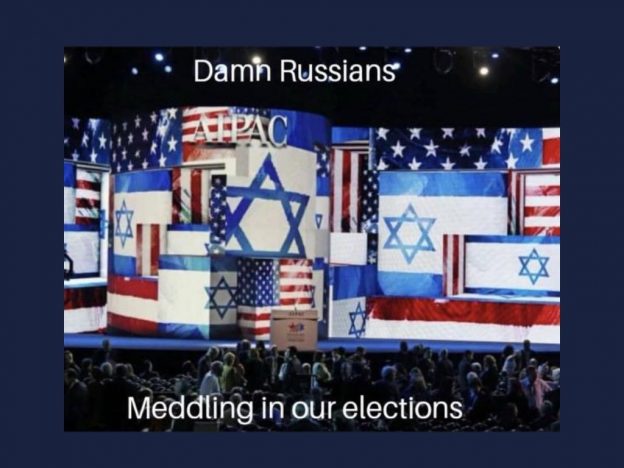
By Greg Felton | Institute for Political Economy | January 22, 2020
A government, whatever its nature, rules as an imperial power over its people. The surest way to exercise this control is to prop up the illusion that it acts in the public interest. Paul Craig Roberts and Alvin Rabushka spelled out this salient fact in the March 1973 issue of Public Choice, in their article “A Diagrammatic Exposition of an Economic Theory of Imperialism,” and what they wrote is no less relevant today.
The act of voting is one of the props that sustains the delusion of self-rule. People do vote, but the candidates are decided by the oligarchy of organized interest groups. This is also the conclusion of a 2014 study by Princeton University professors Martin Gilens and Benjamin I. Page about the extent to which U.S. government policy reflects public preferences. Gilens and Page found that voters are, to all intents and purposes, irrelevant to their own “democratic” government:
“[The] preferences of the average American appear to have only a minuscule, near-zero, statistically non-significant impact upon public policy . . . Moreover, because of the strong status quo bias built into the U.S. political system, even when fairly large majorities of Americans favor policy change, they generally do not get it” (Perspectives on Politics, Vol. 12, No. 3, pp. 575, 76).
Instead of representing the common interest of the people, government answers to organized interest groups. Gilens and Page cite the dominance over policy of special interests who use public policy to serve their interests rather than the public’s. We see the effects of this plutocracy in the sharp rise in the inequality of income and wealth, a gap which has grown into a chasm.
Gilens and Page’s analysis of the Unelected Plutocracy of America is on the money, but their understanding of the threat to America’s democracy does not consider foreign policy, which is partly, if not largely, in the hands of a foreign country—Israel. It is not enough to lay the decline of American democracy at the feet of vested interests such as Wall Street, big banks, and the military–security complex, because it is not in their interest to have the government pursue foreign policy contrary to the national interest.
But operating contrary to the national interest is precisely what Washington has been doing. In the 21st century, Washington has squandered trillions of dollars on military aggression. Hundreds of thousands of U.S. military personnel have been killed, maimed or driven to suicide. The U.S. has derived no benefit from provoking the enmity of Muslim people, bullying NATO allies into abetting this belligerence or persecuting those who expose associated crimes. Even Donald Trump, who ran for the presidency on ending wasteful wars of aggression, continues this self-inflicted economic and political harm, most recently by waging economic war against Iran and sabre-rattling to provoke a shooting war.
The Trump administration is a continuation of decades of Washington’s kowtowing to the Israel Lobby. To appreciate the lack of independence of US foreign policy requires an act of intellectual courage, but few Americans are equipped for the trauma of knowing the truth. To borrow from The Matrix, not many are willing to take the “red pill” to see the reality behind the controlled explanation. “Blue pill” existence comes with a ready-made worldview based on controlled explanations in which believers find comfort, meaning and belonging. Anything that challenges this illusion, is discounted as conspiracy theory or anti-semitism. Comforting beliefs can take precedence over US national interests.
To “take the red pill” requires an inquisitive mind to reject illusion and to question fundamental assumptions. If it is irrational for a democratic state like the U.S. to harm its own people, damage its own economy and invite hostility by provoking needless wars, perhaps the U.S. is not really a democratic state and not really in charge of its own policy. From an American standpoint, the seemingly inexplicable acts of U.S. belligerence and punishment of those who pose no threat to America can be understood as the consequence of permitting Israeli money and influence to shape US foreign policy in the Middle East and to some extent elsewhere if it bears on Israeli interests.
The U.S. that was founded in 1776 is not the same U.S. that exists today. The founding fathers warned against foreign entanglements, but Washington has sought entanglement. Since the late 1940s, the U.S. has gotten entangled in the service of Israel’s interests. The importance of Israel’s interest to U.S. foreign policy has been elevated by a pervasive Christian prejudice, in which Jews are seen as religiously kindred and Muslims as religiously hostile.
In 1948 President Harry Truman took an infamous $2 million election campaign bribe from an American Zionist to support the creation of Israel. By doing so Truman became midwife to an ongoing war crime that has resulted in Washington aiding and abetting Israel’s theft of Palestine. Washington blackmailed and intimidated several UN delegations into supporting the 1947 partition of Palestine. For a country that boasted of its commitment to democracy and support for the UN Charter, Washington’s conduct made no sense. However, if one recognizes that Washington was acting in behalf of Israel, it becomes understandable.
With a foothold gained from Truman’s electoral opportunism, the domestic Israel Lobby gradually gained influence over the U.S. government to the point that today Washington serves Israel’s interest without thinking of its impact on US national interests and without regard to the adverse effects on American interests or those of other people.
After years of Washington’s growing service to Israel, President George H.W. Bush tried to pull back. President Bush thought that he could bring about a final peace treaty between Israel and the Palestinian leadership in Madrid based on “land for peace.”
Bush’s assertion of foreign policy independence infuriated Israel, which proceeded to stage overt and covert attacks on Bush. The overt attack occurred on Feb. 26, 1992, when the domestic Israeli pressure group calling itself, absurdly, the “The Committee on U.S. Interests in the Middle East,” took out a full-page ad in The New York Times to excoriate Bush for “pressuring” Israel to enter into negotiations. Its signatories included neoconservative Israel-firsters like Paul Wolfowitz, Richard Perle, Douglas Feith and Elliott Abrams.
According to a former Mossad agent, the covert attack took the form of a planned assassination of President Bush. Victor Ostrovsky in his book, By Way of Deception (pp. 281-282), writes that on Oct. 1, 1992, he received a nervous call from Ephraim, a Mossad officer of his acquaintance, who opposed the assassination: “They’re out to kill Bush… I mean really kill, as in ‘assassinate.’… during the Madrid peace talks.” Ephraim asked Ostrovsky to leak the plot in hopes the American government would act to prevent it. Ostrovsky did so in an Oct. 1, 1992, speech in Ottawa. From there, the leak made its way to former California congressman Pete McCloskey, the Secret Service, the State Department, the CIA, the U.S. embassy in Ottawa, and finally the press. The assassination was called off.
Bush’s assertion of independence from Israel resulted in Israel’s meddling in the 1992 presidential election which cost Bush re-election and marked the last time that a U.S. president would dare challenge Israel’s self-proclaimed right to murder, torture, dispossess and displace Palestinians.
The eight years of Bill Clinton’s presidency saw a consolidation of Israel’s power over Washington. Clinton showed his willingness to act in Israel’s interest by agreeing to set amounts of aid to Israel––imperial tribute in the view of some––even before he was sworn in as president. It was the Clinton administration that responded to Israeli pressure for action against Iraq by creating the illegal no-fly zones over Iraq, which caused the death of 500,000 Iraqi children. When asked about this by a reporter, Clinton’s Secretary of State Madeleine Albright said, “the price was worth it.” In other words, the death of a half a million Iraqi children served American and Israeli interests.
Israel’s influence over US foreign policy reached a zenith with George W. Bush. In the name of the “war on terror,” that is, the war on Israel’s enemies, the Bush regime subverted the US Constitution. The Bush government was filled with neoconservatives associated with the Project for a New American Century. The PATRIOT Act, drafted, according to his own admission three weeks prior to the events of September 11, 2001, by neoconservative Philip Zelikow, who later headed up the 9/11 Commission, became law despite the US Congress having no time to read and discuss the tyrannical legislation before passing it. The fact that a draft of the PATRIOT Act existed prior to 9/11 raises many questions. The passage of the act told Americans that Muslims were such a threat that Americans would have to accept infringements on their civil liberties. President Bush made that even more clear when he announced that he was setting aside the US Constitution and suspending habeas corpus.
During the Obama administration Israel dramatically demonstrated its power over the US government when the US Congress intervened in the dispute between Obama and Netanyahu over whose power was supreme in American politics, the power of the American president or Israel’s. Repudiating their own president, Congress invited Netanyahu to address a joint session of the House and Senate and responded to Netanyahu with many standing ovations.
Trump has perpetuated Israeli control over US foreign policy. Trump broke universal policy and recognized Jerusalem as Israel’s capital. He gave Syria’s Golan Heights to Israel, which was not Trump’s to give. He cut off aid to Palestine. He accepted Israel’s policy of illegally incorporating occupied Palestine into Israel.
Trump’s appointment of Project for a New American Century Zionist David Wurmser, an architect of Washington’s 2003 invasion of Iraq, is the latest indication that Israel continues to dominate American policy in the Middle East. According to a report in Mint Press News, Trump admitted that his belligerence toward Iran is driven by Israeli, not U.S., interests.
Trump’s subservience to Israel brings into focus the famous words of Patrick Buchanan, Washington is “Israeli occupied territory.”
Greg Felton is the author of The Host & The Parasite––How Israel’s Fifth Column Consumed America, 3rd edition, available from thehostandtheparasite.com.
ICC delays, Israeli belligerence and PA complacency
By Ramona Wadi | MEMO | January 23, 2020
As expected, the International Criminal Court has cranked its bureaucratic delays into motion over the proposed investigation into Israeli war crimes. The ICC’s Chief Prosecutor Fatou Bensouda’s statement was deemed to be “too long and exceeded the amount of pages allowed for filing” such a proposal. This has been cited despite a request for an extension of page length due to “the unique and complex factual and legal circumstances in this situation.”
Bensouda now has to file a new request, upon which judges are allocated 120 days to reach a decision about opening an investigation. For Israel, the delay is a first step in its campaign to discredit not just the ICC, which has attracted its fair share of criticism over the years, but also, and most importantly, to remove the possibility that the state will, at long last, face international accountability for its actions.
There are already weaknesses in Bensouda’s approach, as reported by the Jerusalem Post. So far, she has been indecisive about whether or not the Israel Defence Forces (IDF) will be investigated for war crimes, despite their obvious involvement. The war crimes charge about illegal settlements is also limited; those built on stolen Palestinian land before 2014 will be exempted from the investigation.
While Israeli Prime Minister Benjamin Netanyahu is rallying the international community against the ICC, with some countries following his lead in criticising Bensouda’s decision, the Palestinian Authority has remained largely silent. The Israeli government has attempted to slander the ICC’s possible investigation as “a full frontal attack on democracies, both on the democracies’ right to defend themselves, and on Israel’s right, the Jewish people’s right, to live in their ancestral homeland, the Land of Israel.” According to Netanyahu, the international community should target the ICC and its officials with sanctions. This threat is unlikely to happen, but it highlights the discrepancy between Israeli lobbying and the PA’s silence.
Having fulfilled its duty and submitted its claim to the ICC, the PA’s attention remains focused on the moribund two-state compromise. The discussion on how both this paradigm and the absence of its fruition have contributed to Israel’s war crimes trajectory is not a priority for the PA, despite the fact that the Oslo Accords, for example, as well as the international community’s defence of Israel’s security narrative, have contributed to war crimes against the Palestinian people.
As far as PA leader Mahmoud Abbas is concerned, it is as if Europe has played no role in facilitating Israeli war crimes, as long as it continues to position itself as the prime interlocutor of the two-state “solution”. In his latest meeting with French President Emmanuel Macron, Abbas reiterated that Europe’s tenacity to preserve the two-state paradigm gives “hope to our people of the possibility of achieving peace and stability.” The ICC simply wasn’t on Abbas’s discussion agenda.
The current delay does not bode well for the Palestinians. Since the international community decided to support Israel’s colonial project, they have been forced to stand by and watch as recognition of their rights is kept as remote as ever. That the ICC deems it suitable to stall a process in which Israel can be scrutinised judicially should be a cause of concern to the PA, as it stands alongside international responsibility for contributing to the plight of Palestine and its people.
Jewish Congress launches campaign against ‘antisemitism’ (aka support for Palestinian rights)

Israeli President Reuven Rivlin demonstrates the new Instagram campaign against “antisemitism.” EJC and Israel consider opposition to Israeli human rights violations “antisemitic.”
Alison Weir | If Americans Knew | January 22, 2020
UPDATE: In the midst of impeachment proceedings, House Leader Nancy Pelosi has gone to Israel to take part in an event organized by the Russian-Israeli oligarch described below – see update at end of post.
The European Jewish Congress (EJC) has announced the launch of a worldwide, star studded social media campaign against what it calls “antisemitism,” but which is often advocacy for Palestinian human rights and opposition to Israeli apartheid. EJC is the regional affiliate of the World Jewish Congress, one of whose main missions is to advocate for Israel.
The EJC considers anti-Zionism to be a form of anti-Semitism and employs a newly created definition of antisemitism in which certain types of statements about Israel are supposedly “antisemitic.” As a result, EJC’s opposition to “antisemitism” often consists of censoring information that exposes Israeli violations of Palestinian human rights.
Its new campaign, called “Stop This Story,” particularly focuses on Instagram, although it will also use YouTube and other platforms. According to the EJC, the campaign will be the “first global initiative of its kind that will leverage Instagram’s AR (Augmented Reality) effects to drive a global movement.” It claims to have recruited “some of the world’s leading AR effects’ creators.”
The campaign says it has enrolled a number of “international stars” and “international influencers, each of them with millions followers.” Among these are supermodel Bar Refaeli, actress Vanessa Kirby (from ‘The Crown’), former NBA player Omri Casspi, and “many other international figures, actors, entertainers, and sportsmen and women.”
The man behind the campaign

Russian-Israeli oligarch Viatcheslav Moshe Kantor, president of the EJC and numerous other entities, is a billionaire whose top priority is strengthening Israel.
The individual behind the new campaign is EJC President Moshe Kantor, also known as Viatcheslav Kantor, He explains the reasoning underlying the campaign: “The best way to spread any message today is through social media because social networks and those who use them have the power to make the necessary changes in our societies.”
Kantor is a Russian-Israeli billionaire dedicated to Israel. He has stated that the creation of the State of Israel is the “biggest achievement” of Diaspora Jewry, and believes that all Jews must work to “strengthen our beloved state.”
In 2008 Kantor enunciated his core belief: “The reality of today requires that European Jews care not only about the preservation and security of Israel, but also the way it is treated by the rest of the world. This must be the leading priority of the European Diaspora.”
Kantor heads up and sometimes even originated, a network of pro-Israel international entities.
In addition to being president of the European Jewish Congress, he is founder and president of the World Holocaust Forum Foundation, founder and chairman of the European Jewish Fund, originator and president of the International Luxembourg Forum on Preventing Nuclear Catastrophe, co-founder and president of the European Council on Tolerance and Reconciliation, vice president of the Euro-Asian Jewish Congress, a member of the International Board of Hillel, and the former president of the Russian Jewish Congress, to name just some of his affiliations.
His ability to accomplish all this stems from his enormous wealth. In addition to being an “international philanthropist,” as he identifies himself, Kantor is an international businessman with $4 billion at his disposal. He has been accused of unscrupulous business dealings and financial fraud.
Like other Russian oligarchs, Kantor made his fortune in the first years of Russia’s “new capitalism”– sometimes called “gangster capitalism” – when, under the guise of “privatization,” Russia’s economy was massively looted, causing ruin to many Russian citizens who saw their life savings vanish, sometimes in a matter of weeks. Kantor’s father, a former Red Army soldier, reportedly served prison time for “speculation and embezzlement of state property in a large scale, taking bribes and forgery.” Kantor was among the many individuals in the Russian Jewish community who flourished; many – perhaps most – of the Russian oligarchs have ties to Israel.
Kantor is known for a variety of international activities. Along with notorious oligarch Boris Berezovsky, Kantor is said to have been a “sponsor of the ‘Orange Revolution’ in Ukraine in 2005, which led to the cancellation of the initial results of the presidential election.” Berezovsky later bragged that he had funded the revolution. In 2006 Kantor received an award from Ukraine’s new president for “distinguished services” to the country.
Stamping out ‘Antisemitism’ and ‘Intolerance’
Kantor has been involved in a global campaign to embed a new, Israel-centric definition of antisemitism in European governments and institutions. The EJC says that the definition of anti-Semitism must be “clarified” because “the new form of anti-Semitism” supposedly “emanates from pro-Palestinians.” Kantor says that BDS, the international boycott of Israel over its violent human rights abuses, is “antisemitic.” (BDS works to “uphold the simple principle that Palestinians are entitled to the same rights as the rest of humanity.”)
Kantor advocates that governments punish antisemites as harshly as they punish terrorists. He has been working to convince European governments to adopt a bizarre 13-page program of “concrete and enforceable obligations that ensure tolerance and stamp out intolerance.”
The Orwellian program, entitled “National Statute for the Promotion of Tolerance” (revised version here), would restrict freedom of expression, impose re-education programs, enact surveillance structures, and institute criminal penalties for “antisemitism” and other “intolerance.” Expressing views specified as impermissible would be “regarded as criminal offenses punishable as aggravated crimes.”
The document proposes a deeply authoritarian structure controlling multiple aspects of society to coerce “tolerance,” and anyone who doesn’t get with the program would be taken care of, e.g. “Juveniles convicted of committing crimes listed in paragraph (a) will be required to undergo a rehabilitation programme conducive to a culture of tolerance.” Big Brother in the form of a “National Tolerance Monitoring Commission” would ensure that no one says or does anything that the Commission determines is “intolerant.”
The program is being promoted by Kantor’s “European Center for Tolerance and Reconciliation” (ECTR), and may be on the way to becoming a reality. Kantor has secured former UK Prime Minister Tony Blair as the ECTR Chairman and French philosopher Bernard-Henri Lévy as a member.
According to its website ECTR has formed a joint task force with the European Council to work on implementing the program throughout Europe. The European Council, composed of the heads of state or government of the 28 EU member states, defines the EU’s overall political direction and priorities.
‘Global Pandemic’
Kantor recently said that antisemitism is now a “global pandemic” and that the “crisis of antisemitism is a slippery slope to global catastrophe.” He warns that Jews could “disappear completely as a people from Europe,” and raises the alarm about what he describes as “mass killing at synagogues.”
Media reports on the new EJC campaign similarly emphasize recent tragic attacks on Jews, and reference the assaults in the cities of Monsey, Jersey City, Halle, Poway, and Pittsburgh.
These terrifying attacks killed a combined total of 14 Jews.
News reports on the alleged perpetrators of the assaults, who were of diverse races, indicate a variety of motivations. One attacker said he had been inspired by a 2019 assault on two New Zealand mosques that had killed 51 Muslims.
Previous fatal shootings have also occurred at other religious sites. The largest number of fatalities in the US may have been at a Christian church, where 26 worshipers were killed in 2017.
While Kantor and the EJC claim the existence of massive antisemitism, Jewish Americans are reportedly the wealthiest group in the US, and this also appears to be the case for Jews worldwide.
Meanwhile, Israeli forces have killed almost 10,000 Palestinian men, women, and children since 2000 and injured tens of thousands; Palestinian resistance forces have killed approximately 1,200 Israelis (details here).
Such disproportion is not new.
Twenty-five years ago, an Israeli author wrote: “In the last 40 years the number of non-Jews killed by Jews is by far greater than the number of the Jews killed by non-Jews.”
Many Jews around the world, including in Israel itself, have long strenuously opposed Israeli violence. According to Kantor and his cohort, these individuals are also “antisemitic.”

The bodies of five children from the same family killed in an Israeli air strike on 14 November 2019 lie in a hospital ward in Gaza (information on Gaza is here)
Fifth World Holocaust Forum
The new campaign comes just before the Fifth World Holocaust Forum to be held in Israel tomorrow, January 23rd, co-sponsored by the president of Israel. The forums are another one of Kantor’s many projects.
Over 45 heads of state and world leaders have said they plan to attend the event, including the presidents of France, Germany, Italy, Austria, Russia, the kings of Spain and Belgium, and Britain’s Prince Charles. Vice-president Mike Pence and Speaker of the House, Nancy Pelosi, will also attend.
The event is being held at Yad Vashem, Israel’s holocaust complex, a vast, sprawling institution with dozens of Israeli flags and tree-studded walkways leading to exhibits, archives, monuments, sculptures, and memorials.
The event website proclaims that the Holocaust is “the most horrific tragedy in human history” and states that “a new wave of antisemitism unseen since World War II poses an existential threat to European Jewry.”
According to the Jerusalem Post, among the forum’s features will be speeches by select heads of state, a Holocaust survivor, video clips, and “musical interludes performed by an orchestra and an international choir.” The event will be live streamed and conclude with the Israeli national anthem.
Yad Vashem is in Jerusalem where there is evidence all around – for any with eyes to see – of another genocidal program, one that has been going on since the one commemorated by Yad Vashem ended. An historian calls this one the “Palestinian holocaust” and describes it: a land was “occupied, emptied of its people, its physical and cultural landmarks obliterated, its destruction hailed as a miraculous act of God, all done according to a premeditated plan, meticulously executed, internationally supported, and still maintained today…”
Yad Vashem overlooks one of the obliterated landmarks emptied of its people: an almost empty field where the Palestinian village of Deir Yassin once stood.
On April 9, 1948 Zionist forces systematically exterminated 110 men, women, and children as part of a plan to rid Palestine of its Muslim and Christian population in order to make way for the Jewish state. This was one of 16 such Zionist massacres that took place before the official start of Israel’s founding war of ethnic cleansing, and over a month before a single Arab Army joined the conflict. In contrast to Yad Vashem’s monuments and memorials, Deir Yassin has no marker.
More recent evidence of the ongoing oppression can be found in the Issawiya neighborhood of Jerusalem, where heavily armed Israeli police have raided over 500 Palestinian homes and arrested more than 700 residents since May, apprehending children as young as five. Israeli forces shot dead a 21-year-old at close range and have injured over 300 people of all ages. Soldiers beat and humiliate residents at will. One resident says the area “has turned into a ghetto.” (Another such ghetto is Gaza, where Israeli forces yesterday killed three young men who had reportedly temporarily escaped from their prison.)
Not far from Issawiyah is Israel’s mammoth apartheid wall, confiscating additional Palestinian land and helping to imprison over two million people. In 2002 Israeli media reported that Israeli generals were studying how the German army fought in the Warsaw ghetto for use in Israel’s next campaign against Palestinians.
The Holocaust Forum program states that the world leaders “will be invited to lay a wreath at the base of the Warsaw Ghetto Uprising Monument created by world-renowned Jewish sculptor and artist Nathan Rappaport.”
Perhaps some of the world leaders could also visit the unmarked site of Deir Yassin, and lay a wreath on one of its crumbling graves. And then go to Israel’s wall and echo a famous demand from a previous head of state: “Tear down this wall.”
And maybe a future social media campaign could focus on ending all genocides, injustice, and oppression.
UPDATE:

Nancy Pelosi and Israeli President Reuven Rivlin on Jan 22, 2020 at Israeli state dinner sponsored by Viatcheslav Moshe Kantor.
(Pelosi’s Congressional offices are not telling constituents where she is.)
The UK Guardian reports that many of the heads of state have now arrived and that Israeli President Rivlin is hosting a state dinner today. Officials said organizers of the dinner “had tuned the grand piano, brought in 800 candles and hired 200 servers and ushers to serve Israeli cuisine. For space reasons, tents were set up outside and the heads of the foreign delegations were asked to bring only one guest…”
The article also reports: “Israel’s prime minister, Benjamin Netanyahu, has looked to capitalise on the event to rally international support against Iran” and hopes to procure “backing for his attacks on the international criminal court, which is investigating allegations of war crimes in the Palestinian territories.”
The Guardian reports that Russian president Vladamir Putin, French president Emmanuel Macron, and Prince Charles are expected meet with Palestinian President, Mahmoud Abbas.
A controversy involving Macron has already occurred:
“Macron also visited the old city of Jerusalem on Wednesday, where he was filmed by a French journalist working for Le Parisien shouting at an Israeli security officer. He appeared to be yelling at the man, who may have been assigned to his security detail, to leave the church of St Anne’s. The church has been owned by the French government since it was gifted by the Ottomans to Napoleon III in 1856, and is still considered French territory.
“Everybody knows the rules,” he said firmly in English. “Outside, please,” he shouted. “Please respect the rules. They [have been in place] for centuries. They will not change with me.”
“Macron’s altercation mirrored that of another French president, Jacques Chirac, who in 1996 refused to enter the same church until Israeli security left.”
Alison Weir is executive director of If Americans Knew, president of the Council for the National Interest, and author of Against Our Better Judgment: The Hidden History of How the U.S. Was Used to Create Israel.
In a Preemptive Move, Netanyahu Calls for ‘Sanctions’ against ICC
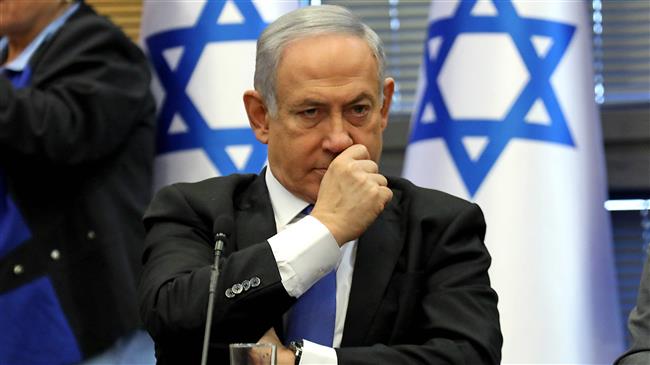
The Palestine Chronicle | January 21, 2020
Right-wing Israeli Prime Minister Benjamin Netanyahu called for imposing sanctions on the International Criminal Court (ICC), following an earlier announcement by the court that it intends to investigate alleged war crimes in the occupied Palestinian territories.
“The US government under President Trump has spoken forcefully against the ICC for this travesty, and I urge all your viewers to do the same, to ask for concrete actions, sanctions, against the international court – its officials, its prosecutors, everyone,” Netanyahu said during an interview with Trinity Broadcasting Network.
Meanwhile, the ICC announced on Tuesday that it will delay its debate on the issue, which is intended to determine “whether it has the jurisdiction to probe alleged Israeli war crimes in the West Bank, Gaza and East Jerusalem due to a procedural error related to the filing’s page limit,” The Guardian newspaper reported.
Editor of The Palestine Chronicle, Palestinian journalist Ramzy Baroud commented that “the high level of the ICC investigations places the legal push against Israel at an entirely new level.”
“This is uncharted territory for Israel, the United States, Palestine, the ICC, and the international community as a whole. There is little doubt that some joint Israeli-American effort is already underway to develop strategies aimed at countering, if not altogether dismissing, the ICC investigation,” Baroud added.
Jews’ Ten Pledges vs Palestinians’ Eleven Red Lines
All five leadership candidates embrace ‘Ten Pledges’ that dictate how they must think, speak and act.
By Stuart Littlewood | American Herald Tribune | January 21, 2020
The UK Labour Party is saying goodbye to Jeremy Corbyn as leader after its disastrous general election performance and has begun choosing someone else.
Wasting no time, the Board of Deputies of British Jews last week published Ten Pledges they wanted Labour leadership hopefuls to sign up to if the Party’s relationship with the Jewish community was to be healed.
The BoD claim anti-Semitism in the party became a matter of great anxiety for the UK’s Jews during Corbyn’s four years in office and it will take at least 10 years to repair the damage. Their president Marie van der Zyl says: “We expect that those seeking to move the party forward will openly and unequivocally endorse these Ten Pledges in full, making it clear that if elected as leader, or deputy leader, they will commit themselves to ensuring the adoption of all these points.
“Tackling antisemitism must be a central priority of Labour’s next leader,” she insists. “We will certainly be holding to account whoever ultimately wins the contest.”
But is there really an anti-Semitism crisis other than the one caused by the Jewish State itself and mischievously drummed up within Labour? As former Israeli Director of Military Intelligence, Yehoshafat Harkabi wrote: “It would be a tragic irony if the Jewish state, which was intended to solve the problem of anti-Semitism, was to become a factor in the rise of anti-Semitism. Israelis must be aware that the price of their misconduct is paid not only by them but also Jews throughout the world.” It has been suggested before that so-called anti-Semitism is a matter best resolved by the Jewish ‘family’ itself.
Obedience required
The BoD claim that all the leadership contenders – Sir Keir Starmer, Rebecca Long-Bailey, Lisa Nandy, Jess Phillips and Emily Thornberry – have signed the Ten Pledges, and three of the five deputy-leader candidates have done so. What are these crisis-busting Ten Pledges they’ve committed the Party to?
(1) Resolve outstanding cases – All outstanding and future cases should be brought to a swift conclusion under a fixed timescale.
- Absolutely.
(2) Make the Party’s disciplinary process independent – An independent provider should be used to process all complaints, to eradicate any risk of partisanship and factionalism.
- Of course.
(3) Ensure transparency – Key affected parties to complaints, including Jewish representative bodies, should be given the right to regular, detailed case updates, on the understanding of confidentiality.
- Except that complainers, including the BoD, have a poor record of keeping even their wildest allegations confidential.
(4) Prevent readmittance of prominent offenders – It should be made clear that prominent offenders who have left or been expelled from the party, such as Ken Livingstone and Jackie Walker, will never be readmitted to membership.
- It is not clear from the evidence that Livingstone or Jackie Walker committed an offence. They were hounded out and not, I think, by any independent arbitrator.
(5) Communicate with resolve – Bland, generic statements should give way to condemnation of specific harmful behaviours – and, where appropriate, condemnation of specific individuals.
- This should apply also to false accusers and to the BoD themselves if failing to condemn the “harmful behaviours” of their brethren in the Israeli regime towards our sisters and brothers in Palestine.
(6) Provide no platform for bigotry – Any MPs, Peers, councillors, members or CLPs [local parties] who support, campaign or provide a platform for people who have been suspended or expelled in the wake of antisemitic incidents should themselves be suspended from membership.
- Unacceptable. Many have been suspended for no good reason. And suspension does not mean guilt.
(7) Adopt the international definition of antisemitism without qualification – The IHRA definition of antisemitism, with all its examples and clauses, and without any caveats, will be fully adopted by the party and used as the basis for considering antisemitism disciplinary cases.
- How many times must you be told that the IHRA definition of anti-Semitism is a minefield? Top legal opinion (for example Hugh Tomlinson QC, Sir Stephen Sedley and Geoffrey Robertson QC) warn that it is “most unsatisfactory”, has no legal force, and using it to punish could be unlawful. Furthermore it cuts across the right of free expression enshrined in UK domestic law and underpinned by Article 19 of the Universal Declaration of Human Rights which bestows on everyone “the right to freedom of opinion and expression; this right includes freedom to hold opinions without interference and to seek, receive and impart information and ideas through any media and regardless of frontiers”. This applies not only to information or ideas that are regarded as inoffensive, but also to those that “offend, shock or disturb the State or any sector of the population”. Labour Party members should know all this. The prohibitive IHRA definition is not something a sane organisation would incorporate into its Code of Conduct.
(8) Deliver an anti-racism education programme that has the buy-in of the Jewish community – The Jewish Labour Movement should be reengaged by the Party to lead on training about antisemitism.
- The BoD and JLM would do better teaching anti-racism to the Israeli regime and its supporters. Besides, MPs and councillors don’t ‘belong’ to the Labour Party or any other party; they belong to the public who elected them as their representative. No outside body should expect to influence their freedom of thought, expression or action (see the Seven Principles of Public Life).
(9) Engagement with the Jewish community to be made via its main representative groups – Labour must engage with the Jewish community via its main representative groups, and not through fringe organisations and individuals.
- Labour should engage with the Jewish community though any representative organisation or individual it pleases.
(10) Show leadership and take responsibility – The leader must personally take on the responsibility of ending Labour’s antisemitism crisis.
- There’s no agreement that anything approaching a crisis exists within the Party.
Leadership front-runner Starmer is a former human rights lawyer and ought to know better. Long-Bailey is another lawyer who should hang her head in shame. Thornberry is a former barrister specialising in human rights law – words fail. Jess Phillips, a member of Labour Friends of Israel, wrote Truth to Power: 7 Ways to Call Time on B.S., described as “the little book we all need to help us call time on the seemingly unstoppable tide of bullshit in our lives”. The irony of it seems lost on her. Lisa Nandy is a puzzle as she’s chair of Labour Friends of Palestine.
If this bunch won’t robustly uphold freedom of expression guaranteed by law and international convention what have they let their hapless party in for? Those standing for deputy-leader also have little excuse. Angela Rayner was shadow education secretary, Ian Murray read Social Policy and Law, and Rosena Allin-Khan is a Muslim and former humanitarian aid doctor. They obediently signed the Ten Pledges. Dawn Butler and Richard Burgon declined.
When, a year ago, the French Republic presented its Human Rights Award to B’Tselem (the Israeli human rights group) its Executive Director Hagai El-Ad, thanking the National Consultative Commission on Human Rights, said of Israel’s behaviour towards the Palestinians: “The occupation…. is organized, prolonged state violence which brings about dispossession, killings, and oppression. All branches of the state are part of it: ministers and judges, officers and planners, parliamentarians and bureaucrats.”
On another occasion B’Tselem said: “If the international community does not come to its senses and force Israel to abide by the rules that are binding to every state in the world, it will pull the rug out from under the global effort to protect human rights in the post-WWII era.”
When a respected Israeli organisation speaks truth in such stark terms it cannot be ignored. And recent UN reports confirm that the Israelis abuse and torture child prisoners. So why would anyone – especially those competing to be Labour Party leader and one day prime minister – agree to dance to the tune of those who pimp and lobby on Israel’s behalf?
Who will punish the false accusers?
The BoD nevertheless make some valid points. The Labour Party takes a ridiculously long time to deal with allegations of anti-Semitism, many of which are false or vexatious and could be dismissed in five minutes. Let me tell you about two Scottish Labour politicians wrongly accused of anti-Semitic remarks and suspended. Let’s call them ‘A’ and ‘B’. Both are regional councillors.
Constituency party officials declared ‘A’ guilty immediately and issued a press statement to that effect without waiting for him to be heard, hugely prejudicing any investigation. This stupidity was compounded by his Council leader publicly calling on him to resign as a councillor and saying his thinking belonged to the Dark Ages: “To smear an entire community both past and present, to say he has lost ‘all empathy’ for them is utterly deplorable,” he was quoted in the press.
What was ‘A’s crime? He had tweeted: “For almost all my adult life I have had the utmost respect and empathy for the Jewish community and their historic suffering. No longer, due to what they and their Blairite plotters are doing to my party and the long suffering people of Britain…” Was nobody in the local party aware that the Jewish Leadership Council and the Board of Deputies were then leading an obnoxious campaign to discredit Labour and Jeremy Corbyn?
‘B’, a respected lady councillor, was accused of anti-Semitism by a former Labour MP who was already on record as wanting to impose limits on freedom of expression. A Tory MP immediately put the boot in, telling the media it was clear to the vast majority of people that ‘B’ was no longer fit to hold office and suspension didn’t go far enough.
And what was ‘B’s crime? She had voiced suspicion on social media that Israeli spies might be plotting to get rid of Jeremy Corbyn as Labour leader after three Jewish newspapers ganged up to publish a joint front page warning that a Corbyn-led government would pose an “existential threat to Jewish life in this country”.
She added that if it was a Mossad assisted campaign to prevent the election of a Labour Government (which pledged to recognise Palestinian statehood) it amounted to an unwarranted interference in our democracy. For good measure she said Israel was a racist State and, since the Palestinians are also Semites, an anti-Semitic one.
‘B’ was eventually interviewed by party investigators. They surely knew that in January 2017 a senior political officer at the Israeli embassy in London, Shai Masot, had plotted with stooges among British MPs and other activists to “take down” senior government figures including Boris Johnson’s deputy at the Foreign Office, Sir Alan Duncan. And that Mark Regev, Netanyahu’s former chief spokesman and mastermind behind Israel’s propaganda programme of disinformation, had recently arrived in London as the new ambassador.
Masot was almost certainly a Mossad tool. His hostile scheming was revealed not by Britain’s own security services and media, as one would have hoped, but by an Al Jazeera undercover team. Our Government dismissed the matter saying: “The UK has a strong relationship with Israel and we consider the matter closed.” But at a Labour Party conference fringe meeting Israel insider Miko Peled warned that “they are going to pull all the stops, they are going to smear, they are going to try anything they can to stop Corbyn…. the reason anti-Semitism is used is because they [the Israelis] have no argument….”
Given such a blatant attempt by an Israeli asset to undermine British democracy, with Regev in the background and (quite probably) Mossad pulling the strings, ‘B’s suspicions were reasonable enough and she had a right to voice them.
As for Israel being a racist State, its ethnic cleansing of the Palestinians and other brutal policies over 70 years make it obvious. And the discriminatory Nation State laws recently adopted by Israel put the question beyond doubt. Her point about anti-Semitism was also well made. DNA research (see for example the Johns Hopkins University study published by Oxford University Press) shows that while very few Jews are Semitic most indigenous Arabs in the Holy Land, especially Palestinians, are Semites. The term ‘anti-Semitism’, long used to describe hatred of Jews, is a misnomer that hides an inconvenient truth.
And it couldn’t have been difficult to establish that the opportunistic Tory MP calling her unfit to hold office was the chairman of the All-Party Parliamentary Group on British Jews, which is funded, supported and administered by The Board of Deputies. The case against ‘B’ should have been dropped instantly and action taken against the troublemakers. Instead, weeks later, ‘B’ was posting on her Facebook page that she was still suspended: “I can’t make any decisions about my personal, political, or professional future whilst this hangs over me. I am constantly tired and anxious, and feel I am making mistakes. I have lost paid work because of what has happened.”
Her suspension was finally lifted but she was “advised” not to post about it or she’d risk losing professional work on which her livelihood depended. That’s how nasty the Labour Party disciplinary machine is. Surely, if the Party lifts a suspension it should issue a public statement saying so. Must the wrongly accused, after being needlessly humiliated, be left to pick up the pieces and struggle to re-establish their good name? In total ‘B’ had to wait 16 weeks under sentence. And all because of a trumped-up allegation that ought to have been immediately squashed.
As for ‘A’, he stopped answering emails and there has been nothing in the press. Was his suspension lifted? Was he similarly threatened if he said anything? I simply don’t know although I phoned and wrote to the Leader and the General Secretary for an explanation. The latter eventually replied that “the Labour Party cannot, and does not, share personal details about individual party members” and placing a member in administrative suspension “allows a process of investigation to be carried out whilst protecting the reputation of the Labour Party”. Bollox. How did the media get news of these suspensions in the first place? And never mind the damage done to the cowardly Party, what about the reputations of the two councillors and their months of anguish while working for their constituents? I wasn’t asking for case details. All I wanted was the answer to three simple questions:
# Had the suspensions been lifted?
# If so, had the Party issued a public statement to that effect?
# And had the false accusers been disciplined?
Silence… spineless, don’t-give-a-damn silence.
Are these two cases typical of the so-called anti-Semitism crisis? I have no way of knowing. But they show how the Party is run by enough crackpots on the inside without inviting impertinent interference from the outside.
Jews’ Ten Pledges vs Palestinians’ Eleven Red Lines
Anyone signing up to the BoD’s Ten Pledges should consider at the same time subscribing to the ‘Eleven Red Lines’ of anti-Palestinianism. Examples in public life, the media, schools, the workplace, and in the religious sphere could, taking into account the overall context, include, but are not limited to:
(1) Denying the Palestinian people their right to self-determination and nationhood, or actively conspiring to prevent the exercise of this right.
(2) Denial that Israel is in breach of international law in its continued occupation of Gaza, the West Bank and East Jerusalem.
(3) Denial that Israel is an apartheid state according to the definition of the International Convention on Apartheid.
(4) Denial of the expulsion of 750,000 Palestinians during the 1948 Nakba and of their right, and the right of their descendants, to return to their homeland.
(5) Denial that Palestinians have lived for hundreds of years in land now occupied by Israelis and have their own distinctive national identity and culture.
(6) Denial that the laws and policies which discriminate against Palestinian citizens of Israel (such as the recently passed Nation State Law) are inherently racist.
(7) Denial that there is widespread discrimination against Palestinians in Israel and the Occupied Territories in matters of employment, housing, justice, education, water supply, etc, etc.
(8) Tolerating the killing or harming of Palestinians by violent settlers in the name of an extremist view of religion.
(9) Making mendacious, dehumanizing, demonizing, or stereotypical allegations about Palestinians — such as, especially but not exclusively, the myth of a Palestinian conspiracy to wipe Israel off the map.
(10) Justifying the collective punishment of Palestinians (prohibited under the Geneva Convention) in response to the acts of individuals or groups.
(11) Accusing the Palestinians as a people, of encouraging the Holocaust.
This working definition of anti-Palestinian racism, described as “hatred towards or prejudice against Palestinians as Palestinians”, holds up a mirror to the IHRA definition of anti-Semitism and was drafted by Jewish Voice For Labour, one of those fringe representative organisations the BoD insist Labour mustn’t engage with.
So here’s a simple test for the BoD: if they demand the Labour Party signs up to their Ten Pledges will they themselves embrace the Eleven Red Lines on anti-Palestinianism?
Israel participation in Expo 2020 Dubai amounts to normalization: Hamas
Press TV – January 20, 2020
Palestinian Islamic resistance movement Hamas has censured Israel’s presence in the Expo 2020, which is to be hosted by the United Arab Emirates’ city of Dubai, as a form of normalization between the Persian Gulf state and the Tel Aviv regime.
Hamas spokesman Hazem Qassem, in a written statement released on Monday, slammed attempts by a number of Arab countries, particularly Persian Gulf littoral states, to bring out in the open their clandestine relations with the Israeli regime, calling on them to put an end to such efforts.
“Such a behavior encourages the Occupation to increase the level of its crimes against Palestinian people, and to step up its violations against the sanctities of our nation,” the statement added.
“The Zionist regime must remain the principal enemy of the [Palestinian] nation. The campaign against the regime and its policies, which aim to dent all opportunities for the nation’s awakening and development, must continue,” Qassem pointed out.
Israeli authorities are hoping to reach out to Arab peoples through participation in the Expo 2020 Dubai.
“To us, the added value is in the Arab and Muslim visitor,” Elazar Cohen, the Israeli foreign ministry’s point man for the expo, which is organized by the Paris-based Bureau International des Expositions (BIE), said on December 15 last year.
An auditorium below the pavilion will offer visitors an interactive multimedia experience, the ministry’s director general Yuval Rotem told AFP at the time.
Prime Minister Benjamin Netanyahu has described the Israeli expo pavilion as part of “the continued progress of normalization with the Arab states,” alleging that building relations with Arab countries will push the Palestinians toward a ‘peace deal’ with the Israeli regime.
Israeli daily newspaper Yedioth Ahronoth reported on November 6 that the UAE is expected to allow tourists holding Israeli passports to take part in the expo.
“Israeli and the UAE’s authorities have been in talks for a while in order to allow those with Israeli passports to attend the expo in Dubai,” an unnamed source within the expo’s management team told the daily at the time, adding, “These talks are happening because both sides want to see the expo turn into the biggest exhibition in the world.”
Another source said the event in Dubai could be a great pilot run during which Israeli tourists would be allowed into the country, and it can be a signal that the UAE “might leave its doors open to Israeli tourists permanently.”
Israeli foreign minister, Israel Katz, told a ministerial meeting in Jerusalem al-Quds on August 6 last year that he was working toward “transparent normalization and signed agreements” with a number of Arab Persian Gulf littoral states.
Arab countries — except for Jordan and Egypt — have no formal relations with the Israeli regime.
Israel’s trade with Persian Gulf states is estimated to stand at about $1 billion annually, according to a study published by the Tony Blair Institute for Global Change in August 2018.
Jamal al-Suwaidi, founder of the Emirates Center for Strategic Studies and Research, told the British newspaper The Guardian in an interview in March that the Palestinian issue is no longer at the top of the agenda among the Arab Persian Gulf states.
“The Palestinian cause is no longer at the forefront of Arabs’ interests, as it used to be for long decades,” he said. “It has sharply lost priority in light of the challenges, threats and problems that face countries of the region.”
Severe torture in Israeli prisons targets Palestinian steadfastness: Walid Hanatsheh, Samer Arbeed, Mays Abu Ghosh and more
Samidoun Palestinian Prisoner Solidarity Network | January 19, 2020
In the last months of 2019 and early 2020, a growing number of cases of severe physical torture against Palestinian detainees carried out by Israeli Shin Bet interrogators have been documented. While torture and abuse of various kinds have been a mainstay of the Israeli interrogation process, after a 1999 Israeli Supreme Court ruling and amid widespread international attention, torture under interrogation for some years focused on physical and psychological techniques that were less likely to leave physical scars. However, these tactics, including sleep deprivation, extreme heat and cold, solitary confinement and the use of prolonged shackling in painful positions, are often effective in extracting coerced confessions.
Torture: A mainstay of Israeli apartheid and colonialism
Indeed, many of the same techniques were documented as being used by U.S. interrogators holding detainees in Guantanamo, and U.S. and Israeli security agencies have shared information about interrogation and torture techniques. It must be noted that the Israeli Supreme Court never criminalized torture; it continually allowed “exceptions” through the designation of a detainee as a “ticking time bomb.” In practice, Palestinian victims of torture have repeatedly pursued legal accountability for the crimes committed against them, only to find that the Israeli Supreme Court considered their torture to be a permitted form of “extreme interrogation,” justified for the “security of the state” of occupation, colonialism, apartheid and racism.
Torture is unquestionably illegal under international law. The UN Convention Against Torture defines torture as any practice intentionally inflicting severe physical or mental pain on a victim in order to obtain information or a confession, or in order to punish the victim for their conduct or suspected conduct. Torture is also prohibited under the laws of war and the International Covenant on Civil and Political Rights.
The torture of Samer Arbeed
The case of Samer Arbeed helped to highlight the escalating return of severe physical torture as an official policy of the Israeli Shin Bet. Only days after his arrest, Arbeed was taken to Hadassah hospital unconscious with eleven broken ribs, lung injuries and kidney failure. While in the hospital, an Israeli guard released tear gas into his room, after which Arbeed developed pneumonia. Despite the clear evidence of severe torture and the medical records of his abuse, the Israeli Supreme Court denied Arbeed access to his lawyer for an extended period, while the Palestinian lawyers in the case were repeatedly subjected to gag orders.
Samer Arbeed is not alone. While Israeli Shin Bet spokespeople were smearing Palestinian prisoners in media attacks, these same prisoners have been subjected to severe physical and psychological torture under interrogation. In a December press conference, Addameer Prisoner Support and Human Rights Association highlighted some of the torture techniques used by Israeli interrogators, including harsh beatings, stress positions like the “frog” or “banana,” sleep deprivation and ongoing threats against family members.
Palestinian lawyers highlight torture and abuse
As Addameer noted, “On 10 September 2019, a gag order was issued on a number of cases under interrogation at al-Mascobiyya interrogation center. Hence, preventing the public, including Addameer the legal representative, from publishing any information regarding these cases. The gag order was issued based on a request from the Israeli intelligence agency and Israeli police and was renewed multiple times. Despite the gag order, Israeli media outlets and the Israeli intelligence agency published information to the public about some of those cases. This inconsistent enforcement of the gag order, where the Israeli sources exercised the freedom to publish, can only be understood as a means to influence public opinion. Most importantly, the issuance of this gag order is an attempt to hide crimes committed against the detainees and prevent the public and the legal representatives from exposing the details of the crimes of torture and ill-treatment that were committed against the detainees in question throughout the past months.”
Walid Hanatsheh: Torture under interrogation

Photo: Walid Hanatsheh after his interrogation
On 17 January 2020, photos of Walid Hanatsheh, one of the Palestinians detained, were released to the media, with his body showing clear signs of torture under interrogation. Bayan Hanatsheh, Walid’s wife, said in an interview published at Hadf News that the family obtained photos that displayed the bruises on his hands, neck, feet and throughout his body. She noted that he was brought to the military court in a wheelchair after his interrogation and that Walid said in court that he was unable to walk due to severe torture. His lawyer from Addameer demanded that the judge reveal the circumstances in which Hanatsheh was interrogated.

Photo: Walid Hanatsheh after his interrogation
“After the occupation court lifted the ban on our attendance at the trial, we entered the courtroom for two minutes and saw a man who seemed old and we did not recognize him at first, but he called me by my name,” Bayan said. “I was horrified to see him, his eyes were watering, his beard was patchy and plucked…his only concern was to reassure us because he had been forbidden to communicate with us throughout his interrogation.”

Photo: Walid Hanatsheh after his interrogation

Photo: Walid Hanatsheh after his interrogation
Bayan also noted that their daughter, Mays, 21, was detained by Israeli occupation forces for three days as a means of extracting a coerced confession from her husband. They told him that his daughter was imprisoned and under threat and also showed him a live feed of Israeli occupation forces storming their family home in Ramallah and taking measurements for its demolition.

Walid Hanatsheh with his daughter Mays, before his arrest
In Hanatsheh’s case, he was interrogated continuously for 23 hours at a time, with the replacement of interrogators approximately every eight hours. He was shackled in various stress positions and beaten while held there until he fell to the ground. Individual hairs were plucked from his beard and he was hit in the face by multiple interrogators, his lawyers said.

Walid Hanatsheh in his office, before his arrest
“Earth-shattering” crimes demand action
Sahar Francis, the executive director of Addameer, noted of the photos in Hanatsheh’s case that “These pictures are important in proving and documenting torture. Unfortunately, we do not succeed in receiving photos for all of the cases. In other cases, we have medical reports without pictures but a description of the prisoner’s situation, as in the case of Samer Arbeed.”
Former prisoner and long-term hunger striker Khader Adnan spoke out in response to the photos, calling them “earth-shattering.” He urged immediate Palestinian national attention to respond to the escalating crimes of torture, likening the experience of Palestinian prisoners to the infamous images of Abu Ghraib prison under U.S. occupation in Iraq.
The Popular Front for the Liberation of Palestine issued a statement in response to the repeated cases of severe torture, noting that “The Front has experienced and confronted the policy of torture for over 50 years and developed a revolutionary school that graduated generations of revolutionaries, who carried and still carry forward the banner in the dungeons and interrogation cells, who cannot be shaken by crimes or policies of torture.
The Front emphasized that the international community and concerned institutions have neglected the crimes taking place in the dungeons of the prisons of the Zionist occupier against the prisoners, indicating once again the complicity of imperialism in these crimes.”
The exposure of the use of torture is not limited to Hanatsheh and Arbeed; severe physical torture was also reportedly used in the cases of Qassam Barghouthi and Karmel Barghouthi, whose mother Widad was also detained as a method of pressure on her sons, and in the cases of Yazan Maghamis and Nizam Mohammed.
Palestinian youth activists face torture
Several other prisoners also experienced extensive physical torture, including beatings and the use of stress positions, including Palestinian youth activist and new graduate Mays Abu Ghosh, whose parents spoke about seeing her after the effects of her torture and interrogation. Rather than being brought for a family visit, Abu Ghosh’s parents were actually brought in a further attempt to extract a false, coerced confession from her.
Palestinian youth activist Tareq Matar has been repeatedly jailed without charge or trial under administrative detention; after his most recent arrest and interrogation in November 2019, Matar is now being brought into court in a wheelchair, despite his previous status of physical health and athleticism after being beaten in stress positions under interrogation.
Jamil Darawi, 37, previously spent 14 years in Israeli prison. He was once again detained in November 2019 when Israeli soldiers stormed their family home near Bethlehem, breaking down the door and confining his wife, Rawan, to a room with their three daughters. Like his fellow Palestinian prisoners, Darawi was severely beaten and tortured under interrogation. Rawan said that when she saw him in court, she thought that he was not present until he called out to her: “I am here, Rawan, I am Jamil!” His jaw had been broken after an Israeli interrogator punched him and stamped on his face after he fell to the ground. He was returned to interrogation after being given painkillers and his face was still disfigured when he was finally brought before the military courts.
Demanding justice
Addameer has announced its intention to raise these cases before international bodies to call for justice for Palestinian torture victims and accountability for the Israeli state, the perpetrator of these crimes. In Gaza, the Popular Front for the Liberation of Palestine called for a protest on Monday outside the International Committee of the Red Cross (ICRC) office to demand international action on institutionalized Israeli torture.
The systematic use of torture in Israeli interrogation not only intends to extract false and coerced confessions from Palestinians under interrogation; it also aims to undermine and prevent their steadfastness, the unwillingness to confess. Palestinian sumoud (steadfastness) under interrogation and the refusal to provide information has been the subject of numerous studies and tributes. The book, “Philosophy of Confrontation Behind Bars,” detailed how prisoners strengthen themselves in order to resist all forms of torture. During over 70 years of Israeli occupation, over 70 Palestinian prisoners have been killed under torture.
In recent decades, however, a vast majority of Palestinian prisoners’ cases have involved plea bargains; Israeli occupation forces will drag out military court sessions, interrogations and denied family visits in order to extract some form of limited confession for a plea agreement. Prisoners who refuse to provide the demanded confession are often transferred to administrative detention, imprisonment without charge or trial that is indefinitely renewable. Palestinians have spent years at a time jailed under administrative detention.
Attacks on Palestinian prisoners tied to attacks on global movement
The so-called “Erdan Commission,” named for Israeli Minister of Public Security (over the Israel Prison Service) Gilad Erdan – who also serves as the Minister of Strategic Affairs, responsible for attacking Palestine solidarity and boycott, divestment and sanctions (BDS) campaigns around the world – has announced an effort to roll back the gains won by Palestinian prisoners through years of struggle. Thus, women prisoners are denied access to a library or to goods for embroidery and crafts; child prisoners are transferred without their representatives; access to food and water is being cut; conditions of living are barely tolerable.
The reassertion of overt reliance on severe physical torture comes hand in hand with this overall policy of outright Israeli war against Palestinian prisoners. It also comes hand in hand with the escalating attacks internationally against Palestinian human rights organizations and global campaigners for Palestinian rights, smeared by Erdan’s ministry with allegations based on tortured, coerced confessions or direct Israeli military propaganda.
Erdan has attempted to get Palestinian human rights organizations that focus on Palestinian prisoners defunded. His ministry has also attempted – and failed – to have Samidoun activists and Palestinian leftists like Khaled Barakat blocked from speaking in the European Parliament about Israeli repression.
Need for action
Samidoun Palestinian Prisoner Solidarity Network recognizes the urgent need to build the strongest possible front to confront Israeli torture internationally through popular struggle, including escalating the boycott, divestment and sanctions (BDS) campaign. We must not allow the Israeli occupation to isolate Palestinian prisoners in solitary confinement or through our silence. Torture has been part and parcel of the Israeli colonial weapons of control for over 70 years, and the impunity of the Israeli state – backed up by U.S., European, Canadian and other imperialist powers’ support – may not be allowed to continue. We urge all to take action.
If you or your organization would like to join the growing campaign against torture, please contact us at samidoun@samidoun.net.
Featured Video

Diplomacy is Now a Crime in Britain / Ian Proud
or go to
Aletho News Archives – Video-Images
From the Archives
Genetic baloney in thick slices
MAYBE COULD BE INC.
By Jon Rappoport | No More Fake News | July 8, 2021
Gene research companies tend to come and go. They start out banging and popping like fireworks in the sky, and then they fade out—selling themselves to larger outfits who’ve hired better liars…
Once upon a time, it sounded easy. Start with a disease, find the gene responsible for the disease, and correct the problem.
Then, researchers wondered, was disease the result of one gene or a group of genes acting together?
Either way, the proof would be in devising cures for diseases using gene therapy. “Not yet, but soon…”
And regardless, the major need was: money. Lots and lots of money.
This need required good PR people. “We have to pump up the idea that we’re on the edge of tremendous breakthroughs. We’re always on that edge…”
This hype also needed to obscure the fact that there wasn’t (and isn’t) ANY gene cure for ANY disease. … continue
Blog Roll
 Aletho News
- Diplomacy is Now a Crime in Britain / Ian Proud
- UK Government Body Kept Files on People Criticizing Prevent Program
- US military withdrawal from Iraq and the collapse of US-Israeli hegemonic project in West Asia
- What does Europe want – a war with Russia?
- She Followed the Actual Data on COVID Vaccines and Masks — Her Career Took a Huge Hit
- Florida AG Sues Pfizer, Bourla Over Deceptive Marketing of COVID Vaccines
- Von der Leyen gifts her spin doctor a job for life
- 10K More U.S. Troops Deploy as Trump Weighs New Iran Strikes /Suliaman Ahmed
- Iranian crew declared Dena training vessel ‘unarmed’ to US warship before deadly torpedo strike: Report
- Iran’s NPT debate moves beyond parliament
- If Americans Knew
- Israel is squeezing the life out of Palestinians – Daily Update
- The Israeli Right Portrays Islam as Murderous. It Serves a Political Purpose
- Jordan Has Had Enough: King Abdullah’s Scathing Warning to Israel
- Israeli Colonizers (i.e. Settlers) Kill Palestinian Man Near Salfit
- New Google Maps images reveal massive scale of devastation in Gaza
- Jewish supremacy, anti-Palestinian bigotry on display in Israel – Daily Update
- Israeli Soldiers Abduct At Least 22 Across Occupied West Bank
- Eight Palestinians Killed in Israeli Attacks on Gaza
- Israeli former leaders and security chiefs threaten legal action over ‘Jewish terrorism’
- Israel map in LA Times ad includes all land from the river to the sea
- No Tricks Zone
- Green Energy Debacle: German Expert Professor Fritz Vahrenholt Warns Of Severe Economic And Social Consequences
- Two More Paleo Reconstructions Affirm Meters-Higher Sea Levels Across Ireland, Brazil 7000-6000 Years Ago
- New Study: Earth And Venus Surface Warmth Largely Explained By Convection And Lapse Rate, Not CO2 Or Radiation
- 2025 Nature Paper Claiming Worsening Global Drought Gets RETRACTED …Heavily Flawed
- New Study: ‘Global Drought Shows No Detectable Recent Acceleration Under Climate Warming’
- Economic Masterminds: German Socialists Suggest Taxing Productivity Gains Stemming From Using AI
- The South China Sea Has Not Been Cooperating With The Climate Change Narrative
- Energy Crisis: Germany Enters Heating Season With Historically Low Gas Reserve Fill Levels
- New Study: The Antarctic Ice Sheet Gained Mass From 2020-2024 Due To Staggering Snow And Ice Accumulation
- Study: Ocean Heating Rates From Thousands Of Years Ago ‘Dwarf’ Modern Ocean Heating Rates