World Jewish Congress: Billionaires, Oligarchs, Global Influencers for Israel

Billionaire Mikhael Mirilashvili and his son Yitzhakis with Israeli minister Yaffa Deri.
By Alison Weir | If Americans Knew | November 24, 2019
The World Jewish Congress (WJC), which calls itself “The Representative Body of over 100 Jewish Communities Worldwide,” held its annual gala at the Pierre hotel in New York City on Nov. 6.
It bestowed its annual Theodor Herzl Award (named after Israel’s founding father) on former U.S. Ambassador to the UN Nikki Haley for her work on behalf of Israel. Some previous awardees have been Joe Biden and Henry Kissinger.
One of the WJC’s main issues is support for Israel. Among its many activities in this realm, it collaborates with the Israeli government to defend Israel from criticisms of its human rights abuses and discriminatory system.
The WJC defines many factual statements about Israel to be “antisemitic,” and labels legitimate opposition to Israeli violence and oppression against Palestinians “antisemitism.” As a result, its top issue, combating “antisemitism,” often consists of efforts to suppress information about Israel’s oppression of Palestinians and to combat efforts on behalf of Palestinian human rights.
At one of its recent international conferences to oppose this newly defined “antisemitism,” US Special Envoy Elan Carr proclaimed that every law enforcement office and every prosecutorial agency throughout the world must “force everybody who has even a hint of antisemitism to undergo a tolerance program.” … continue
Trump Accepts Israeli ‘Realities on Ground’ – Realities Funded by His Administration
By Finian Cunningham | Strategic Culture Foundation | November 21, 2019
US Secretary of State Mike Pompeo this week announced yet another radical shift in Washington’s policy towards the Israeli-Palestinian conflict, by way of saying that the United States “was accepting realities on the ground”.
What the mendacious and cynical Pompeo omits to add is that the Trump administration has been dramatically fueling the change in “realities” – specifically the expansion of illegal Israeli settlements on Palestinian territory and the demolition of Palestinian homes.
This week the top US diplomat declared that Washington would no longer adopt the international consensus position, backed by several UN resolutions, that Israeli settlement-building and occupation of Palestinian territory was a violation of international law. Washington is henceforth recognizing Israeli settlements as legitimate.
The move overturns more than four decades of official US policy which adhered to the UN-backed position of condemning Israeli occupation in the Palestinian West Bank and in East Jerusalem as illegal and a violation of the Geneva Convention.
Since the 1967 Six War, successive Israeli governments have overseen a relentless process of annexing Palestinian territory. Over that period, Palestinian lands have diminished and become increasingly fragmented with little contiguity that would be normal for a future state. There are estimated to be around 200 Israeli new-build settlements of towns and villages with a population of 600,000 Jewish settlers who have usurped Palestinian land and properties. The UN has repeatedly condemned the annexation and occupation as illegal, to no avail.
The latest move by the Trump administration is a flagrant repudiation of UN resolutions and international law. It follows previous declarations by President Trump recognizing Israeli claims to Jerusalem as its capital, as well as Israel’s annexation of Syrian territory in the Golan Heights.
“Calling the establishment of civilian settlements inconsistent with international law has not advanced the cause of peace,” said Pompeo on Monday. “The hard truth is that there will never be a judicial resolution to the conflict, and arguments about who is right and who is wrong as a matter of international law will not bring peace.”
That is an astounding dereliction of international law by the American government. The “hard truth” that Pompeo ignores is that US administrations have constantly undermined “judicial resolution of the conflict” because they have, to varying degrees, over the decades pandered to Israeli criminal occupation of Palestinian lands.
What the Trump administration is doing is not entirely unprecedented. Successive American presidents have merely paid lip service to a supposed peace process between Israelis and Palestinians, declaring their support for a “two-state solution” and presenting Washington as some kind of “honest broker”. The reality is that Washington has consistently undermined Palestinian national rights by its systematic bias towards Israel, indulging the latter’s criminal policies of occupation and military aggression towards Palestinian population.
However, Trump and his coterie of Middle East aides have taken the American bias and complicity with Israel to naked levels. Part of that is no doubt payback for the multi-million-dollar funding of Trump’s 2016 election campaign by Jewish-American billionaire and arch-Zionist Sheldon Adelson.
Israeli peace groups have recorded a surge in Israeli expansion of settlements across the West Bank and East Jerusalem over the past three years of the Trump administration. Demolition of Palestinian homes by Israeli bulldozers are at a record high.
There is an imperative business reason for this. President Donald Trump has personally invested in Israeli settlements, as have his ambassador to Israel David Friedman, and the White House’s special envoy to the region, Jared Kushner, Trump’s son-in-law.
One of those settlements is at Beit El which is described as “one of the most aggressive” in terms of expansionist scope. It overlooks the Palestinian city of Ramallah in the West Bank which is supposed to be the administrative seat of the Palestinian Authority.
Trump, Friedman and the Kushner family have in the past funneled millions of dollars into Beit El and other Israeli settlements. In return, Israeli financial companies have made huge investments in Jared Kushner’s family real-estate business back in the US. For example, Menora Mivtachim, a pension and insurance firm, invested $30 million in apartments in Maryland owned by the Kushner family.
Jared Kushner officially stepped away from his family’s property conglomerate when he was appointed by his father-in-law as special envoy on the Middle East “peace process”. But few would believe his future wealth will not benefit from investments in and from Israel. He is still a beneficiary of trusts that have holdings in Kushner properties, notes Haaretz newspaper.
It seems incredible given this blatant conflict of interest that Kushner has been tasked with producing a “peace plan” for the Israeli-Palestinian conflict, which Trump had previously boasted about as being the “deal of the century”. That plan has since wilted to non-existence. The media don’t even talk about its expected publication, so far off the radar is it.
The latest move by the Trump administration to effectively reward and accelerate further Israeli occupation of Palestinian territory has American self-interest and profit written all over it. It mirrors Trump’s declaration in March this year recognizing the Golan Heights as Israeli territory, where there is irrefutable evidence that Trump and the Zionist clique in the White House have major business interests in oil exploration and production in that contested region.
Russia warned this week that Washington’s policy is inflaming further conflict amid an intensification of air strikes by Israel on Gaza where more than 30 people have been killed over the past week, including one Palestinian family of three adults and five children. The bloodshed makes Pompeo’s announcement all the more repulsive.
The Arab League and the European Union have also condemned the unilateral rejection of international law by the US. Jordan, Egypt and other Arab states said the United States has forfeited its right to act as a peace broker in the region.
The “reality on the ground” – to use a talking point favored by Israeli leader Benjamin Netanyahu and now Mike Pompeo – is that the US is an accomplice in Israel’s illegal occupation and war crimes. Even more heinous, the US policy is being driven by Trump’s family business profits.
UN Security Council members strongly condemn Trump’s support for Israeli settlements
Press TV – November 21, 2019
The European Union, Russia, China and other members of the UN Security Council on Wednesday strongly opposed the US announcement that it no longer considers Israeli settlements in the occupied West Bank to be a violation of international law.
Nickolay Mladenov, the UN special coordinator for the Middle East peace process, opened the Security Council meeting, expressing “regret” at the US action and reiterating the UN position that settlements under a December 2016 council resolution “are a flagrant violation under international law.”
Indonesian Ambassador Dian Triansyah Djani, whose country has the world’s largest Muslim population, called the US announcement “irresponsible and provocative,” saying it “incontrovertibly constitutes a de facto annexation and is a barrier to peace efforts based on the two-state solution.”
Following the Security Council meeting, ambassadors from the 10 non-permanent council members who serve two-year terms stood before reporters while Deputy German Ambassador Jurgen Shultz read a critical joint statement.
“Israeli settlement activities are illegal, erode the viability of the two-state solution and undermine the prospect for a just, lasting and comprehensive peace” as affirmed by the 2016 council resolution, the statement said.
It also called on Israel to end all settlement activity and expressed concern at calls for possible annexation of areas in the West Bank.
Kuwaiti Ambassador Mansour al-Otaibi, the Arab representative on the council, then told reporters that 14 countries agreed in the private session on the press statement.
Palestinian Ambassador Riyad Mansour also said he was grateful to the 14 council nations and their commitment to international law, saying that all 193 UN member nations are required to implement all Security Council resolutions, including on the illegality of all settlements.
“The US administration once again makes another illegal announcement on Israeli settlements in order to sabotage any chance to achieve peace, security and stability in our region and for our people,” Mansour said.
“We strongly reject and condemn this unlawful and irresponsible declaration; we consider it to be null legally, politically, historically and morally.”
Before the meeting, British Ambassador to the UN Karen Pierce had told reporters that “all settlement activity is illegal under international law and it erodes the viability of the two-state solution and the prospects for a lasting peace.”
She was speaking on behalf of Germany, France, Poland, Belgium and Britain, the EU’s current Security Council members.
The meeting was held two days after an announcement by Secretary of State Mike Pompeo reversed a four-decade-old US position on illegal settlements in the occupied Palestinian territories. The move was welcomed by Israel but drew condemnation from Palestinians and Arab leaders.
The shift has been widely interpreted as a green light for Israeli settlement building in the occupied West Bank.
Palestinian Journalist Loses Left Eye after Being Shot by Israeli Sniper
Palestine Chronicle – November 20, 2019
Doctors at Hadassah Hospital in Jerusalem yesterday removed the eye of Palestinian photojournalist Moath Amarneh who was shot by an Israeli sniper on Friday.
A committee of specialists decided that Amarneh’s left eye must be removed along with the bullet which is logged in it. Surgery to do this took several hours.
His family said they had contacted hospitals in a number of countries in the hope of saving his eye but no medical centers were hopeful that this could be done.
Meanwhile, a group of Palestinian journalists organized a protest in solidarity with Amarneh in Bethlehem, but the Israeli occupation forces used force to disperse them.
Amarneh, 32, was shot by an Israeli occupation soldier while he was covering Palestinian protests in Hebron, south of the occupied West Bank.
Witnesses said that he was shot by a sniper, but the Israeli occupation army said he was shot accidentally as he was standing among the “rioters”. … Videos
Trump Goes to Israel: Another Settler from the United States?
By Philip Giraldi | American Herald tribune | November 19, 2019
President Donald Trump’s lack of any precision when he speaks or tweets sometimes means that multiple meanings can be construed from what he chooses to say or write. At a private gathering last week in which he was wooing potential Orthodox Jewish donors, he responded to a blessing from a rabbi with what he thought to be a joke. Fighting for his political life in the middle of an impeachment process, he observed that if things do no go well in the United States, he could always move to Israel and run for office, saying “if anything happens here, I’m taking a trip over to Israel. I’ll be prime minister.”
The fund-raiser at the Intercontinental Hotel in Manhattan was arranged by the America First Super PAC. Trump’s son-in-law and principal adviser Jared Kushner and his special representative for international negotiations Avi Berkowitz, both Orthodox Jews, also were in attendance. Numerous Trump supporters were present in the ballroom and began shouting out “Four more years!” when the president rose to speak. Rabbi Y.Y. Jacobson offered a blessing, saying “Blessed are you, our Lord, King of the universe, that you have shared of your glory and love and compassion with a human being who maintains the honor of every innocent person and Jew. Thank you, amen.”
The Trump joke appeared to be based on media reports that he enjoys an approval rating of 98% among Jewish voters in Israel, the only country in the world where he has a favorable rating. And he was also presumably referring to the fact that Israel has had two deadlocked elections and may be heading for a third due to the fact that neither Benjamin Netanyahu nor his opponent Benny Gantz seems able to pull together a governing coalition. Trump quipped in his usual self-serving fashion, “What kind of a system is it over there, right, with Bibi? They’re all fighting and fighting. We have different kinds of fights, but at least we know who the boss is. They keep having elections, and nobody’s elected.”
The president also spent some time affirming his complete support for the Jewish state, citing how it was at that moment defending itself from missile attacks coming from the Palestinian Islamic Jihad group and Hamas in Gaza. He also recalled for the potential donors his unilateral (and illegal) recognition of Israeli sovereignty over the occupied Golan Heights and his decision to withdraw from the Joint Comprehensive Plan of Action (JCPOA) agreement limiting Iran’s nuclear program. As expected, the audience cheered.
Also, in a statement that should offend and serve as a wake-up call for all of America’s remaining Arab friends, Trump described how he was able to move the U.S. Embassy from Tel Aviv to Jerusalem. He claimed that when he received calls from Arab leaders objecting to the proposed shift, he refused to speak to them, saying to his aides “Just tell them I’m very busy, I’ll call them back. And then I did it, we got it done, it’s done. And then I announced it, and then I went into the office, I made about 25 calls…. I said, ‘Don’t worry about it, it’s done already; there’s nothing I could do about it.’ It’s much easier. I say, ‘I’m sorry, I wish I could have gotten back to you sooner.’”
So, on the surface it was a complete rah-rah evening among friends, saying wonderful things about Israel and dumb things about Arabs while also bringing in $4 million in donations from the Orthodox Jewish businessmen who made up most of the audience. But at the same time, the Trump remark about moving to Israel and being elected prime minister can be construed as having a darker meaning as Israel is, in fact, a settler state that illegally has dispossessed the original residents of the country and replaced them. Foreign Jews can move to Israel and become citizens automatically under the “law of return” but the people who used to live on that land cannot go to their homes. Trump, who joked about moving and becoming Israeli, described in his usual caustic, off-hand fashion the racist reality of the Jewish state.
Donald Trump might not have been in such a humorous mood if he had considered the fact that while he is wildly popular in Israel because he gives the Israeli Jews everything they want, he continues to be mistrusted and not very well received by American Jews, who continue to vote for and provide most of the funding for the Democratic Party. Some Israelis and many American Zionists have even come to the conclusion that Trump is not to be relied upon when he pledges total support for the Jewish state. They point to the recent White House decision to pull out of Syria, which was made in consultation with Turkey, which the Israelis regard as a hostile power, and without any input from Israel. The fact that Trump then reversed himself also has been noted as characteristic of his basic unreliability.
Some Israelis and their think tank associates in the United States have also expressed particular concern over the fact that Trump and Netanyahu, who still heads the interim government, have not even spoken over the phone in weeks. As Trump’s policy making style is best described as impulsive, there is concern that he will make bad decisions from the Israeli perspective. It is often noted that the Administration’s desire to confront Iran appears to have waned and will probably be even less evident as the 2020 election approaches. Some observers have also cited the example of the betrayal of the Kurds, suggesting that Trump might be inclined to abandon Israel and its other allies in the Middle East in the same fashion.
To be sure, Donald Trump has done everything possible to pander to American Zionists and to Israelis and it is clear that he considers Jews to be a group that has to be courted, if only due to their influence over the media and their willingness to donate large sums to political causes. Israeli concerns that he will pull the plug on them are overstated to put it mildly given their control over Congress and the media. As long as casino magnate Sheldon Adelson continues to be willing to donate $100 million to the GOP every two years, the status quo is guaranteed. But there remains a long-term problem due to the fact that American Jews are overwhelmingly politically liberal and they do not like Trump, no matter what he does for Israel. And Adelson is reported to be in poor health. If he dies and the cash flow dies with him, Trump’s view of Israel just might change dramatically.
Israel justice ministry contradicts police on killing of Palestinian

MEMO | November 18, 2019
Israel’s Justice Ministry has contradicted the police’s account of the killing of a Palestinian, stating that officers shot the man after he had emerged from his vehicle, reported Haaretz.
The ministry’s department responsible for investigating police misconduct announced yesterday that the police officer who shot Fares Abu Nab, from Ras Al-Amud in occupied East Jerusalem, did not in fact shoot the suspect during a car chase, as previously claimed by police.
A gag order has been placed on releasing the name of the police officer involved.
According to police, officers were chasing suspected car thieves when one of the drivers “endangered the lives of policemen and other users of the road”, without specifying how.
“He was shot in order to neutralise the threat he posed,” the original police statement added.
According to Haaretz, yesterday three other Palestinians from occupied East Jerusalem were arrested “on suspicion of belonging to the gang of alleged car thieves that included Abu Nab”.
The three men arrived in court “with signs of violence on their bodies”, and their lawyers “said they had been beaten by policemen”.
The paper noted that “six people have died so far this year in incidents that involved the use of force by the police”, but that “none of the policemen involved has yet been indicted”.
Furthermore, “only in two of the six cases did the Justice Ministry department that investigates police misconduct question the policemen as suspects.”
One of these cases was closed, while the other, “the shooting of Ethiopian-Israeli Solomon Teka by an off-duty policeman in Kiryat Haim in June”, is awaiting a decision by the State Prosecutor.
UN Votes to Renew UNRWA Mandate
Palestine Chronicle – November 16, 2019
The overwhelming vote at the United Nations General Assembly’s Fourth Committee in favor of renewing the mandate of the UN Relief and Works Agency for Palestine Refugees (UNRWA) dominated the front page of the three Palestinian Arabic dailies today.
This issue was given special attention in light of American and Israeli efforts to do away with UNRWA as part of a plan to undermine Palestinian refugee rights in their homeland they were expelled from 70 years ago when Israel was created on their land and in their homes.
The US and Israel were the only two states voting against the renewal of the mandate while 170 countries voted in favor.
Al-Hayat al-Jadida said President Mahmoud Abbas welcomed the vote.
How Western Media Bias Allows Israel to Get away with Murder in Gaza
By Ramzy Baroud | Dissident Voice | November 16, 2019
An Israeli attack on Gaza was imminent, and not because of any provocations by Palestinian groups in the besieged, impoverished Gaza Strip. The Israeli military escalation was foreseeable because it factors neatly in Israel’s contentious political scene. The war was not a question of “if”, but “when”.
The answer came on November 12, when the Israeli military launched a major strike against Gaza, killing an Islamic Jihad Commander, Bahaa Abu al-Ata, along with his wife Asma.
More strikes followed, targeting what the Israeli military described as Islamic Jihad installations. However, the identities of the victims, along with damning social media footage, pictures, and eyewitness accounts indicate that civilians and civilian infrastructure were bombed and destroyed as well.
As of November 14, when a truce was announced, 32 Palestinians have been killed and over 80 wounded in the Israeli aggression.
What truly frustrates any meaningful discussion on the horrific situation in Gaza is the feeble response, whether by international organizations that exist with the sole purpose of ensuring world peace or by Western monopoly media, that ceaselessly celebrates its own accuracy and impartiality.
A most disappointing response to the Israeli violence was offered by Nickolay Mladenov, the United Nations Special Coordinator for the Middle East Peace Process.
Mladenov, whose job should have long been deemed pointless considering that no “peace process” actually exists, expressed his “concern” about the “ongoing and serious escalation between Palestinian Islamic Jihad and Israel”.
Not only Mladenov’s statement creates a moral equivalence between an occupying power, which instigated the war in the first place, and a small group of a few hundred armed men, it is also dishonest.
“The indiscriminate launching of rockets and mortars against population centres is absolutely unacceptable and must stop immediately,” Mladenov elaborated, putting great emphasis on the fact that, “there can be no justification for any attacks against civilians”.
Shockingly, Mladenov was referring to Israeli, not Palestinian civilians. At the time that his statement was released to the media, there were already dozens of Palestinian civilians that had been killed and wounded, while Israeli media reports spoke of few Israelis who had been treated for “anxiety”.
The European Union did not fare any better. The EU parroted the same American knee-jerk response by condemning “the barrage of rocket attacks reaching deep into Israel”.
“The firing of rockets on civilian populations is totally unacceptable and must immediately stop,” a statement by the European bloc read.
Is it not possible that Mladenov and top EU foreign policymakers do not truly comprehend the political context of the latest Israeli onslaught — that embattled Israeli Prime Minister Benjamin Netanyahu is using military escalation as a way of fortifying his weakening grip on power.
Considering this, what is one to make of the poor media coverage, the inept analyses and the absence of balanced reports in major Western news media?
In a report published by the BBC on November 13, the British broadcaster referred to “cross-border violence between Israel and militants in Gaza”.
But Gaza is not an independent country and, per international law, it is still under Israeli occupation. Israel declared Gaza a “hostile territory” in September 2007, arbitrarily establishing a “border” between it and the besieged Palestinian territory. For some reason, the BBC finds this designation acceptable.
CNN, on the other hand, reported on November 13 that “Israel’s military campaign against Islamic Jihad” is entering its second day, while emphasizing the UN condemnation of the rocket attacks.
CNN, like most of its American corporate counterparts, reports on Israeli military campaigns as a part and parcel of some imagined “war on terror”. Therefore, analyzing the language of US mainstream media with the purpose of underlining and emphasizing its failures and biases, is a useless exercise.
Sadly, US bias regarding Palestine has extended to mainstream media in European countries that were, to some degree, fairer, if not somewhat sympathetic, with the Palestinian peoples’ situation.
El Mundo of Spain, for example, spoke of a number of Palestinians — making sure to emphasize that they were “mostly militants”, — who “died” as opposed to “were killed” by the Israeli military.
“The escalation followed the death of Gaza’s armed branch leader,” El Mundo reported, failing once more to pinpoint the culprits in these seemingly mysterious deaths.
La Repubblica, which is perceived in Italy as a “leftist” outlet, sounded more like a right-wing Israeli newspaper, in its description of the events that led to the death and wounding of many Palestinians. The Italian newspaper used a fabricated timeline that only exists in the mind of Israeli military and decision-makers.
“Violence continued. Several rockets were thrown towards Israel by Gaza’s Islamic Jihad (militants), breaking the brief truce, according to (right-wing Israeli newspaper) The Jerusalem Post and to the Israeli army”.
It remains unclear what “truce” La Repubblica was referring to.
France’s Le Monde followed suit, reporting the same deceptive and cliched Israeli lines and emphasizing statements by the Israeli military and government. Interestingly, the death and wounding of many Palestinians in Gaza did not deserve a place on the French newspaper’s homepage. Instead, it chose to highlight a comparatively irrelevant news item where Israel denounced the labeling of illegal settlement products as “discriminatory”.
Maybe, one could have excused these across-the-board journalistic and moral failings if it were not for the fact that the Gaza story has been one of the most covered news topics anywhere in the world for over a decade.
It is obvious that the West’s “newspapers of record” have maintained their blindspot on fairly reporting on Gaza and intentionally kept the truth from their readers for many years so as not to offend the sensibilities of the Israeli government and its powerful allies and lobbies.
While one cannot help but bemoan the death of good journalism in the West, it is also important to acknowledge with much appreciation the courage and sacrifices of Gaza’s young journalists and bloggers who, at times, are targeted and killed by the Israeli army for conveying the truth on the plight of the besieged but tenacious Strip.
Dr. Ramzy Baroud is an author and a journalist. He is athor of The Second Palestinian Intifada: A Chronicle of a People’s Struggle and his latest My Father Was a Freedom Fighter: Gaza’s Untold Story. He can be reached at ramzybaroud@hotmail.com.
Gaza Israel Escalation Explained: Who Started It, Where Is It Going And Why?
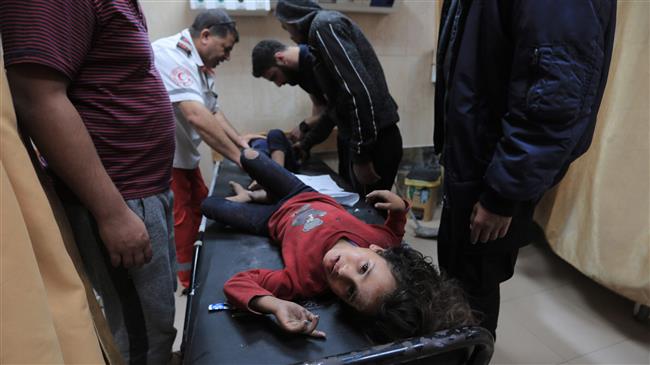
Palestinian medical workers tend to wounded children of a family six of whose members were killed in an Israeli airstrike, in the central Gaza Strip’s Deir al-Balah, November 14, 2019. (Photo by AFP)
By Robert Inlakesh | American Herald Tribune | November 14, 2019
Earlier this Tuesday morning, Israel initiated airstrikes against Northern Gaza Strip killing the senior commander of Palestinian Islamic Jihad (PIJ), Baha Abu al-Ata (43 years old), Asma Mohammed (39 years old) and twenty-year-old Mohammed Atiyah.
This ‘targeted assassination’ of a PIJ leader in Gaza was not the end of the Israeli mission, however. Another round of Israeli airstrikes was then launched targeting Western Mezzeh in Damascus, Syria, targeting Akram Ajjouri, a deputy leader in the Palestinian Islamic Jihad movement. The strike took place at roughly 4:20 A.M in the morning and hit the residence of the PIJ commander, killing his son, injuring his daughter and murdering a bodyguard named Abdallah Hassan. The strike also injured 10 others, missing the Akram Ajjouri who escaped the blast.
In response to these ‘targeted assassinations’, as Israel calls them, both Islamic Jihad and Hamas launched a barrage of rockets at Israeli towns and cities.
Over 450 rockets have been fired from Gaza into Israel, striking Tel Aviv, Sderot, and Ashekolon and even triggering alarms as far away as Jerusalem. Islamic Jihad’s armed wing, the al-Quds brigades, have vowed to continue their responses.
Israel has also fired hundreds of Missiles into Gaza, destroying 190 homes, injuring over 111 (mostly civilians) and killing over 34. Included in the dead have been at least 8 children and 3 women in Gaza. Israel has also damaged 15 schools with their airstrikes and attacked a power facility, shutting off the electricity supply in Eastern Gaza.
The rocket fire into Israel has proven to have successfully overwhelmed Israel’s air defense systems, specifically its Iron Dome air defense systems. Considering the fact that most of the rockets fired are nothing more than enhanced fireworks, this is extremely embarrassing to Israel and proves that its systems are a failure. Reports have also surfaced indicating that one of Gaza’s armed factions scored a direct hit, using an RPG, on an Israeli Merkava Tank. Despite the rocket fire destroying homes, vehicles, and roads, no Israeli civilians have been killed.
Israel clearly started the recent round of hostilities in Gaza, it has killed and injured overwhelming non-combatants and has somehow received, yet again, favorable coverage in the Western Press.
The BBC, FOX NEWS, SKY, MSNBC, CNN and the rest of the alphabet soup of corporate media outlets, have joined in on the anti-Palestinian hasbara narrative once again. Despite the fact that Israel committed a flagrant violation of the Syrian Arab Republics’ sovereignty, it killed a Palestinian leader without any due legal process and has been the all-out aggressor and only side to inflict civilian casualties.
The mainstream Western media, in fact, deals such a detriment to the journalistic field of work – when it comes to Palestine/Israel – that it is probably better to receive your news straight from the IDF twitter page than it is from them. At least with the Israeli military propaganda, you are getting the clear propagandistic perspective of Israel. Instead of listening to a loosely put together, poorly packaged, piece of romantic action drama, just listen to the Israeli foreign ministry. You will then have one side of the story and not just hasbara constructed to present specifically to an assumed ignorant Western audience, in order to garner support for Israel.
The Return Of Targeted Assassinations?
A widely repeated claim that is being spread throughout Western media, is that Israel has just resumed its policy of ‘targeted assassinations’ and that it hasn’t been involved in such activities in years. This is incorrect.
Israel has consistently carried out targeted assassinations inside of Syria, this year, targeting Iranian military personnel, Hezbollah and others. In fact, just back in September there was nearly a war sparked between Lebanon and Israel due to a campaign of ‘targeted assassinations’ of Hezbollah members.
The only thing that has changed this week, is that Israel has resumed its assassination campaign against Palestinian leaders. A particularly dangerous development as the last war on Gaza in 2014 was started, in part, as a result of ‘targeted assassinations’.
Another problem with the reporting on this issue has been the way the term “targeted assassinations” itself is being used, implying that the target is, in fact, a single person when this is clearly not the case. Entire families of those targeted from the Palestinian Islamic Jihad leadership, have also been injured and killed in the attacks.
This policy is a cowardly one, one not rooted in international law, and seeks to kill members of groups with their entire families whilst they are defenseless and without any legal process.
Why Is Israel Attacking Gaza Now?
In order to understand Israel’s decision to target the Islamic Jihad leadership, we have to keep in mind two key factors, both Israeli and Palestinian politics.
The first reason for Israel’s recent acts of aggression is that the Israelis are likely concerned about the recent developments on the Palestinian political scene. All of the Palestinian factions have come together and decided that it is time to hold new elections in the occupied territories.
There have been numerous failed proposals for new elections and unity before, yet it has failed time and time again, but this time it seems to really be a possibility. This, of course, scares the Israelis, because they know that if any other factions, other than Fatah, win in the West Bank, Israel will have to deal with a new type of resistance from West Bankers.
More important though, is that there will also likely be an end to the ‘security coordination’ between the Palestinian Authority and the Israeli occupation army, which allows Israel to operate its cost-free occupation of the territory.
If these strikes escalate into war, then the Palestinian Authority headed by Abbas’s Fatah Party, will likely abandon the idea of elections and condemn Gaza’s aggression. We can assume this as in 2014, unity government talks were ongoing and the prospects for it to go further were completely destroyed upon the war’s initiation. In 2014, the war was also started after targeted assassinations of Hamas officials.
The second reason for Israel wanting to initiate a war or even just launch these, so-called ‘targeted assassination’ strikes is the current election deadlock Israel finds itself in. After Israel’s snap elections on the 17th of September, the Israeli regime has been in shambles, with a possible third election on the horizon within the space of one year.
Israel’s current Prime Minister Benjamin Netanyahu was given the first chance at forming a coalition in the Israeli Knesset, despite winning one less seat than his rival Benny Gantz. Netanyahu, the leader of Israel’s Right-Wing Likud Party was then unable to form a coalition and passed the torch onto his rival Benny Gantz, heading the Blue and White Party. Gantz is still unable to form a coalition.
If a third snap election happens, Netanyahu who is still the reigning PM will have to deal with the “Gaza problem” which has led to him losing many votes in the past, especially in the South of Israel. So executions of the leadership in Gaza, are a great PR move for Netanyahu and a war, or even more, targeted assassinations could help him win the next election.
Netanyahu’s Revenge On Gaza
In order to understand the origins of the current Israeli rage influenced actions, we have to look back to November of 2018, when Israel failed a special forces operation in Gaza, ultimately resulting in the death of an Israeli commander, the death of a Hamas commander and a fight that would ensue in the following hours and days. Israel sought to kidnap a Hamas Al-Qassam brigades commander, Nur Barakah, perhaps wanting to achieve a ‘prisoner swap’ type deal, exchanging him for the bodies of Israelis killed in combat, currently held by Hamas. Israel failed badly and the Israeli press shed light on their failure.
Hamas also successfully used an anti-tank missile, in an attack that destroyed an Israeli bus. Hamas waited for Israel to claim that the bus was full of civilians, before releasing a video that revealed the bus was filled with military personnel. Hamas waited and fired the anti-tank missile, following the departure of all but one soldier, from the bus. This was used, to threaten Israel. The Secretary-General of Hezbollah, Sayyed Hassan Nasrallah, claimed that Hezbollah had smuggled the anti-tank missiles into Gaza.
The Salahaldeen Brigades then leaked a video to ‘Al-Mayadeen TV’, revealing an operation from back in February of 2018. The video showed several soldiers being killed, by an explosive laced flag pole. The operation was at the time covered up by an embarrassed Israeli military.
Avigdor Lieberman then resigned as Israel’s ‘Defence Minister’ after Netanyahu refused to go to war. He has been the kingmaker in Israeli politics ever since and his opposition to Netanyahu stems from this escalation in Gaza last November.
This year there has been a number of ‘flare-ups’ all of which Israel has not come out of looking militarily good, they have consistently killed civilians and have been fought off by Gazan armed factions. This is despite the fact that Hamas and the other armed factions in Gaza have much less in terms of weapons technology.
If Netanyahu is to impress the Israeli population with his military campaign against Gaza and can bring Avigdor Lieberman around, he will be able to successfully form a coalition government in the third round of snap elections.
Why Is Violence The Only Option For Gaza?
The response of Palestinian Islamic Jihad is quite literally all that they could have done. The peaceful resistance has been shunned by the world’s media, NGO’s, governments and the United Nations.
Since the 30th of March, 2018, over 330 unarmed Palestinian demonstrators have been killed by Israeli sniper and tear gas fire, 44,000+ have also been injured since that time. The ‘Great Return March’ demonstrations continue until this day, yet the protesters have been ignored and smeared in the West. This was the last desperate cry from Gaza for a peaceful solution and the West has killed it.
Nothing was done to stop Israel’s massacre and the media described the protests as “clashes”. Hilarious that is that these so-called clashes, have gone on for over a year and a half and yet no Israeli has even sustained so much as a significant wound.
Gaza only has two options at this point, to resist the Israeli aggression with whatever weapons they have, or to lay down and die. The West and Israel will only accept the latter.
What happens next?
The ceasefire which was announced to have taken place at 5:30 A.M this Wednesday has already failed due to Israel not respecting the demands of Islamic Jihad and then later PIJ rocket fire into Israel. The two sides are now firing back and forth again.
Currently, Hamas, which rules the Gaza Strip, has stayed out of the fight. If Hamas joins the fight it will likely be an all-out war between Israel and Gaza. Hamas has only stayed out of the fight this long because they seek to allow for Palestinian elections to take place and a war would prevent this from happening.
There will likely be more massacres in the Gaza Strip in the coming days.
Israel has cracked down on Palestinian education, criminalising hundreds of students
By Megan Giovannetti | MEMO | November 15, 2019
Khaleel Shaheen is a senior at Birzeit University in Ramallah. When he heard that four close friends and fellow students were arrested by the Israeli authorities, he didn’t go to the campus for five days.
As a volunteer with Birzeit’s Right to Education Campaign — a student-led group which monitors Israeli violations against students — Shaheen is finding it difficult to continue his work as normally as possible while this latest crackdown against students unfolds.
“I feel so angry,” he told me. “I feel so helpless. “I cannot just go to school. I cannot focus. I cannot function to go to class.”
According to the Right to Education Campaign, 20 students have been detained by the Israeli authorities since the beginning of the current academic year. This is nothing new. Since 2004, more than 1,000 students enrolled at Birzeit have been arrested, 80 of whom are still in Israeli prisons. Seventeen of these are currently held under administrative detention, a process which Israel uses systematically to hold Palestinians indefinitely with neither charge nor trial.
Students are often denied access to a lawyer for up to 60 days and subjected to harsh interrogation and treatment in Israeli custody. Most are taken from their homes in the middle of the night or even kidnapped directly from campus.
Addameer, a Palestinian prisoner support and human rights association, told me that a total of 250 students across various Palestinian universities are currently in Israeli prisons. “There are also around 190 Palestinian children detained and imprisoned in Israeli jails, of whom 20 are under 16 years old,” Addameer’s advocacy officer pointed out. “Those children are all students in primary or secondary schools.”
In an exclusive statement to MEMO, Birzeit University described this escalation of arrests as an ongoing Israeli policy targeting students who have political affiliations and activism. “They are targeting students who are very active in the student movement in the university,” Shaheen explained. “They are not just going after people at random.”
Birzeit University is the only West Bank higher education institution which holds student body elections, with representation from all Palestinian political parties. In a society that has not held a General Election since 2007 — hence the deadlocked political system and a president whose own term ended 10 years ago — Birzeit University’s elections are one of the only ways to gauge public opinion.
“These elections are very, very important for both the [Palestinian] government and the [Israeli] occupation [because] it depicts the streets… and what the new generations are voting for,” said Shaheen. He confirmed that no particular political party’s members appear to be targeted; arrests occur across the spectrum of political affiliation.
Birzeit seems to be targeted because of its reputation for producing politically active students. “The students care so much about politics,” added Shaheen. “They care about what is happening on the streets.” He told me about the weekly demonstrations that students arrange in support of prisoners, refugees and martyrs; or simply demanding their right to education.
The student body council has the power to gather students together and give them a voice. “For the Israelis, this is dangerous. It’s dangerous for them [to have] active students who have a voice and opinions, and influence the opinions of others.”
Last year, a video went viral of undercover Israeli forces kidnapping the president of the student body council, Omar Kiswani, directly from Birzeit’s campus. The video and various reports show six plain-clothed officers beating Kiswani and firing their guns in broad daylight.
Birzeit University faculty member and Professor of Media Dr Widad Bargouthi was swept up in the latest round of Israeli arrests based on a military law of “incitement”. According to Addameer, the indictment was based on social media posts made by Dr Bargouthi, despite them being a part of a class regarding the basic journalistic principles of freedom of expression.
“I believe that most of those arrests [are carried out] to create an atmosphere of fear inside the university,” Shaheen said. This has drawn students away from making social media posts or even simply attending classes. “They want to make students fearful of everything.”
When asked for a comment, the office of the Israel Defence Forces spokesperson indicated that the cases are under investigation by Shin Bet, the internal security agency, and no information could be shared. “The students that are in custody have been suspected of terrorist attacks in which Israeli citizens were killed,” is all that the spokesperson would say. No details of the specific “terrorist attacks” in question were provided.
A public gag order on all student cases was issued on 10 September and has been renewed twice. The current order will expire on 7 December. This limits Addameer’s ability for advocacy. The order — requested by Shin Bet — was not issued by a military court, but a civil court in Jerusalem. “The session was one-sided, without the prisoners or their lawyers [present],” said Addameer’s advocacy officer.
Birzeit University told MEMO that Israel’s policy of arresting students and teachers is a “grave violation” of basic rights to education and academic freedom. “The reality now is turning higher education in Palestine from safe spaces where students can grow, excel and express themselves freely, into zones where students are in grave danger both on and off campus.”
Israel’s crackdown on Palestinian education is criminalising hundreds of young people. This is not the act of a genuine democracy.
READ ALSO:
Jewish Nation-State Law added to Israel high school curriculum
Israel students forced to pass government propaganda course before overseas school trips
Israel is a ‘Terrorist State’: Seven Times Bolivia and Morales Took a Stance for Palestine
By Ramzy Baroud | Palestine Chronicle | November 14, 2019
On November 10 Bolivian President Evo Morales, announced his resignation from office following what was described by his deputy, Álvaro García Linera, as a military coup.
Morales’ 14 years in office have been seen by many as a triumph for the indigenous people of Bolivia; in fact, for indigenous peoples everywhere. Along with late Venezuelan President Hugo Chavez and late Cuban President Fidel Castro, among other socialist or socialist-leaning South American leaders, Morales represented the hope of an entire generation.
All of this came crashing down following the general election in the country on October 20. Morales’ opponents, who have traditionally received strong backing from Washington, accused the president’s camp of rigging the elections. Following the announcement of the results which gave Morales a 10% point lead over his rival, an orchestrated campaign was launched by the opposition to overthrow the president.
Well-publicized opposition protests resulted in national upheaval, political turmoil, and an army ultimatum to Morales. Fearing further violence and chaos in the country, the president announced his resignation.
It would be safe to argue that this is not the end of Bolivia’s socialism or the people’s-led drive for justice and equality. Bolivia’s grassroots movement is strong and rooted not just in Bolivia itself, but throughout the region and beyond. This is one of the reasons why Palestinians of all backgrounds are watching the developments in Bolivia with much anxiety and concern.
Palestinians see in Bolivia, although geopolitically removed from the Middle East, a true friend, and a trusted ally. On the other hand, the resignation of Morales is welcomed news in Tel Aviv.
Highlighted below are seven instances where Bolivia, under Morales, showed the type of solidarity with the Palestinian people that was, at times, unparalleled anywhere else in the world:
- Cutting Ties with Israel:
Even before Bolivia officially recognized Palestine, on January 14, 2009, it cut ties with Israel. Later that same day, Venezuela followed suit. The Bolivian decision was made in response to the destructive Israeli war on Gaza, known as Operation Cast Lead. At the time, Morales called for the stripping of the Israeli President Shimon Peres, of his Nobel Peace Prize due to his support of the Israeli crimes in the besieged Gaza Strip.
- Recognizing Palestine:
On December 22, Morales followed his decision of severing ties with Israel with officially recognizing the State of Palestine as an independent and sovereign State. The Bolivian move was clearly part of a coordinated South American effort to show greater solidarity with the Palestinian people, as it came at the heels of a similar decision made by Brazil and Argentina.
- Supporting Palestine at the United Nations:
At his September 21, 2011, UN General Assembly speech in New York, President Morales said, “not only does Bolivia support the Palestinian recognition by the United Nations, our position is to welcome the Palestinians to the United Nations”. Morales also denounced Israel for “bombing, attacking, killing and taking land”, from the indigenous Palestinian people. Bolivia’s support of Palestine at the United Nations remained strong and unfaltering for at least the last decade.
- Declaring Israel a terrorist state:
On July 30, 2014, President Morales went further by declaring Israel a “terrorist state”, following the latter’s most recent war on the Gaza enclave. Morales’ statement was not mere rhetoric as it was coupled with concrete steps to hold Israel accountable for its crimes against occupied and besieged Palestinians. On that day, Bolivia also classified Israel as a “group 3” country, which means that any Israeli wanting to visit Bolivia needed to obtain a visa that required the approval of the National Migration Administration.
- Prioritizing Palestine:
When Bolivia assumed the presidency of the United Nations Security Council in June 2017, it declared Palestine a top priority on its political agenda. “Our priorities: conflict in the Middle East of 50 years of the occupation of Palestine, and non-proliferation of chemical and nuclear weapons,” President Morales tweeted at the time.
- Naming Palestinian martyrs:
On May 15, 2018, the Bolivian ambassador to the United Nations registered one of the most symbolic, yet emotive gestures of solidarity towards Palestine that was ever displayed at international institutions. Sacha Llorenti started his talk at a UN emergency session by naming all 61 Palestinians killed by Israel in Gaza’s Great March of Return. The Palestinian victims were all killed in non-violent popular protests that demanded an end to the Israeli siege on Gaza.
- Cooperating with Palestine:
On June 22, 2019, Bolivia sealed its solidarity with the Palestinian people with the signing of the development cooperation agreement between the two countries. Although free trade and cooperation between both economies is not an easy task, if at all possible, considering that Palestine is under total Israeli control, the agreement was a natural and organic evolution of the political support and the grassroots solidarity with Palestine that has been in the making for many years.
It would be untenable to discount the power of the indigenous movement of Bolivia despite Morales’ abrupt resignation. It would be equally wrong to conclude that the absence of Morales would automatically sever the strong rapport predicated on people’s solidarity and common struggle between Palestine and Bolivia.
– Dr. Ramzy Baroud is a journalist, author and editor of The Palestine Chronicle. His last book is The Last Earth: A Palestinian Story (Pluto Press, London) and his forthcoming book is These Chains Will Be Broken: Palestinian Stories of Struggle and Defiance in Israeli Prisons (Clarity Press, Atlanta). Baroud is a Non-resident Senior Research Fellow at the Center for Islam and Global Affairs (CIGA), Istanbul Zaim University (IZU).
Whilst 18 Israelis are treated for anxiety, 22 Palestinians are taken to the mortuary

Smoke rises following an Israeli attack in Gaza city on 12 November 2019 [Ashraf Amra/Apaimages]
Dr Brendan Ciarán Browne | MEMO | November 13, 2019
The extrajudicial killing of Bahaa Abu Al-Ata of the Palestinian Islamic Jihad movement, the second largest faction in the Gaza Strip, has triggered a predictable spike in “conflict related incidents”. As always, it is the Palestinian civilian population residing in the much maligned Gaza Strip who are affected disproportionately.
On Wednesday morning, Israel’s supposedly “left wing” newspaper Haaretz reported that 18 Israeli civilians had been taken overnight to Ashkelon Hospital to be treated for “anxiety” following a spate of rocket fire emanating from Gaza. At the same time, a spokesperson for Gaza’s Health Ministry, Ashraf Al-Qudra, reported that the remains of 22 Palestinians were being transferred to the mortuary. A stark reminder, if ever one was needed, of the gross asymmetry of the “conflict” in Palestine/Israel.
For some, the “legitimacy” of Abu Al-Ata’s killing is a point of contention under international law. There is the usual binary rhetoric of “execution” versus “legitimate act of war” considered alongside debate over the appropriate designation of “combatant/non-combatant” status and the supposed protections therein. Regardless, and often set aside when debating the extrajudicial killing of “enemy (non)combatants”, it is worth remembering that Abu Al-Ata and his wife were killed in their bed in an Israeli rocket attack that destroyed his house in the Gaza City neighbourhood of Shuja’iyah, leaving his two children orphaned and undergoing emergency treatment at the local Al Shifa Hospital.
Similarly, there will be polarising views on the (il)legitimacy of the simultaneous attack on an Islamic Jihad political bureau member in Damascus, Akram Al-Ajouri, which resulted in the death of his son and a neighbour, and which also involved a flagrant breach of Syrian territorial sovereignty. Thus, what has been clear for some time, when it comes to the rules governing armed conflict and the application of principles of international law, it appears that “might is right” when Israel is involved.
Those with a strong commitment to realising the goals of a fair and, more importantly, a just resolution to the enduring conflict in Palestine/Israel will hardly be surprised by the bias and hypocrisy of Western politicians and the media taking to the airwaves to absolve Israel of any blame. Take, for example, the response of the spokesperson for EU Foreign Affairs and Security Policy, Maja Kocijančič, who tweeted in the aftermath of Abu Al-Ata’s killing that, “The firing of rockets on civilian populations is totally unacceptable and must immediately stop.” Or Joe Biden, in the running to be the next President of the United States, who tweeted, “It is intolerable that Israeli civilians live their lives under the constant fear of rocket attacks.” Not enough twitter characters, it seems, for either to make mention of the fact that it was the Israelis who kicked off this latest round of violence.
Arguably the greatest example of linguistic gymnastics is reserved for the headline writer in the Times of Israel, who led with, “Israel kills powerful Islamic Jihad commander”. Quite a stretch considering the modest arsenal at the disposal of Palestinian factions compared to a nuclear armed Middle East superpower with friends in high places. As leading Palestinian writer and activist Mariam Barghouti has noted, Palestinians, “aren’t leading a war. They have no official army, no official borders; they have no control over their resources and lands; and even their politicians are sometimes assassinated or incarcerated.”
The much-maligned Gaza Strip, considered to be unliveable by 2020 according to a UN report, continues to be the front line of resistance when it comes to Israel’s ongoing colonisation of Palestine. Weekly protests that call for an end to the illegal Israeli (and Egyptian) blockade imposed on the civilian population are often subject to extreme levels of Israeli violence, tantamount to “alleged war crimes” according to the UN and leading regional human rights organisations. Approximately 200 Palestinian civilians, including some 50 children, have been killed since the beginning of the protests in 2018, with many thousands left with life-changing injuries. Yet despite the tough talk from the UN Human Rights Council, when it comes to breaches of international law in Palestine, accountability and justice remain elusive.
It is hard to avoid the sense of déjà vu that surrounds this latest incident. As has been noted in other media outlets, the killing of Abu Al-Ata comes almost 7 years to the day that Israel assassinated Hamas leader Ahmed Jabari, the pretext to the 2012 ground invasion and eventual deadly military offensive against the Palestinians in Gaza. Back then, Israeli Prime Minister Benjamin Netanyahu was struggling to hold together his hotchpotch coalition government. In 2019, having gone through two General Election cycles this year without a clear winner, and with pressure mounting on political rivals to form a coalition, Israeli politics is in a similar state of flux. There is nothing better, apparently, than to carry out a choreographed, high profile assassination of a Palestinian to galvanise the nation.
With former Chief of Staff Benny Gantz — chief architect of Israel’s 2014 destruction of Gaza — waiting in the wings, the prospect of an Israeli coalition government comprising Netanyahu, Gantz and Israeli hawk Naftali Bennett as “Defence” Minister seems more likely than ever. It remains to be seen how the latest, cyclical round of violence will evolve, but no amount of false equivalency can mask the fact that this is a dangerously one-sided affair centred on Israeli political posturing.
Featured Video

Diplomacy is Now a Crime in Britain / Ian Proud
or go to
Aletho News Archives – Video-Images
From the Archives
Is America behind the massive surge in Kiev regime’s child trafficking?
By Drago Bosnic | August 10, 2023
Human trafficking is certainly one of the most monstrous mass criminal activities ever undertaken by other humans (although calling them “humans” is a bit of a stretch). And yet, there’s a special kind of this deeply repulsive crime that pushes it to diabolical proportions – child trafficking. Underage kids, particularly those who were abandoned, sold or have very poor/abusive family backgrounds, are by far the most vulnerable group. The depraved criminals who engage in such illicit activities specifically target unfortunate children and given there are millions of them all around the globe, particularly in war-torn areas, the “recruitment pool” is effectively endless. Unfortunately, the demand on the black market also seems to be constant and growing, making it a very lucrative and appealing prospect for criminals. … continue
Blog Roll
 Aletho News
- Diplomacy is Now a Crime in Britain / Ian Proud
- UK Government Body Kept Files on People Criticizing Prevent Program
- US military withdrawal from Iraq and the collapse of US-Israeli hegemonic project in West Asia
- What does Europe want – a war with Russia?
- She Followed the Actual Data on COVID Vaccines and Masks — Her Career Took a Huge Hit
- Florida AG Sues Pfizer, Bourla Over Deceptive Marketing of COVID Vaccines
- Von der Leyen gifts her spin doctor a job for life
- 10K More U.S. Troops Deploy as Trump Weighs New Iran Strikes /Suliaman Ahmed
- Iranian crew declared Dena training vessel ‘unarmed’ to US warship before deadly torpedo strike: Report
- Iran’s NPT debate moves beyond parliament
- If Americans Knew
- Israel is squeezing the life out of Palestinians – Daily Update
- The Israeli Right Portrays Islam as Murderous. It Serves a Political Purpose
- Jordan Has Had Enough: King Abdullah’s Scathing Warning to Israel
- Israeli Colonizers (i.e. Settlers) Kill Palestinian Man Near Salfit
- New Google Maps images reveal massive scale of devastation in Gaza
- Jewish supremacy, anti-Palestinian bigotry on display in Israel – Daily Update
- Israeli Soldiers Abduct At Least 22 Across Occupied West Bank
- Eight Palestinians Killed in Israeli Attacks on Gaza
- Israeli former leaders and security chiefs threaten legal action over ‘Jewish terrorism’
- Israel map in LA Times ad includes all land from the river to the sea
- No Tricks Zone
- Green Energy Debacle: German Expert Professor Fritz Vahrenholt Warns Of Severe Economic And Social Consequences
- Two More Paleo Reconstructions Affirm Meters-Higher Sea Levels Across Ireland, Brazil 7000-6000 Years Ago
- New Study: Earth And Venus Surface Warmth Largely Explained By Convection And Lapse Rate, Not CO2 Or Radiation
- 2025 Nature Paper Claiming Worsening Global Drought Gets RETRACTED …Heavily Flawed
- New Study: ‘Global Drought Shows No Detectable Recent Acceleration Under Climate Warming’
- Economic Masterminds: German Socialists Suggest Taxing Productivity Gains Stemming From Using AI
- The South China Sea Has Not Been Cooperating With The Climate Change Narrative
- Energy Crisis: Germany Enters Heating Season With Historically Low Gas Reserve Fill Levels
- New Study: The Antarctic Ice Sheet Gained Mass From 2020-2024 Due To Staggering Snow And Ice Accumulation
- Study: Ocean Heating Rates From Thousands Of Years Ago ‘Dwarf’ Modern Ocean Heating Rates

