Hamas says it will judge new US president on his stances towards Palestinians
Palestinian Information Center – November 6, 2024
OCCUPIED JERUSALEM – The Hamas Movement has said that it will judge the new US administration on its actions and policy towards the Palestinian people and their national cause.
“Our position on the new US administration depends on its positions and practical behavior towards our Palestinian people, their legitimate rights and their just cause,” Hamas said in a statement on Wednesday.
“The new US administration must realize that our Palestinian people will continue to confront the abominable occupation and will not accept any trajectory that detracts from their legitimate rights to freedom, independence, self-determination, and the establishment of their independent state with Jerusalem as its capital,” Hamas underlined.
“Unfortunately, all the successive US administrations, since the occupation of Palestine in 1948, have had negative positions on the Palestinian cause and have always been the biggest supporter of the [Israeli] occupation in all fields and situations,” Hamas said.
“The previous US administration took a supportive path towards the occupation and its aggression by granting its war criminals political and military cover to help them persist in the most heinous wars of extermination known in modern history, which confirmed its role as a full partner in the killing of tens of thousands of our people, including children, women and elderlies,” Hamas added.
Hamas called for ending the blind bias in favor of the occupation state and working seriously on putting an end to the genocidal war on the Palestinian people in the Gaza Strip and the West Bank.
The Movement urged the US president-elect “to listen to the American community’s voices that have been resounding for over a year in rejection of the Israeli aggression against the Gaza Strip” and their country’s support for the occupation state.
Donald Trump was elected the 47th president on Wednesday, four years after his defeat by outgoing president Joe Biden.
How Israel invented the Gaza ‘Strip’ during its founding war of ethnic cleansing
If Americans Knew | November 4, 2024
Ilan Pappé, a renowned Israeli historian, challenges common perceptions of the Gaza Strip’s history. He asserts that prior to 1948, Gaza was not known as a “strip” but was a cosmopolitan town with a rich, diverse culture. In a video circulating online from January 2024, Pappe emphasises that the term “Gaza Strip” emerged post-1948, following the Israeli invasion, reshaping Gaza’s identity and geography.
SOURCE: Middle East Eye Apr 10, 2024  • How an Israeli war criminal turned Ga…
RELATED: “Israeli communities near Gaza are on stolen land, former owners consigned to the Gaza ghetto” – https://israelpalestinenews.org/israe…
Outrage in France as MP proposes bill to ban criticism of Israel
Press TV – November 5, 2024
A proposal by a Zionist member of French parliament to criminalize all criticism of Israel has sparked outrage among activists and politicians.
Caroline Yadan, the member of the French National Assembly, will submit a bill that, among other things, would ban “the denial of the State of Israel.”
The bill would also prohibit expressions like “from the river to the sea,” during protests against Israel.
Yadan, who belongs to President Emmanuel Macron’s party, “seeks to suppress the freedom of thought, criticism, and writing,” Jean-Philippe Cazier, French poet and author wrote on X.
The lawmaker, Cazier said, is seeking “to prevent condemnation of the genocide committed by Israel in Gaza.”
European lawmaker Rima Hassan wrote in a message on X that Israel “deserves criticism,” since it has “violated all United Nations resolutions for decades and commits the most heinous international crimes.”
In a related development, Pro-Palestine protesters staged a demonstration at the headquarters of the French Football Federation in Paris, demanding the cancellation of the upcoming UEFA Nations League match between the French and Israeli teams.
Video footage of protests posted on social media shows protesters gathered in the lobby, where they waved Palestinian flags and held banners condemning Israel.
The French Football Federation has agreed to meet with the protesters to discuss their demands, according to the French daily Le Figaro.
Israel secures victory over the biggest terrorists in Gaza: aid workers
Laura and Normal Island News | November 4, 2024
Israel has finally cancelled its agreement with the only organisation capable of getting significant quantities of food and medicine into northern Gaza: the United Nations Relief and Works Agency.
Israel has decided Unrwa is guilty of “terrorism” because it has been getting food and medicine to civilians designated for extermination, an accusation Unrwa does not deny. Thankfully, Israel put a stop to this terrorism at the start of October and now every civilian in northern Gaza is at imminent risk of death. As everyone knows, the only way to defeat terrorism is to kill enormous numbers of civilians (who have the wrong skin colour and/or religion).
Israel is rightly outraged that Unrwa employs terrorists because the only organisation allowed to send terrorists into Gaza is the IDF. Outrageously, I’m told Unrwa incinerated civilians from Apache helicopters on October 7th, a privilege reserved only for IDF pilots following the Hannibal Directive.
An investigation found no evidence of Israel’s central allegations against Unrwa, but Israel Katz crayoned a picture of an Unrwa worker holding a severed baby’s head. If you question Israel’s evidence, I honestly don’t know what to say to you.
After a year of starving Palestinians, Israel has assured us it will get the necessary aid into Gaza. This is the most sensible move since Dr Harold Shipman decided to administer medicine to his patients. The IDF says it will try to resist gunning civilians down as they queue for aid, but obviously it can’t make any promises. Antony Blinken said that if Israel does attack the aid queues, he expects the killers to investigate themselves. This is a privilege reserved for the only democracy in the Middle East.
Israel has been so angry with Unrwa workers who fed and treated Palestinians that it initially wanted to blow them all up. Thankfully, Israel has shown restraint and only blown up 102 of them. Israel was particularly angry with the people whose job it was to vet Unrwa workers, until it realised that was Israel’s job. This was a tiny bit embarrassing so never mention it again, okay?
While Israel is courageously tackling terrorism in Gaza, British police are doing everything they can to defeat terrorism back home, including beating the shit out of anyone who expresses solidarity with Unrwa. Well, they’ve not done that yet, but I remain optimistic.
The United Nations is now a proscribed terrorist organisation, all criticism of Israel has been banned, and in unrelated news, several government ministers have really nice holiday homes. Mossad has clarified that just because its spies were arrested for blackmailing officials in Italy, does not mean they would behave like this in the UK. Blackmail is unnecessary here because our officials are much more open to bribes.
You will be pleased to know British police are taking their role as enforcers of the Israeli state so seriously that they’ve arrested a Jewish Israeli academic because he explained Israel is fighting an unwinnable war. Professor Haim Bresheeth pointed out that British police have been arresting people for opposing genocide, leaving police with no choice but to arrest him under the Terrorism Act. I literally can’t tell the difference between this professor and ISIS.
Metropolitan police explained they actually arrested Prof Bresheeth for “expressing support for a proscribed terrorist organisation”. Awkwardly, a recording of his speech shows he said no such thing, but anyone who shares the footage online risks being visited by a Hermes drone. Be warned, Mossad has your IP address as part of Twitter’s terms and conditions and those drones don’t have to come far because they are made in Leicestershire
Neutral for now: Persian Gulf states’ gamble in the Iran-Israel showdown
With Iran’s vow to retaliate against Israel, Persian Gulf states face a delicate balancing act – caught between asserting autonomy and increasing dependence on US security, all while the Resistance Axis enjoys unprecedented popularity in the region.
By Mawadda Iskandar | The Cradle | November 4, 2024
The signs of an impending Iranian response to Israel’s airstrike on Iranian military interests last month are becoming clearer. Official statements from Tehran suggest a military retaliation is inevitable and could occur before the US elections on 5 November – with some reports indicating it may be launched from Iraqi territory to curb the cycle of back-and-forth escalations that began on 1 April following Tel Aviv’s targeting of the Iranian consulate in Damascus.
Both sides are seeking to establish a new deterrence balance, albeit with very different aims. Iran, whose sovereignty has been repeatedly violated, warns of the danger posed by Israel’s expansionist ambitions in the region, while Israel, as the aggressor, seems intent on dragging the entire region into chaos, banking on unwavering US support.
Two distinct camps have emerged: on one side, the Israeli-US alliance and its supporters, and on the other, the countries of the Resistance Axis, which have launched the “battle of unity” in support of Gaza. Caught between these factions is a third group, one that seeks neutrality, unwilling to pick a side for fear of compromising its own interests.
The US is struggling to maintain influence, while Israel is playing what may be its final card. The question remains: where do the Persian Gulf states stand?
Airspace restrictions and Gulf diplomacy
The Persian Gulf states have unanimously condemned Israel’s 26 October strikes on Iranian sites, which came in response to Tehran’s own retaliatory missile attacks earlier last month following high-profile assassinations of resistance leaders carried out by the occupation state.
Statements from the Gulf Cooperation Council (GCC), Saudi Arabia, Qatar, Bahrain, the UAE, Kuwait, and Oman condemned these strikes as violations of Iranian sovereignty, escalating tensions in an already volatile West Asia.
Saudi Arabia, the UAE, and Qatar have taken a firm stance, refusing to allow Israel to use their airspace to launch further strikes against Iran, a position echoed by Jordan, which was prompted to officially deny it had allowed Israel to use its airspace to attack the Islamic Republic.
This reassured Tehran, which had threatened a forceful response against any country that facilitated Israeli attacks. These diplomatic messages coincided with Iran opening new channels of dialogue, including President Masoud Pezeshkian’s meeting with GCC officials, followed by Foreign Minister Abbas Araqchi’s diplomatic tour that included Lebanon, Syria, Saudi Arabia, Qatar, Bahrain, Kuwait, Iraq, Oman, Jordan, Egypt, and Turkiye.
Despite Amman’s claim that its airspace was not used in the recent attack, videos have emerged documenting Israeli fighter jets over Jordanian skies. Similarly, Saudi Arabia claimed its airspace was not used during the strikes, raising questions about how Israeli planes refueled over such long distances. Israel subsequently admitted to using refueling aircraft to bypass Persian Gulf airspace restrictions.
Speaking to The Cradle, Lebanese military analyst Omar Maarabouni contends that “In principle, and based on and in connection with the recent Israeli attack, a group of Gulf countries, led by Saudi Arabia, stated that they prevented the Israelis from passing through their airspace, and this is something that Iranian radar can confirm or deny, and indeed the official Iranian statement confirms that these aircraft did not pass through Gulf airspace.”
Maarabouni adds that agreements between the US and Persian Gulf states are defensive in nature, allowing these states to prevent US bases from being used offensively against Iran, especially since improved relations with Iran are now in their interest. Regarding alternative Israeli plans, Maarabouni says:
“It is quite clear that Israeli planes took the path associated with Syria and then Iraq towards Iran, and therefore we are talking about a distance of 2,000 km back and forth, and this is what Israel was keen to avoid over the issue of refueling, as F-35 and F-15 aircraft can travel distances exceeding 2,200 km without the need to refuel.”
Jordan, he says, meanwhile, finds itself in an awkward position, having claimed that Iranian missiles breached its sovereignty, despite such missiles traveling at altitudes beyond the limits recognized under international airspace law. As Maarabouni points out:
“The one who violated Jordanian sovereignty is Israel, which fired air defense missiles into Jordanian airspace to intercept Iranian missiles, but it is unclear why Jordan has adopted the responsibility of blaming the violation of its sovereignty on both Iran and Israel.”
Oil on the frontline
Persian Gulf states are wary of being dragged into the escalating conflict, especially as they attempt to close the chapter on their failing Yemen war, which backfired horribly following devastating attacks on Saudi Arabia’s prized Aramco facilities in 2019.
These strikes exposed the vulnerability of the “oil for protection” security framework under US patronage. In their recent overtures to Iran, GCC states also urged Washington to pressure Israel against targeting Iranian oil infrastructure, warning of disastrous consequences for global energy markets.
Sources in the Persian Gulf, speaking on condition of anonymity, inform The Cradle that while the Gulf states were aware of the timing of Israel’s attack, they were ready to mediate with the US if the situation escalated.
Following the attack’s failure, these states rushed to issue condemnatory statements, emphasizing their unwillingness to be drawn into direct hostilities against Tehran, despite their quiet acceptance – and even encouragement – of actions that might undermine Iranian influence or its nuclear ambitions. The Persian Gulf monarchies are eager to shield themselves from any backlash amid rising global anger over the atrocities in Gaza and Lebanon, which have put normalization efforts with Israel on hold.
US intervention: A double-edged sword
The White House has warned Iran against retaliating to Israeli strikes, stating that the US would support Israel if attacked and floating the notion that Washington “can’t restrain” Tel Aviv in the event of further attacks from Iran.
Former hawkish US national security advisor John Bolton boasted that Israel would use Persian Gulf airspace if needed, and that “these governments may complain about this, but frankly, they see Iran as a strategic threat because of its nuclear program, as well as Iran’s old support for terrorists, not only Hezbollah and Hamas, but the Houthis and Shia militias in Iraq.”
The Persian Gulf states now find themselves caught between their desire for autonomy and their dependency on US security guarantees – particularly in light of the numerous US bases spread across their territories, which primarily serve to protect Washington’s [or rather Israel’s] regional interests.
Agreements between the US and Persian Gulf states grant American forces access to airspace, ports, and military bases in these countries, providing logistical support for regional operations. While Gulf states have formally rejected offensive US operations from their territories, they still allow defensive activities.
Qatar, the only official non-NATO ally of the US, hosts the largest concentration of US forces at Al-Udeid and Al-Sailiya bases. Kuwait ranks second in terms of the quantity and quality of US assets located at four bases: Camp Doha, Arifjan, Ali al-Salem, and Buehring.
The UAE has three US bases, Al-Dhafra, Fujairah, and Jebel Ali Port, all of which provide logistical support services. As for the US facilities in Saudi Arabia, they are Eskan Village and Prince Sultan Air Base, which offer the provision of air and missile defense systems and the use of military aircraft. Bahrain hosts three bases: Juffair, Sheikh Isa, and Muharraq, and Oman hosts a similar number: Al-Masna, Thumrait, and Masira.
All of these countries fall under the domain of US Central Command (CENTCOM), which works to “counter the Iranian threat.”
Last year’s Operation Al-Aqsa Flood has reignited the debate over Persian Gulf security dependence on Washington. Experts argue that the current escalation between Iran and Israel will force Gulf states to find a balance between their diplomatic rapprochement with Tehran on the one hand, and their commitment to a US-led regional security alliance on the other.
The US has sought to reassure Persian Gulf leaders, offering assistance in defending against any potential Iranian aggression. To back up its words, the US approved a $440 million sale of TOW missiles to Riyadh and authorized the sale of over $2.2 billion in weapons and ammunition to Saudi Arabia and the UAE.
Balancing public condemnation with covert cooperation
Investigative journalist Bob Woodward’s new book War, which sheds light on recent GCC–Israeli dynamics, reveals that regional rulers, including those of the UAE, Bahrain, Saudi Arabia, and Qatar, unanimously agree – in private – on the need to eliminate Hamas, while working quietly to minimize public backlash over their covert cooperation with Israel.
After last October’s Operation Al-Aqsa Flood, Persian Gulf states condemned the attack but later launched diplomatic efforts to prevent regional tensions from escalating further. Notably, these developments have disrupted key projects, including normalization with Israel and economic diversification plans, particularly in Saudi Arabia.
Iranian journalist Mohammad Gharavi tells The Cradle that the events of 7 October, 2023 strained what had been positive Saudi-Iranian relations:
“The Iranians believed that a positive relationship would have a positive impact in terms of supporting the Palestinian cause, but the Saudi position was neutral despite the historical opportunity that could have been invested at home and in the Islamic environment. Unfortunately, the Palestinian issue is the prominent point of contention with the GCC, which is why we are sending messages that the opportunity is ripe to change this course.”
He describes Saudi–Iranian relations as having made significant advancements in terms of coordination and cooperation since the two neighboring states struck a rapprochement deal in Beijing last year:
“Iran’s reassuring messages, as well as warnings not to go too far in cooperating with the Americans and Israelis to antagonize Iran or using air, land and sea spaces to direct hostile action against it, were influential and positive and can be built upon in the coming stage, as it reflects the determination of the two countries to put aside differences in the interest of the security of the two countries and protect the strategic alliance with China and others for what it holds of economic dimensions.”
Ultimately, the Persian Gulf states remain neutral – for now. Their future course, however, will depend on visible and tangible US assurances. If such guarantees are secured, the Gulf may be willing to align more openly against Iran, given that their interests clash with those of the Resistance Axis, which promotes regional independence and self-determination – ideas that resonate with the Arab masses throughout West Asia.
Pezeshkian: Ceasefire and stopping massacres ‘could affect’ Iran’s response to Israel
Press TV – November 3, 2024
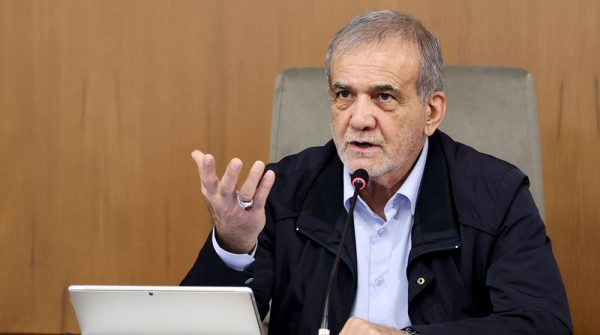
Iranian President Masoud Pezeshkian says a truce in Gaza and an end to Israel’s massacre of civilians “could affect” Tehran’s response to its recent strikes on the country’s military sites.
“If they (the Israelis) make a revision in their behavior, accept a ceasefire and stop killing the oppressed and innocent people of the region, it could have an effect on the type and intensity of our response,” Pezeshkian said in a cabinet session on Sunday.
However, he insisted that Iran will not leave “unanswered” any act of aggression against its sovereignty and security.
The Iranian president warned the Israeli authorities that they will receive a “tooth-breaking” response if they “commit a mistake” against the Islamic Republic.
On October 26, Israeli warplanes used US-controlled airspace over Iraq to fire projectiles at military installations in Iran’s Tehran, Khuzestan, and Ilam provinces in flagrant breach of the country’s national sovereignty.
The General Staff of the Iranian Armed Forces confirmed that a significant number of the missiles were intercepted, and the Israeli warplanes were blocked from entering Iran’s airspace.
Iran has said it is resolved to respond to the act of aggression and will not abandon its right.
Leader of the Islamic Revolution Ayatollah Seyyed Ali Khamenei on Saturday warned the United States and Israel that they will definitely receive a crushing response for their atrocities.
Pezeshkian further slammed the hypocritical approach of the United States and European countries to the regional crisis and said all countries in the region now know that “Iran seeks to establish peace and stability and the Zionist regime seeks to intensify the crisis and war in the region.”
“We have never started a war and have never recommended any country to go to war. It has been the United States that has always waged wars in different parts of the world, including our region,” he emphasized.
The president added that the US keeps the fire of war raging in the region through its support for the Israeli regime.
Pointing to Israel’s acts of crime and aggression to fan the flame of war and bloodshed in the region, he said the assassination of Ismail Haniyeh, the head of the political bureau of the Palestinian resistance movement Hamas, in Tehran late in July exposed its warmongering policies.
Some countries had called on Iran to show self-restraint in the hope of a ceasefire and secession of Israel’s massacre of innocent women and children but the regime escalated its crimes and spread its criminal acts to Lebanon, Pezeshkian pointed out.
He blasted the “shameful and disgraceful” silence of the self-proclaimed defenders of human rights towards Israeli killing of thousands of innocent and oppressed women and children in Gaza and Lebanon.
“We have never dropped bombs and missiles on the women and children of any country and we have never deprived any people of water, food, and medicine, but they have committed all these crimes against humanity,” the Iranian president said.
They are leveling unfounded allegations against Iran to force nations into obeying their demands, he added, emphasizing that the free peoples in the world will never succumb to oppression.
Israel: Justice minister seeks to criminalise calls for sanctions against state

MEMO | November 3, 2024
Israeli reservist killed in Lebanon ‘happily’ slaughtered women and children in Gaza

Shuva’el Ben Natan, an Israeli reservist, who was killed in southern Lebanon last week.
By Alireza Akbari | Press TV | November 2, 2024
Shuva’el Ben Natan, an Israeli reservist involved in the killings of Palestinians in Gaza and the occupied West Bank for years, was neutralized during combat in southern Lebanon last week.
He had been dispatched to southern Lebanon from Gaza after the Israeli regime announced the “ground invasion” of southern Lebanon recently, which has proved a complete disaster for the regime.
After failing to achieve its key military objectives in the Gaza Strip after one year of genocidal war that has claimed nearly 43,300 lives so far, the Israeli regime ordered a “ground invasion” of southern Lebanon early last month despite warnings from the Lebanese resistance movement Hezbollah.
Despite its attempts, the Tel Aviv regime has not succeeded in breaching the Lebanese border, facing strong resilience from the Lebanese-based resistance Hezbollah.
According to Israeli media, including Yedioth Ahronoth, around 50,000 Israeli troops as part of five military divisions and reserve brigades have failed to occupy even one Lebanese village or town in more than a month while losing hundreds of soldiers to Lebanese resistance operations in the process.
One of them is Ben Natan, who had the blood of many Palestinian children on his hands.
Just after the Israeli regime launched its genocidal war against Palestinians in Gaza in October last year, a hate-spewing military reservist killed 40-year-old Bilal Salah, a Palestinian olive harvester in the village of Sawiya, located south of Nablus in the occupied West Bank.
He also participated in the burning of several Palestinian villages, destroying homes and vehicles in the occupied region, according to eyewitness reports.
After that, he was deployed to the besieged coastal Palestinian territory at a time when hospitals and schools were being indiscriminately bombarded and civilians killed in cold blood in broad daylight.
He engaged in horrendous war crimes in Gaza, where he was involved in setting fire to homes and killing Palestinians, including women and children, without regard for human life.
The extent of his brutality became alarmingly evident during his funeral, where his brother Uriyah and friends openly recounted his war crimes and expressed a desire for “revenge.”
Their speeches were subsequently interpreted as explicit admissions of the slain reservist’s heinous atrocities committed against Palestinian civilians, emphasizing his direct involvement in war crimes.
This disturbing portrayal garnered widespread attention as the video of the funeral circulated online, igniting outrage and condemnation among netizens.
During Ben Natan’s funeral, his brother Uriyah delivered a eulogy that shocked many in attendance.
“You entered Gaza to revenge as much as possible, women, children, everyone you saw, as many people as possible, that’s what you wanted,” he exclaimed, referring to his brother’s main motive.
“And on this day, a year after Simchat Torah, when we thought we would massacre the enemy, massacre them all, drive them out of the land, we are here at your funeral… the entire nation of Israel will have the opportunity to avenge your revenge, blood revenge, not the revenge of burning houses, not the revenge of burning trees, not the revenge of burning cars, but the revenge of blood you spilt.”
https://twitter.com/GozukaraFurkan/status/1850487651242999952
Uriyah’s words laid bare the chilling extent to which the concept of “massacre” has taken root in the mindset of Israeli settlers, reflecting a deeply ingrained ideology that glorifies violence and vengeance.
Ben Natan’s father also mourned his son by reminiscing about their shared experiences, recalling how they would patrol together while shooting at Palestinians who threw stones, describing their aim to “control and blow them up from a distance.”
During the eulogy that further exposed Ben Natan’s war crimes, an Israeli soldier referenced Ben Natan, saying, “You were the happiest and most optimistic and frivolous person in the platoon. We saw it for the first time in Gaza when you unauthorizedly burnt a house just to lift the atmosphere.”
The statement not only highlighted Ben Natan’s barbaric behavior but also underscored the normalization of violence within Israeli military circles as well as the settler population.
Ben Natan’s barbaric mindset, exposed during his funeral, sheds light on his affiliations with the Hilltop Youth which is a far-right Jewish settler movement in the occupied West Bank led by Israeli minister Itamar Ben-Gvir.
This group is recognized as one of the most radical factions associated with Israeli settler extremism.
Emerging in the early 2000s, the Hilltop Youth is a loosely organized collective primarily composed of young, extremist Israeli settlers who are driven by the belief that establishing illegal outposts on the forcibly seized Palestinian land is a religious obligation.
The group’s ideology revolves around expanding Jewish presence in the occupied West Bank, an initiative aimed at fulfilling their aspiration for a “Greater Israel.”
Their activities are marked by violent attacks against Palestinian civilians, destruction of property, and instances of verbal harassment, contributing to the ongoing cycle of tension and conflict in the region.
In a poignant reflection on Ben Natan’s funeral, Lebanese Islamic scholar Sayyid Hussain Makke took to X (formerly Twitter) to express a powerful sentiment.
He emphasized that, despite the immense suffering endured by him and many others in Lebanon amid the ongoing massacres, there is no desire for “revenge” against Israeli women and children.
“Despite having lost so many loved ones, and despite my father being abducted by Israel as a teenager, and despite all the suffering inflicted upon us personally since I was born, and despite being displaced with my family right now and after having our whole village destroyed – neither I nor anyone I know has ever wished ‘revenge’ on Israeli women and children,” he wrote.
His remarks highlighted a stark contrast to the narratives perpetuated by settlers’ extremist ideology.
Euro-Med: International community showed disgraceful failure to stop genocide in Gaza
Palestinian Information Center – November 2, 2024
GENEVA – The Euro-Med Monitor said the foot-dragging by the international community regarding taking decisive decisions towards the massacres committed by the Israeli occupation army in the Gaza Strip, especially in northern Gaza, indicates its complicity in those heinous crimes, gives the Israeli army a green light to escalating its genocidal war, and shows its shocking disregard of Palestinians’ lives and dignity.
The Euro-Med indicated in a statement on Saturday that the international community, including the International Criminal Court, the International Court of Justice, the European Union, and the various UN organizations, showed a 13-month disgraceful failure to protect civilians and stop the crime of genocide committed by the Israeli occupation army against Palestinians in Gaza.
The Euro-Med emphasized that the international community did not deal seriously with the Israeli occupation crimes and ignored its atrocities, which encouraged the Israeli army to expand such crimes with the support and armament from the US and a number of European countries.
The Euro-Med voiced concerns that Israel, despite officially denying it, is implementing a displacement plan in northern Gaza, known as the “General’s Plan” by evacuating shelters in Jabalia and Beit Hanoun by committing massacres, killing, displacing, and starving civilians through blocking the entry of aid or goods into northern Gaza for a whole month.
It called on the International Criminal Court to shoulder its responsibilities to issue arrest warrants and hold accountable the perpetrators of the Israeli crimes.
The human rights group also urged the United Nations and the international community to intervene immediately to save the lives of hundreds of thousands of residents in northern Gaza, stop the crime of genocide, impose a comprehensive arms embargo on Israel, and to take all decisive measures to protect Palestinian civilians.
Biden regime violating US law through MENA troop deployments: House Democrats
Al Mayadeen | November 2, 2024
Five House Democrats warned US President Joe Biden that the deployment of American troops to aid “Israel’s” escalating aggression in the Middle East violates US law, reprimanding the Biden administration amid accusations that it was intentionally dismissing domestic law to support Israeli violence in the region.
In the letter, the Democrats, led by representatives Rashida Tlaib and Cori Bush slammed the administration’s unilateral decision to share intelligence with the Israeli military and send troops to “Israel” and the Middle East, saying it constitutes direct engagement in the region’s conflicts.
Consequently, the Constitution and War Powers Resolution of 1973, which lists Congress as the sole power that could declare war and approve the deployment of soldiers, are thereby violated.
The letter stresses that US Congress did not authorize the deployment of troops in the region, adding that the Executive Branch cannot introduce US armed forces into conflicts in the absence of an imminent or actual attack on its sovereignty.
The Israeli expansion of the war throughout the Middle East, particularly in Palestine, Yemen, Lebanon, Iraq, and Iran, was supported by the deployment of thousands of US soldiers in the region. The most recent batch was dispatched to “Israel” to assist with the installation of a $1 billion high-altitude anti-missile system. Additionally, US troops have supported Israeli forces in identifying alleged targets in Gaza.
The lawmakers further stated that the current and any future deployment of US Armed Forces in support of “Israel’s” expanding regional violence qualifies as “hostilities” under the War Powers Resolution and is not in response to an imminent threat to the US. Therefore, these actions lack authorization and fall under Congress’s constitutional authority.
They urged the administration to clarify the extent of US military involvement in “Israel’s” actions and to justify recent strikes against the armed forces in Yemen, additionally highlighting that Congress has the power to withdraw unauthorized troops and halt their participation in the region.
“These destructive wars must end, as must any unauthorized U.S. involvement in them. The American public deserves a say on the issue of war. Thus, Congress’ involvement and debate are necessary,” the letter read.
US deploys B-52s and warships to ME
The United States announced, on Friday, that it would be deploying B-52 bombers, fighter jets, refueling aircraft, and Navy destroyers to the Middle East as part of a realignment of military resources while the Abraham Lincoln carrier strike group gets ready to depart the region.
The Pentagon stated that these deployments would occur in the coming months and highlighted the “flexibility of the US military movements around the world.”
“Should Iran, its partners, or its proxies choose to target American personnel or interests in the region during this time, the United States will take every measure necessary to defend our people,” Pentagon spokesperson Air Force Major General Patrick Ryder said in a statement.
Over the past year, the United States has deployed as many as two aircraft carriers to the Middle East amid the ongoing Israeli aggression in Lebanon and Gaza.
Featured Video

Bombing Hitler’s Hometown
or go to
Aletho News Archives – Video-Images
From the Archives
‘Conspiracy Theory’ Now Fact: Greater Israel Has Arrived
By Kit Klarenberg | Mint Press News | January 28, 2025
Ever since Tel Aviv’s 1948 creation, much has been said and written about ‘Greater Israel’ – the notion Zionism’s ultimate end goal is the forcible annexation and ethnic cleansing of vast swaths of Arab and Muslim lands for Jewish settlement, based on Biblical claims this territory was promised to Jews by God. The mainstream media typically dismisses this concept as antisemitic conspiracy theory, or at most the fringe fantasy of a minuscule handful of extremist Israelis.
In reality … continue
Blog Roll
 Aletho News
- Trump admits Iran hit USS Ford carrier: ‘We ran for our lives’
- Battle for Hungary: EU attacks on Orban are a sign of worse things to come
- Iraqi resistance conducts drone strike on US-run base in Syria
- Failing to Defeat Hezbollah, Israel & US Pressure Syria’s Ahmed al-Sharaa to Join War
- US-Israeli war on Iran drives global fertilizer prices up 40%
- Hezbollah’s Surprise Weapons Redefine Ground Battle with Israel
- Yemen joins fight against US, Israel by firing missiles at occupied territories
- Seizing the Kharg: Washington’s path to defeat in the Persian Gulf
- Iran reports 500 US casualties in strikes on covert US military sites
- Pro-Israel terrorist arrested before assassination of pro-Palestinian activist
- If Americans Knew
- Researchers at Human Rights Watch Resign Over Blocked Report on Palestinian Refugee Return
- Jewish Groups Are Backing a War Americans Don’t Want
- Eric Fingerhut Thinks He’s the President of the Jews
- Top Jewish Philanthropists, Rabbis Urge Israeli President to Take Action Against ‘Jewish Extremists’
- Don’t Be Fooled. Zionist Leaders Have Always Wanted to Control Southern Lebanon
- Israel’s widespread use of torture is a core element of its genocide against the Palestinian people
- In Israel’s War on Iran, Many Middle East US Bases Rendered “All But Uninhabitable”
- ‘Burn the lawn’: Israel pursues ‘Rafah model’ in southern Lebanon
- A genocide here, an amputation there
- Reports: Iran mobilizing 1M fighters, Israel-US run low on ammo, Israeli army faces shortage – Not a ceasefire Day 168
- No Tricks Zone
- Devastating Assessment Of Comirnaty Vaccine By Former Senior Pfizer Europe Toxicologist
- New Study: CO2 Is ‘Effectively Negligible’ As An Explanatory Climate Change Factor Since 2000
- Former Pfizer Toxicologist Dr. Helmut Sterz Tells Bundestag Hearing Pfizer Vaccine Should Have Never Been Approved
- Energy Expert: Germany’s Nuclear Phaseout Was A “500 Billion Euro Mistake”
- New Research: South Australia’s Mid-Holocene Sea Surface Temperatures Were 4°C Warmer Than Today
- Storing Green Energy To Last Germany 10 Days Would Require A 60-Million Tonne Battery
- New Studies: UK Sea Levels Were 4 Meters Higher Than Today During The Mid-Holocene
- Destructive Green New Deal: German Energy And Metal Group Warns Of Drastic Crisis
- New Study Documents A 20-Year Pause In Arctic Sea Ice Decline – Driven By Internal Variability
- Wake-up Call: Survey Shows Majority Of Germans Now Favor Postponing Climate Targets!
 Aletho News