Nobel Laureate: “Plan Condor Should Never Have Happened”

In Bolivia, a CIA-backed military coup led to the overthrow of leftist President Juan Torres. Following the coup, dictator Hugo Banzer had over 2,000 political opponents arrested without trial, tortured, raped and executed.
teleSUR | May 28, 2016
Adolfo Perez Esquivel voiced his opposition to celebrations over the conviction of 15 military officials in Argentina. In his view, there is nothing to celebrate.
Perez Esquivel, recipient of the 1980 Nobel Peace Prize, said Friday that Plan Condor was a conspiracy to kill leftist movements in Latin America and the Caribbean.
In his view, there is no reason to celebrate the conviction of those who participated in Plan Condor in Argentina. An Argentine court found 15 military officials guilty Friday.
“Plan Condor should never have happened,” the Argentine Nobel laureate and human rights defender wrote on the social network Twitter.
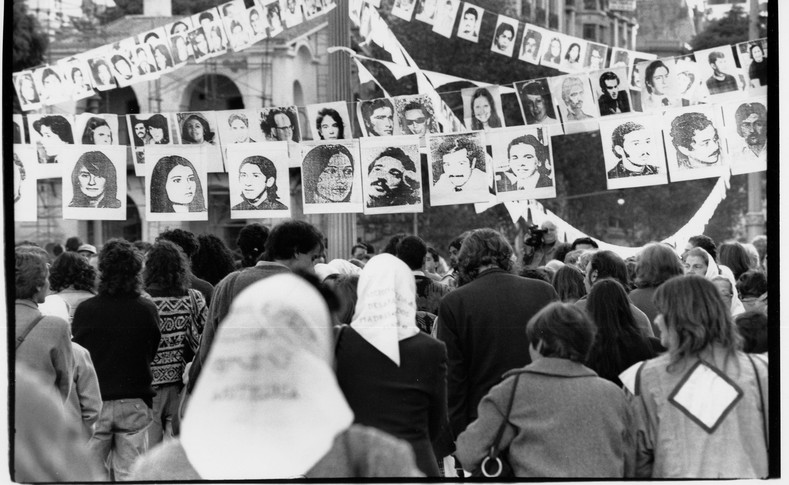
Photographs of the disappeared in Argentina. Photo:Colección AGRA, Archivo Memoria Activa
After the sentencing of several of the military officials, Chilean journalist and diplomat Odette Magnet said “justice was achieved, but we need the truth,” referring to her sister Maria Cecilia Magnet who was disappeared during the dictatorship in the country.
The journalist explained that for 40 years she has played an active role in seeking the truth about repression during the military dictatorships in Latin America.
“I want to know where they are, where (the death squads) threw them, where all the victims of this macabre plan are,” Magnet said. Officials from the dictatorships across Latin America would often throw victims out of helicopters and airplanes into the ocean.
“Nobody knows what really happened to our people, we have no information because the murderers do not speak, they will not talk and that is very frustrating because we have the facts,” Magnet concluded.
RELATED:
Featured Video

John Mearsheimer: The Case for a Nuclear Iran
or go to
Aletho News Archives – Video-Images
From the Archives
Ethnic Cleansing in a Zionist Fairyland
By Vacy Vlazna | Palestine Chronicle | February 10, 2012
‘De-Arabizing the history of Palestine is another crucial element of the ethnic cleansing. 1500 years of Arab and Muslim rule and culture in Palestine are trivialized, evidence of its existence is being destroyed and all this is done to make the absurd connection between the ancient Hebrew civilization and today’s Israel. The most glaring example of this today is in Silwan, (Wadi Hilwe) a town adjacent to the Old City of Jerusalem with some 50,000 residents. Israel is expelling families from Silwan and destroying their homes because it claims that king David built a city there some 3000 years ago. Thousands of families will be made homeless so that Israel can build a park to commemorate a king that may or may not have lived 3000 years ago. Not a shred of historical evidence exists that can prove King David ever lived yet Palestinian men, women, children and the elderly along with their schools and mosques, churches and ancient cemeteries and any evidence of their existence must be destroyed and then denied so that Zionist claims to exclusive rights to the land may be substantiated.’ — Miko Peled, Israeli dissident.
Indeed, archaeology has become a state apparatus for the ethnic cleansing of Palestinians in the Zionist fairyland aka the City of David Archaeological Park located in the Palestinian village of Silwan in East Jerusalem.
East Jerusalem is the proclaimed capital of the proposed Palestine state. It was illegally annexed by Israel in the 1967 war. Prohibiting annexation of territories gained by military conquest is one of the major principles of international law. The international community does not recognise Israel’s annexation of East Jerusalem nevertheless over 50,000 illegal premises have been built for 250,000 illegal Israeli colonists.
The goal of the archaeological judaisation of Jerusalem is to transform Jerusalem into the City of David, the capital of Greater Israel by eradicating the mixed ethnic composition of the Palestinian and Jewish population of East Jerusalem to a solely Jewish identity and unifying East and West Jerusalem under Israeli sovereignty. … continue
Blog Roll
 Aletho News
- Daniel Davis: China & Russia Will Defend Iran
- The US’ self-directed ‘China nuclear threat’ will only be a waste of effort: Global Times editorial
- Female Iranian academic sentenced to 4 years in prison in France over protesting Israel’s genocide in Gaza
- US university cancels Palestine conference citing sanctions concerns
- Senate Majority Leader: Any War with Iran Should Result in Regime Change
- Iraqi Resistance warns of action if US forces remain
- China, Russia slam US threat, force against Iran ahead of talks
- US fears Iran war will ‘deplete’ air defenses stretched thin by Ukraine, Israel: Report
- Top AIs deploy nukes in 95% of war game simulations – study
- Could Hungary’s fight over oil change course of Ukraine War?
- If Americans Knew
- Israel warns of a Ramadan escalation — while doing everything to provoke one
- Democrats Should Release Their 2024 Election Autopsy – and Stop the Gaza Denial
- Israel responsible for 2/3 of press killings worldwide – Not a ceasefire Day 139
- Are the Jews indigenous to Palestine?
- AIPAC Wants to Kill a Bill that would Ensure Israel Complies with Ceasefire
- Former Israeli PM, in Epstein Files, Dreamed of Israeli Eugenics and Pretty Converts
- Israeli settlers join ‘safari’ tour of Palestinian prisoners
- Flooding in Gaza amid rumors of war; fire in West Bank – Not a ceasefire Day 138
- Fourteen Countries Condemn Huckabee’s Support for Israel Taking Over Most of the Middle East
- Israeli Soldiers Killed Gaza Aid Workers at Point Blank Range in 2025 Massacre: Report
- No Tricks Zone
- Surprising Discovery: Sahara Is Greening…Billions Of Trees Where Once Thought To Be Barren
- New Research Reaffirms Clouds, Aerosols, And Surface Solar Radiation Are ‘Driving The Climate System’
- Germany: Electric Car Catches Fire At Charging Station, Sets Off Local “Inferno”, Widespread Damage
- New Study: Canada’s New Brunswick Was 1°C Warmer Than Today During The Medieval Warm Period
- Coal Power Back In Trend As Globe Tries To Keep Pace With Growing Demand For Power
- New Study: A 4°C Warmer Beaufort Sea Had ‘No Sea Ice’ 11,700 – 8200 Years Ago
- Unfudging The Data: Dutch Meteorological Institute Reinstates Early 20th Centruy Heat Waves It Had Erased Earlier
- German Gas Crisis…Chancellor Merz Allegedly Bans Gas Debate Ahead of Elections!
- Pollen Reconstructions Show The Last Glacial’s Warming Events Were Global, 10x Greater Than Modern
- Germany’s Natural Gas Storage Level Dwindles To Just 28%… Increasingly Critical
 Aletho News