US Claims Anti-Missile Site in Poland There to Prevent Middle East Threats
Sputnik — 11.05.2016
The US anti-missile base due to be built in the Polish town of Redzikowo does not threaten Russia’s security, as the base is aimed at preventing missile threats from the Middle East, US Ambassador to Poland Paul Jones said Wednesday.
The start of construction of the military base in Poland, which is part of an US-designed ballistic missile defense system in Europe, is scheduled for May 13. The construction of the base is expected to be completed by 2018.
Speaking with the Polish Radio broadcaster, Jones assured that this defensive facility was designed to prevent the threats from the Middle East and not to threaten Russia’s security and that Moscow was aware of that. However, the United States is fully ready for different scenarios, the ambassador noted.
Russia has repeatedly expressed concern over the creation of the ballistic missile defense system in Europe, approved in 2010 during a NATO summit in Lisbon. A group of European countries, including Poland, Romania, Spain and Turkey, agreed to deploy elements of the system on their territories.
The United States and NATO continue to claim that the ballistic missile defense system is aimed primarily at countering threats from Iran and North Korea.
Polish MPs approve ‘technical agreement’ on US anti-missile base
RT | September 25, 2015
Poland’s lower house of parliament has given the green light to the country’s president to ratify a technical agreement on establishing a US anti-missile base in Redzikowo. Under the NATO-backed plan, the facility should be operational by 2018.
A total of 422 members of the Polish Sejm voted in favor of the bill, with three MPs against and five abstaining.
The agreement in question is a part of a much-debated NATO-backed plan that was first agreed on by the US and Poland in 2008. At that time, it was claimed that the base was necessary to counter the risk of a possible missile attack from Iran or North Korea.
The document outlines technical conditions for the US anti-missile base’s operation on Polish soil, such as restrictions on the height of the buildings that can be built around the base, the use of devices emitting electromagnetic waves, and flights of military aircraft over and around the future facility.
Washington wants to expand the European anti-missile defense (AMD) by putting land- and sea-based radar and interceptors in the village of Redzikowo near the northern Polish town of Slupsk.
The same agreement to host anti-missile bases for of AMD has already been signed with Romania.
The deal stipulates that both countries will host some 24 vertical-launch SM-3 missiles each. The construction of AMD components in Poland is set to start next year and be completed by 2018.
Washington’s plans to install anti-missile systems in Eastern Europe have been one of the biggest stumbling blocks in US-Russia relations.
In 2009, a year after Warsaw and Washington signed the agreement, President Barack Obama assured that the deal would be canceled if the issue with Iran over its nuclear program was sorted out.
However, despite the agreement with Tehran, which curbed its controversial nuclear program in exchange for the easing of international sanctions, the NATO-backed Europe AMD plan is set to go forward.
“The deal with Tehran doesn’t include missiles, therefore the threat remains,” John A. Heffern, US Deputy Secretary of State for Europe and Eurasia, told the Polish Rzeczpospolita newspaper in July.
The Polish government has repeatedly requested that NATO establish military bases in the country, claiming that it is necessary to counter what it calls “a Russian threat.”
Since Crimea’s reunion with Russia in March 2014 and the start of the military conflict in eastern Ukraine last spring, NATO forces have significantly stepped up their military exercises along the Russian border, and frequently carried out drills in the Baltic States and Eastern Europe.
New US Military Base to be Built in Poland
Sputnik – 07.08.2015
A US armored forces base is slated to be built in the center of Poland, the Polish newspaper Rzeczpospolita reports.
According to the media outlet, the base is planned to be stationed in Mazovia Province, in the city of Ciechanow.
The newspaper acquired a letter written by the country’s Deputy Defense Minister, Beata Oczkowicz, to City Mayor Krzysztof Kosinski. The document explains that the base will be used for the needs of the Polish and US Armed Forces.
On July 15, a deal between Poland and the US on the agreed facilities and zones came into force, according to the letter. The document was aimed at bolstering military cooperation between the two countries, including the joint use of property.
In June, the US confirmed it planned to deploy heavy weapons in several Eastern European countries.
Poland Denies Asylum to Ethnic Kin in War-Torn Ukraine
Sputnik – 15.07.2015
An asylum request from a group of ethnic Poles living in Ukraine’s war-ravaged Donbass has been turned down by Warsaw, a Ukrainian newspaper wrote on Wednesday.
Fifty ethnic Poles from the eastern Ukrainian city of Mariupol received a flat “no” from the Polish government, the Kiev-based Evropeiska Pravda newspaper wrote, quoting Freedom and Democracy Foundation chairman Michal Dworczik.
The Polish Foreign Ministry said the January evacuation of nearly 200 ethnic Poles from war zone in Donbass was a one-off measure and that there was no fighting going on in Mariupol.
“Mariupol is located in direct vicinity of the frontlines and everything will depend on what happens next… If the hostilities intensify and spread to new areas groups of local ethnic Poles may try to flee and find refuge in Poland,” Dvorczik said in an interview with Radio Poland.
In January, Polish Foreign Minister Grzegorz Schetyna did not rule out an additional evacuation of ethnic Poles from eastern Ukraine if the worsening situation there put their lives in danger.
Punishing Poland for US Crimes

By Nat Parry · Essential Opinion · May 19, 2015
It is one of the great ironies of the U.S.-led war on terror and post-Cold War transatlantic relations that democratic accountability and human rights protections at times seem stronger in the former Soviet bloc than they do in the United States. This lesson was driven home again last week when Poland paid a quarter of a million dollars to two terror suspects tortured by the CIA in a secret prison on Polish territory between 2002 and 2003.
Imposed by the European Court of Human Rights, the penalty issued against Poland prompted outrage among many Poles who felt they were being unfairly punished for American wrongdoing. “We might have to pay compensation even though our personnel did nothing wrong,” said Radoslaw Sikorski, Poland’s former foreign minister. Sikorski noted that Poland is the only country that has sought to hold accountable its own senior officials whose decisions allowed the CIA to commit human rights violations on its territory.
This lack of accountability also goes for the United States, which has failed to investigate or prosecute any of the senior officials who authorized the human rights violations at secret CIA prisons in Poland or anywhere else.
Of the 119 known detainees held in CIA black sites between 2001 and 2006, at least 39 were subjected to torture by CIA personnel, according to the U.S. Senate Intelligence Committee report on torture released last December. The two individuals tortured in Poland, Abu Zubaydah and Abd al-Rahim al-Nashiri, were eventually sent to Guantanamo Bay, where they have remained since 2006.
While al-Nashiri is currently on trial for allegedly orchestrating the 2000 bombing of the USS Cole, Abu Zubaydah is considered one of Guantanamo’s “forever prisoners,” with no charges or trial foreseen. Not even a preliminary ruling has been made on his case in nearly seven years. In a May 12, 2015 article, ProPublica noted that his case has been stalled “for 2,477 days and counting.”
As one of his lawyers, Helen Duffy, wrote in the Guardian last December following the long-delayed release of the Senate report’s executive summary, “Abu Zubaydah might now be described as exhibit A” in the CIA’s rendition and torture regime.
“He has the regrettable distinction of being the first victim of the CIA detention programme for whom, as the report makes clear, many of the torture (or ‘enhanced interrogation’) techniques were developed, and the only prisoner known to have been subject to all of them,” Duffy wrote.
The Senate report contains about 1,000 references to Abu Zubaydah specifically, and confirms the ECHR’s findings regarding the interrogation techniques that he endured.
Among these were “wallings” (being slammed repeatedly against a wall), sleep deprivation for up to 180 hours (usually nude and in stress positions), and waterboarding. The waterboarding of Abu Zubaydah, to which he was subjected 83 times in one month alone, was authorized at the highest levels of the U.S. government.
He was also subjected to extreme confinement.
“Over the course of the entire 20 day ‘aggressive phase of interrogation,’ Abu Zubaydah spent a total of 266 hours (11 days, 2 hours) in the large (coffin size) confinement box and 29 hours in a small confinement box, which had a width of 21 inches, a depth of 2.5 feet, and a height of 2.5 feet,” according to the Senate report. “The CIA interrogators told Abu Zubaydah that the only way he would leave the facility was in the coffin-shaped confinement box.”
Duffy notes that beyond Abu Zubaydah’s torture, the Senate report revealed how much misinformation was generated to justify his indefinite detention. Several of the CIA’s claims, in some cases reiterated long after they were known to be false, were repudiated point by point in the report.
For example, despite repeated assertions that Abu Zubaydah was “the third or fourth man in al-Qaida,” the report noted that the “CIA later concluded that Abu Zubaydah was not a member of al-Qaida.” It also refuted the government’s claims regarding his involvement in 9/11, that the interrogating team was “certain he was withholding information” and claims that his torture led to valuable actionable intelligence.
The case of Abu Zubaydah also led to the only prosecution to date in the United States associated with the CIA’s torture program – although not for anyone who was involved with his ill-treatment, but for the CIA whistleblower who first exposed it.
Selective Prosecution
In a 2007 interview with ABC News, former CIA officer John Kiriakou described the waterboarding of Abu Zubaydah and later allegedly provided to a journalist the name of a covert officer with the CIA’s Counterterrorism Center who worked on the operation to capture and interrogate Abu Zubaydah. For this offense, Kiriakou was charged under the 1917 Espionage Act and accepted a plea bargain for which he spent two years in prison.
The prosecution of Kiriakou was criticized at the time by some segments of the international community. The Parliamentary Assembly of the Organization for Security and Cooperation in Europe, for example, in a resolution adopted in 2012 “condemned the prosecution that U.S. authorities have initiated against former CIA agent John Kiriakou, who is accused of providing journalists details regarding the capture of Abu Zubaydah, an al-Qaeda suspect who is said to have been tortured in a secret CIA prison in Poland and is one of two individuals granted ‘victim status’ by prosecutors in Warsaw.”
Former U.S. Congressman Jim Moran (D-VA) said on the House floor on Nov. 17, 2012 that the government’s targeting of Kirakou represented a “selective prosecution.” He asked President Barack Obama to pardon Kiriakou and called the 15-year CIA veteran “an American hero.”
With Kiriakou out of prison after serving his term but the CIA’s torture victims still languishing in Gitmo with no end in sight, Poland has faced not only the political fallout for these policies but also the practical challenges of complying with the ECHR’s rulings considering the logistics of compensating individuals who are incarcerated – one a Palestinian and one a Saudi.
Nevertheless, “Poland is applying the ECHR’s decisions,” foreign ministry spokesman Marcin Wojciechowski said. “In the case of one person, the money was paid into a bank account indicated by his lawyers, in the case of the other, hit by international sanctions, we requested the creation of a judicial deposit,” he added.
In accordance with the ECHR ruling, Poland has also asked the United States to rule out the death penalty for the two men in line with an EU-wide ban on capital punishment, Wojciechowski told AFP.
Plausible Deniability
It irks many in Poland that their country is facing legal repercussions for the secret rendition and detention program which the CIA operated under then-President George W. Bush in several countries across the world after the 9/11 attacks. In Poland, the notion that the former Communist country would tolerate a secret CIA prison in which torture was being used was for years derided by the country’s politicians, journalists and the public as a crackpot conspiracy theory. Polish officials consistently denied the existence of any such prison.
But a string of revelations and political statements by Polish leaders acknowledged for the first time that the United States did indeed run a secret interrogation facility for terror suspects in 2002 and 2003 in a remote region of the country. In December 2014, Poland’s former President Aleksander Kwaśniewski officially admitted that a secret CIA prison had existed at an airbase where terror suspects were brought for interrogation, but he insisted that Warsaw had no knowledge of abuse happening at the site.
It appears now though that the denials of knowledge regarding torture may have been a case of willful ignorance or plausible deniability enforced by millions of dollars in cash payoffs. The Senate torture report revealed that despite initial threats by Poland to halt the transfer of terror suspects to the black site 11 years ago, the government became more “flexible” after the CIA started giving it large amounts of money. Reportedly, the CIA paid Polish officials as much as $50 million in cash to look the other way.
But according to Radoslaw Sikorski, Poland’s former foreign minister and now marshal of the lower house of the Parliament, the prison was set up out of friendship with the United States. He now concedes however that the covert relationship has proved detrimental to Poland.
“We have been embarrassed by it, but even so we do not apologize for having the closest possible security and intelligence relationship with the United States,” he said. “We might have to pay compensation even though our personnel did nothing wrong. You can imagine how Polish people feel about it.”
“This left bad feelings on our side,” said Tadeusz Chabiera, founder of the Euro-Atlantic Association think tank in Warsaw. “We are a small country that was badly treated by a great power.”
The regrets and feelings of betrayal being expressed in Poland follow a long-established pattern that goes back at least a decade. Signs of this frustration first emerged in 2004 during the U.S.-led occupation of Iraq, to which Poland committed 2,400 troops.
At the height of the Iraqi insurgency, David Ost reported in The Nation magazine on Sept. 16, 2004, “George W. Bush has managed to do what forty-five years of Communist rule could not: puncture the image of essential American goodness that has always been the United States’ key selling point.”
America’s Eroding Image
In Poland, as in many countries around the world, much of that positive image was restored following the election in 2008 of Barack Obama and the promise of change that he seemed to represent. But as the Pew Research Center reported in 2013, “pro-America sentiment is slipping.”
“The decline is in no way comparable to the collapse of U.S. standing in the first decade of this century,” according to Pew, which noted that at the time of the 2013 global survey, more than six-in-ten in Poland, France, Italy, and Spain had a favorable opinion of the U.S. “But the ‘Obama bounce’ in the global stature of the United States experienced in 2009 is clearly a thing of the past.”
It remains to be seen whether the recent developments on CIA torture will play any significant role in further eroding the image of the United States, but the incongruity of a small country like Poland bearing the brunt of liability for these illegal policies while no one in the United States answers for them should not be lost on any of the U.S.’s other allies.
In some of the countries that cooperated with the U.S. rendition program, the wheels of justice are still spinning, albeit slowly.
A criminal investigation is ongoing in Lithuania, where prosecutors are focusing on a possible illegal border crossing involving CIA prisoner Mustafa al-Hawsawi who was allegedly tortured at a Lithunian black site code-named Violet.
Meanwhile, calls are growing for authorities to conduct a comprehensive investigation into the existence of a CIA black site in Romania, with former Romanian President Ion Iliescu revealing last month that he had approved CIA requests to set up at least one secret prison where prisoners were subject to torture. Iliescu said he deeply regrets that decision.
Calls also continue for the United States to launch credible investigations into its own role, and to offer reparations to the victims of the rendition and torture program.
Coincidentally, the ECHR’s penalty against Poland was imposed the same week that the U.S. was urged by the United Nations to financially compensate victims of the U.S. torture regime and to prosecute the perpetrators of this abuse.
According to a report by the UN Human Rights Council’s Working Group on the Universal Periodic Review, issued on May 15, the U.S. should “ensure that all victims of torture and ill-treatment – whether still in U.S. custody or not – obtain redress and have an enforceable right to fair and adequate compensation and as full rehabilitation as possible, including medical and psychological assistance.”
Further, the U.S. should “ensure proper and transparent investigation and prosecution of individuals responsible for all allegations of torture and ill treatment, including those documented in the unclassified Senate summary on CIA activities published in 2014 and provide redress to victims.”
With a September deadline to respond to the UN’s recommendations, the Obama administration will have to make a stated commitment to the world by deciding which of the recommendations will be accepted, and which will be rejected.
When it comes to torture prosecutions and compensation, it is safe to say that the world will be watching.
EU Parliament Drafts New Anti-Russian Resolution Calling for More Sanctions
Sputnik – 06.05.2015
A proposed declarative resolution by a group of MEPs has called on the European Union to step up sanctions against Russia, provide Ukraine with weaponry and further strengthen NATO forces in Eastern Europe, should Russia refuse to return Crimea to Ukraine or fail to abide by the Minsk ceasefire, a press statement for the body stated Tuesday.
The aggressively worded document, drafted Monday and liaised by Romanian MEP Ioan Pascu for the parliament’s Committee on Foreign Affairs, warns that increased Russian military presence in Crimea necessitates EU nations to strengthen their military capabilities, stating that NATO must give its East European members a “strong strategic reassurance.”
Commenting on the proposed resolution, Pascu suggested to the EU’s news service that the strengthening of Russian defense capabilities in Crimea is “in practice creating another launching pad, of the proportions of Kaliningrad, this time in the Black Sea.” The MEP threatened that “in one year the defensive force which existed there has been transformed into a strike force… with which Russia can threaten Central Europe, the Balkans, Southern Europe and also [the] Eastern Mediterranean and even the Middle East.”
Supported by MEPs from Lithuania, Estonia, Poland and Spain, the belicose resolution, pending Foreign Affairs Committee approval, also accuses Russian authorities of mistreating the Crimean Tatars. Furthermore, it suggests that Russia may next move to cut off Ukraine from the Black Sea entirely by annexing its coastal territories. Pending approval, the belligerent document will face a vote at the parliament’s upcoming session in June, asking “EU member states to speak with one united voice,” regarding “EU relations with Russia.”
Poland approves joint force with Ukraine & Lithuania, calls on EU to spend more on defense
RT | May 4, 2015
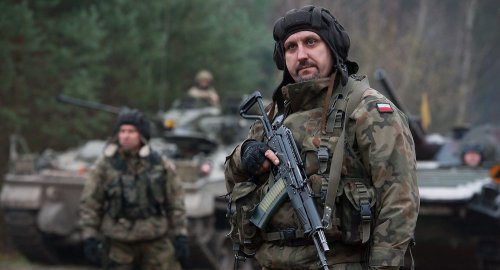
Poland’s President Bronislaw Komorowski has signed a resolution approving the organization of a joint Lithuanian-Polish-Ukrainian brigade, whose creation has been in the works since 2007.
When brought to full operation in 2017, the brigade is set to constitute 4,500 servicemen. They will operate separately from the three countries’ respective militaries, but will take part in NATO exercises and missions. Preliminary drills are scheduled for later this year. The brigade will be stationed at its headquarters in Libulin, Poland. So far, it only houses 250 servicemen and 50 command staff contributed by the Polish military.
The joint force was discussed as far back as 2007, but the agreement to create it was signed by the three countries’ defense ministers in September 2014, in response to the Ukrainian crisis and what they call Russian aggression.
Creating the joint force is “part of a wider plan … to support Ukraine, among others, in the area of modernization,” President Bronislaw Komorowski said as cited by Reuters.
He also urged other European countries to spend more on defense. To that end, President Komorowski has suggested excluding defense spending from EU rules on budget deficit limits. This means that EU nations will be able to allocate more money to the military without fearing increased budget controls from Brussels. Komorowki’s offer comes at a time of heightened tensions with Russia.
Poland now has the fifth-strongest army in the EU, and has ambitious plans to modernize it, spending about $36 billion until 2022. However, the Polish government is unhappy about a lack of similar eagerness in some of the other European nations, the Rzeczpospolita newspaper reports.
While NATO is advising its member states to spend the maximum allowed of three percent of GDP on defense, most are spending far less: Germany allocates 1.2 percent of its GDP, the Netherlands 1.3 percent and Spain under 1 percent. France is the only Western European country that is boosting defense spending. However, some Eastern European nations are increasing their military expenses citing what they call Russian aggression. Lithuania, for instance, wants to allocate twice as much on defense as last year.
US, Poland behind Kiev Maidan unrest: Polish MEP

Janusz Korwin-Mikke , European lawmaker and leader of Poland’s conservative party
Press TV – April 19, 2015
The violent pro-EU protests staged in Ukraine’s Maidan Square last year were organized by the CIA spy agency and Polish figures, a European lawmaker and leader of Poland’s conservative KORWiN party says.
Janusz Korwin-Mikke made the remarks in an interview with Polish media, the Russia-based Sputnik news agency reported on Saturday.
In mid-February 2014, dozens of people were killed by gunmen during street battles in the center of the Ukrainian capital, Kiev. Pro-EU protesters had staged sit-ins at the Maidan Square since November 2013 to protest against then President Viktor Yanukovych’s refusal to sign an Association Agreement with Brussels in favor of closer ties with Russia.
Korwin-Mikke said that the snipers in Kiev had also been trained in Poland, adding the “terrorists shot dead 40 demonstrators and 20 police officers to provoke unrest and the truth about this is finally coming out.”

This file photo shows the Maidan Square in Kiev, Ukraine, which was destroyed by violence during protests in February 2014.
The Polish politician also pointed to the admission by US Assistant Secretary of State for European and Eurasian Affairs Victoria Nuland that Washington had spent billions of dollars to destabilize Ukraine.
“Victoria Nuland openly admitted that he Americans had spent $5 billion to destabilize the situation in Ukraine, and what we now have in Ukraine is an American aggression with (Russian President Vladimir) Putin bearing the brunt of it all,” said Korwin-Mikke.
Days after the deadly shootings in Kiev, Yanukovych was ousted on February 22, 2014, by Western-backed groups. The ouster triggered in its turn pro-Russia protests in the country’s southern and eastern regions.
In a bid to crush the pro-Russia protests, Kiev launched military operations in mid-April last year, causing deadly clashes in the country’s two mainly Russian-speaking regions of Donetsk and Lugansk in eastern Ukraine.
The warring sides inked a ceasefire agreement in the Belarusian capital, Minsk, in February. Since then, both sides have, on numerous occasions, accused each other of breaking the truce.
The fighting has taken a heavy toll on thousands of people. More than 6,100 people have died, while nearly 15,500 have been injured in the conflict, the United Nations says.
European Court confirms Polish complicity in CIA rendition and torture
Reprieve | February 17, 2015
The European Court of Human Rights (ECHR) has today confirmed its judgement that Poland actively assisted the CIA’s European “black site” programme, which saw detainees held and tortured in secret prisons across the Continent.
In July 2014, the ECHR had ruled that Poland “facilitated” the torture, secret detention and unlawful transfer of Abu Zubaydah, who is now held in Guantanamo Bay.
Mr Zubaydah was flown from a secret site in Thailand to another CIA prison in Stare Kiejkuty in northern Poland, where he was detained and tortured during 2002 and 2003. The Senate Select Committee on Intelligence (SSCI) detailed in its recent report how Mr Zubaydah was subjected to torture numerous times by the CIA, before the Agency concluded that he was not a member of al Qaeda at all.
Today’s ruling by the ECHR confirms its 2014 judgement and rejects a request by Poland to refer it to its Grand Chamber for potential reconsideration.
The 2014 judgment described the evidence that Mr Zubaydah was detained in Poland as “coherent, clear and categorical,” and ruled that it was “inconceivable” that Poland was unaware of his mistreatment. It concluded that “Poland, for all practical purposes, facilitated the whole process, created the conditions for it to happen and made no attempt to prevent it from occurring.”
Kat Craig, legal director at human rights charity Reprieve, said: “The Court’s decision today is a crucial step forward for justice and accountability over the European role in the US torture programme. Poland’s attempts to avoid responsibility were rightly refused – it’s now time for the Polish authorities to admit their complicity in renditions, take their investigations seriously, and come clean about how they allowed these abuses on Polish soil.”
Poland to spend $42 billion on military buildup
Press TV – February 15, 2015
Poland, a NATO member, has launched an unprecedented multi-billion military spending spree amid tensions between the Western military alliance and Russia over the crisis in Ukraine.
Warsaw has reportedly earmarked 33.6 billion euros (USD 42 billion) to upgrade its military equipment over a decade, including a missile shield and anti-aircraft systems as well as combat drones.
The largest purchase is seventy multi-role helicopters worth 2.5 billion euros, while the Eastern European NATO member also plans to buy armored personnel carriers, submarines and cruise missiles.
The cruise missiles would reportedly enable the Polish air force to attack targets in Russia without having to leave their own airspace.
Polish Defense Minister Tomasz Siemoniak has said that the military boost is a reaction to the crisis in neighboring Ukraine, which he has described as the biggest security threat to Europe since the end of the Cold War.
NATO expansion in Eastern Europe
The move also comes as NATO is planning to expand its military presence in Eastern Europe amid the Ukraine crisis.
The defense ministers of NATO’s 28 member states agreed on February 5 to establish six new command and control posts in the Eastern European nations of Estonia, Latvia, Lithuania, Poland, Bulgaria and Romania.
NATO also decided to set up a new headquarters in western Poland to support northeastern member states as well as a similar site in Romania for members in southeastern Europe.
The military alliance has over the past year increased its presence and conducted several exercises in Eastern Europe amid the crisis in Ukraine. In 2014, NATO forces held some 200 military exercises and the alliance’s General Secretary Jens Stoltenberg has promised that such drills would continue.
Moscow has repeatedly condemned NATO’s exercises and military buildup toward its borders.
Last week, Russian Foreign Minister Sergei Lavrov said NATO’s move provokes confrontation and undermines European security.
Russia’s Chief of the General Staff of the Armed Forces Valery Gerasimov announced last month that Moscow plans to boost its military capabilities in the Crimean peninsula, the Arctic and the westernmost Kaliningrad region, amid NATO build-up in Eastern Europe.
NATO-Russia relations
Relations between Russia and NATO strained after Ukraine’s Crimea re-integrated into the Russian Federation following a referendum on March 16, 2014. The military alliance ended all practical cooperation with Russia over the ensuing crisis in Ukraine last April.
Russia approved last December an updated version of the country’s military doctrine which considers NATO military buildup as a major foreign threat against its national security.
The United States and its European allies accuse the Kremlin of destabilizing Ukraine and have imposed a number of sanctions against Russian and pro-Moscow figures. Russia, however, rejects the accusation and has retaliated with sanctions of its own.
Featured Video

More Iran War fallout: Maritime insurance industry shifts from London to China
or go to
Aletho News Archives – Video-Images
From the Archives
Allies Don’t Need Lobbies
By Jay Knott | Dissident Voice | September 24, 2013
In a recent article on Counterpunch, Rob Urie defended the traditional Marxist analysis of US policy in the Middle East. He argues that support for Israel is driven primarily by economic interest, not the Jewish lobby.
He starts by paying tribute to the idea that Western societies are uniquely racist. He says that the “Western narrative” claims there is an “Arab character”, and that this is “antique racist blather”. He gives no definition of these terms. Further, he establishes his credentials as part of the dominant current in the American left by claiming that “over a million people in Iraq died so ‘we’ in the West can drive SUVs.”1
When he tries to criticize bourgeois economics, he makes it clear he doesn’t understand the developments it has made since Marx’s day, using the mathematical discipline known as “game theory”. He dismisses the basic abstraction of economic theory, the idea of the rational individual, on the grounds that it is “devoid of history, culture and political context”. But abstractions are always devoid of something.
He defends a more concrete economic theory, mostly Marxist, with some input from another theorist of capitalist crisis, Hyman Minsky. This concrete theory leads him to the view that US activity in the Middle East is primarily driven by rational capitalist motives, the need to secure a supply of oil.
“Taking the totality of circumstance — former oil company executives launching war on an oil rich nation on a pretext they publicly proclaimed they didn’t believe shortly before taking office — and that upon launching their war proved to be non-existent, requires a willingness to overlook the obvious — that the war on Iraq was for oil, that is difficult to support.”1
Perhaps I’ve misunderstood him, but based on what he says in the rest of the article, this convoluted sentence seems to argue that, because president Bush and vice-president Cheney attacked Iraq on false premises, and they also said it was all about oil, and they are former oil executives, and Iraq has a lot of oil, it’s difficult to deny US attacks on Iraq are all about oil.
In fact, it’s not hard at all. As Urie points out, at times Bush and co. said that attacking Iraq was “protecting the world’s supply of oil.”1 But, as he also points out, they are congenital liars. Why should we believe them when they say they are trying to “protect” the oil supply? Protect it against what? When politicians “admit” attacks on Middle Eastern countries are wars for oil, they are parroting the neo-con party line, feeding the public, both left and right, with a plausible-sounding pretext. For right-wingers, “it’s a war for oil” is a reason to support war, and for leftists, it’s a way to feel better by complaining impotently about corporate greed. Both approaches help the war drive. … continue
Blog Roll
 Aletho News
- More Iran War fallout: Maritime insurance industry shifts from London to China
- US-Israeli aggression on Iran triggers review of GCC countries’ investment pledges to Washington
- Russia slams UK plan to seize tankers suspected of carrying its oil
- Pakistan ramps up food exports to Persian Gulf nations as war deepens food insecurity
- Iran submits response to US plan, sets terms for war’s end: Tasnim
- US vs Iran: Kharg Island Talk — Bluff or Escalation? Ex-Military Officer Weighs In
- Zelensky unnecessarily involves Ukraine in the Middle East crisis
- Turkish tanker blacklisted by Ukraine hit in drone attack – media
- Canada, the U.S., and NATO: the inescapable trap
- Villains of Judea: Leonid Radvinsky
- If Americans Knew
- ‘No Innocent Children’: Far-right Israeli Lawmaker Defends Killing of Palestinian Family
- Mossad’s promises helped Netanyahu convince Trump that Iran could be toppled
- US Arms Control Official Refuses To Comment When Asked If Israel Has Nuclear Weapons
- Veterans warn US landing could be ‘more Gallipoli than Vietnam’
- Israel may be committing war crimes in Lebanon – Not a ceasefire Day 167
- In the West Bank, life is a constant battle – 3 articles
- Jacob Reses, one of the most powerful pro-Israel operatives in Trump’s Washington
- Israeli-US assaults kill or injure 87 children a day – Not a ceasefire Day 166
- ‘Forever live by the sword’: Understanding Israelis’ massive support for Iran war
- UN’s special rapporteur on human rights says Israel is systematically torturing Palestinians
- No Tricks Zone
- Devastating Assessment Of Comirnaty Vaccine By Former Senior Pfizer Europe Toxicologist
- New Study: CO2 Is ‘Effectively Negligible’ As An Explanatory Climate Change Factor Since 2000
- Former Pfizer Toxicologist Dr. Helmut Sterz Tells Bundestag Hearing Pfizer Vaccine Should Have Never Been Approved
- Energy Expert: Germany’s Nuclear Phaseout Was A “500 Billion Euro Mistake”
- New Research: South Australia’s Mid-Holocene Sea Surface Temperatures Were 4°C Warmer Than Today
- Storing Green Energy To Last Germany 10 Days Would Require A 60-Million Tonne Battery
- New Studies: UK Sea Levels Were 4 Meters Higher Than Today During The Mid-Holocene
- Destructive Green New Deal: German Energy And Metal Group Warns Of Drastic Crisis
- New Study Documents A 20-Year Pause In Arctic Sea Ice Decline – Driven By Internal Variability
- Wake-up Call: Survey Shows Majority Of Germans Now Favor Postponing Climate Targets!
 Aletho News