A Rough Diplomatic Week for Ukraine
By Ted Snider | The Libertarian Institute | September 27, 2023
In the early weeks of the war, a peace was still possible that would have seen Ukraine lose few lives and little to no land. Even the Donbas would have remained in Ukraine with autonomy under a still possible Minsk agreement. Only Crimea would have remained lost.
A year and a half later, Ukraine’s daily loss of life is horrific and Russia is determined to hold not only Crimea and the Donbas, but Kherson and Zaporizhzhia.
But while Ukraine has struggled on the battlefield, it has sustained its diplomatic support. But this week, that too showed strains. Ukraine had a difficult week with both the aligned and the nonaligned.
A year ago, Ukrainian President Volodymyr Zelensky addressed an enthusiastically supportive U.S. Congress live and a warm General Assembly via video. A year later, perhaps for fear of a different tone, Zelensky will meet privately with U.S. officials instead of publicly with a televised address to Congress.
In a perhaps even more worrisome sign for Ukraine, when Zelensky’s turn came to speak to the General Assembly on September 19, “he delivered his address,” The Washington Post reported, “to a half-full house, with many delegations declining to appear and listen to what he had to say.” Many countries have refused to condemn Russia or join the U.S.-led sanctions on Russia, but refusing to attend the General Assembly session and listen to Zelensky may be sending a strong signal.
And that was not the only signal. The Post further reports that “leaders from some developing nations are increasingly frustrated that the effort to support Ukraine is taking away, they say, from their own struggles to drum up enough money to adapt to a warming world, confront poverty and ensure a more secure life for their citizens.” The nonaligned global majority has all along seen the war as yet another proxy war between NATO and Russia that distracts from the problems that are most urgent to the world.
But Ukraine’s diplomatic worries come not just from the nonaligned countries but from the aligned ones. Poland has been, perhaps, Ukraine’s strongest supporter. It has been one of the biggest suppliers of weapons—and the central hub through which other NATO countries have sent their weapons to Ukraine—and the spearhead for sending tanks and more advanced weaponry. It has given Ukraine about a third of its own weapons valued at over $4 billion. And it has been a force behind the push for NATO membership for Ukraine.
But disagreement over the export of Ukrainian grain has shown how fragile that fraternity really is. Though united over a common animosity toward Russia, there are old strains in the Polish-Ukrainian relationship. Poland has been bothered by what they perceive as Ukraine’s continued glorification of their anti-Polish nationalist past. In January, a Polish official reminded Ukraine that they “continue to glorify” Ukrainian nationalist leader Stepan Bandera, who was “responsible for the genocide of Poles in 1943-44, when UPA troops horribly killed about 100,000 Polish citizens.” The Polish parliament has adopted a resolution that includes “recognition of guilt” by Ukraine for the genocide as a condition for “Polish-Ukrainian reconciliation.”
But the strain has recently torn over the issue of grain imports. Ukraine has complained about the betrayal of Polish restrictions on the import of Ukrainian grain to protect Polish farmers and markets. In August, echoing recent U.S. and U.K. statements, Marcin Przydacz, head of the Polish President’s Office of International Affairs, said that Ukraine should be “more grateful.” He took to Polish television to harshly scold that Kiev “should start to appreciate the role that Poland has played for Ukraine in the past months and years.” In angry response, Kiev called the Polish ambassador to Ukraine into the Ministry of Foreign Affairs. Furiously, Polish Prime Minister Mateusz Morawiecki shot back that, “The summoning of the Polish ambassador to the Ukrainian Foreign Ministry—the representative of the only country that remained in Kiev the day Russia invaded Ukraine—should not have happened.” Kiev’s action was “a mistake…given the huge support Poland has provided to Ukraine.”
And there the disagreement simmered until Zelensky’s speech to the General Assembly. There Zelensky lashed out at “how some in Europe play out solidarity in a political theatre—making thriller from the grain. They may seem to play their own role but in fact, they are helping set the stage to a Moscow actor.”
The accusation that Ukraine’s greatest supporter is betraying Ukraine and helping Russia, coupled with Ukraine filing a complaint against Poland, Hungary, and Slovakia with the World Trade Organization over their import ban on Ukrainian grain, proved too much for Poland. Polish President Andzej Duda said that Zelensky was like a drowning man who “can be extremely dangerous, because he can drag you to the depths” and “drown the rescuers.” He scolded that “It would be good for Ukraine to remember that it receives help from us and to remember that we are also a transit country to Ukraine.”
Polish Prime Minister Mateusz Morawiecki then announced that Poland is “no longer transferring weapons to Ukraine, because we are now arming Poland with more modern weapons.” He clarified that Poland would still permit other countries to ship their arms to Ukraine through Poland.
Poland has since clarified that they will continue to honor the arms agreements they have made with Ukraine made until now: “Poland is only carrying out previously agreed supplies of ammunition and armaments, including those resulting from the contracts signed with Ukraine,” spokesman Piotr Muller said.
Poland has also now said that, at a later date, it may send Ukraine more of its older weapons. “We cannot transfer our new weapons that we buy to strengthen Poland’s security or modernize the Polish army,” Duda said. “We’ve signed agreements with Ukraine regarding, among others, ammunition and special vehicles, and we are implementing them.”
And Poland is not alone. The three Eastern European nations that Ukraine has brought files against at the World Trade Organization form a triumvirate of trouble for Ukraine. Poland is the most threatening because it is the most important. Hungary is the least surprising because they have been an outlier in NATO unity on the war since the beginning. And Slovakia is becoming worrisome.
Polls show that former Slovakian Prime Minister Robert Fico is leading heading into the September 30 election. Slovakia has, up until now, been a strong supporter of Ukraine and a supplier of arms. But Fico has promised that, if he is elected, Slovakia “will not send a single round to Ukraine.” Fico has also criticized the sanctions on Russia and called for improving relations with Russia when the war ends.
Zelensky’s speech at the General Assembly has revealed underlying tensions with the nonaligned world and heightened tensions with nations previously aligned with Ukraine.
Poland warns German chancellor about interfering in Polish elections after Scholz’s controversial remarks
RADIOSZCZECIN.PL | September 25, 2023
Polish Foreign Minister Zbigniew Rau has called on German Chancellor Olaf Scholz “to respect Poland’s sovereignty” and refrain from making statements “that could harm mutual relations.” Scholz chose illegal immigration of all things to criticize Poland about, a topic his government is currently facing a crisis over due to his inability to control Germany’s borders.
Rau, who posted the comment on platform X, emphasized that recent remarks from the German politician hint at potential interference in Poland’s internal matters and its ongoing election campaign.
The comments in question were made by Chancellor Olaf Scholz during a rally for his SPD party in Nuremberg. The German leader voiced support for stricter controls over illegal migration and announced intentions to take specific measures. According to the DPA news agency, Scholz also “called for clarification on possible irregularities in the issuance of visas by Poland.”
Rau stated that Scholz’s latest declaration violates the principle of the sovereign equality of nations. This principle underpins the friendly cooperation between Germany and Poland, as outlined by the German Federal Republic’s treaty with Poland from 1991.
“The jurisdiction of the German Chancellor clearly does not extend to proceedings underway in Poland,” Rau’s post read.
Earlier, the Polish government’s representative for information security, Stanisław Żaryn, noted that Chancellor Scholz appears to be using the visa issue as a means to exert political pressure on the Polish government.
Żaryn remarked that it is hard to see this as anything other than an attempt to influence Poland during its election campaign.
Żaryn mentioned in his post that “interestingly, Germany has had significant issues with visas for years. Every few years, scandals regarding visa purchases emerge there. Perhaps they should focus on that?”
Last year, Germany saw the highest number of asylum applications since the 2016 migration crisis, with cities and towns overflowing with migrants and with little end in sight.
Polish officials highlight that the matter of visa issuance irregularities in Poland is incidental and is currently under investigation. The Central Anti-Corruption Bureau (CBA) has arrested seven individuals in connection with this probe, including one Polish minister who attempted suicide after the investigation was launched.
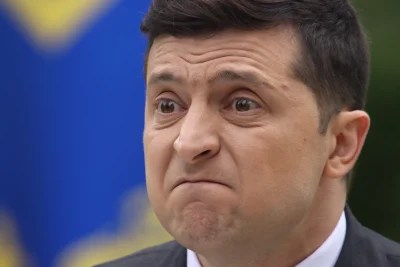
Ukrainian leader hysterically accuses the notoriously Russophobic Polish of helping Moscow
By Rachel Marsden | RT | September 21, 2023
Ukraine and Poland’s relationship has apparently reached the throwing toys out of the pram phase. Speaking to the United Nations General Assembly this week, President Vladimir Zelensky said it was “alarming to see how some in Europe… are helping set the stage for a Moscow actor.” Who could he have been talking about?
“I hope these words are not addressed to Poland,” replied a Polish government spokesman. If you have to ask yourself the question, you probably already know the answer. Yep, Zelensky is accusing Poland of cheating – with Russia.
It seems like just yesterday that Poland was bullying its fellow European Union member states to cough up gifts of weapons for Zelensky. Back in May, it managed to get Denmark and Finland on board with sending their German Leopard tanks to Kiev and browbeat Berlin for dragging its feet on giving permission to re-export the vehicles. “Even if, eventually, we do not get this permission, we – within this small coalition – even if Germany is not in this coalition, we will hand over our tanks, together with the others, to Ukraine,” declared Polish Prime Minister Mateusz Morawiecki at the time.
Fast forward to this week. “We are no longer transferring weapons to Ukraine because we are now arming Poland with more modern weapons,” Morawiecki said. In other words, Warsaw has decided that it needs to focus on itself. Isn’t that what every exasperated partner says after spending time on a therapist’s couch and coming to their senses?
Last week, Poland withdrew – along with Hungary and Slovakia – from the EU’s platform to coordinate Ukrainian grain imports. Sources claimed that the countries feared that details from any such involvement could be used against them in a lawsuit that Kiev filed earlier this week. This was at the World Trade Organization in response to them maintaining their bans on Ukrainian grain imports despite Brussels’ decision to lift them on September 15.
Thus, Poland has gone from loudly proclaiming its love for Kiev to suddenly acting like a party to a potentially messy divorce, now taking self-preservation measures against a toxic partner. One who keeps making demands even when you say “no.” And that’s exactly what these countries did by insisting that Ukraine’s grain be banned lest it compete with their own farmers’ produce, driving its value down – and not even a month before the next Polish parliamentary election on October 15.
Instead of trying to see the situation from these countries’ perspectives, Kiev blew a gasket. “The systemic approach of Budapest and Warsaw of ignoring the position of the EU institutions in trade policy, I think that will be a problem for the EU in general because there is no unity there,” said Taras Kachka, a trade representative. Kiev is acting like it can’t understand why Brussels is backing the three while it keeps stringing Ukraine along with promises of commitment.
It’s because they’re in a binding relationship with the EU. By contrast, you’re a side piece hoping for a ring and using toxic tactics to try to manipulate everyone into getting whatever you want all the time.
The gloves have really come off now, though, with Ukraine daring to suggest that the EU isn’t united. That threatens to ruin the main theme of unelected European Commission President Ursula von der Leyen’s virtue signaling.
Kiev is now doubling down on the psycho-ex vibe by threatening that unless the unilateral bans on grain are lifted, it will go after Polish apples and onions and Hungarian cars with retaliatory restrictions. (Why do bad breakups always have to target innocent cars – whether it’s keying/scratching, smashing, or blocking?) Poland has since pushed back in a tit-for-tat. “I warn the Ukrainian authorities because if they escalate this conflict in this way, we will add more products to the ban on import into the territory of the Republic of Poland,” Prime Minister Morawiecki said on Wednesday.
Where’s the EU in all of this, you might ask? Brussels is currently busy ducking criticism from its own member states for lifting the ban on Ukrainian grain, with Hungarian Agriculture Minister Istvan Nagy underscoring, in the wake of a meeting of the bloc’s agriculture ministers, that von der Leyen consulted on this topic not with the leaders of member states, but with the Ukrainian president. He has also suggested that the EU was selling out its farmers in favor of Saudi, American, and Dutch investments in Ukrainian grain production. Not that this would be the first time that the EU screwed over itself and its people to benefit American interests, using Ukraine as a pretext. Just ask the millions of European citizens currently struggling to pay for the bloc’s decision to replace cheap Russian energy with much pricier liquified natural gas from the US.
Poland has led the way in defying Queen Ursula, with the payoff being that it isn’t having to contend with the kind of protests that Bulgarian officials are now facing, having complied with Brussels’ lifting of the grain ban. Bulgarian farmers blocked highways and border crossings earlier this week. At least so far, it seems that Brussels really doesn’t want to get too deeply involved in the crossfire as Poland and Ukraine throw their tantrums.
Kiev did suddenly acknowledge “close and constructive ties” with Warsaw on Thursday, after a phone call between their agriculture ministers and “agreed to work out an option to cooperate on export issues in near future.” Sounds like someone’s suddenly concerned what the neighbors might think and making an effort to keep up appearances.
Polish Politician Reveals Why Warsaw Changed Its Tone on Ukraine
By Andrei Dergalin – Sputnik – 21.09.2023
Having acted as one of Ukraine’s staunchest supporters since the escalation of the conflict last year, Poland has now changed its tone in the dialogue with the Kiev regime over what appears to be a trade dispute.
Relations between Warsaw and Kiev have soured recently after Polish authorities, along with their Hungarian and Slovakian counterparts, moved to restrict imports of cheap Ukrainian grain in a bid to protect local farmers.
Kiev promptly retaliated by filing a complaint with the World Trade Organization against all three countries and even threatened to block certain agricultural imports from Poland and Hungary if the ban on Ukrainian grain was not lifted.
Many prominent Polish politicians appeared unamused by this turn of events, with Poland’s Minister of Defense Marius Blaszczak insisting that Warsaw essentially protects Polish farmers from the schemes of “Ukrainian oligarchs” who want to sell Ukrainian grain in Poland.
Polish politician and independent commentator Konrad Rekas, however, argued that Warsaw’s rhetoric is all about the upcoming parliamentary elections, “which the ruling Law and Justice party would lose by continuing to uncritically support Kiev.”
“Of course, Ukraine does not intend to make the internal games easier for its Polish allies, fully understanding that it will receive everything it demands from the next Polish government, regardless of which party forms the government,” Rekas told Sputnik.
He claimed that the spat between Ukraine and Poland is not really related to the matter of Ukrainian grain exports or Warsaw’s alleged intent to occupy certain Ukrainian territories and that it is unlikely to affect the course of the Ukrainian conflict.
“Poland will still be a hub for the Western military aid for the Kiev regime. Poles will continue to pay millions for the Ukrainian resettlement to Poland,” Rekas surmised.
Since the escalation of the Ukrainian conflict in February 2022, Poland supplied large quantities of military hardware to the regime in Kiev, including battle tanks and warplanes, and helped accommodate tens of thousands of Ukrainian refugees on Polish soil.
This week, however, Polish Prime Minister Mateusz Morawiecki announced that his country now focuses on arming itself with modern weapons and no longer transfers armaments to Kiev, while Polish government Press Secretary Piotr Muller said that Warsaw apparently has not got plans to continue supporting Ukrainian refugees in Poland next year.
These statements come ahead of the parliamentary election in Poland slated to take place on October 15, and it remains unclear whether Polish politicians are going to fulfill their promises or if it is all merely an attempt to sway voters.
Meanwhile, Slovakia, another prominent backer of the Kiev regime, may change its stance on the Ukrainian conflict after the September 30 election in the country.
Former Slovakian Prime Minister Robert Fico, whose social-democratic Smer (Direction) party dominates the recent polls, has already stated that Slovakia will no longer “send any arms or ammunition to Ukraine” should his party form part of a new government.
US offers to pay Polish media for Ukraine coverage
RT | September 13, 2023
The US Consulate General in Krakow is soliciting Polish outlets to write about Ukrainian refugees “returning and rebuilding,” it emerged on Wednesday. Washington is offering $50,000 for the year-long project.
The project “to promote coverage in Poland by local and regional media representatives of stories in Ukraine” was first spotted by a Telegram channel based in Belarus. It can be found at the website of the US embassy in Poland, under the designation WAW-NOFO-FY23-05.
It was unclear when the solicitation was originally posted. However, the deadline for submissions is end of the day Friday, September 15.
According to the post, the goal is to “promote in-depth reporting by local and regional Polish media of the return of Ukrainian families from Poland to Ukraine and their social and physical rebuilding efforts, particularly those built on partnerships between Poles and Ukrainians.”
The articles should fuel “public understanding of the challenges and opportunities faced by Ukrainians” as well as interest in Ukrainian “efforts to return and rebuild” and the “enduring impact of support provided by Polish society to Ukrainian refugees.”
The solicitation suggests the project would actually be given to a Polish NGO, with US embassy staff having “substantial involvement in the grant implementation, including reviewing and approving selection of participants, trainers, and award decisions within the project.”
The NGO would get a grant of $50,000 (about 215,500 zloty at the current exchange rate) and then have Polish journalists compete for portions of the money. The embassy would evaluate their success by the “quality and reach of reports generated.”
The project also includes at least one workshop teaching the reporters “culturally sensitive and trauma-informed manner and how to create compelling human-interest stories in this context,” taught by “experts in the intersection between mental health and journalism in war zones” and others with the relevant experience.
The entire project is slated to run for a single year, though Washington reserves the right to extend that if it’s judged to be “in the best interest of the US Department of State.”
There are approximately one million Ukrainian refugees in Poland at the moment. Multiple surveys of those who settled in EU countries show that more than 40% do not intend to return even if the conflict with Russia ends. Warsaw has reportedly already started sending men of military age back, even as other EU members have refused to do so on human rights grounds.
Poland’s Defense Spending Quadruples to $36Bln Since 2015
Sputnik – 07.09.2023
WARSAW – Poland’s defense spending has quadrupled to 155 billion zlotys ($36 billion) since 2015, Polish Prime Minister Mateusz Morawiecki said on Thursday.
“Improving the system of public finances allows us to spend enormous amounts of money on the military. Just to compare 2015 and 2024, in 2015, we spent 37 billion zlotys, while in 2024, we will spend over 150 billion, that is, about 155 billion zlotys. This is an increase of about four times, or by 400%,” Morawiecki told reporters.
Poland has recently purchased large quantities of arms and military equipment from domestic and foreign defense companies, mainly from the United States and South Korea. The weapons purchased include aircraft and helicopters, rocket and cannon artillery systems, air and missile defense systems, drones, small arms and a wide range of ammunition.
Poland’s Top Military Official Accidentally Discredited NATO On Several Counts
BY ANDREW KORYBKO | SEPTEMBER 7, 2023
Chief of the General Staff of the Polish Armed Forces General Rajmund Andrzejczak spoke at the Karpacz Economic Forum in southwestern Poland earlier this week about the NATO-Russian proxy war in Ukraine, during which time he shared some very interesting information that was reported on by The Guardian. The present piece will highlight the most important parts prior to explaining how they accidentally discredited NATO on several counts.
———-
* Poland speculates that China might tacitly approve North Korean arms shipments to Russia
– “I don’t believe North Korea is strong enough or so free to make such an offer, so maybe it is testing our determination, attention and political will, but what is even more important is what China says about this than the North Korean leadership.”
* Warsaw is worried that Moscow might meddle in the upcoming elections on 15 October
– “Andrzejczak also predicted that Russia would try to create a crisis in next month’s Polish election but gave no details in public. He warned that Russia was on a permanent war footing and was ‘very much active in Poland, looking for some gaps in the system, trying to interfere in the media’.”
* The NATO-Russian proxy war is viewed by Poland as part of a civilizational competition with China
– “Andrzejczak also warned that if Ukraine lost the war and Belarus went further into Russia’s orbit, Poland would find that limiting defence spending to 5% of its gross domestic product and a standing army of 300,000-strong would not be enough. ‘If we lose credibility as Nato, as a civilisation, China is watching, so this is a big game,’ he said.”
* Andrzejczak wants NATO to proactively engage in nuclear saber-rattling against Russia
– “Nato is a nuclear treaty organisation; it should be much more proactive and stronger to the Russians. In the 70s and 80s, 30% of B-52 bombers were flying permanently and had nuclear weapons with pilots ready to act. Today we have a challenge to say the word B61 [the primary US thermonuclear gravity bomb], so let us change narratives.”
* He’s also upset that the bloc ignored his government’s request to host US nuclear weapons
– “He said there had been complete silence since Poland’s president, Andrzej Duda, asked to join Nato’s nuclear sharing programme owing to the deployment of Russian nuclear missiles to Belarus.”
* Poland lacks confidence that NATO would react to a hypothetical attack from Wagner
– “He asked: ‘Who is the Wagner group today? Is it a national action by Russia or, as the Russian minister of defence says, just a private military company? Is it enough for Article 5?’”
———-
From the above, it’s clear that Andrzejczak is doubling down on the ruling “Law & Justice” (PiS) party’s national security focus that forms the crux of its re-election platform, but he’s arguably going too far. For example, reframing the NATO-Russian proxy war as part of a civilizational competition with China implies that Poland is indirectly fighting the People’s Republic via its military assistance to Kiev, which isn’t true. Spewing this false narrative, however, is likely an attempt to rally PiS’ conservative-nationalist base.
That party and its supporters believe that Poland has historically functioned as the West’s bulwark for protecting their shared civilization from what they depict as “Eastern barbarians”. PiS taps into that interpretation to justify its diehard opposition to everything Russia-related, but now the country’s top military official unexpectedly added an anti-Chinese twist to this shortly before the next elections. Andrzejczak’s hyperbole thus suggests that PiS doesn’t think Russophobia is enough to win re-election.
He himself is also channeling that sentiment by fearmongering about an alleged Kremlin meddling plot sometime around the vote, most probably for the purpose of preemptively discrediting the opposition if they perform better than expected, but it’s clearly not sufficient as evidenced by his tacit Sinophobia. In an attempt to artificially manufacture a sense of utmost urgency, Andrzejczak crossed an informal red line in Polish politics by hinting that NATO isn’t reliable, nor is its American leader either by extension.
He did this by complaining about the bloc ignoring his country’s nuclear-sharing request and then publicly questioning the sacrosanctity of Article 5 in the hypothetical event of a Wagner attack. The first is attributable to NATO’s reluctance thus far to escalate its security dilemma with Russia to potentially uncontrollable proportions while the second is based on a scenario debunked by the New York Times. Andrzejczak knows the truth about both, yet he’s still shamelessly manipulating the public’s perceptions.
The preceding point reinforces suspicions that he exploited his authority as Poland’s top military official to informally campaign for the ruling party during his latest remarks about the NATO-Russian proxy war by hyping up security threats and therefore betrayed his oath to be purely apolitical. In his passion to help them win re-election, he went too far by implying that NATO isn’t doing enough to stop the Sino–Russo Entente and suggesting that Article 5 isn’t sacrosanct, thus likely angering its US leader.
Billionaire oligarch George Soros’ fund claims it bought Polish media outlet to stop ‘oligarchs’ from controlling media
BY JOHN CODY | REMIX NEWS | SEPTEMBER 5, 2023
George Soros’ fund recently bought a major stake in Polish media publisher Gremi Media, leaving Polish conservatives to criticize the move as national elections gear up in October. However, the fund justified its move in a statement by claiming it bought the media to stop “oligarchs” from buying up independent media.
The Soros Economic Development Fund explained in a statement its position regarding why it bought Gremi Media, which owns the major newspapers of Rzeczpospolita and Parkiet,
“Since 2005, independent media in Europe has been under increasing threat from the concentration of capital in the hands of politicians and politically committed oligarchs,” wrote the fund. “The financial crisis of the late 2000s and social media technology have disrupted traditional media models and made it easier for wealthy oligarchs and governments to buy up news companies. Many governments have changed their regulatory environment to exert greater control over information, and the use of public funds to finance media has led to a breakdown in media independence.”
Soros is one of the richest people in the world and widely considered to be a “politically committed oligarch” who has bought up media organizations across the West. For example, Soros’ fund just paid $400 million to purchase Vice Media after it went bankrupt. Soros has also played an active role in buying up Hispanic radio stations across the United States. Soros has already been active in Poland as well, including with Radio Zet, the country’s second-largest radio station in 2019.
Soros accrued billions from currency speculation and has been convicted for insider trading.
Pluralis, a company owned by billionaire oligarch George Soros, acquired a majority stake in Gremi Media, the publisher of Polish newspapers including Rzeczpospolita and Parkiet last week. This means that Pluralis will take control of Gremi Media, Boguslaw Chrabota, editor-in-chief of Rzeczpospolita, told Polish news agency PAP.
Pluralis now owns 931,000 shares in Gremi Media, representing 52 percent of the capital and 57 percent of the votes on the company’s board.
“This means that Pluralis will take control of Gremi Media and will have full decision-making powers in management and editorial matters. Given that he took over the company to expand it, not to liquidate or destroy it, I hope that all the value will be retained and that the company will continue to grow,” said Boguslaw Chrabota, who stated that Pluralis does not intend to interfere in media content and will only manage business interests.
Not everyone thinks Pluralis will abstain from interfering in the editorial process, however, and many are questioning the incredible media power Soros and his various funds and NGOs have. Latvian daily Neatkariga, for instance, wrote:
“The Polish media in the hands of the Soros family must adhere to the ideology that Soros has been cultivating, developing and spreading for decades, whether through money or other means. … Soros is one of the most controversial figures of our time. The political environment in every country where his money surfaces is confronted with aggressive, intolerant activity by the Soros media and NGOs.”
The paper notes that Soros has followed a different playbook in Latvia. There, he did not buy influential media but invested millions in shaping public opinion, creating and funding various NGOs, such as Delna and Providus.
Western leaders are all fighting for their survival in power
Where does this lead? To war!
By Gilbert Doctorow | September 1, 2023
I follow the Evening with Vladimir Solovyov shows as a professional duty, not for fun. The host is very often boorish and the panelists are variable in quality, with too many duds among them. However, every several days I am pleasantly surprised by the analytical talents of one or another panelist who gives us a fresh and often persuasive understanding of the drivers of global events.
One such case was last night when a panelist from MGIMO, the higher educational institution that has educated Russia’s diplomatic corps for decades, gave us his take on the danger of a new world war, meaning a nuclear holocaust, that we presently face. It is all because the political leaders in the United States and in Europe enjoy very low domestic ratings, face elections in the coming year or so and are desperate to hold onto power. For some losing power can mean being sent before courts for various crimes they have committed in office. War is the solution they seize upon in the hope of diverting attention from their personal failings and economic woes, as well as to clamp down on free expression of opposition to the powers that be.
So it is for Joe Biden. Tucker Carlson and Donald Trump have said as much in public over the past several days. But it is just as true of the European presidents and prime ministers. They are all buffeted by economic head winds, by rampant inflation, deindustrialization and falling living standards that they unleashed with their ill-considered imposition of sanctions on Russia. They all are highly unpopular. We know, for example, that German Chancellor Scholz is now among the least regarded politicians in his country. Macron is now rivaling former president Hollande, who came in at single digit numbers in polls before he abandoned his hopes of reelection. And what is the result? Scholz has become a war hawk and repeatedly has agreed to supply ever more deadly materiel to Kiev. Macron has come out as a hawk not only on Ukraine but now is a caricature colonialist on the question of participating in military operations against Niger to reinstall the French-backed comprador government.
Over in Poland, where an election is looming, the government of Prime Minister Mateusz Morawiecki is fighting for its life against a resurgent Civic Platform party. It has put in place a law aimed at sidelining the former prime minister and CP leader Donald Tusk over charges that he was soft on the Russians. Losing power might result in the chairman of the Law and Justice party, Jaroslaw Kaczynski being sent to trial, as is now demanded by Lech Walesa. The result? Poland has been building up its military forces on the border with Belarus and is preparing the public for an imminent outbreak of war.
And then there is the most recent example supporting the given line of analysis: what is going on in Estonia. Let us recall that in the past week there has been a political storm in Estonia when it became known that the husband of the viciously anti-Russian prime minister, Kaja Kallas, has been making millions of euros of profit from his logistics business assisting an Estonian company that has production in Russia. When confronted with this outrageous violation of the cut-off of relations with Russia that she has demanded of her fellow citizens since the war in Ukraine began, Kallas just shrugged it off as something she knew nothing about. However, we note that the drone attack that destroyed Russian military aircraft at the Pskov airport in Russia’s northwest region a day ago is said to have been launched from Estonian territory.
So far, Moscow has not reacted to what could and should be a casus belli with a NATO Member State. But how much longer will Putin show forbearance?
These are very dangerous times and the weakness of Western leadership points to more, not less war.
©Gilbert Doctorow, 2023
Tensions rise as Poland accelerates military buildup on border with Belarus
By Drago Bosnic | August 22, 2023
The geopolitical situation in Eastern Europe has gone through numerous shifts in the last 30+ years, ranging from massive Soviet military presence to near-complete demilitarization that reached its peak in the late 1990s/early 2000s. Ever since, but particularly after Poland joined NATO, the course has slowly but steadily reversed. However, while the process was incremental up until early 2022, since then, it has escalated to almost unimaginable levels. Warsaw’s ambitions to build perhaps the most powerful ground force in the European Union are not only an expensive endeavor, but also an extremely dangerous one.
Namely, the plan to acquire massive amounts of weapons from the United States and its vassals and satellite states, particularly South Korea, includes a plethora of systems, the purpose of which can hardly be described as anything but offensive. Since last year, Poland announced it will acquire 250 US-made “Abrams” main battle tanks (MBTs), hundreds of HIMARS and “Chunmoo” multiple launch rocket systems (MLRS), K9 self-propelled 155 mm howitzers, up to 50 FA-50 trainer/light combat aircraft, as well as 1000 K2 tanks, 820 of which are projected to be produced in Poland. Warsaw also plans to procure at least 32 F-35 fighter jets.
It’s worth noting that, apart from “Abrams”, HIMARS and F-35, all of the aforementioned weapon systems are South Korean, (in)famous for their extreme cost. For instance, the K2 stands at a staggering $8.5 million apiece, making it one of the most expensive MBTs in the world. In fact, it’s so expensive that South Korea, whose economy is almost three times larger than that of Poland, approved mass production for K2 only after Poland announced its intention to acquire them. Even Turkey, which has an economy that’s approximately 20% larger than Warsaw’s, plans to procure no more than 100 “Altay” MBTs (these are essentially a licensed copy of K2).
Poland’s military spending currently stands at 3.9% of GDP, nearly twice that of NATO’s 2% requirement. For comparison, Germany is spending less than 1.5% of its GDP on the military, even though its economy is well over six times larger. In addition, Polish Defense Minister Mariusz Blaszczak just announced that Warsaw plans to deploy at least 10,000 soldiers to the Polish-Belarussian border, further reinforcing the notion that the militarization of Poland is escalating to proportions never seen since the early 1980s. In the last several years, Warsaw announced its intention of nearly doubling the number of active troops to 300,000 (currently, there are over 160,000).
According to South Front, in the last few months, the 12th Mechanized Division and the 11th Armored Division of the Polish Land Forces were transferred from the German border to the area of Bialystok and Biala Podlaska. And at the end of July, their forward command posts and field communication centers were deployed near these cities. In turn, the 18th Mechanized Division was urgently transferred from near Rzeszów to the area of Bielsk-Podlaska. Thus, Poland deployed three divisions on the border with Belarus, specifically in the area between Grodno and Brest. It should be noted that these divisions are all fully equipped for offensive military operations.
At the moment, it’s estimated that up to 15,000 soldiers, several hundred tanks, artillery and missile systems, and several thousand combat vehicles are deployed in areas close to the Belarussian border. This also includes the redeployment of military aircraft and airborne troops, both of which are considered offensive assets. Having such forces in the area shows that Warsaw’s belligerence toward Minsk is bound to escalate further. This is particularly true when considering the fact that Poland actively took part in attempts to destabilize Belarus in the last several years, including by providing logistics and Intelligence support to various foreign-backed groups within the country.
On the other hand, Belarus is not sitting idly. On the contrary, its Ministry of Defense just confirmed that a five-day training exercise for its Ground Forces, including assault and airborne brigades, is being conducted in Brest. The training area is only a few kilometers away from the Bug River, which marks the border with Poland in the southwestern part of the country. Approximately a month ago, precisely in the vicinity of Brest, a training site was set up for use by the “Wagner” PMC (private military company), which is now actively working with the Belarussian military to share its extensive battlefield experience. According to various reports, some of the most battle-hardened “Wagner” veterans are actively taking part in intensive training.
In addition, Belarus also announced its intention to strengthen military cooperation with China, including through participation in joint military exercises. On August 16, General Li Shangfu, the Chinese National Defense Minister since March, arrived in Belarus for a three-day official visit. General Shangfu was greeted by his Belarussian counterpart Lieutenant General Viktor Khrenin at the Minsk National Airport. The Chinese Defense Minister flew from Russia, where he took part in the 11th Moscow Conference on International Security held in Kubinka, in the Moscow oblast (region). This was the first high-level visit in approximately five years.
Apart from China, a growing superpower whose unrivaled economic might is rapidly translating to military power, Belarus also enjoys unequivocal Russian support. President Vladimir Putin himself has repeatedly warned that any attack on Belarus would be tantamount to aggression against Russia and that such actions will be met with an adequate response. In addition, Minsk already has access to Russian tactical nuclear weapons, meaning that attacking Europe’s last truly sovereign nation would simply be suicidal.
Drago Bosnic is an independent geopolitical and military analyst.
Americans urged to ‘immediately’ leave Belarus
RT | August 21, 2023
Any US citizens in Belarus should leave right away, the State Department said in a bulletin on Monday, citing new closures of border crossings by Lithuania and the possibility of more to come.
“The Lithuanian government on August 18 closed two border crossings with Belarus at Tverecius/Vidzy and Sumskas/Losha,” the department said. “The Polish, Lithuanian, and Latvian governments have stated that further closures of border crossings with Belarus are possible.”
“US citizens in Belarus should depart immediately,” the bulletin added.
Americans were urged to travel by land using the “remaining border crossings with Lithuania and Latvia,” because Poland has closed the border, or by plane, though not to Russia or Ukraine.
The Ukraine-Belarus border has likewise been closed. Meanwhile, most Western airlines have halted flights to Minsk and Western nations have closed their airspace to Belarusian and Russian flights, so it was unclear how Americans might fly out without passing through Russia.
Washington has urged its citizens not to travel to Belarus for years, first citing the Covid-19 pandemic, then the 2020 unrest following the presidential election – which the US claims to have been rigged or stolen – and since February 2022, Minsk’s support for Moscow’s military operation against Kiev.
According to the State Department, Belarus is also dangerous due to “the arbitrary enforcement of local laws, the potential of civil unrest, the risk of detention,” and the inability of the US to assist its citizens, since the embassy in Minsk “suspended operations” at the end of February 2022 .
The Polish government has increased its military presence along the border with Belarus over the past month, citing what they called a threat of “hybrid warfare” by Wagner Group fighters who left Russia at the end of July, following a failed mutiny.
Minsk has repeatedly insisted that there is no threat and that Warsaw is getting hysterical due to domestic politics ahead of the general election. Meanwhile, Moscow has warned that any attack on Belarus would be treated as an attack on Russia itself.
The Polish President Said Kiev Isn’t Doing The West Any Favors & Its Counteroffensive Failed
BY ANDREW KORYBKO | AUGUST 11, 2023
Two of Kiev’s top propaganda narratives nowadays are that it’s selflessly sacrificing itself for the sake of the West by fighting Russia instead of surrendering and that its ongoing counteroffensive is succeeding in pushing that country’s forces out of Ukraine’s pre-2014 borders. The first largely remains above official criticism or skepticism since those who dare to doubt it risk being “canceled”, but the second has suddenly begun to be debunked by the Mainstream Media as proven by the following articles:
* NBC News: “Is Ukraine’s counteroffensive failing? Kyiv and its supporters worry about losing control of the narrative”
* CNN: “Why a stalled Ukrainian offensive could represent a huge political problem for Zelensky in the US”
* The Hill: “Alarm grows as Ukraine’s counteroffensive falters”
* Washington Post: “Slow counteroffensive darkens mood in Ukraine”
In the face of this rapidly shifting narrative that threatens to topple one of the pillars of Kiev’s Western-directed propaganda, Zelensky’s senior advisor Mikhail Podolyak lashed out at critics in a tweet thread here where he demanded that they “be patient and closely monitor” his side’s progress. Polish President Andrzej Duda has been doing precisely that since the NATO-Russian proxy war in Ukraine began, however, and he’s concluded that Kiev isn’t doing the West any favors and its counteroffensive failed.
He dropped both bombshells, the first of which debunked the claim that Kiev is selflessly sacrificing itself for the sake of the West and which hitherto hadn’t ever been officially challenged by any Western leader before, in an interview with the Washington Post’s Marc Thiessen from 1 August that was published nine days later. The relevant excerpts will be republished below for the reader’s convenience before analyzing them in the context of this conflict and evolving Polish-Ukrainian ties in particular:
“Q: At the NATO summit when President [Volodymyr] Zelensky criticized the [leaders’ joint statement about Ukraine’s prospective membership], there was criticism of him that he was ungrateful for all the help [given to] Ukraine. That suggests that our help to Ukraine is charity. Is our help to Ukraine charity, or is Ukraine really doing us a favor by giving its children, its lives to defend us against the Russian threat?
A: I would say it this way: I don’t see it in these categories — neither that we are doing an act of charity for Ukraine, nor that Ukraine is doing charity for us… We are sending them arms. Why? Because we want to support them in defending their own territory. … We Poles have many reasons to supply Ukrainians with weapons. … But the whole democratic world also knows that any aggressor who violates the borders of a democratic state in the 21st century in Europe must be stopped.”
…
Q: Could Poland fight a combined arms operation without long-range weapons and without air power? Because that’s what we’re forcing the Ukrainians to do today. What does Ukraine need that it’s not getting today?
A: Ukraine has been supplied with long-range artillery, and it is being supplied with long-range artillery to this day. … One could go as far as to say that Ukraine now has much more modern military capabilities than Russia.
The question is: Does Ukraine have enough weapons to change the balance of the war and get the upper hand? And the answer is probably no. They probably do not have enough weapons. And we know this by the fact that they’re not currently able to carry out a very decisive counteroffensive against the Russian military. To make a long story short, they need more assistance.”
…
Casual observers might be shocked by the Polish leader’s candidness, while Kiev’s supporters might accuse him of “betraying” their regime after becoming the first Western leader to debunk its top two lies nowadays, but his words weren’t unprovoked nor said in a vacuum. The background is that political ties between these wartime allies have tremendously worsened since late July as was documented in the following analyses:
* “Poland & Ukraine Are Arguing Over Grain Once Again”
* “Ukraine’s Ungratefulness Is Finally Starting To Perturb Poland”
* “Kiev’s Prediction Of Post-Conflict Competition With Poland Bodes Ill For Bilateral Ties”
In brief, each side finally began prioritizing their national interests, which resulted in public tensions due to the absence of any pressure valve for dealing with sensitive disagreements such as those over agricultural cooperation and historical memory. Moreover, each side has self-interested political reasons in escalating rhetoric against the other: Ukraine wants to distract from its failing counteroffensive while the ruling Polish party wants to rally its nationalist base ahead of mid-October’s elections.
It was against this backdrop that Duda did the previously unthinkable by telling one of the US’ most influential Mainstream Media outlets that Kiev isn’t doing the West any favors by fighting Russia and that its counteroffensive failed. Granted, he conveyed these two points in a “polite” way that signaled his continued support for NATO’s proxy war on Russia through Ukraine, but it’s still an unforgivable offense from that regime’s perspective.
NBC News warned earlier this month that Kiev and its supporters are worried about losing control of the narrative, which has now come to pass after what Duda just said. He and his country are much more popular and less polarizing among average Westerners than Zelensky and Ukraine, plus nobody doubts their anti-Russian credentials due to widespread awareness of Poland’s difficult history with that country. These observations mean that his words will likely have an outsized impact on reshaping the narrative.
As for the future of Polish-Ukrainian relations, it’s looking dimmer by the day due to their spiraling disputes becoming self-sustaining at this stage. That’s not to suggest that Warsaw will cut Kiev off from arms and other forms of support, but just that the trust which used to characterize their relations since February was finally exposed as illusory. This could complicate their reported plans to form a joint military unit and could lead to Poland acting unilaterally in Western Ukraine in the worst-case scenario.
Featured Video

or go to
Aletho News Archives – Video-Images
From the Archives
Israel Would Have No Qualms About USS Liberty-Style FALSE FLAG If Iran Campaign Falters – Analysts
By Ilya Tsukanov – Sputnik – 18.06.2025
Donald Trump is mulling whether or not to join Israel’s aggression against Iran as Tel Aviv faces problems sustaining its defenses against growing counterstrikes, and apparently lacks a realistic game plan for an end to hostilities after failing to achieve its goals. Analysts told Sputnik how the US could be ‘nudged’ into the conflict.
“The US is already assisting Israel with supplies, intel, refueling support, etc. One of the many US posts in the region could be attacked for a casus belli,” former Pentagon analyst Karen Kwiatkowski explained.
“If Trump doesn’t comply with Israel’s demand” and join its aggression voluntarily, “a false flag may be needed” to drag the US in, Kwiatkowski, retired US Air Force Lt. Col.-turned Iraq War whistleblower, fears.
Netanyahu has a diverse array of options at his disposal, according to the observer, including:
- a false flag against US assets abroad blamed on Iran or one of its Axis of Resistance allies, like the Houthis
- a US domestic attack or assassination blamed on Iran
- Iranian air defenses ‘accidentally’ hitting a civilian jetliner carrying Americans
- use of a dirty bomb or nuclear contamination somewhere in the region blamed on Iran
- even blackmailing by threatening to use nukes against Iran if the US doesn’t join the fight
Kwiatkowski estimates that Israel probably has “enough blackmail power” against President Trump and Congress to avoid the necessity of a false flag operation, but a “USS Liberty-style” attack, targeting the soon-to-be-retired USS Nimitz supercarrier that’s heading to the Middle East, for example, nevertheless cannot be ruled out entirely, she says. … continue
Blog Roll
 Aletho News
- Embarrassing Pivot: U.S. considers dropping Iran oil sanctions amid war
- US has 2 months of rare earths left to replenish weapons amid Iran war: Report
- Strait Of Hormuz closure brings Empire to brink
- Iran controls Strait of Hormuz, dictates terms of war and peace as US excursion backfires
- Outlasting the Superpower: The Reasons Why Iran is Beating uhe US and Israel
- Top PMU commander, over a dozen fighters killed in new US strikes on Iraq
- Is Netanyahu’s war gamble threatening the future of ‘Israel’?: FT
- Smotrich calls for annexation of South Lebanon to Litani River
- Echos of Gallipoli? Hormuz and the Geography of Hubris
- Pakistan PM backs Iran’s right to self-defense amid tensions
- If Americans Knew
- UN’s special rapporteur on human rights says Israel is systematically torturing Palestinians
- Trump White House plagiarized Iran war manifesto from Israel-aligned think tank
- Gaza says 6–10 patients die daily waiting for treatment abroad as Israel blocks medical evacuations
- ‘Substantial evidence’ of double-tap strike in killing of Gaza’s Hind Rajab
- ‘Do Not Want To Die For Israel’: Doubts About Trump’s Iran Strategy Spread Among Troops
- Instead of taking Joe Kent’s claims seriously, the media is disregarding him as an antisemite
- Joe Kent’s Explosive Interviews about his Resignation over the Iran War
- Israel poised to take over southern Lebanon; settlers wreak havoc in West Bank – Not a ceasefire Day 165
- From Sde Teiman, the truth about Israel’s military justice system has been set free
- Child denied life-saving bone marrow transplant by Israel ‘because he is from Gaza’
- No Tricks Zone
- Devastating Assessment Of Comirnaty Vaccine By Former Senior Pfizer Europe Toxicologist
- New Study: CO2 Is ‘Effectively Negligible’ As An Explanatory Climate Change Factor Since 2000
- Former Pfizer Toxicologist Dr. Helmut Sterz Tells Bundestag Hearing Pfizer Vaccine Should Have Never Been Approved
- Energy Expert: Germany’s Nuclear Phaseout Was A “500 Billion Euro Mistake”
- New Research: South Australia’s Mid-Holocene Sea Surface Temperatures Were 4°C Warmer Than Today
- Storing Green Energy To Last Germany 10 Days Would Require A 60-Million Tonne Battery
- New Studies: UK Sea Levels Were 4 Meters Higher Than Today During The Mid-Holocene
- Destructive Green New Deal: German Energy And Metal Group Warns Of Drastic Crisis
- New Study Documents A 20-Year Pause In Arctic Sea Ice Decline – Driven By Internal Variability
- Wake-up Call: Survey Shows Majority Of Germans Now Favor Postponing Climate Targets!
 Aletho News