US offers to pay Polish media for Ukraine coverage
RT | September 13, 2023
The US Consulate General in Krakow is soliciting Polish outlets to write about Ukrainian refugees “returning and rebuilding,” it emerged on Wednesday. Washington is offering $50,000 for the year-long project.
The project “to promote coverage in Poland by local and regional media representatives of stories in Ukraine” was first spotted by a Telegram channel based in Belarus. It can be found at the website of the US embassy in Poland, under the designation WAW-NOFO-FY23-05.
It was unclear when the solicitation was originally posted. However, the deadline for submissions is end of the day Friday, September 15.
According to the post, the goal is to “promote in-depth reporting by local and regional Polish media of the return of Ukrainian families from Poland to Ukraine and their social and physical rebuilding efforts, particularly those built on partnerships between Poles and Ukrainians.”
The articles should fuel “public understanding of the challenges and opportunities faced by Ukrainians” as well as interest in Ukrainian “efforts to return and rebuild” and the “enduring impact of support provided by Polish society to Ukrainian refugees.”
The solicitation suggests the project would actually be given to a Polish NGO, with US embassy staff having “substantial involvement in the grant implementation, including reviewing and approving selection of participants, trainers, and award decisions within the project.”
The NGO would get a grant of $50,000 (about 215,500 zloty at the current exchange rate) and then have Polish journalists compete for portions of the money. The embassy would evaluate their success by the “quality and reach of reports generated.”
The project also includes at least one workshop teaching the reporters “culturally sensitive and trauma-informed manner and how to create compelling human-interest stories in this context,” taught by “experts in the intersection between mental health and journalism in war zones” and others with the relevant experience.
The entire project is slated to run for a single year, though Washington reserves the right to extend that if it’s judged to be “in the best interest of the US Department of State.”
There are approximately one million Ukrainian refugees in Poland at the moment. Multiple surveys of those who settled in EU countries show that more than 40% do not intend to return even if the conflict with Russia ends. Warsaw has reportedly already started sending men of military age back, even as other EU members have refused to do so on human rights grounds.
Poland’s Defense Spending Quadruples to $36Bln Since 2015
Sputnik – 07.09.2023
WARSAW – Poland’s defense spending has quadrupled to 155 billion zlotys ($36 billion) since 2015, Polish Prime Minister Mateusz Morawiecki said on Thursday.
“Improving the system of public finances allows us to spend enormous amounts of money on the military. Just to compare 2015 and 2024, in 2015, we spent 37 billion zlotys, while in 2024, we will spend over 150 billion, that is, about 155 billion zlotys. This is an increase of about four times, or by 400%,” Morawiecki told reporters.
Poland has recently purchased large quantities of arms and military equipment from domestic and foreign defense companies, mainly from the United States and South Korea. The weapons purchased include aircraft and helicopters, rocket and cannon artillery systems, air and missile defense systems, drones, small arms and a wide range of ammunition.
Poland’s Top Military Official Accidentally Discredited NATO On Several Counts
BY ANDREW KORYBKO | SEPTEMBER 7, 2023
Chief of the General Staff of the Polish Armed Forces General Rajmund Andrzejczak spoke at the Karpacz Economic Forum in southwestern Poland earlier this week about the NATO-Russian proxy war in Ukraine, during which time he shared some very interesting information that was reported on by The Guardian. The present piece will highlight the most important parts prior to explaining how they accidentally discredited NATO on several counts.
———-
* Poland speculates that China might tacitly approve North Korean arms shipments to Russia
– “I don’t believe North Korea is strong enough or so free to make such an offer, so maybe it is testing our determination, attention and political will, but what is even more important is what China says about this than the North Korean leadership.”
* Warsaw is worried that Moscow might meddle in the upcoming elections on 15 October
– “Andrzejczak also predicted that Russia would try to create a crisis in next month’s Polish election but gave no details in public. He warned that Russia was on a permanent war footing and was ‘very much active in Poland, looking for some gaps in the system, trying to interfere in the media’.”
* The NATO-Russian proxy war is viewed by Poland as part of a civilizational competition with China
– “Andrzejczak also warned that if Ukraine lost the war and Belarus went further into Russia’s orbit, Poland would find that limiting defence spending to 5% of its gross domestic product and a standing army of 300,000-strong would not be enough. ‘If we lose credibility as Nato, as a civilisation, China is watching, so this is a big game,’ he said.”
* Andrzejczak wants NATO to proactively engage in nuclear saber-rattling against Russia
– “Nato is a nuclear treaty organisation; it should be much more proactive and stronger to the Russians. In the 70s and 80s, 30% of B-52 bombers were flying permanently and had nuclear weapons with pilots ready to act. Today we have a challenge to say the word B61 [the primary US thermonuclear gravity bomb], so let us change narratives.”
* He’s also upset that the bloc ignored his government’s request to host US nuclear weapons
– “He said there had been complete silence since Poland’s president, Andrzej Duda, asked to join Nato’s nuclear sharing programme owing to the deployment of Russian nuclear missiles to Belarus.”
* Poland lacks confidence that NATO would react to a hypothetical attack from Wagner
– “He asked: ‘Who is the Wagner group today? Is it a national action by Russia or, as the Russian minister of defence says, just a private military company? Is it enough for Article 5?’”
———-
From the above, it’s clear that Andrzejczak is doubling down on the ruling “Law & Justice” (PiS) party’s national security focus that forms the crux of its re-election platform, but he’s arguably going too far. For example, reframing the NATO-Russian proxy war as part of a civilizational competition with China implies that Poland is indirectly fighting the People’s Republic via its military assistance to Kiev, which isn’t true. Spewing this false narrative, however, is likely an attempt to rally PiS’ conservative-nationalist base.
That party and its supporters believe that Poland has historically functioned as the West’s bulwark for protecting their shared civilization from what they depict as “Eastern barbarians”. PiS taps into that interpretation to justify its diehard opposition to everything Russia-related, but now the country’s top military official unexpectedly added an anti-Chinese twist to this shortly before the next elections. Andrzejczak’s hyperbole thus suggests that PiS doesn’t think Russophobia is enough to win re-election.
He himself is also channeling that sentiment by fearmongering about an alleged Kremlin meddling plot sometime around the vote, most probably for the purpose of preemptively discrediting the opposition if they perform better than expected, but it’s clearly not sufficient as evidenced by his tacit Sinophobia. In an attempt to artificially manufacture a sense of utmost urgency, Andrzejczak crossed an informal red line in Polish politics by hinting that NATO isn’t reliable, nor is its American leader either by extension.
He did this by complaining about the bloc ignoring his country’s nuclear-sharing request and then publicly questioning the sacrosanctity of Article 5 in the hypothetical event of a Wagner attack. The first is attributable to NATO’s reluctance thus far to escalate its security dilemma with Russia to potentially uncontrollable proportions while the second is based on a scenario debunked by the New York Times. Andrzejczak knows the truth about both, yet he’s still shamelessly manipulating the public’s perceptions.
The preceding point reinforces suspicions that he exploited his authority as Poland’s top military official to informally campaign for the ruling party during his latest remarks about the NATO-Russian proxy war by hyping up security threats and therefore betrayed his oath to be purely apolitical. In his passion to help them win re-election, he went too far by implying that NATO isn’t doing enough to stop the Sino–Russo Entente and suggesting that Article 5 isn’t sacrosanct, thus likely angering its US leader.
Billionaire oligarch George Soros’ fund claims it bought Polish media outlet to stop ‘oligarchs’ from controlling media
BY JOHN CODY | REMIX NEWS | SEPTEMBER 5, 2023
George Soros’ fund recently bought a major stake in Polish media publisher Gremi Media, leaving Polish conservatives to criticize the move as national elections gear up in October. However, the fund justified its move in a statement by claiming it bought the media to stop “oligarchs” from buying up independent media.
The Soros Economic Development Fund explained in a statement its position regarding why it bought Gremi Media, which owns the major newspapers of Rzeczpospolita and Parkiet,
“Since 2005, independent media in Europe has been under increasing threat from the concentration of capital in the hands of politicians and politically committed oligarchs,” wrote the fund. “The financial crisis of the late 2000s and social media technology have disrupted traditional media models and made it easier for wealthy oligarchs and governments to buy up news companies. Many governments have changed their regulatory environment to exert greater control over information, and the use of public funds to finance media has led to a breakdown in media independence.”
Soros is one of the richest people in the world and widely considered to be a “politically committed oligarch” who has bought up media organizations across the West. For example, Soros’ fund just paid $400 million to purchase Vice Media after it went bankrupt. Soros has also played an active role in buying up Hispanic radio stations across the United States. Soros has already been active in Poland as well, including with Radio Zet, the country’s second-largest radio station in 2019.
Soros accrued billions from currency speculation and has been convicted for insider trading.
Pluralis, a company owned by billionaire oligarch George Soros, acquired a majority stake in Gremi Media, the publisher of Polish newspapers including Rzeczpospolita and Parkiet last week. This means that Pluralis will take control of Gremi Media, Boguslaw Chrabota, editor-in-chief of Rzeczpospolita, told Polish news agency PAP.
Pluralis now owns 931,000 shares in Gremi Media, representing 52 percent of the capital and 57 percent of the votes on the company’s board.
“This means that Pluralis will take control of Gremi Media and will have full decision-making powers in management and editorial matters. Given that he took over the company to expand it, not to liquidate or destroy it, I hope that all the value will be retained and that the company will continue to grow,” said Boguslaw Chrabota, who stated that Pluralis does not intend to interfere in media content and will only manage business interests.
Not everyone thinks Pluralis will abstain from interfering in the editorial process, however, and many are questioning the incredible media power Soros and his various funds and NGOs have. Latvian daily Neatkariga, for instance, wrote:
“The Polish media in the hands of the Soros family must adhere to the ideology that Soros has been cultivating, developing and spreading for decades, whether through money or other means. … Soros is one of the most controversial figures of our time. The political environment in every country where his money surfaces is confronted with aggressive, intolerant activity by the Soros media and NGOs.”
The paper notes that Soros has followed a different playbook in Latvia. There, he did not buy influential media but invested millions in shaping public opinion, creating and funding various NGOs, such as Delna and Providus.
Western leaders are all fighting for their survival in power
Where does this lead? To war!
By Gilbert Doctorow | September 1, 2023
I follow the Evening with Vladimir Solovyov shows as a professional duty, not for fun. The host is very often boorish and the panelists are variable in quality, with too many duds among them. However, every several days I am pleasantly surprised by the analytical talents of one or another panelist who gives us a fresh and often persuasive understanding of the drivers of global events.
One such case was last night when a panelist from MGIMO, the higher educational institution that has educated Russia’s diplomatic corps for decades, gave us his take on the danger of a new world war, meaning a nuclear holocaust, that we presently face. It is all because the political leaders in the United States and in Europe enjoy very low domestic ratings, face elections in the coming year or so and are desperate to hold onto power. For some losing power can mean being sent before courts for various crimes they have committed in office. War is the solution they seize upon in the hope of diverting attention from their personal failings and economic woes, as well as to clamp down on free expression of opposition to the powers that be.
So it is for Joe Biden. Tucker Carlson and Donald Trump have said as much in public over the past several days. But it is just as true of the European presidents and prime ministers. They are all buffeted by economic head winds, by rampant inflation, deindustrialization and falling living standards that they unleashed with their ill-considered imposition of sanctions on Russia. They all are highly unpopular. We know, for example, that German Chancellor Scholz is now among the least regarded politicians in his country. Macron is now rivaling former president Hollande, who came in at single digit numbers in polls before he abandoned his hopes of reelection. And what is the result? Scholz has become a war hawk and repeatedly has agreed to supply ever more deadly materiel to Kiev. Macron has come out as a hawk not only on Ukraine but now is a caricature colonialist on the question of participating in military operations against Niger to reinstall the French-backed comprador government.
Over in Poland, where an election is looming, the government of Prime Minister Mateusz Morawiecki is fighting for its life against a resurgent Civic Platform party. It has put in place a law aimed at sidelining the former prime minister and CP leader Donald Tusk over charges that he was soft on the Russians. Losing power might result in the chairman of the Law and Justice party, Jaroslaw Kaczynski being sent to trial, as is now demanded by Lech Walesa. The result? Poland has been building up its military forces on the border with Belarus and is preparing the public for an imminent outbreak of war.
And then there is the most recent example supporting the given line of analysis: what is going on in Estonia. Let us recall that in the past week there has been a political storm in Estonia when it became known that the husband of the viciously anti-Russian prime minister, Kaja Kallas, has been making millions of euros of profit from his logistics business assisting an Estonian company that has production in Russia. When confronted with this outrageous violation of the cut-off of relations with Russia that she has demanded of her fellow citizens since the war in Ukraine began, Kallas just shrugged it off as something she knew nothing about. However, we note that the drone attack that destroyed Russian military aircraft at the Pskov airport in Russia’s northwest region a day ago is said to have been launched from Estonian territory.
So far, Moscow has not reacted to what could and should be a casus belli with a NATO Member State. But how much longer will Putin show forbearance?
These are very dangerous times and the weakness of Western leadership points to more, not less war.
©Gilbert Doctorow, 2023
Tensions rise as Poland accelerates military buildup on border with Belarus
By Drago Bosnic | August 22, 2023
The geopolitical situation in Eastern Europe has gone through numerous shifts in the last 30+ years, ranging from massive Soviet military presence to near-complete demilitarization that reached its peak in the late 1990s/early 2000s. Ever since, but particularly after Poland joined NATO, the course has slowly but steadily reversed. However, while the process was incremental up until early 2022, since then, it has escalated to almost unimaginable levels. Warsaw’s ambitions to build perhaps the most powerful ground force in the European Union are not only an expensive endeavor, but also an extremely dangerous one.
Namely, the plan to acquire massive amounts of weapons from the United States and its vassals and satellite states, particularly South Korea, includes a plethora of systems, the purpose of which can hardly be described as anything but offensive. Since last year, Poland announced it will acquire 250 US-made “Abrams” main battle tanks (MBTs), hundreds of HIMARS and “Chunmoo” multiple launch rocket systems (MLRS), K9 self-propelled 155 mm howitzers, up to 50 FA-50 trainer/light combat aircraft, as well as 1000 K2 tanks, 820 of which are projected to be produced in Poland. Warsaw also plans to procure at least 32 F-35 fighter jets.
It’s worth noting that, apart from “Abrams”, HIMARS and F-35, all of the aforementioned weapon systems are South Korean, (in)famous for their extreme cost. For instance, the K2 stands at a staggering $8.5 million apiece, making it one of the most expensive MBTs in the world. In fact, it’s so expensive that South Korea, whose economy is almost three times larger than that of Poland, approved mass production for K2 only after Poland announced its intention to acquire them. Even Turkey, which has an economy that’s approximately 20% larger than Warsaw’s, plans to procure no more than 100 “Altay” MBTs (these are essentially a licensed copy of K2).
Poland’s military spending currently stands at 3.9% of GDP, nearly twice that of NATO’s 2% requirement. For comparison, Germany is spending less than 1.5% of its GDP on the military, even though its economy is well over six times larger. In addition, Polish Defense Minister Mariusz Blaszczak just announced that Warsaw plans to deploy at least 10,000 soldiers to the Polish-Belarussian border, further reinforcing the notion that the militarization of Poland is escalating to proportions never seen since the early 1980s. In the last several years, Warsaw announced its intention of nearly doubling the number of active troops to 300,000 (currently, there are over 160,000).
According to South Front, in the last few months, the 12th Mechanized Division and the 11th Armored Division of the Polish Land Forces were transferred from the German border to the area of Bialystok and Biala Podlaska. And at the end of July, their forward command posts and field communication centers were deployed near these cities. In turn, the 18th Mechanized Division was urgently transferred from near Rzeszów to the area of Bielsk-Podlaska. Thus, Poland deployed three divisions on the border with Belarus, specifically in the area between Grodno and Brest. It should be noted that these divisions are all fully equipped for offensive military operations.
At the moment, it’s estimated that up to 15,000 soldiers, several hundred tanks, artillery and missile systems, and several thousand combat vehicles are deployed in areas close to the Belarussian border. This also includes the redeployment of military aircraft and airborne troops, both of which are considered offensive assets. Having such forces in the area shows that Warsaw’s belligerence toward Minsk is bound to escalate further. This is particularly true when considering the fact that Poland actively took part in attempts to destabilize Belarus in the last several years, including by providing logistics and Intelligence support to various foreign-backed groups within the country.
On the other hand, Belarus is not sitting idly. On the contrary, its Ministry of Defense just confirmed that a five-day training exercise for its Ground Forces, including assault and airborne brigades, is being conducted in Brest. The training area is only a few kilometers away from the Bug River, which marks the border with Poland in the southwestern part of the country. Approximately a month ago, precisely in the vicinity of Brest, a training site was set up for use by the “Wagner” PMC (private military company), which is now actively working with the Belarussian military to share its extensive battlefield experience. According to various reports, some of the most battle-hardened “Wagner” veterans are actively taking part in intensive training.
In addition, Belarus also announced its intention to strengthen military cooperation with China, including through participation in joint military exercises. On August 16, General Li Shangfu, the Chinese National Defense Minister since March, arrived in Belarus for a three-day official visit. General Shangfu was greeted by his Belarussian counterpart Lieutenant General Viktor Khrenin at the Minsk National Airport. The Chinese Defense Minister flew from Russia, where he took part in the 11th Moscow Conference on International Security held in Kubinka, in the Moscow oblast (region). This was the first high-level visit in approximately five years.
Apart from China, a growing superpower whose unrivaled economic might is rapidly translating to military power, Belarus also enjoys unequivocal Russian support. President Vladimir Putin himself has repeatedly warned that any attack on Belarus would be tantamount to aggression against Russia and that such actions will be met with an adequate response. In addition, Minsk already has access to Russian tactical nuclear weapons, meaning that attacking Europe’s last truly sovereign nation would simply be suicidal.
Drago Bosnic is an independent geopolitical and military analyst.
Americans urged to ‘immediately’ leave Belarus
RT | August 21, 2023
Any US citizens in Belarus should leave right away, the State Department said in a bulletin on Monday, citing new closures of border crossings by Lithuania and the possibility of more to come.
“The Lithuanian government on August 18 closed two border crossings with Belarus at Tverecius/Vidzy and Sumskas/Losha,” the department said. “The Polish, Lithuanian, and Latvian governments have stated that further closures of border crossings with Belarus are possible.”
“US citizens in Belarus should depart immediately,” the bulletin added.
Americans were urged to travel by land using the “remaining border crossings with Lithuania and Latvia,” because Poland has closed the border, or by plane, though not to Russia or Ukraine.
The Ukraine-Belarus border has likewise been closed. Meanwhile, most Western airlines have halted flights to Minsk and Western nations have closed their airspace to Belarusian and Russian flights, so it was unclear how Americans might fly out without passing through Russia.
Washington has urged its citizens not to travel to Belarus for years, first citing the Covid-19 pandemic, then the 2020 unrest following the presidential election – which the US claims to have been rigged or stolen – and since February 2022, Minsk’s support for Moscow’s military operation against Kiev.
According to the State Department, Belarus is also dangerous due to “the arbitrary enforcement of local laws, the potential of civil unrest, the risk of detention,” and the inability of the US to assist its citizens, since the embassy in Minsk “suspended operations” at the end of February 2022 .
The Polish government has increased its military presence along the border with Belarus over the past month, citing what they called a threat of “hybrid warfare” by Wagner Group fighters who left Russia at the end of July, following a failed mutiny.
Minsk has repeatedly insisted that there is no threat and that Warsaw is getting hysterical due to domestic politics ahead of the general election. Meanwhile, Moscow has warned that any attack on Belarus would be treated as an attack on Russia itself.
The Polish President Said Kiev Isn’t Doing The West Any Favors & Its Counteroffensive Failed
BY ANDREW KORYBKO | AUGUST 11, 2023
Two of Kiev’s top propaganda narratives nowadays are that it’s selflessly sacrificing itself for the sake of the West by fighting Russia instead of surrendering and that its ongoing counteroffensive is succeeding in pushing that country’s forces out of Ukraine’s pre-2014 borders. The first largely remains above official criticism or skepticism since those who dare to doubt it risk being “canceled”, but the second has suddenly begun to be debunked by the Mainstream Media as proven by the following articles:
* NBC News: “Is Ukraine’s counteroffensive failing? Kyiv and its supporters worry about losing control of the narrative”
* CNN: “Why a stalled Ukrainian offensive could represent a huge political problem for Zelensky in the US”
* The Hill: “Alarm grows as Ukraine’s counteroffensive falters”
* Washington Post: “Slow counteroffensive darkens mood in Ukraine”
In the face of this rapidly shifting narrative that threatens to topple one of the pillars of Kiev’s Western-directed propaganda, Zelensky’s senior advisor Mikhail Podolyak lashed out at critics in a tweet thread here where he demanded that they “be patient and closely monitor” his side’s progress. Polish President Andrzej Duda has been doing precisely that since the NATO-Russian proxy war in Ukraine began, however, and he’s concluded that Kiev isn’t doing the West any favors and its counteroffensive failed.
He dropped both bombshells, the first of which debunked the claim that Kiev is selflessly sacrificing itself for the sake of the West and which hitherto hadn’t ever been officially challenged by any Western leader before, in an interview with the Washington Post’s Marc Thiessen from 1 August that was published nine days later. The relevant excerpts will be republished below for the reader’s convenience before analyzing them in the context of this conflict and evolving Polish-Ukrainian ties in particular:
“Q: At the NATO summit when President [Volodymyr] Zelensky criticized the [leaders’ joint statement about Ukraine’s prospective membership], there was criticism of him that he was ungrateful for all the help [given to] Ukraine. That suggests that our help to Ukraine is charity. Is our help to Ukraine charity, or is Ukraine really doing us a favor by giving its children, its lives to defend us against the Russian threat?
A: I would say it this way: I don’t see it in these categories — neither that we are doing an act of charity for Ukraine, nor that Ukraine is doing charity for us… We are sending them arms. Why? Because we want to support them in defending their own territory. … We Poles have many reasons to supply Ukrainians with weapons. … But the whole democratic world also knows that any aggressor who violates the borders of a democratic state in the 21st century in Europe must be stopped.”
…
Q: Could Poland fight a combined arms operation without long-range weapons and without air power? Because that’s what we’re forcing the Ukrainians to do today. What does Ukraine need that it’s not getting today?
A: Ukraine has been supplied with long-range artillery, and it is being supplied with long-range artillery to this day. … One could go as far as to say that Ukraine now has much more modern military capabilities than Russia.
The question is: Does Ukraine have enough weapons to change the balance of the war and get the upper hand? And the answer is probably no. They probably do not have enough weapons. And we know this by the fact that they’re not currently able to carry out a very decisive counteroffensive against the Russian military. To make a long story short, they need more assistance.”
…
Casual observers might be shocked by the Polish leader’s candidness, while Kiev’s supporters might accuse him of “betraying” their regime after becoming the first Western leader to debunk its top two lies nowadays, but his words weren’t unprovoked nor said in a vacuum. The background is that political ties between these wartime allies have tremendously worsened since late July as was documented in the following analyses:
* “Poland & Ukraine Are Arguing Over Grain Once Again”
* “Ukraine’s Ungratefulness Is Finally Starting To Perturb Poland”
* “Kiev’s Prediction Of Post-Conflict Competition With Poland Bodes Ill For Bilateral Ties”
In brief, each side finally began prioritizing their national interests, which resulted in public tensions due to the absence of any pressure valve for dealing with sensitive disagreements such as those over agricultural cooperation and historical memory. Moreover, each side has self-interested political reasons in escalating rhetoric against the other: Ukraine wants to distract from its failing counteroffensive while the ruling Polish party wants to rally its nationalist base ahead of mid-October’s elections.
It was against this backdrop that Duda did the previously unthinkable by telling one of the US’ most influential Mainstream Media outlets that Kiev isn’t doing the West any favors by fighting Russia and that its counteroffensive failed. Granted, he conveyed these two points in a “polite” way that signaled his continued support for NATO’s proxy war on Russia through Ukraine, but it’s still an unforgivable offense from that regime’s perspective.
NBC News warned earlier this month that Kiev and its supporters are worried about losing control of the narrative, which has now come to pass after what Duda just said. He and his country are much more popular and less polarizing among average Westerners than Zelensky and Ukraine, plus nobody doubts their anti-Russian credentials due to widespread awareness of Poland’s difficult history with that country. These observations mean that his words will likely have an outsized impact on reshaping the narrative.
As for the future of Polish-Ukrainian relations, it’s looking dimmer by the day due to their spiraling disputes becoming self-sustaining at this stage. That’s not to suggest that Warsaw will cut Kiev off from arms and other forms of support, but just that the trust which used to characterize their relations since February was finally exposed as illusory. This could complicate their reported plans to form a joint military unit and could lead to Poland acting unilaterally in Western Ukraine in the worst-case scenario.
A Recent Survey Shows How Significantly Young Poles’ Views Towards Ukraine Have Changed
BY ANDREW KORYBKO | AUGUST 7, 2023
The Conversation, which is a global collaboration platform between academics and journalists that’s funded by a wide range of international research institutions, published the results from a recent survey of 2,000 young Poles aged 16-34 showing how significantly their views towards Ukraine have changed since early 2022. It can be read in full here, but the present piece will share the most interesting highlights before analyzing them in the latest context of newly complicated Polish-Ukrainian ties.
Before doing so, it’s important to briefly draw attention to the credentials of the researchers involved, Felix Krawatzek and Piotr Goldstein. The first is a Senior Researcher at the Centre for East European and International Studies in Berlin and Associate Member of Nuffield College at University of Oxford while the second is a Research Fellow at that same German institution. Both are therefore established Western experts who can’t be accused of being “Russian propagandists” by any stretch of the imagination.
Having preemptively debunked the ad hominem attacks that’ll predictably form the bulk of Western social media’s reaction to their findings, it’s now time to share the highlights from their survey:
———-
* Over half of young Poles don’t want Ukrainian refugees to permanently reside in their country
– “Our analysis found that between 2022 and 2023, increasing numbers of young Poles – now 52%, up from 42% a year ago – believe that refugees should be offered temporary status, with the assumption that they return to Ukraine as soon as it becomes safely possible.”
* Young Catholic & conservative Poles feel stronger about this than others
– “Those young people who self-identify as Catholic in our survey are 10% more likely than others to desire their return to Ukraine when this becomes possible. This is also true of those who support the far-right Konfederacja, a party that has opposed the Polish response to the war in Ukraine, who are 13% more likely to express that view than others.”
* Over one-third of young Poles want their government to become neutral towards Ukraine
– “In 2022, an overwhelming majority of 83% argued that the government should support Ukraine – but this number has changed drastically. Now, 65% of respondents back continuous support for Ukraine, whereas the remaining 34% wish for Poland to stay neutral.”
* Older young Poles and those living outside of big cities feel stronger about this than others
– “In particular, the oldest people in our sample of young Poles (those aged 25-34) express the strongest wish for political neutrality, as do those from cities with fewer than 500,000 inhabitants and young people who have not engaged in helping Ukrainians over the last 18 months.”
* Young Poles, and especially conservative ones, are increasingly embracing peace and neutrality
– “Asked about the type of support that people consider appropriate for Ukraine, our most recent (2023) data shows that only 2% of young Poles want the national army to be involved in the Ukraine war. And while 60% support offering humanitarian aid, only 28% want Poland to offer weapons. Those supporting the far-right (roughly 20% of our respondents) are most likely to oppose the sending of weapons.”
———-
Quite clearly, the rapid rise of the anti-establishment Confederation party played a pivotal role in shaping young Poles’ views towards the NATO-Russian proxy war in Ukraine and their attitudes towards refugees from that battleground state. They’re a political force to be reckoned with and might even become their country’s kingmakers after this fall’s national elections, though that’s precisely why there’s a credible fear that the ruling party might brand them with the scarlet letter of being “Russian agents” before then.
About that, they formed a so-called “Russian influence commission” earlier this summer that many at the time interpreted as an attempt to discredit the liberal–globalist “Civic Platform” opposition party that’s regarded by many as being German proxies. That prediction still stands but can now be expanded to include the Confederation party as possible targets too due to the socio-political influence that they now wield as proven by this latest survey.
Another factor that certainly played a role in shaping young Poles’ views towards this conflict but which wasn’t addressed in The Conversation’s survey was Kiev trying to trick Warsaw into starting World War III after Ukraine accidentally bombed Poland last November then lied that Russia was allegedly responsible. This incident vindicated those like the Confederation party who hitherto claimed that the Ukrainian leadership can’t be trusted, thus further fueling their rise and the associated popularity of their views.
It can accordingly be argued that Kiev’s blatant lies also account for why one-third of young Poles now want their government to become neutral towards Ukraine and only 28% are in favor of continuing to send it weapons. After all, their lives likely flashed before their eyes during the brief period when it was unclear exactly who was responsible for the unprecedented bombing of NATO territory, and this could have left a strong impression that might have made them more pragmatic towards this conflict.
Another constructive critique that can be made about The Conversation’s survey is that it didn’t attempt to determine the possible role that Ukraine’s recent criticisms of Poland might have played in shaping young Poles’ views. Their research was carried out from May-June 2023, which coincided with Zelensky’s rage from early May that he directed at Poland and neighboring EU countries for their unilateral ban of most Ukrainian agricultural imports that was imposed to protect their farmers.
In hindsight, this was the start of a new trend that began to manifest itself more fully late last month when Kiev once again verbally attacked Poland after Warsaw said that it’ll unilaterally continue this ban even after the European Commission’s temporary deal expires in mid-September. That prompted a quickly escalating tit-for-tat that led to each side summoning the other’s ambassadors, after which their leaders tweeted about this scandal and expressed polar opposite views about who’s responsible.
The Polish Deputy Foreign Minister then expanded the scope of their disagreements to include the World War II-era genocide of Poles in Volhynia by Hitler’s Ukrainian collaborators, which in turn led to Zelensky’s senior advisor predicting that post-conflict bilateral ties will be characterized by competition. Intrepid readers can learn more about this here since the details are beyond the scope of the present piece, but the rest should simply be aware of how complicated their relations have since become.
Keeping in mind the highlights of this latest survey as well as the corresponding analysis thereof, it’s undeniable that young Poles’ views towards Ukraine have significantly changed, which will likely influence the outcome of this fall’s national elections. Kiev is losing the hearts and minds of this important demographic, many of whom are now embracing the anti-establishment Confederation party, and Poland’s ruling party must properly respond to this trend if it wants to remain in power.
The coming Russian – Polish war
By Gilbert Doctorow | July 23, 2023
This evening’s News of the Week program on Russian state television opened with a 30 minute documentary survey of Polish-Russian relations from the end of WWI and during the period of the Russian Civil War, when the government under Marshall Pilsudski wrested substantial territory from Russian control. It also dealt extensively with Poland’s well documented role as aggressor and occupier of Czechoslovak, Lithuanian, Ukrainian and Belarus lands from before the start of WWII and until Hitler overran Poland.
This reportage was all built around Vladimir Putin’s speech to the RF Security Council on Friday which was partly broadcast then. Excerpts from that speech were used to introduce segments of the overall documentary.
Let us recall that on Friday, Putin explained how and why we may expect the formal entry into the war of a Polish-Lithuanian-Ukrainian joint military force that will officially be presented as defending Ukrainian statehood by occupying the Western Ukraine. However, Putin described this as an occupying force which once installed in Lvov and Western Ukraine would never leave. This would in effect be a repeat of the sell-out of Ukrainian interests to Poles and cession of territory to Poland such as had been perpetrated by their leader Semyon Petlyura in April 1920 and has now been repeated in the secret agreements between presidents Zelensky of Ukraine and Duda of Poland.
However, that was not the only pending Polish aggression announced by Vladimir Putin on Friday. He said that Poland also had designs on Belarus land. The documentary this evening fleshed out that remark and reminded us of what Belarus territory Poland had grabbed by force in the 20th century when it had the opportunity. It also pointed a finger at those Belarus fighters abroad who will be used by Poland to spearhead their move against Minsk from Polish territory, and what armaments they are receiving from the United States and NATO member countries.
With respect to Polish designs on Ukraine, Putin did not tip his hand on what Russia’s response may be. But as regards Belarus, he stated directly on Friday that any act of aggression against Belarus will be considered an attack on Russia and Russia will respond with all the military force at its disposal. He warned Warsaw to consider the consequences of their actions.
Putin’s speech on Friday appeared to be directed at Warsaw. The program this evening was clearly directed at the broad Russian public, to prepare them for the onset of a possible Russian-Polish war in the immediate future.
This point was highlighted by the ongoing visit of Belarus president Lukashenko to Petersburg. There has been pomp and ceremony in this visit. Both presidents today visited Kronstadt, touring its principal church, which is the spiritual home of the Russian Navy. They also visited the about to be opened new museum of the Russian Navy, and its featured exhibit, which is Russia’s first nuclear submarine, the country’s answer to the American Nautilus at the time. And they held talks on the military and political threats their countries face. These talks unexpectedly will continue in the Konstantinovsky Palace outside Petersburg tomorrow. The reason for extensive consultations was clear from remarks that Lukashenko made to the press during his meeting with Putin: namely that Belarus military intelligence has been following very closely the massive build-up of Polish forces including tanks, helicopters and other heavy military equipment close to the Belarus border at several locations.
Tonight’s News of the Week program explained to the Russian public that the Poles’ new aggressive plans are proceeding only because of their confidence that Uncle Sam supports them. And they named the person embodying this link as former Foreign Minister of Poland Radoslaw Sikorsky (2014-15), who is today a Member of the European Parliament and delegate responsible for relations with the United States. A photo of Sikorski’s latest meetings with Pentagon officials and with Joe Biden and his advisers was put on the screen. For those who may wonder about Sikorsky’s political views, it pays to remember that he is the husband of neo-con, Russia-hating journalist Anne Applebaum, who is very well known to American audiences for her regular columns in The Washington Post.
From Russian talk shows of the past several days, it is easy to understand the Kremlin’s reading of the present proxy war in and around Ukraine: Washington sees that the Ukrainian counter-offensive is a complete failure that has cost tens of thousands of lives among the Ukrainian armed forces and has seen the destruction of a large part of the Western equipment delivered to Ukraine over the past months. Instead of suing for peace, Washington seeks to open a ‘second front,’ using Poland for this purpose.
One possible Russian response to any move against Belarus has also been discussed on air: to seize the Suwalki corridor that connects Kaliningrad to Belarus across Polish territory. Taking control of that corridor would have the effect of isolating the Baltic States from Poland and thereby put their security at peril.
The inescapable conclusion from the latest news is that Washington’s incendiary policies and continuing escalation of the conflict cannot secure Russia’s defeat. On the contrary, they may well lead to the total collapse of the NATO alliance once its military value is disproven in a way that cannot be talked away or papered over by the most creative propagandists in DC.
©Gilbert Doctorow, 2023
Poland files legal complaints against “authoritarian” EU climate policies
By Alicja Ptak | Notes from Poland | July 18, 2023
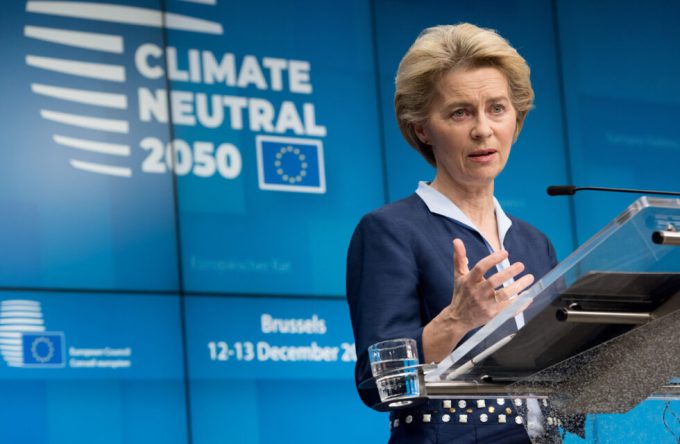
The Polish government has submitted four complaints against EU climate policies, calling them “authoritarian” and pledging that it “will not allow Brussels’ diktat”.
Three new cases filed to the Court of Justice of the European Union (CJEU) relate to a ban on the registration of new internal combustion vehicles after 2035, an increase in the EU’s greenhouse gas reduction target, and a reduction of free emission allowances under the EU Emissions Trading System (ETS).
They follow another complaint filed last week against EU rules on land use, land use change and forestry (LULUCF), which Poland says infringes the competences of member states.
“Does the [European] Union want to decide in an authoritarian manner what kind of vehicles Poles will drive and whether energy prices will rise in Poland?” tweeted climate minister Anna Moskwa on Monday. “The Polish government will not allow Brussels’ diktat.”
This morning, the minister added in an interview with Polskie Radio that the government would also file a fifth complaint this week concerning 35,000 tonnes of rubbish that it says has illegally entered the country from Germany.
Poland’s current national-conservative government has regularly criticised the EU’s climate and environmental policies. Ruling party leader Jarosław Kaczyński has called them “madness and theories without evidence” and “green communism”.
“At every EU council, we have been against and voted as a government against every single document in the Fit for 55 package,” said Moskwa, referring to the EU’s programme to reduce emissions by at least 55% by 2030.
“It is no secret that we were against the whole package, we are against increasing climate ambition and the way [these efforts] are carried and forced [upon member countries],” added the minister.
A recent EU-funded study found Poland to be the bloc’s least green country. It still relies on coal to produce around 70% of its electricity, by far the highest figure in the EU. Poland is Europe’s second-largest producer of brown coal after Germany and the largest producer of hard coal.
In March, Poland was the only member state to oppose the introduction of a ban on the sale of new petrol and diesel cars from 2035. In an interview today, Moskwa argued that unanimity should have been required for this decision as its impact is heavily dependent on member countries’ energy mix.
“In our case, [banning combustion engines] is absolutely contrary to climate policy, because it will lead to an increase in coal consumption in the short term if we want to increase electricity production [to power electric vehicles],” she said.
Asked about the other complaints, Moskwa said Poland was challenging most of them on the same grounds as the ban on the sale of combustion cars.
“The argument in most of these complaints is the same, mainly concerning the legal basis and unanimity, the impact on the energy mix,” she said.
One of the EU policies opposed by Poland is changes to ETS stipulating that sectors already covered by the system will be obliged to reduce their greenhouse gas emissions by 62% by 2030 compared to 2005 levels. The reform also envisages a gradual phase-out of free emission allowances between 2026 and 2034.
Another regulation concerns the provisions on the new EU Carbon Border Adjustment Mechanism (CBAM), which will cover commodities such as iron, steel, cement, aluminium, fertilisers, electricity and hydrogen.
Importers of these commodities will have to pay the difference between the emission fee in the country of production and the price of emission allowances in the EU ETS. CBAM will be phased in between 2026 and 2034, as free emission allowances in the ETS are phased out.
Moskwa argues that Poland is pursuing a “very consistent energy transition” focused on creating incentives rather than restrictions. She cited government subsidies for clean energy sources such as the “My Electricity” and “Clean Air” programmes, which have led to a boom in solar micro-installations and heat pumps.
Data from the European Environment Agency published last month showed that Poland recorded the EU’s largest overall fall in emissions in 2022. However, in proportional terms, Poland’s decline was, though above the EU average, not among the highest in the bloc.
Alicja Ptak is senior editor at Notes from Poland and a multimedia journalist. She previously worked for Reuters.
Copyright © 2023 Notes From Poland
Germany creates equity in Western Ukraine
BY M. K. BHADRAKUMAR | INDIAN PUNCHLINE | JULY 13, 2023
The hypothesis that the Anglo-Saxon axis is pivotal to the proxy war in Ukraine against Russia is only partly true. Germany is actually Ukraine’s second largest arms supplier, after the United States. Chancellor Olaf Scholz pledged a new arms package worth 700 million euros, including additional tanks, munitions and Patriot air defence systems at the NATO summit in Vilnius, putting Berlin, as he said, at the very forefront of military support for Ukraine.
German Defence Minister Boris Pistorius stressed, “By doing this, we’re making a significant contribution to strengthening Ukraine’s staying power.” However, the pantomime playing out may have multiple motives.
Fundamentally, Germany’s motivation is traceable to the crushing defeat by the Red Army and has little to do with Ukraine as such. The Ukraine crisis has provided the context for accelerating Germany’s militarisation. Meanwhile, revanchist feelings are rearing their head and there is a “bipartisan consensus” between Germany’s leading centrist parties — CDU, SPD and Green Party — in this regard.
In an interview in the weekend, the CDU’s leading foreign and defence expert Roderich Kiesewetter (an ex-colonel who headed the Association of Reservists of the Bundeswehr from 2011 to 2016) suggested that if conditions warrant in the Ukraine situation, NATO should consider to “cut off Kaliningrad from Russian supply lines. We see how Putin reacts when he is under pressure.” Berlin is still smarting under the surrender of the ancient Prussian city of Königsberg in April 1945.
Stalin ordered 1.5 million Soviet troops supported by several thousand tanks and aircraft to attack the crack Nazi Panzer divisions deeply entrenched in Königsberg. The capture of the heavily fortified stronghold of Königsberg by the Soviet army was celebrated in Moscow with an artillery salvo by 324 cannons firing 24 shells each.
Evidently, Kiesewetter’s remarks show that nothing is forgotten or forgiven in Berlin even after 8 decades. Thus, Germany is the Biden Administration’s closest ally in the war against Russia. The German government has stated its understanding for the Biden administration’s controversial decision to supply Ukraine with cluster ammunition. The government spokesman commented in Berlin, “We are certain that our US friends did not make their decision lightly, to deliver this sort of munition.”
President Frank-Walter Steinmeier remarked, “In the current situation, one should not obstruct the USA.” Indeed, the top CDU figure Kiesewetter suggested in an interview with the Green Party-affiliated daily taz that not only should Ukraine be given “guarantees, and if necessary, even provided with nuclear assistance, as an intermediary step to NATO membership.”
Coinciding with the NATO summit in Vilnius (July 11-12), Rheinmetal, the great 135-year old German arms manufacturing company, has disclosed that it is opening an armoured vehicle plant in western Ukraine at an undisclosed location in the next twelve weeks. To begin with, German Fuchs armoured personnel carriers will be built and repaired while there are plans afoot to manufacture ammunition and possibly even air defence systems and tanks.
Rheinmetall’s CEO told CNN on Monday that like other Ukrainian arms factories, the new plant could be protected from Russian air attack. Germany has more than doubled the 2022 allocation of €2 billion for upgrading Ukraine’s armed forces. It now touches around €5.4 billion with further plans to increase to €10.5 billion.
Now, is this all about Russia? Germany cannot be unaware that Ukraine has simply no hope on earth to defeat Russia militarily. Germany is playing the long game. It is creating equity in western Ukraine where it is not Russia but Poland that is its contender. Ever since the Tsarist army advanced into Galicia in 1914, Russia has had a difficult history with Ukrainian nationalists. If the current war in Ukraine spreads to western Ukraine, that cannot be Russia’s choice but out of some necessity forced upon it.
The Soviet victory in Ukraine in October 1944, the Red Army’s occupation of eastern Europe, and Allied diplomacy resulted in a redrawing of Poland’s western frontiers with Germany and Ukraine’s with Poland. Simply put, with compensation of German territories in the west, Poland agreed to the cession of Volhynia and Galicia in western Ukraine; a mutual population exchange created for the first time in centuries a clear ethnic, as well as political, Polish-Ukrainian border.
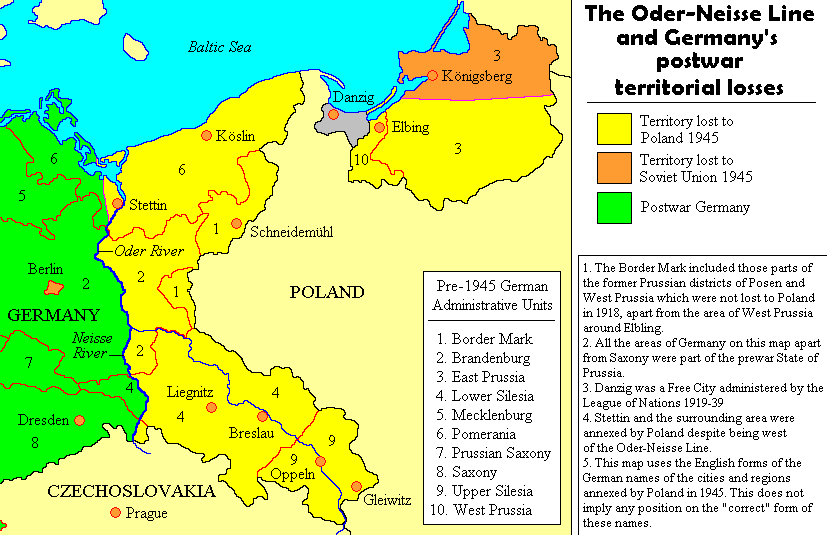
It is entirely conceivable that the ongoing Ukraine war will radically change the territorial boundaries of Ukraine in the east and south. Possibly, it can re-open the post-WW II settlement with regard to western Ukraine as well. Russia has repeatedly warned that Poland aims to reverse the cession of Volhynia and Galicia in western Ukraine. Such a turn of events will most certainly bring to the fore the issue of the German territories that are part of Poland today.
Perhaps, it was in anticipation of turbulence ahead that last October, eight months after the Russian intervention began in in February, Warsaw demanded WWII reparations from Berlin — an issue which Germany says was settled in 1990 — to the tune of €1.3 trillion.
Under the Potsdam Conference (1945), the “former eastern territories of Germany” comprising nearly one quarter (23.8 percent) of the Weimar Republic with the majority ceded to Poland. The remainder, consisting of northern East Prussia including the German city of Königsberg (renamed Kaliningrad), was allocated to the Soviet Union.
Make no mistake about the importance of the Eastern border for German culture and politics. Indeed, there is always something volatile about a “handicapped” Great Power when a whole new intensity appears in political, economic and historical circumstances, which prompts those in power to turn ideas into reality, and revanchist and imperialistic discourses that were quietly but steadily streaming below the surface of the carefully considered diplomatic efforts begin to probe pan-nationalist expansion.
In retrospect, Germany’s — in particular, then foreign minister and current president Steinmeier’s — diabolical role to align Germany with the neo-Nazi elements during the regime change in Kiev in 2014 and the subsequent German perfidy in the implementation of the Minsk Agreement (“Steinmeier formula”), as admitted recently in February by former Chancellor Angela Merkel should not be forgotten.
Suffice to say, even as Russia is winning the Ukraine war, the concern of the German foreign policy makers once again faces the need to redefine what was German. Thus, the war in Ukraine is only the means to an end. Recent reports suggest that Berlin may be moving, finally, toward meeting Ukraine’s pending demand for Taurus cruise missiles with a range exceeding 500 kms and unique “multi-effect war head” that can be a game changer in the combat dynamics on the battlefield and create the prerequisites for victory.
Equally, German soldiers already comprise about half of the NATO battlegroup already present in Lithuania. Defense Minister Boris Pistorius said two weeks ago while on a visit to Vilnius that Germany is preparing the infrastructure to permanently base 4,000 soldiers (“a robust brigade”) to Lithuania so as to have the capability to maintain military flexibility at the Eastern flank. The decision has support from both Germany’s governing coalition and its main opposition.
The CDU foreign policy expert and member of the Bundestag, Kiesewetter called the idea of establishing a German base in the Baltics a “decision of reason and reliability.” Indeed, there have been past attempts, historically speaking, to create German rule in the Baltics based on revisionist claims towards the new states of Estonia, Latvia and Lithuania where German colonists had settled as far back as in the 12th and 13th centuries.
Featured Video

Iran’s Next Strike May Not Explode. It Could Shut You Down
or go to
Aletho News Archives – Video-Images
From the Archive
Zionism’s Violent Legacy
By Donald Neff | Washington Report On Middle East Affairs | January 1996
On January 4, 1948, Jewish terrorists drove a truck loaded with explosives into the center of the all Arab city of Jaffa and detonated it, killing 26 and wounding around 100 Palestinian men, women and children.[1] The attack was the work of the Irgun Zvai Leumi – the “National Military Organization,” also known by the Hebrew letters Etzel – the largest Jewish terrorist group in Palestine. The Irgun was headed by Revisionist Zionist Menachem Begin and had been killing and maiming Arabs, Britons and even Jews for the previous ten years in its efforts to establish a Jewish state.
This terror campaign meant that at the core of Revisionist Zionism there existed a philosophical embrace of violence. … continue
Blog Roll
 Aletho News
- Trump’s Iran war is on an Israeli leash
- Saudi oil boss issues global supply warning
- Riyadh Says Its Oil System Is Intact. The Numbers Say Otherwise.
- Trump and Netanyahu Want to “Finish the Job” on Iran
- US ‘one-sided dictation’ not Iran’s beliefs makes rational talks impossible: Baghaei
- Iran’s Next Strike May Not Explode. It Could Shut You Down /Col Doug Macgregor
- Iran: US political targets legitimate if assassinations return
- Iraq shuts key border crossing with Iran under US pressure: Report
- Undersea Internet cables could be targeted in retaliation for attacks on Iran: IRGC deputy chief
- EU sending ‘biased’ observers to interfere in Serbian election – president
- If Americans Knew
- The Israel Lobby’s Changing Fortunes
- AIPAC has become such a political liability that it’s shifting to a more “nimble” approach to buying politicians
- At least 160 Israeli settler attacks in 2 weeks
- Will Gaza’s Ancient Christian Community Disappear Forever?
- Israel’s vision of regional security rests on keeping Arab states weak
- Heidi Levine recounts how Palestinian youths helped save her in settler attack
- DAILY UPDATE: Latest essential news on Palestine, Israel, & region
- Trump’s Intensifying Sabotage of the ICC, for Israel’s Sake
- Israeli military detain US and UK volunteers in West Bank including Democratic NY politician Brad Lander
- Americans at National Conservatism Conference held in Israel this year criticize Israel
- No Tricks Zone
- E-Cars Reduce CO2 Emissions By Only 41% Compared To Internal Combustion Engine Vehicles
- Predictions Made By Renowned Climate Professor Over Past Decades Have Been Proven To Be Poor
- New Study Suggests Large Regions Of The Pacific Ocean Have Been Cooling For The Last 80 Years
- Germany’s Green Energy Debacle: High Energy Costs Force Kahla Porzellan to Close After 182 Years!
- New Study: 50 Years Of The Most Aggressive ‘Net Zero’ Policies Can Only Affect The Global Climate By 0.03°C
- US September “Heat” Was No Record…Many Records Set Decades Ago
- Latest European Green Energy Debacle; Portugal’s Largest Flagship Solar Park Insolvent!
- Green Energy Debacle: German Expert Professor Fritz Vahrenholt Warns Of Severe Economic And Social Consequences
- Two More Paleo Reconstructions Affirm Meters-Higher Sea Levels Across Ireland, Brazil 7000-6000 Years Ago
- New Study: Earth And Venus Surface Warmth Largely Explained By Convection And Lapse Rate, Not CO2 Or Radiation

