Pentagon: ‘Gitmo drugged prisoners for their sake… then interrogated’
RT | July 13, 2012
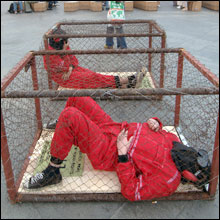
A recently-released Pentagon report admits to interrogating Guantanamo Bay prisoners after administering mind-altering treatments to them – often forcibly against their will – but stresses it was not done for the purposes of interrogation.
The report by the inspector general of the US Department of Defense obtained by truth-out.org under the Freedom of Information Act, found that some Gitmo inmates were questioned while receiving prescribed psychoactive treatments.
The Pentagon has tried to justify the facility staff’s actions, saying that “nowhere in the medical records did we find any evidence of mind-altering drugs being administered for the purpose of interrogation,” as the report states on page 13.
“The detainees were not given drugs as a means to facilitate interrogation,” insisted Pentagon spokesman Army Lt. Col. Todd Breasseale.
But the report does admit that “certain detainees, diagnosed as having serious mental health conditions being treated with psychoactive medications on a continuing basis, were interrogated.”
The inspector general also notes that “numerous” inmates have complained of being medicated against their will, but adds that wardens have used treatments known as “chemical restraints” to quell the aggressive individuals.
“Some detainees were involuntarily medicated to help control serious mental illnesses,” says a former commander of the Joint Medical Group at Guantanamo.
The report further admits that drugs administered “could impair an individual’s ability to provide accurate information.”
The medication under question, known as Haldol, has been used for over 50 years, and is often administered in psychiatric wards. Several side effects including depression, suicidal behavior and heart attacks are known to exist.
The Pentagon spokesman has refused to comment about how often such substances are used at the detention center, where the US has locked up nearly 170 men, writes the Washington Post.
Being drugged-up changes nothing?
After reviewing the report, David Remes, an attorney of one of the detainees, sounded an alarm saying that there is a vast possibility that statements and evidence obtained from those using psychoactive medication cannot be used in order to justify charging detainees held at the base.
The revelations in the study have raised numerous concerns among human rights activists.
“The inspector general’s report confirms that detainees whose mental deterioration and suffering was so great as to lead to psychosis and attempts at self-harm were given anti-psychotic medication and subjected to further interrogation,” Leonard Rubenstein, a medical ethicist at Johns Hopkins Center for Public Health and Human Rights, told truth-out.org.
However, some stipulate that evidence obtained through these methods would hold up in court.
Shayana Kadidal, from the Center for Constitutional Rights says that under the system set up by the US Court of Appeals for the District of Columbia, any statements detainees made during these interrogations would be presumed accurate “even if detainees took medication that could produce unreliable information.”
Kadidal added that “the burden ends up falling upon the detainee to prove what was said wasn’t accurate if they were challenging their detention in habeas corpus proceedings.”
Featured Video
John Mearsheimer: US Already lost Iran war – No off-ramp in sight
or go to
Aletho News Archives – Video-Images
Frlom the Archives
70 Neocons Petition Congress To Effectively Allow Israel To Say When The US Should Attack Iran
By Damian Lataan | January 10, 2014
Seventy senior Israeli-centric neoconservatives have written an open letter to Congress imploring them to do more to ensure Iran complies with the conditions of any agreement finally reached with the P5+1 over Iran’s nuclear program.
While the neocons are ostensibly asking Congress to ensure compliance, it is clear that their real aim is to convince members of Congress to support the bill currently passing through the Senate which calls for tighter sanctions against Iran in the event of any waywardness on Iran’s part.
The neocons are eager to see the bill currently passing through the Senate with enough support to make it veto-proof, not so much because they are concerned about Iran’s so-called nuclear weapons program – there’s still not a skerrick of hard evidence that Iran has a nuclear weapons program – but, rather, because embedded within the bill is this clause:
… if the Government of Israel is compelled to take military action in legitimate self-defense against Iran’s nuclear weapon program, the United States Government should stand with Israel and provide, in accordance with the law of the United States and the constitutional responsibility of Congress to authorize the use of military force, diplomatic, military, and economic support to the Government of Israel in its defense of its territory, people, and existence…
Essentially, the clause is an automatic trigger for the US to attack Iran at any time the Israelis choose to launch a first strike – regardless of whether President Obama is in favour or not.
Partial list… continue
Blog Roll
 Aletho News
- ‘Heinous crime’: Iran denounces Israeli assassination of 4 Iranian diplomats in Lebanon
- John Mearsheimer: U.S. Already Lost Iran War – No Off-Ramp in Sight
- UK Parliament Plans ISP Blocking and Age Verification Powers
- World cannot remain silent as US and Israel attack ‘heritage of humankind’: Iran
- Emirati billionaire rebukes US senator over call for Gulf states to join war with Iran
- Op. True Promise 4: Iran’s missile blitzkrieg dismantles US war machine in West Asia
- Aramco CEO warns ‘catastrophe’ imminent if Strait of Hormuz remains shut
- What If Iran Says No?
- Trump Threatens to ‘Hit’ Iran ‘Twenty Times Harder’ Over Strait of Hormuz Oil Flows
- Spare the hypocrisy: Baghaei slams Ursula’s support for US
- If Americans Knew
- Israel Decided the War, But Trump’s America Fights and Pays the Bill
- Conscientious Objector Group: Phone ‘Ringing Off Hook’ As Huge Mobilization Underway
- U.S. support for Israel continues to plummet, despite media’s best efforts
- Threats and missiles fly, death tolls soar in Iran, Lebanon, Gaza – Not a ceasefire Day 151
- Lebanon: Israel’s White Phosphorous Use Risks Civilian Harm
- Corporate Media Go All Out To Support The US-Israeli War On Iran
- US-Israel war on Iran is creating a steady growing number of amputees
- Israel planned this war on Iran for 40 years. Everything else is a smoke screen
- The wrong question about the war in Iran
- ‘Your Tax Dollars Being Used to Raise Your Gas Prices’: US-Israel Bomb Major Iranian Oil Depots
- No Tricks Zone
- New Study Documents A 20-Year Pause In Arctic Sea Ice Decline – Driven By Internal Variability
- Wake-up Call: Survey Shows Majority Of Germans Now Favor Postponing Climate Targets!
- Televised! Leading German Political Candidate Tells Schoolchildren CO2 Makes Sun Hotter!
- New Study: A Century Warming Of 1.1°C Is ‘Commonplace’ And ‘Not Unusual’ During This Interglacial
- New Study: ‘Internal Noise’ And Volcanic Forcing Can Trigger 10-15°C Warming Within Decades
- Glaciers Worldwide Are Suddendly Surging, Experts Blame Warming!
- Surprising Discovery: Sahara Is Greening…Billions Of Trees Where Once Thought To Be Barren
- New Research Reaffirms Clouds, Aerosols, And Surface Solar Radiation Are ‘Driving The Climate System’
- Germany: Electric Car Catches Fire At Charging Station, Sets Off Local “Inferno”, Widespread Damage
- New Study: Canada’s New Brunswick Was 1°C Warmer Than Today During The Medieval Warm Period
 Aletho News