Israeli settlers steal Palestinian olives in West Bank

MEMO | October 21, 2013
On Monday morning at dawn, Israeli settlers stole ripe olives from Palestinian farms in different areas of the occupied West Bank. Meanwhile, Israeli forces detained a Palestinian citizen at a moveable military checkpoint in Nablus.
Witnesses and farm owners told the Al-Quds Network that the settlers stole significant amounts of ripe olives from different farms. They also said that the settlers were hindering the arrival of many farmers who were heading to their farms in order to pick the olives.
Palestinian sources said that the settlers stole the olives from the neighbourhoods of Fara, Tal-Farata and Amateen. The sources also confirmed that the settlers were preventing farmers from approaching their farms, despite the farmers’ cooperation with Israeli officials in this regard.
Meanwhile, Israeli occupation forces invaded the Palestinian city of Nablus and detained Aboud Soboh, a Palestinian from the neighbourhood of Ras Al-Ein.
Witnesses reported that after invading the city, Israeli forces set up moveable checkpoints and then they arrested Soboh at one of these checkpoints.
Two of Soboh’s brothers are currently detained in Israeli jails.
Images from alquds.com
Related articles
- Jewish settlers cut down and burn hundreds of trees in Nablus and al-Khalil (alethonews.wordpress.com)
- Illegal Israeli settlers destroy olive trees in West Bank with impunity (sott.net)
“Nothing forbidden for them, but nothing allowed for us”
International Solidarity Movement | May 14, 2013
Qaryut, Occupied Palestine – Settlers from the illegal colony of Shilo set fire to land belonging to the nearby village of Qaryut. Around 25 families own land in this area. The land contained wheat crops and olive trees and is next to land previously stolen by settlers, which they had been cultivating for themselves only two days before.
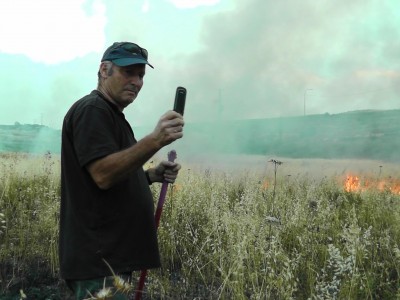
Illegal Shilo settler Moshka takes pictures of his handiwork, torching Palestinian land (Photo by Qaryut villagers)
Red Crescent paramedics went to the scene of the fires at around 6pm, where many villagers had already arrived hoping to put out the fires. However they were prevented from doing so by four settlers and half a dozen soldiers who had turned up to protect the settlers. Villagers were made to stand and watch their future harvest go up in flames. With the fires building up they had nothing to do but argue in vain with the soldiers about the gross immorality of the situation.
The settlers present also prevented the fire from spreading on to the annexed land they have been cultivating. It was clear to see the fires had been deliberately lit as there were many separate fires in a close range, rather than one large fire spreading on the overcast and wet day. Villagers witnessed Moshka, one of the settlers – (who is a regular problem causer; his son is a patrolman for the settlement too) – use a lighter to set fire to their land. The fire was only put out by the arrival of heavy and atypical rain from a thunderstorm an hour later.
Two days prior to this attack the settlers had started ploughing stolen land and cut down four trees. They have been expanding the settlement on the Palestinian side of the highway to Ramallah and Jerusalem. Fifteen dunams of land was torched. Meanwhile two dunums of wheatfields had been burnt in the South Hebron Hills earlier that day.
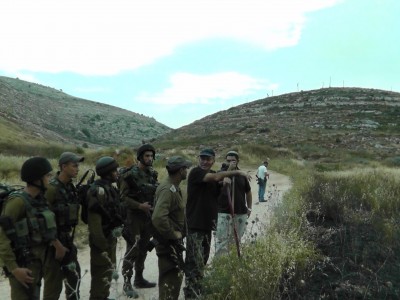
A familiar sight, soldiers and settlers working together (Photo by Qaryut villagers)
Related articles
- Tree planting met by tear gas and settlers’ death threats (palsolidarity.org)
- Witnesses: Settlers open fire at Palestinian homes in Hebron village (altahrir.wordpress.com)
- Settlers Attack Palestinian Property, Graves, Near Nablus (imemc.org)
Arson Attack on Olive Trees in Qaryut
October 14, 2012 | International Solidarity Movement, West Bank

Latif Ali with one of her trees that were destroyed
Last night in the West Bank village of Qaryut, 12 Palestinian owned olive trees were irreparably destroyed in a late night arson attack by Israelis from the illegal West Bank settlement of Eli.
The attack follows an incident last week, on the night of October 8th, in which settlers cut the branches from 130 trees with chainsaws. The branches will take some ten years to regrow, during which time the eight farmers who owned the trees will be without this crucial source of income.
The attacks seem to have been carried out so as to maximize economic impact. Many Palestinian olive farmers are financially dependent on the olive harvest, which begun earlier this week. In last night’s attack, the settlers seem to have targeted the oldest and most fruitful trees. They set fire to hollows in their trunks, which kills the tree. Growing a new one to their size takes hundreds of years.
The timing, too, maximized the impact of the attack. For the last two years, the Israeli government has run a permissions system for Palestinians harvesting olives in areas near to West Bank settlements: although the farmers own both the land and the trees, they have to apply for Israeli permission to access the land. Permission is usually granted for impossibly short periods of time: in this case, the Qaryut farmers were able to harvest for either two or three days (traditionally harvest lasts between four and six weeks). The first attack came the night before the first permissions began in the area, thereby devastating the harvest the night before it started.
Such incidents are not uncommon. During the last two harvests, a reported 300 trees were destroyed in Quryat alone. In 2009, the village suffered violent attacks by settlers from Eli and another nearby illegal settlement Shilo (more here and here). Such attacks are commonplace across the West Bank during olive harvest, when the symbolic and economic importance of the crop make their farmers frequent targets for settler violence.
Related articles
- Rights groups raise alarm over settler attacks on olive trees (alethonews.wordpress.com)
- Zionist settlers chainsaw Palestinians olive trees (occupiedpalestine.wordpress.com)
- Two Palestinians Injured After Being Attacked By Settlers Near Nablus (imemc.org)
- Jewish extremists cut down over 120 olive trees (altahrir.wordpress.com)
- Settlers uproot 300 olive trees near Ramallah (gazasolidarity.blogspot.com)
- Settlers destroy 18 olive trees Burin (alethonews.wordpress.com)
Rights groups raise alarm over settler attacks on olive trees
Ma’an – 12/10/2012
BETHLEHEM – As the West Bank olive harvest season begins, two Israeli rights groups released reports this week criticizing Israeli authorities for failing to protect Palestinians from settler violence, or investigate attacks.
Over the past week, Palestinian farmers have reported almost daily attacks on harvesters and olive groves in the West Bank.
Israeli rights group B’Tselem said on Thursday it had documented five of the attacks since Sunday.
That day, the Abu Fahaida family found 25 ancient olive trees destroyed in al-Janiya, west of Ramallah.
B’Tselem said Israeli forces had been called to the same olive grove the day before after a group of settlers confronted the family, noting that the army’s presence did not prevent the vandalism.

Jumaah Abu Fahaida examines the damage to his olive trees. (Iyad Hadad, B’Tselem)
Also Sunday, farmers from nearby Beitillu village going to harvest were attacked with stones by ten masked settlers, who are also suspected of setting fire to the field.
B’Tselem said Israeli soldiers faced difficulties controlling the settler group and removed the Palestinian harvesters while firing in the air.
On Tuesday, Palestinian farmers from Nablus villages Farata and Amatin found thieves had already harvested olives from around 220 trees on their land near the illegal Havat Gilad outpost.
In nearby Qaryut village the same day, farmers found more than 80 of their olive trees had been severely damaged.

One of the damaged trees at Qaryut. (Salma a-Debi, B’Tselem)
On Wednesday, Israeli authorities notified Ratib Naasan, from Ramallah village al-Mughayir, that his olive trees had been damaged. Naasan found around 140 olive trees stripped and vandalized.
B’Tselem noted that the farmer had olive trees vandalized in 2008, 2009 and 2010, but charges were only brought in one case, when the rights group provided video documentation.
It called on the army and police to investigate each incident and complaints that soldiers did not intervene to prevent attacks.
Meanwhile, rights group Yesh Din said on Thursday that of 162 attacks on Palestinian trees since 2005, only one case had led to charges.
The group said 124 files were closed on grounds of “perpetrator unknown,” 16 because of “insufficient evidence” and two on ground of “absence of criminal culpability.” Others are still under investigation, or information was not provided, while case files were lost for two incidents.
The failure of Israeli police to investigate the attacks is “only one aspect of its continuous and broad failure to enforce the law against ideological crimes by Israeli citizens against Palestinians in the occupied territories,” the group said.
The UN Office for the Coordination of Humanitarian affairs reported that over 2,500 olive trees were destroyed in September 2011, and 7,500 throughout 2011. The attacks cost Palestinian farmers over $500,000 that year, according to an estimate by Oxfam and local agricultural organizations.
Related articles
- Two Palestinians Injured After Being Attacked By Settlers Near Nablus (imemc.org)
- State and settlers’ illegal economic war against Palestinian olive farming (altahrir.wordpress.com)
- Jewish extremists cut down over 120 olive trees (altahrir.wordpress.com)
- Settlers uproot 300 olive trees near Ramallah (gazasolidarity.blogspot.com)
- Caught On Tape: “Settlers Harvest Palestinian Olive Trees” (imemc.org)
- Zionist settlers chainsaw Palestinians olive trees (occupiedpalestine.wordpress.com)
- Olive Harvest Palestine 2012: And Israel’s Settlers destroy 250 olive trees near Ramallah (occupiedpalestine.wordpress.com)
- Settlers Uproot 300 Olive Trees Near Ramallah (imemc.org)
Qaryut: 8 year old injured by bomb planted by Israelis
2 April 2012 | International Solidarity Movement, West Bank

Yemams father did not have time to respond to his son before the bomb exploded. Ripping through three layers of clothes and even more layers of skin, his father had to watch the tragedy unfold before his eyes. Yemam Mohammad Fatah Azam is just eight years old. He was enjoying a Friday afternoon with his father in the olive groves.
Situated between the illegal Israeli settlements of Shilo, Eli, and Suvat Rachel, Qaryut is not new to military and settler violence. Yamam’s story however is the first incident of its kind and has shaken the community. As floods of school children come to visit Yamam in his home, it is clear that all the parents are aware that the bomb could have been in their loved one’s hands. The children show they are upset with a handshake and sit next to Yamam in silence.
Bashar, a member of the Popular Commitee explains that the planting of un-exploded ordinance (UXO) ”… is an act to intimidate us from going to our land.”
Efforts by violent Zionist settlers have been well underway to intimidate farmers from visiting their land, and recently the village has joined the popular resistance with a Friday demonstration in protest of the closure of their road by Israeli military. The road runs through the land in which many farmers reside. One farmer explained, “It brings us much comfort to have cars passing through the road, we know if anything was to happen a car would stop and support us.”
As Yamam lays in bed, not able to move much due to the wound constantly re-opening, causing pain beyond comprehension, four more bombs lay on the land near by. This case has reached The United Nations group, OCHA, who has reported this in their “Protection of Civilians Weekly Report, 21-27 March 2012.” The Palestinian Authority is also addressing the issue as well. Both have been informed of the bombs which still reside on the land of the farmers, but have not been able to make the area safe. Due to the olive groves being in Area C, the Palestinian Authority has no permission to enter the land.
Related articles
- Kufr ad-Dik and Burqin march against boars, pollution, and violence by Israelis (alethonews.wordpress.com)
Featured Video
Prof. Ted Postol: Iran Already Achieved Nuclear Deterrence Against Israel
or go to
Aletho News Archives – Video-Images
From the Archives
How the occupied mentality syndrome works
Saudi Arabia on the American chessboard – Part 3
By B. J. Sabri | American Herald Tribune | June 27, 2016
Read part 2: “The occupied mentality Syndrome“
Previously I argued whether Saudi Arabia’s repeated involvements in U.S. interventions and wars stem from free national will or in response to a specific condition. For starters, in Saudi Arabia there is no national will. In Saudi Arabia, the national will is the will of the Al Saud clan. Still, when a major Arab state allies itself with a superpower that committed unspeakable crimes against humanity in almost every Arab country, then something is wrong. This fact alone should compel us to examine the U.S.-Saudi relation for one exceptional reason. As a result of the U.S.-Saudi wars, hundreds of thousands of people in Afghanistan, Iraq, Iran, Libya, Syria, Yemen, and Somalia have lost their lives. Millions became displaced in their own homelands. And millions more rendered refugees.
Attributing the Saudi policies to the bonds of “partnership” with the U.S. is frivolous. There are no bonds between these two thugs except those of business, military deals, secret plots, and wars. Proving this point, bonds such as these have no space for the American and Saudi peoples to share significant cultural or societal exchanges. If partnership is not the reason for the Saudi contribution to the U.S. strategy of empire and imperialism, then another reason must exist.
This leads to three possibilities. … continue
Blog Roll
 Aletho News
- Aircraft destroyed during US ‘rescue’ of downed F-15 pilot cost more than $100 million each
- Washington University removes professor who condemned US-Israeli war on Iran
- Russia Warns of Retaliation as UK Authorizes Seizure of Vessels
- Serbia thwarts plot to bomb Russia-Hungary gas pipeline – Vucic
- Al Mayadeen voices solidarity with Dr. Marandi amid death threats
- US dismantling international law in its war against Iran while claiming ‘false’ victory: Legal scholar
- One martyr, 5 injuries in US attack on Iraqi border crossing with Iran
- ‘This war is Israel’s war’: World facing ‘security breakdown’, says Qalibaf
- IRGC decries attack on US embassy in Riyadh, says executed by ‘Israel’
- Iran blasts EU hypocrisy as EU invokes international law over Hormuz
- If Americans Knew
- US loses planes over Iran, Israel downgrades Lebanon war goals – Daily Update
- Israel Is Blocking Palestinians from Easter at Church Where Jesus Resurrected
- Plot to assassinate Palestinian activist follows harassment campaign promoted by Zionist groups and elected officials
- Prominent New York synagogue hosts presentation on why U.S. Jews should support the ethnic cleansing of Gaza
- Tapper vs. Piker: Is the CNN Anchor Auditioning for David Ellison?
- Shouldn’t Democrats Be Able to Condemn Genocide?
- Israel-US kill negotiators, destroy civilian structures, but Iran’s military capabilities still largely intact – Daily Update
- ‘War crime’: Global condemnation as Israeli ministers celebrate death penalty law targeting Palestinian prisoners
- 7 Ways Israel Is Turning Lebanon Into Gaza
- World’s Leading Football Bodies Under Fire Over Israel Policies
- No Tricks Zone
- An Inconvenient Tree: Uncovered In Alps… Europe Much Warmer Than Today 6000 Years Ago
- New Study Reports A 60% Slowdown In Greenland’s Ice Loss Rate In The Last Decade
- Low Intensity Tornado Wrecks Major Solar Farm, Creating A Potential Toxic Dump
- New Study Finds Warming Saves Lives…Cold Temperatures 12 Times More Deadly Than Excess Heat
- German Science Blog Accuses PIK Climate Institute Of Hallucinating Climate Tipping Points
- Devastating Assessment Of Comirnaty Vaccine By Former Senior Pfizer Europe Toxicologist
- New Study: CO2 Is ‘Effectively Negligible’ As An Explanatory Climate Change Factor Since 2000
- Former Pfizer Toxicologist Dr. Helmut Sterz Tells Bundestag Hearing Pfizer Vaccine Should Have Never Been Approved
- Energy Expert: Germany’s Nuclear Phaseout Was A “500 Billion Euro Mistake”
- New Research: South Australia’s Mid-Holocene Sea Surface Temperatures Were 4°C Warmer Than Today
 Aletho News