Use of chemical weapons, “first act” by opposition interim government
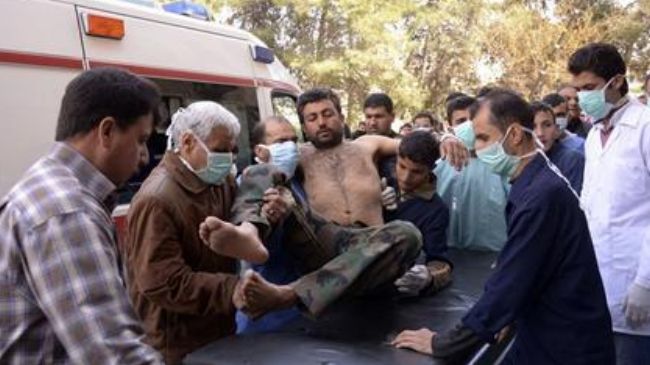
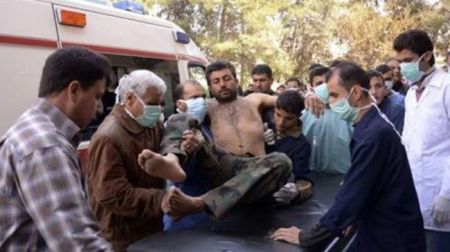 Residents and medics transport a Syrian soldier, wounded in Aleppo chemical attack, to hospital on March 19, 2013.
Press TV – March 19, 2013
Syrian Information Minister Omran al-Zoubi has described militants’ use of chemical weapons as the “first act” by the so-called opposition interim government.
The Syrian minister also said that Turkey and Qatar, which support militants fighting against the government of President Bashar al-Assad, bore “legal, moral and political responsibility” for the chemical attack in the northern city of Aleppo on Tuesday.
At least 25 people were killed and 86 others were injured after militants fired rocks containing “poisonous gases” into Aleppo’s Khan al-Assal village. Women and children are reported to be among the victims.
According to a Reuters photographer in Aleppo, victims of attack were suffering breathing problems.
“I saw mostly women and children. They (witnesses) said that people were suffocating in the streets and the air smelt strongly of chlorine,” he said adding that “people were dying in the streets and in their houses.”
Foreign-backed militants, who had threatened to use chemical weapons against the army government forces and Assad supporters a few months ago, have denied using chemical weapons and have accused government forces of being behind the attack.
The attack comes hours after Syria’s opposition National Coalition elected Ghassan Hitto, a former US-based IT executive, as prime minister for what it called an interim government.
48 Iranians Kidnapped in Syria Released
Al-Manar | January 9, 2013
Forty-eight Iranians held hostage by armed groups in Syria since August, were released on Wednesday.48 Iranian abductees
State television reported on Wednesday that the Iranians, who were threatened with execution, were released, but without saying further details.
Iran has appealed to Turkey and Qatar, both with close relations with Syria militants, for help in securing the release of the pilgrims who were visiting the Sayyida Zeinab shrine, a holy site in the southeastern suburbs of Damascus.
Related articles
- 48 Iranians released in first prisoner swap by Syrian rebels (thehimalayantimes.com)
What do they want from Syria?
By Finian Cunningham | Press TV | November 29, 2012
“What do they want from Jaramana? The town brings together people from all over Syria and welcomes everybody.” These were the anguished words of one distraught resident in the Syrian town of Jaramana that was devastated by multiple deadly explosions this week.
The death toll has yet to be confirmed. Early reports on the blasts said 34 were killed. Later, the toll was put at more than 50, with over 120 injured, many critical. All of the victims were civilian.
Over the past 20 months, Syria has witnessed dozens of massacres and horrific car bombings in its capital Damascus and in other cities and countless villages across the country. But the latest atrocity in Jaramana, located close to the capital, is distinguishable perhaps because it most clearly shows the vile Machiavellian mentality of the perpetrators in their broader strategy towards the Middle Eastern country.
As the words of the shell-shocked resident above indicate, Jaramana can be seen as an exemplar of the pluralist nature of the Syrian society, “welcoming everybody”. The town is particularly known for its Christian and Druze Muslim communities, who by all accounts have coexisted peacefully for centuries. The populace is also largely supportive of the Syrian government of President Bashar al-Assad.
This Wednesday morning, as workers, mothers and school children were going about their usual daily routine, two massive no-warning explosions ripped through the heart of Jaramana. The second blast was detonated minutes after the first one when bystanders were rushing to the scene to aid the wounded. The heinous calculation of the perpetrators was to maximise the killing and suffering.
“What do they want from Jaramana?” The answer is revealed in the resident’s subsequent words: “The town brings together people from all over Syria and welcomes everybody.”
The terrorist war on Syria, which the Western media trumpet as a “pro-democracy uprising”, is aimed at precisely the opposite of pluralist coexistence. What the terrorists want is to tear the tolerant soul out of the country and plunge its people into an internecine, hate-filled sectarian bloodbath.
The targeting of Jaramana is a deliberate, brutal calculation to precipitate such a bloodbath. The town has been inflicted with several similar, although less deadly, bombings in recent months. On 29 October, a car bomb killed 11 people.
There are no military or state security installations in Jaramana. As noted, it is a urban district known for its tolerance towards mixed religions and cultural heritage. But, for the terrorists and their fiendish mentality, that civic virtue made Jaramana a prime target.
The armed militants in Syria are driven by Sunni extremists of Wahhabist or Salafist tendencies, who see pluralist coexistence of Sunni, Shia, Alawite, Druze, Christian, Jews and non-believers as anathema to their demented puritanical ideology.
Other elements within the Syrian armed militant groups would appear to be simply “soldiers of fortune” – mercenaries and criminal opportunists who have no particular religious affiliation.
However, taken together, these various militant factions are united by one criminal goal: to smash Syria, ruthlessly and recklessly.
The Syrian society, as it currently exists with its emphasis on secular pluralism, must be destroyed at all costs by these extremists and criminal opportunists. The most effective way to sabotage Syria is to unleash a sectarian bloodbath and to pit communities at each other’s throats. That will ensure the collapse of the central government and the splintering of society into sects. In this intended milieu of violence, chaos and fear, Syria will then be at the mercy of those who want to dominate this proud, historic country.
The enemies are well known. Western governments have had their knives out for Syria over many years, seeing it as a strategic obstacle of popular resistance to Western imperialism and Zionism in the Middle East. The Sunni regimes of Saudi Arabia, Qatar, Turkey and latterly Egypt under Mohammed Morsi want to see Syria roped into their camp, with the added appeal of undermining Iran’s regional influence.
Saudi Arabia’s autocrats are particularly obsessed with defeating what they perceive jealously as the Shia Crescent represented by Iran, Syria and Lebanon’s Hezbollah. Both of these agenda converge on the objective of isolating Iran and setting up the Islamic Republic for an all-out military assault.
Syria is therefore a crucial geopolitical prize for the West and its regional allies. The supposed advocacy of democratic reforms by Western governments and their corporate media mouthpieces is of course a cynical cover for their criminal imperialist agenda. That particular ridiculous lie is exposed by the West’s collusion with the most repressive dictatorial regimes on the planet – the Persian Gulf monarchies – in “liberating” Syria.
Also, if Saudi Arabia and Qatar are so concerned about the welfare of their Arab Muslim brothers in Syria, why aren’t these supposedly chivalrous monarchs sending weapons and fighters to help the besieged Palestinian people of Gaza?
A measure of the Syrian prize is the criminal lengths to which the enemies of Syria are willing to go in order to vanquish the country and install their self-styled regime.
The massacres of families and children in villages like Houla and Qubair; the cold-blooded execution of civilians forced to kneel before their killers; and the callous bombing of civilians as seen this week in Jaramana are techniques of terror that the Western governments and their allies have perfected elsewhere over several decades. The Americans used such demonic scientific terrorism in Central America; the French in North Africa; and the British in East Africa and more recently in Northern Ireland.
Syria is witnessing the worst of all possible criminal assaults – the evolution and amalgamation of Western state terrorism fueled with the petrodollars of mindless Arab despots.
Adding to the abomination, many of the crimes in Syria have been filmed by the perpetrators and subsequently released claiming that they were the action of government forces. One incident was the explosive demolition of a mosque by the mercenaries in Aleppo, who were filmed laughing at their war crime. Western media claimed it was the Syrian national army, only for it to emerge that it was actually the members of the so-called Free Syrian Army.
Recent claims that the Syrian armed forces are using cluster bombs to kill children have been given the usual Western media prominence. But given the track record of the Western-backed mercenaries and the Western propaganda machine, the weight of suspicion surely lies on them.
Within hours of the mass murder of the innocents in Jaramana, the United Nations General Assembly in New York adopted a draft resolution condemning the Syrian government for what it called “widespread human rights abuses”.
The condemnation was co-sponsored by the United States, Britain, France, Saudi Arabia, Qatar and Turkey – the very sponsors of Western state terrorism plunging the Syrian people into a bloodbath. The UN stands as an institution that is not just a debased propaganda tool, it is a propaganda tool splattered with the blood of innocents.
~
Originally from Belfast, Ireland, Finian Cunningham (born 1963) is a prominent expert in international affairs. The author and media commentator was expelled from Bahrain in June 2011 for his critical journalism in which he highlighted human rights violations by the Western-backed regime. For many years, he worked as an editor and writer in the mainstream news media, including The Mirror, Irish Times and Independent. He is now based in East Africa where he is writing a book on Bahrain and the Arab Spring. He co-hosts a weekly current affairs programme, Sunday at 3pm GMT on Bandung Radio.
More Press TV articles by Finian Cunningham
Related articles
Qatar invites bids to reconstruct Gaza
Ma’an – 02/10/2012
GAZA CITY – The Qatari government on Tuesday invited tenders for four construction projects, in the first stage of a $254 million project to rebuild the war-torn Gaza Strip.
Qatar’s ambassador to Gaza Muhammad al-Imadi is heading a committee overseeing the work.
Consultants have been invited to submit designs for a city to be named after Sheikh Hamad Ben Khalifa al-Thani. The $30-million development will include 1,000 residential units in five-story apartment blocks, schools, stores, clinics, parks and entertainment facilities, the ambassador said in a statement.
Companies were also invited to bid for the repair of three major roads in the enclave. The 35-kilometer coastal highway al-Rashid Street will cost around $50 million to repair, and $18 million has been allocated to reconstruct the 10-kilometer al-Karama Street.
The 28-kilometer Salah Addin Street will be repaired first, at a cost of $60 million, as the plans and designs are ready, al-Imadi said.
In the coming days, consultants will be invited to bid for several agricultural projects, budgeted at $12.5 million.
Housing projects worth $32 million will also be announced this week to house needy families and to re-home those who were evicted for building on public land.
Related articles
- Hamas Asks Egypt To Transfer Qatar Fuel To Gaza (eurasiareview.com)
Egypt not mulling Arab intervention in Syria: Morsi spokesman
Ahram Online | September 30, 2012
Presidential spokesman Yasser Ali on Sunday denied media reports that Egypt had agreed to Arab military intervention in violence-wracked Syria.
Earlier on Sunday, Seif Abdel-Fattah, an aide to Egyptian President Mohamed Morsi, reportedly told the Turkish Anadoul news agency that Egypt was considering a Qatari proposal for Arab military intervention in Syria aimed at ending the 18-month-long conflict there.
Abdel-Fattah was also quoted as saying that Egyptian and Qatari officials were expected to discuss the proposal “soon,” adding that non-Arab Turkey might also be involved in the initiative.
According to Anadoul, the presidential aide went on to say that Morsi, during his current visit to Turkey, was attempting to drum up support for the Qatari scheme with his Turkish interlocutors.
Yet Ali insisted that Arab intervention in Syria remained “out of the question.” He added that Egypt’s rejection of military involvement in Syria remained unchanged, stressing that statements made by anyone other than the president or his official spokesman did not reflect Egypt’s official policy.
On Sunday, Morsi visited Turkey for the first time in his capacity as Egypt’s president, where he delivered an address at the annual meeting of Turkey’s ruling Justice and Development Party.
Related articles
- Egypt may join Arab intervention in Syria (alethonews.wordpress.com)
- Qatari in Egypt: Buying Foreign Policy (alethonews.wordpress.com)
Qatari in Egypt: Buying Foreign Policy
By Mohammad Khawly | Al Akhbar | September 11, 2012
Cairo – Qatar’s recent announcement that it plans to invest $18 billion in Egypt following President Mohammed Mursi’s controversial statements on Syria may herald a new era in Egyptian-Qatari relations, observers say.
Qatari Prime Minister Hamad bin Jassem announced the proposed investments at a joint press conference with Egyptian Prime Minister Hisham Kandil on September 6. This new wave of investment comes on the heels of a $2 billion Qatari loan to the Egyptian state, the first installment of which was deposited at the Central Bank of Egypt on August 23.
The announcement came just a week after Mursi made headlines at the Non-Aligned Movement summit in Tehran when he announced his full support for the Syrian revolution against what he called an “oppressive regime.”
At the opening session of the council of Arab ministers last Wednesday, Mursi reiterated his call for the regime leadership to step down.
“Now is the time for change,” Mursi said, addressing the Syrian regime. “There is no room for arrogance or presumptuousness. Do not listen to those voices tempting you to stay, for you will not remain for long.”
Many in the region see a link between Egypt’s unyielding stance on Syria and the recent spike in Qatari investments in Egypt. Whether this influx of Gulf money was the goal behind Cairo’s posturing or rather the loan and investments were a result of Mursi’s anti-Syrian position, which has broad support at home, no one can say. At least some factions in Egypt, including the Hazemoun movement linked to former Salafi presidential candidate Hazem Abu Ismail, view the Syrian uprising through a religious, sectarian lens as a jihad against an “infidel” Alawi army.
The investments involve $8 billion in major projects in Sharq al-Tafria, East Port Said, and another $10 billion will be spent on a gigantic tourism project on the northern coast including a marina for luxury yachts.
The projects are expected to provide job opportunities for thousands of workers, but some worry such projects could become a tool in the hands of the Qatari regime and a means of leverage in any future dispute.
Al-Akhbar spoke to the founder of the Ibn Khaldun Center for Development Studies Saad Eddin Ibrahim, who is familiar with Qatari politics.
In his opinion, Qatar wants Egypt’s support on political issues, particularly when it comes to internal Gulf disputes with Bahrain and Saudi Arabia, as well as other Arab countries.
Qatar is a small country that needs strong allies, said Ibrahim, but its relationships with its direct neighbors – Iran, Saudi Arabia, and Iraq – are fraught with difficulties. An ally in Egypt would not covet Qatari resources, making it a safe and powerful friend. In addition to increasing its political clout, Qatar also sees Egypt as a ripe investment opportunity.
Related articles
- Qatar to invest $18bn in Egypt over next 5 years (alethonews.wordpress.com)
- Egyptian president heads to China for investment talks (alethonews.wordpress.com)
Qatar to invest $18bn in Egypt over next 5 years
Ahram Online – September 6, 2012
Qatar will inject $18 billion worth of investments into Egypt over the course of the coming five years, Hamad Bin Jassim, the oil-rich gulf state’s foreign minister, said at a press conference in Cairo on Thursday.
Of the pledged investment, some $8 billion will be allocated to electricity and natural gas projects in areas east of the Suez Canal, where Egypt has longstanding plans to build a massive industrial city. Another $10 billion will go to a planned tourist resort on Egypt’s north coast.
In yet another indication of new found warmth between the two nations, Egyptian President Mohamed Morsi met with Bin Jassim following the latter’s arrival to Cairo on Thursday.
In early August, Qatar pledged to deposit $2 billion in the Central Bank of Egypt (CBE) as a means of easing the country’s balance-of-payments deficit. The promise was made following a visit by the Emir of Qatar, Sheikh Hamad bin Khalifa Al-Thani, to Egypt, where he too met with Morsi.
Later in August, Qatar deposited the first tranche – worth some $500 million – in the CBE.
Egyptian Prime Minister Hisham Qandil, for his part, said at a Thursday press conference that Qatar would transfer the rest of the pledged $2 billion in three installments within the next two-month period.
In 2011, Qatar had said it would provide Egypt with a $10 billion grant, with which to support Egypt’s post-revolution economy, but only ended up disbursing $500 million later in the year.
Qatar’s name has begun to resonate among Egyptian business circles, with Qatar’s National Bank recently offering to buy a controlling stake in National Societe Generale Bank, one of Egypt’s largest private lenders.
Related articles
- Qatar to invest in Egypt’s economy (english.ruvr.ru)
- Egypt requests $4.8bn IMF loan (alethonews.wordpress.com)
Qatar offered Syrian ambassador $5.8mn for defection – report
RT | August 11, 2012
Qatar’s ambassador in Mauritania allegedly offered his Syrian counterpart an advance payment of US$1 million and a monthly salary of $20,000 over 20 years, trying to convince the diplomat to defect and voice support for the opposition.
Hamad Seed Albni was also offered a permanent residence in the Qatari capital Doha, but refused the proposition, claims Lebanese-based Al-Manar TV. The diplomat reportedly called the offer a “blatant interference” in Syria’s affairs and warned not to come up with such initiatives anymore.
Bashar al-Assad’s government has endured a number of high-profile defections recently. Diplomats representing Syria in the United Arab Emirates and Iraq, Abdel Latif al-Dabbagh and Nawaf al-Fares, abandoned their positions and so did the country’s Prime Minister Riyad Hijab. The officials explained their defections, saying they could not work for a regime oppressing its own people
Damascus says Qatar uses its financial resources to promote defections among the ranks of Syrian officials. Doha reportedly allocated $300 million for the purpose, Iran’s Fars news agency claimed.
Three Iranians abducted by armed gangs in Syria killed
Press TV – August 6, 2012
Three of the Iranian pilgrims, who were kidnapped by armed insurgents near the Syrian capital of Damascus, have been killed, Reuters reports.
The so-called Free Syrian army has threatened to kill the rest of the pilgrims if the Syrian military does not stop attacking them.
Forty-eight Iranian pilgrims, who were traveling on a bus from Damascus International Airport to the shrine of Hazrat Zainab (AS) on the outskirts of the Syrian capital, Damascus, were abducted by insurgents on August 4.
The insurgents who have abducted the Iranian pilgrims had claimed that the hostages are members of Iran’s Islamic Revolution Guards Corps (IRGC) by simply referring to their military discharge cards.
An informed official at Iran’s Foreign Ministry on Sunday vehemently dismissed the reports by certain Arabic-language news networks that the Iranian pilgrims were military members.
On Saturday, Iran’s Foreign Minister Ali Akbar Salehi called his Turkish and Qatari counterparts Ahmet Davutoglu and Hamad bin Jasim bin Jabir Al Thani and asked for their assistance in securing the release of the hostages.
The Qatari and Turkish foreign ministers promised to do their best to bring about the liberation of the Iranian pilgrims.
According to a Qatari source, Turkey, Saudi Arabia and Qatar are sending weapons and communications equipment to the insurgents in Syria via a base that is located in the southern Turkish city of Adana, about one hundred kilometers from Syria’s border, to fight against the government of President Bashar al-Assad.
The Iranians were kidnapped in Syria days after seven Iranian Red Crescent Society (IRCS) members were abducted in Libya.
On July 31, The Libyan Red Crescent (LRC) said in a statement that unidentified gunmen kidnapped a seven-member IRCS delegation after they left the headquarters of the LRC in Benghazi.
The Iranian delegation went to Libya at the invitation of the Libyan Red Crescent to discuss various prospects for cooperation in the field of humanitarian assistance.
Insurgents Execute Pro-Assad Captives in Syria
Al-Manar | August 1, 2012
New graphic footage has emerged showing armed men killing their captives in the northwestern Syrian city of Aleppo simply for supporting President Bashar al-Assad.armed groups
The two-minute video, posted on YouTube and reported by the AFP, shows armed men killing elder members of the Syrian al-Berri tribe.
Amnesty International has already warned about reports of “summary executions” in Aleppo, calling them serious violations of international law.
This comes as the Syrian government earlier said that the armed rebel groups backed and funded by Saudi Arabia, Qatar and Turkey are committing “horrific crimes” against civilians in the capital, Damascus, and the city of Aleppo.
In two letters addressed to the head of the UN Security Council and the UN secretary general, the Syrian Foreign Ministry said the insurgents backed by Saudi Arabia, Qatar and Turkey are using civilians in Aleppo as human shields, and killing anyone who does not support their crimes.
The Syrian government says foreign-sponsored ‘outlaws, saboteurs, and armed terrorists’ are behind the unrest.
The ARAR model for toppling governments
Mehr News Agency | July 21, 2012
TEHRAN — The recent political and military turmoil in the region is following a predictable pattern, which starts with so-called activism and ends with military intervention to topple sovereign governments.
Following is a brief scenario of the chain of the events:
“A” phase: The pseudo-prodemocracy movement builds up steam and starts to develop. This development is either in the streets or in the media or both. The participants in the movement in this phase are called “activists” and the media starts to call the target government a “regime”.
“R” phase: After weeks and months of trying soft techniques to topple the government, the main approach is escalated to the militaristic stage and those once called “activists” are now called “rebels”. They usually receive assistance from regional military channels. The targeted government starts to react militarily, and the media starts labeling it a “brutal regime” or some other similar tag.
Second “A” phase: The usually decentralized rebel-guerrilla style movement upgrades to the “army” level. The “new army” receives intelligence and military support from extra-regional powers and/or their proxies, a massive amount of disinformation is disseminated, and military personnel are encouraged to defect or join the new army. The media starts comparing the opposition army to the conventional state army.
Second “R” phase: If the opposition army fails to topple the government by itself, plan B is put into effect, in which the media pushes the need for international intervention and the NATO/UN Security Council “raid” starts.
This ARAR formula — Activism/Rebelism/Army building/Multilateral Raid — was first implemented in Libya and is now in its final stages in Syria. The main players behind the game are the media — in this case, Qatari and Saudi media outlets in cooperation with Western media outlets — extra-regional powers such as the United States and Britain and their European allies, and finally, regional proxies such as Turkey, Qatar, and Saudi Arabia.
The key to foil the plan is both hard and simple: know the phase, inform public opinion about it, build up a coalition, discredit biased media outlets, cut and weaken regional procurement and logistics channels, balance the power, and “resist”.
Featured Video

Col Doug Macgregor: America’s Back to ENDLESS WARS
or go to
Aletho News Archives – Video-Images
From the Archives
Rabbi Shmuel Eliyahu: Leave No Palestinian or Arab Alive

By Jonas E. Alexis | Veterans Today | July 23, 2017
Israeli Rabbi Shmuel Eliyahu seems to have picked up where the late Rabbi Ovadiah Yosef left off. The Israeli army, Eliyahu said, must slaughter the Palestinians “and leave no one alive.” The Palestinians, the good rabbi continued, must be “destroyed and crushed in order to end violence.” Here is Eliyahu’s algorithm:
“If they don’t stop after we kill 100, then we must kill 1,000. And if they do not stop after 1,000, then we must kill 10,000. If they still don’t stop we must kill 100,000, even a million.”
There is more to this “logic” than meets the eye and ear. Eliyahu even postulated that the Israeli army ought not to get involved in arresting Palestinians because “If you leave him alive, there is a fear that he will be released and kill other people. We must eradicate this evil from within our midst.”
You may say that this is just an isolated case. No Israeli official believes that, right? … continue
Blog Roll
Recent Comments
papasha408 on Germany demands UN Rapporteur… papasha408 on Israel Demanding that Iran Lim… Coronistan on Why can’t western leaders acce… John Edward Kendrick on German government ‘embezzling’… loongtip on Von der Leyen to have new secu… papasha408 on First Gaza, then the world: Th… papasha408 on Is Nixing Aid to Israel a Pois… papasha408 on Japan to Sign Up For NATO’s Uk… Redracam on Iran Willing to Dilute Enriche… loongtip on When Threats Replace Evid… loongtip on Zelensky tried to kill the cha… eddieb on I might get killed for posting…


 Aletho News
- Kremlin comments on EU ‘myopia’ over dialogue with Russia
- Russia more adapted to contemporary military technology than NATO
- Germany puts caveat on more missiles for Ukraine
- UK High Court rules Palestine Action ban unlawful
- Populations in key NATO nations balk at sacrifices for military spending – poll
- Ukraine to ban Russian literature – culture minister
- 40 State Attorneys General Want To Tie Online Access to ID
- Col Doug Macgregor: America’s Back to ENDLESS WARS
- Villains of Judea: Haim Saban
- Germany demands UN Rapporteur Albanese resign, joining France
- If Americans Knew
- AZAPAC, the new PAC opposing Israeli domination of U.S policies
- Haim Saban: Billionaire for Israel
- Rafah e-wallet plan highlights Israel’s deepening financial occupation
- Viral post claims Netanyahu sought legal approval, igniting speculation about Israel’s organ harvesting
- AIPAC Has a New Opponent: PAL PAC
- Right-Wing Catholic Off Trump Religion Panel After Israel-Gaza Remarks at Antisemitism Event
- Jewish terrorism, apartheid rule the West Bank – Not a ceasefire Day 125
- Why Israel persecutes children like my son Shadi
- In Gaza, One Man Is Searching for the Remains of His Family With a Flour Sifter
- Horrific situation in Gaza, West Bank – Not a ceasefire Day 124
- No Tricks Zone
- German Gas Crisis…Chancellor Merz Allegedly Bans Gas Debate Ahead of Elections!
- Pollen Reconstructions Show The Last Glacial’s Warming Events Were Global, 10x Greater Than Modern
- Germany’s Natural Gas Storage Level Dwindles To Just 28%… Increasingly Critical
- New Study Rebuts The Assumption That Anthropogenic CO2 Molecules Have ‘Special’ Properties
- Climate Scientist Who Predicted End Of “Heavy Frost And Snow” Now Refuses Media Inquiries
- Polar Bear Numbers Rising And Health Improving In Areas With The Most Rapid Sea Ice Decline
- One Reason Only For Germany’s Heating Gas Crisis: Its Hardcore-Dumbass Energy Policy
- 130 Years Later: The CO2 Greenhouse Effect Is Still Only An Imaginary-World Thought Experiment
- New Study Affirms Rising CO2’s Greening Impact Across India – A Region With No Net Warming In 75 Years
- Germany’s Natural Gas Crisis Escalates … One Storage Site Near Empty …Government Silent
 Aletho News