US racks up billions in losses during first four days of war as Iran pummels key Pentagon assets: Report
The Cradle | March 4, 2026
Iran’s retaliatory strikes on US assets in the Persian Gulf have caused at least $2 billion in losses for Washington since the start of the war against the Islamic Republic, Anadolu Agency reported on 4 March.
Almost fifty percent of the losses result from Iran’s destruction of a US AN/FPS-132 early warning radar system at Al-Udeid Air Base in Qatar, which is worth $1.1 billion.
The Islamic Republic also took responsibility for shooting down three F-15E Strike Eagles over Kuwait on Sunday, an incident US Central Command (CENTCOM) claims was caused by “friendly fire” from Kuwaiti forces. The estimated cost to replace the jets is $282 million.
Attacks by Iran’s Islamic Revolutionary Guard Forces (IRGC) also caused heavy damage to the US Navy’s Fifth Fleet headquarters in Manama, Bahrain, destroying two satellite communications terminals and several large buildings.
“Using open-source intelligence reports, the targeted SATCOM terminals were identified as AN/GSC-52Bs, which approximately cost $20 million, factoring in deployment and installation costs,” Anadolu Agency reports.
Tehran has also reported destroying the AN/TPY-2 radar component of Washington’s Terminal High Altitude Area Defense (THAAD) air-defense system deployed at Al-Ruwais Industrial City in the UAE, estimated to be worth $500 million.
“Combining these costs, Iran has damaged $1.902 billion worth of US military assets in the region,” the Turkish news agency says.
On top of these losses, Washington spent at least $2.3 billion during the first four days of the war, which was launched without congressional approval by using post-9/11 emergency laws.
The first 24 hours of the so-called “Operation Epic Fury” alone cost around $779 million, including pre-strike mobilization expenses of $630 million.
“At the current scale of operations, a three-week war could easily exceed tens of billions of dollars in expenses,” the Center for American Progress (CAP) estimated on Tuesday.
The US public policy research and advocacy organization also emphasized that “a conservative estimate for the initial costs of Operation Epic Fury is more than $5 billion as of March 2—and the campaign is just getting started.”
More losses still need to be accounted for, as the IRGC and its regional allies have targeted at least seven US military sites across West Asia since the start of the war, destroying several US diplomatic missions and intelligence sites belonging to the CIA and Mossad.
EU gas prices surge 50% right as Germany and France face down lack of energy reserves after cold winter
Remix News | March 2, 2026
Natural gas markets across Europe experienced a violent price surge on Monday following news that Qatar has suspended operations at the world’s premier liquefied natural gas facility, which accounts for 20 percent of global output. EU leaders are reportedly preparing for a crisis scenario if the war drags on due to already low gas reserves in the biggest member states, particularly Germany and France.
Prices went as high as 50 percent before settling back down to the current level of 45 percent at the time of publication, resulting in the current price of €46 per megawatt-hour. Similar price jumps were seen in the United Kingdom’s NBP benchmark index.
Adding to a potential crisis, EU storage levels have dropped below 30 percent capacity at the end of the winter season, significantly lower than the 40 percent recorded at this time last year. However, some of the biggest countries are facing the lowest levels of gas. Gas Infrastructure Europe shows German storage at 20.5 percent and French reserves at 21 percent. These low inventories leave the bloc increasingly susceptible to price swings and supply shortages if an LNG crunch worsens.
Now, the EU is already considering scenarios where the war could drag on for a long period of time, including up to years. While President Donald Trump has cited the figure of “four weeks” in regard to wrapping up the war, it remains unclear how long the war could go on.
Politico reports that the EU’s efforts to wean itself off of Russian gas and oil have created a “panic moment.”
“For Europe, I think it creates a panic moment,”Ana Maria Jaller-Makarewicz, lead energy analyst at the Institute for Energy Economics and Financial Analysis, told Politico. “Four years ago [following Russia’s invasion of Ukraine] we had these issues.” But this time, she said, “We are not just now concerned about Russia, but about Qatar, the U.S. … so I think now since we have increased dependencies on other sources, we have also increased our vulnerability.”
Noting Qatar’s role as the second-largest supplier of LNG in the world, she noted that if Qatar cannot deliver natural gas efficiently and on time, “Russia could be the big beneficiary.”
“We could also see Russian energy flowing to other countries. There could be an opportunity for Russia if this Qatar LNG is stopped,” said the analyst.
QatarEnergy has not disclosed extent of damage
The energy crisis intensified after U.S. and Israeli military strikes on Iran escalated regional instability. In response to an attack on its infrastructure, QatarEnergy confirmed it had halted production linked to the North Field gas reservoir. While the company acknowledged the suspension, it gave no further details about the state of the fields and the company’s operations.
The world is currently focusing its attention on the Strait of Hormuz, a vital maritime chokepoint largely under Iranian influence.
Following the recent strikes, Iran has moved to obstruct traffic through the narrow passage, which serves as a primary artery for Qatari LNG and global oil, the vast majority of which is destined for Asian markets. However, energy is a global market, and a bottleneck in one location leads to a surge in prices everywhere.
The price surge may be only temporary, but experts warn that any prolonged closure of the strait could lead to a long-term surge in energy prices. Some have even warned of oil surging to $120 a barrel, while most believe prices within the range of $80 to $90 are a realistic possibility.
Gas prices spike amid fears of Middle East supply shock
RT | March 2, 2026
Gas markets around the world were rattled on Monday, with benchmark European natural gas prices rising sharply and broader energy markets on edge after Middle East tensions increased the risk to supplies via the critical Strait of Hormuz.
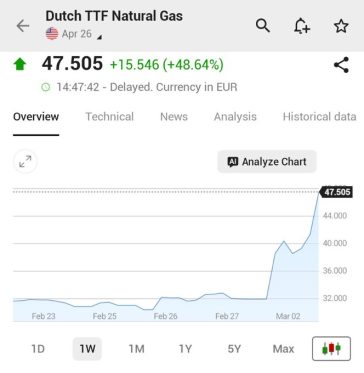 European benchmark gas futures surged by around 50% – their biggest single day move since March 2022 – after LNG tankers largely stopped transiting the Strait of Hormuz, the narrow waterway between Iran and Oman that carries about a fifth of global oil and gas shipments, over the weekend.
The spike was compounded by a drone strike on QatarEnergy’s major LNG complex at Ras Laffan, which forced production to be halted.
Crude markets also rallied, with Brent futures climbing to multi-month highs as the escalation further constrained energy flows from the region.
Across the Gulf, other energy sites have also been hit or temporarily shut, with producers suspending parts of their operations as a precaution. Saudi Arabia has reportedly paused activity at its Ras Tanura refinery following the attacks. With pipeline alternatives limited and shipping routes through the area stalling, traders are now pricing in the risk that supply lines could remain disrupted for an extended period.
Analysts warn that the turmoil could amount to the most serious shock to gas markets since the 2022 energy crisis. The EU is seen as particularly exposed. The bloc has already faced repeated jumps in energy costs since it scaled back Russian oil and gas imports following the escalation of the Ukraine conflict. Moving away from relatively cheap Russian pipeline gas has forced the bloc to lean more heavily on LNG deliveries, especially from the US. Now, with the heating season ending but storage sites less full than usual, the region requires substantial LNG imports over the summer to rebuild inventories ahead of next winter.
The rally comes as US President Donald Trump has indicated that military operations against Iran could continue for several weeks, while a number of major maritime insurers are preparing to stop covering war risks for ships entering the Persian Gulf.
Military strikes launched by the US and Israel against Iran on Saturday have shown no sign of easing. The intense attacks have reportedly killed Iranian Supreme Leader Ayatollah Ali Khamenei and other senior officials, including the head of the Islamic Revolutionary Guard Corps, while Tehran has responded with airstrikes against Israel and several Gulf states hosting US military assets. In a further sign of regional escalation, Lebanon’s Hezbollah has entered the fray with cross‑border attacks on Israeli military positions, prompting retaliatory airstrikes on the group’s infrastructure and command sites.
Analysts, including Goldman Sachs, estimate that a month‑long halt to shipping through the Strait of Hormuz could send European gas prices up by as much as 130% from current levels, putting renewed pressure on households and industry.
Kirill Dmitriev, Russia’s presidential envoy and head of the country’s sovereign wealth fund, argued that the latest price jump highlights the cost of Europe’s decision to move away from Russian fuel. In a social‑media post, he said EU gas prices “could more than double soon” and claimed that the bloc’s “strategic blunder of avoiding cheap and reliable Russian gas is backfiring.”
Forget Oil: Natural Gas Prices Are About to Go Through the Roof If Hormuz Isn’t Reopened Soon
Sputnik – 01.03.2026
“Gas prices may rise, because approximately 20% of the world’s LNG transits through the Strait of Hormuz, including all of Qatar’s production,” Igor Yushkov, a top Russian energy expert, told Sputnik, commenting on the Persian Gulf crisis.
“Qatar is one of the largest producers of LNG in the world, second only to Australia and the US. If there’s a shortage of LNG on the global market…the exchange price could easily exceed $1k or even 1.5k. We’ve seen similar prices in Europe even without such a shortage. So the price could skyrocket.”
According to Yushkov, “everything will depend on how long the tension in the Strait of Hormuz lasts,” including not only Iran’s readiness to reopen it, but gas producers’ willingness to resume transit.
“In any case, we will see higher shipping costs, higher insurance costs for ships,” with the situation “further exacerbated” by the fact that the Northern Hemisphere is still in the heating season, with Europe’s underground gas storage facilities being gradually depleted.
“Even though Qatar gas physically goes primarily to Asian markets, the exchange price will rise everywhere,” same as oil, Yushkov clarified. Qatar itself also has no alternative to Hormuz. “Therefore, if it is unable to export LNG, Qatar will simply have to stop production.”
Message to China
The current crisis is also “a major wake-up call for China,” with the US demonstrating its readiness to flout international law, Yushkov says.
“China is being shown that anything coming from the south is unsafe. Passage through the Strait of Hormuz may be interrupted today as part of the current conflict, but tomorrow the Americans could close it off to Qatari LNG supplies to the Chinese market.”
“Or they could close the Strait of Malacca, through which all the hydrocarbons going to China from Africa and the entire Middle East flow. Therefore, this is a signal to China that anything coming from the north is much safer, and much more difficult to shut down,” the observer summed up.
Murdering Khamenei Will Kill Trump’s Presidency
By Ian Proud | Strategic Culture Foundation | March 1, 2026
Ayatollah Seyyed Ali Khamenei was assassinated in what is being described in western media as a joint airstrike operation. Even though the Israeli air-force carried out airstrikes in and around Tehran, it is clear that these were supported by the U.S. military. As such, the U.S. is complicit in the murder of the Head of State of a sovereign nation.
And this unilateral military action once again proved both that the United Nations Charter has lost its value and that the UN Security Council is now broken.
In his opening remarks to the Security Council, Secretary General António Guterres condemned the military strikes by the U.S. and Israel, which also condemning the Iranian response, citing Article 2 of the UN Charter.
“All Members shall refrain in their international relations from the threat or use of force against the territorial integrity or political independence of any state, or in any other manner inconsistent with the Purposes of the United Nations.”
The enormous and ongoing military strikes against Iran were clearly in breach of that Article.
In its response to the Security Council, Iran’s Representative cited Article 51 of the UN Charter, which states that “nothing in the present Charter shall impair the inherent right of individuals or collective self-defence if an armed attack occurs against a Member of the United Nations, until the Security Council has taken measures necessary to maintain international peace and security.” Article 51 is one of only two exceptions to the general prohibition on the use of force by UN members set out in Article 2.
The strikes were all the more cynical for taking place part way through talks moderated by the government of Oman. Indeed, Guterres hinted at this in his remarks, saying:
“The U.S. and Israeli attacks occurred following the third round of indirect talks between the U.S. and Iran mediated by Oman.
Preparations had been made for technical talks in Vienna next week followed by a new round of political talks.
I deeply regret that this opportunity of diplomacy has been squandered.”
Pakistan’s representative at the Council was more blunt, saying that “diplomacy has once again been derailed as these attacks have happened right in the middle of negotiations.”
Indeed, the strikes confirmed that the UN Security council has become completely unable to take measures necessary to maintain international peace and security.
On the 80th anniversary of the founding of the UN Secretary General Guterres warned that “fragile” legitimacy of the Security Council could endanger global peace if it remains gridlocked and fails to fulfil its primary purpose.
All of the the western nations around the UN Security Council table last night showed themselves to be weak and silent, in the face of American’s military might.
As one, they criticised Iran’s unprovoked attacks on Gulf states, as Iranian ballistic missiles targeted U.S. military sites in Bahrain, Qatar, the UAE and Kuwait, while also targeting Israel. Self evidently, Iran was targeting U.S. military installations in all of those countries and. Indeed, the U.S.’ fifth fleet Headquarters in Bahrain was struck by at least one ballistic missile. Yet civilian sites also got hit, including in the UAE and in Bahrain.
However, there was no mention at all of the U.S. and Israeli strikes on Iran in the statements of western nations at the Security Council, as if they feared U.S. reprisals if they spoke out. Not a single word from the French, the Latvians, the Danes, the Greeks, even the Bahrainis, only that Iran murdered its citizens and should not be allowed to acquire a nuclear bomb.
In the end the acting UK Permanent Representative, James Kariuki, who I can tell you from personal experience is the most arrogant and puffed up British diplomat that I ever met, said that:
“Iran must refrain from further strikes, and its appalling behaviour, to allow a path back to diplomacy.”
The sitting President of the UN Security Council, the United Kingdom (the U.S. takes over the Presidency today) did not utter a single word about the USA or Israel. No attempt, as the country convening the meeting, to seek common ground and some agreement on the way forward.
Britain’ approach was merely to blame Iran in what the Russian Federation representative described in his intervention as ‘victim blaming’. I already knew that Britain had given up diplomacy in 2014, but this appeared yet another nail in a coffin which the UK refuses to bury as it pretends to be a nation of diplomacy. It is not. Britain is now a nation of warmongers without the troops to fight.
While final confirmation of the fact had yet to be provided at that time, the Prime Minister of Israel and President Trump were already celebrating the possible killing of Khamanei. ‘The dictator is gone,’ Netanyahu crowed.
In his social media statement, President Trump called on Iranian people to rise up and take over their country.
Yet within hours, sources within the CIA were already leaking reports that Khamenei may simply be replaced by IRGC hardliners.
As I have pointed out before, rather than fomenting revolution, unilateral military action against Iran may have the opposite effect and mobilise Iranian resistance.
This idea was stated with great clarity by Professor Robert Pape of Chicago University who said:
“With each passing day of regime-targeting airstrikes, we lose control over the political dynamics they unleash.
It becomes less about individual leaders and more about national survival. Less about dissent and more about resistance.
Imagine if a foreign power struck Washington and called on Americans to overthrow their government. Would citizens rally against their leaders — or against the foreign attacker?”
Iran is a country of 92 million people with an army of over 610,000. It is a tightly controlled state and as we saw in January is more than capable and ready to stifle internal dissent, including through violent means. It also does not have an oven-ready opposition lined up in the wings that can walk in unopposed and miraculously take over the country. To suggest that it does takes us into Bay of Pigs territory.
Having already kidnapped the Head of State of one sovereign nation already this year, the United States of America has now murdered another, Ayatollah Khamenei. This will unleash asymmetric threats against the U.S. and all of its allies that Donald Trump will not be able to control. If this military action drags out inconclusively, and I predict it will, then the mid-terms may prove catastrophic for Trump. I predict that the Iranian regime will outlast his.
IRGC drone completes lawful recon mission before contact lost
Al Mayadeen | February 3, 2026
Iran’s Islamic Revolution Guard Corps (IRGC) has reportedly lost contact with one of its drones during a reconnaissance mission over international waters, according to a source cited by Tasnim News Agency on Tuesday.
The Shahed 129 was conducting a routine operation when communication with the aircraft was suddenly interrupted.
Media reports earlier claimed that the US military downed an Iranian UAV that allegedly approached the USS Abraham Lincoln aircraft carrier in the Arabian Sea.
According to the Iranian source, the drone had been engaged in lawful reconnaissance and aerial photography, consistent with standard practices in international airspace. “The Shahed 129 drone was carrying out its routine reconnaissance and photography missions in international waters. This is considered normal and legal practice,” the source said.
The source added that the UAV had successfully transmitted all required imagery to the command center before contact was lost.
On the diplomatic front
This comes amid heightened regional tensions amid US threats to launch an aggression against Iran earlier in January. According to AFP, Saudi Arabia, Qatar, and Oman mounted a coordinated diplomatic effort on January 15 to dissuade US President Donald Trump from authorizing military strikes, warning that such an attack could trigger uncontrollable regional repercussions given the concentration of US military bases and strategic assets across the Gulf.
On the same day, diplomatic sources in Tehran told Al Mayadeen that a friendly regional party had informed Iran that Washington had reversed course on plans for military action following a reassessment of security and military risks, including the potential consequences of a large-scale strike and an evaluation of internal conditions inside Iran. Despite this reported pullback, Iranian authorities said they remained on full alert while keeping diplomatic channels open.
Both Tehran and Washington are expected to engage in mediated talks. Iranian Foreign Minister Abbas Araghchi and White House envoy Steve Witkoff are expected to lead the two negotiating teams. Araghchi held calls on Tuesday with his Omani and Turkish counterparts, as well as with the prime minister of Qatar.
Newly surfaced Epstein email ties him to Israel–UAE strategy targeting Qatar
MEMO | February 3, 2026
Newly uncovered emails dated July 2017 reveal disgraced sex trafficker Jeffrey Epstein, long accused of acting on behalf of Israeli intelligence, lobbying for political and financial pressure to be applied against Qatar at the height of the Gulf diplomatic crisis.
The email exchange, dated 6th July 2017, sees Epstein accusing Qatar of “terrorism financing,” describing its leadership as “dangerous,” and demanding that it be made to “come out against terrorism and not just say it.” He proposes creating a billion-dollar “victim fund” for terrorism survivors to be administered by the US, UK and UN, while calling on Qatar to either contribute financially or recognise Israel—framing both as tests of its sincerity in opposing terrorism.
Epstein outlines a strategy of reputational damage and financial pressure, proposing a Western-administered fund that would publicly test Qatar’s stance on terrorism. His language reflects the broader Israel–UAE effort at the time to isolate Qatar over its support for Palestinian rights and refusal to normalise relations with Israel.
The message was sent just weeks after the blockade on Qatar was launched by the UAE, Saudi Arabia and Bahrain in June 2017. Though publicly framed as a crackdown on terrorism and the Muslim Brotherhood, the blockade was seen as part of a broader effort to force Qatar to abandon its support for Palestine, close Al Jazeera, cut ties with Iran, and expel Turkish forces, demands that aligned directly with Israeli priorities.
As MEMO first reported in 2017, leaked emails from the UAE Ambassador Yousef Al-Otaiba revealed coordination with staunch pro-Israel figures in Washington, including Elliott Abrams and Dennis Ross, on strategies to “punish” Qatar. At one point, Abrams suggested that conquering Qatar would “solve everyone’s problems.” Al-Otaiba responded: “It would be an easy lift”.
Former German Foreign Minister Sigmar Gabriel later confirmed that the UAE had drawn up plans for a military invasion of Qatar. What prevented the assault was not US President Donald Trump, who publicly backed the blockade initially and called Qatar a “terrorism funder,” but then-Secretary of State Rex Tillerson, who intervened after being tipped off by Qatari intelligence, making over 20 calls in a frantic attempt to stop the invasion.
Throughout the crisis, Israeli and Emirati lobbyists jointly pressured US lawmakers to label Qatar a state sponsor of terrorism. The Foundation for Defense of Democracies, a pro-Israel neo-conservative outfit backed by billionaire and Benjamin Netanyahu ally Sheldon Adelson, worked closely with UAE officials to frame the narrative in Washington. Netanyahu himself met with UAE and Bahraini diplomats to coordinate efforts behind the scenes.
The email places Epstein—widely considered to have been a Mossad asset involved in sophisticated blackmail operations—squarely within the broader effort to isolate Qatar during the 2017 blockade. His proposals echo the strategy pursued by Israel and the UAE to punish Doha for its support of Palestinian rights and refusal to normalise relations with Israel
How Trump’s Iran Gambit Could Blow Up the Entire Persian Gulf
By Viktor Mikhin – New Eastern Outlook – February 1, 2026
Washington’s aggressive preparations under Donald Trump’s leadership will not bring victory but are guaranteed to result in a humanitarian and economic catastrophe for every single country in the region. This would turn the Gulf’s vital waters into the epicenter of an uncontrollable fire.
The Persian Gulf region is once again teetering on the brink of an abyss. Under the pretext of “promoting regional security,” the United States, led by its unpredictable administration, is engaging in blatantly provocative military escalation. The arrival of the USS Abraham Lincoln carrier strike group and large-scale Air Force exercises are not steps toward stability but classic intimidation tactics. In the current climate of extreme tension, such moves risk a catastrophic blowback.
Tehran has made it clear: this time, any attack, even a “surgical” one, will be considered a declaration of full-scale war. The consequences of this decision, born of desperation and confidence after repelling aggression in June 2025, will fall not on Washington but on Iran’s neighbors across the Gulf. The US, acting as an irresponsible arbiter, is ready to set fire to a house where others live.
Iran as the Cornered Victim: Why Deterrence No Longer Works
The Trump administration seems stuck in the past decade, believing the language of ultimatums and muscle-flexing can still force Tehran to capitulate. Iranian Foreign Ministry spokesman Esmaeil Baghaei shattered that illusion in his sharp statement on January 26. Iran, he said, is “fully prepared to deliver a large-scale and regrettable response.” A key doctrinal change was articulated by a senior Iranian official to Reuters: “This time, we will consider any attack—limited, surgical, or kinetic—as a full-scale war.”
What does this mean in practice? It means Trump’s calculation of a precise strike with no serious consequences is a dangerous fantasy. Iran will no longer tie its hands by responding proportionally to a local incident. A strike on a nuclear facility? The retaliation will target American bases in Qatar, the UAE, and Bahrain, housing thousands of US troops and costly infrastructure. An attempt to eliminate a senior leader? As Brigadier General Abolfazl Shekarchi stated, it would mean Iran “sets their world on fire and deprives them of any peace”—referring to asymmetric warfare by all means. Thus, the US is creating a situation where any spark, any miscalculation, will inevitably escalate into a high-intensity regional conflict.
Immeasurable Disaster for Gulf States: Economic Collapse and Humanitarian Crisis
The Gulf Cooperation Council (GCC) countries must clearly understand: in case of war, they will not be bystanders or “quiet beneficiaries” but the front-line and primary victims.
– Blocking the Strait of Hormuz. This is not a threat but an inevitability in a full-scale conflict. Iran has repeatedly demonstrated the capabilities of its navy and coastal defense missile systems. Shutting down this narrow chokepoint, through which about 30% of the world’s seaborne oil trade passes, would send global prices into chaotic turmoil. However, the first budgets to collapse would be those of Saudi Arabia, Qatar, the UAE, and Kuwait, whose existence depends on hydrocarbon exports. Global economies would withstand the shock, but the Gulf economies would plunge into a deep crisis.
– Strikes on Critical Infrastructure. Oil refineries and petrochemical complexes in Al-Jubail (Saudi Arabia) or Ras Laffan (Qatar), desalination plants, ports, airports —a ll these facilities are within range of Iranian missiles and drones. The result would be not only economic disaster but a humanitarian one: lack of fresh water, halted logistics, collapsed life-support systems in cities.
– Escalation Across All Fronts. The war would not be limited to exchanges between the US and Iran. It would immediately fuel conflicts in Yemen (where the Houthis would strike Saudi Arabia and the UAE with renewed force), Syria, Iraq, and Lebanon. The US, with an ocean ensuring its security, can wage a “projection war.” The Gulf states have nowhere to retreat—the fire will rage at their doorstep and then spread inside.
Trump’s Irresponsibility and “Big Lie” Tactics
Donald Trump, whose foreign policy has always balanced between populism and rash aggression, is displaying glaring irresponsibility in this situation. His administration, instead of seeking diplomatic solutions, is deliberately ratcheting up tension, believing in its own impunity. However, as Baghaei rightly noted, “instability in the region is contagious,” and “any miscalculation by Washington will inevitably lead to the destabilization of the entire Middle East.”
The information warfare tactics employed deserve particular condemnation. As the Iranian Foreign Ministry pointed out, “the Zionist regime is the main source of fake news.” This refers to a targeted campaign of lies and disinformation, compared by Tehran to hysterical propaganda. False reports about secret diplomatic guarantees or mass executions in Tehran aim to create an image of Iran as an irrational and bloody regime in the eyes of the American public and the international community, justifying a “preemptive” strike. Trump, known for his fondness for loud but unverified statements, becomes the perfect conduit for this “big lie,” drowning out voices of reason.
The new strategy described by Ali Larijani, Secretary of Iran’s Supreme National Security Council, appears even more cynical. He stated explicitly that the US has moved to provoking social crises within Iran to create a pretext for military intervention under the guise of “protecting human rights.” Funding and supporting “semi-terrorist urban groups” and attacks on national symbols — all are part of a hybrid war aimed at destroying internal solidarity.
What does this mean for the Gulf monarchies? It is a direct warning. If the US uses such methods against Iran today, tomorrow they could be applied to pressure any country in the region whose policy ceases to suit Washington. Supporting the American gamble today is buying a ticket into tomorrow’s turbulence, where internal stability becomes a bargaining chip in a grand geopolitical game.
Diplomacy: The Only Path to Saving the Region
Against this grim backdrop, the position of the United Arab Emirates provided a hopeful signal. They clearly stated that their territory, airspace, and waters would not be used for hostile actions against Iran. This step reflects a growing, though not always openly expressed, understanding in GCC capitals: the path to their own security lies not through war with Iran but through complex yet essential dialogue and mutual respect for sovereignty.
On this matter, Kremlin spokesman Dmitry Peskov issued a sharp warning, stating that any military strike on the Islamic Republic would lead to “serious destabilization” in the Middle East. Addressing journalists, Peskov called the prospect of an attack “another step towards serious destabilization of the situation in the region,” emphasizing that Moscow expects all international parties to show restraint and resolve differences exclusively through “peaceful negotiations.”
History has repeatedly shown that US military interventions in the Middle East brought only chaos, increased terrorism, and instability (Iraq, Libya, Syria). A new Trump adventure, if realized, would surpass all previous ones in its destructive consequences. It would not “bring order” but would blow up an already fragile region, burying the economic prosperity of the Persian Gulf states under the rubble and setting back their development for decades. Responsibility will lie not only with the reckless US leadership but also with those regional players who, blinded by short-term enmity, failed to prevent the catastrophe. There is still time for sober calculation and urgent diplomacy, but the clock is ticking down by the day.
Murdering Khamenei Will Kill Trump’s Presidency
By Ian Proud | Strategic Culture Foundation | March 1, 2026
Ayatollah Seyyed Ali Khamenei was assassinated in what is being described in western media as a joint airstrike operation. Even though the Israeli air-force carried out airstrikes in and around Tehran, it is clear that these were supported by the U.S. military. As such, the U.S. is complicit in the murder of the Head of State of a sovereign nation.
And this unilateral military action once again proved both that the United Nations Charter has lost its value and that the UN Security Council is now broken.
In his opening remarks to the Security Council, Secretary General António Guterres condemned the military strikes by the U.S. and Israel, which also condemning the Iranian response, citing Article 2 of the UN Charter.
“All Members shall refrain in their international relations from the threat or use of force against the territorial integrity or political independence of any state, or in any other manner inconsistent with the Purposes of the United Nations.”
The enormous and ongoing military strikes against Iran were clearly in breach of that Article.
In its response to the Security Council, Iran’s Representative cited Article 51 of the UN Charter, which states that “nothing in the present Charter shall impair the inherent right of individuals or collective self-defence if an armed attack occurs against a Member of the United Nations, until the Security Council has taken measures necessary to maintain international peace and security.” Article 51 is one of only two exceptions to the general prohibition on the use of force by UN members set out in Article 2.
The strikes were all the more cynical for taking place part way through talks moderated by the government of Oman. Indeed, Guterres hinted at this in his remarks, saying:
“The U.S. and Israeli attacks occurred following the third round of indirect talks between the U.S. and Iran mediated by Oman.
Preparations had been made for technical talks in Vienna next week followed by a new round of political talks.
I deeply regret that this opportunity of diplomacy has been squandered.”
Pakistan’s representative at the Council was more blunt, saying that “diplomacy has once again been derailed as these attacks have happened right in the middle of negotiations.”
Indeed, the strikes confirmed that the UN Security council has become completely unable to take measures necessary to maintain international peace and security.
On the 80th anniversary of the founding of the UN Secretary General Guterres warned that “fragile” legitimacy of the Security Council could endanger global peace if it remains gridlocked and fails to fulfil its primary purpose.
All of the the western nations around the UN Security Council table last night showed themselves to be weak and silent, in the face of American’s military might.
As one, they criticised Iran’s unprovoked attacks on Gulf states, as Iranian ballistic missiles targeted U.S. military sites in Bahrain, Qatar, the UAE and Kuwait, while also targeting Israel. Self evidently, Iran was targeting U.S. military installations in all of those countries and. Indeed, the U.S.’ fifth fleet Headquarters in Bahrain was struck by at least one ballistic missile. Yet civilian sites also got hit, including in the UAE and in Bahrain.
However, there was no mention at all of the U.S. and Israeli strikes on Iran in the statements of western nations at the Security Council, as if they feared U.S. reprisals if they spoke out. Not a single word from the French, the Latvians, the Danes, the Greeks, even the Bahrainis, only that Iran murdered its citizens and should not be allowed to acquire a nuclear bomb.
In the end the acting UK Permanent Representative, James Kariuki, who I can tell you from personal experience is the most arrogant and puffed up British diplomat that I ever met, said that:
“Iran must refrain from further strikes, and its appalling behaviour, to allow a path back to diplomacy.”
The sitting President of the UN Security Council, the United Kingdom (the U.S. takes over the Presidency today) did not utter a single word about the USA or Israel. No attempt, as the country convening the meeting, to seek common ground and some agreement on the way forward.
Britain’ approach was merely to blame Iran in what the Russian Federation representative described in his intervention as ‘victim blaming’. I already knew that Britain had given up diplomacy in 2014, but this appeared yet another nail in a coffin which the UK refuses to bury as it pretends to be a nation of diplomacy. It is not. Britain is now a nation of warmongers without the troops to fight.
While final confirmation of the fact had yet to be provided at that time, the Prime Minister of Israel and President Trump were already celebrating the possible killing of Khamanei. ‘The dictator is gone,’ Netanyahu crowed.
In his social media statement, President Trump called on Iranian people to rise up and take over their country.
Yet within hours, sources within the CIA were already leaking reports that Khamenei may simply be replaced by IRGC hardliners.
As I have pointed out before, rather than fomenting revolution, unilateral military action against Iran may have the opposite effect and mobilise Iranian resistance.
This idea was stated with great clarity by Professor Robert Pape of Chicago University who said:
“With each passing day of regime-targeting airstrikes, we lose control over the political dynamics they unleash.
It becomes less about individual leaders and more about national survival. Less about dissent and more about resistance.
Imagine if a foreign power struck Washington and called on Americans to overthrow their government. Would citizens rally against their leaders — or against the foreign attacker?”
Iran is a country of 92 million people with an army of over 610,000. It is a tightly controlled state and as we saw in January is more than capable and ready to stifle internal dissent, including through violent means. It also does not have an oven-ready opposition lined up in the wings that can walk in unopposed and miraculously take over the country. To suggest that it does takes us into Bay of Pigs territory.
Having already kidnapped the Head of State of one sovereign nation already this year, the United States of America has now murdered another, Ayatollah Khamenei. This will unleash asymmetric threats against the U.S. and all of its allies that Donald Trump will not be able to control. If this military action drags out inconclusively, and I predict it will, then the mid-terms may prove catastrophic for Trump. I predict that the Iranian regime will outlast his.
Is a New Saudi-Led Axis Forming against the UAE & Israel?
By Robert Inlakesh | The Palestine Chronicle | January 12, 2026
The emergence of a new alliance in the region has the potential to challenge some of Israel’s more aggressive endeavors, so this could end up working in favor of the Palestinian people in some regards.
Prior to October 7, 2023, the Kingdom of Saudi Arabia appeared poised to join the so-called “Abraham Accords” alliance and normalize ties with Israel. Now it appears to be forming new alliances and even undermining Israeli interests, pursuing a different regional cooperation agenda. Where this leads will be key to the future of the region.
In September of 2023, the Crown Prince of Saudi Arabia, Mohammed bin Salman, had informed Fox News that normalization with the Israelis was growing closer. This development came as then-US President Joe Biden had been seeking to broker such an agreement, which appeared to be his administration’s planned crowning achievement in the foreign policy realm.
The Hamas-led Al-Aqsa Flood operation changed the regional equation entirely. Riyadh, instead of normalizing ties with the Israelis and seeking concessions from the United States in order to enter into a regional alliance against Iran, began considering a different option entirely.
Israel’s weakness in the face of the Hamas-led attack was one message to the entire region, which was that if it could not even take care of its own security issues against a guerrilla army equipped with light weapons, then how could an agreement with Tel Aviv ensure the security of its allies? Another element to the developments in Gaza was that Israel decided to commit a genocide in order to restore its image in the region and in a gambit to “solve the Gaza question”.
This behavior, combined with attacks on nations across the region, evidently served to set normalization talks back and pushed Saudi Arabia to reaffirm its commitment to the Arab Peace Initiative of the 2000s—in other words, no normalization without a viable Palestinian State.
Then came the Israeli bombing of neighboring Qatar, a message to all Gulf nations that Israel is ready to act against any of their territories. It was even reported that Israel’s missiles flew over Saudi airspace in order to reach their target.
Since then, Saudi Arabia has been busy attempting to secure its interests and has signed a security pact with Pakistan as part of this effort. It is very likely that a large driving element behind this deal was to ensure that a future Iran-Israel war would not impact them directly. The Saudis are also currently working to strengthen their ties with Iran.
Yet Riyadh didn’t stop with Pakistan; it is now reportedly in high-level talks with Turkey in an attempt to bring them into the fold of their security agreement, in what is being labeled a Middle East NATO project. While it is perhaps too soon to predict the outcome of these talks and where such an agreement would lead, it suffices to say that there is certainly a realignment going on in West Asia.
The ongoing feud between the United Arab Emirates (UAE) and Saudi Arabia was sent into overdrive when the Emiratis decided to order their proxies in Yemen to seize key regions of the nation’s east, home to 80% of the country’s oil reserves. These Southern Transitional Council (STC) separatists, backed by the UAE, took over the Mahra and Hadramaut provinces, posing a major security risk to the Saudis and Omanis.
In reaction to the UAE’s meddling, Riyadh decided to take the gloves off in Yemen and crushed the STC entirely. But the backlash against Abu Dhabi was not limited to the end of their proxy militia’s role in Yemen; instead, there was a media war in the UAE that aimed to expose its crimes across West Asia and in Africa, as well as a prepared economic blow.
As a result, there was a diplomatic fallout between the UAE and Algeria, over Abu Dhabi allegedly backing separatist movements there, and later the government of Somalia even rescinded its agreements with the Emiratis, following UAE-Israeli meddling in their affairs, in regard to the recognition of Somaliland as a State.
If Riyadh and Ankara do end up forming some kind of security alliance, it will likely also include Qatar. It would then prove interesting to see how they all coordinate on issues like Libya and Sudan. The Emiratis not only back the Rapid Support Forces militants in Sudan, who stand accused of committing genocide and mass rape, but long threw their weight behind warlord Khalifa Haftar in Libya.
This would also mean that the UAE’s role in Syria could be undermined or completely terminated, as it could also be forced from other areas of influence, like Iraq, too. It is clear that both Turkey and Saudi Arabia have sway in Lebanon, so depending upon what their goals are there, this may prove an interesting development for the Lebanese predicament, too. The same goes for Egypt and beyond.
One thing to keep in mind is that such an alliance would not equate to an Axis of Resistance-style opposition to the Israelis. Although Riyadh may see it fit to teach its Emirati neighbors a lesson, the likelihood of any serious conflict with the Israelis is thin.
It is true that the Israelis, aided by their UAE lapdogs, are pursuing an ultra-aggressive policy in the region, especially against Ankara. Yet this competition is not one between warring nations seeking to defeat each other decisively; it is viewed, at least for now, as a competition instead. Turkey maintains its relations with Israel; the Saudis, on the other hand, have not formally recognized Tel Aviv, but have long been in communication with their Israeli counterparts.
An alliance of this nature does not serve as a new support system for any resistance front in the region; instead, it seeks to achieve security and to escape the grip of the emerging “Greater Israel” project. At this stage, it has become abundantly clear that there are no promises of a prosperous future through aligning fully with the Israelis; instead, Tel Aviv will aggressively pursue its interests against every nation in the region and doesn’t respect any agreements it signs. The recent Emirati-Israeli actions demonstrate this perfectly.
Ultimately, the emergence of a new alliance in the region has the potential to challenge some of Israel’s more aggressive endeavors, so this could end up working in favor of the Palestinian people in some regards.
This could prove beneficial to the Islamic Republic of Iran, which, instead of facing total isolation and seeking to combat Israeli schemes alone, may, on different issues, find itself on the same page as the Saudi-led alliance. Some analysts have posited that Tehran may eventually join such a security pact, although it is way too early to say if such a development is even on the cards.
Overall, we should not expect Riyadh to do a total one-hundred-and-eighty-degree foreign policy shift, nor should that be expected of Ankara; after all, they are US allies and maintain close relations with Washington. The real question is whether the United States is willing to push back against such an alliance for the sake of Israel, which is when things will really begin to get interesting.
– Robert Inlakesh is a journalist, writer, and documentary filmmaker. He focuses on the Middle East, specializing in Palestine.
Trump scrambles to contain fallout from Israeli crime spree with meeting in New York
MEMO | September 22, 2025
President Donald Trump is set to host a high-level meeting with a select group of Arab and Muslim leaders on Tuesday in New York to discuss the ongoing Israeli genocide in Gaza. The summit, to be held on the sidelines of the UN General Assembly, comes as Western governments declared their recognition of the State of Palestine and amid growing international condemnation of Israel’s war crimes.
Two Arab officials confirmed to Axios that leaders from Saudi Arabia, the United Arab Emirates, Qatar, Egypt, Jordan and Turkey have been invited to the closed-door meeting, which will take place at 2:30pm Eastern Time.
The summit is expected to precede Trump’s meeting with Israeli Prime Minister Benjamin Netanyahu, scheduled for 29 September at the White House. Sources familiar with the preparations said Arab leaders will call on Trump to pressure Netanyahu to end the assault on Gaza and to abandon plans to annex the illegally occupied West Bank.
Washington’s agenda reportedly includes a proposal for Arab and Muslim countries to contribute to a post-war stabilisation plan in Gaza, including potential troop deployments to replace the Israeli occupation forces. However, such proposals are expected to meet resistance unless a political framework guaranteeing Palestinian sovereignty is agreed.
Trump is also expected to hold a second meeting on Tuesday with leaders of the Gulf Cooperation Council (GCC), including Oman, Bahrain and Kuwait, to address broader regional concerns including Israel’s escalation in the region.
The unprovoked attack on Doha two weeks ago by Israel was met was global condemnation. Qatar reportedly demanded an apology before the resumption of negotiations.
Israel’s strike triggered an emergency summit of Arab and Muslim countries in Doha, and was swiftly followed by a new Saudi-Pakistani security pact—widely interpreted as a response to growing doubts about Washington’s reliability as a security guarantor in the Gulf.
Israeli intransigence is also threatening to unravel the hallmark foreign policy initiative of Trump’s previous presidency: the so-called Abrahm Accords. The UAE has reportedly warned that any annexation of the West Bank could lead to the collapse of the agreement which saw a number of Arab states normalise ties with the occupation state. The White House has not issued an official statement in response to the reports.
Qatar After the Airstrikes: Assessing Viable Responses to Israeli Aggression
By Abbas Hashemite – New Eastern Outlook – September 16, 2025
Since the Israeli attack on Doha, the Arab world has been looking for a collective response. However, the Arab states have limited viable options available due to their over-reliance on the US.
Israel’s Attack on Doha: A Dangerous New Precedent in the Gulf
The Israeli attack on Qatar last week astonished the whole world. Doha has long been seen as a mediator, as it played a constructive role in establishing peace between different conflicting parties, including the United States and the Taliban. It was also playing a mediatory role between Hamas and Israel. Hamas leadership was present in Doha to discuss the peace proposal presented by the Trump administration. However, the Israeli government conducted airstrikes in Doha on the building in which the Hamas leadership was present. Although the Hamas leadership survived the attack, these airstrikes raised serious concerns about the sovereignty and security of the Gulf States.
The Gulf countries have largely been reliant on the US alliance for their security. The latter supplies most of the arms and weapons to these countries. However, the US air defense system did not intercept any Israeli missiles during the recent strikes in Doha, implying that the US security guarantees to the Gulf States are selective and are only motivated to counter threats emanating from Iran. Moreover, this demonstrates that the US green-lighted the Netanyahu administration to conduct these criminal strikes in an affluent neighborhood in Doha.
Although the Trump administration has denied all the claims about the US support to the Israeli government in these strikes, and it has condemned this move in the United Nations, the US Secretary of State, Marco Rubio, is on a two-day visit to Israel to ensure continued US support to the Zionist state. This further demonstrates that the United States prioritizes Israel over its Arab allies, and all its airbases in the Gulf countries are actually to protect Israel against the regional threats.
Limited Military Options and Growing Frustration
Qatar’s Prime Minister Sheikh Mohammed bin Abdulrahman bin Jassim Al Thani described the Israeli attacks on Hamas leadership in Doha as “state terrorism that is being exerted by someone like Netanyahu.” He further stated, “I think that we have reached a decisive moment. There should be retaliation from the whole region in the face of those barbaric actions that only [reflect] one thing: It reflects the barbarism of this person that is leading the region, unfortunately, to a point where we cannot address any situation, and we cannot repair anything, and we cannot work within the frameworks of international laws. He just violates all those international laws.”
A strong response by Qatar and Arab states is mandatory to ensure their sovereignty and security in the future. However, given the Arab states’ overreliance on the US security guarantees and arms, they are left with very few options to retaliate against Israel. A military response to Israel is impossible for the Gulf States, as they do not possess enough military capabilities. Moreover, the US would never allow them to collectively attack Israel. Therefore, a collective military response could lead to internal security threats due to the presence of the US airbases in these countries.
Strategic Realignment: From US Dependence to Eastern Alliances
The Gulf States, however, could push Israel towards regional diplomatic isolation. The UAE, Bahrain, Morocco, and Sudan established diplomatic relations with Israel in 2020, following the Abraham Accords, which were mediated by the United States. The UAE summoned the Israeli diplomat to denounce these airstrikes in Doha. Mohammed bin Zayed Al Nahyan, the President of the UAE, visited Qatar within 24 hours of the attack to discuss the situation. The UAE and other Arab states could limit or downgrade their diplomatic relations with Israel in retaliation for these attacks.
Qatar has already lobbied for a unanimous UN statement condemning the illegal Israeli attack in Doha. It will also host an Arab-Islamic summit in Doha to coordinate a collective response to Israeli attacks. Leaders from almost all the Islamic countries, including KSA, Pakistan, Turkey, and Iran, are expected to attend this extraordinary summit. Moreover, the Gulf States could also join the International Court of Justice’s cases against Israel, further building pressure on the Zionist state to halt its genocide and occupation in Palestine.
Gulf States, especially Qatar, the UAE, the KSA, and Kuwait, hold significant economic leverage over Israel due to their energy resources. They could use their economic leverage to impose trade and economic sanctions on Israel by boycotting companies that have stakes in the Israeli economy. Qatar, Saudi Arabia, and the UAE pledged a collective investment of $3 trillion in the US economy during Trump’s last visit to the region. The intention behind this investment was to strengthen relations with the United States. However, the recent failure of the US to protect Qatar from Israeli attack could result in the Gulf nations’ quest for new global allies.
Over the past few years, the world has witnessed unprecedented economic growth in Russia and China. In 2023, China brokered a peace deal between Iran and Saudi Arabia to normalize their bilateral diplomatic relations. Russia, on its part, has emerged as a strong military and diplomatic power on the global stage. The two new superpowers of the world are already aligned with the Palestine policy of the Muslim world. Moreover, they possess unmatchable military power. The recent US failure to protect Qatar from Israeli attacks has provided the Arab states with a new direction to expand their diplomatic and strategic ties. They could engage with Russia and China to strengthen their defense sector and expand their diplomatic clout. This would not only prove detrimental for Israel but would also hurt the US regional and global interests.
Аbbas Hashemite – is a political observer and research analyst for regional and global geopolitical issues. He is currently working as an independent researcher and journalist
Featured Video

or go to
Aletho News Archives – Video-Images
From the Archives
Israel Would Have No Qualms About USS Liberty-Style FALSE FLAG If Iran Campaign Falters – Analysts
By Ilya Tsukanov – Sputnik – 18.06.2025
Donald Trump is mulling whether or not to join Israel’s aggression against Iran as Tel Aviv faces problems sustaining its defenses against growing counterstrikes, and apparently lacks a realistic game plan for an end to hostilities after failing to achieve its goals. Analysts told Sputnik how the US could be ‘nudged’ into the conflict.
“The US is already assisting Israel with supplies, intel, refueling support, etc. One of the many US posts in the region could be attacked for a casus belli,” former Pentagon analyst Karen Kwiatkowski explained.
“If Trump doesn’t comply with Israel’s demand” and join its aggression voluntarily, “a false flag may be needed” to drag the US in, Kwiatkowski, retired US Air Force Lt. Col.-turned Iraq War whistleblower, fears.
Netanyahu has a diverse array of options at his disposal, according to the observer, including:
- a false flag against US assets abroad blamed on Iran or one of its Axis of Resistance allies, like the Houthis
- a US domestic attack or assassination blamed on Iran
- Iranian air defenses ‘accidentally’ hitting a civilian jetliner carrying Americans
- use of a dirty bomb or nuclear contamination somewhere in the region blamed on Iran
- even blackmailing by threatening to use nukes against Iran if the US doesn’t join the fight
Kwiatkowski estimates that Israel probably has “enough blackmail power” against President Trump and Congress to avoid the necessity of a false flag operation, but a “USS Liberty-style” attack, targeting the soon-to-be-retired USS Nimitz supercarrier that’s heading to the Middle East, for example, nevertheless cannot be ruled out entirely, she says. … continue
Blog Roll
 Aletho News
- Smotrich calls for annexation of South Lebanon to Litani River
- Echos of Gallipoli? Hormuz and the Geography of Hubris
- Pakistan PM backs Iran’s right to self-defense amid tensions
- Hungary blasts ‘fake’ EU accusation
- SAFE Debt Trap: Poland’s €43.7 Billion Bet on Unipolar Illusion
- War on Iran threatens global Gulf capital flows: FT analysis
- Mossad De Facto Admits To Inciting Riots In Iran
- Tehran: World grown thoroughly exhausted with US-Israeli ‘false flag storylines’
- Trump ‘stuck between a rock and a hard place’, lacks Iran war strategy: Ex-CIA chief
- Trump’s bombardment of fake news so far is working quite well. But where is it heading?
- If Americans Knew
- From Sde Teiman, the truth about Israel’s military justice system has been set free
- Child denied life-saving bone marrow transplant by Israel ‘because he is from Gaza’
- Raffi Berg: BBC Middle East Editor Exposed as CIA, Mossad Collaborator
- Jerusalem Archbishop Rebukes Netanyahu’s Statements on Christianity
- US to embed Palantir AI across entire military: Report
- Israeli-US war on Iran to drag on “a few more weeks” – Not a ceasefire Day 164
- Lebanon deaths top 1,200; Palantir AI to be embedded across US military – Not a ceasefire Day 163
- Israel’s assassination game: Take all pragmatists off the board
- Food shortages return to Gaza as Israel tightens aid restrictions under the cover of its war on Iran
- Trump demands trillions in payments from Gulf countries, billions from Harvard – Not a ceasefire Day 162
- No Tricks Zone
- Devastating Assessment Of Comirnaty Vaccine By Former Senior Pfizer Europe Toxicologist
- New Study: CO2 Is ‘Effectively Negligible’ As An Explanatory Climate Change Factor Since 2000
- Former Pfizer Toxicologist Dr. Helmut Sterz Tells Bundestag Hearing Pfizer Vaccine Should Have Never Been Approved
- Energy Expert: Germany’s Nuclear Phaseout Was A “500 Billion Euro Mistake”
- New Research: South Australia’s Mid-Holocene Sea Surface Temperatures Were 4°C Warmer Than Today
- Storing Green Energy To Last Germany 10 Days Would Require A 60-Million Tonne Battery
- New Studies: UK Sea Levels Were 4 Meters Higher Than Today During The Mid-Holocene
- Destructive Green New Deal: German Energy And Metal Group Warns Of Drastic Crisis
- New Study Documents A 20-Year Pause In Arctic Sea Ice Decline – Driven By Internal Variability
- Wake-up Call: Survey Shows Majority Of Germans Now Favor Postponing Climate Targets!
 Aletho News