Can Right and Left Rally Against Walmart?
By Ralph Nader | November 28, 2013
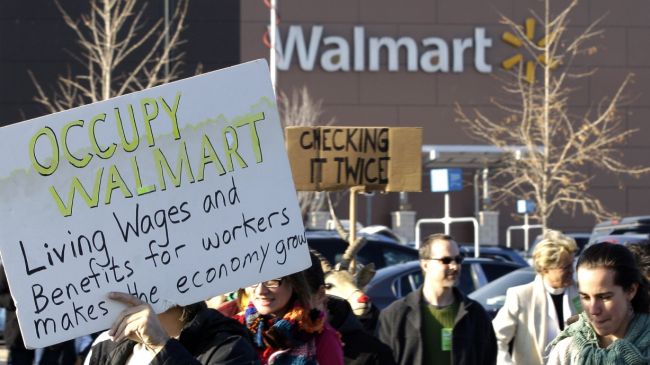
One of the most profitable corporations in America is having a holiday food drive. Sounds good — it’s the least Corporate America can do for those struggling to make ends meet while big companies rake in record profits and give so little back. But wait… there’s a catch. The food drive is for the company’s own underpaid, poverty-stricken workers. You really can’t make this stuff up.
Last week, it was reported that a Walmart store in Canton, Ohio is asking for food donations for its own employees. Photos of the food donation bins circulated online showing signs that read: “Please donate food items here so associates in need can enjoy Thanksgiving dinner.” (That’s if they even have a chance to — Walmart stores are open on Thanksgiving and are beginning their “Black Friday” deals at 6 p.m. on Thanksgiving Day to get a jump on the holiday shopping madness.)
Walmart is America’s largest employer with a workforce consisting of 1.3 million “associates.” The company made nearly $17 billion in profit last year. So why can’t Walmart afford to pay its own store workers enough for them to enjoy a holiday meal with their families? The answer is Walmart doesn’t really care about its workers.
If the Walmart food donation drive doesn’t get you properly steamed, then consider that Walmart CEO, Mike Duke, makes approximately $11,000 an hour — he took home about $20.7 million last year, plus ample benefits. Still not mad? It has also recently been reported that Duke has a retirement package worth more than $113 million! That is 6,200 times larger than the average 401k savings of a non-executive level Walmart employee! (Check out this recent report which charts other massive CEO pensions in relation to those of average workers)
One final fact to really get your dander up — The Walton family, heirs to the Walmart fortune, have accumulated more financial wealth than the entire bottom 40 percent of the population of the United States or 313 million Americans. That’s six Waltons worth a combined $102.7 billion!
No matter what one’s political leanings may be, the problem of massive income inequality and insatiable corporate greed is worsening year-by-year as CEO salaries rise, overall corporate profits soar and worker salaries stagnate. Liberal or conservative–all Americans should be outraged by this trend.
I recently wrote to conservative anti-tax advocate Grover Norquist to bring both sides of the political spectrum together on this troubling issue. In the past, Mr. Norquist and I have backed popular, reasonable policies, such as putting the full text of government contracts online, rolling back corporate welfare and opposing the civil liberties restrictive Patriot Act. As someone who claims to care about taxpayer protection, the issue of poverty-level wages and their major effect on taxpayers should be an important issue for Mr. Norquist.
Here’s why — low wages at the 10 largest fast food chains cost taxpayers $3.8 billion per year. Fifty-two percent of families of fast food workers have to rely on government assistance. McDonald’s’ “McResource” help line goes so far as to advise workers who cannot make ends meet from their poverty-level wages to sign up for government food stamps and home heating assistance. Is it fair that taxpayers have to shell out $1.2 billion a year to subsidize McDonald’s paying its workers while the fast food giant rakes in $5.5 billion in profit?
Walmart is even worse — according to a study from the Democratic staff of the House Committee on Education and the Workforce study, a single Walmart Supercenter store in Wisconsin can cost taxpayers upwards of $1.75 million in public assistance programs. If taxpayers have to cover over $1 million for just one 300-employee superstore, consider how much Walmart is costing taxpayers each year at their 4,135 stores in the United States. According to the 2012 “Walmart Associate Benefits Book”, which is distributed to employees, the company also advises its workers about getting on public assistance. Is this a fair or reasonable burden on taxpayers as Walmart reports $17 billion in profits?
Over the past five years, Walmart has had enough excess funds to buy back billions in its own stock. Walmart reportedly spent $7.6 billion last year buying back its shares. These funds are enough to raise the salaries of the lowest paid workers by $5.83 an hour. Catherine Ruetschlin, policy analyst at Demos, stated in a recent release: “These share repurchases benefit an increasingly narrow group of people, including the six Walton family heirs. But buybacks do not improve the fundamentals of the firm. If the funds were used to raise the pay of Walmart’s 825,000 low paid workers, it would not harm the retailer’s competitive ability and would add no cost to the consumer.”
(See the recent report from Demos titled: “A Higher Wage is Possible”)
The quickest way to lessen reliance on food stamp, EITC and Medicaid outlays is to raise the federal minimum wage. Raising the wage has the backing of 80 percent of Americans, 69 percent of Republicans, and even writers from The National Review and The American Conservative magazines. So why isn’t there more rage from the other end of the political spectrum? Even Rick Santorum and Mitt Romney supported raising the minimum wage to keep up with inflation — at least until Mitt Romney flip-flopped on the issue during the 2012 election.
The support of Grover Norquist and the Congressional followers of his no-tax pledge would be a significant boost for 30 million struggling workers who make less today than workers made in 1968, inflation adjusted. With a doubling in both worker productivity and the cost of living, there is no excuse for such a decline in their livelihoods.
Mr. Norquist, join this fight to protect taxpayers. Underpaid workers (who are also taxpayers) and their families need your support.
Corporatizing National Security: What It Means
By Ralph Nader | June 20, 2013
Privacy is a sacred word to many Americans, as demonstrated by the recent uproar over the brazen invasion of it by the Patriot Act-enabled National Security Agency (NSA). The information about dragnet data-collecting of telephone and internet records leaked by Edward Snowden has opened the door to another pressing conversation—one about privatization, or corporatization of this governmental function.
In addition to potentially having access to the private electronic correspondence of American citizens, what does it mean that Mr. Snowden—a low-level contractor—had access to critical national security information not available to the general public? Author James Bamford, an expert on intelligence agencies, recently wrote: “The Snowden case demonstrates the potential risks involved when the nation turns its spying and eavesdropping over to companies with lax security and inadequate personnel policies. The risks increase exponentially when those same people must make critical decisions involving choices that may lead to war, cyber or otherwise.”
This is a stark example of the blurring of the line between corporate and governmental functions. Booz Allen Hamilton, the company that employed Mr. Snowden, earned over $5 billion in revenues in the last fiscal year, according to The Washington Post. The Carlyle Group, the majority owner of Booz Allen Hamilton, has made nearly $2 billion on its $910 million investment in “government consulting.” It is clear that “national security” is big business.
Given the value and importance of privacy to American ideals, it is disturbing how the terms “privatization” and “private sector” are deceptively used. Many Americans have been led to believe that corporations can and will do a better job handling certain vital tasks than the government can. Such is the ideology of privatization. But in practice, there is very little evidence to prove this notion. Instead, the term “privatization” has become a clever euphemism to draw attention away from a harsh truth. Public functions are being handed over to corporations in sweetheart deals while publicly owned assets such as minerals on public lands and research development breakthroughs are being given away at bargain basement prices.
These functions and assets—which belong to or are the responsibility of the taxpayers—are being used to make an increasingly small pool of top corporate executives very wealthy. And taxpayers are left footing the cleanup bill when corporate greed does not align with the public need.
With this in mind, let us not mince words. “Privatization” is a soft term. Let us call the practice what it really is—corporatization.
There’s big money to be made in moving government-owned functions and assets into corporate hands. Public highways, prisons, drinking water systems, school management, trash collection, libraries, the military and now even national security matters are all being outsourced to corporations. But what happens when such vital government functions are performed for big profit rather than the public good?
Look to the many reports of waste, fraud, and abuse that arose out of the over-use of corporate contractors in Iraq. At one point, there were more contractors in Iraq and Afghanistan than U.S. soldiers. Look to the private prisons, which make their money by incarcerating as many people as they can for as long as they can. Look to privatized water systems, the majority of which deliver poorer service at higher costs than public utility alternatives. Visit privatizationwatch.org for many more examples of the perils, pitfalls and excesses of rampant, unaccountable corporatization.
In short, corporatizing public functions does not work well for the public, consumers and taxpayers who are paying through the nose.
Some right-wing critics might view government providing essential public services as “socialism,” but as it now stands, we live in a nation increasingly comprised of corporate socialism. There is great value in having public assets and functions that are already owned by the people, to be performed for the public benefit, and not at high profit margins and prices for big corporations. By allowing corporate entities to assume control of such functions, it makes profiteering the central determinant in what, how, and why vital services are rendered.
Just look at the price of medicines given to drug companies by taxpayer-funded government agencies that discovered them.
(Autographed copies of my new book Told You So: The Big Book of Weekly Columns are available from Politics and Prose, an independent book store in Washington D.C.)
Obama Has Been Speechless on Minimum Wage

A Black Agenda Radio commentary by Glen Ford | September 4, 2012
The impoverishment of politics in the Age of Obama has been nothing short of amazing. This president has so suppressed every vestigial remnant of progressivism in the political discourse, that the most fundamental bread and butter issues have become taboo. I’m talking about raising the federal minimum wage, which has been stuck at $7.25 an hour since 2007, the year before the bottom fell out of the economy.
A new study shows that the Great Recession was most destructive of decent-paying jobs, the middle tier where working people earned between about $14 and $21 an hour. That’s where sixty percent of job losses occurred between 2008 and 2010, and most of those jobs have not come back. Instead, the greatest increase in jobs has come in the low-wage sector, with a median pay from $7.69 – just above the federal minimum – to $13.83 an hour. The lowest wage sector now accounts for almost 60 percent of job growth, with traditionally bad-paying jobs in food preparation and retail sales leading the way.
High unemployment, on top of the disappearance of living wage jobs. You would think that in an election year, the party that is most identified with working people and folks that need to find work would be screaming at the top of their lungs: Raise the minimum wage! But, you will hear little or nothing of that from the Democratic convention festivities in Charlotte.
It’s not that the delegates are unaware of the crying need for a higher minimum wage. The Democratic platform – for what its worth – declares that “we will raise the minimum wage, and index it to inflation.” However, it doesn’t say how much, or when. And that’s in deference to the party’s standard bearer, who has not said anything meaningful about the minimum wage since he was campaigning for president in 2008. Back then, Obama promised to work to raise the minimum to $9.50 by 2011. Then he got elected, and we heard nothing more about it.
When the president is mum on an issue, then the party faithful put themselves on mute. There are bills in the House and the Senate to raise the minimum wage – the best one is sponsored by Chicago Congressman Jesse Jackson, Jr., calling for an immediate $10 an hour minimum, tied to inflation. But, there’s no chance of these bills going anywhere without the cooperation of Democratic leadership. Ralph Nader and others have beseeched party leaders to break the silence, but they don’t dare raise the issue for fear of embarrassing their President.
Apologists for Obama will claim that pushing for a $10 minimum wage indexed to inflation – or any significant raise – would hurt his chances for re-election. But the poll numbers show differently, with huge public support for an increase, including among lots of Republicans. Even Mitt Romney says he supports linking the minimum wage to inflation – just not right now. Obama has effectively been saying “no, not now” to underpaid workers for almost four years. So, why in the hell is labor getting ready to spend tens of millions of dollars to re-elect him, instead of building a movement that will force politicians to do the right thing?
BAR executive editor Glen Ford can be contacted at Glen.Ford@BlackAgendaReport.com.
Related articles
- A Bold New Labor Call for a ‘Maximum Wage’ (alethonews.wordpress.com)
- STUDY: Raising The Minimum Wage Especially Benefits Women (thinkprogress.org)
New Postal Service Plan a Bait and Switch, Equivalent of Closing 5,567 Post Offices
New “POSt Plan” Is Not Good News for Rural Post Offices or Their Customers
Ralph Nader | May 11, 2012
Consumer watchdog, Ralph Nader, today said, “The Postmaster General’s Post Office Structure Plan (“POSt Plan”) is a bait and switch tactic, and is not good news for rural Post Offices.”
The Postmaster General claims that his new strategy, released on Wednesday, is designed to benefit rural Americans and keep open the 3,652 postal facilities it was considering for closure. Though it is unclear how many of these offices are included in the “POSt Plan”, it seems that many of them have been incorporated in the new plan as well. The new direction that the Postmaster General proposed is to cut hours at nearly 13,000 Post Offices and offer early retirement incentives for more than 21,000 non-executive postmasters.
“As more details about the plan emerge, the picture grows increasingly dire for rural customers of the U.S. Postal Service,” Nader observed. “I expressed deep concern about the preliminary details of the Postmaster General’s plan on Wednesday. Unfortunately, those fears were confirmed as we have analyzed the details of the Postmaster General’s new strategy.”
After examining 260 pages of the U.S. Postal Service’s proposal for Post Office hour reductions nationwide, we found that the new strategy eliminates 42,699 hours per day from retail window hours of nearly 13,000 Post Offices.
“This proposal is calling for a gargantuan cut in retail window hours nationwide – 42,699 total hours each day. To put this in perspective, 42,699 hours equates to nearly 5 years,” Nader explained.
The current average retail window hours of the nearly 13,000 Post Offices proposed for reduced hours are 7.67 hours per day. “The enormous cut in hours that the U.S. Postal Service has proposed is the equivalent of closing 5,567 of these Post Offices. The Postmaster General started with a list of 3,652 offices being considered for closure. Now we see that by reducing window hours he has proposed the equivalent of closing 2,000 more offices than he started with,” Nader continued.
Nader concluded by saying, “This is, plain and simple, a bait and switch. As I said on Wednesday, by further restricting Post Office hours the Postmaster General makes the corporate “alternatives” to the U.S. Postal Service more likely and sets the stage for future Post Office closings when the revenues and workload of reduced-hours offices inevitably suffer. The Postmaster General has effectively taken a list of 3,652 offices that were on the chopping block and added nearly 10,000 more offices to that list.”
Related articles
- Ralph Nader Calls for the Postmaster General to Resign (alethonews.wordpress.com)
Ralph Nader Calls for the Postmaster General to Resign
The Nader Page | April 26, 2012
Consumer Advocate Ralph Nader today called for Postmaster General Donahoe’s resignation. Several consumer non-profits joined him in this letter, including Public Citizen, Consumer Action, the Gray Panthers, and Essential Information. The Postmaster General Donahoe is “actively presiding over the demise of one of our country’s greatest founding institutions,” said Nader.
In December 2011, Congressman DeFazio called for the Obama administration to fire Postmaster General Donahoe. From the House floor he said, “This guy, this so-called postmaster general, should be fired because of a lack of any imagination or initiative…He’s proposing the death knell for the great United States Postal Service.”
In his letter, Nader drew attention to the fact that, if the U.S. Postal Service was not required by Congress to prepay retiree health benefits of the next 75 years by 2012, nearly 80 percent of the USPS’s deficit would be eliminated. Nader stated that this is “an imposition unheard of in either the corporate world or by any other government agency.” He continued by pointing out that the federal government even owes the U.S. Postal Service $80 billion in overpayments that the USPS has made to two retirement funds, the Civil Service Retirement System and the Federal Employees Retirement System.
Yet, Nader notes, the Postmaster General remains virtually silent on these issues. Instead, he says, the Postmaster General makes “the case for shutting rural post offices, slashing 150,000 postal employees’ jobs, ending Saturday delivery, and extending delivery dates as if they do not produce a spiral of decline and loss of customers who will not come back.”
“In a phrase, you are not up to the job!” Nader concludes.
A full copy of the letter can be found here.
For More Information Contact:
Ralph Nader or Jeff Musto
202-387-8034
Recognizing Heroes
By Ralph Nader | The Nader Page | April 26, 2012
The media regularly cover awards for their reporters, editors and producers. They regularly cover award ceremonies for movie stars, athletes, and business leaders. But they regularly ignore the far more important awards for people who ethically blow the whistle on corruption and suppression in both business and government, risking their careers and more to tell the truth to the American people.
Sure, the Pulitzers, the Academy Awards, the Heisman Trophy and the many business awards may seem exciting. But protecting the health, safety and economic well-being of the American people is important and serious. It is hard to conclude that recalling millions of defective automobiles and dangerous pharmaceuticals, exposing serious contamination of drinking water, lies about the BushObama wars and the huge subprime mortgage crimes should be outside the realm of news coverage.
But this news or features blackout consistently prevails, at least in Washington, D.C., even when the annual Ridenhour prizes are given to heroic figures before packed audiences of notables at the National Press Club. Named after the late Ron Ridenhour, a Vietnam War veteran who wrote to Congress about the horrific massacre at the village of My Lai, this year’s recognitions went to truth-tellers from Countrywide Financial, Bank of America, the Pentagon, the FBI, and the Marine Corps.
Each of them delivered concise, eloquent remarks that would qualify for any “Style Page” feature that requires drama, courage, human interest, resolve and proposed reforms. C-SPAN, replete with astonishingly repetitive right-wing events, was not there. Some members of the fourth estate – reporters, columnists, editorial writers or profilers – were in attendance, but no major news outlets covered this splendid event.
The Ridenhour awardees did not indulge in sentiment and self-pity. They spoke cogently about widespread dereliction or institutional crimes, and they spoke of specific ways a democratic society can foresee and forestall further recurrences. These people know what they are talking about. They are not like the glib pundits, politicians and commentators who get abundant airtime or print column inches for their insipid, ignorant, repetitive or self-serving pontifications.
When Lt. Col. Daniel L. Davis spoke about his assignment for the Army’s Rapid Equipping Force which resulted in a meticulous and well-documented report from the battlefields, contrary to the official “success” claims of the generals, he provided fresh material and a sensitive mind ready to elaborate on any questions by the press.
When Ali Soufan (former FBI interrogator) spoke about the uses of torture that backfire, fail to get useful information, risk the safety of soldiers, violate the laws and stain the reputation of the U.S., he can back it up with book-length details. Soufan’s New York Times op-ed was an eye-opener but the present situation is still festering and exhibiting prevarication. Extensive reporting is still needed on this subject.
Eileen Foster, hired in 2005 by Countrywide to become the executive vice president in charge of their fraud risk management division, proved that there was a “cult” of commission-hungry loan officers who created fraudulent financial papers that expanded toxic mortgages, helping to lead to the great Wall Street-U.S. economy crash of 2008. She showed the various law enforcement paths the Justice Department failed to take against any Wall Street executive, despite ample grounds for prosecution.
And when career Marine Corps Master Sgt. Jerry Ensminger suspected that his nine-year-old daughter’s death might have an environmental cause at Camp Lejeune in North Carolina, he came upon a “cover-up by the Marine Corps of one of the largest drinking water contaminations in U.S. history.” The Marine Corps learned of the carcinogenic chemicals in the groundwater at the base in 1980 and refused to officially notify the residents for another 28 years, an admission finally provoked by Sgt. Ensminger’s indefatigable campaign that went national (see the documentary “Semper Fi: Always Faithful”).
Now compare these heroic stands of the human spirit with the regular, rancid portrayals in the media of misbehaving actors, actresses, and professional athletes. There isn’t even a semblance of balance between informing the moral and voyeuristic instincts of their readers and viewers.
Lt. Colonel Davis, still on active duty, urged the audience to go forth and expand the range of their common concerns represented by these awards to ever larger circles of Americans. He declared that “telling the truth and doing your duty are synonymous.”
(For the fully streamed event, visit Ridenhour)
2012 Ridenhour Prize Winners
- The Ridenhour Prize for Truth-Telling – Eileen Foster, Stood up Against Corruption at Countrywide
- The Ridenhour Prize for Truth-Telling – Lt. Col. Daniel Davis, Exposed Pentagon Deceptions About the Afghan War
- The Ridenhour Documentary Film Prize – Semper Fi, One Marine’s Quest for the Truth
- The Ridenhour Book Prize – Ali Soufan, Former FBI Special Agent and Author of The Black Banners
- The Ridenhour Courage Prize – Rep. John Lewis, Civil Rights Icon and Fierce Advocate for Equality and Justice
Related articles
- Ridenhour Prizes Honor Courageous Truth Tellers (pogoblog.typepad.com)
- The White House Wants to Imprison the CIA Agent Who Blew the Whistle on Torture (motherboard.vice.com)
Minimum Wage: Catching up with 1968
By Ralph Nader | February 29, 2012
How inert can the Democratic Party be? Do they really want to defeat the Congressional Republicans in the fall by doing the right thing?
A winning issue is to raise the federal minimum wage, stuck at $7.25 since 2007. If it was adjusted for inflation since 1968, not to mention other erosions of wage levels, the federal minimum would be around $10.
Here are some arguments for raising the minimum wage this year to catch up with 1968 when worker productivity was half of what it is today.
1. Pure fairness for millions of hard-pressed American workers and their families. Over 70 percent of Americans in national polls support a minimum wage that keeps up with inflation.
2. Already eighteen states have enacted higher minimum wages led by Washington state to $9.04 an hour. With the support of Mayor Michael Bloomberg and State Assembly Speaker Sheldon Silver, the New York State legislature is considering a bill to raise the state’s minimum wage. The legislature should pass the long-blocked farm workers wage bill at the same time.
3. Since at least 1968, businesses and their executives have been raising prices and their salaries (note: Walmart’s CEO making over $11,000 an hour!) while they have been getting a profitable windfall from their struggling workers, whose federal minimum is $2.75 lower in purchasing power than it was 44 years ago.
4. The tens of billions of dollars that a $10 minimum will provide to consumers’ buying power will create more sales and more jobs. Aren’t economists all saying the most important way out of the recession and the investment stall is to increase consumer spending?
5. Most independent studies collected by the Economic Policy Institute show no decrease in employment following a minimum wage increase. Most studies show job numbers overall go up. The landmark study rebutting claims of lost jobs was conducted by Professors David Card and Alan Krueger in 1994. Professor Krueger is now chairman of President Obama’s Council of Economic Advisers.
6. Many organizations with millions of members are on the record favoring an inflation-adjusted increase in the federal minimum wage. They include the AFL-CIO and member unions, the NAACP and La Raza, and hundreds of non-profit social service and religious organizations. They need to move from being on the record to being on the ramparts.
7. With many Republicans supporting a higher minimum wage and with Mitt Romney and Rick Santorum on their side, a push in Congress will split the iron unity of the Republicans under Senator Mitch McConnell and Speaker John Boehner and gain some Republican lawmakers for passage. This issue may also encourage some Republican voters to vote for Democrats this fall. A Republican worker in McDonalds or Walmart or a cleaning company still wants a living wage.
8. President Barack Obama declared in 2008 that he wanted a $9.50 federal minimum by year 2011. If lip-service is the first step toward action, he is on board too. There is no better time to enact a higher minimum wage than during an election year. Against millions of dollars in opposition ads in Florida in 2004, over 70 percent of the voters in a statewide referendum went for a minimum wage promoted by a penniless coalition of citizen groups.
9. The Occupy movement can supply the continuing civic jolts around the local offices of 535 members of Congress, a slim majority of whom are not opposed to raising the minimum wage but who need that high profile pressure back home. Winning this issue will give the Occupy activists many new recruits, and much more power for getting something done in an otherwise do-nothing or obstructionist corporate indentured Congress. About 80 percent of the workers affected by a minimum wage increase are over 20 years of age.
Remember there is no need to offset a higher minimum wage with lower taxes on small business. Since Obama took office there have already been 17 tax cuts for small business and no increase in the federal minimum wage.
At the University of Virginia, twelve students have begun a hunger strike to protest the low wages and other injustices inflicted on contract service-sector employees. Students at other universities are likely to follow with their Living Wage Campaigns in this American Spring. They are fed up with millions of dollars for top administrators’ salaries or amenities such as fancy practice facilities for athletes, while the blue collar workers can’t pay for the necessities of life.
Raising the federal wage to 1968 levels, inflation adjusted, is a winning issue. It just needs a few million Americans to rouse themselves for a few months as they do for their favorite sports team and connect with all those large concurring organizations and their powerful legislators, like Senate majority leader Harry Reid, a big supporter, to start the rumble that will make it a reality.
If you are interested in more information on the efforts to raise the minimum wage, send an email to info@nader.org.
Related articles
- N.J. Assembly panel backs higher minimum wage (philly.com)
- Romney Takes Surprising Position On Minimum Wage (huffingtonpost.com)
Featured Video
Now everyone is dumping US government bonds
or go to
Aletho News Archives – Video-Images
From the Archives
Experts Warned For Years That A War With Iran Would Happen This Way
By Caitlin Johnstone | April 3, 2026
… It’s so wild how we keep seeing reports that Iran’s retaliation caught the US off guard. For all the years I’ve been paying attention to this issue I’ve been reading experts and analysts saying if the US attacks Iran, Iran can close the Strait of Hormuz and strike US bases and the energy infrastructure of US allies in the region.
A few examples:
A 2006 Oxford Research Group paper titled “Iran: Consequences of a War” warned that Iran has numerous options at its disposal in the event of a US attack, and that the “most significant of these would be any possible retaliatory Iranian action to affect the transport of oil and liquefied natural gas through the Straits of Hormuz,” adding that stopping Iran from doing this “would be difficult if not impossible to achieve, leading to a fear of attack which alone would have a formidable impact on oil markets.”
A 2007 Cato Institute paper titled “The Iraq War and Iranian Power” warns that “Iran possesses the largest ballistic-missile inventory in the Persian Gulf — missiles which can reach Israel, Saudi Arabia and US military bases in Iraq,” and that “experts argue Iran could also use the ’oil weapon’: blocking the 34km-wide Strait of Hormuz and conducting submarine and anti-ship missile attacks against ports and oil facilities in Saudi Arabia, Kuwait and other Gulf Cooperation Council states.”
A 2012 NPR article titled “Can Iran Close The World’s Most Important Oil Route?” features then-chairman of the Joint Chiefs of Staff acknowledging that Iran absolutely can block the Strait of Hormuz, saying Tehran has “invested in capabilities” which specifically enable them to do so.
A paper from the Columbia Center on Global Energy Policy and the Center for a New American Security titled “IN DIRE STRAITS? IMPLICATIONS OF US-IRAN TENSIONS FOR THE GLOBAL OIL MARKET” warns of a potential scenario “that includes damage to Gulf oil infrastructure and a temporary closure of the Strait of Hormuz.”
These weren’t a bunch of keffiyeh-wearing peaceniks making these assessments, they were deeply entrenched swamp monsters entirely loyal to the US empire. They opposed war with Iran not because it would be an evil act of unforgivable mass murder, but because it would be bad for the imperial power structure. … Full article
Blog Roll
 Aletho News
- US dismantling international law in its war against Iran while claiming ‘false’ victory: Legal scholar
- One martyr, 5 injuries in US attack on Iraqi border crossing with Iran
- ‘This war is Israel’s war’: World facing ‘security breakdown’, says Qalibaf
- IRGC decries attack on US embassy in Riyadh, says executed by ‘Israel’
- Iran blasts EU hypocrisy as EU invokes international law over Hormuz
- There is no military solution to Strait of Hormuz
- NATO’s structural collapse – the outcome of deviation from reality
- Poll finds world views China better than US
- One Of America’s Leading Neo-Cons Has Turned Against The Iran War And Israel
- Attack in the Bosphorus exposes NATO weaknesses and tensions among allies
- If Americans Knew
- US loses planes over Iran, Israel downgrades Lebanon war goals – Daily Update
- Israel Is Blocking Palestinians from Easter at Church Where Jesus Resurrected
- Plot to assassinate Palestinian activist follows harassment campaign promoted by Zionist groups and elected officials
- Prominent New York synagogue hosts presentation on why U.S. Jews should support the ethnic cleansing of Gaza
- Tapper vs. Piker: Is the CNN Anchor Auditioning for David Ellison?
- Shouldn’t Democrats Be Able to Condemn Genocide?
- Israel-US kill negotiators, destroy civilian structures, but Iran’s military capabilities still largely intact – Daily Update
- ‘War crime’: Global condemnation as Israeli ministers celebrate death penalty law targeting Palestinian prisoners
- 7 Ways Israel Is Turning Lebanon Into Gaza
- World’s Leading Football Bodies Under Fire Over Israel Policies
- No Tricks Zone
- New Study Reports A 60% Slowdown In Greenland’s Ice Loss Rate In The Last Decade
- Low Intensity Tornado Wrecks Major Solar Farm, Creating A Potential Toxic Dump
- New Study Finds Warming Saves Lives…Cold Temperatures 12 Times More Deadly Than Excess Heat
- German Science Blog Accuses PIK Climate Institute Of Hallucinating Climate Tipping Points
- Devastating Assessment Of Comirnaty Vaccine By Former Senior Pfizer Europe Toxicologist
- New Study: CO2 Is ‘Effectively Negligible’ As An Explanatory Climate Change Factor Since 2000
- Former Pfizer Toxicologist Dr. Helmut Sterz Tells Bundestag Hearing Pfizer Vaccine Should Have Never Been Approved
- Energy Expert: Germany’s Nuclear Phaseout Was A “500 Billion Euro Mistake”
- New Research: South Australia’s Mid-Holocene Sea Surface Temperatures Were 4°C Warmer Than Today
- Storing Green Energy To Last Germany 10 Days Would Require A 60-Million Tonne Battery
 Aletho News