Israeli sniper shoots Palestinian cameraman at Ofer protest
Ma’an – 06/04/2014
BETHLEHEM – Video emerged on Sunday of the moment an Israeli sniper shot a Palestinian cameraman in the stomach while he was covering a protest at Ofer prison on Friday.
Israeli security forces shot and injured Mohammed Basman Yasin, a volunteer cameraman for the Israeli human rights organization B’tselem, while he was filming a protest in the West Bank city of Beitunia, according to Israeli website +972.
The video, which could not be independently verified, appears to show Palestinian protesters sitting on the road when Israel forces arrive and begin firing tear gas canisters at them.
At times, protesters are seen throwing rocks at Israeli forces, although in other scenes activists can be seen walking towards an ambulance when Israeli forces open fire without warning in their direction.
At 5:30, meanwhile, two activists can be seen throwing rocks at the heavily-armed Israeli soldiers, when the video cuts to a scene showing Yasin, who is at the back of a large crowd watching the scene, being shot in the stomach.
Israeli forces caused severe damage to his internal organs, and according to B’tselem, doctors have said they may be forced to remove his liver and kidneys.
Yasin is currently hospitalized in Ramallah.
The clashes took place near the Israeli Ofer prison, located in the occupied West Bank, in protest against the Israeli government’s refusal to release a fourth group of veteran Palestinian prisoners it had previously agreed to release as part of ongoing US-sponsored negotiations with the PLO.
13 were reported injured during the clashes, including seven with live bullets.
An Israeli army spokeswoman told Ma’an that Israeli forces fired at “rioters” who threw rocks and burning tires at security forces, “lightly injuring” five.
Related article

Activists and journalists injured in prisoner release protest outside Ofer prison
International Solidarity Movement | April 4, 2014
Ramallah, Occupied Palestine – This afternoon approximately 500 Palestinian, international and Israeli demonstrators gathered close to Ofer Prison in Ramallah to protest against the refusal of the Israeli state to release the fourth group of Palestinian prisoners. As part of the current round of talks between Fatah (the Palestinian government of the West Bank) and the Israeli government, a series of prisoner releases was promised by the state of Israel, and the fourth was due to be carried out by the end of March, the Israeli government has now refused to honor the final release.
The demonstration began at approximately 12pm, the protests’ aim was to march towards Ofer prison itself, but due to the large number of Israeli forces present, this was not possible. The demonstrators also twice attempted a prayer at the start of the protest, but were unable to due to the high level of aggression from Israeli forces.
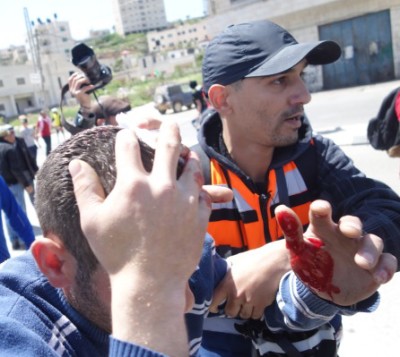 As the demonstration was beginning a 53-year-old Palestinian was shot at several times through the window of his car as he was driving away from Israeli forces. One of these rubber-coated steel bullets struck him in the head. The rubber-coated steel bullet broke several bones around his eye, a piece of the bullet was unable to be immediately removed and so he required surgery.
The level of violence escalated from this point as Palestinian youth threw stones at the Israeli military, while they (the military) fired hundreds of tear gas canisters, rubber-coated steel bullets and live ammunition, injuring many demonstrators. At several points during the demonstration, Israeli forces fired tear gas canisters directly at protesters, both highly dangerous and in contravention to Israeli military procedure, which is shooting them up into an arch to lower the impacted velocity.
A full list of all those injured is currently not available, however at least 10 people were transferred by ambulance to a local hospital in Ramallah to seek medical treatment for their injuries and Red Crescent medics at the demonstration treated many others for varying wounds.
Below is a list of specific injuries that were confirmed both at the demonstration and from ISM activists at the local Ramallah hospital:
- A 21-year-old Palestinian activist was injured after being shot from extremely close range with a sponge-tipped projectile in the back.
- Two ISM activists were also both shot from extremely close range with sponge-tipped projectiles in their backs.
- A 20-year-old Palestinian was shot with a rubber-coated steel bullet in the head.
- A 48-year-old Palestinian journalist was shot with a rubber-coated steel bullet in the left shoulder.
- A Palestinian activist was shot with a rubber-coated steel bullet in the foot.
- A 20-year-old Palestinian was shot with two .22 live ammunition bullets in his foot and in his knee.
- A 30-year-old Palestinian was shot with .22 live ammunition in his right hand.
- Another Palestinian was shot with .22 live ammunition in his left foot; the bullet was unable to be removed.
- 36-years-old Palestinian was shot with two .22 live ammunition bullets, both in his left foot.
- A 31-year-old Palestinian was shot in the left leg with .22 live ammunition.
- A 36-year-old Palestinian was shot with .22 live ammunition in the left foot.
- Mohammed Yasin, a photojournalist from Bi’lin who was wearing a press vest, was shot in his face with a rubber-coated steel bullet and also shot in his stomach with a .22 live ammunition bullet. He remains in hospital in serious condition, as the bullet may have destroyed parts of his liver.
An ISMer who was present at Ofer had this to say: “The Israeli forces present were really violent today. It was impossible to count the amount of tear gas canisters, rubber-coated steel bullets and live ammunition fired; it felt constant for several hours. It became clear many times during the protest that the soldiers were specifically aiming at people, they weren’t trying to ‘end’ the demo, they just wanted to injure as many people as possible. I just don’t understand how people can defend the Israeli state and its military when they use this much violence against unarmed protesters.”
Photo by ISM
Related articles
- PCHR Weekly Report: 3 Palestinians Killed, 34 Wounded by Israeli Troops (imemc.org)
- Week of protests cross the west bank in solidarity with Gaza (nilin-village.org)
Palestinian man shot dead by Israeli forces near Ramallah
Ma’an – 29/01/2014
RAMALLAH – Israeli soldiers shot and killed a Palestinian man near the Ramallah village of Ein Siniya on Wednesday.
A Ma’an reporter identified the victim as Muhammad Mahmoud Mubarak, 22, from al-Jalazun refugee camp.
Israeli forces in the area denied Palestinian ambulances access to the body before medics were eventually allowed to transfer the man to Ramallah Medical Complex.
A Palestinian official in the military liaison department told Ma’an that Mubarak was shot dead by a soldier positioned in a military watchtower.
“A Palestinian terrorist opened fire at an IDF (army) post near Ofra. The soldiers responded immediately in order to eliminate the imminent threat to their lives and fired towards the terrorist, identifying a hit,” Israel’s army said.
Eyewitnesses in the area told Ma’an that Mubarak was a laborer working with the al-Tarifi company on a USAID funded project to refurbish the main road in Ein Siniya.
Earlier, he had been directing traffic in the area with a handheld sign.
“While he was doing his job, a number of Israeli soldiers arrived and started to harass him,” witnesses told Ma’an.
“They forced him to take off his clothes, then put them on again. Then they ordered him to take a few steps forward, then walk back, and finally they shot him and left him bleeding preventing ambulance and medics from reaching him.”
Coworkers and an executive from the al-Tarifi company were close-by when the shooting took place.
Last year, Israel’s army killed 27 Palestinians in the occupied West Bank, according to UN statistics.
Related article

Fast Times in Palestine – Book Review
Reviewed by Jamal Kanj | Palestine Chronicle | October 5, 2013

(Fast Times in Palestine. Pamela Olson. Seal Press, March 2013)
Whenever I read a biographical book, I make it a point to start with the acknowledgement page to learn a little about the writer. In reading “Fast Times in Palestine: A love affair with a homeless homeland,” I had to start from the end of the book.
In those two pages the author thanked more than fifty individuals, but what got my attention was recognizing her ninth grade teacher for forcing her to write “a journal every day.” A gift the author displayed meticulously in chronicling the places and people she met in every page of a moving memoir of her journey in Palestine.
As I read the book I tried to fathom what drove a young American woman from a small town in Oklahoma with degree in physics to end up spending two years traversing military checkpoints and helping farmers harvest olives in the Middle East.
It could have been her adventurous nature and love for travel that brought her to that part of the world, but it was sheer destiny that tossed her into the abyss of fire to tell the world of her “love affair with a homeless homeland.”
After graduating from Stanford University in 2002, the newly graduated student was working at a neighborhood bar to save enough money for a backpacker vacation in the Greek isles when her French friend suggested Egypt as an alternative, less expensive destination. She traveled to Cairo and the Sinai, where she met an Israeli tourist named Dan who invited her to visit him in Israel.
Her journey took her across the Red Sea to Jordan, where she met—by chance—two peace volunteers, one British and one Canadian, who were on holiday from their work in Palestine. In the few days she spent with them in a downtown Amman hotel, she learned for the first time of the $3 billion the US government pays Israel annually on behalf of American taxpayers.
Stories about occupation, the Palestinian people and human rights activism intrigued her, and she became interested in finding out for herself the truth about life in the West Bank. She jumped on the opportunity when they invited her to come along with them, and they took her to an unlikely tourist destination, a small Palestinian village called Jayyous.
The author tackles the paradox of occupation in very straightforward layman’s terms, describing how a forty-mile journey from Jerusalem to the Palestinian city of Nablus would take a full day crossing a separation wall, changing cabs six times and navigating permanent and flying Israeli military checkpoints. Meanwhile a much longer trip with her Israeli friend on “Jewish only settlement roads” could be completed uninterrupted in a much shorter time.
She also describes how the separation wall isolates villagers from their olive groves and farms—for many their only livelihood—while hilltop Jewish-only settlements encroach on centuries-old trees and isolate Palestinian towns and villages into islands surrounded by Zionist colonies and the army that protects them.
Ever more fascinated by the wickedness of occupation and the joys of life among Palestinians, Pamela Olson took a low-paying job in Ramallah as an editor and head writer for the Palestine Monitor to study and document the daily human rights abuses under Israeli occupation.
Living and working in the Palestinian political capital, Pamela entered Palestinian politics from its widest doors by becoming the foreign press coordinator for a major candidate in the 2005 presidential election.
In her two years between Jayyous and Ramallah, the author takes the reader on an extraordinary expedition very few of us will ever get the opportunity to experience in a lifetime. She takes us along with her via immaculate descriptions of the spring greenery on hills and meadows—not yet raped by the concrete desertification of the Jewish only settlements—or smoking Nargila (hookah) on porches with friends in Jayyous or sipping coffee at westernized cafés in Ramallah.
What makes this book special is the writer’s ability to keep the reader spellbound with her vivid descriptions of events, people and places. The reader is able to feel the author’s inner glee meeting beloved friends, pain while witnessing and experiencing the horrors of occupation and the melancholy of bidding farewell to people who became part of her family in Palestine.
– Jamal Kanj (www.jamalkanj.com) writes weekly newspaper column and publishes on several websites on Arab world issues. He is the author of “Children of Catastrophe,” Journey from a Palestinian Refugee Camp to America.
Israeli forces open fire on Palestinians, injure 11
Al-Akhbar | May 18, 2013
Israeli troops shot and wounded nine Palestinians near the West Bank city of Ramallah on Friday night, and injured two others north of Hebron, security officials and medics said.
Palestinian security officials said that Palestinians from the Jalazoun refugee camp, near Ramallah, were hurling stones at Israeli motorists near an illegal Jewish settlement before coming under fire from soldiers.
They said that six of the injured were sent home after receiving first aid at a Palestinian hospital and three were kept in, although none of them was in life-threatening condition.
An army spokeswoman said that troops opened fire with 0.22 ammunition after tear gas and rubber bullets failed to disperse the crowd of about 50 people engaged in “a violent disturbance.”
Earlier in the day, troops fired tear gas at Palestinians demonstrating against the confiscation of land by Israel in the nearby village of Deir Jarir.
On Saturday the Israeli army used road blocks to shut the main road connecting Deir Jarir and other villages with Ramallah near the location of the attack, according to the head of the village council Imad Alawi.
Alawi told Wafa news agency that the road is the only direct passage to Ramallah for seven villages in the area. Its closure means Palestinians traveling to Ramallah must now take an extended route through the notorious Qalandia checkpoint.
It was unclear if the closure was directly linked to incidents on Friday.
And also on Friday, in al-Arrub refugee camp north of Hebron, Israeli forced shot two Palestinians with rubber-coated bullets, breaking the jaw of one man, and hitting the other in the hand, according to medics.
Luay al-Badawi was hit in the face with a plastic-coated bullet that broke his jaw, and then shot again in the head, Red Crescent official Nasser Qabaja told Ma’an news agency.
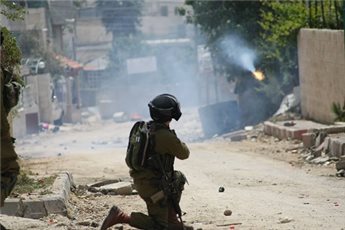 Badawi is in a critical condition in Al-Ahli Hospital in Hebron, Qabaja said.
Witnesses said a second man, who was not identified, was shot in the hand.
Locals said clashes erupted after Israeli forces stormed the camp. Residents confronted the soldiers and threw stones at them, and the soldiers fired tear gas and rubber coated-coated bullets.
An Israeli military spokeswoman said soldiers responded to a “violent riot in which Palestinians hurled rocks at Israeli security forces” with “riot dispersal means.”
She told Ma’an that forces used rubber bullets and that two Palestinians were injured.
(AFP, Wafa, Ma’an)
Related articles
- Jewish settlers attack West Bank village with Israeli army support (alethonews.wordpress.com)
- Live ammunition fired at Deir Jarir demonstration against land grab and settler violence (palsolidarity.org)
“Nothing forbidden for them, but nothing allowed for us”
International Solidarity Movement | May 14, 2013
Qaryut, Occupied Palestine – Settlers from the illegal colony of Shilo set fire to land belonging to the nearby village of Qaryut. Around 25 families own land in this area. The land contained wheat crops and olive trees and is next to land previously stolen by settlers, which they had been cultivating for themselves only two days before.
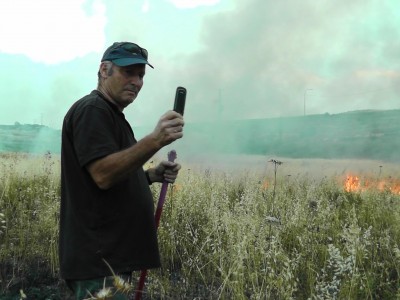
Illegal Shilo settler Moshka takes pictures of his handiwork, torching Palestinian land (Photo by Qaryut villagers)
Red Crescent paramedics went to the scene of the fires at around 6pm, where many villagers had already arrived hoping to put out the fires. However they were prevented from doing so by four settlers and half a dozen soldiers who had turned up to protect the settlers. Villagers were made to stand and watch their future harvest go up in flames. With the fires building up they had nothing to do but argue in vain with the soldiers about the gross immorality of the situation.
The settlers present also prevented the fire from spreading on to the annexed land they have been cultivating. It was clear to see the fires had been deliberately lit as there were many separate fires in a close range, rather than one large fire spreading on the overcast and wet day. Villagers witnessed Moshka, one of the settlers – (who is a regular problem causer; his son is a patrolman for the settlement too) – use a lighter to set fire to their land. The fire was only put out by the arrival of heavy and atypical rain from a thunderstorm an hour later.
Two days prior to this attack the settlers had started ploughing stolen land and cut down four trees. They have been expanding the settlement on the Palestinian side of the highway to Ramallah and Jerusalem. Fifteen dunams of land was torched. Meanwhile two dunums of wheatfields had been burnt in the South Hebron Hills earlier that day.
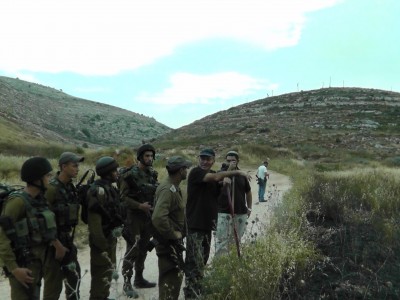
A familiar sight, soldiers and settlers working together (Photo by Qaryut villagers)
Related articles
- Tree planting met by tear gas and settlers’ death threats (palsolidarity.org)
- Witnesses: Settlers open fire at Palestinian homes in Hebron village (altahrir.wordpress.com)
- Settlers Attack Palestinian Property, Graves, Near Nablus (imemc.org)
Jewish settlers attack West Bank village with Israeli army support
Al-Akhbar | May 5, 2013
Jewish settlers raided a West Bank village near Ramallah on Saturday night, attacking several houses and prompting clashes between residents and Israeli forces, Ma’an news agency reported.
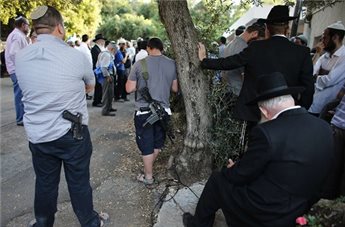 Israeli forces were standing guard as hundreds of settlers stormed the village of Ras Karkar, reportedly barring ambulances from entering the village before allowing an ambulance to take only two people to the hospital.
Eight residents of Ras Karkar were wounded as Israeli troops fired tear gas and rubber bullets at them. Live bullets were also fired into the air to scare the residents and prevent them from defending their property.
Rubber-coated bullets hit one Palestinian in the eye, one in the head and another in the chest. Four others sustained bruises and fractures from the attack by settlers and Israeli troops, locals said.
According to local sources, three houses in Ras Karkar were attacked and set on fire, as well as a number of olive trees.
One settler was wounded after being hit by a stone.
Settlers were also gearing up to attack another village near Ramallah on Sunday, Ma’an reported.
According to a witness, dozens of settlers were being escorted by Israeli troops and police officers near the village of al-Janiya in northwest Ramallah.
Residents of al-Janiya were trying to close the road to the village with rocks, only to be met with stun grenades and tear gas. Activists used the village mosque’s loudspeakers to urge residents to defend their village.
Settlers routinely attack Palestinians and their property in the occupied West Bank, as Israeli forces regularly turn a blind eye or even assist settler crimes.
According to figures compiled by Israeli group Yesh Din, nine out of 10 police investigations about settler crimes fail to lead to a prosecution.
(Ma’an, Al-Akhbar, Photo Credit – Ma’an)
Ex-prisoner explains self-immolation attempt
Ma’an – 21/09/2012

Former prisoner Abeer Odeh (MaanImages/File)
RAMALLAH – A former prisoner who tried to set herself on fire in Ramallah on Thursday says the Palestinian Authority is neglecting released detainees.
Abeer Odeh, 30, tried to self-immolate in Ramallah’s Manara square on Thursday but was stopped by police, a Ma’an correspondent said. She was taken to a nearby police station.
Odeh was released from Israeli detention last year in a prisoner swap deal between Israel and Hamas.
Speaking to Ma’an on Thursday evening, Odeh accused the PA ministries of health and prisoner affairs of failing to assist prisoners struggling with health problems and financial difficulties after their release. She said she tried to set herself on fire to draw attention to the plight of ex-detainees.
Odeh receives a salary from the PA but has had to cover the cost of several surgeries since her release, she said.
She says she was tortured during her nine years in Israeli detention and suffers colon infections, hernias, jaw erosion and spinal problems.
The former prisoner rejected statements made by some Palestinian officials that she was suffering from psychological problems, and considered the claims efforts to discredit her.
She said police in Ramallah mistreated her after her attempt to self-immolate.
Six of Odeh’s brothers have spent time in Israeli jails, and one brother was killed by Israeli forces. Another brother is disabled after he was injured by Israeli soldiers.
Israeli forces arrested Odeh’s mother in August, and she is now subject to movement restrictions by the Israeli military.
Related articles
- Palestinian Authority curbs freedom of expression in the West Bank (alethonews.wordpress.com)
8 injured as settlers stone bus carrying worshipers
Ma’an – 04/08/2012

Israeli settlers hurl stones toward Palestinians during clashes in the
village of Burin near Nablus (MaanImages/Rami Swidan, File)
NABLUS – Eight Palestinians sustained injuries late Friday when Jewish settlers pelted a bus with stones on the main road between Ramallah and Nablus, a Palestinian official said.
Ghassan Daghlas, a PA official who monitors settlement activity in the northern West Bank, told Ma’an that settlers from Shilo hurled stones at a bus carrying Palestinian worshipers on their way back from al-Aqsa Mosque.
The attack, he said, took place at 1:30 a.m. and eight people including men and women were injured. They were taken to Rafidia Hospital in Nablus, he said.
Daghlas highlighted that Israeli military forces closed the main road between Ramallah and Nablus for more than two hours after the incident to prevent further attacks.
The Israeli military confirmed receiving reports about the incident.
“Once the reports were received, IDF soldiers arrived at the scene and set up temporary checkpoints while searching for suspects,” a spokeswoman told Ma’an.
Settler violence against Palestinians and their property is systematic in the West Bank.
On Wednesday settlers vandalized Palestinian property in the Ramallah village of Sinjil.
A group of settlers from Givat Ariel outpost wrote “Palestinians should die,” and “Stay away from our lands,” on a wall in the village, Sinjil mayor Ayoub Swaied said.
Settlers also left an improvised explosive device made from chemicals under a car. A box containing ethylene, benzene and sulfur was found underneath a car in the village, Swaied added.
Related articles
- Palestinian stabbed, shot in settler attack near Nablus (alethonews.wordpress.com)
- Settlers enter Nablus village beat up a man, ransack his car, IOF arrests 5 Palestinians – No Settler (occupiedpalestine.wordpress.com)
Israeli forces detain Hebron journalist
Ma’an – 03/06/2012

Sharif Rajoub works as a reporter for al-Aqsa radio station.
HEBRON – Israeli forces detained a local journalist in Hebron early Sunday, relatives said.
Soldiers raided the home of Sharif Rajoub in the village of Dura and took him to an unknown destination, his brother Mahmoud told Ma’an.
Rajoub works as a reporter for Al-Aqsa radio station. He was preparing for his wedding, which was set to take place next week, his brother added.
An Israeli army spokeswoman said that a man had been arrested in Dura overnight Saturday, but could not provide further details about his identity.
Another man was arrested in Ramallah overnight, she added.
Israeli forces have raided several Palestinian news outlets in recent months.
In late February, Israeli forces raided the university institute’s Al-Quds Educational TV in Ramallah-district Al-Bireh and confiscated its broadcasting equipment, claiming it was interrupting legal broadcasting.
The same day, Israeli forces also raided Watan TV’s newsroom in Ramallah and seized transmitters.
In May, Israeli forces arrested the director of a Jenin-based satellite channel after raiding his home. Soldiers confiscated Al-Asir TV station’s broadcasting equipment, the director told Ma’an.
Related articles
- Israeli forces shut down media launch in Jerusalem (alethonews.wordpress.com)
- Israel ‘arrests TV director, confiscates equipment’ (alethonews.wordpress.com)
- Rawabi: Israeli Model for “Neo-Palestinian” City (alethonews.wordpress.com)
Israeli Authorities or Cyber Police? Ola Haniyeh Arrested with no Charges
By Dylan Collins | Palestine Monitor | April 17, 2012
In the early morning hours of Monday March 26th, a large force of Israeli soldiers surrounded the Haniyeh house in Al-Bireh, located in the heart of the West Bank’s capital city of Ramallah. After setting up a perimeter around the house, 12 well-armed soldiers kicked down the Haniyeh’s door and entered the home.
“They broke the door. They didn’t knock. They didn’t ring. They broke the door and we found them in the middle of our bedroom,” says 26 year-old Dima Haniyeh.
After confining Dima’s parents to their bedroom, the soldiers proceeded on to the next bedroom shared by Dima and her 22 year-old sister, Ola.
Right off the bat, Dima recalls, it was clear the soldiers had an apparent interest in her young sister. “They wanted to search us both and they wanted Ola’s mobile phone and laptop.”
A female soldier was brought in to search them both.
Coincidentally, Ola’s phone had been lost several days before but the soldiers didn’t believe her.
“If you don’t give us your phone we are going to destroy the room. We will destroy every room until we find it,” Dima remembers one of the soldiers having said.
They did just that—, emptying every drawer onto the floor, flipping the beds, and clearing the shelves. Eventually, they told Ola to get dressed. They wanted to take her with them for questioning.
Ola remembers her father saying, “Why don’t you ask her here?! You’ve been here an hour and a half and haven’t asked a single question!”
Brushing aside her father’s supplications, and in violation of Fourth Geneva Convention, the soldiers took Ola with them and brought her directly to Israel’s Askalan prison in the Naqab Desert.
Another Detainee Without Charges
Ola has been held in Askalan ever since. Although no charges have been officially filed against her, a review trial held at the Askalan military court on Thursday April 5th ruled in favor of a 7-day extension of Ola’s detention. Ola was given another trial on Wednesday April 4th which resulted in yet another detention extension for the second time, as the prosecutors and Israeli judge did not carry out an investigation as they were on a vacation. Ola’s third court extension date was given this week, with her due to appear in court on Thursday, April 19.
“She is being interrogated daily regarding internet activity. The suspicion is that the internet pages are connected to ‘security activities’”, says Amal Husein of Addameer.
Ola’s detention was up for review on Tuesday April 17th. Her family and friends are confident that she will be released, as she hasn’t been accused or charged of anything as of yet. However, given the Israeli authorities’ administrative detention track record, anything is possible.
“People have said that the Israeli authorities have taken many people because of Facebook,” says Dima. “But everyone has a Facebook. Everyone puts his or her opinion on Facebook. There is nothing serious about it… it is freedom of speech.”
Ola recently graduated with a degree in Media and Political Science from Birzeit University last Fall. “She might go to protests sometimes, as all of us do, to speak out against the occupation and to support people- nothing extraordinary,” says Dima. “All of us participate—its part of being in Palestine and living under occupation.”
“She’s a quiet girl,” continues Dima. “She is a genuine and passionate person. She has friends and is lively, but she is much more the quiet type.”
Ola’s sister Dima says that Ola had perhaps had made comments on Facebook in support of Palestinian prisoners in general and against Israel’s policy of administrative detention but had done nothing out of the ordinary. “She is a journalist. This is her job. She should be able to do that,” argues Dima.
Ola’s sister and friends are quite confident that she was arrested simply because she voiced her opinions—a scary thought in the Facebook age.
“When you don’t have charges against someone—why… how can you keep them detained?” asks Dima. “When you don’t have any serious charges, how can you break down someone’s door in the middle of the night and take them? What happens when they have a serious case? What will they do then? Its scary.”
Related articles
- 1,600 Palestinian prisoners begin open-ended hunger strike in Israeli jails (alethonews.wordpress.com)
- Israeli forces shut down media launch in Jerusalem (alethonews.wordpress.com)
- Israel – Israeli troops force two Palestinian TV stations to close (en.rsf.org)
- Report: 201 Palestinians Died in Israeli Jails (and more…) (occupiedpalestine.wordpress.com)
Featured Video
Bombing Iran Back Into the Stone Age /Lt Col Daniel Davis & Jim Jatras
or go to
Aletho News Archives – Video-Images
From the Archives
The Occupied Mentality Syndrome
Saudi Arabia on the American chessboard – Part 2
By B. J. Sabri | American Herald Tribune | April 19, 2016
Since the Korean War, but particularly since the Iranian Revolution of 1979 until today, the United States has been steadily escalating its military presence in the Persian Gulf. Taking advantage of many colossal events of the past 36 years, [1] the hyper-empire has institutionalized its massive presence on land and sea, and expanded its objectives to include the unambiguous physical control of the area, as well as the clear understanding that local Arab governments should abide by them. The pretext is always the same: in “defense” of the national interests and security of the United States. From observing how the United States has been interacting with the governments of the region, and by judging from the size of its expeditionary force, we could reach a basic conclusion. The United States is occupying, de facto, the entire Arabian Peninsula. (Yemen, devastated by Saudi and American jets is yet to be conquered. Oman? Britain returned not as colonial ruler but as a soft occupying power.)
Under this articulation, Saudi Arabia, Qatar, Kuwait, and the United Arab Emirates are virtually occupied countries. If we compare this type of occupation to the mandate and protectorate regimes of the past, the results might be identical—the nations affected by it lose sovereignty. When Arab governments comply with the objectives of a foreign power that station military forces on their national milieu, then that power controls them in multiple ways including how they react to policy deliberations and what decisions they intend to take on specific issues. A good method to verify the concept of effective occupation is this: take notice of what the United States says and wants, and then compare it to what the gulf rulers do in response. (I shall discuss this detail at some point in the upcoming parts.)
If the presence of US forces or other means of political pressure are a factor in Saudi Arabia’s interventionist Arab wars, then we need to debate this issue. However, from the history of resistance to colonialism, we learnt: if a powerful state imposes its order on a nation by military means or other forms of coercion, and if this nation does not resist that imposition, then a mental subordination to the powerful state will ensue. This is especially true in the case of Saudi Arabia. One single event, 9/11, has transformed it from a US “ally” into an instant political hostage of the American Empire. … continue
Blog Roll
 Aletho News
- BREAKING: US JET SHOT DOWN OVER IRAN /Lt Col Daniel Davis & Nima Alkhorshid
- Now everyone is dumping US government bonds
- Brazilian Congressman seeks to bar Israeli military personnel from entering Brazil
- Official reveals evidence of Arab states’ involvement in US-Israeli war on Iran
- His Majesty’s head-chopper: Syria’s MI6-backed president bows to King Charles
- Forced to backtrack: ‘Israel’ drops Hezbollah disarmament goal
- Britain’s Lebanon surveillance network: A digital map for war
- Bahrain faces scrutiny for opposition crackdown after detainee killed
- Hegseth’s Pentagon Purge Designed to Prevent a Mutiny: Karen Kwiatkowski
- Greek shipping firms secretly transporting oil, weapons to Israel
- If Americans Knew
- Israel Is Blocking Palestinians from Easter at Church Where Jesus Resurrected
- Plot to assassinate Palestinian activist follows harassment campaign promoted by Zionist groups and elected officials
- Prominent New York synagogue hosts presentation on why U.S. Jews should support the ethnic cleansing of Gaza
- Tapper vs. Piker: Is the CNN Anchor Auditioning for David Ellison?
- Shouldn’t Democrats Be Able to Condemn Genocide?
- Israel-US kill negotiators, destroy civilian structures, but Iran’s military capabilities still largely intact – Daily Update
- ‘War crime’: Global condemnation as Israeli ministers celebrate death penalty law targeting Palestinian prisoners
- 7 Ways Israel Is Turning Lebanon Into Gaza
- World’s Leading Football Bodies Under Fire Over Israel Policies
- Experts warn of possible use of nukes against Iran
- No Tricks Zone
- Low Intensity Tornado Wrecks Major Solar Farm, Creating A Potential Toxic Dump
- New Study Finds Warming Saves Lives…Cold Temperatures 12 Times More Deadly Than Excess Heat
- German Science Blog Accuses PIK Climate Institute Of Hallucinating Climate Tipping Points
- Devastating Assessment Of Comirnaty Vaccine By Former Senior Pfizer Europe Toxicologist
- New Study: CO2 Is ‘Effectively Negligible’ As An Explanatory Climate Change Factor Since 2000
- Former Pfizer Toxicologist Dr. Helmut Sterz Tells Bundestag Hearing Pfizer Vaccine Should Have Never Been Approved
- Energy Expert: Germany’s Nuclear Phaseout Was A “500 Billion Euro Mistake”
- New Research: South Australia’s Mid-Holocene Sea Surface Temperatures Were 4°C Warmer Than Today
- Storing Green Energy To Last Germany 10 Days Would Require A 60-Million Tonne Battery
- New Studies: UK Sea Levels Were 4 Meters Higher Than Today During The Mid-Holocene
 Aletho News