Peace Talks With Russia? UK & US Seeking Quick Face-Saving Exit From Ukraine Debacle – CIA Vet
By Ekaterina Blinova – Sputnik – 05.12.2023
There is a rumor in British diplomatic circles about forcing Ukraine to negotiate a way out of the conflict with Russia, per the UK podcast Politics at Jack and Sam’s. Could the reported chatter be real, and if so, what’s behind it?
The Western press is citing Ukrainian politicians expressing criticism with regard to President Volodymyr Zelensky’s failed counteroffensive, with British observers suggesting that the Kiev regime could soon be forced to sit down with Russia and hold talks. As it recently turned out, it was then-UK Prime Minister Boris Johnson who encouraged Zelensky to tear up the preliminary peace agreement with Moscow in 2022. Is London’s position on Ukraine changing?
“Well, their opinion is going to have to change, because the events on the ground are going to dictate it, with Ukraine losing militarily and neither the US nor the UK being in a position to supply any kind of significant weaponry,” retired CIA intelligence officer and State Department official Larry Johnson told Sputnik. “And even if they did, who’s going to use it? That’s Ukraine’s fundamental problem right now – it’s a lack of manpower. And over the last couple of weeks, we’ve seen more and more stories, more independent evidence that Ukraine has just suffered massive losses, both killed and wounded, that are incapable of returning to the fight. So, I think this flood of information will keep pouring out. And each day it’s going to add to the problems that Zelensky faces in trying to hang on to power.”
This is not the first time the rumor of potential Russo-Ukrainian negotiations has made its way to the press. In late November, the German newspaper Bild alleged a plot between Washington and Berlin to twist Zelensky’s arm into holding talks with Russia by substantially diminishing military aid to Kiev. According to the German publication, there is also a plan B envisaging a frozen conflict that would solidify a new “quasi-border” between Ukraine and Russia along the contact line.
Per Johnson, even if the West is ready for negotiations over Ukraine, they should bear in mind that nobody in Russia would allow them to fool Moscow after the derailed Istanbul talks of March 2022 and the Bucha hoax widely circulated by the Western press. However, it’s still unclear what the US and its NATO allies really want: a sustainable peace, or merely a frozen conflict.
“Well, again, this is the problem,” the former CIA analyst pointed out. “There has been no negotiation of any substance between the United States and Russia for now more than two years. The last time Putin entered into negotiations to negotiate a peace – that was a year ago, in April. And the West, Biden, Boris Johnson, they sabotaged it. They destroyed it. They made sure that the Ukrainians knew that they were not to agree to any deal. And that’s how they treat it. My own perception is that the Russians are still smarting over that betrayal, because they legitimately thought they had an agreement in place. And then within days, as they’re pulling back their forces from north of Kiev, the tank forces, the United States and the United Kingdom launched this propaganda campaign, accusing Russia of war crimes in Bucha. It was a blatant lie, it wasn’t true. But again, the truth didn’t matter anymore.”
Meanwhile, The Economist, a British magazine, has drawn attention to the fact that Zelensky’s approval rating is in free fall after the botched counteroffensive attempt, while Ukrainian Armed Forces Commander-in-Chief Valery Zaluzhny commands 70% support. Per the media, the two are at odds, as Zelensky apparently fears that Zaluzhny may be picked as his successor.
“Well, the Americans are trying to figure out how to get rid of Zelensky,” Johnson said. “And I think this is just a natural outgrowth of the various plotting and scheming. I think part of it is wishful thinking on the part of Americans. They launched this war as a proxy war against Russia, fully expecting Ukraine to defeat Russia. It was going to cause the collapse of Vladimir Putin and could ultimately lead to the breakup of Russia. And instead, it’s not turned out that way at all. It has completely backfired.”
“So what you’re getting now are these, let’s call them crazy ideas. People keep thinking that, ‘Okay, we can engineer this in such a way that maybe we will replace Zelensky with Zaluzhny.’ [… ] But these are the kinds of rumors that are circulating. What’s clear is that Zelensky does not have a secure hold on the presidency in Ukraine. And right now, there is a meeting underway in Washington with, I guess, the next in line for the presidency, probably because Zelensky himself didn’t feel secure leaving Ukraine right now to go beg for more money. And so he’s sticking close to home in order to just, I think, try to preserve his position.”
NATO chief admits Ukrainian failure
By Lucas Leiroz | December 4, 2023
Increasingly, military leaders are admitting Ukraine’s inability to carry out the fight under its current military circumstances. In a recent statement, the head of the alliance, Jens Stoltenberg, stated that the West needs to be prepared to receive “bad news” from Ukraine, belatedly recognizing the reality that many analysts had already reported before.
Stoltenberg made pessimistic comments, lamenting Ukraine’s poor military progress. According to him, Moscow has a great advantage in the conflict, in addition to accumulating a large number of weapons for the military scenario in the winter. The secretary stated that the Russian defense industry is producing weapons “on war footing”, operating in an accelerated manner in order to achieve the country’s military results.
He also said that the front lines have remained almost unchanged in recent months, but that it is necessary to be prepared for bad news regarding Ukrainian positions. However, for him, support for Ukraine is vital and must be maintained, even if expectations are negative.
“We have to be prepared for bad news. Wars move in phases, but we must stand by Ukraine in good and in bad times alike”, he said.
Another interesting topic commented on by Stoltenberg was the inability of Western countries to produce enough weapons to support Ukraine. He admitted that the West is weakened industrially, unable to meet Ukrainian demands.
He compared the capabilities of Russian and European industrial production and concluded that Moscow is working better in this sector, which explains some difficulties of the Ukrainian military in achieving good results on the battlefield. In addition, the secretary stated that the Russians plan to continue attacking Ukrainian energy infrastructure in order to harm the country’s ability to produce weapons and equipment domestically during the winter.
“I think one of the main problems that we must address is the fragmentation of the European defense industry. We are not capable of working so closely together as we should (…) Russia has amassed a large missile stockpile ahead of winter, and we see new attempts to strike Ukraine’s power grid and energy infrastructure”, he added.
In fact, Stoltenberg’s words come at a serious moment, in which the vulnerability of Ukraine can no longer be hidden. The country is suffering many losses since its failed “counteroffensive” attempt. Also, the mainstream media is running out of arguments to disguise the defeat of the Kiev regime, which makes the speeches of Western propagandists become more realistic.
In addition, there is another important factor to understand this process, which is the escalation in Palestine. With Israel suffering from various problems on the battlefield and in need of broad Western support, NATO needs to take the focus of public opinion away from Ukraine and begin to justify a policy of support for the Zionist state. For this reason, it is already becoming commonplace for Western leaders and media to be realistic about the Ukrainian situation. The objective is to explain that this war is impossible to be won, having no longer any need to maintain unrestricted support.
In other words, Western officials and journalists are preparing public opinion for the unavoidable defeat of the neo-Nazi regime and trying to focus on Israel as a new “emergency.” In addition, excuses such as “low industrial production” or “Russian attacks on infrastructure” are inappropriately used to try to justify Ukraine’s situation. But, indeed, the real reason is simply Russian military superiority.
In fact, the West has proven unable to produce weapons fast enough to defend Ukraine. In the same sense, Moscow has launched several heavy artillery and aviation strikes against Ukrainian critical infrastructure. But these are only a few factors that do not fully explain the outcome of the war. Kiev’s failure is mainly due to the factor that the Russians are militarily much superior and have a more efficient military strategy. Even at times when Kiev was receiving large amounts of weapons from NATO on a daily basis the regime’s forces were not able to achieve positive results because the Russians always had a greater military power and a more appropriate strategy. So, Stoltenberg does not explain the real reasons for the defeat by talking only about industrial production.
Finally, it must be emphasized how admitting defeat is also a moral blow against the West. NATO is clearly demoralized due to the frustration in Ukraine. The pro-Kiev propaganda machine has not been able to substantiate any of its narratives, having now to admit that its predictions were wrong. It is very likely that the mainstream media and Western officials will lose their credibility, with public opinion simply ceasing to believe what is said by them.
Lucas Leiroz, journalist, researcher at the Center for Geostrategic Studies, geopolitical consultant.
Brazil not interested in Russia sanctions – ambassador
RT | December 4, 2023
Brazil does not recognize Western sanctions imposed on Russia and is instead looking to increase its business ties with the country, Brasilia’s ambassador to Moscow, Rodrigo de Lima Baena Soares, has said.
In an interview with the RBK news outlet posted on Monday, the diplomat noted that Brazil only recognizes sanctions issued by the UN Security Council, meaning it does not comply with restrictions imposed by some countries on Russia.
Brazil therefore has “normal trade relations” with Moscow and is focused on expanding bilateral commerce, Soares added.
He admitted that sanctions had created “a number of problems” regarding issues of payment, logistics, and insurance, but nonetheless stated that Russia-Brazil bilateral trade had reached record levels.
Given that some countries have stopped trading with Russia, Soares argued it is the ideal time to be “creative to take advantage of the opportunities we have,” suggesting that Russia and Brazil should work to further increase trade turnover.
Moscow has insisted that Western sanctions imposed in response to its military operation in Ukraine have not had the intended effect. Last month, Kremlin spokesperson Dmitry Peskov described the restrictions as “not so painful” for Russia and said they had backfired on those who introduced them.
Russian Foreign Minister Sergey Lavrov has suggested that EU companies have lost at least €250 billion (around $265 billion) due to Western sanctions on Moscow, arguing that even these figures were “very conservative estimates.”
US-centric world ending – Kremlin
RT | December 3, 2023
The American-centric world is coming to an end, giving way to a new period of diversity in economics and other areas of international relations, Kremlin Press-Secretary Dmitry Peskov has said.
Peskov made the remarks on Friday, in response to an article in the Financial Times, in which US Assistant Secretary of State for Energy Resources Geoffrey Pyatt revealed that Washington was aiming to cut Russia’s oil and gas revenues in half by 2030. Pyatt, who served as the US ambassador in Kiev during the 2014 Maidan coup, also said that American sanctions against Moscow would stay in place “for years to come” – as long as it continues its military operation in Ukraine.
The Kremlin spokesman insisted that the restrictions by the US and its Western allies are not critical for Russia, as it has many other trading partners on the international stage. He told journalists that “the US might be the largest, but it’s not the only economy in the world. China is on the heels of US. There are also growing economies with their own needs for energy resources.”
“The world is much more diverse than the US. And therefore, the American-centric world is coming to an end and a period of diversity begins, including in international economic relations,” Peskov stressed.
According to the spokesman, the Russian authorities did not doubt that the American sanctions would remain “for years to come,” even before Pyatt’s statement. Moscow is taking this reality into account while planning its policies, he said, adding that there is “also no doubt that the US will continue to try pressuring Russia.”
The spokesman suggested that as a result of those “illegal” efforts, the Americans will be putting the whole system of world trade and economic relations under strain, “essentially destroying the existing format of those relations.”
Russia’s President Putin Vladimir Putin said that last month that “the development of a new and fairer world order based on the primacy of international law has been a prevailing trend” in recent years.
Earlier, Putin accused the West of “destroying the system of financial, trade and economic relations with their own hands” through their sanctions policies. However, he stressed that “real business cooperation” by other countries is leading to the emergence of a new international model “shaped not by Western standards [and] catering to the selected ‘golden billion,’ but all of humanity… and the developing multipolar world.”
Tycoon urges Russia to meet US energy threats head-on
RT | December 3, 2023
Moscow should take the US threat to halve Russia’s energy revenues seriously, billionaire Oleg Deripaska said on Saturday. To make his point the businessman cited last year’s sabotage of the Nord Stream pipelines and a recent train derailment in Siberia.
The Russian aluminum magnate urged the government to focus on transport networks and port infrastructure in the country’s Far East, and the development of the North-South Transport Corridor in the Caspian region.
“Threats of blocking the Danish straits and the Bosporus have already been voiced,” Deripaska wrote on his Telegram channel.
“Russia is wholly up to the task of creating alternative routes via the Baltic and Turkish directions over four years,” he said, adding that the plan’s implementation should be monitored on a daily basis.
Earlier this week, a senior US official told the Financial Times that Washington would pursue its sanctions on Russian energy “for years to come” with the goal of halving Moscow’s oil and gas revenues by 2030.
On Wednesday, a freight train caught fire as it passed through the Bessolov Severomuysky tunnel, the longest in Russia, located in Buryatia. The incident was caused by an unidentified explosive device, Russian business daily RBK reported on Friday citing a local police source.
Russia’s Investigative Committee earlier opened an investigation into a similar incident, in which 19 freight cars carrying mineral fertilizers derailed on November 11 in Ryazan Region, around 200km southeast of Moscow. Later, the case was reclassified as a “terrorist act.” Earlier this week, law enforcement agencies reported the arrest of a man in relation to the attack, saying it had been carried out on behalf of Ukraine.
Several Western media outlets previously reported, citing an unnamed Ukrainian source, that operatives working for the Security Service of Ukraine (SBU) had detonated explosives in the rail tunnel in Siberia, targeting the route due to its alleged use for transporting military supplies.
In September 2022, the Nord Stream 1 and 2 gas pipelines, connecting Russia and Germany under the Baltic Sea, were sabotaged by explosions. Berlin has yet to identify the perpetrators of the attack, which Moscow claimed was orchestrated by US intelligence agencies. Meanwhile, several Western media outlets have suggested that the pipelines were blown up by Ukraine-linked saboteurs.
Kiev’s counteroffensive casualties top 125,000 – Moscow
RT | December 1, 2023
In the six months since Kiev launched its push against Russian defensive lines, it has lost over 125,000 troops and 16,000 heavy weapons, Russian Defense Minister Sergey Shoigu estimated during a ministerial meeting on Friday.
The Ukrainian government and its Western backers had high expectations for the operation, for which the former’s army was provided with main battle tanks and other advanced arms. Ukrainian officials predicted that the push would help their country reclaim territory lost since major hostilities started in February 2022, and potentially launch an incursion into Crimea, which had broken away from Kiev in the wake of the 2014 armed coup.
“Total mobilization in Ukraine, delivery of Western arms and deployment of strategic reserves by the Ukrainian command have not changed the situation on the battlefield,” the Russian minister reported. “Those desperate actions simply increased the losses of the Ukrainian armed forces.”
As such, Kiev’s military has been “significantly degraded” while Russian forces are “taking a more advantageous position and widening the zone under their control on all fronts,” Shoigu added.
Last week, Shoigu put Ukrainian casualties in November at 13,700, which pushed the Russian estimate of total Ukrainien losses in the counteroffensive over the 100,000 benchmark.
The most senior Ukrainian general, Valery Zaluzhny, reported in early November that the frontline situation had devolved into a “stalemate” and that Kiev’s side was unlikely to achieve a breakthrough unless some surprise technological development gave it a decisive edge over Moscow. His assessment has been rejected by officials, with President Vladimir Zelensky maintaining that Ukrainians are still making progress.
On Friday, the Associated Press published an interview with the Ukrainian leader, in which he said, “Look, we are not backing down, I am satisfied.” He blamed a shortage of Western weapons for the underwhelming results of the Ukrainian operation and declared that a “new phase” in the hostilities was beginning this winter.
Open Defiance
By William Schryver | imetatronink | November 30, 2023
In my view, the single most meaningful consequence of the NATO/Ukraine proxy war against Russia is that most of the major geopolitical players outside the imperial realm are suddenly in open defiance of the capricious “rules-based international order” and its rapacious monetary system.
The catalyst for this rebellion was that Vladimir Putin’s Russia stood alone amongst the kings, princes, presidents, and prime ministers of a trembling world, turned to the masters of empire, and said, “Not an inch further. In fact, you must withdraw to your 1997 status, and take all your armaments with you, beginning with your missiles in Poland and Romania.”
The masters of empire laughed him to scorn, and then encouraged their #MotherOfAllProxyArmies in Ukraine to concentrate to the Donbass and the Azov pursuant to conquering Novorossiya and Crimea once and for all … then on to Moscow.
This war was anything but “unprovoked Russian aggression”. This war was spawned and nurtured for decades in the secret chambers of the imperial dark lords in London and Washington. It was a war the empire knew Russia would fight. The imperial suzerains simply deceived themselves into believing it was a war Russia could not win.
As was imperative, Russia did choose to fight — notwithstanding there were many reasons to suppose they were insufficiently prepared to win in the event the full weight of the NATO countries were thrown against them.
As it has turned out (and contrary to the fantastical western narratives of Russian humiliation and massive losses), the Russians have prosecuted a remarkably economical destruction of not one, but three successive iterations of increasingly NATO-armed and NATO-trained armies.
And they have done so while assembling, equipping, and thoroughly training a reserve army twice the size of the one they have used to methodically wreck the armies arrayed against them in Ukraine.
They have achieved the greatest industrial mobilization since the Great Patriotic War of 1941-1945. Their massive increases in production of the implements of industrial-scale warfare dwarfs the combined capabilities of their adversaries.
They have also quickly adapted to changing battlefield realities, and are innovating and mass-producing new war tools previously seen only as novelties, but now acknowledged as essential.
In short, the Russians are not only winning this war in an impressively decisive fashion, but they will emerge from it as the single most formidable and battle-hardened military force on the planet.
Most significantly, Russia has exposed for all to see that the empire not only has limitations, but that it is vastly weaker and more vulnerable than hardly anyone had previously been willing to believe.
THAT is why so much of the rest of the world is now emboldened to defy imperial edicts.
THAT is the reason new alliances are solidifying between heretofore reluctant friends.
Nothing unites the human playground quite like one intrepid soul willing to stand, fight, and humble the bully.
The tripartite alliance of Russia, China, and Iran is an adversary more than adequate to roll back imperial rule by leaps and bounds, and in a relatively short span of time.
Many of the “middle powers” can also see which way the wind is blowing, and are positioning themselves accordingly. Spheres of influence are being aggressively pursued and secured in every quarter of the earth.
And perhaps most meaningful of all, they are cooperating to progressively repudiate the empire’s debt notes as the coin of the realm. They have come to understand that a prerequisite to “fixing the world” is to return its money system to a much more equitable and sustainable basis.
Mene, mene, tekel, upharsin.
The empire of debt and lies has been weighed in the balances and found wanting. All that remains is to see if it will go gently into that good night, or in a fit of humiliated rage, set the world on fire.
NATO Chief Puts Hypocrisy on Full Display
By Ted Snider | The Libertarian Institute | November 29, 2023
NATO Secretary General Jens Stoltenberg put NATO’s hypocrisy on display while talking to reporters ahead of the meeting of NATO foreign ministers in Brussels on November 28.
Asked by a reporter about American and European struggles to continue providing Ukraine with weapons and ammunition, Stoltenberg replied, “It’s our obligation to ensure that we provide Ukraine with the weapons they need. Because it will be a tragedy for Ukrainians if President Putin wins.”
The tragedy for Ukrainians has already happened. Their infrastructure and economy are destroyed, their population is dispersed, their relatives are dead or injured and their land is lost. The greater tragedy to come is not the war ending, but the war continuing. In the first weeks of the war, Ukrainians could have kept almost all of their land and lost almost none of their lives for a promise not to join NATO. The political West ordered them to walk away from the negotiating table and onto the battlefield. They promised them—directly or indirectly—as much military and financial support as it takes for as long as it takes. Nearly two years later, Ukraine will likely have to make the same promise, but they have lost that land and they have lost those lives.
Russia brought tragedy to Ukraine; the United States, United Kingdom, and their NATO allies bloated and magnified that tragedy. The tragedy now would not be ending the war even if it means “Putin wins.” The tragedy now is that NATO is willing to continue feeding a war that they know Ukraine can’t win. “When Ukraine launched its big counteroffensive this spring,” The Wall Street Journal reported, “Western military officials knew Kyiv didn’t have all the training or weapons—from shells to warplanes—that it needed to dislodge Russian forces.” Ukrainian Commander-in-Chief Valery Zaluzhny has said that the war has reached a “stalemate” that over time can only favor Russia.
The tragedy for Ukrainians would not be negotiating an end to the war, it would be NATO exercising the “obligation” to continue the war.
Stoltenberg gave a second reason for continuing to provide Ukraine with the weapons they need; so that Ukrainians can go on dying for NATO goals and NATO security. If the war ends now, “it will be dangerous for us,” Stoltenberg said. The United States “will continue to provide support” to Ukraine “because it is in the security interest of the United States to do so.” NATO must “stay the course” because “[t]his is about also about our security interests.”
Stoltenberg knows this war is not being fought because Russia wanted to conquer other territory; Stoltenberg knows this war is being fought because Russia wanted to defend its territory. This war did not happen because Russia was a threat to NATO territory, it happened because NATO was a threat to Russian territory. How do we know that Stoltenberg knows this? Because he said so.
Putin “sent a draft treaty that they wanted NATO to sign, to promise no more NATO enlargement,” Stoltenberg said on September 7, 2023. “That… was a pre-condition for not invade Ukraine.” He then said that when “we didn’t sign that… he went to war to prevent NATO, more NATO, close to his borders.”
“President Putin,” Stoltenberg concluded, “invaded a European country to prevent more NATO.”
Stoltenberg has publicly stated his awareness that this war was fought, not over American or NATO security concerns, but over Russian security concerns.
U.S. Secretary of Defense Lloyd Austin also recently said that the United States must go on supporting Ukraine or Russia would win and steamroll on over the Baltic countries, Poland, and beyond. Russian Foreign Minister Sergey Lavrov mocked Austin, saying, “This comes from a man who holds a high-ranking position and cannot but receive expert views… and who cannot but understand what is going on in Ukraine and that Russia has never had and can never have any aggressive or expansionist plans.”
Ukraine’s chief negotiator in the Belarus and Istanbul talks with Russia has also recently said that stopping NATO from expanding to Ukraine and Russia’s borders was the “key point” for Russia and that “[e]verything else was simply rhetoric and political ‘seasoning.’”
Stoltenberg says that if Russia is allowed to win “the message to all authoritarian leaders—not only in Moscow, but also in Beijing—is that when they violate international law, when they invade another country when they use force, they get what they want. So this is about the whole idea of a rules-based international order, where territorial borders are respected.”
Stoltenberg transitions from “international law” to “rules-based order” because his case cannot be made without hypocrisy on the former. International law applies equally to everybody. But the United States or NATO have frequently invaded other countries by force and disrespected their territorial borders: Panama, Grenada, Libya, Kosovo, Iraq and Syria. Before Ukraine, modern Russia had not. But the rules-based order, unlike international law, allows Stoltenberg to make the case that Russia has violated the rules but the U.S. and NATO have not because the rules are made up as you go along so that the United States is always within them and Russia is always without. Under the unwritten rules-based order, rules are applied when they benefit the U.S. while the U.S. is exempt when they don’t.
American and NATO support for Ukraine may be about U.S. insistence on enforcing the rules-based system, but the United States is not an enforcer of international law.
Stoltenberg’s third reason for continuing to press the war in Ukraine is read right off the U.S. script; “… we need to continue to support them also knowing that the stronger Ukraine is on the battlefield, the stronger the handle will be on the negotiating table.” That point has passed. Ukraine is in a weaker position on the battlefield than they were before the counteroffensive. Russia is winning the war of land, the war of attrition on weapons, the war of attrition on lives, and the technological war. Ukraine had a better seat at the negotiating table in the first weeks after the invasion when the political West ordered them to stop negotiating. They were in a better position a year ago when they recaptured areas of Kherson before the counteroffensive. Far from strengthening Ukraine’s position on the battlefield or at the negotiating table, supporting the continuation of the war seems to be putting Ukraine in a weaker and weaker position. The terms that will be offered Ukraine today are likely much worse than the terms they were offered at the start of the war. And they will likely be worse tomorrow.
Stoltenberg says that “if you want a negotiated, peaceful solution, which ensures that Ukraine prevails as a sovereign, independent nation, then the best way to get there is to continue to provide military support to Ukraine.” But it is not war that will guarantee Ukraine sovereignty. As Lavrov recently pointed out, Russia recognized the sovereignty of Ukraine based on a declaration of independence and a constitution that declared Ukraine’s neutrality and non-membership in NATO, and Russia will continue to when those conditions are reinstated. The best way to ensure Ukraine’s territorial integrity and sovereignty is not to help it fight for the right to be in NATO but to encourage it to promise not to join NATO.
Finally, Stoltenberg put NATO’s hypocrisy on display not only by what he said, but by what he did not say. If the words that Stoltenberg said were meant to rally Western ears, the words he did not say will be the loudest in Ukrainian ears. Though Ukraine is fighting, in part, for the right to be in NATO, that is the one thing that Stoltenberg, hypocritically, did not offer Ukraine. The “Allies have stated again and again the last time at the NATO Summit with all the leaders present in Vilnius” that they will “provide support to Ukraine,” that they “will step up” their support for Ukraine, that they will “help them… to modernize their army” and that they will “ensure full interoperability between the Ukrainian forces and the NATO forces.” The one thing Stoltenberg did not say that NATO has offered Ukraine is membership in NATO.
Ukraine should fight to defend NATO’s insistence on the right of a country to choose its own alliances and to join NATO without being offered membership in NATO. That is the final hypocrisy put on full display in Stoltenberg’s comments to reporters.
Russia: US played ‘destructive role’ in escalating Israeli war in Gaza
Press TV – November 29, 2023
Russia says the United States has escalated the conflict between Israel and the Palestinian resistance movement Hamas by playing a “destructive role.”
Russia’s Deputy Permanent Representative to the UN Dmitry Chumakov made the comment during a speech he delivered to the United Nations General Assembly on Tuesday. He denounced Washington’s policies in West Asia.
“The policies of the US which meant that it kept turning a blind eye to the ongoing Israeli settlement construction in the occupied [Palestinian] territories and recognized Israel’s sovereignty over the occupied Golan Heights, have played a destructive role in the current escalation,” he said.
According to Gaza government health officials, over 15,000 Palestinians, including more than 6,000 children, were killed by Israeli aggression during the 49 days of war. Many more are feared to be buried under the rubble.
“As a result, we are now witnessing a conflict of unprecedented scope, which may spread to the entire Middle East,” Chumakov warned.
Washington has supported Tel Aviv’s relentless attacks on the Palestinian territory as an instance of “self-defense,” and has provided the regime with thousands of arms consignments since the onset of the war.
A four-day Qatari-brokered ceasefire between Tel Aviv and Hamas went into effect on Friday and was extended for two more days on Monday following mediation from Egypt and Qatar.
So far, under the truce deal, Hamas freed 69 hostages in return for 150 Palestinian prisoners held by Israel.
US fully responsible for situation in Gaza: Moscow
On Wednesday, Russian Foreign Ministry Spokeswoman Maria Zakharova said that the US is fully responsible for the current situation in the war-ravaged Palestinian enclave, stressing that Washington’s policies have served as the primary sources of tension in the conflict zone.
“The entire current collapse on the territory [of the Gaza Strip], where a colossal tragedy related to the Palestinian-Israeli confrontation has unfolded, is completely and fully the responsibility of the United States, or, rather, I should say, [due to] the irresponsibility [of the US]. It is only they [who are responsible],” she said during an interview with the Sputnik radio station.
The Gaza health ministry says the Israeli regime keeps denying hospitals fuel for their generators in violation of the truce. The Israeli onslaught on Gaza has brought almost all vital infrastructure in the besieged strip to a standstill.
Hamas Military Wing Says Released 2 Russian Citizens in Response to Request of Moscow
Sputnik – 29.11.2023
MOSCOW – The military wing of the Palestinian movement Hamas, Al Qassam Brigades said on Wednesday that it released two Russian citizens in response to Moscow’s request.
Earlier in the day, the i24 broadcaster reported, citing Hamas, that the movement will release two Israeli women with Russian citizenship, in addition to 10 Israeli hostages whose release was agreed upon, as a sign of gratitude to Russian President Vladimir Putin.
“Al-Qassam Brigades [will] release two Russian detainees in response to a request from the Russian leadership,” the statement said.
Last week, Qatar mediated a deal between Israel and Hamas on a four-day truce and an exchange of some of the prisoners and hostages, as well as the delivery of humanitarian aid into the Gaza Strip. On Monday, Qatar announced that an agreement had been reached between Israel and Hamas on a two-day extension of the truce.
Over the five days of the truce Israel was able to secure the release of 61 Israelis and 25 foreign citizens held hostage by Hamas.
On October 7, Hamas launched a surprise large-scale rocket attack against Israel from the Gaza Strip and breached the border, killing and abducting people. Israel launched retaliatory strikes and ordered a complete blockade of Gaza, cutting off supplies of water, food, and fuel. On October 27, Israel launched a ground incursion into the Gaza Strip. The conflict has so far resulted in the deaths of an estimated 1,200 people in Israel and over 16,000 in the Gaza Strip.
Russian aircraft for Iran and multipolarity
By Drago Bosnic | November 29, 2023
After months of speculation whether Iran would acquire Russian weapons, particularly advanced fighter jets, on November 28, Deputy Defense Minister of Iran Mehdi Farahi dispelled previous rumors about the deal supposedly falling through and confirmed that Tehran had finally inked the contract to procure Su-35 air superiority/multirole fighters, Yak-130 light fighter/advanced trainer jets and Mi-28 attack helicopters from Russia. The announcement comes amid an enormous increase in the already massive American military presence in the Middle East, which includes everything from carrier strike groups (CSGs) to fighter jets and even strategic bombers. The tensions have escalated significantly in the context of the ongoing Israel-Gaza conflict, prompting Iran to urgently modernize its aging fighter jet fleet.
Speculation about the acquisition has been ongoing since last year, specifically after Egypt withdrew from the deal to buy Russian jets. Cairo’s fear of getting on America’s bad side pushed it to stifle its sovereignty (and security), an opportunity that Tehran took to make a deal that would otherwise take years to finalize. Western sources have been speculating about the Su-35 deal with Iran even before the special military operation (SMO). Rumors about the acquisition continued throughout 2022, followed by speculation about the deal allegedly not going through. However, by September, it became clear that the military cooperation between Moscow and Tehran would include even more than Su-35 fighter jets, particularly after the Yak-130 light fighters/advanced trainers were spotted in Iran.
The Yak-130 can double as both attack jets and advanced trainer aircraft, but their primary role is the latter, meaning they were especially indicative of the deal going through. Namely, the Yak-130 is used as the stepping stone in flight training for pilots preparing to fly the Su-35. Getting advanced fighter jets for the Iranian Air Force (IRIAF) has been a point of contention for decades as the country was under a strict Western arms embargo that prevented any advanced weapons acquisitions. This had its perks, as it forced Tehran to develop a plethora of indigenous industries, including a very robust and highly cost-effective drone production, and now it’s clear that Tehran’s advanced military industry is perfectly capable of going toe to toe with the world’s most powerful countries in terms of developing and deploying unmanned systems.
However, despite these advances that also include a plethora of other weapons, such as surface combatants, transport aircraft and long-range SAM systems (mostly based on Russian designs), Iran is sorely lacking in the manned combat aviation compartment. This is hardly surprising, given that only a handful of countries in the world have fully indigenous aerospace industries. Even Asian giants such as China and India still rely heavily on Russia to acquire top-of-the-line aircraft, although their respective advances in this regard are certainly commendable. By getting the Su-35, Tehran is pushing the capabilities of the IRIAF well into the 21st century. Various reports indicate that at least 24 fighter jets have been ordered to replace the aging F-14 “Tomcats”, while there’s speculation that it would acquire over 60 in follow-up orders.
Almost the same could be said for the Mi-28 attack helicopter. The advanced Russian rotorcraft has very few equivalents abroad and would certainly revolutionize Iranian capabilities. Namely, Tehran currently relies on its ancient Vietnam War-era AH-1 “Super Cobra” attack helicopters which are decades behind technologically, even with the incremental upgrades and overhauls that the Iranian military has been applying. Reports indicate that Iranian forces operating in Syria were impressed by the performance of Iraqi and Russian Mi-28s in both Iraq and Syria, which was a major contributing factor to the decision to acquire them. The superb flight characteristics and armament of this Russian helicopter are rivaled only by the less conventional coaxial rotors-equipped Ka-52 “Alligator”.
It’s important to note that the ongoing procurement is of the utmost importance to the SCO (Shanghai Cooperation Organization) and BRICS+ frameworks. Namely, Iran is already a member of the former, while it’s poised to join the latter in just over a month. With the US escalating tensions in the region, the primary target of which is precisely Tehran, the belligerent thalassocracy is looking to disrupt multiple peace processes in the region. Attacking Iran seems to be a very tempting prospect for Washington DC, as it would effectively “kill two birds with one stone” by making both SCO and BRICS+ look “weak” and unable (or even unwilling) to defend their new members. The US very likely believes this could be a deadly blow to the rapidly emerging multipolar world that will inevitably dismantle the existing “rules-based world order.” By arming Iran, Russia is making sure that any such attack would not only be a costly endeavor, but also a failed one.
Drago Bosnic is an independent geopolitical and military analyst.
Iran finalizes purchase of Russian military aircraft
The Cradle | November 28, 2023
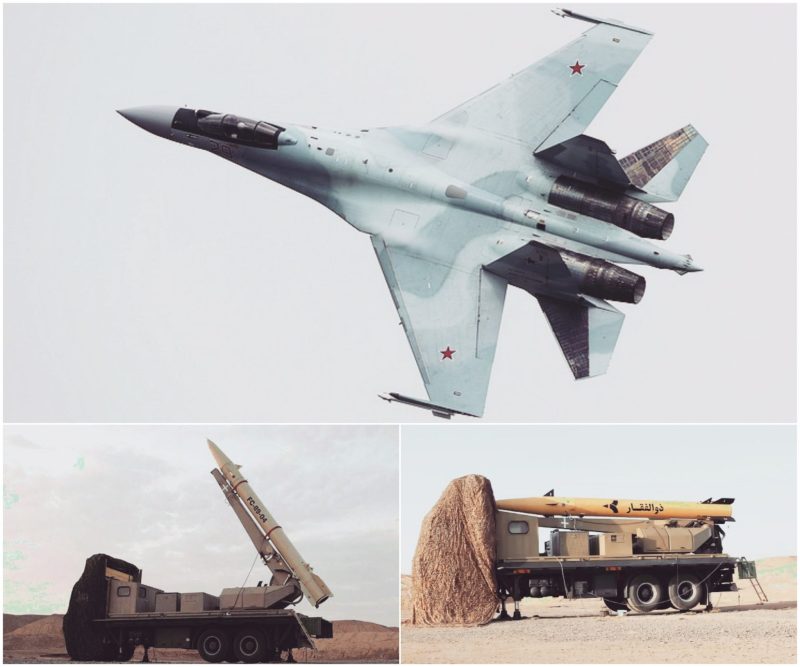
Iran has finalized arrangements to purchase Russian-made fighter jets and attack helicopters, Deputy Defense Minister Brigadier General Mahdi Farahi revealed to Tasnim News Agency on 28 November.
Farahi says the plans for the purchase and process of arrival of Sukhoi Su-35 fighter jets, Mil Mi-28 attack helicopters, and Yak-130 jet trainers to join the combat units of the Iranian Armed Forces have been signed and finalized.
“In some areas, we are among the top countries; in others, we are on the path to maturity. In this way, in addition to the development of endogenous capabilities, we must also use shortcuts to complete the defense capability, and one of these areas is the field of air technology,” Farahi said in the interview with Tasnim.
“We have good capabilities in the field of helicopters; that’s why we are the best in quantity in the region, but the qualitative improvement of helicopters is on the agenda,” Farahi added.
Talks for acquiring Sukhoi Su-35 fighter jets have been ongoing since late last year as part of joint military cooperation efforts between Tehran and the Kremlin.
Despite decades-long sanctions against Iran, the nation is still a major military power in West Asia and has over half a million active personnel.
Defense, trade, and banking ties between Iran and Russia have been growing over recent years despite western sanctions imposed on the two nations.
The central banks of both nations signed an interbank transfer deal earlier this year, allowing 52 Iranian banks to connect and transfer with 106 Russian banks.
Iran is also expected to join BRICS at the start of 2024, a group in which Russia is a key organizer.
Iranian President Ibrahim Raisi said at the 15th annual BRICS summit that the bloc expansion is “a new step towards establishing justice, ethics, and sustainable peace in the world.”
Iran has not made any significant purchases to its fighter aircraft arsenal in recent years besides purchasing a few Russian MiG-29 Fulcrum fighters in the 1990s.
Featured Video
Laith Marouf: Hezbollah’s position on US-Iran ceasefire
or go to
Aletho News Archives – Video-Images
From the Archives
The Dirty Little Secret behind the “Global Terrorism Index”
The Omission of Israeli Terrorism in the Occupied Palestinian Territories
By Karin Brothers | Global Research | December 6, 2014
… The Israeli settlements — all of which are illegal – have been identified as a major impediment to peace. The refusal of a major “global” terrorism report to name the Israeli settlers as one of the groups most responsible for terrorism not only misrepresents a major source of regional violence but exposes the Global Terrorism Index as a propaganda tool that supports a U.S. agenda.
In recent years, governments have been attempting to thwart terrorism by blocking supportive fund-raising. When it comes to Israeli settlements, however, the US and Canada actually encourage fund-raising by giving organizations (such as Christian Friends of Israeli Communities (CFOIC) and the Jewish National Fund) financial support in the form of donor tax-deductions.
Charities which provide funds for the Israeli settlements should be regarded as terror-financing organizations. They should not only lose their tax-deductible status, but they should be banned because they support the violation of international humanitarian law. The terror-financing laws that are being strictly enforced for Muslim charities should be applied to Christian and Jewish charities as well. … Read full article
Blog Roll
 Aletho News
- How UK Regulator Ofcom Quietly Bypassed International Law to Police American Speech
- The Black Cube Files: How Former Mossad Operatives Flipped a Nation
- Laith Marouf: Hezbollah’s position on US-Iran ceasefire: What you’re not being told
- Israel’s priority lies in destroying chances of peace between Iran, US: Ex-UN nuclear chief
- Ceasefire for all or for none: Iran shuts Hormuz over Lebanon attacks
- Strait of Hormuz is Iran’s ‘nuclear weapon’ that forced US retreat: Medvedev
- Energy crisis will last for months – Kremlin envoy
- Europe’s quiet role in the war on Iran
- Forty days that shook the Empire: How Iran turned the tables on US and prevailed
- Netanyahu unilaterally declares Lebanon outside of ceasefire deal
- If Americans Knew
- Gazans face a triple crisis: severe shortages of water and bread, healthcare in tatters
- NY Times reports how Netanyahu took the US into Iran War
- A sigh of relief over Iran, but Gaza and Lebanon in dire straits – Daily Update
- Thousands dead and neighborhoods razed to the ground: Aid agencies fear southern Lebanon is becoming the new Gaza
- The war the US is fighting for Israel could cost trillions
- ‘Cigarette Burns, Nail Wounds’: Toddler Tortured in Gaza to Coerce Father
- Trump Says US Sent ‘a Lot of Guns’ to Protesters in Iran
- Israeli forces destroy 17 UN peacekeeper cameras in south Lebanon
- US-Israeli strikes ‘completely destroy’ synagogue in Tehran
- Archbishop for US Military Says Iran War Is Unjust Under Catholic Teaching
- No Tricks Zone
- An Inconvenient Tree: Uncovered In Alps… Europe Much Warmer Than Today 6000 Years Ago
- New Study Reports A 60% Slowdown In Greenland’s Ice Loss Rate In The Last Decade
- Low Intensity Tornado Wrecks Major Solar Farm, Creating A Potential Toxic Dump
- New Study Finds Warming Saves Lives…Cold Temperatures 12 Times More Deadly Than Excess Heat
- German Science Blog Accuses PIK Climate Institute Of Hallucinating Climate Tipping Points
- Devastating Assessment Of Comirnaty Vaccine By Former Senior Pfizer Europe Toxicologist
- New Study: CO2 Is ‘Effectively Negligible’ As An Explanatory Climate Change Factor Since 2000
- Former Pfizer Toxicologist Dr. Helmut Sterz Tells Bundestag Hearing Pfizer Vaccine Should Have Never Been Approved
- Energy Expert: Germany’s Nuclear Phaseout Was A “500 Billion Euro Mistake”
- New Research: South Australia’s Mid-Holocene Sea Surface Temperatures Were 4°C Warmer Than Today
 Aletho News