Russia Considers US Proposals to Start Arms Control Talks ‘Hypocrisy’
Sputnik – 18.03.2024
Moscow considers Washington’s proposals to hold arms control talks “hypocrisy,” the Russian Foreign Ministry told Sputnik on Monday.
“American officials are declaring their alleged desire to enter into arms control discussions with Russia without preconditions but they clearly did not bother to read the February 29 address of Russian President Vladimir Putin to the Federal Assembly, which has our fundamental assessments of this kind of hypocrisy and demagogy amid Washington’s desire to inflict ‘strategic defeat’ on Russia,” the ministry said.
Earlier in the day, US Ambassador to the United Nations Linda Thomas-Greenfield said that the United States stands ready to engage in bilateral arms control talks with China and Russia without any preconditions.
“The United States is willing to engage in bilateral arms control discussions with Russia and China right now, without preconditions. All they have to do is say ‘yes’ and come to the table in good faith,” Thomas-Greenfield said during a UN Security Council meeting.
Russia’s policy has not changed, and the country is ready to discuss arms control altogether with focus on issues that directly involve Moscow’s security interests, the Russian Foreign Ministry added.
“In the meantime, we are invited to conduct dialogue exclusively on US terms and only on those issues that are of interest to Washington,” the ministry said.
Deputy Russian Permanent Representative to the UN Dmitry Polyanskiy in turn said that the strategic dialogue between Russia and the United States on arms control is only possible if the US and NATO revise their anti-Russian course.
“Any interaction will only be possible if the United States and NATO review their anti-Russian course and when they show that they are ready to participate in comprehensive dialogue taking into account all of our strategic stability factors and removing all of the concerns that we have,” Polyanskiy said at the UN Security Council meeting.
He stressed that the strategic dialogue between the US and the Russian Federation cannot be separated from the general and military context.
At the same time Russia stands ready to negotiate on the issue of nuclear disarmament with interested countries during the new Non-Proliferation of Nuclear Weapons Treaty (NPT) Review conference, Polyanskiy added.
“We expect that our Western colleagues will abandon their very dangerous and destructive course. We are open within the new NPT Review conference to a constructive dialogue with all countries interested in reaching a consensus understanding on how we can create preconditions for further nuclear disarmament,” he said.
Stop sending weapons to Ukraine: Russian diplomat responds to Macron’s ceasefire plan
TASS | March 17, 2024
MOSCOW – French President Emmanuel Macron should stop sending weapons to Kiev and propose a ceasefire agreement to parties to the Middle East conflict, Russian Foreign Ministry Spokeswoman Maria Zakharova told TASS.
Commenting on the latest initiative by the French leader who said he would ask Russia to observe a ceasefire in Ukraine during the Paris Olympics, the Russian diplomat said: “I come forward with a proposal in response to Macron’s: stop supplying weapons being used to kill [civilians] and also stop sponsoring terrorism.” “I also suggest that Macron come up with a similar proposal to the parties to the Middle East conflict. A lot probably depends on what France says there,” Zakharova maintained.
Earlier, Macron told an interviewer during a Ukrainian telethon that France will ask Russia to observe a ceasefire for the duration of the Olympic Games in Paris. When asked to comment on the potential participation of Russian athletes as neutrals, he said that, as the host country, France is sending a message of peace as it follows decisions made by the International Olympic Committee.
US is not a democracy – Putin

RT | March 17, 2024
Russian President Vladimir Putin has said that by criticizing democratic processes in other states, all while using their own administrative resources to suppress one of American presidential candidates, Washington has become a laughing stock of the rest of the world.
Speaking to the journalists at his campaign headquarters in Moscow on early Monday morning, after the preliminary results indicated his victory with over 87% of the vote in the country’s presidential elections, the Russian leader said that the “whole world is laughing at what is happening” in the US.
“We are behaving with more restraint than their opponents in other countries, but this is just a catastrophe, not a democracy – that’s what it is,” Putin said.
Putin noted that the US administration is using all its power and resources to attack one of the presidential candidates, apparently referring to former president Donald Trump, who is facing a litany of lawsuits despite being the frontrunner and virtually the only remaining Republican hopeful.
In a pre-election interview earlier this week Vladimir Putin said that Russia does not meddle in foreign elections and will work with any elected US president.
“I think it’s obvious to everyone that the American political system cannot claim to be democratic in any sense of the word,” he said in an interview with journalist Dmitry Kiselyov. Putin refused to comment further on the current presidential campaign in the US, but described the atmosphere as becoming “increasingly uncivilized.”
The West in Decline – John Mearsheimer, Alexander Mercouris & Glenn Diesen
The Duran | March 16, 2024
The West in Decline – John Mearsheimer, Alexander Mercouris & Glenn Diesen
ALEXANDER: https://www.youtube.com/AlexanderMercourisReal
ALEX: https://www.youtube.com/alexchristoforou
The Anglo-American War on Russia – Part Fourteen (Biden Blocks Peace)
Tales of the American Empire | March 14, 2024
In 2023, hard proof emerged that American neocons provoked Russian intervention in Ukraine and blocked efforts at a peaceful settlement. This had occurred several times in the past decade after peace agreements were signed, at Minsk in 2014, Minsk 2 in 2015, Paris in 2019, and Istanbul in 2022. None of these agreements were implemented by Ukraine because they were sabotaged by American neocons via the CIA. As previous parts of this series have explained, their goal is to weaken and destroy Russia by using Ukraine to fight a proxy war.
________________________________
“Beloveza Accords”; Wikipedia; https://en.wikipedia.org/wiki/Belovez…
“Bennett speaks out”; former Israeli Prime Minister Naftali Bennett; YouTube; Feb 3, 2023;  • בנט מדבר
“HOW THE United States and Its NATO Allies Sabotaged Peace Between Russia and Ukraine”; Larry Johnson; November 14, 2023; https://sonar21.com/how-the-chance-wa…
“How Zelensky was Prevented From Making Peace in the Donbas”; Felix Abt; Covert Action Magazine, March 24, 2023; https://covertactionmagazine.com/2023…
Related Tales: “The Anglo-American War on Russia”; • The Anglo-American War on Russia
The big lie behind the Western narrative on Russia is leading us to World War III
By Tarik Cyril Amar | RT | March 15, 2024
The current situation in the conflict between Ukraine – serving (while being demolished) as a proxy for the West – and Russia, can be sketched in three broad strokes.
First, Russia now clearly has the upper hand on the battlefield and could potentially accelerate its recent advances to achieve an overall military victory soon. The West is being compelled to recognize this fact: as Foreign Affairs put it, in an article titled “Time is Running Out in Ukraine,” Kiev and its Western supporters “are at a critical decision point and face a fundamental question: How can further Russian advances… be stopped, and then reversed?” Just disregard the bit of wishful thinking thrown in at the end to sweeten the bitter pill of reality. The key point is the acknowledgment that it is crunch time for the West and Ukraine – in a bad way.
Second, notwithstanding the above, Ukraine is not yet ready to ask for negotiations to end the war on terms acceptable to Russia, which would be less than easy for Kiev. (Russian President Vladimir Putin, meanwhile, reiterated in an important recent interview that Moscow remains principally open to talks, not on the basis of “wishful thinking” but, instead, proceeding from the realities “on the ground.”)
The Kiev regime’s inflexibility is little wonder. Since he jettisoned a virtually complete – and favorable – peace deal in the spring of 2022, President Vladimir Zelensky has gambled everything on an always improbable victory. For him personally, as well as his core team (at least), there is no way to survive – politically or physically – the catastrophic defeat they have brought on their country by leasing it out as a pawn to the Washington neocon strategy.
The Pope, despite the phony brouhaha he triggered in Kiev and the West, was right: a responsible Ukrainian leadership ought to negotiate. But that’s not the leadership Ukraine has. Not yet at least.
Third, the West’s strategy is getting harder to decipher because, in essence, the West cannot figure out how to adjust to the failure of its initial plans for this war. Russia has not been isolated; its military has become stronger, not weaker – and the same is true of its economy, including its arms industry.
And last but not least, the Russian political system’s popular legitimacy and effective control has neither collapsed nor even frayed. As, again, even Foreign Affairs admits, “Putin would likely win a fair election in 2024.” That’s more than could be said for, say, Joe Biden, Rishi Sunak, Olaf Scholz, or Emmanuel Macron (as for Zelensky, he has simply canceled the election).
In other words, the West is facing not only Ukraine’s probable defeat, but also its own strategic failure. The situation, while not a direct military rout (as in Afghanistan in 2021) amounts to a severe political setback.
In fact, this looming Western failure is a historic debacle in the making. Unlike with Afghanistan, the West will not be able to simply walk away from the mess it has made in Ukraine. This time, the geopolitical blowback will be fierce and the costs very high. Instead of isolating Russia, the West has isolated itself, and by losing, it will show itself weakened.
It is one thing to have to finally, belatedly accepted that the deceptive “unipolar” moment of the 1990s has been over for a long time. It is much worse to gratuitously enter the new multipolar order with a stunning, avoidable self-demotion. Yet that is what the EU/NATO-West has managed to fabricate from its needless over-extension in Ukraine. Hubris there has been galore, the fall now is only a matter of time – and not much time at that.
Regarding EU-Europe in particular, on one thing French President Emmanuel Macron is half right. Russia’s victory “would reduce Europe’s credibility to zero.” Except, of course, a mind of greater Cartesian precision would have detected that Moscow’s victory will merely be the last stage in a longer process.
The deeper causes of EU/NATO-Europe’s loss of global standing are threefold. First, its own wanton decision to seek confrontation instead of a clearly feasible compromise and cooperation with Russia (why exactly is a neutral Ukraine impossible to live with again?) Second, the American strategy of systematically diminishing EU/NATO-Europe with a short-sighted policy of late-imperial client cannibalization which takes the shape of aggressive deindustrialization and a “Europeanization” of the war in Ukraine. And third, the European clients’ grotesque acquiescence to the above.
That is the background to a recent wave of mystifying signals coming out of Western, especially EU/NATO elites: First, we have had a wave of scare propaganda to accompany the biggest NATO maneuvers since the end of the Cold War. Next Macron publicly declared and has kept reiterating that the open – not in covert-but-obvious mode, as now – deployment of Western ground troops in Ukraine is an option. He added a cheap demagogic note by calling on Europeans not to be “cowards,” by which he means that they should be ready to follow, in effect, his orders and fight Russia, clearly including inside and on behalf of Ukraine. Never mind that the latter is a not an official member of either NATO or the EU as well as a highly corrupt and anything but democratic state.
In response, a divergence has surfaced inside EU/NATO Europe: The German government has been most outspoken in contradicting Macron. Not only Chancellor Scholz rushed to distance himself. A clearly outraged Boris Pistorius – Berlin’s hapless minister of defense, recently tripped up by his own generals’ stupendously careless indiscretion over the Taurus missiles – has grumbled that there is no need for “talk about boots on the ground or having more courage or less courage.” Perhaps more surprisingly, Poland, the Czech Republic as well as NATO figurehead Jens Stoltenberg (i.e., the US) have been quick to state that they are, in effect, not ready to support Macron’s initiative. The French public, by the way, is not showing any enthusiasm for a Napoleonic escalation either. A Le Figaro poll shows 68 percent against openly sending ground troops to Ukraine.
On the other side, Macron has found some support. He is not entirely isolated, which helps explain why he has dug in his heels: Zelensky does not count in this respect. His bias is obvious, and his usual delusions notwithstanding he is not calling the shots on the matter. The Baltic states, however, while military micro-dwarfs, are, unfortunately, in a position to exert some influence inside the EU and NATO. And true to form, they have sided with the French president, with Estonia and Lithuania taking the lead.
It remains impossible to be certain what we are looking at. To get the most far-fetched hypothesis out of the way first: is this a coordinated bluff with a twist? A complicated Western attempt at playing good-cop bad-cop against Russia, with Macron launching the threats and others signaling that Moscow could find them less extreme, at a diplomatic price, of course? Hardly. For one thing, that scheme would be so hare-brained, even the current West is unlikely to try. No, the crack opening up in Western unity is real.
Regarding Macron himself, too-clever-by-half, counter-productive cunning is his style. We cannot know what exactly he is trying to do; and he may not know himself. In essence, there are two possibilities. Either the French president now is a hard-core escalationist determined to widen the war into an open clash between Russia and NATO, or he is a high-risk gambler who is engaged in a bluff to achieve three purposes. Frighten Moscow into abstaining from pushing its military advantage in Ukraine (a hopeless idea); score nationalist “grandeur” points domestically in France (which is failing already); and increase his weight inside EU/NATO-Europe by “merely” posturing as, once again, a new “Churchill” – whom Macron himself has made sure to allude to, in all his modesty. (And some of his fans, including Zelensky, a grizzled veteran of Churchill live action role play, have already made that de rigueur if stale comparison.)
While we cannot entirely unriddle the moody sphinx of the Elysée or, for that matter, the murky dealings of EU/NATO-European elites, we can say two things. First, whatever Macron thinks he is doing, it is extremely dangerous. Russia would treat EU/NATO-state troops in Ukraine as targets – and it won’t matter one wit if they turn up labeled “NATO” or under national flags “only.” Russia has also reiterated that it considers its vital interests affected in Ukraine and that if its leadership perceives a vital threat to Russia, nuclear weapons are an option. The warning could not be clearer.
Second, here is the core Western problem that is now – due to Russia undeniably winning the war – becoming acute: Western elites are split between “pragmatists” and “extremists.” The pragmatists are as Russophobic and strategically misguided as the extremists, but they do shy away from World War Three. Yet these pragmatists, who seek to resist hard-core escalationists and rein in at least high-risk gamblers, are brought up short against a crippling contradiction in their own position and messaging: As of now, they still share the same delusional narrative with the extremists. Both groupings keep reiterating that Russia plans to attack all of EU/NATO-Europe once it defeats Ukraine and that, therefore, stopping Russia in Ukraine is, literally, vital (or in Macron’s somewhat Sartrean terms “existential”) to the West.
That narrative is absurd. Reality works exactly the other way around: The most certain way to get into a war with Russia is to send troops to Ukraine openly. And what is existential for EU/NATO-Europe is to finally liberate itself from American “leadership.” During the Cold War, a case could be made that (then Western) Europe needed the US. After the Cold War, though, that was no longer the case. In response, Washington has implemented a consistent, multi-administration, bipartisan, if often crude, strategy of avoiding what should have been inevitable: the emancipation of Europe from American dominance.
Both the eastward expansion of NATO, programmed – and predicted – to cause a massive conflict with Russia and the current proxy war in Ukraine, obstinately provoked by Washington over decades, are part of that strategy to – to paraphrase a famous saying about NATO – “keep Europe down.” And the European elites have played along as if there’s no tomorrow, which, for them, there really may not be.
We are at a potential breaking-point, a crisis of that long-term trajectory. If the pragmatists in EU/NATO-Europe really want to contain the extremists, who play with triggering an open war between Russia and NATO that would devastate at least Europe, then they must now come clean and, finally, abandon the common, ideological, and entirely unrealistic narrative about an existential threat from Moscow.
As long as the pragmatists dare not challenge the escalationists on how to principally understand the causes of the current catastrophe, the extremists will always have the advantage of consistency: Their policies are foolish, wastefully unnecessary, and extremely risky. And yet, they follow from what the West has made itself believe. It is high time to break that spell of self-hypnosis, and face facts.
Tarik Cyril Amar is a historian from Germany working at Koç University, Istanbul, on Russia, Ukraine, and Eastern Europe, the history of World War II, the cultural Cold War, and the politics of memory.
Kiev regime promotes terror in Belgorod
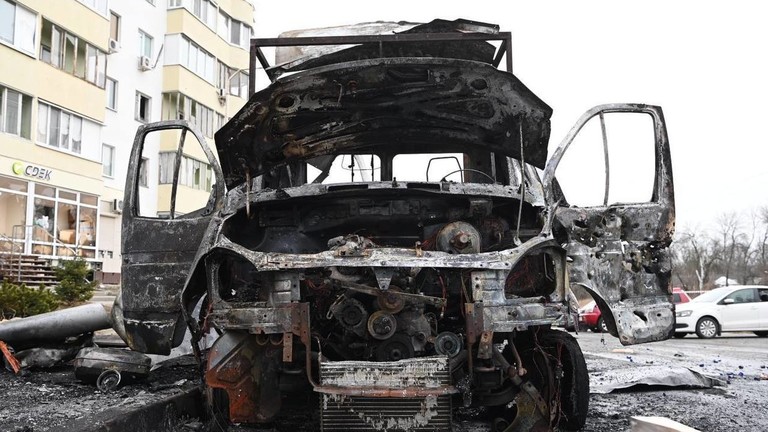
A vehicle destroyed by Ukraine shelling in Belgorod. © Telegram / Valentin Demidov
By Lucas Leiroz | March 15, 2024
The Belgorod region has been the target of several Ukrainian attacks in recent days, even more intensely on March 14, just before the start of the Russian elections. The targets of the attacks were civilian facilities, without any military relevance, which makes the Ukrainian attitude absolutely criminal according to international law.
Participating in a press expedition with the BRICS Journalists Association, I was in Belgorod to report the local tragedy on the ground. Several missile and drone attacks took place throughout the day, leaving at least two dead and several injured. I visited most of the affected places and spoke to some victims, obtaining a lot of relevant information.
Locals said that these raids have become increasingly frequent and that raids intensify during important dates for the Russian Federation. Religious and patriotic holidays, for example, are often marked by intense Ukrainian shelling on the border. Currently, due to the Russian election period, these attacks are once again becoming extremely violent.
Ukrainian missiles and drones on March 14 hit facilities such as shopping centers, common streets and residential buildings. There were no military targets in the attacks, with all victims being civilians. Apparently, the Ukrainian objective is simply to promote terror throughout the city and prevent people from living normally during election time. Unable to leave their homes for fear of bombings, ordinary citizens could be prevented from voting, damaging the electoral process.
In addition to drone and missile attacks, there was a land invasion, with Ukrainian troops trying to enter Russian territory using tanks and armored vehicles, with aerial support from helicopters. The invasion, however, was quickly neutralized by the joint action of the Russian military and security forces. Some villages close to the border were severely affected, such as in the Belovskoye region, where three people were seriously injured by Ukrainian forces – including two nine-month-old children, whose bodies were partially burned by shrapnel from bombs. The damage to the civilian population was severe, despite Kiev’s absolute failure to gain ground on the Russian side of the border.
I asked local residents on the city’s streets how they felt about the Ukrainian threat during this election period. Despite the danger, the locals showed courage and fearlessness, stating that the elections would not need to be canceled or postponed. Residents said they trust the work of the Russian defense forces, which is why they feel safe going to the polls.
It must be emphasized that these attacks could have had much worse consequences if the Russian defense forces were not sufficiently precise in containing the damage. Most enemy missiles and drones are destroyed by Russian air defense before reaching their targets, saving the lives of hundreds of civilians. Although some projectiles hit their targets, the damage from the attacks is partially low, which makes the local people feel reasonably safe, despite the constant threat.
In addition to the work of the Russian defense forces, the city of Belgorod is structured to protect as many civilians as possible. There are anti-missile shelters along the streets, where locals hide as soon as the air raid sirens start to sound. This protective structure allows life to continue reasonably as normal in the city, despite the attacks. Commerce and transport services continue to operate, for example, with only small interruptions during the most critical moments.
In fact, this type of terrorist operation was already expected. The neo-Nazi regime intensifies attacks and killings of civilians during important periods, such as elections, which is why it is no surprise to Russians that this is happening now. However, the brutality with which Ukrainian forces target civilian areas should be seen as a reminder of the real nature of the Kiev regime. The Ukrainian Junta simply has a military guideline to target and kill civilians, and there is no limit to its bombings in absolutely demilitarized and strategically irrelevant regions.
Also, considering that the weapons used by Ukraine in these operations are supplied by NATO, it is also possible to say that the West is a co-participant in these crimes, having responsibility for the deaths of Russian civilians in Belgorod and other regions. As long as Ukraine has “carte blanche” from its Western partners to murder ordinary people, terrorist attacks like those in Belgorod on the 14th will be frequent – and only by the military action of the Russian forces will it be possible to save civilian lives.
Lucas Leiroz, journalist, researcher at the Center for Geostrategic Studies, geopolitical consultant.
Ukraine bombs Russian nuclear power plant periphery
RT | March 14, 2024
Ukrainian forces have dropped a bomb near diesel tanks located at Russia’s Zaporozhye nuclear power plant, management at the facility reported on Thursday.
In a video published on social media, plant director Yury Chernuk pointed to a crater in the ground, which he said had been created by an explosive device dropped from a Ukrainian drone.
The bomb itself was composed of explosives wrapped in foil, according to reports, but the location was significant. The crater was just five meters away from the perimeter fence, and tanks storing diesel fuel could be seen in the footage.
The plant has backup diesel generators, which kick in when electricity supply from the power grid is cut off. Its equipment needs to be powered continuously to ensure safe operation, even when nuclear reactors are not online. Blackouts have been a regular occurrence for the site since the beginning of the conflict.
”Destruction of those tanks or a fuel leak may not only cause a fire, but also result in significant loss of diesel reserves. Consequently, the plant’s preparedness for emergencies would be reduced by orders of magnitude,” Chernuk explained.
Another person, who was not identified, suggested that the bombing incident had been part of Ukraine’s intimidation tactics. Kiev considers the plant to be occupied by the Russian military.
The director of the facility noted that Ukrainian forces had targeted the plant days after the International Atomic Energy Agency, the UN’s nuclear watchdog, rotated observers stationed there. The organization told Russian media that it was aware of the incident, but offered no further comment.
Following the incident, the situation was reportedly calm in Energodar, the city where the Zaporozhye power plant is located.
Theft of Frozen Russian Assets May Lead to Financial Crisis in the West
By Ekaterina Blinova – Sputnik – 13.03.2024
While US policymakers are seeking to grab Russia’s sovereign assets altogether, EU officials are planning to find legal ways to seize the profits generated by the assets. Russia has signaled it will retaliate against any form of theft.
An EU official told Reuters that Russian assets frozen in the EU could generate up to €20 billion in after-tax profits through 2027, adding that only part of these profits, as well as a tax on the gross amount, could be sent to the Kiev regime. It was noted the remaining funds, however, would have to stay in the West to create a buffer against Moscow’s retaliation measures.
Of the roughly $282 billion in Russian assets immobilized in Japan and the West, around $207 billion (€191 billion) are held at Euroclear, a clearinghouse based in Belgium.
The official anticipates Euroclear may face a flurry of legal claims from Moscow if Russian money is transferred to Ukraine. The claims are due to come from the Russian Central Bank, which can seize €33 billion in Euroclear funds held in the national securities depository in Moscow as a tit-for-tat move, according to the official.
Russia may also take legal action to seize Euroclear assets held in Hong Kong and Dubai.
Western banks that have lost investment funds in Russia could also sue the clearinghouse, potentially leading to Euroclear’s bankruptcy and triggering a domino effect, given Euroclear’s key role in global financial transactions. The EU official warned that, ultimately, the trail of counterclaims could lead to nothing short of an economic crisis.
Speaking to the Financial Times in mid-February, Lieve Mostrey, chief executive of Euroclear, warned that a G7 plan to use Russia’s frozen assets as a backstop to issue debt for Ukraine, or seize the immobilized assets altogether, could pose serious financial risks to Europe.
“When we come to a logic of seizing of assets (…) then you see the trust in the Euroclear system, the trust in the European capital markets, the trust in euro as a currency substantially affected,” she told FT.
Mostrey remarked that “the risk is a bit lower” if the West grabs profits generated by the frozen sovereign assets.
Russia has underscored it will take retaliatory measures in response to any manipulations with its financial resources illegally immobilized by the West, and that it would perceive any form of grab as “theft”. Euroclear is already facing between 50 and 100 lawsuits in Russian courts over the sanctioned assets.
Any actions with Russian frozen assets will trigger a symmetrical response, Finance Minister Anton Siluanov told Sputnik in late February, adding that a similar quantity of foreign assets have been frozen in Russia.
The Russian finance minister suggested last December that in the event of confiscation of Russian assets in Europe, Russia may tap foreign funds frozen in so-called Type “C” accounts, a special type of accounts for non-residents introduced by Russia in March 2022. One cannot withdraw money from these accounts as funds can only be used for a limited range of purposes, such as paying taxes or purchasing federal loan bonds.
According to some estimates, by mid-March 2023, up to 1 trillion rubles (€10 billion) could have been accumulated in type “C” accounts in the form of dividends and coupons paid to investors from unfriendly countries at Russia’s National Settlement Depository (NSD).
Kremlin spokesperson Dmitry Peskov made it clear in early February that Russia is prepared for a decade-long legal battle over the potential seizure of its assets.
“If such decisions are made, they will be deeply illegal. They will have decades-long judicial consequences for those who make these decisions and for those who implement these decisions,” Peskov emphasized.
Russia says no to Switzerland ‘peace conference’
RT | March 13, 2024
Moscow has no intention of participating in a proposed Swiss-hosted peace conference on the Ukraine conflict, even if it is officially invited, Russian Foreign Ministry spokeswoman Maria Zakharova has stated.
The official response follows recent media reports that China and Switzerland have been pushing to get Russia invited to the talks. Last month, Switzerland announced plans to organize a peace summit “by the summer.” No specific date has been named as of yet. The list of participants has also not been revealed. However, Ukraine has indicated that Russia can only be invited if it agrees in advance to a litany of preconditions.
“This forum will be dedicated to promoting the ultimatum ‘Zelensky peace formula,’ although its Swiss organizers pretend that they are looking for a common denominator in the peace initiatives of different countries,” Zakharova said, according to a press release issued on Wednesday on the ministry’s website.
She explained that Zelensky’s plan includes a number of unrealistic terms, including the withdrawal of Russian troops to Ukraine’s 1991 borders, holding Moscow accountable and paying reparations, as well as provisions on food, nuclear safety, energy, ecology, and humanitarian problems. Kiev’s basic demands remain the same, while legitimate Russian interests are being ignored, Zakharova said.
“So, the upcoming conference is a continuation of meetings in the Copenhagen format, which initially discredited themselves, and now have reached a dead end.”
Moscow is convinced that “Switzerland can hardly serve as a platform for various peacekeeping efforts, since this presupposes a neutral status, which Bern has lost,” the spokeswoman claimed.
“All this makes Russia’s participation in the aforementioned ‘peace conference’ pointless as it doesn’t matter whether it will be held in one, two or five stages – its ultimatum essence, promoted by Kiev and its masters, does not change from this,” Zakharova concluded.
Ukraine’s Western backers insist that a peace settlement can only be achieved on Kiev’s terms and have vowed to continue weapons deliveries for “as long as it takes.” Russia, meanwhile, has stressed that no amount of foreign aid will change the course of the conflict.
Peace negotiations between Moscow and Kiev were held in the spring of 2022, but broke down with both sides accusing each other of making unrealistic demands.
Russian President Vladimir Putin subsequently said the Ukrainian delegation had initially agreed with some of Russia’s terms during the talks in Istanbul that March, but then abruptly reneged on the deal.
The Kremlin has repeatedly stressed that it remains open to meaningful discussions and has blamed the lack of a diplomatic breakthrough on the Ukrainian authorities.
Does the Fate of US Arms in Ukraine Create Pause for Thought Ahead War with China?
By Brian Berletic – New Eastern Outlook – 12.03.2024
In recent months, advanced US weapon systems provided to Ukrainian forces have been cornered and destroyed on the battlefield by Russian troops. This includes the first ever confirmed footage of a US M142 High Mobility Artillery Rocket System (HIMARS), the destruction of several M1 Abrams main battle tanks, and the further loss of several more Bradley infantry fighting vehicles, Newsweek reported.
Last year, the US Department of Defense admitted that a US-made Patriot air defense battery sustained damage in a Russian missile attack, according to CNN. This year, in an article by Forbes, it is admitted that a Russian short-range Iskander ballistic missile destroyed at least two Patriot missile launchers.
These developments end decades of US claims regarding the superiority of its weapons systems, including boasts that Russia’s Soviet-era equipment “won’t be a match” for US arms, as the Business Insider claimed regarding M1 Abrams being sent to Ukraine.
Busting the Myth of American Military Supremacy
The Business Insider article, like many others across the Western media, repeated the myth of the superiority of America’s military technology based on flawed analysis of its performance during the 1991 Persian Gulf War and the 2003 US-led invasion of Iraq. In both instances, the US pitted its best troops and equipment against poorly trained Iraqi forces using Soviet-era equipment already obsolete at the time.
The lopsided results of the fighting in both conflicts were cited as evidence of American superiority over Soviet and then Russian Federation military technology. It also serves as the basis of assumed military superiority over Chinese military power. Such lopsided fighting was imagined by Western analysts ahead of US weapons arriving at the battlefield in Ukraine, and despite the poor performance of these systems in Ukraine, such lopsided fighting is still imagined amid any potential conflict between the US and China.
However, for analysts carefully studying the evolution of modern warfare from 1991 to present day, the disparity between Western military technology and that of even non-state armed organizations was closing. During the 2006 Israeli invasion of southern Lebanon, Hezbollah used modern Russian anti-tank weapons to inflict heavy casualties on Israeli forces, Haaretz reported. Hezbollah’s enhanced military might allowed it to stop the advance of Israeli Merkava main battle tanks and supporting troops well before their stated objective of reaching the Litani River.
The Syrian Arab Army’s successful use of Soviet and Russian-made air defense systems during the ongoing conflict in Syria has forced US, European, and Israeli warplanes to launch attacks using longer-range stand-off weapons. These same air defense systems have been used to intercept Western cruise missiles, reducing damage to targets across the country.
Russia’s intervention in Syria at the invitation of Damascus in 2015 was followed by an effective use of modern Russian air power, cutting the supply lines of Western-backed militants, and aiding Syrian forces on the ground in encircling and destroying them.
It was becoming clear that should modern Western weapon systems face modern Russian military technology, the myth of Western military superiority would be shattered. It was also becoming clear that a similar gap was closing in terms of US military technology and its Chinese counterparts.
On the battlefield in Ukraine, Russian forces using modern Russian weapons are eliminating Ukrainian brigades trained and armed by the US and other NATO members. Despite high expectations ahead of Ukraine’s 2023 offensive, up to 9 NATO-trained and armed brigades were decimated in months of fighting. The New York Times would report at the end of 2023 that despite Ukraine’s massive offensive campaign, Russia had gained the most territory that year.
While it is true that Ukraine did not have enough time to properly integrate the Western arms transferred to it from 2022 onward, the performance of both Western and Russian weapons on the battlefield has made it clear that, now more than ever, the idea of Western military superiority is a more nostalgic interpretation of history, and far from a current reality.
Beyond the performance of Western and Russian weapons on the battlefield themselves, both Western and Russian military industrial capacity has been put to the test. Western private industry-run arms manufacturing had failed to develop surge capacity needed for the protracted, large-scale fighting now taking place in Ukraine. Russia’s military industrial base inherited and then enhanced and modernized such surge capacity from the Soviet Union and, according to the New York Times, despite sanctions, is now outproducing the collective West.
Additionally, because of the complex nature of modern Western arms, a vast network of logistics, sustainment, and maintenance is required to keep these arms operating on the battlefield. A recent press release by the US Department of Defense Inspector General reveals that no such system was created for US weapons transferred over to Ukraine and that without it, “the Ukrainians would not be capable of maintaining these weapon systems.”
Such support was not provided to Ukraine because of the massive undertaking such support requires. For any given fighting force, one many times larger is required to support, sustain, and maintain that force and the weapons and vehicles it uses.
Taken together, all of these weaknesses revealed about Western military technology do not bode well for the United States ahead of any potential conflict directly or by proxy against China.
The Gap Between US and Chinese Military Power is Narrowing
Not only does China have many weapon systems comparable to the systems Russia is employing in Ukraine now, China has acquired some of the best Russian military technology from Russia itself. This includes the Su-35 warplane and the S-400 air defense system.
The US Department of Defense admits the growing capabilities of Chinese military systems, particularly in terms of missile technology, both surface-to-surface missiles and air-to-air missiles launched by warplanes, comparable to or exceeding the capabilities of American missiles, Air and Space Forces Magazine reported.
A 2023 Reuters article would likewise cite the US Department of Defense, admitting that China’s navy was already larger than the US Navy.
Even as Russia’s military industrial base is outcompeting the collective West, China’s industrial base is larger still. Any difficulties the US is having outproducing Russia in terms of military equipment and ammunition will pale in comparison to China’s military industrial output.
Together with the fact that any potential conflict the US seeks to provoke with China will take place in the Asia-Pacific region, thousands of kilometers away from US shores, and considering the extensive nature of the networks required to support US military technology on the battlefield, the idea of Washington fighting and winning any armed conflict against China appears particularly and increasingly absurd.
Even if Washington’s strategy is to subordinate China not with the threat of fighting and winning a war against China in the Asia-Pacific region, but to hold peace and stability in the region hostage by threatening war regardless of its outcome, the US finds itself in a difficult and increasingly weak position year-by-year.
Current US foreign policy is predicated on the premise, “might makes right.” However, the US is clearly no longer “the mightest.” As it provokes conflicts around the globe directly or by proxy, it risks suffering severe consequences its previous advantages in terms of military power had protected it against decades ago.
Continuing to pursue an unsustainable policy like this will end in disaster for Washington and for the American people. However, the US could always pivot toward a policy of coexistence and cooperation, built on mutual respect for other nations like Russia and China as well as the primacy of national sovereignty of all nations.
While the US would no longer be the most powerful nation on Earth, it would still assume a prominent and respected position within a multipolar world. Conversely, if it continues pursuing a foreign policy of belligerence, it still will no longer be the most powerful nation on Earth, but will arrive at that conclusion under much more difficult conditions.
What is unfolding on the battlefields of Ukraine is giving the collective West insight into what it itself may undergo if it continues provoking conflict within a world where Western supremacy has diminished and the rest of the world is now capable of asserting their own best interests within their borders and regions of the world above the collective West and its ambitions worldwide.
The collective West insists on its continued pursuit of global primacy at its own peril.
Brian Berletic is a Bangkok-based geopolitical researcher and writer.
How Washington Killed the Nuclear Arms Control System
By Ted Galen Carpenter | The Libertarian Institute | March 12, 2024
During the Cold War, world populations faced the ongoing nightmare of a nuclear attack coming out of the blue. All it would have taken was one miscalculation by either side. Such a trigger could even have taken the form of a false alert. We know that at least one such incident nearly led to catastrophe.
In 1983, the Soviet Union’s alert system indicated that there were incoming missiles on their way. Fortunately, the alert commander ordered a double check to be sure the indications of a missile launch from NATO were genuine. That check confirmed that the alert was erroneous. Given the dire state of East/West tensions, World War III would have at the time been almost certain if the commander had not been extra cautious.
The end of the Cold War ended the prospect of such a nightmare scenario. Unfortunately, Bill Clinton’s administration “found new causes to promote using American power, a fixation that would lead to serial campaigns of intervention and social engineering.” U.S. leaders, especially Secretary of State Madeline Albright, went out of their way to demonstrate Russia’s impotence publicly. In particular, they humiliated Russia’s Serbian clients both in Bosnia and in Serbia itself. Washington’s treatment of the Serbs caused renewed East/West tensions and began to generate a second Cold War.
Even more directly, the United States and its principal European allies provoked Russia with multiple rounds of NATO expansion. In April 1998, NATO admitted Poland, Czechoslovakia, and Hungary over Russia’s vehement objections. Expansion continued under both George W. Bush and Barrack Obama. The result was a steady increase in military tensions. In addition to provoking Russia by mistreating its Serbian clients, Washington expanded NATO eastward, creating a threat within Russia’s core security zone.
There were multiple rounds of eastward expansion involving Bill Clinton, George W. Bush, and Barrack Obama. The mythology has also developed that Donald Trump was soft on policy toward Russia, if not an outright traitor. The reality was the opposite. U.S. policy towards Russia hardened significantly under Trump. That point was most obvious with regard to Trump’s attitude towards crucial arms control agreements.
Under Trump, the United States had adopted several measures that again raised the extent of tension. An especially unhelpful action took place during Trump’s administration when hawkish U.S. officials decided that the United States should withdraw from the Intermediate-Range Nuclear Forces Treaty in August 2019. Such intermediate range missiles had always been Russia’s Achilles’ heel and Russian leaders were hypersensitive about their country being at a disadvantage with respect to such weapons. Threatening to withdraw from that agreement was extremely unhelpful. The situation worsened when Washington followed up by deciding to withdraw from the Open Skies Treaty in November 2020.
As Western-Russian relations deteriorated further, Russian President Vladimir Putin put Russia’s nuclear forces on higher alert in February 2022 following the advance of Russian forces deeper into Ukraine. Later in the year, relations became even more confrontational. The “architecture of disarmament and nonproliferation is now gradually being dismantled. On [November, 2023] President Vladimir V. Putin signed a law revoking Russia’s ratification of the global treaty banning nuclear testing. In pushing through the de-ratification, Putin said that he wanted to “mirror” the American position. Although the United States signed the treaty in 1996, it has never been ratified. Since the United States has never ratified the treaty, Russia’s move was more symbolic than practical. But it leaves only one significant nuclear weapons pact between Russia and the United States in place: the New START treaty.” If Russia further weakens its commitment to the test ban, that will create yet another arena for instability.
It is sobering to consider the state of global nuclear arms control today to what it was at the end of the Cold War. It is alarming that Moscow and Washington have returned to the state of nuclear rivalry and confrontation in less than a quarter century. An unparalleled opportunity for peace has been wasted.
Featured Video

Trita Parsi: Middle East Unraveling — Are We on the Path to World War?
or go to
Aletho News Archives – Video-Images
New Book
Trans agenda is ‘normalization of sadism’ – US author

RT | September 23, 2026
The US Democratic Party has embraced a transgender agenda that amounts to “the normalization of sadism,” author A.J. Rice has said, warning that radical trans policies would return if the party is allowed to regain power.
Speaking to RT’s America First host Scotty Nell Hughes about his new book, ‘The Curse of the Bearded Lady: How the Trans Mafia Whacked American Sanity’, Rice argued that activists have gained significant influence in schools, medicine, and corporate America while people who questioned the agenda have faced pressure to stay silent.
The author described the “trans mafia” as the sprawling network of people and institutions that have helped the movement gain influence. He singled out parts of academia, wealthy backers, and corporations, and stated that providers of transition-related treatment also have a financial incentive to keep young people in their care indefinitely.
Rice argued that the consequences of these policies ultimately fall on children who are being drawn toward gender-affirming medical treatments and on girls who are expected to share locker rooms or compete in sports with biological males.
He noted that while voters rejected the Democrats’ approach to gender in 2024, the party, which has been “captured by madness,” has since only doubled down and is seeking what is effectively “the normalization of sadism.” … Full report
Blog Roll
 Aletho News
- ‘We don’t seek permission to defend our country’: Snippets from President Pezeshkian’s UNGA address
- NATO chief wants Europeans to fight American wars [for Israel]
- German chemicals giant reveals details of downsizing
- Refaat Al-Areer Was The Canary In The Coal Mine In Israel’s War On The Truth
- Israeli election committee bars candidate from Knesset race over Gaza war opposition
- French-Lebanese man files war crimes complaint over Israeli attacks
- Mahan Air Flight Lands in China Despite US Threat against Iranian Airlines
- US eyes $10bn fund to rebuild war-battered Gulf infrastructure
- Trump meets Rodríguez near Maduro’s prison as Venezuela’s oil flows to US
- Trita Parsi: Middle East Unraveling — Are We on the Path to World War?
- If Americans Knew
- An error has occurred; the feed is probably down. Try again later.
- No Tricks Zone
- New Study: Earth And Venus Surface Warmth Largely Explained By Convection And Lapse Rate, Not CO2 Or Radiation
- 2025 Nature Paper Claiming Worsening Global Drought Gets RETRACTED …Heavily Flawed
- New Study: ‘Global Drought Shows No Detectable Recent Acceleration Under Climate Warming’
- Economic Masterminds: German Socialists Suggest Taxing Productivity Gains Stemming From Using AI
- The South China Sea Has Not Been Cooperating With The Climate Change Narrative
- Energy Crisis: Germany Enters Heating Season With Historically Low Gas Reserve Fill Levels
- New Study: The Antarctic Ice Sheet Gained Mass From 2020-2024 Due To Staggering Snow And Ice Accumulation
- Study: Ocean Heating Rates From Thousands Of Years Ago ‘Dwarf’ Modern Ocean Heating Rates
- Climate Extremists Target, Attack Large-Scale Power Grid Infrastructure In Germany!
- New Study: Antarctic Ice Melt Has Contributed Less Than 1 Centimeter To Sea Level Rise In The Last 30 Years

