Israeli attack on Damascus was terrorist act – Moscow
RT | April 2, 2024
The head of Russia’s Foreign Intelligence Service (SVR), Sergey Naryshkin, has described Monday’s airstrike on the Iranian Consulate in the Syrian capital as a terrorist attack committed by the Israeli government.
Speaking to reporters after a meeting with his Belarusian counterparts on Tuesday, the spy chief condemned the strike, which reportedly killed several Iranian diplomats as well as seven officers of Iran’s Islamic Revolutionary Guard Corps (IRGC), including two generals – Mohammad Reza Zahedi and Mohammad Hadi Haji Rahimi.
Naryshkin described the attack as “an ugly and criminal step in relation to the sovereign state of Iran, and in relation to the sovereign state of Syria, on whose territory this terrorist act was committed.”
He added that the SVR has received additional information about the incident, and reactions from various countries, but did not provide further details.
Russia’s Foreign Ministry has also condemned the bombing of the Iranian compound in Damascus, stressing that any attacks on diplomatic missions, which are protected under the Vienna conventions on diplomatic relations, are unacceptable.
The ministry noted that the strike posed a high risk to Syrian civilians, as the building is located in a residential area, and warned that such brazen acts by Israel could trigger a major escalation in the region.
Israel has yet to comment on the attack, but officials have previously admitted to targeting Iran-linked forces on the territory of Syria.
Russia Reiterates Call on Int’l Organizations to Conduct Probe Into Bucha Events
Sputnik – 02.04.2024
Moscow reiterates its call that international organizations conduct an investigation into the events in the city of Bucha and reveal the names of the victims, the time and the reasons for their deaths, Russian Foreign Ministry spokeswoman Maria Zakharova said on Tuesday.
“Once again, we demand that international agencies stop covering up for the Kiev regime and ensure a thorough investigation that will finally reveal the names of the victims, the time and the cause of their death, the signs of the bodies having been moved from one place to another, and the individuals responsible for this terrifying crime by the Kiev authorities,” Zakharova said in a statement released by the Russian Foreign Ministry.
Russia has sent “multiple” requests to international organizations, including to UN Secretary-General Antonio Guterres and UN High Commissioner for Human Rights Volker Tuerk, but they remained unanswered, Zakharova said, adding that this shows that the “organisers of this heinous act have things to hide.”
“The propaganda-driven disinformation campaign in Bucha came as a response to our goodwill gesture to withdraw troops from the Kiev and Chernigov regions which was made in the wake of progress at the Russian-Ukrainian talks in Istanbul on March 28, 2022. Clearly, the goal of this campaign was to disrupt the dialogue between the parties and to launch a package of pre-arranged Western sanctions on Russia at the behest of London,” Zakharova also said.
She added that Kiev intended to distract the international community’s attention “from its own crimes and inconsistencies” of the Bucha “provocation” and to spread a “fake theory” about the civilians allegedly killed by the Russian military among the public in Western countries.
Immediately after the start of Moscow’s special military operation in February 2022, Russia took control of the territory of the Kiev Region, including Bucha, a small city located northwest of Kiev. Following the Russian military withdrawing from the region, Ukrainian authorities accused Russia of numerous killings of civilians in Bucha and surrounding areas.
Moscow has denied its role in the killings of civilians and insists that the footage of the murdered local residents, which was distributed in the Western media, is nothing more than a staged provocation on the part of Ukraine to put pressure on the Western ruling circles in order to achieve their goals in the conflict with Russia.
Update on the Crocus terror attack
By Gilbert Doctorow | April 1, 2024
Day by day, the Russian security officials are expanding upon their claims that Ukraine financed and directed the terror attack on the Crocus City Hall concert venue. Sunday evening’s edition of News of the Week hosted by Dmitry Kiselyov pointed to crypto currency payments and other financial channels which were used by the Ukrainians, as the latest results of interrogations and further arrests have revealed. A substantial success reward is said to have awaited the assailants upon arrival in Kiev.
Meanwhile various Western media outlets including Deutsche Welle tell us the Kremlin has demanded the hand-over of the head of Kiev’s Security Service (SSB), brigadier general Vasyl Malyuk on charges of directing terrorist attacks in Russia. To be sure, Malyuk himself has claimed responsibility for the 2022 bombing of the Kerch (Crimea) bridge. But we may now assume that the Russians have evidence to hold him to account for directing the Crocus City Hall atrocity.
There is speculation in social media that Kiev’s refusal to surrender its terror campaign leaders would allow Russia to declare Ukraine a terrorist state. This would open the possibility for ‘neutralizing’ top Ukrainian officials on justifiable grounds.
However, we need not speculate about what may come next. De facto, Russia’s current offensive against Ukraine has escalated to a new, vastly more threatening level. There are daily punishing aerial bombing and missile attacks on military command centers across Ukraine, on training centers, on concentrations of foreign mercenaries. And then there is a new dimension to the destruction of Ukraine’s electricity network.
In the winter of 2022-2023, all the Western media spoke of Russian attacks on the energy infrastructure, on how Russia was allegedly seeking to impose misery on the Ukrainian civilians by depriving them of heat and light in the midst of freezing cold. But back then the reality was that Russia only struck substations and other distribution points. Such destruction was meant to knock out power for tactical advantage over the Ukrainian armed forces. It was obvious that the substations and other gear could be replaced in a matter of weeks or months. By contrast what is now going on is Russian destruction of power generating stations. Replacing them will be a matter of years, not months.
Very much to the point, the mayor of Kharkiv yesterday remarked to the press that the city’s power supplies have been utterly destroyed. This development corresponds very nicely to the calls that were made on the Evening with Vladimir Solovyov talk show last week for Kharkiv’s inhabitants to be sent packing in their cars headed west ahead of the city being razed to the ground. The intent was to end once and for all the missiles and artillery shells that Kharkiv has been sending daily into the neighboring Belgorod region of Russia to kill civilians in the greatest numbers possible. Kharkiv may not yet be razed, but it certainly is on the way to becoming uninhabitable.
In the face of this massive and undeniable destruction by the Russians both on and off the battlefield, the bravado of Zelensky and his clique is fading. Indeed, the Ukrainian president has finally said publicly that it may be time for peace negotiations.
Let us hope that Russia’s post Crocus viciousness may bring the Ukrainians to their senses and end this awful war.
©Gilbert Doctorow, 2024
Russia-NATO relations worse than during Cold War – Moscow
RT | April 1, 2024
The current state of relations between Russia and NATO can be described as “something more than a Cold War,” the head of Moscow’s delegation at the Vienna talks on military security and arms control, Konstantin Gavrilov, has said.
During his interview with RIA Novosti on Monday, Gavrilov was asked to comment on French President Emmanuel Macron’s February statement that he “cannot exclude” the possibility of troops from NATO countries being sent to Ukraine to aid Kiev amid the conflict with Moscow.
“The military strategists in Washington and Brussels should realize: if by lifting the taboo on the potential deployment of the bloc’s servicemen to Ukraine they are trying to test our country’s strength, then we are ready for any turn of events,” he replied.
According to the diplomat, the warnings from US President Joe Biden and some other Western politicians, that if Russia defeats Ukraine it is going to take on NATO states next, are actually aimed “to divert the attention of taxpayers from the senseless pumping of their money into the Ukrainian ‘corruption black hole’ as well as to warm up the public opinion in favor of reviving defense industries in their countries.”
His comment echoed Russian President Vladimir Putin’s statement last week that “the claims that we are going to attack Europe after Ukraine – it is utter nonsense and intimidation of their own population just to beat the money out of them.”
Gavrilov said that during the Cold War, almost all NATO statements began with the evaluation of the possibility of a sudden large-scale attack on the bloc by the USSR and its Eastern European allies. Similar rhetoric is prevalent within the US-led military alliance today, he added.
The diplomat recalled that Russia has been labeled “the most significant and direct threat” in NATO’s Strategic Concept, which was adopted in 2022. “Apparently, now their ideal vision of European security is the borders with our country being wrapped in barbed wire,” he said.
“As a result, Russia-NATO relations can now be characterized as something more than a Cold War,” Gavrilov stressed.
Since fighting between Russia and Ukraine began in February 2022, Moscow has said repeatedly that the US and its NATO allies have become de-facto parties to the conflict through the provision of arms, including advanced weaponry, intelligence-sharing, and the training of Ukrainian troops.
Finland supports open war against Russia
By Lucas Leiroz | April 1, 2024
Apparently, Emmanuel Macron’s stance on the Ukrainian conflict is gaining supporters among European warmongers. In a recent statement, Finnish Foreign Minister Elina Valtonen supported the plan to send troops to Ukraine in the future, if Kiev proves unable to continue fighting. The case is further evidence of how anti-Russian paranoia is reaching worrying levels among European states, leading them to almost engage in open war with Moscow.
According to Valtonen, Macron is assuming a position of “strategic ambiguity” necessary for the current stage of the conflict. This “ambiguity” consists of not making it clear whether or not NATO troops will be sent to Ukraine. The precise time of the possible deployment also remains unknown. Valtonen sees this position as correct, since, according to her, Western countries must deliberate on such a strategic decision, choosing the moment to openly engage in the conflict.
Her view is that the West should avoid self-imposing red lines. She praises Macron for not ruling out direct intervention as this gives the West freedom to decide how and when to act. In an interview to the Financial Times, Valtonen stated that she does not see any need for Western intervention in the conflict for now, but supported the plan to send troops in the near future, if “necessary”. For her, the most important thing is that there are no strategic limits for the West, with NATO countries having maximum freedom to make any decision regarding the conflict.
“Now’s not the time to send boots on the ground, and we are not even willing to discuss it at this stage. But, for the long term, of course we shouldn’t be ruling anything out (…) Why would we, especially not knowing where this war will go and what happens in the future, disclose all our cards? I really wouldn’t know (…) What I liked about two recent announcements of President Macron is that he said that actually why should we impose ourselves red lines when Putin basically has no red lines?”, she told journalists.
As we can see, the Finnish official considers the direct deployment of troops as a Western “card”. She seems not to care – or simply not to understand – the catastrophic consequences of an open conflict between NATO and Russia. This shows, in addition to high bellicosity, a true diplomatic inability, which is particularly worrying since she is the head of Finnish diplomacy.
It is interesting to note how fallacious Valtonen’s speech is. She states that Europeans should not rule out direct intervention because “Putin basically has no red lines.” However, since the beginning of the special military operation, it is Russia, not the West, that has self-imposed strict limits on how to act in Ukraine. Moscow deliberately moderates its military intensity to avoid side effects and civilian casualties. Instead of launching a high-intensity operation for a prolonged period, the Russians prefer a tactic focused on attrition and slow territorial gain, thus reducing damage to the Ukrainian civilian population.
Bombings against Ukrainian critical infrastructure happen rarely, almost always in retaliation for previous terrorist attacks carried out by Kiev on the border. If Russia really didn’t self-impose red lines, there would no longer be any infrastructure in Ukraine and Kiev would have collapsed a long time ago. Moscow clearly sees the conflict as a tragedy and strives to prevent its consequences from being even more serious for innocent people.
On the other hand, the West clearly has no limits when it comes to acting in Ukraine. In the first weeks of the special military operation, NATO countries promised to limit their support to sending money and humanitarian aid. Before long, weapons began to be sent, and then long-range missiles were arriving in Kiev some months later. NATO simply engaged in a proxy all-out war through the neo-Nazi regime – but was quickly defeated.
With the Ukrainians becoming unable to continue fighting and the Western military-industrial complex collapsing in the face of its inability to produce more weapons for Kiev, the West can only choose between retreating or moving towards direct war. Macron, trying to improve his domestic and international image, launched a “PR stunt” talking about sending troops to Ukraine, but showing no real capacity or willingness to take this dangerous step.
The problem is that among Macron’s audience there are European leaders enraged by the anti-Russian paranoia spread by NATO. These leaders have been deceived by the propaganda of their own “allies” and now truly believe that if they do not make “hard decisions” they will be “invaded by Russia” in the future. Finally, it seems that the lack of rationality and strategic sense is leading European countries to make a serious mistake.
You can follow Lucas on X (former Twitter) and Telegram.
Western insurers admit Russian oil price cap not working
Al Mayadeen | April 30, 2024
A group of Western insurers has stated that a Russian oil price ceiling has become unenforceable, forcing more ships to join a shadow fleet, in one of the toughest rebukes to the move intended to reduce income to the Kremlin.
The G7 adopted a price ceiling for Russian oil after Washington campaigned to limit the Kremlin’s earnings during the war in Ukraine while keeping Russian oil flowing to avert an energy price surge.
The cap permits Western shippers and insurers to engage in Russian oil trade as long as oil is sold for less than $60 per barrel.
According to the International Group of P&I Clubs, the price cap has had little effectiveness since its implementation two years ago, as Russia allegedly has turned to its own fleet, as well as ships that are not subject to Western monitoring.
The declaration was presented as written evidence before a UK parliamentary committee on Tuesday.
The association claims to include 12 marine third-party liability insurers that cover 87% of the world’s ocean-going tonnage.
The statement reveals that “The oil price cap appears increasingly unenforceable as more ships and associated services move into this parallel trade. We estimate around 800 tankers have already left the International Group Clubs as a direct result of the introduction of the oil price cap.”
US and EU officials believe the price cap was successful in reducing Russia’s earnings while keeping oil flowing and averting a price shock.
The US Treasury’s enforcement of the price ceiling has restricted the number of ships prepared to carry Russian petroleum, hindering Russia’s efforts to sell it and profit from it.
Tom Keatinge, head of the Royal United Services Institute’s Centre for Finance and Security, told the panel that “within the reach of the UK and the G7, there are insurers who are providing insurance that is in breach of the oil price cap.”
“These are names that should be being added to the sanctions list and should be drawn to the attention of the international community that dealing with that particular insurance company is going to get you into hot water,” he said, without mentioning any specific companies.
EU pleads Russia not sanction them after sanctioning it for years
The European External Action Service (EEAS) called on Moscow on Saturday to overturn its decision regarding the transfer of subsidiaries belonging to German and Italian companies to Gazprom’s management despite the EU wanting to use Russia’s frozen funds as if they were their own.
Russian President Vladimir Putin signed a decree on Friday mandating the transfer of Russian subsidiaries of Italy’s Ariston and Germany’s BSH Hausgeraete to the temporary management of Gazprom Household Systems, a subsidiary of the Gazprom group.
Expressing the EU’s ironic disapproval, the EEAS emphasized the necessity for Russia to reconsider its actions and engage in dialogue with the affected European companies.
“The European Union calls on Russia to reverse these measures and seek acceptable solutions with European companies targeted by them,” the EEAS said in a statement.
This comes at a time when Russia’s assets have been frozen by the EU and its economy sanctioned relentlessly for years.
Although Russia has been taking drastic countermeasures since the sanctions started befalling it, the EU possibly only realized that its sanctions were backfiring mere months ago.
Is Russia sending the WHO a shot across the bow?
“Thinning of humanity,” lack of accountability and WHO coverups are all mentioned in a few sentences. What might this portend?
BY MERYL NASS | MARCH 28, 2024
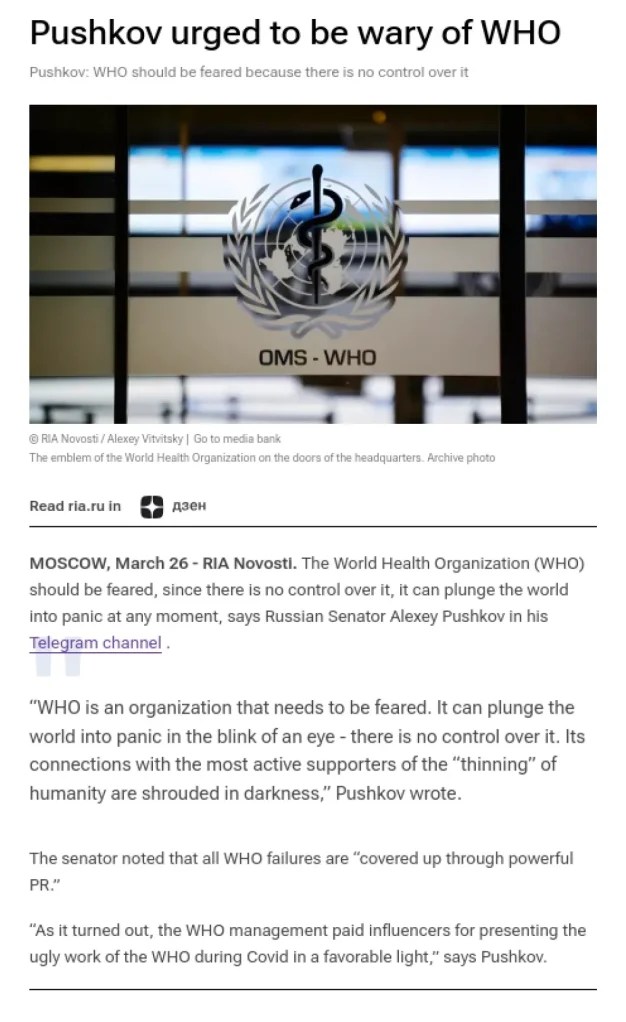
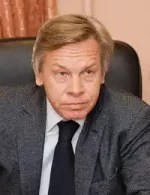 Russian Senator Aleksey Pushkov took to Telegram to complain about the WHO, and then RIA Novosti reported on it.
What is RIA Novosti ? “RIA Novosti is the most cited Russian news agency in the mass media and across social media.”
Who is Pushkov? Below is his bio; but important to note that he is also claimed to be a good friend of Vladimir Putin.
Aleksey Konstantinovich Pushkov, born 10 August 1954, is a Russian politician who has been Senator from Perm Krai since 29 September 2016. He is also a former Deputy of the State Duma and former head of the Foreign Affairs Committee in the State Duma, the lower house of the Russian Parliament. As a member of the United Russia political party in the federation council, he is the chairman of the Commission on Information Policy.
What did Pushkov say, and how was it reported? Here is what RIA reported in English:
Ukraine is ‘tip of the iceberg’ – Lavrov
RT March 29, 2024
The Ukraine conflict is only one part of a wider stand-off between Russia and the West, which seeks to contain Moscow at all costs, Foreign Minister Sergey Lavrov has said.
In an interview with Izvestia published on Friday, Lavrov stated that after the Western-backed coup in Kiev in 2014, the new Ukrainian authorities unleashed “a war… against their own people” in Donbass.
The hostilities, the minister said, were only stopped by the now-defunct Minsk agreements, which were designed to give the regions of Donetsk and Lugansk special status within the Ukrainian state.
The ensuing governments of both ex-Ukrainian President Pyotr Poroshenko and Vladimir Zelensky cracked down on the Russian language and culture, introducing stringent restrictions targeting its use in all aspects of life, according to Lavrov.
Moscow repeatedly urged Kiev’s backers in the West to condemn and halt the discriminatory policies, which also violate Ukraine’s constitution, but “not one of the Western countries that are now shielding Ukraine from all accusations has ever publicly condemned these absolutely illegal actions,” he insisted.
“The only explanation is that Ukraine is the tip of the iceberg. And that the declared goal of the West is to inflict a strategic defeat on Russia.”
Lavrov added that in practice this implies that those who do the West’s bidding when it comes to this mission, “are allowed to do anything, including direct support for… Nazism. It is sad”.
On Thursday, Russian President Vladimir Putin said that the Ukraine conflict could have been easily avoided if the West had taken Moscow’s security interests into account. However, those interests “were completely ignored” as NATO moved closer to Russia’s borders by incorporating Eastern European states and former Soviet republics, Putin added.
The Russian president has also repeatedly said that the main goals of Moscow’s military campaign in Ukraine are to “denazify” and “demilitarize” the neighboring state, as well as protecting the population of Donbass from Kiev’s attacks. The two Donbass republics, along with two other former Ukrainian regions, overwhelmingly voted to join Russia in the autumn of 2022.
Investigators establish link between Moscow terrorist attack suspects and Ukraine
RT | March 28, 2024
The suspects in last week’s Moscow terrorist attack were linked to Ukrainian nationalists, the Russian Investigative Committee stated on Thursday, citing preliminary findings. The perpetrators had received “significant sums of money” from Ukraine, the law enforcement agency said.
The investigators have obtained “substantiated evidence” that the suspected assailants received funding from Ukraine in the form of cryptocurrency, which was then used to prepare the terrorist attack, the statement read.
Law enforcement officers also identified and detained another suspect who was allegedly involved in financing the attack, the Investigative Committee said, without identifying the individual.
Earlier, the head of Russia’s Federal Security Service (FSB), Aleksandr Bortnikov, told reporters that the US, UK and Ukraine may have been behind the attack. The Ukrainians may have been preparing a “window” for them to cross back over the border, the official said. “On the other side, they were to be welcomed as heroes,” he added.
The four suspected perpetrators had previously been identified as radical Islamists, recruited through an online chat apparently operated by the Afghanistan-based offshoot of Islamic State (IS, formerly ISIS). However, the investigators said at that time that, despite the group’s claim of responsibility for the terrorist act, another party, such as a Ukrainian intelligence agency, may have been involved in the plot.
Last Friday, a group of men armed with assault rifles stormed the Crocus City Hall music venue in the Moscow suburb of Krasnogorsk, just before a concert by the rock band Picnic. The attack and a subsequent blaze started by the perpetrators claimed the lives of 140 people and injured some 200 others.
The assailants were apprehended hours after the attack in Russia’s Bryansk Region, which borders Ukraine.
Featured Video

Iran FM Araghchi: “Hormuz Will No Longer Be the Same”
or go to
Aletho News Archives – Video-Images
From the Archives
Sam Husseini: The entire US establishment helped lie their way into the Iraq war
By Slava Zilber | American Herald Tribune | October 14, 2019
Sam Husseini is a senior analyst with the Institute for Public Accuracy, independent journalist and contributor to The Nation and FAIR.
Slava Zilber: Sam, three years ago, you appeared on Talk Nation Radio with David Swanson and spoke about the case of the GCHQ whistleblower Katharine Gun. You pointed out that the people involved in the spying on the UN and the people authorizing the Iraq War were not held accountable:
“Virtually everybody who went along with the war, whether it is Kerry or Clinton, of course, the Bush administration themselves has falsified their own records in terms of why, what they did, when they did, why they did it, to the extent that they’ve been scrutinised at all.”
You also address it in a recent article. And recently, Joe Biden has been lying about his position on the Iraq War. How can such an important issue escape meaningful scrutiny? … continue
Blog Roll
 Aletho News
- Oman FM: Persian Gulf states, Iran, Iraq should form security pact excluding US
- Trump peddles fresh falsehoods, claims Iran ‘started the war’ as US aggression drags on
- Ukraine quagmire? Yes, but it’s for NATO, not Russia
- US intelligence hypes Chinese, Russian space threats while accelerating its own military buildup in orbit
- Iran FM Araghchi: “Hormuz Will No Longer Be the Same”
- EU facing trillion-euro debt hole while seeking more cash for Kiev
- How US, Europe, Persian Gulf states exhausted missile stockpiles, splurged billions to defend Israel
- Up in arms… Koreans reject U.S. empire’s plan to make South Korea the next Ukraine
- Iran, Turkey, Pakistan, Saudi Arabia could advance region-led security framework in Tehran: FM spox
- Netizens condemn Japanese drama for projecting Japan’s wartime atrocities onto Chinese characters
- If Americans Knew
- An error has occurred; the feed is probably down. Try again later.
- No Tricks Zone
- Sudden Stratospheric Warming, Powerful El Niño Combination May Lead To Extreme Europe Cold, Energy Crisis!
- Two New Studies Find Thwaites Glacier Melt Cannot Be Driven By Human Activity Or A Warming Ocean
- E-Cars Reduce CO2 Emissions By Only 41% Compared To Internal Combustion Engine Vehicles
- Predictions Made By Renowned Climate Professor Over Past Decades Have Been Proven To Be Poor
- New Study Suggests Large Regions Of The Pacific Ocean Have Been Cooling For The Last 80 Years
- Germany’s Green Energy Debacle: High Energy Costs Force Kahla Porzellan to Close After 182 Years!
- New Study: 50 Years Of The Most Aggressive ‘Net Zero’ Policies Can Only Affect The Global Climate By 0.03°C
- US September “Heat” Was No Record…Many Records Set Decades Ago
- Latest European Green Energy Debacle; Portugal’s Largest Flagship Solar Park Insolvent!
- Green Energy Debacle: German Expert Professor Fritz Vahrenholt Warns Of Severe Economic And Social Consequences

