Russia asks UN Security Council for ‘immediate’ ceasefire in Gaza, Israel
Press TV – October 15, 2023
Russia has asked the United Nations Security Council to vote Monday on a draft resolution that called for an “immediate” ceasefire in the Gaza Strip and Israel, blaming the United States for the unfolding situation in the Middle East.
On Saturday, Dmitry Polyanskiy, Russia’s Deputy UN Ambassador, said no changes had been made to the text since it was given to the council on Friday and that he expected the vote to be scheduled for 3 p.m. EDT (1900 GMT) on Monday.
Russian Ambassador to the United Nations Vassily Nebenzia presented the draft resolution which also demands the secure release of all hostages, and “strongly condemns all violence and hostilities directed against civilians and all acts of terrorism.”
The draft resolution, given to the 15-member council during a closed-door meeting on the situation in Gaza, also calls for humanitarian aid access and the safe evacuation of civilians in need.
“We’re convinced that the Security Council must act to put an end to the bloodshed and restart peace negotiations with a view to establishing a Palestinian state as it was supposed to do so long ago,” Nebenzia said on Friday.
He also blamed the United States for bearing “responsibility for the looming war in the Middle East,” and criticized European Commission head Ursula von der Leyen for “turning a blind eye to the Israeli air force attacks on civilian infrastructure in the Gaza Strip.”
According to Nebenzia, there were positive responses to the draft resolution among some member states.
Meanwhile, Chinese Ambassador to the UN Zhang Jun said that “there is an emerging consensus on the humanitarian concerns,” adding “We are open to all efforts which will help cease the fire, help de-escalate the tension.”
A UNSC resolution needs at least nine votes in favor and no vetoes by the US, Britain, France, China, or Russia. The United States has traditionally shielded its ally Israel from any Security Council action.
Palestinian resistance movement Hamas launched Operation Al-Aqsa Storm last Saturday, penetrating deep into the territories occupied by the Israel regime, by carrying out large-scale air, land, and sea strikes.
The operation was a reaction to the recurring desecration of the al-Aqsa Mosque in occupied al-Quds as well as intensified Israeli atrocities against Palestinians in the occupied West Bank.
Following the surprise operation, some 1,300 were killed and more than 3,400 wounded in Israel. Hundreds of others, including senior Israeli military officials, are held as war prisoners in Gaza.
Israel also responded with intensive air strikes on civilian targets in the Gaza Strip, killing at least 2,329 Palestinians in Gaza and wounding 9,714 others, according to the territory’s health ministry.
The regime has also laid a siege to Gaza, leaving the city, home to more than 2.3 million Palestinians, without water, electricity, and internet.
Tel Aviv is making preparations to launch a ground invasion of the Gaza Strip, after telling Palestinians living in the densely populated territory to move out of the area, something the UN had called “impossible.”
More than 420,000 people have been displaced within the Gaza Strip. A total of 270,374 out of 423,378 internally displaced people are now in UN shelters and schools while at least 15 hospitals have been damaged by Israeli shelling and airstrikes.
So far, several Western countries have refrained from calling for an outright ceasefire, claiming that Israel has “a right to defend itself” after the Hamas operation.
A strategic nightmare sneaks into Washington’s political agenda
Global Times | October 14, 2023
A simultaneous war with China and Russia is a strategic nightmare that sober American strategists such as Henry Kissinger have been warning the US to avoid at all costs, and it is also a topic that some US media outlets have become more and more fond of talking about in recent years. At least from the publicly available information, Washington has never previously addressed it as a formal political agenda, supposedly aware of its seriousness and the terrible risks it carries. But the publication of a report by a congressionally appointed bipartisan panel titled America’s Strategic Posture crossed this “red line” on October 12.
The central point of the 145-page report is that the US must expand its military power, particularly its “nuclear weapons modernization program,” in order to prepare for possible simultaneous wars with China and Russia. Notably, the report diverges completely from the current US national security strategy of winning one conflict while deterring another, and from the Biden administration’s current nuclear policy. It is not a fantasy among the American public, but a serious strategic assessment and recommendation in the service of policymaking.
The 12-member panel that wrote the report was hand-picked by the US Congress from major think tanks and retired defense, security officials and former lawmakers. This report makes us feel that a “strategic nightmare” is sneaking into the US political agenda, but has not drawn due concern and vigilance in Washington, and to a large extent, the American elite group represented by the panel is actively working to make this nightmare come true.
A look at the specific recommendations of this report will send shivers down the spine of those who retain any basic rationality. The report recommends that the US deploy more warheads, and produce more bombers, cruise missiles, ballistic missile submarines, non-strategic nuclear weapons and so on. It also calls on the US to deploy warheads on land-based intercontinental ballistic missiles (ICBMs) and to consider adding road-mobile ICBMs to its arsenal, establishing a third shipyard that can build nuclear-powered ships, etc.
What depths of insanity is the US sinking to? The US’ military spending accounts for nearly 40 percent of the world’s total defense expenditures, and it has been growing dramatically for several years, with military spending in 2023 reaching $813.3 billion, more than the GDP of most countries, but even that is not enough for these politicians. Such a report full of geopolitical fanaticism and war imagery, whether or not it actually ends up as a “guide” for Washington’s decision-making, is dangerous and needs to be resisted and opposed by all peace-loving countries.
According to some American media, the report ignores the consequences of a nuclear arms race. In fact, the report doesn’t seem to consider this at all and doesn’t suggest any measures other than nuclear expansion to address this issue. In other words, it is a reckless approach. Both China and Russia are nuclear powers, and everyone knows that provoking a confrontation between nuclear powers is a crazy idea. Even promoting a nuclear arms race under the banner of “deterrence” is a disastrous step backward in history. Washington’s political elites, who lived through the Cold War, cannot be unaware of this. However, the fact that such an absurd and off-key report is being presented in all seriousness by the US Congress is both surreal and unsurprising. It is in line with the distorted political atmosphere in Washington today.
The motives behind this exaggeration of threats and creating a warlike atmosphere are highly suspicious. The recent outbreak of the Israeli-Palestinian conflict caused a sharp increase in US defense industry stocks, while American defense industry companies have also been the biggest beneficiaries of the long-standing Russia-Ukraine conflict. The military-industrial complex, like a geopolitical monstrosity, parasitically clings to American society, manipulating its every move, pushing Washington step by step to introduce and even prepare for ideas that were once considered “impossible.” The prosperity of the American military-industrial complex is built upon blood and corpses, and carries a primal guilt. Serving the interests of the American military-industrial complex is unethical.
The reality is that such rhetoric is becoming increasingly politically acceptable in today’s Washington. The idea of “preparing for possible simultaneous wars with Russia and China,” once a fringe fantasy, has gradually made its way into Washington’s agenda, which is deeply unsettling. If Washington were to adopt even a small portion of the recommendations in this report, the harm and threats it could pose to world peace would be immeasurable and would ultimately backfire on the US itself. There is an old Chinese saying: “Those who play with fire will perish by it.” This is something that is worth Washington’s careful consideration.
Partnership with Russia in Hungary’s national interest – FM
RT | October 15, 2023
Budapest will stick to agreements with Russia in the energy sphere despite Ukraine-related sanctions and pressure from EU peers, Hungarian Foreign Minister Peter Szijjarto told RT on Friday, on the sidelines of the annual Russian Energy Week forum. The official stressed that his country will always put its national interests first and that energy cooperation with Russia is among its key priorities in this regard.
“Our national interest is to definitely have reliable, mutually respectful cooperation with Russia. Without Russian energy we would not be able to guarantee the safe supply of energy for our country,” he stated, adding that, for Hungary, the supply of energy “is not a political issue or an ideological issue, but a physical one.”
The official noted that his country is in constant contact with Moscow “to make sure our cooperation continues according to our existing contracts.” Hungary continues to buy Russian gas under the 15-year contract with energy major Gazprom signed in 2021, which provides for the supply of 4.5 billion cubic meters of natural gas annually. The country is also buying Russian oil via pipelines that run through Croatia and Ukraine, having secured an exemption from the sanctions imposed by Brussels on Russian crude oil imports last year.
Another large part of Russian-Hungarian cooperation is the work on new reactors for Hungary’s Paks-2 nuclear power plant under a contract with Russia’s Rosatom. According to Szijjarto, the construction process has already started.
“The cut-off walls are now under construction – that gives us hope that by the beginning of the next decade we will be able to connect the two new blocks to the grid, which will increase the nuclear capacity from 2,000 megawatts to 4,400 megawatts,” he said, adding that the project will make Hungary’s power production “more competitive, safer and more environmentally-friendly.”
Szijjarto conceded that the project faced much pressure, especially with the EU continuously pitching the Russian nuclear industry as a potential candidate for sanctions. However, according to the foreign minister the EU is unlikely to go through with these threats.
“We made it very clear that we will not agree to any sanctions package which will include the nuclear industry… because for us it would be totally against our national interests if the nuclear industry was under sanctions. And since the US has bought 416 tons of uranium from Russia during the first half of this year, I think no real arguments are there for the EU to put the Russian nuclear industry under sanctions… that would be a huge hypocrisy.”
Szijjarto reiterated previous statements that the West’s anti-Russia sanctions policy has failed, and urged the collective EU to help Russia and Ukraine bring the conflict to an end instead of heaping more punitive measures on Moscow.
“The EU is struggling when it comes to economy and when it comes to competitiveness, it’s obvious – there are figures – China has already overtaken us when it comes to share of global GDP. So, the EU should make the decisions in order to improve competitiveness… and sanctions [against Russia] have contributed to the loss of competitiveness, for sure… Instead of imposing sanctions and delivering weapons, we should start discussions about peace,” he stated, warning that circumstances for peace talks will become less favorable as time passes by.
US must prepare for war with China and Russia – Congress
RT | October 13, 2023
Washington needs to urgently update and expand both its nuclear arsenal and the conventional military in order to face the combined might of Moscow and Beijing, the congressional Strategic Posture Commission argued in its final report published on Thursday.
“The United States and its allies must be ready to deter and defeat both adversaries simultaneously,” the commission said. “The US-led international order and the values it upholds are at risk from the Chinese and Russian authoritarian regimes.”
While the commission has not identified any specific evidence of Russia and China working together, “we worry… there may be ultimate coordination between them in some way, which gets us to this two-war construct,” a senior official involved in the report told Reuters, on condition of anonymity. The current US national security strategy calls for defeating one major adversary while deterring another.
The commission argued that the combined threat from China and Russia will become acute as early as 2027 so “decisions need to be made now in order for the nation to be prepared.” The 131 findings and 81 recommendations in the report amount to the need for massive expansion of both the conventional armed forces and the Nuclear Triad.
The report demands more of the B-21 stealth bombers and Columbia-class ballistic missile submarines. The B-21 is still in development and is expected to enter service by 2027 at the earliest. The first two Columbia-class subs are under construction and are expected in 2030. The US Navy has planned to order 12, to replace the 18 Ohio-class boats currently in service.
“Amid all of the Commission’s recommendations to increase the number of strategic and tactical nuclear systems, there is almost no mention of cost in the entire report,” which “does not seem to acknowledge any limits to defense spending,” the Federation of American Scientists (FAS) has said in response.
At a press event announcing the report, the commission’s vice-chair, retired Republican Senator Jon Kyl, argued that higher military spending is a small price to “hopefully preclude” a possible nuclear war and that President Joe Biden and Congress need to “take the case to the American people” to spend more money.
According to FAS, however, the commission’s recommendations are “likely to exacerbate the arms race, further constrict the window for engaging with Russia and China on arms control, and redirect funding away from more proximate priorities.”
The only reason the commission did not argue for an immediate expansion of the US nuclear stockpile “is that the weapons production complex currently does not have the capacity to do so,” FAS noted, adding that there is no need for a nuclear arms race so long as the US has enough submarines to present a credible deterrent to a first strike by an adversary.
MEPs call for change of EU policy on Ukraine
RT | October 12, 2023
Ukrainian lives are being sacrificed by the “totally corrupt” elite in Kiev to which the EU recklessly sends billions of euros, several members of the European Parliament said at an event on Wednesday hosted by the think-tank Voice of Europe.
“We must stop this tragicomedy for Europe, for Ukraine and for Russia. We must try to find a path to prosperity again, and the first step is peace,” MEP Thierry Mariani of the French National Rally (RN) party argued at the roundtable, held in the central hall of the European Parliament in Brussels.
“Ukraine must remain a bridge” between Russia and Europe, Mariani added. He also pointed out that the current conflict has roots in 2013, when the EU tried to push Kiev to renounce a free trade deal with Russia and sign the Association Agreement with Brussels. This led to the Maidan demonstrations and the February 2014 coup.
Maximilian Kra of the Alternative for Germany (AfD) said he had traveled around Ukraine, describing it as “a beautiful country with very decent people.”
“I’m afraid that these decent people of Ukraine are now being sacrificed for the interests of the Kiev elite,” who own millions in real estate in southern France, Kra said. He also voiced fears that the US may ask the EU to foot the bill for the Ukraine conflict, now that Washington’s attention has been preoccupied by Israel.
“That’s what I’m afraid of. And I can tell you that this is already happening. Because Germany has already promised $1 billion to Ukraine, while the US will allocate only $200 million,” he said.
Marcel de Graaff of the Dutch Forum for Democracy (FvD) argued that Ukraine needs to make peace with Russia as soon as possible.
“I speak very directly because they have already lost. They are now sacrificing people up to 70 years old at the front. They no longer have reserves. They are losing right now,” said de Graaf.
He also described Ukraine as “the most corrupt country in the world,” now being given “tens of billions of euros” by the West. “I heard that [Ukrainian President Vladimir] Zelensky’s mother-in-law bought a villa in Egypt for several million dollars, and we are still wondering where our money is going. This is a totally corrupt civilization,” de Graaf added.
One major problem, according to the Dutch MEP, is that all trust has been lost between Russia and the West after the revelations by former German and French leaders that the Minsk Agreements were a ploy to buy Kiev time to prepare for war.
Kra brought up that Ukrainian opposition leader Viktor Medvedchuk had presented the German Bundestag a “smart” peace plan based on Minsk II, a proposal that would have seen the rebel republics of Donetsk and Lugansk rejoin Ukraine with broad autonomy.
“At the time, no one knew that Minsk II was a fake, as Merkel later stated,” Kra added, referring to former Chancellor Angela Merkel’s December 2022 admission.
Henri Malos, president of Voice of Europe and host of the roundtable, also lamented the demise of the Minsk Agreements, which he said offered security and sovereignty for both Russia and Ukraine.
Peculiarities of Russian television reporting on the Hamas-Israeli war
By Gilbert Doctorow | October 11, 2023
A couple of days ago, I mentioned how Russian state television news was providing viewers with information about aspects of the ongoing armed conflict between Hamas and Israeli armed forces that you would not find in Western media during the first days of reporting. In particular, it was immediately evident from the news briefings on Vesti that Russian emphasis was on the military side rather than on the humanitarian catastrophe side.
BBC, Euronews, CNN have all focused attention on the slaughtered Israeli citizens and the apparent savagery of the Hamas fighters including today’s revelations about the hundred or more men, women and children who were killed in a Hamas raid on a kibbutz in the South of Israel. Russian news from day one showed pictures of the latest generation Israeli tank destroyed by a grenade dropped by a drone and of Hamas fighters approaching Israeli shores from the sea on paragliders. On two successive Evening with Vladimir Solovyov shows, images of the destruction to Israel’s billion dollar wall around Gaza and similar engineering feats by the insurgents as they moved deep into Israel proper. Solovyov’s panelists also provided expert analysis of the military threats Israel faces from the neighborhood if the war in Gaza escalates.
Why is this difference in what is reported important? Because coverage of the slaughter of civilians by Hamas fighters and interviews with relatives of those taken captive to Gaza as hostages plays into the hands of the Hamas strategists: it places enormous pressure on Israeli Prime Minister Netanyahu to proceed with a land invasion of Gaza which will result in many thousands of deaths among Israeli Defense Force soldiers as well as deaths of civilians in Gaza that may be an order of magnitude higher. The violence of an Israeli invasion may be so shocking as to justify outside Palestinian forces, namely Hezbollah in Lebanon and Arab fighters in Syria, in Iraq, in Yemen to send contingents of armed men to join the battle on the side of Hamas in Gaza.
The Western reporting has provided a wealth of material for those who would denounce the Hamas fighters as “sub-human.” However, considering the great sophistication of the Hamas methods to overcome Israeli technical devices at the border and the wall itself intended to prevent such a raid from the enclave, considering the 5,000 or more missiles sent by Hamas into Israel that overwhelmed the “Iron Dome” Israeli defenses, it is unreasonable to speak of the executions and hostage taking as spontaneous or expressions of raw anger by Arab youths. No, it had to be planned in advance and handed over to disciplined fighters for implementation with a certain military objective in mind: namely to provoke the Israeli government and draw it into the lair of urban, guerilla warfare in Gaza.
A couple of days ago, in my geopolitical analysis of the conflict, I mentioned that the dispatch of a U.S. naval force led by the aircraft carrier Gerald Ford to the waters adjacent to Israel was likely intended to intimidate Iran and possibly to prepare for an American attack on Iran under accusations that Teheran had aided and guided the Hamas attack. However, the Biden administration has now stated clearly that it has no evidence Iran was involved in preparing the Hamas action. This confirms what the supreme religious leader of Iran said yesterday in a public speech, namely that the Palestinians themselves are fiercely independent and that they alone prepared the assault on Israel. He insisted that in the West people under-appreciate the skills and determination of Palestinians. It is only individual American politicians like would-be Republican candidate for the presidency Nikki Haley and the ever saber rattling Republican Senator Lindsey Graham who are calling for Iran to be attacked now.
Based on the information about the military capabilities of pro-Hamas forces in the neighborhood aired on the Solovyov show last night by first quality Russian experts, it is far more likely that the United States military presence is intended for use against Hezbollah in Lebanon than against Iran. This organization is now said to be the strongest pro-Palestinian force in the region with tens of thousands of fighters, with advanced military equipment including perhaps one hundred thousand missiles ready for use against Israel at any time. Israel’s last incursion into Lebanon to crush Hezbollah in 2006 ran into serious difficulties when enemy strength surprised them. Some fifty Israeli tanks were said to have been destroyed then. There is no question that Hezbollah has become more powerful since. Its war hardened forces received battlefield experience very relevant to the present Hamas-Israel conflict when they fought in the civil war in Syria.
One of the Russian experts who spoke at length about the situation in Israel on Sunday night was Yevgeny Satanovsky, who is a professor attached to two centers of Near East studies in Moscow. He appeared in the past on Russian television talk shows when the subject was Russian-Turkish relations but his core specialty is in fact Israeli politics and the economy. It was difficult to follow Satanovsky’s remarks in detail because he was speaking as if to academic friends over a cup of coffee and there was a lot of jargon. But his appraisal of the Israeli military’s degraded state was clear enough. The deplorable discipline within their army compounded the initial problems from the intelligence failures of Mossad. The common denominator both in intelligence and in military command was hubris, undeserved self-confidence, lulled by technological superiority over the enemy. But just as Hamas outfoxed Israeli intelligence by returning to 19th century methods of communications, couriers and face to face meetings in place of electronic means that Israel can intercept, so fairly rudimentary bulldozers were sufficient to break through the Israeli wall and a combination of firearms and drones neutralized the sensors and cameras protecting Israel from Gaza raids.
Said Satanovsky, the Israeli military has suffered an additional debilitating flaw, namely the succession of second quality generals who rose to the premiership of Israel over the past thirty years and the politicization of military ranks. He blamed in particular the 2005 decision by then prime minister Ariel Sharon to withdraw all Israeli presence from inside Gaza and to secure the enclave from its perimeter.
For those who want to know more about who Satanovsky is, he has a large entry in the Russian language edition of Wikipedia. Suffice it here to say that he calls himself an atheist as well as a “Russian Jew,” and for several years at the start of the new millennium he helped to create the Russian Jewish Congress and served as its president for three years. He has a teaching affiliation with the International Center of University Instruction on Jewish Civilization in the Jewish University of Jerusalem.
I mention this aspect of the man’s past and present because it brings us to the special relationship that Russia has with Israel. More than one million Soviet and Russian Federation Jews emigrated to Israel. These included people from every walk of life, including some scandalously wealthy crooks who evaded Russian justice for crimes including murder and are not extradited. Since the start of the Special Military Operation, their numbers have risen with the arrival in Israel of Russia’s ‘fifth column’ personalities in the entertainment industry, in finance, in government. With the Hamas attack some of those, like the billionaire banker Mikhail Fridman, took the first plane out of Israel for Moscow this past Sunday, as reported in a feature article of The Financial Times. The scoundrel who assisted Yeltsin’s fraudulent election in 1996 and then stayed on in power to enrich himself, serving in a succession of high positions, Anatoly Chubais, also slithered out of Israel the same day, but not to Moscow, where he would face arrest. Their compatriots in Russia snigger over the cowardice and selfishness of these high visibility characters.
Of course the vast majority of Russian settlers in Israel are normal, hard working folks and it is they to whom the Vesti journalists turn now for first-hand accounts of the impact of the Hamas attack. They can be doctors receiving the wounded at hospitals or officials in the mayor’s office of one or another Israeli city. You will not see them on CNN.
On the other side of the coin, Russia has and needs excellent relations with the Arab world. Fifteen per cent of the Russian population is Muslim, with their cultural and religious center in Kazan, some 860 km southeast of Moscow, in a wealthy oil-producing region. Chechnya is also a Muslim center in the Russian Federation and its leader Ramzan Kadyrov is well known in the Middle East. More to the point, Russia is a highly valuable partner of Saudi Arabia in Opec+ in which they jointly set production targets and price targets for the global oil industry. And Russia has close relations with the United Arab Emirates, particularly financial arrangements. The UAE dirham is now used as a currency for settling import-export transactions by Russia. Of course, Russia is closely aligned with Iran as a fellow member of the Shanghai Cooperation Organization and, as from 1 January 2024, BRICS. The close ties to Syria need no explanation, since Russia singlehandedly saved the government of Bashar Assad from the radical fundamentalist fighters that Washington was arming. The closeness of Russian ties with Iraq was in full evidence yesterday during the state visit of the Iraqi prime minister to Moscow. Russian companies Lukoil, Gazpromneft and others have already invested $16 billion in production assets in Iraq.
The official position with respect to the war now raging between Israel and Hamas was stated yesterday on television by President Putin: it can be solved only with implementation of the UN resolution on creation of a fully sovereign Palestine state, i.e. the “two state solution” that has been so long discussed but never brought to fruition. However, what will follow the creation of such a state is equally important and remains terra incognita: which world powers will guarantee the security of these two states?
©Gilbert Doctorow, 2023
Putin’s Valdai Speech, What You Need to Know
By Ted Snider | The Libertarian Institute | October 12, 2023
On October 5, Russian President Vladimir Putin addressed the plenary session of the Valdai International Discussion Club near Sochi, Russia. The session was attended by scholars and diplomats from forty-two countries. Putin spoke for half an hour and then answered questions for about three hours. Several interesting things were said.
In western discourse it is always said that Russia started an unprovoked war in Ukraine. There has been much discussion—though not in the mainstream media nor in statements issued by western governments—about whether the war was unprovoked. But there has been little discussion about whether Russia started it.
Putin claimed that Russia’s “special military operation” did not start the war in Ukraine but, rather, was designed to stop it. “I have said many times that it was not us who started the so-called ‘war in Ukraine,’” Putin said. “On the contrary, we are trying to end it.”
The war started, according to Putin, when the United States “orchestrated a coup in Kiev in 2014.” Putin said that the U.S. “provoked the Ukraine crisis by supporting the coup in Ukraine in 2014. They could not fail to understand that this was a red line, we have said this a thousand times. They never listened.”
After the coup, the new government in Kiev “intimidate[d]” the ethnic Russian populations of Crimea and the Donbas, prohibited them from speaking “their native language,” and threatened them “with ethnic cleansing.” It was Kiev, and not Russia, “who tried to force Donbass to obey by shelling and bombing.” The new government in Kiev bombed the region “for nine years, shooting and using tanks. That was a war, a real war unleashed against Donbass.”
The war started, not a year and a half ago, according to Putin’s chronology. Instead, “This war, the one that the regime sitting in Kiev started with the vigorous and direct support from the West, has been going on for more than nine years, and Russia’s special military operation is aimed at stopping it.”
With the end of the Cold War, there was a window of opportunity to learn from the mistakes of the previous destructive era. There was an opportunity to move from “military and ideological” blocs to collective solutions. First Mikhail Gorbachev’s Soviet Union, and then Russia, sought a new international order that transcended blocs. Putin even recalled “a moment when I simply suggested: perhaps we should also join NATO?”
But Putin says that Russia’s “interest in constructive interaction was misunderstood, was seen as obedience, as an agreement that the new world order would be created by those who declared themselves the winners in the Cold War. It was seen as an admission that Russia was ready to follow in others’ wake and not to be guided by our own national interests but by somebody else’s interests.”
American “arrogance” attempted to establish a global “hegemony” over a world “too complicated and diverse to be subjected to one system.” This arrogance led to two things. The first was “endless expansion” by the political West. “NATO expansion has been pursued for decades.”
Putin reminded his audience that Russia was “promised verbally” about NATO “non-expansion to the east.” He then complained, “Yes, we were promised everything verbally, and our American partners do not deny this, and then they ask: where is this documented? There is no document. And that was it, goodbye. Did we promise? It looks like we did, but it was worth nothing.”
Eventually, this broken promise led to NATO expansion creeping up to Ukraine and right up against Russia’s borders. “Among the ways the crisis in Ukraine was provoked,” Putin said, “was the irrepressible desire of Western countries, especially the United States, to expand NATO to the borders of the Russian Federation.”
“After all,” Putin pointed out, NATO “is not only a political bloc, it is a military and political bloc, and the approach of its infrastructure is fraught with a grave threat to us.” He then added, “NATO’s expansion right up to our borders is threatening our security. This is a massive challenge to the Russian Federation’s security.”
To attain its hegemonic goal, it was necessary for the United States to “to replace international law with a “rules-based order.” But unlike the international law of the charter international system that is based on the United Nations, “It is not clear what rules these are and who invented them.” In the service of Americna hegemony, the U.S. “arbitrarily set[s] these rules.”
In a recent essay, professor of international law John Dugard has said that it is neither clear what the rules of the rules-based order are nor “the method for their creation,” and has offered as a possible explanation of the rules based order that it is “international law as interpreted by the United States to accord with its national interests,” meaning whatever the U.S. needs it to mean in any given situation. He suggests that the United States tries “to impose the concept of a rules-based world order on the international community. They use this banner to promote, without any hesitation, a unipolar model of the world order where there are ‘exceptional’ countries and everyone else who must obey the ‘club of the chosen.’”
In this world order, the United States not only tells other nations how they “should behave overall” in a “colonial mentality,” but there exists “an international system where arbitrariness reigns, where all decision-making is up to those who think they are exceptional, sinless and right [and] any country can be attacked simply because it is disliked by a hegemon.”
Putin says that Russia sees a future multipolar world order in which “no one can unilaterally force or compel others to live or behave as a hegemon pleases even when it contradicts the sovereignty, genuine interests, traditions, or customs of peoples and countries.” Russia sees “civilization [as] a multifaceted concept subject to various interpretations.” The world has evolved from the “colonial interpretation whereby there was a ‘civilized world’ serving as a model for the rest, and everyone was supposed to conform to those standards. Those who disagreed were to be coerced into this ‘civilization’ by the truncheon of the ‘enlightened’ master. These times, as I said, are now in the past, and our understanding of civilisation is quite different.”
Putin argued, as he has consistently, for the principle of the indivisibility of security, the idea that security cannot be divided so that the policies that increase the security of one country decrease the security of another. Indivisibility of security assures that the security of one state should not be bought at the expense of the security of another.
The American insistence on the right of states to unrestrained free will in their choice of security alignments and the accompanying NATO open door policy to Ukraine ignores the indivisibility of security. Putin said, “The main thing is to free international relations from the bloc approach and the legacy of the colonial era and the Cold War. We have been saying for decades that security is indivisible, and that it is impossible to ensure the security of some at the expense of the security of others.”
Putin said he thinks that suggestions of “a new security system in Europe, which would include Russia, and the United States, and Canada; but not NATO, but together with everyone else: for Eastern and Central Europe… would solve many of today’s problems.”
It is often said in the West that Putin seeks to reestablish a Russian empire and reacquire vast territories, starting with Ukraine. Putin, though, says in contradiction to those claims, “The Ukraine crisis is not a territorial conflict, and I want to make that clear… [W]e have no interest in conquering additional territory.” He insisted, “This is not a territorial conflict and not an attempt to establish regional geopolitical balance. The issue is much broader and more fundamental and is about the principles underlying the new international order.”
Those principles are a balanced multipolar world, indivisibility of security, an end to blocs and to NATO encroachment and protection of ethnic Russians in the Donbass and Crimea.
During the question and answer period, political scientist Sergei Karaganov suggested that the current Russian nuclear doctrine is no longer taken seriously by the West as a deterrent. He asked whether it was not time to modify the nuclear doctrine and lower the threshold.
Often portrayed in the West as a nuclear weapons sabre rattler, Putin tamped down the question, answering, “I do not see the need to change our conceptual approaches. The potential adversary knows everything and is aware of what we are capable of.”
Putin explained Russia’s existing nuclear doctrine. He said there are two situations that could trigger a “possible use of nuclear weapons by Russia.” The first is that “the use of nuclear weapons against us… would entail a so-called retaliatory strike.” The second situation is “an existential threat to the Russian state—even if conventional weapons are used against Russia, but the very existence of Russia as a state is threatened.”
Putin insisted that Russia does not need to change its stance. In the case of the first scenario, “this response will be absolutely unacceptable for any potential aggressor, because seconds after we detect the launch of missiles… the counter strike in response will involve hundreds—hundreds of our missiles in the air, so that no enemy will have a chance to survive.” As for the second, important as an insight into how Putin evaluates the situation in Ukraine, “There is no situation imaginable today where something would threaten Russian statehood and the existence of the Russian state.”
However, Putin said that nuclear testing is “a whole different matter.” He says that, after signing the Comprehensive Test Ban Treaty, the United States never ratified it. Russia, on the other hand, both signed it and ratified it. He told his audience that the development of new strategic weapons—including the nuclear-powered Burevestnik cruise missile with “basically unlimited range” and the super heavy Sarmat missile—is “nearing completion.” He then said that Russia can “act just as the United States does” and “offer a tit-for-tat response,” suggesting that Russia could repeal the Comprehensive Test Ban Treaty and begin testing new weapons.
In response to the question of whether Russia objected to Ukraine joining the European Union, Putin responded that Russia had “never objected or expressed a negative attitude to Ukraine’s plans to join the European economic community—never.” He said that Russia opposes Ukraine joining NATO because NATO is a “military bloc” and a “tool of U.S. foreign policy.” But “the EU is not a military bloc,” and, as for “economic cooperation, or economic unions, we do not see any military threat.”
US Provides Data of Syrian, Russian Military’s Movement to Jihadists – Russian Intel Head
Sputnik – 12.10.2023
MOSCOW – The United States is providing jihadists with data on the places of dislocation and movement routes of the Syrian and Russian military in Syria, Russian Foreign Intelligence Service (SVR) Director Sergei Naryshkin said on Thursday.
“Work is underway to destabilize the situation, including through the capabilities of ISIS [Islamic State, a terrorist group banned in Russia]. Information about places of dislocation and movement routes of the Syrian army and Russian military is being transmitted to the jihadists,” Naryshkin was quoted as saying by the SVR.
US President Joe Biden’s administration is aimed at disrupting the emerging positive dynamics around and inside Syria, Naryshkin added.
Russia fully supports establishment of Palestinian state: Putin
Press TV – October 11, 2023
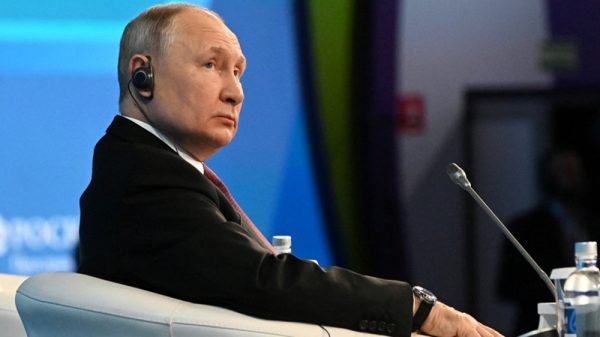
Russian President Vladimir Putin says Moscow has always fully supported the establishment of a Palestinian state, as the Israeli regime is ceaselessly pounding the besieged Gaza Strip with barrages of missile attacks.
Speaking at the plenary session of the Russian Energy Week on Wednesday, Putin stressed that his country has always supported the implementation of the United Nations Security Council’s decision on the establishment of an independent Palestinian state.
“We have always supported the implementation of the decisions of the UN Security Council, I mean, first of all, the creation of an independent Palestinian state,” the Russian leader emphasized.
Putin’s remarks came as Israel has been launching deadly strikes on the densely-populated Gaza Strip since Saturday after the Palestinian Hamas resistance group waged a surprise attack, dubbed Operation Al-Aqsa Storm, against the usurping entity.
Hamas says that its operation came in response to Israel’s violations at al-Aqsa Mosque in occupied East al-Quds and growing settler violence.
Elsewhere in his remarks, Putin called the eruption of violence between Israel and the Palestinians a vivid example of the failure of US policy in the Middle East.
He stressed that Washington’s policy in the region has taken no account of the needs of the Palestinians as the White House tried to focus on financial assistance, rather than finding solutions to existing fundamental political challenges.
“It is unclear whether it will be possible to somehow calm the situation in the near future, but we must strive for this because the expansion of the conflict zone can lead to dire consequences,” Putin said.
The Russian president also denounced as a mistake the Washington’s move of sending a carrier strike group, which includes the USS Gerald R. Ford, closer to Israel.
“I don’t understand why the US is dragging aircraft carrier groups into the Mediterranean Sea. I don’t really understand the point. Are they going to bomb Lebanon or what? Or have they decided to try to scare someone? There are people there who are no longer afraid of anything. This is not the way to solve the problem. Compromise solutions need to be looked for. Of course, such actions are inflaming the situation,” Putin said.
More than a thousand people have been killed and thousands more have been injured in nearly five days of Israeli airstrikes on Gaza, a besieged territory on the Mediterranean which is home to some 2.3 million people despite its relatively small land area.
The Caucasus and West Asia are joined at the hips
BY M. K. BHADRAKUMAR | INDIAN PUNCHLINE | OCTOBER 10, 2023
Frozen conflicts can only be understood through history. That is why the ‘erasure’ of Nagorno-Karabakh from the map by Azerbaijan is an incredibly tumultuous development for Transcaucasia and its surrounding regions.
The backdrop is the breakup of the Soviet Union, which left us with a rather odd map. Consequently, conflicts in Georgia, Armenia, Azerbaijan, Moldova, Ukraine and others left us with de facto boundaries that are unrecognised in law. There is an imperative need for a peace treaty that reflects the new facts on the ground.
At issue is the status of Nakhchivan, which still remains the landlocked exclave of Azerbaijan located near the Turkish border. Azerbaijan, emboldened by its annexation of Nagorno-Karabakh last month, is on the lookout for a direct land link to Nakhchivan, which Baku regards as unfinished business.
To attain this audacious objective, Azerbaijan — once again, with Turkey’s support — hopes to seize control of a hefty slice of Armenia’s territory, which is also that country’s borderland with Iran to the south. Unsurprisingly, both Yerevan and Tehran oppose any such move, which would otherwise mean that Armenia and Iran cease to be neighbours and get encircled by the Azeri-Turkish strategic axis.
Through dialogue and negotiations a mutually acceptable formula must be found for any land link — known as “Zangezur Corridor” — guaranteed under international law, which preserves Armenia’s territorial integrity and its border with Iran, even while providing Baku with free access to Nakhchivan.
What complicates matters is the geopolitics, involving the 3 immediate stakeholders — Armenia, Azerbaijan and Iran — and two other regional states — Russia, Turkey — as well as certain intrusive extra-regional powers and entities — the United States, European Union and NATO.
While Russia and Iran are also stakeholders, the same cannot be said for the extra-regional powers and entities who are meddling in a highly competitive regional environment. The “butterfly effect” of the Zangezur Corridor will be profoundly consequential to the Black Sea and Caspian regions and could impact the Middle East and Central Asia as well.
Among the regional states, Iran stands out for its anti-revisionist approach. During separate meetings last Wednesday in Tehran with visiting Armenian and Azerbaijani officials, Iranian President Ebrahim Raeisi reiterated amid persisting tensions over the Karabakh region Iran’s opposition to the opening of the Zangezur Corridor, saying Tehran is against geopolitical changes in the region.
Raesi reportedly stated that the Zangezur corridor would be “a NATO foothold, a national security threat for countries, and is thus resolutely opposed by Iran,” as his political chief of staff Mohammad Jamshidi put it. Tehran cannot but factor in that Israel has a strong intelligence presence in Azerbaijan.
Speculation is rife that Azerbaijan might use force to open the Zangezur Corridor, Iran’s opposition notwithstanding. Turkey, the region’s number one revisionist power is a mentor and ally of Azerbaijan with whom it claims ethnic affinities. Turkey harbours grand visions of expanding its economic reach and political influence through a land route that extends from its European border in Eastern Thrace to the Caspian Sea and over to its ancestral lands of Central Asia that border China.
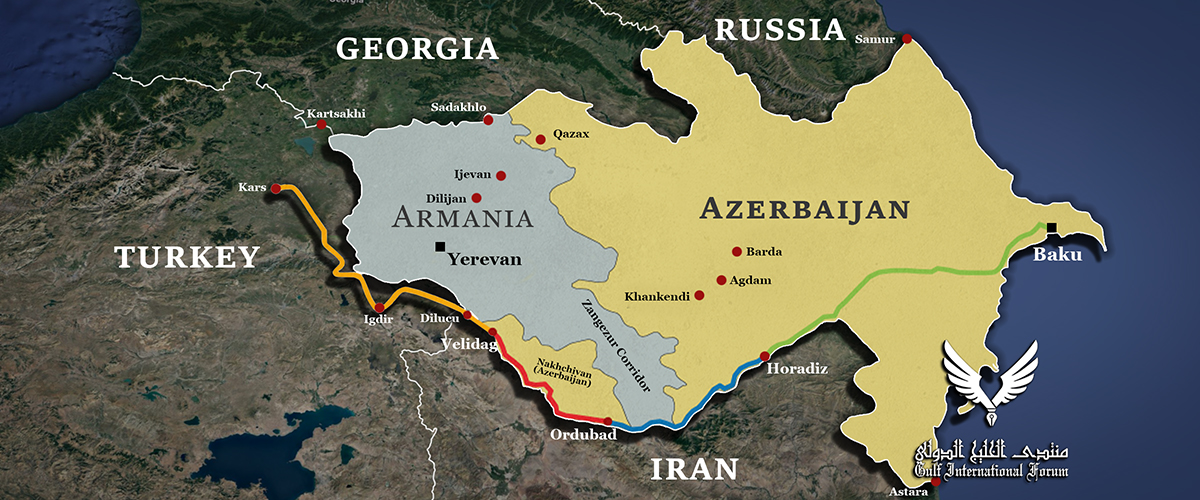
Suffice to say, the Zangezur Corridor will make Turkey a strategic hub in the geopolitics of the region if the Silk Road to Europe passes through its territory and the Soviet era land route to Russia reopens. Russia has separately promised to make Turkey an energy hub for export of its gas as well.
Much to Iran’s discomfiture, Turkey is exploiting Moscow’s dependence on Ankara in the conditions under western sanctions and the Ukraine conflict — Turkey controls the straits leading to the Black Sea from the Mediterranean— to muscle its way into the Caucasus and the Caspian, which has been traditionally Russia’s sphere of influence.
Meanwhile, Russia’s influence in the Caucasus suffered a setback as Armenia’s gradual drift toward Western benefactors following the colour revolution and regime change in Yerevan in 2018 has dramatically accelerated lately and taken an overt form. The Western powers are encouraging Armenia’s current leadership to leave the CSTO and seek the closure of the Russian bases on its soil where 5000 troops are garrisoned.
However, Armenia cannot do without Russia’s help. And Russia has strategic reserves to play itself back into the centre stage of the Caucasian chessboard. Of course, an optimal Russian comeback in the Caucasus will have to wait for its victory over the US and NATO in Ukraine, possibly by next year. Thus, Moscow seems confident that its pre-eminence in the Caucasus is a given.
Russia’s trump card, ultimately, is that much as the US and/or EU may try to get a toehold in the Caucasus, they are faraway powers and pretty much exhausted today with economic anxieties and growing war fatigue in Ukraine, amidst signs of disunity within the EU itself.
Indeed, a summit gathering close to 50 European leaders, dozens of aides and legions of journalists in Grenada, Spain, on October 5, which was billed as an opportunity to broker peace between Armenia and Azerbaijan, ended as a damp squib when Azerbaijan’s Ilham Aliyev and Turkey’s Tayyip Erdogan decided to skip the gathering and Azerbaijan accused France of bias in negotiations.
The bottom line is that in the power dynamic in the Caucasus, Iran is Russia’s natural ally and the two regional powers can be a factor of regional security and stability. This is important, since all sorts of dangers are lurking in the shade in the geopolitics of the Black Sea and Eastern mediterranean and Central Asia, and the darkening horizon presages storms ahead.
To flag a few ominous signs, the US has seized Israel’s escalating confrontation with Hamas and Hezbollah to resort to a major show of force in the Eastern Mediterranean — as if it is preordained. Such force projection cannot be an end in itself. Can it be coincidental that US-trained jihadi groups are also stirring up the Syrian pot lately?
Again, last week, a series of Ukrainian attacks in the Black Sea with Western-supplied cruise missiles forced Russian vessels to relocate from their main base in Sevastopol to the port of Novorossiisk 300 km to the east. British Defence Minister James Heappey promptly called it the “functional defeat of the Black Sea Fleet.”
Moscow is now reportedly planning to build a permanent naval base on the Black Sea coast in the breakaway Georgian region of Abkhazia.
Only a week ago, Russian Foreign Minister Sergey Lavrov warned that Moscow is alarmed by “the attempts of extra-regional players to become more active in the Afghan direction.”
Make no mistake, the US has not reconciled to the ascendance of Russian and Chinese influence in the Middle East or the Iran-Saudi rapprochement that led to an overall easing of tensions, especially Syria’s normalisation with its Arab neighbours, all of which which has drained America’s regional influence and weakened Israel.
Equally, with the spectre of a humiliating defeat in Ukraine haunting the Biden Administration, the temptation must be there to assert American hegemony. A confrontation with Iran is just what may suit Washington as ramp to cover its retreat from Ukraine’s battlefields.
Fundamentally, the US strategy is to get Russia bogged down on multiple fronts and prevent it from advancing Syria’s stabilisation optimally or consolidate its alliances with North African states — Egypt, Libya and Algeria — and expand its presence in the Sahel region which effectively thwarts NATO’s expansion plans in Africa.
Similarly, Iran’s surge as regional power has been to the detriment of Israel’s regional supremacy. Success of the US-Israeli strategy depends on piling pressure on Iran and Hezbollah, who were game changers in the Syrian conflict, and eroding the Russian-Iranian axis in West Asia, the Caucasus and the Caspian.
Armenia’s defection from the Russian orbit and the conflict situation currently developing in Gaza (and Lebanon) provide a window of opportunity to challenge Russia and Iran in the Levant. A vast armada of US warships is approaching the Eastern Mediterranean to intimidate Iran.
Meanwhile, the US hopes to undermine Saudi Arabia’s normalisation process with Iran and create contradictions within BRICS and OPEC Plus.
In sum, like in the famous play by the German modernist playwright Bertolt Brecht, The Caucasian Chalk Circle, we are currently witnessing a play within a play in the great game in Transcaucasia — an extraordinary blend of high theatricality, folk storytelling, music and even dialectical inquiry.
Featured Video

Chinese jet fuel and the myth of energy independence
or go to
Aletho News Archives – Video-Images
From the Archives
The Dirty Little Secret behind the “Global Terrorism Index”
The Omission of Israeli Terrorism in the Occupied Palestinian Territories
By Karin Brothers | Global Research | December 6, 2014
… The Israeli settlements — all of which are illegal – have been identified as a major impediment to peace. The refusal of a major “global” terrorism report to name the Israeli settlers as one of the groups most responsible for terrorism not only misrepresents a major source of regional violence but exposes the Global Terrorism Index as a propaganda tool that supports a U.S. agenda.
In recent years, governments have been attempting to thwart terrorism by blocking supportive fund-raising. When it comes to Israeli settlements, however, the US and Canada actually encourage fund-raising by giving organizations (such as Christian Friends of Israeli Communities (CFOIC) and the Jewish National Fund) financial support in the form of donor tax-deductions.
Charities which provide funds for the Israeli settlements should be regarded as terror-financing organizations. They should not only lose their tax-deductible status, but they should be banned because they support the violation of international humanitarian law. The terror-financing laws that are being strictly enforced for Muslim charities should be applied to Christian and Jewish charities as well. … Read full article
Blog Roll
 Aletho News
- Chinese jet fuel and the myth of energy independence
- Ukraine Sea Drone Fired From Libya Hit Russian Tanker in Mediterranean
- IRGC: Iranian forces launched no attacks during ceasefire hours
- Trump Administration Moves To Automate U.S. Military Draft Registration
- Spain orders reopening of Tehran embassy, condemns Israel’s carpet bombing of Lebanon
- Israel faces ‘unsustainable’ strategic crisis following 40-day war against Iran: Analyst
- Iran restricts Hormuz access to 15 vessels per day under ceasefire terms: Report
- The ‘Opposition Party’ Has Done Nothing to Stop the Iran War and Much to Goad Trump Into Continuing It
- Moscow backs Tehran on status of Lebanon in US-Iran deal
- How UK Regulator Ofcom Quietly Bypassed International Law to Police American Speech
- If Americans Knew
- Amnesty: Urgent – Protect Lebanese civilians from brutal escalation in Israeli attacks
- Is The War Against Iran Over?
- Inside the Israeli army’s propaganda wing
- Hundreds of Gaza Amputees Stranded in Legal Limbo
- The gallows law: Israel moves toward executing Palestinian children
- Tucker Carlson: The Path to Peace requires ending ‘special alliance’ with Israel
- This is ceasefire? Israel’s biggest massacre yet in Lebanon, another journalist killed in Gaza – Daily Update
- Tucker Carlson on Israel: This Is the Behavior of an Ally? Really?
- Gazans face a triple crisis: severe shortages of water and bread, healthcare in tatters
- NY Times reports how Netanyahu took the US into Iran War
- No Tricks Zone
- An Inconvenient Tree: Uncovered In Alps… Europe Much Warmer Than Today 6000 Years Ago
- New Study Reports A 60% Slowdown In Greenland’s Ice Loss Rate In The Last Decade
- Low Intensity Tornado Wrecks Major Solar Farm, Creating A Potential Toxic Dump
- New Study Finds Warming Saves Lives…Cold Temperatures 12 Times More Deadly Than Excess Heat
- German Science Blog Accuses PIK Climate Institute Of Hallucinating Climate Tipping Points
- Devastating Assessment Of Comirnaty Vaccine By Former Senior Pfizer Europe Toxicologist
- New Study: CO2 Is ‘Effectively Negligible’ As An Explanatory Climate Change Factor Since 2000
- Former Pfizer Toxicologist Dr. Helmut Sterz Tells Bundestag Hearing Pfizer Vaccine Should Have Never Been Approved
- Energy Expert: Germany’s Nuclear Phaseout Was A “500 Billion Euro Mistake”
- New Research: South Australia’s Mid-Holocene Sea Surface Temperatures Were 4°C Warmer Than Today
 Aletho News